



Abstract
Urban sensing systems increasingly rely on vibration—acoustic and kinetic signals that move through bodies, buildings, and terrain—to detect and respond to activity. Platforms such as gunshot-detection arrays in US cities, seismic sensors along the southern border, and piezoelectric monitoring systems in elder-care settings convert conditions shaped by segregation, migration control, and demographic precarity into problems of signal detection and rapid response. This article examines that vibrational regime through a close analysis of ShotSpotter, the most widespread urban acoustic-detection platform in the United States. It traces ShotSpotter’s seismological lineage in Cold War sensing infrastructures, its operational life in Chicago, and the temporal form it produces through realtime detection. The article then turns to Mendi + Keith Obadike’s Free/Phase: Node 1 Beacon to develop a counter-practice grounded in historical memory and collective listening. Together, these cases show how vibration organizes contemporary urban governance by structuring what can be registered and acted on, while alternative sonic practices sustain other relations to place, history, and shared experience. The article argues that any recalibration of these systems requires confronting their imperial lineage and developing forms of sensing that remain accountable to the conditions they engage.
Intro: Vibrational governance
A fall inside an apartment, a gun firing on a city block, the slow approach of a family toward the US-Mexico border: each event releases mechanical waves that course through floors, walls, soil, and air.1–3 A human ear registers only a narrow fraction of this activity. Pressure changes shift the eardrum, set cochlear fluid in motion, and bend clusters of hair cells that encode a limited band of vibrations—roughly 20 Hz to 20 kHz—into neural signals. Most of the motion in these scenes lies outside human perception. Surveillance and monitoring systems register far more. Piezoelectric elements pick up stress in walls and floors. Geophones sense shear waves moving through the ground. Acoustic arrays record fast transients as they scatter across urban surfaces. Digital circuits turn these signals into samples, filter noise, and use timing differences to infer location or classify an event.
Architectural computing now builds on this broadened sensorium. It captures bodily tremors as well as structural and ground vibrations and turns them into data for governing streets, borders, and homes. ShotSpotter converts brief shock waves into geospatial truth claims about gunfire. 4 Along the border, Customs and Border Protection’s Unattended Ground Sensors—military-grade seismic devices—register human movement and activate cameras, radar feeds, and mobile biometric units.5,6 In elder-care facilities and private homes, platforms such as UC San Diego’s I-Care place piezoelectric discs under nightstands, beds, and bathroom fixtures to track everyday touch—getting out of bed, reaching for medication, bracing against a counter—and the jolt of a fall. 7 These signals feed dashboards that sort routine movement from disruption and risk.
Across these environments, vibrational sensing extends habits built into American surveillance infrastructures. Cold War command systems and post-9/11 policing left a dense field of practices that read racialized neighborhoods as threat zones, treat people on the move as bodies to intercept, and frame older residents as logistical challenges. Marketed as tools of safety or support, these systems respond to conditions shaped by imperial policy, economic abandonment, and demographic pressure. They do not address these forces. They recast them as signals to be detected and acted upon, turning political problems into computational events.
This article argues that vibrational sensing has become a mode of governance in which architecture, computation, and empire converge. The aim is not to catalog every contemporary use of vibration but to show how these systems operate through a shared material and epistemic logic. ShotSpotter serves as the central case. Its three-decade trajectory—from Cold War seismology labs to hundreds of square miles of acoustic coverage in Chicago—reveals the technical, political, and temporal forms that structure this regime. The article then turns to Mendi + Keith Obadike’s Free/Phase: Node 1 Beacon, which develops an urban vibrational imagination grounded in relation and historical memory. Their work models a way of listening that resists the routines of technocratic management.
This argument sits within a field of scholarship that links imperial power, military practice, and urban technology.8–13 Research on militarized urbanism shows how wartime methods settle into civic infrastructures. Stephen Graham traces how techniques forged in colonial and counterinsurgency environments shape policing and circulation in Western cities. 8 Ersela Kripa and Stephen Mueller document how military training routines and informal enforcement practices drift into everyday urban space. 14 Work on racialized technologies exposes the classificatory work embedded in these systems: Simone Browne tracks how contemporary sensors extend the surveillance logics of slavery and colonial rule; Ruha Benjamin shows how algorithmic systems reproduce structural inequity under claims of neutrality.15,16 At the scale of empire, Laleh Khalili maps logistical infrastructures—pipelines, ports, convoy routes, and data systems—that coordinate extraction and labor control across large territories. 17 My own work on realtime urbanism builds on this field by treating computation as an imperial infrastructure shaped by these same forces.18,19 This article extends that approach and identifies vibration as one of the media through which this militarized governance operates.
Foregrounding vibration makes these systems visible in new ways. Vibrational capture ties racialized policing, border sensing, and fall-detection regimes to a shared chain that moves a signal from detection to computation to action. It also reveals their limits: these platforms reach further than they can understand, perform unevenly across sites, and routinely misread the conditions they reduce to data. By placing vibration at the center, the article shows both the consolidating power and the structural misrecognitions that define contemporary architectural computing. Studying these vibrational regimes places architectural computing within a geopolitical field marked by unequal exposure and uneven authority. In the near term, the discipline must confront how these systems mistake political and economic pressures for technical issues and translate them into matters of signal detection. In the longer term, it must reckon with the imperial infrastructures built into realtime computation—systems shaped by US military operations abroad and police programs at home that determine how movement is sensed and regulated. The article contributes to this special issue’s call for “rebalance and reciprocity” by arguing that any meaningful recalibration requires addressing this legacy directly and cultivating forms of computational practice accountable to the worlds they shape rather than the logics they inherit.
Vibrational environments
Shortly after midnight in Chicago’s West Garfield Park, an impulsive acoustic transient reaches a sensor fixed to a rooftop. The signal jumps across a wireless mesh and arrives at SoundThinking’s Incident Review Center in Newark, California (Figure 1). There, technicians parse the waveform’s rise time, spectral distribution, and reverberant decay against a library of impulsive signatures. If the profile matches the criteria for gunfire, the system injects a coordinate into Chicago’s Strategic Decision Support Centers. The alert appears within the city’s broader matrix of policing technologies—license-plate readers, camera feeds, predictive grids—and officers in nearby beats see the point on their in-car terminals.
2
This workflow has become routine: capture vibration, classify its pattern, circulate a geospatial event, dispatch (Figure 2).
20
ShotSpotter incident review center, California. Image: ShotSpotter Inc. ShotSpotter diagram. Image: ShotSpotter Inc.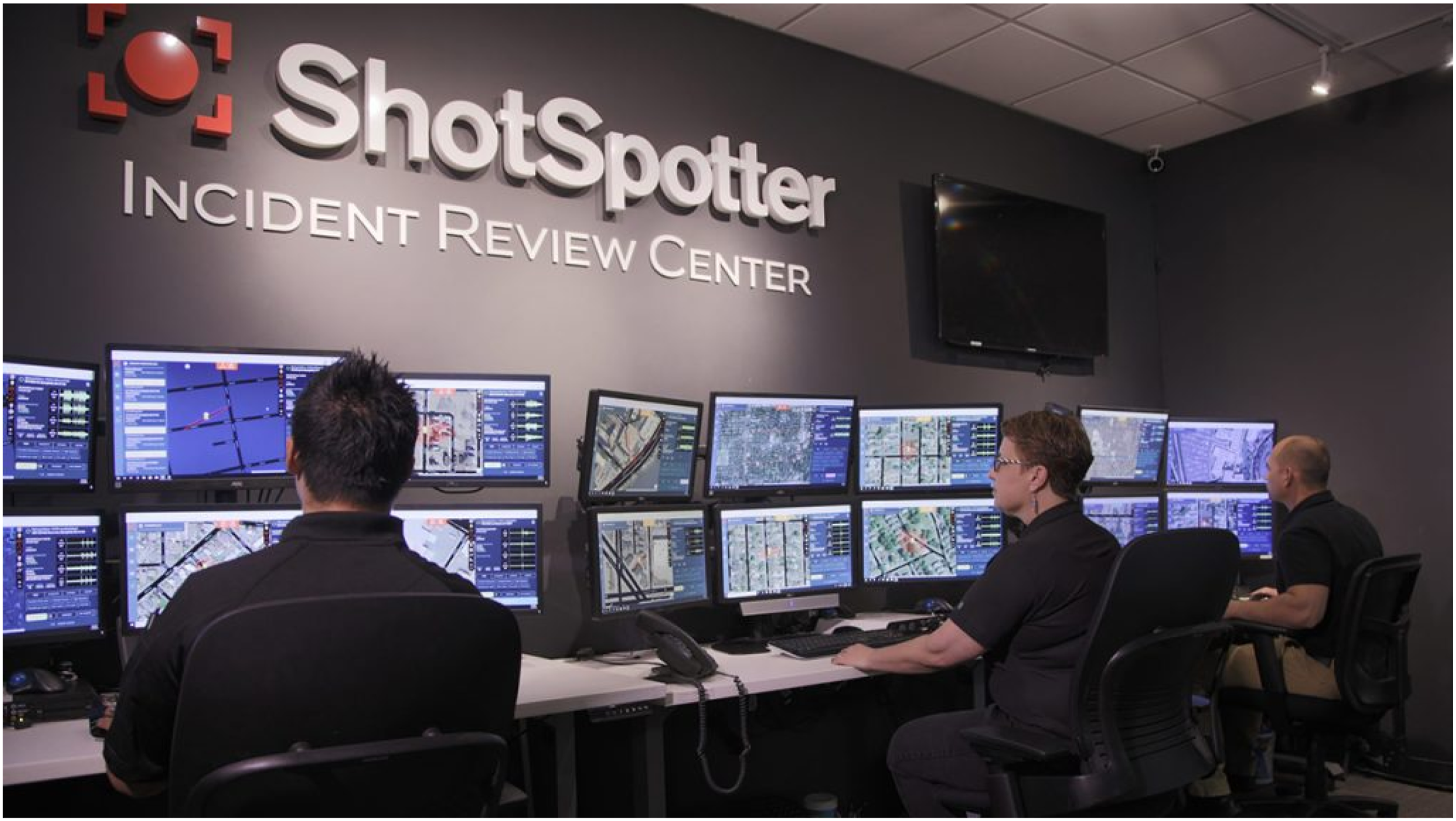
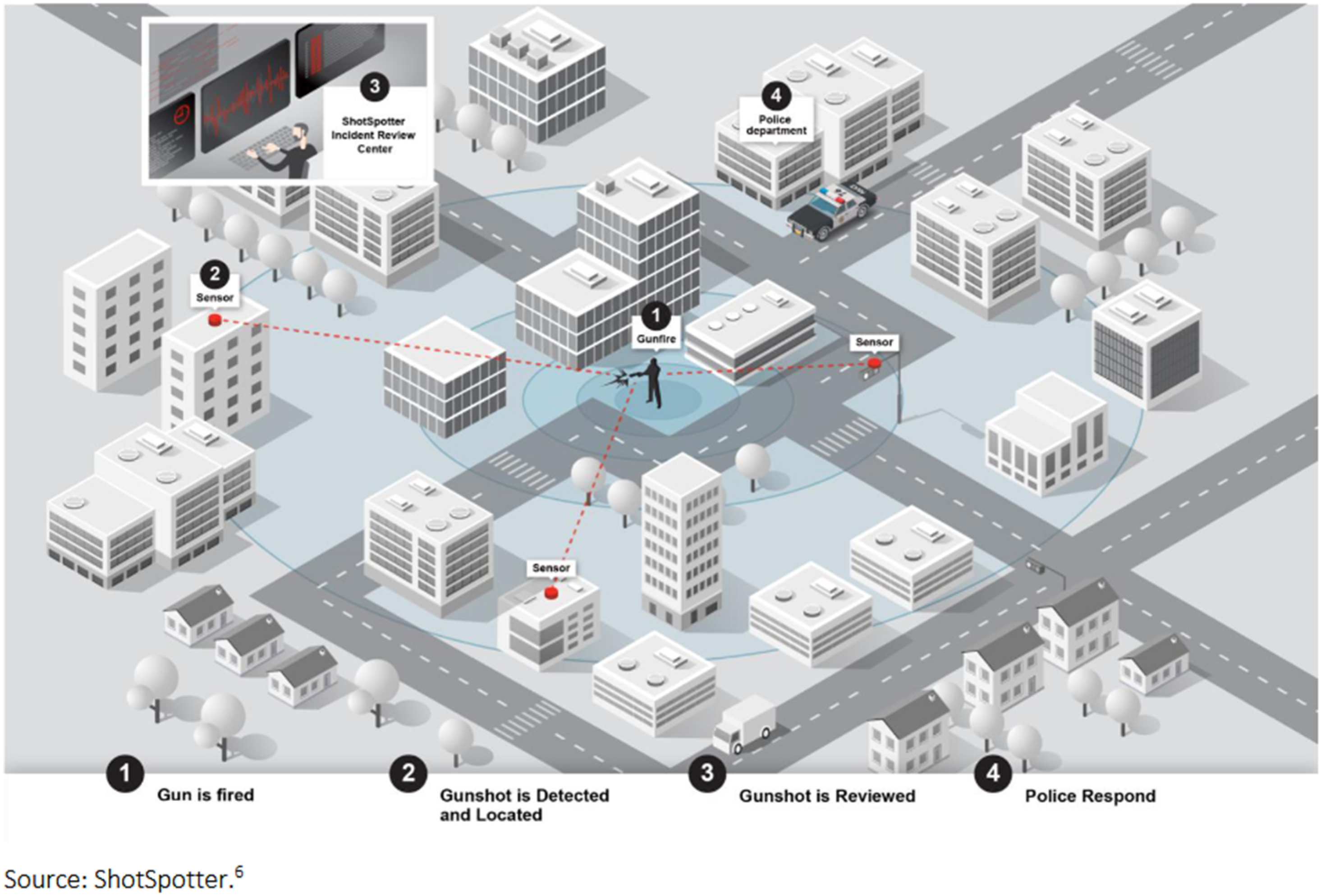
Chicago shows how this architecture governs in practice. More than one hundred square miles of the city sit under acoustic surveillance, concentrated in neighborhoods long shaped by segregation, municipal neglect, and aggressive policing (Figure 3). The system issues thousands of alerts annually, yet Chicago’s Inspector General found that roughly 90% of ShotSpotter-initiated deployments yield no corroborating evidence—no shell casings, no property damage, no victim, no eyewitness.
2
In one widely publicized homicide case, prosecutors abandoned the ShotSpotter alert after the company’s post-processing reassigned the source location.21–23 Investigations have documented alerts triggered by fireworks, echoes, and mechanical noise. These occurrences reveal a structural pattern: the system saturates racialized neighborhoods with signals translated into events while producing limited investigative or safety outcomes.
24
ShotSpotter equipment overlooks the intersection of South Stony Island avenue and East 63rd street in Chicago. Photograph by Charles Rex Arbogast/AP, accessed via OPB.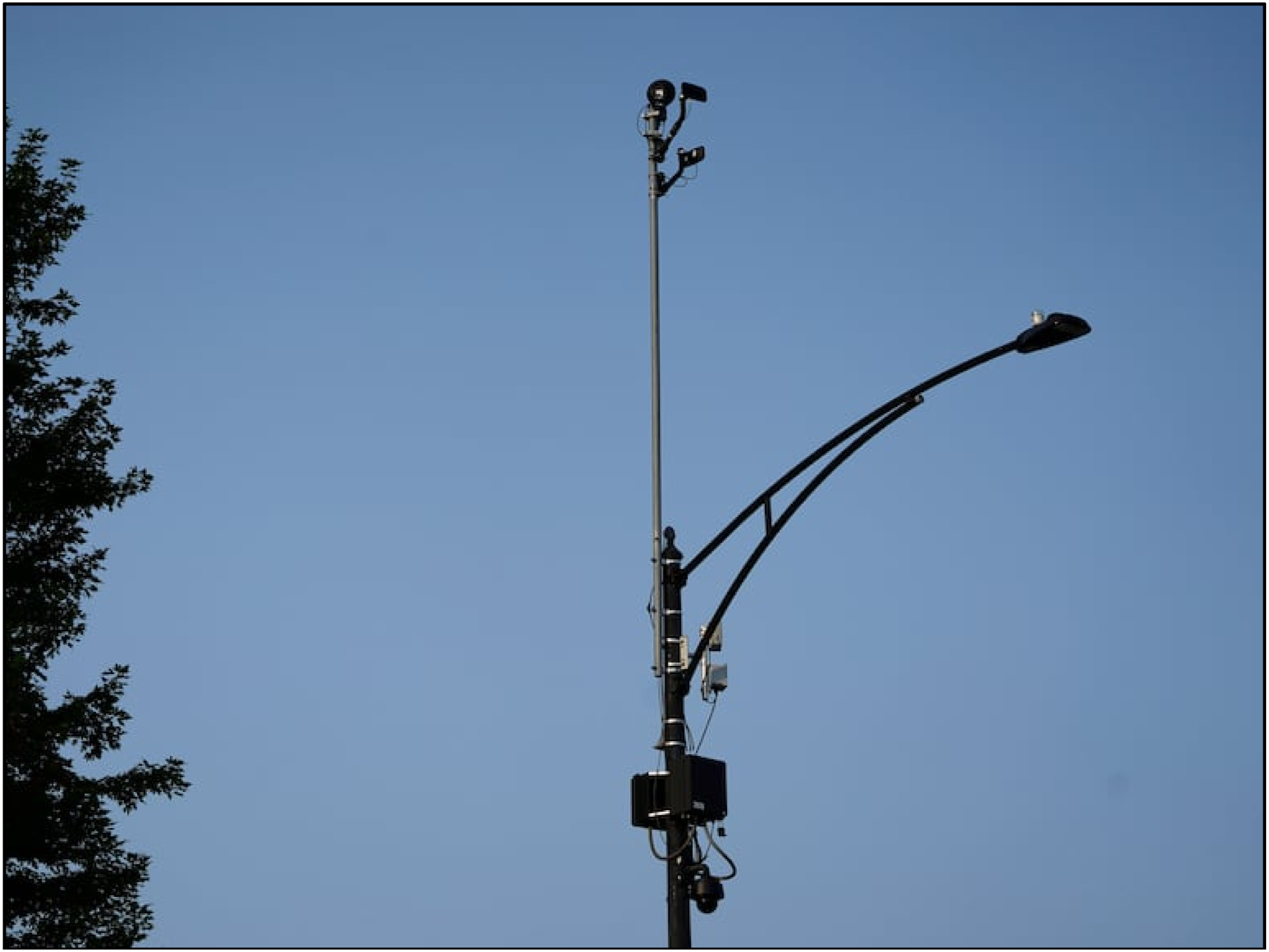
The company’s promotional materials continue to insist on “life-saving intelligence” and “critical seconds matter.” 20 Police executives and company representatives regularly emphasize that the system detects gunfire residents do not report, a claim repeated in media coverage and corporate outreach. The most comprehensive independent evaluation—the 2024 National Institute of Justice study comparing Chicago and Kansas City—reported no reduction in gun violence, no improvement in case clearance, and, in Chicago, a statistically higher incidence of shootings in treated beats. 25 ShotSpotter identifies acoustic impulses with technical clarity but does not alter the structural conditions that produce violence. 25
The durability of this pattern requires returning to the system’s technical origin. ShotSpotter’s architecture descends from seismic array science developed during the Cold War. Robert Showen, a physicist and electrical engineer at SRI International in Menlo Park, in the heart of Silicon Valley, helped shape the platform’s core methods.
26
SRI, originally the Stanford Research Institute, was one of the major defense-research institutions of the era, involved in global surveillance technologies, signal-processing systems, and environmental-monitoring tools funded through military and intelligence contracts.27,28 Showen’s 1997 patent, Automatic real-time gunshot locator and display system, describes a network of widely spaced acoustic sensors mounted on rooftops and utility poles (Figure 4).
29
The system triggers on impulsive sounds, measures their arrival-times across a small set of sensors, and uses those differences to triangulate the source. When a confirming signal arrives from a fourth sensor, the location is fixed and plotted on a digital map for police dispatch. The patent directly cites earlier seismological research, making clear that the methods behind gunshot localization—timing wavefronts, comparing arrivals, and locating an impulsive source—derive from techniques originally developed to detect earthquakes and underground nuclear tests. Sheets from Robert L. Showen and Jason W. Dunham, “Automatic Real-Time Gunshot Locator and Display System,” US Patent No. 5,973,998, filed August 1, 1997, issued October 26, 1999. Source: US Patent and Trademark Office, accessed via Google Patents.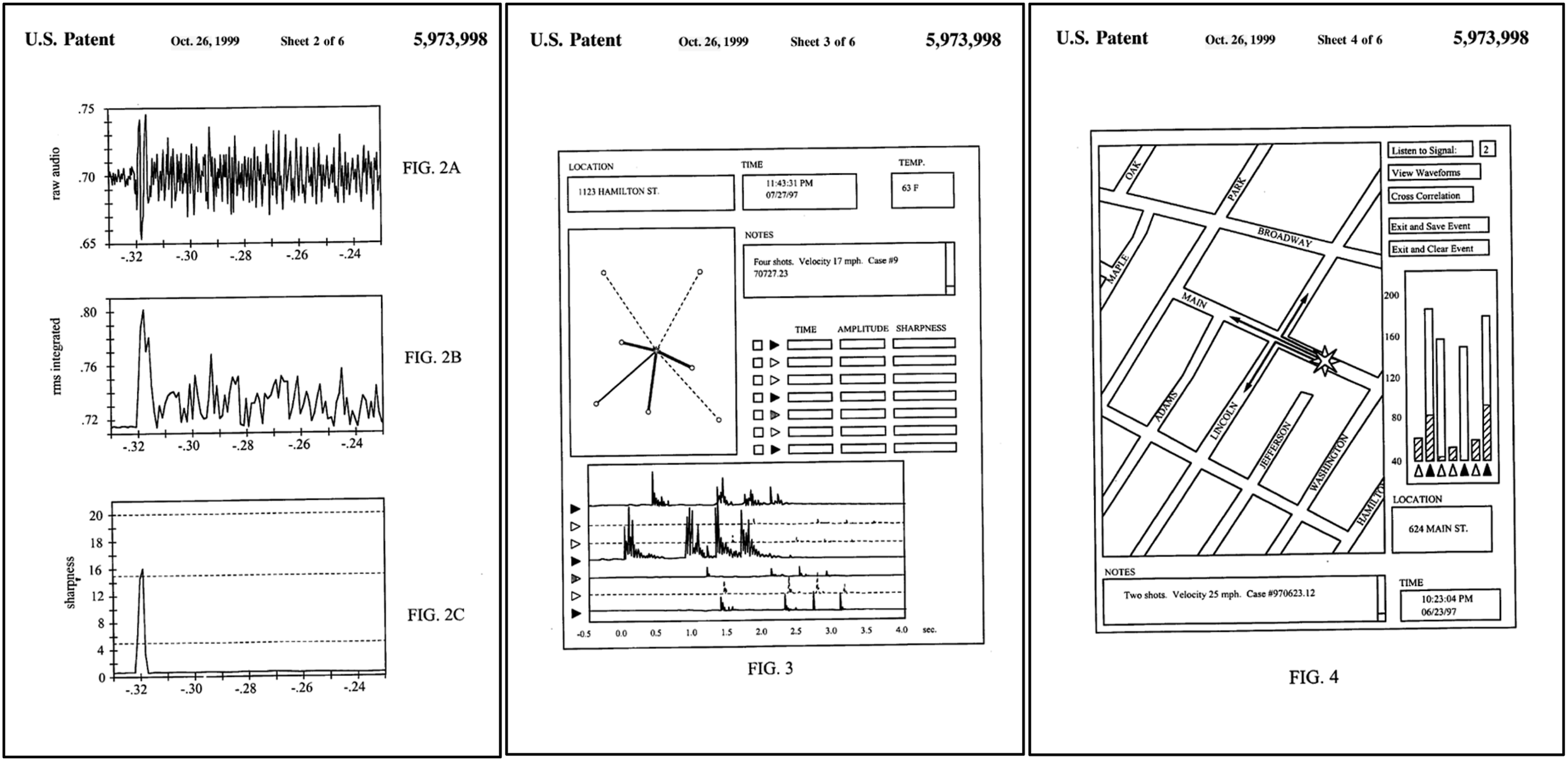
This migration of seismic techniques into urban policing sits within a longer history of US sensing infrastructures. Beginning in the early 1960s, the US government built global seismograph networks—first the World-Wide Standardized Seismograph Network, later the Global Seismographic Network—to record earthquakes and, crucially, to improve detection of underground nuclear tests.30,31 These systems established a standardized grammar for distributed sensing: radio-synchronized clocks, spatially dispersed but identically instrumented stations, and centralized analysis of differential wavefront arrivals.32,33 They formed a geopolitical infrastructure for perceiving events across vast territories within a Cold War regime of strategic oversight. 34 ShotSpotter inherits this architecture. The platform internalizes a sensor regime developed for outward-facing surveillance and applies it to domestic neighborhoods governed through racialized notions of disorder. Vibration becomes not an index of global threat but a commodity of urban administration, priced and sold by the square mile to municipalities.
In the mid-1990s, the first sustained community deployment of gunshot detection sensors occurred in Redwood City, not Chicago. A few miles north of Menlo Park, where Showen worked, the city was predominantly white and middle-class. The trial zone, however—Redwood Village—was a compact, largely Hispanic neighborhood near industrial corridors and Highway 101. 35 Newspaper reports described a recurring pattern of celebratory gunfire on New Year’s Eve, Independence Day, and Cinco de Mayo, with residents discovering bullets lodged in porch railings and roof shingles.36,37 The area’s long periods of quiet punctuated by predictable bursts of gunfire made it suitable for controlled trials.
At the time, Showen left SRI to form Trilon Technology and partnered with the US Geological Survey’s Menlo Park office to adapt seismic methods to gunshot detection. The USGS’s 1996 fact sheet, Earthquake Technology Fights Crime, documents this early collaboration (Figure 5). Gunfire was framed as an “impulsive event” analogous to a microseismic signal: acoustic waves propagating through air could be treated like seismic waves moving through the ground. Programs originally built to locate earthquakes were modified to track the high-frequency signatures of gunshots. In the Redwood City trials, microphones mounted on rooftops and utility poles radioed signals to a central PC running earthquake-location software. Suburban features—stucco façades, wooden eaves, tight lot lines, and low-rise roofs—became the architectural substrate for the experiment. The built environment effectively served as a laboratory for repurposing seismic science into a policing technology. The migration of seismic event detection into policing. This US Geological Survey fact sheet casts gunfire as a locatable urban event, translating earthquake-monitoring methods into an acoustic system for realtime police response. Source: John C. Lahr, Peter L. Ward, Peter H. Stauffer, and James W. Hendley II, “Earthquake Technology Fights Crime,” US Geological Survey Fact Sheet 096–96, 1996.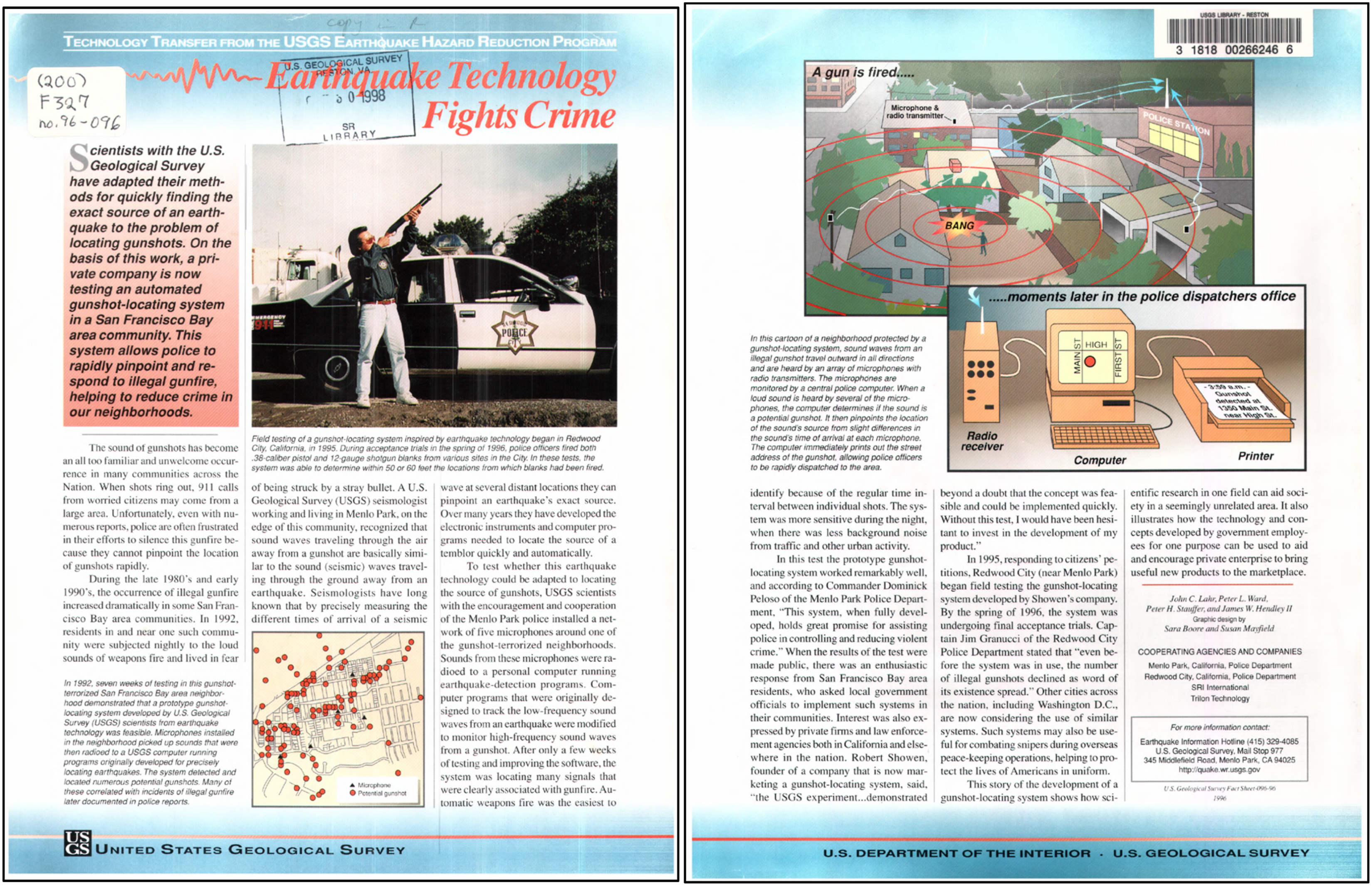
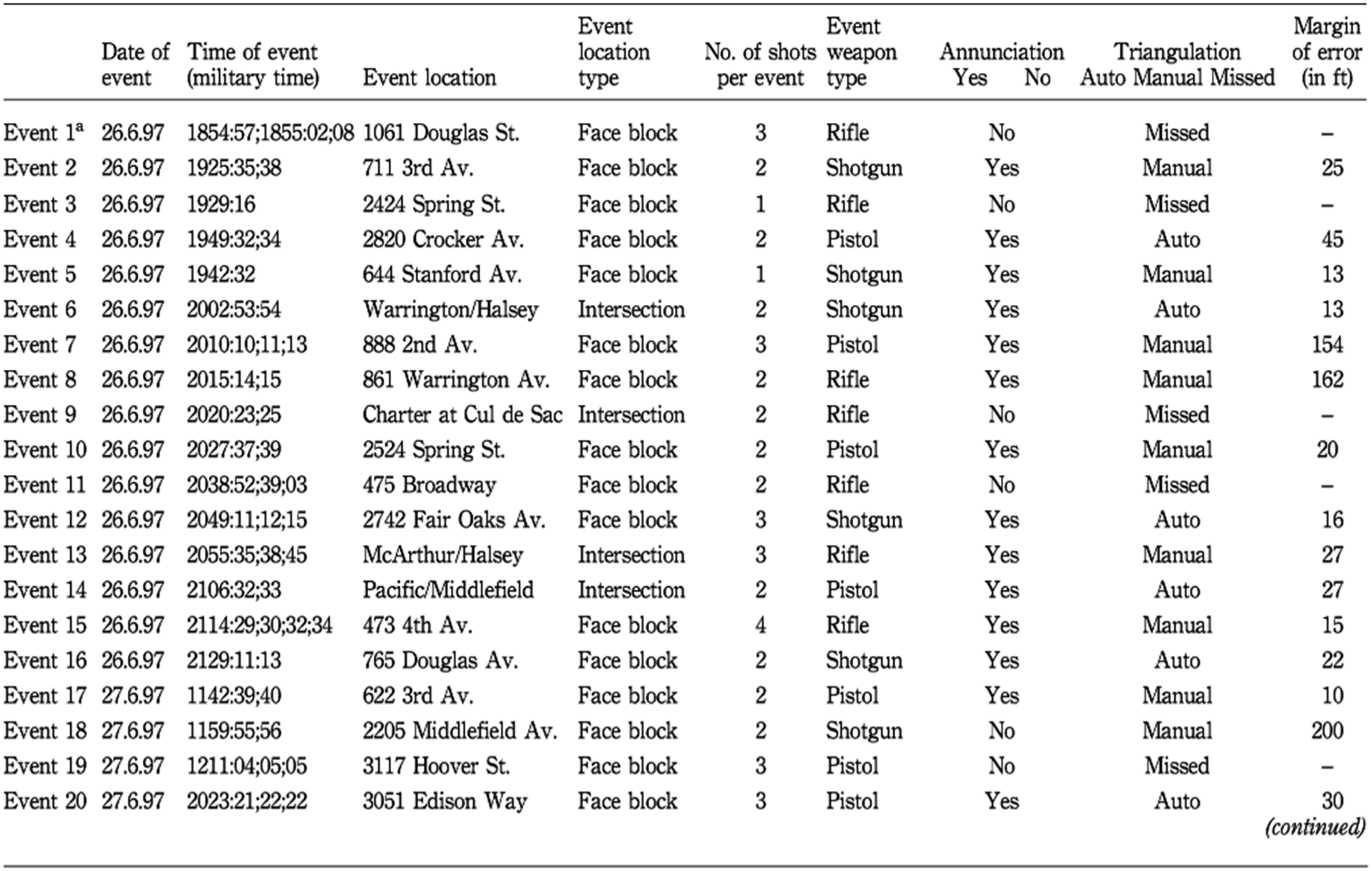
A separate evaluation appeared shortly afterward in a Department of Justice–funded report, Field Evaluation of the ShotSpotter Gunshot Location System (Figures 6 and 7).
35
Unlike the earlier USGS–Trilon prototype, this study assessed a commercialized version of the system deployed in Redwood Village. Eight acoustic sensor modules were installed on rooftops across the neighborhood, disguised as heating vents or birdhouses and linked by radio to the San Mateo County Communications Center. In controlled field trials in June 1997, officers fired blank rounds from pistols, shotguns, and an MP5 at dozens of preselected locations. The system annunciated roughly four out of five test shots and successfully triangulated the vast majority of them within a few dozen feet, confirming that the underlying detection and location algorithms worked as designed. The broader operational findings were far less impressive. Event and sensor map from the Redwood City ShotSpotter field trial, showing the distribution of gunfire events and microphone sensor locations. Source: Cory Watkins et al., “Technological Approaches to Controlling Random Gunfire,” Policing 25, no. 2, 2002. Incident table from the Redwood City ShotSpotter field trial, recording event location, weapon type, annunciation, triangulation method, and margin of error. Source: Cory Watkins et al., “Technological Approaches to Controlling Random Gunfire,” Policing 25, no. 2, 2002.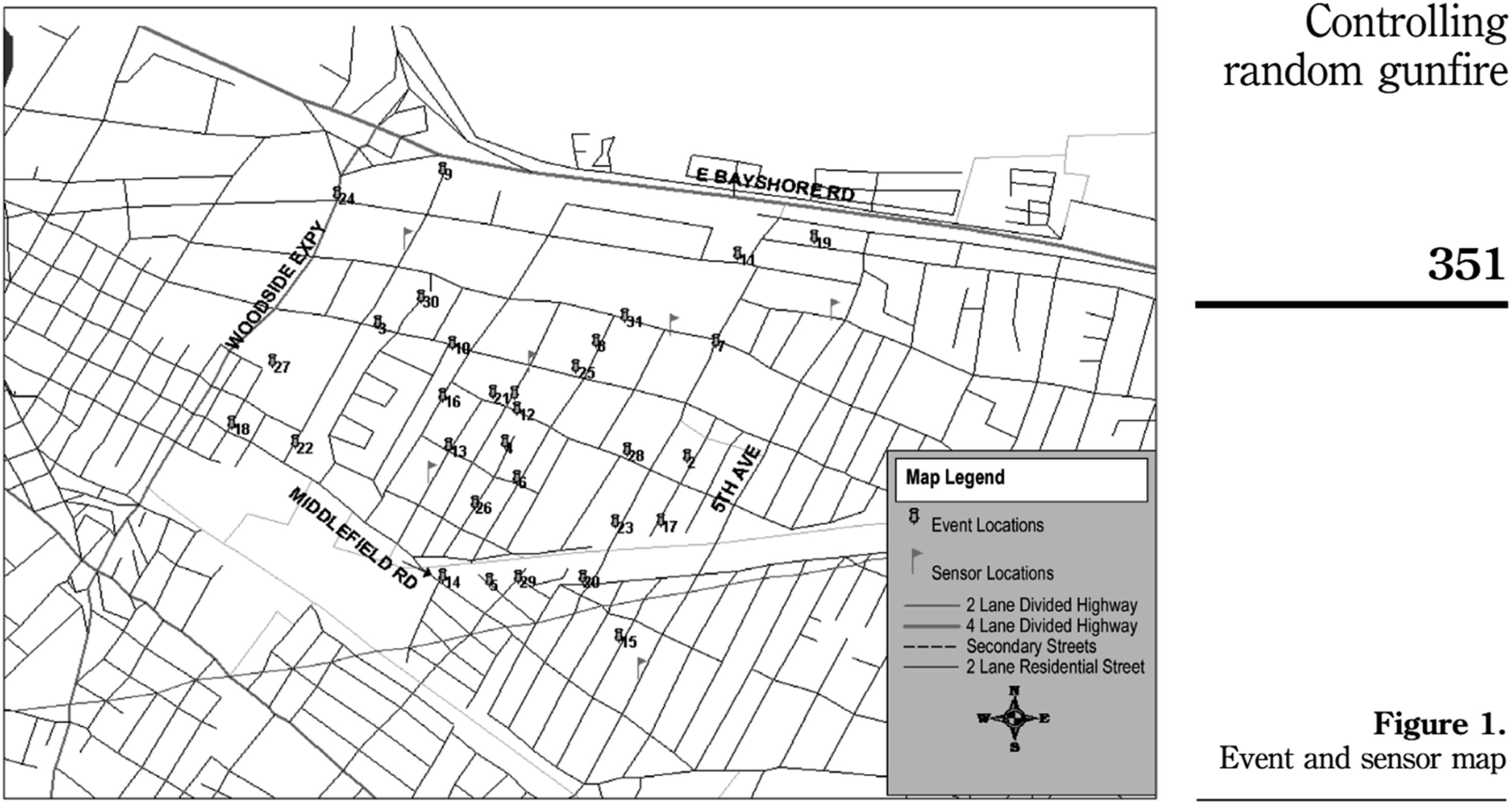
Focus groups of residents divided sharply: some credited the system with making them feel safer and improving police-community relations; others argued that it produced a false sense of security, had no effect on arrests, and consumed resources that would be better spent on additional officers. 35 Surveyed officers reported that, while ShotSpotter could identify and locate random gunfire, they did not believe it improved their response times, increased apprehension rates, or enhanced victim survival. Participants across the study emphasized that much of the gunfire was celebratory and tied to specific holidays, and that the underlying problem lay in social conditions and neighborhood infrastructure rather than a lack of information about where shots were fired.
These early findings established a pattern that has now persisted for decades. The system reliably turns vibration into actionable information, yet this informational precision does not reduce gunfire or the violence it produces. ShotSpotter’s expansion across US cities reflects its administrative utility: it generates evidence of activity, produces metrics that can be reported upward, and offers officials a visible sign of technological initiative. It delivers a continuous stream of events—a constant present tense of signals that populate dashboards and sustain claims of rapid response. It produces temporally indexed, geospatial information rather than structural change.
Computing information, crisis, and catastrophe
Mary Ann Doane’s writing on temporality, media, and crisis helps explain how systems such as ShotSpotter reorganize urban time. Her 1990 essay—written as television was beginning to cede cultural authority to networked computation—examined how broadcast media structured collective perception through three temporal categories: catastrophe, crisis, and information. 38 Catastrophe referred to rare, large-scale ruptures that exceeded administrative intervention. Crisis named the ongoing emergencies rooted in political and economic conditions. And information designated the rapid stream of small updates that filled the screen. These categories were descriptive and operational. They shaped how television selected events, paced them, and turned them into a shared experience of the present.
Television built a mode of managing crisis through practices that created a sense of constant presence. Producers cut between cameras, anchors broke into programming with updates, and newsrooms piped police-radio audio into the broadcast. Helicopter crews supplied the overhead view that tied these elements together. The police chase sat at the center of this system. A camera followed a moving car from above while a reporter narrated each turn, making pursuit feel continuous and nationally shared. The chase staged authority on the screen and taught viewers to read the present, in televisual real time, as a chain of incidents unfolding in front of them.
Doane also observed that television could not absorb every demand placed on it. The growing volume of updates and the pace at which they moved eventually outstripped what a broadcast could show or explain. Incidents multiplied faster than producers could narrate or place on screen. Many events slipped past the camera entirely because they did not lend themselves to images or live commentary. During this period, new technical systems began to take shape—systems built to register events automatically, without narration, and to operate at speeds and scales that television could not reach.
It is within this shift that computational sensing systems assume their contemporary urban form. Earthquakes belong to catastrophe: infrequent ruptures that justified the creation of seismic arrays. Gun violence belongs to crisis: a structurally produced condition rooted in segregation, disinvestment, firearm availability, precarious labor, and policing practices. ShotSpotter functions in the register of information. It cuts the city into time-stamped acoustic fragments and moves them through a lattice of rooftop sensors. Catastrophe yields too few events to sustain such a system. Crisis generates a steady, recurring field of incidents. That density underwrites the model: continuous detections produce the data flows, service metrics, and contractual claims on which subscription systems depend. Once vibration is framed as information, it is pulled into a machinery built to act within milliseconds, and the sensor network begins to define the timescale on which the event is understood.
The shift from television to computational sensing reshapes how crisis is organized. Television staged crisis through spectacle: it placed the incident in front of viewers, linked images and commentary, and held attention through continuous narration. Sensor networks handle crisis by cutting it into many small signals and moving those signals through software that sorts, labels, and forwards them. A computational event does not unfold on a screen. It enters a database as a coordinate with instructions attached. The temporal frame contracts to the analytic interval—the milliseconds in which the system detects an impulse, assigns a category, and triggers a response. This is a different formulation of realtime: a transmission defined by calculation rather than vision, and by the speed of machine decision rather than the pace of broadcast.
Yet computational sensing does not eliminate spectacle; it produces a different one. ShotSpotter’s interface—first as printed readouts, later as PC-based cartographic overlays, and now as animated dashboards in Real Time Crime Centers—turns acoustic impulses into graphical events. Dot clusters, map flashes, and cascading alert logs provide a continuous feed of urban threat rendered as data. These visualizations command the attention of dispatchers and analysts, secure the authority of the system, and frame the city through a lens of algorithmic vigilance. The spectacle shifts from televisual narrative to the informational screen. What once unfolded through commentary and images now appears as the graphical immediacy of a system that claims to reveal the city’s hidden activity in realtime.
The spatial setup of the system strengthens this temporal logic. Rooftop sensors create a listening grid above the street. Shingles, parapets, façades, and cornices shape how sound moves and give the network the surfaces it needs to capture vibration. These materials become part of an apparatus that hears but does not dwell in the spaces it monitors. It records pressure changes without engaging the people or histories that produce them. The longer timelines that shape exposure to violence fall out of view. The software receives a chain of acoustic instants and treats them as the primary facts of the city. Urban life is rendered as a stream of micro-events, not as a place formed by political and economic histories. This abstraction of the city through acoustic events also defines a specific model of listening—one that can be situated within, and challenged by, a longer history of acoustic theory and practice.
Counterlistening
The field of acoustic ecology has long proposed that environments can be understood through listening, yet foundational accounts often treat the “soundscape” as an object available for recording and analysis, a condition later critiqued by sound studies scholars who question the assumption that microphones faithfully render sonic environments.39–41 Recordings, spectrograms, and later computational analyses present themselves as accounts of a site’s sonic life, while the position of the listener and the conditions that shape what can be heard recede from view. This orientation carries forward into contemporary urban sensing systems. As discussed in the Chicago case, ShotSpotter mounts microphones on rooftops and calibrates them to register acoustic impulses as discrete events, converting vibration into time-stamped coordinates that enter a policing workflow. Sound becomes evidence, and the environment is rendered as a field of measurable activity rather than a city shaped by use, memory, and uneven exposure to surveillance.
The term computational listening names a specific arrangement in which microphones, signal processing, and classification systems reorganize the act of listening. It is not equivalent to sensing in general. It describes a pipeline in which acoustic input is captured, processed, classified, and routed toward decision-making, with listening distributed across devices, models, and operators. In this arrangement, the listener does not disappear but is repositioned. What had been an embodied practice—hearing within a scene, orienting oneself through sound—becomes an operation that receives processed outputs, whether as alerts, coordinates, or classifications. Computation enables the system to register events across wide areas, synchronize signals, and assign them meaning within seconds. At the same time, it narrows what listening can hold. The ambiguity of sound, its movement through surfaces and bodies, and the histories carried in particular sites fall outside the terms by which the system recognizes an event. Authority over what counts as an event shifts toward the model and its thresholds, while the situated listener no longer determines what has been heard.
Gascia Ouzounian’s writing unsettles this orientation by placing listening within the material situations in which it occurs. She treats listening as something carried out by bodies that move through environments already shaped by architecture, media systems, and prior uses. 42 Drawing on Tim Ingold’s critique of emplacement, alongside Hildegard Westerkamp’s “moving ear,” and Luc Ferrari’s “wandering ear,” she describes listening as an activity that takes form through motion. 42 As a listener moves, surfaces reflect and absorb sound, infrastructures transmit and distort it, and other bodies and devices introduce competing signals; what is heard emerges through these conditions rather than appearing as a stable field. Recording does not stand outside this process. The recordist selects a position, directs the microphone, and determines when to begin and end, while the device itself amplifies some frequencies and suppresses others. These decisions and constraints shape what enters the recording and what falls away, so that the result carries a trace of the situation in which it was made. Listening, in this account, operates as a way of working through how environments are organized and how perception is structured within them, including how sound is routed, filtered, and made available for recognition and response.
This reframing clarifies what is at stake in the proliferation of computational listening systems. ShotSpotter occupies an inverse position: a disembodied ear that treats environments as collections of signals, removes the situated listener, and foregrounds computation. Its evidentiary claims rest on the removal of social context and the substitution of mechanical neutrality.43,44 Yet the system does not eliminate subjectivity; it reorganizes it. Decisions about thresholds, classification models, and signal interpretation establish in advance what counts as relevant sound and what does not, and these judgments are embedded in the system’s architecture. As a result, the authority to hear and to decide is exercised at a distance from the sites where sound occurs. The city is reconstructed as a field of measurable impulses, producing events that circulate through administrative networks without retaining the histories of the spaces from which they emerge. This configuration extends a lineage of signal processing that refines the extraction of meaning from vibration while displacing listening from place, even as its claims to neutrality depend on that displacement.
Mendi and Keith Obadike’s artistic project Free/Phase: An Intermedia Suite in Three Nodes offers a counter-practice. Commissioned by Columbia College Chicago’s Center for Black Music Research in relation to the anniversaries of the Emancipation Proclamation and the Selma marches, the project draws on 150 African American freedom songs from the CBMR archives and unfolds across three nodes: Beacon, Overcome, and Dialogue with DJs. At the Chicago Cultural Center, the rooftop installation Beacon reactivates listening as a historical and relational act (Figures 8–10). The Obadikes assembled a corpus of spirituals, emancipation-era hymns, and protest songs rooted in long struggles against racial violence and state power, and broadcast them into public space through a parabolic loudspeaker mounted atop the building, sounding at 9 a.m., noon, and 7 p.m. each day, like what the artists described as a lighthouse beam or call to prayer. The installation restores these sonic forms to the Chicago civic sphere, placing histories of enslavement, resistance, and collective memory into the city’s present, where they are largely absent from dominant accounts. Mendi + Keith Obadike, Free/Phase: Node 1 Beacon, Chicago Cultural Center. Video still showing the parabolic loudspeaker mounted atop the building. Source: Mendi + Keith Obadike, YouTube video, https://www.youtube.com/watch?v=5JF4EGh-5uQ. Mendi + Keith Obadike, Free/Phase: Node 1 Beacon, Chicago Cultural Center. Video still showing the view from the rooftop speaker toward Millennium Park, indicating the direction of the acoustic broadcast. Source: Mendi + Keith Obadike, YouTube video, https://www.youtube.com/watch?v=5JF4EGh-5uQ. Mendi + Keith Obadike, Free/Phase: Node 1 Beacon, Chicago Cultural Center. Video still showing the view from Millennium Park toward the rooftop speaker; the circled area marks the speaker’s location. Source: Mendi + Keith Obadike, YouTube video, https://www.youtube.com/watch?v=5JF4EGh-5uQ.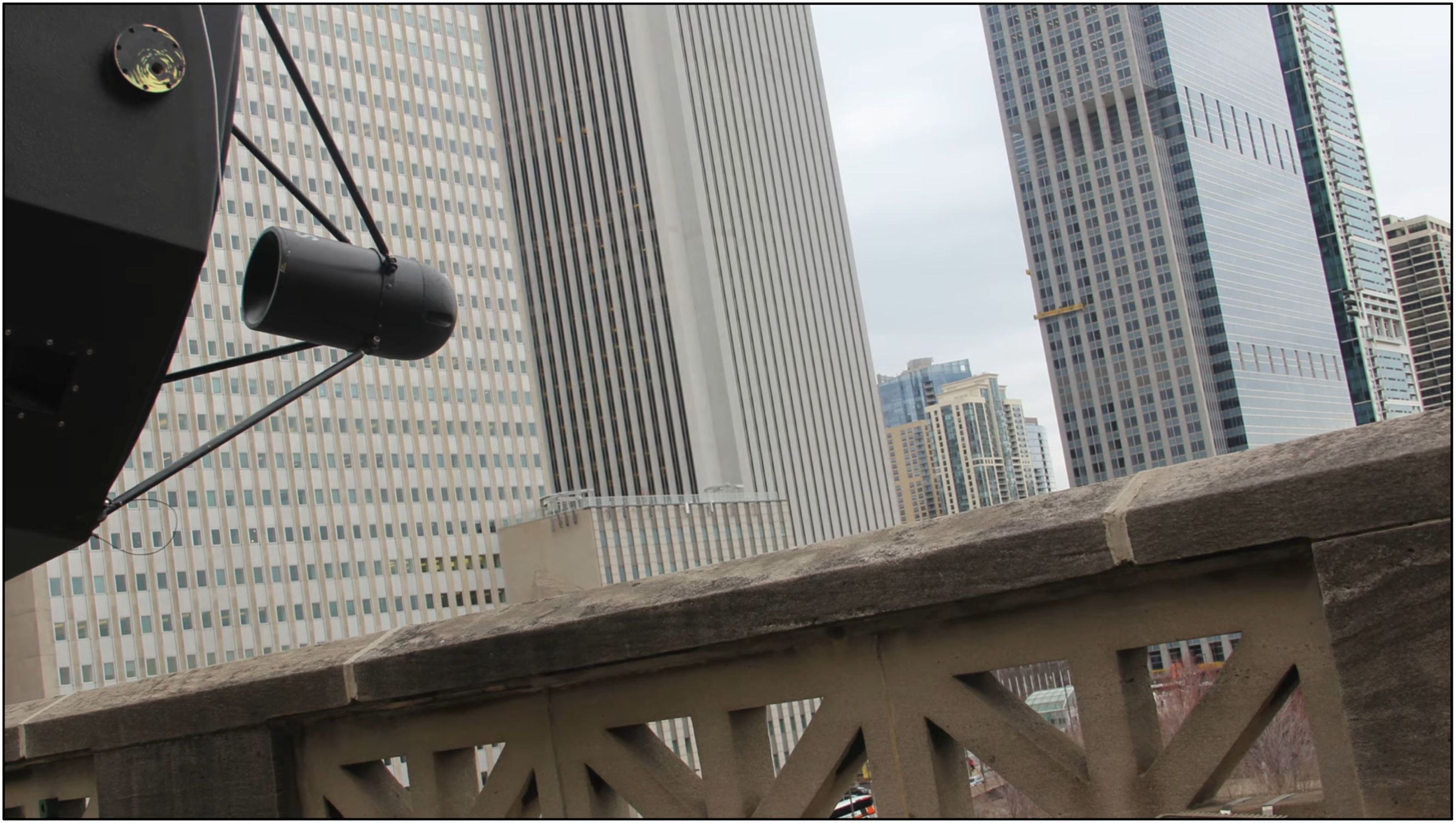
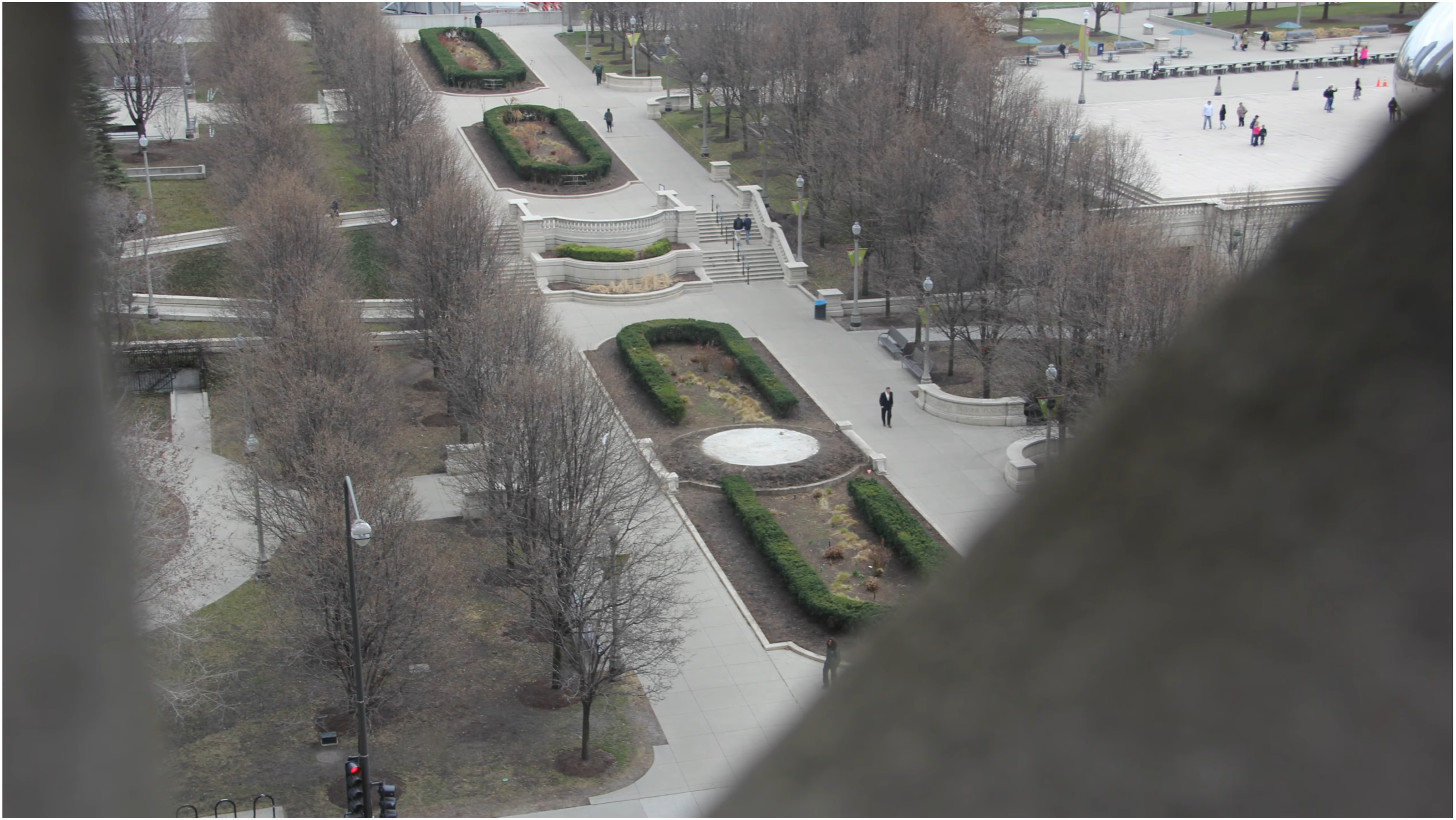
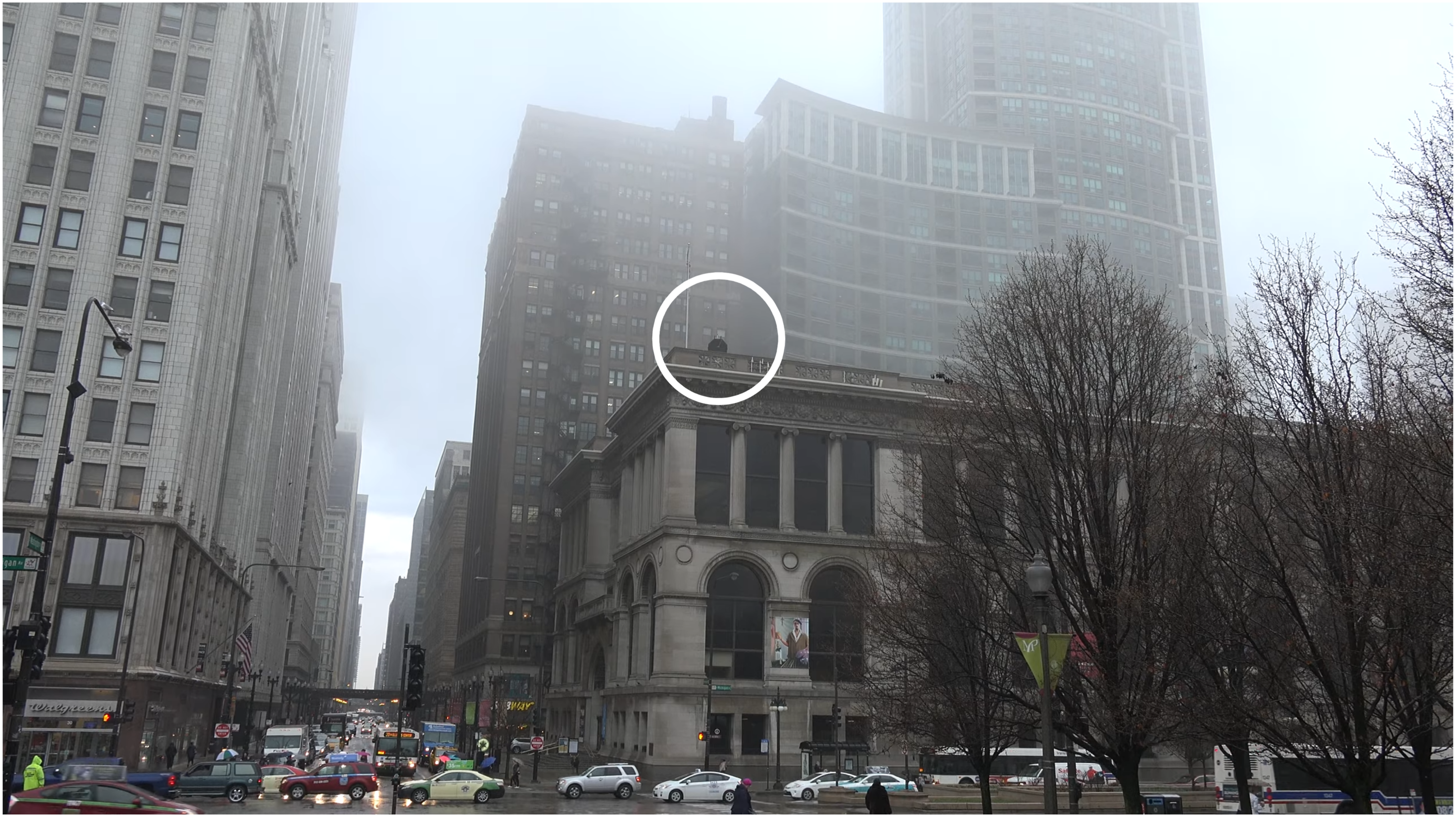
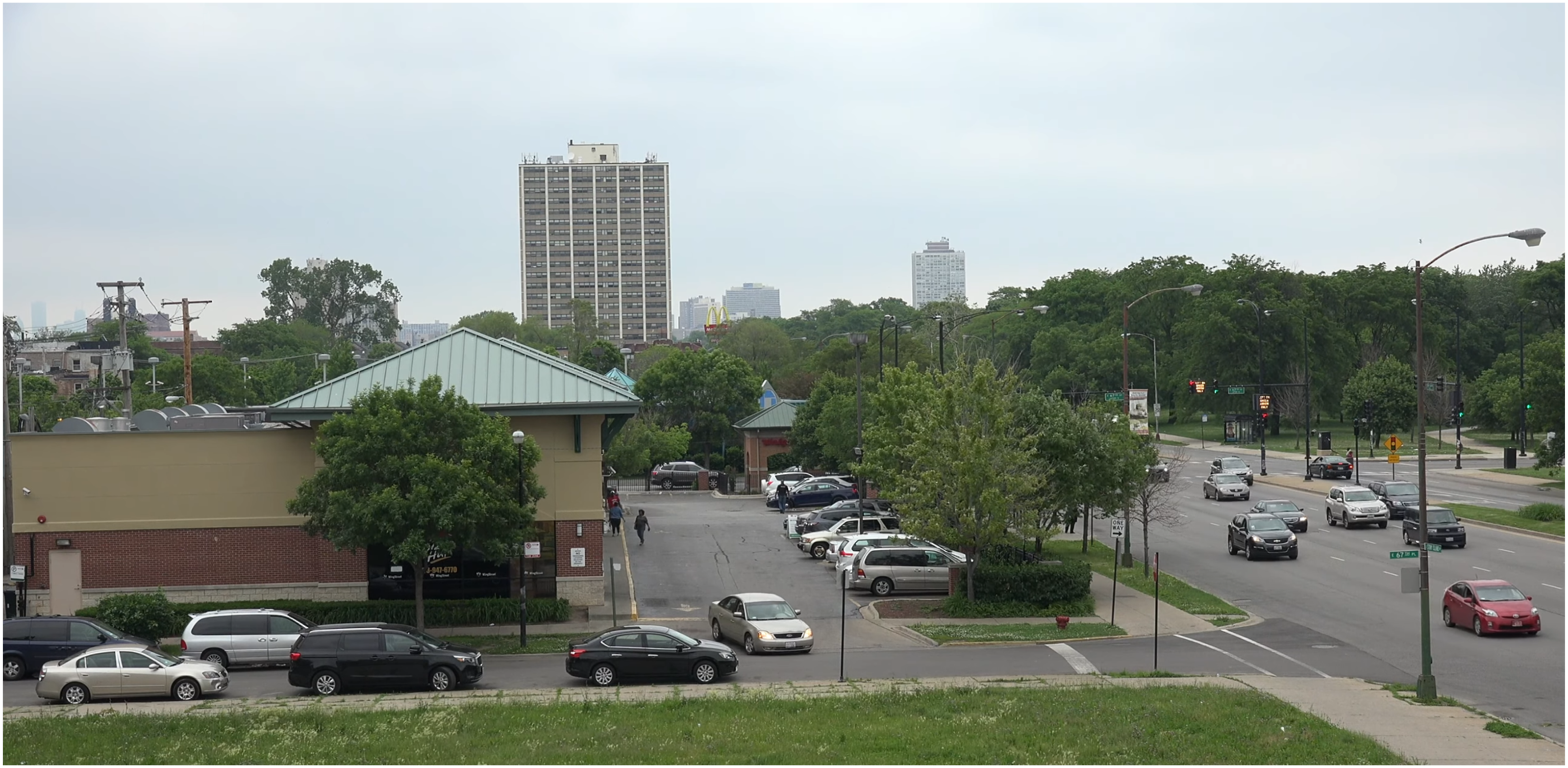
Ouzounian reads Beacon as an act of counterlistening. The clarity and unembellished resonance of the melodies—bell tones, harmonic overtones, precisely articulated notes—enable recognition even at a distance. The Obadikes use the rooftop as a site for broadcasting memory. The architectural surface that supports Chicago’s acoustic policing infrastructure becomes the conduit for a different temporal and political regime. In other nodes of Free/Phase, including work at the Stony Island Arts Bank on the city’s South Side (Figure 3), listeners described how the songs transformed the atmosphere around the site. They shifted it from vacancy and disinvestment toward a sense of resolve and collective presence (Figures 11 and 12).
45
The installation made audible the persistence of struggle in a neighborhood long marked by racialized neglect. Each melody carried across empty lots and underused buildings, producing a sense of continuity across generations of resistance. The work’s temporality refused the analytic interval. It replaced the instantaneity of detection with the long durée of emancipation and civil rights movements, reorienting the urban sound field from crisis to historical endurance. In their account of the project, the artists describe their archival practice as an effort to reflect on information that vanishes from view because it is ephemeral or buried, and to invite listening to the past and future at once. That temporal claim places the present inside a much longer history of Black struggle and collective movement.
46
Mendi + Keith Obadike, Free/Phase: Node 1 Beacon, Stony Island Arts Bank. Video still showing the parabolic loudspeaker mounted atop the building; the circled area marks its location. Source: Mendi + Keith Obadike, YouTube video, https://www.youtube.com/watch?v=uVSg4xlAOW0. Mendi + Keith Obadike, Free/Phase: Node 1 Beacon, Stony Island Arts Bank. Video still showing the view from the rooftop speaker looking north along South Stony Island Avenue, a few blocks south of ShotSpotter sensor equipment, indicating the direction of the acoustic broadcast. Source: Mendi + Keith Obadike, YouTube video, https://www.youtube.com/watch?v=uVSg4xlAOW0.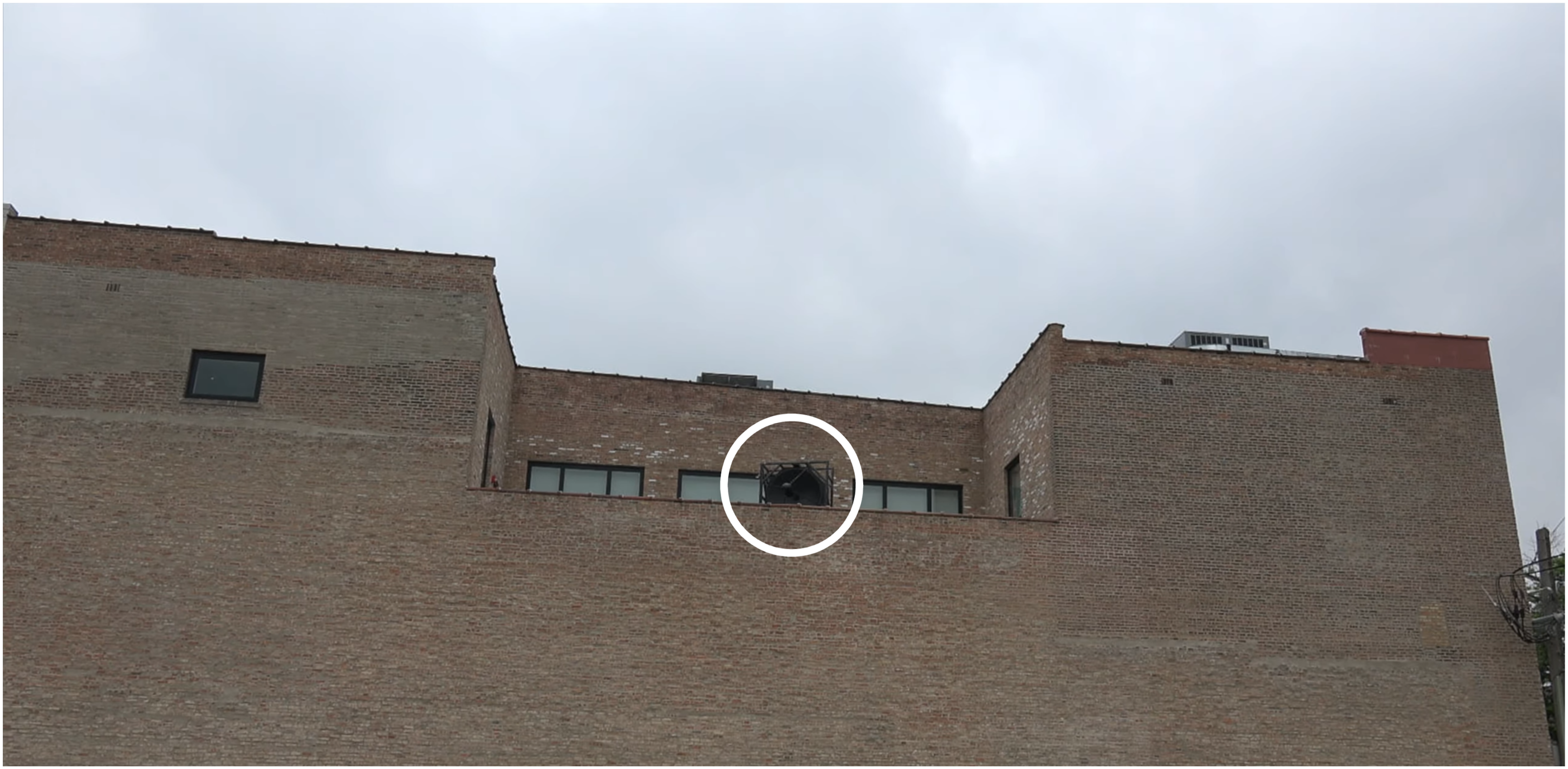
Beacon reorganizes how vibration is understood in the city. ShotSpotter channels sound through a technical pipeline that classifies acoustic events and routes them into policing workflows. Beacon routes sound through a different set of relations: a practice of listening that ties people to one another, to place, and to the histories carried in their environments. ShotSpotter produces a stream of discrete acoustic incidents. Beacon produces shared moments of hearing that move across rooftops and walls and gather listeners. In ShotSpotter, sound functions as a tell, marking a location for pursuit. In Beacon, sound arrives as song—historically formed, emotionally charged, and publicly addressed—encountered within a shared environment where listening remains embodied and situated. These competing sound projects articulate different ways of organizing urban life. The same rooftop can register vibration as evidence within a security network or project sound back into the city as a form of public life.
Conclusion: Realtime vibrational urbanism
ShotSpotter’s trajectory—from SRI’s laboratories to Redwood Village to Chicago’s Strategic Decision Support Centers—situates urban sensing within a longer geopolitical formation in which techniques for registering distant disturbances as vibration—underground tests, ground movement, acoustic shock—are redeployed in the city to register activity across space. Rooftops, façades, and communication systems become part of this arrangement, extending vibrational capture into everyday environments. This inheritance shapes how architectural computing defines the urban problem: it isolates events that can be measured and located in time, directs attention toward them, and coordinates response within a short interval. The conditions in which these events occur—segregation, disinvestment, uneven exposure to policing—remain present but do not register as actionable objects within the system’s field of operation.
This limit follows from design. Designers, engineers, and architects construct the systems through which institutions register activity, define urgency, and organize intervention. As these systems expand, they capture the urban imagination and shape images of innovation and transformation, reinforcing a mode of governance oriented toward rapid response. Within this feedback loop lies a political choice: to invest in the constant present of micro-events rather than in the structural futures that reduce harm. The problem is therefore not only technical but temporal and political, as crisis is refined into information while the forms of change that matter most unfold on entirely different scales.
Structural change proceeds through political organization and sustained collective action over time. Architectural computing enters this field by shaping perception and attention, setting the terms of what becomes visible, what circulates, and how events are situated within longer histories. Beacon makes this capacity legible by using a vibrational system to situate present conditions within histories of resistance and projected futures of freedom, while gathering listeners into a shared environment organized through collectivity. Architectural computing, then, does not simply register and act on signals. It organizes how environments are perceived and how attention is held, and in doing so it can either reinforce systems oriented toward accelerating realtime response or support the longer temporal work through which social and spatial conditions change.
Footnotes

Funding
The author received no financial support for the research, authorship, and/or publication of this article.
Declaration of conflicting interests
The author declared no potential conflicts of interest with respect to the research, authorship, and/or publication of this article.