




Abstract
Digital transformation has been inevitable in all socio-economic fields, including higher education. Recently, under the burden of the COVID-19 pandemic, many universities have to change their entire teaching systems to online learning to ensure their students' learning is not interrupted. Thus, it is essential to study how universities’ students, educators, and administrators perceive online learning in different countries. To this aim, this study investigates the factors affecting university members' preference for online learning in Singapore and Vietnam. Using a cross-country sample with a sound theoretical framework of the Technology Acceptance Model (TAM), we found that each member group in the university was influenced by a different weight of factors. Specifically, students' preference for online learning is most affected by their technical skills. Meanwhile, educators and administrators are influenced mainly by the perceived usefulness of online learning and practice conditions, respectively. We further conducted multi-group testing and confirmed the certain separation in online learning preferences of observed objects between the two countries. Overall, this paper enriches the literature on online education, and has important implications for educational policymakers and university stakeholders both during and after the pandemic.
Keywords
Introduction
Over the past decade, the world has experienced a profound digital transformation, represented in interdisciplinary achievements (Udovita, 2020). The digital concept of the 21st century is not only confined to the implementation of technologies but is further concerned with optimizing of the value creation and delivery process (McKinsey, 2018). Most of the existing studies have focused on digital transformation in firms with emphasis placed on the establishment and amendment of a suitable transformation model to tackle potential challenges associated with the progression Von Leipzig et al. 2017; Saarikko et al., 2020). Meanwhile, in the field of social sciences, especially with regard to education, research on this issue is still in its infancy.
In the governing system of any nation, higher education has always been important because its performance can influence the whole national workforce and the sustainability of economic growth (Mishra et al., 2020). It is critical for higher education institutions to constantly improve learning conditions to ensure the educational quality (Moore et al., 2011). One of many effective ways is to promote online learning, which allows students to study regardless of time and space (Gejendhiran et al., 2020). Scholars often define online learning as the learning experiences gained from technology access towards the promotion of connectivity, flexibility, and interactions among learners (Moore et al., 2011). This form of learning has a history spanning for decades. Nevertheless, its adoption on a global scale has never been as rapid as during the time between 2020 and 2021 (Nurhas et al., 2021). This is explained by the outbreak of the precedent Covid-19 pandemic when higher education institutions were forced to shut down. Universities must change their entire teaching systems to online learning as an adaptive strategy to ensure that their students’ learning is not interrupted. The historic Covid-19 pandemic has brought adverse impacts to the world, with most aspects hitting bitter lows. However, the involvement of online learning seems to be beneficial.
As the conversion to online learning happened so fast, many universities started to feel uncertain about whether it will negatively impact the teaching-learning process (Ken Research, 2019; Vu and Hartley, 2018). The concern applies to universities across countries regardless of solid online infrastructure such as Singapore (Taso and Chakrabarty, 2020) or fragile online infrastructure such as Vietnam (Maheshwari, 2021). Beyond the availability of technology and infrastructure, the preparation of members in universities is the key to making online learning effective (Müller et al., 2021). Therefore, investigating the preferences of universities' members towards online learning is essential to provide evidence for stakeholders to give appropriate policies when onsite instruction resumes in the world. These insights will serve as valuable foundations when further investments into the creation of optimized online learning systems are planned and realized.
This study uses the data from 856 questionnaires completed by students, educators, and administrators from universities in Singapore and Vietnam, and applies the Technology Acceptance Model (TAM) to investigate the behavior towards online learning among respondents. The findings reveal that the preference towards online learning of each institutional stakeholder is influenced by different factors, especially technical skills, and the learning/teaching conditions. Furthermore, the influences of certain factors on the preference of institutions’ members in the two observed countries are significantly different. Our study thus contributes a more-acute image of a comprehensive, efficient online learning system for higher education, which can serve as a prerequisite for future policies.
Literature review
Digital transformation and higher education
The early adoption of online learning in higher education has been catalyzed by Western countries since the 20th century, with the central concept of off-campus study (Wallace, 2003). Several bodies of literature describe online learning as an extension of distance learning with the flourishing experience via technology (Moore et al., 2011; Singh and Thurman, 2019). Online learning systems have experienced such intense and disruptive transformations from emerging technologies that all practitioners acknowledge its influences (Gejendhiran et al., 2020). Thanks to online learning, education has moved into a profound transmission in how courses and programs are designed and delivered (Moore et al., 2011). Nowadays, the advancement of connectivity and flexibility enabled by online learning has been so apparent that several scholars agree that online learning has been the backbone of all class activities and education functions of higher education institutions (Cui et al., 2013; Gejendhiran et al., 2020). However, besides the outstanding benefits, particular concerns of online learning still exist and have an impact on all stakeholders and participants (Dumford and Miller, 2018).
From the students' perspective, the logistical components such as technology and learning conditions are the foremost challenges that affect their readiness (Lee, 2010). The improper functioning of technology can make students struggle with online learning and hinder their studying outcomes (Hall et al., 2020). However, existing studies indicate that students’ acceptance is the most intervening variable driving students’ preference for online earning (Ko, 2017); Crosling et al., 2015). It explains why even in developed countries with high-quality technical infrastructure, students’ rating for the particular form of resource-based online learning was still “poorly” (Crosling et al., 2015). Should students not consider online learning a long-term commitment but a temporary replacement tool in the sudden changes, their preferences toward online learning will be relatively low (Iivari et al., 2020).
From the educators' perspective, they find it even harder than students to adapt to performance using the online format, which makes them usually in need of special guidance or training (Nacu et al., 2018). Accordingly, educators must devote more time to learning the new teaching methods and rapid technological changes. Nevertheless, should they actively learn and be constantly present in online discussions, they seem to face another problem of maintaining the work-life balance (Wong et al., 2021). Existing literature often advises educators to put more effort into designing innovative activities to attract students, but there exist only a few studies on how to assuage the concerns of educators in this new learning paradigm.
From the administrators’ perspective, besides encountering similar issues to educators, administrators face further difficulties in keeping up with the sudden changes in the entire educational institution (Mishra et al., 2020). The shift from onsite to online learning has delivered a disruptive event that requires more effort from administrators (Dorius et al., 2021). Although administrators do not directly get involved in lecture delivery, their responsibility to make the institutions float is indispensable. Many administrators express concerns about the ineffectiveness and lack of interaction during the implementation of online meetings with students or educators (Capano et al., 2020). A survey conducted by Johnson et al. (2020) in the United States with 672 administrators reveals that almost all administrators have no experience in working online. Therefore, they need further assistance to access online digital materials and guidance for working from home.
Digital transformation and online learning in Singapore
Singapore is a pioneer in Southeast Asia in the acceleration of life-long learning for its citizens (Guan et al., 2015). Online learning was introduced in Singapore in 2011 when the government found the potential of online platforms to facilitate students’ independence in learning (Tay et al., 2021). At an early time, most of students and educators are unwilling to participate in online classes due to the limitations in administrative control and technical issues (Rowe et al., 2010). In that context, the Singaporean government actively invested in standard information technology infrastructure to meet the demand for online learning (Lee, 2010). Considerable effort has been paid to technology innovation and financial assistance so that learners may pursue education effectively (Guan et al., 2015). Recently, the World Competitiveness Ranking 2021 ranked Singapore among the top five global economies for digital competitiveness (IMD 1 , 2021). In the wake of the Covid-19 epidemic, higher education institutions in Singapore have actively adapted to the challenges thanks to the government’s enforcement and universities' support (Tay et al., 2021; Watermeyer et al., 2021). Regarding universities, the two significant factors that bring online learning success are students’ self-efficacy and educators' presence (Lim et al., 2021). While students acquire equivalent high self-efficacy, educators provide similar social communication effects as they perform in onsite classes (Tay et al., 2021).
Digital transformation and online learning in Vietnam
In Vietnam, the government issued “National Digital Transformation Plan to 2025 with orientation to 2030,” referred to as “the National Plan” henceforth in Decision No. 749/QD-TTg dated June 3, 2020. Based on the National Plan, the Ministry of Education and Training established a Digital Transformation steering committee for all educational levels. Although online learning is not a strange notion to Vietnamese universities, its adoption into general universities is still limited (Maheshwari, 2021). According to Pham and Ho (2020), this situation can be explained by two main reasons. First, higher institutions do not have intrinsic motivation to conduct a new educational model, such as technology investment. Second, the supportive policies from the government remain unclear to integrate online learning into their regular courses. The unprecedented outbreak of the COVID-19 pandemic has significantly contributed to the rapid shift from traditional learning to online learning within the country (Maheshwari, 2021). However, despite the supports from educators and administrators (for instance, guiding to use learning platform or resolving technical problems), many Vietnamese students struggle with online learning (Nguyen et al., 2021; Maheshwari, 2021).
Theoretical framework
The paper uses the Technology Acceptance Model (TAM) by Davis et al. (1989) as the key model to analyze factors determining the preference for online learning. Over 30 years, several models have been developed to describe the association among factors and people’s acceptance of technology, but TAM remains the most influential and best-operationalized approach model (Charness and Boot, 2016; Legris et al., 2003; Wessels and Drennan, 2010). At the individual level, there are two primary constructs in TAM model are “perceived ease of use” and “perceived usefulness” (Charness and Boot, 2016). “Perceived ease-of-use” is “the degree to which a person believes that using a particular system would be free from effort” (Davis, 1989). In the paper scope, we explain this “perceived ease of use” as an assessment of how the use of the Internet (as the medium) can be adopted by individuals easily, supportively, and without effort. Meanwhile, “perceived usefulness” is “the degree to which a person believes that using a particular system would enhance their job performance” (Davis, 1989). We adopted the term to refer student’s assessment of how the use of online learning applications improves the work/learning performance of participants in the university context. These two factors will then have an impact on the attitude of users towards the technology, which in turn, determines the behavioral intention of the users. This process will finally decide whether users will actually apply the technology. Both “perceived ease of use and usefulness of technology in online study, teaching, and working process alter the intention of students, educators, and administrators for online learning” (Joo and Choi, 2015). Thus, both indicators are valid and impacted by other variables such as the Vietnamese and Singaporean cultures.
Prior research, which also used the TAM model, has provided valuable insights into the reasons why people adopt technologies in higher institutions (Venkatesh, 2008). The Covid-19 pandemic demands solutions to cope with the disruption of onsite instruction, thus, delivering the strong development of online learning with educational applications. Following that, stakeholders (students, educators, and staffs) in the university environment gradually accumulate experiences of use, contributing to the knowledge cycle or database updating in Vietnam (Maheshwari, 2021) and in Singapore (Tay et al., 2021). Even though the number of potential barriers to online learning will keep rising, acceptance is the key ((Venkatesh, 2008). By having technology acceptance, the students will find a solution to engage in online learning. From an objective point of view, institutions' support in various forms, such as providing necessary infrastructure and creating a prompt helpdesk, can effectively assist students, lecturers, and administrators in implementing a new and complex technology platform (Jasperson, 2005)). Should the universities continue to concentrate on facilitating learning conditions, it will lead to greater user acceptance of new systems (Miltgen, 2013). It can undoubtedly be indicated that conditional support plays a crucial role in determining the intention of applying technology among users.
Meanwhile, from the subjective viewpoint, researchers have investigated the readiness for online learning among undergraduate students over the last few years and found the primary factors that affect students' achievement in online learning were technical skills (Joo and Choi, 2015; (Yousafzai, 2007), so by enhancing personal skills, participants in online learning will improve their technology capability. Researchers also noted that technical skills are related to the performance of not only learners but also educators (Nacu et al., 2018). Lack of technical skills, particularly insufficient computer and typing skills, was found to be one of the barriers met by educators when engaging with the willingness and implementation of online learning (Dyrbye et al., 2009). In a comparison of traditional and technology assisted learning method, Sauers and Walkers (2004) found that online courses help students improve their writing skills and communication practices. Therefore, lecturers should consider practicing skills to get familiar with online courses in order to provide the best form of course delivery on different online platforms. Accordingly, five hypotheses of factors affecting online class and their roles in delivering core application outcomes are put forward as follows:
Hypothesis 1 (H1): The higher perceived ease of use, the higher preference that students, educators, and administrators have for online learning.
Hypothesis 2 (H2): The higher perceived usefulness, the higher preference that students, educators, and administrators have for online learning.
Hypothesis 3 (H3): The better personal technical skills that students and educators acquire, the higher preference they have for online learning.
Hypothesis (H4): The better conditions for online learning, the higher preference that students, educators, and administrators have for online learning.
Hypothesis (H5): There is a difference in the preference that students, educators, and administrators have for online learning in countries with different experiences in online learning implementation.
Research method
Instrument development
The model was developed from the study of Mohammadi (2015), who applied the structural equations modeling (SEM) to examine factors affecting users’ intentions and satisfaction towards e-learning. We collected data through a survey with the five-point Likert scale where one indicates completely disagree, and five indicates completely agree. Initially, our questionnaires were designed in English and sent to our partners at the National University of Singapore (NUS) for the pilot survey on Singaporean students. After revising the questionnaires, our team translated them into Vietnamese and simultaneously surveyed in two countries. In the questionnaires, we attached items that are shown in the theoretical framework. Our survey using Qualtrics included three separated questionnaires for three stakeholders, namely, students, lecturers and administrators. In each questionnaire, we input all four latent factors such as perceived ease of use, perceived usefulness, conditions, and personal technical skills and their associated items. The summaries of the items are illustrated in Tables A1, A2, and A3 in the Appendix.
Statistical methods
To determine our initial set of research questions (hypothesis 1–4), we employed the partial least squares structural equation modeling (PLS-SEM) to estimate the parameters (Hair et al., 2019). PLS-SEM is a statistical algorithm that has the power to explain variance of latent constructs which creates validitity and cogent for researchers to conduct research (Astrachan et al., 2014). Besides, PLS-SEM does not require the assumption of normality and is applicable to a very small sample size (Hair et al., 2019). Therefore, using PLS-SEM to estimate the relationship between latent variables, for example, the perceived ease of use and usefulness, is reasonable. In addition, we utilized bootstrapping to generate the robust standard error for the coefficients in each path (P) of our model. Our second group of research questions (Hypothesis 5) is verified via a bootstrapped t-test to measure the significant differences in online learning stimulation between surveyed students, educators, and administrators between the two countries.
Samples
As stated in our introduction, our research aimed to understand the difference in perceptions of universities’ students, educators, and administrators in Vietnam and Singapore as two countries with different online learning background. To improve our data validity, we used a purposive sampling technique to select Vietnam National University, Hanoi and Van Lang University in Vietnam, and National University of Singapore in Singapore. The survey digital questionnaires were randomly disseminated to respondents via Qualtrics to collect stakeholders’ perceptions and awareness for online learning in their institutions from January 2021 to March 2021.
The rationale to collect samples from the above-mentioned three universities is due to the institutions’ representativeness in the higher education systems of Vietnam and Singapore. First, the Vietnam National University, Hanoi (VNU) has affirmed its number one position in Vietnam. In 2022, VNU was listed in Top 1001–1200 universities globally according to Times Higher Education World University Rankings (THE) 2 and Top 801–1000 according to Quacquarelli Symonds World University Rankings (QS), 3 with several academic disciplines placed in Group 401–500 globally, approaching Asia’s Top 100 Universities. Next, Van Lang University (VLU) is also among the top universities in Vietnam when achieving QS 4 stars in 2021. 4 Over the course of development, VLU has developed robust partnerships with diverse international institutions for promoting the collaborations on research, joint training, student and faculty exchange, and technology transfer. Lastly, National University of Singapore (NUS) is a leading university in Singapore, ranking 21st in the World University Rankings provided by THE and 11th in the QS Global University ranking in 2022. The University’s multidisciplinary and real-world approach to education, research, and entrepreneurship enables NUS to work closely with industry, governments, and academia to address crucial and complex issues relevant to Asia and the world.
A total of 856 subjects from the Quatric-based questionnaire were found to be valid. Specifically, the student participants consisted of either undergraduates or graduates with total 582 retrieved questionnaire forms (372 Vietnam and 210 Singapore). These student’s majors vary from social sciences to natural sciences. Therefore, we divide our surveyed students into two groups. In specific, Vietnamese students majoring in social sciences account for 71.51% (379) of total surveyed students. Meanwhile, that of Singaporean students accounts for 48.07% (25) of total surveyed students. Regarding students majoring in natural sciences, Vietnamese and Singaporean students occupy for 28.49% (151) and 51.93% (27) of total responding students, respectively. There were 220 educators participating in our surveys with 116 from Vietnam and 104 from Singapore. Administrator respondents rendered the fewest responses with 54 returned questionnaires (35 Vietnam and 19 Singapore). Generally, the age of students ranged from 20 to 25 years old. That of educators was 30–40 years old and that of administrators was categorized in 40–49 years old. Regarding genders, female over male ratio of students, educators, and administrators was 0.74, 0.93, and 0.86, respectively.
Data results
Reliability and validity
Stata software is employed to analyze our data. Each stakeholder data is inputted and estimated accordingly. We have three separate models according to three questionnaires. Reliability and validity are fundamental indices utilized to specify the constructs demonstrated in a study using Likert scale. Reliability is determined via Cronbach alpha (α) (Hair et al., 2019). When Cronbach alpha is larger than 0.7, the reliability of the scale is verified. In our study, we test the scales of three objectives (students, educators, and administrators) to obtain Cronbach α = 0.9358, 0.8571, and 0.8526, respectively. Validity refers to adequacy or sphericity. KMO measure of sampling adequacy is fundamentally used to evaluate the relevance of employing a factor analysis on our data set, meanwhile, Bartlett’s test of Sphericity is utilized to test whether our explanatory variables in the sampling correlation matrix are structurally correlated or uncorrelated (Habibi et al., 2020). Our KMO values for the three objectives were 0.929, 0.841, and 0.658 and Chi-square values of Bartlett’s test illustrated associated p-values smaller than 0.01 in our three objectives. We can confidently conclude the appropriateness of our dataset to proceed with the faultur factor analysis. Subsequently, a rotation loading matrix was used to test the suitability of our predictor factor analysis (genuine sub-factors placement in appropriate factors). Thus, we ran three rotation loading matrices for each research subject which were described in Tables A4, A5, and A6 (in Appendix). All sub-factors possessed values smaller than 0.5 that were excluded in our factors (Hair et al., 2019). The remaining sub-factors and factors would be estimated in our structural model via PLS-SEM. Online learning framework _ Technology acceptance model (Davis et al., 1989).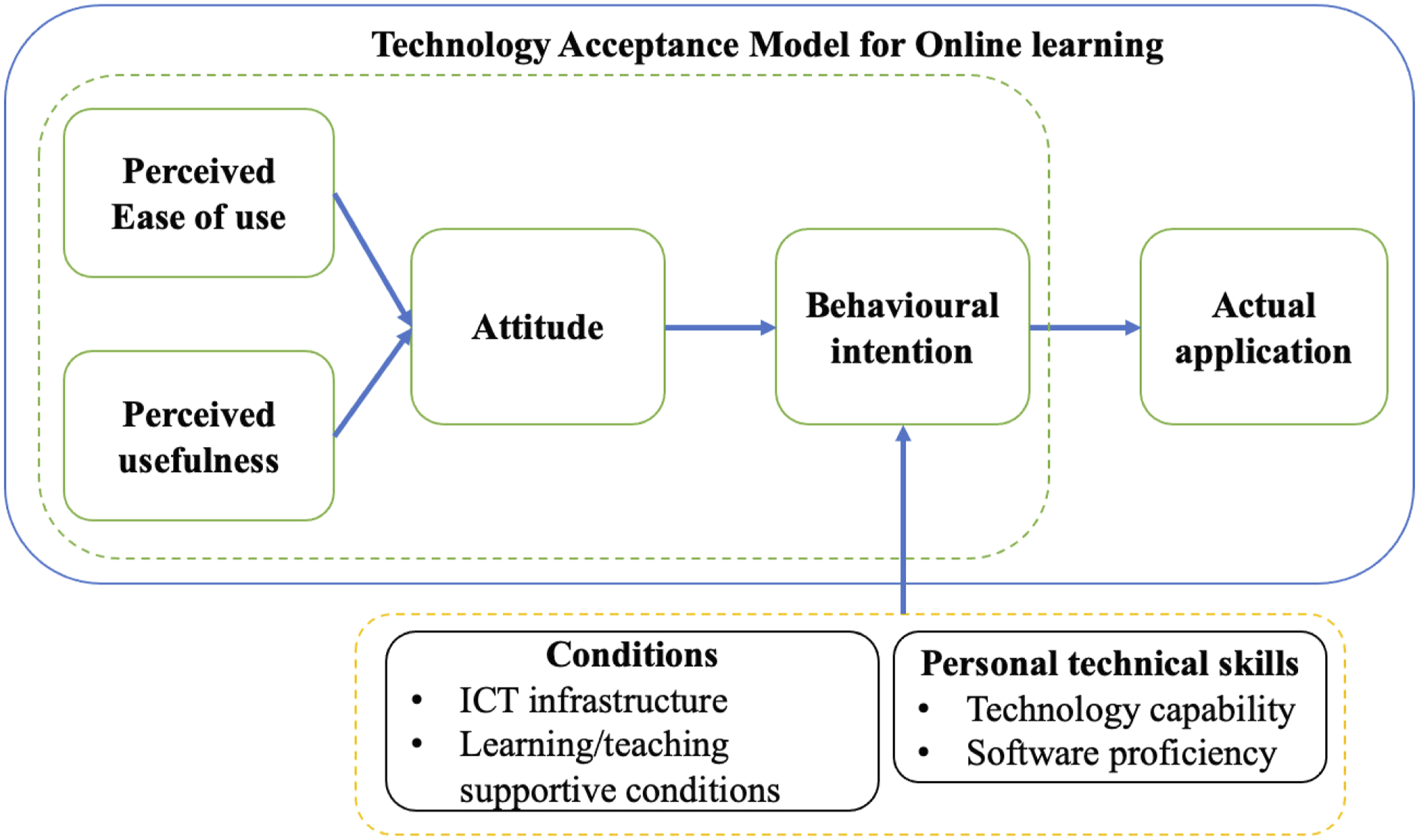
Estimation results
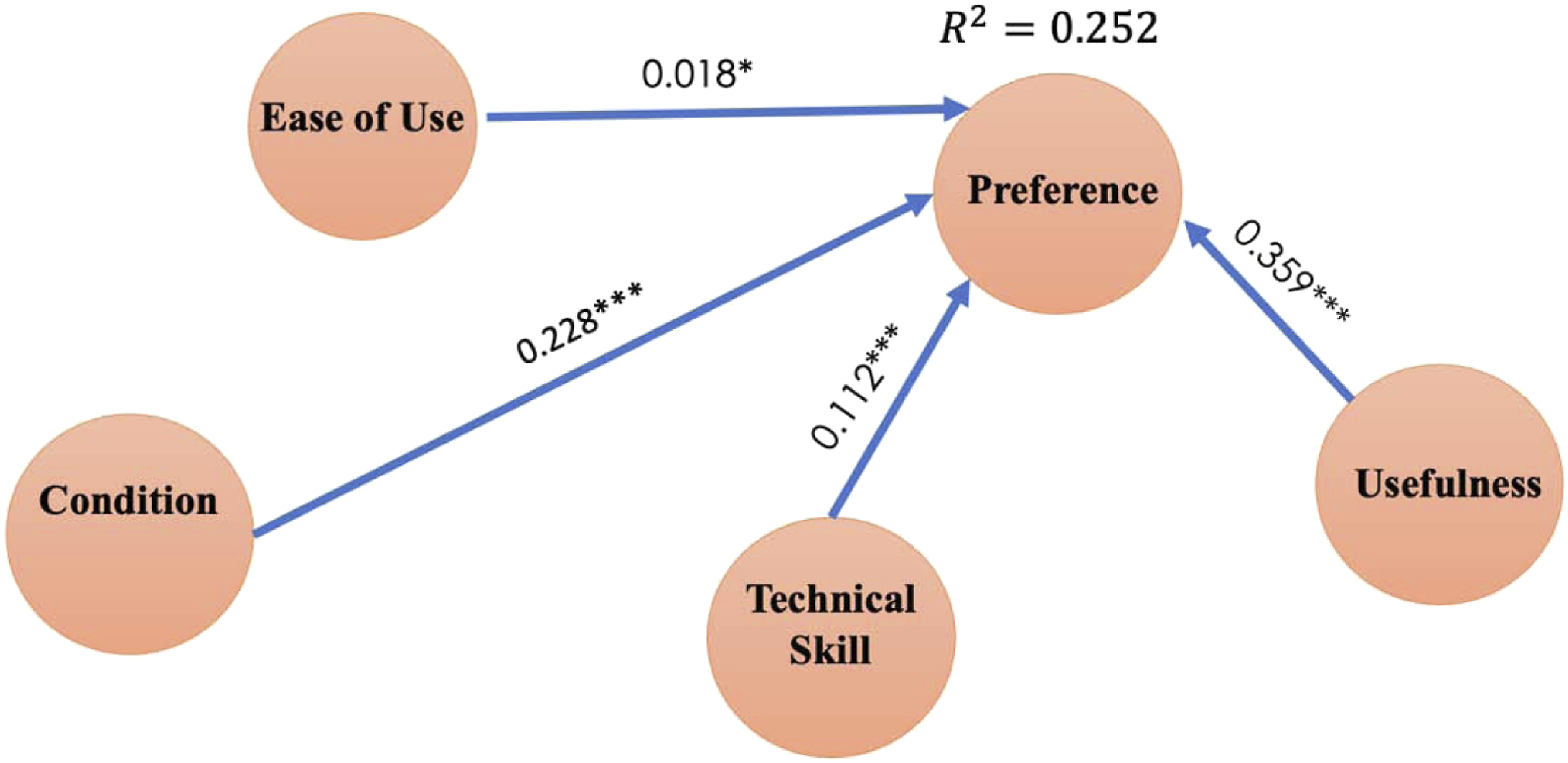
The determinants of students, educators, and administrators’ preferences for online learning are illustrated in Figures 2–4. The explanatory power of the model is evaluated by measuring the discrepancy amount in the dependent variables of the model. According to Hair et al. (2019), the R-square and the path coefficients are the essential measures for assessing the structural model. Although the R-square value of Figures 3 and 4 are not high (0.252 and 0.193), it is acceptable in this study because first, our variables are endogenous latent, so the results range is substantial (Cohen, 1988). Second, our aim is mainly to investigate the association between independent factors and the readiness of using online learning, a high value of R-square does not exactly answer for that purpose (Moksony and Heged, 1990). Additionally, we present the result’s significance via p-value to ascertain that our result is not a chance finding. In scientific research, the smaller p-value is, the more significant the model it presents. The three primary thresholds of p-value are <0.05, <0.01, and <0.001, with the abbreviation in our model as *, **, ***, respectively. Determinants of students’ preferences for online learning. Determinants of educators’ preferences for online learning. Determinants of university administrators’ preferences for online learning.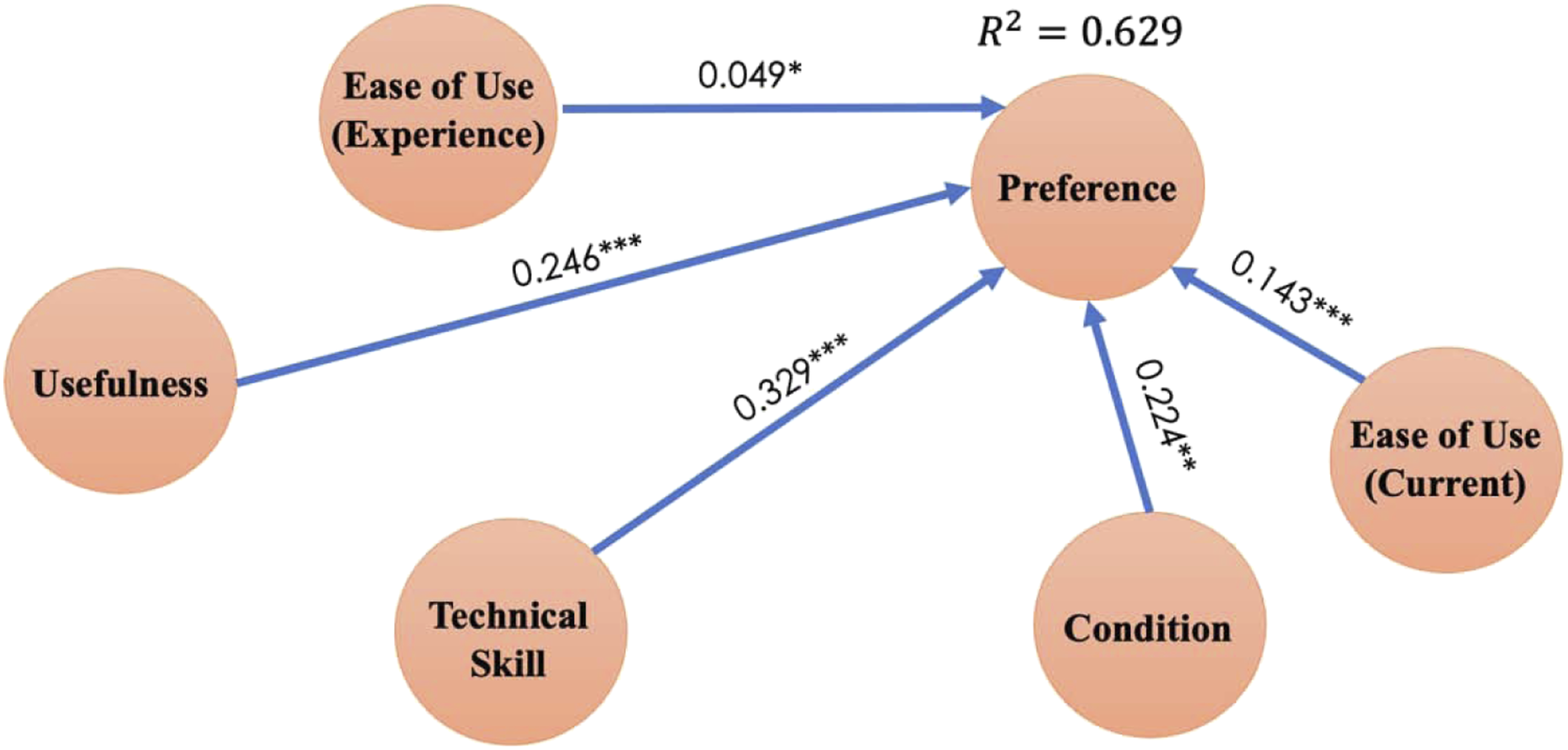
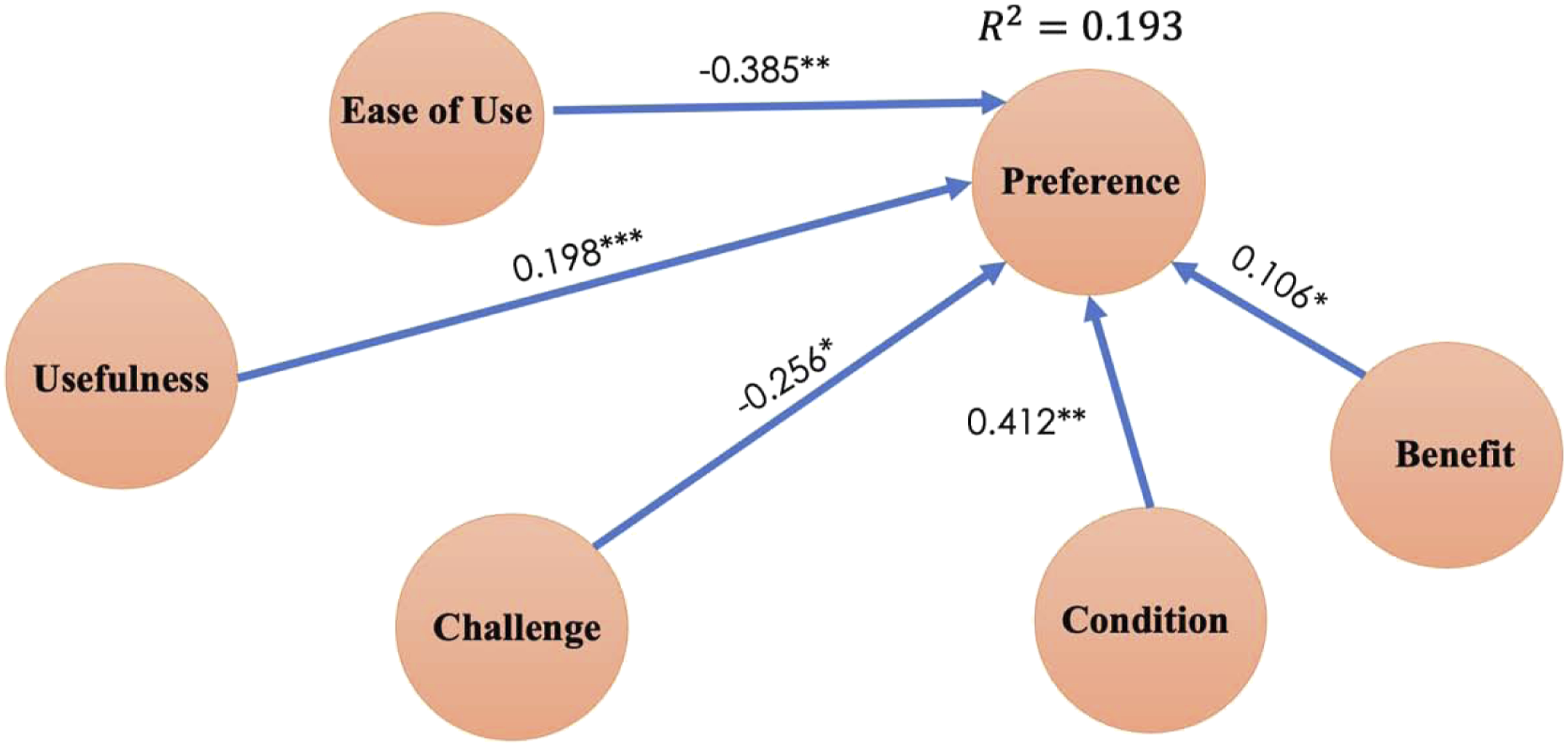
Regarding the model of administrators' preference, we added variables “benefits” and “challenges” to measure the preference to adopt online. This is because compared to lecturers and students, university administrators possess more unique perceptions of online learning. Administrators have to be responsible for designing and facilitating the entire system, so they must stretch themselves to think beyond the benefits and limitations of the online classes (Stanford-Bowers, 2008). Accordingly, variables “benefits” and “challenges” would more strongly motivate or demotivate administrators' adoption than that of students and educators. In addition, compared to the model of students and educators, we did not use the variable “technical skills” because administrators are the ones who assist necessary services in terms of technology to lecturers and students during the transition of online learning (Mishra et al., 2020). Thus, technical skill is considered not necessary in the model of administrators.
Our first hypothesis is successfully indicated via the assessment of students and educators. Sharing the common approach about the ease of using online learning, the perception of students is driven by its catalyst. If the ease comes from experience, its influence on students is not as high as the ease created by the current situation (0.094 in different). It seems that when students have no other learning options during the pandemic, the ease of use will play a more crucial role in their preference. Meanwhile, they could switch to other learning methods in the past, so the ease of use is not strongly considered. Regarding educators, the ease-of-use experiences the least correlation among all factors with the preferences of educators in online learning practices, with the effect value of 0.018. Meanwhile, we find a statistically negative coefficient on administrators, which is against the findings of Hong et al. (2013) and Halim et al. (2016). This can be explained because the ease of use may reduce the online privacy risk to facilitate e-service adoption. This feeling of insecurity towards technology is seemingly associated with the decreased willingness towards online learning of administrators.
Our fourth hypothesis is also proven by our empirical model when conditions for online learning motivate all stakeholders’ fondness for this form of learning. Specifically, the results show that conditions for online learning are the most fundamental factor affecting university administrators’ preference for online learning, with the value of 0.412. Particularly, we employed two extra explanatory factors that are benefits and challenges to observe university administrators’ preference for online learning. While the perceived benefits from online learning motivate administrators' preference for online learning (0.106), challenges in adopting it negatively influence their preference (−0.256).
Comparison between Vietnam and Singapore.
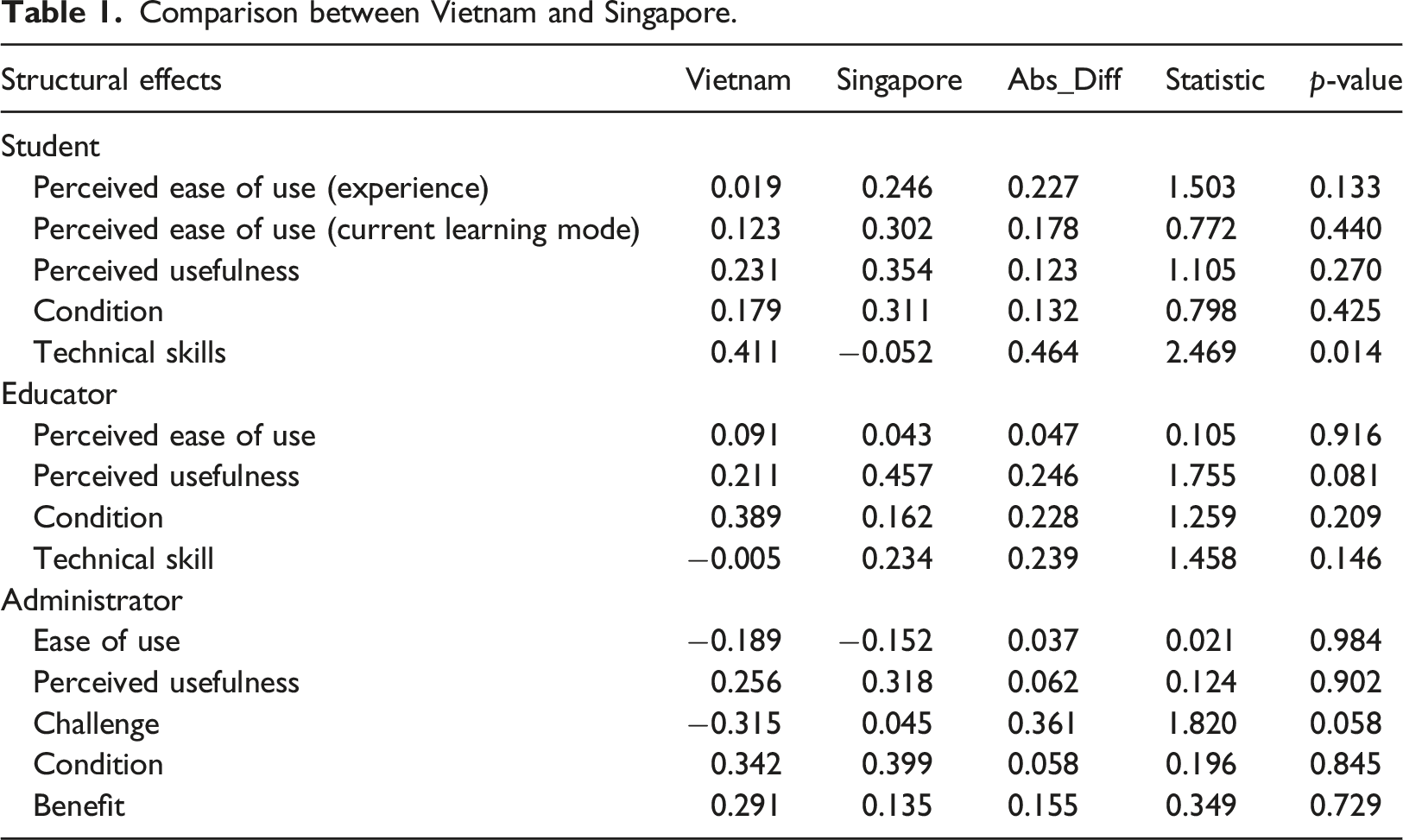
With respect to the view of students, the influence of personal technical skills witnesses the most difference among students in the two countries. While in Vietnam, technical skills have the positive and strongest impacts on Vietnamese participating students (0.411), Singaporean participating students do not consider it as an essential factor and even reveal its negative effects on their readiness (−0.052). The perception of the usefulness of online learning among students in the two countries shares approximate results, only 0.123 difference. Noticeably, the ease of use and learning conditions for Singaporean participating students are more principal than for Vietnamese students’ preference for online learning, with the priority going for the ease of use.
With respect to the opinions of educators, Vietnamese educators perceived learning conditions as the most important (0.389) and technical skills are the least important factor to take into consideration during the course of online learning (−0.005). However, Singaporean educators’ view is different in this regard. For them, the perception of usefulness is the most outstanding factor (0.457), and ease of use stays as the least important factor (0.043). Another difference can be seen from the factor of technical skills. If technical skills allow Singaporean educators to conduct online classrooms better (0.234), it is likely to prevent Vietnamese educators from effectively deliver e-lectures, with a considerably low coefficient at −0.005.
With regards to the perception of university administrators, there are two mutual factors between Singaporean and Vietnamese staff. The first is about the opinion on the ease of use. It is negatively associated with the tendency of employing online learning in both countries, with a higher coefficient goes for administrators in Vietnam. The second is about the most affected factor seen as learning conditions with the value of 0.342 and 0.399, respectively. It is noticeable that the appetite for challenges of Singaporean and Vietnamese staff is different from each other. If Vietnamese staff is not fond of challenges and negatively responds to them (−0.315), it seems more motivated for those Singaporeans to implement online learning (0.045). The perception of the benefit and usefulness are together positive to university administrators of both the two countries.
Discussion
So far, all the proposed hypotheses of the study have been verified. This finding verifies the practicality of our conceptual framework in explaining the preference of universities’ stakeholders towards technological application (online learning).
Regarding students' perspectives, students from two countries admit technical skills have a profound impact on their preference towards online learning. However, our comparison detects a gap in the link of this factor to students in each country. While high-technical skills students from Vietnam find it more motivating to study online, low-technical students from Singapore are the ones who are more in favor of online learning. This may be because if Singaporean students do not feel confident with their computer self-efficacy or other related skills, the university’s service will quickly assist them in their learning process. Hence, it is reasonable for students with insufficient technical skills to feel more encouraged for online learning than higher technically prepared students. This finding again emphasizes the importance of the university’s technical service to the transition of online learning. Should the universities want to sustain the online learning system in the time to come, they should pay more attention and investment in this sector.
The usefulness of online learning is the second most important factor affecting students’ preference for online learning. The empirical result confirms that when students believe in the usefulness of the online learning platform, it will drive their intention to adopt the model. Although some studies show that there are many barriers preventing students from opting for online study in the long run (Muilenburg and Berge, 2005; O’Doherty et al., 2018), our finding indicates that if students are appropriately aware of the helpfulness of online learning, their willingness towards this platform can be enhanced. In order to achieve that, the university administrators need to improve the online system constantly so that the perception of usefulness truly comes from students’ experience, besides word-of-mouth or social media.
Regarding educators, the usefulness of online platforms acts as the most critical factor that motivates cross-countries educators to adopt online teaching. In the past, online courses assisted educators in fulfilling their mission of off-campus teaching (Wallace, 2003). At present, its usefulness continues to encourage them to practice online teaching for their students regardless of geographical constraints within the pandemic.
Additionally, Vietnamese educators are likely to face several difficulties in terms of technical skills, but it does not prevent their preference towards online courses. In our study, Vietnamese educators with low-technical skills are shown to be more excited about the online course, while the high-technical ones express contrastive attitudes. On the other hand, Singaporean educators are more familiar with online teaching platforms because their country has operated online courses since the early 2000s (Lee, 2010). Therefore, Singaporean educators with more computing experience tend to be more ready for the online transition. Overall, it is suggested that educators with humble computing and other related skills should devote more effort in learning at the first stage and better prepare before operating online classes. By doing so, educators having different starting points can still meet special requirements and deliver quality online lessons for all learners.
In terms of virtual learning conditions, the infrastructure to hold online courses was invested a decade ago in Singapore, thus, educators in this country seem to take this factor slightly important in the transition in the time (Tay et al., 2021). Meanwhile, in Vietnam, the investment in online learning is just at the early stage, consequently making educators consider this factor high weight in measuring their preference for online teaching. Given the context, there is a need for a larger budget from the government or funds from investors to upgrade the universities’ facilities and surrounding conditions to lift the willingness of educators and other school members.
Regarding administrators' perception, the condition is unsurprisingly the most vital factor in both countries. It is essential to improve the enablers for administrators to implement online learning systems, such as introducing new mechanisms of income or the norm of working time. It is also worth noticing that challenges separately impact administrators in two countries. While Vietnamese administrators are not the risk-appetite group, Singaporeans seem to be more attracted by challenges. This finding is important in giving suitable managing strategies to the board of directors. Specifically, in Vietnam, the universities' leaders should avoid or mitigate existing barriers during the online transformation. Meanwhile, in Singapore, universities leaders should put certain pressure or challenges towards online learning so that their administrators will be more willing to overcome the issue and participate more actively in the new system.
On the whole, beyond the measurement of factors, the best practice to successfully adopt online learning in universities is the collaboration of all stakeholders, including students, teachers, and administrators with various interests and expertise. Each online course should be carefully designed to fit well within the discipline of the system and the needs of learners and educators.
Conclusion
Our primary goal is to examine the determinants affecting the preference of students, educators, and administrators for online learning in Singapore and Vietnam. To do so, we follow the Technology Acceptance Model (TAM) by Davis (1989) with the main variables consisting of perceived ease of use, perceived usefulness of technology, technical skills, and technical environment. Data were collected from 856 surveys completed by local universities’ students, educators, and administrators. The participants were asked about their engagement in online learning through different factors, namely, ease of use, perception of usefulness, technical skills, and conditions. By employing the PLS-SEM model, we further compare the different preferences among stakeholders in two observed countries for online learning and confirm the differences in students, educators, and administrators’ preferences for online learning. Our second finding shows that the adoption of online learning depends largely on technical skills and the learning/teaching conditions.
The first contribution of our study is the facilitation of a diversified source of literature, thereby offering a more wide-ranging understanding of how factors influence the willingness to learn online of people occupying different positions. The second contribution is the provision of evidence for policy implications in developing countries with different technology bases to sustain the quality of online learning and satisfy stakeholders. As technical skills are the most vital factor, policymakers and senior administrators should have proper assistance and support for their students and educators, especially those with less equipped conditions. Students, educators, and administrators also need to proactively improve their technical skills and be better prepared to confront difficulties and possible future change.
On the whole, it is necessary for stakeholders from the government to universities’ management boards to join hands to discuss multiple aspects of online learning. Additionally, there should exist no borders between nations, regardless of their “developed” or “developing” status, to share experience in building sustainable online systems and making preparations for possible changes in the future.
Our study still faces unavoidable drawbacks. First, R-squared—an indicator for the model’s goodness-of-fit, is estimated at only 0.193 for university administrators' model, which is due to a small sample size of administrators in the two countries. An increase in the sample size should be subsequently undertaken in further studies to enhance our estimate model’s robustness. Second, enabling and appropriate regulations and policies from both governmental and institutional levels, which also play an important role in developing online learning, were slightly mentioned in our analysis.
Footnotes
Declaration of conflicting interests
The author(s) declared no potential conflicts of interest with respect to the research, authorship, and/or publication of this article.
Funding
The author(s) disclosed receipt of the following financial support for the research, authorship, and/or publication of this article: This work was supported by the Vietnam National University, Hanoi (VNU) under project number QG.22.56 (QG.22.56).

Notes
Appendix
Variable
Mean
Explanation
ease1
3,82646
Interface is easy to use
ease2
3,542955
The design is eye-catching and impressive
ease3
3,640893
The illustrations are very detailed and easy to visualize
prefer1
3,762887
Online tools and platforms are easy to use and user-friendly
prefer2
3,652921
Online tools and platforms are effective in helping me learn and understand my course materials
prefer3
3,723368
Online tools are frequently incorporated into my learning
prefer4
3,623711
I am familiar with using the video-conferencing tool
use1
2,862543
More effective in helping me to understand the course content
use3
2,814433
More convenient and flexible
use4
2,878007
I feel more motivated to learn through online learning platforms and tools
use5
3,139175
More efficient
use6
2,823024
COVID-19 has made online learning a viable alternative to classroom learning
con1
3,35567
The quality of internet connectivity in my town is excellent
con2
3,489691
I can find a quiet place for attending online classes
skill3
3,486254
I am adequately equipped with the necessary IT skills to do online learning
skill4
3,594502
I have access to training materials and courses to learn basic computer skills and how to use online learning platforms
skill5
3,348797
I can identify technical problems and know how to solve them
skill6
3,264605
I have been provided with appropriate guidelines to trouble-shoot technical problems
Variable
Mean
Explanation
ease1
3,936364
Interface is easy to use
ease2
3,836364
It meets the needs for me to teach and communicate with my students
ease3
3,618182
The system is stable and does not disconnect frequently
ease4
3,831818
Online tools are frequently incorporated into my learning
use1
2,736364
I continue to communicate with students via emails and learning management platform
use3
2,713636
More convenient and flexible
use4
2,754545
I encourage students to participate actively by switching on their camera and asking questions
use5
2,922727
I include group discussions to increase student interaction during class
use6
2,709091
I think the learning atmosphere improved during online teaching as there is more interaction
use8
2,645455
COVID-19 has made online teaching a viable alternative to classroom teaching
use9
3,200000
My online lectures are designed with lectures, group work and multimedia materials (e.g., videos/slides)
con3
3,772727
A quiet place to conduct online classes
con4
3,818182
I feel assured that my personal information is well-protected while I am conducting online teaching
con2
3,945455
The quality of Internet connectivity in my town is excellent
con5
3,404545
The school should provide clearer online teaching guidelines to teachers
skill2
3,790909
It would be beneficial to assign a teaching assistant to help with online teaching
skill3
3,672727
I have access to training materials and courses to learn basic computer skills and how to conduct online lessons
Variable
Mean
Explanation
ease4
3,092593
More convenient and flexible
ease5
3,388889
More efficient
use1
2,907407
Compared to classroom teaching, students are likely to feel more motivated to learn through online platforms and tools
use2
3,018519
Compared to classroom teaching, teachers are likely to feel more motivated to teach through online platforms and tools
use4
3,222222
COVID-19 has made online teaching a viable alternative to classroom teaching
challenge3
3,685185
Students preference for traditional face-to-face teaching
challenge4
3,666667
Teachers preference for traditional face-to-face teaching
con3
4,351852
Training for teachers to conduct online teaching
con4
4,166667
Training for students to do online learning
con5
4,148148
Raising awareness on the benefits of online learning/teaching
con6
4,444444
A dedicated team to plan and implement strategy for online learning adoption
con8
4,203704
Improve the online learning management platform
con9
4,259259
Invest in training teachers to conduct online teaching
con10
4,296296
Create a dedicated team to strategize and implement online learning adoption
benefit2
3,888889
University will have a better reputation for being IT-savvy and forward-looking
benefit3
3,759259
Overtime, online learning can help the university reduce costs
Variable
Factor1
Factor2
Factor3
Factor4
Factor5
ease1
0,6048
ease2
0,7184
ease3
0,6999
prefer1
0,7831
prefer2
0,789
prefer3
0,7866
prefer4
0,7363
use1
0,7818
use3
0,8241
use4
0,8298
use5
0,6992
use6
0,7614
con1
0,5878
con2
0,582
skill3
0,7014
skill4
0,6202
skill5
0,764
skill6
0,7288
Variable
Factor1
Factor2
Factor3
Factor4
ease1
0,7809
ease2
0,866
ease3
0,729
ease4
0,705
use1
0,7826
use3
0,8351
use4
0,8325
use5
0,7774
use6
0,7592
use8
0,7477
use9
0,6132
con3
0,6703
con4
0,6425
con2
0,6049
con5
0,5395
skill2
0,5933
skill3
0,5321
Variable
Factor1
Factor2
Factor3
Factor4
Factor5
ease4
0,5705
ease5
0,529
useful1
0,8143
useful2
0,7844
useful4
0,5616
challenge3
0,8129
challenge4
0,817
con3
0,8078
con4
0,6876
con5
0,694
con6
0,8102
con8
0,6083
con9
0,8388
con1
0,7652
benefit2
0,6434
benefit3
0,7129