




Abstract
Critical Race Theory (CRT) has recently been positioned as a serious problem requiring urgent policy response among partisan media outlets. Making a case for pressing policy demands, several policy makers have proposed federal, state, and local level legislation and other measures to restrict how race, racism, or American history in general can be taught in K-12 schools, higher education institutions, and state agencies. Anti-CRT rhetoric in media and policy proposals have also propagated the notion of CRT as being divisive as well as ubiquitous in public education. Given this, it is critical to examine whether policy opinions regarding reactionary legislation is based on a real understanding of CRT. We conduct a conceptual and theoretical inquiry into anti-CRT rhetoric relying on the sociological concepts of moral panics and folk devils. Then, we examine familiarity, knowledge, ideology, policy beliefs, and policy opinions regarding CRT in education using nationally representative survey data. The analysis showed that most parents are not familiar with CRT, and the average parent neither opposes nor supports teaching of CRT. The opposition to teaching of CRT is largely driven by political affiliation and related ideological beliefs and positions.
Keywords
Introduction
Critical Race Theory (CRT) is an academic framework developed from the mid-70s onward by the legal scholars and practitioners Derrick Bell, Kimberlé Crenshaw, and others, to study how racism becomes institutionalized in the ideas and routine practices of the legal system and of social organizations (Bell 1995; CrenshawWilliams, 2010; Delgado and Stefancic, 2013, 2017). The theory emerged as legal theorists contended with persistent racism after the civil rights movement ended de jure discrimination, and the framework has since been applied within an interdisciplinary body of scholarship, especially in education (Gillborn, 2005; Taylor et al., 2023) and sociology (Bonilla-Silva, 2015). Until recently, it has largely been limited to academic scholarship within institutions of higher education, but the theory has since become politicized, largely due to an essay published by Rufo (2020a) in the City Journal of the Manhattan Institute, a conservative thinktank. The intention of the article was to position Seattle’s attempts at police reform squarely within the so-called cultural wars, and to argue that Critical Race Theory has informed these efforts and “become a force in progressive politics” threatening the values and safety of American society. After several more articles on the matter, conservative media outlets amplified his core premise to emphasize CRT overtaking government trainings, and not only higher, but also K-12 education. While CRT has never been directly influential on K-12 public school curricula, it has nonetheless been positioned as if it has been, and as if it were a vehicle for anti-white indoctrination.
Making a case for pressing policy demands, several policy makers have since proposed federal, state, and local level legislation and other measures to restrict how race, racism, or American history in general can be taught in K-12 schools, higher education institutions, and state agencies. The CRT Forward Tracking Project (2023), launched by the UCLA School of Law Critical Race Studies Program to track anti-CRT attacks, has determined that “[s]ince September 2020, a total of 214 local, state, and federal government entities across the United States have introduced 699 anti-Critical Race Theory bills, resolutions, executive orders, opinion letters, statements, and other measures.” The accompanying premise for such policy often involves depictions of concerned parents and citizens observing the danger and harm, and demanding policy action. For example, senator Marsha Blackburn (R-Tenn.), who co-introduced a resolution condemning the use of Critical Race Theory in K-12 schools, argues that “[f]or months, parents have raised the alarm about the left’s effort to brainwash children by injecting Critical Race Theory (CRT) into public school curriculum” (2021). The center-right think tank American Enterprise Institute refers to “wave of local grassroots activism by concerned parents” against CRT (Eden, 2021).
Given the assertions that CRT is divisive as well as ubiquitous in education, it is critical to examine whether policy opinions regarding reactionary legislation is based on a real understanding of CRT or a contrived social construction. First, we conduct a conceptual and theoretical inquiry into anti-CRT rhetoric relying on the sociological concepts of moral panics and folk devils. We argue that this deluge of legislative and policy making attempts to ban teaching of race, gender, and other content deemed divisive and controversial from government training and public education—the so-called anti-CRT bills—are examples of bad-faith policies. After our theoretical inquiry, we present analysis of nationally representative survey data collected in 2022 as part of the Understanding America Study (UAS)—one of the largest and most comprehensive surveys on the topic—to provide empirical insight into familiarity, knowledge, ideology, policy beliefs, and policy opinions about CRT in education (Polikoff et al., 2022). The main empirical questions are as follows: How much do Americans know about CRT? Does the perception of their familiarity with it match their actual knowledge of CRT? How common are CRT-aligned views? What are the policy opinions regarding the teaching of CRT in schools? Is there widespread support for or opposition to a CRT ban? How do knowledge, CRT-aligned views, and political orientation influence policy opinions regarding the teaching of CRT?
Literature Review
Policy narratives of moral panics and folk devils
The social construction of policy realities—the idea that the perceptions and interpretations of the policy reality matters for the public policy making process—is a central assumption in narrative policy research (Durnova et al., 2016; Ertas, 2015; Ertas and McKnight, 2019, 2020; Fischer, 2003). Narrative policy scholars are concerned with how narratives affect the public debate as a tool of cultural framing around norms, beliefs, and ideological aspirations and as a related tool of persuasion or manipulation. We argue that Critical Race Theory (CRT) has been strategically pushed as a threat, or in sociological parlance as a “folk devil,” to catalyze a moral panic and to drive policy change to increase social control (Demby et al., 2021; Frank and Laats, 2021). In his book Folk Devils and Moral Panics, the late sociologist Stanley Cohen (2002) defined moral panics in the following terms: Societies appear to be subject, every now and then, to periods of moral panic. A condition, episode, person or group of persons emerges to become defined as a threat to societal values and interests; its nature is presented in a stylized and stereotypical fashion by the mass media; the moral barricades are manned by editors, bishops, politicians and other right-thinking people; socially accredited experts pronounce their diagnoses and solutions; ways of coping are evolved or (more often) resorted to; the condition then disappears, submerges or deteriorates and becomes more visible. (p. 1)
In other words, a moral panic is built on a narrative of widespread but typically irrational fear of an entity posing a threat to the values, safety, and interests of a community or society at large. The concept of the folk devil is central to the theory of moral panics. Folk devils refer to stereotypes blamed for various social problems and perceived, in the context of a moral panic, as posing threats to social values. In theorizing moral panics, Cohen (2002) discussed three strategies employed by the media and moral entrepreneurs 1 to develop moral panics: “(i) Exaggeration and Distortion; (ii) Prediction; (iii) Symbolization” (p. 25). The facts of the controversy surrounding the folk devil are typically distorted, or altogether fabricated, and the seriousness of the events are exaggerated. Further immoral and harmful actions are anticipated, and when discrepancies between expectations and reality occur, elements which confirm expectations are selectively emphasized. Finally, an exclusively negative symbolization in regard to the issue is constructed, where words and images are stripped from their neutral origins and transformed into symbols imbued with danger, fear, anger, and hostility.
Exaggeration, distortion, and symbolization to evoke an emotional reaction are common in the anti-CRT rhetoric. Progressive media watchdog group Media Matters reported that conservative television channel Fox News mentioned CRT 1900 times in less than 4 months in 2021 (Power, 2021). According to PEN America—the advocacy organization that tracks anti-CRT and other educational gag bills in the US—a coordinated legislative campaign appeared right after the nationwide social justice movements and policy demands following the murder of George Floyd in 2020 (PEN America, 2022a). This event has spurred widespread protests in multiple cities, and initiated dialogue regarding the role race and racism play in American history and present society. The origins of the villainization of CRT can be traced back to conservative activist Christopher Rufo’s article about the multi-day protests in the city of Seattle in the aftermath (2022a), his follow-up blog post where he condemns the city of Seattle’s anti-racism seminars as “endorsing principles of segregationism and group-based guilt” (Rufo, 2020b), and a third commentary which he subtly titled “Against Wokeness: Conservatives must understand the threat posed by critical race theory” (Rufo, 2020c). In this piece, he further framed CRT as abandon[ing] the illusion of neutral teaching standards and get[ing] in the trenches of race-based activism. . . . [t]he stated goal is to “advance educational racial equity,” but in practice, these programs often serve to introduce, perpetuate, and enforce a specific ideological agenda.
In his tweets and interviews, Rufo is quite clear about his discovery and rebranding of CRT to catalyze conservative public emotions. In The New Yorker, staff writer Benjamin Wallace-Wells notes that “he thought that the phrase was a better description of what conservatives were opposing, but it also seemed like a promising political weapon,” quoting him saying “(s)trung together, the phrase ‘critical race theory’ connotes hostile, academic, divisive, race-obsessed, poisonous, elitist, anti-American” (Wallace-Bells, 2021). In a series of tweets, Rufo (2021) wrote that [w]e have successfully frozen their brand—“critical race theory”—into the public conversation and are steadily driving up negative perceptions. We will eventually turn it toxic, as we put all of the various cultural insanities under that brand category. The goal is to have the public read something crazy in the newspaper and immediately think critical race theory. We have decodified the term and will recodify it to annex the entire range of cultural constructions that are unpopular with Americans.
The exaggeration, distortion, negative symbolization, and predictions are noteworthy in this revelation.
CRT: History and application in education
What follows is a brief positioning of the history of CRT, specific to the Bell (1995) and Delgado and Stefancic (2013). We will then then provide an example of its influence over educational research via Ladson-Billings and Tate (1995). While these examples are certainly not exhaustive, they will help to frame the trajectory of the discussion to come.
Derrick Bell is widely credited with providing the seed ground for what would eventually be referred to as CRT with his seminal work Race, Racism and American Law (1973). In a 1995 University of Illinois Law Review article, he defines CRT succinctly: critical race theory is a body of legal scholarship, now about a decade old, a majority of whose members are both existentially people of color and ideologically committed to the struggle against racism, particularly as institutionalized in and by law. Those critical race theorists who are white are usually cognizant of and committed to the overthrow of their own racial privilege. (p. 15–16)
As a theoretical model CRT is committed to looking at racism as something embedded in our institutions and providing frameworks for cultural analysis and systemic change. As extension of Bell’s conception, in the introduction to the fourth edition of a well-established edited volume of essays on CRT, first published in 1995, Delgado and Stefancic (2013) state that “CRT begins with a number of basic insights. One is that racism is normal, not aberrant, in American society” (p. 2). Following this CRT proffers That a culture constructs its own social reality in ways that promote its own self-interest, [and] these scholars set out to construct a different reality. Our social world, with its rules, practices, and assignments of prestige and power, is not fixed; rather, we construct it with words, stories, and silence. (p. 3)
It is from this latter point that we can begin to see CRT emerging in education circles as primarily a mode of critique, and a way to frame research toward the development of a more equitable system of education, rather than a vehicle for P-12 curriculum development (Ladson-Billings and Tate, 1995; Zamudio et al., 2011). In a seminal essay Toward a Critical Race Theory in Education Ladson-Billings and Tate state that there are reasons why “discussions of race continue to be muted and marginalized” (p. 47) in discourse surrounding formal institutions of education. They further posit that CRT research frameworks provide “an analytical tool for understanding school inequity” (p. 48). If educational institutions are to be reformed it will require a recognition that these inequities are structural and are rooted in how race has been socially constructed in US society and how it is presently embedded in how access to property parallels access to a quality education. It is this “intersection of race and poverty” (p. 56) that largely drives the present inequitable situation. Relating back to CRT as a mode of research as structural critique rather than a tool for curriculum they draw attention to the inadequacies of multicultural education methods as falling short of pursuing greater degrees of equity precisely because of the structural barriers. It is not that they oppose multicultural education, but that the issues at hand are not simply a matter of superstructural cultural inclusiveness in school curricula and are instead at the social and economic base of how wealth and by extension power operates in a racialized society.
CRT and its critique of education as folk devil
A defining characteristic of moral panic narratives are the discursive contradictions they contain. For example, the issues are presented as new, but also old: as “camouflaged versions of traditional and well-known evils” (Cohen, 2002, viii). The issue and actors involved are presented very harmful themselves, but they are also only warning signs of the real and bigger danger. The problems are presented as easy to see, but also as opaque, where the perils are hidden behind seemingly benign activities and artifacts such as schools and curriculums in the CRT case. Such discursive contradictions are evident in the rhetoric of the legislative attempts seeking to restrict the teaching in public schools. Critical race theory positions narratives concerning education as key in confronting longstanding inequities within institutions of education, but also in the wider society. Per Zamudio et al. (2011), these broadly take three overarching forms. The first involves a critique of liberalism as presenting “an image of society as fair and egalitarian where individuals rise and fall based on their own merits” (p. 15). The second looks at the problematic concept of color blindness, as related to the aforementioned individualism, as it generally ignores issues of institutional hegemony as a continuation of history, and also of identity formation in terms of ourselves and our perspectives of others as provided generationally by larger cultural norms and attitudes. The third, and perhaps most controversial, is related to the idea of whiteness and the history of white supremacy, which corresponds to some of the problems with color blindness in that it ignores not only history, but its evolution concerning entrenched racial and cultural inequities that are historically embedded within economic and social structures. These themes are common in much of the legislation. By way of a prominent example, CS/HB 7 (2022), or the Stop WOKE Act (which stands for “Stop Wrongs to Our Kids and Employees”) passed in Florida proffers common mischaracterizations and direct attacks on the intentions of CRT without defining terms or providing examples. For example, it prohibits the teaching of “[s]uch virtues as merit, excellence, had work, fairness, neutrality, objectivity, and racial colorblindness are racist or sexist” (pp. 4–5), conflating a kind of equality with language designed to avoid responsibility for contemporary manifestations of past transgressions in favor of ideological positions that emphasize colorblindness and meritocracy. Similarly, Texas (S.B. No. 3., 2021) legislation adds the notion that “the advent of slavery in the territory that is now the United States constituted the true founding of the United States” (S.B. No. 3., p. 8) to the restricted content by specifically referencing and prohibiting teaching of Hannah-Jones et al. (2019) 1619 Project, a series of essays examining the legacy of slavery in the U.S. published and promoted by the New York Times. Similar to most other legislative proposals, Mississippi’s proposal has CRT in its title, but contains no discussion or definition of it in the body of the document (Alfonseca, 2022). These discursive contradictions with regards to opacity of the threat, and the negative villanization based on emotional language suggest that the anti-CRT policy proposals are built, not on real concerns, but on bad-faith arguments meant to provoke fear of a straw man—the anti-white and anti-American indoctrination by teachers.
Data and methods
We used data from the Understanding America Study (UAS), which is administered by the Center for Economic and Social Research (CESR) at the University of Southern California (USC), to answer the empirical questions. The UAS is a longitudinal panel survey study designed to track Americans’ knowledge, opinions, and behaviors on several topics to provide insights and information to policy makers and researchers. Participants use computers, tablets, or smartphones to anonymously answer the UAS survey questions. 2 The UAS479: Topics in School sample used in this study is drawn from participants in Wave 29 of the UAS tracking survey, administered from August to September 2022 (Polikoff et al., 2022). The survey team invited equal numbers of households with and without at least one child attending public school at the K-12 level to participate in the survey. A total of 3,751 adult US residents responded to the survey, resulting in an overall response rate of 83.95%. All analysis use UAS provided weights. The UAS uses a two-step process to generate sample weights, first by computing base weights to correct for unequal probabilities of sampling UAS members, and then by generating post-stratification weights to make the sample representative of the US population of adults along gender, race and ethnicity, age, education, and census regions. 3
The main purpose of the analysis is to examine knowledge, political views, and policy opinions regarding CRT. When appropriate, relevant statistical significance tests are used. Since this is a weighted design, for numerical measures, adjusted Walt tests, and for categorical measures, design-based F tests—a corrected weighted Pearson chi square statistic—were applied (Long and Freese, 2014). Finally, multinomial regression models are used to examine whether knowledge, CRT-aligned views, or political orientation influence support for or opposition to a CRT ban. In addition to the baseline model, a second model controls for demographic variables, and a third model includes an interaction term between knowledge and political affiliation to check whether increased knowledge of CRT has different effects on policy positions by political affiliation.
Results
Familiarity with and knowledge of CRT
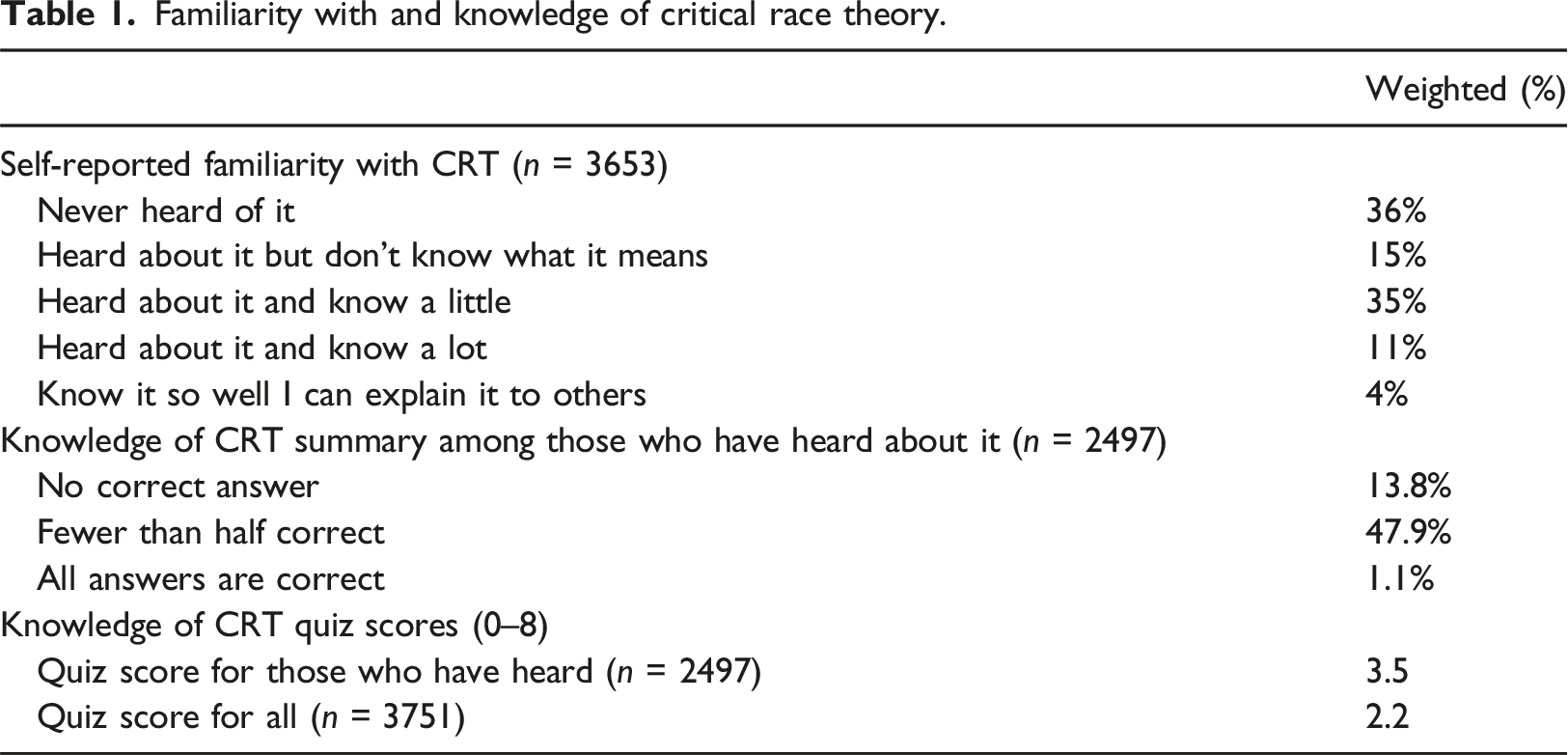
Familiarity with and knowledge of critical race theory.
Next, we turned our attention to how accurately respondents can identify the tenets of CRT. The UAS survey team included the following four statements that reflect different tenets of CRT and four statements that contradict the theory (Saavedra, 2022, p. 30): 1. Racism is central to U.S. life (Centrality of racism). 2. In the U.S., people mostly succeed because of how institutions (e.g., government and corporations) help or hinder their progress (U.S. non-meritocratic). 3. The people who have power in U.S. society are those who own property (Property as power). 4. White people support social changes that benefit non-white people only when those changes also benefit them (Interest convergence). 5. In the U.S., people mostly succeed because of how hard they work (U.S. meritocratic). 6. White people should feel guilty for the historical acts of their ancestors (White guilt). 7. Our goal as a society should be to treat all people the same without regard to the color of their skin (Colorblindness). 8. Some races are naturally superior to others (e.g., in terms of intelligence and physical abilities) (Racial superiority).
In parentheses are the corresponding political terms to which the item aligns according to the UAS team (Polikoff et al., 2022; Saavedra, 2022, p. 30). Statement 5 to 8 are not aligned with CRT. Items 6 and 8 are common mischaracterizations of CRT that can be observed in anti-CRT legislation. Statement 6 aims to capture the notion of “white guilt” and statement 8 the notion of “racial superiority” (Polikoff et al., 2022). The remaining two items 5 and 7 refer to ideas CRT seeks to disrupt. According to CRT, the dominant discourse of meritocracy is used to sustain denial about systematic, institutional, and structural forms of injustice (CrenshawWilliams, 2010). CRT also critiques the idea captured in statement 7, reasoning that “awareness of and explicit accounting for race is central to correcting for racism and racial bias in the United States” (Polikoff et al., 2022). Those who reported having heard of CRT are asked whether each statement aligns with Critical Race Theory. Respondents could answer “Yes,” “No,” or “I don’t know.”
An overall knowledge quiz score is calculated by assigning 1 to each correct answer and 0 to each incorrect answer and don’t know response, so this score ranges between 0 and 8. Overall CRT knowledge quiz scores are very low. Only about 1% were able to correctly identify all the tenets, almost half got fewer than half correct, and about 14% were not able to identify any tenet correctly. Among those who report being familiar, the average quiz score was 3.5 out of 8. When we assign a knowledge score of 0 to those who reported having never heard of CRT, the average knowledge score for the entire sample drops down to 2.2.
When individual quiz items are examined, 20%–40% of respondents chose the “I don’t know” option on any given item. The item that respondents performed the best on were “Some races are naturally superior to others,” with 57.4% of respondents correctly identifying it as not aligning with CRT. However, this also means that over 40% of individuals did not know or incorrectly attributed the racial superiority argument, a mischaracterization commonly intimated by the language used in anti-CRT laws (Polikoff et al., 2022), to CRT. The item that was hardest for respondents, with only 16.3% of sample correctly identifying it as not aligned with CRT, was the colorblindness statement. Polikoff et al. (2022) noted that CRT “critiques colorblindness, maintaining that awareness of and explicit accounting for race is central to correcting for racism and racial bias in the United States” (p. 10). Over 80% of the sample who claimed to have heard of CRT either did not know that colorblindness is not aligned with CRT or incorrectly thought that it was.
CRT knowledge by familiarity.
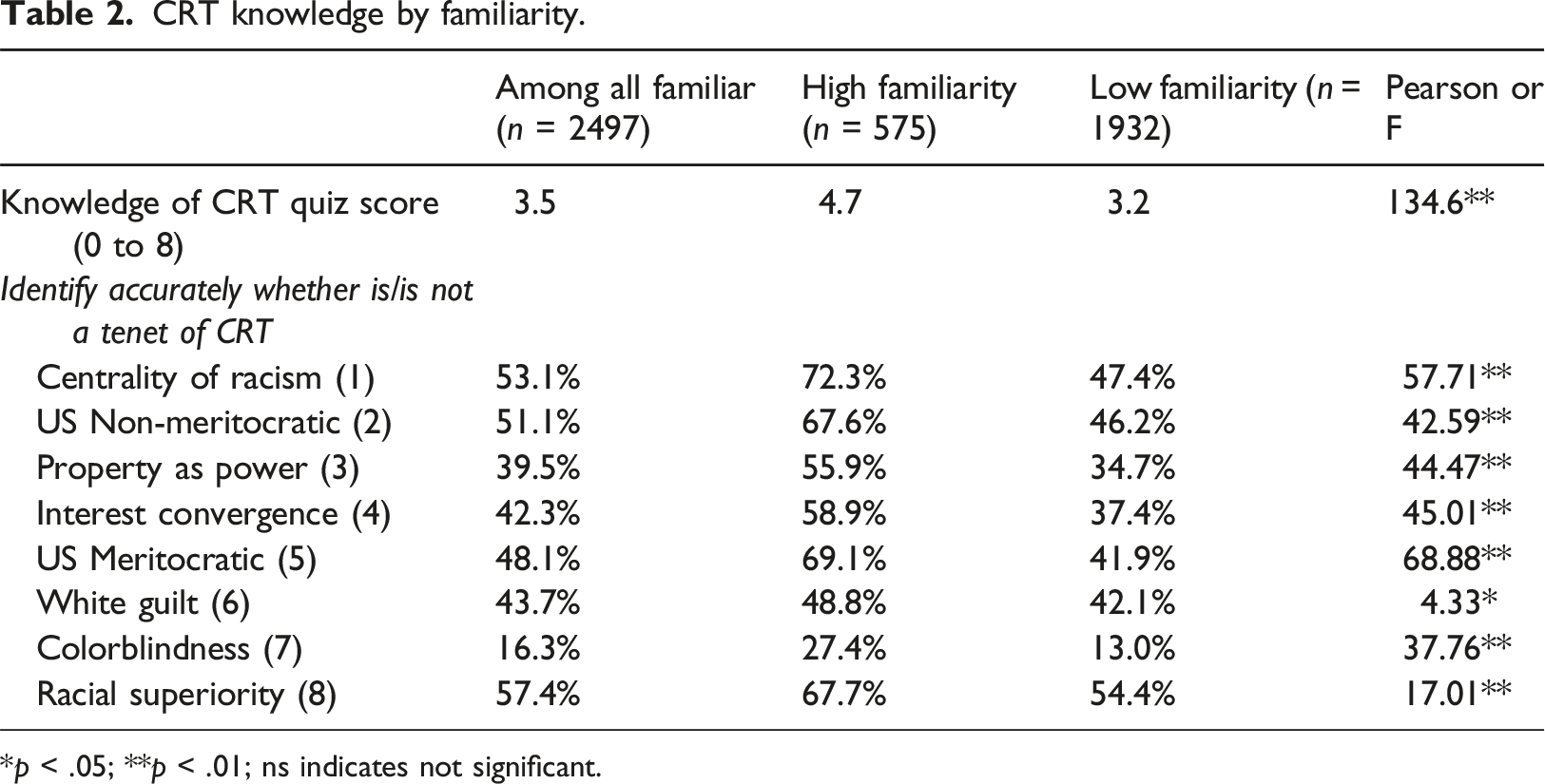
*p < .05; **p < .01; ns indicates not significant.
The UAS records gender as male or female (Saavedra, 2022). For race, respondents chose from among White (1); Black (2); American Indian or Alaska Native (3); Asian (4); and Hawaiian/Pacific Islander (5). If the respondent answered “Yes” to at least two of the single race categories, they are coded by the UAS as Mixed (6) (Saavedra, 2022). There is a separate question that indicates whether the respondent identifies themselves as being Hispanic or Latino. Based on these two variables, a minority variable is created and takes the value 0 for non-Hispanic whites and 1 for everyone else. The UAS asked about partisan affiliation at the survey’s end, after all the substantive questions. The question’s text reads: “Regardless of if or how you are registered to vote, are you more closely aligned with Democrats, Republicans, Independents, Libertarians, Green Party, some other party, or not aligned?” If respondents chose “independents (no political party)” or “not aligned with any political party,” they were prompted again: “Generally speaking, do you lean more toward affiliating with Democrats or with Republicans?” and coded as leaning toward affiliating with Democrats, leaning toward affiliating with Republicans, or not leaning toward either party (Saavedra, 2022). By combining responses to both, a 3-category political affiliation variable is created to indicate whether the individual leans Democratic, Republican, or neither.
CRT-aligned political views
Next, we examined how common CRT-aligned views were. The UAS asked about the extent to which the respondents personally agreed with each idea were able to answer with 1 Strongly disagree; 2 Disagree; 3 Agree; or 4 Strongly agree (Saavedra, 2022). An additive index was created using these eight items. Since the last four items do not align with CRT, the answers are first reverse coded so that higher values on the index indicate higher alignment of personal views with CRT. Cronbach’s Alpha is .68, so this scale has relatively good internal reliability. The majority of Americans (63.5%) scored between the 25th to 75th percentile in the mean alignment index distribution.
CRT-aligned views by familiarity and partisan affiliation.

p < .05; **p < .01; ns indicates not significant.
Policy opinions regarding a CRT ban
To investigate support for a CRT ban, respondents were asked “To what extent do you support or oppose the teaching of Critical Race Theory in schools?” and answer categories included Strongly oppose (1); Oppose (2); Neither oppose nor support (3); Support (4); Strongly support (5) (Saavedra, 2022). We created a 3-category variable by combining values indicating opposition and support. There is no widespread opposition or support for teaching of CRT in schools. A plurality of Americans (47.8%) as well as parents (50.6%) are unsure whether CRT should be taught in schools, about 28% indicated opposition and 23.5% indicated support. The largest difference in policy opinions was by partisan affiliation. While a plurality of all subgroups chose neither oppose nor support, this is not the case for Republican-leaning individuals. About 55% of Republicans, compared to 9% of Democrats, oppose teaching of CRT in schools. While 40.4% of Democratic-leaning individuals support teaching of CRT in schools, the corresponding percentage for Republican-leaning individuals was only 5.4%.
We estimated three multinomial regression models to examine policy opinions regarding teaching of CRT. Multinomial regression models are used to model polytomous nominal outcome variables (Long and Freese, 2014). The first model examines knowledge, CRT-aligned views, and partisan affiliation as predictors of policy opinions, and then the second model also incorporates education, race, gender, parental status, and age. In the third model, interactions are added to test whether the relationship between knowledge and policy opinion was different for Republicans, Democrats, and those identifying with neither party. According to Louviere et al. (2000), “values of rho-squared McFadden’s pseudo R2 between 0.2 and 0.4 are considered to be indicative of extremely good model fits” (p. 55), and the models seem to have reasonably good fit. The entries in the table are estimates in the form of risk ratios—the exponentiated coefficient commonly interpreted as odds ratios—of several predictor variables for opposition or support of teaching of CRT, in comparison to having no opinion. The standard interpretation of an odds ratio above 1 indicates a positive effect, whereas below 1 indicates a negative effect (Long and Freese, 2014).
Modeling policy opinions regarding teaching of CRT.

“Neither” is the base outcome. Odds ratios and robust standard errors are reported. ^ p < .10; *p < .05; **p < .01.
Since increased knowledge is associated with both increased support and increased opposition, and the probability of opposition differ significantly by political affiliation, the third model—in addition to controlling for gender, race, education, age, and parental status—includes an interaction term between knowledge and political affiliation to check whether CRT knowledge has different effects on policy positions for Democrats, Republicans, and independents. The interaction term for Republicans is significant for opposing teaching of CRT, but not for supporting it. An average Republican-leaning individual is 3.5 times as likely to oppose teaching of CRT as an average Democrat. For every one unit increase in knowledge, the average Republican’s likelihood of opposition increases by a factor of 1.37 (p < .01). In other words, the difference in opposition between Republicans and Democrats widens as CRT knowledge increases. There is no significant overall effect for those who identify themselves as neither Democrat- nor Republican-leaning, however the significant interaction suggests that the effect of knowledge on opposition—but not support—matters for the unaffiliated (RRR:1.22, p < .05).
While statistical significance suggests that there are genuine differences, it does not provide information on substantive or practical differences. To aid with interpretation, we also estimated average marginal effects (AMEs). On average, Republicans’ probability of opposing teaching of CRT is 35 percentage points higher than it is for Democrats. The probability for opposition for those who identify with neither Republicans nor Democrats was on average 13 percentage points lower than their Democratic-leaning counterparts. While the AMEs produce a single estimate of the marginal effects, the regression results suggest that the effect of partisan affiliation on policy opinions may vary with knowledge. To check whether partisan differences are smaller or larger for people with different levels of knowledge, we also estimated marginal effects at representative values (MERs). The visual in Figure 1 shows how the marginal effect differs considerably by knowledge. Differences between Republicans and Democrats for both opposition and support increase with knowledge. Full knowledge of CRT increases the marginal effect for support from 19.6 to 56.7 percentage points for Democrats, and only from 7.5 to 8 percentage points for Republicans. Predictive Margins for partisan affiliation by knowledge.
Discussion and conclusion
These findings are in line with our main argument that the so-called anti-CRT policies are intentionally built on bad-faith arguments, not real concerns. While the controversy is built on the notion that CRT is taking over government and schools, the average American has never heard about CRT, and examination of their knowledge about specific traits of CRT reveals that many Americans know less than they report knowing. Contrary to the media portrayal of upset parents demanding bans, most parents are also not familiar with CRT, and the average parent neither opposes nor supports teaching of CRT. The policy position regarding opposition to teaching of CRT is largely driven by political affiliation and related ideological beliefs and stances. All other things being equal, Republican leaning individuals tend to oppose teaching of CRT more than Democrats. More knowledge increases the probability of opposition to teaching of CRT—dramatically so for Republican-leaning individuals, and somewhat for independents, presumably because they are exposed to repetitive, exaggerated, and negative coverage of its seriousness, reach, and harm via partisan media outlets (Cohen, 2002; Power, 2021).
These findings are not surprising. First, while not discussed in this paper due to space limitations, the data also show that many Americans, including parents, do not know what is currently being taught in schools, and there is widespread agreement for students learning about the causes and consequences of racial inequality and income inequality, especially at the high school level. Second, CRT is an advanced level academic theory, taught mostly in law schools and graduate-level programs in universities, and had remained in relatively obscurity until the polemical anti-CRT narrative was concocted and magnified in partisan media outlets. Third, the emergence of CRT in public discourse has been via an abrupt, deliberate, and politically manufactured policy narrative, which exhibits typical characteristics of a moral panic. So why care if the policy problem is manufactured?
This insight is crucial for understanding not only the current polarized debate around CRT in the United States, but also the broader consequences of “ideological and magical solutions” for perceived “problems” in education and social policymaking globally (Ball, 1998: 119). The global education policy landscape has long been subject to a neoliberal transformation which prioritizes private markets over state control and redefines education as a commodity whose purpose is to prepare students to be competitive in the global economy This vision often involves more surveillance of teachers and students, and control of curricula and teaching at the level of policy and practice has long been a central strategy towards such commodification of education. The moral panic theorists articulate that the moral narratives are manufactured and utilized by politicians, media, and corporate interests to manipulate public emotions, which, in turn, are used to justify policymakers responding to the invented threat with new legislation and policy. The new policies often form the basis of a culture of increased social control and are directly related to political power (Cohen, 2002). Specific folk devils would likely get recontextualized in adaptation to local political architectures, policy traditions, and historical legacies, and these adapted localized moral panics may be exploited by bad-faith actors as a means of justifying increased social control and surveillance over curriculums, teachers, and schools.
Recognizing the recontexualized folk devil and pushing back against bad policy that advances nothing connected to a recognized objective of broader public interest, equality, and justice remain a central task for critical education scholars in different geographies (Stewart et al., 2017). In Pedagogy of the Oppressed, Paulo Freire (1970) advocated for educational encounters that liberate and empower learners to critically engage with their own reality. He envisioned the role of the teacher as problem poser who enables students to explain their life experiences and become critically aware of the structures of oppression. It is through this that education can be a tool of social transformation. Manufactured moral panics are tools to interrupt and prevent this dialogue and the implications of acquiescence are dire. Punitive measures create pressure on educators to avoid teaching critical topics related to race, gender, history, and inequality, creating a chilling effect on open and constructive discourse within educational settings. Censorship leads to the stigmatization of specific subjects or perspectives, removal of diverse viewpoints, and sanitized educational environments. In summary, a manufactured threat diverts attention and resources away from genuine problems related to equality and power, as it erodes civil liberties and trust in public education institutions.
As Ira Shor (1992) once observed “if education was irrelevant to power, it would be regulated less” (p. 196), which is why resistance is warranted concerning political preempting of honest historical discourse. In other words, confronting policy based on fabricated public problems rooted political ideology and the desire to maintain power is critical to pursue honest policy solutions. Education, politics, and hegemony are inevitably related and that is why resistance is warranted concerning the political preempting of honest historical discourse. The irony is that the goals of CRT include fostering a deeper understanding of the US’ racist past and its legacy, which is precisely why it is being maligned by those whose ideological position is to thwart greater public understanding of this knowledge.
Footnotes
Declaration of conflicting interests
The author(s) declared no potential conflicts of interest with respect to the research, authorship, and/or publication of this article.
Funding
The author(s) received no financial support for the research, authorship, and/or publication of this article.
Disclaimer
The project described in this paper relies on data from survey(s) administered by the Understanding America Study, which is maintained by the Center for Economic and Social Research (CESR) at the University of Southern California. The content of this paper is solely the responsibility of the authors and does not necessarily represent the official views of USC or UAS. For any questions or more information about the UAS, contact Tania Gutsche, Project and Panel Manager, Center for Economic and Social Research, University of Southern California, at
