



Abstract
A key factor of semi-presidential regimes is power-sharing mechanisms between president and government. Influenced by Shugart and Carey’s seminal work on premier-presidential regimes, this article addresses intra-executive dynamics in light of recent scholarship on the risks and consequences associated with conflict and cooperation between the president and the cabinet. Through an in-depth comparison of three premier-presidential systems with broadly similar constitutional designs, Finland, Lithuania and Romania, it forces us to reconsider how coordination mechanisms and political context shape presidential influence. Absent of a working constitutional division of labour and established modes of intra-executive coordination, presidents are more likely to use alternative channels of influence – such as the strategy of ‘going public’ or direct contacts with political parties, the legislature or civil society stakeholders – and to intervene in questions falling under the competence of the government. Lack of institutionalized coordination also benefits the presidents as they hold the initiative regarding cooperation between the two executives.
Introduction
Understanding variation in president–cabinet relations in semi-presidential and presidential regimes, and to what extent this variation matters, are at the core of contemporary research on constitutional regime types (Åberg and Sedelius, 2018). Matthew Shugart and John Carey’s (1992) seminal study paved the way for this literature by making careful distinctions – anchored in neo-Madisonian theory about institutional origin and survival – between parliamentary, premier-presidential, president-parliamentary and presidential regimes. Especially for semi-presidential regimes where a directly elected president shares executive power with a prime minister (PM), president–cabinet relations are a very delicate matter indeed and ‘a primary challenge of constitutional design must be to establish a clear division between the authorities of head of state and head of government’ (Shugart and Carey, 1992: 56).
Largely influenced by the work of Shugart and Carey, a number of studies have established that conflict between the two executives is to be expected under semi-presidentialism – both in premier-presidential regimes (where the cabinet can only be dismissed by the parliament) and president-parliamentary regimes (where both the president and the parliament have the formal power to dismiss the cabinet) (e.g. Beuman, 2016; Elgie, 2018; Protsyk, 2005, 2006). Intra-executive conflict is associated with negative outcomes such as cabinet instability (Sedelius and Ekman, 2010) and disruptive policy making (Lazardeux, 2015, 2017). A largely neglected variable in the comparative literature, however, is the institutional instruments for coordinating policy and executive leadership between the president and the cabinet. Shugart and Carey (1992: 59) indeed acknowledged the risks associated with constitutional ambiguities where presidents ‘may attempt to avoid conceding leadership of the executive by exercising extraordinary legislative authorities’. Yet we still know very little about the extent to which coordination mechanisms between the two executives vary among semi-presidential countries, and more importantly, how such variation may influence the balance of power between the two chief executives. To be clear, we do not expect coordination mechanisms to be more important than key institutional variables, such as presidential powers or electoral and party system dynamics. But we do argue that typical president/cabinet conflicts over policy, legislation and appointments may in fact be manifestations of coordination problems.
Apart from facilitating beneficial outcomes, effective coordination mechanisms reduce uncertainty and ‘can provide a salient point of reference for politicians who acknowledge the rules of the game’ (Shugart and Carey, 1992: 61). Institutions can thus make a difference in that they induce actors otherwise driven by self-interest towards a ‘problem-solving’ mode characterized by cooperation and search for mutually beneficial solutions (e.g. North, 1990; Scharpf, 1989). And in line with the ‘logic of appropriateness’ (March and Olsen, 1989, 2006), stable and repeated coordination should also over time strengthen the socialization effects of institutions whereby both executives, their offices, and other stakeholders become accustomed to certain ‘ways of doing things’ and perceive regular coordination as the appropriate course of action.
Against the backdrop of existing data on presidential powers and levels of intra-executive conflict, and drawing on unique interview data in three premier-presidential countries – Finland, Lithuania and Romania – this article examines institutional instruments used for coordinating relations between the president and the cabinet. We have chosen to compare three premier-presidential countries, as this enables us to explore how the presence or absence of such instruments is related to the power balance and level of conflict inside the core executive. While the three countries have rather similar constitutional designs, they at the same time represent variation regarding presidential powers, level of intra-executive conflict and political context. Finland is a stable democracy with a highly institutionalized political system, where a constitutional reform implemented in the 1990s resulted in a significant weakening of its historically strong presidency. Lithuania, on the contrary, is a young democracy with a largely personalized political culture but has generally functioned with few instances of severe intra-executive conflict. Romania, finally, has faced more severe transitional difficulties and has struggled with disruptive policy making, widespread corruption and several instances of intense conflict between the president and the government. As explained in the third section of this article, the constitutional powers of the president are somewhat stronger in Lithuania and Romania than in Finland.
While acknowledging the importance of key variables such as presidential powers, party politics or political culture, this study will dig deeper into institutional design at the level of practices, routines and coordination instruments between the executives, that is, at a level where comparative research is currently lacking on systematic and empirical knowledge. By utilizing interview data with key civil servants and politicians, and official documents, we are able to reach ‘behind the scenes’ to explore the relative importance of coordination mechanisms vis-à-vis other more frequently addressed variables. Moreover, these unique data enable us to understand the interplay between institutional design at the operational level with the basic constitutional rules of premier-presidential regimes.
In the next part, we set the theoretical framework of our study by addressing the incentives and disincentives for conflict and cooperation in premier-presidential regimes. We then identify various coordination instruments relevant to the interaction between the president and the PM. The subsequent sections present our data and a condensed contextualization of the Finnish, Lithuanian and Romanian regimes from the 1990s to the 2010s. The empirical analysis is structured around the presence or absence of coordination mechanisms identified in the theoretical section. Our main argument is that absent of a working constitutional division of labour and established modes of intra-executive coordination, presidents are more likely to use alternative channels of influence – such as the strategy of ‘going public’ or direct contacts with political parties, the legislature or civil society stakeholders – and to intervene in questions falling under the competence of the government. Lack of regular, formal coordination mechanisms thus produce higher levels of presidential activism. Lack of institutionalized coordination will also benefit the presidents as they hold the initiative regarding cooperation between the two executives. In the conclusion, we sum up our main findings and discuss the general implications of our study for the wider literature on regime types and semi-presidential systems – also in light of Shugart and Carey’s seminal work.
Theoretical Framework: (Dis)Incentives for Cooperation and Coordination
Conflict and Cooperation in Premier-Presidential Regimes
Semi-presidential regimes encompass vast differences on the precise relationship between the cabinet and the president. Instead of splitting semi-presidentialism into a myriad of sub-categories, Shugart and Carey (1992) provided an operative categorization of semi-presidential regimes by distinguishing between premier-presidential regimes and president-parliamentary regimes.
In this study, we focus only on premier-presidential regimes. However, also within that category, we find considerable variation regarding presidential powers. Finland’s 2000 constitution, for example, provides the president with formal prerogatives, particularly through co-leadership of foreign policy, that are just a little more than those of a ceremonial figurehead. Other examples from Europe include Bulgaria, Slovakia and Slovenia. A potential risk is that weak and marginalized, yet directly elected, presidents can seek to compensate their limited powers with obtrusive behaviour, especially given that presidents are typically more popular than PMs. The presidents’ greater popularity may be attributed to their limited powers. They have projected themselves to be above party politics, being somewhat elevated from the usual political quarrels. PMs, on the contrary, exercise their power in areas of controversy, such as social and economic policies, thereby further eroding their popular support. The paradox, however, is that presidents may feel that their popularity does not translate into political influence. When seeking ways of converting their perceived prestige into actual power, they may publicly criticize the government by leaning on the popular mandate. The literature is full of examples of such behaviour (Sedelius, 2006).
When the government is clearly dominant, also the PM can feel no need for coordination beyond perhaps the president’s office receiving information about governmental decisions and policies. In general, the president and the PM should thus have stronger incentives for cooperation where there is a more balanced distribution of power between the government and the president and if the two executives share powers in particular policy areas. Under such power-sharing there are simply more issues subject to joint decision making. To be sure, there are simultaneously also more possibilities for disagreement and conflict, which raise the need for regular and well-defined coordination in order to facilitate successful policy making. Indeed, there may be good reasons for politicians motivated by re-election or policy influence not to enter into cooperation or, despite coordination mechanisms, to ‘go public’ with their opinion differences, especially when the two leaders represent different ideological blocs (cohabitation). For example, Lazardeux (2015) shows that in France winning presidential elections, the main prize in French politics, has shaped the strategies of both executives despite active intra-executive coordination.
Regardless of the exact powers of presidents, presidential activism tends to be higher when the country is experiencing political turbulence, with low level of societal consensus or weak governments (e.g. Tavits, 2009). These considerations are particularly relevant for the younger democracies in Central and Eastern Europe, where surveys show high levels of public trust in the presidents but outright distrust in other political actors such as the PM and the parties. Apart from societal context and party system factors, we also expect to find variation between issue areas. Coordination is expected to be most advanced in foreign and security policies, including European Union (EU) affairs, issue areas where it is often emphasized that disunity at home should not undermine success abroad (Raunio and Wagner, 2017).
Coordination Mechanisms
Figure 1 summarizes our basic theoretical argument. We understand cooperation mechanisms as intervening variables positioned between key explanatory factors derived from previous literature (constitutional powers, party politics, societal context) and the level of presidential activism and distribution of power inside the executive. This in turn is expected to affect the level of president/cabinet conflict and overall leadership capacity. The more regular and institutionalized the coordination mechanisms are, the stronger their effect should be.
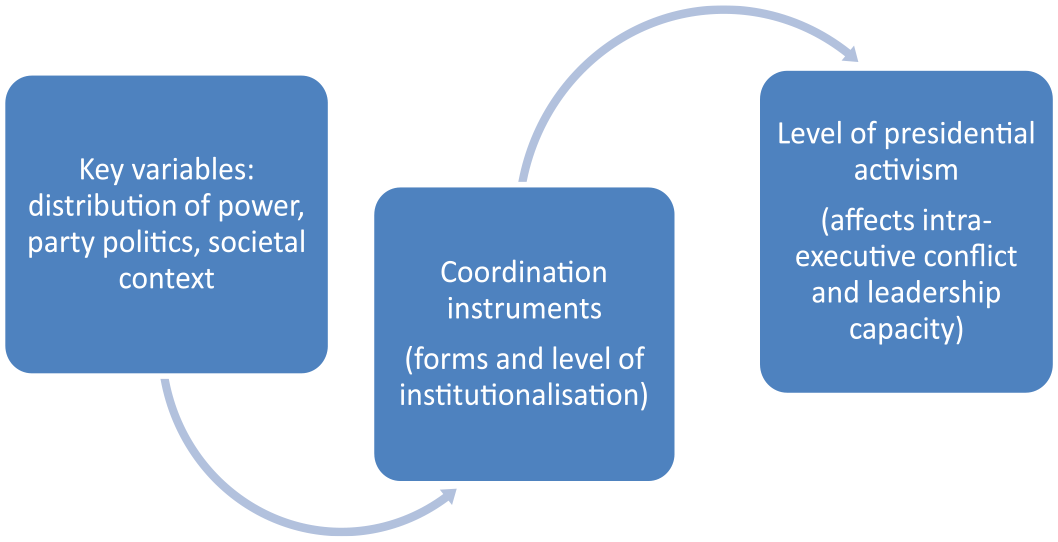
Theoretical argument: coordination instruments and political outcomes.
We argue that coordinative institutions can make a genuine difference: individual officeholders are constrained by them, especially when the mechanisms have become more entrenched and recognized as legitimate by the actors involved. In contrast, when coordination instruments do not exist or are weak, then both executives have more freedom of manoeuvre. Without regular coordination, particularly the presidents are more likely to use alternative channels of influence – such as the strategy of ‘going public’ or direct contacts with political parties, the legislature or civil society stakeholders – and to intervene in questions falling under the competence of the government. Furthermore, ad hoc practices are likely to favour the side that enjoys agenda-setting powers and can thus choose or at least strongly influence the levels and forms of coordination.
We need, finally, to outline how we define coordination instruments. We focus on three levels of coordination – bilateral (between the president and the PM), collective (between the president and the government) and administrative (between the offices of the president and the PM and the ministries) – while also differentiating among policy areas. We introduce the coordination instruments one-by-one, identifying also their predicted roles in intra-executive coordination (Figure 2).

Coordination instruments between the president and the cabinet.
Bilateral Meetings Between the President and PM
We assign particular importance to confidential exchanges between the two leaders that form the core of intra-executive coordination. Hence, this type of coordination is in the centre of Figure 2, whereas the other mechanisms should on average be less crucial particularly in terms of solving intra-executive conflicts. Regular talks between the president and the PM enable them to learn about each other’s preferences, negotiation styles and personalities. Such face-to-face contacts should ideally take place before the president meets the whole government or before either side meets foreign leaders or attends international or EU meetings. In this way, potentially sensitive issues can be discussed in private and even if no compromise is found, both leaders can agree on how to proceed with these matters. However, it is unlikely that laws would regulate such bilateral meetings and thus they can be particularly vulnerable to break down after the election of new officeholders.
Ministerial Committees or Joint Councils Between the President and the Government
As the literature on coalition governments shows, ministerial committees perform an important function in both cabinet decision making and as a conflict-resolution mechanism (Müller and Strøm, 2000; Strøm et al., 2008). These ministerial committees typically bring together a sub-set of ministers from all coalition parties and they deal with specific issue areas such as economic policy or European policy. The powers and composition of the ministerial committees are normally regulated by laws or even by constitutions, with more detailed rules found in the government’s rules of procedure. In policy areas where the president shares power with the government, mainly in foreign and security policy, such ministerial committees would enable both sides to keep track of developments and to exchange ideas before the formal decision-making stage. Various joint councils would on average have a more informal status. These councils would again bring together the president and ministers to discuss specific societal issues such as education or economy. They could also take the form of periodic meetings between the whole government and the president that would focus perhaps mainly on topical issues.
National Security, Foreign Policy or EU Affairs Councils
External relations were identified as a policy area where directly elected presidents not only have constitutional powers but where countries are expected to act with one voice. National security councils or equivalents often have a central role in defining and planning the countries’ security and military strategies. They can simultaneously facilitate intra-executive coordination, but who chairs such bodies can be a delicate question. Naturally, ministerial committees can also be established to examine foreign and security policy and indeed European matters. EU affairs pose particular challenges for coordination, especially as the development of the Common Foreign and Security Policy (CFSP) means that national foreign and security policies – areas where presidents enjoy constitutional powers – are increasingly linked to European-level policy processes (Raunio, 2012). Hence, whether the president is involved in or excluded from the national EU coordination system can have broader implications for leadership in foreign affairs.
Administrative Coordination Between the Offices of the PM and the President
Moving away from the explicitly ‘political’ coordination to the administrative level, we are interested in the interaction between the respective offices of the president and the PM. Comparative literature suggests that the role of top-level administrative elites has become more important over the decades. Political leaders have typically two categories of staff working for them: civil servants that work for the state and political staff that come and go with individual officeholders. The PM’s office oversees and coordinates activities in the ministries while handling central governmental communication. Particularly the political staff provides policy advice to the PM or the president, including in foreign and security policy, and can be key players in solving disputes between different branches of government (e.g. Eichbaum and Shaw, 2014; Gherghina and Kopecký, 2016; Marland et al., 2017; Mitchell, 2005; Yong and Hazell, 2014).
Regular coordination between the staffs of the PM and the president should facilitate successful cooperation between the two executives. However, the size and responsibilities of the president’s staff can also be important variables in shaping the role and influence of the president. Even when the president’s office is small, the presidents can compensate this with recruiting personnel that focus on specific policy areas, including those falling in the competence of the government. For example, a policy adviser in economy can provide crucial information to the president and can form contacts with the relevant ministry and parliamentary committee – thereby seeking to win support for the positions and initiatives of the president. Furthermore, an effective communication staff can be of substantial help in spreading the word about president’s views and activities.
To sum up, the weaker the presence of such coordination mechanisms, the more there is space and need for presidential activism: direct contacts to individual ministers and party leaders, the parliament and its party groups, with the president building these contacts to ‘stay in the loop’ of governmental activities and to influence decision making in the cabinet or the legislature. Presidents are in most cases elected as candidates of a particular political party or coalition of parties, and hence ties to those parties should naturally be stronger than to the competing parties. Weaker coordination should also increase the likelihood of the president criticizing the cabinet publicly.
Three Cases of Premier-Presidentialism: Finland, Lithuania and Romania
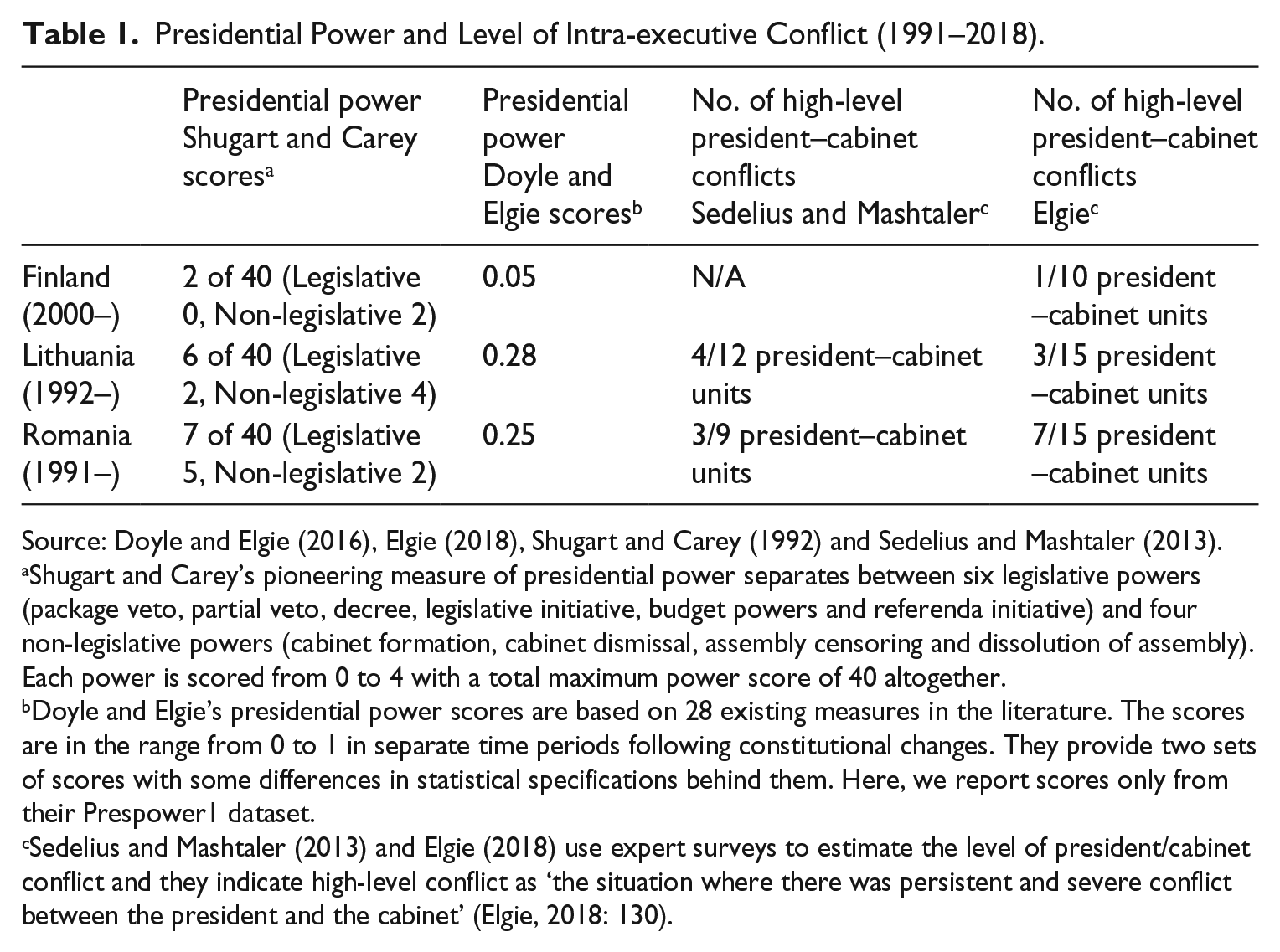
As explained in the ‘Introduction’ section, our three cases represent different semi-presidential experiences: a stable political system and the considerable weakening of a historically strong presidency in Finland from the 1990s onwards, general intra-executive stability under a personalized political system in Lithuania and stronger presidential influence, personalized politics and high institutional tensions in Romania. The constitutional prerogatives of the president are stronger in Lithuania and Romania than in post-2000 Finland (Table 1), but in all three countries, foreign policy is either led by the president (Lithuania and Romania) or co-directed between the president and the government (Finland). Lithuania and Romania share the legacy of systemic communism, the subsequent transition to democracy and market economy in the 1990s and the EU and NATO (North Atlantic Treaty Organization) accession processes in the 2000s.
Presidential Power and Level of Intra-executive Conflict (1991–2018).
Source: Doyle and Elgie (2016), Elgie (2018), Shugart and Carey (1992) and Sedelius and Mashtaler (2013).
Shugart and Carey’s pioneering measure of presidential power separates between six legislative powers (package veto, partial veto, decree, legislative initiative, budget powers and referenda initiative) and four non-legislative powers (cabinet formation, cabinet dismissal, assembly censoring and dissolution of assembly). Each power is scored from 0 to 4 with a total maximum power score of 40 altogether.
Doyle and Elgie’s presidential power scores are based on 28 existing measures in the literature. The scores are in the range from 0 to 1 in separate time periods following constitutional changes. They provide two sets of scores with some differences in statistical specifications behind them. Here, we report scores only from their Prespower1 dataset.
Sedelius and Mashtaler (2013) and Elgie (2018) use expert surveys to estimate the level of president/cabinet conflict and they indicate high-level conflict as ‘the situation where there was persistent and severe conflict between the president and the cabinet’ (Elgie, 2018: 130).
However, the selection of cases is also based on the fact that these countries embody various patterns of intra-executive dynamics and conflict. Table 1 reports the level of president/cabinet conflict as measured by Sedelius and Mashtaler (2013) and Elgie (2018). Both studies are based on expert surveys although Elgie covers a longer period and a larger set of countries, including Finland. Romania has clearly experienced more instances of intra-executive conflict than Finland and Lithuania. Already at the beginning of the transition period, there was intense conflict culminating in violent demonstrations between President Ion Iliescu and PM Petre Roman. Cohabitation in Romania has tended to generate conflict and has twice, 2007 and 2012, ended in impeachment procedures against the president. Although the president’s role in policy making is restricted to foreign and security matters, Romanian presidents to date have exercised substantial influence over the whole political process. Presidential involvement is facilitated by Article 80(2) of the constitution, according to which the President of Romania shall guard the observance of the Constitution and the proper functioning of the public authorities. To this effect, he shall act as a mediator between the Powers in the State, as well as between the State and society.
Reflecting the French model of semi-presidentialism, the idea is that president is above the parties and in that capacity responsible for the smooth functioning of the political system.
As with other Central and East European contexts, scholars have characterized the political systems in Lithuania and Romania in terms of personalization and relatively low levels of institutionalization (Crowther and Suciu, 2013; Duvold and Jurkynas, 2013). A high percentage of citizens appear to favour the presidency over other institutions, including the PM and political parties (Ekman, 2014; Ekman et al., 2016). Despite its formally weak powers, the presidency is considered in both countries as the big prize for ambitious political leaders, which enhances the importance of personalities. In this sense, there is a presidentialization component involved where political parties have often been organized around individuals with political ambitions related to personal interests and to the presidency (cf. Samuels and Shugart, 2010).
Expert Interviews and Data
Our data and analysis cover the period from early 1990s to 2018. We use official documents, secondary material such as politicians’ memoirs and research literature, and particularly interview data with top-level civil servants and politicians sitting on firsthand knowledge on the inside structures and processes of president–cabinet relations. The experts on each country were contacted in order to collect information on how the semi-presidential systems have worked in practice with regard to intra-executive relations and coordination mechanisms. Having charted the existence of coordination mechanisms, the key objective of the interviews was to establish the actual role and importance of these institutions. The topic is obviously quite sensitive and the interviewees were willing to speak only under the condition of anonymity. A total of 10 persons were interviewed in Finland, 9 in Lithuania and 12 in Romania. Many of them had experience of intra-executive coordination under two or more presidents. The positions of the interviewees include current and former high-level civil servants, counsellors and advisors in the offices of the president and the PM, speakers and members of parliament (MPs), and ministers including one former PM. 1
Empirical Analysis
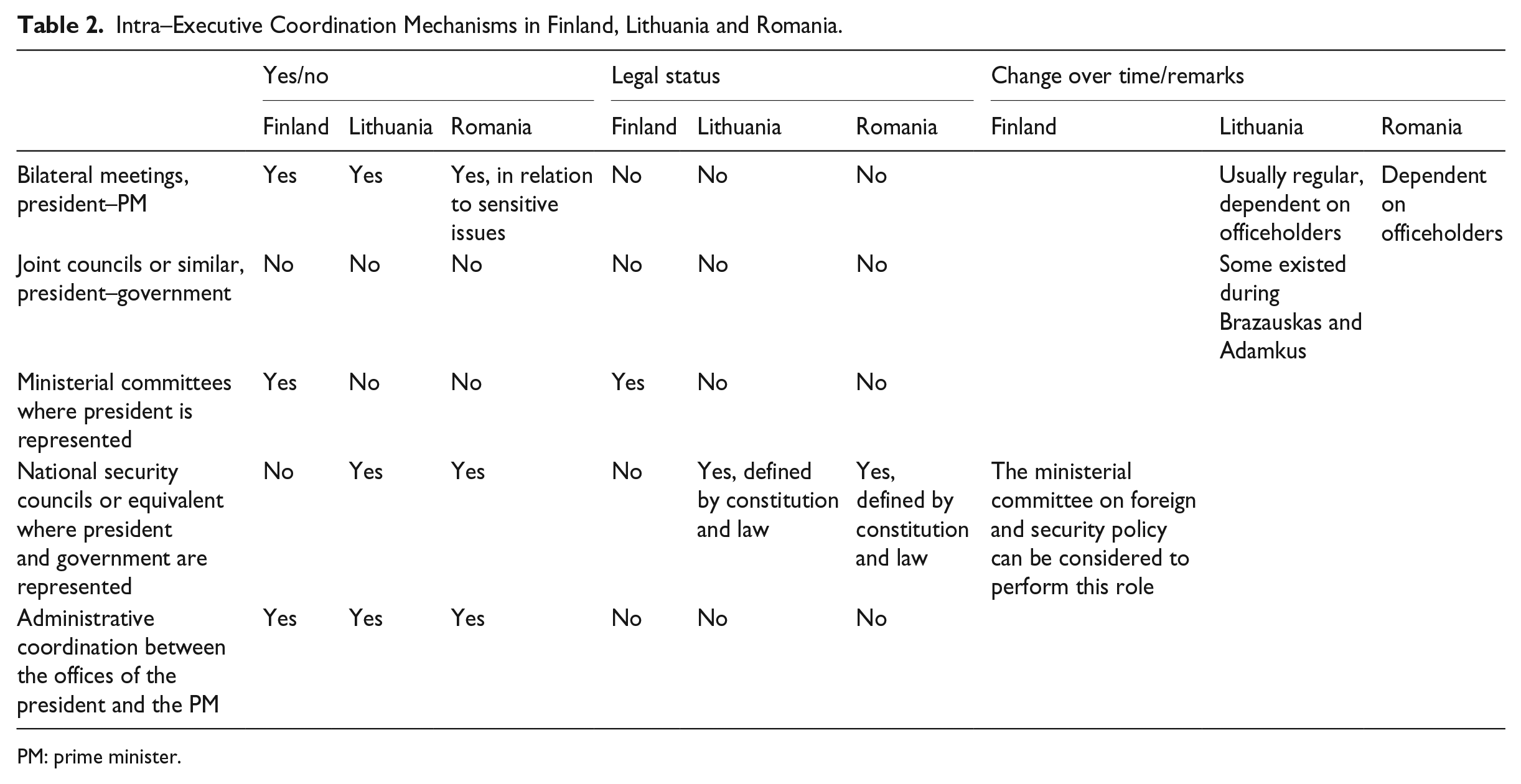
Our comparison of coordination mechanisms reveals significant differences between the three countries (Table 2). Given space limitations, the analysis focuses purposefully on uncovering patterns of coordination and behaviour in Finland, Lithuania and Romania, with concrete examples of intra-executive conflict or presidential activism only used to illustrate or highlight particular country-specific developments. 2
Intra–Executive Coordination Mechanisms in Finland, Lithuania and Romania.
PM: prime minister.
In our theoretical framework, we assigned particular weight to bilateral, confidential exchanges between the two leaders. In Finland, the system has remained the same ever since the new constitution entered into force in 2000. The president meets the PM essentially on a weekly basis, on Fridays before the plenary of the government and a potential meeting of the Ministerial Committee on Foreign and Security Policy. These bilateral meetings are very short, lasting normally at most half an hour. While not based in any law or decree, the meetings have become an established practice not dependent on individual officeholders. No PM or president has questioned their importance and legitimacy, and it is very likely that such action by either executive would be strongly criticized by the political and administrative elites and the media.
In Lithuania and Romania, on the contrary, much depends on the party-political context and the presidents that have the initiative regarding such meetings. In Lithuania, the presidents have by and large met PMs regularly, but presidents have also opted not to have such bilateral talks. For example, President Dalia Grybauskaitė met the PM almost weekly, but for 6 months in 2016, there were no regular meetings with the PM. Also during the presidencies of Algirdas Brazauskas and Valdas Adamkus, the regularity of meetings varied. Overall, out of our three countries, the importance of party politics and especially cohabitation is definitely strongest in Romania, and this is also displayed in bilateral exchanges. Such interaction is certainly smoother and more active when the president and the PM share the same political affiliation (e.g. between Nicolae Văcăroiu and Ion Iliescu, Victor Ciorbea and Emil Constantinescu, and Emil Boc and Traian Băsescu). In such circumstances bilateral talks can take place weekly or even more often, and should be understood in the overall context of the president being actively involved in the work of his party. When the president and the PM come from opposing ideological camps, cooperation is less regular and has been in several instances clearly hampered by tensions between the two leaders. For example, in spring 2018, cooperation between President Klaus Iohannis and PM Viorica Dăncilă was difficult, with Iohannis accusing the PM of avoiding contacts.
None of the countries employ more permanent joint councils that would bring together the president and members of the government. Finland is the only country utilizing ministerial committees, with the president chairing the Ministerial Committee on Foreign and Security Policy. Meeting regularly, it performs an important function in the co-leadership of foreign and security policy between the president and the cabinet. In Lithuania, presidents Brazauskas and Adamkus made use of some more short-term councils, and obviously presidents from all three countries have at different time points set up various working groups or brought together relevant stakeholders to discuss a range of topics.
In the realm of security and defence policy, the situation is very different, with each country having decision-making bodies that bring together the president and the government. In all three countries, the president and the foreign minister also maintain regular contacts. As discussed above, in Finland, the Ministerial Committee on Foreign and Security Policy can be considered to perform a coordinating role in security policy, as the committee deals with all issues related to Finland’s foreign and security policy, defence matters included. In Lithuania, the functions and competence of the State Defence Council are defined in the constitution and the Special Law on State Defence Council. Romania also has a similar special coordinating authority, the Supreme Council of National Defence (CSAT). Furthermore, in line with Article 87 of the constitution, the Romanian president can chair those sessions of the full government where national security issues are on the agenda. Notably, the president needs to be invited to such meetings, and hence the frequency of the presidential sessions of the government depends not only on external developments but also on relations between the PM and the president. It is important to note that in all three countries, it is the president who chairs the security councils. This clearly strengthens the position of the president both regarding when meetings are held and actual decision making in the sessions.
Finally, turning to administrative coordination, there is less variation between our three cases. This is of course logical when considering that in all three countries, the two executives essentially need to exchange information in order to facilitate decision making in matters where both the president and the PM are involved, such as appointments. Given that in all three cases the president either leads foreign and security policy or at least co-directs it with the government, it is not surprising that such administrative coordination is most developed in external relations. Presidential offices are also in very active contact with the foreign ministry, as in all three countries the foreign ministry is mainly responsible for handling day-to-day administration regarding foreign policy: communication with other countries and international organizations, preparing national positions, particularly those to be presented in the Foreign Affairs Council of the EU and planning state visits abroad.
The analysis so far shows that Finland has considerably more intra-executive coordination mechanisms, particularly through bilateral exchanges between the two leaders and through the Ministerial Committee on Foreign and Security Policy. Lithuania and Romania have less such institutionalized cooperation instruments, and hence we should thus expect higher levels of presidential activism in these two countries. In Finland, the deliberate and consensual process of constitutional reform in the 1990s continues to shape the role of the president. Under the old constitution, and notably during the long reign of President Urho Kekkonen (1956–1981), it was customary for the president to intervene in domestic matters. Against the backdrop of such presidential activism, a broad understanding emerged around the need to constrain the presidency so that the government and the Eduskunta would be responsible for domestic and EU affairs while presidential influence would be limited to the field of foreign and security policy. The public seems to favour a stronger presidency, but by and large it is not considered appropriate for the Finnish president to become involved in matters falling under the jurisdiction of the government. This applies particularly to government formation, as one of the key factors contributing to the position of Kekkonen was his ability to basically dominate government formation processes, cherry-picking PMs and vetoing ministerial candidates and even the inclusion of whole parties in cabinets. In the twenty-first century, it is expected that the president does not intervene in any way in cabinet formation, although the president is consulted about the choice of the foreign minister. Presidents normally do not comment on ongoing government formation talks beyond perhaps expressing the hope that the talks are not delayed too much. Nor do Finnish presidents really publicly criticize the government. For example, when the social democratic President Tarja Halonen shared power with centre-right PMs from 2003 to 2012, she often emphasized different topics in her speeches, but even in case of open clashes, such as over civil service appointments or representation in the European Council, she mainly refrained from publicly attacking the government. The exceptions are issues falling under the foreign policy co-leadership between the president and the government, where Halonen and particularly President Sauli Niinistö have on rare occasions publicly questioned the comments made by cabinet ministers.
In Lithuania and Romania, on the contrary, it is certainly both legitimate and appropriate for the president to both ‘go public’ and to interfere in matters that constitutionally belong to the competence of the government. Government formation is crucial here, as each Lithuanian and Romanian president has tried to influence the selection of premiers and other cabinet members, while also using public pressure to force PMs to resign. In both countries, presidents routinely attack the PM and the government in their public speeches and interviews, including even in official addresses delivered in the parliament. Here the presidents, as guardians of national interest above the dirty deals and shady bargaining of party politics, benefit from the low trust in parties and political institutions. For example, in Lithuania, President Adamkus resorted twice to high-profile television speeches when forcing PMs Gediminas Vagnorius (1999) and Brazauskas (2006) to resign from office. President Grybauskaitė in turn has essentially in all her State of the Nation addresses criticized the government or the Lithuanian political system at large.
In Romania, presidential activism has been facilitated by the above-mentioned constitutional clause, according to which the president ‘mediates’ between state institutions. Our analysis and earlier literature on Romanian politics clearly show the challenges caused by this constitutional clause. In the impeachment cases against Băsescu, the president was accused of misusing his ‘mediating’ role. His political opponents argued that Băsescu had maintained too close ties to his own party and had unnecessarily interfered in the work of the government and the legislature (Gherghina and Miscoiu, 2013; Perju, 2015). In both countries, cohabitation reduces presidential influence and makes it substantially more challenging for the president to use informal party channels, but at the same time it contributes to the presidents making active use of other avenues such as public speeches. Presidents are also more likely to resort to direct contacts with political parties, the state administration and civil society actors when they do not have friendly majorities in the parliament. The best example comes from the turbulent presidency of Băsescu. When relations with PM Călin Popescu-Tăriceanu soured, the president did not hesitate to repeatedly attack the premier and his cabinet in public. According to the comparative study of Elgie (2018: 127–149), this cohabitation produced one of the highest levels of intra-executive conflict across the examined 21 European countries. However, during the premiership of Emil Boc from 2008 to 2011, Băsescu’s position was indeed very strong and this period probably was the peak in the ‘presidentialization’ of Romanian politics so far. But when forced to share power with PM Victor Ponta from 2012 onwards, Băsescu had little choice but to accept a more limited role during the final 2 years of his presidency.
At the same time, it is important to go beyond cohabitation when assessing the role of political parties in facilitating or hindering presidential influence. In all three countries, the president as the head of state is not formally a member of any party, but here we see notable variation. Romanian presidents, notably Iliescu and Băsescu, have been quite openly involved in the work of their parties: the presidents have attended various party congresses, maintained in general close ties with their parties and even campaigned in favour of their parties in parliamentary elections. In Lithuania, such party ties are much weaker, although we must remember that two of the three presidents, Adamkus and Grybauskaitė, were elected into office as independent candidates. In Finland, the non-involvement of presidents in party politics is strictly observed. The Lithuanian and Romanian examples also illustrate how ‘outsider’ presidents, such as Constantinescu and Iohannis, have found it much more difficult to shape politics than incumbents that have long experience from party politics.
The policy ambitions of the president are clearly reflected in the size and functions of the respective presidential offices. The Finnish president has a very small office and it is clear that the president is strongly dependent on preparatory work carried out by the government. In Lithuania and Romania, in turn, the presidential staff has performed a key role in facilitating presidential activism and also policy influence. The staff of each Lithuanian president has comprised also or even mainly policy advisers in areas falling under the competence of the government – including social policy, economic policy, education, culture, religion and so on. In late 2018, the office of President Grybauskaitė brought together 50 persons under the following organizational headings: Economic and Social Policy Group (8 advisors); National Security Group (4); Press Service (11); Education, Science and Culture Group (5); Legal Affairs Group (5); Domestic Policy Group (2); Foreign Policy Group (10, four of whom work for the Protocol Division); and the Office of the Chancellor (5). In Romania, the advisors to the president cover essentially all policy sectors. Apart from the President’s Cabinet and the General Secretariat, in late 2018 the presidential administration was divided into the following departments: National Security; Foreign Policy; European Affairs; Legislative Affairs; Relations with Public Authorities and Civil Society; Domestic Politics; Institutional and Constitutional Reform; Economic and Social Policies; Culture, Religion and Centenary; Public Health; Education and Research; Relation with Romanians Abroad; Public Communication; and Protocol. Each department is headed by a presidential advisor and has roughly three to five employees that essentially come and go with each president. Altogether around 200 persons work for the president. With the help of these advisors, successive Lithuanian and Romanian presidents have actively formed ties with individual ministers and ministries, political parties, the MPs and civil society stakeholders.
The obvious challenge stemming from lack of clear constitutional rules and a shared understanding of the respective duties of the president and the government is that power can be very much ‘up for grabs’. This applies particularly to periods when the government is weak or effectively under the control of the president. The best example comes from EU affairs. In all three countries, the government and specifically the PM is in charge of national European policy, and yet representation in the European Council has produced major political drama and jurisdictional disputes. Following the Lisbon Treaty (2009), each country is represented in the European Council either by the PM or the president, and in Finland, despite objections from President Halonen who had participated in the majority of the European Council meetings together with the PM, it was decided by the government that the PM would be representing Finland. According to a constitutional amendment from 2012, ‘The Prime Minister represents Finland on the European Council. Unless the Government exceptionally decides otherwise, the Prime Minister also represents Finland in other activities of the EU requiring the participation of the highest level of State’. The situation is thus very clear, with the government representing Finland in all EU meetings, including, for example, also more informal summits between the EU and countries or regions outside the EU (Raunio, 2012).
The Lithuanian and Romanian constitutions are in turn silent about representation in the European Council, and in general do not say very much about how European matters are handled domestically. However, the constitutions of both countries do stipulate that foreign policy is led by the president, with the president thus being the main representative of the state in external relations. In Lithuania, President Adamkus attended certain European Council meetings, including together with the PM. Grybauskaitė in turn has monopolized representation in the summits, and this practice has not been seriously questioned, not even by Seimas. Grybauskaitė essentially benefitted from the weakness of the cabinet of Andrius Kubilius which needed presidential support for its austerity measures. In Romania, it is also the president that attends the European Council. A major conflict between PM Ponta and President Băsescu broke out in 2012 about the issue. Ponta, backed by the legislature, claimed the mandate to represent the country in the European Council of 28 to 29 June. The president refused to accept this and the Constitutional Court ruled in Băsescu’s favour, stating that as the president represents the country in foreign affairs, the PM could attend the European Council only on the basis of an express mandate from the president (Perju, 2015). Lithuanian and Romanian presidents have also influenced other EU issues and have specific staff focusing on European matters.
The preceding analysis thus confirms that absent of written rules or otherwise strong norms guiding intra-executive coordination, presidents enjoy more discretion in designing their own modes of operation (Lithuania and Romania) – and vice versa (Finland). In line with institutional theory, the adopted approach has become the appropriate course of action, with each new Lithuanian and Romanian president bringing her own staff, personality and leadership style to the equation. When both countries adopted semi-presidential constitutions, it was for various reasons not perceived important or legitimate to detail the institutional forms for coordination between the executives. The Lithuanian and Romanian presidents also enjoy the power of initiative regarding cooperation, and this can of course facilitate presidential influence. For example, while regular joint meetings might facilitate better coordination, presidents do not need necessarily such bodies. As one interviewee from Lithuania put it, ‘Presidents that have enough powers do not create such councils, they do not need such kind of institutions, they just arrange ad hoc meetings despite the fact that it is not foreseen in any law’. Coordination is clearly most institutionalized in foreign and security policy, including between foreign ministries and the president’s office. Lithuania and Romania utilize specific national security councils, whereas Finland has a ministerial committee on security policy. Such bodies facilitate confidential exchange of information between the two executives, and our interviews in general confirm that even when the president and the PM disagree about domestic matters, particular attention is paid to ensuring that the countries speak with one voice in international negotiations.
Conclusion
Shugart and Carey (1992) paved the way for more institutionally informed and structured examinations of intra-executive dynamics in semi-presidential regimes. By developing their typology of premier-presidential and president-parliamentary systems anchored in the separation of powers principle, they provided a clear-cut framework for approaching incentives and disincentives that structure president/cabinet relations. Against the backdrop of their seminal work, this study has focused on coordination instruments between the president and government in premier-presidential regimes, an institutional factor that has been largely ignored by previous literature. Our results may not be altogether surprising but they are logical: the more institutionalized and regular cooperation between the two executives is, the less we find presidential activism and intra-executive conflict. The absence of coordination in turn produces more tensions and opens the door for presidential activism, not least through public criticism of the cabinet and direct contacts with political parties, the state administration, the legislature and civil society actors.
At the same time, we must exercise caution when drawing lessons from our study. Given the lack of previous research on both intra-executive coordination mechanisms and presidential activism, this article should thus in many ways be understood as an exploratory exercise. We have compared one stable democracy (Finland) with two younger, less institutionalized political regimes (Lithuania and Romania). Hence, our main findings need to be understood in the context of these rather fundamental societal differences. In terms of causal mechanisms, we also readily acknowledge that there are many variables at play and how much coordination mechanisms account for the observed differences and similarities between the three countries is very difficult to establish. As a result, we should be careful before inferring any causal interpretations from our analysis. For example, the transition to democracy and the broader modernization of the society have proven difficult in Romania, with poor constitutional design contributing to the high level of presidential activism and intra-executive conflict (Elgie, 2018; Gherghina, 2015: 215–249). Yet, we must ask whether the presence of regular coordination mechanisms could have prevented the impeachments or the overall assertive presidential behaviour. Similarly, we can reflect on how much the relatively smooth intra-executive relations in Finland result from the president meeting both the PM and the whole government almost every week.
Our article also highlights the interplay between institutional mechanisms, political culture and party politics. The semi-presidential regimes in Central and Eastern Europe are in general characterized by personality-centred political cultures coupled with low trust in parties and political institutions. This facilitates presidential activism irrespective of the party-political context and makes it possible for individual presidents to shape the balance of power in their favour. Both Lithuania and Romania have opted not to establish regular intra-executive coordination mechanisms beyond foreign and security policy, and our study suggests the need to explore whether the lack of coordination instruments and the observed behavioural patterns apply also to other countries in the region. Institutionalized coordination mechanisms may make politics less entertaining by reducing public confrontations between the two executives, but they facilitate policy making and coherent political leadership, outcomes that are clearly relevant for all semi-presidential countries.
Footnotes
Funding
The author(s) disclosed receipt of the following financial support for the research, authorship, and/or publication of this article: The research was supported by the Swedish Research Council (VR 2014-1260).
