



Abstract
Presidents of the Republic are crucial actors in both presidential and semi-presidential regimes. Despite the fact that these two systems represent the majority of all the world’s political systems, the focus on the head of state has only relatively recently been covered comparatively and systematically. Although big gaps still persist in relation to many aspects of ‘presidential power’, advances have been made, and the ‘presidential’ world has been analysed with more sophisticated tools and concepts. However, the ‘presidential party’ remains relatively understudied at both the theoretical and the empirical levels. The ‘party of the president’ is the key political actor that affects presidential activity during his or her mandate. The article aims to present a theoretical framework and a potential guideline for comparative studies. Starting from a critical review of Shugart and Carey’s seminal book, I propose a conceptualisation of the presidential party and the theoretical possible effects of it on the legislature, which might be useful for further empirical analysis.
The Presidents of the Republic and the Political Parties in Context
Presidents of the Republic are crucial actors in political systems (Blondel, 2015). Their effective influence and power depend on formal constitutional provisions and political equilibrium alike. Both elements represent crucial variables, although they act in different ways, and they influence different arenas. If their constitutional powers are relatively easy to identify and, albeit to a lesser extent, to measure (Shugart and Carey, 1992), there is not always agreement on how to compare them across cases (Doyle and Elgie, 2016; Morgenstern et al., 2018; Siaroff, 2003). Even so, constitutional provisions represent a ‘quantifiable’ variable. By contrast, presidents’ other skills and powers are much more difficult to measure, to compare and to use as a key element in defining the presidential role and influence. Psychology, personal attitudes and qualities, charisma, leadership and electoral appeal, among others, are variables that can vary deeply between presidents, as well as over time in a consideration of the same president or presidency. Here, I shall instead deal with the ‘presidential party’ (PP).
I examine the PP starting from Shugart and Carey’s critical review on the topic, Presidents and Assemblies. Although political parties are crucial actors, and as such, have been extensively analysed from a comparative perspective, Shugart and Carey (1992) focus on parties mainly in relation to presidential power and the strength of the party leadership over the rank and file.
I consider different outcomes in the configurations of the PP as a crucial element – the key variable – in determining the president’s political effectiveness in different arenas. The PP will, in fact, be decisive in dealing with the legislature, with the executive branch, as well as with the electorate. The PP can be defined as the organisation that selected and supported the candidate who ran under its label and who subsequently became president (or to the party the candidate declares an affiliation with in the case of a coalition of parties supporting his or her presidential race). 1 The president’s ability to deal with it and the control of the organisation can depend on different elements: being the leader of the party or not, and acting as such formally or not, and being the leader of the party in the public office, that is, the parliamentary majority. Depending on the form of government, the intense control of the PP can generate, therefore, different political outcomes. The presence of a situation of cohabitation or of divided government, the term length and the party’s features are among the most important variables in making the PP work. Therefore, we can broadly assume that the more that is under the control of the presidential party, the greater is the presidential strength.
The PP’s features depend on the institutional asset and the genetic features. Among the latter, we should include societal changes and the de-ideologisation that affect many political parties, as Kirchheimer (1966) has underlined. Although the PP can also be considered as that which supports the candidate running for the presidency, I will focus solely on the political parties of the candidates who have won the elections.
The article proposes a theoretical framework on the PP and its effects that is useful for analysing and comparing cases of presidential parties in both presidential and semi-presidential systems. In this sense, I would make a clear distinction. Although most of the literature considers the PP a dependent variable, here I am more interested on the explanatory strength it has. Therefore, I am interested in the PP as an independent or at least as an intermediate variable. The implications of such an assumption clearly intervene in the possibility to observe variations not only between regime types and institutions but also within each of them. In fact, the PP’s features together with the relationships with the president may significantly affect the political and legislative outcomes. Before going into detail, it is important to define the borders of this peculiar political actor, as well as the institutional context in which it operates, and consequently, the opportunities and constraints it could face. As clearly stated by Blondel, ‘leadership cannot be divorced from the environment within which it occurs’ (Blondel, 1987a: 321, 1987b). Once the main variables affecting the PP configuration are indicated, I will illustrate the different patterns of relationship that exist between the president and the president’s own party, and the possible outcomes that can originate from them. The main hypotheses about the effects of presidential parties’ patterns on the legislature and presidential activities will be presented.
The Presidential Party (PP)
Institutions are, in fact, relevant in affecting the way in which political parties behave and, to some extent, also how they evolve over time and adapt to the regime in which they exist, presidential and semi-presidential ones in particular.
The reason behind the choice to focus only on these two regimes and their sub-types (Elgie, 2011; Shugart and Carey, 1992) is the need to better understand the relationship between the president and his or her own party (if any) in institutional contexts which allow for executive–legislative bargaining (Bucur, 2017; Bucur and Cheibub, 2017) between the president and the legislature (although with the impossibility of dismissing each other), and the president and the prime minister/parliament in semi-presidential cases (where presidents have the competence to dissolve the parliament). These relationships can assume different patterns.
The president in a presidential regime represents an executive ‘with considerable constitutional powers, […] directly elected by the people for a fixed term and is independent of parliamentary vote of confidence’ (Linz, 1990: 52). In the same line, Sartori (1994: 83–84) clearly indicated that the contemporaneous presence of three distinctive presidential criteria must exist: (1) the direct or direct-like popular election of the head of state for a fixed time span; (2) the executive is neither appointed nor dismissible via a parliamentary vote; and (3) the president heads or otherwise directs the governments that he or she appoints.
Juan J. Linz (1990) strongly criticised the presidential regime due to its intrinsic characteristics, that is, the presidential fixed-term, the separation of powers and the related dual legitimacy (president and parliament), which he finds are potentially sources of institutional weakness. In terms of the political party, Linz did not directly refer to the PP; rather, he considered the parliamentary actor as a source of potential problems with the head of the executive. The party is not considered as the legislative branch of presidential politics but rather as its political and institutional counterpart and conflictual counter power. This complex relationship configuration originates, according to Linz (1990: 53), from the fact that when legislators ‘represent cohesive, disciplined parties that offer clear ideological and political alternatives, [they] can also claim democratic legitimacy’. However, it must be specified that legislators are not always, if ever, represented by a cohesive and disciplined party. This is an important theoretical point that is useful in depicting the PP’s features and its effects on the legislature and the president’s political power. Therefore, as stated above, the party is not considered in its political relationship with the president but as a disturbing element in the political equilibrium caused by the institutional framework (Linz, 1990: 54). The separation of powers is seen as creating tension and risk to democratic stability, gridlock and potential stalemate at the least. Linz later presented a more detailed discussion of the relationship between presidents and parties in which he also in a sense ‘mitigated’ the criticisms, or more accurately, offered more nuances to his argument on the concentration of power that the president could have due to the majoritarian logic of the system. For example, he argued that the ‘president might not take all because his party might be the minority in the congress’; or again, when resuming the discussion of the ‘perils of the presidentialism’, Linz (1994: 69) admits that ‘not all of these consequences obtain in each and every case. I only argue that they are likely. Much more research is needed to prove them systematically’.
Semi-presidentialism is defined as ‘the situation where a country’s constitution establishes both a directly (or popularly) elected president and a prime minister and cabinet that are collectively responsible to the legislature’ (Elgie, 2011: 22). In this regime type, the role of parties is important as in presidential cases, as the president needs a legislative hand in order to pass his or her legislation. During periods of unified government, the president is more able to manage the parliamentary majority if he or she is also the chief of the majoritarian party, while in phases of cohabitation, he or she needs to gain the support of an opposition party in order to deal with a government that is likely held by a leader opposed to him or her.
However, this reasoning can also address the influence that institutions have on parties’ organisations and their behaviour. Considered under this light, the institutions, as an independent variable, allow a better investigation of the relationship between parties and the president beyond the institutional tensions of the separation of powers. The political party is then the crucial tool that presidents have in dealing with the legislature, considering that they operate in a system in which they do not directly control the parliament. Parties are not monoliths, but they have changed over time, and they also react/adapt differently to the institutional context, as I shall present. Moreover, parties have less to say vis-à-vis voters. The changes that have affected voters and the candidates–leader relationship have been labelled as personalisation (Blondel et al., 2009; Garzia, 2014; Karvonen, 2010; McAllister, 1996, 2007; Mughan, 2000; Musella, 2018), and different reasons have been considered as the main explanatory variables. This perspective concerns mainly the leader, and therefore, potentially, the presidents. With respect to the topic in this context, the party side, the authors have pointed out the increasing process of the presidentialisation of politics (Poguntke and Webb, 2005), referring to a general process that is affecting all contemporary democratic polities and political systems. Other scholars have emphasised the relevance of institutions in shaping political parties’ behaviour (Samuels and Shugart, 2010), and others have also included the parties’ genetic features to explain the level of their presidentialisation (Passarelli, 2015a). An attempt to further clarify and to go beyond the potential overlapping of both approaches has been made (Elgie and Passarelli, 2019).
Moreover, one must underline the differences that exist between the type of party in a presidential regime and that encountered in a parliamentary system. As Sartori (1994: 112) has argued, political parties need a ‘parliamentary fit’ to be able to deal with the opportunities and the constraints of parliamentary regimes. Those political parties lacking these characteristics may, in fact, be difficult to navigate, for example, when the institutional system moves from a presidential regime to a parliamentary one (Samuels and Shugart, 2010: 263). Too often, the literature on party politics has been based mostly on the parties of (Western) European parliamentary systems, with the addition of some cases following a Westminster model or a European political culture (e.g. Canada, Australia, New Zealand, Japan, India and Israel). Political parties in parliamentary regimes are different from those in presidential and semi-presidential cases, not only for institutional reasons but also for ontological and genetic factors. Political parties are, in fact, constrained by institutions to adapt to the latter’s logic, but at the same time, they have their own features that can be modified only until a certain point. In this vein, I am interested in looking at whether and how similarities occur between political parties under the same regime type but having different genetic features.
PP and Shugart and Carey
In their book, Shugart and Carey (1992) only once referred literally to the ‘presidential party’. They did so in their analysis of the effect of the president’s role in the electoral result of the party(ies) supporting him or her. The two authors reported that ‘the election of a president in a multiparty system leads to a realignment within the bloc of parties supporting the president, but does not aid the overall coalition’ (Shugart and Carey, 1992: 253). And what happens to the president’s party itself? Shugart and Carey reported that in the three cases for which we can identify both a single party and a coalition (Frei, Allende and Mitterrand’s first term), the president’s party remained larger at the midterm than at the base-point (although smaller than at the honeymoon) (Shugart and Carey, 1992: 252).
So, there are many indications that emerge and have been documented regarding the direction of the influence of the president’s election on the party’s performance, although more systematic research is needed.
However, they have clearly analysed the assemblies and executives’ interaction, and in chapter 9, they developed the ‘theoretical constructs of inefficient and efficient presidentialism, based on the relation between presidential legislative powers and the form of party organization, as shaped by the electoral rules’ (Shugart and Carey, 1992: 10). 2 Moreover, they reported extensively on the ‘president’s party’ and its role in giving more/less power to the president in the legislative action. Therefore, for them, the role of the parties is very important, and they recognised the relevance of the party organisation and its development. It is influential over the legislative process depending on its discipline (and thus, the electoral system), the role of the leadership and the parliamentary strength (Carey, 2007). In this latter case, the reference to the presidential veto power is, in fact, paradigmatic of the president and his or her party relationship, as Shugart and Carey (1992: 146; Coppedge, 1988) clearly reported. The presidential role and activism may, in fact, be crucial in affecting the legislature’s effectiveness and the majoritarian party’s ability to successfully promote and approve bills. Similarly, the president – when directly elected – is important because he or she is independent from the legislature, but at the same time, he or she can deal with the legislature specifically through the ‘presidential party’. 3 ‘In a presidential system, the process of forming the executive is institutionally distinct from the process of filling seats in the assembly, as both branches are popularly elected’ (Shugart and Carey, 1992: 2). In the case of the ‘leadership’, analysing it is quite problematic, as has been well reported by Elgie (2011, 2015), especially when relying on a psychological approach, such as those well credited in the field of behaviourism (see, for example, Barber, 1972; Rubenzer and Faschingbauer, 2004).
The question of the leadership leads inevitably to the relation between the president and the party. The principal-agent theory helps us to investigate further and to understand the consequences whether the president is the leader of the party or not. Samuels and Shugart (2010: 16) emphasised this aspect when analysing the party and the executive, especially the president: ‘the party is the principal and the national chief executive is the agent, accountable to that principal’. So, having a president who is actually also the leader of the party could exacerbate the two risks of the (neo)Madisonian dilemma: power maximises both the problems of adverse selection, which occurs ex ante the selection, and moral hazard, which occurs ex post.
Moreover, on the one side, we know that political parties are influenced by institutions; institutions matter. Therefore, it is important to take into account the institutional framework in which the presidential political parties act: semi-presidentialism, parliamentarism or presidentialism. If it is true that ‘party behavior and organisation will tend to mimic constitutional structure’ (Samuels and Shugart, 2010: 16), then it is evident how important it is to consider the regime type. This latter aspect is particularly true when considering the presidentialisation of political parties (Passarelli, 2015b; Samuels and Shugart, 2010), but it is also useful to consider the PP behaviour under different institutional frameworks as offering different opportunities and constraints. The other side of the coin is represented by the party’s features in themselves, which are relevant in that they affect the president–party relationship.
However, despite Shugart and Carey (1992), it was in a book written with Samuels (Samuels and Shugart, 2010) that Shugart systematically dealt with the problem of the political party and its relationship with presidents and assemblies alike. Parties are strongly affected by the institutions in their behaviour and organisation, and they tend to follow and to adapt to the constitutional constraints. From this perspective, the role of the PP is relevant, as Samuels and Shugart (2010) clearly indicated that there is a risk to the party that the president might become unaccountable to it once elected, which would generate many problems in the electoral and legislative arenas. The political actors that should be taken into account in analysing the PP are as follows: the presidents of the republic, the political parties, elections and legislatures. Moreover, as institutions tend to shape the organisation of political parties, we should bear in mind the nature of the political regime (presidential or semi-presidential) in which the parties operate.
What Is a PP?
In a broad sense, the PP can be defined as the party of the candidates who stood for election. This approach reiterates Sartori’s definition of a political party, but it is still a vague way of defining a PP. In a more restricted meaning, it can be understood as the party of the candidate who in a presidential or semi-presidential system runs under its label and is directly 4 elected. This distinction is important because it provides not only a conceptual difference but also has a related empirical consequence. In the first case, it is possible to study the relationship between the (candidate) president and his or her party up until the day of the elections, or more accurately, until the next election, he or she continues to be the most eminent politician in the party. In this article, I think it is methodologically and theoretically more appropriate to refer only to the presidential party of the candidate who became president. Moreover, considering that in many of the central and eastern European countries after 1990 (Köker, 2017), the president is supported by a coalition, and in Latin America, presidents also mostly run as the heads of coalitions (Chaisty et al., 2018); the above description needs some specifications. Therefore, in defining the PP, I refer to the organisation that selected and supported the candidate who ran under its label and later became president, or to the party the candidate declares an affiliation with in the case of a coalition of parties supporting the candidate’s presidential race. Moving beyond the problem of establishing a definition, the crucial element is then to shed light on the PP’s balance of power and relationships. Moreover, although it is important to analyse the relationship between the candidates to the presidency and their political party, it is even more important to focus only on those who won the election. Only in studying the relationship between the president and his or her party is it possible to disentangle how the different types of PP can interact and may affect the president’s impact on the legislature (party behaviour, legislative power). In fact, depending on the president’s and the party’s features, the president, through the PP, will be able to act differently.
The combined study of both actors can, in fact, allow a better understanding of what the PP is, what it does and eventually, why it does so. If the leaders are important, and their influence increases both in quantity and quality over the electoral process and over the political system as a whole, at the same time, the political parties, as organisations, still maintain an important role as the gatekeepers of many crucial political activities.
Studying the mutual influence and relationship is then relevant to better understand the combined effects of both the presidential election and the party’s features. Therefore, the PP must be seen not only as the sum of the two terms but rather as their interrelation, and in a sense, the ‘merger’ of two political actors and their relationship.
Therefore, keeping in mind the definition I offered above, the PP should be analysed in both presidential and semi-presidential regimes. The reason for this choice is grounded on the fact that only in these two regimes do the president and the president’s party have a real impact on legislative action, and both can intervene – albeit differently – in the action of the executive.
In considering the two systems, this interplay clearly emerges. Sartori indicates three characteristics: (1) the head of state is popularly elected; (2) the parliament can neither appoint nor remove the government; and (3) the head of state is also the head of the government (cabinet). However, the standard definition of semi-presidentialism states that it ‘is the situation where a constitution makes provision for both a directly elected fixed-term president and a prime minister and cabinet who are collectively responsible to the legislature’ (Duverger, 1980; Elgie, 1999: 13).
Having introduced the president and the parties, it is now important to turn to an examination of the relationship between the presidential parties and the elections (both for the head of the state and the parliament), as well as their role in dealing with the legislature.
Is the PP useful to the president? If so, then one should consider why and in what manner it can help the head of the state during his or her term. However, it is important to verify what the president offers and puts on the table as a negotiating tool for the party.
Therefore, studying the PP necessarily implies a focus on both terms, ‘president’ and ‘party’, defining them and then accomplishing the goal by identifying the characteristics of the PP.
A Party for What? Elections and Legislatures
In terms of the relationship between the president and the party vis-à-vis the elections, Shugart and Carey (1992: 252) made clear that ‘in the cases where it is possible to identify both a party of the president and a coalition contributing to his election, the honeymoon gains by the president’s own party are greater than for the coalition as a whole’. 5 What Shugart and Carey referred to above in terms of the possibility to ‘identify party and president’ represents an important clause. In fact, there is a conspicuous and important number of cases that can be defined as non-partisan presidents, that is, ‘those who were not affiliated with a political party at the time of taking office’, as reported by Bauman (2016). 6 Thus, it is possible to have a partisan president, or an independent, or more accurately, a non-partisan one, and a party or coalition supporting the candidate. That is, it is possible to have ‘candidates not identified with or supported by any political party’ (Linz, 1994: 26).
Moreover, the midterm elections could represent an important factor in redefining the executive–legislative relationships. In fact, as in semi-presidential regimes, even if presidents do dominate the executive, a potential midterm loss of legislative support will not portend crisis if they name an opposition cabinet that enjoys assembly support, and they are capable of exercising the constitutional powers of the presidency while ceding control over the cabinet to an opposition prime minister (Shugart and Carey, 1992: 50).
The latter is the case of cohabitation, but it can, of course, be a case – mutatis mutandis in terms of separate institutions – of a divided government as well (Elgie, 2001). Here, it is worth mentioning the fact that – albeit from another perspective, despite the meaning analysed in this article – Linz’s (1990: 61) seminal article on presidentialism only once referred to the ‘president’s party’ when underlining the risks of a divided government, that is, when the legislative branch ‘is dominated by opponents of the president’s party’. Shugart and Carey (1992: 270) emphasised the importance of the electoral cycle in influencing the possibility of having a period of cohabitation in semi-presidential regimes. This reasoning, with institutional differences, can also be adapted to presidential regimes, albeit in those cases, the fixed presidential term means that the midterm elections are stable in time. 7 In this line of thinking, Shugart (1995) emphasised the influence of the electoral cycle as one of the most important variables, together with the institutional framework, in determining the likelihood of having a divided government. Recalling the ‘mid-term decline’ concept, Shugart underlined the relevance of considering whether elections are held concurrently with the presidential elections as a factor weakening the chances of having a divided government. Moreover, Shugart (1995: 328–330) also emphasised the role of the electoral laws as a tool conferring independence to the legislators or not.
Finally, but not least, these factors also lead to a consideration of the kind of electoral system, not only for parliamentary elections but also for the presidency. The latter element is important either for some provisions of law that regulate the number of terms a president can cover or for contributing to the presidential electoral performance. In particular, it is relevant to consider the possibility of (immediate) re-election, the limit on the number of consecutive terms, the presence of a runoff, the plurality system or the parliamentary election after the first round through popular vote (McClintock, 2018a, 2018b; Shugart, 2007; Shugart and Carey, 1992; Shugart and Taagepera, 1994). Shugart (1995: 332) extensively reported that the electoral cycle matters, for example, in non-concurrent elections, there is a change in the percentage of seats for the president’s party, which tends to decrease. Analogously, the time factor also matters when considering a partisan president’s activity, which is more likely to deviate from the party line during the second term (Samuels and Shugart, 2010). Finally, it is plausible to argue that these features of electoral systems will also affect the behaviour and the organisation of the political parties (Passarelli, 2015b, 2018; Samuels and Shugart, 2010).
How Does a (Presidential) Party Benefit? Seats and Votes
The party can benefit from the president’s influence and actions in many respects. On the electoral side, it is worthwhile to mention the coat-tail effect (or down-ballot effect), which is the tendency for a popular political party leader to attract votes for other candidates of the same party in an election. This latter phenomenon can be tested, for example, in parliamentary elections and/or at midterm elections (Edwards, 1979). In this respect, Shugart and Carey claimed that, [a] president who is immediately a lame duck can offer no coattails to potential supporters in congress, and so will likely have even greater difficulties soliciting cooperation among congresspersons than one who can be reelected. This difficulty may exacerbate the problem of immobilism that leads to criticisms of presidentialism (Coppedge 1988) (Shugart and Carey, 1992: 90).
The argument raised by Shugart and Carey on the president’s influence on elections is an interesting point that inevitably leads to an argument about the electoral system and the possibility of re-election, either immediately or alternatively with a mandate (e.g. consider the case of Chile, where immediate re-election is not possible; Mexico, where only one term is possible; or the United States, among others, where a maximum of two terms are allowed). The coat-tail effect also has an impact on the executive–legislative relationship (Elgie et al., 2014).
As Shugart and Carey pointed out, [h]aving a congress composed of representatives who have been elected principally on presidential candidates’ coattails and are not disposed to compromise individually, plus a president without a veto, is not a recipe for either faithful representation or smooth executive-congressional relations. What it does is make for an unusually majoritarian form of presidentialism, since the presidential check on congressional majorities is minimal (Shugart and Carey, 1992: 196).
Moreover, the coat-tail effect resounds in the words written by Shugart and Carey (1992: 253) when they mention the ‘presidential party’, which represents the baseline to measure the influence of the president on the performance of the parties supporting his or her coalition.
Analogously, the supposed positive influence of the presidential electoral performance can be observed on the parliamentary majority, especially when the general elections are held ‘a few days’ 8 after the election of the president. The elections held in the honeymoon period are more likely than other electoral cycles to produce an assembly majority for the just-elected president (Shugart and Carey, 1992: 263). Accordingly, and considering the topic discussed here, it is important to also underline the effect of honeymoon contests in producing a surge in support for the newly elected president’s party (Shugart and Carey, 1992: 263). Moreover, it must also be considered that the presidents can politically engulf their own party according to the well-known ‘inverse relationship’. In fact, as Shugart (1998: 2) has underlined, politicians tend to maintain a weak party organisation so that they can continue to cultivate a personal reputation. As extensively discussed by Doyle and Power on this special issue, Shugart and Carey (1992: 177) found that where party organisational strength is weak, the legislative powers of presidents tend to be high. Moreover, Elgie (2018a: 92) has pointed out the relationship between the incumbent’s PP and economic voting.
Midterm Elections
The predictability of the PP’s performance at the midterm elections has been the object of various analyses. There is a well consolidated set of studies which has pointed out the fact that in presidential regimes, ‘the support of the president’s party nearly always declines at midterm’ (Shugart and Carey, 1992: 270). In particular, ‘the literature on midterm elections in the United States examines at length the proposition that voters cast congressional ballots based on presidential performance, and that congressional candidates position themselves accordingly’ (see Campbell et al., 1964; Erikson, 1988; Kernell, 1977; Shugart and Carey, 1992: 34). One of the most important consequences of the midterm elections, especially in quasi-parliamentary coalitions, is that they generate different partners, ‘in accordance with new voter preferences expressed in the composition of the renewed parliament’ (Shugart and Carey, 1992: 270; on coalitional presidentialism, see Chaisty et al., 2018).
The relevance of the midterm elections is remarkable, and thus, Shugart and Carey clearly summarised their effects on what is analysed here, that is, the PP. Shugart and Carey observed the following tendencies: (1) the president’s party’s gains over its share in the previous nonpresidential election; (2) if the presidential election was itself a multicandidate affair (including the first round of a majority runoff election), the president’s party may gain even over its own presidential candidate’s showing; and (3) the vote share of the party whose candidate was the runner-up in the presidential election declines (Shugart and Carey, 1992: 251). In this line of thinking, Linz (1990: 61) also pointed out that when the president ‘stands at the head of a multiparty coalition, he may even represent an option within an option as he deals with other members of the winning electoral alliance’.
Moreover, in this line of thinking, it is worth mentioning the role of the primaries, where held, because they can affect the role of future presidents and their relationship with the organisation. Party primaries to select presidential candidates are regularly held not only in the United States but also in many Latin American countries, so making a comparison effective, albeit we will not deal with it in this article. The United States represents a crucial case, but it is not only to be considered in a comparative perspective covering also semi-presidential contexts. Moreover, in the light of the midterm elections, it is important to expand the analysis to other presidential regimes such as Argentina, Chile and Mexico.
A Theoretical Framework for Presidential Parties
In reporting the argument that Linz adopted to support his interpretation of the perils of presidentialism, it is useful to introduce the distinction between the two roles of the president to disentangle the different patterns of the relationship with the party. If it is true that the president may find it difficult to combine his role as the head of what Bagehot called the ‘deferential’ or symbolic aspect of the polity […] with his role as an effective chief of executive and partisan leader fighting to promote his party and its program (Linz, 1990: 61)
then it is crucial to analyse the different configurations of a PP.
I have classified different patterns for the president–party relationship, as there are different types of presidential parties and as many effects on the legislature. Here, I present the four most relevant ones, assuming that their combination could cover all the possible configurations of political equilibria in the PP (Figure 1).
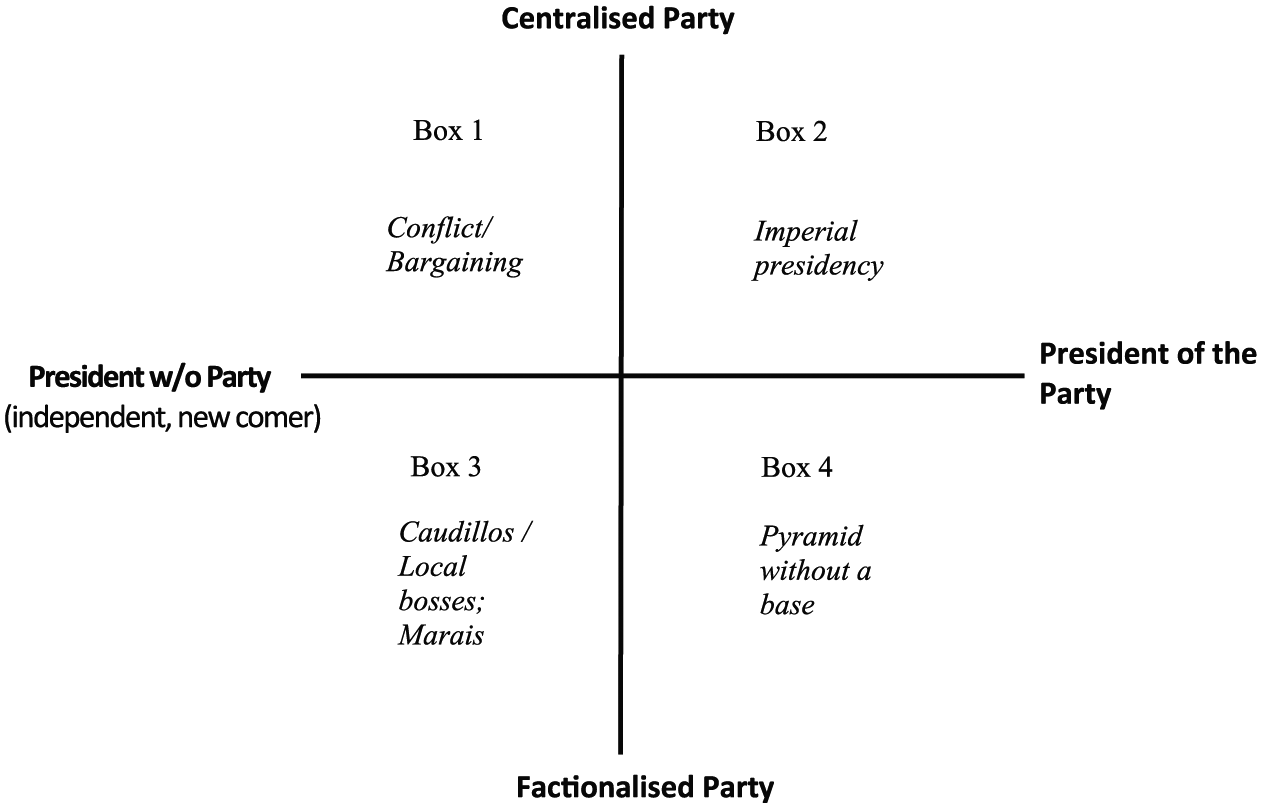
Four Sub-types Derived from the Typology.
The first analytical dimension refers to the political parties. It is important to consider what the characteristics of the political party are under whose label the candidate who became president ran in the election. The first dimension I consider refers to the type of party organisational structure (Gunther et al., 2002; Katz and Crotty, 2006; Katz and Mair, 1992, 1994, 2002; White, 2006). Political parties have changed over time in many relevant ways and in as many respects. The mass-party paradigm has been reconsidered, updated and even surpassed by other interpretations and analytical frameworks. Since Kirchheimer’s (1966) insights onwards, political science has reconsidered the political parties’ organisational structure based on the paradigmatic ‘mass parties’ (Neumann, 1956). All the changes have been interpreted as following or accompanying societal changes and adaptations, focusing on different political parties’ analytical dimensions, although many refer mainly to the organisation.
According to the stratarchical interpretation (Carty, 2004), there is a mutual independence among the levels (strata) obtained in contemporary (and cartel) parties. Similarly, Nicole Bolleyer’s (2012) reflections on federations, hierarchies and stratarchies may be of interest in understanding the differences among parties, especially considering that many parties have abandoned (or never met) the mass model of the 1960s and are now facing new organisational challenges. So, I expect to observe variations in eJuan Jach of their organisational structures in terms of the level of centralisation of crucial competences and resources (e.g. the selection of parliamentary candidates, mechanisms for conflict resolution, finances) and in the extent ‘to which interest representation in national party organs follows territorial lines’ (Bolleyer, 2011), as well as for the party’s leadership style and structure. It is, in fact, relevant to consider that a party can be centralised (the leadership) but stratarchical (in terms of the territorial organisation). In this sense, Ignazi and Pizzimenti (2014) referred to the trend towards the verticalisation of the parties’ leadership. The variable I consider relevant in analysing the party’s structure is the parties’ genetic features, as they can affect their further organisational development. From a theoretical point of view, we know that the genetic ‘nature’ of a party is a relevant factor in explaining the parties’ features and organisation. There are three factors concerning a party’s genetic features: (1) the organisation’s construction and development; (2) the presence or the absence (at the party’s origin) of an external ‘sponsor’; and (3) the role of charisma in the party’s formation (Panebianco, 1988: 50–52). Here, I will focus on these dimensions, as they are useful in detecting the level of centralisation in a party’s organisation. The different level of centralisation affects the way in which the president who was elected deals with it, and thus, the presidential ability to act in the legislative area and to exercise the presidential powers. The parties’ genetic features are relevant, as they are based on the model of organisational development (penetration vs diffusion), the characteristics of the dominant coalition (factions vs tendencies), as well as the balance of power in the dominant coalition (central office vs public office). Parties vary in the extent to which they have had organisational development through penetration, as opposed to those that have developed via diffusion. The first ‘tends to produce a strong institution, [and] a cohesive élite, able to set in motion a strong developmental process in the nascent organisation, is present by definition from the start’. However, a party which developed through diffusion ‘tends to produce a weak institution because of the presence of many competing elites controlling conspicuous organizational resources; the organization is thus forced to develop through federation, compromise, and negotiation among a plurality of groups’ (Panebianco, 1988: 63). Thus, penetration and diffusion in the party development context mean respectively having an organisation that is more cohesive (in the first case) or more factionalised (in the latter) (Passarelli, 2015b).
Centralised Party
A centralised party will be organised on hierarchical bases, and it will be led by a unified leadership. The dominant coalition is quite homogeneous, and there are no factions, or the latter are not influential. The party, both as an organisation and in the parliament, follows the policy determined from the centre. ‘Independent of the distinctions between regimes, “centralized” parties that are cohesive, disciplined, without factions and with a leadership that is “independent” from the organization (for extra-political or statutory resources) will be more suitable to increasing levels of presidentialization’ (Passarelli, 2015b: 237). A centralised party entails that if the president controls it, then his or her influence over the legislature will be more important. However, in the case of a party with a different political colour than the presidential one, the party itself will be keener to not indulge the president’s policies and activities. As a cohesive party, it will be more capable of opposing the presidential legislative will and, therefore, the president will face more obstacles in implementing his or her political programme.
Factionalised Party
However, political parties can be, and often are, not unified. Especially depending on their genetic features, parties can display a very divided organisational pattern. If it is true, as Panebianco stated, that the leader, even if he leads because he controls crucial zones of uncertainty, must (more often than not) negotiate with other organizational actors: he is at [the] center of a coalition of internal party forces with which he must at least to a certain degree negotiate (Panebianco, 1988: 37)
this is particularly true when the party shows an organisational genetics based on factions or groups, and not on clear, centralised or even charismatic leadership. In particular, the party can be internally divided and fragmented. As Sartori (1994: 66–67) pointed out, we can have ‘a threefold terminological articulation: fraction (the general, unspecified category), faction (a specific power group), and tendency (a patterned set of attitudes)’.
Therefore, the party type is relevant, as the behaviour, and therefore, the relationship with the context and the president also depend on its features. The party’s origin affects its future development and organisational assets, as well as its leadership (Panebianco, 1988; Passarelli, 2015b; Samuels and Shugart, 2010). To better predict the configuration of the PP’s assets, it is crucial to determine which party type the president will deal with. The second analytical dimension refers to the role of the president in the political party.
President of the Party
The person who holds – de jure or de facto – the role of chief of the party organisation that has stood for election supporting the candidate to the presidency can be the president or the secretary of the party.
President w/o a Party
In a situation in which the candidate who won the presidential election does not have any party under whose label he or she stood for election, he or she consequently does not have a correspondent political partner in the legislative branch. This is the case of an independent president, or more accurately, a non-partisan president (Linz, 1994).
Thus, considering the role of the president vis-à-vis his or her party is very important, as it indicates the presidential role in the parliamentary majority. The president can be the chief of the parliamentary majority, or more accurately, of its biggest party in the case of a coalition. Conversely, he or she can be the chief of the party (the biggest opposition party or the biggest party) who did not elect him or her, the minority party of the coalition, thus producing a case of a divided government or cohabitation (Chaisty and Power, 2019; Elgie, 2001).
The variables that I consider are then related to the (1) party type and (2) the president’s role in the party that has the majority (even relatively, in the case of coalitions) in the parliament (Table 1).
Party Type and Presidential Role.
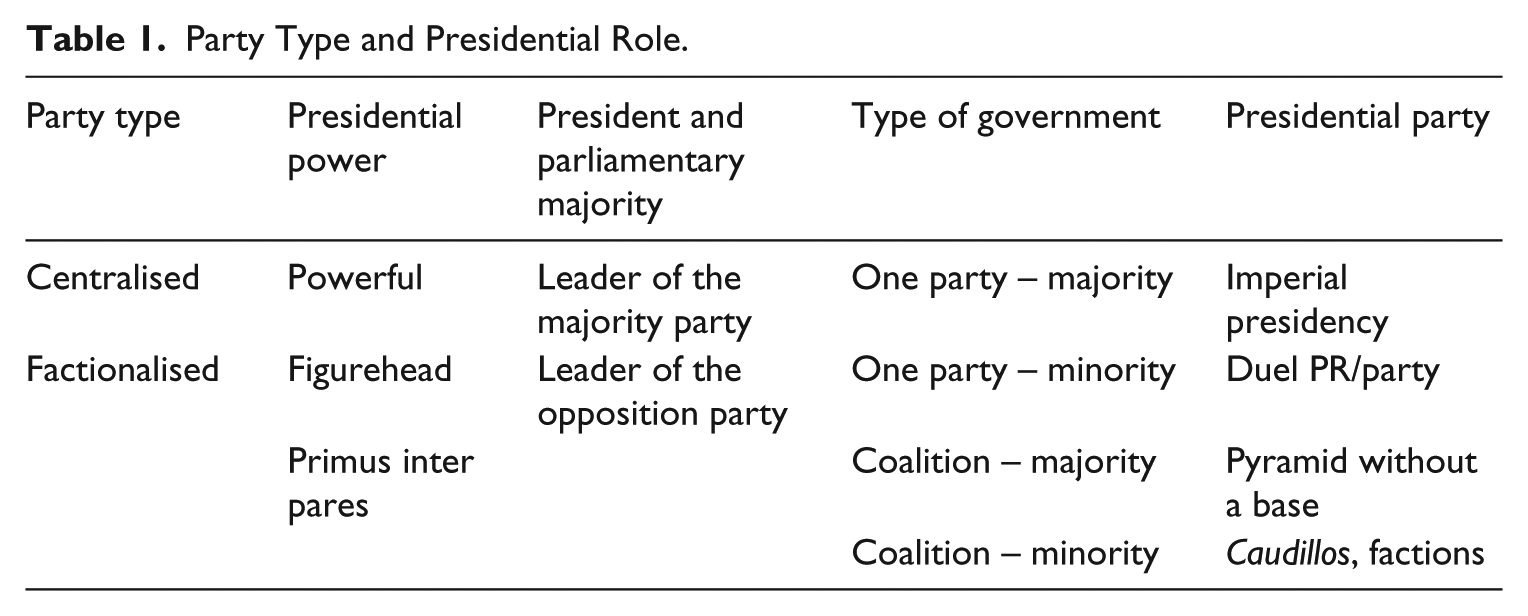
Figure 1 reports the four sub-types derived from the typology I have illustrated above.
Quadrant 1: The political party has a centralised organisation, which is unified and hierarchically structured. The president who won the election, on the contrary, does not have his or her own party represented in the parliament. The head of the state did not run under the label of a political party but as an independent, non-partisan candidate. This implies that there will be a case of cohabitation/divided government unless the president can find a majority in the parliament, which is unlikely, because he or she does not have a party. It is likely that there will be a situation of conflict or tough bargaining between the president and the ‘majority’ party in the parliament. In particular, in presidential regimes, if the two actors do not find an agreement, the conflict can generate a stalemate. The absence of a PP should increase the parliamentary legislative activity in promoting bills, while the presidential role should likely cover the task of a negative power maker. In this context, the party–parliamentary cohesion would likely be high, as the party who has the majority would try to weaken the presidential intent to play the opposition role.
Quadrant 2: In contrast to the case of quadrant 1, here, the party is always centralised but the president not only has his or her own party but is the president of the party. He or she is the recognisable, and recognised, political chief of the party, that is, of ‘his or her’ party. It is then possible that the personal/personalised PP would lead to a sort of imperial presidency. The political consistency between the two branches would increase presidential legislative activity through the president’s party. The centralised and unified party will likely follow or indulge the president’s political programme. Parliamentary cohesion should increase accordingly, as the legislators’ fate depends on presidential success.
Quadrant 3: As in Quadrant 1, the president does not have his or her party as he or she ran as an independent. On the party side, the organisation is highly factionalised and internally divided. The president will likely try to build ad hoc parliamentary majorities to support his or her legislative activity, while the legislators’ parliamentary cohesion should decrease. Each of the MPs will act individually, both to respond to their own constituency’s will and to accomplish the goal of re-election. The situation would be similar to that of a president dealing with caudillos, local bosses in a political condition close to the so-called marais (Duverger, 1964; Elgie, 2018b). Of course, as has been underlined, the candidates’ attitudes to seek for personal votes will mostly depend on the electoral system as well (Carey and Shugart, 1995; Shugart and Carey, 1992). Legislative activity will be difficult to manage, and bills will tend to be blocked by mutual vetoes between the president and groups of MPs aligned along informal and unstable alliances. Party–parliamentary cohesion would already be low because the party will also be weakened by the president’s intrusions into the party rank and file to attract the support of single deputies or senators.
Quadrant 4: The president is a primus above unequals. In Sartori’s (1994: 103) words, this is the case of ‘a chief executive that is the party leader, that can hardly be unseated by a parliamentary vote, and that appoints and changes cabinet ministers at his or her pleasure’. The president leads the party, which is internally divided and has factions that cross the organisation. The legislative activity will mainly follow the presidential political programme, and party–parliamentary cohesion should be built each time a bill is presented. The PP is a sort of pyramid without a base, and the president would incentivise single MPs or factions to support his or her legislative action. The president would be likely to adopt pork-barrel spending to overcome a possible legislative stalemate. Moreover, it must be stressed that most presidential regimes in Latin America have coalition governments. The president may have some difficulties in managing the government coalition. If the PP is only one element of the coalition, this can cause instability to allow the president to gain close control over his or her executive agenda. The role of the PP within the coalition is therefore important to analyse.
I must specify that, albeit valuable from a theoretical and analytical point of view, cases 1 and 3 are not common or are even rare, as some cases of independent presidents can be found in Central or Eastern Europe. 9 Nevertheless, even these independents are sometimes supported by a real PP. The crucial point I would underline considering these two types is that the president is constantly in a situation of conflict or bargaining with the majority party in parliament. Therefore, he or she needs to build ad hoc parliamentary majorities to support his or her legislative activity. In particular, the independent candidates are in fact ‘outsiders’ or ‘newcomers’ (Carreras, 2012) who create their own party (Calise, 2015) to launch and support their candidacy for the presidential election (especially in Latin America as indicated by the cases of Fujimori in Peru, Correa in Ecuador or Uribe in Colombia) (Carreras, 2014, 2017). This situation can potentially lead to a surge of president–legislature conflict.
Thus, formally, the president is without a party; in reality, the president must look for a ‘coalition’ party in parliament, as he or she needs to ‘control’ the legislative branch, or at the least to have one trusted link there. In this sense, we do not have a PP as soon as the president is elected, but rather the president attempts to build one.
When considering the typology described above, it is important to consider the regime type, as well as the kind of government. Therefore, I have referred to the majoritarian party, albeit it is, of course, possible to have a president who is dealing with a party that is not his or her own under which he or she ran during the election. As stated above, the president can be the leader of a minority party as well. Therefore, the typology tells us that cases 1 and 3 have some kind of ontological cohabitation or divided government as the president does not have his or her own party. In contrast, in cases 2 and 4, if there is cohabitation, then there will be a premier-presidential context or a president–parliamentary one in semi-presidential regimes, and divided government in presidential regimes.
Moreover, with respect to the presidential axis, it is important to consider presidential power. Presidents may have different powers, as they vary from country to country depending on the constitutional provisions. In order to have a reliable measurement that could allow comparative approaches and quantitative measurement, I propose here to refer to the recent classification of Doyle and Elgie (2016). 10 Regarding the parties in analysing the PP, it is important to take into account the kind of Government/Parliamentary majority type. The parliamentary majority, both conferring a vote of confidence to the chief of the executive (as in the semi-presidential context, for example, France, Romania and Portugal), or not, as in presidential contexts, could have different formats. The theory of political coalition (Riker, 1962) tells us that parties may decide to unite or to run alone, depending on their size, the ideological distance, the cabinet formation and so on. The presence of a minority government/parliamentary majority (Strøm, 1984), a coalition (minimum-winning or oversized) or a one-party majority has a potentially different impact on the president’s political activity, his or her influence on the legislature and the control of cabinet alike (Elgie, 2018a: 162 ff).
These relationships (Bowler, 2000) must be considered in light of the electoral context. I already introduced the relevance of the elections in re-shaping the relationship between the president and his or her party. Shugart and Carey were very clear in stressing the role of the midterm elections, and in general, of the electoral calendar as factors potentially influencing the electoral performance of the PP in parliament. That is, the destiny of the president and that of his or her party are linked due to the coat-tail effect when elections are held simultaneously (or nearly simultaneously, as in the French case), and at the same time, the president can negatively affect his or her party or coalition if voters sanction the incumbent (the so-called down-ballot effect). Moreover, the midterm elections in presidential regimes and the non-synchronised calendar in semi-presidential cases may generate a divided government/cohabitation. Therefore, these latter situations will again influence the internal dynamics of the PP’s balance of power. Overall, the elections are important because transforming votes into seats can modify the quality of the relationship between the president and the party.
It is then crucial to focus on the number of votes the PP has received before the presidential election, at the moment of the presidential elections, and for all the elections held during the presidential term. Finally, in this context, it is very interesting to consider the relationship in the PP when the candidate who wins the presidential race is performing in a peculiar, albeit dissimilar way, that is, the candidate is elected in a runoff after having been the run-up candidate in the first round: This is the so-called backoff (Shugart, 2007). It is important to consider the electoral system, the timing of the election and the electoral term for both the president and the parliament.
Finally, I focus on a few factors that represent as many analytical dimensions as are relevant in detecting the presidential parties’ features. In fact, the following interact with the dimensions I have presented in the typology of the president–party relationship.
They are not a kind of arbitrary list of independent variables that might have some effect on the dependent variable. Rather, they are a reasoned report on the factors that intervene in the PP building process.
The purpose of Table 1 is to determine the contextual independent variables that can affect the PP’s features. Each variable is related to the PP as a source of potential change in the latter. The party type, as stated above, has an important impact, as it is crucial to know whether it is centralised or factionalised in its organisational structure.
The party’s strength/size and its related ability to deal with the elected president directly depend primarily on its size. The parliamentary size is, in fact, a tool used to shape presidential decisions and to deal with the president, both in the case of coherent majorities and of a divided government. Therefore, a good indicator for analysing the PP is to consider the number of seats it has won, both as a percentage of the total seats of the assembly and of the size of the parties supporting the president in the case of a coalition. In this latter case, it is crucial to consider the Latin American context (Mainwaring and Shugart, 1997; Morgenstern and Siavelis, 2008). Samuels and Shugart were clear on this topic, as their book’s introduction refers to the case of the Brazilian President Lula. In the authors’ own words, the 2006 reelection of Brazil’s incumbent president, Luis Inácio Lula da Silva. At the same election, the party that Lula had helped found in the late 1970s and had led for over a decade, the Partido dos Trabalhadores (Workers’ Party, PT), won the largest share of votes in Brazil’s legislative elections. Yet while Lula won 49% of the votes, his party won only 15% that same day. Even more remarkably, in constituencies where Lula did well, the PT did poorly. That is, in 2006 there was a negative correlation between Lula’s performance and the PT’s performance, wholly contradicting the notion of presidential coattails (Samuels and Shugart, 2010: 1).
Together with concerns about the effects of presidential elections, the data presented above stress the relevance of the PP size in the assembly. Therefore, the reference to the ‘effective number of parties’ (ENP) over time is also a variable to consider.
The political influence of the PP is also related to the president’s ability to intervene in the legislative process and the political system. It is thus not only interesting but also important to consider the presidential powers, as conferred by the constitutional provisions (Doyle and Elgie, 2016). The presidential powers are crucial in defining their political win set (Doyle and Elgie, 2016; Shugart and Carey, 1992). Among the formal powers indicated in the constitutions, the veto power is certainly worth mentioning (Köker, 2017). Therefore, a measure of these powers can certainly be useful in predicting the presidential ability to influence the parliamentary action of the PP. Moreover, the cabinet formation also represents an important indicator of presidential freedom. A presidential cabinet is less likely than its parliamentary counterpart to contain strong and independent-minded members. The officers of a president’s cabinet hold their posts purely at the sufferance of their chief: If dismissed, they are out of public life altogether (Linz, 1990: 63).
There certainly are remarkable differences between the presidential and the semi-presidential executives. In any case, even in the presidential context, the presidential freedom to intervene in managing the executive depends only on constitutional provisions, and on political variables such as the influence he or she has over the party supporting him or her. When a US president faces a divided government condition, especially if it is the Senate opposing him or her, the president is in bad shape when appointing a cabinet. Analogously, even when the parliamentary majority is led by a party of the same presidential colour, the head of the executive can have trouble in managing the cabinet. In fact, if the party is reluctant to fully support him or her and is factionalised, or is part of a multiparty coalition (Chaisty and Chernykh, 2017; Chaisty et al., 2018), this can generate trouble for the president’s full control of his or her executive agenda. The semi-presidential context, to a certain extent, tends to amplify such dynamics of potential conflict. The president must carefully manage the relationship with his or her party in order to influence both the prime minister and the composition of the cabinet, specifically through the parliamentary majority (Bucur and Cheibub, 2017). A few studies on semi-presidential regimes in Europe show these differentiated patterns in which the PP plays a crucial role (Bucur, 2017; Passarelli, 2010; Raunio and Sedelius, 2017). Thus, there may be powerful, primus inters pares or mere figurehead presidents.
Then, on the legislative side, it is important to take into account the kind of government and the political role of the president in the parliament. In the latter case, this means verifying whether the president is the leader of the majoritarian party or instead of the opposition party. Moreover, the president can also be the leader of a party other than the biggest in the coalition. Finally, in this line of thinking, we must consider the type of government, that is, one party or a coalition, and for both cases, we must consider whether the government has the majority or rather is a minority government. The president may be the chief of the biggest parliamentary majority party, as was, for example, the case in France under the presidency of François Mitterrand (1981–1986 and 1988–1993) or the Portuguese president (Mário Soares 1995–1996 and Cavaco Silva 2011–2015). An example of a president leading a minority party of the government’s coalition was the presidency of Giscard d’Estaing (1974–1981) in France (Cole, 1993; Grossman and Sauger, 2009; Thiébault, 2017), but this has not happened in Portugal or in the United States due to the one-party nature of the parliamentary majorities. However, presidents have often and for long periods faced parliamentary majorities opposed to their party. An increasing period of divided governments has been registered in the United States since the 1980s, in Portugal (1986–1995, 2002–2005 and 2006–2011) and in France (1986–1988, 1993–1995 and 1997–2002) (Elgie, 2002), albeit to a lesser extent after 2000. A few historical examples can be useful as a general reference. Case 2 can be well represented by the first part of François Mitterrand’s first term, as well as F. D. Roosevelt. While the case of a president leading the party but without a real base in it (case 4) can be detected in Latin American presidencies, such as Argentina or Peru. In case 3, we can indicate the president of Mexico, who has a weak grip on his factionalised party, so the consequence is a permanent conflict and tension between the two. Finally, the case of Donald Trump can represent a good approximation of a quite centralised party which does not respond to the presidential will, so that the relationship oscillates between conflict and bargaining.
Therefore, from analysing the PP’s features and its relationships with the presidents, it is possible to indicate the general pattern. The latter refers to the level of presidential ability to control his or her party and to determine the legislative outcomes.
Although the president is considered the legislative branch in presidential regimes, with the PP usually increasing the president’s power in legislative activities, this is not always the case in other direct-elected heads of the state, such as semi-presidential ones. The president’s ability in controlling his or her own parliamentary group depends on the institutional framework, the presidential powers and the political parties’ features which determine the relationship between the president and the legislature.
The article has outlined the PP’s features and has also pointed out the main political consequences that emerge because of them. Shugart and Carey’s (1992) contribution was particularly important and inspiring in developing a theoretical tool to more effectively analyse the role, the characteristics and the impact of the presidential parties on the legislatures and the government. Starting from a standard definition, I have indicated the different PP types as depending on the nature of the parties’ organisation and the president’s role in the party. The outcomes reveal four kinds of relationships between the two political actors – the party and the president – and various impacts on the legislature and the cabinet generated by the presidential parties. The theoretical framework I have outlined is a useful tool for conducting empirical investigations comparing presidential parties over time, as well as for different countries and regime types.
Footnotes
Acknowledgements
This article Is dedicated to the memory of Robert Elgie. He also contributed by commenting a first draft. Thank you.
Funding
The author(s) received no financial support for the research, authorship and/or publication of this article.
