



Abstract
We know that many people feel that they have a duty to vote in elections, but we know little about what other civic duties they believe they ought to fulfill. In this study, we address the question of whether people feel that they have both a duty to vote and to be informed. We use an original Canadian survey which includes questions about whether respondents construe voting and keeping informed as duties or a matter of choice. We find that the duty to vote is more widespread than the duty to be informed and that almost half of those who say that they have a moral obligation to vote indicate that they do not have a duty to keep informed. The better educated are more likely to feel that they have a moral obligation to both vote and keep informed while younger respondents are more prone to reject both duties.
Introduction
The belief that voting is a citizen’s duty is a powerful predictor of electoral participation (Blais, 2000). The extent to which citizens feel this duty alone or along with other civic duties is a question related to several normative and academic debates on citizenship, and particularly to the literature on the “good enough” citizen (Dahl, 1992; Dekker, 1996). Lomasky and Brennan (2000), for instance, do not find the claim that voting is a civic duty compelling because, they argue, a non-informed vote is not morally superior to abstention. From that perspective, it does not suffice to vote to be a “good” citizen, and one must cast an informed vote. Clearly, this is a harder task for the citizen to accomplish and it is closer to idealistic views of the “good citizen” than to the “realistic” perspective of the “good enough” citizen. The empirical combination of these two duties (the duty to vote and the duty to be informed) yields four possible combinations from which two stand out: an ideal good citizen (who feels both duties) and a good-enough citizen who feels she has the duty to vote but not necessarily the duty to keep informed. But how widespread are such duties among the population? Are they shaped by the same factors or considerations?
We wish to determine how the beliefs about these two citizens’ duties are combined and distributed among the population. We also wish to determine whether some citizens believe that they have a duty to be informed but not a moral obligation to vote. This article addresses these questions by constructing a taxonomy based on the two aforementioned duties. We aim to identify how many “good” and “good enough” citizens there are, and what are their relationship with the most usual sociodemographic and attitudinal correlates of citizenship norms. This article takes an exploratory approach. By doing this, we wish to contribute to the literatures on citizenship and on civic duty. We expect certain groups, who tend to vote more and to be better informed about politics—for example, older and more educated citizens—to be more likely to feel both duties. We also expect groups who are more likely to abstain, like those with a lower sense of political efficacy, to be more likely to see voting and being informed as a choice.
Using a Canadian survey, we produce evidence that suggests that many people believe that both duties go hand in hand but about as many only see voting as a duty (and do not feel a duty to be informed). Many others reject both duties. There is thus no consensus about whether citizens have the duty to vote and/or to be informed.
Theoretical Framework
Citizens’ duties, along with their rights, are the essence of citizenship (Koopmans et al., 2005; Marshall, 1973). High normative standards usually refer to ancient Greek values and practices, and they entail a long list of desirable attributes and skills (van Deth, 2007). More realistic standards are about avoiding bad citizens, characterized by complete detachment from public affairs (Christ, 2006). These different standards of “good citizenship” correspond with different theories, where participatory democracy requires a higher level of civic competence from citizens than representative democracy (Fratczak-Rudnicka and Torney-Purta, 2003). Nevertheless, the realistic, representative standard is not exactly clear. In his pioneer work, Robert Dahl (1992) posited that a “good enough” citizen is not completely alien to politics, bears a minimum interest for politics, and is at least somewhat knowledgeable about the issues of the day. Some scholars mention a belief in the legitimacy of the democratic system, tolerance, love for freedom, and the like (Dekker, 1996). More recent developments add having a party or candidate preference, knowledge of key political issues and political actors, as well as being willing to vote (Fratczak-Rudnicka and Torney-Purta, 2003). 1
Willingness to vote is among the bare minimum requirements for both the good and the good-enough citizen. In fact, “in both types of democracy theories, political participation of the citizen is required” but participatory democracy theories “ask about additional political activity beyond voting” (Fratczak-Rudnicka and Torney-Purta, 2003: 74). We can then consider voting as one of the core requirements of the “good enough” citizenship, as it is easy and takes little time (Blais, 2000). From a minimalist perspective, a good-enough citizen should show up at the polling station or at least feel compelled to do so, and by doing so demonstrate her support for the political system and the country (Blais and Galais, 2016). But of course, electoral participation is costlier if the individual takes the time to gather information about the extant alternatives and analyses how they match her values and interests.
Keeping informed about politics is clearly more demanding than attending the polls and may sometimes be boring or complicated, especially when the issues are complex or simply not exciting. As Michael Schudson (1999) pointed out, the ideal of the informed citizen emerged at the end of the nineteenth century, becoming an unrealistic standard designed to limit the voting franchise. 2 From this point of view, a citizen who not only feels the duty to vote but also the duty to be informed holds a rather maximalist view about what defines a good citizen. 3
The possibility exists that many people accept the duty to vote as a low-cost compromise for not feeling the obligation to keep informed. Such a suspicion comes to mind when reading Lomasky and Brennan’s (2000: 63) claim that “voting is not morally superior to abstention.” These authors concede that there may be circumstances where one could feel highly confident about her personal capacity to determine which party or candidate would best maximize the public good and that it would make sense in those circumstances for that person to believe that she has a moral obligation to vote. However, they add that, that would still not support a general duty to vote. Rather it would almost show that there are consequentialist reasons for someone who is good at voting to do so – and consequentialist reasons for someone who is bad at voting to abstain . . . It follows that there cannot be a completely general citizen’s duty to vote (Lomasky and Brennan, 2000: 72).
Consequently, if one feels that she has a duty to vote because she wants to contribute to the public good, she should also conclude that she has a duty to be well informed since she should want to vote “correctly,” and she thus needs to acquire as much information as possible about the candidates and the parties. 4 From that perspective, the duty to vote entails the duty to try to vote correctly, and therefore the duty to be informed. All those who feel that they have a duty to vote should also think that they have a duty to be informed.
This view is similar to the one adopted by Elizabeth Theiss-Morse in her work on conceptualizations of good citizenship. She concludes that voting and being informed are requirements for the good citizen that are present in the four main democratic theories (elitist, pluralist, citizenship, and participatory). While these theories differ in their views about the scope of politics and citizens’ roles, “all four theories hold that ideally citizens should be active in politics in one way or another and should be informed about politics in order to make better political decisions” (Theiss-Morse, 1993: 361). Following this train of thought, voting and being informed are not requirements that are easy to fulfill and on which all democratic theories tend to agree. Theiss-Morse’s empirical findings suggest that indeed both characteristics go hand in hand; citizens who support Representative Democracy consider appropriate for the good citizen to vote and being informed.
Considering both duties (voting, being informed) inseparable is related to the utilitarian philosophical tradition. Uninformed voters should abstain because their vote represents an irresponsible action and informed voters should participate because they are voting responsibly. If there are too many uninformed voters, this could lead to information effects that could potentially influence the results of the election (Bartels, 1996; Blais et al., 2009). This reflects the idea that an action should seek to maximize the public good. However, the duty to vote can be justified on purely ethical grounds, without any consideration of its potential consequences (Blais and Achen, 2019). From such a perspective, whether there is a duty to be informed is a separate issue. This raises the question how many people feel that they have a duty to vote but nothing else, not even the duty to be informed.
The relationship between voting and being informed about politics has been approached from an empirical perspective. We know that better informed citizens vote more (Lassen, 2005). We also know that citizens mobilized to vote also become more informed about the election (Shineman, 2018). But—leaving aside Theiss-Morse’s 1993 work—we know very little about whether and to what extent citizens perceive both as civic duties. The author who has invested more efforts in understanding what are the duties that citizens believe that they have to fulfill in a democracy is Russell Dalton (2008). Using a question (that we discuss at some length below) about what it takes to be a good citizen, Dalton distinguishes two dimensions of citizenship, which he calls “citizen duty” and “engaged citizenship.” Duty to vote belongs to the first dimension, with other duties such as obeying the law and not evading taxes, which is curious in the sense that the duty to vote (just like the duty to be informed) is not legally enforced, unlike obeying the law and paying taxes. 5 The other dimension is called “engaged citizenship” though it entails duties as well (since the question is about what it takes to be a good citizen); it includes being active in associations, keeping watch on government, and helping those who are worse off. Interestingly, keeping watch on actions of government seems to load on both dimensions. This is very close to the duty to be informed, which is our concern in this article. To sum up, it is not clear—neither from a purely theoretical viewpoint nor from a more empirical perspective—whether or not the duty to vote and the duty to be informed go necessarily hand in hand, or whether being informed is an extra requisite that only those supporting a stronger, ideal view of citizenship will consider.
Our purpose in this study is to determine how many people believe that they have a moral obligation to vote and how many think they also have a duty to be informed, and whether some subscribe to the view that they have a duty to keep informed but not necessarily to vote and vice versa. Our first goal is to portray an accurate picture of how people feel about the duty to vote and the duty to be informed. We indicate how many people subscribe to both norms, reject both, or accept one but not the other. We then examine the sociodemographic and attitudinal correlates of citizens’ views about these two norms.
We focus on these two duties because they can be directly linked, as we have seen above. One could argue that citizens in a democracy have a duty not only to vote but also to cast a correct or informed vote. The issue is whether people think that voting is “enough” or whether one’s citizen duty is “larger,” that it is also necessary to “understand the issues” in order to cast a “correct” vote.
The Study
We use the Internet Use and Political Activity in Canada Survey, 6 a random digit dialing (RDD) telephone survey that was conducted by the Institute for Social Research at York University in February and May 2014 among a representative sample of 2021 Canadians. 7 The questionnaire included two key questions tapping respondents’ personal views about whether they have a duty to vote and to be informed.
The exact question wordings are presented in Appendix 1. The question about duty to vote is borrowed (with a slight modification) from Blais and Achen (2019; see also Blais and Galais, 2016). The question has been drafted to minimize the risk of a social desirability bias associated with the existence of a public norm. There is the public norm that it is a duty to vote. Some people agree with the norm, others disagree, and still others are ambivalent or don’t have a true opinion. We wish to distinguish those who have internalized the norm from those who have not but may prone to pay lip service to statements such as “it is a citizen’s duty to vote.” Our approach is therefore to avoid agree/disagree statements, which are plagued with social desirability and acquiescence biases (Krosnick, 1999; Schuman and Presser, 1981).
We have refrained from using the type of question included in the General Social Survey (GSS), which has been utilized by Dalton (2008) in his analysis of citizenship norms. The question deals with what it takes to be a good citizen, which makes sense if we want to study public norms, but it has the disadvantage of asking how important (on a scale from 1 to 7) it is to vote or obey the law. The problem is again one of social desirability; it is just too easy and tempting to say that everything is very important. In fact, the modal answer to the duty to vote and duty to keep watch on government (the closest item to keeping informed) is 7, on the 1 to 7 scale, and the mean is 6. As we show below, these numbers are bound to exaggerate citizens’ true level of adherence to the norm that people have a moral obligation to vote or be informed.
The challenge, therefore, when it comes to tapping citizens’ true feelings about whether they have a moral obligation to vote and keep informed, is to neutralize as much as possible the social desirability bias and to make it easy for those who do not really believe they have those duties to admit so. The approach proposed by Blais and Achen (2019) is to offer a “no duty” option with a positive connotation. More specifically, they suggest that the “no duty to vote” position be couched as one in which voting is construed as a matter of personal choice. Clearly having a choice is a “good” thing, and it should thus be normal for someone who has not internalized the duty norm to think that voting is a matter of choice. Of course, it is possible to think that voting is both a duty and a choice, but the question is what it is, first and foremost.
We proceeded exactly in the same way to measure citizens’ belief about whether they have a moral obligation to be informed, indicating that some people feel that they have a duty to keep informed while others view this as a matter of choice, and asking whether for them personally this is first and foremost a duty or a choice.
The intersection between the two questions yields four groups of people: (1) those who think that they have a duty to vote and to keep informed; (2) those who believe that they have a duty to vote but no duty to be informed; (3) those who construe voting as a matter of choice but feel that they have a duty to keep informed; and (4) those who reject both duties.
We first wish to determine the distribution of respondents among these four groups. We are particularly interested to find out how many people believe that they have a duty to vote but no obligation to be informed or vice versa. We are also keen to see the socioeconomic profile of these groups and to sort out the attitudes that underlie adherence to the norm that citizens have a duty to vote and/or to be informed. For this purpose, we consider three sociodemographic characteristics: gender, age, and education. We also examine the impact of three attitudinal variables: political interest, party identification, and external political efficacy.
The Findings
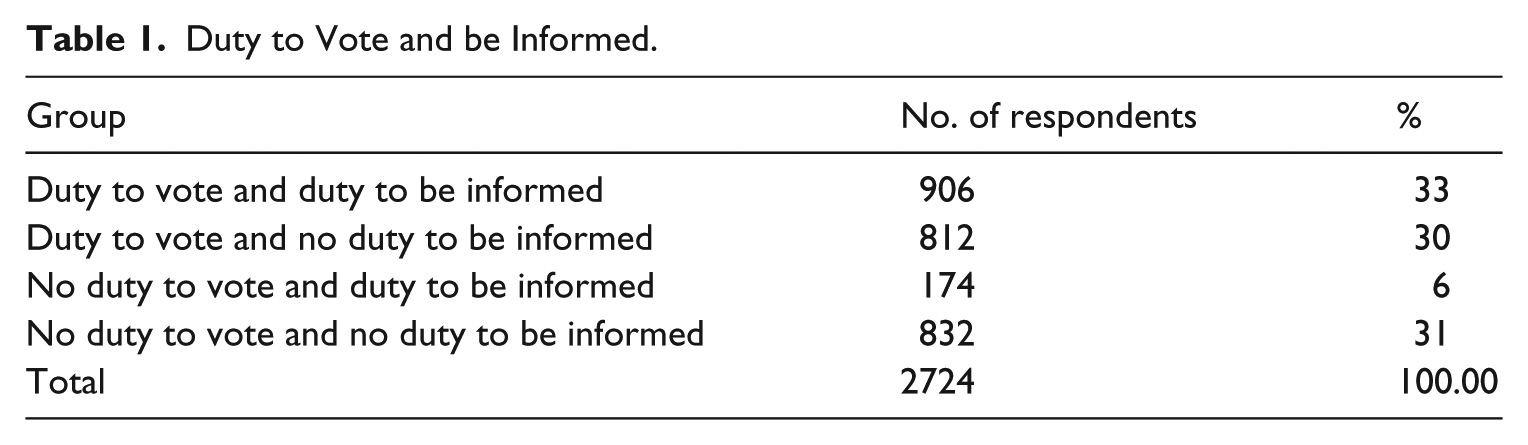
Among our Canadian respondents, 63% say they have a duty to vote while 37% answer that it is a matter of choice. The level of duty to vote is slightly higher than that reported in Blais and Achen (2019). This is possibly because their original question indicated that those who view voting as a choice feel free to vote or not to vote depending on how they feel about the parties and candidates. “Free” has a positive connotation and makes the choice option more attractive. In this study, those who construe voting as a choice are simply deemed to “only vote when they feel strongly about that election.” The choice option is less appealing when the word “free” is absent. Feelings about the duty to be informed are different. In this case, only 39% say that they have a duty to be informed. It seems that feelings of duty to vote are more widespread than feelings of duty to be informed. In fact, almost half of those who think that they have a duty to vote believe that this does not entail a duty to keep informed.
The combination of responses to these two questions yields four groups of people. The distribution of these four groups is presented in Table 1. We can see that very few people believe that they have an obligation to keep informed but not to vote. At first, this appears unsurprising because having a duty to be informed but not to vote seems like an odd combination. However, this category may actually represent a reasonable thought process whereby the citizen feels she has the duty to be informed about the election and its potential consequences (or lack of consequences) before deciding whether she has a duty to participate in the election. However, the small size of this category suggests that most people do not reason this way when considering their civic duties. Each of the three other groups (those who accept both duties, those who reject both, and those who adhere to the duty to vote but not to the duty to be informed) corresponds to about 30% of the sample. Perhaps, the most important finding is that quite a few people believe that they have a moral obligation to vote yet feel that this does not entail the duty to keep informed in order to cast a “correct” vote. This suggests that many citizens subscribe to the public norm that they ought to fulfill some form of civic responsibility, provided that such responsibility is minimal.
Duty to Vote and be Informed.
What kinds of citizens belong to the four groups that we have just distinguished? Table 2 presents the findings of a multinomial logit estimation in which the dependent variable corresponds to these four groups and the independent variables are the three sociodemographic variables mentioned above. We can see that men are more likely to feel that they have a duty to be informed and to both vote and keep informed, while older and better educated respondents are more prone to believe that they have a duty to vote and to both vote and keep informed. 8
Sociodemographic Correlates of Duties.
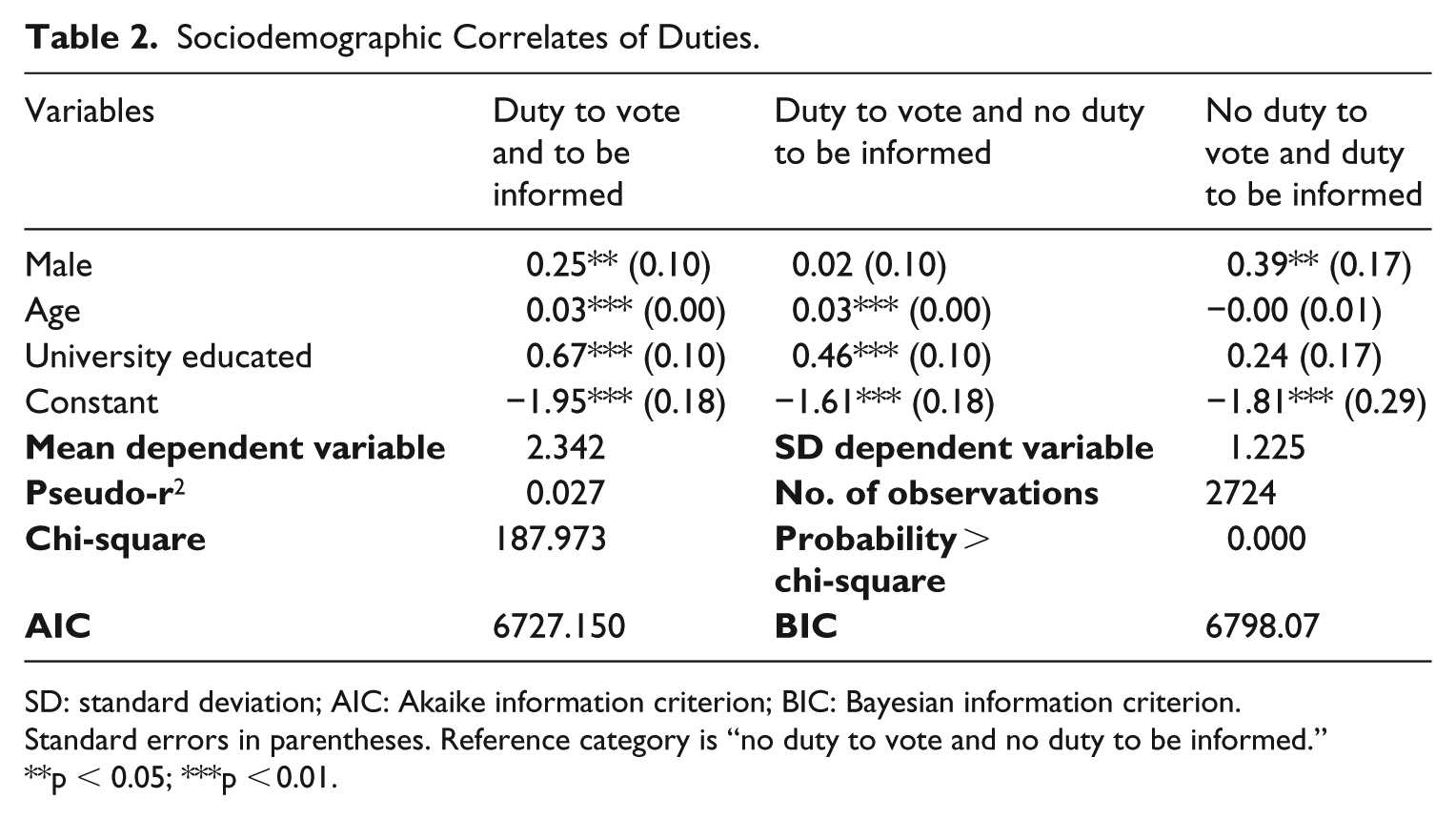
SD: standard deviation; AIC: Akaike information criterion; BIC: Bayesian information criterion.
Standard errors in parentheses. Reference category is “no duty to vote and no duty to be informed.”
p < 0.05; ***p < 0.01.
Table 3 presents the predicted probabilities of belonging to each of the four groups for men, women, those with or without university education, and the young (aged 30) and the old (aged 60). Gender differences are quite muted. The better educated are more likely to feel that they have a moral obligation to both vote and keep informed, while younger respondents are more prone to reject both duties.
Predicted Probabilities of Duties: Gender, Education, and Age.
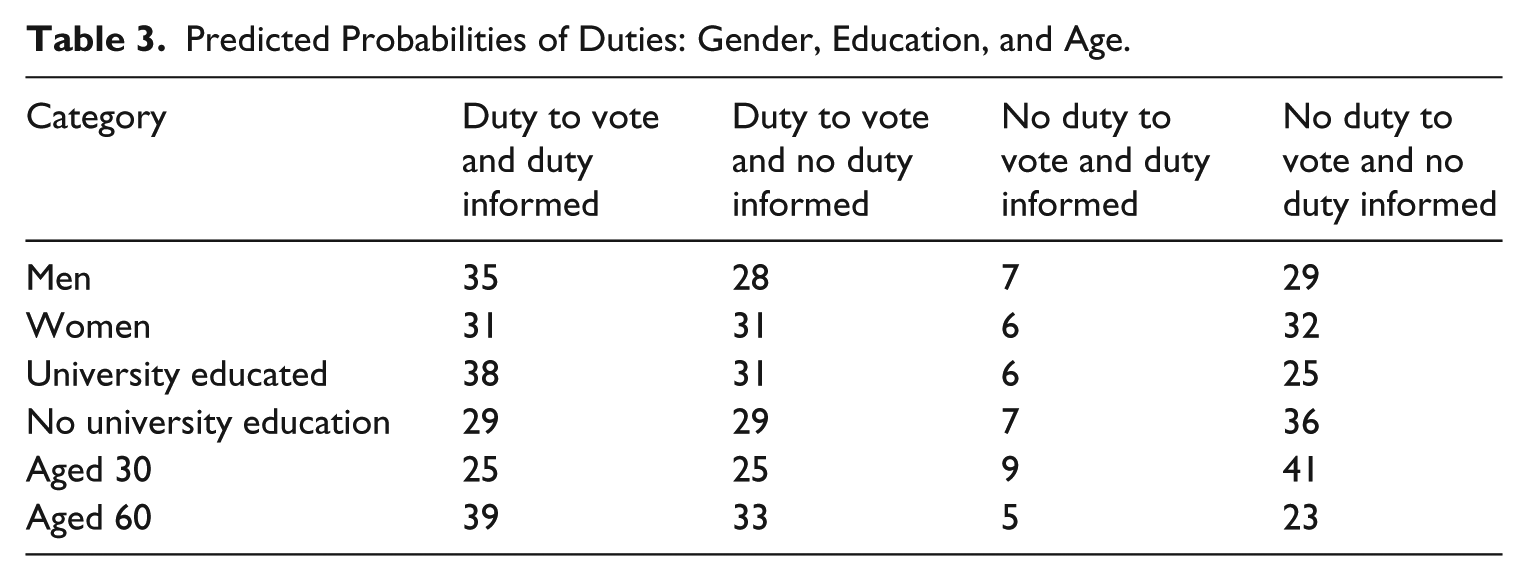
Table 4 presents the findings of the multinomial estimation that includes political interest, external efficacy, and party identification (plus the sociodemographic variables as controls). We can see that political interest is most strongly associated with the duty both to vote and to be informed, while political efficacy is most strongly correlated with the duty to vote. The impact of party identification is weaker.
Attitudinal Correlates of Duties.
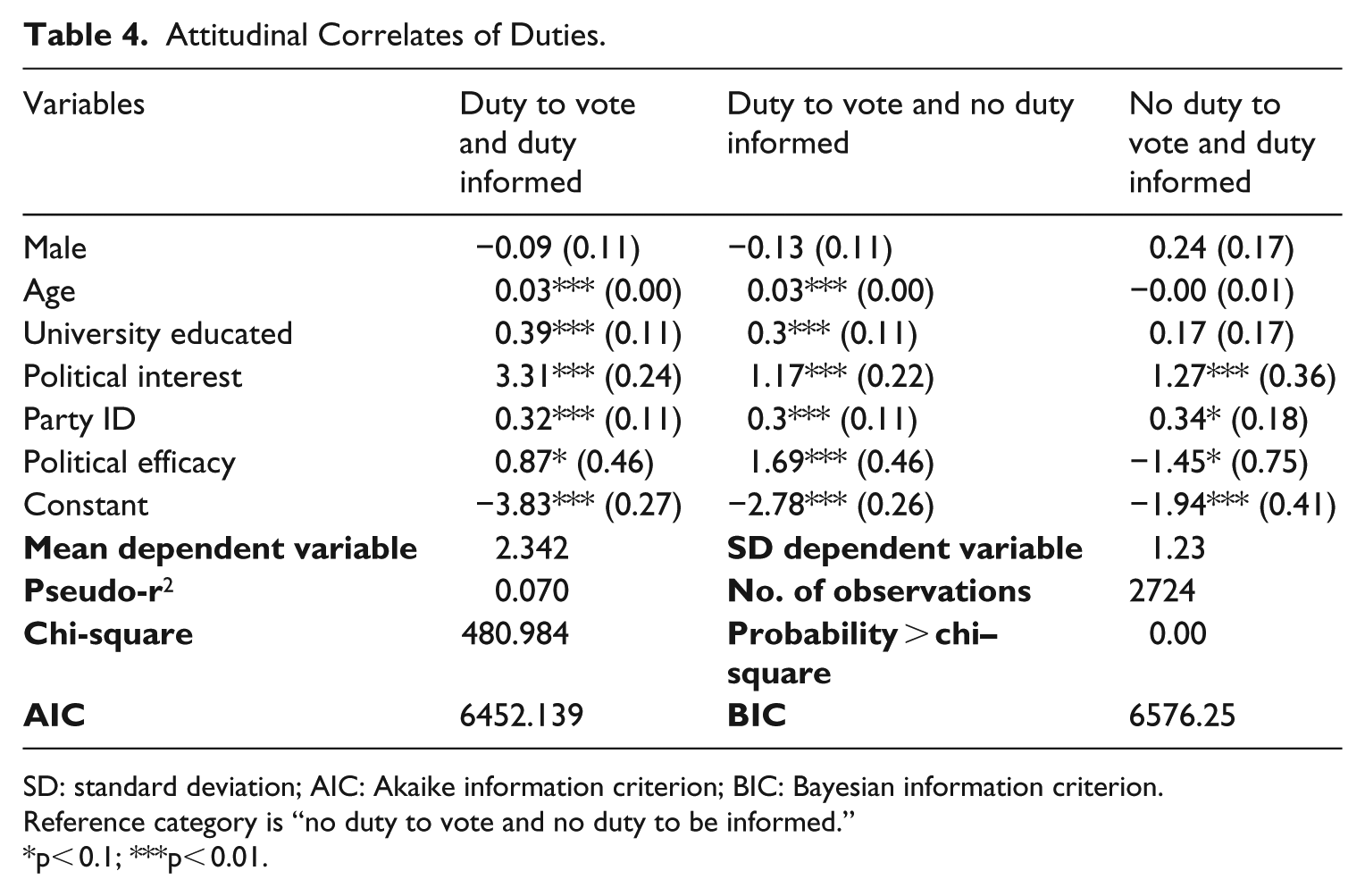
SD: standard deviation; AIC: Akaike information criterion; BIC: Bayesian information criterion.
Reference category is “no duty to vote and no duty to be informed.”
p< 0.1; ***p< 0.01.
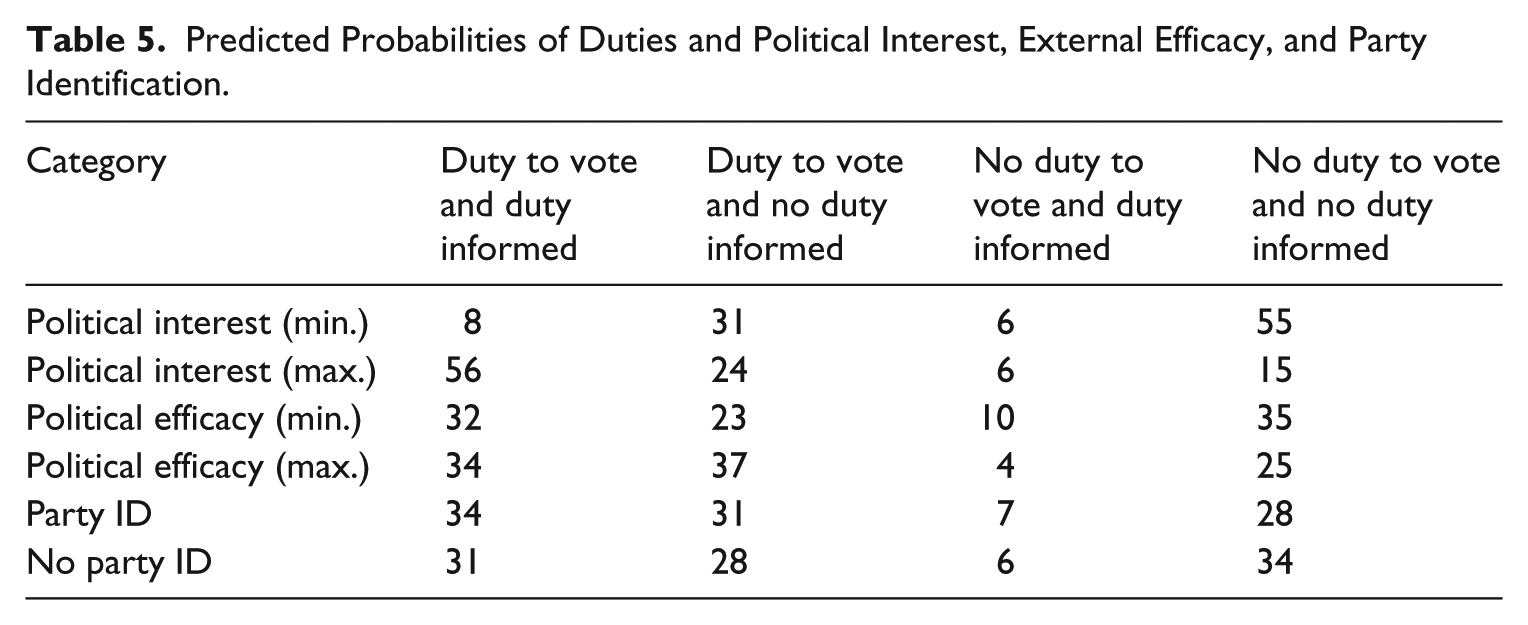
Table 5 presents the predicted probabilities related to these attitudes. The probability of feeling that there is a duty to both vote and keep informed increases by 48 percentage points as one moves from minimal (8%) to maximal (56%) interest. The propensity to think that one has a duty to vote but not to be informed increases from 23% when one feels very inefficacious to 37% when one feels most efficacious. The biggest difference with respect to party identification concerns the “no duty” group; 34% of non-partisans hold such a view, compared with 28% among partisans. In sum, political interest strongly affects the propensity to believe in the duty to both vote and keep informed, while the impact of party identification is weak. Finally, those who believe that politicians are not receptive to their demands are indeed more likely to reject both duties, but they are particularly less inclined to believe that they have a moral obligation to vote but not to be informed.
Predicted Probabilities of Duties and Political Interest, External Efficacy, and Party Identification.
Conclusion
We know that many people feel that they have a duty to vote in elections, but we know little about what other civic duties they believe they ought to fulfill. There has been some attempt to explore this issue by examining responses to survey questions in which people are asked how important it is for the good citizen to do certain things (such as obeying the law and being active in voluntary organizations). We are skeptical about such an approach since it is so easy for people to pay lip service to the public norm that one should be active rather than passive. Indeed, respondents are prone to say that everything is very important.
Following Blais and Achen (2019; see also Blais and Galais, 2016), we have adopted an approach whereby it is easier for people to acknowledge that they do not believe that they have a moral obligation to vote and keep informed; this is by making the “non-duty” option more appealing by labeling it as a matter of personal choice. With that approach, we have addressed the question of whether people feel that they have both a duty to vote and to be informed.
This is a crucial question in order to better understand how and why so many people feel that they have a duty to vote. Lomasky and Brennan (2000) suggest that many people adhere to the norm that they have a duty to vote in part because this is a cheap way to do very little in the polity while still feeling like a good citizen. If it is the case, we should observe that many people believe that they have a duty to vote but no obligation to keep informed about politics.
An original survey conducted in Canada which includes questions about whether respondents construe voting and keeping informed as duties or matters of choice allow us to address this question. We find that the duty to vote is more widespread than the duty to be informed and that almost half of those who say that they have a moral obligation to vote indicate that they do not have a duty to keep informed. Lomasky and Brennan’s suspicion is thus at least partially supported. Many people are willing to accept that voting is special and that they have a responsibility to cast a vote in an election, but many are unwilling to say that they also need to be well informed in order to cast a “correct” vote.
Our findings are particularly at odds with those of Dalton (2008) with respect to the so-called generational gap. On the basis of responses to the “how important” questions, Dalton concludes that, generations are changing in the types of citizenship norms they stress . . . the young reflect a new political reality and stress alternative norms that encourage a more rights conscious public, a socially engaged public, and a more deliberative image of citizenship (Dalton, 2008: 39).
It is true that the young in our survey are more inclined than older respondents to say that they have a duty to be informed and not to vote (the predicted probability is 9% for someone aged 30 vs 5% for someone aged 60), but the bottom line is that, by far, the dominant position among youth is to reject both duties. Youth are more critical of duties in general, including the duty to keep informed.
Finally, we must consider whether our results can be generalized or are specific to a certain context. We see no reason to believe that Canada is an exceptional country with regard to conceptions of civic duties. Turnout in the most recent Canadian federal election was 68.5%, only slightly below mean turnout in contemporary legislative elections, which is around 70% (Blais, 2010: 168). As for sense of duty to vote, the only comparative data that come from the Making Electoral Democracy Work (MEDW) project, which suggests that duty to vote is slightly higher in Canada than in France, Germany, Spain, and Switzerland (Blais and Daoust, in press). Of course, more research is needed to properly address this question.
Our results raise additional questions about what other duties people feel they personally ought to fulfill in a democracy. We have confined here to the duties to vote and keep informed. Obviously, we need to examine other types of duties, especially more participatory types. In the process, however, we should pay attention to how we measure people’s beliefs about civic duties. Because there is the public norm that the good citizen should be “engaged,” there is the risk of social desirability. We need to make it easy for people to acknowledge that they do not really believe that they have a moral obligation to be active in politics.
Footnotes
Appendix 1
Funding
The author(s) received no financial support for the research, authorship, and/or publication of this article.
