



Abstract
In this article, I present a portrait of the American power elite and their relationship with the party system. I focus on occupational categories as institutional positions and take up three questions: Which occupational categories wield social influence? How politically mobilized is each of these occupational categories? And what partisan tilt is exhibited by each category? My results help clarify the contemporary structure of American electoral competition. Furthermore, they also shed light on which social groups have a voice in American politics and, thus, speak to questions of political equality.
This article presents a portrait of the American power elite and their relationship with the party system. I ask the following: Which occupational categories wield social influence? How politically mobilized is each of these occupational categories? And what partisan tilt is exhibited by each category?
To answer these questions, I introduce a new dataset that identifies the set of socially influential occupational categories in contemporary America and describes partisan mobilization and alignment for 203,973 prominent, living Americans affiliated with these categories. With these data, I address calls in elite studies to treat the cohesion of elite groups, on dimensions of shared identity such as partisanship, and the interconnectedness of these groups as empirical questions (Korsnes et al., 2017).
I find that elite occupational groups vary greatly in the extent to which they publicly engage in partisan politics—for instance, from 36% of lawyers to 13% of chief executives and just 1% of athletes. Meanwhile, half of the socially influential occupations show a clear partisan preference, while the rest are either divided between the parties or unengaged. My results identify which social groups have an out-sized voice in American politics and thereby move discussions of American political inequality beyond a purely economic perspective.
Studying Elites
Social class is a multi-dimensional concept that cannot be reduced solely to economic capital (Cunningham, 2019; Savage et al., 2015). In America, “micro-classes,” or narrow occupational categories, are the institutional positions that effectively capture the many forms of capital that constitute social class (Weeden and Grusky, 2012). Occupations communicate social status and endow occupants with resources (Zhou, 2005). They also generate subcultures with shared worldviews through the processes of workforce selection, occupational socialization, shared training, consistent working conditions, and occupation-based rent-seeking (Weeden and Grusky, 2012). Consequently, McAndrew et al. (2020: 34) argue that occupational subcultures are an “under-recognised source of social and cultural division” and urge scholars to empirically examine the extent to which occupational categories share political values.
I focus on the political values of elite occupations because scholars show that they use their status and resources to successfully shape the political agenda and mass opinion (Page and Gilens, 2017). They do this by joining one of the two major parties and engaging in coalitional politics (Domhoff, 2017). For instance, Silicon Valley’s elite occupational subcultures share an ideology that is not obviously Democratic, but to the extent that they seek political influence they do so through the Democratic coalition (Broockman et al., 2019). For this reason, I summarize the political mobilization of occupations by party.
My goal is to describe the partisan engagement of elites who command enough attention to shape public perceptions of their occupational group. How can scholars identify these individuals and understand their political mobilization in a systematic manner? To study occupations methodically, I follow Weeden and Grusky (2012) and use the Standard Occupational Classification (SOC) system devised by the Bureau of Labor Statistics.
To identify which of the 840 SOC occupational categories confer social influence, I draw on TIME magazine’s annual list of the 100 most influential people. The selection procedure for the TIME 100 emerged through the deliberations of academics, politicians, journalists, and editors (TIME Staff, 1998). In introducing the first annual list, TIME editor Michael Elliott noted that, throughout history, social influence has been heavily concentrated and asked: “If the great men and women of ancient times were kings and queens, nautical explorers and epic poets,” then “who is that core group today?” (Elliott, 2004). In answering that question, TIME editors identify key institutional positions of influence in society (e.g. governor, mutual-fund president, and doctor), and, then, identify specific individuals in those positions who command public attention and have changed daily life for many people (Elliott, 2004). With TIME’s list, I can identify the set of occupational categories that command attention and influence in American society.
For each occupation deemed influential by the TIME 100, I use Wikipedia to identify the universe of socially prominent individuals and their level of political participation. Wikipedia’s notability guideline limits pages to individuals who have “received significant coverage in reliable sources that are independent of the subject” (Wikimedia, 2020). This restricts my sample to occupational members that successfully command attention. For these individuals, Wikipedia communicates independently verifiable political activities that extend beyond voting (e.g. endorsements, campaign involvement, issue advocacy, partisanship) when the public observes them using their command of public attention for political purposes. Scholars find that Wikipedia’s coverage of objective information about prominent, living Americans is comprehensive, accurate, up-to-date, and well-sourced (Mesgari et al., 2015). Thus, Wikipedia provides an appropriate and effective behavioral measure of the type of political activity that drives government agendas and partisan identities (Atkinson and DeWitt, 2019).
Leveraging publicly available information—such as administrative records, membership lists, and biographical directories—is a common strategy for studying elites because capturing their preferences through surveys is challenging (Korsnes et al., 2017). In the typical nationally representative survey, elites are few in number and poorly categorized (Savage et al., 2015). When targeting elites, survey research firms find it difficult to identify and successfully contact elite populations (Young et al., 2016). Consequently, scholars typically lack survey samples of sufficient size to study elites at the micro-class level (exceptions include Broockman et al., 2019; McAndrew et al., 2020; Savage et al., 2015).
Beyond Wikipedia, no other public data source allows me to identify the highest-level influentials in each occupational category and determine which of these individuals uses their social influence for political purposes. To illustrate, the principal alternative measure of political engagement is Federal Election Commission (FEC) data on political donations by occupational categories. However, for three reasons, Wikipedia allows me to measure the mobilization of socially influential individuals by occupational group, whereas FEC data do not. First, Wikipedia uses a systematic classification system to organize individuals into occupational categories (Lehmann et al., 2012). By contrast, the FEC occupational category is self-reported and contributors frequently enter either misleading occupations or none at all. Second, Wikipedia’s notability guidelines limit pages to socially prominent individuals—my theoretical object of interest—whereas FEC data do not. Finally, Wikipedia allows me to identify the entire universe of socially prominent individuals in an occupational category (the denominator) as well as the number of prominent individuals who are politically engaged (the numerator). By contrast, FEC data lack a denominator. This can be overcome when a comprehensive directory exists for an occupation, but the vast majority of occupations lack such a resource.
Data
To identify prominent individuals in elite occupations, I compile a list of all individuals included in the TIME 100, from 2004 through 2015. For each individual featured in the TIME 100, I identify their Wikipedia page and download a list of all tags contained on that page. These tags place an individual in a range of categories that are used to structure pages on Wikipedia. I flag all tags associated with an individual’s dominant source of social authority.
I construct a list of 1066 Wikipedia categories that describe the sources of social authority for individuals included in the TIME 100. Then, I collate all Wikipedia pages for living Americans associated with each of these tags—203,973 individuals in all.
The process for determining an individual’s partisanship is as follows. Using automated content coding, I flag each of the 203,973 Wikipedia entries that include one of the following words: “Democrat,” “Republican,” “liberal,” or “conservative.” Then, reading through flagged pages, I code entries according to whether they indicate that an individual is a Republican, Democrat, or not affiliated with a party. To illustrate, Natalie Portman, an actor, is coded as a Democrat because her Wikipedia page lists her as “a supporter of the Democratic Party” and identifies her campaign work on behalf of three Democratic candidates and on behalf of a Democratic issue campaign (same-sex marriage). 1
To present results according to conventional occupational categories, I use the 2010 update of the SOC System. This helps me organize 1066 Wikipedia organizational tags into 15 “major” and 60 “detailed” occupational titles. I focus on “detailed” occupational categories, as they bring workers with similar skills, resources, and working conditions.
Results
In Table 1, I present the occupational engagement data using two levels of aggregation. The table contains the following columns:
In the first column, I organize the occupational elite into 15 “major” and 60 “detailed” occupational groups, as defined by the 2010 SOC System. I differentiate between these classifications by indenting “detailed” occupational subgroups underneath their “major” occupational category.
The second column, labeled “N,” identifies the number of socially prominent individuals (i.e. those with Wikipedia pages) in each major and detailed occupational group.
The third column helps answer the question: How politically mobilized is each of these occupational categories? It identifies the percentage of socially prominent individuals in each major and detailed occupational group who have a partisan political affiliation (either Democrat or Republican) listed on their Wikipedia page.
In columns 4 and 5 of Table 1, I report the proportion of mobilized individuals who are mobilized on behalf of the Democratic Party and Republican Party, respectively. In combination, this reveals the partisan tilt of each occupational category.
Public Political Engagement in the United States, by Occupation.

The results presented in Table 1 demonstrate that occupational groups vary greatly in the extent to which they engage in politics beyond voting. Public political engagement ranges from 36% of elite lawyers to 14% of financial analysts and just 1% of engineers.
Figure 1 displays the 10 detailed occupational categories with the highest mobilization rates, ranging from military leaders (38%) to management analysts (17%). By contrast, most socially influential occupations are far less engaged. For instance, 35 of 60 detailed occupations have mobilization rates of 5% or less. And 19 of 60 detailed occupations have mobilization rates of 1% or less, which includes, for example, composers, athletes, physicists, chefs, psychologists, computer and information research scientists, astronomers, and dancers.
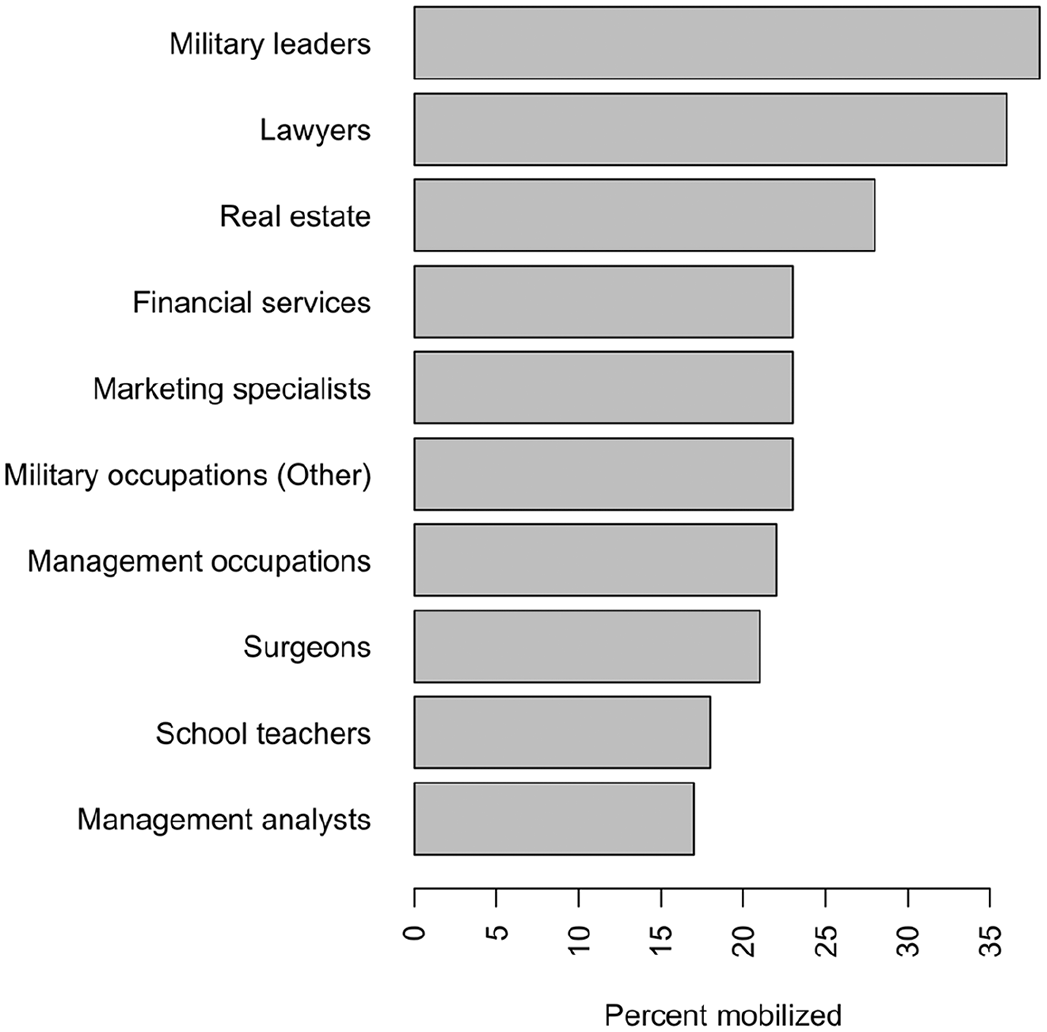
Occupations with Highest Mobilization Rates.
I find that half the occupations show a clear partisan preference while the rest are either divided between the parties or unengaged. For instance, some occupations are virtually all Republican (chemical engineers, computer and information systems managers, and management analysts), others are virtually all Democrats (epidemiologists, computer programmers, and historians), and some are evenly divided (real estate brokers, broadcast news analysts, and financial analysts).
To provide more clarity about the social groups that constitute the partisan coalitions and shape their public identity (Green et al., 2002), Figure 2 presents the occupational groups that are predominantly Democratic—that is, the ratio of Democrats to Republicans is 1.5 or greater—and Figure 3, the occupational groups that are predominantly Republican—the ratio of Republicans to Democrats is 1.5 or greater.

Occupations with a Democratic tilt

Occupations with a Republican tilt.
Finally, to verify that Wikipedia’s coverage is not biased toward a particular party, I compare my results with a pair of studies that estimate the partisan tilt of lawyers and doctors by merging comprehensive occupational directories with partisan administrative records. According to Bonica et al. (2015), 43% of all lawyers have donated money to a federal campaign and 68% have donated more cash to Democrats than Republicans. In comparison, I find that 36% of elite lawyers publicly engage in partisan politics and 61% of those individuals affiliate with the Democratic Party. Second, using a nationally representative sample of American physicians, Hersh and Goldenberg (2016) find that 53% of partisan physicians register as Democrats and 47% as Republicans. I also find that the SOC category for physicians—“medical scientists, except epidemiologists”—divides nearly equally between the parties, 48% are Democrat and 52% Republican. Thus, my Wikipedia-based estimates match the best available data on occupational partisanship.
Discussion
While political scientists agree that elite groups are the primary driver of American political behavior, partisan institutions, and public policy, they have only impressionistic notions about the composition of this elite (Page and Gilens, 2017). My results provide a more precise picture of the occupational group composition of the power elite and their relationship with the American party system. Since partisanship organizes economic, racial, and cultural conflict in contemporary America (Aldrich, 2011), these results demonstrate that the American elite is not a monolith and document a key dimension of “internal contestation and dispute” (Savage et al., 2015: 309).
Footnotes
Acknowledgements
Thanks to Matt Atkinson, Sunny Rollins, and Helene Valencia for making this project possible and to Fanny Lauby, Samantha Majic, and Valerie O’Regan for incisive comments on earlier drafts. I also appreciate the valuable research assistance of Vivian Dao, Gonzalo Martinez, and Andrew Scibetta.
Declaration of conflicting interests
The author(s) declared no potential conflicts of interest with respect to the research, authorship, and/or publication of this article.
Funding
The author(s) received no financial support for the research, authorship, and/or publication of this article.
