




Abstract
To explore the mechanisms that foster rational, communicative, and actionable citizenship, this research proposes a mediation as well as moderation research framework that links deliberative thinking, political self-efficacy, social capital, and civic participation. Data from 865 Taiwanese university students are analyzed with structural equation modeling, showing a positive association of deliberative thinking to political self-efficacy and civic participation, as well as a positive association between them. Moreover, the association between deliberative thinking and civic participation is significantly and positively mediated by political self-efficacy. When background factors are controlled, only social capital is identified to be moderating any associations between variables in this study. The established association between deliberative thinking and political self-efficacy and that between deliberative thinking and the non-electoral, as well as community-based dimensions of civic participation, are significantly weaker among those possessing less social capital, while such differences are not significant in the case of gender and household income. Based on these findings, the relative roles of deliberative thinking, political self-efficacy, and social capital in promoting effective deliberative democracy will be discussed.
Keywords
Introduction
University students have traditionally played a leading role in social movements in Taiwan, such as in the case of the Wild Lily movement in 1990 which urged for democracy, as well as the Sunflower movement in 2014 calling for the suspension of the China–Taiwan Free Trade Agreement. Such passion for participating in public affairs among university students, however, is not unique to Taiwan (Nie et al., 1996; Verba et al., 1995). In this regard, traditional political studies have pointed to the relevance of self-efficacy in motivating civic participation. According to Dahl (1998), a sound democratic procedure requires effective participation on the part of most community members (i.e. gaining enlightened understanding and exercising ultimate autonomy over the agenda). These standards resonate significantly with the idea of deliberative and participatory democracy: It is believed that public deliberation can help policy decisions transcend the self-interests and values of individuals engaging in collective rationality and communication (Gutmann and Thompson, 1996; Valadez, 2001). Apart from contributing to self-efficacy and willingness to participate in public affairs, deliberative thinking has gradually been integrated as a core quality of proactive citizenship in view of establishing and maintaining a rational civil society.
Since 1990, Taiwan has been democratized and engaged in reforming the tertiary education curriculum, especially in many of the liberal arts disciplines. With the presence of nascent elements of civic education such as the democratic process, human rights, constitutional laws, critical thinking, and reasoning to community engagement, it is believed that young adults in Taiwan are increasingly equipped with the sufficient knowledge and skills, as well as the deliberative thinking required for civic participation. Given this context, one core issue this study aims to address is to what extent are university students able to think rationally and communicate with fellow citizens with different interests and opinions upon receiving a formal education in the liberal arts.
In addition to the discussion regarding how deliberative thinking and self-efficacy are related to civic participation, this study explores possible background factors which could potentially condition the effectiveness of those motivators, such as gender, household income, and social capital. This article will be structured as follows: conceptual framework, method, results, discussion and implications, research limitations, and conclusion.
Conceptual Framework with Its Empirical Groundings
Political Efficacy and Participation
Political efficacy, an issue of great concern among scholars of politics for decades (Abramson and Aldrich, 1982), refers to how individuals perceive the influences of their political actions on the political system (Campbell et al., 1954) and is widely regarded as a key predictor for political participation and proxy for the public to assess government performance and their own political capacity: The higher the degree of self-efficacy, the greater the resulting political trust, support, and participation (Aleksandra et al., 2011; Almond and Verba, 1963; Craig et al., 1990; Finkel, 1985, 1987; Homero et al., 2017; Yang and DeHart, 2016). The concept can be classified into two dimensions, namely, internal political efficacy and external political efficacy (Acock et al., 1985; Anderson, 2010; Asher, 1974; Balch, 1974; Converse, 1972; Craig, 1979; Craig and Maggioto, 1982; Lane, 1959; Morrell, 2005; Niemi et al., 1991). The former indicates how citizens perceive their ability to influence the political system, whereas the latter refers to how they perceive its responsiveness (Caprara et al., 2009; Lane, 1959; Marx and Nguyen, 2016). While early studies suggest that the positive association between political participation and political self-efficacy is limited to the external one (Ginsberg and Weissberg, 1978; Salisbury, 1975), the mainstream view holds that the internal counterpart is a more important motivational factor for political participation (Finkel, 1985; Jung et al., 2011). Indeed, the significance of internal political efficacy in predicting political participation has found support from numerous studies (Condon and Holleque, 2013; Krampen, 2000; Schulz et al., 2010).
Regarding the formation of political efficacy, Abramson (1983: 152–165) proposes four theoretical accounts, namely, those from the perspectives of political education, social deprivation, intelligence position, and political reality. Previous research has focused greatly on the latter two explanations, both pointing to political socialization, that is, political education or civil education (Campbell et al., 1954; Easton and Dennis, 1967; Sears, 1975; White, 1968). Individuals with higher education typically have more time, money, skills, and information for political participation (Nie et al., 1996; Verba et al., 1995). It is believed they thus tend to be more likely to vote (Endersby et al., 2006) and engage in political campaigns or community affairs (Dalton, 2014). Scholars have also observed that those who enjoy higher socioeconomic status are more readily accessible to decision-makers and capable of choosing effective channels to participate in decision making. By contrast, the less advantaged usually have limited opportunities to approach decision-makers. Often marginalized within the system, they have no choice but to resort to exogenous approaches to address grievances, that is, demonstration, marches, and even violent means (della Porta and Diani, 2006; Harris and Gillion, 2010; Tarrow, 1998). In this connection, the political self-efficacy of citizens essentially represents the building block of civil society and serves as a cornerstone of democracy.
Some suggest that the political self-efficacy of ordinary citizens can indeed be enhanced by the increased opportunities for political participation within a participatory democracy as it closes the gap between the people and the power center and enhances their decision-making ability (Morrell, 2005; Pateman, 1970). Participatory democracy consists of various forms of public deliberation: citizen conferences, town meetings, designated deliberation times, citizen juries, deliberative polling, study circles, national issue forums, scenario workshops, social group forums, citizen communication cycles, and televised debates (Parkinson, 2006). It is believed that such varied and informed forms of participation can effectively reduce physical and social barriers to participation. In this study, the measurement of political participation includes a wide range of civic activities beyond the traditional electoral focus, such as joining or collaborating with NGOs or neighborhood associations and engaging in talks or debates on social affairs.
Deliberative Thinking and Political Deliberation
Central to public deliberation is citizens’ ability to engage in deliberative thinking. It requires a transparent and rational discussion based on public interests regardless of participants’ own stances and interests (Gutmann and Thompson, 1996). When dealing with issues of high concern, it is necessary for participants to rationally consider opposing arguments from others, that is, to comprehend and engage with opposing viewpoints, provide a persuasive argument with sufficient justification, reflect on one’s own preferences, and strive for a solution acceptable to most (Beauvais and Baechtiger, 2016; Bohman, 1996; Elster, 1998; Guttmann and Thompson, 2004).
Rationality and volition are the underlying principles of such deliberative communication actions. They can be traced back to the notions of John Rawls on “public reason” and Jürgen Habermas on “communicative action,” which refer to a form of deliberation in which participants as agents can freely communicate and debate so as to reach a consensus by way of increased mutual understanding (Bächtiger et al., 2018; Fearon, 1998; Habermas, 1994, 1998; McAfee, 2004; Mouffe, 2000; Smith, 2009). Deliberative democracy features community-based communication which emphasizes equality, transparency, reciprocity, freedom from power, considered debate, accountability, and a focus on consensus or common good (Fishkin, 2011; Reuchamps and Caluwaerts, 2018; Walsh, 2007). For Sanders (1997), deliberative advocacy typically entails rationality, reserve, cautiousness, quietude, community, altruism, and universalism. Some also point out that public discussion can encourage cooperation among participants and foster trust and establish reputation, reducing dishonesty, and inappropriate decisions (Mackie, 1998).
Hence, deliberative thinking is related to the willingness and ability to communicate with fellow citizens of different viewpoints and interests, which is another important aspect of political participation. It is expected that with the increasing civic education young people are receiving in Taiwan, their participation in public affairs should be bolstered by growing skills of and motivation for deliberation. Admittedly, a citizen who regards himself or herself capable of understanding and influencing public affairs is not necessarily the one who takes part in deliberative democracy, unless they are also willing and able to communicate with others. To better identify predictors of political participation, especially those activities related to deliberative actions, the analytical framework of this study will offer an account of respondents’ inclination and ability to engage in political deliberation in addition to self-efficacy.
Political Efficacy as a Mediating Factor
According to the “deliberative participation hypothesis” (Gastil et al., 2008), the more one discusses politics, the more likely one is to feel confidence regarding their political skills, therefore eliciting a “virtuous” circle between participation and self-efficacy (Gastil and Dillard, 1999; Gastil and Xenos, 2010; Morrell, 2005; Smith, 1999). Central to this argument is indeed the indirect effects of deliberative communication on civic engagement through self-efficacy, as the former can “increase participants’ political efficacy . . . raise participants’ interest in politics . . . and increase the frequency of participants’ political information seeking and political activity” (Gastil, 2000: 117–118).
Furthermore, the theory of planned behavior argues that it is the personal sense of control and feelings of self-efficacy that initiate behavior (Ajzen, 1991, 2012; Bandura, 1977; Krampen, 2000; Steinmetz et al., 2016). It is evident in international surveys that citizenship self-efficacy is conducive to adolescents’ expectations to participate in civic activities (Manganelli et al., 2015; Schulz et al., 2010). In relation to political deliberation, a study on potential factors affecting environmental opinion leadership behaviors (i.e. informing the public about environmental issues) finds that individuals’ willingness to communicate with others on public issues is indeed predicted by self-efficacy (Dalrymple et al., 2013). Based on the findings of a deliberative field experiment on Michigan Medicaid program, Myers et al. (2020) suggest that public deliberation does not necessarily increase and broaden political engagement, as it may only occur in particularly intensive, directly empowered forms of public deliberation.
In the field of political education, there is evidence to support the view that the effects of an open classroom climate and civic education strategy on students’ civic participation are mediated by political self-efficacy (Manganelli et al., 2015; Maurissen, 2020). Similarly, in the field of media research, passive political media use, such as political late-night comedy, satire, and traditional TV news (Hoffman and Thomson, 2009; Hoffman and Young, 2011; Long et al., 2020), as well as the proactive form, such as sharing political information on social media (Halpern et al., 2017), are found to be positively associated with civic engagement through political self-efficacy. In addition to online political communication, offline interpersonal political discussion is found to have similar mediating effects (Chan et al., 2017; Jung et al., 2011).
While empirical studies in the past decade have indicated the significance of political self-efficacy as a mediator of the association between deliberative communication and the willingness to participate in civic activities, many are limited to actual activities of political discussion, sharing and information acquisition as measured by frequency. Based on Weinmann’s (2018) measurement of political deliberation, in this study we regard deliberative thinking as a core citizenship competence or inherent characteristic alongside political self-efficacy, that is, how well one has considered the diverse concerns underlying issues and how others prioritize issues differently.
Social Capital as a Moderating Factor
Citizens’ deliberative actions take place in certain social contexts. Scholars have found that benefits of deliberation are unclear when participants cannot clearly determine the veracity of others’ viewpoints (Przeworski, 1998). Studies have also showed that putting members from disparate social backgrounds together may exacerbate conflicts and prejudices (Bettencourt and Dorr, 1998; Miller and Davidson-Podgorny, 1987). In this connection, another empirical issue that this study attempts to address is the role of social capital in shaping citizens’ willingness and ability to participate in public affairs. Although deliberative thinking is expected to be relevant to civic participation, whether such effects remain present in a social setting that lacks trust is unclear.
While the concept was originally used to describe the collective characteristics of social coherence in terms of general social trust and connectedness through social networks and organization membership (Putnam, 1993, 2000), a number of empirical studies at the individual level have also confirmed that individuals who are more trusting and connected tend to be more engaged in democracy than those who are not (Booth and Richard, 1998; Cohen and Rogers, 1992; Dowley and Silver, 2002; Gibson, 2001; Mishler and Rose, 2005), especially given their relatively greater political self-efficacy (Erickson and Nosanchuk, 1990; Olsen, 1972; Verba et al., 1995) and knowledge (Ikeda et al., 2003), as well as higher degree of civic participation (Ikeda et al., 2003; Rosenstone and Hansen, 1993; Verba and Nie, 1972). This is perhaps not surprising as individuals with strong ties to the community tend to have a greater degree of access to and confidence in community resources. It is found that community integration, or a sense of community, is closely related to feelings of personal and group efficacy, ultimately promoting participation in public affairs (Chavis and Wandersman, 1990; McLeod et al., 2001).
Following the social capital argument, researchers have explored how social trust and networks, in addition to promoting civic participation directly, mediate the latter’s relationship with unemployment (Lorenzini and Giugni, 2012), ethnicity (Bevelander and Pendakur, 2007), and multimodal communication (Chan, 2018). More pertinently, Choi and Shin (2017) find that while both social capital and the use of social media to express opinions or acquire trusted information promote civic engagement, the latter two exert differential effects on civic participation, depending on the individual’s level of social capital, rather than having an equal impact on civic participation. As they noted, studies based on linear causality ignore that the impact of political use of media communication on civic participation could differ depending on social capital factors and that citizens already hold pre-existing levels of social capital in reality.
In this study, we will also explore whether social capital has such moderating effects on political self-efficacy and civic participation. Instead of applying social capital in the association model of this study as a mediator, we are more interested in its potential moderating effects that magnify the hypothesized pathways to civic participation, especially in relation to self-efficacy as well as political deliberation. It is hoped that such an approach can present a new perspective in this field of study, with special attention to how differently political deliberation will function to promote self-efficacy and civic participation in those with and without sufficient social capital as a conducive context.
Research Hypotheses
Based on the above conceptual framework, we propose the following research hypotheses to examine the roles deliberative thinking and self-efficacy play in fostering civic participation (including community participation and socio-political participation), as well as the significance of social capital in moderating those associations (Figure 1):
Direct association hypothesis
Mediating effect hypothesis
Moderating effect hypothesis
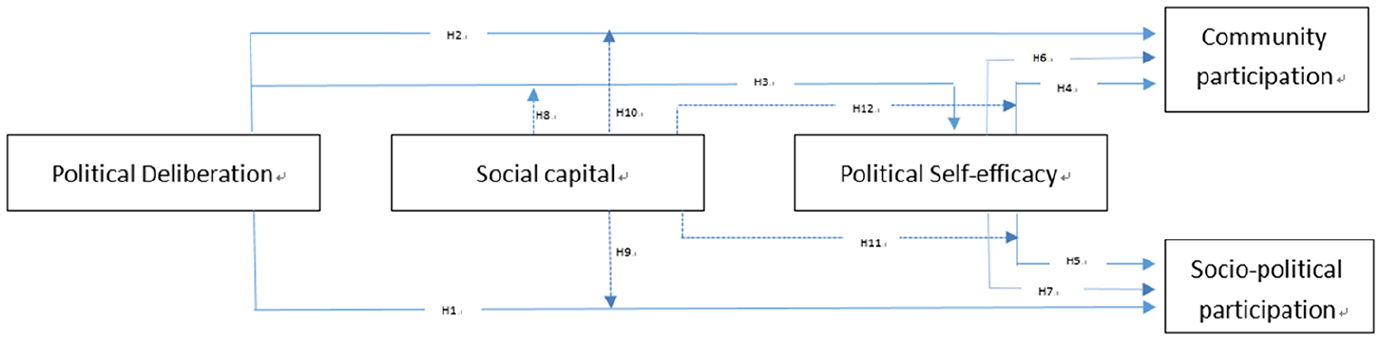
Research SEM Model.
Method
Participants and Procedure
In early June 2020, we invited participants studying in higher education institutions (HEIs) in Taiwan to take part in a self-administered online survey. We randomly selected three universities from four different regions of Taiwan (North, East, Middle, and South) and online questionnaires were distributed to each university. The final dataset was collected from the 12 universities, including 8 public HEIs and 4 private HEIs. Out of the 1600 questionnaires distributed, 980 were returned, yielding a response rate of 61.25%. To identify careless responses and ensure a high-quality dataset, we used two qualifiers and only included those who finished the whole survey in 10 minutes or more, resulting in a final sample of 865 respondents (559 females, 64.60%; Mage = 20.18, SDage = 1.40, age range = 18–24 years).
Measures
Table 1 shows the detailed corresponding scale items used to measure each variable including political deliberation, political self-efficacy, community and socio-socio political participation, and social capital, along with background variables.
Summary of Constructs and Its Corresponding Scale Items.
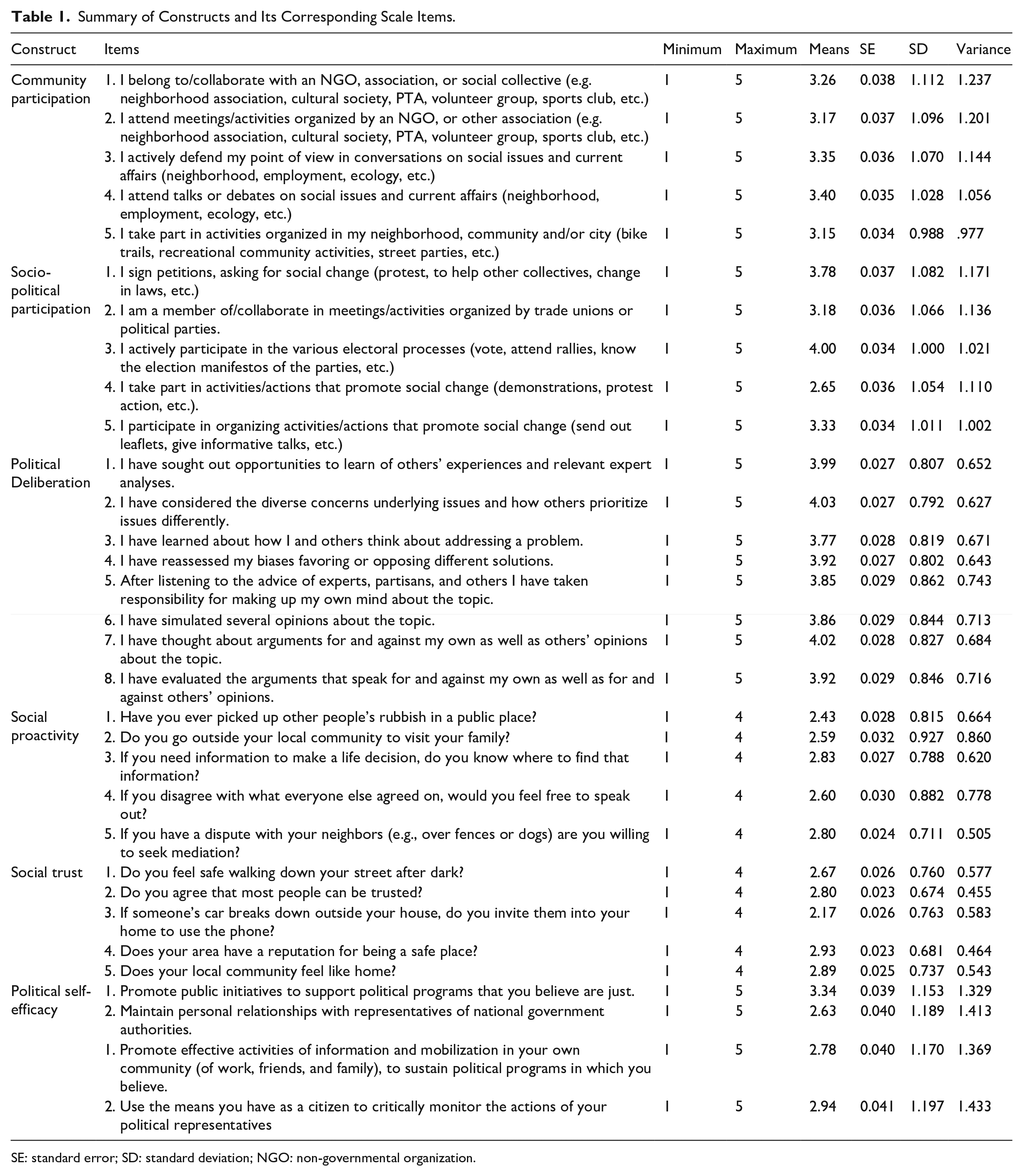
SE: standard error; SD: standard deviation; NGO: non-governmental organization.
Political Deliberation
A “Deliberation Within” scale was measured with four validated items (Weinmann, 2018). Eight items were carefully translated and back-translated by separate Chinese–English bilinguals and the final Chinese version was approved by two linguist cross raters. The respondents were asked whether each item (e.g. Promote public initiatives to support political programs that you believe are just) could describe their political deliberation (1 = strongly disagree to 5 = totally agree). The Cronbach’s alpha for this scale was 0.943.
Political Self-Efficacy
Political self-efficacy scale was measured according to four validated items (Vecchione et al., 2014). The items were carefully translated and back-translated by separate Chinese–English bilinguals and the final Chinese version was approved by two linguist cross raters. Respondents indicated on a scale from 1 (strongly disagree) to 5 (totally agree), the level with which they have perceived their political self-efficacy (e.g. Promote public initiatives to support political programs that you believe are just) could describe their internal political efficacy. The Cronbach’s alpha for this scale was 0.883.
Community and Socio-Political Participation
A community and socio-political participation scale was assessed by a Chinese version of the 10-item global citizenship scale (Moreno-Jiménez et al., 2013). All items were carefully translated and back-translated by separate Chinese–English bilinguals, and inconsistencies were resolved in a final discussion of the translation. The respondents indicated on a scale from 1 (never) to 5 (very often) the extent to which they engage in community participation (five items; α = 0.906) and socio-political participation (five items; α = 0.889). A sample item tapping community participation is “I belong to/collaborate with an NGO, association or social collective, such as neighborhood association, cultural society, PTA, volunteer group, sports club, etc.” A sample item regarding socio-political participation is “I sign petitions, asking for social change, such as protest, to help other collectives, change in laws, etc.”
Social Capital
We used the validated Chinese version of the social capital scale, which is designed to measure important aspects of social proactivity (five items) and social trust (five items) (Chen et al., 2007; Onyx and Bullen, 2000). Participants rated each item on a four-point Likert-type scale ranging from 1 (strongly disagree) to 4 (strongly agree). A sample item of social proactivity asks: “If you disagree with what everyone else agreed on, would you feel free to speak out?,” and one of social trust states “My social relationships are supportive and rewarding.” The Cronbach’s alpha α = 0.642 and 0.760, respectively. Normally the accepted value of Cronbach’s alpha α is 0.70, however, some recent studies have also found that values above 0.60 are also acceptable (Taber, 2018; van Griethuijsen et al., 2015). Due to the modest reliability of two constructs, its results should be interpreted and discussed with caution.
Background Variables
The questionnaire also consisted of demographic information, including respondents’ age, gender, the region of hukou (certifying that the holder is a legal resident of a particular area; that is, Northern, Middle, Southern, Eastern, Western regions and Outer Islands in Taiwan), household income and perceived social class status, which is an indicator of socioeconomic status.
Data Analysis
All statistical analyses were conducted with SPSS 27.0 (IBM Corp., Armonk, NY, USA) and Mplus 8.3. We first examined the descriptive statistics among all variables before proceeding to test our proposed model. Second, we examined the discriminant and convergent validity of the measurement model with a series of confirmatory factor analyses (CFA). Following the CFA analyses, a latent mediation analysis was conducted to determine whether the relationship between political deliberation and community/socio-political would be mediated among Taiwanese undergraduate students. The model fit was also assessed by chi-square (χ2) index, a root mean square error of approximation (RMSEA), a comparative fit index (CFI), a Tucker–Lewis index (TLI), and a standardized root mean square residual (SRMR). We also executed 5000 bootstrapped resamples for bootstrapped mediation test. Finally, we also further examine the coefficient of the mediated moderation effect of social capital on the relationships between political deliberation and political self-efficacy, as well as between political deliberation and community/socio-political participation.
Results
Descriptive Profile
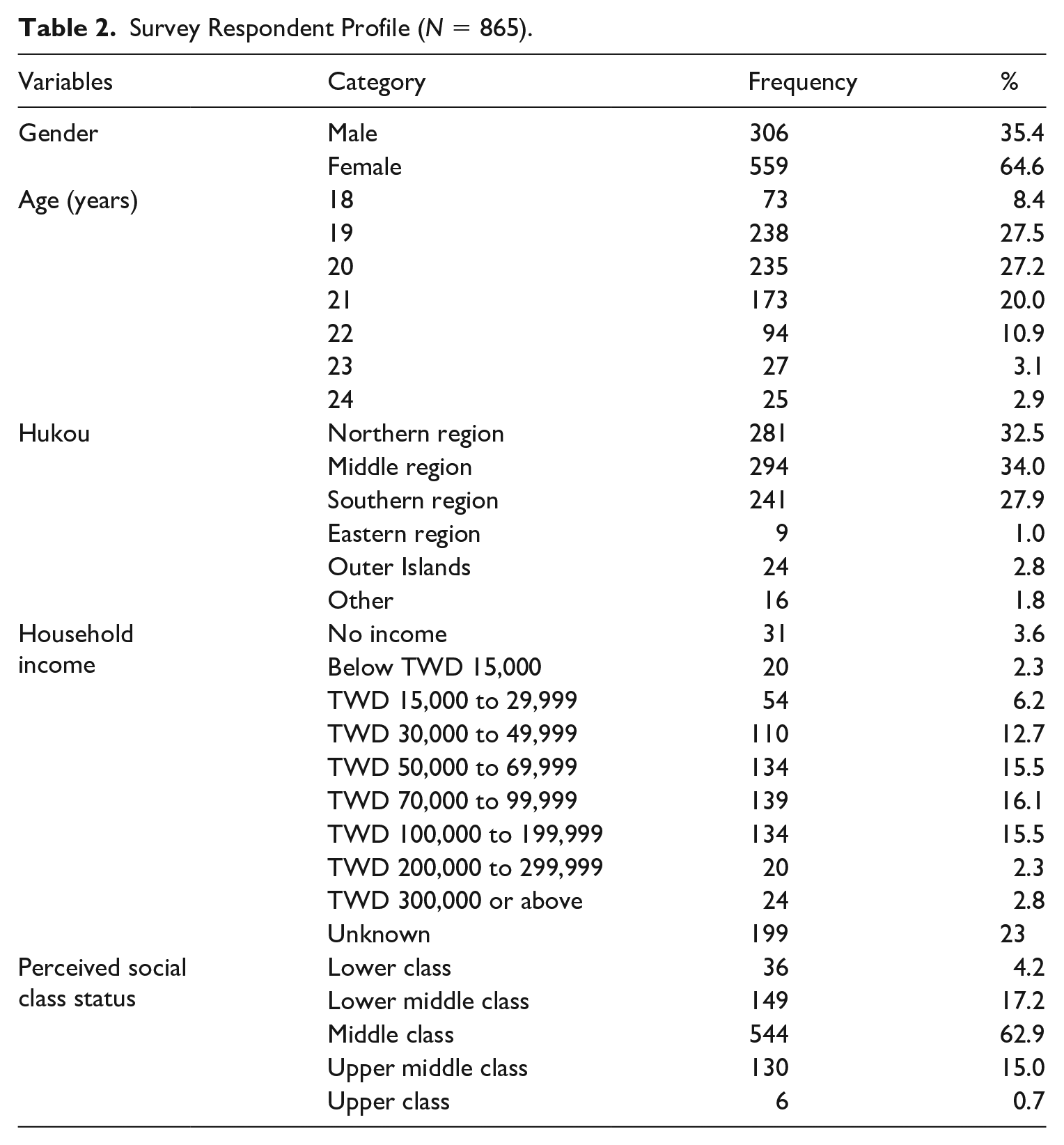
Table 2 displays descriptive statistics for our variables of interest. In terms of gender, 35.4% respondents were male and 64.6% were female. The age of most respondents was 19 (27.5%) and the others were 20 (27.2%), 21(20.0%), 22(10.9%), 18 (8.4%) 23 and above 23 (6.0 %). As for household income, 16.1% identified their income as TWD 70,000 to 99,999, 15.5% TWD 100,000 to 199,999, 15.5% TWD 50,000 to $69,999, 12.7% TWD 30,000 to 49,999, 8.5% indicated an income below 30,000, 5.1% indicated an income above TWD 200,000, and 3.6% reported no household income. After household income, in regards to perceived social class status, 62.9% respondents identified as middle class, 17.2% lower middle class, 15.0% upper middle class, 4.2% lower class, and 0.7% identifying as upper class. In terms of hukou, 34.0% reported living in the Middle region of Taiwan, 32.5 % in the North region, 27.9% in the South region, 1.0% in the East region, and a total of 4.6% in the Outer Island and other.
Survey Respondent Profile (N = 865).
CFA Analysis
This study employed a CFA to test composite reliability (CR), convergent validity, and discriminant validity. First, as shown in Table 4, the CFA indicated that the standardized factor loadings of the 22 observed variables (ranging from 0.62–0.86) were statistically significant (t-value > 1.96), and all observed variables were greater than the 0.5 criterion, which suggested the data was properly fit in the proposed model (Jöreskog and Sörbom, 1996). Second, the CR ranged from 0.81 to 0.94, and the average variance extracted (AVE) ranged from 0.47 to 0.70, three of which were higher than the recommended values of 0.60, other than the latent construct of socio-political participation (Bagozzi and Yi, 1988). Hence, the internal consistency of the research model was acceptable, and the scale items exhibited reliability and convergent validity. Following this analysis, a low correlation between the two constructs demonstrated discriminant validity (Anderson and Gerbing, 1988). According to Anderson and Gerbing (1988), the correlation coefficients between constructs should be lower than the square root of the AVE. In this study, the figure ranged from 0.68 to 0.84 (see Table 3), which was higher than the inter-correlation coefficient between each of the constructs. Based on the rigorous examination of measurement criterion, most of the constructs met the academic standard of discriminant validity.
Squared Correlations for the Complete Sample and AVE (N = 865).
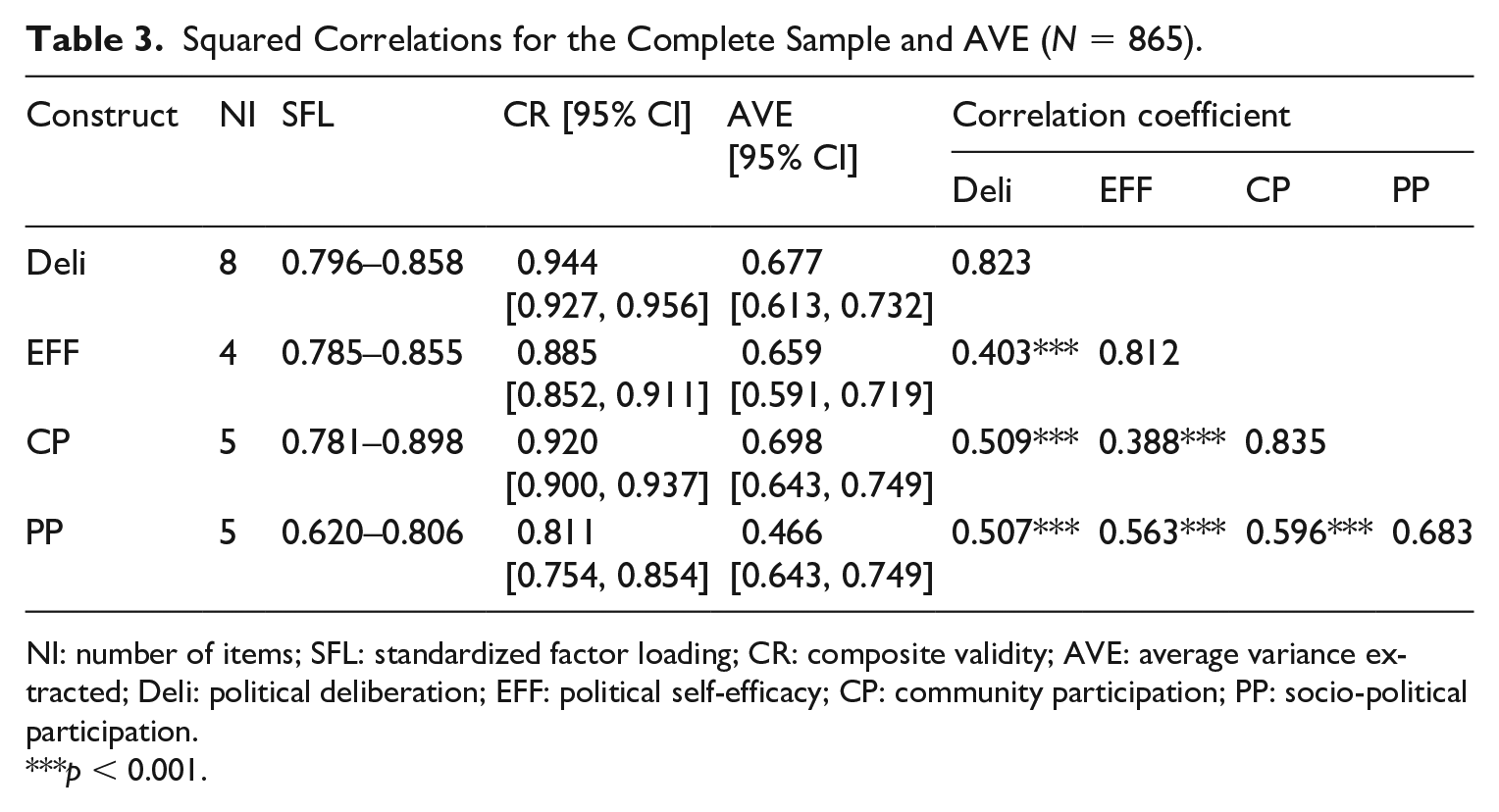
NI: number of items; SFL: standardized factor loading; CR: composite validity; AVE: average variance extracted; Deli: political deliberation; EFF: political self-efficacy; CP: community participation; PP: socio-political participation.
p < 0.001.
Confirmatory Factor Analysis (CFA) for the Complete Sample.
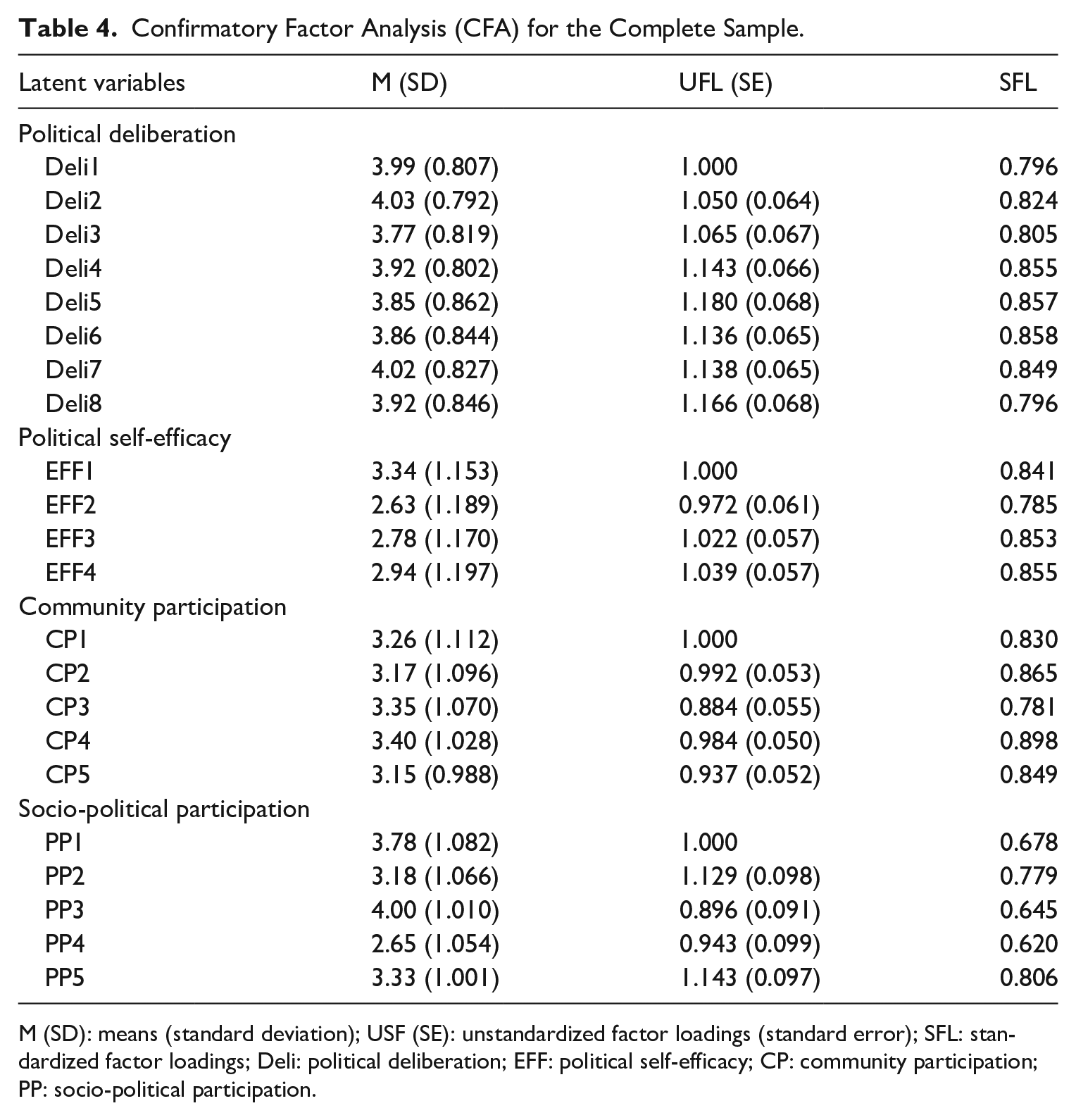
M (SD): means (standard deviation); USF (SE): unstandardized factor loadings (standard error); SFL: standardized factor loadings; Deli: political deliberation; EFF: political self-efficacy; CP: community participation; PP: socio-political participation.
SEM with Latent Mediation Analysis
To account for the shared association among predictors in the latent mediation model estimated, the political deliberation variable was included in the model for political self-efficacy (mediator) and community and socio-political participation (outcomes). All model coefficients are shown in Table 5. With 204 degrees of freedom, it produced a normed chi-square of 3.63 (p < 0.001), an RMSEA of 0.086, a CFI of 0.905, a TLI of 0.900, and an SRMR of 0.063. All of these indicators are regarded as an acceptable fit for the data (Kline, 2005). In order to test Hypotheses 1 to 5, we followed Baron and Kenny’s (1986) suggestion to assess the first condition of mediation. The standardized direct association indicated that political deliberation is positively and significantly related to political self-efficacy (β = 0.40, p < 0.01), community participation (β = 0.42, p < 0.01) and socio-political participation (β = 0.33, p < 0.01); political self-efficacy is significantly related to community participation (β = 0.22, p < 0.01) and socio-political participation (β = 0.43, p < 0.01). Therefore, Hypotheses 1 to 5 were all supported (Table 6). For Hypotheses 6 and 7, we assessed the indirect associations of mediation with percentile and bias-corrected percentile bootstrapping based upon 5000 bootstrapping resamples at a 95% confidence interval. We estimated the lower and upper bounds of confidence intervals to investigate whether the mediating relations were significant. The bootstrapping test results identify the positive and significant indirect association of political self-efficacy on the relationship between political deliberation and community participation (β = 0.088, p < 0.01, bias-corrected 95% confidence interval (CI) = [0.083, 0.0183]) and between political deliberation and socio-political participation (β = 0.193, p < 0.01, bias-corrected 95% CI = [0.143, 0.244]). As a result, Hypotheses 6 and 7 were supported (Table 6; Figure 2).

Standardized structural equation model with maximum-likelihood (ML) estimation.
Bootstrapping Analyses of the Hypothesized Model.
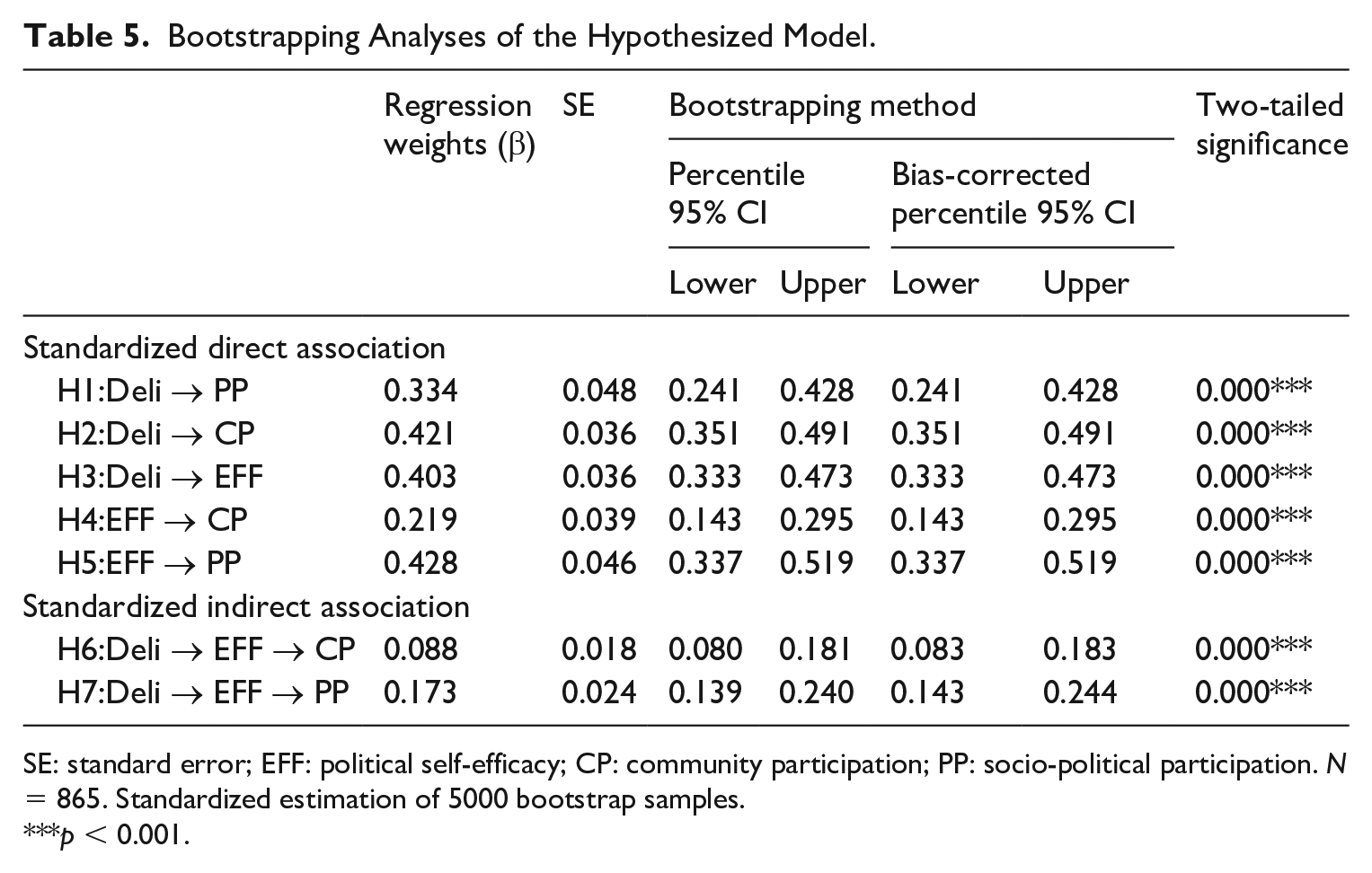
SE: standard error; EFF: political self-efficacy; CP: community participation; PP: socio-political participation. N = 865. Standardized estimation of 5000 bootstrap samples.
***p < 0.001.
Results of Hypothesis Testing.

Deli: political Deliberation; PP: socio-political participation; CP: community participation; EFF: political self-efficacy.
SEM with Latent Moderation Analysis
We constrained the path of political deliberation to political self-efficacy, the path of political deliberation to community participation, and the path of political deliberation to socio-political participation to assess the moderating effects of social capital, indicated by social proactivity and social trust. The result showed that social capital significantly moderated the association between political deliberation and political self-efficacy, β = 0.057, SE = 0.013, t = 4.453, p < 0.001, 95% CI = [0.032, 0.082]; community participation, β = 0.033, SE = 0.013, t = 2.617, p = 0.009, 95% CI = [0.008, 0.058]; while not moderating the association between political deliberation and socio-political participation, β = 0.015, SE = 0.021, t = 0.740, p = 0.459, 95% CI = [–0.025, 0.056].
Furthermore, we constrained the path of political self-efficacy to community participation, and the path of political self-efficacy to socio-political participation to verify the moderating effects of social capital. The result demonstrated that social capital did not significantly moderate the association between political self-efficacy and socio-political participation, β = 0.049, SE = 0.030, t = 1.606, p = 0.108, 95% CI = [–0.011, 0.108], nor did it significantly moderate the association between political self-efficacy and community participation, β = 0.027, SE = 0.022, t = 1.211, p = 0.226, 95% CI = [–0.017, 0.070]. Table 6 also revealed the moderating effects of binary levels (high and low levels) of social capital on the relation between political deliberation and political self-efficacy, as well as between political deliberation and community participation. As a result, Hypotheses 8 and 10 were confirmed (Table 6).
Discussion and Implications
The first finding of this study pertains to the positive association of deliberative thinking to political self-efficacy, community participation and socio-political participation in Taiwan, on top of a positive association among the latter three. This study resonates with traditional political studies on political self-efficacy and civic participation (Acock et al., 1985; Asher, 1974; Balch, 1974; Converse, 1972; Craig, 1979; Craig and Maggiotto, 1982 ; Lane, 1959; Niemi et al., 1991) and adds the observation that deliberative thinking is also instrumental in motivating citizens to take part in public affairs. More importantly, respondents who are active in public affairs are not just those who regard themselves as capable of understanding and influencing decision making, but also those who are willing and able to communicate with others of different opinions and interests. This suggests, at least among young university students, passion of participation in public affairs is bolstered by growing skills and motivation of deliberation in Taiwan. In other words, civic participation on the part of university students in Taiwan can be seen as deliberative in nature. For example, on 30 March 2014, a grass-roots social movement including university students and civil society actors gathered outside the Presidential Office in Taipei to protest a trade deal with China. The supporters of the movement, which subsequently came to be known as the “Sunflower Movement,” have been described as embodying “an awakening of civil society within Taiwan” and the emergence of “a third political force” in Taiwanese politics (Lowther, 2014). The protests reshaped and shifted Taiwanese people’s attention to precipitating institutional forms of politics, joining existing political parties, or even establishing new ones, which presents significant ramifications for maintaining and facilitating the democratization in Taiwan. It perhaps manifests a “deliberative turn” in the paradigm of university students’ civic participation going beyond “competitive elitist democracy” or “aggregative democracy” (Dryzek, 2000).
Since Taiwan became democratic in 1990, in addition to many elections, abundant social activities have served as channels for political participation. During the process of its burgeoning political participation, heated debates over a variety of issues have become increasingly commonplace, such as the cross-strait relationship with Mainland China, nuclear power and the abolishment of the death penalty. It is argued that such debate is, in fact, a search for a solution acceptable to all (Bohman, 1996; Elster, 1998; Guttmann and Thompson, 2004). This search may also manifest in the various ways that interest groups and university students engage in the discourse, including TV debates and online forums (Parkinson, 2006). All have contributed to the normalization of rational public discourse and furthered the public consensus (Fearon, 1998; Habermas, 1998; McAfee, 2004; Mouffe, 2000). The findings of this study therefore identify the maturation of democracy in Taiwan in terms of the practice of deliberation in civil society and enlightened reforms in liberal art education that encourage students’ enthusiasm, as well as tolerance, self-reflection and willingness to communicate with fellow citizens in civic participation.
Another finding of this study is in relation to the mediating effects of political self-efficacy between deliberative thinking and civic participation. While both political self-efficacy and deliberative thinking are found to be closely interrelated and helpful in fostering civic participation, the former is considered by the authors to be a more significant factor in the association model, as the latter predicts civic participation largely through it. This lends support to one of the theory of planned behavior’s central premises which holds that the initiation of behavior is predicated on personal sense of control and feelings of self-efficacy (Ajzen, 1991; Bandura, 1977; Dalrymple et al., 2013; Krampen, 2000). This implies if those who are willing and able to communicate with others do not perceive themselves as capable of influencing decision making in public affairs, they may remain unwilling to participate in the process. The samples of this study were collected from an educational setting where the background of respondents is relatively homogeneous. Yet, it must be noted that the role of political self-efficacy is still unneglectable. The practical implication is that apart from educational reforms that promote deliberative thinking, the capacity of the political system itself to engage citizens from different backgrounds is an issue that should not be overlooked in future endeavors to promote inclusive democracy.
The third finding of this study supports the claim that deliberative thinking and self-efficacy are moderated through social capital in their association with community participation (the less formal or electoral dimensions of civic participation). The moderating models in this study suggest that when social capital is lower, those willing to communicate with others are less likely to regard themselves as efficacious and active in community affairs. Considering the established positive association of deliberative thinking to civic participation, this finding does not reject deliberative thinking as an important driver of civic participation, but rather highlights the social conditions for such a motivator to become less effective. This echoes Choi and Shin’s (2017) finding on the moderating effects of social capital on the association between political communication on social media, but we extend the measurement of the concept of political deliberation to the inclination to communicate with others, beyond the frequency those communicative actions. Theoretically, there are other potential moderating factors such as respondents’ gender and income, but their moderating effects are not found in any established correlations in this study. This underscores the relative significance of social capital in conditioning the effects of community participation as a motivating factor as compared to other background factors.
Notably, no moderating effects of social capital are found between political self-efficacy and any forms of civic participation. Our correlation coefficient test shows that social capital is highly correlated to all of the other variables (deliberative thinking, political self-efficacy and civic participation), which is in line with previous mainstream studies on the significance of social capital in fostering citizenship (Chavis and Wandersman, 1990; McLeod et al., 2001; Rosenstone and Hansen, 1993; Verba and Nie, 1972). However, our moderated model additionally notes that the role social capital plays in civic participation remains somewhat unclear, especially when political self-efficacy is taken into consideration. The joint association of political trust and self-efficacy to political mobilization has long been observed by researchers (Fraser, 1970; Gamson, 1968). A previous study using European Social Survey data on civic participation (Hooghe and Marien, 2013) found that the positive association of political trust is dependent on self-confidence regarding one’s capability of understanding politics. This study generates similar results using measurements for general social trust.
Research Limitations
Despite the abovementioned contributions to academic and practical discussion, there are several research limitations in this study. First, while the sample has included every region of Taiwan by proportion of their population sizes, this study is not fully cross-sectional as the sampling of research subjects was limited to university students. The results may therefore not be entirely representative of the overall democratic life of citizens from all backgrounds in the country. For instance, age is widely considered a significant controlling factor of civic participation but is lacking in our model. Second, this study is only a snapshot of 2020 and lacks tracking data to generate any comparable longitudinal results. Moreover, as a result of the first limitation regarding the lack of cross-sectional data, our findings should be interpreted as mainly associative rather than causative. Based on this study, future research efforts may extend the scope to the general population and track the time-series difference.
Conclusion
In sum, deliberative thinking represents a characteristic which has become closely related with political self-efficacy among active participants of public affairs in Taiwan, as it should be in a mature democracy. At the same time, the results of this study indicate that political self-efficacy remains a primary driver of civic participation as its association with deliberative thinking is largely subject to the mediating effects of the former and the moderating effects of social capital.
Footnotes
Declaration of conflicting interests
The author(s) declared no potential conflicts of interest with respect to the research, authorship, and/or publication of this article.
Funding
The author(s) received no financial support for the research, authorship, and/or publication of this article.
