



Abstract
This article investigates presidents’ foreign and defence policy activism under Portugal’s premier-presidential system from 1982 to 2021. First, the article discusses the extant literature on intra-executive conflicts in semi-presidential systems. Then, it provides an overview of Portugal’s experience with semi-presidentialism since 1976 and the powers of the Portuguese president. The third section describes all significant foreign and defence policy presidential interventions from 1982 to 2021 that resulted in disputes with the prime minister. This section estimates presidents’ and prime ministers’ ex-ante preferences over the issues at stake. We verify which preference is closest to the ex-post content of the policy implemented – if it is the president’s, it counts as a presidential win. We identify the formal and informal means by which presidents acted. Informal means are essentially going public tactics. In addition, we inductively pin down the necessary and sufficient conditions under which presidents intervene and succeed. The article’s main findings are two: first, the president’s second term, absence of a strictly unified executive and a majority cabinet are separately necessary but jointly sufficient for presidential interventions to occur; second, formal powers are a necessary but insufficient condition for presidential victory. Finally, we speculate on the policy, institutional, and electoral consequences of presidential activism.
Introduction
In premier-presidential systems, the prime minister and the cabinet must coexist with a directly elected president whose power is usually restricted to specific areas. However, it is not rare that presidents reach beyond constitutional limits and circumvent formal policy-making, leveraging their power to influence governmental policies. While many studies focus on cohabitation and presidential activism, crucial questions remain. As Raunio and Sedelius (2020: 52–58) point out, most presidential power measures fail to address presidential participation in national security and foreign policy adequately. To contribute to filling this gap, this article aims to answer three questions: under which conditions are presidents active in foreign and defence policy? Under which conditions are they successful? What are the consequences of presidential activism? Empirically, we will investigate the case of Portugal’s premier-presidential system from 1982 to 2021.
Portuguese presidents wield some influence over foreign and defence policy, but most powers reside with the government. The literature suggests that the policy-making process in these areas is highly institutionalised and marked by a robust cross-party consensus (Carreiras, 2022; Freire, 2022; Passarelli, 2010; Raimundo, 2017; Teixeira, 2010; Teixeira and Fernandes, 2005). The prime minister is the first mover in policy issues. However, most Portuguese presidents have had significant attitudes towards foreign and defence policy. Thus, there exists a latent potential for clashes between the head of state and the government.
Portugal is a particularly suitable case to study presidential activism. It generally has very stable institutions and is a notable example of a highly institutionalised and consensual foreign and defence policy-making process. 1 These attributes reduce the presence of confounders when pinning down the motivations, tactics and outcomes of presidential behaviour.
To investigate Portuguese presidents’ activism and success in foreign and defence policy, we first briefly review what we know of intra-executive disputes in semi-presidential systems and the special character of those policies. Then, we provide an overview of Portugal’s experience with semi-presidentialism since 1976 and the powers of the Portuguese president. The third section describes all the significant episodes of presidential intervention in foreign and defence policy from 1982 to 2021. This section provides rough estimates of presidents’ and prime ministers’ ex-ante preferences over the issues under scrutiny. To identify the winner in disputes between presidents and prime ministers, we verify which preference is closest to the policy’s ex-post content after a presidential intervention. If the president’s position is the one to which the implemented policy is pushed, it will be considered as a presidential win. We also identify the formal and informal means presidents resorted to in each intervention. Informal means are essentially going public tactics. We inductively pin down the necessary and sufficient conditions under which presidents intervene and succeed. The article’s main findings are two: first, the president’s second term, the absence of a strictly unified executive, and a majority cabinet are separately necessary but jointly sufficient for presidential interventions to occur; second, formal powers are a necessary but insufficient condition for presidential victory. Finally, we speculate on presidential activism’s policy, institutional, and electoral consequences, and discuss deviant cases and an alternative explanation.
Intra-Executive Conflicts in Semi-Presidential Systems
We follow Elgie’s and Raunio and Sedelius’ concept of intra-executive conflicts: severe and persistent tensions between the president and the cabinet (Elgie, 2018: 130; Raunio and Sedelius, 2020: 58). A significant cause of conflict in premier-presidential systems is cohabitation: when the president and the prime minister are from different parties and the president’s party is not represented in the cabinet (Åberg and Sedelius, 2020; Elgie, 2010, 2011: 12; Sedelius and Mashtaler, 2013).
However, the underlying conditions for those conflicts are likely more complex. Presidents and prime ministers belonging to highly fractionalised parties or different parties under the same coalition might have fewer incentives to cooperate (Protsyk, 2006). Another structural condition that may influence the occurrence of intra-executive conflict is the cabinet’s legislative support – how many seats the ruling coalition holds in parliament. Minority cabinets may be a sign of weakness, providing incentives for enterprising presidents to challenge the government.
The most common roots of intra-executive conflicts are disputes for power and influence (Raunio and Sedelius, 2020: 151; Sedelius and Mashtaler, 2013). On one hand, both presidents and prime ministers can claim popular mandates but in different ways. Prime ministers are indirectly selected and are only accountable to parliament, especially in premier-presidential systems. Popularly elected presidents derive legitimacy from their direct connection with voters. However, presidential powers are often not extensive. This disconnect between presidents’ popular support and their limited power is at the core of intra-executive disputes. Ambitious presidents may intervene in politics, leveraging their popularity to force the government to adopt certain policy positions to fulfil their election promises or satisfy their preferences (Köker, 2017: 214, 246). Likewise, a president’s popular support is also key to understanding to what ends informal powers are used, as their compliance mechanism is legitimacy (Grimaldi, 2021). In other words, strategic presidents are cautious about using their powers and do so according to popular opinion, lest they see their support – indeed, their legitimacy – decrease.
Furthermore, studies on European semi-presidential regimes show that as institutionalisation increases, the space for presidential activism decreases, reducing the potential for conflicts (Raunio and Sedelius, 2020: 152, 160; Sedelius and Mashtaler, 2013). Our analysis of Portugal supports this, as Portugal’s premier-presidential system is stable and institutionalised (Amorim Neto, 2022). Finding only six cases of overt intra-executive conflict over four decades conforms with theoretical expectations from the literature.
Given these limitations, how can presidents challenge the prime minister and prevail? Constrained presidents have few avenues. As we further discuss, the two main approaches seem to be going public and deftly using their few formal constitutional attributions.
Foreign and Defence Policy – A Special Case
Semi-presidential systems can experience conflicts that impact policy coordination, particularly in foreign and defence policy. These areas require a unified stance, typically under the executive’s domain, to ensure coherence and avoid delays. Even with symbolic roles, presidents are important figures in these spheres, and intra-executive conflicts may threaten unity and provide leverage for the president over the government.
In more institutionalised systems, behavioural norms and coordination mechanisms emphasise coherence in foreign and defence policy (Raunio and Sedelius, 2020: 36, 145). States like France and Finland maintain coordination through meetings between key officials even during cohabitation (Elgie, 2011; Raunio and Sedelius, 2020: 94–96, 119–120).
Portugal also has a very institutionalised system. 2 The principal coordination mechanism for foreign and defence policy in the country is the Superior Council of National Defence. Enshrined in the Constitution after the 1982 reform, and further reformed in 1997, it soon became a centre of institutional cooperation in all matters of defence and foreign policy. 3 It meets every 3 months. The president chairs it; the ministers of defence and foreign affairs, the chief of the joint staff of the armed forces and other relevant members of the cabinet and parliament have a seat at the table.
The ‘Europeanisation’ of Portuguese foreign and defence policies, while resisted in domestic politics, is more pronounced in foreign policy (Magone, 2014: 197, 224–228; Raunio and Sedelius, 2020: 145). Portugal’s Atlanticist tradition and strong ties to Lusophone and African countries contribute to limit Europe’s influence, allowing for a balance between strategic and cultural interests while adhering to European Union (EU) demands (Robinson, 2016).
An Overview of Semi-Presidentialism in Portugal Since 1982
Portugal’s authoritarian Estado Novo ended with the Carnations Revolution in 1974. The 1976 Constitution established a presidential-parliamentary regime, granting extensive powers to the chief of state. In 1982, Portugal’s main political parties mustered a two-thirds legislative majority to pass a comprehensive constitutional reform. Its most significant consequences were curtailing presidential powers and strengthening the cabinet and parties to the detriment of the chief of state and the armed forces. Hence, in 1982 Portugal changed from presidential-parliamentarism to premier-presidentialism. The president, however, continued to play a crucial role in domestic politics, mainly because of his veto power and his prerogative to request verification of the constitutionality of the laws passed by parliament and the decrees issued by the government (Amorim Neto and Lobo, 2009).
According to Elgie (2005), three dynamics emerge from premier-presidentialism: (1) the parliamentary dynamic, (2) the diarchic dynamics, with two subtypes, competitive and hierarchical, and (3) the presidential dynamic. The 1982 constitutional reforms and the less fragmented party system that emerged in the 1990s did not engender a parliamentary dynamic because the president has not been reduced to a figurehead and keeps playing active roles in national politics and policy-making (Jalali, 2011). Therefore, since 1982 a hierarchical diarchy has solidified. Under the latter, the prime minister is the leading figure within the executive branch.
Thus, the main task in studying Portugal’s premier-presidential system is to find where, when and how the president matters. This depends, first, on the extension of presidential powers. Veto and referral powers stand out as the most significant within Portuguese presidents’ toolbox (Amorim Neto and Lobo, 2009; Feijó, 2021: 82–127; Fernandes and Jalali, 2017; Franco, 2020: 204–225; Freire and Costa Pinto, 2010; Freire and Santana-Pereira, 2017; Jalali, 2011; Novais, 2007; Rapaz, 2017). These works also provide data showing that presidents use their powers more frequently under cohabitation or in their second terms (all Portuguese presidents have been re-elected so far).
In addition, the power to make foreign and defence policy also resides with the government, but as heads of state, presidents also have a role. Cunning presidents use this status to fight for prominence in foreign policy.
Portuguese presidents have another informal way to affect the policy process: going public tactics. Presidents’ ability to address the nation and the legislature and draw media attention enables them to set the political agenda (Amorim Neto and Lobo, 2009; Feijó, 2021: 82–127; Salgado, 2017; Serrano, 2002).
The Portuguese system is similar to Raunio and Sedelius’ description of Finland’s semi-presidential experience (2020: 94–96, 119–120). A clear division of powers between president and government exists, and a robust set of behavioural norms and institutions prevent Portuguese presidents from interfering too much – except in grey areas, as we discuss further, and when public opinion is in their favour.
To sum up, presidential activism in Portugal is a function of the political context, that is, the type of government (majority vs minority; single-party vs coalition; cohabitation vs unified) and presidential term (first vs second). Presidential popularity is also a key source of presidential behaviour. Below, we will apply these findings to understand the conditions under which presidents intervene and win in foreign and defence policy disputes. Given their well-studied role in national security policy-making, personal clashes or animosities should also be considered systematically (Allison and Zelikow, 1999).
Six Episodes of Presidential Intervention in Portugal (1982–2021)
We found six episodes of public disputes between the president and the prime minister concerning defence or foreign policy from 1982 to 2021.
We consulted five Portuguese experts on potential cases of interest. 4 Then, we searched histories, memoirs and news archives to identify other suitable episodes and gather the necessary information. Finally, we identified six episodes that met our reliability criteria in 1982–2021 – mentioned in memoirs and historical accounts and subjected to academic scrutiny. Other conflicts may exist, but the lack of substantive information prevents investigation, or identifying the actors’ preferences and outcomes. Two examples are as follows.
In 1987, the United Nations General Assembly (UNGA) voted on a resolution for Nelson Mandela’s release, with Portugal, the US and the UK opposing. It is said that Portugal’s President Mário Soares opposed the vote. The information resurfaced when former Prime-Minister Cavaco Silva was president and he claimed the vote protected Portuguese nationals in South Africa. Yet, Portugal supported a similar resolution voted on the same day, with milder language. There is not enough information to ascertain if the conflict existed at all and Cavaco Silva’s seemingly forgetting what his government voted on the same day further muddies the waters.
Another possible case is President Soares’s vetoing a government decree called Lei dos Coronéis (Colonels’ Law) in 1992. The decree restructured the armed forces and faced stiff opposition from high-ranking officers. Soon after the veto, it was introduced to Parliament as a bill; it passed easily, due to the government’s ample majority. We do not use this episode, however. It was a minor incident resolved swiftly – which escapes our definition of intra-executive conflicts, and neither Soares nor Cavaco Silva gave it much weight. Cavaco Silva barely mentions it in his biography (2004: 415–416); he gives more importance to the episodes we ultimately selected.
We credit such scarcity of disputes (or information about them) to the broad consensus present in Portuguese politics regarding the drivers of foreign and defence policy and the role and appropriate behaviour of the president.
Below, we describe each episode, the stakes, the main actors and their ex-ante preferences, and the dispute’s outcome. What constitutes a ‘win’? If the outcome is closer to the president’s preferences, it is a presidential win, and vice versa. If both must give in by some measure, it is a draw. It is hard to perfectly ascertain the intent behind each action, so we rely heavily on biographies, histories and interviews given by these individuals to determine what the actors hoped to achieve – and whether they did it or not.
The chosen episodes are significant because they focus on less-explored conflicts between presidents and prime ministers in foreign and defence policy, where presidents typically hold formal and informal powers. In addition, they show that even when presidents don’t outright win, they can obtain concessions from prime ministers, leading to small, long-term victories for the head of state.
Eanes vs Soares: Quarrel Over the Dismissal of General Garcia dos Santos (1983)
António Ramalho Eanes, a non-partisan army general, was the first Portuguese president elected (1976–1980) and re-elected (1980–1986) after democratisation. Mário Soares, a prominent Socialist Party member, served as prime minister twice (1976–1978, 1983–1985) and president twice (1986–1991, 1991–1996). Soares’s government fell in 1978, and though he believed he could form a new cabinet, Eanes dismissed him. Soares later returned as PM in 1983 and eventually succeeded Eanes as president.
In 1983, Prime Minister Soares dismissed General Garcia dos Santos, the army’s chief of staff, as a ‘political choice’ (Franco, 2018: 405) without providing explicit reasons. His likely motivations were to retaliate against Eanes for blocking his 1978 government formation and to capitalise on the recent Constitutional Reform and National Defence Law (both enacted in 1982). Garcia dos Santos, a key figure in Portugal’s democratic revolution and Eanes’s close friend, faced dismissal despite Eanes’ refusal to sign it. The conflict persisted for months, generating public criticism and media coverage, with Garcia dos Santos later attributing the dispute to the ‘deep enmity’ between Eanes and Soares (Lusa, 2011).
By the end of 1983, Eanes conceded and signed the dismissal, marking a victory for Soares after a highly visible and protracted conflict. Nonetheless, Eanes secured a minor but significant triumph; though legally the government handles military appointments and dismissals, Soares agreed to involve the president in these decisions (Franco, 2018: 405). This unwritten rule became integral to president–prime minister relations in Portugal, providing Eanes, who had strong ties with military top brass, with a valuable addition to his presidential powers, and transforming a ceremonial role into an informal one.
We mark this conflict as a draw. The president conceded the prime minister’s show of force. The prime minister agreed to consult the president on military appointments. Both gained and lost by equal measure.
Eanes vs Soares: A Dispute Over East Timor and Indonesia (1984)
The Carnations Revolution (1974) ended the authoritarian Estado Novo regime and the Portuguese Colonial Wars. The Portuguese armed forces favoured decolonisation and self-determination for colonies (Gorjão, 2002). Portugal was involved in East Timor’s decolonisation when Indonesia invaded in 1975, leading to severed diplomatic ties until 1999, following East Timor’s independence.
In March 1984, Eanes and Soares disagreed over Portugal’s stance on Indonesia’s occupation of East Timor during a Council of State meeting (Franco, 2018: 379). Eanes advocated for East Timor’s complete independence, while Soares preferred a diplomatic approach to resume relations between Portugal and Indonesia.
Although the Council of State meeting details were leaked to the press, the source remains unknown. On 31 May 1984, Eanes and Soares released a joint communiqué on East Timor’s ‘inalienable right to self-determination’. Portugal shifted its approach, agreeing to negotiate with Jakarta under the UN’s auspices (Pereira, 1997). A solution only emerged in the late 1990s.
Due to limited information, it is difficult to determine a winner in this episode. From 1984 onwards, the issue was addressed through summits and bilateral meetings, not forceful UN demands. Eanes seemingly extracted a statement of assent from Soares on 31 March 1984. This episode is tentatively marked as a win for Soares, as Portugal’s policy became less aggressive in the long run, aligning with his preference, and his parliamentary majority helped enforce his position.
Again, we tentatively mark this episode as a win for the prime minister. Portugal continued to defend East Timor’s independence, but the country’s policy turned less aggressive in the long run, as Soares desired. Unlike the first episode, this dispute was about policy divergences, and Soares’s vast majority in parliament helped enforce his position.
Soares vs Cavaco Silva: Soares’s Remarks on the Angolan Civil War (1994)
Soares became president in 1986 and served until 1996. He had a peaceful relationship with Prime Minister Aníbal Cavaco Silva during his first term, as both preferred to avoid conflict (Jalali, 2011). Soares aimed to act as an arbiter in domestic politics, hoping for an influential role in foreign policy, and avoiding adversarial positions to maintain his re-election chances (Frain, 1995).
In his second term, Soares felt empowered to push back against Cavaco Silva’s government, as he was ignored on defence and foreign policy issues (Frain, 1995). Soares sought more significant participation, but Cavaco Silva resisted the president’s attempts.
The Angolan civil war (1975–2002) involved the MPLA and UNITA guerrilla movements. The MPLA took control of Luanda, the capital, becoming the de facto government. Portugal maintained an open relationship with them. Soares, however, sympathised with UNITA and had friendly relations with its founder, Jonas Savimbi.
During the 1994 peace talks, the MPLA launched a military offensive against UNITA. Soares publicly condemned the MPLA’s duplicity, resulting in Angola’s ambassador condemning Soares’s comments. Angolan president José Eduardo dos Santos refused to attend the first Community of Portuguese-Speaking Countries Summit, postponing the event and dealing a blow to Cavaco Silva’s foreign policy efforts (Santos, 2003: 72).
Soares vs Cavaco Silva: Dismissal of General Mendes Dias, Chief of the Air Force Staff (1995)
In 1993, a scandal emerged involving the alleged sale of weapons to Angola through Portuguese state-owned aircraft manufacturer OGMA, violating an arms embargo on Angola. The Minister of Defence Fernando Nogueira admitted sending two MiG aircraft to Luanda, but argued it did not violate the embargo (Frain, 1995).
The scandal caused an uproar in the media and parliament but did not bring down the government. However, President Soares took advantage of the situation, rejecting a proposal to extend General Mendes Dias’s tenure as chief of the Air Force Staff, leading to the minister of defence offering his resignation (Frain, 1995).
In both cases, Soares used informal powers to force the government, such as going public and attacking the MPLA’s government, generating friction and weakening the government. He also refused to subscribe to an appointment by the government, pressuring the minister of defence (Frain, 1995).
Both episodes are marked as victories for Soares, as he leveraged his foreign policy preferences to achieve his domestic goals: to topple the government and hurt Cavaco Silva's 1996 presidential bid. He failed in the first but succeeded in the second, contributing to Cavaco Silva losing the presidential election to Jorge Sampaio, a Socialist Party member like Soares (Frain, 1995).
Sampaio vs Barroso: The Lajes Summit (2003)
In 2003, Portugal was divided over joining the US-led invasion of Iraq, with President Jorge Sampaio against involvement and Prime Minister José Manuel Durão Barroso in favour (de Lima, 2013: 63–150; Magone, 2014: 225–226).
During the Lajes Summit, Barroso hosted leaders to discuss support for the invasion, resulting in the Azores Declaration. However, Sampaio demanded and obtained a guarantee that the armed forces wouldn’t participate in military action in Iraq (de Lima, 2013: 151–183).
Portugal sent the National Republican Guard (GNR) to Iraq, which answered to the government and prime minister, not the president. The US aimed to secure Azores and other Portuguese facilities for transport and logistics, which was part of established policy regarding US–Portugal relations (Telo, 2008: 244).
A victory for Sampaio would mean keeping Portugal out of the conflict entirely. While both the president and prime minister won and lost in this case, this episode is tentatively marked as a presidential win since Sampaio kept the Portuguese armed forces from Iraq and effectively wielded his position as commander-in-chief over the prime minister’s foreign policy position (Correia, 2020: 293).
Sampaio vs Barroso: Ambassador Seixas da Costa’s Posting Becomes a Crisis (2002–2004)
Ambassador Seixas da Costa, affiliated with Sampaio’s Socialist Party, frequently criticised the Barroso government, leading to his removal from his UN posting.
Sampaio accepted Seixas da Costa’s new post at the Organization for Security and Co-operation in Europe (OSCE), under the condition that he would later be posted in London. Seixas da Costa continued his invectives (Castanheira, 2017: 530). When the ambassador was passed over for the London posting, Sampaio questioned Barroso again.
Nearing the end of his term, Sampaio demanded that Seixas da Costa be posted as ambassador to Brazil, threatening to not confirm any other government appointments (Castanheira, 2017: 531; Franco, 2018: 410–411). Barroso relented, and Seixas da Costa went to Brazil.
Sampaio, like Eanes and Soares, used a symbolic prerogative to force the government’s hand, earning himself a second victory in the process.
Explanatory Conditions of Presidential Interventions and Wins
This section discusses what motivates presidents to initiate conflicts with the prime minister and what determines the victor. Table 1 summarises the conditions under which Portuguese presidents and prime ministers openly clashed.
Attributes of President–Prime Minister Dyads and Presidential Interventions in Foreign and Defence Policy in Portugal, 1982–2021.

Parties: NA = not applicable; PS = Socialist Party (centre-left); PSD = Social Democratic Party (centre-right). Eanes did not belong to any party during his terms.
Source: Historical information adapted from Franco (2018), Gorjão (2002), Pereira (1997), Frain (1995), Jalali (2011), Santos (2003), Magone (2014), Telo (2008), and Castanheira (2017). Popularity data since 1986 gathered from (Carlin et al., 2019); prior to 1986 from Gallagher (1988), Bacalhau (1990), and Lochery (2017). Cohabitation and cabinet data: Amorim Neto and Lobo (2009) and Silveira and Silva (2022).
We focus on standard variables used by the literature on intra-executive conflicts, plus relevant information on the episodes we analyse. As for popularity, we used the ‘approval’ measure of the Executive Approval Database (Carlin et al., 2019), which contains data from 1986 to 2018. Data prior to 1986 come from historical texts describing Eanes’s popularity. The average presidential approval in Portugal in 1986–2018 is 59%. The lowest value is 32% (2016), and the highest is 81% (1989). We used quarterly data and coded popularity as high when approval is above 60%, medium when between 59% and 50%, and low when below 49%. All codings represent the period average and tendency.
Two conditions are apparent. First, all public conflicts occur either under cohabitation or a military, non-partisan president (Eanes). We expect intra-executive disputes to be anticipated and resolved internally or mediated through the government’s party machinery under a strictly unified executive. The first two episodes are exceptions, as President Eanes was non-partisan. However, he was firmly opposed to Prime Minister Soares’s policies. Second, all episodes started in a president’s second term. Since a third term is not permitted, presidents may feel free to engage in conflicts with the government then.
Here we see a story of presidents, already in their second term, facing a powerful government from a different party. We may rule out the type of cabinet (coalition or single-party) as an impediment to these conflicts. Thus, the combination of a president’s second term, the absence of a strictly unified executive and a majority cabinet seem to be associated with presidents’ starting a confrontation. The nature of the conflicts supports the absence of a unified executive as a necessary condition, as most stemmed from policy divergences. Half of the episodes we discussed were also motivated by personal clashes, but they are likely related to Soares’s personality and style rather than general factors.
No condition seems sufficient by itself. Instead, we argue that (1) the absence of a strictly unified executive, (2) a majority cabinet and (3) a president’s second term are separately necessary but jointly become a set of conditions that is sufficient for conflict to occur.
Counterfactually, under a unified executive (one including the president’s party), open conflicts would not occur because the president’s party in the cabinet would channel disputes to an internal resolution. Under a minority cabinet, open conflicts would not occur because a weak prime minister would do their best to anticipate and accommodate presidential preferences that could clash with those of the head of the government, potentially leading to the government’s downfall. Open conflicts are unlikely under a president’s first term as they would not risk re-election by recklessly picking a fight with a majority cabinet. Finally, open confrontations would also be unlikely in a president’s first term facing a minority government. In this case, outcomes would be uncertain: the president would be unwilling to hurt their re-election chances, and the government would be afraid to give the president an excuse to dismiss the government or call for new elections.
Next, we look at the conditions for victory (Table 2).
Conditions for the Outcome of Presidential Interventions in Foreign and Defence Policy in Portugal, 1983–2004.
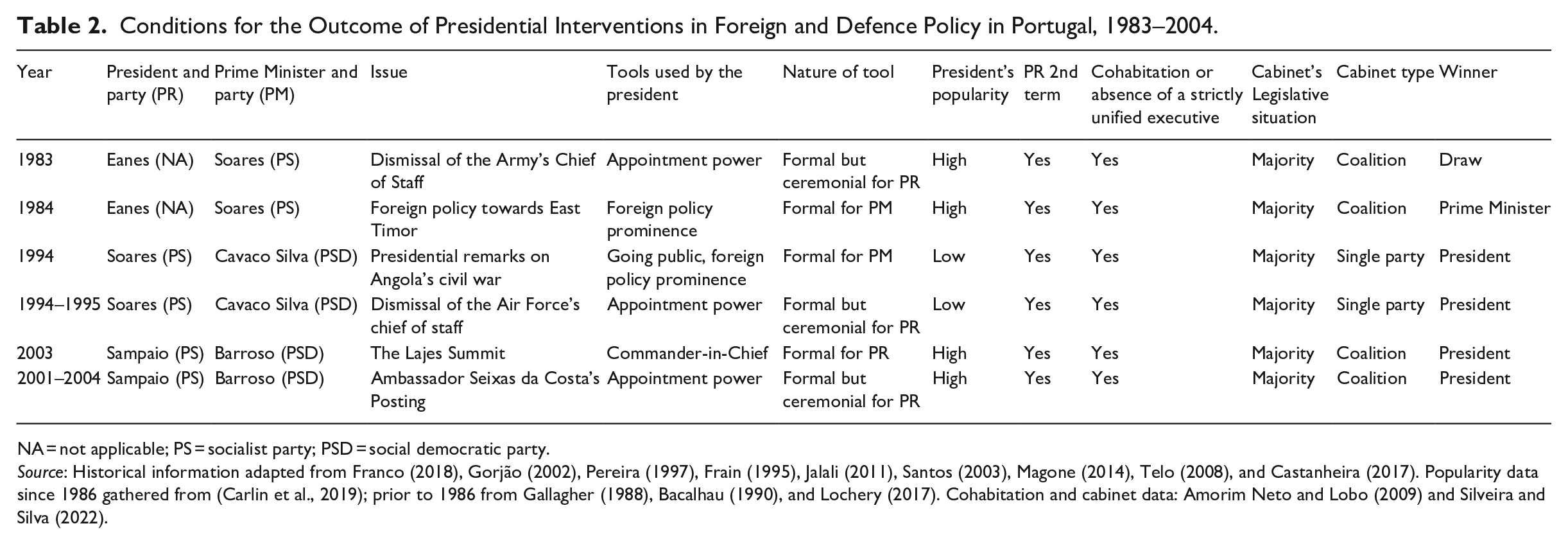
NA = not applicable; PS = socialist party; PSD = social democratic party.
Source: Historical information adapted from Franco (2018), Gorjão (2002), Pereira (1997), Frain (1995), Jalali (2011), Santos (2003), Magone (2014), Telo (2008), and Castanheira (2017). Popularity data since 1986 gathered from (Carlin et al., 2019); prior to 1986 from Gallagher (1988), Bacalhau (1990), and Lochery (2017). Cohabitation and cabinet data: Amorim Neto and Lobo (2009) and Silveira and Silva (2022).
Presidents tend to win (four victories, one draw and one defeat in six episodes). These may be small victories, except for the Sampaio win on the Lajes Summit episode. They are significant due to their small number – six in over four decades (1982–2021) – which may well indicate that presidents know when and how they may win.
Also significant is that Soares was previously the prime minister. We surmise that his deep knowledge of the powers and limitations of both offices was crucial to defeating both Eanes and Cavaco Silva.
Finally, we call attention to the powers or tools presidents use to win disputes. While all episodes eventually became public knowledge, going public was a deliberate strategy only once. The presidential power to appoint personnel, which often means signing on decisions made by the government, was instrumental on three occasions. Ironically, it was used against and by Soares on two occasions and once by Sampaio. The formal position of commander-in-chief of the armed forces was crucial during the Lajes Summit episode. Prominence over the country’s foreign policy was a tool used twice. While the power to direct foreign policy rests with the government, the president has both a symbolic and formal role over it, which can and was used in their favour. Sampaio’s dispute with Barroso was a subtler case, as the president never really attempted to wrestle the power to direct foreign policy from the prime minister.
The president attempted to take foreign policy into their own hands twice. Both cases involved Soares, one as head of government and one as chief of state. He won both. Once, by jealously defending his attribution as prime minister to determine how Portugal would deal with Indonesia’s occupation of East Timor. Twice, by openly criticising an ally of the Portuguese government and making a debacle of prime minister’s Cavaco Silva chief foreign policy effort: to create the Community of Portuguese-Speaking Countries (CPLP).
Formal powers emerge as a necessary condition for a presidential victory – ceremonial or not, constitutional provisions – but they are not sufficient. Thus, president Eanes reached a draw with prime minister Soares in the first episode but lost in the second, when the formal power was in the hands of Soares. Likewise, president Sampaio won twice against prime minister Barroso.
The type of cabinet (single-party or coalition) slightly influences the outcome. President Eanes achieved a draw, and Sampaio won handily against coalition governments. It may be the case that formal powers and a fragmented government together become a sufficient condition for presidential victory.
The first clash between President Soares and Prime Minister Cavaco Silva is a different story. Soares was unpopular, and Cavaco Silva had formal prominence in foreign policy-making. However, Soares’s tactic of going public made all the difference. One episode is not enough to infer that such a tactic is a sufficient condition for victory, but it looks so.
The role of presidential popularity remains unclear in victories against the government. Sampaio was the only president sporting high approval to win unequivocally. Eanes was highly popular but lost twice (maybe a sign of the times, as the constitutional reform in 1982 curtailed his powers). Soares, however, prevailed twice despite being unpopular during both episodes. More studies on the effect of public approval and its interaction with other variables are necessary to make more general claims (Köker, 2017: 231–232).
Discussion
What were the domestic consequences of presidential activism? Policy wise, they were mostly of second order, as in the case of Ambassador Seixas da Costa’s posting. There were twists and halts: the Community of Portuguese-Speaking Countries (CPLP) was delayed but eventually created. However, one significant policy consequence stems from presidential activism: Sampaio’s intervention in the Barroso government’s stance on the invasion of Iraq in 2003. It prevented Portugal from fully siding with the Bush administration’s most fateful decision. Lisbon did not openly challenge the US and the UK and even gave them some help. Portugal also remained somewhat aligned with the foremost EU leaders, who firmly opposed the invasion without official UN backing. Presidential activism allowed Portugal to remain on good terms with its indispensable Western allies – Washington, Berlin, London, Paris and Madrid. This is no small feat.
As far as institutions are concerned, presidents’ actions generated lasting changes: Eanes’s demand for the chief of state to be heard on some government appointments became an unwritten rule in Portuguese politics. While significant for the president’s toolkit, this is still an informal outcome, without effecting any changes at the constitutional level and in the effective dynamic of Portugal’s premier-presidential system (hierarchical dyarchy). Interestingly, presidential activism also had one crucial electoral impact: President Soares’s move against the government, part of a more significant effort designed to chip away at prime minister Cavaco Silva’s image, was successful, thus hurting Cavaco Silva’s 1996 presidential bid and securing the presidency to Soares’s party.
In addition, we also need to discuss deviant cases. There are two deviant cases in the period we analyse: the governments led by Francisco Pinto Balsemão (1981–1983) and the one led by Pedro Santana Lopes (2004–2005). In both cases, the explanatory conditions for intra-executive conflicts are present, but no conflict occurred over foreign and defence policy. They share similarities that explain why this is so.
Both PMs assumed office unexpectedly, lacked electoral legitimacy and were unpopular and faced opposition from their own coalitions (Castaño, 2018: 386, 399; Lobo, 2005: 143, 145, 147; Magone, 2006). Finally, both tenures were completely dominated by domestic politics.
Balsemão had to deal with the 1982 constitutional reform. Despite its problems, the government lasted longer due to the reform (Castaño, 2018: 413): Eanes and the military were against it, and civilians maintained support for the government to make it pass. Once the reform was enacted, Balsemão lost support and Eanes dissolved parliament. Santana Lopes was considered hasty and clumsy (Castanheira, 2017: 593; Magone, 2006) and his government was so unstable that public opinion demanded its dismissal by president Sampaio (Castanheira, 2017: 592–594).
In short, they were very weak PMs, despite their cabinet’s majority status. To put it in other words, they are exceptions that prove the rule (the rule being our set of conditions that explain presidential interventions). Presidential interventions occurred in both cases, but not in foreign and defence policy. Weak PMs and intense domestic issues likely allowed presidents more leeway to act without engaging in lengthy conflicts.
Finally, how does our analysis fare against alternative explanations? One possible explanation refers to the personality of the president. More specifically, presidents with prior experience in foreign and defence policy would feel more confident about intervening in these matters (Allison and Zelikow, 1999; Preston, 2001: 11–12; Saunders, 2017). This is a plausible explanation, but still does not successfully explain our cases. Eanes, Soares and Sampaio had experience with foreign policy, and intervened in such issues. At the same time, Cavaco Silva and Marcelo Rebelo, who also had such experience, 5 did not intervene. If prior experience could explain presidential activism, then all presidents should have intervened, which as demonstrated, did not occur.
Conclusion
The president is not the centre of power in Portuguese politics. However, we demonstrated that the office is far from merely ceremonial in foreign and defence policy-making. Under the right circumstances, the president intervenes in these policy areas significantly. Some of the episodes we discuss are minor, which we credit to a broad cross-party consensus on the direction of foreign and defence policies in Portugal. Nevertheless, even small victories accrue over time; presidents redesign the limit of their influence, and future office occupants take advantage of this.
In addition, the low incidence of public presidential interventions against the prime minister in Portugal attests to three factors. First, presidents are careful and ‘ration’ their interventions and use of their powers in foreign and defence policy – no doubt to maximise the effects and likelihood of success. Second, such low incidence corroborates the diarchic dynamics skewed towards the prime minister in Portugal’s premier-presidential regime. Finally, the paucity of disputes is a testament to the notion that Portugal’s defence and foreign policy-making are subjects of a broad consensus across the political field.
As a comparison, Yan and Wu (2022) report 14 episodes of conflict between the president and prime minister in Portugal from 1990 to 2020. Only three (or 21%) count as high-intensity events. Regarding foreign and defence policy, they count one high-intensity episode and another intermediate intensity (7%). 6 In their estimation, Portugal fares well compared with other semi-presidential states: of 19 countries in their dataset, Portugal is the 12th in overall conflict frequency and 9th in foreign and defence policy conflict frequency.
Foreign and defence policies are special cases demanding a higher degree of coherence and coordination – states should ‘speak with one voice’ abroad. More institutionalised countries, such as Portugal and Finland, have mechanisms to ensure coordination and coherence in these areas. In Portugal, the Superior Council of National Defence serves as the primary coordination mechanism, with key officials collaborating on foreign and defence policy matters. Mechanisms such as the Council are crucial to maintaining the country’s consensus.
The consensus still holds, indicating that Portuguese politics remain insulated from the extreme polarisation plaguing many democracies. If such insulation fails and Portugal falls prey to this phenomenon, we expect an increased frequency of presidential foreign and defence policy interventions. An even more recent complication is Russia’s invasion of Ukraine. It is too soon to predict any long-term effects, but it seems clear that a security realignment will occur in Europe. How this will affect Portugal’s national security policy-making remains to be seen, given the country’s balancing act between its Atlanticist tradition and its European identity.
Moreover, the Portuguese premier-presidential system is very similar to the French regarding the extension of presidential powers in foreign and defence policy-making. In both, presidents have an active, if formally constrained, presence in foreign policy and national defence. Nevertheless, French presidents are immensely more active than their Portuguese counterparts (Passarelli, 2010), especially regarding defence matters (Correia, 2020: 294; Matos, 2008: 289). This further reinforces our finding that formal powers are necessary but insufficient for the prevalence of presidential preferences over the prime minister’s. This means that there are more effective drivers of presidential success in foreign and defence policy than their constitutional prerogatives indicate.
All said and done, presidential activism in foreign and defence policy in Portugal should be taken seriously and examined with acumen.
Footnotes
Acknowledgements
The authors thank Jorge Fernandes, Vasco Franco, Marina Costa Lobo, Filipa Raimundo and Edalina Sanches for their extremely helpful advice on Portugal’s political history since 1976; and Phillipp Köker, Sophia Moestrup, Gianluca Passarelli, Tapio Raunio and Thomas Sedelius and the participants of the 2022 Workshop on Presidential Activism, hosted by the University of Tampere, Finland, for their comments on a previous version of the paper. The authors also thank the insightful recommendations made by the two anonymous reviewers.
Declaration of conflicting interests
The author(s) declared no potential conflicts of interest with respect to the research, authorship and/or publication of this article.
Funding
Octavio Amorim Neto acknowledges the support provided by Brazil’s National Council on Scientific Research (CNPq).
