



Abstract
This study discusses the college and career readiness among full-time Southeast Asian American college students in a 4-year public university in New England. Our study consisted of surveys (n = 58) and focus groups (n = 35), of second-generation (born in the United States) or 1.5-generation (immigrated as a youth) college students. While our participants were fairly strong academically, they still struggled to navigate college and many did not feel prepared for careers. We found some variability by majors in the correlation of academic major and career preparedness, and our findings also suggest that Southeast Asian American students shared a number of concerns, such as lack of finances, inconsistent academic advising, and need for more career preparation. Nevertheless, across this heterogeneity, students agreed that peer mentors and effective faculty mentors are invaluable resources and that more such mentors and programs are needed.
When the 2012 Programme for International Student Assessment results came out, the United States ranked 27th in math, 20th in science, and 17th in reading among the 34 Organisation for Economic Co-operation and Development (2012) countries. This lack of significant change from the 2009 test results subsequently reignited President Obama’s administration’s commitment to prioritize college and career readiness on their educational agenda. Scholars who have studied college readiness are seeing a “systemic shift to preparing all students for formal learning opportunities beyond high school” (Baber, Castro, & Bragg, 2010, p. 1). David Conley (2010) notes that as states move toward the adoption of college and career readiness standards, it is vital to better define what is meant by college readiness. In 2003, the Association of American Universities created the first set of college readiness standards that outlined what it takes for students to be ready to succeed in entry-level courses at university (Conley, 2003). The American Diploma Project followed suit and engaged university faculty, economists, and members of the business communities to set the standards for what it means to be college ready (Achieve, Education Trust, & Thomas B. Fordham Foundation, 2004). Conley defines college readiness as the level of preparation a student needs to succeed without remediation in credit-bearing coursework at the postsecondary level (Conley & McGaughy, 2012). Conley and McGaughy (2012) at the Educational Policy Improvement Center have found four major components that students need for college and careers: key cognitive strategies, key content knowledge, key transition knowledge and skills, and key learning skills and techniques.
Similarly, Mueller and Gozali-Lee (2013) define college and career preparedness as follows:
Academic preparedness: Having the academic knowledge and skills to do postsecondary-level coursework at 2-year or 4-year colleges, or other postsecondary institutions, without the need for remediation. Expected attitudes and behaviors or “soft skills”: Having the beliefs, attitudes, and values, and accompanying behaviors to succeed in postsecondary education and the workplace (e.g., motivation, perseverance or tenacity, resilience, teamwork, self-efficacy, goal-setting, work ethic, and self-regulation skills). College and career knowledge: Having the knowledge and support to successfully plan for and enroll in postsecondary institutions (college entrance exams, college applications, financial aid applications, etc.) and pursue careers (career awareness, exploration, etc.). (p. 29)
First-Generation College Students
For first-generation college students, children from immigrant families, and for families of low-socioeconomic status, it is not only college readiness but once they get into college, they face retention challenges. Researchers have found distinct disadvantages for retention and graduation for first-generation college students. Compared with other students, first-generation college students are academically less prepared, often having completed fewer advanced-level courses; have a more difficult time adapting to the stress of college; have different conceptions of the college experience, seeing it primarily as a means of advancing socioeconomically; and have lower levels of self-esteem, social acceptance, creativity, and humor (Atherton, 2014; McGregor, Mayleben, Buzznaga, Davis, & Becker, 1991; Pascarella, Pierson, Wolniak, & Terenzini, 2004; Reid & Moore, 2008). Choy (2001) also found that “students who are nonwhite or from low-income families tend to be disproportionately represented among those whose parents have low education” (p. xxxix).
For Asian Americans, the prevailing model minority myth asserts that all Asian Americans are succeeding academically and financially (Ngo & Lee, 2007). This myth, however, masks issues within the overall Asian America population as well as within Southeast Asian American (SEAA) populations specifically. Chaudhari, Chan, and Ha (2013) found that Asian American Pacific Islander (AAPI) college students are more likely to be unaware of campus support services, to have difficulty connecting to campus communities, and to have “financial, person, or family obligations while in college, and feel unable to turn to family for effective support and guidance” (p. 11).
Complexities of SEAA Students
Moreover, various studies have shown that the “educational challenges of Southeast Asian Americans have been overshadowed by the model minority stereotype” (Her, 2014, p. 35); in other words, the model minority myth actually obscures the academic struggles of SEAAs (Hune, 2002; Museus, 2013; Ngo & Lee, 2007; Tang, Kim, & Haviland, 2013). SEAA communities have the lowest educational attainment among Asian Americans. In addition to trailing behind the overall Asian and U.S. population in bachelor degree attainment (Niedzwiecki & Duong, 2004; Ngo & Lee, 2007; Southeast Asia Resource Action Center [SEARAC], 2011), well over half of the Southeast Asian population—51% of Vietnamese, 63% of Hmong, 65% of Cambodian and Laotian—above 25 years of age has not attended college (Museus, 2013; National Commission on Asian American and Pacific Islander Research in Education [CARE], 2011; Ngo & Lee, 2007). Of those who are attending college, a disproportionate number are enrolled at 2-year community colleges and earning an associate’s degree as their highest level of educational attainment (CARE, 2011; Roderick, Nagaoka, & Coca, 2009). The college persistence and graduation rates for SEAA students remain far below the national average (U.S. Census, 2011). Approximately 49% of Asian Americans earned a bachelor’s degree or higher, exceeding the national rate of 28.2%, but the Cambodian (16.0%), Hmong (14.8%), Laotian (13.2%), and Vietnamese (25.5%) populations earned significantly lower rates of postsecondary degrees (U.S. Census, 2011).
A number of factors impact academic performance among SEAAs, including socioeconomic status, English proficiency, migration history, parents’ educational achievement level, family support and guidance, and institutional climate (Chaudhari et al., 2013; Her, 2014). Due to their migration histories, many SEAAs experience socioeconomic as well as educational disparities, with many SEAA students attending underresourced educational institutions. According to the U.S. Census, SEAAs reported annual earnings well below the national average of $28,452: Vietnamese ($26,352), Laotian ($22,111), Cambodian ($20,737), and Hmong ($19,053; Museus, 2013; U.S. Census, 2011).
The particular history of SEA migration to the United States shapes the experiences of many SEAAs in college. Unlike many other Asian immigrants, Southeast Asians were refugees, involuntary migrants as a result of war and genocide (Museus, 2013; Tang et al., 2013). As Sakamoto and Woo (2007) write, SEAAs’ lower attainments are usually believed to be associated with the historical circumstances of their initial migration streams to the United States. Cambodians, Hmong, Laotians, and Vietnamese are among the most recent of Asian American groups whose initial arrival in the United States occurred mainly as refugees associated with the U.S. involvement in the Vietnam War. (p. 45) SEAAs typically arrived in the United States as refugees under duress with essentially no economic assets or well-devised plans for the future. Many of the first arrivals had no prior family connections … Refugees tend to have lower socio-economic statuses than immigrants who are admitted for their labor market skills. (p. 46)
Moreover, even within SEAA communities, there is great diversity of migration and postmigration experiences. For example, Vietnamese refugees arrived in two waves (1975 and earlier and post-1975), with the earlier wave having higher levels of income and education (Museus, 2013; Sakamoto & Woo, 2007). Other Southeast Asian refugees generally corresponded to the time period, income, and education levels of the Vietnamese second wave, but again, there exists heterogeneity within SEAA communities. Museus (2013) reminds us: [N]ot all SEAAs enrolling in higher education today are refugees. In fact, given that a substantial proportion of Southeast Asian refugees began migrating to the United States over 30 years ago, many current SEAA college students were born or grew up in the States. Therefore, the SEAA college student population is characterized by generational diversity and includes students who entered the United States as adult refugees (i.e., 1st generation refugees), migrated to the United States during or prior to their early teens as refugees (i.e., 1.5 generation refugees), or are children of refugees (i.e., 2nd generation refugees). It is also important to note that the SEAA population is characterized by diverse homelands, cultural backgrounds and traditions, and languages. (p. 711)
Once students enter college, challenges that impact retention include family and work commitments, financial costs, balancing work or life loads, academic struggles, and a lack of support and advising (Wright & Boun, 2011, pp. 46–47). In particular, many second-generation (born and raised in the United States) or 1.5-generation (immigrated to the United States when a child or adolescent) SEAAs are first-generation college students. In fact, first-generation SEAA college students may have to find themselves having to choose between school and family obligations. As Chaudhari et al. (2013) observe, “many AAPI students must maintain their role as caretakers, translators, breadwinners, and ‘cultural brokers’ for their families and communities” (p. 9). Students navigated college by drawing on various resources, including family, aspiration, ethnic or cross-cultural student organizations, and peers (Tang et al., 2013). Chhuon and Hudley (2008) also found that student ethnic and cultural groups were key to student academic success in college, and peers were as critical sources of support during college as they were for the application process (Tang et al., 2013, p. 13).
Thus, scholars have identified a need for more research disaggregated by ethnicity, gender, social class, immigration status, generation status, type of institution (public vs. private; 4-year vs. 2-year), and other factors (Chaudhari et al., 2013; Her, 2014; Maramba, 2011; Wright & Boun, 2011). In its 2013 report, the Asia and Pacific Islander American Scholarship Fund found that research “specifically on low-income and first-generation AAPI students are sparse and this gap in research needs to be addressed to better support them in the context of higher education” (Chaudhari et al., 2013, p. 9). Ngo and Lee (2007) concur that “there is an obvious dearth of research on the education of Cambodian and Lao students” (p. 440). Moreover, Museus (2013) argues that more information is particularly needed about second-generation SEAA college students, as this population comprises an increasing proportion of SEAAs in college, and the small body of literature that does exist on second-generation SEAA students suggests that this segment experiences increased struggles due to factors such as intergenerational conflict and a loss of traditional cultural values that emphasize education. (p. 716)
Purpose of the Study
The purpose of this research study was to examine the college and career preparedness and in-college experiences of SEAA students at one New England 4-year public university. The questions guiding our investigation were as follows: (a) How prepared do SEAA students feel for college? And what are the factors that, in hindsight, were effective in helping to prepare them? (b) What resources do SEAA students draw on to help them navigate college and prepare for careers? (c) How well supported do SEAA students feel in their colleges? (d) What are SEAA students’ career aspirations? And (e) How prepared do SEAA students feel for careers? We were interested in learning about the broader spectrum of the environmental, familial, cultural, and social factors that may influence their college experience.
The significant contribution of this study to the field is twofold. First, this study is the first structured examination of college and career readiness and retention of SEAA college students in New England. Much of the sparse literature on SEAA college students are situated on the West Coast or Midwest where there are larger populations of SEAs (Chhuon & Hadley, 2008; Museus, 2013; Ngo, 2006). Second, it is one of the few multifaceted investigations of second-generation SEAA college students. This study highlights the voices of SEAA students in the field of higher education. Our claims are based on what SEAA students argue are effective strategies in preparing them for and helping them to navigate college.
Conceptual Framework
This research used Conley’s (2010) college and career readiness framework, Pierre Bourdieu’s cultural capital theory, and James Coleman’s social capital theory to explore SEAA students’ college experience. Conley’s framework consists of four interactional components that students must possess in order to successfully complete credit-bearing coursework: key cognitive strategies, key content, academic behaviors, and contextual skills and awareness. Besides content knowledge in core academic subjects, Conley argues that students must possess key cognitive abilities and behavioral attributes to be able to think critically, solve problems, and navigate large systems the collegiate landscape.
Scholars who have investigated first-generation students and traditional students apply social reproduction theory to understand first-generation college students’ preparedness and persistence. Building on the works of Bourdieu (1986) and Coleman (1988), scholars have found differences in cultural and social capital between first-generation students and traditional students. Bourdieu maintains that the cultural experiences in the home facilitate children’s adjustment to school and academic achievement, thereby transforming cultural resources into what he calls cultural capital (Lareau, 1987). Examples of cultural capital are familiarity with and access to linguistic structures, school-related information, social networks, and educational credentials of dominant groups (Bourdieu & Passeron, 1977; Paulsen & St. John, 2002). According to Coleman (1988), social capital is developed when people form a relationship or network with members of the dyad or network exchanging resources with one another. Social capital may become manifest in many forms, including informational channels and social norms. Members of the same or different ethnic groups may have access to different resources (Louie, 2004). First-generation students seek help outside the home because of the limited knowledge and preparedness that students receive from their parents and families.
Without social or cultural capital, Cushman (2005) argues that first-generation students experience frustration and isolation as well as overall greater difficulty transitioning to college. In addition to all the anxieties, dislocations, and difficulties of any college student, first-generation students often confront substantial cultural as well as social and academic transitions (Pascarella et al., 2004). Our study examined how first- and second-generation SEAA students describe their understanding of college and career readiness, as well as their experiences in college.
Method
We conducted surveys (n = 58) and focus groups (n = 35) on college and career readiness with current SEAA college students at a public university in New England that we will call State University Riverside, located in the city of Riverside. 1 State University Riverside is a public, 4-year university where many of the students are from the local region and state, thus maintaining their family and community ties.
Over the past 10 years, the Southeast Asian population in the state grew almost threefold. Riverside is home to the second-largest population of Cambodian Americans in the United States. Although the 2010 U.S. Census Bureau estimated that 13,000 residents are of Cambodian descent, Cambodian American community leaders believe that this is an underestimate, and that in fact, approximately 20,000 to 35,000 Cambodian Americans live in the city. Many undocumented community members do not report their numbers due to fears of deportation. For this same reason, we estimate the total SEAA population, including a significant Laotian and Vietnamese population, in the city to be near 50,000.
Participant Selection
Survey participants
Characteristics of SEAA Survey Participants.
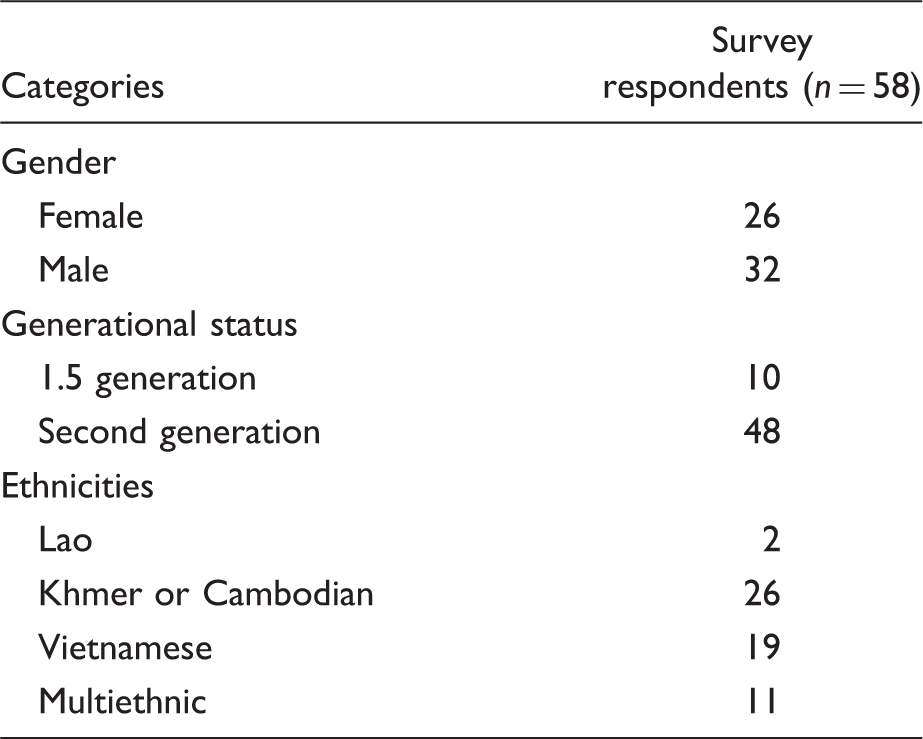
Survey demographic data made it clear that our respondents were primarily second-generation SEAAs. Forty-eight respondents (83%) were born in the United States, while 10 were born outside the United States; thus, our respondents were primarily second generation (born in the United States), and several of those born outside the United States had immigrated when they were very young or adolescents, that is, 1.5 generation. Furthermore, 55 students (95%) indicated that English was spoken at home. Khmer was spoken in 26 (56%) homes, and Vietnamese was spoken in 19 (33%) of homes. Other languages included Lao, Spanish, and Cantonese. Survey respondents included 11 first-year students, 19 sophomores, 20 juniors, 4 seniors, and 4 “other” (transfer students, “super seniors”).
Focus group participants
The 35 focus group participants included 12 Cambodian, 1 Laotian, 14 Vietnamese, and 8 multiethnics (e.g., Cambodian or Chinese, Cambodian or Vietnamese or Thai, Vietnamese or Scottish, and Vietnamese or Chinese). The sample included an equal distribution of males and females with the majority of them (26) being second-generation students, and 9 were 1.5 generation.
Data Collection
The research team recruited SEAA participants using three methods: (a) flyers posted around campus, (b) attending SEAA student club meetings, and (c) snowball sampling. Each participant received a gift card for completing a survey and an additional gift card for participating in the focus group discussion. The focus group discussion lasted approximately 45 to 75 minutes in duration. All focus group discussions were audiotaped and professionally transcribed.
The surveys consisted of predominantly close-ended questions about prior learning experiences and outcomes. The first cluster of survey questions focused on students’ experiences in high school with teachers, while the second cluster focused on academic behaviors and contextual awareness and behaviors (e.g., time management and study skills). The third cluster focused on the student’s sense of readiness for college in terms of academic preparation and key cognitive skills (critical thinking problem solving, etc.). Further questions inquired into students’ experiences with mentors—both for college and for careers—and the extent to which students felt college was preparing them for careers, the next step for most students. The survey also collected demographic and academic data from students.
Data Analysis
Surveys were analyzed by category—learning outcomes, college experiences, and college and career planning—and demographic information—gender, race or ethnicity, nationality, primary language, grade level, and grade point average. We assessed survey data to find general patterns of responses to help us understand the types of experiences and attitudes that students hold.
The focus groups consisted primarily of open-ended questions about the students’ experiences in high school and college, particularly advising and mentoring. Sample questions included the following: (a) How well do you think your teachers and schools prepared you for college and for careers? (b) Please describe your relationship with your advisors; and (c) What advice would you give new SEAA freshmen about attending college? Once the focus group transcription was completed, they were organized and coded using the NVivo qualitative analysis software. First, we used open coding to identify thematic categories around college readiness, and then axial coding was used to further investigate issues that arose during the open-coding process (Strauss & Corbin, 1994). We conducted cross-section analysis by grade level, gender, and majors declared.
Researcher Subjectivity, Reflexivity, and Trustworthiness
While some researchers posit that there is a need to underplay the impact of researcher subjectivity (Strauss & Corbin, 1994), we support Charmaz’s (2005) argument about the importance of researcher reflexivity and the need to acknowledge personal biases and assumptions that influence how the researcher looks at, makes decisions about, and interprets data. As an Asian American research team, we share many traits with the SEAA students in the study, such as similar phenotype, linguistic challenges, and cultural and religious background (i.e., two of the researchers are Buddhist). We firmly believe that our unique position as Asian American scholars—one 1.5 Lao refugee, one second-generation Korean American, and one Cambodian American student—facilitated our entry and helped us build trust and rapport with the SEAA students. We are cognizant of our role as insider–outsider. We acknowledge that as individuals who have knowledge about college, our experiences influence our biases; these biases include the belief that more attention needs to focus on first-generation SEAA college students. Likewise, we believe that institutions of higher education must provide systemic support to faculty and staff in order for them to properly advise and mentor SEAA students.
The credibility of our analysis relies on the congruence of our findings with other marginalized students’ experiences in different school contexts (Merriam, 1998). We implemented several strategies to maximize trustworthiness of the findings (Lincoln & Guba, 1986). First, we triangulated multiple data sources to analyze and verify emergent themes of the surveys, focus group transcription, code reports, and research team field notes. Second, we conducted member checks to ascertain our analysis with the focus group participants’ perceptions. Third, we sought discrepant data throughout the analysis phase to determine alternative hypotheses and consider other theoretical suppositions.
Findings
While the survey and focus group data uncovered many noteworthy findings, this manuscript will only focus on two sets of themes that emerged from the analysis. The first set of themes arose from the surveys and highlights the students’ perception of their college readiness, challenges they faced, and resources they accessed to help them prepare for college. The second set of themes that emerged from the 35 SEAA focus group participants presented differences in the in-college experience based on declared majors, the support they were receiving from advisors, and people they connected with on campus.
Prepared for Academics
The first theme that emerged from the survey data is that the majority of the SEAA college students in this sample reported feeling generally academically prepared for college.
Conley (2010) defines college readiness as the level of preparation a student needs to succeed without remediation in credit-bearing coursework at the postsecondary level. In our study, 51 SEAA students (88%) had a high school grade point average of B or higher, and 46 (79%) had taken honors and AP classes. In fact, 31 students (53%) indicated that they had improved their study skills and learned helpful study strategies while in high school, whereas 43 (74%) understood their academic strengths and areas for improvement. While in high school, 16 SEAA students (28%) had taken college courses in the dual-enrollment program with their high school and nearby college. Studies from the complete college America program, moreover, found that 20% of 4-year college students needed to complete at least one remedial classes (Shaw, 2014). In contrast, only 9% of the SEAA students in our study completed a remediation course (four SEAA students required supplemental writing instruction, and one required supplemental instruction in math). From their survey response, these students articulated a general satisfaction with the education their received in high school. This means that our sample of 58 SEAA felt confident that they had the academic knowledge and skills to do postsecondary coursework and considered themselves among the high-achieving, college-ready students of their peer set.
Expected Attitudes and Behaviors
Not only were the SEAA students academically prepared, but they also reported having the expected attitudes and behaviors to succeed in postsecondary education. Many students talked in detail about their goal-setting skills. Fifty-four SEAA students (93%) had planned to attend a 4-year college or university after graduating high school, despite the fact that few of their family members attended college or university. Sam, a Vietnamese junior, made the following remarks: You need to start doing well early on, because a lot of people wait until their senior year or their junior year to be when they actually start getting into school, and doing all the requirements. But, if you start off before and you’re prepared then it makes the process easier; like getting your SATs done and applying for scholarships, because then you’re not rushing at the end. I think it’s also important to visit college just because a lot of times you think that you want to go to a college just because you hear the name or because it sounds like a really good place to be based on what people are saying. Because you do have your own feeling of whether it’s right to go to that college, because it was certain colleges that I was looking forward to seeing, but then when I saw them they didn’t give me the same feel as the same as other school that I wasn’t really ever thought of it. Educational Talent Search (TRiO) really helped me with the college application process. The program had me and a guidance counselor filling out the college application. This was really helpful to me. The program also helped with touring colleges which help me decide on the institution I wanted to ended up in.
But “Money Was a Problem”: Financial Aid Woes
The issue for these SEAA is not that they are incapable nor was it that they did not understand the college-going process; rather, it was money. The second theme that SEAA students talked about was how they felt generally less well prepared for financial aid processes. Fifty-two percent of SEAA college students reported understanding the financial aid process. Scholars have noted that financial factors such as financial aid have an effect on persistence (Paulsen & St. John, 1997, 2002). Paulsen and St. John (1997) found that students in public colleges considered tuition and living costs, proximity to home and work, and availability of student grants as important factors in their persistence and retention. Siv, a first-generation college sophomore, stated, “[I] felt prepared for classes I signed up with, but still not quite sure how or what qualifies you for financial aid.” Johnny, a Vietnamese junior, reiterated: Money was a problem during the application process. Not knowing how much financial aid I would get affected my decision in my choosing process. Even now I don’t know exactly how much I have to pay to remain in college.
Not Ready for Prime Time: Career Readiness
Moreover, survey results about the preparation for careers were more equivocal. Nineteen (33%) indicated that they did not have mentors to whom they could turn to for advice about careers. First-generation SEAA college students often have trouble finding role models on campus who they can relate to and who can help them navigate the transition from college to careers. Whereas most students had had exposure to college while in high school, only 10 respondents (17%) indicated that they had had the opportunity to shadow a person in the career field they wished to pursue. Thirty-two (55%) indicated that they did not have the opportunity to study the career they want to pursue, and 25 (43%) indicated that they do not feel that they have the required knowledge and skills needed for the chosen career.
Most frequently, students expressed concern about the lack of career readiness in response to the final open-response survey question, “Is there anything else you would like for us to know about how ready you felt to go on to college or start a career?” Answers ranged from “career options from each major was confusing to me” to “I wish I knew what career opportunities I can have with the major I want.” Other students expressed a need for “some co-op experience” since college had “not exposed [them] to many careers out there.” Two seniors reported feeling not ready at all. Jenny, a Khmer senior majoring in Biology, stated, “I am not ready at all because I am so close to graduating and I still have no idea what I want to do.” Vuong, a Vietnamese senior majoring in computer engineering, reiterated, “I am not ready to start my career because I have not found opportunities to reach out to gain experience in my field.”
Impact of Advising and Peer Mentoring
Academic majors played a large role in determining students’ experiences with faculty advisors and career preparation. Students in Science, Technology, Engineering, and Mathematics and health fields had more tightly structured curricula but generally less positive experiences with advisors, although this varied by specific department and advisor. Students in the humanities and social sciences had less structured curricula but generally more positive experiences with advisors. Logan, a Lao senior, explained: There might be a gap between being a north campus major [primarily sciences and engineering] and a south campus major [humanities, social sciences, and nursing], because my best friend is a bio major and she told me that she doesn’t really get an advisor until she can pass [Organic Chemistry].
Among the 35 focus group participants, there was one English major and a handful of social science majors—namely political science and psychology—who generally had positive experiences with faculty advisors. Deven, a political science major, professed, “My advisor’s awesome. Basically, my career path is what he did when he was younger so he’s giving me more advice than just classes but life advice.” Judy, the English major, reflected: I’m a creative [writing] concentration with English … So like at first I had one advisor then I had another and then I ended up with [my current advisor]. And I was really happy because she’s my first Asian [American] teacher ever, and I’m about to be a senior, guys. She understands. She could make that connection with me. So I’m like, “This is great.”
Yet in the sciences and engineering, which the vast majority of focus group participants were majoring in, experiences with advisors were mixed. These students reported not being comfortable as they went to see their advisor, not liking their advisor, and generally not receiving any help from their advisors. Benny, a Civil Engineering junior explicated: I don’t think advising is really helpful to me because for Civil Engineering … I’m taking Physics and [I talked to the professor] and he said email your advisor and I did and then my advisor was like I can’t really help you with this so you should ask someone else for help. I didn’t know where I should go ask for help. You get answers by yourself. They might not have all the answers and so you can always … go to the website and look on like your classes and … put it on yourself. Sometimes the advisors can help you but to a certain extent. Sometimes you have to research on your own and figure out by yourself.
On the other hand, several students praised the advisors in their specific majors. For instance, Latana, an Engineering junior, volunteered, “I don’t know about everyone else’s major but the electrical engineering department, the electrical engineering/computer engineering department, their advisors are great. They actually go out of their way to help you.” Another student, Rich responded, “I just want to go off [that] and say that the Chemical Engineering Department has really good advisors too.” Similarly, in the nursing major, which has a highly structured course of study, students saw advisors as basically functional. Bounmy, a Khmer senior described: So like with nursing, basically our schedules lined out for the entire four years. Each semester you have to take this. There’s really little flexibility. And so basically with my adviser, she gives me what I need for the years.
Untapped Resources: Student Associations
Across the board, however, students identified the need for peer student mentors throughout their college careers. Rita described: I think the number one thing is getting student mentors … Not like faculty mentors, not like professors, like fellow students who know what they're doing, who are like taking classes right now. Because they know what's going on like recently. I think just knowing an upperclassman who is in your major is really helpful because I have like three or four of them and they basically help me pick the professor and the classes that I need for the next semester. They say, oh, that professor, don't take him. He just gives you homework and you study on your own and stuff like that. That's really good advice. And that part, your [faculty advisor] cannot do that for you, like they wouldn't judge a professor. They wouldn't know. What professor would best fit you and having a friend that would know that was helpful.
These findings are consistent with other studies that concluded that students draw on peers and social networks—including clubs and organizations—to help navigate educational institutions (Chhuon & Hudley, 2008; Tang et al., 2013). As Tang and colleagues (2013) posit, SEAA students “actively [seek] out, developed, and valued peer… support” (p. 13). Like the Cambodian college students in Chhuon and Hudley’s (2008) study, our students found support and encouragement from student ethnic and cultural groups on campus. Even if many SEAA college students do not have the same kinds of social and cultural capital as other groups (e.g., knowledge and financial assistance from parents and families), some are savvy about seeking and creating alternative support systems. When asked the SEAA students in our study stated that they would be open to participating in a peer mentor group if the university offered it.
Educational institutions, therefore, can and should do more to support students by improving advising across disciplines, particularly in engineering and science fields. One interesting finding was that 25% of the SEAA students were also very reluctant to ask for help outside of their family and friends, and they explicitly recognized this tendency. The two students below reflect this sentiment: Well for me personally, I think it’s the way I was kind of brought up. In my family I was basically taught to always keep things to yourself. If it’s an issue, it should never be an outside issue. It should always be a family issue or like if it’s not a family issue, you have to take care of it yourself. For me, it’s actually very, very hard to ask for help just because of that. Well, it’s cultural—if you have a problem or something, you don’t ask for help because it’s like weakness and stuff. I’ve watched my parents and mostly my father have that mentality and see how he struggled and I’m like I still have time to change so I’m going to do it. I’ve been reaching out more but I’m still having trouble.
In summary, SEAA students discussed diverse experiences with advising and career readiness. They spoke about effective advising in terms of the academic support they received within their majors and within their social networks with peers and upperclassmen. Some SEAA students were asking for help and being turned away, whereas others were being supported programmatic by the nature of the discipline. These students’ views of career readiness were more equivocal and urge further investigation.
Conclusion
Since there are no baseline studies that examine the college and career readiness of SEAA students, our study is one of the first studies to provide insights from SEAA college students about how well they felt that their high schools prepared them for college and how well one university was doing in supporting them currently. However, since it is the perceptions of 58 SEAA, our sample cannot be generalizable to other SEAA and marginalized groups.
However, echoing other studies, our survey findings suggest that while high schools with a large minority population—particularly a large SEAA population—may help prepare SEAA students for their first years in college, the students are not generally well prepared for navigating the financial aid processes and their specific majors. High schools could implement programs for first-generation college students where they receive information about application process, understanding funding sources, and the scope and sequence of classes for certain majors. Guidance counselors need to get to know the students and their interests in order for them to explain the necessity of certain classes when scheduling. For example, premed majors need 4 years of laboratory sciences (i.e., Biology, General Chemistry, Organic Chemistry, and Physics) and 1 year of English, whereas Engineer majors need 4 years of Math (i.e., Algebra, Geometry, Probability and Statistics, and Calculus) and sciences. In addition, having explicit information of what is needed in order to finance their college education will pave the college pathway for SEAA students and increase their likelihood to succeed.
Higher education, moreover, needs to do a better job of preparing its students for careers. First-generation college students need more career development information. To get into college, navigate college, and prepare for a career, student associations and peer networks are invaluable to students. SEAA students have reiterated the importance of peer mentors at all levels during their high school and college careers. Therefore, a new family and support network should be established at the colleges and universities for SEAA students. In such a model, upperclassmen could be trained to become peer mentors to freshmen, and peer mentors who share the same major could be assigned to every new freshman so they have a buddy to answer various questions regarding classes to how to adapt to college life. Likewise, graduate students could serve as mentors to SEAA juniors and seniors who are interested in pursuing graduate studies in their field, and recent alumni can help mentor those graduates entering the workforce.
Furthermore, the focus groups suggested that advising for SEAA college students—conducted primarily by faculty at SU Riverside—tended to be better when faculty has some experience with developing authentic relationships with their advisees. These finding reflect previous studies that call for teacher training that includes historical knowledge and that is culturally responsive and culturally relevant (Her, 2014; Uy, 2014). Faculty members need to be trained on how to mentor students, especially first-generation immigrant and refugee students. Most doctoral training programs do not include how to be a good mentor. Thus, new faculty orientation could include how to get to know your advisees, what are your program requirements, and what are the support services on campus to refer students to. Improving advising in the sciences and engineering—which most of our respondents were majoring in—would also better serve SEAA students as well as the overall student population.
The variation in the SEAA student experiences suggests several things. First, SEAA college students are a diverse, heterogeneous bunch, even though they share some concerns and issues. Second, some very simple things—namely, support for peer mentoring and better advising—can help students across the board, even if they are very different from one another. Third, faculty and peer mentoring can address the social capital gap for these first-generation college students and provide realistic knowledge regarding workload required to succeed at the college level (Atherton, 2014).
College readiness and retention and career preparedness among SEAA students depend on a number of interwoven academic, contextual, and cultural factors. The SEAA college students in our study are performing well academically—above the average for SEAAs—yet they still struggle with issues of family, culture, race, class, and so on. They have familial, cultural, and racial demands placed on them that other college students do not necessarily face.
A future direction for research is to look deeper into what creates these inequalities. We need to define what inequalities look like for first-generation SEA college students. Are colleges and universities making assumptions about what freshmen know and are able to do coming into their first year such as changing majors, working with advisors, and asking for help? As Ngo and Lee (2007) assert, Although the research on the role of culture has done a great deal to illuminate the salience of culture in the education of Southeast Asian students, an exclusive focus on culture fails to capture the significance of structural opportunities on student responses to education. In cases of academic underachievement, a sole focus on culture serves to blame the victims.” (p. 440)
Our study also suggests that colleges and universities can provide more support to first-generation college students. While traditional colleges may not have the human capital to support first-generation SEAA students, we recommend that they hire college specialists who have similar job functions as TRIO and gaining early awareness and readiness for undergraduate programs program staff have done for high school students. These college specialists could help students by designing career fairs, facilitating internships, supporting college professors with advisement, and developing a college advisory curriculum to track students from college to career or job placement. In addition, colleges and universities could create an accessible website with resources and tools to help students navigate college and career pathways for both first-generation college students and more general college student body. This site can organize information and multimedia resources that college students need to understand in order to successfully graduate and matriculate into a career. Centralizing all this information would be helpful to all college students, not just the first-generation SEAA students.
Footnotes
Declaration of Conflicting Interests
The author(s) declared no potential conflicts of interest with respect to the research, authorship, and/or publication of this article.
Funding
The author(s) disclosed receipt of the following financial support for the research, authorship, and/or publication of this article: The authors would like to thank University of Massachusetts-Boston's Asian American Student Success Program for funding this research study.