




Abstract
This qualitative inquiry explores students’ (N=20) perceptions of Kalamazoo Promise (KPromise), how perceptions influence student motivation, and by what means students are covering remaining costs. Responses indicated deep appreciation of KPromise, built through community efforts. Perceptions of KPromise have developed into strong motivation to perform and in times of underperformance drove guilt. As KPromise scholars assume uncovered costs, most are doing so via work. Half of the participants possess student loan debt, mostly to pay for larger up-front costs or emergencies. KPromise students still expeience financial distress; however, when put into context with non-Promise peers, these students recognize how KPromise eases such. Discussion centers on using this research in giving voice to students within tuition-free discourse and in helping institutional stakeholders better understand tuition-free students’ experiences.
Basically, if I hadn’t gone to Kalamazoo Public Schools, it’s shaped my life in a way that is amazing. I have four little sisters and it’s amazing to see them just kind of grow up in the system too, and their different experiences with it and how it’s kind of shaping them and who their friends are and what they’re interested in, my sisters do the science fair every year. I’m just … I’m grateful that it’s there, and that I have it. (Hillary, Mixed Race, GPA: 3.56)
What Is a Promise Program and the Kalamazoo Promise
Miller-Adams (2015) suggests that Promise programs operate under several core intentions in where these policies (a) provide financial aid based on location—moving away from need or merit-based aid, (b) aim to expand access to postsecondary education, (c) develop a community culture of interacting with college, and (d) provide economic returns to the local and larger communities. Together these core objectives build a working definition of Promise or tuition-free programs. Although scholars have added additional layers to cluster together and more narrowly classify tuition-free programs (e.g., Hemenway, 2016; Perna & Leigh, 2016). This research utilizes Miller-Adams’ (2015) working definition as the core elements are found in emerging tuition-free policy like Detroit, New York, and Tennessee (Smith, 2017) and in nationally focussed policies like America’s College Promise (Collier, Mishra, Houston, Hensley, & Hartlep, 2017).
KPromise is widely considered the foundation for most currently implemented and emerging tuition-free policies (Hemenway, 2016; Perna & Leigh, 2016). The terms of KPromise are simple, any high-school graduate enrolled in the Kalamazoo Public School (KPS) system for at least 4 years will get 65% of tuition covered and those enrolled from Kindergarten through high school receive 100% funding. Students must maintain a 2.0 grade point average (GPA) and have up to 10 years after graduating from high school to use the funds. The scholarship allows students to gain a 4-year degree or is limited to 130 credits. Finally, KPromise funds are first dollar—meaning that government-based grants, like Pell, and scholarships could be used for nontuition-related expenses like room and board (The Kalamazoo Promise, 2015). Although evolving Promise programs draw inspiration from KPromise, some programs (e.g., Tennessee Promise and New York Excelsior Scholarship) are last-dollar programs meaning that Pell and other grants or scholarships are first applied to tuition, then the foundation or state assumes the remaining costs (Association of Community College Trustees, n.d.). Regardless of first- or last-dollar implementation, an important distinction must be made, tuition free does not mean debt free, a common misconception found in the discourse surrounding tuition-free policy (Collier, Mishra, et al., 2017).
Aligning with Promise programs’ core intentions, research on KPromise illustrates that the scholarship has widely affected college-going outcomes. Notably, KPromise has impacted college enrollment (Andrews et al., 2010) and influenced obtaining college credentials—particularly for women and non-Whites (Bartik et al., 2016). At least 85% of Promise eligible students have received funding indicating that the obvious majority of Promise eligible students has attempted some college. Before the Promise, roughly 36% of KPS graduates were estimated to earn a college degree or postsecondary credential within 6 years. Since implementation of KPromise, the estimation has jumped to 48%. Strictly for a bachelor’s degree, previous to KPromise, 30% of KPS students were estimated to earn bachelor’s degrees—however, 40% of KPromise eligible students are estimated to earn such (Bartik et al., 2016). Additional to access and persistence, the scholarship is linked to increased migration (Hershbein, 2013) and decreased out-migration from the KPS system (Bartik & Sotherland, 2015). On an individual level, Promise programs expect to ease the pressure associated with student loan debt as well as debt loads (Miller-Adams, 2015)—yet, research capturing these details are either nonexistent or not widely publicized.
Despite research illustrating KPromise’s benefits and adherence to core intentions, studies fixated on Promise students’ experiences are growing but remain extraordinarily limited. Such limitations may prevent stakeholders from countering narratives commonly found in debates opposing tuition-free policy. Often debates on Promise policies touch upon ideas of community investment and economic returns (Miller-Adams, 2015). However, those who oppose tuition-free policies also have questions surrounding how students perceive the investment, what motivates tuition-free students to perform if the perceived incentives of paying tuition are removed, and how students will use loans and scholarships (Collier, Mishra, et al., 2017). Such narratives have long been highlighted in socially focused policy (Stiglitz, 2012) and widely highlighted in higher education policy, for example, in discussions surrounding Pell grants (Goldrick-Rab, 2016; Kreighbaum, 2017) and emerging discourse on who deserves to access other Promise programs (McCullough, 2018).
Thus, research capturing and assessing tuition-free student attitudes regarding the investment and collegiate experiences can provide much-needed perspective for stakeholders and institutional actors. As Promise policies are being developed and promoted, stakeholders are exploring the viability and fleshing out the fine details of such programs with scarce student-level data (Miller-Adams, 2015). Therefore, we pose the following questions:
How do students perceive their experiences as KPromise scholars? How do students believe KPromise influences college motivation and performance? How are students covering nontuition expenses, and how are their experiences impacted?
Guiding Framework
To capture and frame KPromise scholars’ experiences, this exploratory research is conceptually guided by Tinto (1993) and Bean (1980). Widely popular, Tinto (1993) has developed and refined models based upon the hypothesis that when students’ motivation and academic capabilities are appropriately linked with institutional academic and social features, students’ commitments to educational goals and to remain at the institution become stronger—thus, persistence and obtaining a degree becomes more likely (Tinto, 2006–2007). Because Tinto’s (2010) framework is student centered with the intention of moving toward policy modification, we believed the structure of the framework was an ideal roadmap for developing the interview protocol and connecting responses to wider themes and nested subthemes. Tinto’s (1993) major themes guiding this research protocol and coding were as follows: (a) precollege factors, (b) goals and commitments, (c) academic and social experiences and integration, and (d) factors external to Tinto’s model.
As illustrated, we created an additional bucket—Factors External to Tinto’s Model, to allow for the inclusion of Bean’s (1980, 2005) suppositions that external factors affect student motivation and experiences. Bean (2005) aligns with Tinto (1993) in the belief that the institution can shape students’ perceptions and behaviors. However, Bean’s main deviation from Tinto is in exploration on how external factors (e.g., finances and family support) affect student motivation and stopping out of postsecondary education—with financial need and connected stressors being dominant sources of influencing student performance, assertations supported by subsequent research (Cady, 2014; Lim, Heckman, Montalto, & Letkiewcz, 2014; Robb, Moody, & Abdel-Ghany, 2012; Scott-Clayton, 2011).
With KPromise students accessing higher education at increasing rates and seeing increased graduation rates (Miller-Adams, 2015) and Tennessee Promise students being retained at higher than previous levels (Ohm, 2017), the consideration of Bean’s identified external factors may be paramount when exploring tuition-free student experiences. Utilizing protocols informed by these researchers, our study is uniquely situated in that we explore what may occur to students’ perceptions of the Promise, college, motivations, and experiences when the student generally need not consider covering tuition and mandatory fees.
Methodology
Site and Sample
This study was conducted at a large, regional public research institution in an urban setting in Southwest Michigan. The student body is predominantly White (68.7%), followed by Black or African American (11.2%), international students (7.6%), and Latinx (5.6%) (Institution Website, 2018a)—with 25% of the student body living on-campus (Institution Website, 2018b). The research was a collaboration between a growing research unit associated within the college of education, the KPromise Scholars office—a practitioner unit developed to specifically assist KPromise students and administrators of the KPromise foundation. Since the start of the scholarship, this institution has received “nearly 40 percent of scholarship dollars to date” (The Kalamazoo Promise, 2015, p. 12). Therefore, to examine the typical KPromise scholar, in a 4-year institution, this institution is an optimal site.
Interviews were conducted from March through May in 2017, and $10 incentives were provided via funding from the practitioner unit. Students were recruited through e-mail and in person. The sample consists only of KPromise students, a strictly urban demographic hailing from a high-school system where nearly 70% of students qualify for free-and-reduced lunch (Miller-Adams, 2015). The final sample is 20 (N=20) students—see Table 1 for participant interview position—first to last—and demographic breakdown.
Sample Description.
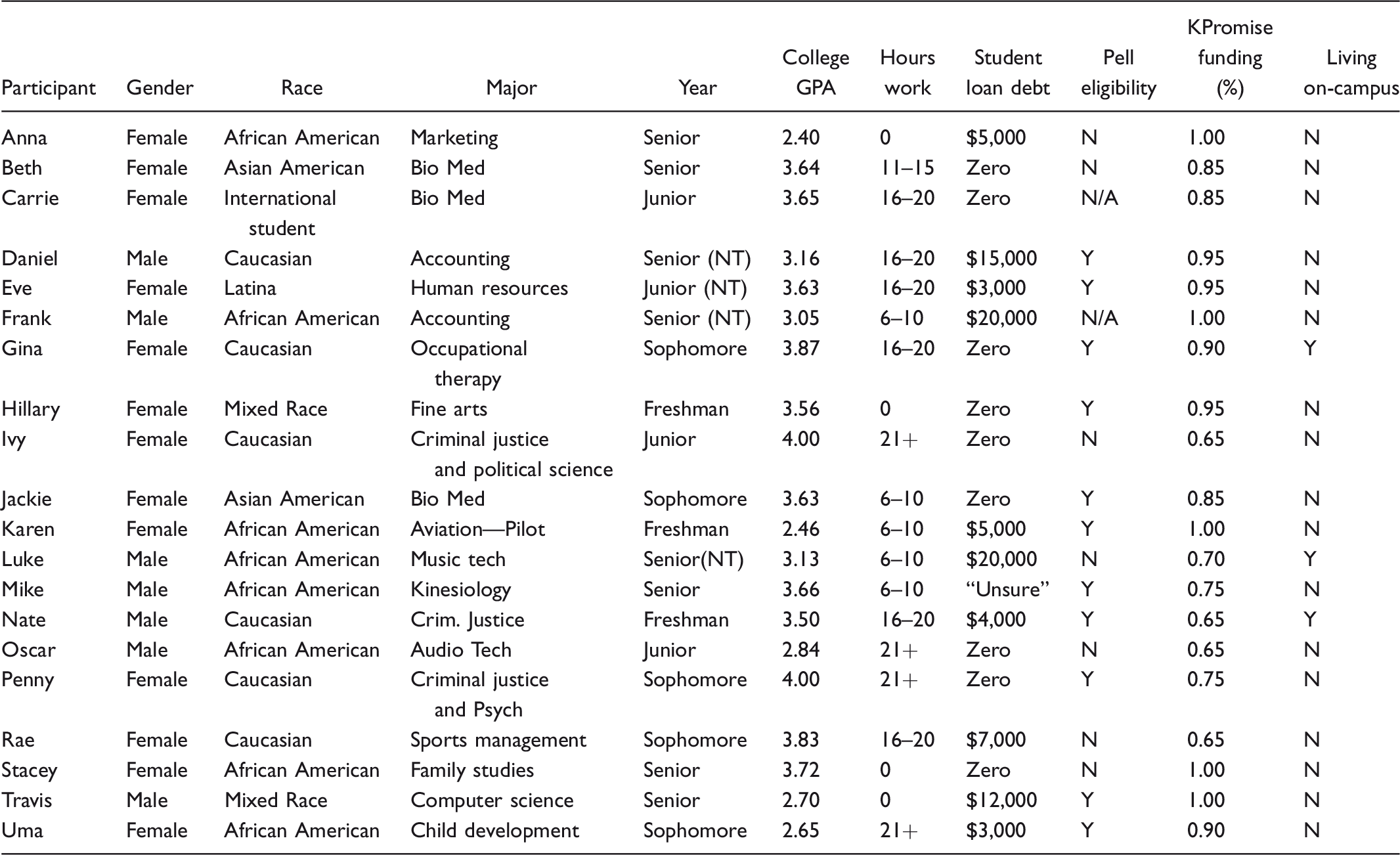
Note. GPA = grade point average; NT = returning or nontraditional student; N/A = data not available.
The sample was invited to engage in interviews via mass e-mails to all currently enrolled KPromise students, which at the time was more than 300 students. Initially, 32 scholars indicated a willingness to engage in the interview—however, for various reasons, not all the students decided to participate. All students willing to engage were included. All but three students were recruited via e-mails—the three students being Oscar, Travis, and Uma whom the administrators from the KPromise Scholars Office personally recruited after the lead researcher indicated a desire to interview more students below a 3.0 GPA.
Research Protocol
Before the interview, students engaged with a survey that captured demographic data and self-reports of mental and physical health and average hours worked per week. After completing surveys, students engaged in semistructured interviews. Harmonizing with advice by Creswell (2013), due to the nature of the personalized, in-depth questions interviews were intentionally positioned to be one-on-one. The first author was the only interviewer and has previously developed and led similar processes (e.g. Collier & Rosch, 2016). Guided by Tinto (1993) and Bean (2005), the qualitative prompt housed 12 overarching questions with subprompts. The prompt travels the following pathway: commitment to the institution and educational aspiration, feelings regarding KPromise funding, meeting uncovered costs, family and friend support system, academic experiences, mentorship, on-campus social engagements, student support units, previous challenges, upcoming challenges, how institutions’ Kalamazoo Scholars office could better serve KPromise scholars, and an open response about how KPromise has affected students’ lives and college decisions. Interviews lasted between 24 minutes and 80 minutes, averaging 44 minutes and were recorded.
Analysis
The authors agreed upon a deductive, thematic approach (Braun & Clarke, 2006)—matching responses to themes found in Tinto’s (1993) and Bean’s (1980) models. Because this exploratory study is linked with established theory, the researchers settled on utilizing latent or interpretive level analysis when assigning responses to the framework codes (Boyatzis, 1998). Within latent approaches, researchers interpret responses and link responses with appropriate, established themes—thus, examining the underlying beliefs and perceptions participants hold (Braun & Clarke, 2006). After the analysis process was set, the lead author input participants’ responses and framework themes in an Excel sheet, and the second author linked responses with said themes. The authors used a multiple coding process by which researchers separately examined responses and generated individual themes. Subsequently, the authors came together to debate how participants’ responses linked with framework themes and identify, discuss, and define subthemes (Barbour, 2001).
To triangulate data, we hosted a meeting with administrators tasked specifically to serve KPromise students and invited a representative from the site institution's KPromise Scholars office to review the findings. In both instances, administrators confirmed that themes generally matched professional experiences in serving KPromise scholars. In addition, member checks were conducted to collect more data and allow students to further support or disagree with our summarized findings—this process allows researchers to further triangulate findings and better understand participant’s perspectives (Taylor & Bogdan, 1998). Participants were given 2 weeks to respond to synthesized findings member-checking procedures. Five (n=5) scholars responded, agreeing that our findings generally matched their perceptions and experiences. These participants were afforded another $10 incentive.
Findings and Discussion
The findings illustrate that students perceived the KPromise scholarship as a community bestowed gift and investment into students’ futures. Development of perspectives on KPromise was an intentional effort by the KPromise foundation, KPS, stakeholders, and parents via consistent promotion and reinforcement from grade school through college. Furthermore, KPromise has become a significant extrinsic motivation for students to academic perform and persist. When students underperformed a deep sense of guilt develops over failing the KPromise or the belief that their personal failures will result in future generations having KPromise stripped away. Which for these students became a turning point to reexamine college goals and postcollege desires, becoming the basis to change behavior and become more focused on academic achievement and persistence. To meet uncovered costs, most students needed to work, and half have assumed student loans. Furthermore, some students with merit scholarships do not necessarily have to work, they choose to. Finally, some students indicated coping with food insecurity.
Students’ Perceptions of KPromise
Our findings illustrate that combined efforts of the KPromise foundation, KPS, and parents of promoting the scholarship has resulted in students possessing a deep gratitude for the scholarship. As such, participants are acutely aware of the donors’ sacrifices and investments—while also illustrating how the scholarship impacts the scholarship currently plays in their lives. Commonly, participants referred to KPromise as a gift, a blessing, an opportunity, or an investment, while expressing deep levels of appreciation and gratitude, for example: If somebody’s giving me this gift, then I feel like I need to stick up to it and stick to it and get it done and it’s played a huge role in my life paying for tuition and stuff looking at it. I don’t know how I would have paid for college without it. I don’t know the right word for it, just blessing I guess to be able to get your school paid for and have people who care enough to want students to continue their education. (Rae, Caucasian, GPA: 3.83) I thank everybody who contributed to this fund because it made college more of an option, and with me getting older, I understand how finances, and all that sort of thing work. It made me appreciate it more and more. I wish everybody could get this scholarship, but everybody doesn’t have the same opportunities. (Mike, African American, GPA: 3.66) I see myself sort of an investment from, like I see myself as an investment so not only just from the scholarship foundation itself, but the Kalamazoo public schools. I always feel indebted that I not only have to graduate to let them know that what they did was right, and they did invest into something that would go onto bring fruit. (Carrie, International Student, GPA: 3.64) The Kalamazoo promise has really opened doors. It’s allowed me to access things that I didn’t think I could do, like taking classes and not having to worry about paying for the specific classes . . . Just looking at how some people have to worry about how they’re going to pay for their books or classes this semester, it’s crazy because we don’t have to worry about that because it’s already taken care of. We just appreciate them so much. (Anna, African American, GPA: 2.40)
KPromise was intentional in assisting students with recognizing how the scholarship intends to personally affect students’ lives and the community they hail from. As such, KPS was recruited to be a prominent promotional and motivational arm (Miller-Adams, 2015). Which according to student responses appear to be successful in helping students develop positive perceptions of KPromise: From like fourth grade to senior year, like, “Hey, you go to college, you get it for free.” You don’t realize how awesome and amazing that is until you get to college and you don’t have to take out any loans. Or you have friends that are like thousands of dollars in debt . . . I’m so grateful for it. It makes me really happy that I don’t have some of those stressors that other people do. (Gina, Caucasian, GPA: 3.87) All through high school, I remember hearing about it all the time. Before that, middle school I remember them saying “you guys have free school, people don’t have that.” The teachers would tell us about it and we would talk about test scores and all types of stuff related to the Promise. (Travis, Mixed Race, GPA: 2.70) [When first heard about KPromise] I was in high-school and that motivated me to do better. When I learned more about it [KPromise], I motivated myself to do better and graduate with a 3.75. (Uma, African American, GPA: 2.65)
Additional to efforts put forth by KPS, parental influences were important in shaping students’ perceptions of KPromise. Rae recited an instance where her parents spoke with her regarding the desire to attend a private high school, in that if she chose private school, her eligibility for KPromise would be eliminated and they could not afford to pay for the high school or college: “I switched from St. Augustine over to Kalamazoo Central and just knowing that I had the option of having school paid for was huge for me.” Frank recalled that his dad’s excitement over KPromise was not at-first personally understood, “He was excited . . . I didn’t really understand how big that it really was, how much college really cost and how much money that the Promise actually really save you.” Lending narratives to Hershbein’s (2013) in-migration links to KPromise, two (n=2) students spoke of how their parents moved to Kalamazoo for the scholarship: First when we heard it, we lived in Minnesota at the time. We moved here when I was 10. My parents had really good job and Mom was in real estate. My dad worked at CGATE. They dropped everything to move to Kalamazoo and that was really hard. My dad was unemployed for three months. My mom couldn’t get hired because she was overqualified for a job. (Beth, Asian American, GPA: 3.64) Well we moved here from Detroit to come to the Kalamazoo Promise so I only get 65% but that’s the only reason I’m even at college now. My mom’s a single parent so obviously I wouldn’t be able to come here if I didn’t have it, you know, the financial aid. But I’m happy with it. I’m grateful. (Nate, Caucasian, GPA: 3.50)
These emerged themes serve to reinforce the importance of community in developing desired perceptions that tuition-free funds are community investments. Although many oppose tuition-free college based on free ride idealizations that students will not recognize the investment (Collier, Mishra, et al., 2017), these students indicate otherwise illustrating a recognition that KPromise provides personal opportunities and investment in their communities. However, participants’ responses suggest cultivating these desired perceptions must be designed into the program and owned by the community—a point argued by Miller-Adams (2015). Students’ appreciation for the scholarship has been systematically crafted and reinforced by KPromise, KPS, and parents from childhood into emerging adulthood. During college, these beliefs were seemingly strengthened when students enrolled in college and fully understood the importance of the scholarship.
KPromise Drives Desire to Perform
Motivation is a critical piece of student performance and persistence (Deci & Ryan 1985, Kori et al., 2015; Tinto, 1993; Vallerand & Blssonnette, 1992) and external factors, like finances, purportedly influence student motivation and performance (Bean, 1980, 2005; Robb et al., 2012; Scott-Clayton, 2011). So, we asked—what occurs to motivation when scholarships cover tuition and students mature in an environment where the community has banded together to ingrain college-going expectations? We understand from Miron et al. (2011) that KPromise motivated students to try harder in K-12 education. However, essentially nothing is known about how KPromise motivates young adults in college.
These participants indicate that imbedded perceptions of KPromise married with perceived reduced financial stress has developed into strong motivations, and pressures, to perform and persist: I mean, they’re [KPromise] paying for it, so you owe it to them to make the best use of it. I’ve always had the attitude that it’s either I do it while they’re paying for it now, or I pay for it later. (Daniel, Caucasian, GPA: 3.16) It definitely makes things a lot easier. I don’t have to take out loans, so that makes me very happy. Makes it a lot more affordable. Whenever my friends bring up how much loan debt they have, I just can take a deep breath and know I don’t have to worry about it, and that makes me feel very happy and blessed. (Ivy, Caucasian, GPA: 4.00) I don’t want to waste their [Kpromise] money, so I feel like I have to graduate. (Karen, African American, GPA: 2.46) Without the Kalamazoo Promise, I didn’t think that I could do well in college, especially at a university, because it’s quite challenging sometimes. A lot of students, they feel like they can’t make it. Some students have dealt with others that criticize them for maybe not going to a university or maybe tell them they shouldn’t go, it’s not worth it. Then, the Kalamazoo Promise helped students realize it can be for you, if you really put your mind into it. (Stacey, African American, GPA: 3.72) Towards the end of the Kalamazoo promise you have to be really careful because a lot of people don’t know if you fail a class you don’t get those credits back, and you do still have a certain limit on the Kalamazoo promise, so you gotta be careful especially taking serious what classes and things. (Anna, African American, GPA: 2.40)
Although every student demonstrated beliefs that KPromise positively influences personal motivations to perform, not all students have been able to match their performance to their expectations. As also found in commentary above, regarding the perception of failure and in instances where students reported failing, some participants expressed developing a sense of guilt over failing themselves and KPromise. The only guilt I would feel is if I do bad it’s on myself, you know what I mean? Like guilt of not working harder in certain situations, especially in the past. Not so much nowadays. (Oscar, African American, GPA: 3.84) Only when I do bad in school. That’s when I feel guilty, because I tried . . . I don’t slack off. That’s not what it is. So, when I did fail a class that made me feel bad about those students, other students who really want to be in the position I was in [having KPromise]. And I’m thinking about the students who really want to be in the position I was at. And I’ve failed the class, and they want to do the class. That’s when I mainly feel bad. (Luke, African American, GPA: 3.13) Now realizing those are being treated as an investment, I believe I used those rather poorly, doing a major I did not consider strongly taken. In hindsight, they [credit hours] would had been spent better, skipping a semester to work and think harder about what I would want to go to [institution] for. (Travis, Mixed Race, GPA: 2.70) My guilt is more like, I wish I felt more emotion towards school. Not that I dislike school, not that I dislike school, I wish I just felt more like “I LOVE SCHOOL!” Not that I don’t think I don’t try, I feel like and plan to do this in the future, work harder. I feel like I didn’t work as hard. (Uma, African American, GPA: 2.65)
A quick examination of the sample’s GPA by gender illustrates that female students possess a half of a letter grade (0.5) higher than male students—mimicking previously highlighted, statistically relevant findings for KPromise (Collier, Parnther, & Beach, 2017) and general trends of males in higher education (Conger & Long, 2010). Uma’s response suggests that similar guilt may manifest in underperforming female students. However, the two lowest performing female scholars, Karen and Anna, did not mention a development of guilt. The lack of developing guilt may be attributed toward which factors they believe led to underperformance, for example, the responses above placed ownership on personal actions whereas Karen cited that her lowered performance was due to personal, psychologically damaging issues with her roommate and becoming pregnant and Anna cited raising a child as drivers lowered performance. Our data and study do not allow us to suggest whether the manifestation of guilt for underperformance is gendered or racialized—but it opens the door for increased research on the matter.
For these persisting students, the guilt of failing the scholarship and the perception that KPromise would be taken away from others seemingly served as a mechanism to internalize moments of underperformance and find ways to overcome challenges. In addition, these participants highlighted an acute awareness that each failure led them closer to ineligibility. By their admissions, these students have experienced nonlinear pathways toward a college degree; however, the motivational pressure of KPromise, development of guilt, and internalization of underperformance prompted students to reexamine their motivations, passions, and intent to persist. Responses indicate that this reassessment has helped these students define their purposes, moderating levels of amotivation, and becoming more focused on what they want from college and on postcollege outcomes. Such reconsiderations are paramount to these students’ success as lack of purpose and increased levels of amotivation directly correlate to poor academic performance and higher likelihood of stopping out (Beattie, Laliberte, & Oreopoulus, 2018; Kori et al., 2015; Kusurkar et al., 2010; Yeager & Walton, 2011)—even in KPromise scholars (Collier, Parnther, et al., 2017). In less forgiving—one-and-done—Promise policies (e.g., Tennessee Promise), these students may never have the opportunity to turn their situations around and move toward earning a degree.
Yet, several questions remain like (a) in which situations would these emotions become overwhelming, influencing stop out and (b) how could faculty and staff help students develop stronger passions earlier, without the development of guilt? Some may read the students’ perceptions of the scholarship, desires to perform, and fears of failure and suggest that the promotional apparatus associated with KPromise is quite successful. While students’ perceptions of KPromise lend credibility to such arguments and weaken perspectives that tuition-free policies may breed complacency, commentary also suggests possible unintended consequences in that how the Promise is being marketed may place too much pressure on the students who believe their communities’ future opportunities hinge on personal success or failure. Clearly, more research examining students who feel this way and outcomes connected with such is much needed as is a thorough examination on how these students generate such mental models.
Overall, we found evidence that students’ perceptions of KPromise have seemingly situated the scholarship as a substantial extrinsic motivation to academically perform—we believe an important narrative to present in discourse. For institutional stakeholders, when extrinsic motivation is focused students identify and engage in behaviors that make them successful in achieving their goals (Deci & Ryan, 1985; Vallerand & Blssonnette, 1992). Therefore, this motivation could be even more powerful if faculty, staff, and stakeholders could properly cultivate and fixate students’ energy on passions and eventual college outcomes. Even though the students presented here were successfully overcoming challenges to persistence, as evident in the estimated 48% persistence to degree rate—many do not (Bartik et al., 2016). Aligning with Yeager and Walton’s (2011) suggestions, if faculty and staff could more quickly identify and respond to students social-psychological states, notably focused on identifying which students possess increased levels of amotivation, more KPromise students may persist without the distress associated responses presented.
How KPromise Students Experience Covering Nontuition Costs
Generally, Promise programs are designed to ease financial stress not to fully eliminate out-of-pocket obligations (Miller-Adams, 2015). Because the scholarship only pays for tuition and mandatory fees, students are still facing cost of living and nonmandatory fee expenses. To cover additional costs, fourteen (n=14) students illustrated the need to work: I have to work full time. I pay for everything myself, my cell phone bill, I have my own bills. I’m in a fraternity. I pay for the dues myself. Just everything. And then books next year, too. I save up money for the year. I will be in a car so I must pay for the insurance and the gas. So, I’ll just have to work. (Nate, Caucasian, GPA: 3.50) International students can work 20 hours a week for 40 hours every pay period, so I work for Heritage Hall. The money I make from there sustains my rent and car and all of that. (Carrie, International Student, GPA: 3.65) I split it [resident hall costs], two-thirds on me, one-third on my parents. So, they pay, I think I said it was 3,000 . . . They usually give me 1,000 for that, and then I pay the rest, which usually ends up being around $2,000. I babysat from Freshmen year of high school . . . and I’ve pretty much been working ever since. (Gina, Caucasian, GPA: 3.87)
Beth and Jackie also worked. However, because they possessed additional merit-based scholarships, these students assumed jobs to build their professional skills and bolster competitiveness for postcollege job opportunities—not for the necessity to cover nontuition costs. These students’ experiences underscore how merit scholarships may play a significant role in behaviors of tuition-free students. To highlight, Jackie possessed both merit-based scholarships and is Pell eligible, which KPromise allows her to use to cover cost of living due being a first-dollar program. In a last-dollar program (e.g., Tennessee Promise) where Pell would automatically be folded into tuition, would a student with limited family contribution but possessing merit-based scholarships, like Jackie, remain in the position where work is a choice? Possibly not. Therefore, last-dollar programs may unintentionally replicate systematic inequalities currently existing outside of Promise policies.
As tuition-free college does not equate to debt-free college (Miller-Adams, 2015), half (n=10) of the participants have assumed student loan debt, with the balances ranging from $3,000 to $20,000. Students who have assumed this debt align in three groups. The first group, consisting of just one (n=1) student, Frank, has used loans to pay for tuition after exhausting the scholarship. Next year, Luke and Travis will join Frank in using loans for tuition after breaching the 130-credit limitation. The second group does not have 100% funding, so the loans were used to cover both remaining tuition and nontuition costs. This group consists of three (n=3) students—Luke, Nate, and Eve. The last group has used loans to cover larger upfront costs (e.g., food plans or dorm deposits) or for emergencies (e.g., family issues and car fixes): [Loan Debt] $4,000. So I have an unsubsidized and a subsidized loan for two grand and that goes up every year with interest. But that’s still nothing compared to what I could have. (Nate, Caucasian, GPA: 3.50) I could afford school with the Promise and everything, but things at home, so I just needed it for bills and things like that since I’m not able to work over 20 hours a week at work. [Amount] $2,000. I don’t like to take out any loans. I don’t like to be in debt. I’ll be taking out another $1,000 loan for summer one, but I only have summer two and this fall semester left, so I don’t think it’s going to be a lot. (Eve, Latina, GPA: 3.63) Since I didn’t have to pay for tuition, I used loan money to move into the dorm, so it allowed me to have the dorm experience. Like $5,000 [In Loans]. (Karen, African American, GPA: 2.46) I have $2,000 in loans, I took it out because at the time I needed a car, so I ended up being able to fix my car. (Uma, African American, GPA: 2.65)
Although this study could not identify who may assume debt, connecting with Tinto’s (1993) framework illustrating the importance of engaging and integrating with peers—our inquiry brought to surface that KPromise scholars actively engaged non-KPromise peers in conversation and comparison of financial situations. Here, students discussed how fortunate they were as compared with their non-KPromise peers and illustrated how they felt less stress: The closer I am to ending college the more I realize how fortunate I am because I make closer connections with friends and learn about their situations and learn how much either they’re taking money out or they’re getting money from their parents. I’m lucky to be in a situation where I’m completed dependent on my own, where I’m self-sufficient. I don’t think I’d be able to be that way at this age without the Kalamazoo Promise. (Oscar, African American, GPA: 2.84) [KPromise] allowed me to be able to go to school and being almost literally debt free. I really appreciate that because I know a lot of people that have their degree, they’re still paying back loans from a long time ago . . . I had $3,000 worth of debt due to not being able to have the financial aid back in the fall and I had to use that for my winter tires. I had to use that for my books and things like that. Just food and stuff like that that I had to use my credit card. (Daniel, Caucasian, GPA: 3.16) I was talking to this girl I knew last semester, and I was telling her how stressed I am. I was just about school, in general, and work, when I had a job. And, I was working like 12 hours a week. I only had like one class that actually had exams, and she works 40 hours a week. And, she doesn’t have a car, like, her job isn’t even close to here. She has to get scholarship, and she . . . Her account was frozen because she couldn’t . . . She didn’t pay some of her [hold]. Yeah. And, she’s a double major . . . She deserves so much more than what she gets, and I just felt like I didn’t the right to complain. (Hillary, Mixed Race, GPA: 3.56) I see a lot of people who are struggling just to go through college. I’m struggling in different ways, but how they’re struggling makes it hard for them to live day to day, because they’re so much in debt. (Beth, Asian American, GPA: 3.64)
The final discovery we wish to bring to light is that food insecurity exists within tuition-free students. Four students (n=4) indicated experiencing food insecurity. Hillary linked her food insecurity directly with recently being laid-off due to her retail store closing—suggesting her food insecurity was potentially a temporary but painful state of financial shock. In the cases of Eve and Frank, food insecurity appears consistent and long term. Both students are returning adult students with children: I always try to make sure that they have everything before I even do. They’re the only reasons I’m trying to get ahead, so I can be able to provide for them. (Eve, Latina, GPA: 3.63) I line myself up to go to functions and stuff where I know I can get the free food. There’s always a lot of free food around campus . . . I try not to drink as much water and stuff because I know that if I drink a lot of water, it open me up or make me hungry . . . I’ll just wait till later in the evening because I know I’m only basically going to eat this one time a day. (Frank, African American, GPA: 3.05)
Limitations and Future Research
This research comes with several notable limitations. First, the sample hails from one institution and while the institution houses a prominent portion of KPromise enrollments, possibly students’ situations and experiences of Promise at institutions like at community colleges or elite public institutions may vary. In addition, we caution generalizability as many Promise policies are not yet well established. KPromise is one of the oldest Promise policies in the nation (Miller-Adams, 2015) and as cited most Promise policies are still rather young—therefore, KPromise has had time to evolve and learn from previous challenges. Emerging Promise policies could learn from KPromise’s evolutions but because of the political and legal structure may not be as adaptable.
We caution generalizability as many established and emerging Promise policies' terms are uniquely different when compared to KPromise - for example, Promise policies that fund only 2-year degrees, last-dollar policies, or those which have less forgiving eligibility terms. Likely, the gratitude and motivation these students espoused may be similarly found—however, elements like financial stressors may be different. Similarly, with last-dollar Promise policies, as Pell is included in the price of scholarship and fees, most students may have to work or work more hours—or more Pell eligible students may have debt. For Promise policies aiming to fund beyond the first 2 years of college, this research could be a glimpse into current or future situations of regional, 4-year institutions— which could be used to better serve Promise students.
Given the small sample size of this exploratory inquiry, variance in interview length stands out in this study. We attribute this to personal preference and style rather than omission of content. Interviews that were lengthy provided wider explanations for how they perceive KPromise, college, and their beliefs and behaviors and often delved more deeply into personal family characteristics that while highly valuable were unexpected.
Lastly, this study only examined currently enrolled students, ongoing research investigating similar questions of stop out students should reveal various similarities and differences and help us further understand what led to a stop out. Future qualitative and quantitative research is much needed on the Promise population—as previously stated little is known about these students and how they are different and comparable to each other and to nontuition free students. Indicated throughout the manuscript, this exploratory study is a humble start in attempting to move researchers in more closely examining the experiences and potential outcomes of tuition-free college students.
Implications and Conclusions
Because tuition-free policies are progressing while little is known about tuition-free students, using a seminal Promise program as an example, this research aimed at bringing to light details of tuition-free students’ perceptions and experiences. Our findings hold several important implications for communities interested in developing and implementing tuition-free policies and the institutions expected to respond to such. First, students describe KPromise as an investment and that they wish to live up the expectations of such. Thus, positioning KPromise as a prime college performance and persistence motivation. Generally, we believe the student narratives uncovered here weaken widely used arguments correlated with free ride rhetoric and beliefs that such policies would only breed complacency. As such, proponents of tuition-free policies must be more intentional in capturing student voices—including those whom this study failed to capture, those who may not as strongly appreciate the scholarship—and interject them into debates surrounding tuition-free policy.
Next, whereas the students here have developed a deep sense of appreciation for the scholarship—cultivated in the scholarship’s design and refined through over a decade of community marketing. Scholars associated with newer tuition-free policies may not yet possess the depth of appreciation illustrated here. Development of such will probably take time but as indicated if multiple entities could unite under common messaging and purpose—K-12 and college students’ motivations could be significantly influenced.
Here, student’s voices illustrate that the Promise is a significant influence in their college decisions, desires to perform and persist, and aspirations to provide economic and noneconomic returns to their communities. To these participants, KPromise appears to be more than just a mechanism for providing personal opportunities. Although the students were obviously thankful for the personal benefits, as consistently referenced in commentary presented and more we could not include, KPromise is generally framed as a program designed to help individuals gain degrees and the community progress. Regarding institutional policy and actors, if faculty and staff could capture the energy associated with students’ framing of KPromise, the motivation and keep students focused on their goals of persisting and postcollege outcomes.
Next, stakeholders must do a better job in understanding how Promise scholars may frame potential and experienced failure. The authors of this study have grown concerned over the possession of manifested guilt in failing the scholarship. As such we have been working with our partners to ease stressors associated with beliefs that meeting personal failure will result in consequences for the community. Those developing the marketing apparatus, we hope, will consider how to position the scholarship as a motivational force while minimizing the pressure and harm associated with failing the community.
Although the students in this study indicated that guilt was a prominent force for readjustment of amotivation, staff could be instrumental in guiding students down healthier pathways of finding passion and driving persistence. The ingrained perceptions students hold of KPromise appears to help students stay accountable to KPromise and themselves, which we believe is beneficial for many. However, there is likely an unexplored consequence of developing such perceptions and while possessing some guilt may inspire several of these students, at what point would this emotion develop into distress, anxiety, and depression—and lead to amotivation, stop out, or worse?
Lastly, our findings illustrate that tuition-free students still have financial struggles associated with nontuition costs of college. Like non-Promise students, many of these students work to pay cost-of-living expenses. In addition, although KPromise has seemingly eliminated the need for some students, including several Pell eligible, to avoid assuming loan debt, half of the students have borrowed to pay for larger up-front expenses or emergencies. While this study pulls into the open interesting discoveries, our findings prompt more questions. What are the factors that influence borrowing? How does the percentage of the population and amount of debt change between first- and last-dollar policies? What does a last-dollar one and done policy mean for students experiencing food and housing insecurity, other financial needs, or need social-psychological interventions? and so on. Undoubtedly, covering tuition for students is greatly beneficial but there is more work to be done.
As development of tuition-free policies continue—we felt it important to give tuition-free students a voice the conversations surrounding the subject. Overall, these stories and subsequent research stemming from such could help those engaged in debate understand how tuition-free policies affect students and college-related outcomes, assist stakeholders in making better decisions while developing tuition-free policies, and provide institutions a stronger foundation to build stronger student-focused supports and services.
Footnotes
Acknowledgements
We would like to thank and acknowledge Bob Jorth of the Kalamazoo Promise for granting us access to Kalamazoo Promise. Additionally, we thank Ron Dillard and Lauren Conrad of the Kalamazoo Promise Scholars Office at our site institution for recruitment, incentive funds, and serving as a layer of credibility regarding the findings. Furthermore, we thank to Brad Hersbein and Michelle Miller-Adams of the Upjohn Institute for continued guidance, feedback, and access to networks and information. Finally, we thank Andrea Beach and Charles Henderson, co-Primary Investigators of the Center for Research on Instructional Change in Postsecondary Education (CRICPE), and Monica Liggins-Abrams of CRICPE for the opportunity to develop and implement this research and promoting it across the nation.
Declaration of Conflicting Interests
The authors declared no potential conflicts of interest with respect to the research, authorship, and/or publication of this article.
Funding
The authors received no financial support for the research, authorship, and/or publication of this article.