




Abstract
In this study, we investigated how environmental, cognitive, and demographic variables influenced students’ ability to graduate from a 4-year university in 4 years. Specifically, we examined how behaviors related to social cognitive career theory (i.e., self-efficacy, outcome expectations, and academic goals) were influenced by contextual experiences related to prescriptive academic advising to ultimately predict students’ ability to graduate in 4 years. After holding students’ demographic characteristics constant, results from structural regression analyses indicated that prescriptive advising had a direct effect on students’ 4-year graduation rates. In addition, prescriptive advising had indirect effects on students’ 4-year graduation rates through its impact on students’ self-efficacy and the serial path involving students’ self-efficacy and their academic goals. Our results suggest that if institutions want to ensure they maximize 4-year graduation rates, helping students understand that it is possible to graduate in 4 years is critical.
Four-year universities often differentiate themselves from other educational institutions based on their academic programs and the expected time it takes for students to graduate. Interestingly, it has become accepted as a standard practice to measure successful graduation at 4-year institutions with a 6-year graduation rate (Complete College America, 2014). According to the authors of Complete College America, national 4-year graduation rates at 4-year institutions hover between 19% and 36%. Ginder, Kelley-Reid, and Mann (2017) reported similar numbers and noted that the average 4-year graduation rates at 4-year institutions range from 17% to 53% (depending on the type of institution—e.g., public, for profit, etc.) with a national average of 40%. Although there are legitimate reasons for students to take longer than 4 years to complete their undergraduate degrees, the costs of doing so can add up quickly. According to some estimates, these costs can range between $50,000 and $68,000 per year (due to the costs of attendance plus the opportunity costs of lost wages) and pose significant problems for students who take additional time to complete a bachelor’s degree (Complete College America, 2014). As might seem obvious based on these figures, making graduation more efficient should help reduce student debt (Johnson, Meija, Ezekiel, & Zeiger, 2013) which means that students can become financially independent more quickly once they graduate. Moreover, for public institutions, the civic investment in students’ educations is more expedient when students graduate in 4 years as well (Complete College America, 2014). For these reasons, several university systems have made it their explicit goal to increase 4-year graduation rates within their campus communities (Jackson & Cook, 2016). Considering the importance of graduating in 4 years, the purpose of the current project was to study what universities might do to effect a timely graduation.
According to the authors of Complete College America (2014), part of the reason that students do not graduate in 4 years is due to unclear expectations and cluttered pathways to graduation. In addition, the authors argue that students often do not take enough units per semester to graduate on time. Of course, other variables matter too. For example, in a national study examining 262 schools and almost 57,000 students, Astin and Oseguera (2005) revealed several predictors of 4-year graduation including race, sex, high school grade point average (HSGPA), and SAT scores. Other predictors of timely graduation include the number of years students study a foreign language in high school, the number of classes they take in physical science in high school, the number of hours students spend doing homework per week (Astin, 2005–2006), perceptions of mathematics and science self-efficacy (Larson et al., 2015), and students’ emotional intelligence (Sparkman, Maulding, & Roberts, 2012).
As it relates to timely graduation, many of the variables noted above seem to stem from students themselves. In fact, according to Astin (2005–2006), “an institution’s degree completion rate is primarily a reflection of its entering student characteristics” (p. 7). As a result, the author argues that institutions of higher education are not likely to influence students’ rates of degree attainment in remarkable ways. Still, institutions do have power to influence the rate of degree attainment over and above students’ entering characteristics. Thus, although the impact of institutional interventions might be limited, it remains that universities should do their best to determine where they might place their efforts when helping students pursue a timely graduation. Several researchers argue that one such place includes the promotion of students’ self-efficacy (Robbins et al., 2004).
In support of this contention, various researchers argue that self-efficacy is among one of the most important variables influencing academic success in higher education (e.g., Bean & Eaton, 2001–2002; Schneider & Preckel, 2017). That said, because self-efficacy can be influenced by students’ interactions with various individuals in their institutions of higher education (e.g., faculty, advisors, etc.), the promotion of students’ academic self-efficacy may prove especially important in their pursuit of a timely graduation; after all, students who believe they can succeed in school are more likely to do so (Bandura, 1997). Bandura (2004) argues that self-efficacious students are likely to succeed because these individuals set higher goals for themselves and persist in the face of challenges. The link between self-efficacy and academic achievement has been supported by the work of other researchers as well (e.g., Komarraju & Nadler, 2013).
Although there are a variety of ways that institutions might influence students’ perceptions of their academic self-efficacy, academic advising seems like a particularly profitable place to focus institutional efforts. This is true insofar as academic advising promotes student success through its ability to link “students’ goals with institutional resources on a personalized basis” (Metzner, 1989, p. 422). Other researchers agree and note that advising is integral to the success of academic institutions because of its influence on student persistence and graduation (Teasley & Buchanan, 2013). Crucially, the impact of advising on student success may not be direct. Instead, as Metzner argues, the influence of advising on student success might be best understood as indirect and operating through its influence on other variables such as students’ psychological outcomes: This is the position that we take in the current project. In particular, the purpose of this study was to test the relationship between academic advising and students’ self-efficacy as it pertains to students’ propensity to graduate in 4 years. More specifically, we utilized social cognitive career theory (SCCT) to test the notion that academic advising can influence students’ self-efficacy for 4-year graduation and, in turn, their actual likelihood of graduating in 4 years.
Antecedents and Consequences of Students’ Academic Self-Efficacy
Self-efficacy reflects an individual’s perception of his or her capability “to organize and execute the courses of action required to produce given levels of attainments” (Bandura, 1998, p. 624), or the confidence and ease a person feels regarding the ability to perform a behavior (Azjen, 2002). According to Bandura (2004), self-efficacy is at the core of human motivation and plays a central role in behavior because it influences a host of outcomes including the goals people pursue, the effort they expend toward these goals, and their success in reaching these goals. As Bandura (1986) notes, self-efficacy is a crucial aspect of personal achievement because people typically avoid tasks that they do not believe they are capable of performing successfully.
As we argued earlier, self-efficacy may help individuals experience success to the extent that it determines the amount of energy people put forward in pursuit of their intended outcomes and has been shown to influence an individual’s willingness to persist in the face of obstacles (Bandura, 1997). These conclusions have received support in a variety of contexts (for a review, see Bandura, 1997) and have been shown to be true for students in academic settings as well. In support of this assertion, Komarraju and Nadler (2013) found that highly self-efficacious undergraduate students were more likely to behave in effort-regulated ways. Specifically, compared to students with lower self-efficacy, students with higher self-efficacy were more likely to focus on their academic work in the face of distractions and obstacles as opposed to quitting. As a result, highly self-efficacious students were more likely to enjoy academic success in the form of higher college GPAs. In addition, researchers have found that academic self-efficacy is tied to important educational outcomes including academic performance and persistence (Brown et al., 2008). In fact, several researchers have registered similar results and report links between students’ self-efficacy and their academic goals and achievement (e.g., Diseth, 2011; Hsieh, Sullivan, & Guerra, 2007; Multon, Brown, & Lent, 1991; Schneider & Preckel, 2017).
Social Cognitive Career Theory
Although self-efficacy is an important aspect of academic success, this variable tends to be examined in the context of general goal attainment. That said, one of the more robust theories of goal attainment and self-efficacy is social cognitive theory (Bandura, 1986, 1997). As it relates to academic success, researchers have examined this theory under the title of social cognitive theory of career and academic interest, choice, and performance (Lent, Brown, & Hackett, 1994), or simply: SCCT (see also Lent et al., 2001, 2003, 2005; Lent, Lopez, Lopez, & Sheu, 2008). According to Lent, Brown, and Hackett (2000), SCCT represents an “effort to understand the process through which people form interests, make choices, and achieve varying levels of success in educational and occupational pursuits” (p. 36). More specifically, the theory suggests that students’ academic outcomes are a product of contextual influences such as academic support systems and their impact on cognitive person variables including self-efficacy, expected outcomes, and academic goals.
The first idea in SCCT pertains to the notion that student achievement is influenced by the context within which students pursue their educations. That is, when it comes to their academic outcomes, proponents of SCCT argue that students are exposed to varying environmental factors which impact their educational success. These environmental factors can vary but include differing levels of academic resources, faculty support and encouragement, financial affordances, and parental or family support, for example. The second idea in SCCT pertains to students’ cognitive person reactions. Specifically, proponents of SCCT argue that students’ experiences of the environmental factors noted earlier impact their perceptions of self-efficacy, expected outcomes, and educational goals (Lent et al., 2001). Consequently, researchers who support SCCT argue that these cognitive person reactions influence students’ educational outcomes including their career selection, academic performance, and persistence (Lent et al., 2001).
As it pertains to cognitive person reactions, self-efficacy is widely seen as the most central of these variables. In academia, self-efficacy is specific to a performance outcome and represents a person’s belief in his or her ability to obtain a particular result. In SCCT, self-efficacy is thought to impact students’ academic outcomes directly and is also thought to impact both their outcome expectations and academic goals. Students’ outcome expectations represent their beliefs about the positivity and negativity related to the consequences of obtaining a result and are modeled to influence academic goals. Academic goals represent an individual’s determination to engage in particular activities to influence a desired outcome and are thought to impact these outcomes directly. Figure 1 illustrates the relationships between these variables(e.g., Brown et al., 2008; Lent et al., 1994).
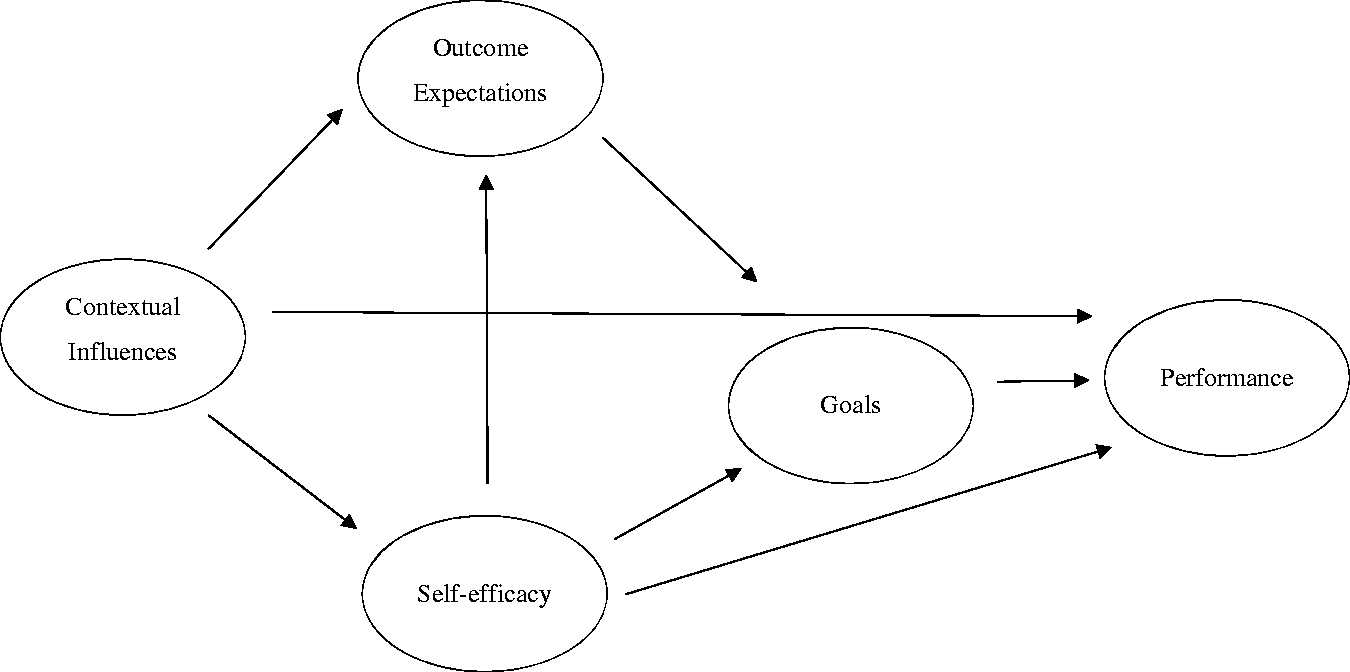
Social cognitive career theory, performance model.
SCCT has been championed by a variety of researchers, perhaps most prominently by Lent et al. From a general perspective, studies demonstrate the impact of contextual support on students’ self-efficacy and, subsequently, the impact of self-efficacy on students’ academic choices and outcomes. For example, Lent et al. have found that social supports (e.g., social and financial support) and barriers (e.g., social, instrumental, and gender) influence students’ outcomes such as their persistence in a major through their impact on students’ perceptions of academic self-efficacy (Lent et al., 2003, 2005, 2008).
As mentioned, contextual support has been operationalized as stemming from a variety of sources including friends, family, and other important individuals such as mentors and role models (Lent et al., 2001). Thus, it seems reasonable to conclude that academic advisors might also play a significant role in the development of students’ academic self-efficacy as well. This might be the case because, similar to the environmental variables noted earlier, academic advising has been shown to help foster important educational outcomes associated with student development and retention (Fielstein, 1989b; Teasley & Buchanan, 2013).
Academic Advising
As O’Banion (1972) notes, academic advising involves many activities including helping students investigate their personal, professional, and academic goals. In addition, advising is instrumental in helping students navigate institutional exigencies including program, course, and scheduling choices. This latter point is particularly important considering the options offered to students at institutions of higher education are staggering and often require expertise if they are to be navigated in an expedient manner (O’Banion, 1972). Unfortunately, most students are not likely to have this expertise, and therefore, many rely on advisors to help them understand issues such as course availability, course scheduling, and the particulars of various graduation requirements. As such, Drake (2011) argues that advising is a crucial component of student success insofar as it is instrumental to their persistence and graduation. In particular, the author states that it is not enough to simply open the doors to academia and let college students proceed without expert guidance. Instead of hoping that students enter institutions of higher education with the wherewithal to efficiently negotiate their way through the maze of academic tasks and challenges, Drake argues that advisors are necessary to help students navigate this journey.
Although advising takes a variety of forms, several authors note an important distinction between developmental and prescriptive advising (Crookston, 1972; Fielstein, 1989a, 1989b; O’Banion, 1972). To this point, Crookston (1972) argues that developmental advising concerns issues of student initiative, growth, and mastery with a special emphasis on student choice and input. Prescriptive advising, on the other hand, is concerned with issues of grades, credits, and institutional requirements with a focus on the dissemination of information. As it pertains to student preferences, Fielstein (1989b) compared developmental (i.e., helping students solve personal problems, getting to know students) and prescriptive advising activities (i.e., explaining university polices and degree requirements) and found that although students appreciate both, they largely valued prescriptive over developmental advising. In particular, for students, the highest priority was placed on explaining requirements for graduation, class selection, and planning a course of study. This conclusion is in line with Fielstein’s (1989a) argument that prescriptive activities form the foundation of effective advising.
When it comes to academic advising and 4-year completion rates, perhaps one of the most important prescriptive goals should be to help students create a feasible path toward timely graduation (Complete College America, 2014). As the authors of Complete College America note, some of the ways that universities might help facilitate timely graduation include helping students develop structured schedules and engaging in initiatives that promote taking 15 targeted units (credits) per semester (and 30 units per year). Because 120 units might be considered a standard load for a 4-year bachelor’s degree, this number of units makes sense: anything lower and students simply cannot graduate on time. Thus, as the authors of Complete College America argue, one of the more important prescriptive advising behaviors that advisors can employ may include helping students create a structured plan toward graduation that includes a focused curriculum and a full course load.
From the standpoint of SCCT, the advising behaviors outlined earlier would form the foundation of contextual or environmental support. According to SCCT, this contextual support should, in turn, influence student graduation rates through its impact on individuals’ self-efficacy, outcome expectations, and goals. Thus, although prescriptive advising may be important in its own right, from the standpoint of SCCT, we might conclude that providing prescriptive advising is helpful because this type of interaction helps students understand that graduating in 4 years is an achievable goal. According to SCCT, if this is the case then students who are led by their advisors to believe that they can graduate in 4 years might subsequently value a 4-year graduation more highly, set higher aspirations to achieve this outcome, and be more likely to graduate in 4 years compared with students who are not. This study was designed to test these assumptions.
In particular, we predicted that advisors who helped students understand that it is possible to graduate in 4 years would influence students’ self-efficacy for doing so and their outcome expectations (i.e., students’ beliefs about the benefits of graduating in 4 years). As a consequence of these changes to students’ outcome expectations and perceptions of self-efficacy, we predicted that students would set higher goals for graduating in 4 years and would subsequently be more likely to achieve this outcome. To help test these assumptions, the following hypotheses were offered: Hypothesis 1 (H1): Prescriptive academic advising toward 4-year graduation will influence students’ 4-year graduation rates through its impact on student’ self-efficacy, and through students’ self-efficacy and students’ subsequent goals regarding 4-year graduation. Hypothesis 2 (H2): Prescriptive academic advising toward 4-year graduation will influence students’ 4-year graduation rates through its impact on students’ outcome expectations and subsequently through students’ goals regarding 4-year graduation.
Method
Participants and Procedure
After gaining approval from the institutional review board, participants were recruited from the population of students who entered a large university on the west coast as first-time freshmen in the fall of 2013 (N = 4,343) and who were currently enrolled in the college of liberal arts as of Fall 2016 (N = 972). Students who met these criteria were identified and targeted by the college for participation in our study during the spring of 2017 (students were in their eighth semester with the university). Students were sent an e-mail asking for input regarding their perceptions, experiences, and behaviors while pursuing their bachelor’s degrees.
Data collection occurred online and students were incentivized with a $10 gift card for participating in the study. Of the 972 individuals targeted, a total of 292 students completed the survey and were matched with complete data from the department of institutional research and assessment based on students’ campus identification numbers. Students in our sample had ages ranging from 20 to 23 years (M = 21.5, SD = .53). Participants were 71 men (24%) and 221 women (76%) with 161 reporting their ethnicity as Hispanic or Latino (55%), 71 Asian (24%), 48 White (16%), and 12 Black or African American (4%). Students who agreed to take part in the study were e-mailed a link to an online survey which asked them to report on the variables listed in the following Instrumentation section. In addition to the data collected from our survey, several variables were provided by the department of institutional research and assessment including students’ sex, ethnicity, SAT composite score, HSGPA, and the number of units taken per semester.
Instrumentation
Independent Variables
Prescriptive academic advising
Academic advising was measured to assess the extent to which advisors on campus helped students move toward a 4-year graduation. A scale was created for the study and included 4 items measured on a Likert-type scale with response options ranging from (1) strongly disagree to (5) strongly agree. Items included “My advisor encourages me to take 15 units a semester,” “My advisor encourages me to graduate in 4 years,” “My advisor helps me see that it is possible to graduate in 4 years,” and “I know what I need to do to graduate in 4 years” (α = .84, M = 4.03, SD = .86). Because they are often advised through various outlets on campus, students were directed to pick the one advising center or program utilized most often when considering their responses.
Self-efficacy
According to Bandura (1997), self-efficacy beliefs vary based on the task at hand and thus measurements are best if they relate to a particular sphere of activity. In this study, self-efficacy was measured as it was related to students’ confidence in their ability to graduate with a bachelor’s degree in 4 years. To assess these perceptions, students responded to 5 items measured with a 5-point Likert-type scale ranging from (1) strongly disagree to (5) strongly agree. Specifically, students were asked to report the extent to which they agreed that graduating in 4 years was “Possible,” “Manageable,” “Easy,” “Achievable,” and “Realistic” (α = .91, M = 3.69, SD = .92).
Outcome expectations
The measure of students’ outcome expectations was adapted from McCroskey and Richmond (1996) and asked students to report the extent to which they agreed with five statements measured with a 5-point Likert-type scale ranging from (1) strongly disagree to (5) strongly agree. Specifically, students were asked to report the extent to which they believed graduating in 4 years was “Important,” “Worthwhile,” “Positive,” “Wise,” and “Good” (α = .91, M = 4.12, SD = .86).
Units Taken Per Semester
We used the average units taken per semester as an indication of students’ goals for graduation. According to Lent et al. (1994), goals represent people’s determination to engage in particular activities to influence a desired outcome. Therefore, we considered the number of units students took per semester to approximate their endeavors to affect a 4-year graduation. The department of institutional research and assessment provided these data as the number of units students’ attempted per semester for their first seven semesters. Units were combined to form an average score (M = 13.57, SD = 1.19).
Dependent Variable
The dependent variable for our project was degree attainment, which was operationalized as having graduated with a bachelor’s degree in 4 years. Information regarding degree attainment was provided by the department of institutional research and assessment. Specifically, degree attainment was scored as a 1 if students had earned their degree by the summer of 2017 and it was scored a 0 if it was not. In our sample, a total of 147 students graduated in 4 years, whereas 145 had not.
Covariates
Because student-centered variables have been shown to influence degree attainment (Astin & Oseguera, 2005), we deemed it to be important to measure a selection of variables to control for their influence in our study. To this end, we asked students to indicate the number of times they switched majors while in pursuit of their degrees. Students reported switching majors from 0 to 5 times (M = .93, SD = .97). In addition, several variables were provided by the department of institutional research and assessment to control their influence on students’ degree attainment. These variables included students’ sex (scored 1 for women and 0 for men), ethnicity (scored 1 for White and Asian students, and 0 for Black and Hispanic students), SAT composite score (M = 1,020.41, SD = 149.03), and HSGPA (M = 3.50, SD = .33). See Table 1 for correlations between variables.
Correlation Coefficients.

Note. Graduate is scored 1 for students who graduated and 0 for students who did not. Sex is scored 1 for women and 0 for men. Ethnicity is scored 1 for White and Asian students and 0 for Black and Hispanic students. HSGPA = high school grade point average.
*p < .05, two-tailed. **p < .01, two-tailed.
Results
Structural regression models using robust maximum likelihood estimation were used to test our hypotheses. Specifically, we tested the notion that advisors’ influence would indirectly impact students’ 4-year graduation through students’ perceived self-efficacy and also through their outcome expectations pertaining to this outcome. In our analyses, advisors’ influence, students’ self-efficacy, and students’ outcome expectations were modeled as latent variables. Four-year graduation, average units taken per semester, ethnicity, sex, SAT, HSGPA, and the self-reported number of times a student switched majors were modeled as observed variables.
To examine our predictions, we conducted separate analyses to assess the fit of the measurement and structural models according to Kline’s (2016) two-step rule. Results of a confirmatory factor analysis indicated that the proposed measurement model fit the data reasonably well: Satorra-Bentler scaled χ2 = 325.47, df = 151, p < .01, standardized root mean square (SRMR) = .04, comparative fit index (CFI) = .93, root mean square error of approximation (RMSEA) = .06, confidence interval (CI) [.05, .07]. However, examination of the modification indices revealed a substantial improvement in model fit if the residual covariance between the first 2 items in the advising scale (i.e., “my advisor encourages me to take 15 units a semester” and “my advisor encourages me to graduate in 4 years”) was allowed to be estimated freely. After making this change, we conducted the analysis again. Results indicated that the new model was a significantly better fit to the data: Satorra–Bentler scaled χ2 = 273.50, df = 150, p < .01, SRMR = .04, CFI = .95, RMSEA = .05, CI [.04, .06]; the Satorra-Bentler scaled χ2 difference test was = 51.97, df = 1, p < .01. Next, we analyzed the structural model to assess its fit to the data. Results indicated that the model was a reasonable fit: Satorra-Bentler scaled χ2 = 317.23, df = 172, p < .01, SRMR = .07, CFI = .94, RMSEA = .05, CI [.04, .06]. Because measurement fit statistics are known to influence the fit of structural models (O’Boyle & Williams, 2011), the root mean square error of approximation of the path component (RMSEA-P)was calculated to determine the fit of the path model alone. The RMSEA-P was .06 which indicated a reasonable fit of the path model to the data (see Figure 2).
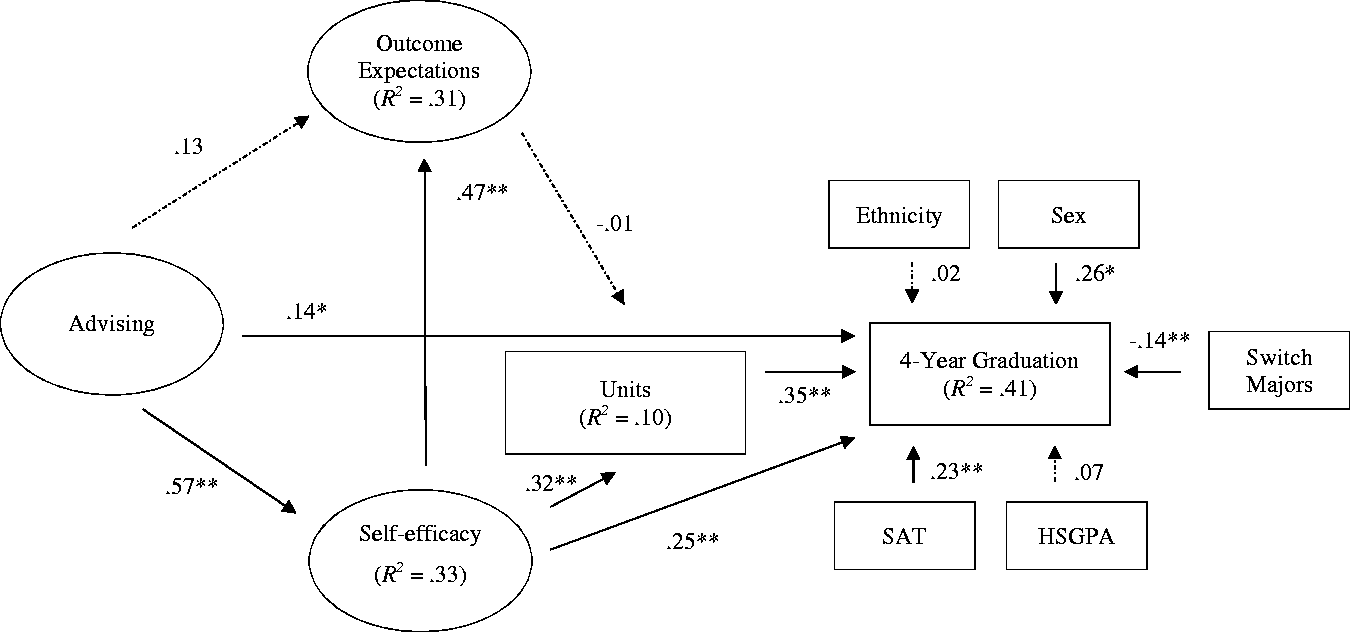
Social cognitive model of factors influencing students’ 4-year graduation. Note that all paths are standardized, *p < .05, **p < .01. Dashed lines represent nonsignificant path coefficients. Four-year graduation is scored 1 for students who graduated and 0 for students who did not. Sex is scored 1 for women and 0 for men. Ethnicity is scored 1 for White and Asian students and 0 for Black and Hispanic students. HSGPA = high school grade point average.
Finally, to test our hypotheses, we conducted mediation analyses using 5,000 bootstrapped samples and bootstrap percentiles (using a 95% CI) to examine the indirect effects of prescriptive academic advising on students’ 4-year graduation rates. Pertaining to H1, we tested the indirect effects of prescriptive advising on 4-year graduation through self-efficacy and through the serial path of self-efficacy and the average number of units students took per semester. Regarding H2, we tested the indirect effects of prescriptive academic advising on 4-year graduation through the serial path of outcome expectations and units per semester. In support of H1, the standardized indirect effect of prescriptive advising on 4-year graduation through self-efficacy was significant with a point estimate of .14 (p < .01, CI [.07, .22]). Similarly, the serial indirect effect of prescriptive advising on 4-year graduation through self-efficacy and units taken per semester was also significant (standardized point estimate = .07, p < .01, CI [.04, .10]). H2 was not supported. The indirect effect of prescriptive advising on 4-year graduation through outcome expectations and units per semester was not significant (standardized point estimate = .00, p = .89, CI [−.01, .01]). Moreover, the standardized indirect effect of prescriptive advising on students’ 4-year graduation through self-efficacy, outcome expectations, and units per semester was also nonsignificant (standardized point estimate = .00, p = .87, CI [−.02, .01]).
Discussion
Results from our study generally support the tenets of SCCT. Thus, our findings add to the body of literature insofar as we demonstrated that students’ academic outcomes, in the form of a 4-year graduation, were a product of academic support systems related to advising and, consequently, students’ cognitive person reactions including their perceptions of self-efficacy and their decisions to pursue challenging academic goals. Taken as a whole, readers might conclude from our results that advisors who help students perceive that graduating in 4 years is attainable have the potential to make this outcome a reality. This effect is largely stimulated through the influence advisors have on students’ beliefs in their abilities to accomplish a 4-year graduation, and subsequently, through the goals students set (including the units they take per semester) to reach this end.
As should be clear, results from this study add credence to arguments regarding the significance of academic advising as it relates to student success. Pertaining directly to the results of the current project, this is likely the case because, as O’Banion (1972) argued over four decades ago, advising is instrumental in helping students navigate various institutional exigencies. As we stated in the literature review, students who enter higher education are often faced with a plethora of options and most need help to proceed through their academic tasks in an expedient manner. Although some students might be capable of navigating these options on their own, many are not likely to have this expertise and must therefore rely on academic advisors to help map a path to a 4-year graduation based on course availability, graduation requirements, course scheduling, and so forth (Drake, 2011).
Importantly, our operationalization of advising diverges from that of other studies (e.g., Teasley & Buchanan, 2013) to the extent that we focused on specific prescriptive behaviors and outcomes related to the student–advisor relationship. In particular, our focus on advising was centered on what advisors do to inform students about how they might be able to graduate in 4 years while also encouraging students to employ specific measures (i.e., taking 15 units per semester, on average) to do so. Thus, the results from this study speak to the importance of prescriptive advising when providing guidance for students. This conclusion is not isolated to the current project. In fact, the authors of Complete College America (2014) argue the same and note that institutions can support students’ timely graduation by providing clear expectations and an uncluttered pathway to graduation. Specifically, the authors argue that this might include the provision of academic maps, default pathways with course sequences laid out for students, periodic assessments to ensure that students are progressing at an appropriate rate, and honest conversations with students regarding how deviation from these paths (including changing majors) might have a downstream academic impact. In summary, similar to the conclusions we draw from the current project, the authors argue that providing a clear structure for student success should lead to an increase in 4-year graduation rates.
The prescriptive advising behaviors measured in this study had both direct and indirect effects on students’ 4-year graduation through students’ self-efficacy and also through the serial mediating path of self-efficacy and the number of units students took per semester. Thus, one question readers might ask is: How/why does self-efficacy work to influence students’ 4-year graduation rates? One of the reasons that self-efficacy might be an important predictor of 4-year graduation is because students who believe in their academic potential are more likely to set higher academic aspirations for themselves (Bandura, Barbanelli, Caprara, & Pastoreli, 1996). Results from Brown et al. (2008) support this conclusion. In particular, these researchers found that, similar to our study, self-efficacy had a direct effect on academic success and an indirect effect through the setting of more challenging academic goals. In the case of this study, aspirations were operationalized as the average number of units students took per semester. Thus, stated in terms of the variables included in this project, students who believed they could graduate in 4 years were more likely to take a higher course load which subsequently contributed to the chances that they were able to graduate in 4 years.
Readers might note that self-efficacy also had a direct impact on students’ 4-year graduation rates as well. This relationship was expected and can be explained by Bandura (2000) who argues that self-efficacy impacts individuals’ outcomes to the extent that these beliefs influence their commitment to goals, effort expended in pursuit of goals, and persistence in the face of obstacles to these goals. Pertaining to the latter, self-efficacy may act as a buffer against failure and could help students take a more resilient approach when facing challenges to their success (Bandura, 1997; Multon et al., 1991). As Bandura (1997) argues, people who are high in self-efficacy might interpret setbacks in terms of a lack of effort or unfavorable circumstances as opposed to a lack of ability. Thus, Bandura claims that instead of giving in to anxiety or stress when faced with academic impediments, self-efficacious students might redouble their efforts in an attempt to achieve their desired outcomes.
Contrary to our predictions, academic advising did not influence students’ outcome expectations (i.e., belief in the positivity of graduating in 4 years), and students’ outcome expectations did not influence students’ goal setting. This result may indicate that despite whether or not students think graduating in 4 years is a good idea, there are exigencies that impinge on students’ abilities to affect this outcome. From a practical perspective, this may indicate that convincing students of the value associated with an 4-year graduation may be of little help in an institution’s pursuit of higher graduation rates; even if students agree with the value associated with graduating in this time frame, our results showed that this belief did little to influence their academic goals over and above the influence of self-efficacy. Perhaps this result was to be expected; several researchers have demonstrated a weak association between outcome expectations and academic goals, performance, and persistence in the context of SCCT (Lent et al., 2003, 2005, 2008, 2016).
Institutional Implications
When it comes to influencing students’ 4-year graduation rates, universities may consider utilizing a variety of strategies to help produce this outcome. Some of these institutional practices might include attempts to increase student engagement through interventions such as the creation of 4-year learning communities, the provision of internship opportunities, and peer mentoring (Jackson & Cook, 2016). Moreover, in addition to enhancing student engagement, Jackson and Cook argue that increased resources for academic advising can help as well. The implications of this study are in line with the latter argument and our results specifically highlight the importance of advising activities that develop students’ self-efficacy toward a 4-year graduation. To this point, Jackson and Cook mention that institutions might consider various practices including utilizing e-advising software to help advisors and students stay up-to-date on student progress in real time and utilizing proactive communication strategies to help students remain aware of course availability and upcoming deadlines. In addition, the provision of default pathways may prove beneficial as well (Complete College America, 2014). By mandating that students get approval for courses outside their chosen paths, advisors can ensure that students take courses that count toward a degree and that they understand the potential downstream consequences of taking courses that do not. Of course, as some might argue, university officials should recognize the tension inherent in students’ desire or need for exploration and timely degree progress. As such, decisions may need to be made regarding the best way to facilitate an appropriate breadth of learning experiences while also promoting institutional efficiency.
Crucially, though a focus on prescriptive advising should benefit universities with a mandate to move students through their campuses more efficiently, students are likely to welcome these types of interventions as well. This is because, according to Fielstein (1989a, 1989b), although students appreciate both developmental (i.e., helping students solve personal problems, getting to know the student) and prescriptive advising activities (i.e., explaining university polices and degree requirements), they largely value prescriptive advising over that which is developmental. As the authors of Complete College America (2014) note, this sentiment makes sense—many university policies are unclear regarding their expectations for student success. Without appropriate prescriptive advising, individuals who enter college for the first time are unlikely to see a clear pathway to graduation on their own and thus may welcome additional help from experts in the know.
Alternatively, if self-efficacy is the goal, institutions might consider what they can do to influence students’ perceptions that they have the capability of graduating in 4 years. To this point, Bandura (1997) suggests several methods to help develop a sense of self-efficacy including the provision of mastery experiences and observing the success of other individuals, for example. Pertaining to mastery experiences, institutions may explore what they can do to help students experience success toward a 4-year graduation on a short-term basis. Perhaps one way to achieve this goal would be to help students track their progress through their academic programs to help them see how their academic trajectory is leading them on their way toward a 4-year graduation (Complete College America, 2014).
Another way to help students in this regard might include identifying milestone courses and activities that “provide realistic assessments of student progress and give students early signals about their prospects for success in a given field of study” (Complete College America, 2014, p. 19). Siegle and McCoach (2007) echo these sentiments and argue that breaking up larger goals into smaller, specific, attainable goals should help draw students’ attention to their progress and allow them to both evaluate and appreciate their development in pursuit of a 4-year graduation. For example, creating 30-, 60-, and 90-unit road maps with easily identifiable milestones including opportunities for study abroad and internships may help students break the sizable goal of graduating in 4 years into smaller, more recognizable goals associated with periodic achievements.
As it relates to vicarious experiences, Bandura (1997) notes that seeing people “similar to oneself perform successfully typically raises efficacy beliefs in observers that they themselves possess the capabilities to master comparable activities” (p. 87). Thus, institutions might consider highlighting model students who are similar to their current student body who have experienced success in their efforts to obtain their undergraduate degrees in 4 years. Ideally, promoting the success of similar others should perform an instructive function to help students understand that the goal of graduating in 4 years is attainable for students such as themselves.
Finally, considering the importance of students’ unit load on 4-year graduation rates, universities should consider what they can do to increase these for students. For instance, universities may consider providing incentives such as priority registration for students who take 15units a semester. In addition, universities might include additional funding for summer and winter courses, the creation of meta majors where the classes students take early in their careers count toward a variety of majors, the provision of guided pathways with structured course loads where students must opt out of instead of opting into 15 unit semesters, and even simple advertisements targeting students and encouraging them to take 15 units per semester (Complete College America, 2014). In some cases, university policies may have to be amended to make these changes happen. For example, some institutions have unit caps (12 units) on initial rounds of registration to give all students the opportunity to register for courses. After initial registration, students are allowed to go back and select more units if they so choose. However, the message this sends to students may be that a 12-unit load is the norm. Not to mention, increasing one’s unit load above this cap carries a variety of costs including selecting from a dearth of classes and problems associated with block scheduling. Irrespective of the method, if institutions can make changes that get their students to take more units per semester, and if those units count meaningfully toward graduation, universities may find themselves on the way to increasing their 4-year graduation rates.
Of course, as we examine institutional practices that facilitate 4-year graduation, at least two (and surely more) considerations are in order. First, the suggestions posited here and elsewhere might be difficult to enact without financial support from parent organizations. For instance, advisors at many institutions of higher education are already overburdened and mandates regarding student outcomes abound. Without appropriate resources to enact change, universities may be unable to follow through on some of the ideas that are linked to student success. Second, as universities move toward more efficient graduation rates, it is important to recognize that some interventions may disproportionately benefit the student body. As developments begin to help students succeed, university administrators should be cognizant of how these changes have the potential to help some students more than they do others.
Limitations and Future Directions
One limitation of this study includes our reliance on a single cohort of students. It could be the case that this sample differs in meaningful ways compared with cohorts from different entering classes. Similarly, the results from this study have been generated from a sample of students at one 4-year university in a particular system of higher education. Although similarities certainly exist among undergraduates across various institutions, the makeup of any student body is sure to differ across campuses which makes the generalizability of our conclusions difficult. In addition, differences in degree formats and requirements may change the findings of this report depending on various institutional policies. Moving into the future, researchers should continue to use SCCT to examine the impact of prescriptive academic advising on students’ self-efficacy to confirm the results of our study across student and institutional samples.
A second limitation of this study includes the fact that we were only able to capture students in a sample of relatively successful individuals. That is, our study focused on students in their fourth year of college and we did not have a chance to measure students who dropped out or otherwise failed to persist to this point. Because our sample of students had made it through at least 3.5 years of college by the time they were surveyed, their academic makeup (including their perceptions of self-efficacy) may have been different compared with a sample including the full cohort of first-time freshmen. That siad, future researchers might consider investigating how self-efficacy helps students pursue 4-year graduation as it pertains to longitudinal effects. Moreover, future researchers might consider examining advising records to determine what types of advising strategies lead to perceptions of self-efficacy.
Finally, another limitation of our study includes the covariates we chose to examine in our analysis. Although these covariates are historically important predictors of student success, other predictors might prove important and might influence the results of our model as well. For instance, covariates such as the number of hours students work per week, the number of dependents students care for at home, and a measure of financial well-being might be important to include in future studies. Thus, going forward, researchers might consider how SCCT predicts student performance in the face of some of these and other extracurricular exigencies. Related to our first limitation, we predict that these considerations may be more or less important depending on the institution where data are collected.
Conclusion
Four-year academic institutions have recently become more concerned with increasing 4-year graduation rates for their undergraduate students. This concern has led to focused attention on individual and institutional facilitators and impediments that affect this outcome. Although much of what happens to drive individuals to a timely graduation is in the hands of the students themselves, institutions play an important role in facilitating 4-year graduation. In this study, we demonstrated that, as a part of this role, prescriptive academic advising that encourages students to graduate in 4 years and educates them regarding how to do so can be a helpful intervention. As we showed, when advisors help students understand what they need to do to graduate in 4 years, students are more likely to believe that they can actually do so. And, when students believe they can reach this goal, we showed that they engage in behaviors (such as taking more units per semester) that help them to achieve this outcome. Thus, institutions might consider how their advising programs are designed to guide students on their way to achieving a 4-year graduation. As we argued in this project, this may include a specific focus on programs and initiatives designed to help students understand, and ultimately believe, that this goal is indeed possible.
Footnotes
Declaration of Conflicting Interests
The authors declared no potential conflicts of interest with respect to the research, authorship, and/or publication of this article.
Funding
The authors received no financial support for the research, authorship, and/or publication of this article.