



Abstract
Interviews with 10 first-year Native American students at a predominately White institution focused on perceptions of risk and protective factors for persistence. Grounded theory analyses suggested a model of mixed resources from two clusters of sources that assist adaptation. Participants generally experienced very high anxiety during the initial 6 to 8 weeks on campus. To cope, they tended to rely initially on established relationships with family and close others off-campus. As participants became more familiar with the university, they formed new connections with faculty, staff, and campus peers. Participants also became more resilient in the face of obstacles through use of internal coping strategies. Through this transition process, participants became involved in various campus support programs or organizations and resolved to further explore their Native American heritage. First-year transition efforts should consider interventions to help Native American-identified students to manage anxiety and form connections on campus very early in their initial semester.
College graduation rates for Native American students are a serious concern for many policy makers. Of the population belonging to the 600 federally recognized Native American tribes in the United States, only 0.9% is currently enrolled in higher education, and only 15% have earned a bachelor’s degree (Keith, Stastny, & Brunt, 2016; National Conference of State Legislatures, 2013). Retention and graduation rates for Native American students are the lowest of any ethnic group (Keith et al., 2016; Mosholder & Goslin, 2013; Patterson, Waya, Ahuna, Tinnesz, & Vanzile-Tamsen, 2014). For example, in a study by Chen (2005) of U.S. students who were 12th graders in 1992, by the year 2000, only 31% of those who were Native American had earned a bachelor’s degree, as compared with 50% of Whites and 51% of Asian Americans. Unique perceptions and challenges that Native Americans face affect their ability to persist and graduate from college (Haynes, 1997; Korkow, 2009; Watson, 2009). To provide context for our grounded theory study, we began with a review of research suggesting possible risk and protective factors for Native American students’ college persistence.
Native Americans as a people have experienced unique devastating traumas, including ethnic cleansing, genocide, and use of the educational system itself as a systematic tool of coerced acculturation (Haynes, 1997; Leonard, 2009; Lucero, 2010). For many Native Americans, this has led to a generalized distrust of the U.S. education system (Guillory & Wolverton, 2008; Martin & Thunder, 2013). Fears of their children losing cultural identity may cause parents in reservation communities to be reluctant to support the prospect of college for their children (Vermillion, 2012; Warne, 2006). Perhaps these family dynamics contribute to the observation that, compared with the typical college student demographic profile, Native American college students tend to be older, female, and single parents (Hunt & Harrington, 2010).
Due to the low numbers of other students or faculty who appear to share a similar heritage, Native Americans often feel invisible at college (Haynes, 1997). In addition, they are often mistaken for members of other ethnic groups and can be pressured by peers to choose a single racial or ethnic identification (Ortiz & Santos, 2009). These experiences can ultimately lead to feelings of invisibility and a lowered sense of integration into campus life and culture and can influence whether students choose to embrace their Native American identity (Haynes, 1997; Ortiz & Santos, 2009). Research suggests that feelings of disconnection are a regular experience for Native American students at predominately non-Native colleges and universities (Lundberg & Lowe, 2016).
Awareness and acceptance of culture and ethnic identity leads to the development of resilience for many Native Americans (Ambler, 2003; Cameron & Turtle-Song, 2002; Leonard, 2009). Resilience is defined as the ability to cope with stress, to recover and persist after a setback, and to return to a state of normalcy (Masten, 2009). The connection between culture, ethnic identification, and resilience has been identified in K-12 education. For example, Enos (1999) found that culture and identity positively influenced Pueblo students’ attachment to their tribal community, attachment to the Westernized education system, and how they reconnected with their community after completing schooling. In addition, HeavyRunner-Rioux and Hollist (2010) found that attachment to the tribal community as well as attachment to family and peers may also enhance social learning. Much resilience of Native Americans in the face of challenges relates to the positive benefits of being grounded in traditional cultural values and worldview (Grandbois, 2009).
Resilience has also been shown to help Native American students to cope with challenges in the transition to college and to help them avoid issues such as substance abuse which can be a significant problem for many Native American adolescents (Galliher, Evans, & Weiser, 2007; HeavyRunner-Rioux & Hollist, 2010). Success in college for Native Americans has also been related to family support and social support in general, warmth of faculty and staff, exposure to college, the development of autonomy, and the ability to navigate cultural pressure (Ambler, 2003; Jackson, Smith, & Hill, 2003; Mosholder & Goslin, 2013; Waterman, 2007). Thus, research suggests that relationships with parents, peers, and campus agents, as well as extent of identification with one’s Native American cultural community are factors that can facilitate both success and challenges for students in their first-year transition to college.
The Current Study
Our primary interest was to gather narrative data of Native American students’ own perceptions regarding what factors might impact their transition to college at a non-Native university, or more specifically, a predominately White institution (PWI). We use the term Native American-identified to refer to Native American participants in this study because 8 of the 10 participants, in addition to embracing Native American as a salient identity, also endorsed one or more additional ethnic identities. Through use of a grounded theory framework guided by Corbin and Strauss (2008), we provided a platform for the voices of individuals who may often feel invisible (Morrow, 2007). A qualitative approach was especially appropriate, given the strengths in Native American culture of storytelling and wisdom gained through narrative (Cheshire, 2001).
Method
Researchers
Our research team consisted of five individuals, including the primary investigator and four undergraduate research assistants—all of varied ethnicities, genders, and cultural identities. The primary investigator identified as Black, Mexican, and Native American. He is a registered member of the Ohlone tribe. The other research team members identified as White, Native American and Latina (1 woman), Persian (1 man), White (1 man), and White and Guamanian (1 man).
Because our team was comprised of individuals of different genders, ethnicities, cultures, and lived experiences, our distinct worldviews likely influenced how we listened to and made sense of the data. Therefore, before conducting data analysis, we each developed a reflexivity statement where we considered how our identities and related power and privileges might impact our interactions with Native American participants and interpretation of their words (Glesne, 1999; Jones, Torres, & Arminio, 2014). We took this critical step to establish trustworthiness and credibility (Morrow, 2007). A copy of this statement is available upon request by e-mail from the first author.
Participants
Participants were selected based on the following criteria: (a) self-identification as Native American or Alaskan Native, (b) aged 18 to 24 years, and (c) no attendance at a community college, tribal college, or university prior to this first semester of enrollment. Ten participants completed an in-person individual interview about two and a half months into their first semester at the university. Table 1 reports demographic characteristics for these 10 interviewees, together with the pseudonym assigned to label quoted material used throughout this article to illustrate key points.
Demographics of Participants.

Note. M = male; F = female.
Participants were recruited through an e-mail invitation sent to all incoming first-year undergraduate students at a PWI in the southeast United States who self-identified on college admission forms at the institution as Native American or Alaskan Native. They were offered a $20 gift certificate incentive. Semistructured in-person interviews were conducted with all the participants.
Developing Interview Protocol
Following the procedure suggested by Charmaz (2006), an initial set of broad open-ended interview questions was developed from a review of the literature. The initial draft of interview questions was refined by a panel of three experts in college student retention, underrepresented students, and students of color. Based on the panel’s suggestions, the initial questions were reworded and edited to ensure cultural sensitivity and provide a coherent framework for participants to tell their stories. The resulting semistructured interview protocol was utilized for the first three interviews. Consistent with the grounded theory tenets of constant comparison, the interview protocol was revisited after analysis of both emergent themes and participant feedback from the first three interviews (Charmaz, 2006; Corbin & Strauss, 2008).
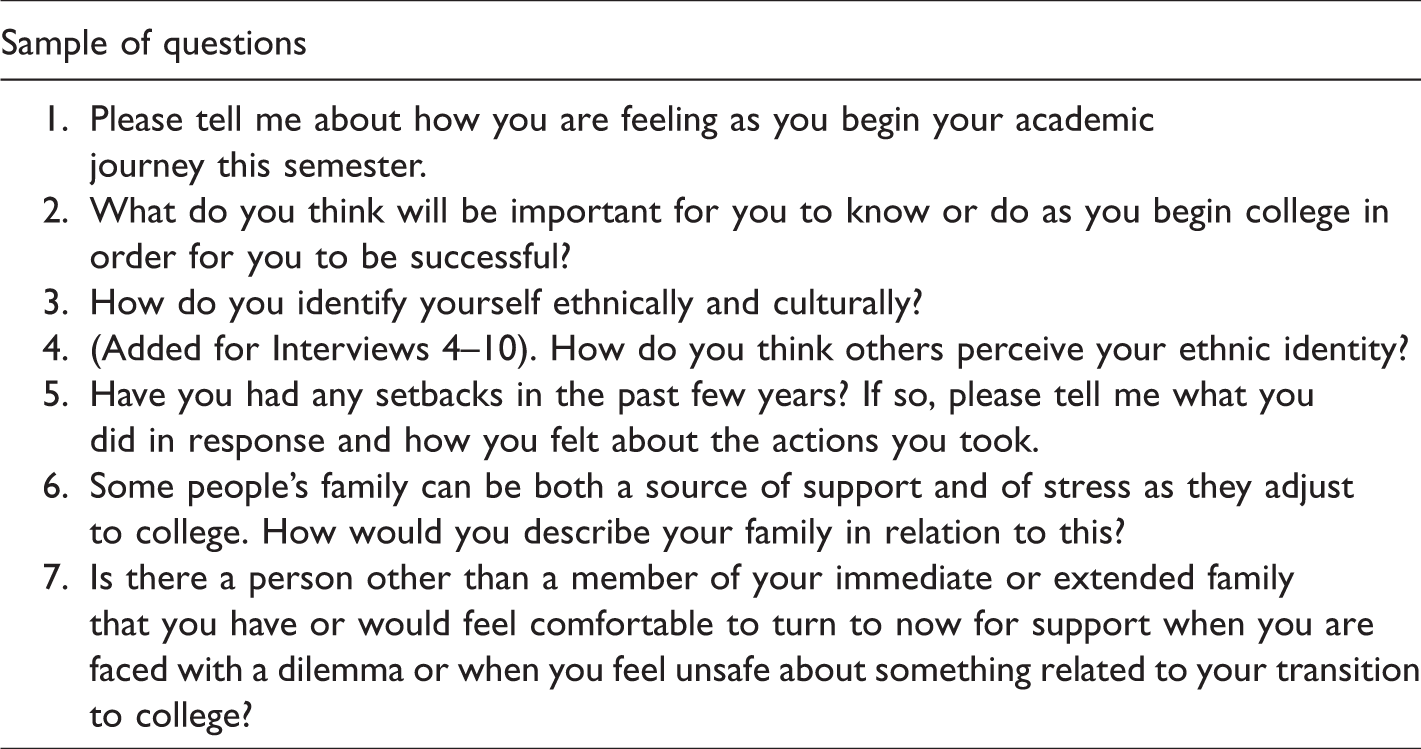
Based on this analysis, the research team decided to keep the content and structure of the existing questions intact and add one additional question based on participants’ suggestions. Table 2 lists the primary questions from the semistructured interview protocol and notes the added question (No. 4) for Interviews 4 to 10. To contextualize and negotiate each interview (Charmaz, 2006), the primary investigator shared with participants how his own identification as Native American motivated his interest in this topic. During the interview, probing questions such as “That sounds really creative, what is another instance where you did that?” were utilized in the moment to obtain more detail and provide for further reflection by participants (Charmaz, 2006). At the end of each interview, participants were encouraged to share their reactions to and provide feedback on the questions.
Semistructured Interview Protocol.
Procedure
Guided by Corbin and Strauss’s (2008) approach to grounded theory, the research team completed transcription, coding, and analysis of the interview data. The initial process involved analytic triangulation (Patton, 2002), in which team members first worked individually, listening to the audio recordings while reading the transcripts to identify interview segments they deemed relevant, noting the transcript line numbers and their reactions to the material. The team then met weekly to review independent ratings, relisten to audio segments, and reach agreement on code labels for meaningful data. After analysis of the first three interviews, the team identified codes that could be merged into higher order categories, while concurrently completing open code analyses of Interviews 4 to 10. Team members shared their interpretations of the interview data and discussed differences in interpretation in order to reach consensus on coding labels for the data. Following individual and group analysis of all 10 interviews, open codes were reviewed and revised as needed, and renamed if indicated by team consensus.
Next, the team engaged in axial coding of the open codes by constructing a timeline as suggested by Corbin and Strauss (2008). The dimensions of this timeline include (a) antecedents, (b) phenomenon, (c) context, (d) facilitating intervening conditions, (e) hindering intervening conditions, (f) action strategies, (g) interaction strategies, and (h) consequences. Busby’s (2009) approach to situating open codes within developmental categories (i.e., context, process, conditions, and consequences) provided an additional framework for data analyses. Finally, team members developed selective code labels to represent the emergent data.
The research team engaged in multiple procedures to enhance the trustworthiness and credibility of the data analyses process (Morrow, 2007). As aforementioned, each research team member wrote a reflexivity statement before analyses began. In addition, members wrote individual weekly memos following the procedure recommended by Corbin and Strauss (2008). The memos became the basis for ongoing discussions of issues related to potential team member bias in analyses and also guided construction and summarization of the findings. Themes and subthemes were established after the first eight interviews. After no new themes emerged, two additional interviews were conducted as a data saturation check. Finally, a provisional description of results was forwarded to each of the participants. Every participant was provided with their individual pseudonym and asked to approve quoted material; 5 of the 10 participants responded. The responding participants affirmed the accuracy of the research teams’ interpretation of the data.
Results
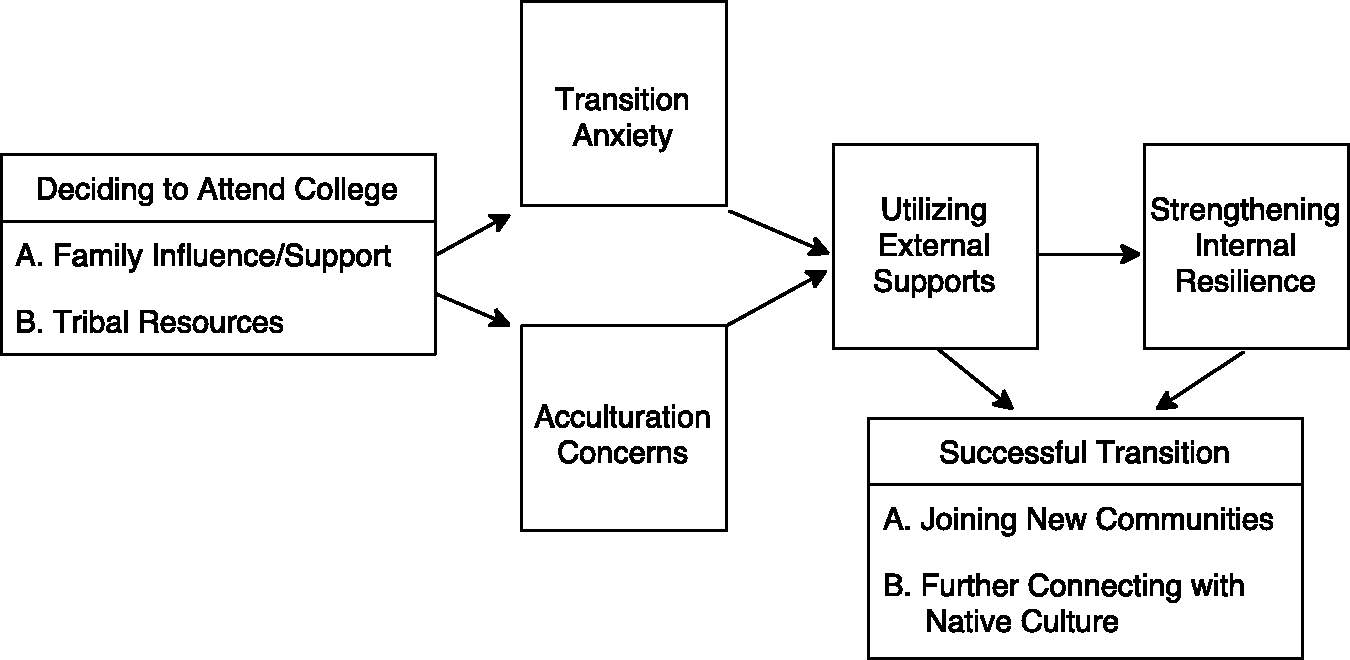
The purpose of the present study was to apply a grounded theory research approach to develop a model incorporating the challenges and coping resources for Native American college students in their transition to college. Figure 1 shows the model suggested by our interviews. Each box of the figure represents the six major themes that emerged from coding the data. Arrows depict proposed causal influences.
Theory of transition.
Deciding to Attend College: Family Influences or Support and Tribal Resources
The first box in Figure 1 represents the role of family and tribe in participants’ decisions to attend college. All participants grew up in families where they were socialized by parents to view higher education as expected and necessary. Therefore, we considered family influence to be crucial in participants’ educational decision-making. For example, Frank reported: I've learned, from a very young age to absolutely love knowledge … , as far as education goes, they [family] certainly stressed the importance of going to college not only from a standpoint of being able to achieve more in life … but also simply for knowledge’s sake.
Many participants who were registered tribal members described tangible resources that contributed to their decisions to attend college, including college preparation advising at tribal high schools, college application and tuition waivers, laptop computers, and monthly allowances for living expenses. Ignacio, who was not yet registered with his tribe, illustrated how his plans to become a registered member could provide for him not only a stronger connection to his Native culture but also the possibility for financial support: Honestly, being able to call yourself Native American is—I mean it’s kind of special ‘cause not many people know which tribe, or can't directly trace it back like I can. I think it's beneficial to be able to actually trace it back specifically, and like register with your tribe, there's benefits there within the tribe like [specific native tribe] has several benefits especially for college students… there's scholarship opportunities, especially for graduate school, and I don't know – I haven't looked into it a whole lot, like I said I haven't been officially registered yet, but within my family, my cousins and all of them have, so they've been able to benefit from it a lot.
Transition Anxiety
Participants’ decisions to attend college led to two types of anxiety, the first was a general anxiety about the transition to college process, and the second related to concerns over how others would perceive their ethnic identity and subsequently treat them. This theme of anxiety is represented by the next two boxes of Figure 1. The theme of transition anxiety was present among all participants, which suggests that this is a very common element in the transition to college for these individuals. Transition anxiety included concerns over how to adapt to the university’s vast physical size, such as Eduardo’s description of the transition as “a big step going from high school to a campus of this size.” Another concern related to the large number of other students in their courses. Jasmine shared that she “was worried about that since I’ve never had to cope with that, like I’ve always had really small classes and I didn’t know how I would transition.” Additional concerns related to difficulty understanding social norms and expectations, and overall campus climate. Candia captured this sentiment: I have a couple of really big lecture hall classes. That was one of the things that frightened me the most whenever I thought about coming here. I was like, ‘Oh, my Gosh I'm going to be in a giant lecture hall and I'm not going to understand what's going on. There's going to be so many people and the teacher's not going to have time to answer my questions.’
Acculturation Concerns
Participants also expressed concern over how others might respond to their ethnic identity. Six of the participants described encounters prior to college in which gross misunderstanding that others demonstrated for their culture caused our interviewee to feel frustrated, misunderstood, and compelled to explain basic features of their experience to others in order to be properly understood. Jasmine, who grew up on a reservation prior to college, described a typical example: I never realized how big of a deal it was until I like go out of the reservation and people have no clue like, about Indians … and some of the questions are horrible. They're crazy like, “Oh, do they know that you left the reservation? Are they mad?” I'm like, “No! We can leave! It's ok!” Just people don't know that much about Indians, so it's kind of crazy. [Native American identity] gives me a unique viewpoint on certain things, … someone who isn't well acquainted with people of my ethnicity would look to me and see me as a model … look at me and say, “Oh, well they're nice people, they're wonderful people!”, cause I'm wonderful! [laughs] So I would like to say that it makes me a model.
Utilizing External Supports
Figure 1 shows that participants first turned to external sources of support as one of two primary coping strategies for responding to anxiety over college. External in this case means seeking support from relationships. In the first weeks on campus, participants sought support primarily from familiar others outside the campus environment. These sources of support included parents, siblings, extended relatives, precollege friends, romantic partners, tribal and community members, and church members. Frank descried his experience this way: Generally, I’ve turned to my [pre-college] friends and my family if I need help on something … and I haven't developed any strong relationships with many of the staff here at [the university], so … my friends and family are pretty much what I turn to.
Strengthening Internal Resilience
The second general set of coping strategies participants reported, in addition to seeking social support, was to draw upon internal sources of resilience when faced with challenges. This ability to draw upon inner coping strategies was reported as particularly useful in the weeks immediately after the initial shock of one’s transition. For those who enjoyed external support, inner coping was described as a valued additional resource rather than a replacement for external relationships. Two participants, Desiree and A-ris, both came to college as student athletes and experienced setbacks related to team membership during their first month of college. After seeking guidance from others, both Desiree and A-ris drew upon inner strength to determine how to move forward. A-ris described: I worked hard to be able to, to pass [the physical fitness requirement] and so failing it was [long pause] disappointing. However, I think I took it well, First, I met with the people in charge and … thought about what I needed to do, and … developed my own plan in response. I've worked harder to ensure that I pass that next time.
Successful Transition
The final box in Figure 1 is the product of participants’ newfound ability to manage transition anxiety through use of both external and internal resources. All participants in our study described their transition as having been generally successful, although certainly incomplete. They attributed two interrelated accomplishments as contributing to the success they had enjoyed so far: joining new communities and establishing stronger connections to Native American culture. After adjusting to the first 6 to 8 weeks of college, many participants became more involved in a variety of activities. One individual joined the Native American Student Association, another the ROTC military cadet program, while a third joined an outdoor club, a fourth became a member of a student success program, and a fifth pledged a fraternity. Other participants made connections off-campus that provided a sense of community. One participant, a single parent, connected with new off-campus neighbors, while another began to volunteer with the local firefighters’ association, and another joined a local church congregation.
Participants also spoke about a reinvigoration of interest in connecting with their Native American heritage. Several students we interviewed engaged in greater participation with their tribes, joined the campus Native American Student Association, or sought out other Native American students on campus as important ways to further explore their cultural heritage. Eduardo reflected on his initial thoughts as he began the semester, “I remember thinking … if I had more Native American blood or I guess, knew other Native Americans, I would … I would participate in more you know, cultural activities.” Through the transition to college, he described the development of a greater desire to learn more about his Native American identity and reported plans to become a registered member of his tribe during his next trip home.
Georgina, who began reattending family Pow Wows around the time of our interview, described the importance of reconnecting with extended family, including aunts, uncles, and cousins through involvement in the Pow Wows. She elaborated on the role this experience has had in shaping her desire to integrate her Native American heritage in raising her future family: [It’s] very cool to see it again [tribal Pow Wow] as like as being older and like kind of understanding more … It means a lot to me [Native heritage]. It's something, I think it's important and like I would definitely want my children to know what factors kind of contributed to me. I mean, it's important. And I think it's important just to be aware of what it is and definitely know it.
Discussion
Interviews with these Native American-identified students suggested a model that describes their transition to college in the first 6 to 8 weeks of the first semester. This is a critical timeframe, given Levitz and Noel’s (1989) findings that identified the first 2 to 6 weeks of college as crucial in determining whether students will persist or dropout due to feelings of homesickness, lack of connection, and stress of coursework. Thompson, Johnson-Jennings, and Nitzarim (2013) in their study of persistence intentions for Native American undergraduate students highlighted coping skills, fitting in with the academic community, and establishing community connections as important for retention. Congruent with Thompson et al.’s (2013) findings, participants in the current study established helpful new connections on campus and identified internal coping methods as important in adjusting to their new environment. These actions enabled participants to establish themselves as members of their university. The resulting sense of belonging helped to lessen their transition anxiety and ultimately led to their resolve to further connect with the campus, the nearby community, and with their Native heritage.
Participants in the current study viewed their parents as sources of encouragement to attend college, as well as support during the transition. This finding was in contrast to findings of prior research by Vermillion (2012) and Warne (2006) suggesting Native parents in reservation communities often do not encourage their children to attend college, perhaps due to the lasting impact of historical oppression and socioeconomic challenges. In another study by Lee, Donlan, and Brown (2010), participants described family obligation as the factor that would most likely lead them to stop out of college. Participants in the current study did not describe any concerns related to family obligations but did discuss attending college as an expectation and necessity based on the messages they received from their parents. To make sense of the differences between our findings and the prior studies, it is important to note that only one of the participants in the current study grew up exclusively on a reservation prior to college, and all participants disclosed having parents who either graduated from college or were currently enrolled.
Our findings are more consistent with Crosby’s (2011) qualitative study, in which Native American participants described family support as the single most important factor in their academic success. Other research on family support for students of color in college highlights similar findings. In a study of Latino men in college, Cerezo, Lyda, Beristianos, Enriques, and Connor (2013) found that family role models who paved the way for success through education were of great importance to those individuals’ success. Similarly, Herndon and Hirt (2004) found that family provided continued emotional, social, moral, and financial support for Black college students. Harris and Wood (2013) reviewed literature on student success for African American and Latino men in college and reported that family members were important influences in the success of these men of color. In line with these findings, it makes sense that many of our participants initially turned to family for comfort, support, and guidance.
When participants in the current study became more comfortable with the university, and with expectations of professors and peers, they began to rely less on prior relationships for support. Instead, they took greater initiative to seek out academic support from faculty, staff, and classmates. Crosby (2011) found that both interactions with faculty outside of the classroom and involvement in campus organizations were important in helping Native American students feel connected to their school. Lundberg and Lowe (2016) assert that faculty who are approachable and supportive contribute to student learning for Native American individuals. Goforth, Brown, Machek, and Swaney (2016) described the important role faculty mentors can play in the retention of Native American graduate students. Related to these findings, participants in the current study discussed the benefits of feeling warmly welcomed by approachable professors and teaching assistants. They described feeling able to seek out these individuals not only for comprehension of course content but also to learn more about the major and potential career paths. In addition, participants learned that they could approach staff in student services departments and peers in the residence halls as needed.
Another important part of the transition to college was participants’ relationship with their Native American heritage. Having a strong sense of one’s ethnic identity is important in adapting to college, connecting with others, and succeeding academically (Aguinaga, Gloria, & Worthington, 2015; Chun, Marin, Schwartz, Pham, & Castro-Olivo, 2016). When Native American students lack knowledge of their cultural traditions and values, they may be less certain of their ethnic identities (Mihesuah, 2004). Native Americans are often mistaken for members of other ethnic groups, and sometimes feel pressured to assertively claim a particular ethnic identity (Ortiz & Santos, 2009), which can also impact their connection to and association with their heritage. Of the 10 participants in this study, only 2 claimed sole Native American ethnic identity. One of these individuals believed others saw her as Native, while the other described regularly getting mistaken as Latina. When we asked the remaining eight participants how they believe others saw them, responses included: Mixed, White, Black, Multiracial, and uncertain.
Finding a label that fits can be very difficult for students of color (Comas-Diaz, 2001). Yet, to be successful, it is important to determine where they fit in within the larger campus community (Mcalpin, 2008; Watson, 2009). Many students of color must become biculturally competent in order to successfully navigate interactions with faculty, staff, and peers of the dominant culture on campus (David, Okazaki, & Saw, 2009; Wei et al., 2010). For example, in a mixed sample of Asian American, African American, and Latin American undergraduates, at a PWI, Wei et al. (2010) found that bicultural competence acted as a buffer to lessen the impact of minority stress on depression. In that study, knowledge of one’s own culture, together with strong social networks in both the heritage culture and White culture were the most helpful components of bicultural competence.
Related to studies of bicultural competence, participants in the current study described initial anxiety over how they would be treated at a PWI based on their identification as Native American. Unique to the experience of many Native students, they also expressed concern over whether others on campus would perceive and accept them as members of the Native American community. It is important to note that all participants maintained identification as Native American throughout the process, from selecting this option on their college admissions application through choosing to participate in this study, and at the end of the transition. Thus, it was important for participants to claim this identify even though it caused initial anxiety over how they might be seen and treated by others.
Numerous studies have identified campus support systems as vital in the retention of students of color in college (Goforth et al., 2016; Palmer, Maramba, & Dancy, 2011; Patterson, Butler-Barnes, & Van Zile-Tamsen, 2017). As a consequence of their transition to college, some participants in the current study became involved in ethnic organizations such as the Minority Achievement Program and the Native American Student Association. They described these resources as integral to becoming more connected on campus. Participating in activities with students who share common characteristics and interests has been found to lead to greater academic success (Patterson et al., 2017).
This also aligns with research by Cerezo et al. (2013) that suggests the important role of a campus family in the success of Latino men in college. Participants in that study identified ethnic organizations and multiethnic fraternities as beneficial. In our study, Eduardo illustrated this finding as a Native student. He actively sought out organizations that would help connect him with other Native American students. He reported that by getting involved in different ways, he began to feel more connected to campus and to his Native American culture. A highlight of Eduardo’s journey was his resolve to become a registered member of his family’s tribe after the end of his first semester in college. As Chun et al. (2016) suggests, low-acculturative stress and strong ethnic identity increase an individual’s sense of belonging and ultimately lead to greater academic self-efficacy. Through the steps they took to connect with the campus and with their ethnic heritage, Eduardo and the other participants were laying the framework for their academic achievement and persistence through graduation.
Limitations
A number of important limitations should be recognized in this study. Our participants all self-identified as Native American. However, all but two of the individuals also identified with other cultural groups. As many pointed out, this likely impacted how they viewed themselves as Native American individuals, their decisions to attend college, and their perceptions about what to expect when beginning college at a PWI. Second, we only investigated transition to a PWI without consideration for other types of college institutions (e.g., tribal colleges, community and junior colleges, non-PWI universities, HBCUs, Hispanic-Serving Institutions, private schools, and so on). Third, every student who volunteered for our study had the resource of family members with at least some college experience. Thus, we also did not capture the transition experience for first-generation Native American-identified students. Self-selection bias in our participants may have also influenced these findings. Individuals who did not persist after the initial 6 to 8 weeks of college were not included in this study, and those who were most at risk for not persisting may have decided not to participate. The 10 individuals who did participate may have represented those among the most successful at coping with the transition to college.
We presented the idea that a change happens for individuals in which they shift from a focus on prior relationships to new individuals on campus and eventually resolve to also turn inward as appropriate when managing obstacles. We described a reduction in anxiety that seemed to occur as a part of this process and likened it to the establishment of resilience. Because our research methodology did not involve a quantitative measurement of anxiety, detail on the specific type of anxiety and level of anxiety reduction cannot be surmised. We hope our findings will encourage future studies that investigate the relationship between transition anxiety and resilience in greater detail.
A final limitation stems from potential biases of our own values and life experiences that shaped the lenses through which we viewed the data. To account for this, as a research team, we reflected regularly on our own ethnic identification and transition to college experiences as such factors would likely influence our interpretation of the data. We also engaged in examining our biases by writing weekly reflections after analyzing data and by discussing as a group any concerns that arose during each part of the data analysis process. Although our biases may still have shaped our interpretation of data, we rigorously adhered to this process with great care in order to respect and honor the voices and stories of these individuals as best we could.
Implications and Conclusions
While relatively sparse, some prior studies have explored the academic experience for Native American college students. Those most related to the current study include Crosby’s (2011) qualitative study of factors that affect college success for Native college graduates, Jackson et al.’s (2003) qualitative study of persistence among Native college seniors who grew up on reservations, and Thompson et al.’s (2013) quantitative exploration of persistence intentions for Native students in various stages of their undergraduate career. Such studies have mainly considered the perspectives of individuals at or near the end of their undergraduate career. To contribute the voices of Native students during their transition to college process, the current study focused exclusively on participants in the first 6 to 8 weeks of their college career.
Through this study, we have suggested not only a process of transition to college for Native American-identified individuals but also a journey toward deeper connection with this ethnic identity through personal exploration, tribal membership, and campus involvement. This highlights an important relationship between a successful college transition and the maintenance of a positive attachment to one’s Native heritage. The findings also support the importance of proactive intervention by campus agents early on in the first semester of college for Native students.
Certainly, these results need to be confirmed with further research, but it is possible to offer some tentative implications of these findings. Because counseling centers are equipped to assist students in dealing with issues including managing anxiety and acculturation difficulties, they are well positioned to address student retention problems. In the first few weeks of college, staff psychologists can provide outreach efforts to help Native American-identified students to better cope with transition anxiety. Perhaps students will more quickly move toward making new connections and relying on their own strengths if they are informed about and obtain the mental health support they need in order to feel more comfortable on campus as they begin the process of adjusting to college.
Student affairs professionals (e.g., outreach and orientation leaders, residence hall advisors, peer mentors, tutors, academic advisors, and other campus agents) should develop services that help students to make initial important connections as they begin college. Services can include workshops on effective interaction in large class settings, and how to approach professors and teaching assistants in-and-out of the classroom. Such workshops may be most effective if they are targeted to incoming students in the first few weeks of the semester, be interactive, ongoing, and specialized for different interest in majors. There can be solidarity in going through the same experiences with others. Student affairs professionals might also consider holding an open house during the first week of classes where a variety of major, ethnic group, special interest, and other clubs and organizations can introduce themselves to incoming students. Campus agents can encourage students to attend this open house and explore clubs or organizations they might not know exist.
During the participants’ first semester of college, faculty seemed to hold a critical role in assisting with the transition to college process. Therefore, professors and teaching assistants who work with first-year students should consider the importance of maintaining regular office hours, reaching out to Native American students, and students of color in general, holding study sessions, and taking a supportive interest in students. In addition, through first-year experience classes or related workshops, instructors can introduce students to starting dialogues about race and culture, including the meaning of one’s culture, and the value of connecting with one’s heritage during life in college. These topics should be introduced very early in the few weeks as natural and meaningful. Perhaps current Native students can provide testimonials of the importance of this process in their own ethnic identify development and academic advancement. Prior research on structured peer mentoring programs for Native American students supports this approach (Jackson et al., 2003; Shotten, Oosahwe, & Cintron, 2007). This can motivate incoming Native students who might be hesitant to open up about their culture to embrace and proudly reflect who they are early on in their first semester.
Staff psychologists, student affairs professionals and paraprofessionals, and faculty and teaching assistants play a vital role in helping students evaluate the contexts, risks, and benefits of determining how to self-identify and affiliate oneself in college. At each stage in this transition to college process, or journey of self-discovery, the aforementioned campus agents may also need to help students to renegotiate relationships with parents, extended family, siblings, and friends in their home community as the students’ identities and labels evolve. These suggestions are congruent with a growing body of research pointing to the importance of bicultural competence and may help individuals to further embrace their Native as well as other identities, which is a critical part of belonging to campus and persisting through graduation.
Although suggestions similar to those we offer here have been made for improving undergraduate student retention for many populations of students of color, Native-identified students are unique in ways that require independent substantiation of these common understandings. For example, many Native American-identified students face barriers not experienced by other students of color in finding information about their cultural traditions due to a paucity of readily available written materials and lack of accessible cultural elders. Native-identified undergraduates have not been studied as frequently as other students of color. This study helps address that gap.
Finally, and perhaps most importantly, our findings point to the crucial importance of helping students find some early point of connection and community on campus. The most beneficial connections may ultimately involve their Native American identity, but as the participants in this study showed, this was the outcome of a larger transition process. Our findings suggest that making meaningful early connections with communities that feel familiar and safe is most important. We hope these findings stimulate further research on the perceptions of Native American-identified students as they transition to college at various types of institutions. As social justice advocates, we are proud to have had this opportunity to share this unique but relatable story of transition, identity development, and connection.
Footnotes
Declaration of Conflicting Interests
The authors declared no potential conflicts of interest with respect to the research, authorship, and/or publication of this article.
Funding
The authors received no financial support for the research, authorship, and/or publication of this article.