



Abstract
A recent increased focus is being placed on college completion agendas, yet there is limited research on senior attrition. Examining why students leave school when they are so close to being done and what motivated them to return when they did, this exploratory case study analyzes several data sets at one public university where a degree completion program was established to help undergraduate seniors return and graduate. Analyzing data from several sources found that the predominant reason why seniors left was for personal reasons and that intrinsic motivation best describes why they wanted to finish their degree. Barriers to graduation and future research are also discussed.
Keywords
As colleges and universities increasingly struggle with lower registration numbers (National Student Clearinghouse Research Center, 2017), institutions are looking for alternative ways to strengthen enrollment, most often through enhanced efforts for retention and persistence of current students but also through degree completion initiatives. Most of the literature on retention and persistence focuses on first-year students and sophomores (e.g., see a comprehensive list of references in Pascarella & Terenzini, 2005). Drake (2011) summarized over 40 years of research in this area, pointing to three critical elements related to student retention and persistence: the value of connecting students early on to the institution through learning support systems …, first-year programming …, and solid academic advising, with advising positioned squarely as the vital link in this retention equation. (p. 9)
One such degree completion program, Come Back to School (CBS; a pseudonym), was established in Summer 2014 at one of three public 4-year universities in Hawaiʻi. The program is designed to support undergraduate students who stopped out during their senior year with finishing their bachelor’s degree. To be eligible for the program, individuals must have senior standing (90+ credits), have a 2.0 grade point average (GPA) or greater, and have not been enrolled for at least two semesters. The limited information available on senior attrition, described later, leaves a significant gap in the literature. Working with students participating in this program provided an excellent opportunity for an exploratory case study to examine the following research questions:
Why do undergraduate seniors leave college when they are so close to being done? Why do undergraduate seniors who stopped out of college return?
Literature Review
A national movement of college completion agendas started appearing around 2008 at the beginning of the Obama presidency. A variety of organizations from businesses to governments and higher education institutions started working toward the common goal of increasing “the number of adults in the United States who have earned a postsecondary credential” (Russell, 2011, p. 1). Numerous initiatives, some funded by major foundations, began taking different approaches to help students graduate with degrees and certificates. For example, the Adult College Completion Network, facilitated by the Western Interstate Commission for Higher Education (WICHE), aims to bring together organizations and agencies that can share ideas on ways to help adults graduate who have prior college credits (“Adult College Completion Network,” n.d.). Project Win-Win focused solely on associate’s degree-granting institutions—60 schools in nine states—and took a two-pronged approach. Participating institutions were asked to identify and award degrees to former students who qualified for but never received their degrees, and they were asked to identify former students who were close to graduating and attempt to bring them back to finish their degrees (Adelman, 2013). Alternatively, the National Coalition for College Completion, sponsored by the Institute for Higher Education Policy, represents businesses and organizations outside of higher education and strives for nonpartisan advocacy of programs and policies supporting college completion (Russell, 2011). At the institutional level, university system-wide programs and even a few individual programs at specific universities across the United States have established degree completion programs. The scope of initiatives ranges from sharing ideas, exploring the K-12 pipeline into college, advocating for policies and funding at local and national levels, and individually assisting students to graduate from postsecondary institutions.
Assisting undergraduate seniors to return and graduate from college is better understood by examining why students leave when they are so close to finishing their degree; however, very limited research exists on senior attrition. Of the four articles written on senior attrition, the predominant finding in the literature is that different indicators exist for students who are early drop outs versus those who drop out later in their academic careers. Several key predictors of senior attrition were identified in the literature. Students’ perception of demanding learning conditions with insufficient support was one of the earliest reasons found as to why seniors leave college (Neumann & Finaly-Neumann, 1989). In the second article published, Mohr, Eiche, and Sedlacek (1998) suggested that “nonretention of seniors was best predicted by dissatisfaction with academic guidance, dissatisfaction with access to school-related information, and dissatisfaction with quality of education, as well as by feelings of institutional alienation” (p. 343). Their study also found that the top six reasons for seniors leaving college were (a) economic factors, (b) transferred to another school, (c) academic difficulties, (d) family responsibilities, (e) personal problems, and (f) poor advising or teaching. Hunt, Boyd, Gast, Mitchell, and Wilson (2012) found “significant competing priorities for students’ energy, time, and attention” (p. 741). Several primary factors they cited as contributing to seniors stopping out include family expectations being a source of pressure, needing to work off campus, and anticipated or received grades. Ma and Cragg (2012) identified potential factors that impact students dropping out later in their college career include being male (although their National Student Clearinghouse follow-up data contradicted this by finding a 46% male attrition rate), being an in-state resident, having a high school GPA ≤ 2.5, majoring in science or nursing, and not receiving merit aid in their first year of college. Ma and Cragg believe late dropouts deserve more attention and go on to say that better understanding this population may lead to improved retention and graduation rates, helping to meet accountability demands by governing or legislative bodies. “From an economic perspective, dropping out late is costly for both the institution and the student … Preventing late dropout and even enabling late leavers to come back and complete their studies may be worthwhile endeavors” (pp. 545–546). Further exploration of this topic is warranted, and the CBS degree completion program at a public university in Hawaiʻi provided the opportunity for an exploratory case study.
Data Collection and Analysis
Data regarding students who stopped out of the university in their senior year are derived from several sources: the student information system (SIS), the CBS intake interview, and two surveys. SIS is the largest data source in looking for students who stopped out. Extracting information from institutional student records provided data sets in order to reach out to former students. The CBS advisor conducts informal, semistructured interviews during the initial conversation with students interested in returning to school. The university administered a Leavers’ Survey in Fall 2012 to 2,263 undergraduate students enrolled in the 2011–2012 academic year who did not graduate or reenroll in Fall 2012. Finally, in Summer 2016, a similar survey was administered to CBS students with whom communication had occurred. The 2016 CBS Survey was modeled after the 2012 Leavers’ Survey and both are discussed in greater detail below. Note that the 2016 CBS Survey respondents are predominantly a subset of the Fall 2014 and Fall 2015 outreach data sets from SIS, and the intake interview responses include overlap with the 2016 CBS Survey respondents and all three outreach data sets included in this study. After obtaining institutional review board approval, all of these data were analyzed in relation to one another and in the context of relevant literature.
Student Information System Data
Data are extracted from the SIS in order to conduct outreach on a planned annual basis. The search criteria used to pull data following the last day to add courses look for students who were enrolled at the university at some point since Fall 2006 but stopped out for at least the last two semesters (e.g., for Fall 2016 outreach students were enrolled at any time between Fall 2006 and Fall 2015), earned 90+ credits (senior standing), and have a cumulative GPA of 2.0 or greater. Beyond basic directory and demographic information, additional data pulled from SIS include cumulative credits, GPA, last term attended, last major and academic college, degree status, academic standing, hold codes, financial obligation amounts, student attribute codes, institutional credits, transfer credits, and percentage of completion in four categories (overall, graduation requirements, general education, and major). To date, outreach has been conducted in Fall 2014, Fall 2015, and Spring 2017.
The data set is then reduced based on external and internal factors. The external factors include having been registered at the university via another system school (the university with this program is not their primary institution), being deceased, being classified as international, having received a bachelor’s degree or higher at any institution (per the National Student Clearinghouse database), and being currently enrolled elsewhere in a bachelor’s degree or higher program (per the National Student Clearinghouse database). The internal factors are based on students meeting certain predetermined criteria using information pulled from SIS. These internal factors that removed students from the outreach data set include being on an approved leave of absence in the previous two semesters, having certain holds on their record (e.g., financial obligation above a certain amount), having been suspended or dismissed (bad academic standing), and not having completed 10+ credits at the university. Attempted outreach efforts to date have been made to 1,962 former students.
Intake Interviews
The CBS advisor conducts informal, semistructured interviews with students when they reach out requesting more information about the CBS program and expressing interest in returning to finish their degree. From Fall 2014 through Summer 2018, the CBS advisor has been in communication with 428 former students who meet program eligibility requirements, which includes individuals responding to the attempted outreach efforts as well as those who were referred to the program or found the program’s website and contacted the advisor. The discussion ultimately is about their current academic interests, what they still need in order to graduate, and how the university can help them reach their goal of earning a bachelor’s degree. The conversation, however, will often include why they left college when they were so close to finishing and whether those reasons still exist as challenges for returning to school. Some students openly discussed why they left and why they wanted to return, but if they did not and the opportunity arose during the conversation, those questions were asked as part of the intake interview. New challenges such as finances and family and work commitments are also discussed. If a student is not able to attend classes on campus during the weekday because they work or moved away, other challenges may be discussed such as whether or not students have taken online courses before and how they differ from face-to-face instruction. The shift away from evening and weekend classes to online education provides them the benefit of greater flexibility in taking courses but also requires excellent time management. Notes were taken of student responses between Summer 2014 and July 2017, providing insight as to why some individuals left (n = 134) and why some returned (n = 62). Why they left and why they want to return do not always come up in the conversation, and the questions are not forced if they do not organically emerge.
2012 Leavers’ Survey
The goal of the Leavers’ Survey, administered in Fall 2012 by the university, was to identify reasons why students left and significant issues they associated with barriers to their academic success. Administered to all undergraduate students who stopped out in Fall 2012, this survey was a longitudinal comparison to the first survey administered in Fall 2006 but only to first-time freshmen and transfer students who did not return. The Fall 2012 survey divided a list of reasons for leaving into four overarching categories: academic, financial, campus support services, and personal. Students were able to indicate whether a listed reason was a major factor, a minor factor, or not applicable in their leaving the institution. Because this paper survey was mailed to students, they were able to see all of the questions and possible reasons for why they left. In examining the survey’s raw data of the 695 who responded, senior responses (n = 76) were separated out and examined as part of this larger data analysis.
2016 CBS Survey
The CBS program conducted a survey of program participants and all former students eligible to participate in the program with whom communication had been established between Summer 2014, when the program was founded, and Spring 2016. The survey was administered electronically in July–August 2016. The goal of the survey was to identify reasons why students left the institution in their senior year (90+ credits), to explore why they decided to return, and to conduct a program evaluation. The results are being used to inform ongoing efforts to help stopped out undergraduate seniors to return and graduate as well as to inform the larger campus community and the field of higher education about key issues identified by students as barriers to their success and ways to help them complete their degree.
The data set included 206 individuals. Only 190 had valid e-mail addresses to receive the request to complete the online survey, but there is no way of knowing if they still checked those accounts. A total of 63 people responded, yielding a 33% response rate. Note that the survey incorporated skip logic so that certain questions were not asked, resulting in a lower number of responses to some questions. One person responded that CBS is a “great way to help those that want to finish degrees but do not know where to start. Thank you!” The following information is a brief synopsis of the 2016 CBS Survey.
The 2016 CBS Survey responses of undergraduates who stopped out of college in the senior year indicate the potential long-term challenges non- or posttraditional students may face. The majority (65.5%) of survey respondents were over 30 years old. Fifty-three respondents disclosed how many times they had stopped out of college: 35.8% once, 30.2% twice, and 34% three or more times. A large number of respondents (39.7%) acknowledged that they were the first person in their immediate family to pursue a 4-year degree. A fifth of respondents (20.6%) left the university thinking they had finished all of their degree requirements and graduated, while 14.5% were eligible to graduate without taking any more courses. Looking at basic demographics across the various data sources can provide a clearer picture of certain aspects of this student population.
Demographics
Demographics regarding gender, age, cumulative GPA, and race or ethnicity were compared across the various data sources. The gender of undergraduate students who stop out in their senior year is rather evenly split between female and male. Compared with the Fall 2017, overall undergraduate population at the university, slightly more males stop out than females. The mean age of students in the three outreach data sets, which looks at last enrollment as far back as Fall 2006, is solidly in the non- or posttraditional age range (25+ years), averaging 30.5 to 32.4 years old. Respondents to the 2012 Leavers’ Survey were slightly younger, averaging 26.6 years old, which is not surprising given those individuals were enrolled the academic year preceding the survey. Compared with the mean age of 22 years for the Fall 2017 overall undergraduate population, working with seniors who stopped out of college indicates they will be returning adult learners. The mean cumulative GPA ranges from 2.58 to 2.69, which is an indicator that these students may not receive a merit scholarship. Race or ethnicity was anticipated to be more challenging to analyze because the university identifies students using 28 different codes in SIS. Upon closer examination, however, the institution’s internal race or ethnicity categories also contained cross-listed codes correlating with the broader Integrated Postsecondary Education Data System (IPEDS) groupings. The “nonresident alien” Integrated Postsecondary Education Data System grouping is not included because international students were removed from the CBS outreach data sets as mentioned earlier. The biggest percentage differences in race or ethnicity of seniors who stopped out compared with the undergraduate population as a whole indicate fewer Asians and more White Non-Hispanics stop out in their senior year (Mānoa Institutional Research Office, n.d.). See Table 1 for a breakdown of demographic information.
Demographic Information.
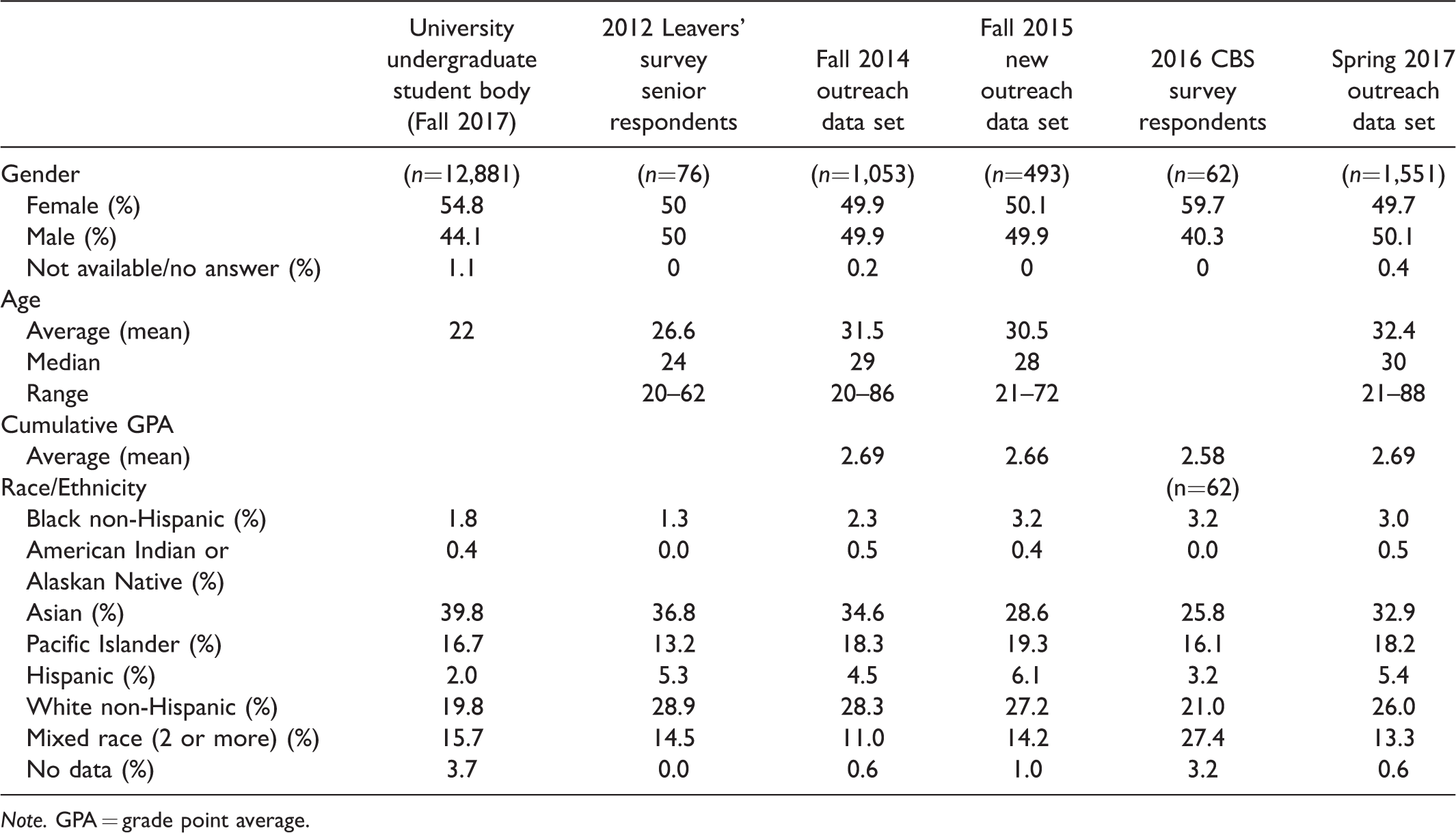
Note. GPA = grade point average.
Why Seniors Left
Looking at the data from the 2012 Leavers’ Survey, CBS intake interviews, and the 2016 CBS Survey, responses were broadly categorized into four areas: personal reasons, financial reasons, academic reasons, and insufficient support services reasons. Multiple contributing factors could be selected, so the percentages do not total 100%. The predominant category for why students left the university in their senior year, according to all three data sets, was personal reasons (58%–76%). The second and third categories vary depending on the data set, ranging from 16% to 56% of respondents indicating financial and academic reasons contributed to them stopping out of school. The least prevalent reason for students leaving college in the senior year is due to insufficient support services on campus. See Table 2 for a breakdown of response percentages in the four different categories by data source.
Reasons Why Seniors Left.
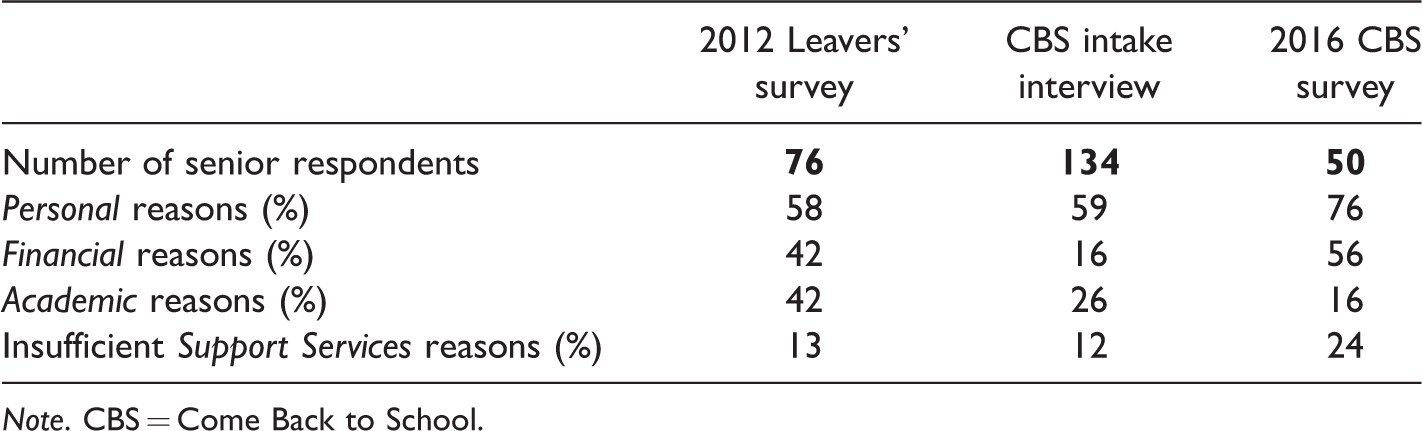
Note. CBS = Come Back to School.
Examining the topmost common reasons in all three data sets provided a better sense of why seniors left in each of the four categories. The main personal reasons include that their family circumstances or responsibilities changed (55.2%, 2016 survey), that they accepted a full-time job (40.5%, 2016 survey), that they wanted to be closer to home (29.5%, 2012 survey), and that they had health concerns (22.7%, 2012 survey). Other varying personal reasons indicated on both surveys include being uncertain about the value of a college degree, having commuting problems, and receiving insufficient family support. Some of the specific personal reasons stated in the 2016 CBS Survey include “left to play for the Olympic … Team,” “I had a child and wanted to be closer to my family,” “daughter had a 5 year battle with cancer and then passed away,” and “botched knee surgery nearly killed me.” The main financial reasons include that they needed to earn money to take care of themselves or family (88.8%, 2016 survey), that the cost of living was too high (50.0%, 2012 survey; 64.0%, 2016 survey), that their student loans were too high (53.1%, 2012 survey), and that tuition and fees were not affordable (40.6%, 2012 survey; 55.5% 2016 survey). One student stated that “not working was not an option,” while another respondent commented, “I was struggling financially and had run out of financial aid.” The main academic reasons include that they earned poor grades (37.5%, 2016 survey), that they did not take enough responsibility for learning (37.5%, 2016 survey), that they did not feel like they could get a job with a degree from this university (22.5%, 2012 survey), and that they were unprepared for college-level work (22.5%, 2012 survey). Having earned poor grades, however, does not really get at the underlying reason for those poor grades, but anecdotal comments during the intake interviews often reflected earning a poor grade for a required course in their last semester of attendance. Also, in thinking about the personal reasons why students left, they may have been trying to come to terms with what was changing in their lives or tried unsuccessfully to “hang in” and finish their remaining coursework. The main reasons related to insufficient support services include inadequate academic advising (81.8%, 2016 survey; 50.5%, 2012 survey), feeling uncared about and viewed as just a “number” (58.3%, 2016 survey), and unhelpful faculty (40.0%, 2012 survey). Other varying reasons related to insufficient support services indicated on both surveys include inadequate career development services, bureaucratic administrative processes, and inadequate parking. A common remark during the intake interviews was that these individuals thought they had graduated. Their comments allude to lack of clarity about graduation requirements, which could indicate insufficient academic advising, but whether the hindrance lays on the student not seeking the advising, the advising not being accessible, or poor advising is unclear. Often students had overlapping reasons for stopping out of school such as finances and family obligations. One student described how working full time made it hard to attend classes plus struggling to find limited parking on campus combined with taking care of everything at home, and they ultimately found it hard to keep focus and burned out. When faced with such competing priorities, school ultimately fell to the bottom of the list.
Why Seniors Return
None of the existing literature explored why these students wanted to return to finish their degree. Although their reasons may seem obvious, trying to better understand why seniors wanted to return and finish their degree may allow for better marketing of degree completion programs and increased recruitment of these students. The CBS intake interview and 2016 CBS Survey responses were examined to gain insight into their reasoning, which fell into one of three categories: intrinsic motivation, career advancement, and financial factors. Intrinsic motivation best describes the majority of responses, indicative by 63% of the intake interview responses grouped as motivational reasons. The top two most common reasons selected on the 2016 survey motivating them to return were too close to being done not to finish (85.4%) and for personal accomplishment (81.8%). Additional reasons include to be a positive role model (49.1%) and to continue learning (57.4% of 2016 survey respondents said this last reason was very important). Career advancement was given as the main reason for returning to school by 27% of the intake interview responses, while 57.4% of the 2016 survey respondents wanted to return to school in order to change careers or get a promotion. Additional examples of career advancement reasons include hoping the degree will open up more opportunities, to be able to “check the box” that they have a bachelor’s degree, or to reenter the workforce. Financial reasons include keeping their job and now being financially able to pay for college. Eight percent of the intake interview responses gave financial reasons for wanting to return to school, while 9.2% of the 2016 survey responses signified that they wanted to finish their degree in order to keep their job. One student stated, “[Not graduating] has been one of my biggest regrets in life.”
Several responses did not easily fit into one of these three overarching categories and are worth discussing. Increasing their potential salary earnings was not mentioned in any of the intake interviews, but 59.2% of the survey respondents said it was a very significant reason. Increasing one’s salary could be a financial reason, or it could be a contributing factor toward career advancement. An open-ended survey response said that family pressure is what led them to consider returning to school, and someone said during the intake interview that they wanted to return because they received the outreach e-mail about the CBS program; otherwise, they “wouldn’t have bothered.” Why students want to return varies, but these data provide some insight as to the main motivational factors. Another student commented, “I am a FIRST generation College Graduate … I come from [a] very poor family … I hope to set a good example to the future generations.”
Barriers to Graduation
Because the CBS advisor assists students in majors all across the university, this is one of the few front-line positions on campus that works directly with students but has a bigger picture view of inconsistencies and challenges they may face. According to the 2016 CBS Survey, the most recent challenges or obstacles to students returning and completing their degree primarily include lack of funds (60.8%) and insufficient time due to working full time (56.7%). The secondary challenges consist of needed classes only being offered during the day and classes only being offered on campus (both 35.3%). These students often are not eligible for financial aid due to working full time and not feeling able to balance more than one course at a time with other life responsibilities. They also are not likely to be eligible for scholarships given that the average GPA in this study ranged from 2.58 to 2.69, and scholarships are often merit based. In addition, they will have an uphill struggle if they are now interested in pursuing graduate school. Based on intake interviews and ongoing conversations with students, challenges include paper-laden, duplicative, inconsistent, and face-to-face campus processes; the later registration window for readmitted students resulting in needed courses filling up by the time they can register; and having to finish the institution-specific degree requirement of Hawaiian or a second language at 202-level proficiency (typically four semesters) after having been away from the language courses for a number of years and not using the language in their daily lives.
An unexpected barrier emerged from the 2016 CBS Survey comments and continues to be supported through ongoing interaction with program participants. Opposite of wanting to return and graduate to be a role model is a deep sense of embarrassment for letting themselves and others down by not graduating. One student commented, “I doubted myself and was ashamed of the financial burden of student loans I had accrued with nothing to show for it.” The feelings of guilt and shame due to a sense of failure may actually prevent former students from even reaching out to the institution about returning. If a student does return but has a minor setback in their academics, these negative feelings can reemerge and cause them to stop out again, ignoring attempts by their advisor to talk with them about the situation. Having worked through these emotions, another student stated, “I now have my degree … after 7 years of absence! The advisor never judged me for taking such a long break and she helped make sure that all the hard work I did was worth it.”
This university’s location can present additional barriers for students. Referring back to some of the reasons why students left in their senior year, the cost of living being too high in Hawaiʻi is a challenge. According to Burrows (2017), Honolulu is the third most expensive U.S. city in which to live in 2017. Although wanting to be closer to home is a challenge many college students face across the country, even many in-state students attending the university wanting to go home for a long weekend must fly to neighboring islands. Students who are not residents of Hawaiʻi have a minimum 5-hour flight to anywhere out of the state. The state of Hawaiʻi consists of multiple islands and is very isolated from the rest of the world, making a trip home costly. All of these barriers and challenges can inhibit students from graduating from the university and potentially from other universities.
Discussion
A number of reasons lead students to stop out of school, and they are motivated by various reasons to return and finish their bachelor’s degree. Based on this study’s analysis, the leading reasons for leaving college in their senior year are categorized as personal reasons, many of which neither the student nor the university can necessarily mitigate in hopes of preventing students from needing to stop out. However, the study also found intrinsic motivation to be the leading factor in a former student returning to finish their degree, and there are ways to support these students on their pathway to graduation.
The findings of this study have certain similarities and differences with the existing literature regarding why students left. Countering Neumann and Finaly-Neumann’s (1989) research, the 2016 CBS Survey only had one response indicating that classes were too difficult, and insufficient support services was the lowest of four categorical reasons why students left based on both surveys and the intake interviews. However, the 2012 Leavers’ Survey indicated students feeling unprepared for college-level work as one of its top two academic reasons for leaving. This is an unexpected sentiment for undergraduate seniors unless they transferred from a community college with an overabundance of credits. Three of the four predictors of nonretention of seniors found by Mohr et al. (1998) were in the insufficient support services reasons category on the 2016 CBS Survey. Their fourth predictor, dissatisfaction with quality of education, had zero students in the 2016 survey indicate that their classes were not challenging enough. Of the top six reasons Mohr et al. (1998) identify for seniors leaving college, only two—family responsibilities and personal problems—were found by this study to fall into the personal reasons category. Significant competing priorities, found by Hunt et al. (2012), were also supported by this study, especially off-campus employment as a considerable factor. The differing reasons for students stopping out in their senior year could be due to the limited research spanning over 25 years. This exploratory study being conducted in Hawaiʻi could also be factor, influenced by varying cultural beliefs found in the islands compared with the continental United States. Additional research including a multi-institutional study in more than one state would enhance the knowledge on such topics.
A surprising finding in this study is the high number of undergraduate students who transferred out of this university in their senior year. As mentioned earlier, the initial student data pulled from SIS were reduced for various reasons, including students having received a bachelor’s degree or higher at any institution and being currently enrolled elsewhere in a bachelor’s degree or higher program. The Spring 2017 outreach data set was run through the National Student Clearinghouse database, and 668 of 2,998 individuals (22.2%) had received a bachelor’s degree or higher from another institution, while 184 (6.1%) were currently enrolled at another 4-year institution. A substantial 28.4% of students with senior standing had transferred to another university to finish their degree. Reaching out to this population to better understand why they left and whether the institution could have done anything differently to assist them in staying warrants consideration.
In examining why students want to return and finish their degree, this study found that undergraduate students who stopped out of school in their senior year for at least two semesters are influenced by intrinsic motivation, career advancement, and financial factors. The main reason students want to earn their bachelor’s degree is due to intrinsic motivation. The internal desire to return and graduate can help them be successful in transitioning schoolwork back into their daily work and family responsibilities and keep them moving forward. Understanding why students want to return can help campuses better support them in this worthy endeavor and provide appropriate encouragement should they begin to struggle with the many responsibilities they are balancing. The reasons why former students decide to return can help the institution in better marketing and recruitment. More significantly, however, these reasons indicate the importance of what students value, which can potentially help them stay focused on their academics, prioritize schoolwork back into their life responsibilities, and ultimately persist to graduation.
The 2016 CBS Survey responses of undergraduates who stopped out of college in the senior year indicate the potential long-term challenges non- or posttraditional students may face and the value that thoughtful, considerate academic advising can play in their success. Respondents to the 2016 survey overwhelmingly agreed that as a result of the CBS advising, they were more aware of their academic pathway options, had a better understanding of their degree requirements, were better able to evaluate their academic progress, were more aware of available resources, and felt more confident about deciding their next steps (agree or strongly agree responses to these questions ranged from 82.5% to 88.9%). One student shared that the CBS advisor “was extremely attentive to my personal academic history and goals. She helped me research all my options and I felt she helped guide me to make the best possible academic decision at this point in my life.” Another 2016 CBS Survey respondent stated that the most beneficial part of the initial advising session was “not feeling alone or lost or that the university no longer cared,” while others stated, “[she] was so supportive and encouraging,” and “she followed up on me regularly making me feel motivated and accountable for getting the assignments and tasks done.” Three quarters of the respondents (75.9%) said that the CBS program played a very significant role in them returning and graduating (15.5% said moderately significant, and 8.6% said not applicable). A graduate stated, “Put it this way … if it wasn’t for this program, I would not have my degree right now.” To summarize, the most common reason indicated for leaving college in the senior year was due to personal reasons, intrinsic motivation is the best way to categorize their reasons for returning to finish their degree, and academic advising plays an important role in helping these students succeed.
Solid academic advising, the third critical element to student retention and persistence Drake (2011) found in her literature review, is also applicable to degree completion programs. Actively reaching out to students who stopped out of college and helping them navigate the system through high-touch advising help these students return and graduate. Using Proactive and Appreciative Advising models (Drake, Jordan, & Miller, 2013) means spending time getting to know the student and their challenges in returning to school as well as their uniqueness and academic interests, proactively monitoring their academic progress and checking in with them, asking open-ended questions, and working with them to cocreate a plan for making their academic dreams a reality. Such positive advising models may be even more critical in light of potential feelings of guilt and shame among this student population. Helping students who cannot attend weekday classes on campus means looking for alternative online options or courses at a college near them and providing a preliminary assessment as to its ability to transfer in as an equivalent course if taken outside the university system. The CBS advisor often provides the ongoing relational connection to the university for students since their friends have all left school. The CBS advisor also helps students complete graduation paperwork, obtains required signatures, and submits the forms to the appropriate office for processing because many students cannot come to campus to fill out and walk these forms around to various offices. These efforts take time and sensitivity on the part of the advisor, but more importantly, they streamline and simplify the process for students to return and graduate, sometimes resolving matters behind the scenes. Providing adequate support makes these students feel valued and not forgotten. One student responding to the 2016 CBS Survey professed, “This program was exactly what I needed … I feared one calculus course would keep me from graduating, from realizing my goals. The [CBS] program helped me.”
Limitations of the Study
Potential limitations of this study are worth considering. The intake interviews are very subjective with regard to the researcher’s interpretations of what the individuals said and how those responses were categorized. Because the respondents were talking with the CBS advisor about the possibility of returning to finish their degree, they may have said what they thought the advisor would want to hear when discussing why they left and why they wanted to return. However, triangulation of data from multiple sources helps to counter this possible limitation. Another limitation of this study is that it was conducted at one university. Even though there are unique challenges given that this university is located in Hawaiʻi, greater insight was gained about this student population with regard to why they left, why they returned, and how to better support them in getting to graduation. The study was exploratory in nature due to the limited literature available, allowing opportunities for additional research. The limited existing literature and the exploratory nature of this study demand additional research.
Future Research
As this type of program is still fairly new and unique, ongoing research needs to be conducted at this institution and beyond. Continuing to collect and analyze data is important, and some of the collected data have yet to be analyzed in different ways, such as cross-tabulating survey responses by demographic categories, including the surprisingly high number of first generation students. Connections made with professional colleagues at other institutions doing similar work have resulted in a collaborative effort to research degree completion programs across institutions. We are in the process of coauthoring articles about such programs (Johnson et al., 2018) and our advising approach to working with seniors who stopped out. We are also designing a multi-institutional study to further examine the subset of first generation adult learners within this population because most first-generation literature focuses on traditionally aged students. Multi-institutional research can corroborate or contradict the broader findings of this exploratory study as well as provide new, deeper findings. Additional research can explore more detailed questions such as what risk factors institutions can reduce that cause students to leave in their senior year, the motivation for students to think about returning to finish their degree, and how they do or do not navigate the challenges in returning to school. Implications for academic advisors working with such student populations may also emerge.
Summary
Very little research has been conducted on undergraduate senior attrition. In this exploratory case study, several data sets at one public university in Hawaiʻi were analyzed to better determine why students stopped out of college when they were so close to being done as well as what motivated them to return when they did. The CBS program, which was established specifically to reach out to and work with this population in an attempt to help them return and graduate, was examined to better understand why they left and why they returned, and it started exploring their challenges and barriers in returning to school. The first four years of this degree completion program resulted in 200 students reengaging with the institution (enrolling or being eligible for degree) and 124 students graduating, but many more of the 1,962 former students to whom outreach efforts were conducted never responded, leaving room for continued growth of the program. The success of CBS and the promise of degree completion programs to increase the number of individuals with postsecondary degrees or credentials prompted the university system office to elevate a similar initiative to all seven community colleges in the system in 2017 and encourage the other two 4-year institutions in the system to think about better serving returning adult students (“UH Targeting Thousands,” 2018).
Although having potentially lower numbers compared with trying to retain first-year undergraduates, this study’s findings indicate a valid option for increasing registration and revenue for the institution and enriching society by advancing more people into the general population with a postsecondary degree. The cost of helping a former student return can be less than recruiting a new first-year student because a connection already exists between the student and the institution and both have already invested time and money into the other (Ma & Cragg, 2012). The gains, however, are not just about the numbers. Several students mentioned having stopped out with negative feelings toward the institution. Advisors taking the time needed to support and encourage these returning students ultimately create more positive impressions by former-students-turned-new-alumni, which can lead to improved personal relations (that may or may not translate into increased donations) and better attitudes about the institution communicated throughout the larger community. The gratitude expressed by students who finally graduate through such a program should not be underestimated. Degree completion programs are worth consideration as a means of increasing enrollment and graduation numbers plus so much more.
Footnotes
Declaration of Conflicting Interests
The author declared no potential conflicts of interest with respect to the research, authorship, and/or publication of this article.
Funding
The author received no financial support for the research, authorship, and/or publication of this article.