




Abstract
This article focuses on how a financial support initiative improved student persistence at an urban commuter institution. Existing research acknowledges that financial concerns of university students may keep them from feeling connected to their institution thereby increasing the likelihood of stopping out. There is less study of how recipients of just-in-timefinancial support make sense of the award—and how those perceptions may help institutions better understand recipients’ sense of belonging. Through an exploratory qualitative research study, we contribute to the retention literature broadly and specifically to the idea of student perceptions of institutional care. We also present guiding principles for creating a successful hardship initiative that supports students financially and emotionally at their most critical time.
Keywords
Introduction
For many years, scholars interested in higher education have investigated topics under the umbrella category of college student retention (cf. Tinto, 2006). Recently, research studies have focused on the persistence of historically underrepresented students (Guiffrida, 2006; Hausmann, Schofield, & Woods, 2007; Rendón, Jalomo, & Nora, 2000; Tierney, 1999, 2000), and members of the Consortium for Student Retention Data Exchange have reported significantly lower retention rates of traditionally underrepresented students confirming that retention is a social justice issue (Seidman, 2005). Further, state governments are increasingly tying the funding of public universities to retention and graduation rates (Hillman, 2016), and the popular press has stated that financial aid debt is on the rise for students who stop-out before earning a degree (Tompor, 2015). This context is the backdrop for current retention initiatives and scholarship that seeks to provide guidance about what worksbest for both students and institutions.
This article contributes to the retention literature by focusing on how student perceptions of institutional commitment to student welfare influences their persistence (Braxton, Hirschy, & McClendon, 2004; Braxton et al., 2013) through an inductive study of a scalable hardship grant funding program, which has successfully addressed issues of financial hardship and has had secondary implications related to student loyalty and commitment to the school. Institutional commitment to student welfare is defined as “a high value placed on students by the institution and an abiding concern for the growth and development of its students” (Braxton et al., 2013, p. 125). Our guiding research question when embarking on this study was how recipients make sense of their hardship funding award and what might this help us understand about persistence.
We share the details of a program built with tuition remissions and designed to support financially struggling students within the business school of a state university. This doctoral granting public university is located in the Pacific Northwest with an undergraduate population of roughly 22,000 students. The university considers itself an access institution, most students view it as a commuter institution, and it is the school of choice for many working adults in the metropolitan area. The average student age at the university is 27 years, and the demographics of the student population are increasingly more students of color and in some departments and schools within the university, White students are no longer in the majority. Although the university is publicly funded, only roughly 11% of the university budget comes from state appropriations while the majority of the remaining cost of running the university is funded via student tuition dollars. The program discussed here was launched in 2015 by the School of Business (SB) within the institution and targets students pursuing their bachelor’s degree.
To provide context, we reviewed the literature on college student persistence, specifically focused on how demonstrable institutional concern for student welfare impacts persistence and students’ sense of belonging. These concepts become the lenses through which we explain how the grant program addresses students stopping-out. Our field research is based on an initiative created to help the most at-risk undergraduate business students to stay enrolled in the program by providing them with financial support. Through qualitative interviews with recipients, we sought to understand how they made sense of their experience of hardship funding through stories that they communicate to themselves and others (Bruner, 1990). These retrospective accounts of sensemaking (Weick, 1993) are helpful for understanding student perceptions of a specific retention program and contribute to our understanding of student welfare and persistence. The findings are related to the effectiveness of this program for increasing persistence and graduation and provide best practices and areas to consider prior to implementing a hardship grant program. Given the changing landscape of higher education funding and the research that articulates how the burden of funding a college education is increasingly placed on students and their families (Goldrick-Rab, 2016), the findings of this study contribute to the study of what works in retention efforts and the provides an understanding of how hardship grant funding programs can both increase persistence and influence student perceptions about their institutions. This study provides outcomes and recommendations for other institutions considering the development of hardship grant programs. We conclude with opportunities for future research.
Literature Review
This section focuses on three interrelated literatures: (a) retention, (b) students’ sense of belonging or community, and (c) students’ financial support related to paying for college.
Retention
Seminal studies on college student retention provided a framework for understanding the issue as one with multiple factors that must be considered, rather than a moral failing on the part of the students who fail to persist. Tinto’s (1975, 1993) body of work shows the influence of student characteristics as well as the degree to which the student integrates into the university. The overall literature highlighted the importance of seeing retention as a complex phenomenon including what students bring with them as they enter their institution (home life and academic ability or preparedness) and student involvement in on-campus activities, connection with faculty, and other educational opportunities (Astin, 1993; Braxton et al., 2013; Braxton, Milem, & Sullivan, 2000; Pascarella & Terenzini, 1983, Spady, 1971; Strayhorn, 2012; Terenzini & Pascarella, 1998; Tinto, 1975, 1993, 2006). Studies have extended this stream of research, emphasizing that it is the student’s social context and aspirations that become intertwined with the institutional environment creating a web of influencing factors (Terenzini et al., 1994).
The last decade of research in retention has seen an increased focus on how data analytics (de Freitas et al., 2015), predictive data (Wagner & Longanecker, 2016), and data mining models (Raju, & Schumacker, 2015) can be used by institutions to increase student retention. The proliferation of online coursework and in turn, the accompanying retention challenges that come with that mode of course delivery has created new opportunities for retention research (Boston & Ice, 2010; Mancini, Cipher, & Ganji, 2018). Researchers have suggested new models of retention by applying classical sociological theory (Kerby, 2015) or in the use of complexity thinking (Forsman, Linder, Moll, Fraser, & Andersson, 2014). In addition, Tinto (2017)explains that for decades, the concept of retention has been viewed from an institutional perspective and he provides a reframe to shift the view of retention to one of persistence from the student perspective.
Another set of research focuses on populations historically at risk of attrition, such as students traditionally underrepresented in college settings. Tinto’s (1993)concepts of integration into the academic and social community are tied to feelings of connectedness and belonging. The concept of integration can seem to be pushing a model of acculturation on students from marginalized groups; an approach that does not value the cultures from which students originate (Hurtado & Carter, 1997). Scholars who took issue with the concept of integration argued that the onus in this construct was placed on the student to change rather than the institution. Further, the idea of integration may amount to cultural suicidefor underrepresented students (Hurtado & Carter, 1997; Rendon, Jalomo, & Nora, 2000; Tierney, 1993, 1999). They argued that the focus in Tinto’s model was on assimilation which implied that students would break ties with their former communities to become integrated into campus (Tierney, 1993). Tinto (1993)reframed his model to state that the concept of membership, rather than integration, is more useful as it allows for “greater diversity of modes of participation” (p. 106). Guiffrida (2006)proposed changes to Tinto’s theory of student departure to allow for a more culturally appropriate approach for students from historically underrepresented groups. Changes included the use of the term connection over integration and the movement toward embracing social systems outside university walls (Guiffrida, 2006). Through these reframes, the construct of sense of belonging and its influence on persistence gained traction in higher education research.
Sense of Belonging
Feeling as though one belongs both academically and socially is a key determinant of retention and graduation (Tinto, 1993). Students who experience feelings of not fitting in are more likely to leave the university (Heisserer & Parette, 2002). As institutions seek effective interactions with students, the ways in which they do so can increase or decrease this sense of belonging. Sense of belonging is a subjective sense of fit and affiliation within a college or university setting and the degree to which a student feels a part of the college atmosphere (Hoffman, Richmond, Morrow, & Salomone, 2002). Strayhorn (2012)defined sense of belonging as a basic human need and motivation, sufficient to influence behavior … students’ perceived social support on campus, a feeling or sensation of connectedness, the experience of mattering or feeling cared about, accepted, respected, valued by and important to the group or others on campus. (p. 3)
Braxton et al. (2013)revised Tinto’s theory of student persistence by dividing his model between residential and commuter campuses. Previous studies highlighted the commuter student group persistence as influenced by preenrollment characteristics as much as any institutional attempts after enrollment (Pascarella, Duby, & Iverson, 1983). This is largely because of the limited opportunities commuting students have to become integrated into the campus culture due to personal time constraints and lack of time actually on campus. This limited opportunity for engagement can negatively influence a students’ sense of belonging at a commuter institution.
Kirk and Lewis (2015)found that commuter students are less likely to develop social connections on campus, are more likely to work full-time jobs, and may be managing multiple roles outside of being a student. Commuting students are also less likely to feel that their institution wants them to thrive (“National Survey,” 2011). They are less likely to express a sense of belonging or a feeling that they are wanted by the institution (Jacoby & Garland, 2004; Newbold, Mehta, & Forbus, 2010). Lewis and Kirk (2015) found that these students were unable to engage fully with events or groups on campus which resulted in the commuter students viewing the college campus as “another location in which they received a service, comparable with the grocery store or beauty salon” (p. 56). Jacoby and Garland (2004)described students who do not have a sense of belonging on campus to liken their college experience to “stopping by the mall to get what they need on the way to somewhere else” (p. 65).
Braxton et al. (2013)developed two models through which to view student persistence, one applies to students attending a residential campus and one applies to students attending commuter institutions. One significant difference between the two models is that social integration was not considered to be a factor influencing persistence of students attending commuter schools. The theory of student persistence in commuter colleges and universities (Braxton et al., 2013) provides a comprehensive model from which to understand the strengths and challenges of commuter institutions and the students they serve as different from residential institutions. Without the influence that social integration provides to residential college student persistence, commuter institutions must leverage their ability to help students make connections between the educational opportunities and their academic growth (called academic development) in order to increase student persistence. The model further states that two of the key influences on academic development are student perceptions of institutional integrity and their perceptions of the institutions’ commitment to student welfare (Braxton et al., 2013).
Financial Support
Another concept that is critical for commuter students is the role their external environment plays in departure decisions (Braxton et al., 2013). Commuter students frequently have responsibilities outside of school including work and family responsibilities. Students who perceive a negative impact on their family resulting from their college attendance may be more likely to leave college. Students with strong empathetic personality traits are even more likely to leave college if they perceive a negative impact on their loved ones (Zhang & RiCharde, 1998).
An area of concern for students who are managing work and school is the impact of college attendance on their family finances. Studies have found financial concerns play a large role in student persistence, specifically the perception of ability to pay for an education and the rising cost of college (Bettinger, 2004; Eichelberger, Mattioli, & Foxhoven, 2017; Goldrick-Rab, Kelchen, Harris, & Benson, 2016; Stewart, Lim, & Kim, 2015). Goldrick-Rab (2016)details the ways in which college costs have shifted to families and the burden this has placed on students to take on large amounts of debt in order to achieve their dreams. Many students end up feeling the pressure of paying for college on their own with little to no financial assistance, and the burden is proportionately greater for poor and working-class students (Paulsen & St. John, 2002). St. John and Starkey (1995)found that for each $1,000 increase in tuition, the probability of poor and working-class students persisting decreased by 7.8%. They also determined that financial aid was insufficient to support persistence of lower income students and attributed this insufficiency to financial-aid packages that did not provide enough financial support to cover college costs incurred by the student.
Maestas, Vaquera, and Zehr (2007)found that a students’ financial stability influences their sense of belonging which led them to recommend that state policy makers and institutional leaders create more programs to support students financially and work to eliminate student concerns about paying for college. In addition, St. John and Starkey (1995)found that the negative effects on families due to student’s working while attending college are decreased if the costs of attending college are minimized. Expected impacts of financial assistance on students include a reduction of dropping out (Cabrera, Nora, & Castaneda, 1992; DesJardins, Ahlburg, & McCall, 2002) and an increase in degree attainment (Goldrick-Rab et al., 2016). In a 2011 ASHE higher education report on student success, one of the primary recommendations provided to institutions working to increase retention was to create small pockets of emergency funds to help students in the moments when they most critically need funding (Kuh, Kinzie, Buckley, Bridges, & Hayek, 2011). This recommendation came as a result of research done by the Pell Institute in 2004 which found that gift aid (scholarships and grants) were associated with higher retention and graduation rates. In addition, the General Accounting Office (1995)discovered that providing an African American or Hispanic student with $1,000 in grant funding decreased their likelihood of attrition from the university by 7% and 8%. Essentially, it was determined that the availability of certain types of financial assistance influences student decisions to persist and universities that are able to create pockets of emergency funds may be able to help students in realtime (Kuh, et al., 2011).
While we understand much about retention, and have a variety of theoretical lenses through which to view the issues, persistence to graduation is complex and remains a challenge for many students and institutions. This research focuses on the intersection of financial support and student perceptions of institutional concern for their welfare and how those perceptions influence their sense of belonging and their persistence. In the next section, we describe our qualitative research design which seeks to contribute to our understanding of these complex issues.
Methodology
We conducted a qualitative study underpinned by an interpretive epistemology (Denzin & Lincoln, 1994) that seeks to understand the role of hardship funding from the perspectives of recipients. We gathered retrospective accounts of sensemaking from award recipients who express their perceptions of what occurred (Weick, 1993, p. 635), with the objective of contributing to the college student persistence literature. People make sense of their world through stories that they communicate to themselves and others (Bruner, 1990). Sensemaking refers to those processes of interpretation and meaning production whereby individuals (and groups) retrospectively interpret their experiences (Weick, Sutcliffe, & Obstfeld, 2005). Given our interest in understanding how students articulate and make sense of a specific retention program, the study is designed to seek plausibility and cogency of reasoning rather than statistical generalizability (Golden-Biddle & Locke, 1993). Conducting qualitative interviews enabled us to access multiple interpretations of the hardship funding to improve the credibility and potency of our analysis.
The Context
The study was conducted at a large, urban public university within the business school, which has approximately 36 hundred undergraduate students; the majority of whom commute to campus and work 20 to 40 hours per week while carrying a full academic credit load. Pell grant eligible students make up 42% of the undergraduate business student population. Students who identify as female make up 45% of the undergraduate population, while 2% do not identify as either male or female. Most of the students transfer in at the junior year and are residents of the state. The average age of the student population is 27 years, and 4% are military veterans. International students compose 11% of business undergraduates. The Hispanic or Latino student population within the SB has doubled since 2011 from 201 to 459 students, increasing from 6.3% of the population to 14% of the population. The underrepresented minority population is growing year-over-year with the most recent numbers demonstrating a demographic shift with 48.9% of the undergraduate population identifying as non-White.
This program was inspired by student needs. The second author was chairing a task force investigating students with excessive academic credit who had yet to graduate. She noted the name of a former student who was just one course away from graduating and was not currently enrolled at the University. Upon contacting the student, the author discovered that the student had an outstanding tuition balance she could not pay until she worked to save money. The outstanding balance had been sent to collections, and each day the balance was accruing interest and the student was becoming further in debt with no degree to show for it. The second author approached SB leadership who agreed to pay the student’s outstanding tuition balance as well as all collection fees and interest. The student graduated that academic year. The authors then formalized the grant program in order to help more students in a systematic way.
The hardship grant program is funded through an institutional rebate of differential tuition that all undergraduate business majors pay for each registered academic credit. Each year, the SB receives less than 1% of its undergraduate tuition revenue as a remission to offer to students who need just-in-timefinancial assistance. Just-in-time is a concept commonly used in business and operations management wherein the necessary item (funding in this case) is provided at the most optimum time—not before and not after it is needed. Previously, those funds were divided among all business students with unmet financial need and averaged two hundred dollars. The authors redesigned the program to create a system wherein the remission funds were set aside as a pool of money available to students in financial distress. To be as flexible as possible, students complete a brief application describing their circumstances and their need. Students request financial support to pay a portion of their tuition, or receive a refund of the tuition they already paid, so as to alleviate burdens that would keep them from academic progress. The financial awards average less than two-thousand dollars but can vary from as low as $126 to as high as $6,200. The awards have been distributed to 232 students thus far. Students can apply more than once in a year if they continue to face financial hardship, and each recipient is encouraged to meet with financial wellness counselors on campus to make a financial plan for paying for school and a budget for their regular expenses. Sixty-nine percent of recipients have received more than one award demonstrating the persistent need within the community for financial assistance. The program is restricted to students admitted to the SB who are in good academic standing with the department which is classified as maintaining a 2.50 grade point average or higher. At the time of writing, 6% of the undergraduate business student population had received funding. We have also seen a 7% increase in our overall retention rate since the inception of this program. Hardship grants are approved in an ongoing manner so the turnaround time is often less than 1 week from application to notification.
Data Collection
This inductive study was approved through the human subjects committee at the university in this study and is based on qualitative interviews. An e-mail notice was distributed to recipients of hardship funding introducing the research project and asking for their voluntary participation. All students who were willing to participate were interviewed in order to get a variety of perspectives. We draw on 32 semistructured interviews, conducted in the fall-term of 2017. Two of the authors were involved in conducting the interviews in a private conference room. The interviews lasted between 30 and 60 min, with an average length of three quarters of an hour. Interviews were audio recorded and transcribed through a professional transcription service. All participants agreed to be recorded and signed an informed consent form. Interviews started with demographic questions. Of the 32 students who participated in these interviews, 22% were Hispanic or Latino, 22% were Black or African American, 22% were White, 9% were two or more races, 3% were Asian, and 3% were Native Hawaiian or Pacific Islanders. First-generation students made up 63% of the participants, women comprised 56% of the interview group, and age of participants ranged from 20 to 41 years. After demographic questions, we proceeded to inquire further about the circumstances compelling the student to apply for hardship funding, how they made sense of being awarded the funding, and their current academic status moving toward graduation.
Data Analysis
To advance our understanding of the dynamics that underlay student experiences of the hardship grant program, we conducted an inductive qualitative analysis of interview transcripts and followed the three-step process recommended by Miles and Huberman (1994). First, during the data reduction phase, the two field researchers carefully read and reflected on each transcript, highlighting sections of text withinand acrosstranscripts that linked to our guiding research question—how do recipients make sense of their hardship funding award and what might this help us understand about persistence? We immersed ourselves in the data, rereading each transcript and annotating passages with words or short phrases that symbolized our interpretation of its meaning. For example, when a passage described recipients’ feelings of anxiety and panic related to how they would pay tuition, the code stresswas written beside the passage. These inductive codes were discussed and compared between the two field researchers and then reduced because of redundancy and overlap. Next, we focused on moving from our preliminary list of codes to the data display phase where connections between the data are made and the initial set of codes are reduced to a smaller number of first-order themes. It was in this phase that the first author began charting the connections between different codes. Continuing with the earlier example of data that described stress, at this stage, the passages coded as such were actually describing (a) an emotional internal state, and at times and (b) a set of circumstances that contributed to these feelings of duress. Statements such as “it's put a strain and even though I'm an honors student it's still hard” emerged as distinctly different from recipients describing the burden of multiple jobs while attending school full time. We coded the emotional internal state described by students as stressand the life circumstances as either difficult choicesor familywhich best represented the nature of the content. Through an iterative process of moving between the transcripts and the themes, five first-order themes were chosen because of their representativeness. In addition, we began distinguishing between two types of interview content: (a) the lived experience of at-risk students who are struggling financially and (b) the shift in perspective that results from a financial award. We began to understand these patterns in the interview data through drawing diagrams that showed relationships across the transcripts as well as marking segments of the transcript with preand post.
During the conclusion, drawing and verification phase of analysis we considered what our data were saying about the nature of student persistence and the implication for our guiding research question. We went through iterations of the five themes and systematically reviewed the scholarly literature that described the manner in which these inductively generated themes could be related to each other. Three broad themes best demonstrated the nature of the interview content, and each theme mapped to the recipients’ perceptions of and relationship to the hardship program. The first theme of financial concernsis associated with the prefunding period that interviewees described while the theme of belongingrefers to their postaward sensemaking. Interestingly, the first-order theme of familywas prevalent in the prefunding and postfunding segments of interviews and because of its prevalence was included as a final theme.
We decided that the most appropriate theoretical framework was that of student welfareas an influencer of persistence on commuter campuses (Braxton et al., 2013). Student welfare is generated by the culture of the institution and is “an abiding concern for the growth and development” of its students expressed by a given college or university (Braxton & Hirschy, 2004; Braxton et al., 2004) and includes characteristics such as high value the institution places on its students, treating each student with respect as an individual, and the equitable treatment of students (Braxton & Hirschy, 2004; Braxton et al., 2004). The theoretical framework of student welfare became evident as the most appropriate when we discovered students were perceiving the financial assistance as more than a grant, they repeatedly described it as a demonstration that the institution was invested in them and cared about them. Once we agreed on this broad conceptual structure, we reviewed all the data and discovered different expressions by students of a culture of concern for students—also known as student welfare—that appeared in many of the interview transcripts. The issues in the student welfare literature, coupled with our data-generated themes and interview data, resulted in two deductive analytical themes around which our findings are organized: financial concerns and belonging. In drawing conclusions about these data we were seeking to be faithful to the participants’ explanations and understandings, while remaining aware of the influence of previous studies on the themes generated within the college student persistence literature. The final visualization of the patterns in the data is shown in Figure 1.
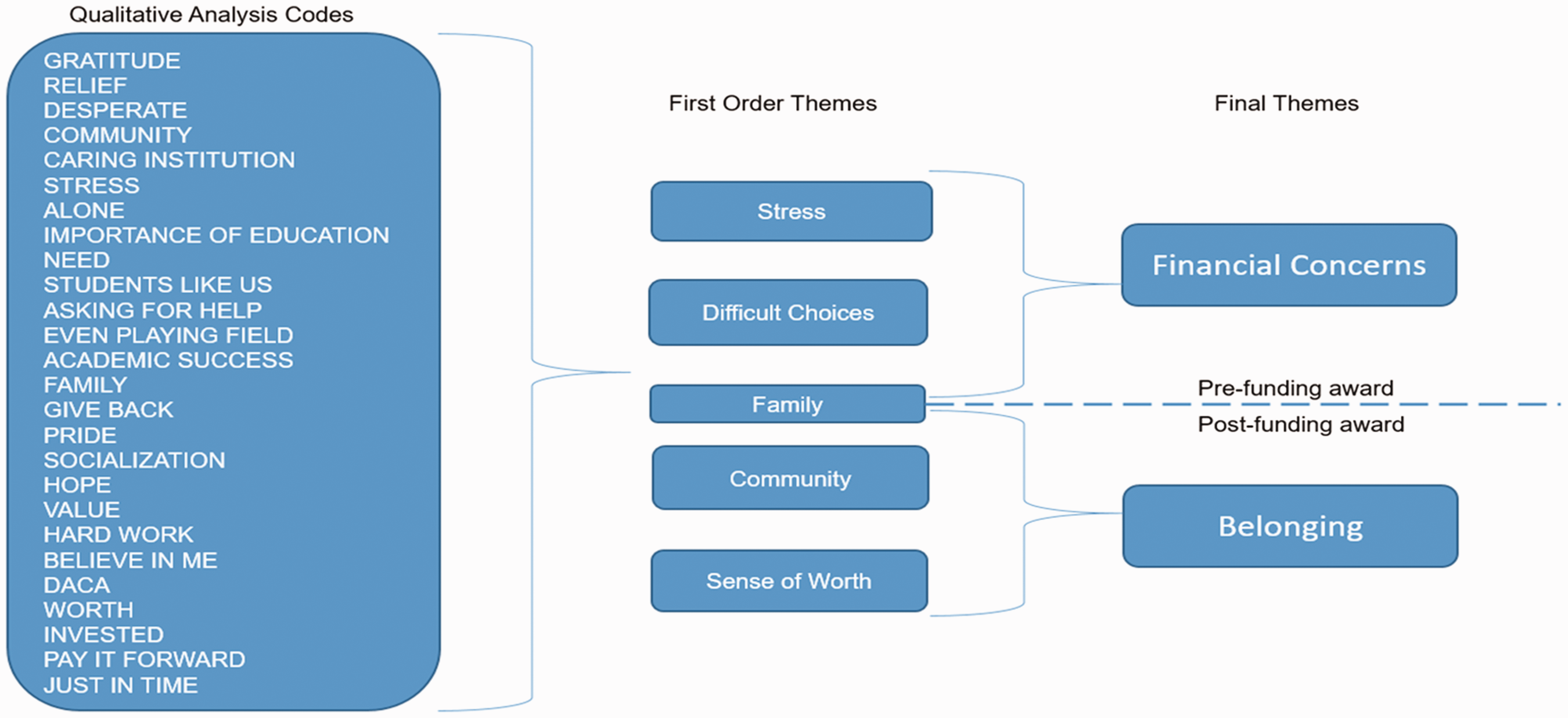
Qualitative analysis process.
Positionality and Reflexivity of Researchers
As the founders of the hardship program, the first two authors were positioned close to and deeply invested in the success of the program and the student recipients. The first author serves as Associate Dean of the Undergraduate Program, and the second author serves as the Executive Director of the Undergraduate Program and manages retention efforts. We decided to conduct research related to the program and approached it with the perspective that any insight would be helpful in conveying to readers either the success or failure of the program and lessons learned. The first two authors discussed their views and coding of the qualitative comments to ensure they were not introducing bias into the analysis. The third author is a professor in the College of Education and provided a lens external to the college that operates the hardship program. This outside perspective was critical to ensuring the research presented a fair and balanced perspective of the program that would be useful to readers. The authors approached the study from three different perspectives including that of an administrator, student affairs professional, and a faculty member. These different institutional placements allowed for a richer view on the research and in turn a more complete analysis of the potential applications and implications for this program.
Findings
Students’ perception of institutional integrity and the institution’s commitment to their welfare influence their academic development (Braxton et al., 2013). The greater the degree of academic development perceived by the student, the greater their commitment to the university which in turn, influences their persistence. This element of the theory of student persistence in commuter colleges was empirically supported (Braxton et al., 2013). In this section, we present the study’s findings against this theoretical foundation. The findings are organized in two subsections that correspond with the final themes: financial concerns and belonging where the former highlights data on the lived experience of at-risk students who are struggling financially and, the latter emphasizes recipients’ shift in perspective that results from a financial award.
Financial Concerns
Financial concerns are, not surprisingly, prevalent across the interviews. By definition, one must be concerned with their finances to apply for hardship grant funding. Within this section, we tag segments of quotes with first-order themes that underpin financial concerns: stress, difficult choices, and family.
Recipients of the hardship grant shared feelings of stress related to paying for college. Stress related to paying for college is particularly acute for first-generation students who are navigating the new college atmosphere without the “college cultural capital” those students whose parents attended college provide to them. McDonough (1997)defines cultural capital as symbolic wealth transmitted from generation to generation. In this case, that symbolic wealth takes the form of knowledge and guidance provided by parents or guardians who have experienced college before and can help steer their students in helpful directions. The majority (63%) of the student participants in this study were first-generation college students. Not understanding how to pay for school and not knowing where to go if financial aid is insufficient is a consistent theme in applications for financial assistance for this program. The emotional strain and tension that students experience as a result of financial concerns is significant. All the recipients were working while attending school. Many are responsible for paying bills including rent, food, credit card bills, auto loans, and care for parents or children: November and December I just wasn’t able to meet any of my credit card payments and so that kind of like shifted – getting the tuition [paid] has since helped … free up [money] to make sure I stay on payments with everything else which is a lot. [stress, difficult choices] I'm always struggling with my bills so the fund really helped me with that … I've also had to take on some babysitting and caretaking … to really make ends meet. It's still hard to make time for … homework when I need to be working. [stress, difficult choices] We’re not able to get financial aid … I had to get multiple cosigners to even get that loan … So receiving the hardship [funding], I was able to move around the money to where I needed to pay things. My car broke down so I had to get that fixed and, you know, just continue trying to move forward. My second oldest brother has been in jail for like ten years and it’s funny because he made a joke to me … he’s like, ‘You’re having a hard time even paying yours [tuition] and then you’re paying like $40 a pop [for my classes],’ but I’ve paid his whole college while he’s been in jail. [stress, difficult choices, family]
Most interviewees talked about their family, or lack of one, when they discussed their financial concerns, and again when describing their excitement about receiving the hardship funding. One student shared that he was alone, living in the United States with no family and had experienced multiple bouts of homelessness. He felt that without this emergency assistance that paid his term’s tuition, he would have been forced out of his housing: I had no money at all. I had skin problems because for two months I was not eating enough, so I had some nutritional problems … it was that bad financially, because I'm on my own, I have nobody here. I would be again on the streets. [stress, difficult choices, family]
Not only do recipients often work multiple jobs, they also live without a financial safety net so that unexpected circumstances like car repair, rent increases, and family illness will set them back in a manner that makes it difficult for them to recover. Below is an example of this: When my dad first had [a] stroke I had over $3,000 [of] unpaid tuition. But nobody [in my family] told me anything because [my dad] was telling people that I'm studying [in the USA], not to … worry me. So, I had no idea I was gonna encounter this problem with tuition because … he was gonna send the money as he always did. But, then one of my youngest brothers accidentally told me, “Dad is really sick.” That’s when I … tried to find out more about [the hardship funding]. [stress, family]
Belonging
The hardship grant program was designed to alleviate financial concerns related to paying tuition. In addition to accomplishing this goal, the program also engenders feelings of belonging by students who perceive the school as understanding their struggles and seeing their worth. Within this section, we tag segments of quotes with first-order themes that underpin a sense of belonging: family, community, and sense of worth.
When the competing responsibilities of rent, food, bills, and family care are minimized, recipients experience a sense of relief and improved focus on school, exemplified here: When I got my first hardship [grant], you can see that my grades were able to get better and better because before that I was struggling in doing my assignments at the right time because I had to focus on going to work and giving a hundred [percent] at work … I was actually on [academic] probation … but since [receiving the hardship funding] I am back in academic good standing, so it has impacted me a lot. [ I think for the just-in-time thing, it’s [tuition assistantship] so crucial that when you are not sure what you are going to do and you are backed up into a corner for there to be like this little sliver of hope for you … maybe there is a way for me to figure this out and to not to get myself into debt and to forge the life that I wanted. [family, sense of worth]
Osterman (2000)defined sense of belonging as a “feeling that one matters to one another, that their needs will be met through a shared commitment to be together” (p. 324). This program demonstrates to students that the institution is committed to their success—to being there for them. These statements from students in turn demonstrate a commitment from them to work harder in their studies. This program may be positively influencing students’ perceived sense of belonging as a collateral effect of providing just-in-time hardship funding.
DACA students may feel a decreased sense of belonging on campus due to their immigration status. DACA recipients do not currently have a path to citizenship in the United States. College campuses across the United States are able to educate undocumented students, and some students are eligible to receive state or private funding but the opportunities for student career paths are less certain. This limiting of opportunity is felt by DACA students and some choose not to attend college at all as a result of their immigration status. One student shared candidly with us about her perceptions of the how others view DACA recipients and how she perceives the grant: That you guys believe in me, believe that I can do it, believe in my future, that’s what has helped me work even harder. And I feel like being a DACA student, being a dreamer, everything’s against you. Everyone wants you to fail … It’s been awesome that the School of Business has been able to provide to those students. [community, sense of worth] This program can definitely touch lives and help those individuals who are … nearing the thought of dropping college and encouraging them to keep on going and helping them … we need programs like this to help the people who are going to go out there and be innovators and are going to … do good in this community. [community, sense of worth]
Interviewees interpreted the hardship funding as a demonstration of institutional concern for, and commitment to, their welfare, and this positively influenced the students’ sense of belonging (Braxton et al 2013). Students shared that the hardship funds ignited a desire to give to others and to consider ways in which they could help others in the future. Examples follow: I actually volunteered to be on the Honor’s Program brochure for the School of Business … I just wanted to do it to show that we as minorities can accomplish those things because, in my own honors cohort, I'm the only Hispanic person there. And men outnumber the women. And I just want more diversity in these programs. [community, sense of worth]
Despite all the recipients being commuter students who disproportionately struggle with the belief that their institution wants them to thrive (Kirk & Lewis, 2015; “National Survey,” 2011), these selected quotes demonstrate the retrospective sensemaking of students about this program, their departmental support, the institution’s care for them, and its influence on their persistence toward degree completion.
Discussion
The empirical research in this article aims to understand how hardship fund recipients made sense of their award and what might those perceptions help us learn about persistence. To this end, we focus on the meaning attributed to the program by its recipients and show how the financial award itself links a seemingly obvious retention intervention to the sense of care that is more challenging to cultivate generally and on commuter campuses in particular. Following this, we demonstrate the guiding principles for implementing a similar initiative that moves beyond the necessary, but insufficient financial interventions that are easily replicable.
Making Sense of Hardship Funding Programs
Increasingly, contemporary studies of student retention in urban universities focus on alleviating financial hardship as an intervention (Kuh et al., 2011; Olbrecht, Romano, & Teigen, 2016). The study reported here extends that research and highlights the sensemaking activities of student awardees whose interviews show their commitment to the institution, belief in themselves because of the institution’s concern for them, and their commitment to paying-it-forward. The stories these students tell are a far more powerful retention tool, than the money itself because in the act of sensemaking, the students are telling stories to themselves as much as to others about the meaning of their experiences (Bruner, 1990). By helping these students, we are, in turn, being helped by them. This creates a virtuous feedback loop where both parties are having a positive effect on each other.
Providing funds in a just-in-time way assists students with their tuition costs at critical junctures when they either drop out or continue working toward their degree. The qualitative interview data provided in this study further illuminate the expected impact the hardship funds had on students; to help them persist toward graduation. Hardship funding programs are increasing in numbers across the United States with one of the most well-known operating out of Georgia State University. The Georgia State University Panther Retention Grant program boasts a retention rate of 88% (Hoover, 2016) which is the same retention rate achieved by the hardship grant program at the institution in this study. The hardship program detailed in this study was inexpensive to implement, and the return-on-investment has been exponential. The cost of the program each year is $200,000, and the departmental budget averages 19 million, meaning that funding the program is 1% of the total budget. The tuition dollars generated by retaining these students, assuming they would otherwise have stopped-out, is conservatively estimated at $4,176,000 over the 3-year program lifespan thus far. In this way, the hardship program supports existing literature that show expected impacts of financial assistance to include increased student persistence and degree attainment (Cabrera et al., 1992).
The 2011 ASHE higher education report on student success, recommended the creation of small pockets of emergency funds to help students in the moments when they most critically need funding, this program is an example of that recommendation enacted successfully (Kuh et al., 2011). Furthermore, financial assistance helps reduce dropping out (Cabrera et al., 1992; DesJardins et al., 2002) and increases degree attainment (Goldrick-Rab et al., 2016). These primary impacts are tied to institutional goals: retention and graduation. From an institutional perspective, students are leaving college with student loan debt (with or without a degree), and some state institutions are being funded based, in part, on their retention rates. Each student who leaves the university represents a loss of future revenue and a current loss of the money invested in recruiting that student. Estimates of revenue lost per cohort hover around $13,000,000 for public institutions and $8,000,000 for private institutions (Raisman, 2013). The cost of recruiting a new student has been estimated at $457 for 4-year public institutions and $2,185 for 4-year private institutions (“National Association,” 2012). Therefore, it is most cost effective to recruit and then retain our students.
Beyond the financial case for improving student persistence, one must consider the social justice case for improving retention and persistence rates which is rooted in the goal to overcome the inherent inequities embedded in the U.S. system of education. Students have grown up operating in a system of White privilege, a system where students of color, first-generation college students, students of lower socioeconomic status, or students who are undocumented have faced continuous barriers or a lack of support. These barriers must be considered in retention and persistence efforts because they compound the inequities many students may face. The intersectionality of race, ethnicity, gender, socioeconomic status, and immigration status must be considered. When these identities intersect, the systemic problems that perpetuate the inequities in the educational systems are compounded. Additional costs of student attrition include the loss of future employment earnings due to inadequate degree attainment levels and the effect of negative self-concept on an individual as a result of internalized feelings of failure (Gomme & Gilbert, 1984). Student persistence toward college graduation creates a ripple effect through their community. College degree attainment demonstrates to younger generations that a college education is attainable. Parental education levels have been found to significantly influence their children’s degree paths, and each first-generation student who persists toward graduation has the potential to break the cycle (Bird, 2018). It is clear that helping students persist toward graduation has a positive effect on the institution, the student, and their community and supporting students traditionally underrepresented in college is a social justice issue that has the potential to disrupt the inequities inherent in the United States today.
It is striking that financial assistance of this sort elicited such strong feelings of student loyalty. When we talk about cultivating alumni relations, it is often tied to athletics and school pride. On commuter campuses this is more difficult to organically develop among students, and yet we have an example of where this is happening as the result of meeting a need of the student and their community. As mentioned earlier, the persistence literature points to the influence financial stress can have upon a students’ family and ultimately on their persistence toward degree completion (Goldrick-Rab, 2016; Olbrecht et al., 2016). When negative effects on families of working students are diminished as a result of minimized financial costs to the family, support and encouragement to attend college from significant others increases. Thus, the lower the cost of college attendance, the greater the support from students’ families to attend college, which in turn increases their likelihood of persisting in college.
In addition to financial support helping with student persistence, the research on retention tells us that engagement between students and institutions matter (Kuh, 2009). Students’ sense of belonging influences their decision to stay at an institution and persist toward degree completion. It is a construct that institutions can work to increase through programs that nurture feelings of belongingness and demonstrate an institutional commitment to its students. However, traditional campus integration efforts that would take the students away from their familial ties may not be effective. Rather, we argue that this program is successful in part because we accept the student for who they are, and where they are at financially and academically.
Recently, studies of institutional work have suggested investigating the process of sensemaking in order to understand how stakeholders create common meanings, and in turn change or maintain those institutions (Maitlis, Vogus, & Lawrence, 2013). Such examinations are all the more important in the case of student retention given the evidence that persistence is mutually constitutive of students’ experiences and the institutions over time (Braxton et al., 2000, 2013; Nora, Cabrera, Hagedorn, & Pascarella, 1996; Tinto, 1975, 1993, 2006). This means while the institution might have created an environment they intend to be meaningful to students, due to the contextual discontinuity, those students have to make sense(Weick, 1993) of the environment and the stories that are being told in the light of their own preexisting stories. Therefore, examining local in-situ sensemaking of students can help foreground any translation of their storyline that may help them to reframe their experience. This in turn may reveal the interplay between institution’s sensemaking and the micro internal process of in-situ sensemaking.
The creation of the hardship funding program did more than provide financial relief to students, it had the effect of creating a sense of community and care for these students. We were surprised to find the theme of student belonging across our interviews related to their perception change as it related to the business school and their role within it. Students reported a desire to give back to the school, to perform better in their classes, and a feeling that the school cared about them as individuals. Thus, the hardship grants not only reduced financial concerns and stress, but it also deepened their connection to the business school and their feelings of being part of the school community as a result of the institution investing in them financially. This discovery connects back to the aforementioned findings about the importance of student perception of institutional integrity and the institution’s commitment to student welfare (Braxton et al., 2013). This perception was found to influence student’s academic and intellectual development and subsequent commitment to the institution and in turn, their persistence at commuter institutions. This virtuous feedback loop demonstrates the concepts of institutional integrity and commitment to student welfare in action. This finding, when coupled with the program’s 88% retention or graduation rate, adds support for Braxton’s model of commuter student persistence.
The notion of institutional care is tied to a sense of belonging that can be influenced by student “experiences of mattering or feeling cared about, accepted, respected, valued by and important … to others on campus” (Strayhorn, 2012, p. 3). Through this small grant program, the institution is enacting a tangible demonstration of its care for students, thus reinforcing to students that they matter. Versions of this narrative are evidence of sensemaking where the funding was about more than the money; it became about what the money signifies. The meaning attributed by all the interviewees was that the funding created a sense of community for them, a sense that the institution cares, believes in them, and is willing to invest in their success.
As Paulsen and St. John (2002)state, financial burden is proportionately greater for poor and working class students. As such, if we are to replicate successful programs that do more than distribute funding, we need to understand the practices that are effective as well as the ethos that underpins the effort. Initiatives that embrace students for who they are can be central to their success. We turn next to a discussion of best practicesthat should inform such efforts.
Implications for Implementing a Hardship Funding Program
The following set of best practices was developed based on data from students interviewed and the experience of the administrator managing the program. These provide important markers for those launching hardship-based micro-grant programs. Just as landmarks on a map provide touchstones for orienting oneself, these recommendations are meant to help start discussions and reflective practice. This is intended to serve as a catalyst for conversation about how to implement a program at other institutions and in other contexts, rather than a comprehensive prescription for all contexts or a list of success factors or mandatory requirements.
The just-in-time nature of the hardship grant program is a key to its success because external circumstances change for students quickly and financial plans for paying tuition are, at times, solidified just as registration begins. Applications are reviewed as soon as they are received, and students are notified within 2 weeks whether they have been awarded funding.
First, consider your population and identify the type of students that may be falling through the cracks and leaving the institution. Use that data to inform your criteria for granting awards. Possible areas of focus may be Pell Grant eligible students, those with unmet financial need, traditionally underrepresented students, or first-generation students. As stated earlier, the just-in-time nature of the hardship grant program is a key to its success. Providing financial assistance at key moments for that student can mean the difference between a student persisting toward degree completion or dropping out. In addition, quick turnaround time is a factor that we have found to be important to students experiencing a financial crisis that is impacting their ability to persist. In the program in this study, students are notified within 2 weeks whether they have been awarded funding. This quick turnaround time decreases student stress related to the uncertainty of their financial situation. Next, enlist faculty and student support staff (advisors, coaches, mentors, etc.) in spreading the word to students at those critical moments. Students often develop strong relationships with advisors and their professors which can result in students feeling more comfortable sharing their financial concerns. When faculty and staff are partners in this work, the information can be shared with students at the moment it is needed resulting in student’s feeling supported both by that staff member and by the institution.
Develop strong tracking systems and determine at the beginning what key metrics you may want to know about the student recipients. Having solid data from the beginning on data points that change over time like grade point average or credit completion pace can be incredibly helpful as the program grows and the need to prove efficacy is increased. Identify the best way to capture the application information and consider your audience’s preferences. Filling out applications online is commonplace and allows for that information to be captured in a systematic way. Comfort with online applications and tools are increasing in today’s college student population. Identify the base level of information needed to decrease the onerousness of the application process for students experiencing stress. Place the management of a hardship program in the hands of student success professionals. This enables more than just a financial issue to be addressed. The student applications often touch on more things than just financial difficulties and having someone who knows where the help is on campus results in students walking away with wraparound support that further demonstrates the institution’s commitment to their welfare. Hardship grant programs can provide more than just funding, by assessing student situations and providing referrals to services including financial counseling, tutoring, or advising.
Limitations of Study
This study was conducted in one college (SB) within one university with 32 students over the course of one term. The hardship grant program the student participants were interviewed has been in operation for just 3 years. The research was conducted in a qualitative way with no goal of generalizability. The intention was to understand the subjective experience of the student recipients of a hardship grant and gain a deeper perspective on how they made sense of the grant. The implications for practice are provided in an effort to assist readers in their development of hardship programs; however, institutions are cautioned to use these recommendations as a compass rather than a map as institutional opportunities, constraints, populations served must be considered in the development of any program aimed at improving student retention.
Conclusion
Today there is acknowledgment that perception of institutional care for students is fundamental to helping at-risk students persist in their university education (Braxton et al., 1995; Heisserer & Parette 2002). This study supports and contributes to that research by investigating a commuter institution that actively showed its commitment to student welfare and enacted its mission through a hardship funding initiative. We identified student financial concerns that motivated application for funding. We highlighted the sensemaking process that occurred as award recipients retrospectively reflected on what the funding meant to them. These insights support Braxton et al.’s (2013)work by demonstrating that recipients perceived the SB as having institutional integrity and commitment to student welfare both because of the monetary support provided through the program, and the goodwill attributed to the institution due to having the fund to begin with.
There is an opportunity, within the current study, to extend our analysis longitudinally, and beyond the Business School to other units on campus that are now modeling programs off of this initiative. Our research is subjected to the customary limits that go with the study of a single context. It would be interesting to compare how perception of the SB’s hardship funding program differs from those of recipients at other institutions with a different mix of students. Such a comparison might inform our finding of the postaward sensemaking by students who felt a sense of belonging.
A hardship funding initiative requires a financial investment on the part of the institution, and it is limited by said budget. While the program boasts an 88% retention or graduation rate for all recipients more than 3 years since its inception, this rate would rise to 92% if the amount of available funding increased. Eight recipients (out of 232 total recipients) who are currently not enrolled are stopped out because of financial balances totaling $53,393. An additional student with no outstanding balance has reached the maximum allowable federal loan amount for an undergraduate student, which is currently $57,500. This student has more than a year left and no financial ability to pay for the remainder of her degree. While universities might be unable to accurately predict the student need for such funds, they can design an intervention that meets as many student needs as funding allows. Tracking the success of these funding awards will likely provide compelling data which may bring in additional funding. This virtuous feedback loop and iterative approach to retention initiatives allows for flexibility and nimbleness to focus where the successes are found.
Footnotes
Declaration of Conflicting Interests
The authors declared no potential conflicts of interest with respect to the research, authorship, and/or publication of this article.
Funding
The authors received no financial support for the research, authorship, and/or publication of this article.
Author Biographies
Dr. Wagner draws on her organizational field-based research when teaching in order to provide rich insights that help illuminate concepts. Throughout her career, Dr. Wagner has been interested in effective learning methods and is dedicated to experimentation in the classroom. She has received multiple teaching awards and is known for her personal connections with students. In her spare time Dr. Wagner is an avid practitioner of yoga and enjoys traveling, reading, and being with her daughter and husband.
Dr. Haley’s favorite part of her work is meeting with students and helping them see their future possibilities!