



Abstract
Declines in college persistence can lead to an array of negative individual-level consequences that can have implications for society in general. Dropout rates are higher among underrepresented minority college students (e.g., African American, Hispanic, and Native American/Alaska Native students) than among their nonminority peers. It has been postulated that these dropout rates are tied to social belonging; minorities drop out because they question whether they belong on a college campus. An earlier social-belonging intervention showed significant improvements in retention among minority students. The new randomized, controlled trial reported here tests, You Are College Material–You Belong, a brief social-belonging intervention. The sample for this study consisted of 207 students who self-enrolled in a section of the required freshmen preparation course at a community college; this location had the highest minority enrollment in the system. Of the 207 students, 102 were assigned to a control group and 105 to an experimental group. The results indicate that the fall-to-spring reenrollment rate was 17.4 percentage points higher among students in the experimental cohort than among counterparts in the control cohort. Studies in several disciplines have demonstrated that a sense of belonging is associated with a range of beneficial wellness and educational outcomes among all student racial groups. The results of this study suggest that social-belonging interventions can contribute to the improvement of academic retention outcomes for minority students.
Educators, policy makers, and institutions have worked for decades to increase rates of college graduation, but half of students who enter college drop out without completing a bachelor’s degree (Seidman, 2005). The rate of student attrition is higher in the United States than in any other industrialized nation (Harvard Graduate School of Education, 2011), and college graduation rates have remained constant in this country (U.S. Department of Education, National Center for Education Statistics, 2017). A key factor that appears to have an impact on graduation rates is early persistence: the rate at which college students remain consistently enrolled from the start of the first year through the start of the first semester of the second year. Despite the proliferation of student support programs, the rate of persistence among first-time college students fell by 1.2% between 2009 and 2012 (National Student Clearinghouse Research Center, 2014).
Declines in persistence can lead to an array of negative individual-level consequences that can have implications for society in general. The wages of individuals who fail to finish a higher education degree are lower than those of counterparts who earn one (Baum & Payea, 2005; Grubb, 2002; Kemple, 2008; Marcotte, Bailey, Borkoski, & Kienzl, 2005). Moreover, educational attainment below the level of a college degree is positively associated with unemployment and use of the human service system (e.g., welfare) but negatively correlated with governmental tax revenues and civic participation (Barton, 2008; Baum & Payea, 2005; National Center for Public Policy and Higher Education, 2004).
Studies in several disciplines have demonstrated that a sense of belonging is associated with a range of wellness and educational outcomes (Begen & Turner-Cobb, 2012; Gillen-O’Neel & Fuligni, 2013; Hagerty, Williams, Coyne, & Early, 1996; Hill, 2006; Kitchen, Williams, & Chowhan, 2012; Ross, 2002; Sánchez, Colón, & Esparza, 2005). Persistence and retention programs in higher education seek to avoid the negative consequences of attrition by offering support for students (Habley, Bloom, & Robbins, 2012; Tinto, 2006). Models of academic and social integration provide the conceptual foundations for such programs (Bean & Eaton, 2000; Karp, Hughes, & O’Gara, 2010; Kuh & Love, 2000; Lee, Donlan, & Brown, 2010; Longwell-Grice & Longwell-Grice, 2008; Rodgers & Summers, 2008; Tinto, 1993; Wolf-Wendel, Ward, & Kinzie, 2009). Within college systems, minority students (e.g., African American, Hispanic, and Native American/Alaska Native) have higher dropout rates than those of their nonminority peers (Musu-Gillette et al., 2017), which can impact health and wellness (Patterson Silver Wolf, Perkins, VanZile-Tamsen, & Butler-Barnes, 2018; Patterson Silver Wolf, VanZile-Tamsen, Black, Billiot, & Tovar, 2015). Retention rates in public institutions of higher education differ for all student populations, but, in terms of demographics, the gap is greatest between minority students and their nonminority peers (Patterson Silver Wolf, Butler-Barnes, & Van Zile-Tamsen, 2015). According to the National Student Clearinghouse Research Center (2017), there is a 20-point difference between the nonminority and minority dropout rates. Research suggests that this is due in large part to differences in social belongingness: Many minority students drop out because they question whether they belong, or fit, on a college campus (Hobson-Horton & Owens, 2004; Hollifield-Hoyle & Hammons, 2015; Walton & Cohen, 2011).
Integration within a campus community and an individual-level sense of belonging to that community are important dimensions of persistence in higher education (Hoffman, Richmond, Morrow, & Salomone, 2002; Hurtado & Carter, 1997). According to Walton and Cohen (2007), a sense of social belonging is a central human need that supports positive relationships with other individuals. Conversely, social exclusion results in many poor health outcomes. The underpinnings for the idea of social belonging can be found within Maslow’s (1943) theory on the hierarchy of needs. Individuals who have met basic needs and obtained some level of safety also experience a need to be loved and a need to belong. Walton and Cohen (2011) observed that members of socially stigmatized groups, such as minorities within college systems, question whether they belong or fit in the college context.
Researchers have found that a sense of belonging is associated with intention to persist, positive coping skills, institutional commitment, and academic progress. Moreover, a sense of belonging is predictive of general satisfaction with college (Berger, 1997; Campbell & Mislevy, 2009; Hausmann, Ye, Schofield, & Woods, 2009; Kember & Leung, 2004; Meeuwisse, Severiens, & Born, 2010; Thomas & Galambos, 2004; Zea, Reisen, Beil, & Caplan, 1997).
Although few programs to encourage persistence and retention are centered on the concept of social belonging in higher education, programs with such an orientation have a demonstrable capacity to positively affect student behavior and perception over time. For instance, Walton and Cohen (2007) tested a social-belonging intervention in which students were exposed to statements about social difficulties in college. All college students, the statements asserted, experience social difficulties that lead them to believe they do not belong, but these feelings are short-lived. Findings from an evaluation of the intervention’s effects indicated that the intervention successfully fortified the sense of belonging among students and that academic performance at the time of the follow-up was better among program participants than among nonparticipants. In a randomized, controlled trial conducted to replicate these results, Walton and Cohen (2011) found similar academic performance outcomes. They also found that in the 3 years after the program, participants exposed to the social-belonging intervention reported a lower number of doctor visits than counterparts who were not exposed to the intervention.
Although Walton and Cohen’s (2011) social-belonging intervention targeted minority students and has been shown to increase retention for them, the intervention protocol required that research participants summarize their own college experiences in a speech, and then to read their speech in front of a video camera. “These materials, participants were told, would be shown to future students to help ease their transition to college” (p. 1448). In 2007, the researchers’ standard protocol indicated that “students were told that the purpose of the study was to investigate ‘the experiences and attitudes of freshmen’ and ‘to create materials to distribute to future [school name] students to help them form accurate expectations about college’” (Walton & Cohen, 2007, p. 88). The investigators led minority participants to believe that they were involved in an honorable and purposeful effort to help other students.
Social belongingness has been shown to be an effective frame, and the Walton and Cohen intervention has some merit, but we felt it important to diverge from their protocol in (at least) one significant way: We removed the performative dimension of students reading into a video camera. Similarly, we did not frame our interactions with students by suggesting that their participation was in some way beneficial for some subsequent or future group of students. By removing these dimensions of student response from our protocol, we believe we were able to capture responses that were more authentic, and not contingent upon changing students’ self-perceptions by suggesting that their contributions constituted a virtuous or noble act.
Thus, the current article presents the results from an evaluation of a randomized, controlled trial testing a social-belonging intervention to improve retention among minority students in a community college—an intervention that pursues these goals without exploiting students’ self-perceptions.
Method
Setting
This study took place in a large urban community college with four campuses in the Midwest. In the fall of 2017, 18,835 students were enrolled in the system; of these, 59% were female, 53% were Caucasian, and 33% were African American. Across the community college system in 2016, the year-to-year retention rate was 53%, and the graduation rate was 13% (College Tuition Compare, 2016). We chose the site for this study—one of the system’s four campuses—because of the administration’s willingness to participate and because minority students comprised about 53% of the enrolled population at that site in the fall 2016 semester.
Research Team
The research team consisted of the lead author and four student research assistants (RAs): three masters-level students and an undergraduate student in a premed program. The RAs were trained to deliver both the intervention and the controlled educational session. They worked in teams of two during the collection of consent, surveys, and delivery of interventions. The RAs visited classrooms in pairs. A presenting RA led the explanation of the study and the delivery of the interventions. The supportive RA handed out and collected consent documents and surveys.
Study Sample
The project was approved by the institutional review boards at the lead author’s university and at the community college campus. The sample (N = 471) was drawn from students who were enrolled in the first semester of their first year at the campus and registered for a required college-preparation course during the fall 2017 semester. In total, 24 sections of that course were offered in the fall 2017 semester. The lead author wrote each section’s number on a piece of paper and placed the slips in a hat. A coin flip determined that the control group would be picked first, and course sections were sequentially assigned into experimental and control groups as the associated numbers were pulled from the hat. Teachers of sections were informed of the study by the college administrator. The lead author subsequently contacted the teachers and explained the study but did not disclose whether the section was assigned to the experimental or control condition. The author then asked whether a research team member could attend a class session and conduct the intervention during the first 30 minutes of a class. The research team’s goal was to draw a sample of approximately 200 students.
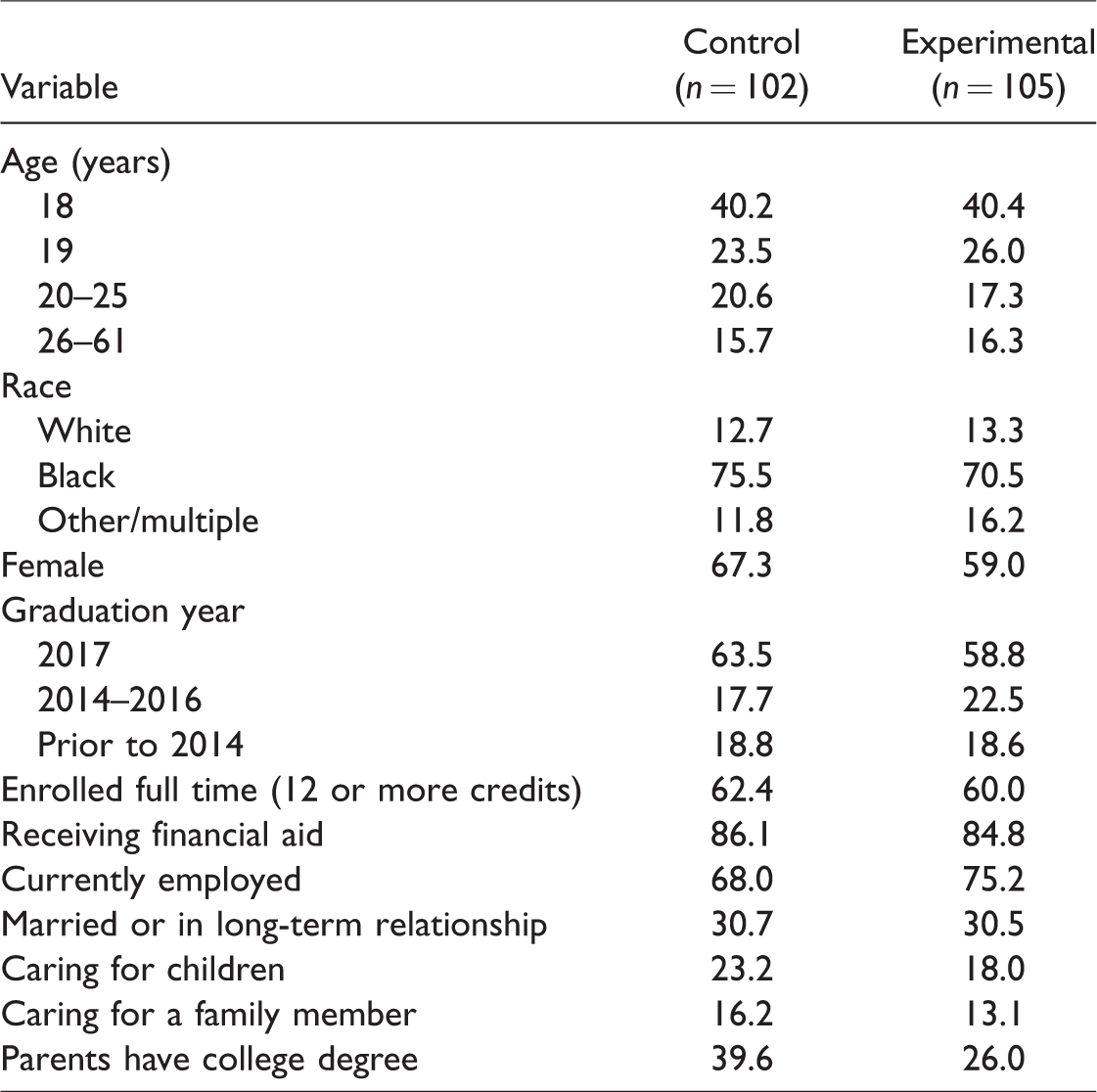
The next stage of recruitment occurred in the classroom. The RAs performed all classroom activities, explained the interventions to students, obtained consent from participants, collected baseline survey data, and conducted the interventions. Students who attended a class but did not grant consent were excluded from the study, and data on them were not analyzed. The sample consisted of 207 students who self-enrolled in a section of the preparation course: 102 students in the control group and 105 students in the experimental group. Table 1 presents a comparison of the groups on select demographic, background, and behavioral variables.
Demographic and Background Characteristics of Study Participants (Percentages; N = 207).
The Interventions
The interventions occurred within a period of approximately three weeks, after the first 2 weeks of the fall 2017 semester and before midterm. Students in class sections assigned to the control condition received, as a group, a structured 30-minute PowerPoint presentation on campus-based student services. Topics included information about and ways to obtain college disability services, career services, supports offered through the federal TRIO program, student health-and-wellness counseling services, and general campus-based student supports.
Students in class sections assigned to the experimental condition received, as a group, a structured introduction via a 13-minute video (Patterson Silver Wolf, Perkins, Butler-Barnes, & Walker, 2017), which was developed and produced by the lead author. Social-belonging theory guided the development of the video (Anderman & Freeman, 2004; Patterson Silver Wolf et al., 2017). Featuring college students of different ages, races, and sexes, the video documents experiences associated with being a new college student and conveys four key messages: Every new student feels out of place at first; each student worries about making friends; all students worry that they are unprepared for college; and these feelings disappear after a brief time. The presenting RA then asked participants whether they could relate to any part of the video. If no student spoke up, the presenting RA posed two probing questions: “Have any of you felt out of place on campus?” and “Were any of you worried about making new friends?” If a student answered affirmatively, the RA requested clarification and encouraged additional, open, free-flowing discussion. The group discussion lasted approximately 10 to 15 minutes; we did not collect or analyze data related to these discussions.
Measures
Prior to presenting the interventions (the video to participants in the experimental condition and the PowerPoint presentation to participants in the control condition), we used items from several instruments to collect survey data from students. These data included information on basic demographics, the number of credit hours enrolled, amount of student financial assistance received, employment, hours spent working, whether the student had children (regardless of residence), whether they were in a relationship with another adult, and whether they provided care for an adult. We collected information on depression with the Patient Health Questionnaire-9, a brief, nine-item scale that includes only the depression-related items from the larger instrument and has been validated for use in the tentative diagnosis of depression (Kroenke, Spitzer, & Williams, 2001).
The Drug Abuse Screening Test-10 was also administered. This 10-item brief screening tool assesses drug use, not including alcohol or tobacco use, in the 12 prior months (Skinner, 1982). We also administered the Global Adult Tobacco Survey. The global standard for systematic monitoring of adult tobacco use, this instrument was developed for a nationally representative face-to-face household survey of young adults aged 15 years. It was designed to generate comparable data within and across countries (National Cancer Institute & Centers for Disease Control and Prevention, 2014). We also used the Short Grit Scale, which assesses perseverance and passion for long-term goals at the trait level (Duckworth & Quinn, 2009). The measure contains eight items, four of which are reverse-scored. The construct of grit has been identified as a factor related to success in several different populations (Duckworth, Peterson, Matthews, & Kelly, 2007). For instance, it has been shown to be positively related to grade point average in college students and to retention among military training academy cadets.
This study also draws upon standardized administrative data collected by the community college system. During the spring 2018 semester, administrators with the focal campus provided de-identified data on whether participants in the study reenrolled in spring 2018 courses—the main outcome of interest.
Results
Randomization Analyses
In addition to comparing the demographic and background variables reported in Table 1, we also compared the intervention and control groups on responses to the Patient Health Questionnaire-9, the Short Grit Scale, and the Drug Abuse Screening Test-10, as well as on other collected variables. We found no statistically significant difference between the two groups on any variable. Thus, we concluded that the randomization was successful.
Covariate Analyses
We next sought to identify whether the measured variables were associated with reenrollment in the 2018 spring semester. Of the variables tested, only gender, χ2(1, n = 206) = 6.36, p = .012, and full-time enrollment, χ2(1, n = 180) = 4.33, p = .037, were significant. Reenrollment was higher for females than males (74.6% vs. 56.6%) and higher for full-time students than part-time students (74.5% vs. 58.6%).
Intervention Analyses
The cross-tabulation indicated that the study condition was significantly associated with reenrollment, χ2(1, n = 207) = 6.36, p = .012. That is, 76.2% of students in the experimental group reenrolled versus 58.8% of students in the control group (Φ = .18, OR = 2.24).
With the addition of gender to the cross-tabulation, the results indicated that study condition was significantly associated with reenrollment among females, χ2(1, n = 130) = 6.34, p = .012, but not among males, χ2(1, n = 76) = 1.03, p = .311. Among females, the reenrollment rate was 85.5% in the experimental group and 64.7% in the control group (Φ = .22, OR = 3.21). Among males, 62.8% in the experimental group reenrolled and 48.5% in the control group did so (Φ = .12, OR = 1.79).
The cross-tabulation for enrollment status (full- or part-time enrollment) indicated that full-time enrollment was not significantly associated with reenrollment in the following semester, χ2(1, n = 110) = 0.20, p = .658, but that part-time enrollment was significantly associated with it, χ2(1, n = 70) = 6.52, p = .011. The reenrollment rates were 77.2% among full-time students in the experimental group and 71.7% among counterparts in the control group (Φ = .04, OR = 1.34). Among part-time students, the reenrollment rates were 73.7% for the experimental group and 40.6% for the control group (Φ = .31, OR = 4.09).
Given the differential intervention response by gender and enrollment status, we examined whether gender was correlated with full-time enrollment status. Although the percentage of females enrolled full time was larger than the percentage of males with that enrollment status, 62.8% versus 58.2%, the difference was not significant, χ2(1, n = 180) = 0.21, p = .648.
In terms of the difference between the experimental and control groups, females reenrolled more than males by 6.5 percentage points and part-time students reenrolled more than full-time students by 27.6 percentage points. We used a series of logistic regression analyses to investigate the joint effects of study condition, female gender, and full-time enrollment, as well as the interactions of these variables.
The first analysis tested the joint effects of study condition, female gender, and their interaction. The results for this model revealed that the gender–condition interaction was not significantly associated with reenrollment, b = 0.583, SE = 0.644, p = .366. In removing the interaction term and reestimating the model, we found that both female, b = 0.932, SE = 0.319, p = .003; OR = 2.54, and study condition (0, 1 = intervention), b = 0.901, SE = 0.318, p = .005; OR = 2.46, were significant. Female students were about 2.5 times more likely to reenroll, and the same was true for students in the experimental group. However, the 6.5 percentage point net difference between females and males, a difference represented by the interaction, was not significant.
The next analysis tested the joint effects of condition, full-time enrollment, and their interaction. The interaction was not significant, b = –1.119, SE = 0.677, p = .098. Results obtained by reestimating the model without the interaction term showed that both full-time enrollment, b = 0.772, SE = 0.334, p = .021, OR = 2.17, and study condition, b = 0.778, SE = 0.333, p = .019, OR = 2.18 were significantly associated with reenrollment. Full-time students were about 2.2 times more likely than part-time counterparts to reenroll, and the same was true for students in the experimental condition. However, the 27.6 percentage point net difference between females and males was not significant.
The final analysis estimated two models: In Model A, we estimated the joint effects of study condition, female, full-time enrollment, and the interaction between study condition and female gender. In Model B, we estimated the effect of the interaction between study condition and full-time enrollment. The results showed that neither the interaction between study condition and female gender in Model A (b = 0.692, SE = 0.699, p = .322) nor that between study condition and full-time enrollment in Model B (b = –1.219, SE = 0.695, p = .079) was significant. We reestimated both models without the interaction terms, finding that all main effects were significant: female gender, b = 0.946, SE = 0.346, p = .006, OR = 2.58; full-time enrollment, b = 0.768, SE = 0.341, p = .025, OR = 2.15; and study condition, b = 0.898, SE = 0.345, p = .009; OR = 2.45.
Discussion
The main question motivating this randomized intervention study was whether reenrollment in the spring semester was positively correlated with exposure to a brief, one-time intervention intended to fortify students’ beliefs that they belong in their college classes. The spring semester reenrollment rate was 17.4 percentage points higher among students receiving the intervention than among counterparts in the control condition (OR = 2.24). None of the examined demographic, background, and behavioral covariates differed significantly between the two groups of students. Two of the covariates, gender and enrollment status, were related to reenrollment. Controlling for either or both of these variables, both of which remained significant in the multivariate analyses, changed the intervention odds ratio by less than 10% in either direction. Preliminary analyses showed that the net intervention–control difference in the likelihood of reenrollment was nearly 7 percentage points larger for female students than that for male students. Surprisingly, the net difference was nearly 28 percentage points larger for part-time students than for full-time students. However, multivariate analyses with interaction terms entered to capture these net differences indicated that the differences were not significant.
Limitations
Although the results of this study are encouraging, several limitations should be noted. The most important is that we were not able to collect information on participants’ grades from the community college. Many considerations influence whether students reenroll, but poor or failing grades are an important reason. Poor grades early in the fall semester may lead students to give up and formally withdraw or simply drop out; poor semester grades likely decrease the chances that the student will return for the spring semester. Another limitation is that though the experimental and control programs were administered in a group—all students in a participating course section were exposed to the same materials and presenters—the results were analyzed individually, as if the condition program had been individually administered. However, even with adequate resources, the number of available course sections would have limited the power of a group-level analysis. The setting of the project raises a question about generalizability but is not a limitation per se. The institution, a campus within a city-based community college system, serves a population that consists of students from low-income households and from racial and ethnic minority groups. The results here indicate that the intervention is successful for this population. It is unknown whether the intervention’s effects are generalizable across the range of community colleges.
This study has some important implications for both college-based student retention efforts and for research on this subject. The main ingredients in the social-belonging intervention should be an acknowledgment of the importance of belongingness and an awareness that peers are feeling out of place (Hoffman et al., 2002; Hurtado & Carter, 1997; Patterson Silver Wolf et al., 2017). The intervention tested in this study educates students and offers them an opportunity to hear their peers express similar feelings.
This study points to several next steps. Research with this intervention should include an assessment of socioeconomic status and of the factor’s influence on outcomes. Moreover, subsequent efforts should draw a larger, more ethnoracially diverse sample to enable an assessment of whether ethnoracial status serves as a moderator of potential program effects. This assessment is imperative because ethnoracial minority groups are overrepresented at community colleges, and rates of attrition are comparatively higher among these groups than among their nonminority peers (Fry, 2004; Hernandez & Lopez, 2004; Knapp, Kelly, Whitmore, Wu, & Gallego, 2004; Wild & Ebbers, 2002). To further understand students’ sense of belonging, future research may also collect and conduct qualitative analyses of the group discussions within the experimental group. Future directions should also consider readministering all survey instruments at a specified follow-up point and compare both pre- and postintervention data.
Efforts to replicate this study should extend beyond assessments of academic performance to examine the intervention’s effects on a range of behavioral outcomes. The efforts should also seek to empirically derive pathway models linking a sense of belonging to such outcomes. The development of those models should inform future iterations of the intervention. The models might further elucidate potential opportunities for prevention and intervention in higher education. Nonetheless, this social-belonging intervention is notable as a brief and comparatively simple program that contributes to the improvement of student persistence and retention in higher education (Habley et al., 2012).
Footnotes
Declaration of Conflicting Interests
The author(s) declared no potential conflicts of interest with respect to the research, authorship, and/or publication of this article.
Funding
The author(s) disclosed receipt of the following financial support for the research, authorship, and/or publication of this article: This work was supported by the Khinduka Fellowship, Center for Social Development, Brown School, Washington University in St. Louis.