



Abstract
This descriptive study explored campus resources used by transfer students to understand ways institutions can better help them persist to graduation. Completed surveys from 257 transfer students indicated a number of programs and services that met this aim. The top three programs and services used at the current institution were the Computer Support Center, Career Services, and University Health Services. Recommended services included transfer programs, child care on campus, help with the transfer process, and advising. Themes students indicated that could help them graduate related to scheduling classes, personal life situations, enrolling in more credit hours, acceptance of more transfer credits, financial resources, advising, and offering transfer programs or workshops or support or activities. Implications and recommendation for institutions are also discussed.
Transfer college students often follow diverse pathways filled with transferable and nontransferable course credits while maintaining aspirations of earning a baccalaureate degree. They may encounter challenges as they bounce between colleges of neighboring states due to financial and personal reasons. Shapiro, Dundar, Wakhungu, Yuan, and Harrell (2015) noted that “Of the 3.6 million students who entered college for the first time in fall 2008, over one third (37.2%) transferred to a different institution at least once within six years” (p. 3). Transfer student enrollment has increased by 8% for public 4-year institutions and 6% for private 4-year institutions (Lazarowicz, 2015; Poisel & Joseph, 2011; U.S. Department of Education, 2014). Further, another 11% of transfer students transferred twice and 2.3% transferred 3 times or more within 6 years (Shapiro et al., 2015). Consequently, transfer students have become the majority subgroup of college-going undergraduate students within the United States (McCormick, Sarraf, BrckaLorenz, & Haywood, 2009).
To develop a comprehensive understanding of transfer students, transfer graduation rates are reviewed, along with how transfer students experience integration to a new campus, followed by issues related to transfer credit and campus services. Moreover, contributing to the literature on transfer students who persist and graduate from public regional comprehensive institutions, this study explored which campus resources students used as well as additional services and programs students perceived would help them to remain enrolled and graduate from the institution.
Transfer Graduation Rates
More than 80% of community college students intend to earn an associate’s degree. However, most leave community college without having earned an associate’s degree prior to transferring to a 4-year college (Monaghan & Attewell, 2015). The graduation rates for transfer students are disproportionate in comparison to nontransfer students (Fauria & Fuller, 2015; Jenkins & Fink, 2015). For example, 60% of the 2007 national cohort of college students who enrolled and remained at a 4-year institution graduated successfully, while only 14% of that same cohort, who began at a community college and then transferred to a 4-year institution actually graduated within 6 years (Baime & Baum, 2016). This resulted in the need to gather more information about this graduation gap and how to reduce it. Only 5.6% of transfer students in a 2011 cohort transferred to a 4-year institution after they received a credential from their starting institution, either a certificate or an associate’s degree (National Student Clearinghouse Research Center, 2018a). The most recent study of college completion rates indicated that 15.8% of students who began in a 2-year college, whether they earned an associate’s degree, completed a degree at a 4-year institution, which was up 1.1% from the previous year’s cohort (National Student Clearinghouse Research Center, 2018b). After 6 academic years, transfer students who started college at a 2-year institution were less likely to earn a bachelor’s degree than students who transferred from a 4-year institution (Crisp, 2017).
Furthermore, research has determined that students’ probability of graduating successfully from a 4-year institution increased if they earn their associate’s degree prior to transferring (Crook, Chellman, & Holod, 2012; Jenkins & Fink, 2015; Shapiro et al., 2015). Shugart and Harrison (2011) suggested that increasing the number of earned associate degrees by 10% prior to transferring would yield an increase of approximately 37,500 associate degrees, thus potentially increasing overall degree completion for transfer students. As a result of this finding, intentional interventions might be beneficial for students who do not hold an associate’s degree.
Campus Integration
Although varied in the intensity of the experience, the pressures and demands of increased academic rigor and feeling a sense of belonging within a new campus culture is known as “transfer shock” (Dennis, Calvillo, & Gonzalez, 2008). Confusion regarding navigating institutional resources and connecting with the campus community, socially and academically, can generate a dip in academic persistence and performance for transfer students (Kirk-Kuwaye & Kirk-Kuwaye, 2007; Owens, 2007). Dennis et al. (2008) studied the transfer experience of students who attended a 4-year Hispanic serving institution and postulated the importance of considering students’ personal characteristics and grade point average (GPA) when creating support services for diverse students. The researchers also determined that the level of confidence, motivation, self-efficacy, and commitment to college were positively related to students’ GPA. The increased amount of family and job responsibilities may determine transfer students’ abilities to persist due to the difficulty in balancing and prioritizing their educational goals. Moreover, Laanan, Starobin, and Eggleston (2010) posited that inaccurate transfer advising, academic rigor, and limiting articulation agreements attributed to persistence and completion obstacles for transfer students.
The criteria to work full-time, manage family responsibilities, make satisfactory academic progress, and plan for reduction in financial aid when transferring to a 4-year institution pose significant risk factors for many transfer students who strive for undergraduate degree completion (Baum, Ma, & Payea, 2013; Guidos & Dooris, 2008; Roberts & Styron, 2010). Consistent with first-year minority student retention risk factors, researchers have also determined that minority transfer students who have low socioeconomic status, academic unpreparedness from high school, challenges with social integration, and prior enrollment in occupational courses negatively influence degree completion (Dougherty & Kienzl, 2006; Dwyer, Hodson, & McCloud, 2013; Laanan, 2007). However, according to Dougherty and Kienzl (2006), adult students who first enroll at age 31 years or older are 20% less likely to acquire a degree than traditional-age students. Prior enrollment in occupational courses also negatively influences degree completion. Wang (2013) highlighted community college transfer students as a heterogeneous group and that administrators and faculty at 4-year universities should consider students’ gender and other demographic differences in implementation of policies and strategies.
Transfer Credit and Campus Services
One of the most prevalent obstacles for transfer students is the loss of credits when they transition from community colleges to 4-year institutions (Jenkins & Fink, 2015). The National Center for Education Statistics discovered variances of policies related to the acceptance of students’ course credits (Simone, 2014).
Within the last decade, new transfer receptivity initiatives have emerged to support degree completion efforts for transfer students. In a 50-state comparison, the Education Commission of the States reported 36 states have transferable core of lower division courses, 16 states have statewide common course numbering, and 31 states have statewide guaranteed transfer of an associate’s degree. “While some policies can establish and reinforce practices to ease the transfer of credit, institutional activity related to transfer students is an area where research has noted the need for more work to increase graduation” (Mullin, 2012, p. 4).
In Zhang, Lui, and Hagedorn’s (2013) posttransfer student qualitative study, students indicated difficulties in allocating time to complete group projects due to family obligations and challenges in relating with younger students. Recommendations from participants included that universities offer orientation programs, transfer learning communities, career planning programs, increased faculty interactions, and online academic advising as retention mechanisms to support degree completion. When comparing native and transfer 4-year enrolled students, Wang and Wharton (2010) determined that transfer students placed emphasis on academic involvement rather than social involvement with faculty, peers, and staff members in comparison to native students. While transfer students utilize academic advising and financial aid offices (Makomenaw, 2012), fewer transfer students participate in campus events and student organizations (Wang & Wharton, 2010). The study was consistent with prior research indicating that transfer institutions must work to find more innovative ways to connect with transfer students as fewer students participated in campus events and student organizations. However, Wang (2009) discovered that for community college transfers, college involvement had a significant positive effect on attaining a baccalaureate degree at 4-year institutions. High levels of commitment with emphasis on career and financial planning are critically important for transfer students.
Noel-Levitz (2013) administered a survey to a sample of 1,708 transfer students (55% from community college and 45% from 4-year college or university) at 72 (2-year and 4-year) institutions nationwide and identified the following findings for public and private enrolled transfer students: 93% of students showed high commitment to finish college; 62% of students from 4-year public institutions wanted assistance in preparing a written academic plan for graduation; and 75% of students from 4-year institutions desired to have help in identifying employment and internship opportunities related to their major. The Noel-Levitz (2013) study also suggests “understanding transfer students’ attitudes, receptivity, and motivation is the first step in supporting their need” (p. 10) and emphasizes developing “student success programs based on the unique needs of individual transfer students and their unique cohorts” (p. 10). Therefore, designing support programs and interventions may reduce multiple institution transfer behavior. Using online transfer resources to facilitate the transfer process, interacting with supportive institutional personnel, and having an academic and career purpose all played a central role in the transfer experience (Nuñez & Yoshimi, 2017). In addition, discovering what transfer students feel they need to be successful in order to sustain degree progression may also impact transfer graduation rates.
Researchers report that while highly selective public universities yield higher graduation rates, less selective regional comprehensive universities enroll the greatest number of transfer students (Jenkins & Fink, 2015). Increased enrollment of transfer students in U.S. public regional universities, similar to the institution examined for this study, necessitates greater attention in creating conditions that aid with persistence toward degree completion (Baime & Baum, 2016; Jenkins & Fink, 2015; Laanan, 2007; Moltz, 2009).
Purpose of the Study
It is important to continue understanding which programs and services are the most beneficial and used by transfer students. While much transfer student research addresses institutional policy barriers and loss of credits when enrolling at selective public institutions (Crisp, 2017; Melguizo, Kienzl, & Alfonso, 2011; U.S. Government Accountability Office, 2017), there is limited research that examines student support services identified as helpful by transfer students who persist toward graduation from less selective comprehensive regional institutions. Therefore, the purpose of this study was to explore campus resources students utilized and which additional services and programs students felt would help them remain at the current institution and advance toward graduation.
More specifically, this descriptive study was designed to answer the following three research questions.
What campus programs or services did transfer students use the most? What other services should the institution provide for transfer students? What can institutions do to help transfer students be successful and graduate in a timely manner?
Method
Many prior studies included archival records review, quantitative survey data, or qualitative interviews to gather information about transfer students’ academic success, persistence, and graduation. This descriptive study included a survey that asked about campus services used by students as well as open-ended questions related to other services students thought the institution should offer and ways students believed they could be successful and complete their degree sooner. A primary aim of descriptive studies is to understand what elements exist in a specific situation with an identified population or cohort. The purpose of this methodology was to enrich the survey data by eliciting additional open-ended responses with real-life examples to better understand student factors related to persistence and graduation, specifically for transfer students.
This study was conducted at a public, 4-year, state university in the southeastern United States enrolling approximately 7,000 students each year. The institution is classified as a Carnegie Master’s College and University. The suburban institution is located 20 minutes from a large metropolitan city. The university consistently enrolls more new transfer students each semester than any other student group, with more than 1,000 new transfer students enrolling each year. Enrolling a large number of transfer students is consistent with findings at many other U.S. 4-year colleges and universities (McCormick et al., 2009). To be admissible to the institution, transfer students must have earned a GPA of 2.00, which is calculated by combining grades from all previous institutions.
Participants
During the spring semester, all transfer students who first enrolled at the institution in the fall semester 2 years prior or the spring semester of the previous year were sent an e-mail inviting them to participate in the study. The purpose was to survey students who completed at least one full year of enrollment, which would enable them to have a variety of campus experiences. Of the 660 students invited to participate in the study, 257 students completed the survey. In an effort to determine a potential nonresponse bias, the 257 survey respondents were compared with the 403 nonrespondents on transfer GPA, the number of prior institutions attended, and their number of transfer hours. Respondents had a significantly higher transfer GPA (M = 2.83, SD = .54) than nonrespondents (M = 2.73, SD = .52), t(658) = 2.295, p = .02. However, the effect size was small (d=.19), which suggests the two groups were comparable in GPA (Cohen, 1988). There were no significant differences in the other two categories as indicated in Table 1.
Differences in Survey Respondents and Survey Nonrespondents.
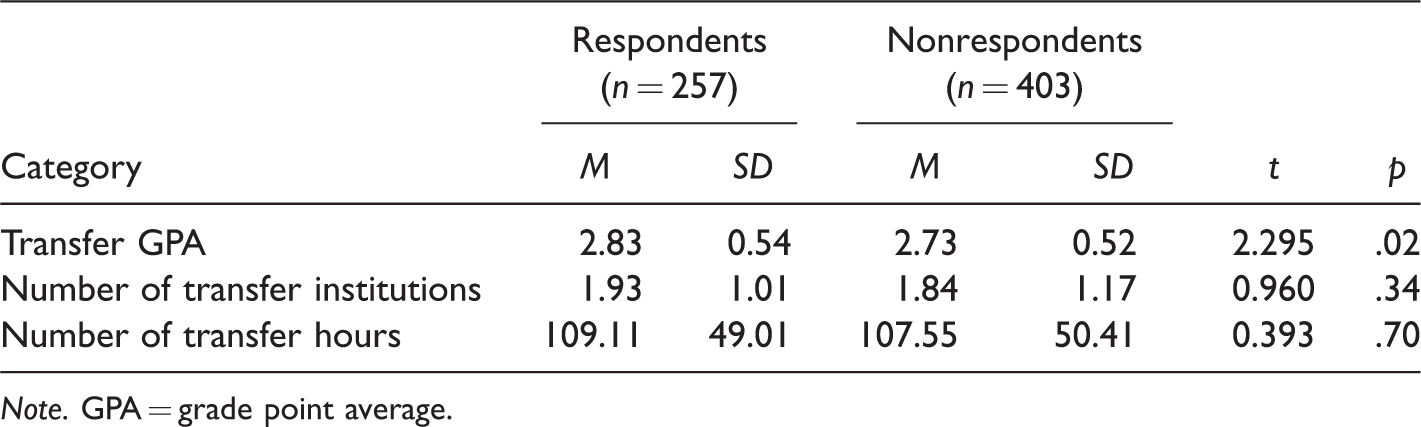
Note. GPA = grade point average.
Of the 257 students, 78.2% (n = 201) were females, 20.2% were males (n = 52), and 1.6% (n = 4) of the students did not indicate their sex on their application for admission. The race or ethnicity breakdown indicated that 70.0% (n = 180) of the students identified as Black or African American, 11.7% (n = 30) as White, 5.8% (n = 15) as Asian, 3.9% (n = 10) as more than one race, 0.4% (n = 1) as American Indian or Alaskan Native, 0.4% (n = 1) as Hispanic or Latino, and 0.4% (n = 1) Native Hawaiian or Other Pacific Islander. There were 7.4% (n = 19) of the students who did not indicate their race or ethnicity. At the time of the survey, 70.4% (n = 181) of the students enrolled full-time (12 or more credit hours per semester) and 29.6% (n = 76) enrolled part-time (less than 12 credit hours per semester). When asked about working a job, 42.4% (n = 109) of the students worked 30 or more hours per week, 19.8% (n = 51) worked between 20 and 29 hours per week, 12.8% (n = 33) worked less than 20 hours per week, and 24.9% (n = 64) did not work at all.
Transfer Student Survey
The researchers created the Transfer Student Survey in an effort to seek out specific reasons why students attended multiple institutions and to gather more specific data concerning services and programs that might reduce transfer shock and support transfer student success. Therefore, the survey questions address some of the gaps in the current research, and questions were precisely written to obtain this information.
The survey consisted of nine multiple-choice questions. These questions asked transfer students to identify the type of previous institution, reason(s) students left their previous institution(s), reason(s) they transferred to their current institution, number of credit hours enrolled in each semester, working status, intent to graduate from the current institution, satisfaction with overall experience at current institution, and programs and services used and requested. Transfer students were also asked three open-ended questions related to what would help them complete their degree sooner, what other services the institution should offer to transfer students, and what the institution could do to help more transfer students be successful and graduate in a timely manner.
Students were also given the opportunity to include their university e-mail address if they wanted to be considered for one of five gift card drawings. Survey responses were then merged with the university’s student information system to collect information about the date of first semester of enrollment, total number of semester hours completed at the institution, number of prior institutions attended, and the total number of credit hours students transferred to the current institution.
Procedure
Students were sent an e-mail with a link to the Transfer Student Survey (designed via Qualtrics software) and an informed consent. After 2 weeks, students who did not complete the survey were sent a follow-up e-mail reminder. A last-minute reminder was sent 2 weeks after that. To encourage students to complete the survey, they were given the opportunity to include their name and e-mail address to be entered in a drawing for one of five $50 gift cards to the university bookstore. Although 258 students completed the survey (39.1% response rate), one student did not list his or her university identification or e-mail address. Therefore, all data from this individual student were removed from the data set. This resulted in complete data sets from 257 students.
Results
The majority of the students (51.4%, n = 132) reported that they transferred from a 2-year college. Other institution type students transferred from included a 4-year public college or university (30.0%, n = 77), technical college (10.1%, n = 26), 4-year private college or university (7.4%, n = 19), and proprietary college or university (1.2%, n = 3). Of these students, 51.8% (n = 133) earned an associate’s degree prior to enrolling at the current institution. Students transferred from 29 to 304 credit hours from a maximum of seven institutions. Credit hours transferred to the current institution include developmental or learning support classes as well as some technical college classes that cannot be used in a degree program.
When asked about their plans to graduate, 93.8% (n = 241) indicated they planned to graduate from the current institution, 3.9% (n = 10) were not sure, and 2.3% (n = 6) stated they did not plan to graduate from the institution. Students who did not plan to graduate listed the following reasons: dislike for school and how teachers teach, transferring to the same program at a better school, transferring to another institution as part of a specific transfer articulation program, and one student was completing a certificate program. When asked which programs and services students used or participated in at least one time, students ranked the top three services as the Computer Support Center (74.3%), Career Services (42.8%), and University Health Services (38.5%). Table 2 lists all services used by the transfer students.
Programs or Services Used at the Institution.
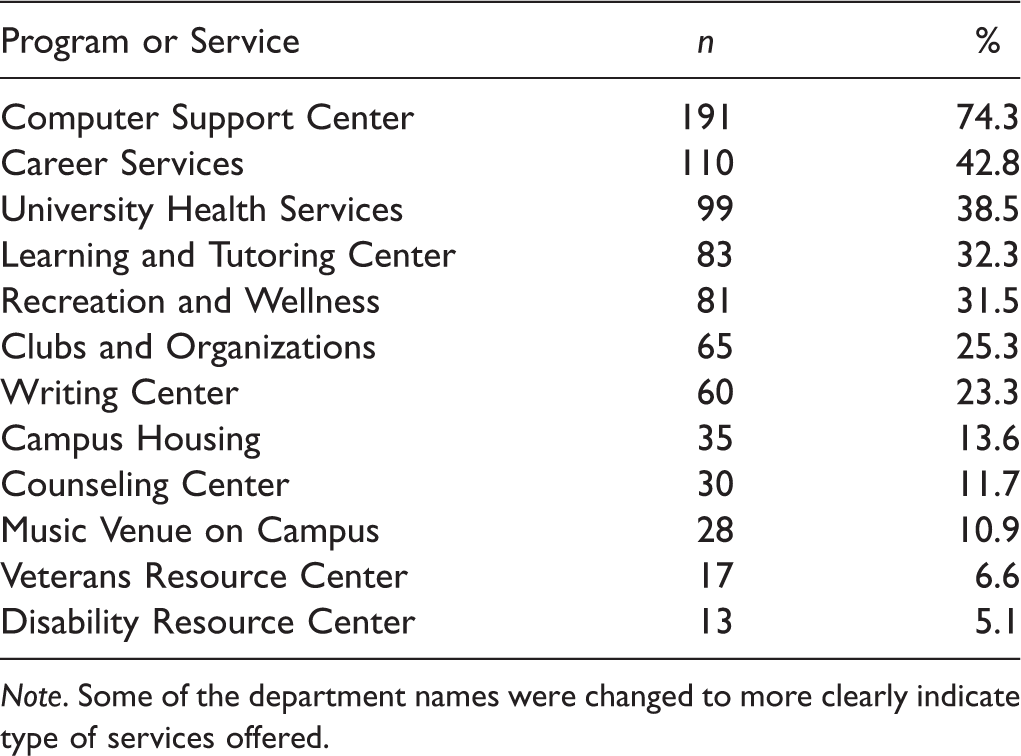
Note. Some of the department names were changed to more clearly indicate type of services offered.
Since students who earned an associate’s degree have a greater likelihood of graduating with a 4-year degree (Crook et al., 2012; Jenkins & Fink, 2015; Shapiro et al., 2015), programs and services used by students were disaggregated by those who earned an associate’s degree and those who did not. More students with an associate’s degree used Career Services (45.1% compared with 40.3%) and the Writing Center (27.1% compared with 19.4%) than students without an associate’s degree. More students without an associate’s degree used the University Health Services (48.4% compared with 29.3%), Learning and Tutoring Center (38.7% compared with 26.3%), and Clubs and Organizations (28.2% compared with 22.6%) than students with an associate’s degree. A Chi-square test of independence was calculated to compare each difference. Significant differences were found for University Health Services, X2(1, N = 257) = 9.85, p=.00, and the Learning and Tutoring Center, X2(1, N = 257) = 4.51, p=.03. All differences by degree are displayed in Table 3.
Programs or Services Used at the Institution by Previous Degree.
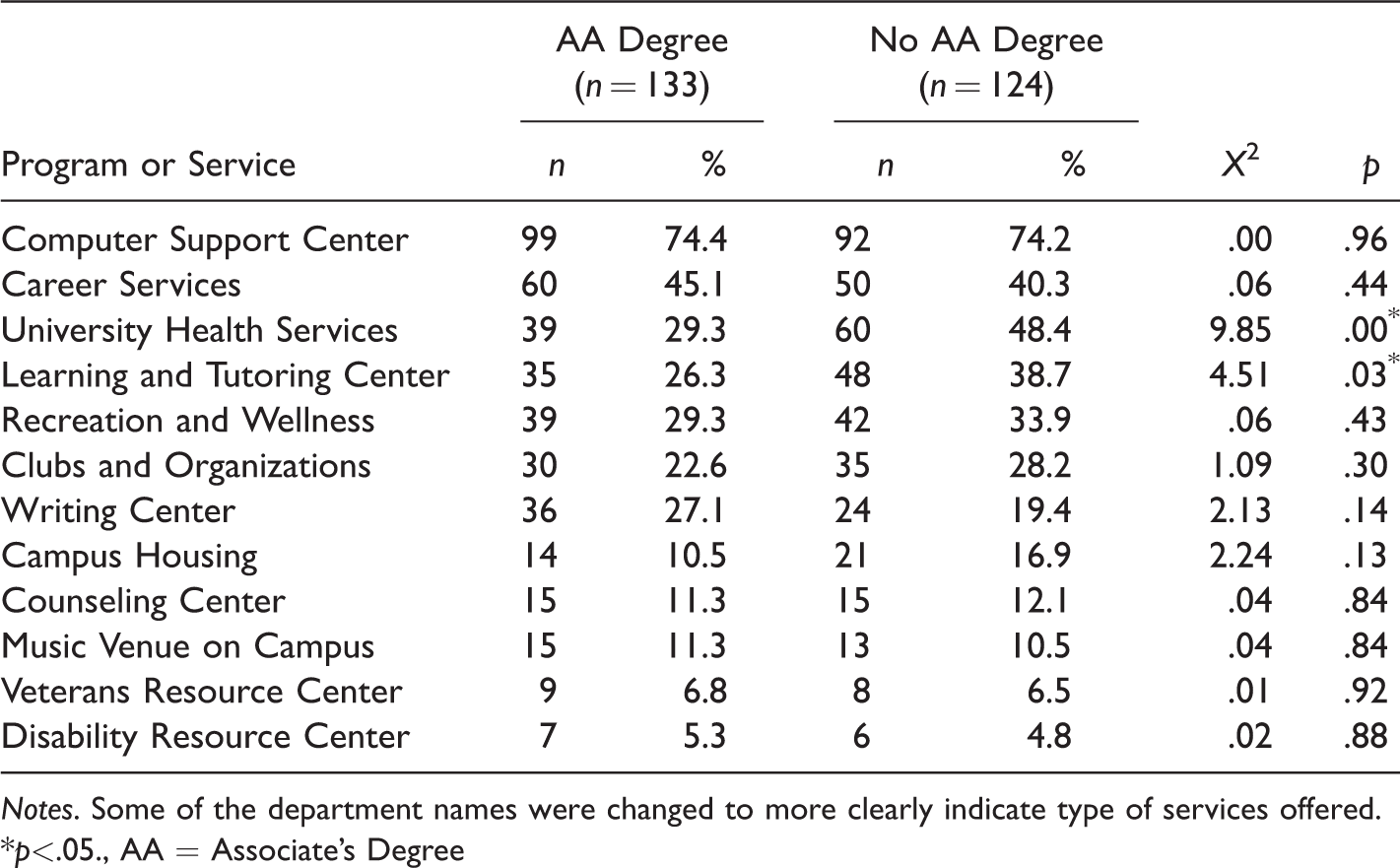
Notes. Some of the department names were changed to more clearly indicate type of services offered.
*p<.05., AA = Associate's Degree
To gather more specific information about what transfer students needed to succeed, participants were asked three open-ended questions. A conventional content analysis approach was used to interpret the open-ended question responses (Hsieh & Shannon, 2005). Question responses were imported into an Excel file, one response per line. Each response was read twice, and after the second reading, similar responses were coded with a number in another data field. Once all responses were coded, they were sorted by code and double-checked to ensure items were in the appropriate category. Once this was complete, the similarly coded statements were given a theme name.
Students were first asked, “What other services should the institution offer for transfer students?” The 75 free response statements resulted in the following most common themes: transfer programs (8 responses), child care on campus (7 responses), help with the transfer process (5 responses), and advising (4 responses). Comments in the theme of transfer programs related to the need for services and programs specifically designed for transfer students, extra help to get students adjusted to the institution, requesting a list of campus programs and activities during the semester, opportunities to meet other transfer students, and transfer student welcome week activities. For example, one student suggested that the institution offer “a program similar to freshman welcome week that can allow transfer students to get to know other transfer students and learn the ins and outs of the school.” Students also suggested that the institution offer child care on campus for children of students. One student suggested “housing, child care and/or after school programs for non-traditional transfer students.” Comments in the theme of help with transfer process related to transfer students getting more assistance with understanding which classes would transfer along with workshops or advising to help transfer students understand how transfer credits are accepted and how a transfer GPA is computed. More specifically, students desired to know which credits would be transferred to the institution prior to attending orientation. One student stated, “Let them know upfront what classes they need to be taking in order to graduate.” Finally, there were 15 positive comments made about the institution services, programs, and staff, and they indicated that there was not a need to offer any additional programs and services.
Students were next asked, “What would help you complete your degree sooner at (name of institution)?” The 94 free response statements resulted in a number of themes. The most common theme related to scheduling classes with a total of 36 responses. Of these responses, most students commented on general issues associated with course availability, including a need for access to more online and summer class offerings, often referring to time of day classes are offered and frequency of course offerings each year. As one student noted, “the choice of having more half term classes could help me to complete my degree sooner.” Eight students stated their personal life situation (often work, family, and children) prevented them from completing their degree sooner. Six students indicated they would be able to graduate sooner if the institution accepted more of their transfer credit. One student commented, “I had 18 credit hours that did not transfer to (name of institution); therefore, I had to make up for it by taking 6 classes every semester, including summer classes.” Finally, six students stated if they had more financial resources they would be able to complete their degree sooner. These students indicated that they had run out of financial aid.
The final open-ended question asked, “What could (name of institution) do to help more transfer students be successful and graduate in a timely manner?” The most common themes to the 87 free responses related to advising (17 responses), course offerings (12 responses), transfer credits (12 responses), online courses (5 comments), and transfer programs or workshops or support or activities (4 responses). Comments in the theme of advising related to not only making sure advising is accurate but also suggested that advisors meet with students on a regular basis to ensure they were enrolled in the correct courses and were meeting their requirements for graduation. Comments in the theme of course offerings recommend offering more classes, and more evening, weekend, and summer classes. As one student stated, “For me, it is being able to take the classes that fit into my work schedule. So, that would mean having more classes offered in the evenings with more selections if possible.” Comments in the theme of transfer credits mostly related to requesting more transfer credits be accepted in the major or as elective credit. Many students commented that they lost credits when transferring to the institution, which delayed their time to graduation. An example includes, “Check all possible options when it comes to transfer credits and substitute options.” Comments in the theme of online courses related to the need to offer more online courses for students. An example includes, “Offer more accelerated and online courses.” Finally, comments in the theme of transfer programs or workshops or support or activities related to suggestions for offering specific programs or workshops for transfer students to assist them and support their needs, other than just a transfer orientation session. An example includes, “Explain the transfer process and keep them on track.”
The final survey question was also disaggregated by students who earned a previous associate’s degree. Students who earned an associate’s degree rank ordered advising, course offerings, transfer credits, and transfer programs or workshops or support or activities as the top areas institutions can focus on to help them be more successful and graduate in a timely manner. Students without an associate’s degree ranked the same top items in a slightly different order: transfer credits, course offerings, transfer programs or workshops or support or activities, and advising.
Discussion
Once again, this study explored campus resources students utilized and through open-ended questions, identified additional services and programs students felt would help them remain at the current institution and persist to graduation. This descriptive study was designed to answer three questions: What campus programs or services did transfer students use the most? What other services should the institution provide for transfer students? What can institutions do to help transfer students be successful and graduate in a timely manner?
Findings from Research Question 1 identified the campus programs or services most used by transfer students. The Computer Support Center was the most used campus program or service. This institution is designated as a laptop campus, and all students are required to carry or have access to a laptop computer. The Computer Support Center is an extremely popular department as it offers free software and hardware support for students. Other top services such as Careers Services, University Health Services, Learning and Tutoring Center, and the Writing Center have been marketed to students at orientation and on campus in an effort to encourage students to take advantage of these free services to assist them personally and toward reaching their academic and career goals. It should also be noted that students enrolled in public institutions in the state of this study must submit previous immunization records or can receive low-cost immunizations at the current health center prior to registering for classes. Although most new students mail in their immunization records or drop them off at the Admissions Office, some students received immunizations at the health center, which might have slightly impacted this ranking or students might have been aware of the center and later returned for additional services.
Since transfer students who did not earn an associate’s degree may be at greater risk of not graduating from a 4-year institution (Crook et al., 2012; Jenkins & Fink, 2015; Shapiro et al., 2015), disaggregating findings by each group might help institutions more appropriately target services based on student needs. More students who earned an associate’s degree used Career Services and the Writing Center than students who did not earn an associate’s degree. A reason for this difference might be that students with the associate’s degree may have earned more credit hours toward a degree, and therefore, are likely closer to graduation and in need of Career Services. In addition, they may be enrolled in upper-level courses requiring more writing assignments. It is noteworthy that more students without an associate’s degree used the Learning and Tutoring Center more than other students, which may suggest some of these students are still enrolled in lower-level core curriculum courses where tutoring is mostly available. This finding may support the idea that services should be tailored to the type of transfer students.
It is interesting to note that 31.5% of the transfer students used Recreation and Wellness services and 25.3% participated in Clubs and Organization. These findings were encouraging and supported by Wang (2009), who discovered a positive effect of college involvement in community college transfers. This may appear unusual since it is not uncommon for transfer students to attend classes, obtain needed campus support, and not have or take time to participate in other campus activities and organizations as discovered by Wang and Wharton (2010).
There were additional services and programs transfer students felt should be offered at the institution (Research Question 2). These included specific programs for transfer students similar to transfer-specific practices identified by Miller (2013), such as transfer centers, transfer-specific advising, transfer orientation, and transfer ambassador mentors. The types of programs students described would typically be offered at institutions once the semester began and not necessarily at orientation, therefore creating opportunities for additional support for transfer students throughout their enrollment. The institution in this study requires all transfer students to attend a half-day orientation session, which briefly includes information about many campus services and programs and culminates with class registration. However, since transfer students have previously enrolled in college, some students at the institution do not feel they need a transfer orientation, but later once the transfer shock sets in (Dennis et al., 2008; Kirk-Kuwaye & Kirk-Kuwaye, 2007; Owens, 2007), they may realize the benefits of additional services and programs designed specifically to meet their needs.
Students also requested a day care on campus for their children, a topic that has been discussed for many years at the institution. This request is not unique as approximately 25% of U.S. college students have dependent children (Nelson, Froehner, & Gault, 2013). Studies found that institutions which provided child care support positively impacted students ability to complete their educational goals (Carter, 2016; Miller, 2013). Transfer students also wanted more assistance understanding the transfer process to include information on how transfer credits are evaluated and accepted and even how the transfer GPA is computed, which is often different from what actually appears on a transcript. Finally, advising services were discussed, specifically related again to transfer credits.
According to transfer students, institutions can take a number of approaches to help them be successful and graduate in a timely manner (Research Question 3). This research question was answered by responses of two similar questions related to what would help the transfer students complete their degree sooner and what the institution can do to help students be successful and graduate in a timely manner.
Initially, transfer students reported that they would like to see more of their credits accepted and applied to their major. This was especially true for students who did not earn an associate’s degree. The associate’s degree is perceived as an easier transfer process because most, if not all, of the core courses are automatically accepted in the degree, resulting in fewer lost credits. That will reduce the number of credit hours needed at the current institution, thus helping students graduate sooner. This finding was supported by several other studies (Jenkins & Fink, 2015; Simone, 2014). The Registrar’s Office at the current institution evaluates transfer credit within 10 to 14 days of student acceptance by the Admissions Office, thus allowing students the opportunity to decide if they choose to register for transfer orientation, which includes paying an orientation fee and then attending the institution. The exception to this evaluation time occurs when late applications are submitted immediately prior to the application deadline. This early notification is recommended and preferred over requiring students to pay a deposit prior to learning which courses will transfer (Ott & Cooper, 2014).
Once credits are accepted, students reported that they would like better academic advising to help them select the courses needed to graduate without wasting time on unnecessary credit hours. This was especially true for students who earned an associate’s degree as advising was their top area they felt the institution can focus on to help them be more successful and graduate in a timely manner, while it was ranked lowest for students who did not earn an associate’s degree.
Transfer students would like to see expanded course offerings and changes in the class schedule during regular and summer semesters, so they can stay on track and not have to wait extra semesters for specific courses to be offered. In addition, they would like availability of more online courses. Having additional financial assistance while enrolled at 4-year institutions would also help transfer students graduate sooner (Miller, 2013). Finally, although it is often assumed that transfer students only want to attend class and then leave due to other commitments such as work and family, transfer students would like to participate in transfer programs, workshops designed for transfer students, and transfer support activities.
Implications
Transfer students have unique needs, which are different from students who begin at an institution as a freshman. Therefore, this study may be helpful to institutions as they attempt to understand these needs and develop strategies from the time of the application and transfer credit review to orientation and adjustment programs during the first semester of enrollment, as they encourage students to persist and graduate. Institutions should help to ensure students have access to programs that support transfer success along with easy access to available campus services designed for all students. Consideration should be given to academic support programs such as computer support centers, writing, and tutoring centers, in addition to career and health services. To help reduce transfer shock, concurrent with Zhang et al.’s findings (2013), institutions should consider that transfer students might be interested in taking advantage of traditional campus services, as they may not have had this opportunity at their previous institution. These services might include recreation and wellness and clubs and organizations. Further, Allen and Zhang (2016) recommend that institutions restructure services to allow adult learners to access information through self-paced learning activities as well as communicate the benefits of campus involvement, both academically and professionally. Acceptance of transfer credit is not as easy as transfer students might expect. Often, transfer credits do not fit into a specific area of the core curriculum or courses designated for the major, especially if students have previously earned credit in developmental precollege courses or career-related credits from technical colleges. Naturally, transfer students would prefer that institutions accept most or all their transfer credit. At the least, institutions should determine the number of transfer credits that will be accepted prior to the student deciding to enroll at the institution.
One recommendation is that institutions should review current academic advising practices and training to ensure advisors are providing current and accurate information about transfer credits accepted and additional courses that are required for graduation. If possible, institutions should assign transfer students specific advisors to carefully help plan their program and go as far as mapping out their plan to graduation, considering the number of credit hours the transfer student wants to enroll in each semester. Course schedules should be created to meet the needs of transfer students; consideration should be given to class schedule days and times as well as online options conducive to the persistence of transfer students.
The transfer process should not end once the semester begins, even if students attended a transfer orientation program. Consistent with the recommendations of Noel-Levitz (2013), institutions should consider offering support programs, academic success workshops, and informational sessions beginning several weeks after the start of their first semester and even into the following semester after the transfer students received their first semester grades. During this timeframe, transfer students are much more likely to have questions they might not consider at the time of application or orientation.
Although these findings will likely be applicable to other institutions, for more specific findings, some institution officials might consider replicating this study or designing a survey similar to the tool utilized in this study to better understand its cohort. This would allow institution leaders the opportunity to provide programs and services that directly meet the unique needs of their students. In addition, future research may expand on the sample size and investigate regional considerations in the United States. For instance, universities with high online student enrollment may increase their sample size.
There are some limitations in this study. Sending the survey to a larger number of transfer students might have yielded a larger sample with possibly more robust results. Although the current institution is similar to other public, 4-year, mid-sized regional comprehensive universities which according to Jenkins and Fink (2015) enroll the greatest number of transfer students, the current institution might admit more transfer students each fall, spring, and summer than other institutions. As a result of this high number, transfer students might feel less marginalized than at institutions that welcome a much smaller number of transfer students.
Future research might also include tracking students through graduation and attempting to replicate the study with another group of transfer students. In addition, the themes discovered from the open-ended questions could be incorporated into a revised survey instrument along with an attempt to validate the current instrument to make it more useful and create greater transferability of the findings.
This study attempted to identify programs, services, and other ways institutional leaders can proactively have a positive impact on transfer student success. Transfer students bring their own unique concerns and issues when they enter a new institution. Therefore, this heterogeneous group will respond differently to intentional initiatives, programs, and services designed to support their dream of graduation with a 4-year degree. Findings from this study should encourage institutional leaders to focus efforts at the transfer evaluation stage, orientation process, and through the first semester of enrollment as they explore ways to support student persistence and attempt to keep students once they enroll.
Footnotes
Declaration of Conflicting Interests
The author(s) declared no potential conflicts of interest with respect to the research, authorship, and/or publication of this article.
Funding
The author(s) received no financial support for the research, authorship, and/or publication of this article.