



Abstract
This research examines the relationships between first-year college students’ attendance at campus-sponsored extracurricular events and grade point average, persistence from fall to spring, and retention to the second year. Students’ attendance at various campus life events over the course of an academic year was tracked by scanning students’ identification cards. Hierarchical regression modeling revealed that first years attending events within a specific category of campus life programming called signature events had significantly higher cumulative grade point averages and better odds of persisting and retaining. The findings from this study add to the body of research on student involvement and engagement, with a specific focus on campus life activities.
Keywords
Decades of research have emphasized the importance of college student involvement in promoting student success. The literature is replete with words like involvement, engagement, extracurricular activities, and cocurricular activities to such a degree that these terms are used interchangeably and have consequently become conflated (Clegg, Stevenson, & Willot, 2010; Lester, 2013; Wolf-Wendel, Ward, & Kinzie, 2009). The ubiquitous use, and sometimes misuse, of these terms can unintentionally undermine the work of student affairs practitioners responsible for fostering campus environments that are conducive to student success. In other words, overuse of these terms can lead to a loss of their meaning and power, which can be problematic for student affairs professionals whose purpose is justified and communicated to stakeholders using such language.
In today’s high stakes, evidence-driven society, where the call for accountability in higher education is undeniable, inevitable, and unavoidable, student affairs divisions are under pressure to tightly control budgets and spend precious resources only on activities and events that measurably contribute to institutional goals, such as student retention. However well-intentioned student affairs staff may be, answering this call to align university-sponsored activities to institutional goals is challenging, as more often than not division staff lack research-based evidence to demonstrate the connection of their work to student outcomes. This study was born from the question “are specific types of campus activities more predictive of student academic success?” Through this research, we sought to gain a more nuanced understanding of the relationship between campus activities and academic success for first-year students and provide evidence-based direction for student affairs practitioners who are seeking to ground their practice in research-driven approaches.
Involvement, Integration, and Engagement
Much of the current literature regarding how and why students are successful in college is informed by Astin’s (1984, 1996, 1999) theory of involvement, which focuses on how college students spend their time. Astin suggests that when students invest time and effort into their academics, spend time on campus, participate in student organizations, and interact with faculty members, they are more likely to experience positive academic outcomes, and a large body of follow-up research suggests that involvement and student success are closely connected (e.g., Lester, 2013; Mayhew et al., 2016).
Dovetailing with Astin’s work, Tinto’s (1993, 1997) theory of integration suggests students who successfully integrate into the social and academic aspects of college are more likely to persist and graduate. Tinto’s work conjectures that the positive relationship between involvement and academic performance is related to students’ sense of connection with their academic experience and their college social environment. When students are involved in academics and campus social life, they feel integrated into the fabric of the campus community and tend to express an enhanced sense of belonging, attachment, and affinity with the institution (Lester, 2013; Mayhew et al., 2016; Tinto, 1993, 1997).
Kuh, Kinzie, Schuh, and Whitt (2005) built on the work of Astin and Tinto to suggest that institutions can and should play a role in blending social and educational benefits to influence student retention and foster institutional success. Emphasizing student involvement has led to a growing understanding of the effects of cocurricular involvement, or involvement in activities that occur together with the academic curriculum (Camerato et al., 2019). Cocurricular activities have discernible academic threads, or otherwise directly enhance the academic curriculum. Examples include undergraduate research, community-based learning, study abroad, and internships, all of which have been linked to positive outcomes for students (e.g., Mayhew et al., 2016; Soria, Werner, Chandiramani, Day, & Asmundson, 2019; Vetter, Schreiner, McIntosh, & Dugan, 2019). To some extent, researchers have also studied the effects of extracurricular involvement, or involvement in activities that occur outside of the academic curriculum and lack tangible academic components (Camerato et al., 2019). Involvement in extracurricular activities like athletics, student government, and clubs and organizations have been shown to have positive relationships with academic outcomes (e.g., Baker, 2008; Chachra, Chen, Kilgore, & Sheppard, 2009; Dalton & Crosby, 2012; Foubert & Grainger, 2006; Strapp & Farr, 2010). However, it is important to note that much of the research on extracurricular activities has focused on full-time, traditional-aged students at predominantly White institutions, and differences in patterns of extracurricular involvement based on race, class, and gender are less known (e.g., Baker, 2008).
While the majority of the extant literature supports the notion that extracurricular participation promotes student success, it is important to note that extracurricular activities come in many varieties. Bergen-Cico and Viscomi (2012) introduced a modifier to delineate the nature of students’ involvement in cocurricular and extracurricular activities into two types: active or passive involvement. Active involvement occurs when students commit to being involved in membership-driven groups, organizations, clubs, or teams. Examples of activities that facilitate active involvement include leadership training, student government, fraternity and sorority life, athletic team membership, honor societies, affinity groups, cultural and political organizations, and community service organizations. The level of commitment students make to participating in these types of activities necessitates a more formalized, participatory form of involvement that might require applying for entry, meeting eligibility criteria, attending meetings, or enacting specific responsibilities in structured environments (Bergen-Cico & Viscomi, 2012; Tieu et al., 2010). Being actively involved often requires the requisite “physical and psychological energy” that Astin (1999, p. 518) notes is important to involvement, and this type of active involvement is characteristic of behavioral patterns and developmental outcomes that Dugan (2013) and others have classified through cocurricular taxonomies (Clark & Trow, 1966; Kuh, Hu, & Vesper, 2000).
In contrast, passive involvement is when students attend campus-sponsored events that require no membership or long-term commitments but that provide open-access opportunities for students to interact and experience fun and social enjoyment (Bergen-Cico & Viscomi, 2012). Examples of extracurricular activities that facilitate students’ passive involvement include movie nights, speaker series, pep rallies, dances, ice cream socials, board games nights, concerts, comedy shows, and festivals. Passive activities are more likely to be freeform and unstructured, and they allow students to engage for as short or long a period as they like, with no regular meetings.
While the relationship between passive involvement and students’ academic achievement is largely unstudied, Bergen-Cico and Viscomi (2012) found that students who passively attended five to 14 events per academic year had grade point averages (GPAs) of approximately a quarter of a point higher (.25 on a 4.0 scale) compared with peers who attended fewer events. Building on Bergen-Cico and Viscomi’s (2012) work, Ohochukwu (2018) found students indicated similar sense of belonging regardless of whether they were actively or passively involved.
Numerous other studies have shown positive relationships between academics and spending time in more passive ways on campus. Spectating at athletic events has been linked to increased feelings of connection and actual persistence (Clopton, 2007; Light, 1990; Pascarella & Terenzini, 1980; Smith & Thomas, 1989; Tinto, 1997; Wann & Robinson, 2002), though some studies argue that too much spectating at sporting events can lead to lower academic performance (Sperber, 2000). A growing body of research suggests positive relationships between academic outcomes and recreation and wellness, including the relationship between spending time in recreation facilities, persistence, retention (Belch, Gebel, & Maas, 2001; Danbert, Pivarnik, McNeil, & Washington, 2014; Forrester, McAllister-Kenny, & Locker, 2018; Huesman, Brown, Lee, Kellogg, & Radcliffe, 2009; Kampf & Teske, 2013), sport clubs and grades (Chu & Zhang, 2018), and intramural participation, grades, and retention (McElveen & Rossow, 2014). Participating in community service has been linked to retention (Astin & Sax, 1998; Bringle, Hatcher, & Muthiah, 2010; Gallini & Moely, 2003; Yeh, 2010) and grades (Batchelder & Root, 1994; Jameson, Clayton, & Ash, 2008). Finally, spending time in religious and spiritual development has been associated with intention to persist (Milem & Berger, 1997), actual retention (Butterfield & Pemberton, 2010), and increased sense of belonging (Hurtado & Carter, 1997; Mayhew et al., 2016).
There are a number of benefits to studying passive involvement. Delineating active and passive involvement may help researchers avoid grouping all out-of-class activities together, which has proven to be a conceptual challenge for student engagement research (e.g., Dugan, 2013; Wolf-Wendel et al., 2009). Scholarly investigations of passive involvement could produce a more comprehensive view of involvement and engagement that reflects the variety of ways students choose to become involved on campus, or not (Kuh, 2009; Mayhew et al., 2016; Pace, 1984). Studying the activities that facilitate passive involvement could help make the work student affairs practitioners do to conceptualize, design, and execute such activities more visible, as it is largely invisible in the higher education literature (Bensimon, 2007; Cochran, 2016). Studying passive forms of involvement could help uncover innovative ways to connect with a changing student body as campuses adjust to welcoming Generation Z students (Seemiller & Grace, 2018). Finally, passive forms of involvement may open avenues to campus life for students who experience barriers to active involvement, including students who work, commute to campus, have family responsibilities, transfer into the institution, spend much of their time in distance learning, or are otherwise on the margin of their institutions (Bensimon, 2007; Harper & Quaye, 2008). As Bergen-Cico and Viscomi (2012) suggest, the “convenient, short-term engagement characteristics of attending … events such as speakers and performing artists may attract more students and provide a broader view of student engagement than long-term activities and group membership” (p. 340).
These findings and prospects encourage further investigation into the relationship between passive involvement in extracurricular activities and student achievement and success. With this in mind, three research questions guide this analysis:
Is first-year students’ passive involvement in certain types of campus-sponsored extracurricular activities related to their end-of-year GPA? Is first-year students’ passive involvement in certain types of extracurricular activities related to their persistence to the spring semester? Is first-year students’ passive involvement in certain types of extracurricular activities related to their retention to the second year?
Setting and Data Collection
We explore these questions using student-level records extracted from a database at Southeastern University (SU), a large, public comprehensive university located in an urban setting in the southeast United States. SU enrolls 14,000 undergraduates and 3,000 graduate students annually. SU uses handheld, electronic card readers to scan student identification cards upon students’ entry to certain campus buildings and activities, and in 2016, SU began scanning student IDs at all campus life-sponsored activities. The data for this study contained records of card slides representing first-year students’ attendance at campus-sponsored extracurricular activities during the 2017–2018 academic year. We selected SU for this study because as a regional, public comprehensive university, it represents an institutional type that is ubiquitous in the higher education environment, yet understudied compared with research-focused institutions. In addition, the student affairs leadership at SU developed a sophisticated framework of campus-sponsored extracurricular activities that the campus life staff uses to organize their programming each year. SU’s framework consisted of three distinct programming types, each with a unique purpose: week of welcome events, predictable events, and signature events.
Week of Welcome Events
Like many institutions, week of welcome takes place at SU during the first few weeks on campus, introduces students to ways of becoming involved in campus life, and provides information for students about campus resources and services (Rudisille, Stringer, & Thiebe, 2012; Soria, Lingren Clark, & Coffin Koch, 2013). Week of welcome events help facilitate students’ transition into academic and campus life and helps newcomers in the getting-to-know stages of the first-year transition (Attinasi, 1989; Hurtado & Carter, 1997; Milem & Berger, 1997). At SU, week of welcome events include block parties, informational sessions, receptions, concerts, and tabling events.
Predictable Events
SU’s predictable events are recurring, themed social gatherings that occur consistently on a specific day of the week throughout the semester and help students find something to do with their free time during weeknights on campus. They encourage peer-to-peer contact and regular, frequent interaction with other students on campus in a relaxed environment (Council for the Advancement of Standards in Higher Education, 2015; Kuh, Ramin-Gyurmek, Douglas, & Lund, 1994). At SU, predictable events include Monday trivia nights, Tuesday crafting nights, and Friday food truck nights. The recurring, weekly series of predictable events require less promotion, fewer resources, and less advanced planning at SU than either week of welcome or signature events.
Signature Events
SU’s signature events include large-scale, large-attendance events that have widespread appeal for heterogeneous groups of students. Signature events are designed to build student identity with the campus community, and at SU, they celebrate the traditions and heritage of the institution. Signature events are unifying, can’t-miss-it activities that foster students’ high spirits, institutional attachment, and mattering through shared social experiences (Cheng, 2004; Council for the Advancement of Standards in Higher Education, 2015; Magolda, 2001; Schlossberg, 1989). At SU, signature events occur with major milestones in the academic year like athletic events and semester beginnings and endings, and they take the form of festival-style events with strong campus history components, such as a German-style Oktoberfest, a fall harvest festival, homecoming events, and an end-of-semester festival around a lake in central campus. The events receive media promotion, feature headliners, and generate considerable campus buzz. Signature events maximize campus participation in ways that week or welcome and predictable events do not, and they have a legacy component in that alumni are invited back to campus to take part. In the same way, Magolda (2001) described the ritualistic aspects of the campus tour or Schlossberg (1989) described rituals as a way to feel connected, signature events are transmitters of culture and subsequently offer students a way to feel connected to the institution.
Sample Demographics
The participants in this study were drawn from the 14,522 undergraduate students enrolled at SU in Fall 2017. We narrowed the sample to 1,944 full-time (enrolled in 12 or more credits fall and spring semester), degree-seeking undergraduates who were traditional-aged, or 18 to 26 years old. We included only first-year students or those who had earned 30 or fewer credits at the beginning of the 2017–2018 academic year. These criteria enabled us to identify and track first years who were socially and developmentally traditional students (Bergen-Cico & Viscomi, 2012) but allowed for the inclusion of students who lived on- and off campus, who worked, and who took classes face to face or through distance learning.
The dataset used for this study was built from records of students’ card slides at campus activities during the 2017–2018 academic year, which was matched through SU’s data warehouse records system to include additional variables known to influence students’ grades, persistence, and retention. The variables included demographic information (sex, race, and ethnicity), academic characteristics (high school GPA and average credits attempted per term over the first year), and college environment factors (categorical variables for whether the student lived on campus, participated in Greek life, and received need-based, gift-based, or self-help-based financial aid). In addition, we included the median number of credits the students attempted over the two terms and the average number of hours per week students worked for pay off campus during the study period. This information was self-reported by SU students, as they are required by the institution to report how many hours they worked for pay as part of registration for new classes each term. We averaged students’ self-reported off campus work hours across the Fall 2017 and Spring 2018 semesters.
During the 2017–2018 academic year, 874 first years (45%) attended one or more week of welcome, predictable, and signature events. Table 1 reports the characteristics of the sample.
Characteristics of the Sample: Full-Time, 18- to 26-Year-Old Degree-Seeking First-Year Students (N = 1,944).

Note. GPA = grade point average.
Methods
First, we used Spearman’s rank correlation tests to identify potential relationships between students’ attendance at week of welcome, predictable, and signature events. We used independent sample t tests to identify relationships between first years’ participation in different types of campus events and their GPAs, and we used chi-squared tests of association to identify relationships between first years’ participation in different types of extracurricular campus events and their persistence and retention. Next, we used linear regression to model the relationships between attending different types of extracurricular activities and students’ end-of-year cumulative GPA while controlling for academic, demographic, and college environment characteristics. We defined the dependent variable cumulative GPA as first-year students’ cumulative GPA (0.0 to 4.0 scale) taken at the end of the Spring 2018 semester, which represents the grades students earned during their first full academic year.
Finally, we used logistic regression to model the influence the different types of extracurricular activities had on the odds of first years’ persistence and retention. We defined persistence as within-year persistence, where students who continuously enrolled from Fall 2017 to Spring 2018 were considered persisters (coded as 1 = persisted, 0 = did not persist). We defined retention as first- to second-year retention, where students who enrolled in Fall 2017 and were still enrolled in the subsequent Fall 2018 exclusive of summer breaks were considered retained (coded as 1 = retained, 0 = did not retain). We specified the logistic regression equations using the logit link and predicted the log odds of persistence or retention, respectively, as a linear combination of the predictor variables. We converted logits into odds ratios for ease of interpretation (Agresti, 2007).
For all the predictive models in this study, we used hierarchical regression analysis as a technique to measure the impact of selected blocks of predictors on the outcome variables in an order we specified in advance and which reflected the contribution of input and environment variables on student outcomes per Astin’s (1984, 1996, 1999) theory of involvement. The initial block in each regression equation predicted the outcome of interest based on first years’ attendance at week of welcome, predictable, and signature events controlling for whether they lived on campus during their first full year. The second block introduced demographic and background characteristics: high school GPA, gender, race or ethnicity, and financial aid status. The final block introduced environment variables: average credits attempted per term over the first year of college, Greek life participation, and average work hours off campus. For the logistic models on persistence and retention, we introduced first-year cumulative college GPA as an environment variable because persistence and retention tend to be linked with grades and because the variance inflation factors indicated no signs of collinearity upon introduction to the models. These methods allowed us to estimate the net effect of extracurricular activities attendance on first years’ grades, persistence, and retention while controlling for an array of potentially confounding variables (Agresti, 2007).
Results
Relationships Between Attending Different Types of Events
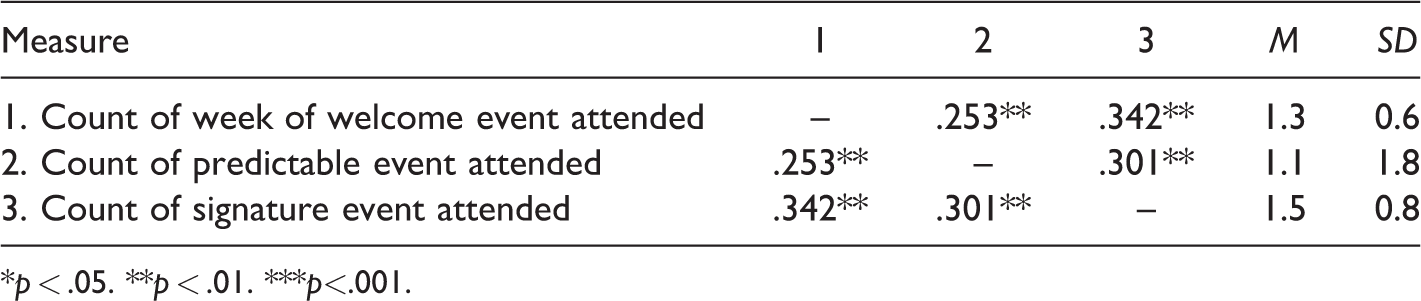
Results of the Spearman correlations indicated there are weak, positive, significant associations between attending week of welcome, predictable, and signature events with r values ranging from .20 to .34 (p < .01; Table 2). Chronologically, week of welcome events occur first thing in the academic year, with predictable and signature events occurring throughout the subsequent semesters. The associations between week of welcome and the follow-on types of events suggest that when students attend week of welcome, they are more likely to attend predictable and signature events later in the semester. Moreover, when they attend one type of programming, they are more likely to attend the other types of programming.
Spearman’s Rho Correlations Between Attending Week of Welcome, Predictable, and Signature Events During the First Full Year (N = 1,944).
*p < .05. **p < .01. ***p<.001.
Participation in Different Types of Activities and GPA
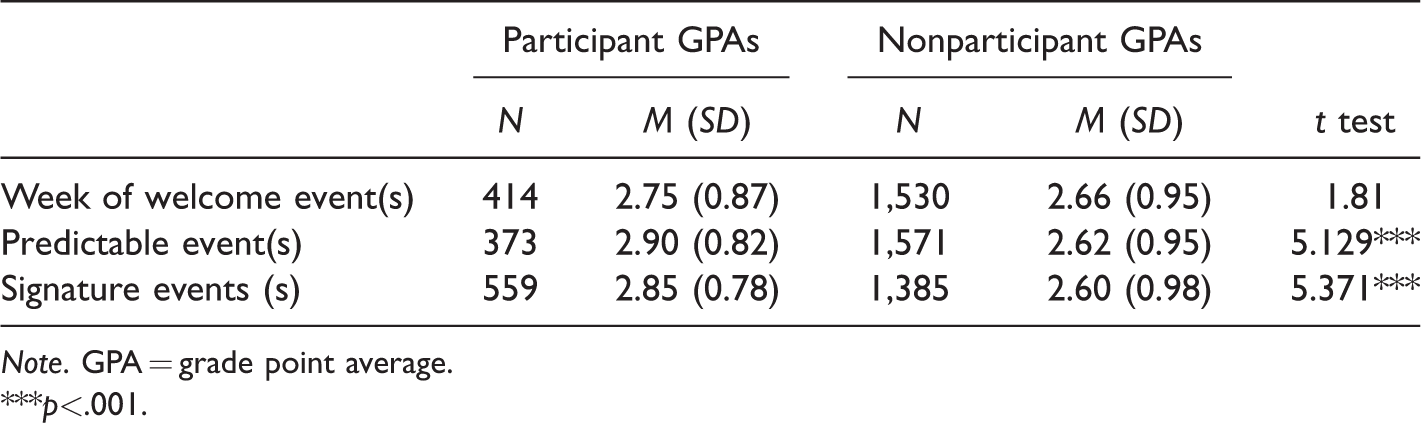
First-year students who attended predictable and signature events tended to have higher cumulative GPAs than students who did not attend these types of events, respectively (Table 3). On average, predictable and signature event participants had cumulative GPAs that were about a quarter of a point higher than nonparticipants.
Cumulative GPAs of Participants and Nonparticipants Who Attended Week of Welcome, Predictable, and Signature Events During the Full First Year (N = 1,944).
Note. GPA = grade point average.
***p<.001.
The relationship between attending signature events and GPA held even after student demographic, background, and environment characteristics were entered into a series of linear regression models (Table 4). In the final model, a one-unit increase in signature event attendance related to a 0.072 increase in GPA, which is noteworthy considering that GPA is on a 0.0 to 4.0 scale. This finding translates to an increase of close to a 10th of a GPA point with every signature event attended after controlling for other characteristics that are known to influence grades. Attending week of welcome and predictable events did not have discernable relationships with students’ GPA. Grades earned in high school, attempting higher average credits per term, and being female were positively linked with GPA, and working higher hours off campus for pay was negatively linked with GPA.
Unstandardized Coefficients (B) for Various Linear Regression Models of Cumulative GPA (n = 1,944).

Note. GPA = grade point average.
*p < .05. **p < .01. ***p < .001.
Different Types of Extracurricular Activities, Persistence, and Retention
Chi-square results indicated that first years who attended predictable and signature events tended to persist from fall to spring semesters, and first years who attended all three types tended to retain from the first to second year (Table 5). The association with persistence and retention was strongest for students who participated in signature events.
Persistence and Retention Rates (%) of Participants and Nonparticipants Who Attended Week of Welcome, Predictable, and Signature Events (N = 1,944).

*p < .05. **p < .01. ***p < .001.
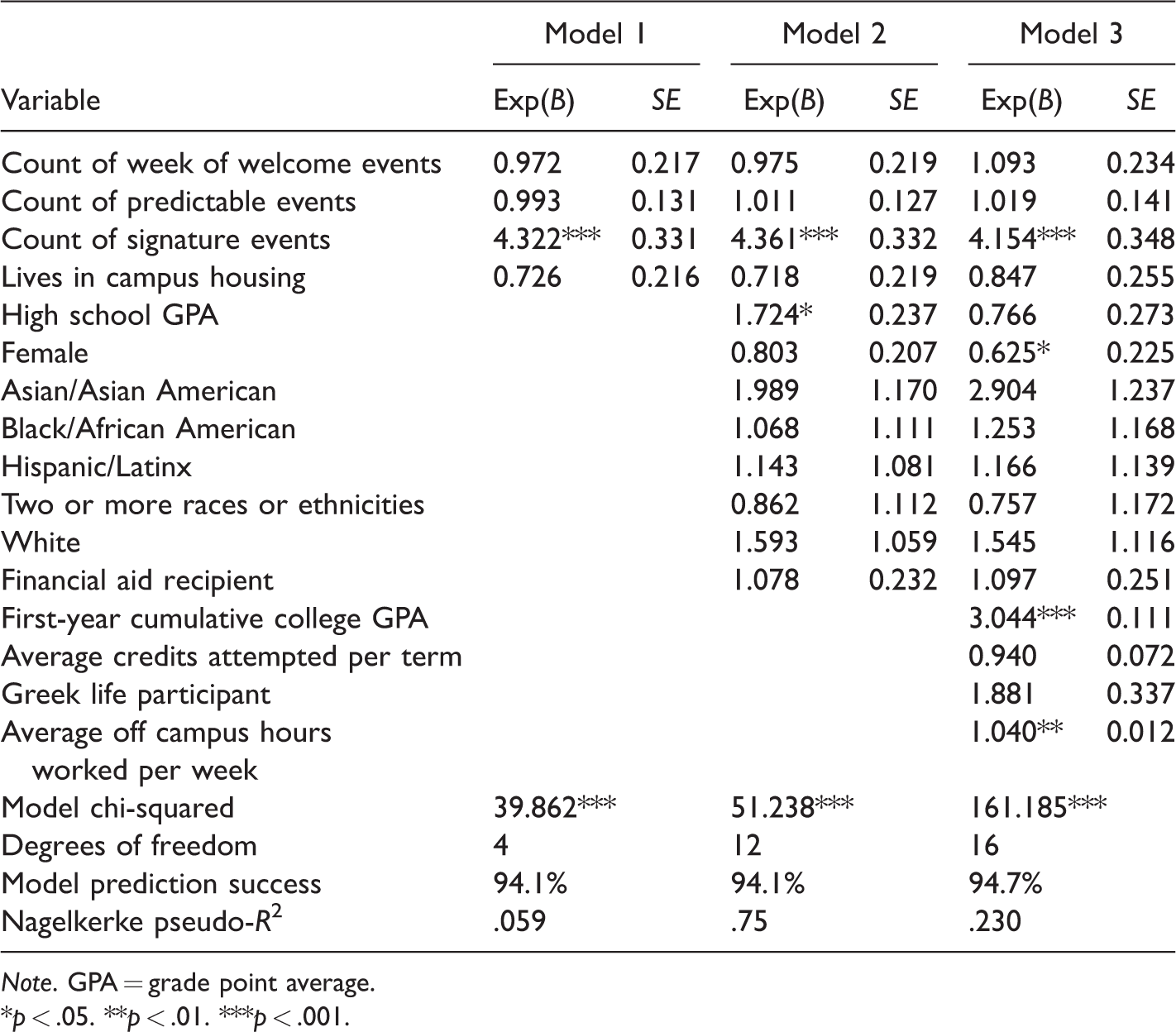
The relationship between attending signature events on first years’ odds of persisting from fall to spring semester held even after students’ demographic, background, and environment characteristics were entered into a series of logistic regression models (Table 6). In the final persistence model, attending signature events produced an odds ratio of 4.154, which means that those who attended signature events had more than four times higher odds of persisting compared with students who did not attend signature programming. Signature events were the only type of extracurricular event that had a discernible impact on students’ odds of persisting. Earning higher grades in the first year of college and working higher average hours off campus positively influenced students’ odds of persisting, with females being less likely to persist than males.
Odds Ratios (Exp(B)) by Variable for Various Logistic Regression Models of Persistence (n = 1,944).
Note. GPA = grade point average.
*p < .05. **p < .01. ***p < .001.
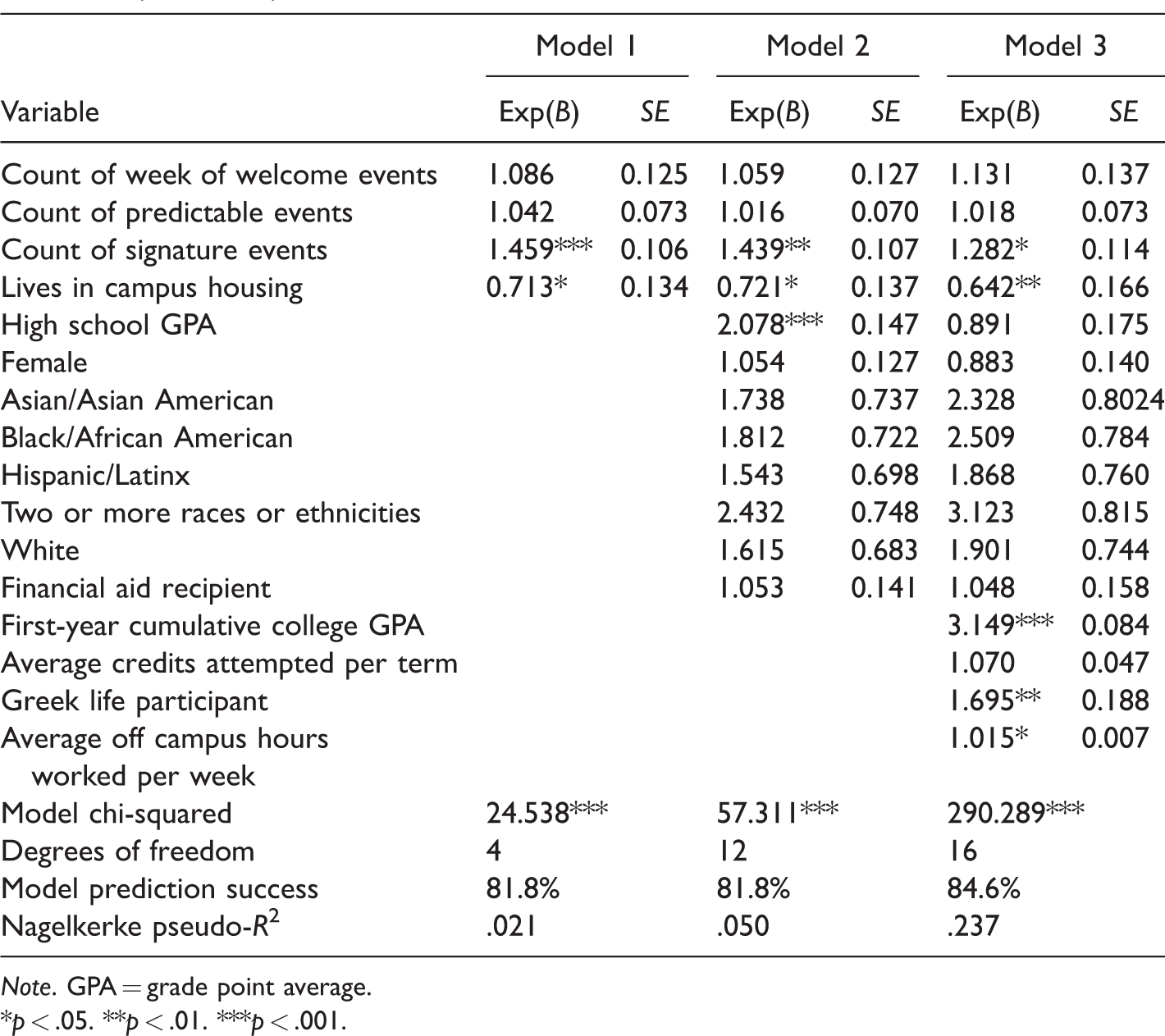
Finally, attending signature events was related to students’ odds of being retained into the next year (Table 7). Attending signature events produced an odds ratio of 1.282 in the final model, which means that students who attended signature events had about 28% higher odds of retaining compared with students who did not attend signature events. Earning higher grades in the first year of college, participating in Greek life, and working more hours off campus also influenced students’ odds of retaining, with students living in campus housing being less likely to retain.
Odds Ratios (Exp(B)) by Variable for Various Logistic Regression Models of Retention (n = 1,944).
Note. GPA = grade point average.
*p < .05. **p < .01. ***p < .001.
Limitations
As with many studies on student involvement and engagement, a limitation to this study is that it uses a correlational research design (e.g., Bensimon, 2007). Our methods helped identify broad trends in the available data using one cohort of students at a single university during an academic year, but multicohort and multi-institutional studies would provide a more comprehensive snapshot of the relationship between passive involvement and student success. In addition, our findings originate from a regional comprehensive campus, and they may not extend to other types of institutions or student populations. Another methodological challenge is that students who are successful academically could be predisposed to attend campus-sponsored events (Wolf-Wendel et al., 2009). Students self-selected into attending the events in this study, and our findings could reflect a limited group of students who are inclined to possess traits that are positively associated with good grades, persistence, or retention. We also do not include measures of their intent to persist or retain, and this study lacks other measures of social integration. The study is focused on students and campus life programming strategies at one university, which may not be representative of students or campus life offices outside the institution. Finally, other measures of student involvement including participation in high-impact practices are unobserved in our modeling. As scholars have noted, students choose to become involved on campus in various ways (Kuh, 2009; Pace, 1984), and the effect of any single activity may not be as critical as the cumulative effect across many experiences (Astin, 1984; Gellin, 2003).
Discussion
Pressure from multiple stakeholders keeps today’s higher education administrators accountable to justify spending and to provide more support for students with fewer resources. While it is well known that involvement in campus activities is positively associated with student outcomes such as GPA, persistence, and retention, it is less understood how participation in certain types of events is related to these outcomes. Findings from this study revealed significant differences between certain types of extracurricular campus events and first-year student GPA, persistence, and retention. Most notably, even after known predictors of these outcomes were entered into the models, attendance at signature events, but not predictable or week of welcome events, was related to higher GPAs and odds of persisting and retaining for first-year students. While it is not surprising that attendance at signature events is associated with positive outcomes, given the robust literature on involvement, engagement, and retention, it is somewhat surprising that all types of programming were not associated with these student outcomes. This suggests that perhaps there is something unique about the signature events in comparison with the other types of programming that influenced the results. Furthermore, if the relationship between passive involvement through signature events was random, we would not expect signature events to show up consistently in modeling on three different outcomes. One plausible explanation is that signature events, which typically coincide with campus milestones and thus may occur later than week of welcome and predictable events, represent the accumulation of involvement and engagement which can lead to integration. This interpretation would be consistent with findings from Bergen-Cico and Viscomi’s (2012) study where attending more events was positively associated with student outcomes. Furthermore, as Tinto (1993, 1997) describes, social integration is essential to retention for college students. Attendance at signature events, then, could provide a valid data point for college administrators to use to way to measure social integration of students.
A second plausible reason for these results may be that signature events, by design, strengthen a student’s connection to the university by building campus culture. The students in our sample were traditional-aged, first-year students who were enrolled full time. Building campus culture and identity takes time and sustained effort and buy-in from those in the community. If attendance at signature events is a representation of the accumulation of involvement for this group of students, it is possible that these types of events could represent mini versions of what Malcom Gladwell (2000) described in his novel The Tipping Point: How Little Things Can Make a Big Difference. Gladwell asserts that tipping points occur as a series of small changes or events converge to affect big change. Gladwell also talks about the rule of 80/20 where he suggests that in affecting change, 20% of the community does 80% of the work. Of these 20%, he suggests that, particular types of individuals are essential to reach a tipping point, one group of which he describes as connectors. Connectors have large social networks and bring people together. It is plausible that in limiting our sample to traditional-aged, full-time, first-year students, we honed in on a group of influencers who while getting involved themselves, connected with others to encourage their involvement, which leads to greater sense of belonging, builds campus community, and positively affects persistence and retention. Connectors may be drawn, and could potentially be drawing others, to signature events because they unify the campus community and serve as a mechanism through which participants can identify with and become further connected to campus (Magolda, 2001; Schlossberg, 1989). Connectors may also be using other tools, such as social media, to promote signature events in their own ways that make these particular types of events appealing to specific networks of students.
Recommendations and Implications
Student attrition is a layered and complex phenomenon, and amid tightening state and institutional budgets, institutions need to make judicious decisions about where to invest limited funds, especially when funding may come directly from student fees (Kuh, 2009; Kuh et al., 2005). Institutions are also called on to create opportunities for engagement and belonging for students and are increasingly expected to measure the effectiveness of their efforts for stakeholders including students, parents, and policy makers (Cochran, 2016; Kuh, 2009; Kuh et al., 2005; Pace, 1984). Understanding the role of extracurricular involvement in the larger constellation of student grades, persistence, retention, and graduation can help institutions effectively respond to these expectations.
While findings from this study did not show associations between first-year student participation in week of welcome and predictable activities, the positive association between attendance in signature events and GPA, persistence, and retention from the perspective that signature events represent an accumulation of involvement lends support for the need for the many and varied opportunities for first-year students to engage. Based on the findings of this study, we recommend that campus administrators are intentional about the creation of varying types of small events that lead up to culminating signature events. We recommend campus administrators consider how card-slide technology can be used as a tool to provide useful data on student attendance at events and opportunities for assessment of the relationships between such events and student outcomes. Furthermore, given the positive relationships uncovered between attendance at signature events, GPA, the odds of persisting, and retaining, we recommend administrators consider using attendance at signature events as a data point for measuring student integration. Implementing card-slide technology for activities tracking could help campuses identify engagement patterns, design interventions, or augment predictive analyses that identify successful student behaviors. Findings from this study can be used to inform offices of undergraduate success, enrollment services, divisions of student affairs, as well as additional campus and local stakeholders who seek to improve student outcomes and build campus community.
This study suggests new avenues for future research by extending the work of Bergen-Cico and Viscomi (2012) and by suggesting a redefinition of extracurricular involvement to include passive forms of involvement. However, this topic warrants more investigation. Including passive forms alongside active forms of involvement in future research has the potential to help shape a more inclusive definition of involvement that can be applied to students who engage on campus in ways that are not captured by traditional definitions. Future studies should explore how different types of students interact with different types of extracurricular activities. Our study also suggests a new framework of types of campus activities—week of welcome, predictable, and signature events—that campuses can adopt to frame or assess their own programming. Future research on this topic could explore this framework in more depth, with multiple years of data, and at various types of institutions. More research is needed to explore the relationship of passive involvement with grades, persistence, and retention beyond the first year, as well its relationship with longer term outcomes like graduation rate, time to degree, satisfaction, sense of belonging, institutional attachment, and even alumni giving. Redefining extracurricular involvement in this way could help student affairs staff and campus leaders select and refine their extracurricular offerings to provide a well-rounded experience while directly supporting students’ academic success.
Footnotes
Declaration of Conflicting Interests
The author(s) declared no potential conflicts of interest with respect to the research, authorship, and/or publication of this article.
Funding
The author(s) received no financial support for the research, authorship, and/or publication of this article.