




Abstract
Success for 4-year universities is often measured by graduation and retention rates; however, gaps exist in understanding nonreturning students at private institutions. Recent research is helping to build the lexicon of drop-outs, stop-outs, opt-outs, and transfer-outs to inform strategic retention initiatives. Using an action research method, we characterized 1,091 students into designated subclasses and utilized exit interviews, advising notes, and university surveys to theme their departure intentions. Findings reveal transfer-outs to be the largest subclass, with departure reasons being summarized within themes of university experience and fit, health, academic, and financial. Recommendations are made for university administrators and retention offices related to exit survey questions, broadening success metrics, and to focus on specific student characteristic groups.
For 4-year universities, success is often measured by graduation and retention rates (Millea et al., 2018). Higher education institutions (HEIs) have long sought to identify characteristics to predict student retention and attrition to achieve success (Brasher et al., 1980; Gathers, 1982; Tichenor, 1987). Nonreturning students depart HEIs for many reasons (Hermanowicz, 2006). Yet, the evolving complexity of these reasons has generated a need for both more than one descriptive category and an instrument with a wider scope than a traditional exit survey (Hoyt & Winn, 2004). Building upon the work of Hoyt and Winn (2004), we studied student departure data from a selective, private, 4-year university to expand a singular descriptor of nonreturning students into four categories: drop-outs, stop-outs, transfer-outs, and opt-outs. We aimed to determine whether the success of retention initiatives is constrained by legacy descriptors that classify nonreturning students as a single population. Furthermore, our action research orientation sought to assist practitioners in improving and refining the lexicon of student retention (Sagor, 2000). In doing so, we hope to accommodate the complex intentionality of departure while informing prediction models that could improve measures of retention success.
Expanding Student Readiness with a Retention Focus
In his foundational college retention theory, Tinto (1975, 1993) utilized a sociological lens when developing his model to understand student departure. This seminal theory highlighted individual entry characteristics (e.g., pre-college schooling, individual attributes) as the predictive factors contributing to student departure (Demetriou & Powell, 2014; Tinto, 1975). More recently, the field of student retention has undergone a shift from focusing on individuals’ sociodemographic characteristics as the sole predictors of student persistence, to utilizing student development theories as the method to better understand the relationship between student development during college, including how external forces shape their experience, and student retention and success. This shift can be seen through the suggestion by Demetriou and Powell (2014) that developmentally focused retention policy “may have more to offer than the dominant sociological paradigm” (p. 419). Their work included transitioning from a college-ready model (with the onus on the student to acclimate to and be prepared for the institution) to a student-ready model (with the onus on the institution to be prepared for all students). This type of model and accompanying research offers a perspective in which “positive development occurs through reciprocal and mutually influential relations between an individual and the multiple organizational levels of an environment” (Demetriou & Powell, 2014, p. 427). Student development theories have led researchers to promising outcomes in academic well-being and student retention (Shek & Chai, 2020; Taylor et al., 2017; Turner & McDaniel, 2016).
Furthermore, research on college-student retention has focused on public institutions, leaving much to be understood of private HEIs. In his research on retention at an elite, private university Hermanowicz (2006) suggested student reasons for leaving college as being pluralistic and ill-formed but sharing “generic properties” that can inform retention policy (p. 21). He stated that student reasoning offers less of a “valid ground to leave” and more of an opportunity for cognitive intervention (p. 35). A 2006 study of first-year Latino students at a private university determined that the sociological factors often treated as predictors of retention were not statistically significant (Chowdhury, 2006). From research at a midsized, private university, McPherson (2016) identified “multitheoretical retention levers” to reduce student withdrawals from college (p. iv). More research is needed on the efforts of private HEIs to retain students.
Nonreturning Students
Working Toward Retention
As with most fields, research on college-student retention is evolving. Prior to the 1990s, retention research largely treated nonreturning students as a single category (Hoyt & Winn, 2004). In the 21st century, however, specific issues of financial solvency, university ranking, and brand reputation have become inextricably linked and measured through student-retention initiatives (Delen, 2011). Building the “sustainable university” is of growing interest to higher education researchers and practitioners alike (Adomssent et al., 2007; Amaral et al., 2015; Gal, 2012; Neamţu et al., 2020; Zahid et al., 2017). Higher education practitioners will recognize the sustaining power of successful retention initiatives. In an article presented at the 2005 National Conference on Student Recruitment, Marketing, and Retention, leading retention researcher Tinto (2006) addressed “what's next” in research and practice: “Unfortunately, most institutions have not yet been able to translate what we know about student retention into forms of action that have led to substantial gains in student persistence and graduation” (p. 5). While some have focused on retention strategies that increase engagement (Davis et al., 2013; Zhao & Kuh, 2004), that engagement often treats nonreturning students as a single category. This treatment leads to “inaccurate findings in the prediction of student retention”―predictions that inform misguided campus engagement strategies (Hoyt & Winn, 2004). Therefore, a need exists to operationalize multiple categorizations to aid actions by institutions to improve retention.
Broadly speaking, recent research has enhanced our understanding of nonreturning students. Namely, financial stress, self-reported student loan debt, and sense of belonging represent useful predictors of student retention (Britt et al., 2017; Davis et al., 2019). International and first-generation students tend to experience lower levels of retention than domestic and non-first-generation students (Haverila et al., 2020; Soria & Stebleton, 2012). Gender, ethnicity, and socioeconomic status also interact to affect student retention rates (Keels, 2013). And lastly, while increased access to higher education has contributed to social and economic benefits for historically underrepresented groups, it has also shed light on the issue of student retention and success for these same populations (Thomas, 2016). Thus, it remains important for higher education leaders to differentiate their retention efforts to ensure a campus ready for student development.
Categorizing Nonreturners
In the 1980s, a notable few researchers began exploring ways to differentiate students’ reasons for withdrawing from college through subclasses like drop-outs, stop-outs, horizontal transfers, vertical transfers, and nonpersisters (Brasher et al., 1980; Gathers, 1982; Tichenor, 1987). These early researchers recognized that “one of the most important tasks of retention research is consequently to enable the administrator [to] distinguish between these importantly different types of withdrawal” (Ewell, 1984, p. 11). Recent research is now helping to build the lexicon of drop-outs, stop-outs, opt-outs, and transfer-outs, as well as informing strategic retention initiatives. Stephenson et al. (2020) found that participation in a voluntary survey in their first semester “had notable retention prediction power” for identifying drop-outs (p. 17). Webb and Cotton (2018) proposed increasing one-on-one interactions between students and faculty, as well as peer interactions, as a strategy to reduce drop-outs and increase retention. Inside Higher Ed recently reported on organizational initiatives focused on reenrolling “stopped-out students” across 13 colleges in 12 states following the global pandemic (St. Amour, 2020, para. 2). For opt-outs, James (2020) suggested that nontraditional-student retention can be increased by better preparing them for the difficulty and time commitment required of online learning. Additionally, it was demonstrated by a recent study that students who transfer out typically exhibit lower levels of social integration at their initial institutions (Ishitani & Flood, 2018). Bringing together recent research around a common lexicon can have important implications for campus-ready retention initiatives targeted at a specific departure population and reasons.
Conceptual Framework
In the early 2000s, Hoyt and Winn (2004) reiterated the need to expand the treatment of nonreturning students beyond a single category. We utilized their conceptualization for the framework of our study. “The problem with treating nonreturning students as a single population is the implications of inaccurate findings in the prediction of student retention” (Hoyt & Winn, 2004, p. 396). Their research at a large, suburban, public university in the Rocky Mountain region of the United States expanded the treatment of nonreturning students to four subclasses: drop-outs, stop-outs, opt-outs, and transfer-outs. Three of these categories find commonality in their degree-seeking objective (drop-outs, stop-outs, and transfer-outs), while one (opt-outs) differs in its non-degree-seeking objective. Table 1 includes definitions and characteristics for each subclass of nonreturning student applied in this study.
Subclasses of Nonreturning Students.

Note. Adapted definitions from Hoyt and Winn (2004).
This conceptual framework promotes a richer understanding of the complex intentionality of student departure from HEIs. Specific to our research is a focus on an understudied area of higher education research―elite, private HEIs.
Purpose and Relevance
Given the lack of research available on retention at private institutions (Hermanowicz, 2006) and the need to further understand nonreturning students (Hoyt & Winn, 2004; St. Amour, 2020; Stephenson et al., 2020), we conducted this study with three purposes: (a) classify nonreturning students using the Hoyt and Winn (2004) framework; (b) summarize the departing intentions of nonreturning students, and (c) compare the number of nonreturning students falling into each subclass based on student characteristics (i.e., student demographics).
Method
Design
Based on the suggestion by Altrichter and Posch (1989) that “what's good for the practice is good for the research” (p. 29), we utilized a method that worked for us as practitioners. Our pragmatic paradigm informed our descriptive, historical (Creswell & Creswell, 2018), action research method to understand what is occurring (i.e., undergraduate-student departures). Action research is a disciplined process of inquiry conducted by and for those taking the action (Sagor, 2000; Melrose, 2001). The primary reason for engaging in action research is to assist the actor (i.e., research team members with responsibility for retention) in improving and/or refining their actions (Sagor, 2000). Action research is appropriate if three conditions are met: (a) the focus of the action research project is on the actor's professional action, (b) the actors are empowered to adjust future action based on results, and (c) improvement is possible (Sagor, 2000). These three conditions were met by the present inquiry as (a) the research team members have responsibility for retention, (b) members of the research team have control and influence to adjust future processes/policies in their respective units to this end, and (c) the research site's undergraduate retention to graduation can be improved and has a stated goal to improve. The Institutional Review Board at the research site reviewed and approved the study.
Population and Sample
Patton (1990) posited the use of purposive sampling when the population is identifiable to the researchers. The population identified for the study was degree-seeking undergraduate students who entered the research site from fall 2017 through fall 2020 and who departed the university temporarily or permanently during fall 2017 through spring 2021. Nonreturning students were operationally defined as those who did not complete one or more fall or spring terms at the research site. Utilizing a roster method (Marsden, 1990) the research team exported a list of 1,091 noneturning students from the student information system in June 2021. A total of 69 students who withdrew for medical issues or were dismissed for academic or conduct reasons were excluded from the sample. Students who were deceased at the time the data were exported were also excluded. Table 2 details the population of the student sample for the study.
Demographics of Nonreturning Students Between 2017 and 2020.

Data Collection
Goodson and Walker (1991) recommended that “the task of research is to make sense of what we know” (p. 107). Therefore, existing educational-student records and data were used to answer the research purpose(s). Specifically, the research site's student information system (SIS), academic-advising notes, exit survey notes, university-administered surveys, and National Student Clearinghouse (NSC) data were combined to form the richest description (Lincoln & Guba, 1985) and institutional understanding for a student's departure.
Student Information System
During the planning phase of the study, the research team brainstormed and identified student data maintained in the SIS to aid in understanding a student's decision to depart. The research team exported student characteristics from the SIS, which included three types of data best conceptualized as (a) academic, (b) demographic, and (c) campus involvement. Academic data exported from the SIS included variables such as admission type, cohort term, graduation status, admission rating, and term-specific data, including enrollment status, academic-standing status, and degree-seeking status. Demographic data included variables such as sex, ethnicity, first-generation status, and Pell eligibility in their 1st year. Finally, exported variables of campus involvement included athlete status, Greek life affiliation, and membership in a scholar group specific to the research site.
National Student Clearinghouse
The research team then requested all enrollment data prior to May 15, 2021 (including the spring 2021 term and earlier; however, spring 2021 data were not yet available) from the NSC for the 1,091 identified nonreturning students in the sample. The research team merged the NSC data with the SIS data and identified 416 students who attended other institutions after their entering-cohort term at the research site. Some students showed as enrolled at both the research site and another HEI within the United States in the same term; in those instances, the research team considered the student enrolled at the research site. Data reporting standards and the operational definition of enrolled students can be found on the NSC website (National Student Clearning House, 2021).
University-Administered Surveys
Two university-administered surveys collect data from or about nonreturning students to aid retention initiatives at the research site. The first is the research site's student exit survey created and disseminated utilizing an online survey platform, Qualtrics. This survey was sent from staff members within the academic success office to identified respondents starting in April 2020. Respondents were identified as eligible for the survey when they notified campus staff or faculty that they intended to permanently leave the institution. The survey was sent immediately to the student from the staff or faculty member, once identified. The survey was primarily completed by undergraduate students themselves, but at times, staff knowledgeable of a student's experience completed it on their behalf. This action was generally taken when a student was nonresponsive to requests for survey completion. The survey consists of 69 items, and display logic and branch logic were utilized to pose additional questions based on a respondent's answers. Of the 69 items posed to respondents, the answers to four open-ended items and one nominal item were included in analysis. There were 130 exit surveys accessible to the research team, of which 85 responses were from students contained within the sample.
The second university-administered survey is a Qualtrics-based survey of staff and faculty on student retention. It is distributed to selected staff and faculty who have engaged regularly with students. The survey contains 11 survey items with the purpose to provide a space for faculty and staff to notify the academic success office, at any point in the year, when they are concerned that a student may be at risk of leaving—both permanently and for short-term leave. In total, this university administered survey had 209 submissions, of which 106 were included in the analysis because they included data about students within the sample.
Academic-Advising Notes
Advising notes document student interactions, primarily between a student and an advisor, via the SIS. This function allows advisors and other staff to record their notes and provide documentation to others authorized to view these student data. The categories documented are academic discussion, graduation discussion, personal discussion, international student services discussion, and student considers leaving university. For the purposes of this study, we only included data identified by the category of student considers leaving university. Within this category, the following subcategories are utilized by advisors and campus staff: financial issues, leave of absence, and transferring to another school. The documentation of a student discussing leaving the university and the citation of one of the subcategories were used when placing students in the appropriate subclass of nonreturning student and/or student intent. Advising notes were implemented in April 2020, with a total of 46 relating to the sample being exported.
Exit Interviews
Exit interviews were conducted from May 2019 to August 2020. The interviews consist of six questions asked by a staff member in the academic success office to the nonreturning student either verbally (in-person or by phone) or via email. There were 127 exit interviews collected. These exit interviews served as the primary method by which offices within the academic success unit had collected data on reasons for student departure until the research site launched the student exit survey. Exit interviews were triggered when a student completed a leave form or were identified as transferring. Exit interviews were seemingly mandatory for student to complete but no enforcement mechanism was utilized. For this study, there were 117 interview notes, and each was connected to a student within the sample.
Data Analysis
To better understand the subclasses of nonreturning students at a private HEI, analysis was conducted by a team of researchers. This team consisted of academic faculty, staff, and both graduate/undergraduate assistants. Analysis was conducted in two phases. First, the population set of 1,091 student records was categorized into one subclass to fulfill the first purpose of the study. Directed content analysis (Hsieh & Shannon, 2005) guided the efforts of researchers by leveraging a conceptual framework posited by Hoyt and Winn (2004) for four subclasses of nonreturning students: drop-outs, stop-outs, opt-outs and transfer-outs. A fifth subclass of too early to determine was added because of the university business process of students being permitted two consecutive terms of unenrollment before a drop-out determination is made. The majority of student records (972 of 1,091) for this study did not contain university administered surveys, academic-advising notes, or exit interviews from which to determine intentionality of student departure. Even though considerably more data was collected and recorded by the institution, only 11% was applicable to understanding the intention of departing students—suggesting some efforts are less helpful to inform retention efforts. We elaborate more on this insight in our discussion and recommendations. Directed by Hoyt and Winn (2004) subclasses, researchers created data-sorting logic to deduce intentionality. Table 3 explains the logic applied to the population set. Please note that opt-out and drop-out are combined.
Subclass Logic for Directed Content Analysis.

The research team was subdivided into two teams (i.e., Team A and Team B). Each subteam reviewed about half of the 1,091 student records. The student records included all of the available data discussed above. Using a strategy suggested by Hsieh and Shannon (2005), each student record was coded by one researcher into one of the five subclasses, and notes and highlights were made to support classification. For example, Researchers A1 and A2 reviewed the same 355 student records. If a disparity was identified between the two researchers in the coding of a primary subclass, a third researcher outside the subdivided team reviewed the record for final determination. Results were recorded in a leading qualitative data analysis computer software package, which aided in the development of an audit trail and interrater reliability (Lincoln & Guba, 1985).
To achieve the second purpose of the study, content analysis (Creswell & Creswell, 2018) was performed on the text of 119 exit interview field notes, university surveys, and advising notes. We began with start codes, formed categories, and finally identified emergent themes on the expressed departure intentions captured by the research site's business practices.
Finally, to achieve the third expressed purpose of the study, we used Fisher's exact test. We assessed the strength of the association between a student's characteristic group (i.e., sex, first-generation status, nonresident aliens, Pell grant recipients, transfer students, etc.) and their nonreturning subclass. Fisher's exact test was utilized to compare the proportion of certain characteristic groups with all other students included in the sample.
Positionality
Inherent in the design of action research, this research project relates to the professional action of its research team members. The seven-member research team comprised higher education professionals responsible for enrollment and retention, as well as student and academic support at the research site. The research team also included undergraduate and graduate students. Membership was predominately White, cis, and female.
Findings
Findings are presented in the order of the three purposes of the study. First, Table 4 presents the classifications of nonreturning students from the directed content analysis using Hoyt's and Winn's framework (2004). The largest subclass is transfer-out, representing 42% of the sample, with drop-outs representing 31%. Additionally, higher frequencies were observed in the fall cohorts from 2017 and generally decreasing to more recent cohorts in 2020.
Subclasses by Entry Cohort Term.

The second purpose of the study was to summarize nonreturning students’ departing intentions between 2017 and 2020. Table 5 presents the four emergent themes that were identified from the content analysis (i.e., university experience and fit, financial, health, and academic), along with descriptions.
Theme Descriptions of Departing Intentions of Nonreturning Students.
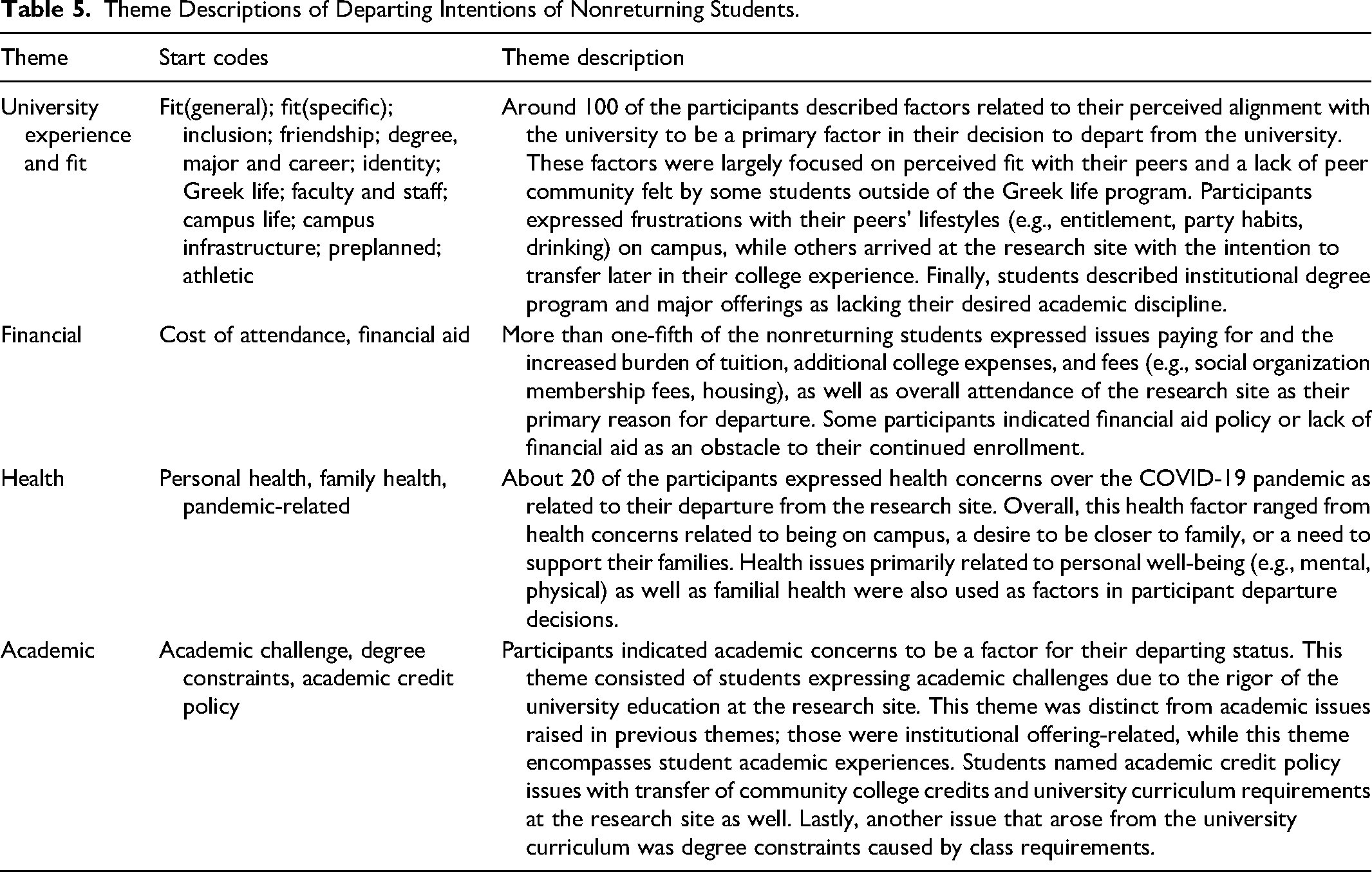
University Experience and Fit
The perceived fit between the participant and the university represented a significant reason for students choosing to leave the research site. As one student emphasized, “the university was not a good fit overall” for them. In addition to comments on general fit, other students expressed more specific issues with the university culture. For example, the “elitist and judgmental attitudes of my fellow students made me realize that [the research site] was not right for me.” Students expressed this lack of fit to be compounded for students outside of the Greek life program. “The entire social life of the school is dominated by Greek life,” remarked one student. Other participants decided to depart since realizing a lack of alignment between the university and their future career plans. This divergence led to departure because it was caused by a lack of specific degree or major. According to one, “for my degree and situation there is another that is a better fit.” Another expressed a need to “take time off to figure out what my passion is.” Some students went on to express concerns about the university faculty and staff as contributing to their intention to depart. For example, “school officials do not respond back to emails with alarming issues.” Others expressed concerns regarding the living requirement of the research site: “the requirement of living on campus … had a negative impact on my view of the university.” Campus infrastructure was also treated as an enabler for intentionality to leave. “The 20-min walks to class made finding the motivation to attend [class] difficult.” Athletic fit was also described by a handful of students, best recounted with the comment, “my style of play … [is] not a good fit for the program.” Lastly, to illustrate the theme of university fit, there were students who had the intention to leave from the beginning of their time at the research site; hence, their departure was preplanned. This sentiment was expressed through statements or comments like “I intended to leave [the research site] after 1 year.”
Financial
Not only did students intend to leave because of a lack of perceived fit with the university, but some students departed for financial reasons. Some participants felt “drowned by the cost of attendance.” Some students experienced financial stress, which was heightened by the site's financial aid policies. For example, one student felt discouraged upon realizing that “the financial aid decreases every time an outside scholarship has been earned.” Finally, changing aid packages during attendance was also cited as a contributing factor to departure.
Health
Thirdly, students conveyed health concerns to be another emergent theme for their intention to depart. While some participants left amid concerns for their personal health (e.g., mental and physical), others left to be caregivers to their family. To illustrate these concepts, one participant posited, “for someone with social anxiety … living on campus isn't easy.” Another health concern emerged in the data with the onset of the COVID-19 pandemic. Some participants wanted to “[live] closer to home … God forbid anything happen to my family.” Others preferred to depart their college education at the site because of concerns over safety: “I feel unsafe with the growing number of COVID-19 cases on campus,” a student enumerated in his exit survey.
Academic
Lastly, academic reasons captured the essence of some students’ intentions to leave. “I felt unchallenged or bored in many of my classes,” a student expressed while discussing the lack of academic rigor. On the other end of the dimension represented in this theme, some students felt overwhelmed by the university degree plan requirements. A student said, “I feasibly could not graduate in four years with my mechanical engineering degree with the horrid breadth/[curriculum] requirements.” Additionally, the site's academic credit policy was criticized for its restrictiveness: “You guys are wrong for not accepting most (if not all) community college credit hours,” a student noted. Therefore, academic reasons were a theme in student departure intentions. Table 6 presents the themes and their representations within each subclass. Overall, university fit was represented within 51 transfer-outs.
Theme Counts of Nonreturning Students by Subclass.
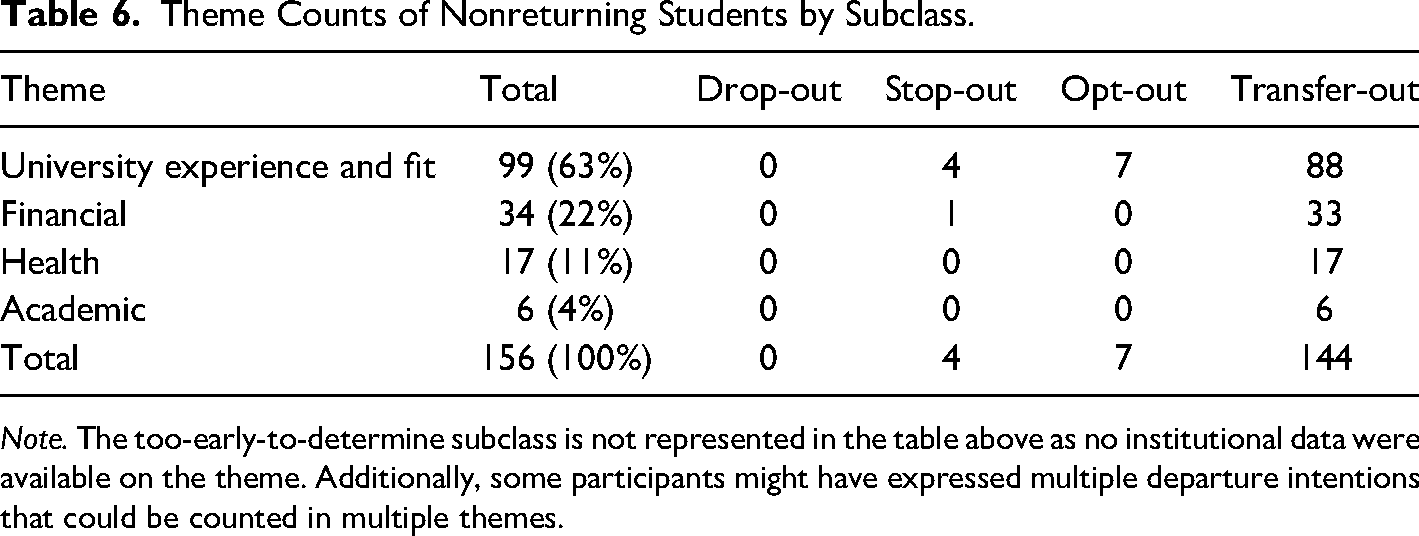
Note. The too-early-to-determine subclass is not represented in the table above as no institutional data were available on the theme. Additionally, some participants might have expressed multiple departure intentions that could be counted in multiple themes.
The third purpose of the study was to compare nonreturning students by student characteristics as exported from the SIS. After performing a series of Fisher's exact tests, significant associations were uncovered between certain student characteristic groups and representation within the nonreturning population. Groups exhibiting greater-than-expected representation within the nonreturning population included nonresident aliens (p < .001), Pell grant recipients (p < .001), transfer students (p < .001), and first-generation students (p = .035). Alternatively, groups exhibiting less representation than anticipated within the nonretuning population included female students (p = .010), student athletes (p < .001), and students enrolled in a university-wide honors program (p < .001).
Discussion and Recommendations
Our findings yielded five insights that extend and corroborate the current literature: (a) drop-outs were the second largest subclass of nonreturning students, (b) opt-outs are significantly less represented within the nonreturning student population, (c) there is disproportionate representation of nonreturning students by some student characteristic groups, (d) an HEI's degree-seeking orientation may present a biased positionality affecting a student's well-being, and (e) intentionality is a derivative of the student voice.
First, of all the subclasses, drop-outs were the second-largest representative group (31%; n = 341) across the 1,091 cases encompassed in the study. Not surprising though, drop-out is often the singular term used to describe all nonretuning students in both the K–12 and HEI contexts and often does not reflect the nuances of all nonreturning students (Hoyt & Winn, 2004). Our study illustrates the need to provide nuance, though, as transfer-outs were the largest subclass represented at 42%. The emphasis and focus on drop-outs dominates current scholarly discussion and within the enrollment management literature (Brasher et al., 1980; Gathers, 1982; Tichenor, 1987). With our action-based research orientation, this often is a large group that is not well understood by HEIs. For instance, the research site's business practice is to allow students the ability to register for classes for two consecutive terms following a recent active term. If no action is taken by the student within two terms, they must reenroll before they are able to register for classes. By leaving the onus on the student, the institution misses an opportunity to collect the intention or to understand the reason for dropping out from the nonreturning student. For instance, institutions should reach out to students after one term of unenrollment to collect and record their intention to return. Nonreturning students encompassed in this subclass might indeed be better characterized by another lexical term. With additional institutional knowledge, the drop-out subclass may be further classified or better understood. Therefore, HEIs should develop mechanisms or a process to reach out to students who do not enroll for two consecutive terms to understand their unenrollment rather than merely assigning the drop-out subclassification.
Second, our study identified significantly fewer opt-outs (n = 2) as compared with any other subclass. This could be the result of students not leaving for this reason; however, it could also be that the university administered surveys and mechanism may not include questions that aid in the identification of opt-outs. To account for this possibility, HEIs should add questions that would better identify this subclass of nonreturning students. Examples of a simple yes/no question could include, “Are you opting out of a college degree in favor of another life opportunity/event?” This simple question could produce quicker classification by the institution of opt-outs. We suspect this subclass to be underrepresented merely by the limitations of the institutional information gathered from nonreturing students.
Third, our findings present a disproportionate representation of nonreturning students by some student characteristic groups (e.g., nonresident aliens, Pell grant-eligible students, and transfer students). Nonresident aliens make up 6% of the university's student population, yet account for 9% of nonreturning students. Fisher's exact test provided very strong evidence that nonresident aliens differ from all other students in their likelihood of not returning (p < .001). From this data, we can gather that this population of students may encounter more struggles with completing their degree than United States citizens. Furthermore, Pell grant recipients make up 13% of the university population, yet account for 17% of nonreturners, while transfer admits make up 15% of the university population, yet account for 20% of the nonreturning population. Similarly, statistical analysis from the Fisher's exact test provided evidence that these two characteristic groups differ from other students in terms of likelihood of not returning (p < .001 for both tests). These findings may imply that students who come from disadvantaged financial backgrounds may experience more trouble meeting financial obligations to maintain continuous enrollment. We can also reason that transfer students may require more resources and focus from the institution to ensure that they remain enrolled and graduate on time especially considering the challenges with transitioning to a new environment.
Fourth, through our research and within the related literature, there appears to be a biased positionality from which to assess a student's reason for departure. There is an assumption that graduation with a 4-year degree is the sole avenue to achieve success. This is problematic. For example, two student records within our study indicated a departure from the university to pursue a military career. While this non-degree-seeking objective may be contrary to the goals of student retention and graduation initiatives of HEIs, it may align with the general well-being or life goals of the student. Therefore, it is recommended that HEIs and future research diversify the definition of success in college. For instance, many universities are investing in entrepreneurial programs to cultivate business startups (Liguori et al., 2018). If a student opts out of college and starts a successful business, is this failure on behalf of the institution if it supported such endeavors with programs and infrastructure? HEIs ought to consider how they might include opt-outs in their success narratives alongside retention and graduation rates. In addition to successful businesses, opt-outs may include a desire to pursue military service, as was the case in our study for two participants.
Lastly, as researchers conducted coding of the sample (n = 1,091), it became clear that participant-articulated intentions played a key role in the categorization of subclasses (i.e., drop-out, stop-out, opt-out, and transfer-out). As discussed previously in the data analysis section, only 188 of the 1,091 student records contained university-administered surveys, academic-advising notes, or exit interviews—intention-focused data sources. This raised the question: Do student records that lack a clearly articulated intention constitute classification under the conceptual framework? Consulting Hoyt and Winn 2004 study in which students “were questioned about their reasons” for departure, we concluded that intentionality is a derivative of the student voice (p. 402). Two important recommendations extend from this conclusion: (a) In the case of the 542 records that did not contain clearly articulated intention-focused data (49.7%), we determined that using a subjective approach to sorting by subclass—using data not derived from the student voice (e.g., institutional records)—provided more value to the HEI than a broad label of “nonreturning student.” (b) It is important that HEI initiatives capture the student voice by questioning intentionality.
Limitations
While we believe our study to be sound, we note several limitations. First, when operationalizing nonreturning students and determining a subclass, we only made determinations on drop-out and stop-out categorizations after two terms had passed based upon university business practices. This strategy may have disproportionately skewed subclassifications in cohorts whose admission terms were in 2020 or 2021. Plus, we used National Clearing House Data which is only available for United States colleges and universities and may not have captured transfer-outs accurately for international students returning to their home country or pursuing school outside of the country. Second, this study was conducted in the summer of 2021 after almost 2 years of the COVID-19 pandemic. The global pandemic impacted all industries including higher education and may have contributed to uncharacteristically high number of stop-outs because students and families across the globe had dramatically changing personal and professional contexts within the timeframe. Further action research should be conducted to specially track COVID-19 cohorts of students or ensure that findings resonate in future years. Third, the 2018 student cohort was represented at a higher degree in the data because of the cohort's longer duration at the institution and greater timeframe to enter the status of nonreturning student. Fourth, prior to 2019, qualitative source data did not contain reasons for leaving the university (i.e., intentionality): the university administered survey and exit surveys were not instituted until 2019 at the charge of new provost-office administrator. Similarly, university forms documenting student reasons for departure (i.e., leave, withdraw, and cancel) were not widely circulated as part of a systematic process until 2019 when the academic success office was created.
Conclusion
Given the significant emphasis placed on student retention by higher education leaders and stakeholders alike, a greater understanding is needed on the subclasses of nonreturning students and their reasons for leaving their institutions. Especially in the wake of the COVID-19 pandemic, HEIs must consider the tools at their disposal to combat student attrition. Furthermore, our research emphasizes the disproportionate numbers of nonreturning students observed in certain student demographic groups. To combat this issue, HEIs should be motivated to provide additional resources to students who may be at higher risk for leaving their university. Perhaps most importantly, our findings demonstrate the importance of capturing the voice of nonreturning students through intention-focused questions. Aside from aiding in the classification of nonreturning students, having access to intention-focused data enables higher education leaders to better assess the drivers of student attrition. Thus, HEIs should maintain well-organized and consistent assessment tools that accurately identify the intentions of and give voice to nonreturning students.
Footnotes
Declaration of Conflicting Interests
The author(s) declared no potential conflicts of interest with respect to the research, authorship, and/or publication of this article.
Funding
The author(s) received no financial support for the research, authorship and/or publication of this article.
