




Abstract
Men of color are not persisting or graduating from college at similar rates as their same-aged peers. This qualitative study seeks to understand how men of color understand and experience college at a rural comprehensive public four-year university on the west coast. This study draws on focus group and interview data from 23 Black, Latino, and Asian American men whose enrollment status at the rural university varied from first-year undergraduate to graduate students. Using the notion of sense of belonging as the theoretical lens, we find that students highlighted the importance of peer groups and the need for vulnerable spaces on campus to explore their gender identity. With the findings from this paper, we aim to help student affairs professionals better understand how to support men of color in rural universities.
The path towards college degree attainment for Black, Latino, Indigenous, Asian American, and Pacific Islander men, hereafter referred to as men of color, is riddled with personal challenges and institutional barriers. The culmination of struggles in higher education for men of color contribute to less than 20 percent a four-year college degree in 2012 (Perez Huber et al., 2015) and unfortunately, this number has not changed in almost 10 years (National Center for Education Statistics, 2020). The low college degree attainment for men of color has drawn national concern and response from higher education, and others, on how to best address how college climates contribute to diminished persistence and retention rates that lead to high attrition (Huerta et al., 2021; Huerta & Fishman, 2014; Hurtado & Carter, 1997; Locks et al., 2008). In higher education spaces, faculty, staff, and leadership are unclear of the best strategies or practices to support men of color (Clark et al., 2013; Huerta & Dizon, 2021), and this creates a void on the unique ethnic, racial, and gendered needs for this group of students. Much of the current scholarship understands how the personal and environmental challenges impacts men of color, but this body of work is centered on students in large, urban, selective public and private four-year institutions (Brooms et al., 2018; Harper, 2015; Huerta & Fishman, 2014; Pérez & Sáenz, 2017; Sanchez et al., 2012), and does not account for men of color in rural colleges and universities.
While research on the experiences of men of color has continued to flourish at predominantly white institutions (PWIs), Hispanic Serving Institutions (HSIs), and Historically Black Colleges and Universities (HBCUs) (Brooms et al., 2018; Guardia & Evans, 2008; Huerta, in press; Huerta & Fishman, 2018; Sáenz et al., 2018; Strayhorn, 2008), little attention has been placed on men of color in rural contexts. Despite extensive research on the college aspirations and college-going behavior of students from rural communities (Irvin et al., 2016; Means, 2019; Means et al., 2016; Tieken, 2016), there is limited research on students enrolled in rural college spaces, particularly on men of color enrolled in rural four-year universities (exceptions, Hlinka et al. (2015) and Valadez, (1996). This poses a serious challenge to our shared understanding of the social and academic needs of college men of color as well as to how institutions can improve practices to support this student population in rural communities.
Although a focus on men of color in rural context has been limited, campus initiatives to support men of color at other types of colleges and universities has increased (Briscoe et al., 2020; Brooms et al., 2018; Huerta, in press; Sáenz et al., 2015a, 2015b). It is important to note that many universities have responded to the social and emotional needs of men of color with the creation of ethnic- and gender-specific empowerment or success programs, hereafter referred to as men of color programs. Men of color programs are one organizational resource that can provide a place for belonging and validation. According to Brooms (2018, Brooms et al., 2018), Black male-centered programs have emerged in the last 15–20 years and encompass interventions that facilitate mentorship, identity development, peer support, and community engagement.
1
Similarly, programs focused on Latino men and other men of color have emerged in recent years to provide comparable efforts to promote enrollment, persistence, and degree completion for Latino and Indigenous college men (Sáenz et al., 2015b). Within this context, the purpose of this research study is to center the voices of 23 Black, Latino, Asian American, and Pacific Islander men of color attending a rural comprehensive public four-year university. It is important to understand what men of color believe their needs to be as well as those of other college men of color at their institution through the theoretical lens of a sense of belonging. We are guided by the following research questions:
How do men of color identify the social and academic needs at their rural institution? How can a sense of belonging help explain students’ experience in a rural university?
While other scholars have focused on promoting college access and readiness in rural communities across the US (Jaegar et al., 2015; Ohlson et al., 2020), this paper aims to highlight the unique needs of men of color enrolled in a rural public four-year comprehensive university. As leaders and policymakers aim to support rural college access and success, stakeholders need more evidence to understand how to support men of color in rural colleges or universities. Our paper contributes to the literature on rural college success and men of color in higher education by providing ideas for practice, institutional policies, and discourse.
Literature Review
To establish the context for this paper, we draw from three distinct areas from the higher education literature. First, we examine the literature on men of color in four-year institutions to interrogate how college environments and student programs are significant for understanding the experiences of men of color. Secondly, we review the literature on masculinity for rural men of color to explore how men of color in rural contexts understand and make sense of expectations of masculinity. Finally, we consider the literature on rural students in higher education to address how the geographical contexts of a rural community impact college-going behavior and experiences.
Men of Color in Four-Year Institutions
Over the last decade, research on men of color shows the nuanced experiences that contribute to their successes or challenges in four-year institutions has grown exponentially. For example, research on institutional types—HSIs or HBCUs—matters in providing culturally validating environments that promote the academic success of Black and Latino men (Huerta, in press; Huerta & Fishman, 2014; Watkins et al., 2007). Validation for college men of color can be fostered through the curriculum, student leadership opportunities, and support and mentorship from peers and faculty members (Brooms et al., 2018; Guardia & Evans, 2008; Huerta, in press; Huerta & Fishman, 2018; Vasquez et al., 2021; Venegas, 2021). Validating experiences is not limited to HSIs or HBCUs; scholars have also demonstrated the lack of positive experiences between college men of color and faculty or staff at PWIs, who at times do not provide career or research opportunities to these students based on racialized perceptions of academic competence (Harper, 2015; Huerta & Fishman, 2014; Pérez, 2017; Pérez & Sáenz, 2017). To our knowledge, literature focused on the experiences of college men of color attending Asian American Native American Pacific Islander-serving institutions (AANAPISIs) or Tribal Colleges and Universities is virtually absent. But we do know that identity-affirming spaces and support programs play a significant role in helping college men of color navigate and become successful in their postsecondary institutions (Brooms, 2018; Huerta, in press).
Men of color programs are an organizational resource that can provide a space and place for the creation of sense belonging and validation. Brooms (Brooms, 2018; Brooms et al., 2018) highlights how Black male-centered programs have emerged in the last 15–20 years to provide interventions that facilitate mentorship, identity development, peer support, and community engagement. There has been an expansion of ethnic and gendered access and retention programs focused on Latino boys and men in recent years to promote college completion (Sáenz et al., 2015b). Brooms et al. (2018) produced the most in-depth and extensive study of students involved in one men of color program in a large, urban, four-year state university and found that engagement in the program fostered a sense of brotherhood, leadership development, and a network of support for resisting campus-based racism. In highlighting the students’ agency and personal development, Brooms et al. (2018) illustrated that student engagement in a men of color program has positive persistence and graduation outcomes beyond traditional academic metrics for college men of color.
Collectively, the scholarship on college men of color and men of color programs in higher education highlights that when campuses provide specific spaces and resources for men of color to form communities, it results in students feeling empowered and increasing academic engagement (Brooms et al., 2018; Huerta, in press; Huerta & Dizon, 2021). However, a majority of the scholarship on these student populations and their experiences in higher education center urban communities, which does not capture the racial and gendered dynamics in rural spaces.
Masculinity for Rural Men of Color
Men of color bring their racialized and gendered selves into academic spaces, which require significant consideration of masculinity and gender identity exploration and development. Thinking of college men as gendered beings, as noted by McGuire et al. (2014), can assist in explaining behavioral trends on college campuses. For example, certain forms of masculinity have been found to be closely related to help-seeking behaviors (Huerta, in press; Vogel et al., 2014). In particular, the fear of adopting “feminine traits” pulls men of color away from forming strong peer networks and can also lead to increased pressure to be self-reliant or restrict the expressions of feelings (Huerta, in press; Sáenz et al., 2015a, 2015b; Vogel et al., 2014).
In unpacking masculinity, Hopkins and Noble (2009) encourage attentiveness towards the impact of place and context on gender relations and identities. Campbell and Bell (2000) caution against referring to rural masculinity as a singular object. They encourage a contrast between the masculine in the rural—the ways that masculinity is constructed in rural spaces and sites—and the rural in the masculine—how notions of rurality help constitute notions of masculinity. This fluidity provides a productive understanding of the dynamics between rural contexts, notions of masculinity, and how they interact with each other. Vogel et al. (2014) found that college men enrolled in a rural Midwest college were reluctant to pursue, or to even suggest that other college men solicit support services to manage emotional distress.
Tillapaugh (2015) helps complicate how students’ experiences can be impacted by the norms that are created, embraced, and perpetuated among different geographical spaces. White college men from rural or politically conservative areas are more likely to uphold certain notions that align with traditional masculine gender norms (Tillapaugh, 2015). However, it is unclear how men of color experience masculinity in rural spaces, regardless of their previous contexts. What is missing from the literature on men and masculinity is the understanding of how rural men of color balance expectations of masculinity while simultaneously navigating college. This paper aims to bring attention to this dynamic by asking men of color to identity their own needs, as well as those of other college men of color, as they navigate their rural college institution.
Rural Students in Higher Education
The impact of education in rural communities is well documented in the higher education literature (Irvin et al., 2016; Koricich et al., 2018). For example, the current realities of the rural economy and perceived limited career prospects have unique effects on the schooling experiences and post-secondary aspirations of students in rural communities (Means et al., 2016; Tieken, 2016). The economic culture of rural communities, which has historically been defined by trade industries and agriculture, has influenced high school guidance counselors and college admissions officials to stress the necessity of a higher education credential as a means for gainful employment (Tieken, 2016).
Despite the attention that is being placed on college attendance and attainment for rural students, there seems to be a tension between rural students and their college-going patterns and attainment through the empirical scholarship. For example, existing literature on rural students explores the college-going behaviors and notes that while rural students’ college enrollment rates have improved, comparably, these numbers are still lower than then peers from urban and suburban high schools (Byun et al., 2012; Wells et al., 2019). Similarly, when compared to their urban and suburban counterparts, rural students have lower chances of attending college (Wells et al., 2019). Means et al. (2016) challenges the widely held beliefs that rural students aspire to pursue manufacturing and agriculture careers and found that rural students are interested in arts and entertainment, culinary, and STEM fields. However, financial barriers tied to high tuition and associated college costs strongly influence how rural students consider and explore the reality of their college aspirations (Means, 2019; Means et al., 2016; Tieken, 2016).
Location is also a factor when considering the barriers that exist within rural K-12 or higher education institutions. Olivas (2005) highlights how the geographic location of students has significant implications for the educational opportunities that are available, or perceived to be available, for social mobility such as college access and information (McDonough, Gildersleeve, & Jarsky, 2010). Within the scholarship of rural spaces and higher education, Hlinka et al. (2015) examined the tensions impacting student success at a rural two-year college and found that students’ academic decisions revolved around the value placed on sense of belonging, family, and community. Students demonstrated complicated emotions regarding what they identified as either a barrier or a source of encouragement throughout their academic pathways (Hlinka et al., 2015). While these studies on rural student and college aspirations have significantly contributed to understanding the challenges associated with college access for rural students. The scholarship on rurality and education does not fully explore the psychosocial components of students navigating a rural college campus or those situated within a rural four-year university. It is critical to highlight that this study concerns itself with men of color attending a rural public four-year comprehensive university, and not simply on rural men of color and their college-going behaviors. Our paper contributes to the body of scholarship of college students in rural colleges through the use of the sense of belonging framework to explore the psychosocial dynamics that college men of color face at a rural public four-year comprehensive university.
Theoretical Framework
Understanding how students develop connections and community provides an essential insight into the support that they have to succeed and graduate from college. An individual's sense of belonging is significantly related to a positive transition and persistence among students of color (Brooms, 2018, 2019; Cole et al., 2020). Sense of belonging is also a gauge for the quality of a student's experiences and interactions in higher education (Hausmann et al., 2009; Hurtado & Carter, 1997; Johnson et al., 2007; Locks et al., 2008). Following Strayhorn (2012), we define sense of belonging as: Students’ perceived social support on campus, a feeling or sensation of connectedness, the experience of mattering or feeling cared about, accepted, respected, valued by, and essential to the group or others on campus. It is a cognitive evaluation that typically leads to an effective response or behavior (p. 3).
Thus, sense of belonging is a multifaceted psychosocial construct. Also known as perceived cohesion, a sense of belonging was initially conceived as a cognitive evaluation of one's membership to a community (Bollen & Hoyle, 1990). For example, a student may feel excited to get up in the morning in anticipation of a student group meeting later that day if they are invested in the college community. Alternatively, a student might be depressed and self-isolate, believing they have no one to turn to for help in college. Strayhorn (2012) suggests that students’ social identities and contexts are important to consider since individuals experience spaces and situations differently which might impact their overall feelings of belonging. For Strayhorn (2012), sense of belonging “takes on heightened importance in certain contexts, at certain times, and among certain populations” (p. 20). Our study explores how sense of belonging is either engendered or thwarted by examining the unique context of college men of color in a rural public state university and how these students understand the needs of not only themselves, but that of their men of color peers.
Studies exploring sense of belonging for commuter students have found that time constraints and commuting hindered belonging (Holloway-Friesen, 2018). Similarly, Jacoby and Garland (2004) note that common needs and concerns of commuter students include feelings of belonging; they argue that opportunities to develop relationships with faculty, staff, and peers are limited. Moreover, gender may impact the type and quality of sense of belonging. For example, a study by Museus et al. (2017), which explored the impact of culturally engaging campus environments on sense of belonging, found that women exhibit a greater sense of belonging than men. This gender difference calls for a deeper exploration of men of color's sense of belonging, which is why we focus on men of color specifically within the rural context. Brooms (2019) has used sense of belonging to understand how 63 Black college men experience a men of color program, shedding light on the utility and impact of this theoretical grounding for our study. A key difference between our paper and Brooms’s (2019) scholarship is that the participants in our study were not involved in a men of color program or initiative. Instead, we highlight the various social and academic needs required to sustain an emerging support system as well as the campus-based infrastructure in place to assist the holistic development of this student population. These findings have significant implications for considering how men of color at a rural public comprehensive university experience a sense of belonging and what they hope and understand for their peers in higher education.
Methods
The purpose of this qualitative study is to understand how men of color identify social and academic needs of themselves and others in a rural public comprehensive four-year university. We draw from a social constructionist lens to understand how participants “make sense” of and construct a shared understanding of their lived experiences within one university (Merriam, 2009). The men of color in our study constructed meaning unique to their experiences attending a rural comprehensive university in the western region of the US. Using in-depth individual and focus group interviews with 23 Black, Latino, and Asian American men and participant and campus observations of college men of color, we asked students about their campus environment and to identify their needs with respect to their sense of belonging. We are guided by the following research questions to understand the experiences at this rural campus for college men of color:
How do men of color identify the social and academic needs at their rural institution? How can a sense of belonging help explain students’ experience in a rural university?
Institutional Context
Mountain State University (MSU), a pseudonym, is located in a rural community about three to four hours from a large urban core in the western region of the US. Over the previous three academic years, the campus has hosted listening sessions with men of color to explore the development of a men of color retention program. At the same time, the campus struggled to manage a surge of white nationalist propaganda and the fear of hate crimes geared towards students of color at the university. The culmination of the larger community context contributed to the perception of a racially hostile campus for students of color (Garvey et al., 2019; Hurtado et al., 1998). At the time of data collection, the university had hired its first person of color president; the president was working to establish various diversity efforts and initiatives to promote both a healthy racial climate on campus and increased graduation rates for all students. Since data collection, the campus has established a men of color program and hired a part-time program coordinator to facilitate programming and support systems for men of color. MSU was also in the process of developing a multicultural center for racial, ethnic, and other historically excluded minoritized student populations including LGBTQ students. MSU serves almost 11,000 undergraduate and graduate students, of which 20% are White, almost 60% are Latino, under 10% are Asian American and Pacific Islanders, less than 2% are Black or African American, and 12% comprise other or not self-disclosed (see Table 1).
Campus Demographics.
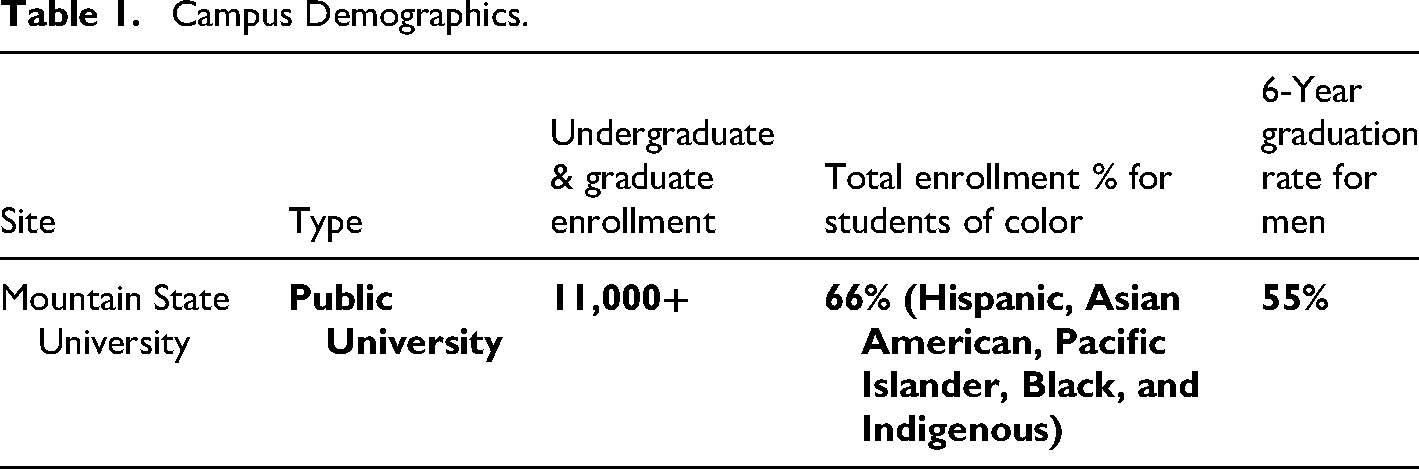
According to the National Center for Educational Statistics, only 55% of men from Mountain State University have earned at least a bachelor's in a six-year window (2021).
Data Collection
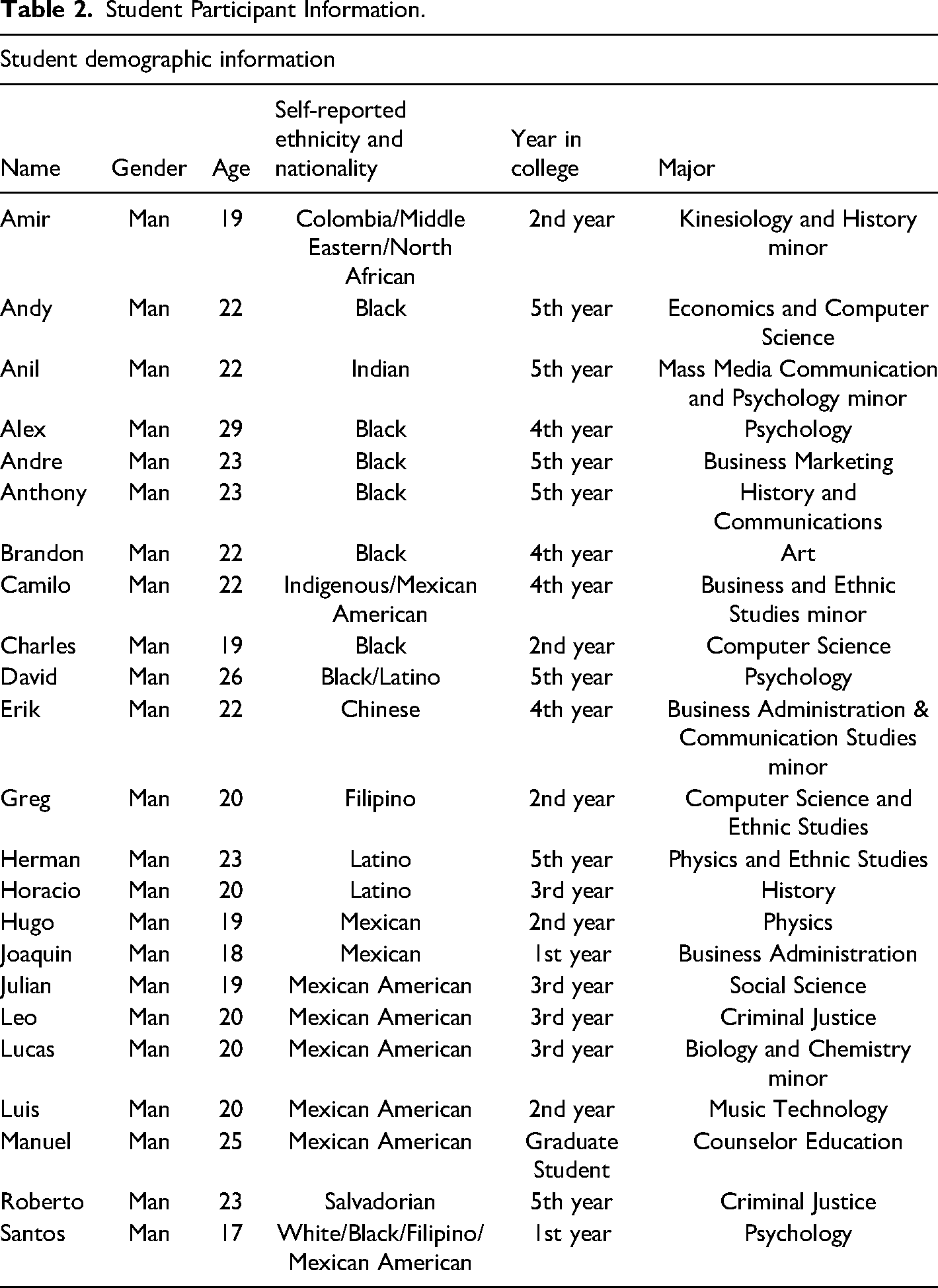
The paper draws data from campus observations as well as in-depth individual and focus group interviews with 23 Black, Latino, Asian American, and Pacific Islander undergraduates and recent graduates during the 2018–2019 academic year (see Table 2 for participant demographics and pseudonyms). The participants were between 17–25 years old with class standings ranging from second to fifth-year to recent alumni who were in graduate programs at MSU.
Student Participant Information.
The first author worked with the MSU Vice President of Student Affairs (VPSA), who provided a list of men of color (e.g., names, emails, and phone numbers) who would be potentially interested in interviews. This contact list included students identified as campus leaders or involved in other campus organizations. The VPSA provided access to a private office or conference room, so that the first author could conduct individual and focus group interviews. The first author then recruited additional men of color in the library, dining commons, and near the student union who could give their perspective on the culture, community, and experiences of men of color on campus. The first author reviewed the aims of the study, reviewed and collected consent forms and demographic sheets, and lastly provided a copy to each participant.
Individual interviews and focus groups ranged from 30–75 min. Participants received a gift card of either $20 for a focus group or $30 for individual interview. Food, drinks, and snacks were provided during individual and focus group interviews. We asked participants about their experiences at MSU, how they would describe the campus culture for men of color, the types of services and programs available to support men of color, and to provide the names of mentors or other campus agents who have been advocates for college men of color or students of color in general. Interviews were transcribed by a third-party transcription service and then verified for accuracy by a member of the research team.
Coding and Data Analysis
Research team members read each transcript, wrote analytical memos, and then reunited to discuss the evolving themes and potential follow-up questions for students. For this study, we used a three-cycle coding approach: we independently read three transcripts (i.e., one individual interview and two focus groups) and then hand-coded using an open coding strategy (Saldaña, 2013). Saldaña (2013) suggests that an open coding strategy allows one to intimately review the data and begin to identity emerging themes without restrictions. As a group, we discussed the codes and emerging themes, and then recoded transcripts using a shared, emerging code book. At each stage of coding, we peer debriefed the nuances of the transcripts and used analytical memos and field notes to guide our conversations (Creswell & Miller, 2000). Once a complete draft of the codebook was developed and clear definitions were agreed upon, we uploaded transcripts to Dedoose 8.3.45 for selective coding (Bernard et al., 2017). Some of the codes we developed for this project include “allies on campus,” “barriers college men of color experience,” “men of color needs,” “student recommendations for the rural campus” and other codes that centered students and those who support or challenge their collegiate experiences in a rural university. These code categories allowed us to understand both the students’ micro-level experiences and the larger social forces that shape how students understand their relationship with each other and campus agents through the lens of sense of belonging. The research team used a function on Dedoose that allows transcripts to be “masked” to prevent collaborators from being primed to review others’ coding applications. This was an important step that allowed the coders to independently review and interpret the data through their perspectives and lived experiences. Lastly, as we coded on Dedoose, members of the research team developed an additional round of analytic memos to capture thoughts, feelings, and data that required additional attention. These collective qualitative strategies aligned within our data analysis plan; where we reviewed the current literature about men of color in four-year institutions and student experiences in rural spaces and compared these to the emerging themes from the data through deductive and inductive analysis (Miles et al., 2014).
To increase the trustworthiness of the data, we shared preliminary findings with the current MSU men of color program coordinator. He was able to provide perspective on the past and emerging efforts to support men of color at MSU. We also peer debriefed during and after data collection with four men and women scholars of color who study college access and success for students of color in the educational pipeline. These multiple data triangulation points centered, clarified, and refined our analysis of the data (Creswell & Miller, 2000).
Positionality and Trustworthiness
It is important to center our identities as scholars of color who are personally and professionally invested in the social and academic needs of college men of color and who are working to hold institutions of higher education accountable for past and current failures to retain and graduate men of color. Lastly, we also draw from our professional experiences working in student and academic affairs, so we understand how institutions of higher education function and allocate resources to address or minimize the needs of minoritized student populations in various institutional context. Our professional experiences—collectively working in multicultural student affairs, graduate school pipeline programs, and with formerly incarcerated students—are tied to our identities at people of color. Our identities and experiences provide a level of cultural intuition (Delgado Bernal, 1998) that motivated our interest and analysis. We shared preliminary analysis with a staff member who is the coordinator for men of color initiative at MSU. His comments helped to confirm our findings. Data from this study cannot represent the larger higher education context. However, it can provide a new nuanced understanding of men of color attending rural higher education communities (Larsson, 2009).
Findings
Scholarship on men in higher education, and masculinity exploration and development find that men are the least likely to seek out academic or socioemotional support systems (Huerta, in press; Sáenz et al., 2015a, 2015b; Vogel et al., 2014). Our paper adds to the discourse on college men of color in rural four-year universities by highlighting what students believe to be the most important efforts to create community and support services for themselves and other college men of color in one rural comprehensive university. While we frame this study using sense of belonging, it's helpful to both understand and document how college men of color experience a rural university. We put the findings in conversation with one another to discuss how peer social groups can serve as sources of support for college men of color and how college men of color discuss the importance of vulnerable spaces to confront and redefine masculinity. The two main findings that emerged from our data analysis are 1) the importance of the role of peer social groups and 2) access to vulnerable spaces for men of color. Together, the two findings specifically speak to students’ need for a sense of belonging at their rural university and highlight the psychosocial needs of men of color.
Peer Social Groups
College life is often advertised as a time for students’ social lives to flourish. Conventional notions about college life promote extracurriculars, developing life-long friendships and feelings of pride and connectedness to a college. However, this traditional college experience was not shared among the men in the study. While some of the college men of color in our study felt embraced upon their arrival to their campus, the majority did not. Andy, a fifth-year Black student, stated that MSU did not feel like a university due to a lack of resources and a sense of community. Students described the challenges that they faced in adjusting their social life experiences and shared many moments of disconnection from their university. While nine of the students shared that they had a positive experience at their campus, they acknowledged that they experienced initial challenges as either first-year or recent transfer students due to a lack of a sense of belonging. Overall, students expressed a desperate need to be involved with a community as a means of feeling accepted. Andre, a Black business marketing commuter student, described his social experience on this campus: Me personally, I go to school and then I’ll leave. … The people I meet here are really cool, and you make friends and then you go to events such as the basketball game, or you try to come to clubs like Black Student Union (BSU), or even other clubs that are here. But in the same way, I don't feel as attached to [the university], just because I feel they try to include everyone but at the end of the day, there's no like, for certain men of color, like Black men, there are no real organizations here to really pull us in full, besides the BSU.
In addition to the lack of organizations described by Andre, students were unable to identity a ‘champion’ for men of color as many organizations and events on campus were not specific to their racialized and gendered experience. Another student, Charles, a second-year Black student, corroborated that the Black Student Union was the only organization that aimed to engage Black men in the campus community and offer space for peer support and interaction. Say for instance, if we had a black fraternity, then yeah, I’d be able to say, “Oh, there's our champion,” because they’re doing events that surround [men of color], or even the BSU, they do events surrounding men of color.
Among the men interviewed, only seven students were able to successfully identify an individual at their campus who they considered to be a champion or ally for men of color. Additionally, many Black men commented that the leadership of the BSU was comprised of all Black women, which they applauded but signaled feeling “left out” nonetheless as specific programming around the social, academic, or emotional needs for Black men were absent from BSU efforts. In the interviews, students consistently brought up the notion of belonging. They acknowledged how the lack of support from institutional agents and the absence of specific spaces for men of color impacted their sense of belonging on campus.
Throughout the interviews, all college men of color described the ways men of color would benefit from a social group of “like-minded” individuals. Anil, a fifth-year communication and psychology minor, explained that a college men of color peer group would allow students to motivate and “feed off” of one another to promote positive and healthy relationships for men. Other students discussed how pursuing a similar goal of a higher education would create an environment of accountability and responsibility among themselves. The men of color interviewed described how these similar goals led to academic encouragement and support from their peers rather than their academic departments or campus overall. In reply to the question of what factors allow men of color to be academically successful and close to graduation, Anthony, a fifth-year history and communications student, shared Honestly, my friends and myself. I don't think much of my … the school department has [not] really influenced me getting to this point. Like maybe on a smaller level, but definitely just the people that I have relationships with, who are also like, “Oh, we’re almost … We’re really close to graduation, or blah-blah-blah.” I would say they encouraged me more than the institution.
Anthony and 17 other students that we interviewed highlight the power of peer interactions and the role that these relationships played in their college experience. Within the focus group spaces, the men expressed not only a sense of community but also “it being the first time” that they were among other men of color discussing specific men of color issues and concerns.
Aside from wanting opportunities to socialize, the men in the study identified themselves and their peers as sources of academic support. Participants acknowledged how their peers’ lived experiences navigating the institution could serve as valuable information to be passed on to others. For example, Hugo, a second-year physics student explained how he had personally benefited from the assistance of an upperclassman in his academic department through course recommendations and scholarship opportunities: For me, I have a friend who's graduating soon. He's also a physics major. He's also the president of the Society of Physics Students, and he's getting a [scholarship] to go to either UC Santa Cruz or Michigan, one of the top schools for physics. And I was just kind of asking him questions and he was just ready to tell me because he was also part of that academy that I went to because he came as a transfer and I was an incoming freshman and he kind of shared his knowledge. He was just kind of telling me here are the kind of classes that I think you should take. This professor's good or this professor you can probably use some work or just kind of giving me some pointers, trying to point me in the right direction. Oh, there's this scholarship that I applied to and I ended up getting so and so much money or whatever. Here, just try and do this. Hey, this is what worked for me. I don't know if it's going to work for you, but you can definitely try these ways.
Hugo's experience highlights how peers and upperclassman share their knowledge to support their peers academically. Hugo's experience is significant because of his agency and proactiveness in asking questions regarding reputable physics institutions and course recommendations. While men of color use their peers to gain access to crucial information regarding financial support and academic success, as Hugo did, this access may not be readily available to men of color who are unaware of which questions to ask or who have not developed positive help-seeking behaviors. Hugo's experience suggests that men of color can strongly benefit from peer interactions (Huerta, in press). It also highlights those men of color may have to depend on their peers to acquire specific information that relates to their academic success.
The students interviewed noted that peer interactions and student support groups could improve their sense of belonging, especially those that were tailored to or centered around their ethnic and gendered realities. These same students also observed that the overall campus culture warranted the need for such support. David, a fifth-year Black and Latino psychology student, identified the need for a “safe haven” for men of color, “When I mean stability, there needs to be a safe haven for men of color. That's one [recommendation]. There needs to be some type of mentorship perspective changing and really motivating.” The necessity for a safe haven for men of color, which was identified by 13 participants, demonstrates the urgency of this need and the timely action required by college men of color from the institutional agents at this rural university. For example, David calls on institutional agents to address and improve the experiences for college men of color while providing insights into how mentoring relationships could play a critical role in this imagined safe haven. The need for mentorship, guidance and belonging was a consistent theme among the men as they offered solutions to the challenges that they were experiencing. Students’ sense of belonging, or lack thereof, as well as their overall college experience allowed them to identify both their needs and actions that the university could follow to better support them. Overall, the men shared positive and hopeful feelings regarding the benefits and necessity for social peer groups to assist their navigating and feelings of belonging to the university.
Vulnerable Spaces: Understanding and Redefining Masculinity
College men of color described the need to disrupt external pressures and societal expectations that pertained to their masculinity and gender identity on multiple accounts. Among the men, 19 acknowledged stereotypes that come with being a man of color and discussed the expectations placed on them to be emotionally stable as well as to serve as the financial provider within their household. A common topic that students discussed during interviews was the stigma associated with asking for help as men of color. The men stated social expectations required them to “[put] on a brave face” and “[be] the rock of the family.” Roberto, a criminal justice student, explained that he felt restrained due to the idea that men “do not cry,” illustrating this stigma through his experience with expressing emotions. The psychosocial needs of men of color are commonly overlooked and leave students to advocate for themselves in circumstances where they feel disconnected and minimally supported.
Through reflection on their experiences with and understandings of masculinity, the participants shared how society dehumanizes and emasculates men of color. This experience inhibits a sense of security. For example, Herman, a physics and ethnic studies student, highlighted the need for a physical space for men of color to feel a sense of empowerment and security at the university: [A] space for vulnerability, I feel like we don't have that and that gets too overlooked, especially because of the patriarchy. Men are, there's no space for vulnerability and no space for just humanizing us.
Similarly, Lucas, a Mexican American biology and chemistry student noted, How many times has someone get to express themselves, fully and openly into a space where that's not too judging or just because you’re male they expect you to act a certain way, you know? Instead of being in a circle or a place that criticizes you, you’re in a space where you’re accepted, you know? And I feel like that's an overall feeling that should be strived to, if making a program like this, it should be strived to or at least a goal to have.
Lucas illustrates the reality that men are susceptible to criticism when they are emotionally vulnerable. Since men are expected to ‘act a certain way,’ Lucas understands a vulnerable space as an opportunity for men of color to be accepted as well as a site for them to resist widely held stereotypes of masculinity.
Across interviews, students consistently discussed some of the repercussions that were associated with expressing oneself and advocated for a space where men of color did not have to think about being labeled or judged. Manuel, a Mexican American graduate student in counselor education, shared, Yeah, to have that environment, that would be awesome. Because a lot of men don't want to, men of color don't want to acknowledge their emotions: What they’re feeling, how they’re feeling. They’re told to bottle it up, handle it differently. They’re told it's not okay to talk about it because it makes you look weak. It makes you look gay. So, creating an environment that can foster men that talk about their emotions and what they’re feeling, you know, let them know that's okay, letting them know that we’re emotional beings. It's not healthy to let our emotions be bottled up.
The men of color in the focus groups acknowledged the severe consequences of not having a space to either express oneself or explore how to construct healthy, robust gender identities. As students left the interviews, many expressed gratitude to us for “holding space” or “community” with them to discuss “real life things” to make the campus a better, more supportive space. Students discussed the broader implications of how the internalization and suppression of emotions could have harmful and detrimental effects on their mental health and future relationships with a loved one and family members. Greg, a computer science and ethnic studies student, addressed the benefits of having a space to talk freely about emotions in an individual interview: I think we’re just all human, and we all go through things. And I think it would help to have a session where you’re open about things and you got no one judging, and it kinda helps to vent, you know? And it's really helpful, it helps your mental health, that we have somewhere [on campus] to just let it all go. I think that would be very beneficial.
The men of color in the focus groups also understood and interpreted vulnerable spaces as an opportunity to learn and grow. The college men of color challenged the notion that being vulnerable was a sign of weakness. Instead, they asserted that the ability to talk openly about one's emotions and challenges was, in fact, a step towards developing strength. Santos, a multiracial first-year student in psychology, expressed this sentiment: At least, from feeling vulnerable, you become stronger in a way. It's like when you run, you tear your muscles apart to make them stronger and that's just the whole part of it. If you can tear yourself apart, be vulnerable, cry about it, and that's okay and, then, you learn from that.
After Santos shared this comment, the other college men of color in the focus group smiled and praised him for his contribution to the rich dialogue. Santos reposition himself in this chair, which may have signaled a new sense of confidence. The students embraced the idea of sharing vulnerable moments with other men of color at their university and demonstrated an eagerness to be in community with each other. Students envision spaces at their university that will allow them to be “unfiltered without judgment” as they explore their needs as men of color. These statements within the individual and focus group interviews demonstrate a gradual shift in how college men of color discuss and challenge traditional forms of masculinity, especially salient giving their geographical location in a rural university.
The testimonies by the men who participated in interviews and focus groups signal a gradual shift away from traditional forms of masculinity. Andre described an instance where he modeled vulnerability with his peers after the passing of his mother: I’ve been in that situation. I’ll get a little personal. These guys know. My mom passed away three years into my freshmen year of college. There was a lot of tears shed on a lot of men's shoulders. And I wouldn't be the way I am today without allowing myself to be vulnerable.
Andre's experience reinforces the role that peers play in the lives of men of color as well as how men of color can transgress stereotypical and cultural expectations of masculinity. In addition to acknowledging the support that he received from his peers, Andre highlighted that his capacity to be vulnerable has significantly contributed to his personal growth. The men of color emphasized the freeing power that the opportunity to be vulnerable presented them. The participants remained hopeful for an on-campus space that would allow them to build connections with other men of color while also providing opportunities where they could be vulnerable at their rural university.
Discussion and Conclusion
The scholarship on the unique experiences of college men of color enrolled in rural universities is slowly evolving to present a more nuanced depiction of the various contours of life on rural campuses. The unique attributes of this study, such as the emphasis on sense of belonging for men of color at a rural university, center how men of color conceptualize their experiences at a rural university as well as voice their concerns about their collective social and academic needs as men of color at their institutions. The students in this study highlight the need for peer social groups on their campus to help elevate men of color. They also emphasize the need for unfiltered spaces where men of color can discuss their emotions without judgement or pressure to uphold expectations of stereotypical masculinity. By using sense of belonging as a theoretical framework, we illuminated how college men of color are beginning to ask for more services and spaces to help them grow as individuals and as a community. Similarly, our findings substantially contribute to the literature since they highlight challenges that men of color experience at one rural university. While our research on peer social groups and vulnerable spaces connect to literature that has elevated camaraderie and bonding for men of color (Brooms, 2019), our findings highlight how a rural context can inhibit feelings of connectedness and belonging. This study contributes to previous literature on the challenges surrounding positive help-seeking behaviors for men of color (Rodriguez et al., 2016; Sáenz et al., 2015a, 2015b) by calling attention to students’ needs as opposed to their help-seeking behaviors. The university has yet to establish an institutionally recognized space or initiative for men of color, although the campus has explored developing a men of color program over the previous three academic years by hosting informational listening sessions with men of color. In doing so, it is important to center students’ experiences navigating their campus to encourage institutional agents and other stakeholders to seriously consider the needs of men of color at rural universities. Through the establishment of a student success initiative or program, rural universities can demonstrate a commitment to the success of college men of color.
Implications
There are several implications for college men of color and their sense of belonging in comprehensive rural institutions from the findings from this study. Firstly, the findings show that the agency and advocacy that the students need from a faculty, staff, or administrator is missing at their institution despite the varying definitions that the students had for a champion for men of color needs. The college men of color at this campus—many of who are the first in their family to attend college—remain as self-advocates, which poses other challenges for persistence and degree completion. Secondly, the findings highlight the importance of vulnerability and unfiltered spaces as a way of constructing a community that provides opportunities to navigate gendered expectations in a healthy manner. The application of a sense of belonging as a theoretical lens helps explain the experiences of men of color attending a rural university by demonstrating how the rural context as well as the limited social support made the men in our study feel disconnected.
Finally, the participants acknowledge that their path through higher education is unique due to the stigmas and stereotypes surrounding masculinity. They want spaces and professional staff members to help them unpack and explore their identities. Students are hyper-aware of the pressure of maintaining their masculine status, demonstrating how gendered socialization impacts student navigation in educational institutions. The ideas presented by the students serve as essential resources for informing higher education institutions on men of color program design and student support services in rural spaces.
Footnotes
Acknowledgments
We presented an earlier version of this manuscript at the ACPA 2021 national conference. We sincerely appreciated the thoughtful feedback Dr. Cindy Ann Kilgo, Indiana University, provided, who saw this paper's promise and potential impact to support men of color in rural communities. All views, analyses, and opinions in this paper are the authors' responsibility and do not reflect the position of the ECMC Foundation.
Declaration of Conflicting Interests
The author(s) declared no potential conflicts of interest with respect to the research, authorship, and/or publication of this article.
Funding
The author(s) disclosed receipt of the following financial support for the research, authorship, and/or publication of this article: This work was supported by the ECMC Foundation.
