



Abstract
The relationship between engagement and the intention to drop out was the focus of this research. Following an empirical–analytical approach, a sample of 1,122 university students responded to a questionnaire designed to measure the engagement and the intention to drop out of school. The results confirmed that undergraduates who considered dropping out had lower scores on the engagement scale. These data are relevant for the adoption of preventive measures against academic dropouts.
Introduction
One of the issues of most concern in the current context of higher education is the dropout rate. Academic dropout is a phenomenon that is present at all levels of education. Despite attempts to tackle this problem from different fronts, alarming figures continue to be recorded every year (Cabrera et al., 2006; Solaguren & Moreno, 2018; Truta et al., 2018). UNESCO itself (2012) warns of the seriousness of the problem and points to the risks for young people and for society in general of dropping out of school. This justifies the need to look further into how to redress this situation. The reduction of academic dropout rates and the application of preventive measures to improve student retention have become one of the most important strategic objectives for educational institutions.
It is important to highlight the multicausal nature of academic dropout, as the variables that cause it are diverse and of very different kinds (Bethencourt et al., 2008; Esteban et al., 2016; Freixa et al., 2017). Research has shown that dropout is related to academic social self-efficacy (Medrano, 2011), student participation (Sánchez & Elías, 2017), academic performance (O’Connor & Paunonen, 2007), motivation and poor adaptation to university (Urbina & Ovalles, 2016), dissatisfaction with the teaching received (Fernández et al., 2007), family socioeconomic status (Rodríguez & Guzmán, 2019), or low academic performance (Lamas, 2015).
Literature Review
In addition to those cited, engagement is another factor directly associated with the intention of university students to drop out of their studies (Arias et al., 2020). To this end, Portillo-Torres (2015) proposes different strategic actions to reduce the impact of school dropout, some of which are based on the engagement approach to achieve greater student retention. The rationale for these actions is that students with low commitment and involvement tend to perform poorly in their studies, which increases the likelihood of dropping out of school (Fredricks et al., 2004). Study performance is reflected through assessment results and refers to the achievement of the learning outcomes of each subject in the curriculum (Caballero et al., 2007). Performance is also used to refer to the level of knowledge that a student demonstrates in relation to the standard in a given subject (Willcox, 2011).
Although engagement analysis began in work environments, in the last decade there has been a notable shift in focus toward the study of school contexts (Brigman et al., 2015; Gutiérrez et al., 2018). The research focused on the study of this trend has made it possible to define academic engagement as a state of positive energy that connects students with the realization of educational activities. This construct is thus closely related to academic performance and study motivation (Salanova & Schaufeli, 2009). Different research works have pinpointed a close link between the active participation or involvement of students in academic activities, the achievement of good results, stress control, persistence, or increased satisfaction in their studies (Cox et al., 2015; López-Aguilar et al., 2021; Martos et al., 2018; Salanova & Schaufeli, 2009; Trowler, 2010). The concept of academic commitment is employed (although other terms such as academic involvement or engagement are also used) to refer to the status of those students who show a high degree of participation and involvement in the learning process. It is conceptualized as a feeling of psychological well-being, which is not momentary or circumstantial but long-lasting and contributes to the quality of the effort to achieve academic achievements (Carmona-Halty et al., 2017). Specifically, this concept is used to refer to the state of students who are motivated and actively involved in their learning process, which contributes to the achievement of good academic results (Coates & McCormick, 2014; Sandoval-Muñoz et al., 2018). Arguably, students with low engagement may have a higher risk of dropping out of school throughout their academic careers. From this perspective, some studies have assessed the relationship between engagement and academic performance (Jang et al., 2010). This leads us to consider engagement as an important predictor of academic performance, in terms of the extent to which students are involved in their learning process (O’Connor & Paunonen, 2007).
This positive state is not only intrinsic to the individual, but is reinforced by the role of the institution or the classroom environment per se, which generates emotions and increases the sense of belonging. When the context exerts cohesion and the student feels accepted and valued by the group, he/she tends to belong and to achieve academic goals. In this way, the sense of belonging, as well as states of happiness and well-being, encourage involvement, effort, and better self-control in the learning process, which leads to better academic results (Orcasita & Uribe, 2010; Paoloni, 2014; Pekrun, 2006; Wilkins et al., 2016). The energy invested by the subject reflects their degree of commitment to the activity. In this way, engagement refers to a state of psychological satisfaction that includes three fundamental factors: vigor, dedication, and absorption (Carmona-Halty et al., 2017; Schaufeli et al., 2002a, 2002b). The three main factors of academic commitment are vigor (understood as the energy and persistence in carrying out a task, even despite difficulties), dedication (which refers to the motivation and active participation in the activities in which the person is involved), and absorption (referring to the concentration and enthusiasm that the student finds in carrying out the academic work).
The hypothesis underlying this study is that students who are highly committed to their studies will achieve better academic results and will not think about dropping out. Those students who approach their formative process with vigor, dedication, and absorption will have greater possibilities of achieving better outcomes in the learning process. Hence, the aim of the research is to analyze the relationship between engagement and academic dropout intention in undergraduate university students.
Method
Participants
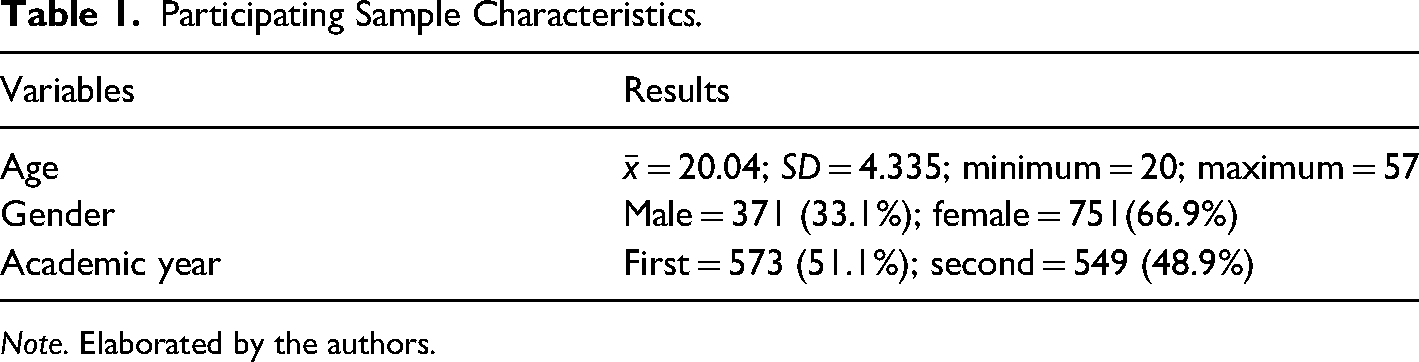
This research was focused on the population of students who were in their first or second year of undergraduate studies at the University of La Laguna (Spain) at the time the data gathering test was administered. The information provided by the Analysis and Planning Office (GAP) of the University of La Laguna (Spain) placed the population meeting these characteristics for the 2020/2021 academic year at a total of 8,369 students. The final sample that took part in the study consisted of 1,122 students, which enabled us to work with a confidence level of 96.9% and a margin of error of ±3.0%. Table 1 presents the study sample characteristics.
Participating Sample Characteristics.
Note. Elaborated by the authors.
Data Gathering Instrument
Data collection was carried out through the “Questionnaire on intention to drop out of university education” drawn up ad hoc for this study. This instrument was constructed on the basis of the Utrecht Work Engagement Scale for Students of Carmona-Halty et al. (2017). The scale includes three dimensions related to the academic engagement construct: vigor (1), dedication (2), and absorption (3). This Likert-type scale was measured based on 7 levels, where 1 meant no agreement at all and 7 referred to strong agreement. The coefficients (Cronbach's alpha, Root Mean Square Error of Approximation [RMSEA], Goodness of Fit Index [GFI], Adjusted Goodness of Fit Index [AGFI], Normed Fit Index [NFI], Non-Normed Fit Index [NNFI], Tucker-Lewis Index [TLI], and Courant-Friedrichs-Lewy [CFL]) obtained in the original scale (Carmona-Halty et al., 2017) were in accordance with those established in the literature.
In addition to this scale, other sociodemographic (age and gender) and academic (year of study) questions were added. Likewise, to measure the intention of academic dropout, a dichotomous question (yes/no) was included to assess whether students had considered giving up their university studies, another binary item to analyze whether it was a definitive abandonment of university studies or a change of degree, and finally, an open question to elicit the reasons for dropping out.
In the process of defining this instrument, the procedures proposed by McMillan & Schumacher (2005) were followed. Specifically:
- A content trial in which three experts linked to the problem under study (n = 3) assessed the relevance, appropriateness, and comprehension of the questions, as well as the specific content of the instrument. - A test of form in which three specialists in the field of social science and legal research took part (n = 3), analyzing the types of questions and scales to be used, statistical analyses to be performed, etc. - A pilot trial, in which 12 students (n = 12) with similar characteristics to those of the final sample took part. The aim of this trial was to assess the clarity and comprehension of the items, analyze the possibility of incorporating new questions and response alternatives, identify response times, etc.
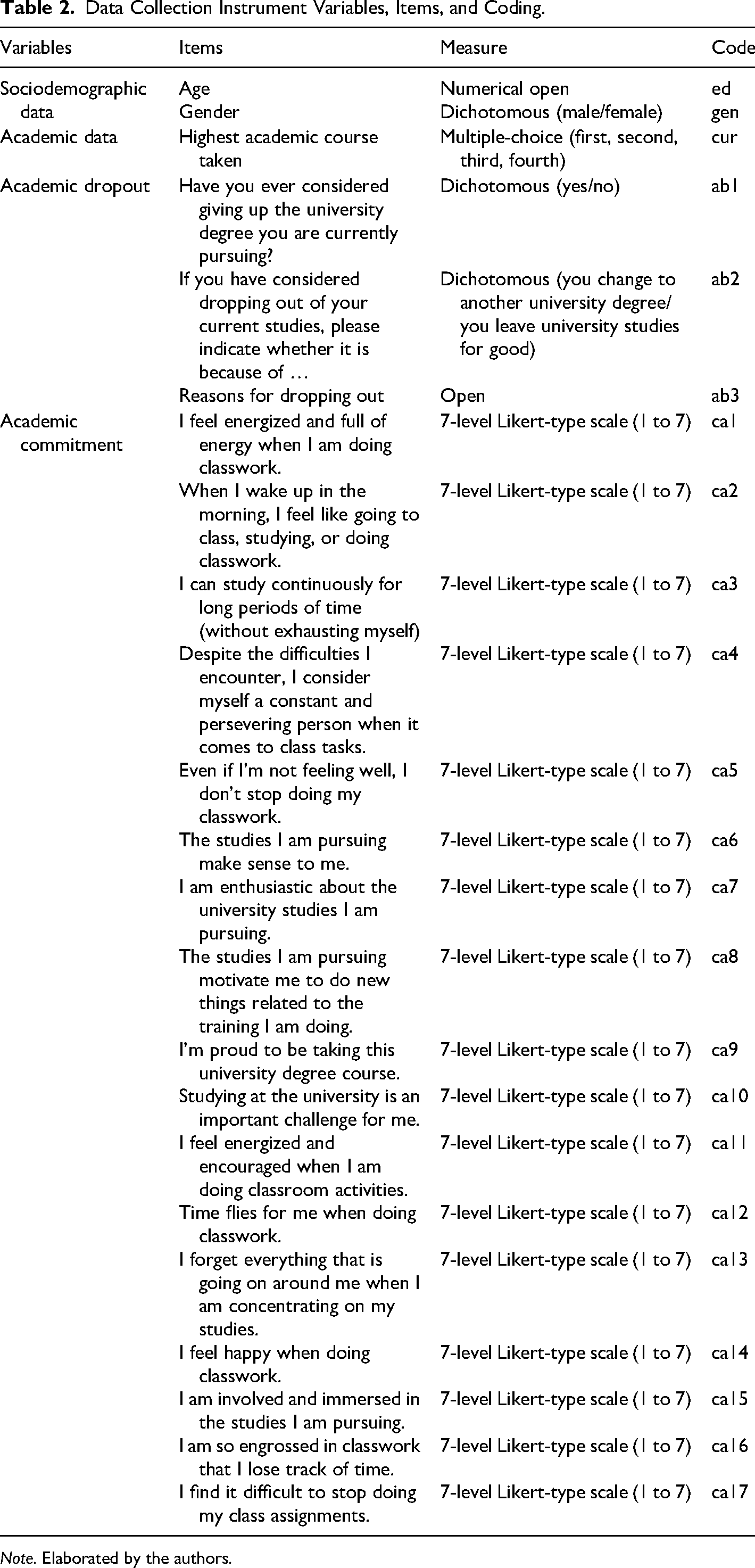
This procedure made it possible to refine and incorporate improvements to the final questionnaire that was applied to the target sample and which was defined as shown in Table 2.
Data Collection Instrument Variables, Items, and Coding.
Note. Elaborated by the authors.
In addition, to ensure that the questionnaire designed did not contain redundant items, a multicollinearity assessment was carried out. This procedure took place through a bivariate correlation analysis for the Likert-type items included in the questionnaire, whose values, for all cases, were r ≤ .85, thus complying with the values proposed by the literature (Holgado et al., 2019) for the absence of information redundancy. The reliability of the measurement scale used was also analyzed through Cronbach's alpha (α) and MacDonald's omega (ω) coefficients. The decision was taken to use both coefficients as, for the first one, the scale used complied with the assumptions of tau-equivalence, unidimensionality, and continuous measurement scale199420172015 AQ4] (Cho & Kim, 2015; Raykov & Marcoulides, 2017). The use of MacDonald's omega test (ω) was motivated by the fact that it is a more robust statistic applicable to ordinal scales and is more recommendable in studies related to the social sciences (Peters, 2014; Viladrich et al., 2017). The results obtained in both tests (α = .95; ω = .96) were excellent (Oviedo & Campo-Arias, 2005).
Procedure and Ethical and Methodological Rigor Issues
To obtain the information, it was decided to adapt the data collection instrument to an online system. For this purpose, The Google Forms tool was applied because it belongs to the Google for Education ecosystem, which was used by the students to whom this research was addressed, so they were familiar with its use. Data gathering was carried out in February, March, and April 2021, contacting, by email, the faculty of the University of La Laguna (Spain) that taught in the first or second year of the undergraduate degrees of this institution. In this initial approach, the purpose and objectives of the research were explained in detail to the teachers, requesting their voluntary participation in administering the survey. The teachers were invited to provide their students with access to the online questionnaire and, finally, their collaboration was acknowledged with thanks.
It should be noted that, throughout the research process, the anonymity of the answers provided by the students was assured in accordance with the provisions of Organic Law 3/2018, of December 5, on Personal Data Protection and the guarantee of digital rights. At the same time, the deontological and ethical codes of the research process were taken into account, informing the research participants about the study aims and the voluntary nature of their participation. As regards methodological rigor, aspects such as the reliability and consistency of the results, the validity of the data collection instruments used, and the credibility of the outcomes obtained were taken into account. This was ensured by implementing different procedures in the design of the data collection instrument (content test, form test, and pilot test). Reliability analyzes were also performed using different statistical tests defined in this document. Finally, to increase the credibility of the results obtained, a discussion process was carried out with previous works and research.
Data Analysis and Interpretation
When the data gathering was completed, the .csv file automatically generated by The Google Forms platform was downloaded. From this file, the database used for data processing was constructed and purged. Specifically, this analysis process was carried out using R-Studio (version 1.4.1106) and Microsoft Excel (Office 365 version) software for the Microsoft Windows 10 operating system.
The analyses carried out to meet the study object were: descriptive analysis of central tendency and dispersion (mean and standard deviation), frequency distribution, reliability analysis (Cronbach's alpha and MacDonald's omega), bivariate correlation analysis, data normality analysis (Shapiro–Wilk and Kolmogorov–Smirnov), content analysis for the open-ended questions posed and contrast analysis based on nonparametric tests (Mann–Whitney U). Following the suggestions of the American Psychological Association, the contrast analyses were completed with the calculation of the effect size.
This analysis was performed based on the superiority probability test (
Results
Database Preparation and Initial Analyses
The initial step in preparing and cleaning up the database to be used was to confirm that the answers provided by the participants were within the expected range for each of the questions asked. Checks were also run to ensure that there were no missing data for any of the items proposed in the data gathering instrument. Another aspect analyzed was the identification of multivariate outlier cases. This process was carried out by calculation of the Mahalanobis distance, which yields a value at which the study put to can be considered outliers by moving substantially away from the center of mass (Muñoz & Álvarez, 2009). For this research, the Mahalanobis value was 64.00. This allowed us to identify a total of 84 atypical cases, thus placing the definitive study sample at 1,038 students.
Likewise, the data distribution was analyzed to determine if it followed the Gaussian bell pattern. The values provided by the Shapiro–Wilk and Kolmogorov–Smirnov tests suggested that the distribution of the data did not follow a normal distribution; p < .000 scores were obtained for all cases (George & Mallery, 2003). This led to the performance of contrast analyses based on nonparametric tests such as those presented in this “Results” section.
Levels and Causes of Academic Dropout Intentions Among University Students
Of all the students surveyed, 35.6% stated that, during their educational career, they had considered dropping out of their current university studies. Upon researching this question, it was found that 51.9% suggested that they would drop out of their studies to start another university degree and 41.9% said they would decide to drop out for good.
The analysis of the reasons behind the students’ intention to change their degree program was mainly focused on three main aspects. The first of these was related to not having made the right choice in the studies started (45.6%). This was evidenced by the accounts provided in the open-ended questions of the questionnaire when the students suggested that “I don't know if I’m sure I’ve chosen the right degree I want for my future” (p. 133), “I don't know if what I am studying is what I really want” (p. 138), or “perhaps I was mistaken and this may not be what I want” (p. 199). The second argument was related to the lack of motivation they had with the studies they were pursuing (10.5%). Proof of this was found in the evaluations offered by the students when stating that “I don't feel motivated” (p. 129) or suggesting that “there may be other more specific careers that motivate me more” (p. 11). Finally, it was also noteworthy how the didactic methodology used in the degree courses had an impact on the intention to drop out of studies (7.76%). In this sense, they stated that “I expected something else in terms of dynamism” (p. 77) at the same time as indicating that the qualification was “not very practical” (p. 60).
On the other hand, when we delved into the causes that students listed as the main reasons that would lead them to abandon their university degree, 18.81% would do so because of the didactic methodology used. In fact, the students were precise when they stated that “in the university the professors do not focus on improving the dynamics of the classes; most of them are people talking about things with new terms that have never been explained to us and where the study load is increased. We need teachers who want to innovate and make each class interesting and new” (p. 270). Another substantive argument was the low motivation they had (18.18%), as evidenced by the specific accounts provided by the research participants when they indicated that they had “lack of motivation to continue… the syllabus becomes very arduous when even the lecturers themselves are not motivated to teach it” (p. 295). Finally, a strong argument put forward by the students was related to the high level of stress derived from the high academic demands of the degree course (13.3%). This situation, in the words of the students, was explained by the “excessive workload required of us, which makes it very difficult for us to carry out other activities in our daily lives, practically forcing us to devote all our time to the university, which greatly affects our quality of life and our mental health” (p. 380).
Academic Commitment and Intention to Drop Out of University Studies
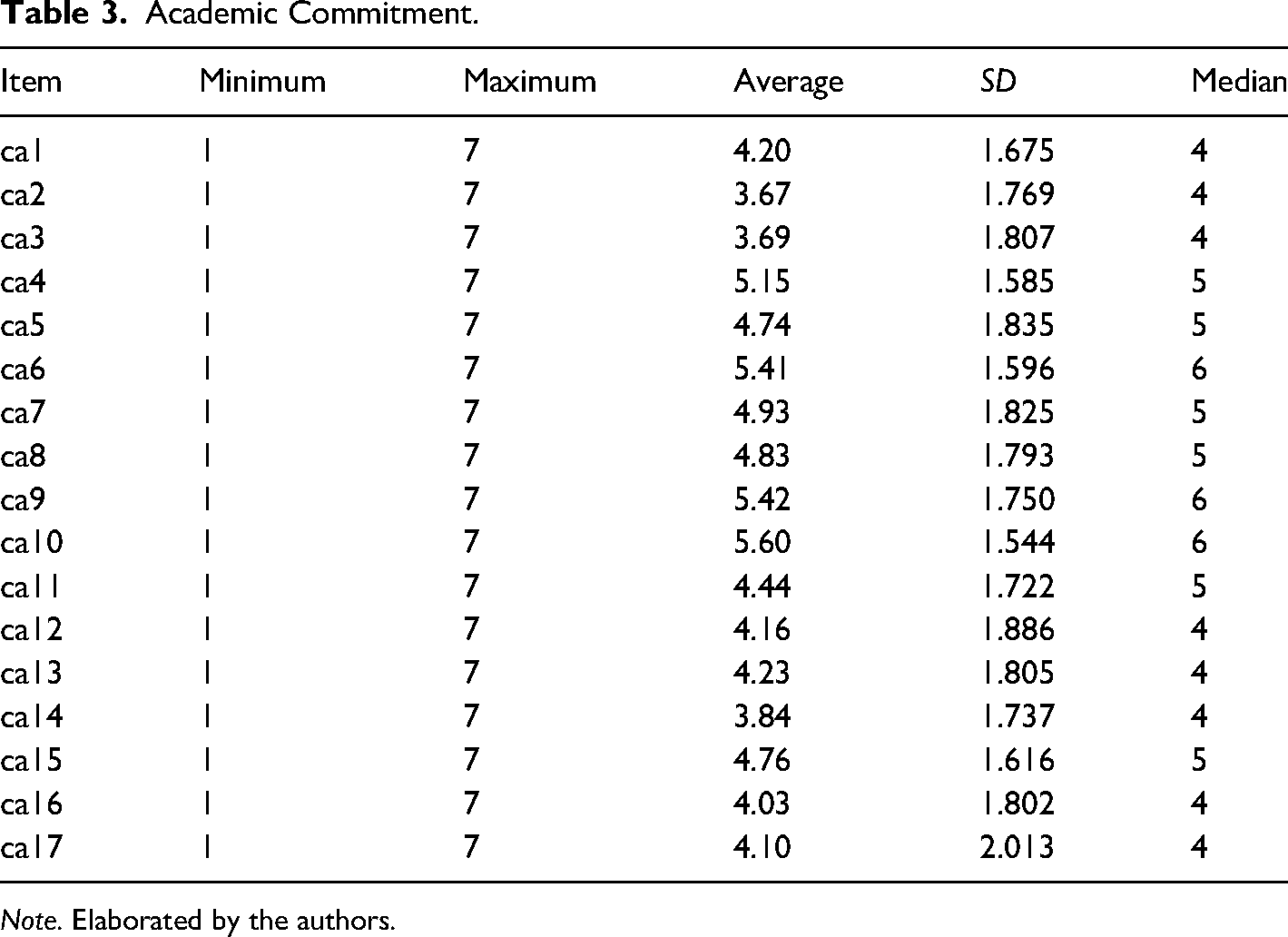
The average score obtained by the students participating in the study on the academic engagement scale used was moderate (
Academic Commitment.
Note. Elaborated by the authors.
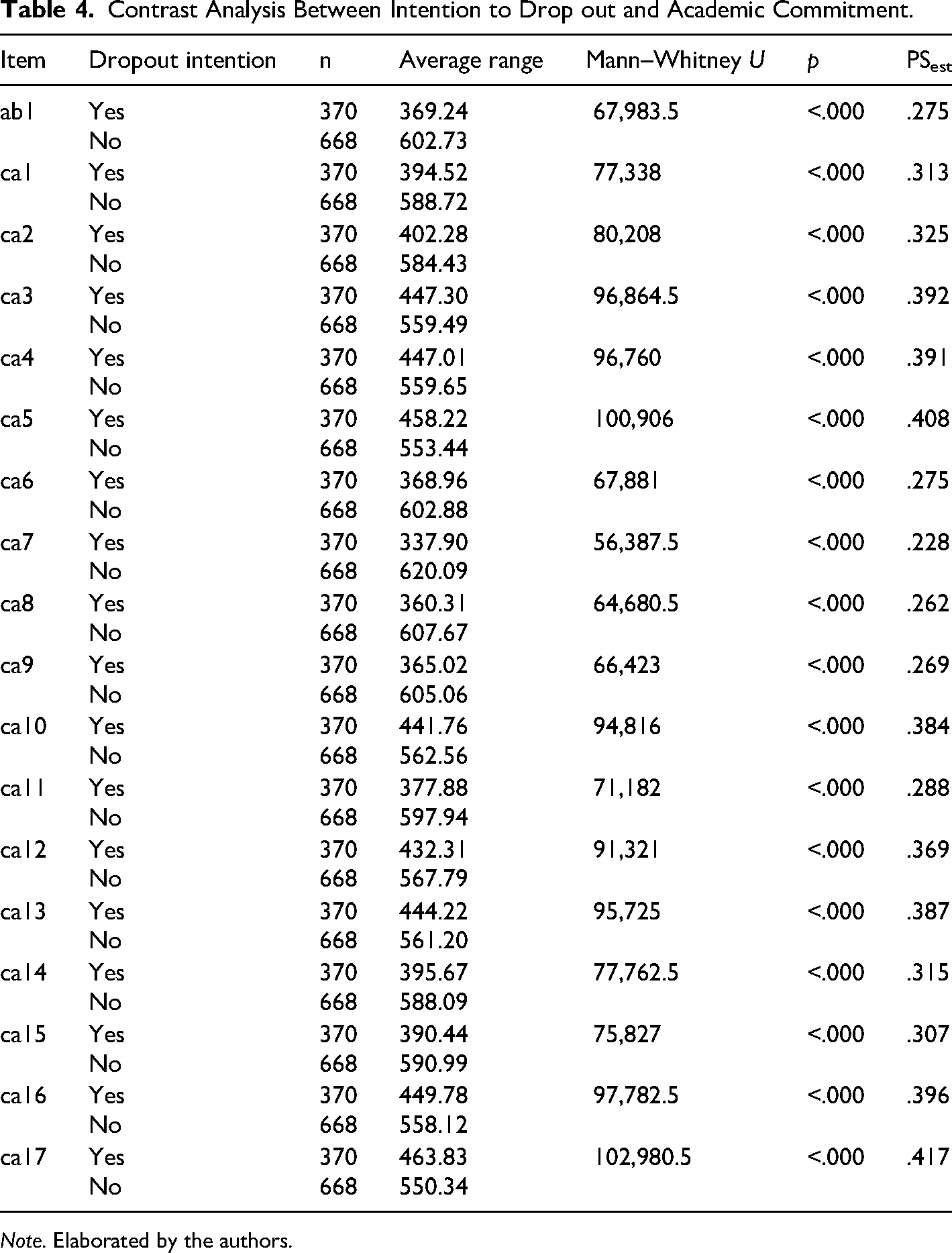
Contrast analyses using the Mann–Whitney U-test revealed that students who stated their intention to stay and complete their studies achieved higher scores on each of the items of the academic engagement scale applied (Table 4). Among the items assessed, the aspects with the greatest difference and where the students who expressed their intention to drop out of university studies scored lowest were the difficulties they have in tackling class tasks (average range: 1.5–1.5) = 463.83; U = 102,980.5; p < .000; PSest = .417), lack of ability to continue progressing in academic activities even if they are not doing well (average range = 458.22; U = 100,906; p < .000; PSest = .408) and high involvement in classroom tasks (average range = 449.78; U = 97,782.5; p < .000; PSest = .396).
Contrast Analysis Between Intention to Drop out and Academic Commitment.
Note. Elaborated by the authors.
The interpretive values proposed by Erceg-Hurn and Mirosevich (2008) suggested, for the totality of statistically significant differences found in this study, that the effect size was small: values PSest ≥ .20; y ≤ .50.
Discussion and Conclusions
The importance of academic dropout for higher education institutions justifies research such as that presented here, whose main objective is an analysis of the relationship between engagement and the intention to drop out of studies among university students. The aim is to contribute to the clarification of the serious problem underlying the study, namely the intention to drop out, providing ideas for the implementation of educational and guidance measures for improvement.
The results achieved in this research have revealed that the intention to drop out of school remains a current problem. The fact that 35.6% of those surveyed stated that at some point in their academic career they had considered dropping out shows that many young people run the risk of disengaging from the education system without completing their education. This undoubtedly causes serious academic, personal, social, and work-related drawbacks, among others.
Analysis of the causes on which students base their doubts about continuing their studies shows the diverse nature of the factors that determine dropout. Among the causes mentioned by the respondents was not having made the right choice of a degree course. This denotes a lack of information and guidance for students in the previous stages, which, as observed in this study, conditions the possibilities of academic and social integration in university education. Improving collaboration between preuniversity and university education professionals, preparing students’ transition in time, and developing preventive guidance programs to prepare them for decision making are key aspects to avoid adaptation and academic dropout issues.
Another factor that, according to the students, influenced the intention to drop out was the lack of motivation. The way young people approach their educational process, their motivation to achieve their goals, and their involvement in learning activities are key factors for academic success. This leads us to link motivation with students’ academic engagement. As pointed out by Bresó and Gracia (2007), a positive level of engagement is an indicator of well-being in academic performance, which is related to good academic results and, therefore, is an obstacle to dropping out of school. And this was precisely reflected in this research: those students who thought they were going to do well in their studies achieved high scores on the engagement scale. In other words, the group of students who showed the greatest academic involvement and commitment was the one with the lowest intention of dropping out of school. This coincides with the results obtained by Parra (2010), who concluded that engagement levels significantly influence students’ school performance.
As found in other research (Manzano, 2002; Salanova et al., 2010), the effort and involvement (engagement) with which students approach their educational process to have a positive influence on their adaptation and performance in their studies. This is because students with high levels of engagement are more proactive, are better self-regulated, have interest and confidence in their possibilities, and face learning challenges with enthusiasm. Even at other educational levels, through the studies we have carried out (Álvarez-Pérez et al., 2021), it has been confirmed that students who score higher on the engagement scale are those who have fewer difficulties in their educational process and do not repeat a year.
Although this study was carried out with a large sample of students from a Spanish university, research carried out in other contexts, both nationally and internationally, shows that the academic, social, and institutional factors associated with academic dropout are quite similar. In this sense, when explaining the causes that lead to dropout, reference is made to variables such as the wrong choice of degree course (Smulders, 2018), the number of subjects enrolled for (Castillo, 2008), the difficulties in adapting to new training scenarios (Pérez et al., 2018), or the influence of performance in the previous stages (Esteban et al., 2016).
For educational practice, the importance of engagement is considerable. If students are engaged and involved in the teaching–learning process, if they are motivated and value the importance of attending class, if they see the usefulness of what they learn for their future projects, if they enjoy learning, etc., the risk of academic failure and dropout can be minimized. And from this standpoint, as noted by Álvarez (2012), institutional tutoring plans offer a space to reinforce adaptation to university life, involvement in learning, and improvement of academic performance.
The findings of this work should be analyzed under the prism of the limitations inherent to any research. In particular, the study was limited to a sample of students from a university institution. And although it is true that the reports available in the Spanish domestic and European scope highlight that the problem of dropout is common to the context of university education, it would be convenient to investigate this problem in depth by extending the sample to a larger number of higher education institutions. Another noteworthy aspect of the research conducted was the historical moment at which it was carried out, where the COVID-19 pandemic could be modulating the evaluations provided by the students, and the results might differ if the study were replicated in a situation free of the pandemic.
Despite the limitations detected, the study initiated with this research work undoubtedly opens up new challenges with a view to gaining a deeper understanding of the phenomenon behind academic dropout from university studies. This leads to the idea of continuing to examine other variables that may be determining factors explaining the issue of dropping out of school, such as self-regulation of learning, adaptability skills, sense of belonging, etc., as well as other variables that may be crucial in explaining the dropout problem, etc. Beyond the incorporation of other dimensions and variables that would contribute to a more detailed understanding of this problem, there is a need to design qualitative studies to identify how the profile and academic trajectory of a university student who ends up dropping out of school are constructed. This would make it possible to identify warning signs to design preventive psycho-pedagogical intervention proposals aimed at reducing university academic failure and dropout rates.
Footnotes
Declaration of Conflicting Interests
The authors declared no potential conflicts of interest with respect to the research, authorship, and/or publication of this article.
Funding
The authors disclosed receipt of the following financial support for the research, authorship, and/or publication of this article: This work was supported by the Universidad de La Laguna. This work forms part of the research project designated “The issue of dropout in students’ educational trajectories: a study on adaptation and permanence at university,” financed by the Vice-Rectorate for Research of the University of La Laguna and the Ministry of Science, Innovation, and Universities.
