




Abstract
The purpose of this research is to examine and integrate the findings of several qualitative studies on student attrition in higher education to identify the factors that influenced study participants’ decisions to switch out or drop out of their initially chosen majors. This meta-ethnography included nine qualitative studies that were analyzed using Noblit and Hare's (1988) seven-step approach to the synthesis of qualitative research. Findings indicate that study participants shared feelings of being underprepared for the academic challenges associated with their chosen majors, that they experienced a lack of support throughout their experience as students in their programs, and that the combination of the lack of preparation and lack of support led students to feel overwhelmed. The findings suggest that students who choose to leave their majors may need additional support from those in their academic areas of interest, as well as from academic advisors.
Introduction
There are many costs associated with student attrition in their declared majors of interests, including the loss of time, finances, and opportunities (Wang, 2013). Researchers in STEM (science, technology, engineering, and mathematics) are particularly concerned with the overwhelming amount of potential STEM graduates that are lost every year when students switch out of STEM majors. This problem, however, is not confined to STEM alone, as students frequently switch out of education, health, and humanities majors as well (Chen, 2015). Many quantitative studies compare student characteristics and students’ academic performance to account for high attrition rates (Dika & D’Amico, 2016). While educational researchers require this information, quantitative data about student characteristics and academic performance can only provide a partial explanation about the problem at hand. More information is needed to help researchers achieve a more thorough understanding about what students may experience in postsecondary education that inspires them to leave their declared academic areas of interest.
It could seem as though the onus is on students to account for their lack of academic preparation, but qualitative research shows that this might not be the case. Qualitative studies about this issue have emerged that offer students the opportunity to describe their experiences and academic choices in their own words. Such qualitative findings can offer insight into the problems that underlie common predictors of academic persistence, such as adequate academic preparation prior to entering a declared major of interest (Lichtenberger & George-Jackson, 2013). The purpose of this research is to examine and integrate the findings of several qualitative studies on student attrition in higher education to identify the factors that influenced study participants’ decisions to switch out or drop out of their initially chosen majors.
Literature Review
While research on academic persistence can tend to emphasize differences in students’ personality (Shaw & Barbuti, 2010), researchers have also drawn attention to the importance of students’ satisfaction with their academic environments (Allen & Robbins, 2008). One student described the misalignment between her earlier success in Advanced Placement (AP) chemistry and their failing grades in college Chemistry courses in the following way: “I realized that I didn’t know this material. And I should have had teachers that picked up on that and really helped me, but they didn’t” (Russell & Russell, 2015, p. 109). Overlooking students’ descriptions of their lack of academic preparation could lead researchers to a misunderstanding about why students may feel inadequately prepared for academic success in tertiary education.
Furthermore, researchers have noted how important it is for students to be able to access help from faculty members (Xu, 2018). Xu explained that the accessibility of faculty members enhances students’ perceptions of the quality of their academic programs, which can help to reduce the likelihood that students will switch out or drop out of their declared major. Qualitative studies permit students who have dropped out or switched out of their chosen major to voice similar concerns. In some instances, these studies reveal that students do not feel seen or appreciated in their departments of choice, with one student claiming,” the [STEM] department is so huge, they don’t care if you stay in it or if you don’t” (Corwin et al., 2020, p. 273). This perceived disconnect between faculty and students in the STEM fields is described as a hindrance on students’ academic engagement with STEM material (Flynn, 2016). As researchers delve deeper into students’ descriptions of their disconnection, it is possible that they may be able to produce solutions for these issues and to offer suggestions for teachers, academic advisors, and other faculty members who are interested in cultivating students’ academic potential. Inversely, educators and researchers may find that failing to address problems involving student attrition further marginalizes students in our educational system who are most in need of their support.
Underrepresented Student Populations in STEM Majors
One of the reasons behind the interest in STEM attrition can be attributed to the limited pathways that some students may experience in their attempts to pursue STEM fields. This issue, which has historically been described as a “leaky pipeline” to degree attainment, especially for underrepresented minorities who transition to other academic areas of interest or drop out of college (Flynn, 2016; Whitcomb & Singh, 2021), which may be better described as a “STEM-grading penalty” through which a student receives lower grades in their STEM courses than they do in other courses during the early semesters of their college experience (Witteveen & Attewell, 2020). This phenomenon appears to contradict other research, which indicates that interest in STEM fields is more prevalent in some students from historically underrepresented populations, including African-American students and students who are from low-income backgrounds, than in students from more commonly represented populations (Lichtenberger & George-Jackson, 2013). At some point in their educational journeys, students from underrepresented populations choose not to pursue an interest in STEM areas, even if they expressed an initial interest in STEM.
Women have also been historically underrepresented in STEM fields, which may be a result of professors’ beliefs about these students’ probability of success compared to their opposite gender counterparts, leading them to spend more time mentoring men (King, 2016). As students change their courses of study, gender segregation increases. Denice (2021) explains that majors become more segregated by gender when students change out of their majors, with women choosing non-STEM fields such as business or the arts. While interest in STEM fields prior to entering college may be similar among diverse populations, students make choices in their postsecondary education that reveal inequitable access to opportunities and success. In an attempt to enhance levels of academic persistence, researchers have emphasized the need to establish a more equitable educational system, as well as offer fruitful outcomes for academic fields that are currently lacking the contributions of potentially talented individuals from underrepresented populations (Perna, 2006). To support academic persistence and persistence in specific majors, it is important for researchers to examine when students make decisions and why they make these decisions.
Factors Influencing Academic Persistence
While academic persistence is a field that researchers in higher education often pursue; whether in hopes of determining social cognitive predictors of persistence (Brown et al., 2008), the relationship between mental health and academic persistence (Hartley, 2011), academic persistence of students from underserved populations (Jackson et al., 2003), or the role of self-efficacy on student persistence (Wright et al., 2013), the conversation surrounding academic persistence does not always extend to students who have remained in college, but have abandoned their majors of choice. For experts in specific fields however, especially those in STEM fields, it is important to not only investigate whether students persist in attaining a college degree, but also to investigate whether students chose to attain a college degree in the majors that they had initially declared.
Shaw and Barbuti (2010) conducted a study with a sample of over 54,000 students, revealing that only 41% of the students in the sample were majoring in the field of their original plans, with differences related to gender, parental income, and first-generational college status. However, these researchers reported that the greatest differences were related to ethnicity, with Native American students choosing to switch from their intended major more than students of any other ethnicity, which is a result that supports prior literature on the topic (Jackson et al., 2003). Mau's (2016) findings were similar; revealing that men were more likely to persist in STEM majors than women; and that White and Asian students were more likely to persist in STEM majors than students who were Black, Hispanic, or Native American.
Ost (2010) explored how the role of peers and grades influenced major persistence, specifically in the sciences, and explained that students were impacted by the higher grades they received in non-science fields. This was especially true for women, who used grades as a determining factor in the major persistence at a higher rate than men did. Similarly, in a study done by Weeden et al. (2020), researchers found the occupation plans that students held in high school had strong and lingering effects on college students’ decisions to persist in their chosen majors. Additionally, these occupational plans accounted for the largest share of the gender gap in the probability of completing a STEM major in college. In other words, women who make occupational plans related to STEM majors in high school demonstrate a stronger commitment to persist in their major once they transition to a postsecondary environment.
Methods
I use the term “meta-ethnography” in reference to Noblit and Hare's (1998) approach to synthesizing understanding from ethnographic accounts. In this approach, meta-ethnography occurs as researchers engage in “the translation of studies into one another” (p. 10). According to Noblit and Hare, meta-ethnographies allow qualitative researchers to move beyond the examined single accounts to reveal the analogies that exist between them. This involves an “interpretive integration of qualitative findings in primary research reports that are in the form of interpretive syntheses of data” (Sandelowski & Barroso, 2006, p. 199) including conceptual descriptions and interpretive explanations.
The meta-ethnography follows Turner's (1980) theory of Sociological Explanation as Translation, which asserts that all social explanations are essentially comparative. In this approach, Turner describes three different steps, including (a) identifying the puzzle; (b) looking more widely around the surrounding customs, practices and circumstances; and (3) choosing sets of practices and circumstances to describe as “game variations,” which show the analogous and disanalogous rules, showcasing the apparent differences as a result of different circumstances. A meta-ethnographer uses this approach to determine the puzzles presented by various qualitative studies, examining their sample characteristics, and translating the results into a study that yields new findings, providing an in-depth examination of the phenomenon that is being studied. In the future sections, I will describe which studies comprised my meta-ethnography and how they were selected.
Purpose of Present Study
I have examined the findings of qualitative studies focusing on student attrition and the factors that contribute to students’ decision to drop out or switch out of their majors. Until now, no study has been done to compare the results of such studies. In the following meta-ethnography, I will compare nine qualitative studies related to students’ decisions to switch majors and describe my interpretation of new findings that arose from this comparison. Researchers can use the results of this meta-ethnography to establish a clearer understanding of the issues facing students who elect to switch out of their chosen major as well as what might be done to help promote the academic persistence of students facing such challenges. Stakeholders who are interested in college student retention such as faculty, staff, administrators, advisors, and donors can use this information to help inform policies related to college student retention; which in some cases may involve supporting students to help them persist in their selected majors and for others, may involve supporting students’ transitions to majors that are suitable in accordance with students’ motivations and interests. Additionally, stakeholders can use the results of this meta-ethnography to determine which students who are willing to transition out of their majors may also be willing to persist in their majors when provided with appropriate levels of support. The following research question was used to describe this study: How do college students describe their experiences switching out of their academic majors?
Data Collection
To gather a sample of studies related to student choices about changing majors, I searched online databases such as the Cumulated Index to Nursing and Allied Health Literature (CINAHL), the Education Resources Information Center (ERIC), Journal Storage (JSTOR), Scopus, and PubMed Central (PMC). To search for relevant literature, I used the following key phrases: student attrition, student major switch, college major switch, qualitative research, grounded theory, narrative analysis, and phenomenology, hoping to secure qualitative studies examining student accounts of their decision to switch out of their major of studies. The first criterion was the date of the study, as I specifically sought recent literature, and chose to only review studies from 2010 to the present. The earliest date for the studies included in the meta-ethnography was 2015, with the latest being published in 2022.
The second criterion that I used to make decisions about a study was whether the study specifically looked at students who chose to switch out of their majors. Studies that discussed students’ choice to drop out of college altogether were kept, provided that the study also included students who pursued alternative majors. The reasons that students leave college altogether may fundamentally differ from the reasons that students choose to pursue a different major than they initially chose. For this reason, I have kept studies that included these students in their sample, but only examined the results pertaining to study participants who have chosen to switch out of their major.
The final criterion pertained to the methodology chosen in each study. Many of the studies pertaining to student attrition were quantitative in nature, but a meta-ethnography is a qualitative study that expands on other qualitative studies. Some studies that were mixed methods were kept, but those that did not specify a qualitative approach, and did not yield qualitative data, were not chosen for review.
Ultimately, this process resulted in nine studies that were chosen for the meta-ethnography. Each study had a different sample, with two studies focusing on the experiences of Black students (Brent et al., 2019; Russell & Russell, 2015), and five specifically examining the experiences of students in STEM fields (Brewer et al., 2021; Corwin et al., 2020; Emekalam, 2019; Rozhenkova et al., 2022; Russell & Russell, 2015). One study focused specifically on Black students’ experience changing majors from engineering (Brent et al., 2019), one explored college students’ reasons for leaving biomedical fields (Rosenzweig et al., 2021), and one (Canzan et al., 2022) specifically focused on the experiences of nursing students who leave their bachelor program. One study was more generalizable in nature, exploring weed-out classes across many disciplines (Weston et al., 2019), but the study was kept because the author met all three of the chosen criteria (date of literature, focus, methodology) for this meta-ethnography.
Sample
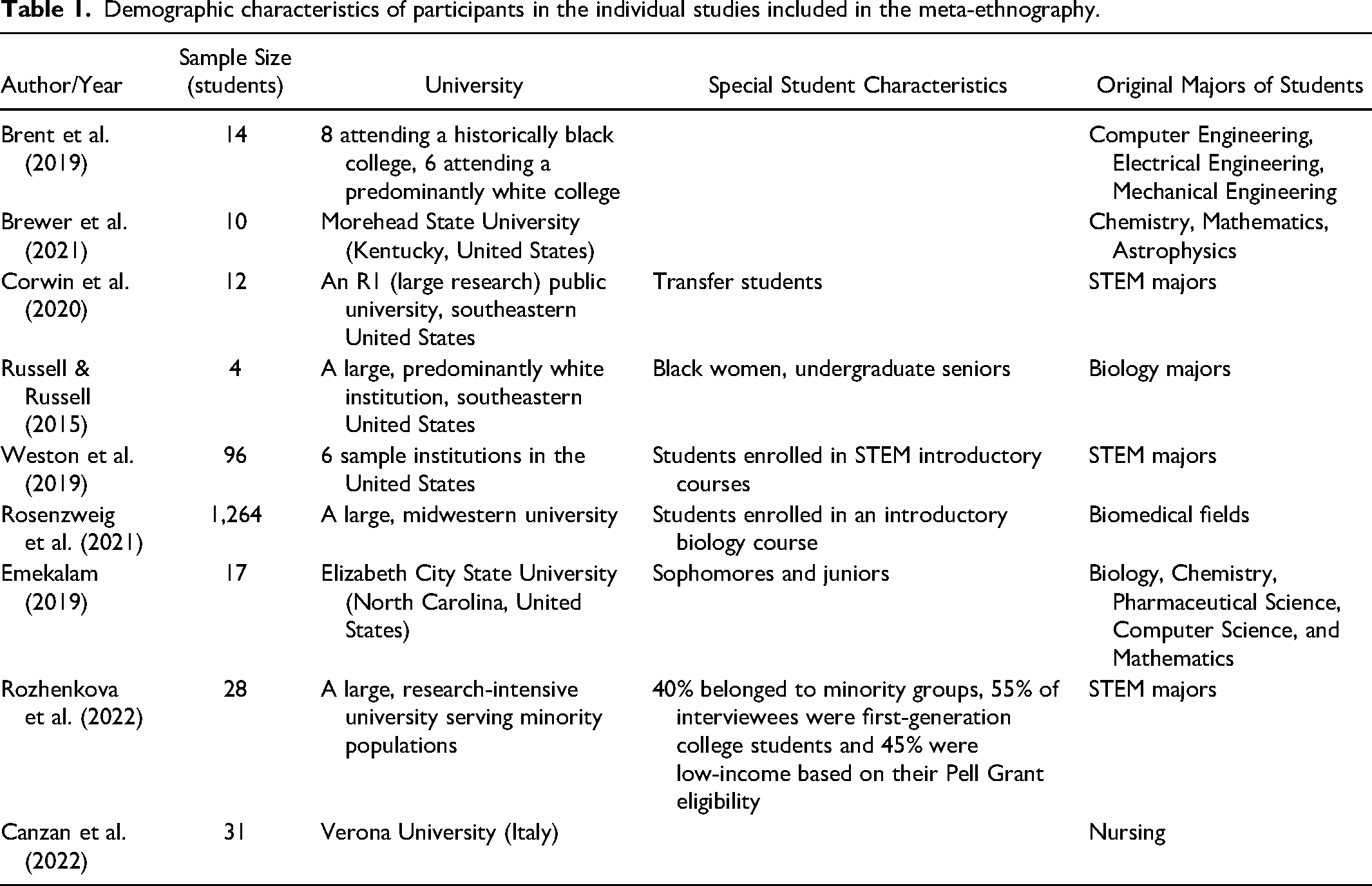
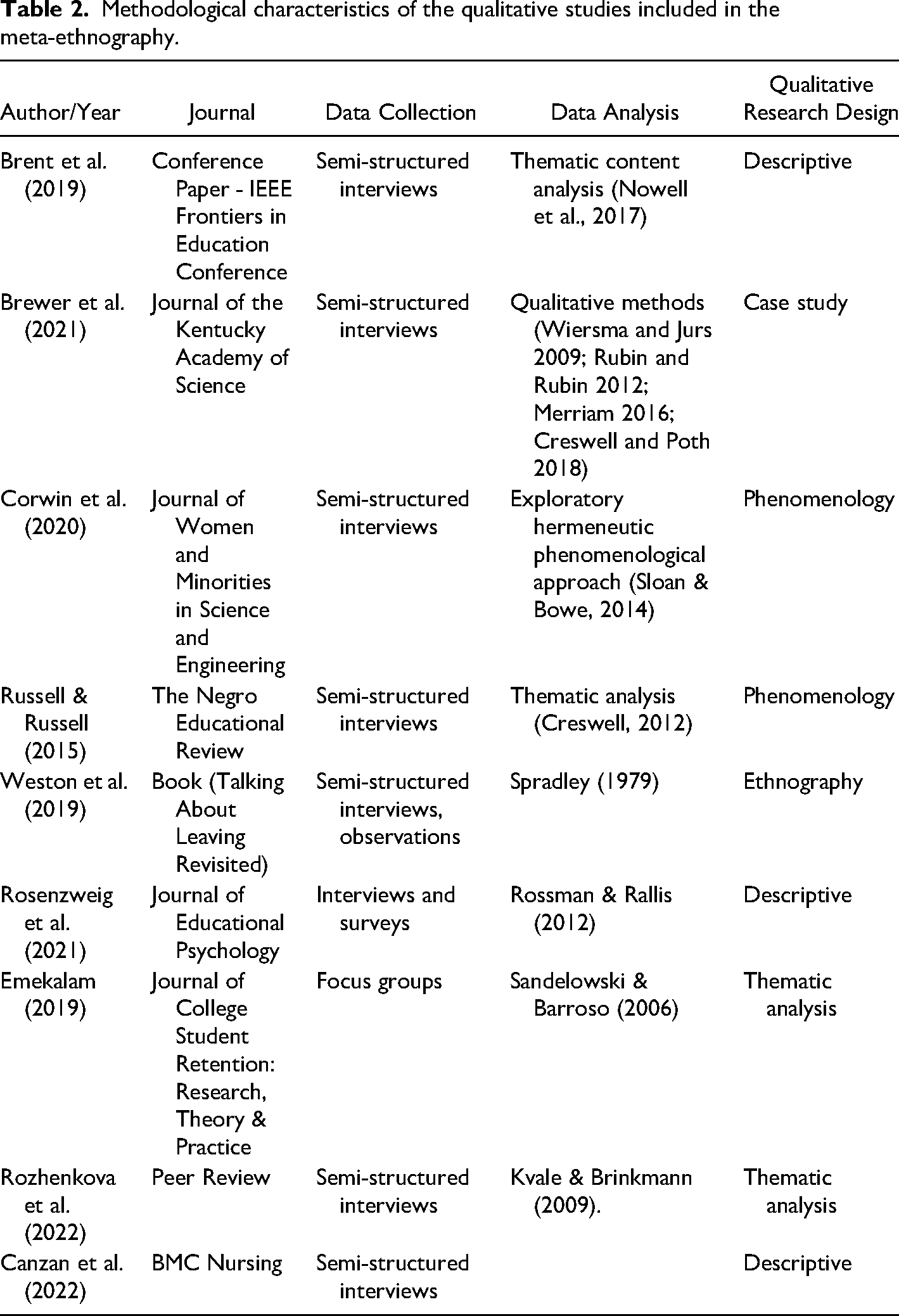
The meta-ethnography comprises nine qualitative studies, which are outlined in Tables 1 and 2. One of these studies was a conference paper (Brent et al., 2019), presented at an education conference, and another was a book chapter that discusses weed-out classes and their consequences (Weston et al., 2019). Other studies were published in the field of education or educational psychology as well. One of these studies, published in the Journal of Educational Psychology, explored college students’ reasons for leaving biomedical fields and another chosen article examined the perspectives of student athletes (Rosenzweig et al., 2021). One study was from a journal that specializes in research, theories, and practices pertaining to student retention (Rozhenkova et al., 2022). One of the chosen articles was published in a journal focusing specifically on the educational experiences of Black college students (Russell & Russell, 2015), while another was published in a journal that emphasized the experiences of women and minorities in the fields of science and engineering. Other studies sought to explore sciences as well, with one of them being published in a science journal. Finally, one of the chosen articles was found in a nursing journal (Canzan et al., 2022). The range of publication avenues for these articles demonstrates the breadth of the issue at hand. When students choose to switch out of majors, their absence is suffered by many fields of study.
Demographic characteristics of participants in the individual studies included in the meta-ethnography.
Methodological characteristics of the qualitative studies included in the meta-ethnography.
Data Analysis
This meta-ethnography synthesized nine studies exploring students’ decisions to change college majors, utilizing Noblit and Hare's (1988) seven-step approach for the synthesis of qualitative research. These steps are meant to be repeated throughout the process of synthesizing qualitative research. These steps include: (a) Getting started - choosing the phenomenon to be studied; (b) Deciding what is relevant to the initial interest - choosing only qualitative studies that are pertinent to the phenomenon in question; (c) Reading the studies - familiarizing yourself with the studies that were chosen to be included in the meta-ethnography; (d) Determining how the studies are related - using metaphors (concepts, themes, or phrases) to explain how the studies are related to each other, and in this meta-ethnography it is assumed that the studies are directly comparable as reciprocal translations; (e) Translating the studies into one another - Noblit and Hare explain that this involves treating the accounts as analogies, maintaining the central metaphors of each account in their relation to other key metaphors in the same account (p. 28); (f) Synthesizing translations - creating something that is more than all of the individual parts put together and determining whether the same metaphors can be used to describe the findings of the other studies or if new metaphors need to be established; (g) Expressing the synthesis - determining the medium that will be used to share the results of the meta-ethnography, which in this meta-ethnography, as well as in many others, will be the written word.
The data found in each of these studies has been collected and described in the tables below. In Table 1, participants’ demographic information from each of the studies is provided. In Table 2, the methodological information about the qualitative studies included in this meta-ethnography is depicted.
Results
To demonstrate the reciprocal translations that were present between the nine studies, I created a table of key metaphors from each study. A key metaphor is the term for each of the phrases that were gathered to compare ideas that were similar in concept. These key metaphors were then organized into three overarching themes: disoriented dreamers, dreamers dismissed, and dreams destroyed. The three overarching themes from my study came from using Noblit and Hare's approach to conducting a meta-ethnography. They recommend determining how studies are related through the use of metaphors (concepts, themes, or phrases). When reviewing the qualitative studies, I noted the sense of disappointment and loss that was present across participants’ responses and perceived “choice of major” as a substitute for “dream.” Then I completed the next step in Noblit and Hare's approach, translate the studies into one another, which required my attention to the metaphors used in other studies. Through synthesizing the translations, I determined that the same metaphors could be used to describe how participants across studies interpreted their experiences. More information about how these themes were present in each study can be found in Table 3.
Overarching themes and key metaphors.
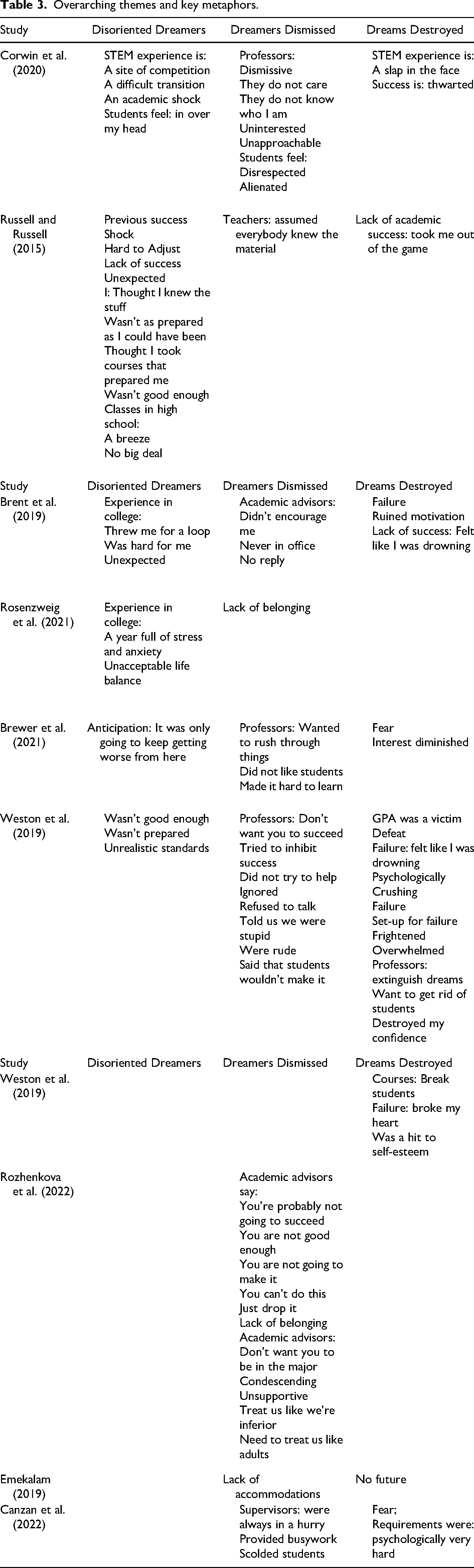
Under the theme of disoriented dreamers were the key metaphors that revealed the surprise that students experienced when they engaged in college courses related to their chosen major. The expectations of these students were disrupted, leading them to feel confused and lost. The overarching theme of dreamers dismissed showcased the experiences of these students as they attempted to adjust to the difficulty of their courses. In their confusion, students sought help from academic advisors, professors, and field supervisors, but their needs remained unattended, leaving them to feel unwanted in their chosen fields. Key metaphors related to students’ feelings of being attacked were listed under the dreams destroyed overarching theme, where students described their decision to give up their intended major. It is in this theme that key metaphors progress from being difficult to unmanageable.
The nine studies represented diverse populations. One of these studies (Corwin et al., 2020) focused primarily on the experiences of transfer students, while two other studies (Brent et al., 2019; Russell & Russell, 2015) discussed the experiences of Black students in STEM fields. Within the key metaphors found in these studies, students described an overwhelming lack of support. The participants of these studies explain that they did everything that was in their power to prepare themselves for academic success but were unable to academically achieve as a result of the neglect and lack of concern they suffered at the hands of teachers, professors, and academic advisors. These participants felt that their teachers had been unqualified to teach them what they needed to know and that they could have been able to perform at a higher level if they had only been given the opportunity. One student explained her lack of academic success in the following way: I succeeded in high school in what I was exposed to but having an opportunity to come to college I realized that I wasn’t as prepared as I could have been. And given those challenges I feel like I could have succeeded even more in college if I had been presented that information earlier. So I feel like I’ve been successful for what I’ve had that exposure to but, you know, learning something new made me feel like I wasn’t as good in it as I thought I was initially and then when I came to college. (Russell & Russell, 2015, pp. 111–112)
Students begin their college career in hopes that they will attain a degree in their chosen major. However, they may find this dream being shattered in the face of obstacles presented to them by college courses and professors; obstacles which their previous academic experiences had not adequately prepared them to overcome. These individuals expressed disappointment about the expectations that they held that had not been met, and frustration that they were not aware of the severity of their needs until it was too late. The metaphors found in these studies suggest that, as students realize that they are underprepared for the academic rigor of their college courses, they look for support. If they are not met with support, they are likely to feel attacked. It is at the point of feeling attacked that many students discuss their choice to switch out of their chosen majors (see Figure 1).

Interactions between key metaphors.
Disoriented Dreamers
Students’ feelings of being underprepared for the academic expectations of their chosen majors were prevalent across the nine studies chosen for review. Participants experienced a “difficult transition” (Corwin et al., 2020, p. 274) which they described as “an academic shock” (Corwin et al., 2020, p. 278). Participants in Russell and Russell's (2015) study echoed this sentiment, with one individual saying that “I was shocked” because “I thought I knew the stuff” (p. 112). One participant in Brent et al.'s (2019) study stated that the experience “threw me for a loop,” emphasizing that the transition “was crazy” (p. 3). This academic shock led some participants to panic. One student described their experience in the nursing field as a “year full of stress and anxiety” (Rosenzweig et al., 2021, p. 4). As one student explained: I liked math [and] chemistry, but I had a [science] class I couldn’t stand. It was kind of difficult and it freaked me out that I didn’t like it. Halfway through the semester, it was already too late to drop the class and I was like, “I don’t want to do this, but I had to.” It was only going to keep getting worse from here and I didn’t feel like I should stick with it. It didn’t feel right. (Brewer et al., 2021, p. 7)
Students did not view their current academic setbacks as temporary. As the student above noted, “it was only going to keep getting worse from here”. These beliefs indicated that students believed that their lack of academic success was inevitable and that this was demonstrated by the lack of success shown by other students in their programs.
Lack of Success
There appeared to be a prevalent belief in students experiencing disorientation and difficulty in the classroom that they were not equipped to handle the academic challenges that they faced in the classroom. Whether or not students were capable of rising to the challenge, the reality was that many students did not believe themselves to be capable of overcoming these academic challenges and acted on these beliefs. One participant in a study done by Rosenzweig et al. (2021) noted that her chemistry courses were “difficult” for her and described this difficulty as “the major reason I switched” (p. 360). Students in Russell and Russell's (2015) study reported that the lack of academic success is “what took me out of the game” and that the decision to switch majors was “totally based on grades” (p. 109). One student admitted that their interest in their initial major was “diminished after it was so hard to do” (Brewer et al., 2021, p. 8), and another stated that “as hard as I tried, I could not get the abstract concepts” (Brewer et al., 2019, p. 8). Study participants were often inclined to internalize their lack of academic success, believing that failure indicated that their academic environment was not a good fit for them, claiming that their chosen fields were “not a very productive environment for me” (Russell & Russell, 2015, p. 108), and that “this isn’t the field for me” (Brent et al., 2019, p. 3).
Shared Shock
Study participants recognized that their feelings were shared by their classmates and peers. According to one student, “A lot of us didn’t know what was going on. So it was like, we can all sit and study together, but all of us are struggling with the same thing’ (Brent et al., 2019, p. 3). This shared struggle led one student to wonder, “If everyone's not getting it, is everyone stupid?” (Weston et al., 2019, p. 3). While students recognized that some of their peers may be more “motivated” (Canzan et al., 2022, p. 6) to achieve, their observations informed them that the academic shock they were experiencing may not be a problem belonging only to them.
One study (Weston et al., 2019) explored this shared academic disorientation in depth, as it discussed the implications of weed-out courses on student choices and achievement. A participant in this study lamented that they were “not prepared for classes with a 75% failure rate” (p. 202) and that everyone in these courses was subjected to “unrealistic standards” (p. 203) that served to discourage students. Another student claimed that it is common in weed-out courses for “half the class” to fail (p. 202) and that grades are curved enough to allow students who performed only marginally better than other students to “just keep going” (p. 202). Participants in this study were frustrated, not only because the courses were difficult, but because they were designed to contribute to the academic shock that these students were experiencing. One student explained this intended confusion in the following way: I won’t say that weed-out classes are the most conceptually difficult. They aren’t. And they may not be the hardest in terms of workload. But they are designed to deliver a culture shock of what your major might be like. So they are the most frustrating and stressful experience- like they go further in depth than is needed to frighten and overwhelm you. (Weston et al., 2019, p. 205)
When in doubt, students may feel inclined to turn to professors, academic advisors, and other supervisors to help them alleviate their concerns about success and self-confidence. Unfortunately, many of the participants in the examined nine studies found that their fears and frustrations were not alleviated, but instead exacerbated by the support that was provided, as well as the support that was unavailable, to them in their time of need.
Dreamers Dismissed
Students who are struggling academically may look to their academic advisors, professors, and other supervisors for support. Every problem that students experience during their coursework is not so dire to motivate students to drop out of their chosen major. Some students experience setbacks that could be addressed by professionals who are willing to provide strategies designed to promote students’ academic success. One nursing student described her academic problems in the following way: I tried to study to pass all the exams during the first semester, but this strategy was a failure because I was studying a bit of every subject and that led me nowhere. There are many different subjects and it's difficult to organize the study of so many different arguments at the same time. (Canzan et al., 2022, p. 5)
Students with such organizational problems may expect to be met with studying advice when they approach academic advisors and professors. Unfortunately, students in the nine studies that comprise this meta-ethnography reported that they did not find the support that they needed. Furthermore, these students claimed that they were instead met with negative feedback that influenced their decision to leave their chosen majors when they consulted with those responsible for providing academic support.
Lack of Support
Study participants in several studies noted their frustration with academic advisors who were unavailable for support. Individuals in Corwin et al. ‘s (2020) study described professors who were “dismissive” (p. 283) of them, which contributed to students’ beliefs that professors were uninterested and unapproachable. This lack of support was not evident in attitude alone, but also in the physical presence of advisors, supervisors, and professors. Canzan (et al., 2022) indicated that supervisors were “always in a hurry” (p. 6), which prevented students from engaging in necessary learning opportunities. One student who switched from computer engineering to computer science stated that: A lot of the time, like, my actual advisor was never there in computer engineering, he was never in his office, as opposed to computer science. I can just go to my advisor's office or at least they will reply to an email in a reasonable amount of time. But with computer engineering, I would email and maybe not get a reply for a few days. (Brent et al., 2019, p. 3)
Time is of the essence when students are struggling to achieve and maintain desirable grades in the courses they have chosen. Thus, academic advisors and professors who are unavailable for academic support appeared to pose an insurmountable challenge for students who would have otherwise preferred to stay in their selected majors. As a student in Rozhenkova's (2022) study stated, “I feel like not having support from (academic advisors) was a huge point for me and why I ended up switching” (p. 10). Another student, who consistently missed lectures and labs because of their role as a student athlete, discussed their attempts to “catch up” with what they had missed by viewing online resources, asking peers in their classes, and by attending scheduled office hours. However, they stated that “Neither of (the resources) and sometimes all of them are not enough’ (Emekalam, 2019, p. 36).
Some students believed that the lack of support demonstrated by those in their field went beyond neglect, as their professors demonstrated deliberate refusal to address students’ needs. In some cases, academic struggle could lead to professors withholding information and support. These students said that, if you were below the grading curve, “professors wouldn’t even talk to you” (Weston et al., 2019, p. 208) and that those students who were struggling to achieve “were all ignored” (p. 208). Those students who were able to make contact with their professors and advisors reported challenges that were different in nature. Rather, study participants across several studies reported that the messages they received from advisors and professors were overwhelmingly negative; designed to discourage students from pursuing their academic goals.
Negative Feedback
As students were struggling with a lack of success in the classroom, they sometimes found that the messages they received from professors and advisors further discouraged them from pursuing their intended academic majors. Transfer students who were struggling were told “You are going to have a lot to catch up on” (Corwin et al., 2020) and students in weed-out courses reported that their professor “told us we were stupid,” (p. 208) and witnessed professors joking “that students wouldn’t make it” (Weston et al., 2019, p. 208). Such comments led students to believe that professors “do not care” (Corwin et al., 2020, p. 273) and that professors “made it hard to learn” and “hard to understand” the content they presented (Brewer et al., 2021, p. 8). The presence of such negativity caused one student to reconsider their academic trajectory on the very first day of their senior year: Yes. I wanted to go into medical school up to my senior year, up until the first day of my chemistry class. Well, the first week of my chemistry class when my instructor said, “If you don’t make an “A” in my class, you’ll never make it in a med school. (Russell & Russell, 2015, p. 108)
In this student's situation, the negative feedback that the instructor provided discouraged the student from persisting in their educational path prior to experiencing any kind of academic failure. This finding is echoed by previous studies, such as Clemens et al. (2017), which showed that students who hold high aspirations are more likely to demonstrate low performance when met with low expectations. This demonstrates the existence of a “Pygmalion Effect” (Rosenthal, 1994), where teachers’ perceptions of students influence students’ academic achievement. In this instance, the instructor made two assumptions - 1) that some of the students they were speaking to would not succeed in their class; and 2) that the lack of success in the current class was indicative of failure in med school. Whatever the instructor's intentions were, the message became a self-fulfilling prophecy for the student mentioned above, who did not choose to pursue their dream of attending medical school.
Academic advisors also made their low expectations of students apparent when they met with participants of these studies. These advisors told students that “you are probably not going to succeed” (Rozhenkova et al., 2022, p. 10), that “you are not going to make it” (p. 10) and that “you can’t do this’‘ (p. 12). This led students to the following statements and beliefs; “(academic advisors) were so mean to me” (p. 8); “(academic advisors) don’t want you to be in the major” (p. 9); and “treat us like we’re inferior” (p. 12). A student in Brent et al. ‘s (2019) said that academic advisors “don’t give you actual guidance” (p. 3) and had “problems pretty much the whole time” with students (p. 3). When students were facing academic challenges (and, sometimes, before students faced academic challenges), they turned to academic advisors, supervisors, and professors who greeted them with low expectations, causing these students to feel discouraged. For some students, this discouragement felt like an attack.
Dreams Destroyed
Participants across the nine studies chosen for review shared the common experience of unrealized academic goals. The studies did not include the experiences of those who struggled in their chosen academic major and persisted, but those who made the decision to switch out of their major or to drop out of college altogether. For some, the termination of their previously held dreams was discussed in more severe terms than for others. As students were dealing with difficult courses and a lack of support, some described the impression of feeling under attack. One student described her interactions as follows: I would go in so many times to speak to the counselors and they were just so mean to me. They would turn me down and then be like, “Oh, look at your social science grades. You got an A and a B. Why don’t you go to social sciences?” I am not here for you to tell me to switch my major. I am here for you to help me stay in the major!… And at the end of the day, what did I do? I got out of my major. (Rozhenkova et al., 2022, p. 9)
Description of Attack
Many students in the selected studies described their experience in their academic field in terms of physical maltreatment. One participant in Corwin et al.'s (2020) study described their experience in a STEM field as “a slap in the face” (p. 273), while another claimed that their courses were “a hit to self-esteem” (Weston et al., 2019, p. 208). Another participant expressed their concerns with some of the requirements of their major, admitting that these requirements were “psychologically very hard” and “extremely frightening for me” (Canzan et al., 2022, p. 5). Students in two different studies used the term “drowning” to detail their experiences, with one participant explaining, “I found myself drowning” (Brent et al., 2019, p. 3) and another stating, “I was drowning in the course” (Weston et al., 2019, p. 214). Such oppressive terms give credence to the negativity that participants reported in previous themes, where they simultaneously encountered academic challenges and unsupportive faculty members. One study participant described how this oppression was coupled with a lack of support in the following way: If you have one thought, one doubt…like I’m sure we’ve all had one thought of “Am I even in the right major?” I always give them advice, “Don’t go to the counselors, they will make you want to drop this major, and you are probably smart enough to be here. If you made it to [this campus], you’re smart enough to be in this major. It's just that counselors are not there to support you. They will break you down and make you leave. (Rozhenkova et al., 2022, pp. 9–10)
Statements like the one above denote students’ beliefs that the negative experiences they encountered were not merely par for the course, but that these attacks were in fact personal. One student in Weston et al.'s (2019) study expounded on this idea through their discussion of weed-out courses, saying that professors were “trying to get rid of the weakest link,” which was “what I felt like,” and that “my GPA was a victim to that mentality” (p. 207). Another student believed that their professor “did not like me at all” (Brewer et al., 2021, p. 7) and described her as “seething” during one of their interactions. A nursing student reported that their supervisor “would reproach me” (Canzan et al. 2022, p. 6), which this student found unconducive to their learning. It was within discussions involving students’ feelings of being attacked that they described the consequences of these attacks, which for many, meant switching or dropping out of their chosen majors.
Consequences of Attack
When feeling attacked, many students choose to flee the perceived root of their oppression. A student in Corwin et al.'s (2020) study claimed that her “success was thwarted” (p. 279), and participants in Emekalam's (2019) study reported that they could no longer envision a future in their initial majors. One student explained that the experiences they had in their major of choice “ruined my motivation” and another connected their failure with the belief that “this isn’t the field for me” (Brent et al., 2019, p. 3). A student in Russell & Russell's (2015) study considered her lack of academic success as “what took me out of the game” (p. 110), with the “game” referring to her original academic area of interest. For some of these students, responding to the oppressive academic environment they found themselves in involved letting go of their dreams. In Chem 140, the room is full, but in upper-level chemistry, there's just seven in the class. But, along the way you are extinguishing people's dreams. Of all the kids I met in that major, only one stayed, and he changed into another science major this semester. So, none of them stayed in chemistry. They all changed their majors. (Weston et al., 2019, p. 208)
As seen in the students mentioned above, academic situations may lead students to seek academic success and support in other academic areas of interest. Students in Brent et al.'s (2019) study who switched academic majors were “getting positive feedback” (p. 4) from supervisors in other fields and were “able to see the result of what I’ve put in right away” (p. 4). Instructors in other fields were described as “absolutely phenomenal” (Weston et al., 2019, p. 209), which may be appealing to students who have not been met with adequate support in their field. A nursing student who switched majors stated that “I know for a fact that I need to be supported closely, I give a lot, but I also need to receive back from people” (Canzan et al., 2022, p 6). For the students in these studies, overcoming feelings of attack just to persist in their chosen majors was neither possible nor desirable. Study participants across the nine studies indicated that they need to experience academic success and support to persist. If they do not find this success and support in the initial majors that they have chosen, they will turn elsewhere to satisfy these needs. In Table 3, each of the studies is depicted in relation to the three themes that were present in this meta-ethnography.
Discussion
It is a desirable and attainable goal for students who are interested in an academic program and are capable of meeting the expectations that are required of their chosen academic program to attain a degree in the field of their choice. Previous conceptual models on college student retention and persistence have demonstrated the factors that influence students’ choice of college and the various strategies that could be employed to help support students as they make these choices. One of such models is Perna's (2006) conceptual model of student college choice, which shows how students use information about academics, resources, expected benefits, and expected costs to make choices about attending college. What is important to note, and what the findings of this study reveal, is that students continue to make choices once they are acclimated to a college environment. These decisions have lasting impacts on not only students, but on fields of academic expertise, and on society at large.
It is understandable that, for some students, interest in their academic major diminishes as they learn more about what a future in their field might entail. This lack of interest was demonstrated in this study as well, with students commenting that they “wanted something else” (Canzan et al., 2022, p. 6) and that they “couldn’t come up with anything that was really exciting to me” (Brewer et al., 2021, p. 9). These students should be encouraged to find an area of interest that they feel more appropriately suits their interests and strengths. It should not be the goal of any academic advisor or professor to push a student to persist in an academic major that does not interest them. However, the themes present in this meta-ethnography suggest that student attrition is not limited to students’ preferences alone.
Highlighting the importance of persistence in major, rather than academic persistence in general, could be an important step in addressing educational inequity for underrepresented minority students. Previous literature on persistence in majors indicates that STEM fields are continuing to lose individuals who indicated initial interest, especially individuals from populations historically underrepresented in STEM fields (Mau, 2016; Shaw & Barbuti, 2010; Weeden et al., 2020; Whitcomb & Singh, 2021). Participants in this study revealed that they face pressure from academic advisors to switch to majors that may be easier so that they could receive higher grades. Doing so may serve an advisor whose goal is to increase the rate of academic persistence at their college, but could negatively impact students who wish to remain in their majors of choice. This is a particular concern for students from underrepresented minority groups (such as Black and Hispanic students) who are being pressured to change academic plans at a higher rate than students from other ethnic backgrounds (such as White and Asian students).
The findings presented in this meta-ethnography suggest that students switch majors when they are overwhelmed by the intensity of the academic challenge they are presented with and are offered limited support to respond to these challenges. These findings support prior research, which suggests that students’ perceptions of the quality of the academic program and accessibility to faculty for help and support are among the most significant factors of student attrition (Xu, 2018). Thus, increasing the quality and level of support that students receive may be helpful for college faculty who are interested in enhancing student persistence in their academic fields. Students in these studies described their responses to what they heard from their college professors and advisors, which suggests that the interactions between students and faculty members play a role in influencing students’ decisions to drop out of, or persist, in their academic majors.
There are a variety of factors that may contribute to students’ attrition that are unrelated to their ability to perform well in their chosen fields. Concannon et al. (2019) found that students’ self-efficacy beliefs were influenced by verbal persuasions, which were associated with students’ persistence in the field of engineering. Suldo et al. (2018) reported that success in International Baccalaureate programs was predicted by school burnout as well as academic scores. Findings by Steenbergen-Hu and Olszewski-Kubilius (2017) suggest that career guidance is an essential component of success for students pursuing STEM fields, even when students demonstrated higher-than-average abilities.
Other factors, as indicated by the participants in this study, that may impede student success involve a lack of professors in the field (Emekalam, 2019); family demands (Brent et al., 2019); family tragedy (Rosenzweig et al., 2021); and a lack of communication (Russell & Russell, 2015). Students reported struggling with a variety of issues that were not necessarily connected to their academic potential. Some students claimed that their classroom “was not a very productive environment for me” (Russell and Russell, 2015, p. 108) and that “exams were not correlated with what we were going over in class” (Brewer et al., 2021, p. 7). For such students, lack of academic success may be particularly frustrating, because they perceive a problem that goes beyond their willingness or ability to achieve. A student in Weston et al.'s (2019) study stated that, “it felt like we had to teach ourselves,” (p. 206) which is not a task that should be given to students who are faced with the acquisition of challenging material.
Limitations and Further Research
This meta-ethnography examined the experiences of college students who chose to leave their majors. The studies that comprised this meta-ethnography included participants from various majors who came from different cultural, linguistic, and economical backgrounds. This study offers an overview of why students choose to leave their majors but does not delve into the specific experiences of students from a particular major or how students’ specific backgrounds inform their decisions to leave (or stay in) their majors. Further exploration into specific majors and specific demographical characteristics may be necessary to produce practical recommendations for students from a variety of backgrounds and in their respective majors of choice.
College faculty members, academic advisors, and other supervisors who aim to enhance student persistence in their respective academic areas of discipline may use the results of this meta-ethnography to guide their approach to providing students with academic support. They should not assume that students’ lack of success is due to a lack of ability, but due to a combination of academic challenges and lack of support. When provided with the necessary academic support and encouragement, it is possible that students may be able to rise to the challenge in their academic majors and be empowered to persist in the fields that initially inspired them.
Footnotes
Declaration of Conflicting Interests
The author declared no potential conflicts of interest with respect to the research, authorship, and/or publication of this article.
Funding
The author received no financial support for the research, authorship, and/or publication of this article.
