



Abstract
The premise of this study is the timeliness of interdisciplinary approaches in news media research, specifically including the perceptions of news audiences. Using a multidisciplinary literature review and qualitative and quantitative analysis, this study adopted a multidimensional construct—news media image—to investigate how news audiences perceive news media organizations. The respondents studied here, who were representative of the general U.S. population, referenced the news media in general in their evaluation of news outlets. Results of focus groups and online surveys (factor analyses) indicated that news audiences evaluate the content and practices of news media overall based on perceptions related to seven specific criteria: usefulness, credibility, empathy, personality, usability, news selection bias, and social responsibility. Image perception encompasses rational, cognitive judgment, and affective evaluation. That news audience respondents commonly employed multiple evaluation criteria related to news media points to the need to broaden the scope of journalistic research in the direction of a new heuristic. Examining news media image, that is, investigating how “the general public” views news media as an institution in a continuously changing—and challenging—news media landscape adds value to media research. Results from a confirmatory factor analysis used in this study suggest that a positive news media image can enhance audience satisfaction and, subsequently, loyalty.
Keywords
As a former journalist currently researching journalistic practices and behaviors in news organizations, I have often wondered why journalists and the news media as a whole are the objects of so much public criticism. Traditional journalism, particularly institutional news media in the United States (and around the world), provokes acute skepticism and even hostility. These attitudes have intensified over the course of the past two presidential elections and throughout the Covid-19 pandemic (Lush, 2017). Of course, news organizations are often biased, and in today’s media environment, people readily refer to news reporting that does not conform to their personal beliefs and political orientation as fake news (Guess et al., 2018). The complexity of the contemporary media landscape calls for a more in-depth, multidimensional approach to examine and meet the needs and expectations of today’s news audiences (Brants & De Haan, 2010; Meijer, 2019). Contemporary news media institutions face a critical challenge: to address issues related to public trust and to improve relationships with audiences.
To better understand and address negative perceptions, a research framework should focus on and identify the criteria that audiences themselves deem relevant. This study, therefore, adapted the image construct as a lens through which to establish a multidimensional view of how contemporary news audiences regard and evaluate news media as a whole. I, therefore, developed a news media image scale as a measurement tool to identify a broad picture of news audiences’ mental schema (Tsfati & Cappella, 2005) and capture relevant information about how they evaluate news organizations.
As such, this study provides a starting point regarding how news audiences evaluate contemporary news media in general. That is, it establishes evaluation criteria shared by participants, rather than focusing on specific, individual networks or outlets, or singling out a particular medium or news format. The results revealed that participants evaluated journalists’ reporting practices and news quality and content (cognitive components) and that their feelings and perceptions (affective components) arose from personal experiences in consuming news (Palacio et al., 2002).
This monograph first introduces a specific concept—image—that is regularly used in corporate marketing and management literature. The image construct—the aim of which is to identify and address public perceptions and attitudes about a given entity—readily lends itself to journalism scholarship. The concept of image refers to “the net result of the interaction of all experiences, impressions, beliefs, feelings and knowledge” that people have about an entity, a corporation, an institution, and so on (Worcester, 1997, p. 147). As per its definition, the image construct encompasses a wide range of attributes of the image object and provides a valuable tool to more fully understand public perceptions and attitudes. Because of its impact on people’s attitudes and behaviors, marketing scholars use the image construct to explain and/or predict people’s behaviors, such as consumers’ purchase intentions, satisfaction, and/or customer loyalty (Dowling, 1986; Flavian et al., 2004; Roth & Diamantopoulos, 2009). No similarly robust conceptual lens is available for understanding audience perceptions of news media.
Extant journalism scholarship has relied extensively on the credibility measure and similar concepts, including believability and trust in news media, and this approach has provided useful insights (Appelman & Sundar, 2016; Fisher, 2016; Kim & Dennis, 2018; Meyer, 1988; Robinson & Kohut, 1988; Williams, 2012). However, journalism researchers limit themselves by focusing largely on normative aspects and/or on the vantage point of journalism professionals, neither of which provide the heuristics required to produce deeper insights into audience perceptions of news media. In a similar fashion to marketing studies using the image construct (Dowling, 1986), news organizations that have a better understanding of their public image might, for example, more readily find a means to improve relationships with their audiences, motivate increased news consumption, and better strategize their competitive positions.
This study began with exploratory approaches, using a multidisciplinary literature review, theories, and both qualitative (focus groups and thematic analysis), and quantitative research methods (online surveys and exploratory and confirmatory factor analyses) to build a news media image construct as perceived by the public. These methods were used to obtain a valid and reliable scale by which to measure news media image and to examine the relationships between image and other news audience-related variables. This study comprises several steps in terms of scale development (Studies 1, 2, and 3), ultimately resulting in seven dimensions of news media image as perceived by the public (see Figure 1). As image scholars report that image can facilitate audience satisfaction and loyalty, this study additionally tested the statistically positive effects of news media image on respondents’ satisfaction and loyalty with regard to news organizations in general.
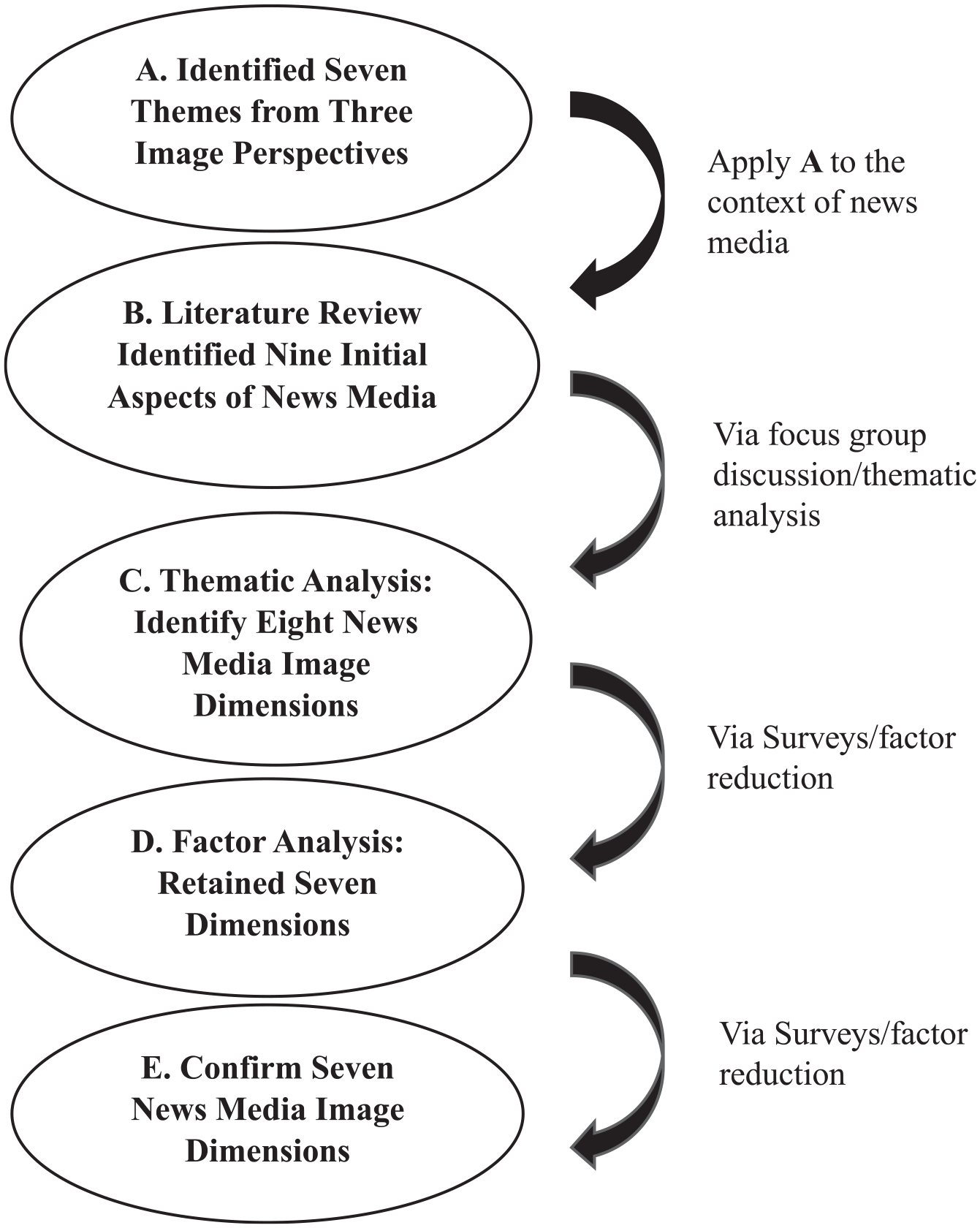
Scale development steps in this study.
Why Adopt the Image Construct?
Current scholarship largely relies on metrics based on researchers’ and journalists’ viewpoints in terms of understanding audiences. However, this focus is limited in that it does not provide information about news audiences’ perspectives and evaluations of news media organizations. I argue that journalism scholarship should include an expanded measure—one that goes beyond the normative journalism standards that typically focus on credibility and news quality. The alternative measure suggested in this study could be used to define audience perceptions more precisely and also provide valuable information about audiences’ news use. I first discuss extant studies about news audience perceptions, including credibility, the most commonly used concept in journalism to gauge public perception. Subsequently, I introduce the concept of image and its wide use in marketing and management, the changing landscape of contemporary journalism, and the benefits of adopting the image construct both for journalism research and for news organizations themselves.
News Media Skepticism
After the 2016 U.S. presidential election, the online news outlet Buzzfeed reported that news consumers relied more on fake news election stories (e.g., stories with false or misleading content) from hoax sites and hyper-partisan blogs than on stories from traditional news media (Silverman, 2016). According to Buzzfeed’s analysis, people actively engaged (liked, shared, reacted to, and commented) more with top fake news stories than with traditional ones. This phenomenon is presumably a clear sign of the decline in traditional news media’s credibility as perceived by the public (Silverman & Singer-Vine, 2016). The year 2016 also marked the juncture when the U.S. public’s trust in news media (newspapers, television, and radio news reporting) was recorded at its historical lowest—32% (Swift, 2016). This situation has not substantially improved: Only 36% of the U.S. public reported they had “a great deal” (7%) or “a fair amount” (29%) of trust in news media last year (Brenan, 2021).
This issue certainly demands special attention. Tsfati and Cappella (2005) suggested that news audiences “have some mental schema for what the news media are” (p. 268) and provide answers based on such schema when asked about news media (for this argument, see also Kiousis, 2001). Based on this premise, I seek to explore a more holistic and inclusive view of news media that incorporates the public’s perspective. The following sections detail various criteria that I will use.
News Audience Perceptions
Emphasis on normative norms
Journalism researchers have examined ways that news is perceived by audiences largely in terms of two factors: credibility and accuracy. This implies that studies of media perceptions have relied mostly on two frames of reference: (a) the information and (b) the providers of information (i.e., the sources or media used). For example, perceived credibility generally focuses on audience perspectives about “the believability of information” (Flanagin et al., 2020, p. 1039). This approach is concerned with the information itself, for example, informational quality, accuracy, or currency (Kohring & Matthes, 2007; Schweiger, 2000; West, 1994), and is also often associated with the level of information sources’ expertness and trustworthiness, that is, the public’s perception of how well informed and how impartial the sources are. Because scholars tend to consider each piece of information, as well as source credibility, separately (or as similar concepts), little research examines all of these together (Kiousis, 2001; Schweiger, 2000).
In addition, the credibility measures currently used include believability, accuracy, trustworthiness, fairness, bias, and completeness of the information (Abdulla et al., 2002; Flanigan & Metzger, 2000), and these measures are largely situated within the boundary of traditional journalistic standards. For example, a frequently used measure includes the five items suggested by Meyer (1988): fairness, bias, completeness, accuracy, and trustworthiness. These credibility items overlap with the objectivity norm, a journalism standard that emphasizes balance, fairness, accuracy, nonbias, independence, neutrality, factuality, noninterpretation, and detachment (Peters, 2015). Such emphasis on normative norms, however, might limit our understanding of audience needs, especially in the contemporary, interactive news media landscape that calls for closer attention to audiences and relationships with them.
Studies also reported differences between audience expectations and professional views in terms of topic preferences, news value judgment, normative standards (i.e., what journalists should do or what good journalism would be) and the scope of coverage (Brand & Pearson, 2001; Meijer & Bijleveld, 2016; Van der Wurff & Schoenbach, 2014; Vos et al., 2019). For example, a survey conducted by the American Press Institute as part of the Media Insight Project suggested that audiences are unlikely to differentiate between articles, editorials, and advertising; meanwhile, online platforms tended to make it more difficult to sort “news” from opinions. Only 43% of the respondents in that survey reported that they could easily differentiate news from opinions on news websites or social platforms (Locker, 2018). Meijer and Bijleveld (2016) found that while audiences and news professionals agreed on which features “qualified” local news should possess, audiences have different opinions about what news media should do for them. Sundar’s (1999) study about audiences’ perceptions of news content reported that audiences relied on a range of criteria or variables in their perceptions of news content that went beyond normative standards such as credibility and quality of the content. Additional variables included “liking” (if audiences liked the content) and representativeness (whether the content was congruent with the general news stereotype, for example, whether the content was relevant, timely, important, or [often] intrusive). By identifying the liking variable, Sundar revealed an additional layer worthy of recognition by news media professionals and scholars: the emotional dimensions of audience perceptions.
Go beyond credibility and cognitive measures
To enhance understanding of news audiences’ perceptions, researchers tried to broaden their scope. Thus, some scholars focused more on issues directly related to trust than on credibility, arguing that people’s trust in news media can inform how they perceive and evaluate it (Kohring & Matthes, 2007; Tsfati, 2002). Kohring and Matthes (2007), for example, integrated the concept of selectivity with audience trust, proposing four dimensions: trust in the selectivity of topics, trust in the selectivity of facts, trust in the accuracy of depictions, and trust in journalistic assessment.
Scholars’ efforts to conceptualize trust, as well as credibility, were often concerned with explaining and predicting how audience perceptions influenced their news consumption behaviors, such as people’s levels of news use or exposure. It is telling that today’s traditional or mainstream media face stiff competition, the competitors often being alternative and/or partisan news outlets (Fletcher & Park, 2017; Ladd, 2011; Strömbäck et al., 2020). Thus, it seems relevant to further explore the factors that affect people’s news use. However, the relationships between credibility and news use are not very clear (see Rimmer & Weaver, 1987; Strömbäck et al., 2020; Wanta & Hu, 1994). For example, Fletcher and Park (2017) suggested that the perception of a low level of credibility in mainstream news outlets was one of the reasons people turn to alternative media, but this does not necessarily mean that a high level of credibility is a predictor of news use or consumption. Metzger et al. (2020) proposed that cognitive dissonance would be a precedent of perceived credibility; this could in turn lead people to seek partisan news producers. Still, these studies focused on a specific medium or type of news content, rather than on the news media in general. It is worth adding that credibility does not always correlate with a preference for a specific medium or type of content (Kiousis, 2001).
Other scholars seek a more general explanation of people’s news use. In attempting to identify predictors of news consumption, Tsfati and Cappella (2005) proposed that audiences’ need for cognition (i.e., their need to “think, to understand, and to make sense of the world, and to learn about various points of view”) is a motivator for news use regardless of whether people believe news media are credible (p. 252). Lee and Chyi (2014) suggested that audiences’ general view of the value of news (e.g., how important the news is in serving the public interest and mobilizing public opinion) is also a motivator.
Aggregating the criteria used in the aforementioned studies leads to the implication that current concepts and measures of audience perception might not guarantee attracting the public’s attention to the news or to maintaining readership. Moreover, a demonstrable lack of consistency characterizes how these concepts have been applied in terms of measuring them (Fisher, 2016). Thus, it might indeed be worthwhile to seek a more comprehensive understanding of what news audiences actually think about, how they evaluate, and how they behave in relation to news media. Examining aspects of people’s perceptions of news media opens a valuable new realm of audience research that identifies layers of audience perceptions, including emotions, and provides more insight into people’s attitudes. This study recognizes that the complexities of the changing media environment, including audience expectations, explain the need for more complex research dimensions.
Introducing the Image Construct
The Cambridge online dictionary defines an image as “a picture in your mind or an idea of how someone or something is,” and “the way that something or someone is thought of by other people.” These definitions imply the subjectivity, multidimensionality, and applicability of images to a variety of contexts. The image concept can be applied to any person and any entity, for example, to political candidates, corporations and their products or brands, to any type of organization or institution, such as universities and hospitals, and even to countries (Dicher, 1985; Dowling, 1986; Roth & Diamantopoulos, 2009). In addition, it is the image that is in the eye of the beholder, not the image object itself; therefore, the very idea of image relates to the beholders’ attitudes toward the object. Image scholars conceive of the image as a subjective evaluation by individuals based on both direct and indirect experience with an image object over time (Dowling, 1986; Weiwei, 2007). In other words, an image is formulated in people’s minds when they encounter the various physical and behavioral attributes of an entity (Echtner & Ritchie, 1991; Nguyen & LeBlanc, 2001, p. 228; Sung & Yang, 2008).
Scholars treat image as an abstraction of reality encompassing various aspects of human cognitive and affective mind work; thus, image is a multidimensional construct generated from a wide range of how an image object’s attributes are perceived (Dowling, 1986; Kennedy, 1977). Early literature considered an image object, such as an organization, as having personality characteristics, and defined image as the sum of evaluations that people develop concerning the personality of an image object (Spector, 1961). Since the late 1960s, the image has been explicated in various ways: It is described as “a simplification of reality” of an image object that can influence people’s behaviors (Enis, 1967, p. 51); the perceived sum of the “entire organization” (Marken, 1990, p. 21); and the overall impression (Dicher, 1985; Nguyen & LeBlanc, 2001) or “the sum total of their perceptions” (Enis, 1967, p. 51). Other scholars argued that image is a stereotype or a person’s overall belief about an entity (Martin & Eroglu, 1993; Roth & Diamantopoulos, 2009).
Image can also be considered to extend beyond people’s impressions and perceptions. For example, by adding “feelings” to the concept of corporate image, Kennedy (1977) described the image as emotional associations with psychological conditions (Tran et al., 2015). These feelings tend to be a product of various interactions and experiences between people and the image object. These beliefs and feelings refer to an entity’s physical and behavioral attributes based on an individual’s personal experience, observational learning, and information from other sources such as friends, parents, and media (Landrum et al., 1999). Because it encompasses both affective and cognitive aspects, Roth and Diamantopoulos (2009) proposed a framework based on attitude theory, which suggests that using an image construct can provide a more integrated understanding. According to their framework, affective and cognitive components comprise an image construct. This image construct affects the third component of attitudes—conative or intended behavioral attributes.
Hence, the image could have a broader definition: As Dowling (1986) summarized, it is “the net result of the interaction of a person’s beliefs, ideas, feelings, and impressions about an object [e.g., corporation, country, travel destination, university, person, etc.]” (Dowling, 1986, p. 110). In addition, as different groups of people may perceive the image object in different ways, a single image object can generate multiple images (Dowling, 1988; Kennedy, 1977). The criteria that people rely on to perceive an image and the relative importance of such criteria also differ for each group (Dowling, 1988). As the image is receiver-specific, the images of news organizations held by audience groups would obviously differ from those of professional groups.
The Power of Image
The image represents a subjective notion that concerns attitudes and behavioral intentions in relation to an image object (Roth & Diamantopoulos, 2009) and thus influences how people perceive and react to things (Dicher, 1985). For example, if a political candidate is perceived as understanding the voters and caring about their problems, is believable, honest, and trustworthy, such a favorable image of the candidate is positively associated with the intention to vote for that candidate (Warner & Banwart, 2016). Likewise, a positive university image increases the possibility of parents sending their children to that university (Landrum et al., 1999). A positive corporate image is essential to a company’s survival in the long run (Dowling, 1986; Wan & Schell, 2007). A good corporate image can help increase the firm’s sales and/or market share and contributes to loyal relationships with customers. In other words, the images they hold help people differentiate one corporation’s products and services from those of its competitors and stimulate sales by influencing consumers’ purchase decisions, satisfaction, loyalty, and/or trust (Andreassen & Lindestad, 1998; Nguyen & LeBlanc, 2001; Tran et al., 2015). While the image construct has been widely used in marketing, journalism studies do not have similarly established concepts or measures to capture information pertaining to public perceptions and to predict their behaviors. I posit that image is an alternative concept and scale that can be employed to gauge the public’s perceptions of news media from broader perspectives and to provide further insight into factors that could relate to people’s news use.
Image Dimensions Across Three Image Studies
To reiterate, image is a function of people’s accumulated experience of a wide range of attributes of an image object; it encompasses their impressions (ideas and opinions) along with their beliefs and feelings. All of these taken together constitute people’s perception, or image, of the image object (Dowling, 1986; Kennedy, 1977; Worcester, 1997). The attributes can be tangible and physical, such as a business name, the architecture of a building, and a variety of products or services. Attributes can also be associated with more abstract forms, such as tradition, ideology, and communication between the corporations’ employees and its consumers (Nguyen & LeBlanc, 2001).
The three bodies of image literature studied most frequently focus on corporate, university, and country image. Adapting these three bodies of literature helps to illustrate similar features of news media organizations. University image can be useful in terms of comparison to the institutional aspects of news organizations; for instance, a news organization is also an established entity of specific public character. News media organizations, in like fashion, provide services and in some cases enact responsibilities for the community. The image of a country as a political or cultural entity parallels news media organizations insofar as being comprised of groups of people with their own rules/laws, values, and autonomy (degree of autonomy being influenced by external powers). Finally, aspects of the corporate image can be associated with features of news media organizations, such as having a distinct orientation and pursuing specific goals. For instance, news organizations are entities that have audience (consumer) relationships and interactions with the people who use their products or services. This approach may appear to be associated with market-oriented journalism—that is, the idea that journalism prioritizes profits over journalism (Lacy & Sohn, 2011; McManus, 1994). However, in its reference to corporate image, the intention of this study is to explore the features of news organizations that relate to their audience relationships and interactions—for example, what attracts people or what might elicit certain reactions from them. Benson (2006) and Bourdieu (2005), for example, view news organizations as being subject to two factors or internal goals: to serve the public and to pursue profits. In his work on journalistic fields, Bourdieu (2005) declared that these two goals continuously influence news organizations as well as the organizational members’ behaviors. In that regard, news organizations possess similar features to corporations: they are entities that interact with audiences and form relationships with people regarding their products and services.
Based on an investigation of the three types of image literature described earlier, and on the adaptation of other relevant attributes, I identified seven initial themes as a starting point to investigate the image construct in terms of news media. Each theme described below pertains to image dimensions that repeatedly appeared across these three bodies of image literature: (a) personality; (b) people’s perceptions of products or services; (c) aesthetics; (d) tradition, culture, atmosphere; (e) personal contact and communication; (f) responsibility; and (g) financial condition.
Seven Initial Themes Related to Image
Personality. Studies in image literature that largely focused on the corporate image found that people tend to humanize corporations and attribute human-like personality qualities to them (Abratt, 1989; Dowling, 1986; Spector, 1961). For example, the corporate image was defined based on whether it appeared to have personality dimensions. Examples include whether the corporation was dynamic (e.g., a pioneer, flexible, active, and goal-oriented); cooperative (e.g., friendly, well-liked, respectful, and eager to please customers); business savvy (shrewd, persuasive, well-organized, etc.); endowed with character (e.g., ethical, reputable, and respectful); and successful (e.g., in healthy financial condition and confident). Corporate personality can also be associated with negative qualities, such as withdrawn (aloof, secretive, [overly] cautious, etc.; Spector, 1961). More recently, scholars adapted the framework of corporate image personality to images of other entities. For instance, a university may convey a brand personality in terms of appearing friendly, stable, practical, inclusive, and so on (Sung & Yang, 2008); or of being prestigious, sincere, appealing, lively, conscientious, and cosmopolitan (Rauschnabel et al., 2016). A country may also have a personality, in terms of exhibiting, for example, agreeableness, conformity, and snobbery (d’Astous, & Boujbel, 2007). Later studies expanded the image concept by including various other aspects of corporations identified by customers that contributed to their overall perceptions, for instance, consumers’ evaluation of corporate products or their assessment of corporate culture (Dowling, 1986; Kennedy, 1977).
Perceptions of Products or Services. Image researchers reinterpreted the concept of image based less on personality characteristics and more on people’s perceptions of physical attributes, that is, the products and/or services provided by a corporate entity. Examples in terms of the corporate product include product quality, diversity, price, product reliability, and technological innovation. An image of a university would be predicated on education quality, campus locations and accessibility, availability of outreach programs, and so on (Landrum et al., 1999).
Aesthetics. Image can also be based on visual appearance or the aesthetics of an entity (Dowling, 1986; Tran et al., 2015). Examples of image formation include the appearance of an internet banking platform (corporate image), the attractiveness of a university’s campus (university image), and the landscape of a country (country image; Dowling, 1986; Sung & Yang, 2008; Tran et al., 2015). Early studies interpreted the image as mostly relating to the aesthetics of corporations, for instance, their brand logos or their architecture (Furman, 2010). It is noteworthy that even in early studies that stressed visual or aesthetic aspects, the focus was on how such visual aspects were integrated with an entity’s identity. Moving in a similar direction, I proposed aesthetics as one of the preliminary dimensions of news media and also attempted to coalesce visual elements within the comprehensive notion of image.
Tradition, Culture, and Atmosphere. The image of an entity can also be based on abstract and general attributes, such as tradition, culture, or atmosphere (Dowling, 1986; Lala et al., 2008). These can encompass an entity’s politics, culture, history, and philosophy. For example, people could evaluate a national image in terms of aspects such as political condition, historical events, culture, traditions, relationships with other countries, and labor conditions (Bannister & Saunders, 1978). As such, Lala et al. (2008) suggested that conflict (i.e., relationships with other countries), political structure (e.g., forms of government and policies that guide decision-making), vocational training (i.e., training and education provided to workers), and work culture (i.e., attitudes, values, and beliefs that people have toward work itself) were among the attributes of the country image. In terms of corporate image, work culture/environment and management philosophy may indicate, for example, how a corporation leads the industry, how it treats its employees (e.g., equal opportunity), and how it projects its vision to stakeholders (Dowling, 1986).
Personal Contacts and Communication. Additional or alternative image dimensions related to corporations include services representing factors such as personal contacts and communication (Flavian et al., 2005; Kennedy, 1977). These factors encompass all kinds of interactions before, during, and after people use the services of a corporation. Corporate image concepts include, for example, attitudes, behaviors, appearance, competence, and professionalism of employees as well as their communication with consumers (LeBlanc & Nguyen, 1996; Tran et al., 2015).
Responsibility. Another category that repeatedly emerges in the image literature is the sense of responsibility an entity demonstrates toward society (Dowling, 1986; Roach & Wherry, 1972; Sung & Yang, 2008). A corporation or a university that contributes to society is concerned with and promotes concern for the local community and/or environment and supports local charities would give people a positive impression. This concept of social responsibility also includes an interest in protecting the natural environment (Tran et al., 2015).
Financial Condition. Finally, an entity’s financial condition or balance sheet contributes to its image (Dowling, 1986). Similar to how the economic and development conditions of a country might affect its image (Lala et al., 2008), people would likely have a positive image of a company in a sound financial condition or that offers regular dividend payments.
Exploring Audiences’ Criteria Related to News Media Image
I adapted the seven themes detailed earlier to news media studies to develop initial attributes of news media image. This part of the study also entailed a literature review of news media and audience perceptions (for concept explication, see McLeod & Pan, 2005).
Defining News Media Organizations—The Image Object
A working definition of news media organizations is required prior to identifying any image construct in the context of news media as a whole. This study defines news media image as news audiences’ total impression, including beliefs and feelings about news media as a whole. Generally speaking, news media are entities that hire news workers to produce media content or do journalism (Benson, 2006; Reese & Shoemaker, 2016; Tunstall, 1971). A news media organization refers to an entity that produces news content as a public information provider while pursuing its own goals as a business. Journalism scholars offer three perspectives to interpret news media: news media as an organization, as an institution, and as a profession (or an entity encompassing many professions). Examining all three perspectives can offer insight into the public’s view of news media. Although the term can be interpreted in different ways in diverse contexts, I refer to news media as a general term for the purposes of this study. All forms of mass media that provide news both to the general public and/or to a target public, including newspapers, local TV stations, news aggregators, social media, and online news providers, fall under this umbrella. News media as an overarching term also includes journalists, news editors, columnists, and news bloggers.
To further broaden the definition, news media can be defined as organizations possessing a planned system of cooperative efforts “in which each member has a recognized role to play and duties that are assigned to achieve the organizational purpose” (Blau, 1957, p. 58). Thus, individual news organizations have a functional structure in which a group of people pursue organizational values and goals (Duval, 2005; Reese & Shoemaker, 2016). News organizations are considered to have two dichotomic values: providing public information and pursuing commercial incentives (Duval, 2005). Within organizational structures, individual journalists are assigned duties (e.g., beats), follow routines and rules, and interact within their own work culture and environment (Becker & Vlad, 2009; Tunstall, 1971).
Scholars define institutions as “a set of rules, compliance procedures, and moral and ethical behavioral norms designed to constrain the behavior of individuals,” and also collectively as an institution that exerts power or authority in society (Glaeser et al., 2004, p. 48; Kostova, 1997). News media also refers to an institution, that is, as a single actor with shared practices across the industry. The press as a whole is considered an institution that possesses “shared processes and predictable products across news organizations. . . The institution as a whole wields the power to shape public opinion and catalyze social discussions” (Benson, 2006; Cook, 1998, p. 2). Likewise, the public can generally rely on news media as an institution that in general presents issues and events of importance and contributes to shaping public opinion—despite the fact that, in practice, individual news organizations choose to pursue their own particular viewpoints and principles.
Finally, despite increasingly vigorous debates over whether journalism is a profession, scholars agree that journalism shares some aspects of professions and is “an occupation whose core element is work based upon the mastery of a complex body of knowledge and skills” (Cruess et al., 2004, p. 75; see also Benson, 2006, regarding specific skills that are unique to journalistic fields). Davis (2010) argued that journalism is a profession because members of the profession constrain their practices in reference to codes of ethics (as people do in other professions) and, most importantly, serve a moral ideal (i.e., that such journalistic values can benefit society). The public also considers that journalists possess a certain level of skill or professionalism within the context of identifying and presenting important information and expect journalists to be sincere in doing their jobs to serve their ideal, in terms, for example, of contributing to democracy and the public good. In research about audience perceptions related to news quality and journalistic professionalism, respondents recognized journalistic skills and unique knowledge in their evaluations (see Urban & Schweiger, 2014; Van der Wurff & Schoenbach, 2014; Vultee, 2015). If we consider journalism to be a profession, then we may also consider news media to be a group of people who share a common occupation and also share a common understanding of their professionalism and occupational ethics.
Important aspects of news media distilled from the perspectives mentioned earlier can be summarized in multiple ways: in terms of their role or responsibilities as a part of society (e.g., to benefit and serve the public), as groups (professionals) having their own standards or ethics in doing the job of journalism (performance and skills), and as organizations having their own goals as a business that hires employees to maintain its own interests. Hence, in this study, I use the term news media organizations instead of news media. A news media organization refers here to an entity that hires media workers (mostly journalists) to produce news content and that pursues its own business goals while simultaneously serving a larger, unified ideal of keeping the public informed.
Exploring Audience Evaluation Criteria
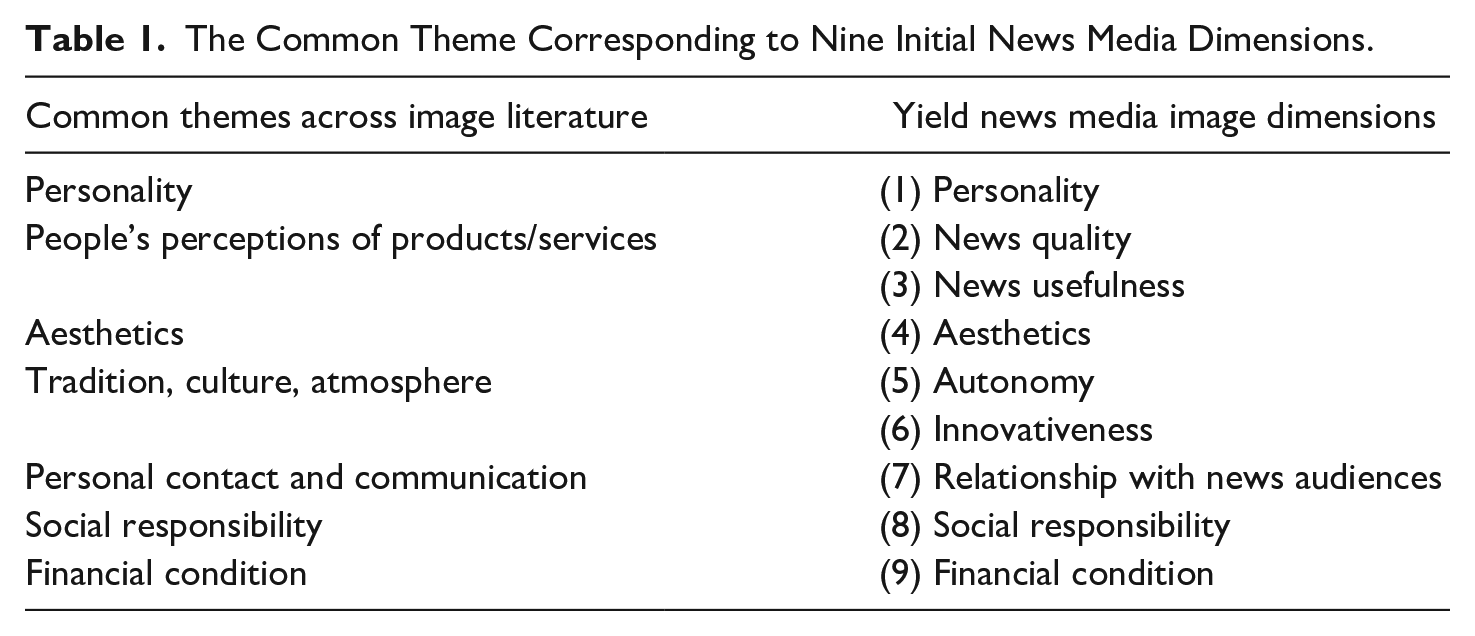
Based on these definitions, and on the aforementioned seven themes gathered from image literature, I proposed nine initial attributes, or dimensions, of news media image (see Table 1): personality, news quality, news usefulness, aesthetics, autonomy, innovativeness, relationship with news audiences, social responsibility, and financial condition:
The Common Theme Corresponding to Nine Initial News Media Dimensions.
News Quality (Credibility). Products/services provide an important cue for consumers in forming a corporate image (Nguyen & LeBlanc, 2001; Tran et al., 2015). News content (such as articles, feature stories, columns, visualizations, podcasts, and many other genres of news content) is the product/service that news media organizations provide. Journalism studies have measured specific normative values in news quality by asking respondents whether, for example, “the reported information” or “a story” appeared to be accurate (e.g., Kohring & Matthes, 2007; Sundar, 1999; Urban & Schweiger, 2014). Studies have shown that audiences to some extent recognize and use normative values in their evaluations (Peters, 2015; Urban & Schweiger, 2014; Van der Wurff & Schoenbach, 2014). For instance, American audiences acknowledged accuracy, lack of bias, and presentation of diverse viewpoints in their evaluations of local news (Heider et al., 2005). Audiences also value comprehensiveness, objectivity, fairness, and journalistic ethics when judging news media (Peters, 2015). On the contrary, Urban and Schweiger (2014) showed that German media users did not identify certain news quality criteria in their evaluations of news. For example, the respondents did not identify ethics, objectivity, and comprehensibility when they were asked to evaluate quality criteria. Nonetheless, as researchers of news audiences typically use the aforementioned values to measure credibility, this study expects that news audiences will evaluate the quality of news content based on their perceptions of news media credibility (Appelman & Sundar, 2016). For instance, Meyer’s (1988) scale of credibility measures includes can be trusted, tells the whole story, is accurate, is unbiased, and is fair (West, 1994).
News Usefulness. Studies have shown that news audiences identify and employ the standard of news usefulness. Meyer (1988) found that most audiences have specific expectations of news organizations (e.g., daily newspapers that respondents were familiar with)—that news organizations be concerned with, for example, their interests, the community/public interest, and society’s welfare. Heider et al. (2005) found that audiences expressed interest in whether journalism demonstrates concerns and offers solutions to community issues. Audiences also expect news media to disseminate news immediately, provide important information, interpret issues, and advocate and provide a voice for the public (Norris, 2014; Van der Wurff & Schoenbach, 2014). These aspects connect the news more closely to audiences’ own lives and needs (Gaziano & McGrath, 1986; Heider et al., 2005). Such concerns about journalism can contribute to a baseline from which audiences perceive news media image.
Aesthetics. In marketing, a corporation’s buildings, websites, and brand logos, the size and location of a university campus, and the landscape of a country are aesthetic attributes that people use to interpret an image (Dowling, 1986; Tran et al., 2015). Journalism literature has shown that newspaper readers prefer certain types of front-page designs (Pasternack & Utt, 1986; Siskind, 1979); that is, they like clean, consistent, and readable formats. Additional aesthetic attributes that can influence audience perceptions of news media organizations include writing style (e.g., bureaucratic or simple writing; Chartprasert, 1993), the physical appearance of sources (the news anchor, guests, experts, and politicians) on television or cable news (Weibel et al., 2008), the brand (logo, music, format, style, etc.), and even the architecture of sets and buildings.
Autonomy. Image literature suggests that the culture and work environment of an entity can be part of its image (Lala et al., 2008; Martin & Eroglu, 1993). The culture here refers to organizational and occupational culture in news media organizations; it also relates to certain kinds of tacit knowledge and education that contribute to an organization’s survival and prosperity (see, e.g., Benson, 2006). Autonomy may also be representative of the organizational and occupational culture in this context: Both journalists and audiences considered autonomy as one of the most important journalistic values (Van der Wurff & Schoenbach, 2014) and believe autonomy to be linked to the concept of professionalism (Soloski, 1989). Autonomy in this study refers to both organizational and occupational levels in terms of the freedom to express important journalistic values and ideas, such as selecting news, topics, and issues at the individual journalist level as well as to autonomy at the organizational level. Mellado and Humanes (2012) connect the concept of autonomy to the political learnings of news organizations. For example, if a news organization favors or leans toward a certain political party, stance, or set of beliefs, the public is likely to perceive it to be less independent and less autonomous.
Innovativeness. News organizations continually adopt new technologies and interactive features to attract and engage audiences with their content (Doudaki & Spyridou, 2015; Himelboim & McCreery, 2012). People can draw inferences about a country or corporation by evaluating its innovativeness (Martin & Eroglu, 1993), and news audiences may likewise evaluate news organizations based on perceptions of their ability to handle technology and innovation.
Relationship with News Audiences. Interactivity between news audiences and journalists is a crucial value of contemporary journalism (Marchionni, 2013). The relationship between news audiences and news organizations corresponds to the concept of personal contact and communication within the corporate image context. The internet facilitates enriched interactive reader engagement through active online participation on many platforms, and such ongoing relationships with the public have become an integral part of news media image.
Social Responsibility. As research has shown, audiences acknowledge news organizations’ social responsibility (Heider et al., 2005; Peters, 2015; Siebert et al., 1956; Van der Wurff & Schoenbach, 2014). Marketing literature recognizes that corporate social responsibility is important to the general public. Taking a role in society can enable an organization to be seen favorably as a useful, respected community member (Furman, 2010). The concept of social responsibility in journalism aligns with its role in contributing to democracy; similar to corporate social responsibility (CSR) practices in marketing, Siebert et al. (1956) proposed the social responsibility theory of the press, the notion that the press has an obligation to society and should be obliged to put the goal of public service first. As such, part of the role of news organizations is to enlighten the public and to act as a watchdog.
Financial Condition. Financial condition is often evidence of an organization’s performance and a basis for judging its sustainability. Accordingly, the financial condition of a news organization can be considered a possible part of news media image; however, little research addresses the public’s perceptions of news media organizations in these terms. Over the last decade, many news organizations implemented large cuts in the number of journalists they employed as a result of decreases in advertising revenue and other fiscal downturns (Somaiya, 2014). Whether the weakened financial state of many news organizations has any impact on audience perceptions has not been clearly identified.
Personality. Image researchers suggest that a “personality perspective” of a country or corporation, often presented using human-like adjectives, provides rich, useful meaning (Abratt, 1989). In terms of corporate personality, adjectives include dynamic, ethical, respectful, successful, and so on (Spector, 1961). In terms of country personality, adjectives might include romantic, snobbish, religious, and so on (d’Astous & Boujbel, 2007). People might use the word stimulating, which is an affective description, to describe their image of a university (Palacio et al., 2002). Adjectives describing news media that were found in previous journalism literature studies include trustworthy, lively, interesting, pleasing, boring, or intrusive (Brants & De Haan, 2010; Sundar, 1999).
Based on the multidisciplinary literature review and assuming that the public’s perceptions of news media would be multidimensional, I applied the initial nine dimensions of news media image to answer:
To develop an image scale, I first used focus groups discussions (Study 1) to confirm the initial nine image dimensions I had derived from the literature review. As detailed in later sections, I then asked online survey respondents to rate detailed attributes of possible news media image dimensions (Study 2). Finally, I examined the structure of the image construct through subsequent statistical analysis (Study 2 and Study 3). For a summary, see Table 2.
Summary of the Present Study.
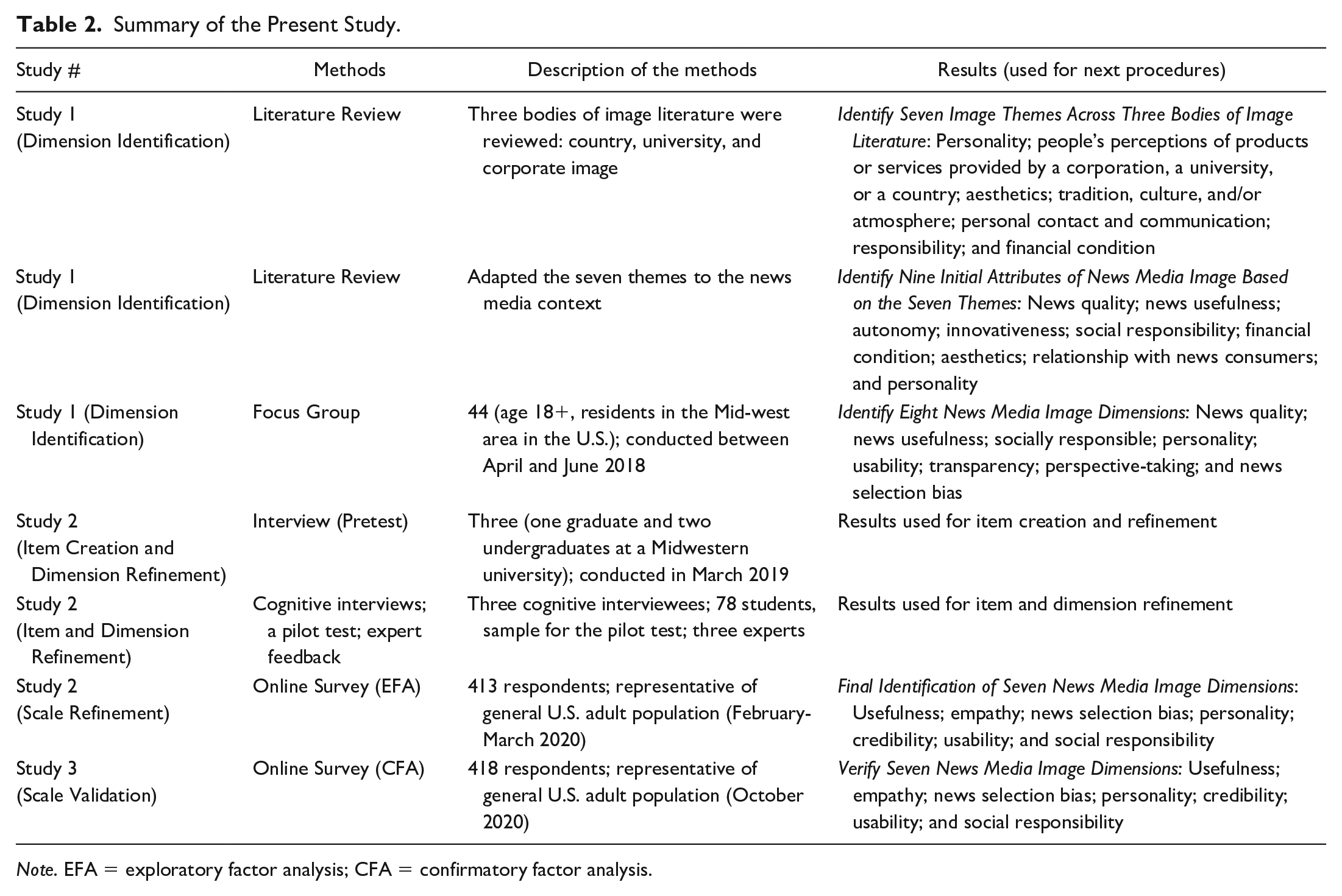
Note. EFA = exploratory factor analysis; CFA = confirmatory factor analysis.
Eight Criteria of News Media Image: Study 1
Method: Focus Group
Following a midwestern university’s Institutional Review Board approval, focus group interviews with 44 participants, all older than the age of 18, were conducted between April 25 and June 14, 2018. These focus group discussions aimed to get at the image of news organizations and their dimensions among U.S. news audiences. The focus group method is useful because it allows for the exploration of participants’ attitudes, opinions, and behaviors; participants’ input subsequently enables identifying the meaning and understanding (Litosseliti, 2003; Lunt & Livingstone, 1996). As audiences might not have recognized news media image as a multidimensional construct, group discussions helped respondents learn from each other’s opinions and develop an understanding of the construct. Group discussions thereby allow researchers to encounter respondents’ unexpected responses, which can lead them to explore new or different aspects of the construct under study.
Descriptives
I recruited local community members via SONA to obtain thoughts and ideas from various audience groups in addition to students. SONA is online research recruiting and scheduling software used by university departments across the country. Participants received a US$20 cash stipend. The average age of participants was 43.3 years old (the U.S. national median age is 37.9), and the majority (70%) identified themselves as women; 68% were White or Caucasian, 10% Hispanic, 10% Asian, 7% Black or African American, and 2% Native Hawaiian or other Pacific Islander. Their education level was higher than the average educational attainment of the U.S. population: 56% of participants had at least a bachelor’s degree, while 32.5% of the U.S. population had achieved this (U.S. Census Bureau, 2017). These proportions reflect a university-based participant pool. Basic demographic information and responses to questions about news consumption behavior were also collected.
The majority (88%) of respondents answered that they were interested in the news (ranging from extremely interested to somewhat interested). The majority of respondents (73%) answered that they accessed news “several times a day,” mostly via smartphone (31%) or computer (27%), followed by television (18%), radio (10%), and tablet (10%). Only one (78 years old) participant answered that he mostly accessed news from print newspapers. In addition, participants valued a range of news types, from international to neighborhood news, but international news was of shared importance to most participants (34 of 44 indicated it was the most important type of news for them). When ranking news topics important to participants, 32% chose “government and politics” first, followed by “traffic and weather” (12%), and “your local town and city” (9%).
Study respondents seemed to be more interested in news and accessed news more frequently than the average U.S. audience. As the aim of this focus group was to build the baseline for developing a scale that represents audiences’ perceptions of news media, respondents who had greater levels of interest in the news were recruited. The recruiting advertisement was targeted at those who wanted to share their opinions about news media. Representativity and generalizability of the study results will be addressed in Study 2 and Study 3.
Protocol
Nine focus groups were organized. Each of the nine groups met only once and had three to seven participants. Eight focus groups were politically homogeneous: two groups for Republicans (four and seven participants, respectively), three groups for Democrats (three, four, and six respondents, respectively), and three groups for Independents (four, four, and six respondents, respectively). I left several days between group meetings to analyze the transcripts and then decided whether to add more sessions until the data satisfied a theoretical saturation. Homogeneous sessions were expected to create a comfortable environment and increase the likelihood that participants would share their opinions freely and openly (Lunt & Livingstone, 1996). In addition, because political affiliation can influence perceptions of news media image, I sought to create a safe and agreeable atmosphere in which respondents freely presented their thoughts. Once I administered the first eight sessions, I recognized that most participants had an advanced level of education (i.e., higher than a bachelor’s degree, reflecting the fact that the community pool was based in the researcher’s geographic area, near a university). Thus, to more closely reflect the general U.S. population, I additionally recruited participants for a ninth session, which consisted of people who had less advanced education (n = 6) regardless of their political affiliations.
The researcher moderated the group discussions. Each focus group session lasted approximately 1 hr 15 min. Data from each session was audio-recorded and transcribed after consent from participants was obtained. Participants were asked to discuss their impressions, beliefs, and/or feelings regarding news media organizations. During the session, the broad questions of what participants think of news media (e.g., “What comes to your mind when you think of news media?” “What is your definition or opinion of journalists?” “What do you think is the purpose of a news organization?”) were asked first. Then, participants were encouraged to elaborate in open discussion. The moderator ensured that each person had an equal opportunity to present their opinions and thoughts, encouraged reticent respondents to engage with the conversation, and created a safe and respectful discussion environment. While respondents in the heterogeneous session (i.e., the last session) unexpectedly appeared to be the most amenable to sharing their thoughts, they were also less likely to engage in deeper levels of discussion.
To explore the nine dimensions of news image, the moderator relied on a semi-structured format that included 32 questions on the following: news quality (e.g., “What expectations do you have when you read the news?”), news usefulness (e.g., “How useful are news stories in your daily lives?”), autonomy (e.g., “To what extent do you believe the news media is influenced by their sponsors or their owners?”), innovativeness (e.g., “What technologies do journalists use to provide news to you?”), social responsibility (e.g., “What are the responsibilities that the news media should have toward society, if any?”), financial condition (e.g., “Have you heard about some news organizations recently implementing large cuts in their journalistic staff? Did this information have an impact your image of that company?”), aesthetics (e.g., “When you read or watch news, how important is the look and appearance [such as graphics and other visuals] of media content?”), interaction with audiences (e.g., “How important is it for news media to interact with the public?”), and personality (“What adjectives would you use to describe the news media in general?”).
One of the primary goals of this part of the research was to observe what themes, in addition to the previously identified dimensions, might emerge from the open discussions. Therefore, as the conversations naturally migrated toward both previously identified themes and novel themes, the moderator injected specific probes and adjusted questions to further explore those responses.
Coding
A thematic analysis of each focus group discussion transcript was conducted; they were coded for a minimum of four cycles. Qualitative data were transcribed verbatim using a commercial transcription service and were coded by the software of QDA Miner. The emerging concepts from the coding were grouped and examined as to whether they fit the a priori dimensions of this study. Additional patterns undetected by the author were identified using QDA Miner software for similarity retrieval and text retrieval. In addition, related clusters of terms were identified and grouped into broader categories using the coding co-occurrence tool in QDA Miner. A second researcher with expertise in journalism research was enlisted to review the themes to evaluate the reliability of the author’s thematic interpretations. The initially identified themes were reexamined to ensure that they represented the theoretical definition of the news media image construct. I analyzed the focus group transcripts to determine whether respondents actually supported the previously identified themes and concepts. Thus, the dimensions detailed in the next section were coded as “present.” In other words, if a respondent disagreed and presented their own, different perspectives, their opinions were coded to correlate with the different themes. If a respondent disagreed and did not present any opinions, I treated it as indicating that the respondent did not use the given criterion to evaluate news media.
Results
Brief summary
“Image” is defined as a collection of impressions (ideas and opinions), beliefs, and feelings existing in the minds of the public. As Abratt (1989) suggested, individuals often select specific attributes to describe an entity, and those attributes combined represent an overall image. I thus began this study by theorizing that various images of news media held by audiences could be broken down into an identifiable number of dimensions and attributes that, grouped together, would encompass people’s shared perceptions, or image, of the news media as a whole.
The literature mapping gave rise to nine possible dimensions based on theoretical definitions of news media image: news quality, news usefulness, autonomy, innovativeness, social responsibility, financial condition, aesthetics, relationship with news audiences, and personality. The focus group participants, however, only fully supported four of those nine dimensions, as discussed/elaborated in later sections of this monograph. The four dimensions supported by focus groups were news quality (credibility), news usefulness, social responsibility, and personality. Two dimensions were supported with some modification: the dimensions of aesthetics and relationship with audiences were replaced by usability and transparency, respectively.
Focus groups also suggested two additional dimensions: perspective-taking (e.g., journalists’ and/or their news organizations’ ability to show empathy to interviewees) and news selection bias (e.g., reporting practices that select specific stories based on the interests of a given news organization). The innovativeness, autonomy, and financial condition dimensions were not supported by the focus group respondents. Based on the present analysis, innovativeness fell under other proposed dimensions, including news quality and usability. The financial condition and autonomy dimensions were combined with news selection bias because respondents indicated that poor financial condition and a loss of independence would render news media organizations biased in terms of the stories they select. Thus, the eight dimensions supported by the focus group discussions were news quality, news usefulness, social responsibility, personality, usability, transparency, perspective-taking, and news selection bias. Detailed descriptions and analyses of each dimension are discussed in the next section.
News quality (credibility)
Thirty-two of 44 respondents said that legitimate news organizations should provide unbiased, factual, in-depth stories rather than a combination of opinion and fact. Twenty-two respondents identified attributes of high-quality content as being unbiased, accurate, factual, and fair (e.g., “I expect it to be accurate and thoroughly investigated” [Respondent 30], adding that “. . .there’s total fairness or objectivity on the part of the large majority of the reporters” [Respondent 24]). That is, they echoed traditional criteria used to measure news media credibility (Kohring & Matthes, 2007; Meyer, 1988). Perceived credibility, therefore, is a central feature of news quality. Elaborating on this theme, Respondent 2 explained their perceptions of accuracy and lack of bias in reference to news about crime:
There were 12 people. One of them got shot. The other people got arrested. That’s a new thing. They want to give you the information of the story so that you can almost be there, but it should be very unbiased, to me, and very factual.
Nineteen of the 44 respondents added that quality news involves depth or thoroughness, which means providing all the necessary facts, based on information from multiple sources, and representing a variety of perspectives. Thoroughness, a more recently valued quality of news media as might be expected given the widespread use of online technologies such as social media platforms, is another factor used by audiences to evaluate website credibility (Metzger et al., 2003). This is likely due to news media organizations’ reliance on social media posts as sources. Respondents stated, for example, that news often lacks the depth of reporting, that they “parrot those social media posts” (Respondent 35), and “[news media] used to be good. . . [at] showing both [sides of opinions]” (Respondent 33). The following quotes express the respondents’ concept of a factual, in-depth news story:
I think when I turn on the news, what I expect is well researched, informational. I don’t think I necessarily look for the news to provide both sides because I feel like that’s on me to figure out what the other side is, or how the other side is feeling. I think it’s to present facts. . . (Respondent 38) They’re [quality news stories] the ones doing the investigating and the reporting and the researching. . . And to me, if I don’t have a lot of unanswered questions, then I think it’s good reporting. I read a lot of articles where I have unanswered questions . . . There should be questions answered about the topics, not just a very brief address of whatever the story is. (Respondent 18)
Respondent 22 said that, unlike international news outlets abroad, U.S. news organizations do not sufficiently report details and news coverage about various aspects of human life because they focus heavily on U.S. context and content (e.g., only following the tweets of political figures such as President Donald Trump):
I wonder if that’s unique to the United States because I have some friends that turned me on to the CBC—the Canadian news, the National. And it’s so much different. It’s so much more detailed—it also has a much more global focus. And it’s really very interesting how the Canadian news works as opposed to American or United States international news.
In summary, most respondents emphasized traditional media credibility measures—in particular, accuracy and being unbiased, as well as the internet credibility measure—referring to news that is thoroughly researched from multiple perspectives. They expected to get unbiased, accurate, and thoroughly researched information but also agreed this would be difficult. Their critique of news media—that it is inherently biased or swayed by political or financial interests—is further explained in a section below that discusses the news selection bias dimension. In addition, it is worth noting that during the discussion about news media credibility and quality, several respondents (at least six, including Respondent 38 above) said that the responsibility for differentiating between fact and opinion should lie with the audience. Respondent 19 presented a similar opinion:
We have so many different points of view. So, I realize that the onus is on me to a large extent to investigate things that I really want to know about. And not just rely on this one source . . . I have to find lots of sources.
The perspective respondents provided may require further examination as a unique feature of news consumption in the age of digital, as well as so-called fake news, journalism.
News usefulness
Respondents made judgments about news organizations based on how useful news stories were to them personally, and they also recognized that news media organizations’ stories could serve their needs. A clear majority of respondents (33 of 44) specifically considered news stories to be useful when the information presented was helpful insofar as interpreting/understanding events or social issues, helping them to make personal decisions (such as regarding financial or health issues) and when stories satisfy their interests. The following quotes further illustrate respondents’ ideas about what constitutes a useful news story:
[Y]ou might not be an expert, but you want to know more. We need to make information accessible to people, especially when it comes to technical or scientific information. I think that’s really important so that people can know what’s going on even if they don’t understand the exact reasons or science behind it really. (Respondent 6) I like to know what’s going on locally and I like to know what’s going on at a state level, national, internationally. At least the basics of it. And part of it, then I can discuss with other people. So, it’s more like it may affect me in one way or the other, financially or personally, but it might just be something to talk about, too. (Respondent 44) It’s interesting to see how the world works, and then to discuss that that with other people and think about it. Some of the stories are really interesting, especially the ones like if you were talking about investigative journalism type stuff. . . (Respondent 25)
Respondents emphasized that news is useful when it provides information relevant to their lives, as illustrated by the discussion below where individuals referred to various subjects commonly covered by the news media:
“If it’s related to stuff like that affects your own life, for example, in my case, news about like I said, immigration and stuff like that” (Respondent 15). “Yes, any news about gas prices I think is going to affect pretty much everybody. . . I mean that’s like a direct action that can happen because of a news story” (Respondent 13). “. . . if they notice a hurricane coming or a big storm, they run out to the stores. . .” (Respondent 14). “Yeah, traffic, any accidents . . .” (Respondent 13)
Respondent 42 also said,
[News is] . . . typically useful because it could be any number of things, like there’s a problem with the product . . . and politics also changes who you might vote for, or who you might want in [power].
In general, it is expected that news stories focus both on perceived importance and on actual aspects of socially relevant issues (Corrigan, 1990). With the advent of the digital era and over the past two decades, audiences have come to appreciate the value of relevance even more (Harcup & O’Neill, 2017). Studies have shown that audiences use information that has an impact on their daily lives, relates to personal goals and decision-making, initiates a conversation with someone, and makes them feel connected to the larger community (Heikkilä et al., 2014; Reynolds & McCombs, 2002). Based on their overall assessment of usefulness, respondents regarded news media organizations as being helpful for providing information. Being useful means being relevant to them personally, about important social issues, and/or about subjects of interest they may not have pursued independently.
Social responsibility
Social responsibility refers to the idea that news media organizations are members of society and should serve this role by seeking to improve it (Siebert et al., 1956; Wood, 1991). Demonstration of this commitment increases their chances of being considered a respectable member of the community by the public. Image literature shows that consumers favorably evaluate a corporation that at least seems to perform well in this regard (Furman, 2010). Social responsibility theory, according to journalism studies, suggests several tenets and ethical guidance, such as providing information about and facilitating political debates and discussions, acting as watchdog, and being of service to society (Siebert et al., 1956). Norris (2014) explained the news media’s role as being a watchdog representative on behalf of the public, investigating the actions of the power elite, and disseminating information about public affairs that would not otherwise be revealed to the public. Singer (2006) considered journalists as “socially responsible existentialists” that act as “a trustworthy source of information that serves the public interest” (p. 2).
Twenty-one of 44 respondents indicated that news media organizations should contribute to building a more efficient democracy and to educating the public in a way that fosters people to act as citizens. Respondents shared a sense that news media has an obligation to contribute to democracy by acting as a watchdog and also agreed that news media should actively gather and disseminate information as well as investigate important topics that the public would or could not do on their own. Hence, news media organizations ought to keep people (such as elected representatives, policymakers) “accountable”:
I do agree with that because I do think the whole point of journalism is to kind of keep you involved politically because, if there are no journalists, then there’s no way to get this information because we have other things to do. We also have jobs. This is your job to keep informed, so we know what’s being fair and just, and we have an opinion on it and could influence it, if we need to. (Respondent 3) I think it’s a way of keeping, especially higher ups accountable for what they do. Because if you imagine a world with no media, then the president could do anything he wanted, and we would have no idea . . . You would just have to believe it. (Respondent 39)
Also, respondents (all of whom were Michigan residents) believed that journalists from news organizations should investigate important community issues, such as the Flint, MI, water crisis in 2016, somehow “update people on the issues” (Respondent 17), and “change history and the direction of people’s health” (Respondent 20).
These respondents’ perspectives regarding social responsibility in news media organizations illustrate a traditional approach to news media, one that positions it as providing a public service (Deuze, 2005). Norris summarizes the ideal role: “[to] serve as effective mechanisms of accountability, triggering public outrage and effective actions by policy-makers, thereby fulfilling lofty democratic principles” (Norris, 2014, p. 114).
Some 23 respondents expressed opinions that were not relevant to the social responsibility dimension. While they acknowledged social responsibility in news media, they expressed their view more in the context of news organizations’ role as credible information providers (i.e., which applied more to the credibility or usefulness dimension).
Personality: Unpleasant and egotistic
Associating an entity’s image with people’s personalized descriptions and perceptions allows researchers to gain richer meaning and insightful interpretations (d’Astous & Boujbel, 2007). In this context, personality is a dimension whose main goal is to reveal the affective aspects of news media image (Abratt, 1989; Furman, 2010; Kennedy, 1977). When depicting the features of a news media organization, 14 of 44 respondents described news media organizations in mostly unpleasant anthropomorphic terms such as “grabby,” “noisy,” or “loud.” In other words, they used descriptions characteristic of a meddlesome or intrusive personality. Nevertheless, a few positive adjectives related to the personality dimension were identified, including being “entertaining” and “informative.”
Respondents who did not use the aforementioned terms instead used adjectives more closely related to news quality and credibility, including objective, credible, and accurate. These adjectives were therefore included in the credibility rather than the personality dimension. As the purpose of the personality dimension is to examine respondents’ emotional reactions to news media in general, I decided to exclude here adjectives that could instead be assigned to the credibility or quality measures. Because the cognitive-related adjectives used by respondents were mostly positive, excluding them resulted in largely negative traits being reported in terms of the personality dimension. It is also notable that when respondents used an adjective related to credibility and news quality, it was often in a negative context. For example, Respondent 36 said, “I thought [of] it [objective] in more generalized terms. . .[however] the news media isn’t, at current, objective.”
While some might argue that a degree of intrusiveness in news reporting is inevitable, the extent of intrusiveness perceived by audiences might be more than journalists believe it to be (Brand & Pearson, 2001). Some respondents described news organizations as being “narcissistic” or “egocentric.” They accused news media organizations, for example, of trying to win a “beauty pageant” (Respondent 18). In the following conversation, respondents explained why news organizations are egocentric, and, in so doing, they compared news media to the comedian Rodney Dangerfield:
“He would tend to wear loud colors a lot of times. He could be a little on the obnoxious side and he would always complain about not getting any respect” (Respondent 17). “So, the news is its own source of disrespect” (Respondent 18). “That’s right. And [news media] can be, at times, loud and obnoxious.” (Respondent 20)
It is worth noting that respondents in this study described news media organizations in mostly negative human-like terms; hence, news media organizations’ personalities could be summarized as being unpleasant. By contrast, in other studies, more amiable rather than negative image descriptions were used in association with the personalities of corporations or countries (Aaker, 1997; d’Astous & Boujbel, 2007; Spector, 1961). This negative personality dimension might reflect the fact that news media organizations are losing favor as well as public trust. Alternatively, negative perceptions of news media’s characteristics in the personality dimension may be because the public imposes tougher standards on news media organizations than on countries or corporations. News organizations, as the fourth estate, are expected to serve the public interest and have been tested as to whether they are doing their job well. Long-standing claims that news media organizations have been losing public trust might be related to this tougher standard as well.
Usability
Usability is a dimension that combines aesthetics and innovativeness. 1 Aesthetic and innovative factors relate to website design and technologies, respectively, and they complement each other. These two factors can directly influence consumers’ experience, of, for example, a website, and can provide a more comfortable and accessible user experience (Yang et al., 2012). Thus, design aesthetics and technological innovativeness can be categorized under the usability dimension in the context of news media.
The term usability was originally used in marketing literature to measure the quality of a website provided by organizations that market themselves online (Wang & Senecal, 2007). Perceived usability is defined as “how well and how easily a user can interact with an information system of a device or a website” (Wang & Senecal, 2007, p. 99). The formulation of favorable impressions on the device or on a website and, further, on the products or services presented on it are important determinants of visitors’ online purchases and intentions to revisit. Previous news media studies also reported that news audiences demand a certain level of usability, for instance, whether interfaces are well and attractively designed and organized, whether there is easy accessibility within websites and on other news platforms, whether websites contain too many advertisements, and how news articles are presented in terms of readability (Abdullah & Wei, 2008; Swaid & Wigand, 2007; Urban & Schweiger, 2014).
Focus group members studied here likewise cared about usability when they are consuming news. They mentioned that font size, line spacing, and well-organized interfaces were important to keep them engaged, as illustrated in the following comments:
“Style matters. [To improve] usability” (Respondent 40). “Yes, because I won’t consume it if I can’t—if it isn’t easy [to access]. It has to be somewhat easy.” (Respondent 42)
Respondent 1 described her view in more detail:
For me, the main thing is, it should be written well enough that I’ll be able to actually understand it. If I get to the second graph or third graph [sic], and I’m having trouble figuring out what is going on here, then I’m disappointed.
Readability in terms of news media involves overall evaluation of the content and the presentation itself, such as having no typos, being well written, succinct, and/or written in an entertaining way. However, certain elements, such as the ways news is disseminated via social media, or providing competing visual elements, may hamper audiences’ experience, and possibly generate negative perceptions of news organizations (Holton & Chyi, 2012; Yuvaraj, 2017). While respondents in this study agreed that accessible website interfaces and visual elements helped identify news and/or understand its content, they also reported that they often felt bothered, overwhelmed, or uncomfortable with some visual elements. For example, they commented,
“. . . that’s just wasting my time. If the format enhances understanding then I think it’s useful, but I feel like that’s not always the case online” (Respondent 7). “[I] . . . need to take a break from it sometimes because . . . it’s just too heavy” (Respondent 9). “Yeah . . . the video playing is always going to be annoying.” (Respondent 3)
Some recognized technology as a crucial element for news organizations’ sustainability. For example, Respondent 19 said,
I definitely think that news organizations make sure [to provide] an app that’s downloadable to the phone . . . Some of our local newspapers waited until the last minute to switch to online print or offering that option. That’s why . . . a lot of your newspapers [are] having to cut back because people were canceling their regular print subscriptions.
Transparency
In developing scale measurements related to news media image, the concept of transparency was picked up from the study’s focus group results to replace the originally suggested dimension of relationship with news audiences. The transparency dimension is further supported by recent trends in the news media industry, wherein transparency “toward the audiences” has become more valued in the digital era (Meier, 2009). Previous studies identified transparency as a newly emerging norm in the digital era (Metzger et al., 2003; Singer, 2018). Arguably, news media organizations that do their own fact-checking and research to find the “truth” thereby benefit audiences, and may thus generate favorable audience impressions.
Fifteen of 44 respondents judged news media organizations based on transparency, suggesting that they could maintain transparency by providing information on “funding streams,” admitting and “correcting mistakes and errors,” providing “links to original documents” to verify the truth of news stories, and by explaining and sharing the process of reporting on ongoing or dramatically changing issues. Respondents said that transparency was important because it can not only increase the perceived credibility of a news organization, but it also helps people notice the intention or background behind the news story:
I’ve seen a difference unfortunately with the school shootings on the different stations that have repeated on it in the different areas. Some of them very clearly will state at the top this is an ongoing story. And then, at the bottom, they’ll list any corrections that they have had to make as they’ve updated. . . . It’s been helpful to follow the story and follow the narrative of it. So, I always appreciate that when they say right up front, we are updating as we receive more for the people that want to have what they know right now. (Respondent 21) The good thing is what the public radio does here, is they tell you up front that they’re being paid by Enbridge [a multinational pipeline company]. So . . . you’ll listen more carefully [and] say, “Hmm, are they skewing things here for Enbridge or not?” . . . . I don’t have any expectation of independence [of news organizations] . . . [because even as nonprofit news organizations, they] still rely on financial resources to deliver news as the same as for profit. (Respondent 1)
Respondents’ ideas about transparency in news media include the ability of news organizations to address public complaints, provide an open assessment of sources, and correct errors. News organizations have great potential to communicate about areas of self-interest, such as sponsorships and political endorsements, and about their news gathering and reporting processes (Meier, 2009, p. 3; Rupar, 2006). Such transparency offers an opportunity to be perceived more favorably and as being reliable, which would in turn promote more successful consumer relationships (Ghzaiel & Akrout, 2012; Kang & Hustvedt, 2014). In sum, the transparency dimension represents how respondents perceive news media’s openness and interactivity regarding their political and financial interests, their sources, their news-making processes as well as honesty about errors and mistakes.
The responses of respondents who did not support the transparency dimension instead focused on somewhat different but related topics, such as how news media organizations are subject to external pressures (e.g., owners, advertisers, politicians), and the belief that audiences are responsible to differentiate fact from opinion and investigate “fact” themselves—because journalists and news organizations often provide one-sided or biased information. Such opinions were considered to support other dimensions (i.e., credibility [explained above], and news selection bias, which will be presented later).
Perspective-taking
Perspective-taking is a newly identified theme that arose from discussion with respondents who referenced the value of journalists who “are dedicated” to investigating and communicating the facts, and who “are compassionate” to their interview subjects, such as Hurricane Katrina victims. The term perspective-taking refers to the ability of journalists and news providers to “put oneself in another person’s place” and empathize with others (Long & Andrews, 1990, p. 126). Someone who engages in perspective-taking is able to treat others as human beings deserving of respect (Long & Andrews, 1990). In the news media context, it refers to journalists’ ability to treat sources, interviewees, the subjects/people reported about, and the audience in a respectful manner. This extends to the ability to be sensitive to the feelings of those who might be affected by news reports and coverage. Twenty of 44 respondents confirmed the value of perspective-taking as illustrated in the following comment in which one respondent criticized news coverage of the suicide of Swedish DJ Avicii at age 28:
They reported it inappropriately and studies show that if people see other people are killing themselves and they’re already on the border of wanting to, then they might—that might push them over the edge. So, they reported it very inappropriately and they got chewed out for it somehow. (Respondent 16)
Studies in communication research show that people weigh or evaluate the manner in which the message was delivered, especially when the outcome is deemed to be unpleasant (Patient & Skarlicki, 2010). Similarly, respondents in this study cared about how news organizations treat their interviewees, and whether they avoid unnecessary, sensationalist, or overly negative coverage when the information is unpleasant or unfavorable:
About 10 years [ago], the front-page story in the middle of the winter, a very cold winter, there was a homeless guy that they found dead . . . You could see from his waist, his legs were sticking out of the water and his waist—and he was . . . just frozen, hanging out of this water that he apparently fell into. And I thought to myself, seriously, you put that on the front page. I questioned whose decision that was. (Respondent 14)
Respondents mentioned that news organizations should respect audiences’ decision-making abilities and not “brainwash anyone” (Respondent 10) or “impose [their] opinion on the people” (Respondent 37). Some respondents especially admired the compassion and empathy that journalists exercise and insisted that journalists should “feel the event, rather than just reporting it” (Respondent 28). One respondent was impressed with journalists’ dedication and empathy when doing live reports at the risk of their own lives:
So many dangerous events. And they [journalists] can’t even leave. They told everyone to evacuate, and the poor news journalist has to stay right to the end, telling the other people, “Leave. Leave while you can. We have to stay here.” And I just think they’re very brave. . . [it’s] being a part, feeling a part of it. I think it’s empathy. (Respondent 26)
Interestingly, while respondents portrayed journalists as being empathetic, during group discussions they also described impartiality or objectivity as important qualities of news reporting. To summarize, the perspective-taking dimension embraces ideas such as compassion, empathy, and self-sacrifice, including the ability of news organizations to recognize negative or harmful effects that could or did result from reporting, and thus refrain from producing sensationalist or hideous news coverage.
News selection bias
News selection bias is the second new dimension identified by respondents in their assessment of the fairness of news organizations’ coverage. News selection bias refers to the ways that news organizations’ biases result in selecting certain stories as newsworthy. This includes gatekeeping bias (story selection preferences), coverage bias (the relative amount of coverage), and/or statement bias (favorability toward a specific party and/or their beliefs in a news organization’s reporting and coverage; D’Alessio & Allen, 2000). Journalists select what they report using their own filtering and judgment processes based on “resource constraints, editorial guidelines, ideological affinities, or even the fragmented nature of the information at a journalist’s disposal” (Bourgeois et al., 2018, p. 535). Thirty-seven of 44 respondents stated that news organizations are biased in selecting and providing certain viewpoints or types of information:
Some stories will get rejected, and some stories will get accepted, or altered, so they’re kind of more appealing to the public. . . (Respondent 3) In my opinion the public news media has lots more resources for news, but the problem is that they may only report some of them and with a biased opinion. (Respondent 8)
In particular, respondents asserted that reporters’ lack of autonomy often results in news selection bias. Being autonomous—referring to the freedom of journalists to work as they please without being influenced by interested parties—is an essential attribute of a free press (Deuze, 2005; Mellado & Humanes, 2012). Respondents said that news media organizations could easily be compromised by their relationships with politicians, sponsors/advertisers, or owners, rendering them less autonomous. For example, Respondent 5 said that when news media outlets are acquired by a corporation, “they lose their independence a lot of times.” Other respondents mentioned that political leanings render news media less autonomous:
I feel like something is behind the news. Like politicians. Something is behind them. Asking them to make news this way. Maybe some other news is some other way. (Respondent 11) If you’re employed by a certain company that has a specific political point of view in mind, you might as a journalist not write your own thoughts but try . . . [to] conform to the company [so] that you’re perpetuating their view. (Respondent 13)
The most pessimistic respondents opined that news organizations have already lost their autonomy. Respondent 7 said, “American news media is not a free news media anymore.” As such, most respondents expressed the idea that an “independent” press is clearly favorable, but not realistic.
A market-oriented news media environment, which prioritizes indulging audiences’ needs and desires, was also blamed for facilitating news selection bias. Scholars suggest that in the last two decades of the twentieth century, news organizations succumbed to the pressure of making profits or increasing ratings/readership, sometimes sacrificing quality reporting (Underwood, 1993, p. 83). Echoing this idea, Respondent 12 said that news organizations are “willing to sacrifice integrity to get more viewers . . . and that’s how problems begin with news.” Another respondent stated that news organizations prioritize specific news items because they are beholden to financial interests:
If they had a territory where they weren’t selling newspapers . . . they’d make sure they went out and did local stories to try to draw the [attention from the target audiences] . . . there’s an audience out there that they weren’t getting they needed to get . . . so they slanted things towards — and it wasn’t good reporting or bad reporting — but they would report more in that area to try to draw a greater circulation. (Respondent 30) They’re always trying to sell something, whether it’s a political candidate; or whether it’s the newspapers themselves because if people stop reading the news, they stop getting revenue and they shut down. . .They obviously can’t include all the information. . . (Respondent 16)
Respondents lamented that news organizations are forced to follow public sentiments and therefore “leave out” (Respondent 13) stories. One respondent said that this makes everything “black or white” (Respondent 4). Another respondent said that news organizations reinforce their (i.e., audiences’) own beliefs, and then the audiences “just keep in a feedback loop of information” (Respondent 8) that creates a polarized environment. Taken together, these factors threaten the ability of news organizations to carry out their role as public service providers. Respondents regarded autonomous news organizations, because they are free from the influence of power and finances, more favorably and more deserving of “the honor” of providing real journalism (Respondent 2).
The seven respondents who did not mention the bias of news media focused instead on polarization in U.S. politics. Respondent 12 summarized their views: “From both the left and the right. They both think the other side is fake news. . . so that just reinforces your beliefs.”
Conclusion
To summarize, Study 1 results showed that respondents’ image of news media was a composite of perception (affective components/feelings) and cognitive evaluation of journalists’ reporting practices, news quality, and content. Respondents formulated their impressions and judgments about news organizations based on their evaluation of news quality and its usefulness in their own lives, as well as on the function of news media as a “community watchdog.” Respondents said that news media organizations should be independent, but they also acknowledged several constraints. First, they said, in reality, a completely autonomous news media organization is highly unlikely, given the need for sponsorship and/or funding. Second, they recognized that news organizations are often beholden, directly or indirectly, to political parties and/or politicians. Respondents said third that news media organizations try to satisfy the public’s needs and expectations while to some extent pursuing economic profit. In either case, respondents stated that news organizations are biased when selecting and presenting news. The dimensions confirmed or newly identified in Study 1 (focus groups) are presented in Table 3.
Summary of Focus Group Discussions (Study 1: Validation and New Dimensions).
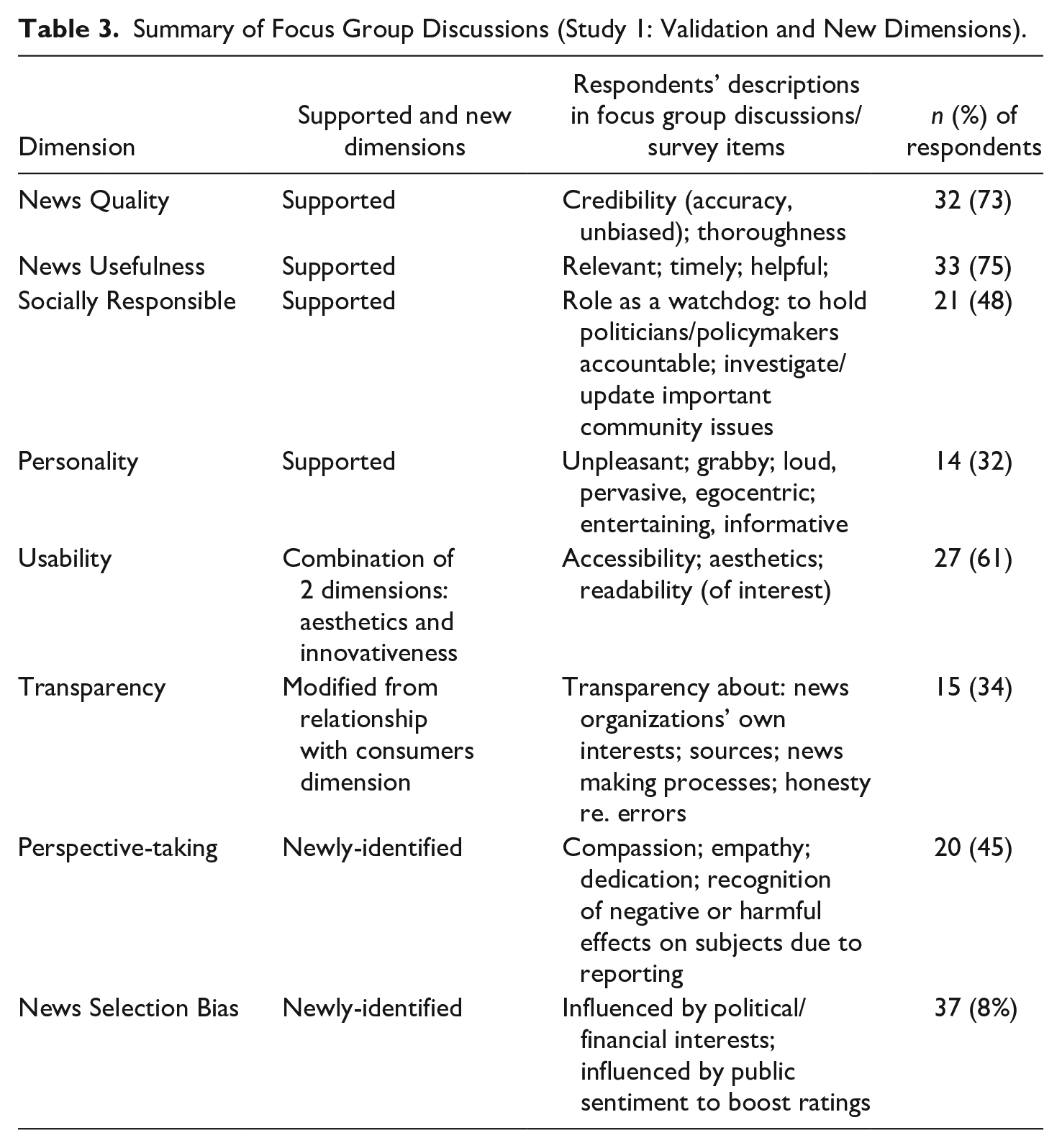
Image Construct to Develop a Valid Scale
The goal of Studies 2 and 3 was to refine and confirm survey questions and dimensions, and then use them to propose a valid scale for a news media image. I generated the initial survey questionnaire based on a review of the literature as well as on findings from the focus groups in Study 1 and from additional interviews conducted in Study 2. After dimension and item refinement, the existence of underlying constructs (i.e., latent variables) was confirmed through exploratory factor analysis (EFA; n = 413, Study 2) and confirmatory factor analysis (CFA; n = 418, Study 3). As suggested in existing image literature, I additionally examined relationships between two audience behavioral variables (satisfaction and loyalty) and tested the construct validity of news media image (Study 3). I explain below the procedures for item creation and factor analyses that I used to validate the news media image scale, and I subsequently propose a model that shows the relationship between news media image and each of the two behavioral variables—satisfaction and loyalty. I followed the scale development procedures recommended by prior research (Carmines & Zeller, 2011; Carpenter, 2018; Kaiser, 1970; Morrison, 2009; Walsh & Beatty, 2007). The procedures are summarized as follows (see Figure 1: Scale Development Steps in this Study and Table 4: Scale Development Process): I researched the meaning and breadth of the theoretical concept (news media image), generated initial dimensions (via focus groups and interviews), generated an initial item pool, conducted item purification (evaluating item wording, item validity, questionnaire decision via expert feedback, cognitive interviews, and/or pilot tests), determined sampling procedures and sample size, conducted scale refinement (exploratory factor analysis, confirmatory factor analysis, construct validity), and concluded with final scale refinement and validation (confirmatory analysis, predictive validity).
Scale Development Process.
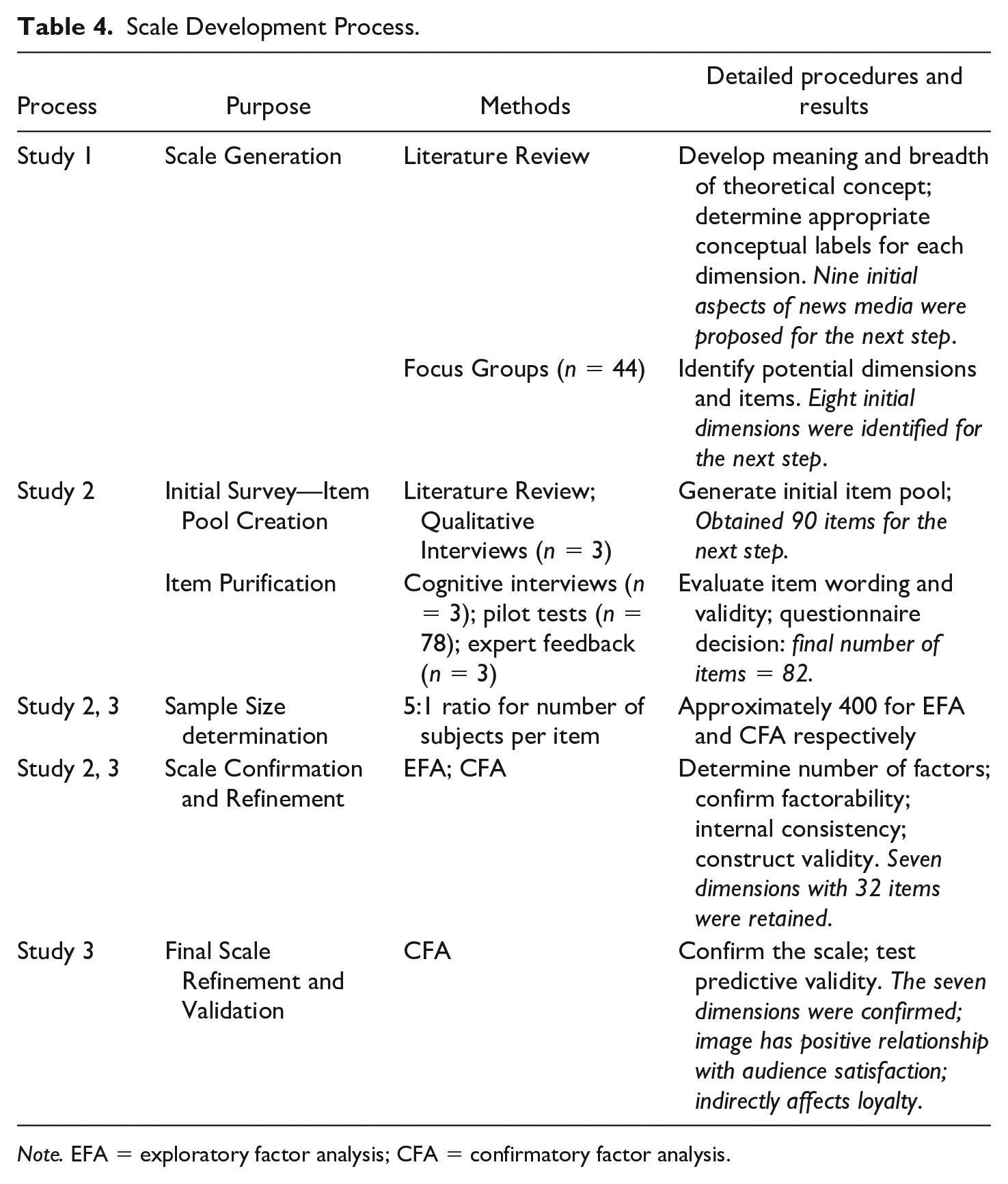
Note. EFA = exploratory factor analysis; CFA = confirmatory factor analysis.
Examining the Underlying Constructs: Study 2
Study 2 asks the same research question as Study 1: RQ1—What does the public perceive as the most representative dimensions comprising news media image?
Survey Item Creation and Refinement
Item creation
I generated the first draft of a survey questionnaire (i.e., items under each dimension to measure news media image) based on literature review, focus group discussions, and interviews (with two undergraduates and one graduate student) to measure each of the eight dimensions proposed in Study 1. The item pool contained 90 items across the identified eight dimensions. The initial focus group results showed that participants did not clearly define news media; this could compromise a valid and reliable scale development. I therefore recruited three participants (convenience sample) to additionally examine whether proposed news media image dimensions and items were relevant to news audiences’ perspectives and were appropriately understood. These interviews also helped identify additional items to be added to the initial item pools (those that had been created from the literature review and focus group findings). During the interviews, which each lasted about 1 hr, I used 16 questions (constructed from the literature review) about news audiences’ definitions of news, news media (organizations), and journalists. I intentionally recruited student participants who did not major in journalism or have a journalism background. Students were identified through the student participant recruiting system (SONA system), and participants received course credits (SONA credits) for their participation. The same coding procedures as used in Study 1 were used in these interviews.
Item and dimension refinement
Once all the items were created, I conducted a pretest (cognitive interview) and solicited expert feedback to refine items, which ultimately enabled me to determine whether the dimensions and items matched the theoretical conceptualization (Carpenter, 2018; Morrison, 2009). This process also allowed me to appropriately label each dimension.
Cognitive interviews
The pretest was conducted in the form of an informal cognitive interview with three nonacademics (a nonstudent sample), all older than the age of 18, who lived in the Midwest region of the United States in August 2019. Local residents were recruited via the community participant recruiting system (SONA system) and received a US$10 cash reward. This pretest aimed to ensure that participants clearly understood the survey items and that the items were aligned with their perceptions of news media (Presser et al., 2004). Cognitive interviews involve the clarification of survey wording, the presentation of specific questions, messages, and concepts, and the invitation to participants to explain/describe their thoughts, feelings, and ideas (Drennan, 2003; for further information about cognitive interviews, see Carbone et al., 2002). Cognitive interviews also help researchers test survey questionnaires, ensuring that both researchers and respondents have a common understanding (Dillman et al., 2014; Presser et al., 2004). As a result of the interviews, the number of items in the study was reduced from 90 to 86.
Pilot test
A pilot test was also conducted, with 78 university students at a midwestern university: Methodologists recommend a sample size of between 50 and 100 participants for a pilot test (Carpenter, 2018; Fowler, 1995; Ruel et al., 2016). Respondents were recruited between April and June of 2019 through the student recruiting system mentioned earlier. This test aimed to ensure that the survey questionnaire could be understood correctly and that it included the most relevant aspects for measuring audience perceptions of news media image. Its purpose was to determine how well data aligned with each factor and to detect whether respondents mistakenly skipped or misunderstood survey questions. Afterward, items were reworded for clarity and additional items were also supplied.
Expert feedback
Next, the items and dimensions were further refined, via expert feedback from three reviewers, to ensure the validity of each dimension and item (i.e., how well each item reflected the overarching construct). Between October and November 2019, three experts were tasked with assessing each item’s validity on a Likert-type type scale as well as via open-ended feedback. Drawing on scale development methodological recommendations, I carefully selected and requested feedback from one methodologist, one researcher with expertise in participants (i.e., an expert specializing in study sample populations and related matters), and one subject matter researcher (i.e., an expert specializing in journalism and news media). The goal of this step was to get qualified items—in other words, to ensure that each item and dimension reflected the overarching construct and that items fell under the appropriate dimensions (Carpenter, 2018). I asked the experts to provide open-ended feedback on each dimension and item and to assess item validity on a Likert-type scale (DeVellis, 2016; Ruel et al., 2016).
Based on this feedback, items belonging to the social responsibility dimension were largely reworded so as to be understood by the general public. Minor revisions were also made to most items. According to the experts, some items were not clearly reflected in the theoretical definitions of each dimension. Therefore, I deleted or modified such items (one from usability and one from credibility). Furthermore, the label of the perspective-taking dimension was changed to empathy. One item from the empathy dimension was accordingly moved to the news selection bias dimension, and 1 item was deleted. The final version of the online survey questionnaire consisted of 82 items across eight dimensions.
Scale Confirmation and Refinement: EFA
EFA was conducted with a sample of 413 adults that closely reflected the demographic composition of the U.S. population. The survey was conducted from February 27 to March 6, 2020, via the survey service provider, Qualtrics.
Procedure
EFA was selected for the purpose of Study 2 because it is a fruitful and realistic method for multidimensional item-level data when researchers do not know the underlying factors of the given construct (DeVellis, 2016; Morrison, 2009). I decided on the EFA sample size of more than 400 based on recommendations from prior studies about the sample size for factor analysis. In factor analysis, the number of subjects should be large enough to yield reliable estimates of correlations among the variables (Pett et al., 2003). Gorsuch (1983) recommends a sample of five subjects per variable/item, with a minimum of 100 subjects (see also Osborne, 2014). Simulation studies (e.g., Boomsma, 1982) also recommend no less than a sample size per item ratio of 5:1, with a minimum of 200 subjects. The number of items in Study 2 was 82, and thus the sample size of 400 satisfied the 5:1 ratio for sample size per item.
Before beginning the analysis, I confirmed that the correlation matrix was not random using Bartlett’s test of sphericity (Bartlett, 1950) and by confirming that the Kaiser–Meyer–Olkin statistic was above a minimum standard of .6. After confirming that the correlation matrix appeared to be appropriate for factor analysis, the matrix was submitted for EFA. Following scholars’ suggestions (Costello & Osborne, 2005; Morrison, 2009; Widaman, 1993), common factor analysis, rather than principal components analysis (PCA), was selected. A principal axis extraction method was used, as principal axis factoring analyzes shared variance among items, generating better correlation estimates. This method does not require meeting normality assumptions, and it is better able to detect weak factors (Briggs & MacCallum, 2003). Squared multiple correlation, which can indicate the initial strength of the relationships, was employed to estimate the initial communalities (Gorsuch, 1983; Pett et al., 2003).
Drawing on the recommended factor number determination methods, I used Cattell’s (1966) visual scree plot (a visual representation that shows how factors are allocated), parallel analysis (Horn, 1965), and minimum average partials (Velicer, 1976) to determine how many factors I should retain. Theoretical convergence and parsimony of the scale were also considered, to determine optimal factor numbers and the items that would be retained. Considering the factors can be correlated, a Promax rotation (k value = 4) was used (Fabrigar et al., 1999). For determining factors, this study considered pattern coefficients ≥ .40 as appropriate (Pett, 2007). Singletons and cross-loading (i.e., factors are salient on several factors and the differences between coefficients are less than .20) were rejected for maintaining parsimony and in the interest of simple structures (Carpenter, 2018; Pett et al., 2003).
Descriptives
The sample was intended to reflect the general U.S. population, particularly in terms of race, age, gender, political affiliation, and education. It consisted of White (63%), Black (43%), Hispanic or Latino (15%), and Asian (4%) respondents (all percentages are based on self-reports). The median age was 44 years old and 48% were male. The percentages of Republicans, Democrats, and Independents were 30%, 29%, and 41%, respectively. About half (49%) of the respondents answered that they accessed news more than “several times a day,” and 26% answered they did so “once a day.” The respondents reported that they most often access news via online websites (e.g., Google news) (26%) or social media (e.g., Twitter) (15%). The American Press Institute reported that 59% of adults in the United States said that they got news several times a day, and 6% said that they did so several times an hour (The Media Insight Project, 2018). No direct comparison is possible because the scales used in each study differ. Nevertheless, respondents in this study appeared to be slightly less interested in news than the average U.S. adult.
Seven Dimensions Proposed Through EFA
Summary
The resulting multidimensional construct operationalizes news media image as a second-order factor with seven dimensions. The seven factor accounts for 70.2% of the total variance explained: (a) usefulness (41.2% of variance explained), (b) empathy (9.5%), (c) credibility (5.2%), (d) personality (4.3%), (e) usability (4.0%), (f) news selection bias (3.2%), and (g) social responsibility (2.8%). The transparency dimension was not supported among the dimensions suggested by qualitative research. The results of Bartlett’s test of sphericity indicated that the correlation matrix was not random, χ2 = 8,605, p < .001, and the Kaiser–Meyer–Olkin statistic was .95 (i.e., above the minimum standard [.6] for factor analysis). In analyzing the quantitative data, parallel analysis recommended four factors. The scree plot, however, suggested nine factors (qualitative data suggested eight and nine factors). Based on these factor solutions, this study retained a seven-factor solution. The eight- and nine-factor solution did not clearly load. In four-factor models, (a) empathy and transparency and (b) credibility, usefulness, and social responsibility were, respectively, intermingled. Most factors were moderately correlated with one another, with the exception of the correlation between Factor III (news selection bias) and Factor VI (usability r = .118). This makes sense because news organizations’ practices of selecting specific events and stories would not have much association with the accessibility and readability of news content. Factor I (usefulness) and Factor V (credibility)—the dimensions that are mostly concerned with news content—showed the highest correlation (r = .686). The loadings between factors are provided in the appendix. Reliability statistics (Cronbach’s α) were between .75 and .93.
Implications of the seven dimensions
The identified factors show that respondents in this study value news media’s understanding of local communities and their interests, their display of empathy toward their interview subjects (e.g., recognizing possible negative effects on people as a result of reporting), and their ability to provide accessible news content. The results also indicate two aspects of news media that are perceived negatively—selecting news stories according to bias, and intrusive reporting practices—suggesting two possible reasons for the public’s negative sentiments toward news media. The traditional journalistic value of credibility and the role of news media as a community watchdog were also identified as part of the news media image construct.
Factor I (usefulness) deserves attention, given that it is not very related to the normative values which are mainly related to news professionals’ perspectives, but it is about the utility of news, as evaluated by the respondents in this study. This factor is mostly associated with community connection as well as providing relevant information to respondents: Respondents appreciated news media that provides the information they can use in their daily lives, for example, information that they can use to improve their understanding of community issues. The fact that this factor accounts for 41.2% of the total variance implies that news audiences put primary emphasis on satisfying their own needs in reading news and that they appreciate when news media keenly responds to community and audience needs.
Factor II was associated with empathy, which refers to news media’s ability to recognize possible negative effects on audiences and interviewees, and to empathize. It is noteworthy that respondents gave priority to this quality—which extant literature has paid little attention to—accounting for 9.5% of total variance explained. As such, respondents in this study acknowledged the ability of news media and journalists to be compassionate toward and respect interviewees. This aspect of news media could be valuable in the digital era, in which news media and journalists have become more interactive with their audiences (Metzger et al., 2003).
Two factors related to negative attributes of news media: the dimensions of news selection bias (Factor III)—respondents’ perceptions regarding how news media selects events and stories that are reported, and how they are covered—and personality (Factor IV)—the intrusive and unpleasant aspects of news media. These factors account for 5.2% and 4.3% of the variance, respectively. In other surveys, respondents criticized news media and journalists’: lack of sensitivity while reporting about people’s misery during disasters or accidents, being overly focused on negative and sensationalist reporting, and being influenced by financial, political, and external interests and pressures (Brand & Pearson, 2001). Such a problematic quality may be inherent in news media, which all too often depends on fear-based and sensationalist reporting, as demonstrated by the old newsroom maxim, “it bleeds, it reads.” Based on the results of this study, I might argue that news media reporting style may play a crucial part in generating an unfavorable image.
Factor V included traditional credibility measures such as trustworthiness, fairness, and accuracy (Meyer, 1988). In addition to the traditional credibility measures, respondents’ perception of news reporting practices related to “conducting thorough research” was also added to Factor V. These items suggest that news media may generate more positive perceptions by providing in-depth research or investigative journalism, in addition to pursuing the value of credibility.
Along with Factor II (empathy), the respondents’ perception of the usability of news media content (Factor VI) deserves more attention in the digital age. This factor includes items such as “news stories are presented in clear and accessible language” and suggests that news audiences may consider how easily accessible and readable news content is in addition to other news media qualities. Considering that various types of platforms are increasingly used in news reporting/dissemination, improving its usability may generate a favorable image of news media.
Finally, social responsibility, as suggested by Factor VII, referred to the journalistic practice of “acting as a community watch-dog.” The respondents in this study acknowledged news media’s practices that hold politicians accountable and push public officials to appropriate actions. Along with Factor V (credibility), this audience perception relates to the more traditional views of perceiving news media, indicating that respondents also recognized traditional values, although not as much as the usefulness, empathy, and usability dimensions.
Final Scale Validation: Study 3
The next step was to verify the dimensional structure of the measure proposed in EFA and determine the extent to which the theoretical model was supported by sample data (i.e., to test the construct validity of the news media image). CFA was conducted using the IBM SPSS AMOS software to test the seven-factor structure identified in EFA and the relationships between news media image and audience outcome variables (i.e., satisfaction and loyalty). This predictive power of the outcome variables should be valuable to enhance knowledge about news audiences and build stronger relationships with them.
Image Construct and Audience Outcome Variables
Research shows that image can affect people’s satisfaction or preferences related to an image object, and thereby influence individuals’ behaviors toward it (Minkiewicz et al., 2011). In the corporate image literature, satisfaction refers to a customer’s initial reaction to the corporation; satisfaction can predict the corporation’s ability to satisfy its customers’ expectations. For example, a customer’s image enhanced their satisfaction with, for instance, a zoological garden (Minkiewicz et al., 2011), internet banking (LeBlanc & Nguyen, 1996), and a department store (Ene & Özkaya, 2014). Image studies have also found that favorable image positively relates to consumer loyalty (Bhat & Darzi, 2018) and that image involves people’s evaluative processes in their choice or preference of one entity over another (Bloemer & de Ruyter, 1998). In the news media context, audience loyalty should represent the audience’s intention to continue subscribing, to recommend news content, and/or to recommend the news organization itself. Some scholars contend that image has a direct effect on customer loyalty (e.g., Bauer et al., 2008). For instance, Nguyen and LeBlanc (2001) found a direct relationship between a bank’s corporate image and customer loyalty, where loyalty refers to customers’ overall preference for the bank and their intention to recommend it to others. Other scholars, however, reported that satisfaction mediates the relationships between image and loyalty (Bloemer & de Ruyter, 1998; Ene & Özkaya, 2014).
In this vein, news media image can also be associated with people’s satisfaction with and loyalty to certain news media organizations, which may, in turn, affect audience behaviors related to news use or consumption. When it comes to audience perceptions, current scholarship is lacking regarding relationships between audience perceptions of news media organizations and variables related to audience behaviors. Media studies have examined the public’s perception of accounts presented by news media (news about politicians, national issues such as public health care, important events, etc.) and the effect of these accounts on the public’s attitudes and/or behaviors related to the matter at hand. There has, however, been much less investigation into the context of the public’s perception of the news media as an entity itself and on the effect of such perceptions on people’s behaviors. Research on credibility, the most commonly used construct to understand audience perceptions, has not clearly demonstrated its impact on people’s news use. In fact, measuring audiences’ news use is another challenge; various studies have reported the difficulty of measuring news use, leading to a vigorous debate about how to do so (Eveland et al., 2009).
For example, among the measurement problems regarding news consumption behaviors include evidence that respondents often inflate the extent of their news use (Vraga & Tully, 2020). In addition to such problems with the self-reports, the measurement itself can also be biased, as it can be rather affective, or be more of a preference rather than a behavioral measure (Rimmer & Weaver, 1987). As such, if the tested variable (news media image in this monograph) possesses some affective components, it may show confounded relationships with an audience behavioral variable (news use in this monograph), because the behavioral variable itself also has an affective component. Indeed, I initiated the present study based on my awareness that media studies have not placed a significant focus on audiences’ perception of the news media organizations as an entire entity, nor have they investigated the effects of audience perceptions on their news consumption-related behaviors. Although the rationale and theoretical stance (specifically regarding my decision to include satisfaction and loyalty in the hypothesis testing) may be weak and insufficient, I hoped that the news media image construct might begin to expose how fragmented and insufficient our understanding of modern news audiences has been. The raison d’être of this study is to initiate relevant and productive discussions in this regard.
Considering the present lack of variables related to audience behaviors that could be used to test the validity of the news media image construct, I tested the relationship between audience perception and satisfaction/loyalty. As suggested in marketing literature, these variables are important in engaging news audience consumption. The notion that satisfied audiences are more likely to develop loyalty to particular news media organizations—which would also affect audience news use—justifies my choice to employ this variable in hypothesis testing.
Based on the aforementioned discussion and findings in image literature, I hypothesized that news media image has a direct effect on both audience satisfaction and consumer loyalty. In addition, given some evidence of the mediating role of satisfaction, I tested the relationship between news media image and audience loyalty mediated by satisfaction (see Figure 2). Therefore, my hypotheses included the following:
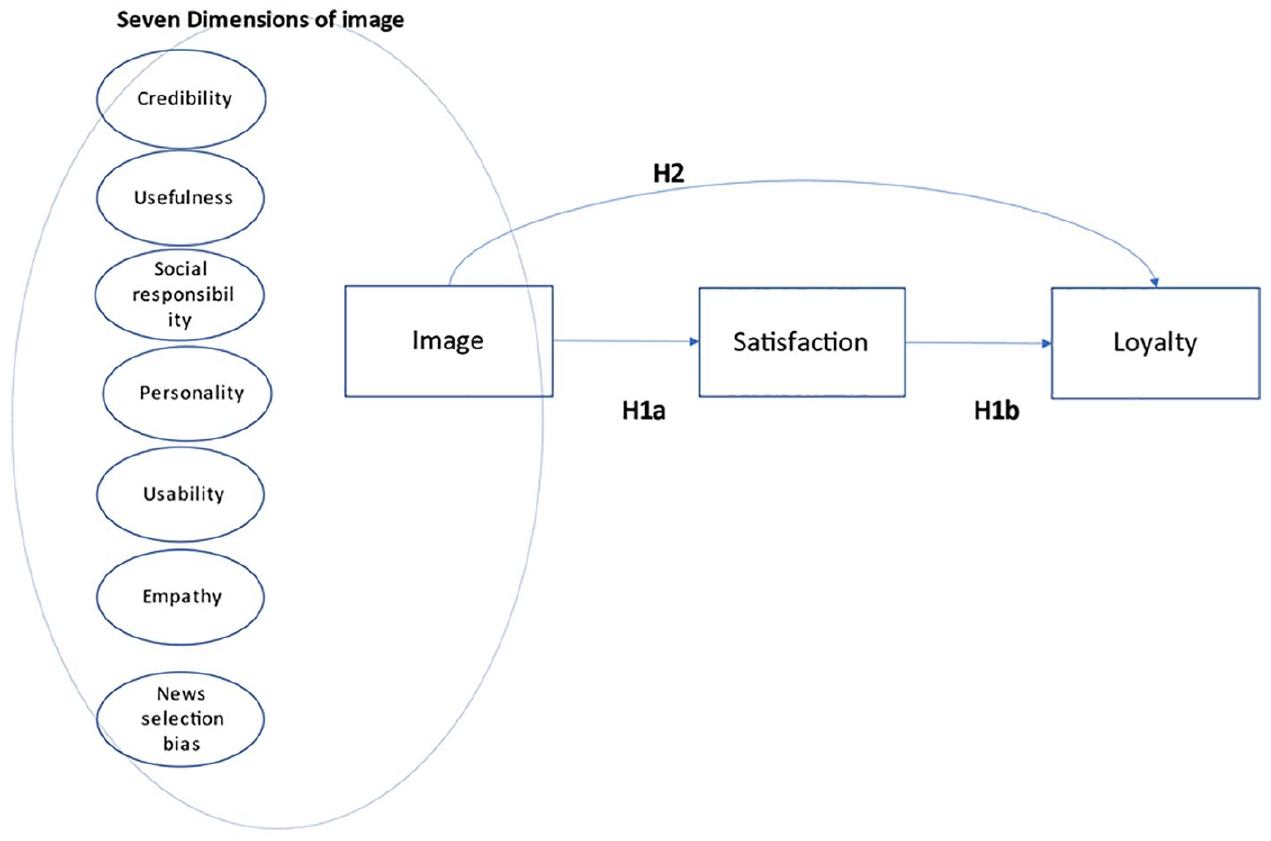
Hypothesized model.
Impact by Dimension
Because the image is itself a multidimensional construct, specific image dimensions may better predict the outcome variables than others (Bauer et al., 2008). For example, a study of the brand image of soccer teams found that nonproduct-related brand dimensions, such as the design of team logos or club histories and traditions, had a larger impact on fans’ psychological attachment and loyalty than did product-related brand attributes, such as teams’ star players, head coaches, or management (Bauer et al., 2008). Fans are more likely to have “all experienced ups and downs of their team such as player and coach changes” (Bauer et al., 2008, p. 221), so these attributes would contribute less to enhancing fan loyalty. Instead, fans tend to be more attached to their favorite team’s logo and history. Walsh and Beatty’s (2007) research on service firms (e.g., banking, retail, and fast-food restaurants) found that the dimension of product and service quality showed the strongest correlations with customer satisfaction and loyalty. This makes sense because people’s first reaction (satisfaction) and preference (loyalty) would largely be shaped by their experience with the services of those firms. Likewise, news media image dimensions would also illustrate varying levels of effect on satisfaction and/or loyalty. As the influence of each dimension is both context and image object specific, I asked the following exploratory question:
Method
Measures
Satisfaction and loyalty were operationalized as follows:
Satisfaction
Image studies conceptualize satisfaction as people’s emotional reaction related to their behavioral intentions (Nguyen & LeBlanc, 1998; Walsh & Beatty, 2007). Operationally, satisfaction is measured by asking about the extent to which individuals’ expectations match their experience and the degree to which they are satisfied or pleased with their experience (Ene & Özkaya, 2014; Hamid et al., 2015). In applying the aforementioned ways of measuring satisfaction to the news media context, I measured audience satisfaction based on respondents’ chosen news outlets, whether their expectations with the content of those media outlets were met, and the extent to which they were pleased with their decisions related to media consumption. These scale items were adapted from the study of Hamid et al. (2015) and Ene and Özkaya (2014). Word choice was modified to fit the context of news media organizations. Scale items validated for this measure include (a) reading news articles from this news organization has met my expectations; (b) this news organization never disappoints me in terms of their news content; (c) I am pleased that I read news articles provided by this news organization; (d) I am satisfied overall getting news from the news organization; and (e) I am satisfied with the news organization. The last question asked respondents to address the following: (f) In general, how satisfied or dissatisfied were you with news provided by this news organization?
Loyalty
Loyalty in image literature refers to individuals’ expressed intent to endorse, use, or purchase a particular service, product, or organization (Andreassen & Lindestad, 1998). Loyalty encompasses people’s decision-making, preference for one entity over others, and behavioral intentions—represented by phrases such as, “I would continue shopping in X Store” (Bauer et al., 2008; Bloemer & de Ruyter, 1998; Ene & Özkaya, 2014). As such, loyalty comprises two components: (a) physical loyalty (e.g., repeated visits to a retail store) and (b) psychological commitment (e.g., emotional attachment to an athlete; Arai et al., 2013; Bauer et al., 2008; Nguyen & LeBlanc, 1998). For the purposes of the present study, audience loyalty was defined as respondents’ intention to continue subscribing to or to recommend specific news organizations. I used scale items proposed by Ene and Özkaya (2014), and one additional item measure, behavioral loyalty, that was adapted by Bauer et al. (2008). The items include (a) I would recommend news articles provided by this news organization to others; (b) I would say positive things to my acquaintances about this news organization; (c) I would continue subscribing; (d) I prefer reading this news organization’ content rather than that of others; and (e) I often intentionally try to look for this news organization’s articles rather than just read any articles provided by others.
Procedure
An online survey via Qualtrics was conducted with a sample of 418 adults, which closely reflects the U.S. population, between October 5 and 11, 2020. The final questionnaire version of the news media image scale included 32 items. An additional 11 items were included for the variables added into the model (six for satisfaction and five for loyalty). The sample size of 418 was determined by following the same logic that was employed in EFA (Study 2): The number of items was 43 for CFA, and thus it sufficiently exceeded the 5:1 ratio expectation. Descriptive statistics were performed using IBM SPSS Statistics to identify missing data, outliers, and also to check the assumption of normality prior to running CFA. The overall model of fit for each CFA performed was judged using root mean square error of approximation (RMSEA, <.08), comparative fit index (CFI ≥ .9), and the Tucker–Lewis index (TLI ≥ .9). The categories used for fit indices include the following: RMSEA refers to an index for fit adjusting for model parsimony, and CFI refers to an index for comparative or incremental fit.
Descriptives
The sample group consisted of White (62%), Black (43%), Hispanic or Latino (18%), and Asian (5%) respondents. The median age was 46 years old, and 49% were men. The percentages of Republican, Democrat, and Independent were 29%, 29%, and 38%, respectively. Thirty-six percent of them had a high school diploma or general educational development (GED); 22% had a 4-year college degree; 20% went to some college but did not receive any degree; 9% had a postgraduate or professional degree, and 4% had a degree less than a high school diploma. About half (52%) of the respondents answered that they accessed news more than “several times a day,” and 23% answered they did so “once a day.” The respondents reported that they access news mostly via online websites (e.g., Google news; 25%) or social media (e.g., Twitter; 15%). Approximately 29% of them reported that they subscribed to a regular issue. Previous reports showed that U.S. adults were quite interested in the news (almost 60% accessed news more than several times a day) as well as actually paid for news (see Mitchell et al., 2020; American Press Institute, 2017). According to the American Press Institute (2017), 53% of U.S. adults pay for news by subscribing “in some form,” including newspapers and magazines, and news apps, or by donating to public media organizations. The sample in this study, by and large, has a somewhat lesser level of interest in the news.
CFA Results: Validation of the Structure
A summary of the final scale based on the CFA is presented in Table 5. The seven-factor model—which was retained in Study 2—was tested. The sample showed significant loadings for items on their respective factors in general. Two of 32 items showed lower factor loadings (i.e., less than .3) or had a negative impact on reliability and were dropped to increase the model fit (Bagozzi & Yi, 1988). These two items, both from the empathy dimension, were as follows: (a) news media professionals are compassionate toward their interview subjects and (b) news media professionals acknowledge interviewees’ feelings. After taking care of the weak loadings, model identification was achieved, and the fit indices suggested that the model adequately represented the sample (CFI = .936, TLI = .928, RMSEA = .051), and χ2/df = 803.161 (df = 384, p < .001).
Summary of Final News Media Image Scale Dimensions.
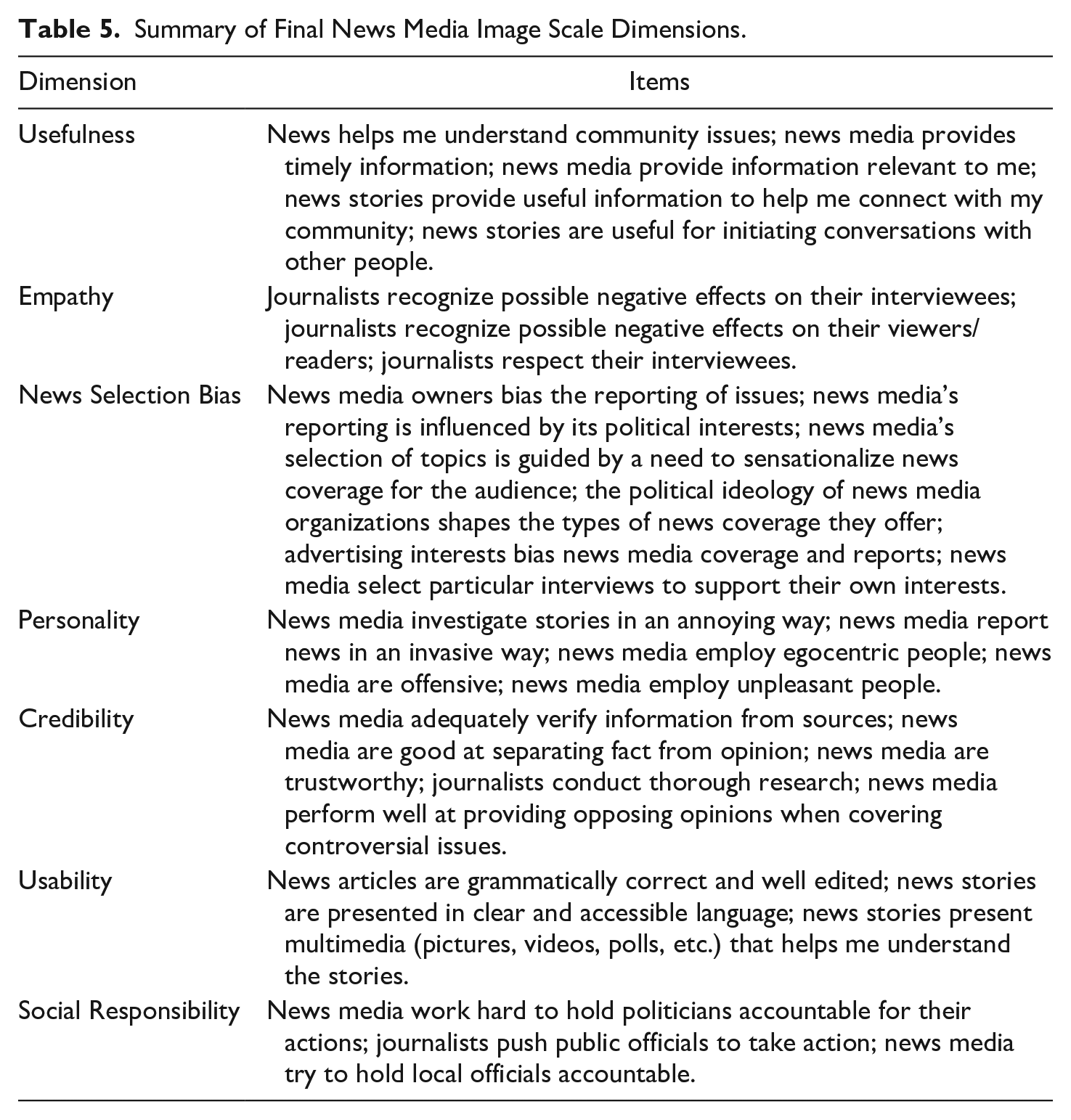
Measures of internal consistency (Cronbach’s α reliability) were calculated for the scale and subscales of news media images to estimate score reliability. Cronbach’s α for the total scale of news media image was .94. Reliability estimates for the seven factors ranged from .74 (usability) and .91 (credibility). It is also noted that personality (α = .74), empathy (α = .75), and social responsibility (α = .77) showed relatively lower, but acceptable reliability estimates (Taber, 2018; Tavakol & Dennick, 2011).
Structural Equation Modeling Results
Construct validity of measurement of theoretical concepts can be determined by testing whether the measure performs well and meets the hypothesized expectations in the theoretical context (Carmines & Zeller, 2011; Walsh & Beatty, 2007). I assessed the news media image scale’s construct validity by testing the relationships between the image construct and two variables (i.e., satisfaction and loyalty) suggested in the image literature. Based on a careful examination of modification indices and theoretical context, two error terms were correlated (Smolkowski, 2020). The inspection of model fit suggested a reasonable overall fit (CFI = .927, TLI = .922, and RMSEA = .048) and χ2/df = 1,648.689 (p < .001, df = 847). In addition, the analysis suggested that news media image affected loyalty (β = .751, p < .001), with audience satisfaction as a mediator (β = .980, p < .001). The regression coefficient between image and loyalty (indirect path) was β = .735 (p < .01). Therefore, Hypotheses 1a and 1b were supported. The direct effect between image and loyalty was not significant (β = −0.092, p = .070), and thus Hypothesis 2 was rejected.
Results by dimension
It is worth noting that usefulness, which is not considered a normative value in news media, had the greatest influence on improving audiences’ satisfaction. It seems, then, that audiences’ experience with news is closely built on their assessments of news organizations’ performance in terms of usefulness of the news content. The usefulness dimension had the strongest relationship for the news media image with the outcome variables—satisfaction (β = .395, p < .001). Credibility (β = .271, p < .001) had the next greatest impact on satisfaction, followed by social responsibility (β = .179, p = .001), usability (β = .158, p = .003), and empathy (β = .109, p = .037). The news selection bias dimension and personality did not have relationships with satisfaction (β = −.008, p = .865 and β = .013, p = .805).
Conclusion
I proposed in Study 3 that audiences evaluate news media organizations based on seven criteria and that their perceptions based on these criteria would influence their level of satisfaction with and loyalty to news organizations. The findings suggest that a more favorable image would contribute to generating a greater level of audience satisfaction, which would in turn increase loyalty. All dimensions indicated varying levels of effect, with the usefulness dimension showing the greatest influence on satisfaction.
By creating a framework from image research conducted in various other academic disciplines, I attempted to expand the discourse surrounding audience perceptions, which I believe could narrow the gap between professionals and the public in terms of their respective perceptions of qualified journalism. The seven dimensions suggested herein could provide insight into how audiences identify, describe, and evaluate news media organizations and, thus, help news organizations to focus on and improve their communication strategies and efforts. Adopting these seven dimension criteria could enable scholars and news media professionals to begin to draw upon a representation of the public’s ideal image of news media. An overview of the theoretical contribution of the three studies and implications from a managerial perspective are discussed below.
Image as a Multidimensional Structure
The goal of the study described in this monograph was to propose a construct to capture audiences’ perceptions of news media organizations from a perspective broader than has been assumed in extant media studies. The premise is that an aggregate of journalism studies over time have employed several noncohesive measures, which, in fact, do not fully contribute to understanding contemporary news audiences within our complex and ever-changing media environment. News audiences’ mental representations of news organizations interpreted and explored through the lens of news media image could offer a comprehensive, multidimensional, audience-focused method that is more inclusive of today’s large proportion of digital and social media audiences. The seven proposed dimensions detailed here demonstrate the importance of considering news media beyond the perspective of credibility. Taken together, these dimensions suggest a starting point for news organizations and journalists to reexamine their news reporting practices in terms of what—and how—they communicate and interact with their audiences.
Extend the Conceptual Understanding
The creation of a news media image scale and perspective highlights a number of audience perceptions worthy of further attention. Study results showed that audiences value news usefulness: Analysis revealed that this dimension contributed the most to shaping image. Respondents acknowledged the importance of news media being inclusive of and focusing on local communities and their interests. “Good” news organizations, as one focus group participant described, should address community and regional concerns so as to provide education and insight into community issues that affect their lives. Doing so facilitates mobilizing and shaping public opinion as well (Chung, 2009; Van der Wurff & Schoenbach, 2014).
The notion of news organizations’ commitment to society and community affiliation can be connected to public service journalism (Ferrucci et al., 2020) and to solutions journalism (McIntyre, 2019). This study also revealed that empathy—that is, whether news organizations/journalists exhibit empathy toward interview subjects and recognize that news reports could result in possible negative repercussions for them—was the second most important dimension in shaping news media image. The empathy dimension speaks to audiences’ expectation that journalists and news organizations more openly communicate their ethics and principles and effectively demonstrate dedication to their journalistic roles. Empathy is also a value that has more recently been appreciated within digital platforms. Based on interviews with journalists, Glück (2016) suggested that empathy is a tool to deploy “emotions in news and in engaging audiences” (p.894).
The personality dimension in particular was linked to audiences’ feelings: respondents reported having negative emotions toward certain kinds of reporting practices that they perceived as negative. Items including “the news media are offensive” or “the news media employ unpleasant people” are associated more with feelings than with a cognitive assessment such as credibility. The personality dimension suggests that audience research should consider affective components—audiences, are not, of course, always rational, and often rely on emotions to evaluate news organizations.
Respondents’ broader definition of usability presents another new aspect worthy of further recognition and examination. Thus far, audience research in the news media field has paid scarce attention to the importance of audiences’ experiences using news platforms, and the feelings generated by these experiences. Considering that numerous technologies are incorporated into news disseminating tools (Himelboim & McCreery, 2012; Westlund, 2013), people’s experiences on news websites and platforms should be considered a highly important measure of news media image.
Notably, focus group respondents appreciated news organizations’ transparency practices, including communicating financial/political interests, being transparent about reporting errors and mistakes, and providing verifiable information sources (e.g., hyperlinks). All aspects of transparency are particularly relevant to audiences in the contemporary digital media environment; transparency should be more broadly considered a crucial virtue for news organizations in terms of providing information to audiences about funding sources and protecting journalistic integrity (Singer, 2018; Zirulinck, 2021).
Finally, study respondents identified two specific dimensions that discernibly contribute to the general public’s negative perceptions of news organizations: personality (interviewing and reporting practices that participants criticized as being intrusive, and their dislike of the egocentric “personality” of news organizations or newscasters) and news selection bias (news organizations’ practices of limiting what kinds of events/issues they cover and selecting specific news stories over others). News organizations may consider the ways that could provide alternative interpretations of such negative attributes perceived by people. For example, journalists could reframe intrusive reporting in a somewhat positive manner by emphasizing that asking hard or intrusive questions is often necessary to obtain and thus provide more credible information (i.e., by taking news credibility or usefulness dimension into account).
A means to connect audience perceptions to news use
Adopting a news media image perspective could offer journalism scholars and news professionals a meaningful framework to further probe specific factors that contribute to audience engagement and news use. Image scholars consider an image to be “an attitude or a bundle of attitudes based on attributes evaluated” (Palacio et al., 2002, p. 489). Precisely because the news media image construct recognizes attitudes, it has potential as a tool to articulate and shed light on audience behaviors. Establishing that the image construct encompasses both rational and emotional interpretations derived from people’s interactions with news media organizations would be relevant in terms of the attitude-to-behavior relationships (Kennedy, 1977; Roth & Diamantopoulos, 2009; Tran et al., 2015). The results of this study (CFA) suggest that image can be positively related to satisfaction and loyalty. Such findings, I hope, will provide a springboard for future researchers trying to gauge audience behaviors in relation to news.
Practical Implications
Applying the news media image scale and evaluation criteria used in this study can assist news organizations to figure out how best to satisfy and motivate people to engage with news. Among the seven dimensions of news media image, usefulness revealed a strong relationship to audience satisfaction, suggesting that this dimension could play an important role in building loyal audiences. This does not mean that journalists can or should disregard normative values. Indeed, credibility and social responsibility followed next as large contributors to satisfaction. Obviously, different groups of audiences are likely to use or prioritize different combinations of image criteria (Dowling, 1988). Thus, it might be useful for individual news organizations to determine the most important dimension(s) applicable to them in trying to shape a favorable public image—which might also lead them to identify criteria related to possible blind spots in their relationships with audiences.
News organizations aware of the attributes referenced by their target audiences’ favorable and unfavorable perceptions can improve their communication approaches and strategies. Instead of focusing on mottos or reports that might, for example, suggest aloofness, a news organization could vary the way it frames itself and pursue more engaged types of journalism—for example, by presenting first-person points of view, and providing more “real” experiences to audiences (Glück, 2016). Such strategies would need to take news users’ perceptions of empathy and usability into account.
Likewise, news organizations could apply the news media image construct to identify the dimensions most applicable to them, and thereby prioritize organizational objectives and values. As the focus group discussions suggested, newsrooms face two somewhat competing goals: maintaining professional autonomy and meeting the needs and expectations of the public they serve (Revers, 2014; Vos et al., 2019). Framing their public image could help news organizations develop a clear identity, strategize more competitive positions in competition with alternative media, and assist newsroom members to enact their roles and responsibilities more effectively (Marken, 1990).
News organizations seeking to improve their image can benefit by broadening and further contextualizing their perspective—that is, by extending beyond traditional news reporting practices that are, inherently, a top-down approach, considering audience utilization and usability, and communicating these efforts to the public to further demonstrate understanding and empathy. Recognition of additional aspects of news organizations as revealed by audiences can launch more in-depth and productive discussion within the field.
Limitations and Future Study
As one of the goals of employing an image construct is to explain and predict people’s behaviors—in the context of this study, audience news use and engagement—more valid and precise measures for audience behaviors related to the frequency of accessing news and level of engagement would be required. Given that this study revealed differences between views of news media held by news audiences and those traditionally held by professionals and scholars, it would also be needed for future researchers to examine differences between various age groups, between audiences who use various technological devices to access news, and between news users with different political affiliations. For example, this study indicated that different age groups may apply different evaluation criteria, and/or weight the news media dimensions differently. As suggested in the pilot test results of the student groups, transparency might be more highly valued by younger and/or more active digital media users: This sample supported the transparency dimension, but the nonstudent adult sample group that represents the general U.S. population later rejected it. Considering that the average age of the student sample was 21.44 years old, and that the majority of student respondents (73%) access news via online websites and social media, this could imply that the younger, more active online news consumers place more weight, for example, on news organizations that provide fact-checking resources and hyperlinks, than do older adults. Group differences in weighing various attributes of news organizations present a number of possibilities deserving further investigation.
Individual news organizations would undoubtedly focus on a specific image and/or on varying degrees of applicability of specific image dimensions. This process could be instructive in identifying their strengths and weaknesses and helping organizations to better communicate goals and objectives both internally within the organization and externally to the public. Further testing would also enhance the validity of the news media image scale.
Supplemental Material
sj-pptx-1-jmo-10.1177_15226379221092019 – Supplemental material for News Media Image: A Typology of Audience Perspectives
Supplemental material, sj-pptx-1-jmo-10.1177_15226379221092019 for News Media Image: A Typology of Audience Perspectives by Soo Young Shin in Journalism & Mass Communication Monographs
Footnotes
Appendix
Items and Dimensions of News Media Image.
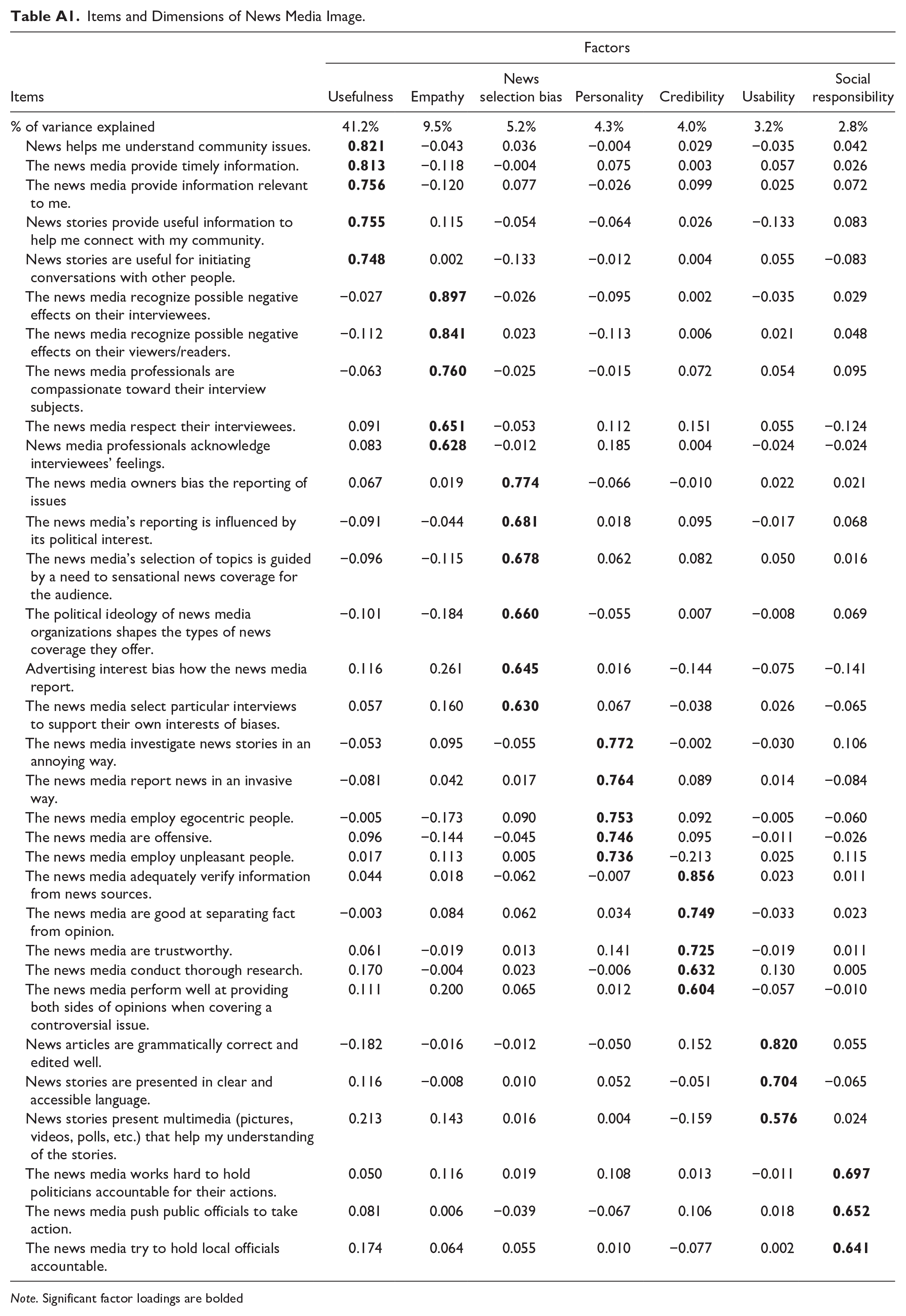
| Items | Factors | ||||||
|---|---|---|---|---|---|---|---|
| Usefulness | Empathy | News selection bias | Personality | Credibility | Usability | Social responsibility | |
| % of variance explained | 41.2% | 9.5% | 5.2% | 4.3% | 4.0% | 3.2% | 2.8% |
| News helps me understand community issues. |
|
−0.043 | 0.036 | −0.004 | 0.029 | −0.035 | 0.042 |
| The news media provide timely information. |
|
−0.118 | −0.004 | 0.075 | 0.003 | 0.057 | 0.026 |
| The news media provide information relevant to me. |
|
−0.120 | 0.077 | −0.026 | 0.099 | 0.025 | 0.072 |
| News stories provide useful information to help me connect with my community. |
|
0.115 | −0.054 | −0.064 | 0.026 | −0.133 | 0.083 |
| News stories are useful for initiating conversations with other people. |
|
0.002 | −0.133 | −0.012 | 0.004 | 0.055 | −0.083 |
| The news media recognize possible negative effects on their interviewees. | −0.027 |
|
−0.026 | −0.095 | 0.002 | −0.035 | 0.029 |
| The news media recognize possible negative effects on their viewers/readers. | −0.112 |
|
0.023 | −0.113 | 0.006 | 0.021 | 0.048 |
| The news media professionals are compassionate toward their interview subjects. | −0.063 |
|
−0.025 | −0.015 | 0.072 | 0.054 | 0.095 |
| The news media respect their interviewees. | 0.091 |
|
−0.053 | 0.112 | 0.151 | 0.055 | −0.124 |
| News media professionals acknowledge interviewees’ feelings. | 0.083 |
|
−0.012 | 0.185 | 0.004 | −0.024 | −0.024 |
| The news media owners bias the reporting of issues | 0.067 | 0.019 |
|
−0.066 | −0.010 | 0.022 | 0.021 |
| The news media’s reporting is influenced by its political interest. | −0.091 | −0.044 |
|
0.018 | 0.095 | −0.017 | 0.068 |
| The news media’s selection of topics is guided by a need to sensational news coverage for the audience. | −0.096 | −0.115 |
|
0.062 | 0.082 | 0.050 | 0.016 |
| The political ideology of news media organizations shapes the types of news coverage they offer. | −0.101 | −0.184 |
|
−0.055 | 0.007 | −0.008 | 0.069 |
| Advertising interest bias how the news media report. | 0.116 | 0.261 |
|
0.016 | −0.144 | −0.075 | −0.141 |
| The news media select particular interviews to support their own interests of biases. | 0.057 | 0.160 |
|
0.067 | −0.038 | 0.026 | −0.065 |
| The news media investigate news stories in an annoying way. | −0.053 | 0.095 | −0.055 |
|
−0.002 | −0.030 | 0.106 |
| The news media report news in an invasive way. | −0.081 | 0.042 | 0.017 |
|
0.089 | 0.014 | −0.084 |
| The news media employ egocentric people. | −0.005 | −0.173 | 0.090 |
|
0.092 | −0.005 | −0.060 |
| The news media are offensive. | 0.096 | −0.144 | −0.045 |
|
0.095 | −0.011 | −0.026 |
| The news media employ unpleasant people. | 0.017 | 0.113 | 0.005 |
|
−0.213 | 0.025 | 0.115 |
| The news media adequately verify information from news sources. | 0.044 | 0.018 | −0.062 | −0.007 |
|
0.023 | 0.011 |
| The news media are good at separating fact from opinion. | −0.003 | 0.084 | 0.062 | 0.034 |
|
−0.033 | 0.023 |
| The news media are trustworthy. | 0.061 | −0.019 | 0.013 | 0.141 |
|
−0.019 | 0.011 |
| The news media conduct thorough research. | 0.170 | −0.004 | 0.023 | −0.006 |
|
0.130 | 0.005 |
| The news media perform well at providing both sides of opinions when covering a controversial issue. | 0.111 | 0.200 | 0.065 | 0.012 |
|
−0.057 | −0.010 |
| News articles are grammatically correct and edited well. | −0.182 | −0.016 | −0.012 | −0.050 | 0.152 |
|
0.055 |
| News stories are presented in clear and accessible language. | 0.116 | −0.008 | 0.010 | 0.052 | −0.051 |
|
−0.065 |
| News stories present multimedia (pictures, videos, polls, etc.) that help my understanding of the stories. | 0.213 | 0.143 | 0.016 | 0.004 | −0.159 |
|
0.024 |
| The news media works hard to hold politicians accountable for their actions. | 0.050 | 0.116 | 0.019 | 0.108 | 0.013 | −0.011 |
|
| The news media push public officials to take action. | 0.081 | 0.006 | −0.039 | −0.067 | 0.106 | 0.018 |
|
| The news media try to hold local officials accountable. | 0.174 | 0.064 | 0.055 | 0.010 | −0.077 | 0.002 |
|
Note. Significant factor loadings are bolded
Acknowledgements
I would like to express my appreciation to all of the participants whom I interviewed for this study. I am grateful for the support and guidance of Dr. Serena Miller as well as the assistance of the invited experts who provided feedback on the questionnaire and the reviewers who provided comments on the manuscript. Finally, I appreciate the generous funding support provided by Michigan State University.
Declaration of Conflicting Interests
The author(s) declared no potential conflicts of interest with respect to the research, authorship, and/or publication of this article.
Funding
The author(s) disclosed receipt of the following financial support for the research, authorship, and/or publication of this article: The author received financial support from the Michigan State University School of Journalism for the research of this article. The author also received a grant in 2019 as part of the Student Research Grant program from the Association for Education in Journalism and Mass Communication (Newspaper and Online Division) for Study 2 of this research.
Supplemental Material
Supplemental material for this article is available online.