



Abstract
This monograph investigates the visual construction of migration on the U.S. southern border by the U.S. news industry. This study employs a quantitative (N = 1,050) and qualitative (N = 21) social semiotic analysis to illuminate the pervasive patterns of visual representation by three news agencies: The Associated Press, Getty Images, and Reuters. The analysis reveals levels of symbolic annihilation, social separation, and asymmetrical power dynamics that contribute to the symbolic othering of migrants. In-depth interviews with 21 photojournalists and field observation of an additional five photojournalists on the U.S.-Mexico border in Texas were conducted to analyze the factors that influence the production of images. Photojournalists are subject to myriad physical, social, and ideological influences from politicians, law enforcement, news organizations, non-governmental organizations, drug cartels, and border residents that constrain the depiction of migration. These complex conditions of production are marked by a scarcity of time, money, and autonomy that ultimately result in conventionalized imagery. The findings suggest that more comprehensive, nuanced, and humanizing accounts of migration can occur when external entities do not intercede in the interaction between photographers and migrants. Unconventional imagery, however, is no guarantee of empathetic reception from audiences who are steeped in hegemonic migration discourses produced by institutions that profoundly profit from a perpetual migration “crisis.”
Migration is a complex topic in American life, to say the least. Migration processes shape American histories ((R. Jones, 2021) and myths (Behdad, 2005). Migration is fundamental to economic prosperity (Castles et al., 2014) and economic exploitation (Paret, 2014). Migrants have influenced nearly every aspect of the American experience (Foner, 2022) but are denigrated for not assimilating into “American Culture” (Jiménez, 2018; Lalami, 2017; Stracqualursi, 2018). The unstable position of migration in the American consciousness has made it one of the most politicized issues in recent decades (L. R. Chavez, 2008; Davis, 2016; Haynes et al., 2016; Wong, 2017). Migration is invoked in public debates about the economy, national security, crime, terrorism, and the so-called American culture wars (Edsall, 2021; Salam, 2016). These debates are often impassioned and contentious (Brader et al., 2008; Thompson, 2018) because the debate is really about the core rights, values, and processes of contemporary life. To examine migration is to examine notions of citizenship (L. R. Chavez, 2008), globalization, neo-liberalism, the role of the nation-state (Zolberg, 2006), and our moral commitments.
As pervasive as it is in public discourse, millions of Americans see migration only in news. Scholars (Akdenizli et al., 2008; L. R. Chavez, 2008) have noted that media spectacles are important sources of knowledge about immigration and migrants’ lives, influencing attitudes, opinions, and beliefs (Atwell Seate & Mastro, 2016; Brader et al., 2008; Haynes et al., 2016). News images bring these processes into view most vividly, transforming abstract narratives into concrete realities.
Consider this example from September 21, 2021, when the head of the Department of Homeland Security (DHS) Alejandro Mayorkas stated on live television: “I was horrified by what I saw . . . . The pictures that I observed troubled me profoundly” (Duster & Vazquez, 2021). Mayorkas was referring to news images showing U.S. border patrol agents charging their horses at people crossing from Mexico into Del Rio, Texas. One particularly dynamic photograph by photojournalist Paul Ratje depicted a border patrol agent grasping Haitian migrant Mirard Joseph’s shirt (Aguilera et al., 2022). Outfitted with body armor, utility belt, fringed riding chaps, and boots, the agent is reaching down from the height of his teeth-baring horse, his clenched jaw framed by his cowboy hat and twirling reins. Joseph, attempting to pull away from the agent, was wearing shorts and a tee-shirt and appears to be carrying food back to the 16,000-person camp that developed under the Acuña—Del Rio International Bridge. The image quickly circulated online and was shared by members of Congress (Ocasio-Cortez, 2021; Schiff, 2021); it garnered thousands of comments on news sites (Miroff & Sonmez, 2021). In less than one day after the image was created, it had provoked countless media personalities (Reid, 2021), private citizens (Hackett, 2021), and even President Joe Biden (Duster & Vazquez, 2021) to engage in a national conversation about migration.
This example is just the latest in a long series of iconic migration news images from the U.S. border that have ignited national conversations and controversies (Pitofsky, 2018; Raymond, 2019; Ulibarri, 2019). Regardless of social status, political position, or access to government information streams, each of the actors mentioned earlier responded to and acted on images they received from mass-mediated news sources. Our knowledges and understandings of complex issues such as human migration are inextricably tied to news.
As an articulation of the “real,” news has a privileged role in knowledge production (M. Carlson, 2016). Historically, this status requires adhering to ethical standards of fairness and honesty (Deuze, 2005; Zelizer, 1993) and invoking the social privilege of embodied witnessing (Peters, 2001). News photography compounds this authority by drawing upon the evidentiary status of the photograph in contemporary life (Schwartz, 2012), an enduring notion that invokes an image’s indexicality (Messaris & Abraham, 2001). News images are a foundational element of a socially constructed knowledge that is called upon for symbolic and material processes. These knowledge bases have been called upon to imprison individuals (Todres & Fink, 2020), separate families (Torres, 2018), and decide in a very real sense who lives and who dies (De León, 2015; Leutert et al., 2020). The continued examination of migration in news is of utmost urgency to deconstruct how the intersecting institutions, actors, and actions create legitimating knowledges of necropolitics, that is, “the management of the withholding of life” (Mirzoeff, 2011, p. 300).
This research examines the visual representation of migration processes in news images and its role in constructing knowledges of social reality. However, this simple premise is confounded by the contradictions and paradoxes of the U.S. southern borderlands (Ulibarri, 2019). The U.S.-Mexico border is far from a tidy, legible geopolitical line; it is a space comprised of multiple borders (Correa-Cabrera & Staudt, 2014). These hybrid periphery zones (de Bustamante & Relly, 2021) operate as “spaces of exception” (De León, 2015), where rights, laws, news routines, and migration processes are contingent and malleable. News images created in these spaces are not simple transcriptions of shape and form but highly structured signs emerging from a complex political economy developed over hundreds of years and stretched across the 1,954 miles of the U.S. southern border. This research draws upon a tremendously diverse range of literature from the intersecting disciplines of sociology, anthropology, migration studies, Latin American studies, art history, English studies, political science, feminist media studies, and journalism studies. As anthropologist Jason De León (2015) stated, “You are never going to capture all of the things that make a border system (dis)functional” (p. 9). This study offers a snapshot of the challenges and implications of rendering a continual human process into intelligible visual news.
To illuminate how migration is constructed in news images and to examine how the representations come to be, the research has two parts. In Part I, news images of migration from the U.S. southern border circulated by three wire services (The Associated Press, Getty Images, and Reuters) are deconstructed through a social semiotic analysis. This analysis delineates the main photographic conventions and explicates the meaning potential. Part II utilizes participant observations and in-depth interviews with photojournalists to analyze three levels of influence—physical, social, and ideological—that create embodied routines and result in conventionalized image-making practices. This study, at its core, is an analysis of the discursive encoding of visual forms as a way of illuminating the causes and potential effects of the visual construction of migration.
Part I
The premise here is that news images are not objective, natural, or truthful representations of reality, but rather are complex, highly structured signs (Kress & van Leeuwen, 2006). This does not mean that news images are not used as truthful reflections of reality. On the contrary, news is one of many social institutions that rely on photographs as evidence. The evidentiary value of images has been theorized and maintained through intrinsic properties of the medium, routines, and practitioner ethics (M. Carlson, 2019). The way in which news images can be regarded as truthful while concealing their constructed origins makes them particularly powerful in shaping the social world (Messaris & Abraham, 2001). News images constructed through hegemonic discourse enable this truth to become self-evident, a seemingly intrinsic meaning on the surface of images. This sleight of hand allows the forces that shape the production of news images to remain largely invisible. This poststructural position will be explicated below, which serves as a foundation to understand news images’ role in constructing knowledges about migration.
Duality of News Photographs
The evidentiary value of a photograph—understood as a naturalistic and truthful representation of the world—involves a constantly evolving discourse that began with photography’s invention. Early pioneers of the craft, such as William Henry Fox Talbot, emphasized photography’s unconstructed nature, asserting in 1844 that photographs were “impressed by Nature’s hand” (Fox Talbot, 1969, p. 1). Early writings diminished people’s role in producing images (Sekula, 1982) and highlighted the mechanical apparatus of the camera, which positioned photographs as objective documentations of reality. John Berger connected this discourse with Auguste Comte’s influential positivist theories, stating that “public photography has remained the child of the hopes of positivism” (Berger et al., 1982, p. 100). Scholars note that this era provided the groundwork for the evidentiary value and notion of objective representation that continues to reverberate (Allan, 2019; M. Carlson, 2019; Raetzsch, 2015). Even influential theorist Roland Barthes upheld this position, declaring a photograph “is a certificate of presence” and “a reality one can no longer touch” (Barthes, 1981, p. 87).
Long before the digital era, scholars objected to this formulation, asserting that photographs are subject to “significant distortions which render its relation to any prior reality deeply problematic” (Tagg, 1988, p. 3). Photographs are a representation of physical objects developed and distorted through a variety of optical apparatus, chemical processing, and the subjective compositional and temporal decisions of a human operator. Tagg (1988) therefore asserted: “The indexical nature of the photograph—the causative link between the pre-photographic referent and the sign—is therefore highly complex, irreversible, and can guarantee nothing at the level of meaning.” (p. 3). This position has become axiomatic for visual scholars in the digital age; photographs’ indexical characteristic, always dubious, has been completely severed (Ritchin, 2009; van Leeuwen, 2005). In digital photography, the light reflected off objects is no longer recorded on a light-sensitive film; instead, it is transformed into “a mosaic of millions of changeable pixels” (Ritchin, 2009, p. 18) from a digital sensor. Rather than recording light, it converts light (Newton, 2013); rather than a “quotation from appearances” (Ritchin, 2009, p. 31), it is more of an “initial impression” (Ritchin, 2009, p. 18). Recent developments in smartphone technology, such as algorithmic composite stitching, serve as an example of how tenuous this connection between reality and image can be (Growcoot, 2023).
Instead of “windows” to the world (Szarkowski, 1978), poststructural scholars conceptualize photographs as highly structured signs created by motivated parties (Kress & van Leeuwen, 2006). In other words, photographs, like any other type of image, are constructed through contingent cultural conventions (Raetzsch, 2015) and the “visual resources produced by centuries of visual art” (van Leeuwen, 2005, p. 175). Photography, in this view, is a set of social practices developed in historical and cultural contexts that are influenced by explicit and implicit sets of rules and regulations. Every type of image-making is subject to a set of social influences, yet photojournalism, as a practice developed with the express purpose of depicting accurate versions of reality, resists this characterization. This creates an irresolvable paradox. News images purport to depict accurate representations of the world through means that render it impossible. This “duality of photographs” (Good & Lowe, p. 10) continues to animate visual research.
This tension is only resolved in contemporary life by suspension of disbelief by practitioners and audiences alike, and this collective faith in the veracity of images makes them “particularly useful artifacts in the public sphere” (Bock, 2021, p. 10). News images may be imperfect, but they “represent the best means available to report human events concisely and effectively” (Kobré, 2017, p. vi). Visual scholar Mary Bock (2021) says, “Photographic images are camera-accurate records that human beings can use in discourse to advance their intentions” (p. 10). They retain their evidentiary status through their utility. If images cannot be trusted, “photography will have lost its currency as a useful, if highly imperfect, societal arbiter of occurrences” (Ritchin, 2009, p. 31). Popular mythologies and truisms such as “the camera never lies,” “seeing is believing,” and “pics or it didn’t happen” persist to this day, and through ubiquity and utility, the structured nature of photographs is suppressed (Kress & van Leeuwen, 2006, p. 26). This allows photojournalism to continue as a “proxy form of vision, positioning the viewer as a witness of the scene with their own eyes” (Good & Lowe, p. 4).
For some scholars, this suspension of disbelief is simple: Photographs tend to look like what they represent (Messaris, 1994). Messaris and Abraham (2001) considered photography an “analogical system of communication” (p. 216) where perception and interpretation are based on the similarity of what something looks like in real life. The “phenomenological” quality of images, Bock (2020) and Pettersson (2011) say, can engage “kinesthetic cues” (Bock, 2021, p. 3) and “put us in the proximity of what they are photographs of” (Pettersson, 2011, p. 185). Photographs engage audiences’ mirror neurons (Barry, 2009; Frosh, 2015; Schott, 2015), affecting memory (Miller & LaPoe, 2016; Newhagen & Reeves, 1992; Zillmann et al., 1999), evoking emotions (Iyer & Oldmeadow, 2006), and commanding attention (Ewbank et al., 2009). Newton (2013) said images put people into a “mass-interpersonal relationship” (p. 151), making the act of viewing a “non-deterministic encounter between human beings” (Azoulay, 2012, p. 223). Images may be incomplete and distorted “quotes from appearances”; nevertheless, they are detailed quotes that describe appearances with high fidelity. This differentiates photographs from other types of signs and communication modalities, which are rarely subject to such ontological controversy.
As useful as photojournalism’s “stenographic function” (Ritchin, 2009, p. 31) is in social life, the collective faith in the veracity of images conceals the conditions of their creation and allows images to be particularly powerful in framing social life (Messaris & Abraham, 2001) and normalizing ideology (Bock, 2021). Photojournalists do not work in a vacuum and are subject to a variety of physical and social influences. Photojournalism foremost requires physical access, so parties that restrict or limit physical access significantly influence the work (Bock, 2021); this embodied gatekeeping (Bock et al., 2016) limits and controls the creation of visual information. But physical access is no guarantee of authentic images: The physical presence of photographers can fundamentally alter depicted people’s actions and reactions (Newton, 2013). News images result from a complex interaction and negotiation among a multitude of people largely outside the frame. To compound this, photojournalists are reluctant to admit to this highly negotiated encounter, given that their autonomy, independence, position in the newsroom, and claims of accuracy depend on it. To justify its status as an arbiter of social reality, photojournalism must deny the forces that profoundly shape it.
And how are news images made meaningful? Because photographs are polysemous and contain no “propositional syntax” (Messaris & Abraham, 2001, p. 218), they “are unable to say much at all by themselves” (Bock, 2021, p. 9). Images are only made meaningful through their use in discourse (Tagg, 1988; van Leeuwen, 2005)—the text, speech, ideas, and attitudes that surround images and the knowledge used to decode them. A Foucauldian formulation of discourse refers to a “relatively well-bounded area of social knowledge” (McHoul & Grace, 1997, p. 31), which is the socially regulated resource utilized to construct and interpret news images (van Leeuwen, 2005). When news images are constructed through a hegemonic discourse—a discourse obtaining the status of knowledge through its diffusion throughout a society’s institutions (Foucault, 1982; Laclau & Mouffe, 2014)—meaning becomes fixed to the surface of images, appearing to be an intrinsic property and emanate from the images themselves. This is the ultimate power of news images: They construct knowledges about the social world through their evidentiary value, conceal their constructed origins, and enable meaning to appear self-evident.
Deconstructing photography’s contingent and contested ontology enables us to strip away any meaning or truth claim predicated on intrinsic characteristics of the medium. Photographs must be understood not as neutral representations but as messages constructed by interested parties (Kress & van Leeuwen, 2006) and made meaningful through discourse. News images are not objective representations of reality nor synthetic fabulations, but rather useful signs that contain contingent truths about the social world. From this position, we can now view photojournalism as a “symbolic process whereby reality is produced, maintained, repaired, and transformed” (Carey, 1992, p. 23) just like all other modes of communication. The construction of the reality of human migration is no trivial matter, but one with severe material consequences for significant numbers of people. News images have a privileged position to contest or confirm knowledge bases that fundamentally alter people’s lives.
Literature Review
Understanding news images through this lens enables us to understand news narratives as constructions—not reflections—of reality that can structure our understanding of migration. This is the core assumption of mediation, the “fundamentally dialectical notion which requires us to understand how processes of communication change the social and cultural environments that support them” (Silverstone, 2005, p. 3). Silverstone notes that mediated communication must be “understood as both producer and product of hierarchy” (p. 4). News texts can be constructed through dominant discourses of migration, but they in turn serve to reproduce them. Below, I review the literature on mediated accounts of migration, especially Latinx migration on the U.S. southern border, which comprises the majority of migration to the United States in the 20th and 21st centuries.
Mediated Migration
The field of migration studies includes foundational research on representations of migration, often comparing news media constructions against empirical analyses of migration. Audience studies and comparative analyses have shown that attitudes and sentiments about migrants are formed through news reports (Beyer & Matthes, 2015; Dunaway et al., 2010, 2011; Hainmueller & Hopkins, 2015). Many of these attitudes are attached to anxiety about migration (Brader et al., 2008), and anti-migrant sentiments have been connected to exposure to conservative media (Gil de Zúñiga et al., 2012). L. R. Chavez, (2008) and Ruiz (2002) detailed how these mediated knowledges become resources for dire material practices, including ones that have excluded migrants from social services, created immigration policy that eliminates the due process (Massey, 2009), increased racial profiling (Aguirre et al., 2011), and even formed militias aimed at unlawfully stopping migration (L. R. Chavez, 2008). Stereotypical media constructions offer resources for institutional racism (López & Chesney-Lind, 2014), such as in detention facilities (Bond-Maupin et al., 2002), courts (Román, 2000), education (Elkins, 2004), and other types of migration control (Torres, 2018).
Among the dominant themes shaping narratives of Latinx migration, the most consistent one is threat (L. R. Chavez, 2008; Molina-Guzmán, 2013; Santa Ana, 2002), a capacious term that conflates economic sovereignty, national security, and White cultural hegemony (Ruiz, 2002). Aguirre et al. (2011) found that The Los Angeles Times constructed Mexican migrants and Mexican Americans generally as a threat, most easily by connecting them with criminality. A criminal stereotype was already in use by news reports in the 1920s and 1930s, which “provide a rhetorical space in which the Mexican body became a criminal body” (Flores, 2003, p. 376). The New York Times, Wall Street Journal, Washington Post, and USA Today connected migration to criminal activity in over 50% of migration-related articles in 2008 and 2009 (M. Chávez et al., 2010). S. Kim et al. (2011), Menjívar (2016), Molina-Guzmán (2013), and Haynes et al. (2016) also found that news media often connected migrants to the criminal stereotype.
Fictional media broadly construct Latina women as a threat to U.S. racial hierarchies (Molina-Guzmán, 2010; Molina-Guzmán & Valdivia, 2004). Yet much less work has been done on news media (Correa, 2010). Hondagneu-Sotelo (1994) argued that women migrants were imagined more often through an association with family, reproduction, and a drain on social services. Women migrants are stereotyped through discourse about “out-of-control third-world fertility” (Ruiz, 2002, p. 41). This helped popularize the phrase “anchor babies” (Menjívar, 2016), which has implicit ties to the White supremacist “great replacement” myth (Reese, 2021). According to Cisneros (2008), Latinx people have been constructed as a cultural pollutant, an Other to dominant White hegemony.
Although many scholars have analyzed visuals in European migration (Amores et al., 2019, 2020; Cozma & Kozman, 2018; Greenwood & Thomson, 2020), less visual scholarship has focused on the United States. L. R. Chavez’s (2001) longitudinal study of the covers of news magazines (Time, Newsweek, and U.S. News and World Report) from 1965 to 1999 found that while Latinx migrants appeared less often than Asian migrants, they were constructed as a threat and a problem. A similar study of news magazines from 2000 to 2010 also found a consistent threat narrative, with migrants represented as undocumented, under arrest, or engaged in low-skill activities (Farris & Silber Mohamed, 2018), constructing them as “peons” or an uneducated laboring underclass (Flores, 2003; Vargas, 2000). Building upon the work of L. R. Chavez (2001), another study by Silber Mohamed and Farris (2020) found that Latino men were overrepresented in news magazines between 2000 and 2010, giving credence to Trump’s narrative of “Bad Hombres” that he perpetuated on the campaign trail in 2015 and 2016. Maher and Elias (2019) found three themes dominating San Diego Union-Tribune news images: unfairly victimized laborers, criminals, and valorized migrants who had assimilated or “made good” (p. 251).
The literature indicates that migration is often constructed through discourses that view migrants as threats, burdens, or generally othered from American society. These mediated accounts offer a circular logic of justification: Migrants appear as threats because they are constructed through a threat discourse, which perpetuates the appearance. This is a crucial way news can naturalize discourse as the perceived conditions of reality. The deconstruction of the regulated ways of speaking—or in photographic terms, the obstinate visual conventions—makes the discursive encoding legible.
Wire Services and Production of News
Wire services, sometimes described as wholesale suppliers of news (McQuail, 2005), are international media organizations that offer large, highly curated collections of images that represent global events. The first news wire service in the United States was the Associated Press, founded in 1846; it transmitted the first image over telephone wires in 1935 (Zelizer, 1995). By 1995, wire agencies provided more than 75% of non-local news to worldwide audiences (Rampal, 1995). Although staff and freelance photojournalists produce the bulk of the images published and distributed by wire services, they also distribute images from a wide range of sources, including other photo agencies, local news organizations, and (non-professional) citizens. Wire service images are often legitimately studied as a cross-section of the photojournalism industry (Bowe et al., 2019; Fahmy et al., 2007; Neumann & Fahmy, 2012).
The most influential and widely used photographic wire services are the Associated Press, Agence France-Presse (AFP), and Reuters. Yet many photo agencies are more or less indistinguishable from wire services because images are now disseminated on the internet and not by telephone wire (e.g., Getty Images, Bloomberg, European Pressphoto Agency, ZUMA Press). Three wire agencies are particularly important in their publication of images of migration in the United States and are the focus of this study: Reuters, Getty Images, and the Associated Press. The photography staff of Reuters received the Pulitzer Prize in 2019 for coverage of migration on the U.S.-Mexico border (The Pulitzer Prizes, 2019). Photographer John Moore is a staff photographer for Getty Images, and his decades-long project on migration won the prestigious World Press Photo Award in 2019 for the widely circulated “viral” image of a crying Honduran 2-year-old (World Press Photo, 2019). The Associated Press has also won many awards for migration coverage, including in the 2019 Pictures of the Year International (POYi) competition (POYi, 2019). Given their wide reach and award-winning level of visual reportage, wire services can be taken as a dominant model of photojournalism in the U.S. media system and an appropriate site of study.
Summary
News is a dominant way of understanding the U.S. issue of migration. A robust body of literature has shown that news narratives routinely utilize the discourse of migration-as-threat and migration-as-burden, thereby naturalizing that discourse as knowledge. News images—the highly structured artifacts that conceal their construction—contribute through their evidentiary value and can be used to justify subsequent material practices. To understand how news images are structured to reflect certain discourses of migration, the following research questions are posed:
Research Questions
Methodology
The first study employs a social semiotic analysis to understand the discursive encoding and thus meaning potential of news images. Social semiotic analyses are a specific type of textual analysis (Fürsich, 2009) in the humanities and social sciences. Social semiotics explains how signs are constructed by the semiotic resources available in a discourse (Kress & van Leeuwen, 2006; van Leeuwen, 2005) and thus investigates “meaning potential” (Jewitt & Oyama, 2011, p. 3). The approach is designed to systematically analyze visual conventions or the sets of socially regulated rules that govern what and how something can be represented. Visual conventions limit what can be represented photographically, and therefore limit the meaning potential. Illuminating these conventions can render discourse somewhat legible, or at least point to the preferred meanings (Hall, 1973) of images. This is an especially useful method for news images where meaning appears as self-evident.
Kress and van Leeuwen (2006) outlined an extremely detailed systematic method for describing three “metafunctions” of images. Harrison (2003) offered a streamlined version suitable for both quantitative and qualitative analysis of images. The “representational metafunction” is the act of creating a sign and refers to the represented persons, objects, and actions in an image. The “interpersonal metafunction” situates represented objects, actions, and people into a specific relationship with a viewer. This is analyzed by examining four variables: the image act or gaze, the social distance or intimacy, the horizontal perspective, and the vertical perspective. The “compositional metafunction” “brings together the individual bits of representation and interaction into the kind of wholes we recognize as specific kinds of text” (Jewitt & Oyama, 2011, p. 8). This can be analyzed through the information value (where represented participants are placed in a composition) and the salience (size, contrast, color) of those participants. These analytical tools are useful in deconstructing images, but they do not “offer all that is needed for the sociological interpretation of images” (Jewitt & Oyama, 2011, p. 24). This is necessarily interpretive work: News images must be contextualized within the conditions of their production and embedded discourses.
Method
The social semiotic analysis consists of both quantitative analysis and in-depth interpretative analysis. The quantitative, descriptive portion was designed to illuminate pervasive visual conventions and guide the selection of images for deep analysis. To understand what is most often depicted and how images are situated relative to viewers, it mainly focused on the representational and interpersonal metafunctions. A purposive sample of 1,050 wire service images between 2015 and 2021 (350 from Reuters, 350 from Getty Images, and 350 from the Associated Press) was selected for this analysis. The time range enables a somewhat diachronic study that does not rely on a single migration event, which is itself a media construction, and allows for analysis of trends. The top 50 images from each year 2015–2021 were downloaded from each wire service’s image bank, utilizing a proprietary search filter from each service. Getty Images utilizes a “most popular” filter, which indicates the most downloaded image, thus representing the most frequently used by media organizations. Reuters utilizes a “ranking” function, which “is a sort order determined by our Editors to show the best images rather than the latest” (Reuters, 2013, p. 5). The Associated Press utilizes a “relevance” feature that filters the most relevant images to the search query. The photographs were searched by keywords “immigration” and “border” and were limited to the United States. When 50 photographs were not available for a particular year, the search term was altered solely to “immigration” and scanned for photographs in the U.S.-Mexico border region. If the quota was still not met, photographs were obtained from subsequent years. Reuters did not have enough available photographs in 2015, 2016, and 2020 that met the study criteria.
The sampling process is not completely random but is designed to allow for identifying relatively generalizable patterns in the data. Because I focused on migration near the border, I removed any photograph not taken in a border state (United States or Mexican). Images did not need to be focused on the journey moment of migration or necessarily label the depicted persons as “migrant” or “immigrant.” Every photograph included in the sample was coded through the categories derived from the social semiotic framework of Kress and van Leeuwen (2006); additional categories were developed inductively through a “long preliminary soak” in the data (Hall, 1975) and from literature on migration discourse, resulting in 13 variables. Ten percent of the sample (105 images) was analyzed by two coders to establish intercoder reliability. After acceptable reliability was achieved for each variable using Cohen’s Kappa, the author alone coded the rest of the images. The 13 coding categories, with Cohen’s Kappa indicated in parentheses, are:
Moment of Migration: Pre-journey, Journey, Settlement, Post Settlement (.983)
Number of Migrants in Frame: Single, Couple or Group (.882)
Children Present in Frame: Yes/No (.960)
Action represented by migrant: Yes/No (.885)
Reaction represented by migrant: Yes/No (.779)
Border Wall Represented: Yes/No (.923)
Action by other represented participants: Yes/No (.924)
Environment of Image: Outside/Inside (.779)
Authority figure in frame: Yes/No (.924)
Image Act and Gaze—Eye Contact Yes/No (.852)
Social Distance—Close, Medium, or Far away (.731)
Vertical Perspective—Below Eye level, Eye Level, or Above Eye Level (.731)
Migrant named in captions: Yes/No (.891)
After calculating the quantitative results, I selected 21 images (one image from each wire service per year) for additional in-depth interpretive analysis. This focused mainly on the interpersonal and compositional metafunctions, that is, how viewers are positioned in relation to depicting subjects and how the visual elements are arranged. For the qualitative sample, the first three ranked, relevant, or popular images from each year 2015–2021 were chosen that included a migrant and were from the borderlands area. While images of politicians, border patrols, or frontier landscapes are important, I focus on representations of migrating people. The only exception was the 2015 image from Reuters, which did not explicitly verify migrants in the caption yet chosen because there were no images of migrants from that year.
Results
Representing Migration
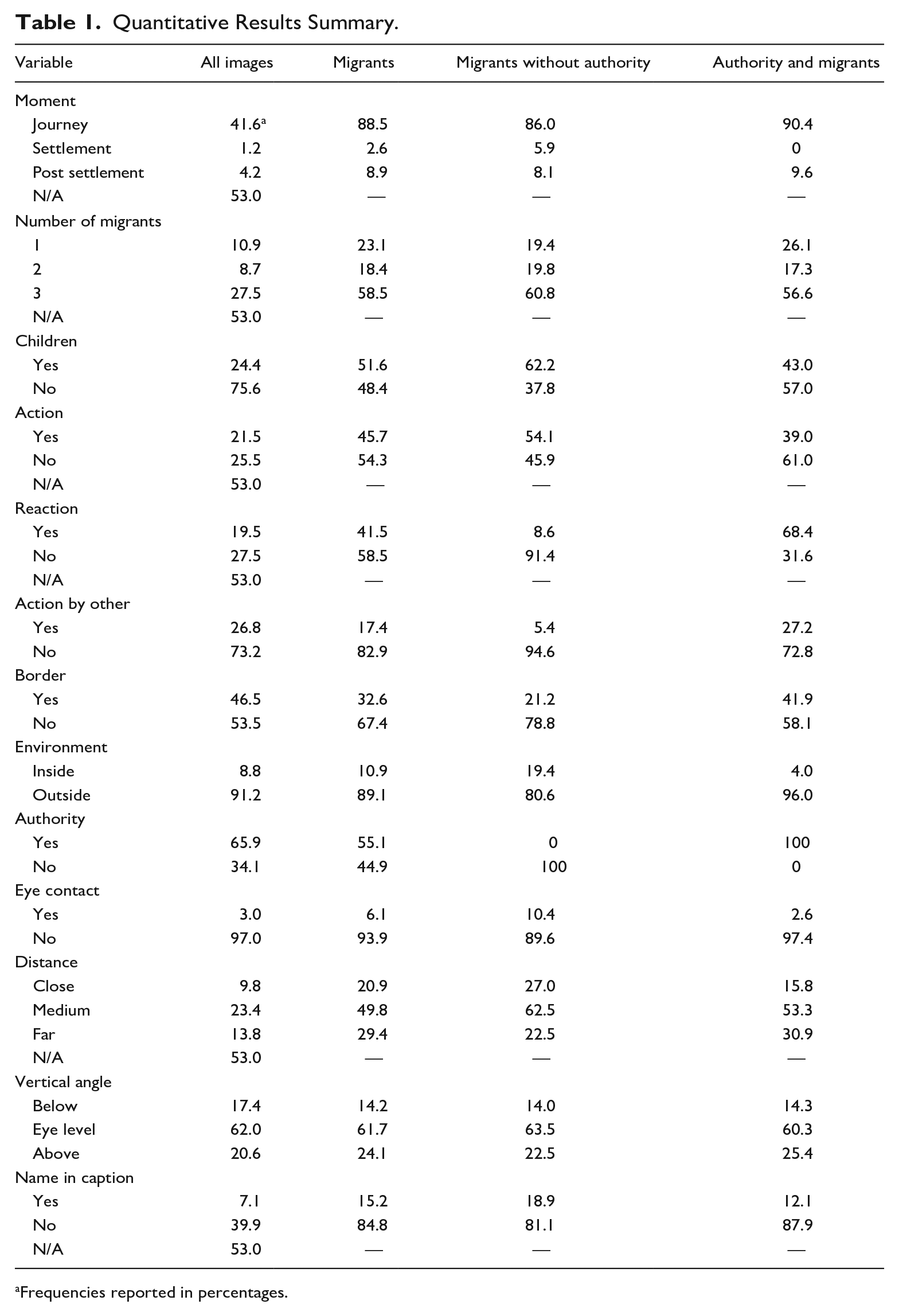
The quantitative analysis revealed many visual conventions in news images’ construction of migration on the U.S. border that address RQ1 (see Table 1 for all results). Regarding the representational metafunction—what was depicted in the images—more than half of the images (53%) that comprised the sample and were tagged with the keywords “immigration” and “border” did not include any migrants. The images instead depicted the wall along the U.S.-Mexico border (46.5% of all images) or politicians and officers from U.S. Customs and Border Protection (CBP), local police, or U.S. Immigration and Customs Enforcement (ICE; 65.9% of all images). Images that depicted the physical aspects of the border without people, such as the frontier landscape or the border wall only, comprised 11.33% of the sample. These results indicate that the most used wire services images on the topic of migration on the U.S. southern border depict the landscape, the physical border, law enforcement, or political press conferences in about equal measure to the images that actually represent migrating people. They are evergreen images that are not intrinsically connected to a specific migration event but can have meaningful consequences.
Quantitative Results Summary.
Frequencies reported in percentages.
When images that depicted migrants were isolated for analysis, several salient trends emerged. With regard to the “moment” of migration, 88.5% of the images in the sample depicted the journey, 2.6% depicted settlement, and 8.9 represented the post-settlement moment of migration. The most common post-settlement type was a sanctioned event such as the “Hugs not Walls” and “Children’s Day” events, where families on both sides of the border could come together and meet for a few minutes under the watch of border control officers. The only images of the settlement moment were three separate series of images depicting migrant families who recently moved into housing in the United States.
Migrants were most often photographed in groups of three or more (58.5%). An individual migrant was photographed in 23.1% of the images, and two migrants together were depicted 18.4% of the time. In total, 51.6% of all images included children. Regarding the action variable, 54.3% of images depicted migrants statically sitting or standing, as opposed to moving, talking, or gesturing. The vast majority of images of migrants were made outdoors (89.1%), and of the images shot inside, most were made in detention centers. Authority symbols were present in 55.1% of the images. Migrants were named in only 15.2% of the images (unnamed in 84.8% of images).
With regard to the formal semiotic cues, the majority of all images were taken at a medium subject-photographer distance (49.8%) and at eye level (61.7%). However, children were twice as likely to be photographed at this intimate social distance (64.1%) than adults (35.9%). Eye contact was only made with the camera in 6.1% of the images, the rest depicted migrating people gazing down or off frame.
Migrants and Authority
One notable pattern was that the visual conventions used to represent migration changed dramatically when symbols of authority (law enforcement officers, border patrol vehicles, local police, man-made fences, barriers, and badges) and migrants were depicted in the same frame. After controlling for the authority figures, there were two comparable sets of images: 273 images with migrants and authority together and 222 images of migrants without explicit authority symbolism.
When authority figures were depicted alongside migrants, migrants were less likely to be depicted engaging in an action (54.1% compared to 39%), less likely to have eye contact (10.4% compared to 2.6%) and less likely to be named (18.9% compared to 12.1%). Children were also less likely to be present alongside authority (62.2% compared to 43%). In addition, when authority symbols were in the frame, migrants are slightly more often depicted from a higher-than-eye-level angle (25.4% compared to 22.5%), more often to be photographed outside (96% compared to 80.6%), and more often depicted alone (26% compared to 19.4%). These findings suggest that visual conventions change when symbols of authority are included in the frame.
Qualitative Analysis
While the quantitative analysis focused on describing what was in the images, the qualitative analysis was designed to describe how those images are structured, that is, how the visual elements are arranged and situated relative to the viewer. Designed to enrich the overall description of visual conventions detailed earlier, this qualitative analysis involved a deep reading of the 21 most popular and most used images from the three wire services. The findings can be separated into two broad themes: the creation of symbolic power through compositional conventions and the creation of social separation.
Symbolic Power
Symbolic power refers to a set of visual conventions that make one element dominant in the frame through size, color, or placement and subordinates all other elements that are depicted within an image. This is one way in which viewers relate focal points with other visual elements and is part of the “compositional metafunction” of images (Kress & van Leeuwen, 2006). I found three ways in which symbolic power was constructed in the qualitative sample of images: hierarchical compositional structures, compositional weight, and compositional containment.
Hierarchical compositions place certain objects physically above other objects and certain people compositionally above other people. Some hierarchies can be innocuous—certain objects exist in the world at higher positions than others—but when juxtaposing people, it conveys a symbolic power. Because news images offer an “initial recording” (Ritchin, 2009, p. 18) of an event, they cannot be adjusted after the fact. Certain natural factors influence this construction, like the physical height of people, but it can also be emphasized through the image’s vantage point and framing. Many images that I qualitatively analyzed depicted migrating people sitting down, while CBP officers stood in a dominant position over them. This sequence of events occurs in front of the photographer in real time, but the photographer’s decision to include both sitting migrants and standing officers within the same frame is a compositional choice. And it conveys symbolic power.
Symbolic power is also communicated through visual weight, which refers to the way an object in a given composition demands attention through size, focus, tonality, proximity, and proportion of a visual element. In many images I analyzed, the proportion of the frame dedicated to the symbols of law enforcement far exceeded those occupied by migrating people (see Figure 1). These included CBP officers, CBP vehicles, searchlights, helicopters, fences, and other instruments of the border enforcement apparatus. The dominant position of authority signifiers can influence viewers to interpret the other elements of the frame in relation to that dominant element. Relegating migrants to secondary or tertiary focal points symbolically positions them as counterpoints of the composition. Migrants’ actions become secondary to the actions of CBP officers. They add complexity to the story of migration but are not the main characters.

U.S. Border Patrol agents take undocumented immigrants into custody capturing them after they crossed Rio Grande from Mexico into Texas on August 18, 2016, near Sullivan City, Texas. (Photo by John Moore/Getty Images)
Finally, symbolic power is also communicated through compositional containment, which, in the sample, was the symbolic capture of migrants between two or more symbols of authority. Agency or the freedom of physical movement by migrants is constrained by the signifiers of law enforcement. This is often a product of the vantage point from which the photographer made the image and the photographer’s choice of elements to include and exclude in a frame. Figure 1 is also an example of this convention, which emphasizes the ability of law enforcement to control and restrict movement. This emphasis on containment—conspicuous in 13 of the 21 images in this sample—creates an asymmetrical power dynamic between migrants and law enforcement officers.
Social Separation
The interpersonal metafunction has a profound effect on the meaning potential of images, as it socially positions a viewer relative to the represented objects in an image (Azoulay, 2012; Jewitt & Oyama, 2011; Newton, 2013). For instance, the vertical angle of an image (photographing from below eye level—colloquially known as the hero pose) is a common convention for signifying power, used in film, television, photography, and drawing (Kress & van Leeuwen, 2006, p. 140). One less commonly theorized convention is social separation, or the absence of shared physical space between the photographer (and thus the viewer) and the people photographed. Social separation was pervasive in this qualitative sample: In nearly every image, photographers did not occupy the same physical space as a migrating person but were separated by objects, people, and many times barricades, fences, or barred windows of vehicles. Conspicuously, this did not hold for any CBP officer in the image; often a CBP officer was the barrier between a migrant and a photographer.
This social separation symbolically distances viewers from migrants. This distance signifies that migrating people may not have agency in the photographic act—such as the ability to consent or physically influence the photographic event. Moreover, it situates viewers as observers. Meanwhile, many images were photographed at an intimate distance over the backs, shoulders, and heads of CBP officers who stood between the photographer and the migrant (see Figure 2). This allows viewers to enter the scene on the side of law enforcement, or perhaps through law enforcement. When viewers occupy the same physical space as officers and observe migrants from a nearly identical vantage, the gazes of the viewer and the officer begin to merge. This compositional convention grants the viewer the authority to observe the socially separated other and encourages the viewer to sanction the depicted activities.
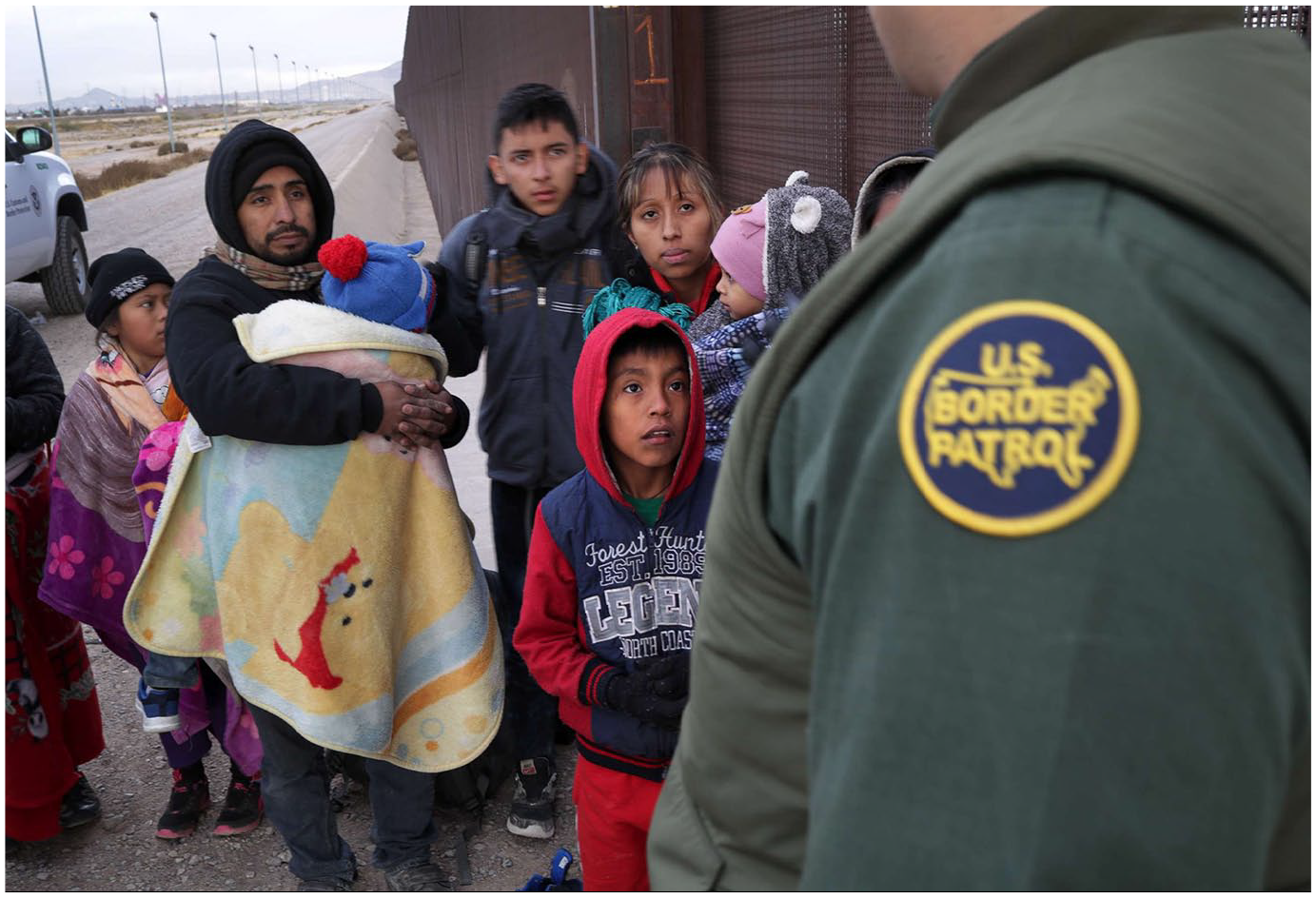
A U.S. Border Patrol agent speaks with Central American immigrants at the U.S.-Mexico border fence on February 01, 2019, in El Paso, Texas (John Moore/Getty Images).
The Meaning Potential of Images
The visual conventions outlined earlier foremost describe the contours of what can be said photographically about migration in the context of photojournalistic practice. Jewitt and Oyama (2011) note, however, that explicating the meaning potential of images also requires other theoretical frameworks, which is the basis of RQ2. Contextualizing these visual conventions within the discourses of mediated migration reveals how migrating people are visually constructed as a socially distanced other, often attached with signifiers of criminality, and depicted in a relatively diminished position. This does not suppose a single unified meaning of images but details how dominant discourses are encoded into the visual through convention and “prefer” an interpretative position.
The majority of the most used, popular, or relevant wire service images that comprised this sample depicted the frontier, border walls, or politicians in front of border walls more than migrants. This amounts to a level of symbolic annihilation (Tuchman, 1978a), a phenomenon where “mass media omit, trivialize, or condemn certain groups that are not socially valued” (Klein & Shiffman, 2009, p. 56). In these images, migrating people exist as an imagined Other to the walls, fences, border patrol agents, and politicians that comprise the borderlands. This begins a process of othering that is exacerbated by the lack of eye contact (93.9%), lack of names (86.8%), depiction of groups (58.5%), and pervasive social separation. Kress and van Leeuwen (2006) theorized that eye contact demands some sort of social response from viewers, enabling them to form some sort of relationship (even imaginary) with the represented people, whereas the lack of eye contact represents people as objects for observation. The pervasive absence of names precludes the ability to symbolically construct a personhood for the represented individual (Scott & Peña, 2023). This is in sharp contrast to the politicians, border patrol officers, and even militia members who were named in the sample. Scholars have argued that a consistent collective group representation prohibits social identification, thus dehumanizing or othering the represented people (Pandir, 2020; Tirosh & Klein-Avraham, 2019). In addition, the inability of viewers to occupy the same symbolic space as migrating people further distances them. Through these conventions, migrating people are constructed as an Other; this act of “symbolic bordering” (Chouliaraki & Zaborowski, 2017) distances them from the imagined audience. Not only does this evidence journalistic ethnocentrism (van Dijk, 1995), it can also signify a lack of cultural identification (Correa, 2010).
The images in this sample largely depicted the journey moment of migration (88.5%), one of four moments that comprise the migration process—the others being pre-journey, settlement, and post-settlement (Castles et al., 2014). Because I focused on images made in the border region, it is logical that the pre-journey moment would be less represented, but Texas and California have the largest migrant populations in the United States (Budiman, 2020). This narrow focus on the journey moment in the borderlands necessarily meant that interactions between border enforcement and migrating people (55.1%) would be significantly represented; this is a premier way to convey criminality in news images (Farris & Silber Mohamed, 2018; Scott, 2021). As discussed earlier, criminality is a major stereotype formed through the threat discourse; it has endured over nearly a 100 years (Haynes et al., 2016; S. Kim et al., 2011; Maher & Elias, 2019; Menjívar, 2016; Silber Mohamed & Farris, 2020). Regardless of the situation migrants were in (e.g., seeking asylum, attempting evasion, being released), the proximity to symbols of authority conveys a sense of criminality. When they interact with the other visual conventions that render migrating people as other, the sense becomes a conclusion.
The social separation of migrants and the construction of criminality can be damaging, but the combination with other patterns of representation further diminishes the power and agency of migrating people. When migrants and law enforcement officers were both in a frame, action by migrants dropped by 15.1%, rendering them static and passive. The compositional conventions of hierarchies, visual weight, and compositional containment furthered an asymmetrical power dynamic and visually diminished the migrants’ agency and power, which is a pervasive construction of the Latinx population in general (Flores, 2003; Maher & Elias, 2019; Vargas, 2000). The act of migration is an incredibly active process by determined individuals, but when viewed narrowly through enforcement moments, migrants are naturalized in news discourse as a population to be regulated and controlled. Diminished power and agency are requisite characteristics of victims—another pervasive discourse used to understand migration and migrating people (Greenwood & Thomson, 2020; Tirosh & Klein-Avraham, 2019). Victimhood contributes to the “dehumanization” in media constructions (Chouliaraki & Stolić, 2017, p. 1164) of migrants and refugees. Although many of the migrating people in this sample could be considered refugees, diminished power and agency for economic migrants also provide the discursive foundations for economic exploitation (Chomsky, 2021; Massey, 2009).
Explicating the meaning potential of each visual convention begins to form an understanding of what discourses were utilized to form these representations and how their internal structures relay a “preferred meaning” (Hall, 1973, p. 9). News images construct migrants as a socially distanced other and, through moments of law enforcement, a criminalized other with diminished power and agency. Through their evidentiary status, images largely naturalize the borderlands as a zone of regulation, control, and enforcement and migrants as a group of people to be controlled and regulated. It is a “border spectacle” (De Genova, 2021, p. 108) where “allegedly ‘unwanted’ or ‘undesirable’—and in any case, ‘unqualified’ or ‘ineligible’—migrants must be stopped, kept out, and turned around” (p. 108). This shapes the perceived conditions of reality. When politicians refer to the “invasion” (Fritze, 2019; Ruiz, 2002; Santa Ana, 2002) by hordes of “criminals” (Reilly, 2016), they need only look to the ubiquitous conventionalized news images for evidence.
PART II
The previous analyses were largely concerned with explicating the meaning potential of the most commonly used visual news images that represent migration on the U.S. southern border. Because myriad questions remain about how these representations come to be, Part II centers photojournalists and the conditions of production that engender these representations. Photojournalism is a highly regulated social practice, subject to multiple levels of influence. The individual experiences of photojournalists are the unit of analysis, but when taken in aggregate, these experiences provide a sketch of the political economy in which they operate.
Theoretical Framework
This study utilizes the hierarchy of influences model by Shoemaker and Reese (2014) to structure the analysis, used in many studies of news production and content (Denham, 2022; Ferrucci & Taylor, 2019; Istek, 2017; Thomson, 2019a; Yaschur, 2012). The hierarchy of influences differentiates the macro, mezzo, and micro levels of influence on news production into five categories: social systems, social institutions, organizations, routines, and individual influences (Shoemaker & Reese, 2014). The social systems level describes the ideological forces that influence every other level. Ideology here refers to the “imagined relationship of individuals to their real conditions of existence” (Althusser, 2001, p. 162). The social institutions level describes the “larger trans-organizational media field” (Shoemaker & Reese, 2014, p. 8), where news systems coordinate—to various degrees—with government agencies, including the constellation of border enforcement agencies. The organization level of influence refers to “how the enterprise itself is structured” (p. 8); here, this refers to the national and international commercial news industry. The routines level consists of the “constraining and enabling structures” (p. 8) in which photojournalists operate, including news values, aesthetic conventions, and most relevant to this study, the routine-level concepts of access and time. Finally, the individual level is comprised of the demographic and psychographic factors of photojournalists, including age, gender, ethnicity, race, education, values, belief, and political persuasion. This conceptual model allows individual levels to be artificially disentangled in the research process, although each level interacts and is predicated on the higher level. Below, photojournalistic news production is contextualized in the literature of each level.
Social Systems
Perhaps the most pervasive ideology in much of the United States is that “whites are the true citizens” (Chomsky, 2007 p. 89). This nativist ideology enables migration in the past to be classified as moral and justified, and not the product of an ongoing settler colonial project (Behdad, 2005), even if many contemporary types of migration are seen as illegal and detrimental to American society. Although the “nation of immigrants” myth, made famous by John F. Kennedy and widely disseminated in the 1960s, is commonly told in the United States, it “is often deployed equivocally to obscure the state’s violent treatment of immigrants” (Behdad, 2005, p. 21). John F. Kennedy specifically mentioned Northern European settlers in Nation of Immigrants (Foner, 2022, p. 149). As Aristide Zolberg (2006) eloquently stated, the United States is a nation of immigrants, “but not just any immigrants” (p. 1).
The history of immigration policy and law in the United States reveals its underlying nativist foundations and explicit racial and ethnic exclusion. The first federal naturalization law in 1790 restricted citizenship to any “free white person” (R. Jones, 2021; Ramírez, 2018), a phrase that was not removed from federal law until 1952 (R. Jones, 2021). The “Chinese Exclusion Act” banned all Chinese people from the nation’s borders in 1882 (Chomsky, 2007). In 1907, a “gentlemen’s agreement” was struck with Japan, preventing Japanese immigration to the United States (Massey, 2009). Historian Reece Jones (2021) asserts that these ethnic exclusion laws were based on White supremacy, but most often justified through eugenics pseudoscience popular at the time. In 1902, President Theodore Roosevelt made great use of the eugenics-derived term “race suicide” to describe the birth rates of immigrants (R. Jones, 2021). In a 1921 article in Good Housekeeping, Calvin Coolidge (Vice President-elect at the time) wrote: “Biological laws tell us that certain divergent people will not mix or blend. . . . [E]thnic law is as great a necessity to a nation as immigration law” (Coolidge, 1921, pp. 13–14). Shortly after, in 1924, the Johnson-Reed Immigration Act implemented national origin quotas, while barring all Asian migration. According to the U.S. Office of the Historian, this law was “to preserve the ideal of U.S. homogeneity” (Office of the Historian, n.d., para. 8). These quotas remained in place until the 1965 Hart-Celler Immigration Act (R. Jones, 2021). Although this 1965 act was seen as a correction of national misdeeds (Foner, 2022; R. Jones, 2021), Senator Ted Kennedy assured Americans that “the ethnic mix of this country will not be upset” (Massey & Pren, 2012). U.S. immigration law has always been aimed at maintaining racial hierarchies and White dominance (R. Jones, 2021).
In the early 20th century, the U.S. government began to actively recruit Mexican immigrants, which politicians and policymakers saw as a source of labor for the “most undesirable seasonal occupations” (U.S. Commission on Immigration, 1911, p. 50). Historian Douglas Massey (2009) noted how early U.S. immigration policy systematically disenfranchised Mexicans, making them “landless laborers for white land and business owners” (p. 15). U.S. policy toward its southern neighbor was simultaneously violent and exploitative. Militias in Texas carried out a “reign of terror” (R. Jones, 2021, p. 195). The forced repatriation of Mexicans and U.S. citizens of Mexican descent in the 1930s (Massey, 2009) and “Operation Wet Back” in 1954 (K. L. Hernández, 2006) likewise involved physical violence. After World War II, overtly racist sentiments became less acceptable in the public sphere (R. Jones, 2021); exclusionary policies were increasingly justified in economic terms, a myth that continues today (Chomsky, 2007). Exploitative policies like the Bracero Program from 1942 to 1964, which Massey (2009) likened to sharecropping, and the Immigration and Control Act (IRCA) of 1986 “transformed Mexican migration . . . into a de facto guest worker program based on the circulation of undocumented migrants” (p. 18). In 1996, President Bill Clinton signed the Illegal Immigration Reform and Immigrant Responsibility Act of 1996 (IIRAIRA); this “eroded the rule of law by eliminating due process from the overwhelming majority of removal cases” (Kerwin, 2018). Massey (2009) writes that IRCA and IIRAIRA assumed “a new centrality in the exploitation and exclusion of Latinos” (p. 22). This context shows the deployment of the “nation of immigrants” discourse to obscure the underlying logics of racial exclusion and the capitalist logics of exploitation.
The U.S. southern border was synonymous with Mexican migration for most of U.S. history, but migration from Central American countries began to rise in the 1990s and surpassed Mexican migration in 2014 (Chomsky, 2021). According to historian Aviva Chomsky (2021), Central American migration to the United States results from a century of U.S. domination and exploitation of Central Americans, a “forgotten history” of economic, political, and military intervention. The immediate roots lie in the Central American wars of the 1980s. European Colonialism, U.S. 19th-century neo-colonialism, and cold-war policies provide a through-line of destabilization and oppression in Central America. The United States was directly involved in occupations, coup d’états, counterrevolutions, death-squad training, and economic imperialism in Guatemala, El Salvador, Nicaragua, and Honduras (see Chomsky, 2021). Unsurprisingly, these protracted conflicts, and the ensuing instability spurred increased migration to the United States, a history that “most all of our political leaders, mainstream media, and educational system would prefer to forget” (Chomsky, 2021, p. 248).
Deployment of the “nation of immigrants” discourse helps obscure White supremacist logics, genocidal conquest, systematic exploitation, and the neo-colonial projects that cause migration. Historian Reece Jones (2021) bluntly concludes in White Borders that U.S. “immigration restrictions are a tool of white supremacy” (p. 198). When politicians conjure the “nation of immigrants” myth, it “perpetually defer(s) confrontation with the core contradictions of national culture” (Behdad, 2005, p. 21). If American border enforcement is a system of racial and ethnic exclusion used in service of White hegemony, then news narratives that do not explicitly reject, critique, or resist immigration restriction help naturalize this ideology and can be considered an actant within the system promoting its continued existence.
Social Institutions
In the seminal book Deciding What’s News, Herbert Gans (1979) insisted that news covers those at or near the top of the hierarchies and “those, particularly at the bottom, who threaten them” (p. 284). News is widely called “an instrument of democracy” (Barnhurst & Nerone, 2001, p. 9) but is widely acknowledged as maintaining “existing political, economic, cultural, and/or ideological subsystems” (Shoemaker & Reese, 2014, p. 77). By adopting the frames of the powerful elite and accepting the “boundaries, values, and ideological rules” (Shoemaker & Reese, 2014, p. 84) latent in the frames, “the media work to legitimate elite positions” (Shoemaker & Reese, 2014, p. 76). As many media sociologists (Gans, 1979; Tuchman, 1978b) have asserted, this often happens through hegemonic influence but also through indexing (Entman, 2003), or when news is predicated on the ideas, frames, and speech acts from official sources. Social institutions explicitly or implicitly index news to the authoritativeness of politicians and military, government, and law enforcement officials. The coordination between news, law enforcement officials, and politicians has a significant effect on the representation of migration.
The relationship between the press and law enforcement has often been described as a marriage that oscillates between symbiotic and adversarial positions (Bock, 2021, p. 172; Mawby, 2002). Foundational studies treat news media as conduits for police ideology (Chermak, 1995) when the subject of news is crime (Grabosky & Wilson, 1989; Hall et al., 1978). Police provide journalists with a “constant stream of usable crime” that “becomes the raw material from which crime news is written” (Sherizen, 1978, p. 288). The former Chicago Tribune police beat reporter Robert Blau (1993) detailed his mutually beneficial relationship with police; more recently, Bock (2021) detailed the constant coordination between journalists and police to cover perp walks. Sherizen (1978) concluded that “the police have a vested interest in crime news appearing in newspapers and other media” because “crime news results in a strengthening of the police view of the causes and solutions of the crime problem” (p. 212). This is very similar to the way that data from border enforcement and government officials often provide the foundation of news stories (Barragán, 2022; Shaw et al., 2023). From a cultural studies perspective, this illustrates the media’s role, to use Marxist language, as an “ideological state apparatus” (Althusser, 2001) disseminating and naturalizing a society’s prevailing ideology.
The press also coordinates intimately with politicians and often identifies social processes as newsworthy by indexing to political rhetoric. Gans (1979) noted that while the political elite can lean on news organizations to represent events in certain ways, most often it is a symbiotic relationship: Politicians are the “equally authoritative and efficient sources” (p. 145) that constantly supply news. Herman and Chomsky (1988) described this in their propaganda model, but in the contemporary era of networked media, increased political polarization, and partisan media, “elite discord” (Entman, 2003, p. 429) provides the conditions for more diverse frames to be adopted from the political elite. Regardless, it is the political elite that can make human migration a newsworthy issue. The simple declaration of an “invasion” or “crisis” or a scheduled “tour” by a politician to see the circumstances firsthand (in a highly orchestrated fashion) is sufficient motivation for news organizations to mobilize in their pursuit to justify or contradict the claims.
News Organizations
Photojournalism is now increasingly comprised of a diverse set of freelancers who individually work for many different news organizations (Hadland et al., 2015), complicating the analysis of how one organization can influence news content. Surveys (Hadland et al., 2015; Pixley et al., 2022) have found that between 50% and 60% of photojournalists worked as freelancers and often relied on supplemental income from other endeavors (Pixley et al., 2022). News photography has often experienced the full force of the commercial pressures on news for decades. Some news organizations have laid off their entire photo staffs. Other legacy organizations retain only a few staff photographers—such as the one staff photographer at the Wall Street Journal (Thomson, 2018)—and rely more on photo agencies, crowdsourced imagery (Allan, 2015), and freelancers. Photojournalists often blame digitization for the “deteriorating job security and working conditions” (Klein-Avraham, & Reich, 2016, p. 437). Photojournalists say their skills, education, and training are devalued through digitization and user-generated images (Mäenpää, 2014; see also Brennen & Brennen, 2015). Photojournalists’ precarious position in the news industry, moreover, may directly affect how images are produced. Klein-Avraham and Reich (2016) suggest that the increased speed at which images need to be transmitted leads to decreased quality in the visual reportage (p. 438).
Thomson (2018) found that many freelance photographers were not mentored or taught by editors at elite news organizations and received little to no feedback on their work after an assignment. In other spheres, the credentialing process for freelancers has become complicated by the lack of traditional news organizations’ authority and/or reputation (Lough, 2019). News routines are therefore developed in more diffused ways, relying on universities, workshops, festivals, and informal training networks. Routines can be seen as arising both from specific organizational structures, such as the photography staffs of legacy news organizations and an eclectic mix of sources arising from the larger visual news industry.
Routines
Photojournalism is unlike other news production processes as it relies (almost) exclusively on physical presence (Bock, 2021; Lough, 2019). Reporters can work from offices, and data journalists can gather networked information. But photojournalists are in the field, which demands developing unique routines. Gaining geophysical access is one main routine established through physical and social means. In addition, the time required to move through space and make images is a fundamental aspect of visual news production. The temporal aspect of news creation is not exclusive to visual news, but it acts as a discursive resource and deserves attention.
Access is a key concept of interest in both the practice and study of photojournalism (Ferrucci & Taylor, 2018; Lough, 2019). Invoked in both legal and social realms, access conjures up notions of private and public property, as well as control over what can and cannot be seen (Santos Silva & Eldridge, 2020). As a theoretical concept in communication research, access is connected to gatekeeping and ethics, visuality, and visibility (Frosh, 2001); it is a prerequisite for any visual newsworker (Fahmy, 2005). Visual researchers often define access as the ability to enter a geophysical space or location (Bossen et al., 2013; Fahmy, 2005) and is of utmost importance to the deinstitutionalized routines of freelance photographers. The daily struggle (Bock, 2008) to gain physical access requires an understanding of local and federal laws and negotiation with official government agents, such as police or military personnel. News photographers often go through a credentialing process (Bock et al., 2018), which is vital to freelancers who lack the institutional sway that staff employees of elite organizations typically possess. Credentialing allows professionals access to public spaces not granted to “average” members of the citizenry, although this is changing (Bock et al., 2018). Central to access is the concept of embodied gatekeeping (Bock, 2021; Bock et al., 2016; Lough, 2019), which refers to the ability of certain individuals and organizations (both public and private) to physically limit access and thereby constrain what can be seen and photographed.
Access has also been understood more broadly, not just as entry into a physical location but also as permission to photograph any aspect of a social situation freely (Ferrucci & Taylor, 2018). News photographers often define access in their metajournalistic discourse through consent by the subjects of the photographic encounter (Ferrucci & Taylor, 2018). Thomson (2019b) found that some subjects of news photographs were offended when they were photographed without this interaction. Trust and mutual respect are key factors necessary to building a relationship that will garner consent to photograph social behaviors that occur within a space (Ferrucci & Taylor, 2018). This was also reflected in the 2020 “Photo Bill of Rights” (2020), a public declaration and tool kit signed by more than 2,500 practitioners. This explicated the concept of “informed consent,” the requirement that photographers explain when, where, and how images will be used and enumerate the potential consequences of image publication (Toolkit for Lens-Based Workers, 2020).
Physical and social access must also be understood through its temporal dimension: A relationship between a discursive (or ethical) ideal and time can be established explicitly through photojournalists themselves (Ferrucci & Taylor, 2018; Photo Bill of Rights, 2020; Thomson & Greenwood, 2017). Photojournalists identified relationship building as an ethical prerequisite, however much time it takes to accomplish (Ferrucci & Taylor, 2018). If ethical representation—that is, what journalists might consider a productive, comprehensive, fair, or “truthful” representation—takes time, then the notion of time can be positioned as a discursive resource. It affects what kinds of representation are possible. One goal of this study is to understand when photographers must short-circuit the full relationship-building process to meet deadlines, increase productivity, and maximize their potential income when they are paid by assignment. Photographers must sometimes select strategies to maximize their potential for image-making, in many cases, utilizing the historically cozy relationship between the press and law enforcement (Bock & Araiza, 2015; Shoemaker & Reese, 2014) and the protection of free expression on public ground.
Examining time as a discursive resource is vital. First, because of the increasing reliance on the freelance model, photographers get paid only when they are on assignment producing images; the preliminary steps of negotiating access and building relationships may fall out of the purview of compensated labor, as it might in a salary model. It is then necessary to understand if photojournalists still engage in the foundational process of relationship building when they are not compensated. Second, the transitory nature of migration can be an obstacle for photojournalists seeking to make repeat visits. Time constraints can directly affect representation and may result in conventionalized representation.
Individual Levels
The previous sections establish that a dominant ideology of migration infuses the social institutions that coordinate to establish routines for news photographers when representing migration. But individual photojournalists are not automatons and engage in this social practice for a variety of reasons and through a variety of perspectives. Good and Lowe (2017) posit at least six identities that photojournalists can inhabit, including the objective recorder, the observer, the storyteller, the witness, the advocate, and the interpreter (pp. 6–8). These roles and identities are also mediated through photojournalists’ own views of migration itself. Some photojournalists may see themselves as witness to newsworthy events, while others may align more as activist for migrants’ rights. Other motivations may not turn on migration at all. The location of a photographer’s home base may influence editors’ decisions in handing out assignments, and some people may be drawn to migration for self-serving purposes. There is no shortage of prizes awarded for news images of migration (POYi, 2022; Reuters, 2019; World Press Photo, 2019), so the allure of prestige may be influential.
The dimension of aesthetic sensibility must also be considered. Photojournalistic style is constructed through the “latent dynamics of a wider visual culture” (Solaroli, 2015, p. 514), and an individual’s preference or taste in aesthetics will influence the construction of images. This is especially true today. Photojournalists may receive little formal training from news organizations (Thomson, 2018); earn supplemental income from other, non-journalistic photographic practices (Pixley et al., 2022); and must justify their professional position in a democratized image-making environment (Mäenpää, 2014) through their subjective mastery of the craft (Solaroli, 2016). Individualized aesthetics are one way that photojournalists differentiate themselves from others (Schwartz, 1990; Solaroli, 2016), establishing visibility and securing future financial prospects.
Photojournalists’ perceived roles, political views, and individual tastes can affect the images they produce, but Shoemaker and Reese (2014) noted that the influence of individual attitudes on content is not clear. Studies have shown that journalists’ perceived role does influence their coverage of events (van Dalen et al., 2012), but individual political bias is more often attributed to media ownership (Shoemaker & Reese, 2014) since journalists are incentivized to align their views with editorial leadership (Ceron et al., 2019). However, because freelance photographers work for many different news organizations, it is necessary to interrogate individual motivations alongside the structures that form their routines. This study seeks to analyze each of these levels of influence, which, for the sake of simplicity, is referred to as the conditions of production. Through this framework, this study seeks to answer the following research question:
Research Question
Methodology
Interviews are a highly popular method (Gubrium et al., 2012) for understanding how people make sense of their own social practices; as such, interviewing is appropriate for examining how practitioners understand their own work. Interviewing also enables the interviewer to examine the conditions of image production. This study relies on semi-structured interviews with photographers who have worked on the topic of migration and on participant observation along the U.S.-Mexico border. Brennan (2017) defines semi-structured interviews as using pre-established questions, yet these offer the flexibility necessary for asking follow-up questions and delving more deeply into specific issues addressed. Semi-structured interviews are utilized to research the organizational ties of the photographers, and how the photographers allocated time to different aspects of image-making (researching the topic, establishing connections, and making and transmitting the images to news organizations). They helped to understand the nature of the relationship between the photographer and the persons they photographed.
Participant observation is a type of ethnographic “fieldwork” (Lindlof & Taylor, 2019) vital to understanding social practices from an emic perspective. It is used to answer questions about “people’s beliefs, rituals, attitudes, actions, stories and behaviors” (Brennan, 2017, p. 166). Participant observation involves talking to people and interacting in their natural environments (Brennan, 2017, p. 167). Participant observations are used here to supplement data from the interviews, as well as to understand how photographers obtain access, develop relationships, and allocate time to different processes of news image creation.
Method
I interviewed 21 staff and freelance photojournalists who worked on visual stories of migration. An initial list of interview subjects was compiled from my professional network, with further contacts identified through bylines of migration images published by Reuters, the Associated Press, Getty Images, the New York Times, and the Washington Post. Collectively, the interviewed photojournalists covered migration from 2006 to 2023 and have won numerous awards, including four individual Pulitzer Prizes.
Each interviewee were given pseudonym initials to obscure their identities. Some information was generalized without locations and time frames to avoid identifying details. Any quotes or descriptions that do identify a time or a location corresponded to a media event where many photographers and news outlets were present. Each interview lasted between 1 and 2 hours, allowing for more time if the conversation permitted and the interviewee agreed. Each interviewee was asked the same questions, including biographical questions, industry-related questions, and specific questions related to access and time. Every interview involved at least one photo-elicitation component, where interviewee discussed with me an image the interviewee made. Photo-elicitation is often used to elicit rich, specific data that might otherwise not come up during the course of conversation (Rose, 2016, p. 315). Each interview was electronically recorded and transcribed through the teleconferencing software Zoom.
Participant Observation
To confirm, supplement, and augment the data compiled from interviews, I conducted participant observation along the Texas-Mexico border. Observations began in May 2022 over a period of 3 weeks; a second 1-week-long trip occurred in May 2023. I shadowed six photojournalists who were actively photographing migration and took close note of the towns, border walls, and geographical features of the border. My goal was to observe photojournalists during the course of their assignments, monitor the processes involved in obtaining access, observe the interactions between photographers and those that they are photographing, and to record how the photographers allocated their time. I especially focused on the relationships and interactions among photographers, migrants, law enforcement (police, border patrol, and U.S. military), and other journalists. Photographs, journal entries, and audio recordings were made to document the ethnographic observations. Each day, I coded and categorized my observations thematically. After completing the field observations, I analyzed the data and compared it to the data from the interviews.
Analogously to the semi-structured interviews, I gave the photographers I observed pseudonym initials to obscure their identity and do not provide the locations of the observations. Each ethnographic participant was invited to view a preliminary draft of the study to ensure adequate measures were taken to obscure identity to their comfort levels.
During both observation trips, I also photographed migration processes and took photographs and field notes of my interactions with CBP, ICE, local police, local residents, and migrating people. In many instances, relying on a decade of previous experience in professional photojournalism, I approached migration processes as a photojournalist myself. The goal was to understand how law enforcement and migrating people would interact with me and regard my presence. I did not take photographs for news outlets during this observation; these were only made to illustrate and argue research findings. These photographs can be found in the online Supplemental Materials of this monograph.
Findings: Conditions of Visual News Production on the U.S. Southern Border
Photojournalists working on the U.S. southern border rarely, if ever, have complete autonomy over their representations of migration processes. The photographic encounter in this milieu is not solely an interaction between two parties—the photographer and the photographed—but the product of complex cultural processes regulated at both the material and abstract levels of society. Many distinct entities have a stake in the visual construction of migration. These stakeholders include law enforcement agencies, news organizations, journalistic communities, private landowners, non-governmental organizations (NGOs), cartels and criminal syndicates, migrating people, and the photojournalists themselves. Below, I detail the findings from the interviews and participant observation relevant to RQ3. Although this interrogation was structured by the hierarchy of influences model, the findings are organized into three different categories—physical influences, social influences, and ideological influences—that enable a more legible structure and description of how all five levels of the hierarchy of influences model interact to influence visual representation in this specific context.
Physical Influences
The foremost influence on the visual construction of migration is the geophysical nature of the U.S. southern border and how access to that land is controlled. The entire system acts as a hybrid collectif (Callon & Law, 1995; De León, 2015)—or a system of human and non-human actors—that influences how photojournalists represent migration. The largest influence is embodied gatekeeping (Bock et al., 2016), but the size of the borderlands and the climate also contribute. The U.S.-Mexico border spans 1,954 miles across four states, but only in certain areas can most migrants cross from Mexico or seek asylum: Tijuana, Yuma, El Paso, or the border along Texas in Del Rio, Laredo, or the Rio Grande Valley. These so-called “hot spots” are where photographers congregate and are subject to strict control and regulation by a combination of federal and state-level law enforcement agencies, as well as private landowners. The process of physically controlling what photographers can see and when they can produce images severely limits the scope of visual reportage.
Embodied Gatekeeping
Migration comprises numerous processes of which border crossings are but one ephemeral portion. Yet, border crossings are one of the most overrepresented aspects in news media. The crossing “hot spots” are among the key locations that photographers must access. These heavily controlled areas all but ensure photographers will need to negotiate access and collaborate with law enforcement agencies. Referring to the Texas-Mexico border, NT estimated that “99 percent of the riverbank on the U.S. side is either private ranch, farms, or federal land.” LN, who has photographed on the border for over 15 years, said that in Texas, geophysical land control often begins miles away from the river. Pulitzer Prize–winning SL said:
You essentially cannot access the border without embedding with border patrol. You can’t just show up as a photographer and access the areas where migrants are crossing, so being embedded with border patrol is pretty much your only option there.
Some photographers elsewhere along the border still ventured out alone to cover migration processes. But one freelancer, VZ, indicated this unembedded approach is a dubious prospect: access depends on the disposition of the DHS officers when photographers physically approach them. HW vividly detailed how CBP often “tell you to fuck off” on the Roosevelt Reservation in Arizona, a 60-foot-wide federally owned strip of land along the border. OQ described frontier areas: “It really depends on who’s working.” Sometimes “there’s no bosses, there’s no oversight” but that can quickly change. This gamble was not always suitable for photographers needing to produce images on deadline. In my observations, I only came across one group of migrants on a public road outside the view of law enforcement. Law enforcement’s embodied gatekeeping creates a funneling effect for photographers actively resisting these geophysical restrictions, limiting the scope of visual reportage:
You may have seen a lot of photos from a place called Roma, Texas. The reason why Roma is a place that we all go to isn’t because it’s the only place to cross. It’s because it is a private piece of land where the owner has given media permission to be there. (MP)
At least seven of the respondents I interviewed were all present at a specific migration event in Roma, Texas, where they had access to a private ranch. “That was the hotspot that everyone like parachuted into,” said AN. He noted that he wanted to be at Roma because it was “the only place where you have that kind of access.” This riverbank location was where coyotes (smugglers) on the Mexican side of the river ferry migrants across on rafts and drop them off on the U.S. side to request asylum from waiting CBP agents, Texas Rangers, and members of the National Guard. TH said the scrum of journalists felt like a “beehive swarm just descending upon these people.” He said he became disheartened by the seemingly callous behavior of photographers toward the migrants and that some were “treating it like a sports game.” TH added that he “lost his shit at one point.” Then, after reflection, TH asked rhetorically, “Is this a mirror of something that’s deep within me that I’m ashamed of?”
Like many other access points, photographers’ access to the river in Roma, Texas, was only temporary: Eventually, the landowner had a change of heart. NT stated that although he could only guess why, he imagined that the officers spoke with the ranch owner after being annoyed by the presence of the photographers, leading to his access being revoked. MP expressed his frustration: “It’s a very thinly veiled way for them to control the amount of media coverage, and I find it really dispiriting. They’re using old-school tactics to control media.” This geophysical control of border-adjacent land is one of the most influential variables affecting the representation of border crossings. It can either funnel photographers to specific areas or force photographers to embed with law enforcement.
Embedding with law enforcement (also called “ride-alongs”) enables photographers to access other migration scenes under the close supervision of the CBP or other border enforcement agencies. Many respondents who embedded recently indicated that these are not with normal patrol units but with a public information officer who usually is not actively working in the field: “If you’re with border patrol nowadays, you are with a PIO, public information officer, or a public affairs officer, you’re not with your general border patrol agent in the field,” IK said. Embeds with trained media specialists are one way for law enforcement to exert formal geophysical influence over what can be seen and what can be hidden from view. SL commented on the constructed nature of these events:
They’re only out in the field when they’re escorting you. When they take you out there, they’re doing the job of a border patrol agent, in terms of apprehending people and things of that nature. That agent wouldn’t be out there doing that if they weren’t escorting you. But it’s this trade-off . . . if you weren’t with them, then we just wouldn’t have any pictures at all.
CJ said PIOs often “put up a show.” She detailed how they were often well-groomed, handsome, and, in her experience, apparently of Latinx descent. NT characterized his experience less as an embed and more as a “media tour.” Many photographers described the dual purpose of these coordinated events as public relations image maintenance through demonstrations of border enforcement efficacy. PIOs would grant geophysical access to help serve an agenda that many respondents said is ultimately tied to political and economic objectives.
Law enforcement and photographers often have shared goals during these moments of close coordination, and sometimes, the shared goal is explicitly stated. AN described one ride-along: “We had been driving around for a little bit and hadn’t seen anything. He (the PIO) was like “I’ll make sure that you, you know, get some apprehensions.” While photographs documenting these experiences are not untrue or staged, they are controlled situations manufactured for the photographer. In many ways, it is akin to the classical notion of the political photo-op, a phenomenon that the National Press Photographers Association (NPPA) Code of Ethics commands professionals to “resist” (NPPA, 2017). Embeds also enable law enforcement to restrict the types of scenes photographers can access. SL was one of many respondents to note this ethical paradox: “Border patrol embeds are almost this weird accepted ethical exception in photojournalism.” He continued:
I tried to keep a really heavy dose of skepticism, keeping in mind where it was they were taking me versus where they weren’t taking me, what they were showing me versus what they were trying to keep me from seeing.
Many photographers indicated that they are more or less reluctant participants in this process and not necessarily satisfied with the arrangement. Respondents who identify as women were especially dissatisfied. KC detailed an experience where CBP officers tried to hug her, which she found unprofessional and demeaning. One photographer said that she was treated differently because “I’m a white lady, I’m a young person, they’re not intimidated by me. But it’s just gross. I hate it.” RS, who also identifies as a woman, detailed how law enforcement officers were always “super macho” and often “use the language of war.”
Other aspects of migration processes can likewise only be accessed through law enforcement coordination, processes that can take years of relationship building to become accessible. Detention facilities are particularly contentious because many are privately owned and have frequently been the site of scandals, such as family separation, unsanitary or unhealthy conditions, and other abuses of migrants (Arriola & Raymond, 2017; Dreisbach, 2023). RS said, “We don’t have a good sense of what’s going on inside of the detention centers and especially the privately-run detention centers.” Getting any visual accounts requires direct coordination. PW was allowed to tour two different public detention facilities in 2014, but representation was tightly controlled.
I was the only photographer that they had allowed in, and it was sort of like “Okay, so, first of all, the rule was you can’t take any photos of anybody’s face,” which is tricky when you have like rooms full of people. (PW)
KC revealed that a Washington D.C. media specialist was their guide in a detention center near the border and issued instructions that included no interaction with migrants, no photographing faces, and no photographing migrants’ documents. MP once capitalized on a new public information officer’s inexperience and was able to gain access and take photographs of a child detention center. The resulting firestorm could have potentially jeopardized many CBP officers’ jobs, but after careful bargaining, the photographer was allowed to publish the images. Other photographers indicated that certain migration events, such as repatriation flights, were also highly controlled and even included publication embargoes levied by ICE. Controlling what the public gets to see comes from the highest levels of the U.S. government, even if they are enacted by individuals on the ground. Photographers must be agile and tenacious to resist this embodied gatekeeping, but the situation on the ground is always fluid.
If geophysical control ever became absolute, photographers indicated they were willing to adopt an adversarial position to authority. When a large migrant camp in Del Rio formed of mostly Haitian migrants, border enforcement quickly became overwhelmed and blocked access to the Rio Grande River; officials even closed the international bridge between Del Rio and Ciudad Acuña. This move specifically kept journalists from seeing what was taking place in the camp and riverbanks. “Del Rio was a shining example of media manipulation on the part of Customs and Border Protection,” said MP. Not to be deterred, many photographers crossed into Mexico at another port of entry and drove back to Ciudad Acuña, where they began photographing from the Mexican side of the river. This was a scene far from business as usual. “It was a free-for-all; we literally did not get any access on the U.S. side of the border,” said IK. Most photographers worked from the middle of the river, where a dam created a shallow water crossing, or they stayed on the Mexican side. AN recounted being frustrated by the lack of access: “I tried talking to border patrol about that, but they weren’t having it.” Two intrepid photographers floated across the river on air mattresses and hid in the camp as agents began searching for them. “CBP helicopters were circling over us and drones searching for us, and they dispatched a patrol of agents on the ground to find us,” said MP. This scene illustrates the lengths to which border enforcement agencies will go to control access to newsworthy scenes of migration, including cordoning off the land and the air. A no-fly zone was implemented to keep photographers from using drones, but one photographer circumvented this by appealing directly to the Federal Aviation Administration to secure a short window each day.
The battle for physical access is one of the greatest challenges to making visual news about migration and has a strong influence on how migration is represented. Law enforcement agencies severely limit the scope of visual representation by denying access altogether, regulating physical movement (such as ride-alongs), and funneling photographers to private lands that the photographers cannot completely control. Above all, it can be incredibly arbitrary. During fieldwork, I attempted to document migration processes at the same location on a public road three times in a span of 24 hours. The first time I was yelled at, restricted from seeing the events, the CBP officer in charge told me to stand under a streetlamp “where I can see you.” I detailed this event to a veteran photojournalist who had planned to work at the same location that evening. He called into the local CBP office, told them I was a photojournalist, and a call came through to the officers on the ground that I was a “friendly”—a military term usually used to identify allied personnel, but in this context, to identify news media personnel who did not possess what they deemed hostile intentions. I approached again, and a different supervising officer told me I could photograph but could not photograph CBO officers’ faces or get too close. The next night, I returned to the same location and was able to photograph without any restrictions. This experience provided direct evidence for what many respondents recounted: access seemed arbitrary and unpredictable. While law enforcement does play an outsized role in this embodied gatekeeping, they are just one of the stakeholders that limit how migration is represented.
Private Landowners
Whatever property on the border is not federally controlled by DHS, CBP, or the U.S. Fish and Wildlife Service is privately owned and often even harder for photojournalists to access. Speculating that owners fear that publicity might attract more migrants to their land, NT said, “Private landowners usually say ‘No, absolutely not.’ They don’t like people to come into their land.” For many South Texas landowners—including many I talked to during fieldwork—migration has been a constant reality throughout their lives, and journalists seeking access is not uncommon. HS detailed how he waited for 10 days outside of the entrance to a ranch just to meet the owner. After first convincing the owner to agree to dinner, he then needed to convince him of his intentions, credibility, expertise, and trustworthiness. For many private landowners on the border, their property is their livelihood, and any access must come with guarantees of stewardship and respect. After 5 years, HS was the only photographer who has continued access to one particular ranch where he can witness individual border crossings, large groups of asylum seekers, drug smuggling, and many other border occurrences. Because he developed relationships with the owner and many other locals that transcend a professional arrangement, he can maintain relative autonomy from the law enforcement agencies that also have permission to operate on that land.
Non-Governmental Organizations
Several photographers mentioned NGOs—the charities and activist groups that run permanent respite centers for migrants, organize temporary camps, and provide aid in numerous other ways. Some migration processes, like border crossings, are ephemeral, and NGOs provide access for photographers to spaces where migrating people live temporarily or stop off for longer periods. One photographer, VZ, said he never embeds with law enforcement and always collaborates with NGOs as his first point of access to migrants. He explained his process: “You get in touch with an activist, a local organization, and they put you in touch with somebody else and that’s a big part of the way I do it.” Many other photographers collaborated with NGOs to meet and photograph migrants, but these arrangements were also temporary, and access was often revoked.
The physical structure of these permanent respite centers allows the organizations to restrict geophysical access. In one popular respite center in McAllen, Texas, the windows are blacked out, and the ubiquitous private property signs underscore the physical control by NGOs. HS described the directors of that respite center as the gatekeepers of news since the shelter was so busy and a common access point for photojournalists. But NGOs also attempted to restrict physical access even when their authority was more dubious. According to KJ, whenever an NGO did not have legal authority to physically control journalists from coming into temporary camps on public land in Matamoros, Mexico, the NGO would withhold news tips to selected outlets as a way to manage newsworkers. Many photographers relied on these tips and information, and if the NGO did not like the way a journalist depicted scenes or reported situations, they would remove the offending journalists from the information thread.
Since the Trump presidency, many photographers noted that their relationships with many NGOs changed drastically. CJ said that as right-wing and fringe media began to descend upon the border, migration advocates, lawyers, and activists began to formally gatekeep, preventing all media workers from speaking with migrants. According to both TN and CJ, people connected with Alex Jones (the conspiracy-peddling media provocateur) would “harass migrants here on the U.S. side as they were crossing or going into the shelters.” Consequently, lawyers and advocates hired security guards to escort migrants from one building to the next so that no journalist could speak with them. Migrant advocates, photojournalists told me, made no distinction between legitimate journalists, fear-mongering media personalities, or citizen watchdogs. IK said that migrant advocates “see me as an enemy.”
Both IK and CJ found this gatekeeping counterproductive to their explicit goals of making images that would provide a counterpoint to the demonizing rhetoric used to describe migrants. CJ, who is a local journalist, recounted instances where migrant activists would tell her how she should be representing migrants. CJ said she understood the activists are trying to protect them, “but they (migrants) are not children, you know. They can think for themselves.” KC detailed a similar interaction when a woman from an NGO approached her aggressively and “chewed my fucking head off” for photographing a migrant woman near a U.S. point of entry. Unbeknownst to the aggressive staff members, KC had been working with the migrant woman for a long period and even had signed release forms from her.
Many photojournalists chafed at the lack of access while simultaneously acknowledging that the NGOs were working in the best interests of migrants who relied on these spaces for safety. LN stated that these respite centers are not immune from law enforcement pressure. According to LN, law enforcement agencies would stop sending migrants to a certain respite center if the center continued to grant access to certain journalists. This jeopardizes the well-being of the migrating men, women, and children by denying them access to safe shelter, food, water, and the information services that these centers provide. Physical access is contingent upon many factors, and the relationship between NGO leadership and the photographers themselves is not isolated from other social pressures.
Of all the participants that influence the photographic encounter, migrants themselves have the least amount of geophysical control or physical influence on their representation. This, of course, is directly related to the nature of migration; the fact that the journey takes place on federal and private land means that migrants have no authority to physically control access. This is similar to other communities that news media marginalize—the unhoused, drug users, and those charged with crimes (Bock, 2021; Scott, 2021)—that are often photographed in public spaces where either the First Amendment or law enforcement guarantee photographers’ access. Yet, this lack of control is not predetermined or absolute. Many migrants in camps and respite centers can control the level of access they grant to photographers who want to document intimate moments, such as family relationships, or vulnerable moments, such as physical or emotional suffering. However, until on private property, migrants must collaborate with other stakeholders to legally restrict geophysical access.
Size of the Borderlands
Embodied gatekeeping and the regulated flow of migration enable these so-called hot spots to develop, but access is contingent and unstable. This ensures that photographers must move if access cannot be obtained in one location. Approximately 1,254 miles of the U.S.-Mexico border is in Texas. This means photojournalists drive many hours up and down the border. Photographers must develop detailed knowledge of the physical geography through a mixture of map research and personal experience. The Rio Grande River serpentines down the entire length of Texas and a labyrinth of public and private roads reach the river. To complicate it further, a series of incomplete border walls were erected in various locations, sometimes directly above the river and sometimes miles inland, cutting across farmland and other private property. Multiple times, I found myself driving down a public road with the border wall to the north and the Rio Grande to the south. Houses, ranches, cemeteries, and farmland sat in between.
The size of the borderlands limits the amount of time photographers can stay in the field. I saw multiple photographers cutting their time short because of an upcoming drive and the energy and planning that comes with it. Other factors were also at play. For instance, in Texas, a border enforcement initiative called Operation Lonestar mobilized nearly every law enforcement body in Texas (E. Hernandez, 2022) and relocated them to the border. This operation filled up nearly every available hotel in the Rio Grande Valley. Most of the photographers I interviewed were not based in the border regions and needed to drive hours back and forth from hotels to the locations where they were working. HS was often concerned about driving 2 hours back to the nearest available hotel after working until the early morning. KH said “I wouldn’t have made it home safely” if a partner had not driven her home after 18 hours straight in the field. Photographers cannot phone it in, and the body is the ultimate limitation of this social practice.
A second way that the vastness of this space influences representation is by constraining the amount of exploration and improvisation that otherwise would be easy. To meet deadlines and minimize financial burdens, many photographers focus most of their energy on places that they predict, based on personal experience or researching other photographers’ work, will be successful. This means coordinating their locations and converging on spaces where access has already been negotiated.
Climate
Once access is obtained, photographers must deal with the climate of the borderlands on a schedule not of their own making. Some migration processes follow predictable patterns (set by cartels and smugglers in Mexico) in certain sections for short periods before changing. Some migration happens during the daytime, like in La Joya, Texas, compelling photographers to spend hours in the sun, where the temperature hovered in the mid-90s during my observations. Other situations begin at 11 p.m. and last all night. Three times, I saw photographers successfully negotiate access to private land, spending hours in both the heat and near-total darkness waiting for migrants to cross the border. Photographers shared stories of the tick nests, mosquitos, tarantulas, and snakes that line the banks. They described sandy and rocky terrains becoming dangerously slick during rain or when migrants cross through the river. LN recalled, “Mesquite, cactus, thorns, it’s like walking through the bush, it’s miserable, it’s sandy, it’s hot.” Likewise, AN stated that his “least favorite assignment ever” was in Brownsville, Texas, in “super thick brush, and it was humid as hell. Within an hour I had sweated through my clothes.”
These precarious conditions influence where photographers are willing to spend their time, “basically hiding in the bushes for 4 or 5 hours at a time, maybe getting bitten by ticks and flies” as SL phrased it. The amount of time photographers spend working contributes to what they describe as psychological and physical burnout. The photographers limited their trips to, on average, between 3 and 7 days on the border (the maximum being 2 weeks) with off-day breaks scheduled throughout. This self-imposed limit allowed photographers to physically and financially endure the hardships of this work, yet it also introduced immense pressure to produce good work. TI once expressed frustration about his previous day in Del Rio, Texas, where he produced very few images that he considered newsworthy, dramatic, or in his estimation “good.” The issue was that relatively few migrants were crossing the border near Del Rio. As a result, he left for another location. I observed visible frustration on other photographers’ faces when too much time had passed without making any dynamic or engaging images. After multiple days of working, photographers became more inclined to pass on witnessing migration intake procedures if they had already captured a similar scene or if only a few people would be migrating. Energy and resources had to be preserved, and this required careful calculations.
Social Influences: Rules, Regulations, and Expectations
Even after obtaining geophysical access, photographers are not necessarily able to represent migration freely. Many times, geophysical access comes at the cost of discursive assurances, agreements that photographers will selectively represent certain aspects of migration while ignoring others. These social influences can be explicit—such as ground rules set by law enforcement or expectations of assigning photo editors—but they are also implicit discursive understandings of the various stakeholders. Photographers must also balance autonomy with productivity and grapple with notions of witnessing and censorship. They juggle the needs of news organizations while attempting to produce images that meet professional standards and values. It is a complicated enterprise, to say the least, one that is both amorphous and opaque.
Law Enforcement: Explicit and Implicit Influence
In Texas, at any time, up to seven law enforcement agencies were working on border enforcement. I directly observed CBP, ICE, the Texas Army National Guard, the Department of Public Safety State Troopers (DPS), the Texas Parks and Wildlife Department, county sheriff’s offices, and local police. As the previous section detailed, photographers must often closely coordinate actions with law enforcement agencies. This necessity produces serious, even existential issues for news workers who have been taught to maintain autonomy and to hold the powerful accountable. Through interviews and direct observation, I found coordination with law enforcement subject to a paradoxical premise: Visual journalists can see more if they agree to say less in their captions, that is, if they leave out what they overhear, what officers or migrants tell them, or what they observe in terms of breaches in protocol.
Law enforcement made demands, whether explicit or implicit, that photographers needed formally to agree to if they wanted continued access. According to my interviewees, the demands vary from agent to agent and shift over time, but often explicit ground rules are established. Some of the rules are specifically related to image management interests of the border patrol officers, such as agreements not to quote officers. JS said officers tell photographers “not to photograph our officers doing this or don’t put . . . their badge numbers or any identifying parts.”
During one embed, AN noted he was only allowed to photograph the public information officer: “They always give you the same spiel about how, like, they could be targeted by cartels and all this other stuff, and I don’t really buy into that.” Some photographers regarded the explanation as partly true; but more likely, it was strategic public relations and image control. While light image maintenance may seem rather innocuous in a contemporary media ecosystem, some photographers detailed situations that approached overt censorship. IK was on a ride-along when they came upon plain-clothed agents making a large arrest in front of unmarked vehicles. As IK approached the scene, he was told to leave, although he was on a public street. IK said it gave him “this really weird and censored kind of feeling.” But, seeing no other option, he had to obey.
Ground rules are also set for photographing and interacting with migrants in specific situations. AN said he was not allowed to talk or interact with migrants during embeds. PW said she was able to “speak freely within a limited time.” RS stated she was “generally allowed to photograph individuals before they are taken fully into custody, so basically up until the point where they’re put into a transport.” But one time, she “had to stand behind them when they were originally first apprehending a group.” CJ was told once not to photograph the faces of unaccompanied minors. Other photographers had very similar experiences. Different law enforcement agents cited different reasons for these rules, according to the respondents, which indicated to them that ground rules were fluid and at times arbitrary. Freelance photographers especially expressed frustration and specifically indicated they felt unable to push back against these requests. A ruptured relationship may lead to being denied access, jeopardizing their livelihood and straining their relationship with the assigning news outlet. Some photographers were able to work within the formal rule structures. As MP noted, “As long as I didn’t break certain rules, I didn’t necessarily have to tell a story that was positive (for border enforcement).” Some photographers appreciated the explicit ground rules to alleviate ambiguity and confusion as to what was allowed and what was off-limits.
Ground rules directly influence how photographers can represent migration processes and whether, based on legal or safety considerations or not, they amount to discursive favors for continued access. Even when ground rules were not expressly stated, knowledge of their existence influenced photographers. Speaking of the process of coordinating with law enforcement, AN said:
It does feel more restrictive, even if, like they’re not going to come out and tell you, “Don’t take a picture,” you start questioning in your head, Can I take a picture of this? Or am I going to get yelled at? It’s doubly frustrating as a freelancer. The last thing I want to do is get myself on any kind of border patrol blacklist or screw anything up for that reporter with their relationship with border patrol. So, it’s like you’re being extra cautious because you don’t want to step on anybody’s toes, break any rules that you might not even know exist.
Freelance photographers mentioned to me this informal influence a total of six instances—more often than staffers, most likely because of the precarity of their position. If a staff photographer pushed the boundaries and lost access, they may have lost a story. But freelance photographers may have lost their jobs.
Many photographers detailed how CBP attempted to influence their images even when they were across the border in Mexico. GI recalled a time that CBP yelled from across the river, questioning him and directing him not to take pictures. “They saw me actually laughing. . . . I was like come over, cross the river.” TH detailed a similar experience: “They would shout at us, telling us we are pariahs, that we were just trying to make the cover of Time magazine.” In one instance, a CBP officer pointed a paintball gun at a journalist’s face who was on the Mexican side of the border fence. In 2019, NBC 7 San Diego broke a story from leaked documents that detailed a joint intelligence-gathering effort by U.S. and Mexican authorities that “created a secret database of activists, journalists, and social media influencers” (T. Jones et al., 2020, para. 1). According to the report, U.S. and Mexican authorities targeted photojournalists at ports of entry for extended questioning and inspection, once holding a photojournalist for 13 hours before denying them entry into Mexico (T. Jones et al., 2020).
Law enforcement’s influence on representation is not solely restrictive, and in many cases, it enables photographers to make pictures when they otherwise would not be able to. Many photographers mentioned that migrants did not perceive them as a separate or distinct party from law enforcement. Authority—signified by badges, guns, trucks, helicopters, and border fences and sanctioned by the U.S. Government—extended to the bodies of photographers during embeds and ride-alongs and influenced their interactions with migrants. Nearly every photographer interviewed acknowledged this inherently asymmetrical power dynamic and often felt conflicted. RS reflected on this phenomenon:
Unfortunately, when I’m working with CBP, I don’t always have an opportunity to engage with individuals. But what I do generally is just make eye contact and I make it very clear that I’m separate from the border patrol. But I mean I am in a position of power, right? I mean they’re being arrested or apprehended and I’m with people apprehending them. I’m very aware of that power dynamic. They (migrants) probably don’t feel like they can push back, but what I can do is study their behavior and their eye contact and when possible, introduce myself and explain what I’m doing and get some consent. But it’s imperfect.
Similarly, CJ put this power phenomenon in a larger context:
These folks have been traveling for a long time and being told what to do, consistently, so they’re just in a mode where they’re like “yes, yes, yes,” like, very obedient. So, when you have border patrol agents that are there, and you’re getting out with border patrol agents, you’re already with this authority level on par with border patrol. Do you think they (migrants) are going to tell you no?
The photographers thus carry with them the privileges associated with authority in ways that are not formal or explicit but through association. I experienced this firsthand whenever migrants asked me for advice about various processing procedures, indicating they saw me as an extension of law enforcement. Many photographers told me their strategies for differentiating themselves from authority to the migrating people, acknowledging that it was an issue. Their solutions were “a very imperfect science,” RS stated. Law enforcement influenced not only what could and could not be seen but also how others reacted to photographers and how they consented to be part of the photographic event.
Each of these dimensions of social influence—the formal censorship, the informal regulation, and the extension of power—affect how photographers approach the story of migration and, ultimately, how it becomes news. JS reflected on his coordination with law enforcement:
I do acknowledge that what I’m photographing is very much a highly edited version of this overall story. And you know, the truth will lie somewhere in between those things, but it’s up to you (the photographer) to kind of decide.
This quote highlights the important fact that law enforcement agencies do not strip all agency from photographers to choose how to represent migration. They may be the most frequent and most influential constraint, but law enforcement agencies do not monopolize representation.
Expectations and Pressures From News Organizations
As photographers negotiate a host of physical and social influences on the ground, they must simultaneously grapple with news organizations’ expectations. Assignment parameters, deadlines, editors’ opinions, and top-level guidance all significantly curtail photojournalists’ editorial autonomy and affect their work. Photographers indicated that collaborations with reporters force their cameras to focus on certain aspects of migration over others. Freelance photographers felt they could not push back on specific demands. Exacerbating this pressure to perform (or conform) was the ever-present knowledge that another photographer would easily fill their shoes if they declined an assignment or failed to meet expectations. At times photographers expressed frustration, but each acknowledged that this is part of the job and the nature of this type of work.
Perhaps one of the most frustrating realities about the U.S. news system is that photographers themselves (who are on the ground to report empirical observations about migration) rarely have the authority to dictate what is or will become news. Contrasting and shifting agendas in power centers in Washington D.C. and New York can ideologically shape what ultimately ends up in news. RS candidly described this phenomenon:
Let me put it this way: Under Obama, a lot of editors in New York didn’t really want to hear stories that were too critical because people kind of wanted him to succeed. Under Trump, every story had to be all his fault, which was kind of infuriating because Obama had such problematic policies to begin with. Trump was really just extending a lot of them.
These top-level agendas dictate what types of assignments get handed out, as well as what existing stories get picked up from independent journalists. These editorial decisions essentially choose the angle or framing of the story and thereby, scholars argue, facilitate political agendas (Entman, 1993; Gitlin, 1980; Reese, 2007). But aside from political agendas, assigning editors practically control which migration processes are covered and how those images and captions are presented. TN said, “The editor straight up told me, ‘We’re looking for people storming the border.’ I’m just like, hold up, did I just read this?” Many respondents expressed irritation about this scope of the story:
I always tell editors in meetings immigration is more than just the border. I’m really happy that I do get to be one of the people who gets to be asked to go to the border, but like there’s so many follow-up stories to do. (AN).
Likewise, SL commented on this social construction of migration in news:
What’s happening at the actual border is this flashpoint of two days, sometimes three days, at most, maybe. And so, concentrating all the coverage on just that three-day period, I felt was, really, a dangerous trap for us to fall in as journalists. That three-day period tends to be highly visual; it’s going to get a lot of attention on the front pages. But it only represents a very, very limited part of their immigration saga.
OQ stated quite candidly: “Migration is not the fucking border. I’m tired of just the same shit.” One photographer noted how news representations influenced perceptions of the borderlands more broadly. TN said: “People say really ugly things about the border. I can’t tell you how many people I’ve met up north that think that the border is a war zone—that it’s crime and people running rampant.” The consensus was that news organizations were not interested in visual reportage of “what is pushing people to flee” (KW) and that the obsession with border crossing unfairly focused on the “worst moment of their life” (GI).
When asked about pitching longer projects or follow-up stories, IK lamented that “there’s really not much interest in those kinds of stories.” In fact, longer in-depth stories are costly, and nothing guarantees how the story would shape up—it is a riskier bet than border coverage. The consensus among respondents was that pitches to editors for follow-up stories rarely succeeded. “I’ve pitched it and not had it go through,” said PW. Ultimately, news organizations need to focus on coverage that can draw viewers. LN opined that “there’s only a certain appetite for border stories, and that’s why we’re not there, day in, day out because I think American people don’t get up and pay attention to it day in and day out.” While taken together, my interviewees had produced many long in-depth stories, but most photographers regarded it as an exception to their general experience.
Time
Many freelance photojournalists in the data expressed frustration over the amount of time available to them to work on assignments, which varied from as little as a few hours to 17 days. Most freelance photojournalists noted that their usual assignments lasted 1–3 days, and on special occasions, 7–10 days. “I always need another day,” said PW. “I just feel like you can’t do as good of a job, ever.” This frustration seemed to be especially prevalent for wire service photographers: “A wire usually wants the photos today, or yesterday,” said CJ. IK expressed similar concerns: “You’d be like shooting and then you’ll be trying to move pictures to your phone and add a caption and then bam! I’m not going to sit here and be editing my photos when stuff is happening, I want to be watching the story.” Many of the interviewees indicated they would file photos throughout the day. When they didn’t, they’d be fielding frenzied calls and texts from the news organization.
Photojournalists indicated that fast turnaround times affected the depth and intimacy of their visual reportage, meaning they could not deeply engage with migrants, learn about their specific experiences, or document a variety of situations. This often contributed to photographers’ disillusionment with the visual news industry that prioritizes fast news. Time is a resource that can enable the production of rich nuanced images to correct what otherwise would be superficial or stereotypical accounts. VZ said, “I am frustrated because sometimes I am shooting a good photograph, but then I know there’s not enough time to stay with them, to build the narrative.” Like many other photojournalists, VZ was committed to telling these stories: “So, in response to that frustration, I decided to come back to the border and to work on my own. That was the only way to really to really go deeper.” JS admitted that “there is a little bit more of a tendency to rush things when you are on (a daily assignment) because of the expectations to deliver on our coverage.” These reflections illustrate how the commercial news industry and their news cycles force photographers to “feed the beast” by continuously producing images, even when nuance and quality begin to decline. IK summarized the link between the resource of time and problematic representation:
I think the major failure of us as photojournalists—especially if you’re working for a wire, where the majority of work comes from—is we want fast news. We just want general coverage, illustrations per se right? I mean, it’s not something that’s done on purpose, but what I’ve seen it causes this perception of these “dark kind of hooded people.” When you see pictures of groups of migrants, and all the faces are blurred out, (it’s) as if they’re some kind of criminal.
More senior wire photographers painted a very different picture. SL said:
Specific to the border, I think working for a wire actually made me feel like I had way more freedom and flexibility. Immigration in the Rio Grande Valley was such an ongoing story that it was rare that was there was something that was truly breaking on that day.
MP, another staff wire photographer, echoed this sentiment, although, in his experience, the lack of formal deadline pressure did not equate to the absence of pressure: “To be honest, my office doesn’t pressure me. When we are on the schedule, all the pressure comes from yourself and no matter how long you’ve been doing it, or whatever success you’ve had.”
Financial Insecurity
The time a photographer is able or willing to spend working on migration stories is inextricably tied to the financial cost of producing news images. In the contemporary news climate, freelancers are rarely able to refuse an assignment, even if they disagree with the focus or the angle. “If I don’t want to work, oh, they’ll find somebody else to send instead of me like that, in a split second,” said CJ. Freelancers referred to themselves as the industry’s “bastard stepchildren.” They are never really “part of the gang” and are simultaneously the most “vulnerable” and the most “loyal.” Freelance photojournalists may be loyal, but as KW said, “ I don’t think that publications have a lot of loyalty to us.”
The latest State of Photography report (Pixley et al., 2022) detailed that almost a quarter of the 1,325 respondents “expressed a high degree of precarity (little to no financial security)” (p. 14). OQ characterized photojournalism’s financial outlook as “bleak,” and KC says making a living as an editorial photographer is “pretty impossible.” KW, who has won major photography awards, said “I’ve been doing it for a long time and still don’t have a sustainable income.” TN detailed that once he received a heads up from his editor about budget cuts, he started taking odd jobs to make ends meet. RS explicitly mentioned that she limits her work trips to “7 to 10 days max” because, “personally I got really burned out, and beyond that, it’s too expensive.”
Freelancer TH said that on one 6-week project, he spent an estimated $5,000—putting all of the expenses on a credit card. After weeks of hard work following migrating people from Mexico City to Tijuana, he “ended up selling it and only making $900 back.” Freelancers must often front the cost of travel, lodging, and food on assignment, not to mention the cost of photography gear and specialized safety equipment such as insect-repellent clothing, headlamps, and GPS locators. On another long-term project, TH estimated that he spent thousands of dollars over years of documentation and published it in the former New York Times photographer blog, Lens blog, for a total of $350. After a moment of reflection, TH said, “But I would do it again. It’s a privilege actually to be able to work.”
Lack of Editorial Control
After editors communicate the scope and angle of the story and photographers make the photographs, the decision of what to publish returns to the editors. “It’s really not up to me, ultimately, like what gets represented what gets pushed out,” said freelancer PW. Editors decide on which images to publish or syndicate, how they are cropped and toned, and what captions will accompany them. Photographers’ intentions and editors’ intentions often did not match. “I’ll get a very good photo and they won’t even use it because it is not the kind of image they can syndicate,” said VZ. “So, I can do the image for me and try to give them a good set of images that can work for what they do.”
This often affects what situations photographers will focus on and what visual techniques (e.g., complex vs. simple compositions, informational vs. ambiguous subject matter, conventional vs. unconventional camera settings) they will use to make their photographs. CJ said: “Some of these photos . . . are not even that good, that is, not my best work, not even close to a mediocre job. But I know that they can use them.” Interviewees described a constant negotiation that at times turned contentious. GI expressed dismay at one news organization’s editorial direction, saying: “You are in New York in your fancy office with a nice temperature and I’m in fucking Juarez, burning myself down in this fucking desert. These are my images; this is what I like.” Many respondents characterized these negotiations as a battle fought at many levels. GI noted that when he made his perspective known, his editor “fought with his boss, and his boss was fighting with his boss” up the chain of editorial command. Other respondents revealed that some hard-earned reporting work would be stripped from their captions when the images were ultimately published, which also put photographers and editors at odds with each other.
Wire service photographers have an additional worry about where the photographs will ultimately end up. KW said, “Pretty regularly my photos appear on Breitbart and the Daily Caller or whatever, and it’s horrible shit.” Wire photographers noted that after they send their images for publication, partisan outlets can “put those photos in any context they want.” Once the photographs are published for syndication, the photojournalist has no control at all.
Drug Cartels
Many photojournalists detailed how the specter of the drug cartels loomed over their work and influenced how they went about their job. Across the border from Texas, for example, drug cartel members directly engage in embodied gatekeeping, as OQ said: “They tell you to leave, and you take their fucking warning.” Another photographer recounted being followed and photographed by suspected cartel members over a series of weeks. In most other cases, the influence of cartels was a social influence derived from the knowledge of who they were and the implicit threat of physical violence. Celeste González de Bustamante and Jeannine Relly’s (2021) in-depth study, Surviving Mexico, reports the enormous danger of being in periphery zones that are far from power centers. They report that 156 journalists were killed in the borderlands of Mexico between 2000 and 2020, and an average of one per month between 2017 and 2020. Many photojournalists in this study described the sense that they were being watched while photographing in temporary migrant camps or Mexican cities. SL mentioned several times “where I was pretty confident there were people connected to the cartels who were hanging about the camp and listening in on what was happening.” Multiple respondents stayed close to the international bridges or even worked exclusively on the bridges unless migrant camps were formed on the other side. RS described the risk of photographing migrant border crossings from the Mexican side: “It would be extremely dangerous to photograph; you’d have to be so fast. . . . I’m not going to stand on the banks because that would be extremely foolish.” Similarly, LN explained how fear of the cartels—and the threat they symbolize—limits his ability to photograph.
I don’t go over there by myself, and I don’t go in very far usually if we cross, you know, stay within a couple blocks of the bridge. You know there’s been a couple times, where we’ve gone in by escort to a shelter or something, but you always feel like somebody’s watching.
Given the threat of violence from cartels, many news organizations had security teams in place on the ground during specific migration processes. Photojournalists said that the security team eased anxiety and added a layer of safety, but sometimes this amounted only to a chat where the group would check in. Respondents indicated that security personnel often gave advice and vetted drivers and fixers. Sometimes security personnel were at odds with the wishes of photographers and would explicitly veto or advise against photographers’ plans. OQ, who is an American citizen, had often photographed in Ciudad Juarez. Yet one time when he was on assignment for a national newspaper, he was overruled. “Our security guy was like hell no, that’s a legal nightmare,” said OQ. Many local photojournalists employed in border cities in Texas said their employers restricted them from entering Mexico to work. Often this was related to insurance and liability, a finding de Bustamante and Relly (2021) also detailed.
While the cartels operating on the U.S.-Mexico border near Texas create significant problems affecting photojournalists’ work, other locations pose fewer or at least different risks. This is an example of the “multiple” U.S.-Mexico borders (Correa-Cabrera & Staudt, 2014). NT recounted spending many nights on the Mexican side of the border wall in California and Arizona and was more concerned with Mexican law enforcement stopping him than cartels. OA explicitly wanted to contest the “danger” narratives on border cities. Yet, even OA noted certain best practices for working in Tijuana: “I was always with people, many friends who are fixers and local journalists. If I had to go to specific areas, I would not go by myself and I would always let people know where I am.” The “buddy system” was a common theme across interviews, and many photojournalists even wore GPS trackers while working in Mexico. The psychological effects of organized crime and other risks inherent in periphery zones (e.g., robbery, getting lost, exposure to elements) influence photographers to limit how much time they will spend working in frontier regions and on the Mexican side of the border. This has serious consequences for the knowledge potential of the photographs: When migration is always represented from the U.S. side of the border, the issue of migration is symbolically seen from a U.S. perspective.
Migrating People and Agency
Many photographers described their representation practices with consternation due in part to the tension between news industry demands and ethical principles that they developed through direct interactions with migrating people. Many of my interviewees indicated that the issue of simple consent and informed consent needed more discussion because, for many migrants, their representation in news might cause them harm. When informed consent could not be obtained—because of embodied gatekeeping, explicit rules from law enforcement, or language barriers—AN stated: “You kind of have to consider the worth of the photo. The worth of potentially putting someone in danger.” The power dynamic between migrating people and photographers is often asymmetrical, but photographers seemed hesitant to say to me that, in the context of this relationship, they held all the power. There are both formal and informal ways that migrants can consent to their image being made even in spaces that they cannot control. However, this often depends on photographers initiating a conversation first.
At the temporary camp of 2021 in Del Rio, Texas, migrants were able to influence and control their representation in the makeshift and temporary shelters, especially because law enforcement had closed off the banks of the river. Two photographers who had clandestinely crossed back to the U.S. side were able to interact with migrating people and photograph those who consented. CJ noted that many of the Haitian migrants did not want their pictures taken, but she only learned this once she was close and inside the camp. But one man called her over to his family and said, “Hey, I want you to photograph us.” Because of the unique circumstances of the Del Rio situation—and the antagonistic relationship between photographers and border enforcement at the time—migrants could communicate their wishes directly to photographers, actively consent to the process, and withdraw participation. The cohesive unit of photographer and law enforcement evident elsewhere had been fractured, and photographers no longer held implicitly sanctioned power.
IK noted that photographing in charity shelters allowed migrants more agency to choose whether they agree to be photographed compared to situations with law enforcement on public property. IK states that this results in more intimate and personal stories that combat the narratives of criminality. LN said photographers were able to “piece together a much fuller story” through longer interactions, and many other photographers indicated that this was a more ethical approach. IK said that going into a shelter felt more like “you are coming into people’s homes,” and this influences photographers to photograph with more sensitivity. Similar examples came from the former camp in Matamoros, Mexico. CJ noted that the relatively stable location of the camp enabled her to tell stories about love, connection, and leadership during the journey to the United States. These humanizing accounts seemed to be made possible when photographers and migrants could interact directly, and mediating entities (e.g., law enforcement, migrant activists) were removed from the equation.
Whether or not photographers were able to request formal consent, many more photographers learned to watch body language and other non-verbal cues as to whether migrants were willing to be photographed. RS explained her process:
I try to study their reaction and their body language to make sure that they’re not traumatized by my presence. I’m often conflicted about it. When I am not sure, then I tend to not photograph that person, even if I would like to.
Photographers claimed that they looked for extended eye contact and for people who seemed curious and interested in their cameras and what they were doing. JS also mentioned that if he sees anyone show “a kind of hesitancy,” he thanks them and moves on. No photojournalist in the pool said they ever filed an image after a migrant explicitly told them not to. “For every person that says no, there’s a person that says yes, and they can be that stand-in for that representation,” said JS, who detailed he routinely saw a hundred border crossings a night. Yet, for every photographer with enough experience to develop these best practices, there are others who prioritize the shot over the comfort, safety, and well-being of the migrants. PW recounted one such instance:
I had been on one of the bridges between Mexico and the U.S. interviewing migrants who were waiting on the bridge to try and seek asylum. And there was one woman there who didn’t speak English or Spanish, but she made it clear to me, she did not want to be interviewed, and did not want her photo taken. So, I didn’t. I moved on. Later that night, the wire had a photo of this woman with her hand in front of her face and the caption says she was crying. How I interpreted the photo was she was actually shielding her face. She said she didn’t want her photo taken, and I was appalled. I just felt like, what are we doing?
Ideological Influences: Roles and Resistance
Migration may be ubiquitous in the news, but what exactly makes migration newsworthy? Or more precisely, how do photographers, law enforcement, and border cities view the news value of migration? While photographing asylum seekers surrendering to CBP one night, HS told me that a good picture can happen anywhere, at any time. Yet, HS, like many others I observed, was frequently drawn to situations involving large groups of migrants and would leave scenes when only a few migrants were present. Larger groups of migrants had more potential news value than a single family or a small group. This notion was also held by some CBP officers. One afternoon in 2022, I was photographing migration processing in La Joya, Texas, and a CBP officer seemed confused by my presence at the relatively routine and small processing taking place. He told me that Eagle Pass, Texas—a border town nearly 5 hours away—was “the place to be” because it was “getting hit hard.” He thus implied that he regarded large groups of migrants being apprehended and detained as the newsworthy aspect of migration and concluded our conversation with the advice that I needed to “watch Fox News.” About a year later, I was in front of a bus station in Brownsville, Texas, where I saw a “Media Registration & Inquiries” sign with a QR code that directed to a webpage entitled “City of Brownsville Media Guidelines for Immigration Influx Coverage.” This indicated that city officials understand that an increase in migration would garner an increase in media attention. Each of these disparate observations began to illuminate that migrants in and of themselves are not newsworthy, but an “influx” is. A single migrant’s story or personal history is not nearly as newsworthy as multiple migrants’ bodies en masse.
Historically, large groups of migrants crossing have been characterized as a “surge” or an “influx,” terms that Santa Ana (2002) includes among the metaphors used to describe Latinx migrants along with tide, flood, stream, and flow. The 2017 and 2018 migrant caravans created a spike in news coverage of migration (Fabregat et al., 2020). Similar spikes in coverage occurred when an estimated 15,000 Haitian migrants crossed into Del Rio, Texas, in September 2021 and when border crossings increased as Title 42 expulsions ended in May 2023 (Jordan et al., 2023). (For three years of the Covid-19 pandemic, the United States used Title 42 of a 1944 public health law, which allowed curbs on migration in the name of protecting public health, to expel migrants.) Stories often index their newsworthiness to the number of “encounters” along the border, which is based on data collected from border enforcement (Aguilar, 2019). This framing serves to narrow the newsworthiness of migration to an event—as a surge has a temporal element. That event is best represented visually by groups crossing borders. Photojournalists know their chances of satisfying the needs of the news organization are tied to large groups, and they often prioritize these situations.
The influx frame is not the only way that migration and migrating people become newsworthy. Politicians and government agencies hold great power in making migration a newsworthy event. Sometimes they do so through policy, such as Trump’s 2017 “Muslim ban.” At other times, this involves nothing more than a constructed spectacle used for political purposes. I witnessed one event in Eagle Pass, where over 40 DPS, CBP, and Texas Army National Guard vehicles waited near the edge of the border fence. Assuming a massive migration event was occurring, I pulled over to observe; but within 20 minutes, every single car had left. Later that evening, Fox News briefly reported on this “Show of Force” (Hunt, 2022), broadcasting its footage of the vehicles flashing their emergency lights in a line on the private land, all facing Mexico. As one of the few outlets with special permission to be on this specific property, Fox News had a front-row seat to this rather obvious media event and used the b-roll to illustrate a reporter’s account of a looming “southern border crisis” (Hunt, 2022).
Four days after the “show of force,” Texas Governor Greg Abbott visited Eagle Pass, on a border tour. A spot underneath the El Camino Real International Bridge, where photojournalists had been working the day before, was taped off because of an “exercise,” according to the Texas Army National Guard public affairs officer. From my observations, the exercise consisted of CBP fan boats driving up and down the river and Enterprise box trucks arriving and outfitting National Guard members with helmets, shields, and other riot gear. Dozens of law enforcement vehicles parked on the riverbank facing Mexico and turned their flashing lights on as the Governor “inspected” the border enforcement apparatus as hundreds of soldiers and officers stood by while dozens of journalists covered the event (See figures in Supplemental Material online). Within minutes, many photojournalists lost interest in this wholly staged media event and began wandering off to photograph National Guardsman stationed in front of Humvees or idly gazing across the river. HK said she was “done with this” and walked back to her car. The governor’s caravan left; the whole event was over in less than 30 minutes. By the next morning, all of the law enforcement vehicles and most of the journalists were gone. Migration continued in that exact spot.
Both events were overt media spectacles produced by government institutions in an attempt to influence perceptions of migration. While journalists often adopt the dominant frames of elites (Entman, 2003; Reese, 2021), I observed many journalists resisting or showing disgust at the blatant attempts by law enforcement and politicians to manipulate media coverage. However, in each case, the photographers I observed still filed their photos for syndication. When the news industry broadly indexes the newsworthiness of migration to “surges” or to specific politicians’ rhetoric or actions, photographers are influenced to construct images that provide evidence of this discourse, instead of searching for other interesting, heartbreaking, inspiring, and otherwise newsworthy features of migration.
Photojournalistic Identity and the Broader Industry
While government actors ideologically influence how migration should be constructed, another diffuse influence comes from the community of journalism. The photojournalism community does more than share meanings and interpretations of events; it reproduces norms (Bock et al., 2017; Lough, 2021) that can put social pressure on photographers to achieve, succeed, and gain prestige in an ultra-competitive industry. These higher-level social pressures exist simultaneously and interact with the expectations of news organizations. JS reflected on this occurrence:
The structure (of the news industry) almost demands that you go and make these pictures, like these high dynamic pictures of people getting detained, those like cliché photographs of immigration. And because this is just such an evidence-based industry, we’re almost forced. Our hand is forced.
Freelance photojournalists must make images that simultaneously please their editors and might make them more marketable or well-known in the news industry. Many respondents talked about how this pressure produces “parachute” journalists, that is, photographers who drop in for a short time to make highly dynamic, even sensational images and then quickly leave. AN said: “I don’t usually like when people decide to kind of parachute into a situation like that, just to build their portfolio or whatever. Showing up in a hotspot just because it’s like the thing to do, it’s really, like, disappointing to see.” The most rewarded news images are dramatic scenes of violence and conflict (Greenwood & Smith, 2007; H. S. Kim & Smith, 2005), and publication of dramatic scenes on the border—especially when migration images garner prestigious awards—encourages other photographers to come down and make similar work. JS explained why he “was willingly complicit” in single-minded focus on dramatic scenes of apprehensions:
I felt like I had no choice, in my own defense. But as soon as I felt like I had established myself as a photographer on migration, I made it a point to stop doing that and come back for more intentional stories that are looking at more of a narrative and kind of a less myopic view of migration.
Certain signifiers are known to conform to what the journalistic community understands as “good images.” The visual conventions that heighten the effect of dramatic scenes of violence and conflict (Greenwood & Smith, 2007; H. S. Kim & Smith, 2005) are light and signifiers of law enforcement. The darkness of night crossings and processing force photographers to use whatever light is available; most often, this is the flashlights and headlights of law enforcement. This creates an unfortunate dramatic aesthetic, constructing scenes of contention or conflict that did not conform to what I saw firsthand at such crossings. IJ explained that he avoided artificial lights and chose to use only ambient light because this was more accurate and conformed to a core tenet of photojournalism: non-manipulation of scenes. The resulting images show shadowy figures emerging from the water illuminated by headlamps (See online Supplemental Material for examples). It appears as if National Guard members are “catching” them. In reality, these were asylum seekers surrendering to authority. Conversely, HS placed LED lights on the banks of the river to provide some illumination and likened it to using a flash, which is well within photojournalistic ethics and standards. The photos showed more detail, such as migrants’ clothes and facial expressions, but these photos also made law enforcement officers’ guns, uniforms, badges, and balaclavas more noticeable. When a person is depicted opposite of law enforcement agents, they are also depicted in opposition to the connotations of those symbols—connotations such as law, order, and safety. This contributes to the criminalization and victimization of migrating people. Ultimately, these decisions can be seen to hinge on the individual photojournalist’s current sense of identity: The objective recorder (Good & Lowe, 2017) uses only available light, while the “witness” (Good & Lowe, 2017) uses artificial light to make visible migration processes.
Many photojournalists, however, made unconventional images. Drawing on non-hegemonic migration discourses to construct their images, they saw themselves as “advocates” (Good & Lowe, 2017). Several told me about how their technical choices provided counter-narratives. OA, for example, developed rules to consciously differentiate her work from conventional and ubiquitous images of migration she had seen elsewhere. She explained her decision to photograph only from the Mexican side of the border: “That was one of my rules that I chose to follow. Normally we are told that Mexico is the other side, Mexico is across the world. And I just wanted to reverse this.” OA mentioned a conscious subject-photographer distance that would neither exaggerate “the pain and suffering” nor show the border wall from beneath as a “huge dramatic monument.”
Photographers acknowledged the difference between a long lens that compresses space and an intimate social distance conveyed with a wider-angle lens. Although longer lenses magnify objects, the focal compression forms an image that feels like looking at someone far away—as if through binoculars. Wider angle lenses force photographers to be physically closer, which can convey intimacy. AN stated his reasoning: “It goes back to not wanting to be this looky-loo. If I’m going to be in that situation, I’m going to be right there with those people, I’m going to be in the river.” Likewise, MP said longer lenses often fill a frame with crowds of faces or people. “I don’t concentrate only on the numbers, the ‘hordes’ of people. I don’t make that a majority of the story, I always try to show the human side of it.”
Many photographers, especially wire photographers, told me that they understood that conservative media might pick up their images and use them to denigrate, marginalize, or even demonize migrants. At times, this directly influenced their technical choices. During a nighttime border crossing, JS said:
I specifically chose a slow shutter speed to obscure their identities, without sacrificing contexts and information and artistic value. Let’s say a propagandist or a right-wing organization picks this up on the syndication site. I don’t have much control [but] at least have the control over this mother not being identifiable.
Photographers constantly make complicated ethical and representational decisions, but the most impactful one is deciding when to—and when not to—photograph. CJ said she once saw a migrant woman hiding, trying to evade authority. CJ purposefully did not photograph the woman so as not to alert the border patrol officers with whom she was embedded: “I looked back, and I saw a woman behind a wall, a person that wanted to evade border patrol. I saw her and then I just looked away. I didn’t say anything because I knew that border patrol was driving around.” She worried her actions would negatively affect the woman and therefore chose to contravene the organizational and hegemonic influences of border enforcement documentation. SL described a very different situation, where putting his camera down was the most humane, ethical decision he could make. But this meant going along with border patrol officers:
They (Border Patrol) basically said, “Hey listen, you know it’s really hot out here, these people are really dehydrated. We want to get them out of the sun as quickly as possible, so we’d like to put some of them in the back of this pickup truck because it’s just a dirt road, where there are no cars. If you photograph, that’s going to get us in trouble.” I said, “Yeah, that’s fine.” . . . I put my camera down because the alternative is they’re just going to be out here, in the heat longer.
Even though embodied and discursive structures influence how migration is represented, photographers exercise deliberate decision-making continually. Their decisions are mediated by their individual motivations, ethics, and experiences working on the border.
Discussion
Photojournalists manage a host of physical, social, and ideological influences that directly affect how migration is visually represented. Many stakeholders—law enforcement agencies, politicians, migrant activists, and border residents—have an interest in how journalists represent migration. Each stakeholder group exercises distinct power to constrain or otherwise influence how images are made. Photographers must navigate these complex power relations within the limits of time and space to construct visual messages. Photojournalists detailed a vexed relationship with this system that often results in conventionalized images. These conventions largely reflect the hegemonic migration-as-problem discourse that contributes to the marginalization and vilification of migrant populations. Even though many photographers expressed views that directly opposed this construction, they conceded it was largely beyond their control. These entrenched conventions can be seen as an instrument of hegemony—they constrain the knowledge potential of images while concealing their origins. This section will specify the consequences of these representations and detail the strategies of some photographers to resist this influence.
Constructing the Other
The foremost consequence of the pictorial conventions outlined in Part I is Othering the migrants. Othering does not merely construct and communicate cultural differences; it dichotomizes powerful social positions and subjugated ones (Thomas-Olalde & Velho, 2011). Three main conventions contribute to the symbolic construction of migrants as Others: symbolic annihilation, social separation, and the denial of personhood. The quantitative analysis revealed that migrating people are represented less often than the border wall, law enforcement agents, and politicians announcing migration policies. The largest proportion of news images of migration excludes the very group whose existence and agency constitute the topic. This amounts to a level of symbolic annihilation—the absence, underrepresentation, or erasure of groups of people (Gerbner, 1972)—that Santa Ana (2013) found was prevalent among U.S. network news about the Latinx population in the United States. In more than half of the images sampled, the border wall, the border enforcement agents, and the politicians who create public migration policy are positioned against an imaginary migrant. This symbolic space is filled in by the viewers, who, without embodied experience to rely on, colored in the space with media representations that they previously consumed. These news images do little to supply new information about migrating people’s lives, which enables entrenched mediated narratives to continue unchecked. In addition, the frequent depiction of one group (e.g., CBP, politicians) and not the other (e.g., migrants) kickstarts the process of Othering. The in-group is formed through frequent depiction and repeated identification, and the out-group becomes an ambiguous question mark. “We don’t know who they are” is a common conservative critique of all types of immigration (T. Carlson, 2021; Heckman, 2022; Trump, 2016).
When migrants are depicted, sets of visual conventions symbolically separate viewers from the migrants. This social separation was most often created by photographers not physically sharing the same space as migrants, photographing from either a removed level or distance, or depicting a physical barrier between themselves and migrants. This phenomenological resource is unique to photography. Photographs can produce physiological sensations as if a viewer is literally seeing a scene (Barry, 1997), and the depiction of barriers can cause viewers to feel physically separated from represented persons. The physical separation works symbolically to restrict identification and affinity between the viewer and the depicted persons; it creates a social separation that conveys a representation of the Other. Social separation also precludes migration from being visualized from a migrant’s perspective. This convention naturalizes the separation of an in-group and an out-group, an “us” and a “them,” especially when law enforcement agents appear in close proximity to the photographer. This convention has a direct correlation to the way law enforcement controls access to migration. The embodied restrictions placed on photographers directly cause and convincingly explain this symbolic convention.
The quantitative finding that migrants are depicted most often in groups rather than individually shows massification (Kurasawa, 2013)—a strategy to convey the magnitude of an event, but one that also renders “specific individuals indistinguishable” (Irom et al., 2022). Massification flattens the diversity of migrant experiences; it consolidates the myriad push and pull factors of migration into a single reductive story. Migrants are frequently massified, and visual stories that single out individuals are framed as exceptions to conventional coverage, especially during the migrant caravans of 2017 and 2018. For instance, TIME’s cover story “Beyond Walls” featured individual portraits of migrants made during the 2018 caravan on a simple white vinyl backdrop. The photographer for this cover story, Davide Monteleone, said that this visual strategy “allows the viewer to reflect on the story of the individual rather than the stereotypical ideas surrounding the migratory experience” (Pomerantz & Traff, 2019, para. 3). Massification thus represents a stereotype. It arises from constructing the “news value” of migration on statistics alone. Many photographers told me that if migration numbers went down, news organizations would stop assigning freelancers and staff photographers to work on the story. Border patrol officers would even be puzzled that photographers were covering what they considered normal or typical levels of migration.
Massified images connect the dominant migration metaphors like tide and surge (and the more xenophobically charged invasion; Fritze, 2019; Ruiz, 2002; Santa Ana, 2002) to bodies. This becomes particularly problematic when circulated in a crisis frame. “The Border Crisis” is a narrative that both liberal and conservative media use (Blake, 2024; Boehlert, 2021; Hunt, 2022; Shear et al., 2024; Taladrid, 2021) to variously describe a humanitarian crisis, a national security crisis, or a cultural crisis. Often the “border crisis” is invoked vaguely and without elaboration, which enables the “surge” of bodies to constitute the whole of the crisis. Massified images do not help to explain migration as a systemic effect of foreign intervention, globalization, inefficient U.S. migration policy, gendered violence, and political corruption among many other factors but present the crisis as “too many people showing up at the border at the same time.” This simplified problem naturally suggests simplified solutions—such as building a border wall—and helps to construct migrants as a threat (L. R. Chavez, 2008) to the existing social, economic, and political order.
The quantitative analysis also revealed that migrating people are rarely identified by name in the photo captions, which is another way to construct the Other. Instead, they are designated with a social identity, a common convention of wire images (Scott & Peña, 2023). Captions, a “basic unit” (Hicks, 1952) of photojournalism, allow for interpretation to be expanded or augmented (Caple & Knox, 2015). The lack of individuality creates a fungibility of bodies: Any one person can be replaced with another. Social identities are gross generalizations that obscure and distort—they can devalue or preclude the personhood of the individual migrant altogether. Naming in captions is a more complicated process than would first appear and is based on many considerations. Getting names is not always physically possible because of law enforcement’s embodied gatekeeping and the sheer amount of time required for photographers to track down every person. Several photographers told me that, in attempting to humanize people, they included names and personal information whenever possible. I directly observed the lengths to which HS would go to ensure he correctly identified migrants’ names, countries of origin, and ages. Other photographers justified withholding names so that migrating people would not be searchable on the internet, a decision made to protect them from potential violence or discrimination in the future. Withholding names for ethical reasons can still have unintended consequences. A name invokes an individual’s experience, history, and personhood (Scott & Peña, 2023); without names, people are relegated to a homogenized group easily constructed as the Other.
Diminishing the Other: Power in Representation
The quantitative analysis revealed that the majority of images of migrants also include border patrol agents or symbols of state authority. This indicates that the highly complex topic of migration in the borderlands between the United States and Mexico is most often represented in a reductive story of border enforcement. As Midberry’s (2017) study of Iraqi stereotypes found, one image can become so pervasive that it is “the only” image seen. The moment of border enforcement similarly has become a synecdoche for the entire social process of migration itself. The reasons for this are fairly straightforward. Representations of apprehensions and arrests are imbued with conflict, danger, and intrigue, news values that are necessary to stay competitive in the U.S. news industry. Moments of enforcement can simultaneously reference societal-level forces (social, political, or economic policies) with the personal impact of migration (the suffering, pain, and perseverance in the face of adversity) all in a single frame. Moments of enforcement are also one of the few migration processes that photographers can consistently access. This representation satisfies many different stakeholders’ interests, but, like all representations, it comes at a price. These representations often diminish migrants’ agency and power.
The moment of enforcement is a situation with an inherent asymmetrical power dynamic. Border enforcement agents not only carry weapons and have access to military-grade technology and equipment but also are also legally empowered to regulate, detain, and control people. Migrants were most often depicted in diminutive positions relative to symbols of authority through three conventions: visual hierarchies, compositional weight, and compositional containment. In most scenes of enforcement in the sample, law enforcement officers, trucks, border walls, or other symbols of authority are compositionally “above” migrants, creating a symbolic hierarchy. This contributes to the long-held stereotype of migrants as “docile outsiders” (Maher & Elias, 2019)—an exploitable labor force that the U.S. Government stated was useful for the “most undesirable seasonal occupations” (U.S. Commission on Immigration, 1911, p. 50).
In addition, these images connect migrants and asylum seekers with criminality, a construction that has been pervasive in American media for decades. Images of border enforcement often include flashing lights, handcuffs, and weapons, which all connote criminality through intertextual association and everyday experience. Criminality is the foremost way that conservative media (Shaw, 2021) and politicians (Lee, 2015) vilify migrants and asylum seekers.
Hegemony in Action
If no other stakeholder besides photographers and migrants seems motivated to change the status quo of representation and the embodied social process, it is because they are not. The most influential of the stakeholders, government agencies and news organizations, benefit greatly from the arrangement, and they are both implicated in the political processes of America. The border enforcement apparatus’s forever war continuously feeds the economic interests of multiple industries (De León, 2015), including the weapons, surveillance, construction, and vehicle industries. From a Marxist-influenced critical framework, these economic bases need a corresponding superstructure, and news images provide the raw material for the production of knowledge and ideas. The current visual narratives of migration serve to galvanize voters, sell news, and obtain resources for law enforcement. The description of the conditions of production is a description of hegemony in action. This enterprise belongs to the order of ideological state apparatuses (Althusser, 2001), a mutually beneficial arrangement that only comes at the cost of migrant marginalization. Hegemonic influence is often naturalized and invisible, but it is not a completely stable or all-encompassing ideology. It is agile and evolving, and fissures open up when stakeholders’ agendas are at odds.
Beyond Witnessing
Under the right circumstances, photographers were willing to betray conventional representations, adopt critical postures and roles, and actively resist hegemonic influences while working on the border. This was often the result of conflicting agendas, either between themselves and news organizations or between the news organizations and law enforcement. The fracturing of hegemonic influence enables visual journalists to compare their embodied experience with their representations and the expectations of news organizations to their personal perspectives. It allowed photographers to migrate to a new position in the web of culture and view news images as constructions and not direct representations of the world. Disruptions produce new vantage points, allowing photographers to move beyond the role of “witness.”
The causes of these agenda conflicts are myriad and complex, but all relate to the way this social practice is performed. The commercial news industry first creates financial precarity that increases competition. The competition leads to territorialism that motivates photographers to distinguish and differentiate themselves from others, often adopting critical perspectives of each other’s work. By reflecting on the constructed nature of images, photographers develop the consciousness to move beyond disinterested documentation or witnessing and develop motivations and rationales for the way they produce work in relation to the ways others produce work. It is the knowledge of expendability that motivates innovation; if there were plenty of money to go around, perhaps not as many would be dissatisfied with the status quo.
Journalism’s financial insecurity also puts photographers at odds with law enforcement. Law officers both enable and restrict access, and when they restrict access, they jeopardize the livelihood of photographers and limit what the public can see. The financial motivations combine with photographers’ higher-level ethical commitments to responsibility and justice. Any discursive assurances that would protect law enforcement’s public image no longer apply, and “disinterested witnessing” transformed into motivated representation to convey the abuses and overreach of an oppressive regime.
Paradoxically, news organizations are also an obstacle to photographers’ intended goals. Many photographers I studied were annoyed by the control that editors and publishers exercised over the scope and depth of their visual reportage. Photographers can directly compare their experiences on the ground with the representation in news products, and the limitations imposed reveal the constructed nature of this practice. The way a story is packaged can directly affect a photographer’s reputation, legacy, and future financial prospects. But until photographers transcend certain financial and popularity thresholds, they are chained to the most consistent source of income and remain at the service of news organizations.
Causes of conflict also include ideological differences and disparities in one’s personal agenda—photographers engage in news work for a variety of reasons. Many photographers who are squarely in the system are the most active advocates for change:
All the images of immigrants are always portrayed as criminals or victims, which I find equally disturbing. My goals are to challenge these stereotypes and provide an alternative imagery. (OA)
When faced with the hypothetical question of how they would cover this story—without financial, industry, or governmental influences—most photographers said they would slow down, dive deeper, explore nuances, and focus on moments of migration other than the journey. But it is one thing to acknowledge the problem, it is another altogether to find concrete solutions. LN connected the superficiality of the visual coverage with the reliance on border enforcement access points. “We just don’t try to go deep enough, or only show what they’re (CPB or law enforcement) letting us show. (We) want to avoid getting just stuck in that spot where they want you to be.” RS hoped to diversify her client list and “hopefully work for publications that allow for those quieter details that can add to the narrative.” In fact, many photographers held ambivalent opinions on the need for fast news of action-packed scenes:
Personally, I am definitely gravitating toward the human story, I still feel the need to photograph the “moment of action” for lack of a better word, but that is not the kind of story that I like in general. I much prefer hearing a longer story and slowed-down experience. (PW)
Photographers identified one approach to slowing down the story as focusing on the backstory of migrants and their motivations, experiences, and aspirations. This idea comprised both macro and micro approaches. “I need to explain why people are leaving,” said VZ. “The geopolitical relationships between the United States, Europe, and the countries fueling this migration.” MP suggested prioritizing the individual:
There’s always the pressure to come up with simple solutions to extremely complex problems. Sometimes coverage focuses more on the number of people coming across as opposed to the reasons why they’re leaving and the reasons why they’re coming, and the individual stories that every single human being has.
Each one of these answers constructed an idea of migration coverage that focused both on the macro-level factors of migration and migration processes, as well as the individual human stories. Because of time restraints, industry influences, and difficulty of access, photographers often are funneled into the spaces where these two elements meet: moments of enforcement, regulation, and control. Two photographers’ responses reveal the poles of the spectrum—the intrinsic problems of representation and the difficulty of reconciliation in any one image:
The protagonists of these stories are left out, and we forget that the protagonists of these stories are people. (VZ) A death march into the desert is a product of our tax money, it is a product of our political willpower, it is a product of our investments. (JS)
Photographers can see these different levels of the story, but the conditions of production do not enable photographers to necessarily show it.
Limitations and Conclusion
While wire service images are ubiquitous and a representative cross-section of the U.S. news industry, I only looked at images created by two American-owned and one Canadian-owned (formerly British) news agencies, which cater to the large U.S. media market. The scope of the visual analysis was further limited by the focus on the U.S. southern border, which is a small portion of the global phenomenon of migration. The interviews expanded this scope, but the pool of photojournalists represents a fraction of all working professionals who have worked on the border over the last few decades. In addition, the ethnographic observations were geographically limited to Texas, which has a very distinct set of social influences as compared to other U.S. border states. To reiterate Jason De León’s (2015) maxim developed over decades of research on the border, “You are never going to capture all the things that make a border system (dis)functional” (p. 9). These studies were analyses of a specific type of migration imagery and require continued exploration to fully understand the implications and influences of this social practice.
Migration is visually constructed through conventions that are formed at abstract and material levels of society. There are no simple solutions to problems of representation, but this research does present one possibility. Many of the problematic conventions arose from the division between photographers and migrating people and must be resisted. Only through interpersonal communication can the power balance be shifted, allowing for hegemonic discourses to be augmented and embodied knowledge to be made intelligible. This may seem like a common prescription, as in a call for informed consent and collaboration (Azoulay, 2016; Toolkit for Lens-Based Workers, 2020), but in no other topic beside migration do so many entities attempt to intervene in the photographic process. Resisting the forces of division in this milieu physically enables photographers to see migration from a new perspective; it can create a new vision of migration. Rather than a problem or issue to be solved, perhaps migration could be represented as an intrinsic part of American life or as an opportunity for the future.
Supplemental Material
sj-docx-1-jmo-10.1177_15226379241261809 – Supplemental material for Visions of Migration: News Images and the Production of Knowledge on the U.S. Southern Border
Supplemental material, sj-docx-1-jmo-10.1177_15226379241261809 for Visions of Migration: News Images and the Production of Knowledge on the U.S. Southern Border by Alex Scott in Journalism & Communication Monographs
Footnotes
Acknowledgements
I would like to give special thanks to Mary Angela Bock, Associate Professor at the University of Texas at Austin, for providing guidance and inspiration throughout all stages of this research. I would also like to thank my academic colleagues T.J. Thomson and David Dowling for their encouragement, editor Linda Steiner for insightful and thorough comments, and the photojournalists that participated in this study for their commitment to redefine ethical photojournalism.
Declaration of Conflicting Interests
The author(s) declared no potential conflicts of interest with respect to the research, authorship, and/or publication of this article.
Funding
The author(s) disclosed receipt of the following financial support for the research, authorship, and/or publication of this article: The author wishes to thank the University of Iowa and the University of Texas at Austin for providing funding for travel.
Supplemental Material
Supplemental material for this article is available online.
Author Biography
References
Supplementary Material
Please find the following supplemental material available below.
For Open Access articles published under a Creative Commons License, all supplemental material carries the same license as the article it is associated with.
For non-Open Access articles published, all supplemental material carries a non-exclusive license, and permission requests for re-use of supplemental material or any part of supplemental material shall be sent directly to the copyright owner as specified in the copyright notice associated with the article.
