



Abstract
The Problem
Despite increasing attention in business, talent management in global contexts has not been explored adequately in HRD. Most studies related to global talent management explain only part of it and do not provide an integrative understanding of what is going on globally in talent management in an HRD perspective.
The Solution
This article proposed an integrative conceptual framework for global talent management that involves the necessity, challenges, and roles of HRD. Considering cross-cultural viewpoints and multinational enterprise issues in HRD, the study analyzed why talent management is necessary and the challenges of developing talent. Finally, proposals were made for developing global talent and roles for HRD researchers and practitioners.
The Stakeholders
The results of this study will provide insights or guides for researchers interested in talent management/development and HR practitioners involved in a multinational enterprise.
Since The War for Talent (Michaels, Handfield-Jones, & Axelrod, 2001), business practitioners have enthusiastically embraced talent management (TM; Iles, Preece, & Chuai, 2010; Lewis & Heckman, 2006). Despite the recent shrinking employment caused by the economic recession, interest in talent in business has extensively increased with the unprecedented global competition (Athey, 2008; Scullion, Collings, & Caligiuri, 2010) because such talent is regarded as generating great benefits and value for the organization (Tarique & Schuler, 2010). The business paradigm has shifted from marketing and finance to “talentship” (Boudreau & Ramstad, 2005, p. 21).
As the world economy continues to globalize, organizations continue to increase their international profits and intensify their overseas investments (Guthridge & Komm, 2008). As this occurs, the importance of global talent in organizations has also been increasing. Managing and developing necessary global talent are regarded as among a company’s priorities for sustainable growth (Collings, McDonnell, & Scullion, 2009; Guthridge & Komm, 2008). According to an Ernst & Young survey that included more than 150 global executives among Fortune 1000 companies, 65% of respondents answered that how to deal with global TM would highly impact their organization (Leisy & Pyron, 2009). For this reason, many organizations are making great efforts to acquire, develop, and retain talent worldwide (Boudreau & Ramstad, 2005; Lewis & Heckman, 2006).
In spite of the recent enthusiastic attention to this theme in business, academic activities on managing global talent have not yet fully recognized its importance (Burbach & Royle, 2010). The concept and features of TM have not been clearly and sufficiently explored (Collings et al., 2009; Lewis & Heckman, 2006), and many studies still debate its identity, definition, and scope (Collings & Mellahi, 2009; Farndale, Scullion, & Sparrow, 2010; Iles et al., 2010; Lewis & Heckman, 2006; McLean, 2010; Tarique & Schuler, 2010). Although there is a view in which TM may be a business fad or “old wine in new bottles” (Iles et al., 2010, p. 126), how to deal with talent is critical for organizations to develop in a sustainable way, no matter what we call TM (McLean, 2010). Most studies on TM were found in human resource management (HRM), although development, as focused in HRD, is one of the key elements in the TM process, and its importance is being increasingly emphasized (Collings & Mellahi, 2009; Tarique & Schuler, 2010). When it comes to a global context, only a few studies on global TM were found. However, these studies, which focused on concepts or cases, explained only part of the global TM approaches and did not provide an integrative understanding of what is going on globally in TM in an HRD perspective.
The purpose of this article is to identify the necessity and challenges of TM in a global context and suggest roles for HRD. First, studies on TM not only in HRD but also in related disciplines were investigated. Then, consideration was given to cross-cultural and multinational enterprise (MNE) issues in HRD, specifically exploring why TM is necessary and the challenges of managing and developing talent in a global setting. Finally, proposals were made for developing global talent and roles for both HRD researchers and practitioners. In this study, we supported the perception of McLean (2010) and Collings and Mellahi (2009) that TM is not a very new concept but should be reemphasized by HR professionals to identify key positions and develop a talent pool, a critical step for successful TM. In addition, findings in this study focused on global TM, which is different from TM in a domestic context.
The results of this study will contribute to further academic and practical studies on global talent by providing guidelines for strategic approaches to managing and developing talent in a global environment.
Talent Management
As TM is a relatively new topic in HR, first introduced as a unified concept in the 1990s, there is still ambiguity and a lack of agreement in terms of its definition, nature, and features (Collings & Mellahi, 2009; Garrow & Hirsh, 2008; Iles et al., 2010; Lewis & Heckman, 2006). However, recently, several studies on TM have helped define its attributes, scope, and aspects in both empirical and conceptual ways.
There are three perspectives on TM prevalent in organizations (Lewis & Heckman, 2006). The first looks at TM as typical HR roles and activities. In this perspective, HR provides the same approaches to talent, however that gets defined, through recruiting, development, and retention as is done with employees not defined as talent. The second view emphasizes how to secure and develop internal talent by building talent pools. This is generally related to organizational staffing and career planning. In the third perspective, talent in the organization is identified not for certain jobs or through specific succession plans but through recognizing outstanding individual performance. In this view, organizations evaluate employees according to their performance and try to retain the talent of the A grades and eject the C and D grades. In addition to these three perspectives, there are talent pipeline approaches, such as succession planning and leadership development, that are regarded as TM (Iles et al., 2010).
By borrowing the concept from a supply chain perspective, Cappelli (2008) proposed four principles for operating TM more effectively. The four principles are hiring or developing talent according to the business strategy as an investment; reflecting the uncertain future; improving the cost-efficiency of employee development; and balancing individual and the organizational interests in development investment.
Integrating recent definitions and perceptions on TM, Collings and Mellahi (2009) proposed a definition for TM emphasizing its strategic aspects:
Activities and processes that involve the systematic identification of key positions which differentially contribute to the organization’s sustainable competitive advantage, the development of a talent pool of high potential and high performing incumbents to fill these roles, and the development of a differentiated human resource architecture to facilitate filling these positions with competent incumbents and to ensure their continued commitment to the organization. (p. 304)
In the same vein, Collings and Mellahi (2009) also developed a theoretical model of strategic TM. In their model, the firm’s performance results from a differentiated HR architecture. To develop and utilize internal talent, an organization should recognize which positions are critically related to its performance. Once a talent pool of high potentials and high performers is formed by developing or recruiting talent, the pivotal positions should be filled from the pool. These organizational efforts in HR architecture are intended to enable talent to retain work motivation, organizational commitment, and extra-role behavior, which results in sustainable performance in the organization. Organizations that deal with human resources in more than one country, however, need different strategies and action plans for talent from domestic organizations. That is, global TM should involve an integrated strategy of TM activities at a global level in order for the business success of global organizations that goes beyond general HR assignments (Collings et al., 2009). Thus, global TM is defined as an organization’s efforts to acquire, develop, and retain talent to meet organizational strategies on a global scale, given not only the differences between organizations but also their global and cultural contexts (Scullion et al., 2010; Tarique & Schuler, 2010). Based on the international human resource management context, Tarique and Schuler identified challenges that influence global TM activities, dividing the challenges into “exogenous” and “endogenous” drivers (p. 126). External challenges include globalization, workforce demographic changes, and shortages of talent, and internal ones incorporate regional specification, retaining talent, and competencies.
HRD in a Global Context
The more globalization, the more studies and practices in international HRD are needed (Wang & McLean, 2007). To support organizational work successfully in this broad and complicated business environment, HRD professionals need a global perspective and understand differences in cultures among countries (McLean, 2006). However, the majority of the studies on cross-cultural training have looked at culture not as the context but as the content of the training and focused on how to prepare expatriates (Osman-Gani & Zidan, 2001).
Global HRD can promote the global success of the organization because the pertinent development of human capital produces an invaluable organizational resource (Marquardt, Berger, & Loan, 2004). When organizations become globalized, roles and activities of HRD will also be influenced by different cultures, ways of doing business, physical locations, environments, and languages. If HRD relies on the same approaches in a global situation as used in a domestic setting, this may result in inappropriate behaviors and decisions by employees. This can then lead to lower performance or even business failure. Therefore, HRD professionals should know how to deal with different cultures and utilize global HRD interventions needed for organizations involved in international or global activities (Marquardt et al., 2004; McLean, 2006). These global interventions include virtual or cross-cultural team building, cultural self-awareness, cross-cultural training, sharing stories, joint ventures, global job assignments, and blending of diverse cultures (McLean, 2006).
DeSimone, Werner, and Harris (2002) listed the four major elements included in most cross-cultural training programs: (a) raising the awareness of cultural differences, (b) focusing on ways attitudes are shaped, (c) providing factual information about each culture, and (d) building skills in the areas of language, nonverbal communication, cultural stress management, and adjustment adaptation skills (p. 639). Cross-cultural training needs to develop knowledge, skills, and attitudes for interactions with people from different cultures (Osman-Gani & Zidan, 2001).
Method
To conduct a comprehensive review of literature, we identified keywords and related terms for a database search: talent management, talent development, global talent management, global talent development, global human resources, international human resources, and cultural training. The search was conducted at the end of 2010. The identified literature was screened by types of publication (scholarly article, research report, and book) and published time (only after 1990), with an initial abstract review. Relevant literature (n = 82) was identified through Google Scholar and several academic databases, such as Academic Search Complete, Business Source Complete, Eric, Human Resource Abstracts, and ABI/INFORM Global, and by references found in the resulting articles.
In spite of the few studies on TM or global TM in HRD, we found a number of relevant literature related to TM in HRM and industrial psychology. The identified studies were analyzed to identify how academic studies and practical activities related to global TM have been conducted and how to maximize developing global talent in the organization.
Why Is Global TM Necessary?
Global TM includes organizational activities to acquire, develop, and retain talent for organizational strategies on a global scale, taking account of cultural contexts (Scullion et al., 2010). Despite the recent global economic recession that has resulted in massive downsizing and restructuring in business, the majority of firms still recognize TM as one of the top organizational priorities (Tarique & Schuler, 2010). The reasons global TM is necessary can be identified as expansion of a market to the world, deficiency of talent, and competition for talent.
Expansion to the World
As companies step into a global environment, they face competition for talent, one of the most valuable assets in the organization (Bartlett & Ghoshal, 1998). A Hewitt survey of more than 500 companies in the United States revealed that 45% of the organizations were currently doing or within 3 years would do business in other countries (Gandossy & Kao, 2004). The success of the organization in a global setting depends on how the resources are used and how talent is supported to commit to the work and organization (Marquardt et al., 2004). Marquardt et al. (2004) classified organization types according to global status: domestic, international, multinational, and global. They found that each stage had different strategies, products, competitors, markets, structures, and cultural sensitivity. Because of these different corporate activities, globalized organizations need talent who can make a profit in a wide scope of environments (Farndale et al., 2010). Moreover, infrastructure around TM in other regions may be different from the headquarters country of the organization (Leisy & Pyron, 2009; Odell & Spielman, 2009).
According to a McKinsey Global Survey, most global companies expect that emerging global markets will provide not only more production but also talent and innovation and plan to look for talent in local markets (44%) or from developed markets and deploy them to emerging markets (35%; Dye & Stephenson, 2010). To identify, acquire, develop, and retain global talent, global organizations need new types of competencies, recruitment strategies, development approaches, career paths, and reward systems that are different from the domestic environment (Marquardt et al., 2004). Global TM is not merely about managing physical bodies of smart people but also about dealing with human capital and the intangible resources of individual knowledge and skills (Odell & Spielman, 2009).
Deficiency of Talent
The U.S. labor force will decline as Baby Boomers retire and the birth rate decline (Athey, 2008). As in the United States, several reports and studies warned that working populations in most developed countries were rapidly decreasing, and this phenomenon would spread over the world in a few years (Gandossy & Kao, 2004; Hayutin, 2010; Leisy & Pyron, 2009; Orr & McVerry, 2007; Strack, Baier, & Fahlander, 2008; Tucker, Kao, & Verma, 2005). According to Hayutin, for the past 20 years, the working-age population grew rapidly in Africa, the Middle East, and Asia, but, for the coming 20 years, the increase would slow in most countries. Most developed countries are projected to face a workforce shrinkage, and the European working population will decline by 50 million (Hayutin, 2010).
The shortages of labor will result in a serious deficiency of talent (Strack et al., 2008) that can cause low productivity in organizations (Dye & Stephenson, 2010). This deficiency will affect the state of talent pools in organizations. Relying only on traditional HR activities may be an ineffective way to retain enough talent because of the limited resources in the labor market. For a sustainable talent supply, organizations need to emphasize not only acquiring and retaining high performers but also developing internal employees who have potential and encouraging them to increase their abilities (Athey, 2008; Strack et al., 2008). In addition, the development activities should not be ad hoc or haphazard but strategically planned to align organizational goals and vision (McDonnell, Lamare, Gunnigle, & Lavelle, 2010).
Competition for Talent
The lack of labor may be one of the major reasons why more intense competition to acquire and retain talent happens (Strack et al., 2008). However, a lack of critical skills that employees have is also regarded as one of the key factors that increase the need for talent globally (Odell & Spielman, 2009; Zheng, 2009) because skill deficiency is related to a high rate of turnover (Zheng, 2009). As global competition for talent heats up, organizations that do not prepare ways to acquire, develop, utilize, and retain talent may fall behind in a race for global business. Therefore, organizations need to consider carefully the actions they take for a sustainable talent supply (Bhatnagar. 2008).
Challenges of Developing Global Talent
Given the geographic and cultural scope in which global organizations work, we found three primary challenges that may occur while developing global talent: ethnocentric strategy, worries about global mobility, and barriers between headquarters and subsidiaries countries.
Ethnocentric Strategy
One of the critical challenges global organizations can encounter when they deal with talent development is ethnocentrism, defined as a belief that other groups are inferior to one’s own (Barger, 2008). Many organizations are not aware that what they have carried out may not be applicable to other regions, cultures, or countries and believe that standardization through an ethnocentric approach is more efficient than considering difference. Indeed, many HR practitioners struggle with a balance between global formalization or standardization and local flexibility or customization (Begley & Boyd, 2003). With global standardization (formalization), organizations may expect efficiency and fairness in HR policies and activities (Begley & Boyd, 2003). However, regional strategies for talent—hiring regional talent and developing them taking into account local contexts—can result in better performance with lower costs than central strategies because each region or country may have a different perception and condition of talent (Tarique & Schuler, 2010).
For instance, Boussebaa and Morgan (2008) discovered that one of the challenges of a multinational company in France, with headquarters in the United Kingdom, was the difference in understanding of talent in headquarters. According to their study, talent has a meaning of someone who has potential among the U.K. companies, whereas talent in France means someone who has already developed and proven their abilities. Failure to take into account the different understanding of concepts of talent brought about a failure of the talent development system projects led by the British company in France.
Moreover, ethnocentric perceptions of global organizations can result in less preparation for global assignments of their talent, which is associated with expatriate failure (Choi, 2002; Shen & Lang, 2009; Yeaton & Hall, 2008). According to Osman-Gani (2000), U.S. expatriates generally deemed that a 3-day predeparture training is most appropriate, whereas the majority of German, Japanese, and Korean expatriates considered at least a 1-week-long training as a minimum. In fact, 16% to 40% of U.S. expatriates fail their assignment and return prematurely (Wagner & Hollenbeck, 1995), which is an apparent contrast to a 5% to 10% global assignment failure of non-U.S. expatriates (Dowling, Welch, & Schuler, 1999).
Worries About Global Mobility
Through the McKinsey Global Survey, Dye and Stephenson (2010) found that 35% of global companies considered deploying talent employed in the host country to other countries. This means a substantial number of people will work for years in an environment where the culture, language, law, business style, and weather may be different from their home country. Although the experience of global assignments can be invaluable for learning and development, many employees assigned to work in another country may be demotivated not only because of the new environment they will face but also because of worries about career disadvantages after repatriation to their home country (Guthridge & Komm, 2008).
Marquardt et al. (2004) reported that 20% of the repatriates left their organization within 1 year after they came back and 50% quit the job within 1 to 3 years. Mismanagement of expatriates can cause tremendous damage to organizations. The reasons why expatriates fear global mobility are that they think they lose promotion opportunities, there may be limited positions for them when they come back, the overseas assignment may be a result of a demotion, few colleagues welcome them back (Allen & Alvarez, 1998), and they hear about negative repatriate experiences from their colleagues (Farndale et al., 2010). In addition to the situations that may happen in the organization, reverse culture shock of the expatriates themselves, as well as their families, can result in maladjustment (Marquardt et al., 2004).
De Cieri, Sheehan, Costa, Fenwick, and Cooper (2009) found that national identity with their country of birth and quality of life in the home country are also factors that can influence global mobility of employees, either in a positive or negative way. A strong sense of national identity is likely to strengthen the desire for repatriation. In terms of quality of life in the home country, they contended that people tend to desire to relocate and stay in another country if the life in the host country is better than in the home country.
Barriers Between Headquarters and Subsidiaries
When the goals of the global organization’s headquarters are not in alignment with the subsidiaries, the regional or local strategies and activities may not be in accord with the overall organization’s purposes (Bjorkman, Barner-Rasmussen, & Li, 2004). If the relationship between headquarters and subsidiaries is distant, local branches will be interested in developing talent only for their performance, not for the overall success of the organization. In this regard, subsidiary managers may recruit, assess, and develop talent with a standard according to their own strategies and competencies rather than that of the headquarters (Mellahi & Collings, 2010). Sometimes the best employee in the organization can be a victim of abandonment when he or she is positioned between the headquarters and subsidiary (Gandossy & Kao, 2004). Furthermore, this defensive behavior can bring about a reduction in effectiveness of global TM strategies (Farndale et al., 2010).
When barriers between headquarters and subsidiaries are strong, a lack of appropriate information on talent in the subsidiaries can cause a failure of the global TM system, which may result in limited opportunities for talent at subsidiaries to work in the upper management team at headquarters (Mellahi & Collings, 2010).
Mellahi and Collings (2010) also found that a reason for a lack of communication between headquarters and subsidiaries is culture. In regions that have a strong power distance culture, such as China, Japan, and South Korea, people tend to regard saving face for someone who is in a higher position as very valuable. Therefore, employees cannot easily report their opinions to headquarters even though mismanagement of talent may happen in the subsidiary.
HRD Roles for Success in Global TM
Wooldridge (2006) warned that relying heavily on a particular approach to talent can no longer be beneficial for the organization and can even adversely affect the future of the organization. Too much emphasis on attracting and retaining talent, and ignoring or neglecting development or deployment, may cause significant harm to the organization (Athey, 2008; Pfeffer, 2001). For this reason, many global organizations have changed their talent supply strategies from hiring outsiders to developing insiders (Boussebaa & Morgan, 2008; Osman-Gani & Chan, 2009), although this does not mean that external transfusion of talent has been ignored. The roles of HRD are critical for global organizations, not only to support talent in order to generate better performance but also to develop employees who have global potential that will lead to a sustainable talent supply for the organization. For successful global TM, we suggest roles for HRD in the areas of balancing centralized and decentralized strategies, developing global competencies, creating structured global talent development, and conducting global team building.
Balancing Centralized and Decentralized Strategies
Although global organizations may have headquarters that have central power and roles, their global subsidiaries are normally led by managers from diverse areas (Marquardt et al. 2004). That is, on the one hand, globally unified strategies, structures, and corporate cultures are emphasized; on the other hand, locally specified and customized approaches cannot be ignored. Thus, when a global organization makes a decision, the uniqueness of each local environment should be taken into account throughout the vision and strategies of the global organization (Harvey, Fisher, McPhail, & Moeller, 2009).
To enhance the organization’s homogeneous culture and strategies, many companies send managers from headquarters to sites around the world to communicate central values and cultures (Marquardt et al., 2004). HR managers from headquarters can help incorporate and utilize global TM systems at the subsidiaries, taking into account the local context. Beechler and Woodward (2009) mentioned the Coca Cola Company as an example of an effective strategy of bringing local talent to headquarters and developing their leadership ability. After one or one and a half years, they go back to the subsidiaries as a manager and spread the company’s core values and culture to the local firms. The shared global TM system and its strategies will make it possible for global organizations to have a balanced supply, structured deployment, and development in terms of talent (Mellahi & Collings, 2010).
Using the same values, systems, and even HR resources tends to provide organizational efficiency, such as flexibility for deploying talent, active communication and cooperation between organizations, and cost saving. However, talent developed for the specific market and culture can result in better performance. A decentralized approach that develops and delivers localized or acculturated interventions (Marquardt et al., 2004) can be effective for local organizations and employees. For example, from a study with Japanese MNCs, Arreglel, Beamish, and Hébert (2009) found that the regional-level effects provided positive influences, such as expanded localized knowledge, strong social relationships, and transfer of knowledge and practices due to geographic proximity. Talent hired and developed through localized strategies may be more productive at the local businesses than at headquarters or in another region. When local HR practitioners adopt a TM system and interventions created by headquarters, the success of the system and interventions will depend on how well the system is localized, taking account of the local culture and business context (Boussebaa & Morgan, 2008).
Developing Global Competencies
Global competencies are indicators that global organizations utilize to manage global talent (Farndale et al., 2010). The competencies need to be used to align and integrate activities and processes with regard to TM in each subsidiary and region in order to maximize the synergy of organizational functions, as well as performance excellence of talent (Heinen & O’Neill, 2004). The role of HRD here is to identify the competencies and provide effective interventions to develop the abilities of global talent.
Marquardt et al. (2004) introduced six global competencies as special abilities for global employees: cultural self-awareness, global perspectives, language, tolerance for ambiguity and differences, cultural flexibility, and strong communication skills. Among these competencies, the need for cognitive abilities is related to a global mindset. A global mindset, which is the ability to develop individual criteria that can be applied to different regions, nations, and cultures and properly utilize those criteria in a different context, is the most critical for the sustainable success of global organizations (Begley & Boyd, 2003). Tarique and Schuler (2010) found three types of required global talent competencies through several related studies. First, general business competencies, which can apply to most companies, are needed for global talent. The second is cross-cultural competencies divided into the competencies we can easily learn, such as knowledge about the culture, and ones that take a long time to obtain, such as characteristics or attitudes common within the culture. The last type is competencies for creating and managing knowledge required for business performance. Global competencies can be utilized not only for training and development but also for global recruitment, assessment, career paths, staffing, and reward and recognition (Marquardt et al., 2004).
Creating Structured Global Talent Development
Global organizations need a structured development system to grow their employees’ abilities for business competitiveness (Marquardt et al., 2004). The structured development system should be connected to business strategies and goals, reflect needs for global talent development strategies, identify action steps, and analyze inner and outer factors and resources.
Global leadership development, succession plans, and expatriate training can be included in a global development system (Odell & Spielman, 2009). Although these interventions are different from each other, the key activities used may be similar. Systematic cross-cultural training and encouraging global assignments may be exemplary activities.
Global talent who work with people from different cultures and backgrounds need cross-cultural training because the training helps employees not only obtain knowledge, skills, and attitudes needed for challenging assignments (Osman-Gani & Zidan, 2001) but also adapt to a culturally different region or country, which is essential for a successful international task (DeSimone et al., 2002). Despite much research on cross-cultural training, McLean (2006) pointed out that many training programs dealing with cross-cultures are still “atheoretical” (p. 211) and emphasize mainly what to do or not to do. Relying only on cognitive information and linguistic skills can be less effective for people who are preparing for global tasks (Guthridge & Komm, 2008; McLean, 2006). To make a cross-cultural training program effective, trainees should have learning experiences in terms of acculturation and be encouraged to have a “cultural milieu” (Marquardt et al., 2004, p. 44) in the program (Stanek, 2000).
Work experience in a challenging assignment is one of the most effective ways of developing employees (Meyers, Paunonen, Gellatly, Goffin, & Jackson, 1989). This effective approach is also applied to development in a global setting, providing thorough support for completing global assignments (McLean, 2004). These assignments can be coordination, computational, or creative tasks so that global talent can develop interpersonal skills, problem-solving abilities, mediating abilities, business insights, and specific subject knowledge and techniques (Harvey et al., 2009). Experiences in different cultures and countries also enable global talent to develop cultural awareness and tolerance (Guthridge & Komm, 2008). In spite of its merit, a global assignment is the least extensively used intervention among global organizations because it takes time to produce desirable results, and employers may be afraid of providing continual opportunities that may fail and damage their business (McDonnell et al., 2010). However, HRD needs to create opportunities for challenging global assignments and establish a supportive environment for talent so that they can improve their capacities and commit to their job and organization (Hiltrop, 1999).
These development interventions provided for talent should be strategically connected to the global TM system. McDonnell et al. (2010) discovered that a number of global organizations did not allocate learning resources to their talent, although they had formalized global development programs. HRD practitioners should recognize what interventions they have and how they can help talent to develop their organizational performance.
Conducting Global Team Building
A global team, a group of employees from different cultures or countries who work together to do a particular job (McLean, 2006), is regarded as an integrated, strategic, and generative approach to managing global talent (Beechler & Woodward, 2009). As telecommunicating technologies are developed, global teams can be organized as not only face to face but also virtual teams in which group members can work in different places at the same time using a web-chat or web-cam (McLean, 2006). Regardless of type, a global team is expected to provide organizations with capabilities to respond to global challenges, solving complex global problems quickly (Marquardt et al., 2004).
According to Marquardt et al. (2004), a global team influences global TM in several positive ways. First, a global team can encourage an atmosphere of managing talent from all over the world. If employees in an organization are culturally and nationally diverse, the employees can help stop or reduce the effects of making a biased decision when recruiting, deploying, promoting, and developing people. Second, organizations have an opportunity to find and develop their high potentials scattered over the world. Through a global team, talent located in a subsidiary can have a chance to show their capability and to be provided with equal support for development from the organization. Third, while dealing with challenging global tasks, talent can enlarge perspectives, increase global capacities, and gain global managerial skills.
However, a global team does not always guarantee successful results. Several studies have pointed out the ineffectiveness of a globally heterogeneous team because of communication problems, behavioral conflicts, and discriminations (Chatman, Polzer, Barsade, & Neale, 1998; Ely & Thomas, 2001; Thomas, 1999). In this regard, Thomas (1999) found that the difference in effectiveness between a culturally homogeneous and heterogeneous team is dependent on the nature of the tasks. He contended that homogeneous teams perform better with highly structured or overall assessment tasks, whereas diverse teams show more confidence and proficiency with tasks involving creative solutions and idea generation. In addition to the nature of the tasks, he argued that individual cultural characteristics also influence the result of the effectiveness of diverse teams. That is, the more individuals with collectivistic characteristics a team has, the more effective the performance of the team is because a collectivistic person tends to be more receptive and regards group harmony as important. However, those from a collectivistic culture may be less creative because it is more subject to groupthink.
To enhance the effectiveness of a global team, global organizations need to provide organizational activities, as well as develop their systems and cultures, so that the organizations can be open to diversity without any unhealthy interpersonal conflict and difficulty (Beechler & Woodward, 2009). Diversity training, coaching, and mentoring programs can help develop both knowledge and attitudes for working with diverse colleagues (McGuire, 2011). Cultural facilitation and mediation by HRD professionals may reduce the incidences of prejudice and misbehavior in the first meeting (McLean, 2006). When individuals are willing to learn about and accept differences, a diverse team can generate a synergic effect and provide better performance (Ely & Thomas, 2001). Interpersonal problems can also be addressed by clarifying team goals, roles and responsibilities, or procedures and processes (Burke, 2011). Efforts for global team building should be a long-term approach in a systemic way so that organizations sustain the interventions and develop their cultures (McGuire, 2011).
Conceptual Framework for Global TM
On the basis of the findings explored, we created a conceptual framework for the necessity, challenges, and roles of HRD in terms of global TM (Figure 1). First, global TM plays a critical role for global organizations because of the globalized business environment, shortage of talent, and competition for talent. Second, ethnocentric perspectives in terms of talent development, concerns of talent about global mobility, and gaps between headquarters and subsidiaries can be challenges in developing global talent. Third, for success in global TM, HRD needs to balance strategies between centralized and decentralized, develop global competencies, create a structured development system, and support global team building.
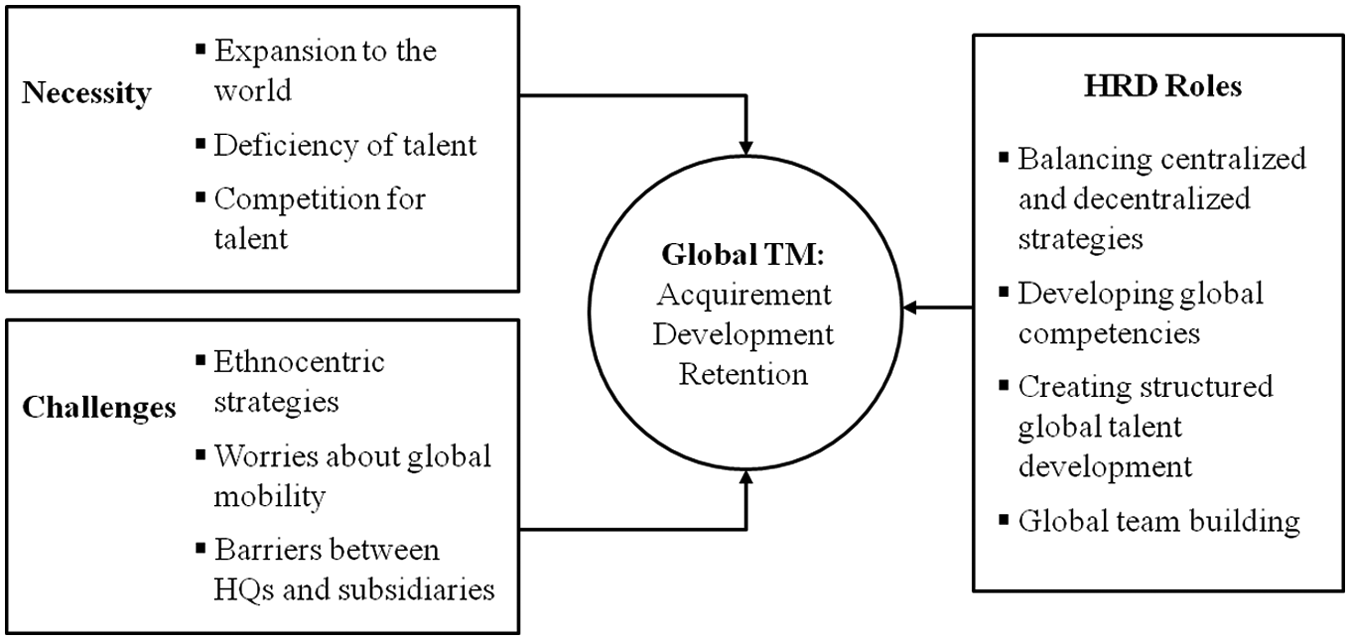
Conceptual framework of the necessity, challenge, and HRD roles for global talent management (TM)
Discussion
Despite the limited literature directly relevant to global TM, we found sufficient information to present the necessity, challenges, and HRD roles through reviewing literature related to HRD, HRM, and industrial psychology and synthesizing their contents. Our findings support our initial research assumption that TM is not a concept newly created but is reinterpreted HRM/HRD activities focusing on high potentials or high performers (Collings & Mellahi, 2009; Iles et al., 2010; McLean, 2010). Challenges and HRD practitioners’ roles regarding global TM may not be very different from those of general international HRD. However, we believe how to manage or develop global talent is critical for success in global business and HR scholars and practitioners should keep paying attention to matters of global talent.
What we discovered in this article makes several contributions to HRD. First, we disclose a topic that has not received much attention among HRD professionals but inevitably needs their involvement and interest. What HRD can consider and do for talent development in a global context was also identified. In addition, we provided strategic and systematic approaches to developing global talent for HRD professionals extending beyond relying solely on cross-cultural training, the most frequently occurring activity in both the field and academy.
This study has limitations. First, only studies written in English were reviewed because of our language and search limitations. Although it appears that the majority of research on global TM has been conducted in the United States, Europe, and countries using English, such as Australia and Singapore, there may be studies or cases in non–English-speaking countries. Second, focusing only on content related to global talent and global HRD limited viewpoints beyond HRD and HRM, although we agree that TM should not be confined to HR. As global talent is emphasized in global business, identifying, developing, deploying, and retaining talent are no longer only HR’s job but the responsibility of all management from line manager to top executive (McCauley & Wakefield, 2006; Odell & Spielman, 2009). Third, our research focus is limited to for-profit organizations and do not include nonprofit global organizations. Thus, there may be difficulty in applying our findings to different types of global organizations.
Recommendations for HRD Researchers
There are four recommendations we suggest for HRD researchers.
First, HRD researchers need to pay more attention to global TM. Although the number of articles on TM have rapidly increased since the concept of TM was introduced (Iles et al., 2010), more theoretical and practical studies are necessary for establishing TM as a solid academic area within HRD. How to manage global talent has been one of the hot issues among organizations involved in international business or interested in global human resources. However, academic development of TM is still so minimal that what scholars have accomplished for TM does not meet the field’s needs. This leads many organizations to rely mainly on business consultants who may use tools or models not theoretically grounded. For the academic development of global TM, more cases need to be investigated and, based on those case studies, more empirical studies should be conducted. And then, HRD researchers can perform theory-building studies on global TM and examine those theories.
Second, HRD researchers need to be careful when they prescribe roles for HRD in TM. In an actual business situation, dividing HRD from HRM is likely to be meaningless because both have the same goal, contributing to organizational performance and have many overlapping tasks under the same umbrella, HR. Thus, it is hard to say that HRD oversees only training functions in TM or that identifying and deploying talent are only HRM’s functions. Rather, to supply the talent the organization needs, HRD must be involved in all processes of TM. For example, when individuals with high potentials need to be developed as leaders, HRD can draw a career map, identify necessary competencies, provide interventions, and evaluate not only TM activities but also the talent themselves.
Third, TM in nonprofit organizations should also be explored. Most studies on global TM are focused on corporations, not other types of organizations, such as nongovernmental organizations. Because these organizations have different purposes, structures, and activities, they may need a different definition of talent and a unique process for managing talent.
Fourth, HRD researchers can broaden their perspective on TM to the national level. Most studies on TM in HR deal with the corporate level. Like the discipline of HRD involving community and nation, however, TM at the national level should also be explored by HRD scholars, recognizing a country as an organization. Therefore, a national policy on acquiring, developing, retaining, and utilizing talent, talent flow in a country, and national brain drain versus gain can be exemplary subjects for further studies on national TM. We expect that these studies will show reasons why phenomena that corporations cannot control occur, such as a deficiency of talent or incompetent employees, and provide appropriate directions for fundamental remedies.
Recommendations for HRD Practitioners
Global TM can be a new term and area among HRD practitioners, especially those involved in a global organization. A great deal of attention is necessary when HRD practitioners deal with global TM because efforts for managing talent are likely to fail without consideration of the necessities and possible challenges mentioned earlier. We recommend the following for HRD practitioners who are preparing to manage global talent.
First, the meaning of talent should be defined, taking into account the organization’s business contexts and strategies. Even though organizations do business globally in the same industry, they may have different types of business operations, such as company-owned, joint venture, and outsourced, and the TM approach should be adapted to the business type (Gandossy & Kao, 2004). Misunderstandings can occur when leaders are seen as equal to talent or leadership development is considered the same as talent development. However, a leader can be talent depending on whether the position is critical for the organization’s profit and sustainable development.
Second, TM is a long-term approach. If HRD practitioners expect immediate effects from global TM, the results may be disappointing. Hasty changes in the management plan and system because of expectations for short-term results can cause not only a waste of time and money but also a loss of trust in HR by the organization. Thus, HRD practitioners may need to be cautious with TM, making sure every step of TM works properly and persuade clients who desire instant outcomes of their investment on TM if necessary.
Third, successful global TM needs fairness in the whole process. Once employees question the criteria for selection of talent, the appropriateness of development opportunities, and the timing of deployment or promotion, complaints about the TM system will arise and cause the organization to suspect its effectiveness. Constant communications and clear statements on the policies and processes will help minimize employees’ confusion or misunderstanding about the organizational approach to TM.
Fourth, HRD practitioners should be aware that the process of TM can result in unexpected problems in cultures different from the host culture. For example, while managing the talent pool, designating talent may cause an unpleasant relationship among colleagues in collectivistic cultures. Because people regard group harmony as most desirable in those cultures, both the selected individuals and their colleagues may feel uncomfortable with a public announcement about the results of the selection. Sometimes, employees in the culture refuse to be identified as a talent because of their relationship with their colleagues.
Fifth, best practices or illustrative case studies can be produced and shared in organizational and interorganizational levels in order to be used as a benchmark, develop more appropriate methods and processes related to TM, and enhance abilities of HRD practitioners. When these techniques are used, however, what is common and different from the applying organization should be taken into account.
Footnotes
Declaration of Conflicting Interests
The author(s) declared no potential conflicts of interest with respect to the research, authorship, and/or publication of this article.
Funding
The author(s) received no financial support for the research, authorship, and/or publication of this article.