



Abstract
The Problem
Human resource development (HRD) university programs, so named, have been found dominantly in the United States. However, university programs in HRD have emerged elsewhere, interestingly, more often in developing countries than in other developed countries. But, globally, we know virtually nothing about these programs, their histories, their curricula, their missions, and their research, as there is an almost complete gap in international literature.
The Solution
Two countries in ASEAN (Association of Southeast Asian Nations), Thailand and Malaysia, were selected as case studies for HRD education in developing countries or upper-middle income countries as defined by the World Bank; they are also the most active in the Academy of HRD (AHRD) in Asia as they have hosted the Asian AHRD conference twice within a decade. Because of the paucity of literature on this topic, we accessed related websites to determine details about the HRD programs, supplemented by our own information related to these two countries based on our knowledge of HRD education in these two countries. The study showed that HRD education in these two countries is at the stage of established, based on the taxonomy developed within the article. More than one university in each country is offering HRD majors in undergraduate, master’s, and doctoral levels.
The Stakeholders
The information in this article should be of interest to anyone interested in international or global HRD, potential students who wish to study HRD in these countries, officers and members of the AHRD, members of the Program Excellence Network (PEN) of AHRD, and anyone generally interested in HRD in higher education.
Following the rapid growth of human resource development (HRD) programs in universities in the United States in the early 1980s, followed by the growth of such programs (though embedded in human resource management [HRM] programs) in the United Kingdom, we began to see the emergence of such programs in developing countries, both as stand-alone programs and as courses offered in other majors. In the late 1980s and early 1990s, HRD programs began to emerge, for example, in Thailand (the National Institute of Development Administration [NIDA]), Korea (Seoul National University), Kenya (Kenyatta University and Moi University), Malaysia (Universiti Putra Malaysia [UPM], Universiti Teknologi Malaysia [UTM], and Universiti Malaysia Sarawak [Unimas]), and others. Some literature exists about this growth in Korea (Kuchinke, Fu, & Oh, 2006; Lim, Song, Choi, & Kim, 2013). Ismail and Osman-Gani (2011) wrote a book on HRD in Malaysia, including a section on HRD education. But other references that we could find in mainstream English language literature about such programs in any other developing countries were sparse. We were not able to find any literature on teaching and learning in HRD university programs in these countries, except in Korea, and this country was eliminated from our article because it is being addressed in another article in this issue. Yet, based on personal connections, we knew that such programs exist as stand-alone programs in China and South Africa, whereas courses in HRD exist embedded in HRM and other programs in Taiwan, Brazil, Sri Lanka, and India, while other programs exist in the Middle East–North Africa region (MENA).
It is this ignorance that makes this article so important to HRD. Given the globalization of the business community, a cliché in today’s world, it is essential to understand how academic programs in HRD are evolving. McLean, at the time of writing, was teaching HRD and HRM courses at the International Islamic University of Malaysia (IIUM), a university with students from 104 nations! The charge to focus on HRD education globally was clearly made by Ardichvili (2012) and much earlier by Kuchinke (2001). Not only will this be a useful addition to HRD’s knowledge base, but this article will also be very useful for potential students throughout the developing world who are interested in acquiring degree credentials, thus meeting both academic and practitioner needs.
Studying HRD education in developing countries, especially in ASEAN (Association of Southeast Asian Nations), demonstrates the importance of HRD knowledge before these countries become a single market in 2015 through ASEAN Economic Community (AEC). The AEC is one of the three pillars to achieve a cohesive ASEAN community. The other two are political/security and social/cultural pillars. Under the AEC, there will be limited free flow of goods, services, investment, capital, and skilled labor (ASEAN Secretariat, 2008). With limited pages available to us, we selected Thailand and Malaysia as case studies. These two countries are most active in the Academy of HRD (AHRD), and they have each hosted the AHRD conference in Asia twice since 2002. Furthermore, focusing on developing countries, and especially these two countries, makes sense as they tend to demonstrate higher economic growth rates but with a low Human Development Index (HDI) (United Nations, 2014).
Significance of the Problem
The information provided here will help developing countries that do not currently have HRD university programs, those developing countries in which additional programs are desired, and even developed countries with and without such programs. It will also help practitioners looking to enroll in academic programs in these countries.
Method
The authors are well connected throughout the world of HRD. Our approach was to write out of our firsthand experiences and to contact our networks to gather information from them regarding universities in their countries that have such programs. Based on this information, we also accessed related websites to determine details about the HRD programs identified from our networks and others located on the web. An attempt to make a personal contact with every program identified was also made to verify the web information and to get additional information. The first author teaches annually in HRD programs in Mexico and Thailand, and has taught in many other countries, whereas the second author was the dean and director of graduate studies in the School of HRD at NIDA in Thailand. We also did extensive literature searches using HRD education and HRD higher education, along with developing countries, Thailand, and Malaysia as our keywords. We used Google Scholar, ResearchGate, academia.edu, and the online searches available at the University of Minnesota and NIDA.
The countries included in this study were selected from the list of developing countries under the International Statistical Institute (ISI, 2014). In 2014, ISI reported that there were 139 developing countries. Ten countries were selected as having available information based on our contact persons and websites. Thailand and Malaysia were selected as extensive case studies based on three factors: (a) The authors have more experience in these two countries, (b) more than one HRD program is offered in several universities in these two countries, and (c) these countries have been the most active host countries for the AHRD conference in Asia (along with Korea and Taiwan, the later having only one standalone program) during the last decade. Thus, information about these two countries’ HRD programs came from contact persons in the countries and the authors themselves.
What Is a Developing Country?
Finding appropriate labels to describe the economic levels of development of countries has long been a dilemma. Recognizing that there is no perfect definition, the definition we used is that put forward by the U.S. Library of Congress (n.d.) in its “Collections Policies Statement” drawing from both the World Bank and the United Nations:
The majority of population makes far less income, and has significantly weaker social indicators, than the population in high-income countries . . . [and] lives on far less money—and often lacks basic public services—than the population in highly-industrialized countries. (para. 4)
Other terms used in the literature include less-developed or least developed countries.
Developing countries are defined according to their Gross National Income (GNI) per capita per year. Thailand and Malaysia are defined as upper middle income countries, having a GNI between $4,125 and$12,746 (World Bank, 2015). These two countries are more advanced and developed than those in the developing world but have not yet acquired the full signs of a developed country (Bozyk, 2006). Upper middle income countries is a category between developed and developing countries. There are six countries so considered: Brazil, China, Malaysia, Mexico, Thailand, and South Africa. It is much more likely to find HRD programs in these countries than in the lower level of developing countries. Therefore, the cases we chose are from those countries that are becoming developed countries.
A Priori Outcome Expectations
Before beginning our research, we laid out our expectations about what we anticipated finding as we began digging deeper into the way in which countries have approached education for HRD. We anticipated finding the following descriptors in a taxonomy (of our creation) of HRD education approaches in developing countries:
Established: More than one university is offering HRD majors, preferably at undergraduate, master’s, and doctoral levels.
Emerging: One university exists offering a degree with a major in HRD, not necessarily at all three levels.
Supplemental: No degrees exist in HRD, but courses in HRD are offered in other majors, most frequently business, management, or HRM.
Multinational corporations (MNCs) and consultant development: Formal academic courses in HRD do not exist; preparation of professionals for HRD is through MNCs or through workshops offered by consultants or consultant groups.
Development outside of country: As in the early days of HRD development around the world, there remain countries that get their HRD experts by sending students to countries in which HRD is well established.
Self-developed: In some countries, especially those low on the economic scale, development comes through self-directed study, attendance at professional conferences, participation in webinars, and other means that require a low level of infrastructure.
We recognize in this taxonomy that many labels referencing HRD might be used to reference similar concepts, such as training management, talent development, people development, and so on.
An Overall Perspective
Tables 1 and 2 contain the information that we were able to identify for a number of developing countries related to their HRD programs (less developed countries and, middle income countries, respectively). These data are not complete, by any means, either in the number of programs, nor even, necessarily, for each program. But it is a beginning. If you have corrections or additions, please communicate them to the lead author, who will commit to maintaining an ongoing database of such programs that can be shared with the profession in the future. This information did not come simply through web searches, although they were utilized. They are heavily supplemented by personal contact with someone in every country and every program that provided a contact name on the website.
Characteristics of HRD Programs in Selected Developing Countries.

Note. HRD = human resource development; HRM = human resource management.
Characteristics of HRD Programs in Selected Upper Middle Income Countries.
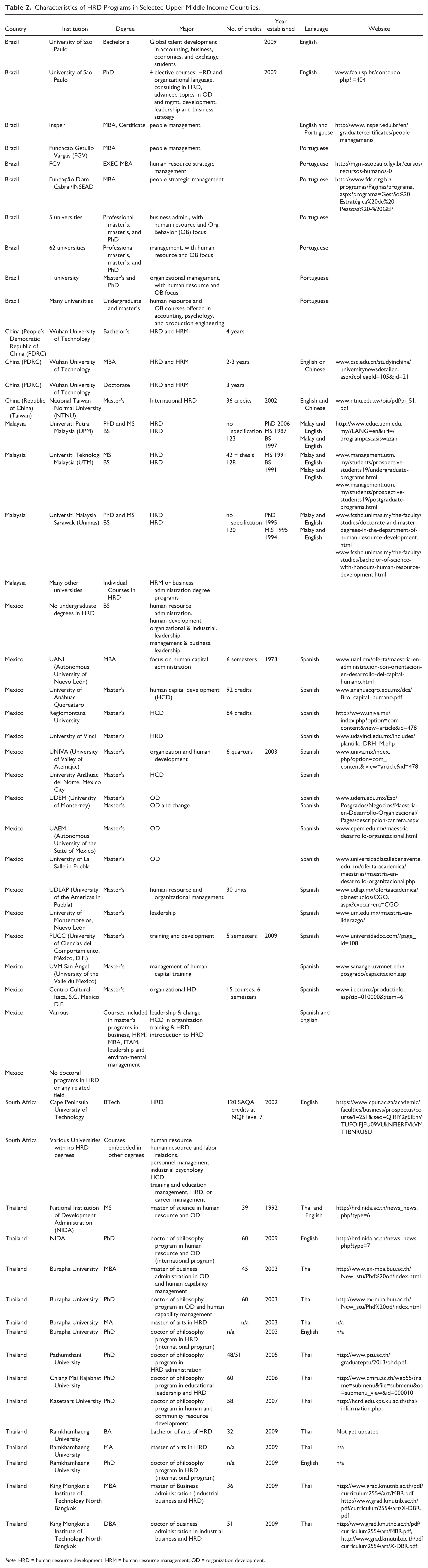
Note. HRD = human resource development; HRM = human resource management; OD = organization development.
Care needs to be exercised in working with the data in Tables 1 and 2 as they have not all been validated. We expect that there may be more HRD programs in some countries than evidenced by this table. Furthermore, many developing countries are not present in this table because no information could be found about that country, either from personal contact or from a web search. Because of this, great care needs to be taken in generalizing the results shown in Table 1. Nevertheless, there are some important findings to be considered about HRD education in developing countries.
First, there is no unitary approach that has been taken by developing countries in providing education in HRD. Second, while some developing countries have taken significant steps in establishing HRD as degree programs, others have relied heavily on HRM, or some other field, to provide the education that occurs in HRD. Third, some of the major countries, like Brazil and China, appear not to have adopted HRD education widely, especially in an academic stand-alone context. Fourth, as anticipated from the variety of definitions that exist for HRD, we also found a variety of labels for what we would call HRD (e.g., “Human Capital Development” or “Human Development”) or some aspect of what we would incorporate into the broader definition of HRD (e.g., training, organization development [OD], or even career development). Fifth, there appears to be not much deviation in curriculum from what would be found in either U.S. or U.K. degree programs.
Indeed, this exercise lends weight to the a priori expectation of the six descriptors in the taxonomy for HRD education in developing countries. Each of the six descriptors can be found somewhere in Tables 1 and 2 representing an approach that a country is taking in providing HRD education. The validation of the taxonomy is one of the major findings of this study.
Thailand: A Case Study
This case study focuses on how HRD is defined in Thailand, the history of HRD education in Thailand, and HRD research and journals published within the HRD programs in Thailand, with a summary of HRD education in Thailand to complete this extended case study.
HRD Definition
Since 1992, with the launching of the 7th National Economic and Social Development Plan (1992-1996; Office of the National Economic and Social Development Board [NESDB], 1992), most Thai scholars have been using Nadler’s (1970) HRD definition. Nadler, a professor at George Washington University, visited Thailand during the launching of the plan. He defined HRD as having three components: training, education, and development (Nadler, 1970). The second widely used HRD definition among Thai scholars has been McLagan and Suhadolnik’s (1989) definition, “HRD as the integrated use of training and development, organization development and career development” (p. 62). Most HR practitioners and scholars have translated and used these two definitions as their own definitions.
Chartchai NaChiangmai (1998), the founder of the first HRD program in Thailand, at NIDA, defined HRD in Thailand as “an interactive process of enhancing and facilitating the development of capabilities and potentials of individuals, organizations, and communities, through organizational development, and community development, to attain effectively, efficiently and harmoniously personal and organizational goals, as well as communal goals” (cited in McLean & McLean, 2001, p. 318). This definition influenced the first HRD curriculum in Thailand and also influenced McLean and McLean’s (2001) global definition of HRD.
HRD Programs
From 1992 to 2014, seven academic institutions in Thailand began to offer HRD programs: one bachelor’s degree, six master’s degrees, and eight doctoral degrees. The first program was developed in 1992 at NIDA, and then 10 years later, the second degree was developed in 2003 at Burapha University. Most of the HRD programs have emerged in the last 10 years.
In 1992, the master’s program in HRD at NIDA was established as the first HRD program in Thailand. It was initiated under the 7th National Plan in 1992. It has offered a master of science curriculum with a concentration in HRD continuously since then. The program covers HRD with both macro and micro perspectives, including individual, organizational, community, and national levels. The program director at that time, Chartchai NaChiangmai, met with Nadler to develop the curriculum to respond to existing economic and social needs.
The first HRD program was reviewed and revised in 2000 by faculty members who had just graduated with doctorate degrees in HRD from the United States and United Kingdom. They interviewed several program stakeholders from public and private sectors and conducted focus groups with alums and other faculty in NIDA. OD first emerged in the program title as “Master of Science in Human Resource and Organization Development.” OD presented a new perspective for HRD professionals in creating change at all levels.
In 2004, the graduate program of HRD acquired the Master of Science in Management Technology from the NIDA Training Center and became the first School of HRD in Thailand and, perhaps, in the world. All of NIDA’s master’s programs are offered in Thai only, except for its International HRD program, offered in English, while its PhD is offered in English only.
Five years after the emergence of the School of HRD at NIDA, the second School of HRD was initiated at Ramkhamhaeng University (Open University) in 2009. It offers a BA, an MA, and a PhD, all in HRD. All of its degrees are offered in Thai only. PhD programs in HRD have been heavily influenced by international input. Two PhD programs exist that are taught in English only: Burapha University and NIDA. The PhD program at Burapha University was established in 2003; the Thai faculty were assisted by international faculty: Gary N. McLean, United States; Ian Smith, Australia; and John Wilson, United Kingdom. The program at NIDA was established in 2009 and is now serving the fifth cohort of international students. It is one of two programs in HRD (the other being the international HROD master’s program) that are offered in English; both programs benefitted from collaboration with an HRD professor from the United States, the University of Minnesota’s McLean, who has been teaching at NIDA since the beginning of the programs. International faculty typically co-teach doctoral courses with Thai faculty.
The other PhD program that has been heavily influenced from the United States is that at Ramkhamhaeng Open University. Michael Marquardt from George Washington University was invited as a guest lecturer for its PhD program from its beginning in 2009. To date, more than 70 PhD students have graduated from this program. Interestingly, this university is the only one in Thailand to offer a bachelor’s degree in HRD. It accepts about 100 students for its bachelor’s degree per year studying on and off campus and about 130 students for its master’s degree in both regular and executive programs. This university has produced the most significant numbers of HRD graduates. For NIDA, about 120 to 150 master’s degree students have graduated each year since 2003 after it opened executive programs. Before then (1995-2002), about 40 to 50 students graduated each year. As an example of demand, though more research is needed here, NIDA typically gets 230 applicants for its 120 positions in the Executive HRD program each year. Since 2010, NIDA has offered an International HROD at the doctoral level. Due to the Higher Education Commission’s (HEC) regulation, it is limited in the number of students admitted each year due to the number of faculty members available to supervise dissertations. So far, there have been 12 to 15 students enrolled for each annual intake batch.
Several labels or titles are used for HRD programs in Thailand. Some represent the scope of study: organization or community. Some present different concentrations: leadership, administration, or industrial business. Geographically, five of the seven universities offering HRD programs are located in Bangkok, the major metropolitan area of Thailand. Burapha University is located on the eastern side of Thailand where there are several industrial locations. There are four HRD programs in this university: two programs in the Graduate School of Commerce and two in the School of Education. The MBA and PhD programs in OD and human capability management were developed in collaboration with the Federation of Thailand Industries (FTI) in the beginning, to develop HR practitioners from the companies around the industrial areas. The master’s and PhD degrees in HRD in the School of Education are focused more on research than practice.
Chiang Mai Rajabhat University is located in the center of Northern Thailand. It was transformed from a teaching university to an institution of higher education for local development. Its main responsibility is to provide not only higher education, but also research services to society. In 2006, the university opened the PhD in educational leadership and HRD. Thus, the program continues to serve the former group of students: teachers and principals.
In addition, HRD subjects are offered in more than 30 HR programs in Thailand under the degrees of HRM, community and social development, public administration, business administration, industrial psychology, and so on. Most of the HRD courses offered can be included in master’s and doctoral degree programs.
Most HRD master’s and doctoral students in Thailand are part-time students. Most work full-time and study over the weekends. Thus, it takes about 2.5 years to graduate with a master’s degree and about 5 years to graduate with a doctoral degree. Two years of working experience are required for executive programs, while regular program students may not have any work experience.
Besides HRD programs, most Thai academics recognize the Human Resource Institute (HRI) as the first HRD institution in Thailand, founded in 1981 at Thammasat University as an office of HRD focusing on research and the provision of academic services, as well as serving as an information base for studies in national human resource issues. Currently, HRI offers many human resource related courses at both the bachelor’s and master’s levels in the Faculty of Law, which provides instruction in labor law and labor relations law; the Faculty of Commerce and Accountancy, which offers courses in labor relations; the Faculty of Political Science, which has a course in labor management; the Faculty of Economics, which has courses in fundamental human resources, labor economics, and health economics; and the Faculty of Social Administration, which has courses in labor law analysis, labor and welfare problems, security of society, a seminar in labor problems, labor welfare, and social administration in industry. It was decided that all of these subjects, taught by different faculties, should be brought together as allied disciplines with a wider scope to enable research into various human resource problems. Thus, HRI was born (HRI, Tammasat University, 2014). In 2010, Khon Kaen University, the public university in the northeast of Thailand, set up the Institute for HRD (IHRD), which has a similar mission to HRI (Institute for HRD, Khon Kaen University, 2014).
HRD Research
Since 2007, the Office of the HEC has required students in doctoral degree programs to publish their papers in refereed journals listed in ISI (Institute of Science Information). Also, master’s degree students who select Plan A (thesis paper) are required to present or publish their papers in conference proceedings or journals. Due to this requirement, in 2008, there was collaboration among seven universities to conduct the first National Conference in HR to provide an outlet for student papers: Graduate School of HRD, NIDA; Faculty of Commerce and Accountancy, Chulalongkorn University; Faculty of Commerce and Accountancy, Thammasat University; Faculty of Social Science, Kasetsart University; International Graduate Program, Burapha University; Sriprathum University; College of Management, Mahidol University; and HRI, Thammasat University. The hosting of this conference has rotated. Three years later, Personnel Management Association of Thailand (PMAT), the HR professional organization, evolved to include this annual conference within its conference and expanded the scope from the national to international level. This annual conference has become a place for research and knowledge sharing among Thai students. In addition, NIDA has twice hosted the Asian Chapter of AHRD’s annual conference.
The other place for research and knowledge sharing among HRD academics and professionals is HRD journals. The first HRD journal in Thailand was published by the Ministry of Public Health in 1997. However, there is no information about this journal after 2001. The second journal was the Human Resource Development Journal, published by Ramkhamhaeng Open University in 2005. In 2008, NIDA launched its HRD journal, NIDA HROD Journal, accepting articles in Thai and English, followed in 2009 by the HRD Journal published by the International Studies HRD Center, Faculty of Education, Burapha University, accpting only English articles. There are three other journals that accept papers related to HR. PMAT, the HR professional organization in Thailand, has targeted HR practitioners as readers. It calls for scholarly peer-reviewed papers in the form of empirical studies, qualitative inquiries, case studies, and critical literature reviews. Thammasat University has an HR journal, Thai HR Research Journal, renamed in 2011 to HRi: Journal of HR Intelligence, accepting both Thai and English articles. See details for all of the identified HR and HRD journals currently published in Thailand in Table 3. Of course, students and faculty are all encouraged to submit their articles to international journals.
List of HRD and HR Journals in Thailand.

Note. HRD = human resource development; PMAT = Personnel Management Association of Thailand; NIDA = National Institute of Development Administration.
Summary
HRD education in Thailand has traveled a long journey over the past 20 plus years. It has grown in terms of academic programs and research to the point where we conclude that it has reached the established stage in our taxonomy. Even though the roots of HRD knowledge have come from the United States, the trunk and limbs are being nurtured and are growing within the Thai culture. The roots and the rest of the tree are being integrated within Thai contexts. Academics are working closely with practitioners, such as FTI and PMAT. They have their own annual national and international conference and journals for HRD knowledge sharing. The challenge in 2015 for HRD education in Thailand, as with other academic fields and the economy and social environment, is coming from the emergence of the ASEAN community, which will bring greater labor and education mobility. This will require expanded knowledge, indigenous theories and principles, and greater understanding among the countries in ASEAN.
Malaysia: A Case Study
Based on Ismail and Osman-Gani (2011) and Osman-Gani (personal communication, April 14, 2014), the Malaysian government has been emphasizing HRD as a national priority. The Ministry of HR and the Ministry of Education have established various programs focusing on education and skills development. The National HRD Fund (HRDF or PSMB in Malay) supports private sector training programs in various ways. For higher education, Malaysian citizens are offered significant financial support (e.g., subsidies and loans) to study in local and overseas universities, including “My brain program,” “My Master’s,” “My PhD,” and so on. Almost all public and private universities have an HR or HRM program, while only a few universities have HRD degree programs.
From the above observation, this case study will present the definition of HRD in Malaysia, the three HRD programs that play the major role in the HRD field in Malaysia, HRD research under these HRD programs, and a summary.
HRD Definition
In 2011, Ismail and Osman-Gani published their book, Human Resource Development in Malaysia. HRD was defined as “a continuous process of education and new learning for unleashing and enhancing the potentials of human beings with the objective of improving performance for the benefit of individuals, organizations, communities and nations in all social and cultural contexts” (Ismail & Osman-Gani, 2011, p. 7). This definition represents its roots in the field of extension education, which aims to help individuals in the community to improve their performance using the philosophy and principles of adult education.
However, this HRD definition is similar to the definitions in the international literature. According to Nur Naha binti Abu Mansor (personal communication, April 15, 2014), HRD in Malaysia is basically similar to what is found internationally, except that “we are quite outdated in terms of terminologies being used . . . even people development is not fully utilized or known except in multinational companies.” She added that “the concept of learning and development also is not fully understood—it is a challenge.” Surprisingly, Malaysia does not have an HRD professional association. Furthermore, faculty are gnerally not encouraged to participate in HRD professional bodies. She observed that this lack of involvement with professional organizations, compared with other countries, leaves Malaysia behind, as there is no benchmarking with global professional bodies.
HRD Programs
We focus, in this study, on the three premier universities in Malaysia with HRD programs: UPM, UTM, and Unimas. These universities have been providing HRD programs for more than two decades. In addition to current HRD degree programs, IIUM is in the process of launching a master’s degree program in HRDM soon. It is expected that more institutions will follow in the near future.
UPM
The first HRD program established in Malaysia was UPM’s master’s degree, which began in 1987. It currently offers a degree at all three levels—bachelor’s, master’s, and doctorate—but it was the last of the three to offer a doctorate, putting it in place in 2006. It was also the last of the three to establish a bachelor’s degree, in 1997. What follows is drawn from responses to questions posed to Dr. Maimunah Ismail, UPM (personal communication, April 15, 2014).
According to Ismail and Osman Gani (2011), HRD academic programs in Malaysia emerged at the same time as HRD programs were emerging rapidly in the1980s in the developed countries. HRD at UPM developed in the field of extension education. UPM is a university that supports the growth of knowledge in agriculture; it is the only university in Malaysia offering extension education at both undergraduate and graduate levels. In 1981, HRD was offered as a specialization within Extension Education at both the master’s and PhD levels, along with specializations in Adult Education and Training Administration. The first master of science (HRD) program started at UPM in 1987 in the Faculty of Extension Education. In 1997, a bachelor of science (HRD) degree was initiated in the Faculty of Educational Studies with emphases on adult education, training and development, OD, and management of human resources. The doctoral degree was initiated in the Faculty of Educational Studies in 2006.
There are mixed views as to how HRD is viewed by other faculties at UPM. Those in the technical sciences (e.g., engineering, medicine, forestry, pure and applied sciences, and so on) consider HRD as a field in the social sciences, all of which are viewed similarly. But within the major disciplines of the social sciences at UPM, HRD is highly regarded, especially as HRD is in the Faculty of Educational Studies, and this location is seen as appropriate. History led to the emergence of HRD and HRM in two different faculty, with HRM in the Faculty of Economics and Administration. However, coordination ensures that there are no overlapping courses between the two programs.
UTM
UTM has the distinction of having offered the first undergraduate degree in HRD in Malaysia, in 1991. In the same year, it began offering a master’s in HRD. It is the only school of the three not to offer a PhD in HRD. What follows for UTM is based on information provided in response to questions provided to Dr. Nur Naha binti Abu Mansor (personal communication, April 15, 2014).
As UTM is an engineering university, the humanities and societies faculties initially play a lesser role across the university. Thus, humanities service other majors through offering elective courses, such as business ethics, Malaysian studies, professional ethics, and so on. However, within the last 20-plus years, this has changed with the development of HRD bachelor’s and master’s programs positioned within the humanities and societies faculties. As a result of this connection, most faculty members involved in HRD come from these faculties. Science and technology faculties continue to dominate the university. HRD is viewed as a place to get an easy grade, according to Dr. Nur Naha binti Abu Mansor. There are two types of MSc HRD programs in UTM: (a) mixed mode, requiring 42 credits and a thesis, and (b) full research, requiring an extended thesis.
Placement of graduates is spread across multiple stakeholders: industries and government agencies, mostly in training centers, if possible. But it all depends. Students get to choose where they want to work, but it depends on whether industries offer placements. There is high demand for students, though there is a lot of placement development yet to be done. Within the diverse set of industries, many offer continuous studies for their employees, and the university provides master’s sponsorships for students who do well. Undergraduate students are exposed during their studies to the potential of continuing studies.
The university is currently reducing enrollment numbers due to the University’s move to transform itself into a full research university. There are currently about 60 master’s and about 250 undergraduate students enrolled. Although the program has received Malaysia Qualification Accreditation, there are still some objectives that the faculty are hoping to accomplish. First, getting professional accreditation across HRD programs is seen as desirable, though there is some internal resistance to investing the time and work necessary to get this done. Second, there is a desire for more collaboration with practitioners in corporate industries in helping with class presentations. Industry expatriates could also help expose students to international HRD.
Unimas
Unimas offers a major in HRD at all three levels, holding the distinction of offering the first HRD PhD, in 1995. It is obvious that a lot of curriculum development was going on in Unimas as the master’s degree was inaugurated the same year, just one year after inaugurating the undergraduate degree in HRD. Initially, both graduate programs were offered as research degrees only. Dr. Rusli Ahmad (personal communication, April 15, 2014) provided the following information in response to questions sent by us.
A market survey in Sarawak showed that there was a need for such HRD degree programs. Benchmarking was conducted with universities in Malaysia and overseas that offered such programs. In addition, an expert panel from the university and industry was consulted. A degree program was developed at all three levels, based on the following: First, a need for HRD academic programs was identified. Second, industry had needs, and therefore demand, for employees and officers in HRD. Needs also existed at the state and national government levels. Third, students from Sarawak wanted to further their study in Sarawak and not in other states in Malaysia or internationally. Parents and society also supported such a decision. The demand for such programs is supported by the fact that enrollment has grown continuously since inauguration, with over 500 undergraduate students in 2014.
Since then, demand for HRD graduates has been great. More than 80% of graduates from the undergraduate program have been employed, while 100% of students graduating with a graduate degree have been employed. Undergraduates work in organizations as HR executives, HR officers, trainers, teachers, in the government in various job posts, and in various HR positions in industry. Graduate students serve as government officers, lecturers in higher education, and HR consultants.
HRD at Unimas follows international standards, including training and development, OD, and career development. However, it adds a fourth area, human resource practices (HRP). This includes all other HRM functions, considering that HRD incorporates any area that contributes to the development aspect of workers.
The university community generally recognizes that HRD plays an important role in managing human resources effectively in any organization. HRD is also recognized as a rapidly growing program, contributing the largest number of students in the Faculty of Cognitive Science and Human Development. HRD students are also good students, and their placement rates are excellent. HRD graduates at all levels are recognized for their contributions to the State of Sarawak, especially to the Sarawak Corridor of Renewable Energy, as HR officers and social science architects and generally contribute to the achievement of Malaysia’s Vision 2020 in which the Government plans to have reached fully developed country status.
HRD Research
In this section, we explore the research focus within each of the three premier institutions and investigate the development of research journals published within Malaysia.
UPM
The main factor contributing to the success of UPM’s faculty in receiving research awards has been the strong emphasis on academic writing among graduate students. This emphasis reflects the requirement for study completion of graduate students. In 2006, UPM obtained Research University status. Since then, all master’s and doctoral candidates have been required to publish paper/s based on their research as one of the criteria for graduation.
The faculty have also organized several avenues, such as seminars for faculty and students, to provide opportunities for students to present papers. Students are encouraged to work with their supervisors to produce papers. Subsequently, students are groomed to write scientific papers to publish in proceedings, book chapters, and journals. Supervisors play an important role in ensuring and guiding students in producing quality research and papers.
In addition, the university has organized many workshops and seminars related to research and publication, including SEM-AMOS (Structural Equation Modeling using AMOS software), quantitative and qualitative research, publishing during studies, publishing in impact factor journals, Mendeley, Refworks, and so on, all generally well attended.
Finally, the program possesses quite a number of senior staff or professors who appreciate excellent research in HRD by contributing to and participating in international conferences organized by AHRD, including the Asia Chapter of AHRD and the University Forum for HRD (UFHRD) conferences. UPM has also hosted the 5th and 10th AHRD conferences, in 2006 and 2011. This engagement enabled the university to establish professional networking with scholars from the United States, Europe, and Asia.
UTM
Faculty members have the tripartite mission of teaching and learning, research, and service, especially in the community. As with faculty in other research universities, this tripartite mission for all faculty members is quite challenging as academics have multiple roles with very stringent key performance indicators in each area. In addition, faculty are increasingly being expected to work across multidisciplinary areas.
Unimas
The faculty in the HRD programs generally come from the cognitive sciences and human development. This comes from the idea that the human brain or cognitive activities are the pillars of any activity performed by individuals (e.g., workers). The faculty have been very successful in winning awards for research at AHRD and other conferences for the following possible reasons. First, HRD is important within the context of Sarawak. Second, faculty really want to show their research competence and skills. Third, the faculty have been trained by expert scholars from national and international higher education institutions.
Research Journals Published in Malaysia
Zainab, Sannil, Edzan, and Koh (2012) identified 464 journals with at least a 5-year publishing history published in Malaysia, more than half of which are or were published by universities and colleges. The Malaysian Citation Centre has also been established recently at the University of Malaya to create an indexing system based on Malaysian publications and research. Of these, 51 are indexed in ISI or Scopus, most in the fields of science and medicine. No journals were identified in Human Resources or HRD, though there are journals in education, humanities and social sciences, and management that would be possible outlets for research in Malaysian HRD.
Summary
We conclude that Malaysia is also at the established stage of the taxonomy that we developed. In addition to the three premier universities that have well-established HRD programs across all three levels, many other universities offer HRD courses embedded in HRM or other degrees, and other universities are posed to launch HRD degree programs. Enrollments are large, and the Malaysian HRD faculty are making a significant contribution to research, service, and teaching at both the domestic and international levels.
Implications for Research
This attempt to identify HRD education approaches in developing countries has highlighted the lack of information that exists within the field, even after surveying leading academicians in some of the developing countries. This effort must continue so we can develop more accurate and complete information about the programs that exist, both in the countries included in this article and in the many countries not included. Case study articles, focusing on single or similar countries, such as those done earlier by Kuchinke (2001) and Kuchinke et al. (2006), are needed.
AHRD makes available an annual directory of HRD programs in the United States (Roberts, 2013). This is a wonderful resource of HRD programs with their affiliated degrees, as well as HRD-related programs and a list of HRD faculty. It would be wonderful if AHRD, in cooperation with a university in each of the regions of the world, would compile a similar directory. Not only would this cover developing countries, but it would also provide in-depth knowledge of all HRD programs. Such a directory would not only be helpful to students aspiring to major in HRD, but it could also assist in collaboration in research and in putting developing programs together with mature programs, as mentors, to assure the development of high-quality programs.
It would also be helpful to do follow-up studies associated with each of the university programs, not only to find out where students go for employment or further education, but also to determine whether there are discernible differences among curricula in preparing people for careers in HRD. Having numbers of applicants compared with those accepted into programs would also indicate the level of demand that exists for each program.
Reviewers also encouraged us to include a section on teaching and learning in our article. This has not been included, primarily because we were unable to identify information in the literature that provided this kind of information in developing countries, other than for Korea, which is being included in a separate article. Answering this question requires empirical data, which is beyond the scope of this journal. However, it is clear that identifying how HRD students at all three levels are taught and how they learn would add significantly to our knowledge about HRD education in developing countries.
It would also be useful to validate the taxonomy that was offered in this article by classifying every developing country according to the taxonomy to see if it is applicable across the broad scope of how HRD is developed in each country.
Implications for Practice
This article is only the beginning of what could be written on this topic; when the recommendations for further research are carried out, much more information will be available. However, once that is accomplished, most of the implications are for practice. First, students seeking a degree in HRD will have access to a greater database of information about where HRD programs exist, including whether those programs are offered in English or in a native language. Second, it can be of great use to universities aspiring to create or improve HRD programs, first, in providing models of what an HRD degree program might look like and, second, in getting assistance from established university programs.
Conclusion
Those in the HRD profession live in an exciting time. HRD programs are springing up everywhere, even in developing countries where resources may be constrained. This is, in part, at least, a recognition that the future of every country lies in its human resources. Without a formal HRD university program or programs, countries are going to have difficulty in establishing strong National HRD programs and providing their industries with well-qualified human resources. A continuation of this project will be important for the ongoing global development of HRD.
Footnotes
Declaration of Conflicting Interests
The authors declared no potential conflicts of interest with respect to the research, authorship, and/or publication of this article.
Funding
The authors received no financial support for the research, authorship, and/or publication of this article.