




Abstract
The Problem
In the 21st century, globalization is key. Therefore, assessing and developing global leadership competencies is an important topic in human resource development (HRD). Global leadership competencies encompass personality traits, knowledge, and skills, as well as behaviors. While there has been a plethora of scholar-practitioner literature identifying global leadership competencies, there has been far less focus on assessing global leadership competencies and how these competencies are developed.
The Solution
We attempt to address this gap by examining the state-of-the-art literature on global leadership assessment and development from several disciplines, including HRD, management, and leadership. With regard to global leadership competency assessment, our goal is to synthesize the literature and provide HRD professionals with a systematic method for identifying instruments that measure core global competencies. With regard to global leadership development, our aim is to provide a framework for understanding how global leadership competencies can be developed.
The Stakeholders
The identification and categorization of various instruments that measure global competencies, as well as a framework that outlines methods to develop these competencies, will benefit human resource (HR) professionals and HRD practitioners.
The need for global leadership is widely recognized as trade barriers have been liberalized, as borders to countries have dissolved, and as technological changes have swept in (Beechler & Javidan, 2007; Canals, 2014). An IBM (2010) study of more than 700 global chief human resource (HR) officers revealed that “developing future leaders” was the most important business skill needed to achieve business objectives (p. 18). These same HR executives suggested workforce gaps needed to be addressed to hire, develop, and retain “borderless leaders” who could function effectively in complex global environments and manage global business teams (p. 3). This leads us to two important questions: What are the tools to assess global talent, and what methods are currently being used to develop global leaders?
While scholar-practitioner literature has detailed comprehensive lists of cognitive skills and psychological traits (Terrell & Rosenbusch, 2013; Tubbs & Schulz, 2006) needed by leaders working in increasingly globalized environments, there has been less focus on assessing these global leadership competencies, how these competencies are learned, and the many ways organizations can provide employees the opportunity to acquire and develop these skills (Prewitt, Weil, & McClure, 2011). We focus on these emerging leadership development issues as they relate to global competency literature in the context of human resource development (HRD).
It has been more than a decade since Marquardt and Berger (2003) called on HRD to provide an in-depth examination of global leadership development at all levels of the organization. However, the reality is that programs intended toward developing global leaders and leadership are often perceived as “eclectic” (Oddou & Mendenhall, 2013, p. 230). There is also some confusion in the delineation of purpose and types of developmental activities of how global leaders learn and develop cognitive, attitudinal, and behavioral competency components (Edwards & Turnbull, 2013; Oddou & Mendenhall, 2013; Pless, Maak, & Stahl, 2011; Terrell & Rosenbusch, 2013). In addition to these aforementioned gaps in the literature, this article addresses the call by Kuchinke, Ardichvili, and Lokkesmoe (2014) to HRD scholars and practitioners to examine and investigate the methods for assessing and developing global competencies. We attempt to address this call by examining the state-of-the-art literature on global leadership assessment and development. With regard to global leadership competency assessment, our goal is to synthesize the literature and provide HRD professionals with a systematic method for identifying instruments that measure core global competencies. With regard to global leadership development, our aim is to provide a framework for understanding the literature regarding how global leadership competencies can be developed.
Method
Our method included examination of several disciplines, including HRD, management, and leadership. Articles were identified through database searches on Business Premier and the Education Resource Information Center (ERIC)-EBSCO, and Google Scholar, as well as within five HRD journals (Advances in Human Resource Development, Human Resource Development International, Human Resource Development Quarterly, Human Resource Development Review, and International Journal of Human Resource Management). The primary keyword search terms included global leadership competencies, cultural intelligence development, global leadership development, and global leader development. In total, we identified and reviewed 98 articles or book chapters on global competency assessment and development. Our search focused on literature from the last 15 years, with an eye to discerning how scholars have addressed the identification, assessment, and development of attitudinal, cognitive, and behavioral global leadership competencies.
Identification and Assessment of Global Leadership Competencies
Given global expansion, technological advances, and the changing nature of work today, many leaders must assume global leadership responsibilities even when operating exclusively within their country of origin. As Canals (2014) suggests, truly global leaders (i.e., those who lead organizations that operate in more than one country) share much in common with domestic leaders. However, global leaders must also operate in different sociocultural and political value systems that create a far more complex, diverse, and uncertain business environment. Recognizing the additional business imperatives and the unique knowledge, skills, and competencies needed by global leaders, Caligiuri and Tarique (2009) broadly define global leaders as “high level professionals such as executives, vice presidents, directors, and managers who are in jobs with some global leadership activities” (p. 336).
The term “competency” has traditionally been used to describe specific knowledge, skills, and characteristics required to be effective on the job (Lucia & Lepsinger, 1999). The components of competencies have been linked to various terms, including characteristics, traits, aptitudes, skills, values, beliefs, abilities, attitudes, and behaviors. HRD professionals have come to rely on competency models for a wide range of practices, including recruitment and selection, training, and performance (Lucia & Lepsinger, 1999).
Organizing Framework
Competency models are commonplace in organizations that aim to prepare workers for future challenges (Kormanik, Lehner, & Winnick, 2009). We rely on Lucia and Lepsinger’s (1999) three-tiered pyramid model as an organizing framework to discuss the assessment and development of global leaders. Their model provides a specific delineation of the domain components of a competency and is focused on the employee level. The pyramid’s base includes personal characteristics such as personality traits, innate talents, or an aptitude suggesting a person has the potential to acquire a skill. The mid tier of the pyramid identifies skills and knowledge, which may be tangible or intangible. At the top of the pyramid are specific behaviors that can be observed and measured.
Due to the volume of competencies associated with global leadership, numerous scholars have created global leadership competency models, including Bird, Mendenhall, Stevens, and Oddou (2010); Jokinen (2005); and Tubbs and Schulz (2006). While these taxonomies help organize a multifaceted phenomenon, criticism has been leveled that global leadership competency models operate from a Western lens (Holt & Seki, 2012) and fail to prioritize what competencies are most relevant in different cultural, environmental, and job/industry contexts for enhancing leadership performance (Canals, 2014). In addition, there is an implicit assumption that either global leadership competencies are different than those for domestic leaders, or that there is a higher need for certain competencies when leaders operate in more challenging global environments (Jokinen, 2005; Steers, Sanchez-Runde, & Nardon, 2012).
Whether one believes global leadership competencies are above and beyond domestic leadership competencies, or global leadership requires an emphasis on certain skills, effective assessment practices can aid in the identification, selection, and development of global talent (Herd, Alagaraja, & Cumberland, 2016). Brownell (2006) argued that competency-based models, while not a panacea, provide HRD professionals with building blocks for identifying global leadership talent. Figure 1 outlines our global leadership development framework of the three competency arenas defined by Lucia and Lepsinger (1999), integrating common assessment tools that measure these competencies, along with four developmental training methods that address these different domains.
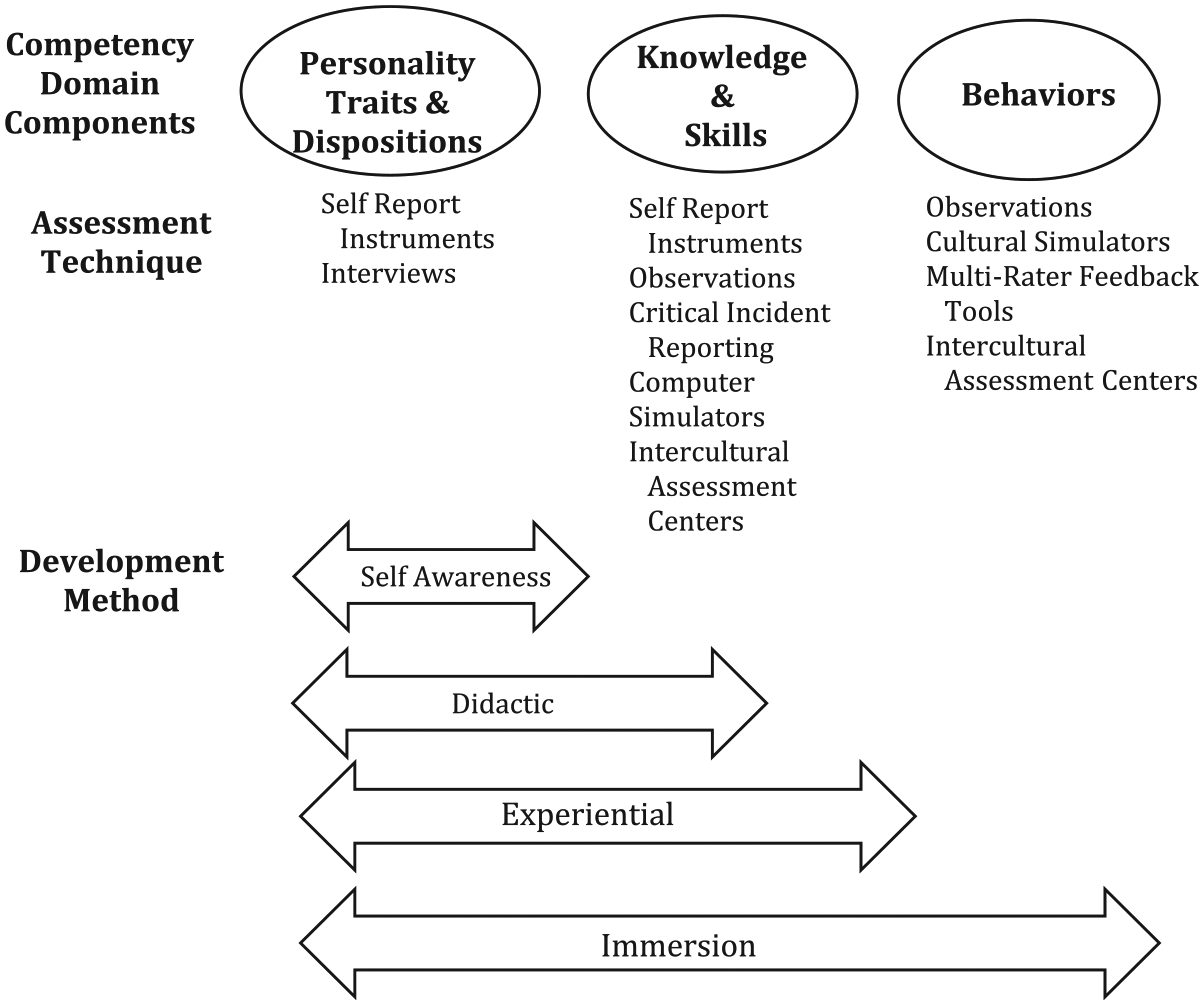
A global leadership development framework by competency domain components.
Personality and Dispositional Competencies
The first competency domain is personality traits, and the assessment of this domain often serves as the basis for global leadership selection and development programs (Caligiuri & Tarique, 2009; Stahl, 2001). A meta-analysis performed by Mol, Born, Willemsen, and Van der Molen (2005) found personality to be more predictive of global leader performance than domestic job performance. Based on our examination of the prominent literature reviews on global leadership competencies since 2005 (Bird et al., 2010; Jokinen, 2005; Mol et al., 2005; Osland, Bird, Mendenhall, & Osland, 2006), as well as empirical studies not included in the aforementioned reviews, we identify 17 personality characteristics consistently linked to effective global leadership. Table 1 lists these along with survey instruments used to measure these traits and dispositions. The psychometric properties of these global leadership instruments are reported in the works of Bücker and Poutsma (2010), Graf and Mertesacker (2009), and Bird and Stevens (2013). As noted by several researchers, the construct definitions for some of the traits and dispositions listed in Table 1 overlap (Bird & Stevens, 2013; Mol et al., 2005), and, for this reason, we listed some traits together after examining the definitions described by the authors (e.g., adaptability and flexibility).
Assessment Tools Measuring Global Personality Traits and Dispositions.
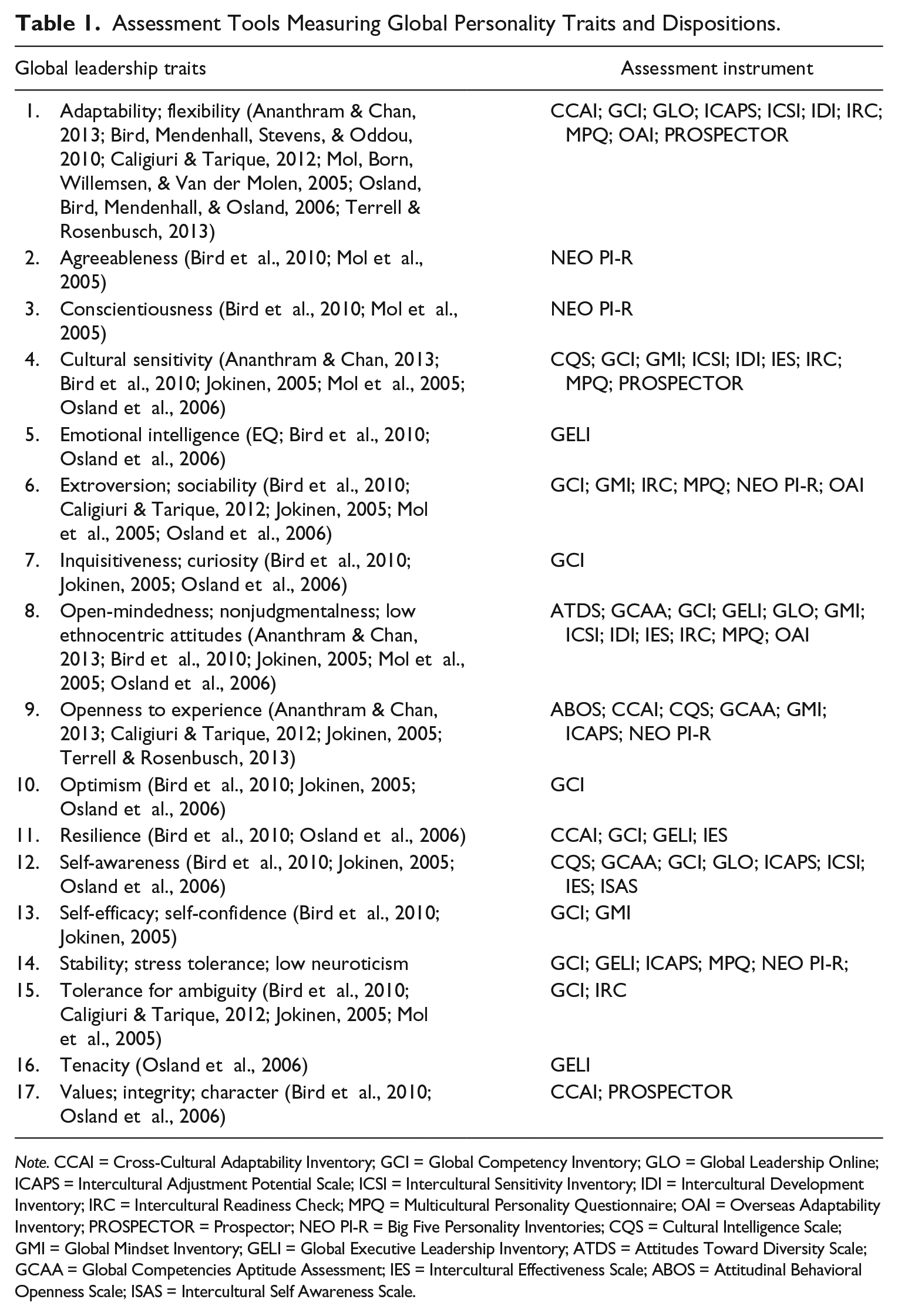
Note. CCAI = Cross-Cultural Adaptability Inventory; GCI = Global Competency Inventory; GLO = Global Leadership Online; ICAPS = Intercultural Adjustment Potential Scale; ICSI = Intercultural Sensitivity Inventory; IDI = Intercultural Development Inventory; IRC = Intercultural Readiness Check; MPQ = Multicultural Personality Questionnaire; OAI = Overseas Adaptability Inventory; PROSPECTOR = Prospector; NEO PI-R = Big Five Personality Inventories; CQS = Cultural Intelligence Scale; GMI = Global Mindset Inventory; GELI = Global Executive Leadership Inventory; ATDS = Attitudes Toward Diversity Scale; GCAA = Global Competencies Aptitude Assessment; IES = Intercultural Effectiveness Scale; ABOS = Attitudinal Behavioral Openness Scale; ISAS = Intercultural Self Awareness Scale.
Personality traits are innate (Smith & Victorson, 2012) and also shaped by culture (Tubbs & Schulz, 2006). Culture is defined as “shared motives, values, beliefs, identities, and interpretations of meanings of significant events that result from common experiences of members of collectives and are transmitted across generations” (House, Hanges, Javidan, Dorfman, & Gupta, 2004, p. 15). As culture directs not only what an individual learns but also how behavior will be interpreted (Hofstede, 1984), some scholars debate the merit of using personality characteristics for assessing global leaders (Steers et al., 2012). They maintain that different cultures value different characteristics and, therefore, assessment of leaders on the basis of their personality characteristics may be ineffective in global environments.
Kowske and Anthony (2007) studied personality based traits (e.g., adaptability, self-awareness, motivation) among mid-level managers across 12 countries using a multi-rater development tool. These scholars found that culture dictates which competencies are valued (Kowske & Anthony, 2007). Agrawal and Rook’s (2014) study using the Global Leadership Executive Inventory (GELI) had similar findings. These scholars examined 1,784 executives, representing 128 nationalities from the 10 national clusters identified by the Global Leadership and Organizational Behaviour Effectiveness (GLOBE) study (see House et al., 1999). The national clusters include Anglo, Confucian Asia, Eastern Europe, Germanic Europe, Latin America, Latin Europe, Middle East, Nordic Europe, Southern Asia, and sub-Saharan Africa. Of the 12 global leadership capabilities examined, all were evident in effective leaders across every culture. The degree to which these leaders exhibited these qualities, however, varied. From these findings, the researchers concluded that leaders must adapt their behavior as different cultures place different values on certain leadership styles. These findings suggest that it is important to consider what traits or characteristics should be developed and in what contexts.
The categorization of assessment instruments by trait provided in Table 1 allows HRD resource professionals to consider what traits will be more important in different situations and then easily identify the instruments that measure those traits. However, in addition to personality traits, it is imperative to ascertain what specific knowledge and skills are required in the effective performance of global leaders. In what follows, we address the knowledge & skills competency domain for global leadership and the various assessment tools.
Knowledge and Skill Competencies
Knowledge is the complex process of remembering, relating, or judging an idea or abstract phenomenon (Bloom, 1956). Skills, on the other hand, define an individual’s ability to execute specific tasks that can be learned over time (Caligiuri, 2006). We discuss two domains that focus on knowledge and skills as they relate to leading global enterprises: global mindset and cultural intelligence (CQ).
The first knowledge and skill domain associated with global leadership is the concept of a global mindset (Cohen, 2010). The idea of a global mindset has received much attention from scholars and practitioners over the last two decades. In their review of the literature on global mindset, Levy, Beechler, Taylor, and Boyacigiller (2007) defined this construct as “a highly complex cognitive structure characterized by an openness and articulation of multiple cultural and strategic realities on both global and local levels, and the cognitive ability to mediate and integrate across the multiplicity” (Levy et al., 2007, p. 244). Most scholars articulate global mindset as a multidimensional construct, and while all scholars do not agree on every aspect, the majority include knowledge and skills as components of a global mindset. For a comprehensive view of the multiple ways that global mindset has been defined, see Cumberland (2015).
The second broad domain associated with global leadership is CQ, a skill that enables individuals to use their abilities appropriately in cross-cultural situations (Brislin, Worthley, & MacNab, 2006; Earley & Ang, 2003). In their seminal book Cultural Intelligence: Individual Interactions Across Cultures, Earley and Ang (2003) advanced attention toward this construct over the last decade. Some scholars consider CQ as differentiated from the global mindset concept (Levy et al., 2007; Thomas et al., 2008), while other researchers argue CQ is simply a subset of the global mindset framework (Cohen, 2010; Story & Barbuto, 2011). Seminal scholars in this arena, Earley and Peterson (2004), define CQ as “a person’s capability to gather, interpret, and act upon radically different cues to function effectively across cultural settings or in a multi cultural situation” (p. 105). Furthermore, these scholars advance the argument that CQ can be measured and should be assessed prior to selection for international assignments. An alternative view, espoused by Thomas et al. (2008), suggests that CQ is such a complex construct that no single technique adequately measures CQ; rather, a combination of assessment approaches is needed.
As shown in Table 2, validated survey instruments specifically designed to measure global knowledge and skills are often used to measure global mindset and CQ. Three literature reviews describing the psychometric properties of the various self-report measures include Bücker and Poutsma (2010), Graf and Mertesacker (2009), and Bird and Oddou (2013).
Assessment Tools Measuring Global Knowledge and Skills.

Note. GELI = Global Executive Leadership Inventory; GMI = Global Mindset Inventory; GMQ = Global Mindset Questionnaire; IES = Intercultural Effectiveness Scale; CQS = Cultural Intelligence Scale; CCWM = Cross-Cultural World Mindedness; GCAA = Global Competence Aptitude Assessment; MAKSS = Multicultural Awareness, Knowledge, and Skills Survey; MASQUE = Munroe Multicultural Attitude Scale Questionnaire; PROSPECTOR = Prospector; SCAS = Sociocultural Adaptation Scale; ABOS = Attitudinal and Behavioral Openness Scale; GLO = Global Leadership Online; ICS = Intercultural Conflict Style Inventory; IRC = Intercultural Readiness Scale.
Another assessment approach for knowledge and skill aptitudes is the use of Situational Judgment Tests (SJT). An SJT presents a user with a job related issue and a set of possible responses from which the user identifies the best response and worst response, rates the responses, and then determines what they would do (Friedman et al., 2013; Morris, Savani, & Roberts, 2014). Computer simulators are also a technique used to understand how individuals might solve a problem in the context of a global assignment. Computer simulations can examine multiple levels of intelligence from simple sense making to situations where possible harm could be had (Earley & Ang, 2003). This tool can provide both qualitative and quantitative data. The disadvantages, however, relate to the need for trained assessors, high cost, possible bias, and the potential that the presence of the assessor may be intrusive and influence behaviors (Earley & Ang, 2003). Finally, observation of intercultural interactions by an assessor may also reveal CQ and the presence of a global mindset (Earley & Ang, 2003).
The assessment of knowledge and skills is difficult given that there will be differences in which knowledge and skills are most pertinent to the role. For this reason, multiple methods of assessment may be useful when evaluating global knowledge and skills competencies. We turn now to the last and final level in the Lucia and Lepsinger’s competency framework and address behavioral competencies.
Behavioral Competencies
Having the appropriate personality traits as well as knowledge and skills of what to do is only part of the equation with respect to global leadership. Translating these aptitudes and abilities into action requires behavioral competencies. More proximal measures of behavior include 360-degree feedback instruments and assessment centers. Feedback instruments, such as 360s, are used to help identify the operational modes of individual executives (Kets de Vries, Vrignaud, & Florent-Treacy, 2004). The Global Leadership Life Inventory (GlobeInvent), for example, relies on a 360-degree measurement tool focusing on the “inner theater of leaders” to measure the dynamic, two-way relationship between leaders and followers (Kets de Vries et al., 2004, p. 476). Cultural assimilators can also be used to determine how an individual might react during a culture clash. This tool uses a critical cultural incident for understanding how a person might react in a specific situation to reveal the presence or absence of intercultural skills (Earley & Ang, 2003).
An approach that provides direct measurement of skill and behavior, as well as knowledge and trait components of global leadership competencies, is the assessment center (Herd et al., 2016). Because assessment centers are designed based on an analysis of organizational and position strategic objectives (Stahl, 2001), they avoid some of the criticisms levied at using survey tools, which tend to assume there are universal global competencies needed across situations (Canals, 2014; Steers et al., 2012). Assessment centers define competencies in behavioral terms and use a battery of tests and simulations in individual and group formats, along with multiple raters, to assess intercultural competencies identified as important for the organization (Herd et al., 2015).
Assessment of global leadership is challenging given differences in situations and organizational strategic needs regarding which competencies will be most pertinent. For this reason, it is recommended that a targeted approach to assessing global leadership competencies be used that is based on the specific needs of the organization (Canals, 2014). Assessment serves as the basis for designing global leadership development initiatives, but many of the tools used for assessment are also used for developing and training global leaders. In the section “Development of Global Leadership Competencies,” we outline methods for developing global leader talent, identify practices used by organizations for improving global leadership skills, and provide a review of recent empirical literature on the effectiveness of global leadership interventions.
Development of Global Leadership Competencies
Organizations embrace a wide variety of approaches to develop global leader competences. Our global leadership development framework delineates four approaches: Self-Awareness Development, Didactic Training, Experiential Opportunities, and Immersion. We review each area in the following section.
Self-Awareness
Enhanced self-awareness is often considered the foundation of global leadership, and is developed by having participants identify and reflect on their own values, attitudes, and behaviors as a means to discover cultural roadblocks (Earley & Ang, 2003). Self-awareness training most often focuses on dispositional and knowledge components of global leadership competencies. Mentoring and coaching, as well as 360-degree feedback, are avenues to help individuals become more self-aware of their cultural biases. Mentors and coaches can be particularly helpful as they can have individuals identify hidden assumptions and use these to assist individuals in identifying other viewpoints (Brownell, 2006; Mendenhall, 2006). IBM uses global mentoring programs to “build relationships and share information via phone and e-mail, and connect in person when business travel allows” (Caligiuri, 2014, p. 65). Similarly, McDonald’s Corporation relies on post-arrival coaching to help newly transplanted employees adapt to job assignments overseas (Morris et al., 2014).
Didactic Training
Didactic training involves a variety of approaches such as diversity training and language training through formal education programs, self-training programs (Caligiuri, 2006), and even theater training methods (Earley & Ang, 2003). Improvisational and theater-based leadership development methods are well suited for those who operate in complex, social systems that require flexibility, emotional intelligence, and adaptability (Tawadros, 2015). In general, the didactic training approaches tend to rely on information-oriented activities with a primary focus on knowledge competency components that enable the individual to understand cultural topics and viewpoints (Littrell, 2006) or gain specific skills through practice.
A specific didactic approach used to help employees improve intercultural interactions is the cultural assimilator (Littrell, 2006). A cultural assimilator involves the participant by having them read cross-culturally oriented scenarios (critical incidents). Then, the individual reads a list of alternatives and indicates which course of action he or she would like to adopt. An instructor with a culturally aware view regarding what would be the most appropriate response then discusses with the individual what the most appropriate response would have been and why. The cultural assimilator develops global leadership competencies through conditioning by having participants practice responding to realistic cross-cultural situations.
On a broader scale, organizations may use International Assessment Centers (IAC) as a tool to train personnel for global assignments (Herd et al., 2015), and these allow for the development of behavioral as well as knowledge and skill competency components. DaimlerChrysler Aerospace, for example, used an IAC as part of its international management development system. Another organizational example reflects the dual modality of IACs to both assess and develop the various components of global leadership competencies. The Grundfos Group, a global organization that manufactures pumps, incorporates a range of techniques in their IAC, including simulation exercises, written exercises, group discussions, and a crisis management activity (Livings & Mitchell, 2011).
Experiential Opportunities
Experiential opportunities involve activities such as working abroad, international business travel, operating as a member of a global team, or serving as a volunteer in another culture (Caligiuri, 2006). Options in this learn-by-doing approach vary in intensity and length of time an individual will be involved (Caligiuri & Tarique, 2014). For example, PricewaterhouseCoopers uses service project assignments in developing countries to help their leaders develop responsible global leadership behaviors (Pless et al., 2011). Similarly, IBM’s Corporate Service Corps (CSC) program is a 6-month effort whereby individuals gain global experience by working in teams in developing countries, to assist micro-business enterprises in becoming more productive (Oddou & Mendenhall, 2013). Organizations such as General Electric use action learning teams, composed of high-potential employees from diverse countries, to collaborate on emerging markets and develop proposals, which are then presented to senior executives (Conger, 2014).
Immersion
Like experiential opportunities, developmental interventions commonly associated with immersion help develop all competency components and include long-term international assignments, expatriate assignments, and culturally immersive foreign-language training (Conger, 2014). International assignments have been lauded as the most useful developmental approach for enhancing all components of global leadership competencies (Beechler & Javidan, 2007; Oddou & Mendenhall, 2013). This learn-in-the field approach is recognized for building business acumen, cognitive complexity, flexibility, and the ability to navigate change and hone cross-cultural skills (Caligiuri, 2006).
With respect to language immersion programs, these are typically structured interventions and may involve some classroom and some natural interaction in a host country. Other types of immersion experiences may install the individual in a country where they are isolated from their native language and must use the new target language for communication (Caligiuri, 2006).
Empirical Findings on Global Leadership Development Efforts
Despite the extensive amount of research advocating global leadership training, scholars lament the limited number of empirical studies available on linking global leadership development programs to enhancing global leader competencies (Nam, Cho, & Lee, 2013; Ng, Van Dyne, & Ang, 2009). Caligiuri and Tarique (2012) found that significant intercultural experiences in either an individual’s professional or personal life positively impacted their flexibility and tolerance for ambiguity. These scholars surveyed 420 global leaders and their supervisors to examine both experiential opportunities initiated by organizations such as working abroad, operating on a global team, being mentored by someone from another culture, and participating in meetings in international locales, as well as non-work related cross-cultural exposure (travel abroad for vacation, study or volunteering, and family diversity). Findings indicated that significant intercultural experiences on both the professional and personal level help individuals learn the appropriate skills and behaviors to operate effectively in a variety of cultural contexts. Likewise, another recent study by Dragoni and colleagues (2014) suggests that international experience in more culturally distant countries is valuable in developing leaders’ strategic thinking competencies (Dragoni et al., 2014).
Another quantitative study of global leaders in a U.K.-based firm found that high contact, cross-cultural leadership activities were more effective than low contact activities in terms of global leader effectiveness (Caligiuri & Tarique, 2009). High contact activities were defined as short-term international assignments, long-term expatriate assignments, global meetings held in international locations, membership on a global team, and mentoring by a person from another culture. Low contact activities included formal education, cross-cultural training programs, and assessment centers for general leadership development, diversity training, and language training. Along this same line, Pless et al. (2011) found that the high contact experience of participation in a company-sponsored international service-learning program increased individuals’ cultural intelligence and global mindset domains. Finally, Terrell and Rosenbusch’s (2013) phenomenological study of 12 global leaders revealed that a variety of high contact cross-cultural experiences, including global travel for work, overseas site visits, mission-related trips, as well as holding global jobs with or without relocating to another country, increased cultural intelligence by enhancing the ability of these leaders to adapt to new situations.
A recent study by Kuchinke et al. (2014) adopted the Intercultural Development Inventory (IDI) to measure whether a student exchange program impacted intercultural competence. Among the group of 41 students, there was very little change in the pre- or post-IDI scores. The authors conclude that it is not sufficient to send individuals into overseas assignments. Rather, they argue that participants on these assignments also need customized in-country coaching and mentoring that is developmentally appropriate to maximize the global leadership development and learning to be gained from these assignments.
Conclusion
With increasing globalization, there is greater urgency to prepare leaders to operate in complex business environments involving diverse stakeholders (Alon & Higgins, 2005). This literature review has contributed to the extant literature on competencies empirically associated with global leadership, tools used to assess these competencies, and methods used to develop these competencies on a macro scale. Taken together, findings from this literature review suggest that assessing and developing global leadership has continued to garner attention across many disciplines, but there remain many promising avenues for future studies.
We suggest that HRD professionals need to continually increase their knowledge regarding global leadership competencies and be able to identify which global competencies are needed for the various roles in their organizations (Chaudhuri & Alagaraja, 2014). Terrell and Rosenbusch (2013) make the case there is a spectrum of global jobs “each with unique competency requirements” (p. 1073). One of the gaps in the literature we found is the need for a more coherent understanding of what global leadership competencies are needed in different contexts. We urge HRD researchers to begin studying and mapping global competencies across these various spectrums, as it is unlikely organizations will be able to find employees who can successfully master all of the competencies that have been associated with global leadership.
As demonstrated in this review, there are a host of tools available to assess different global leadership competencies. Measurement of global leadership is not a settled matter, and HRD researchers should continually seek to improve or expand on measurement tools that avoid a cultural bias. This area of global leadership assessment offers another fruitful line of inquiry.
Because HRD professionals are responsible for making a compelling case to senior leaders that there is the need to invest in the appropriate training infrastructure to build global leadership talent, staying aware of the empirical findings will provide more evidence of what types of interventions have proven effective and what types of interventions to employ in different contexts. HRD researchers could develop a training typology that delineates what leadership development programs work best under what type of circumstances to assist practitioners with these decisions.
Despite the systematic nature of this review, a limitation is that only peer-reviewed journal articles in English were included. Also, while multiple sources were located and reviewed, it is likely that some relevant literature was excluded or overlooked. Finally, HRD scholars and HR practitioners will want to consider the literature on expatriate career development, as this area was not examined in this overview. This establishes opportunities for future work. It is likely that, as the field of global leadership development continues to expand, there will be an ongoing need to synthesize empirical studies to help practitioners successfully select and groom global leaders in the context of their critical strategic management objectives.
Footnotes
Declaration of Conflicting Interests
The authors declared no potential conflicts of interest with respect to the research, authorship, and/or publication of this article.
Funding
The authors received no financial support for the research, authorship, and/or publication of this article.