



Abstract
The Problem
Although a continual nationwide drive to develop human resources has enabled Korea to achieve rapid economic growth, Korean society has recently faced several emerging social and economic issues at the national, organizational, and individual levels including a higher unemployment rate, a competency mismatch between the skills new employees possess and what employers require, and the required additional cost of reeducation. To address these issues, the Korean government and private organizations have cooperated to create a new government-private sector collaboration model called a work and learning dual system (WLDS).
The Solution
Our study explored how WLDS functions in the workplace and its influence on learning and performance outcomes at various levels through interviews with multiple stakeholders and documents collected from the organizations responsible for the implementation of WLDS. Twelve employees in the organizations were interviewed, and internal and external documents were analyzed. The findings were presented within the key dimensions of talent development by Garavan, Carbery, and Rock, and the outcomes were specified from multiple stakeholders at various levels. WLDS provides important implications for research on not only talent development but also human resource development (HRD) practices through public–private partnerships.
The Stakeholders
The findings offer several important practical insights for multiple stakeholders. HRD practitioners and policy makers in emerging markets can learn from this type of combined talent development program with structured off- and on-the-job-training. In terms of national HRD, they can strategically and systematically improve their talent development programs and cooperate with relevant governmental agencies.
With fluctuations in the global economy, many governments in emerging markets have been challenged by unemployment (Organisation for Economic Co-operation and Development [OECD], 2014). The sudden downturn of the market has particularly put youth unemployment at serious risk (Bruno, Tanveer, Marelli, & Signorelli, 2017), which is likely to damage the overall employment and economy of a country (Perugini & Signorelli, 2010). Although job creation may be the principal issue from a macro perspective, a micro perspective highlights the need to improve workforce competitiveness and reduce the skill mismatch between job seekers and the market (Yaldiz, Fraccaroli, & Truxillo, 2017). Talent development (TD) has played a critical role in employment of younger generations in emerging markets.
South Korea (hereafter, Korea) has rapidly developed by planning and investing in TD at the national level through workforce education (Cho & McLean, 2017). Koreans’ enthusiasm for education, represented by a high matriculation rate (72%) into higher education, has contributed to the national economic growth by securing a quality workforce (Lee & Park, 2014). Government-driven workforce education allows younger generations to gain general knowledge and job competencies (Yoon, Hong, & Bae, 2017). However, with recent global economic fluctuations, technology advancement, and low growth of its national economy, government-driven workforce education has led to several challenging issues at the national, organizational, and individual levels.
At the national level, Korean workforce education has not been sensitive to the needs of private enterprises and of younger generations as a future workforce. The workforce education curriculum has not been updated quickly enough to meet the needs of skilled production workers and professionals in high-tech industries. This lack of response has led to a competency mismatch between prospective employees and employers/markets (Na, 2012). Another challenge is that younger generations delay entering the labor market due to the high matriculation rate, making them overqualified in formal education but underqualified in practical competencies (Yoon et al., 2017). This labor supply shortage and the amount of money spent on overqualified education has yielded an opportunity cost of US$19 billion per year (Yoon et al., 2017). From an organizational perspective, Korean enterprises have found it difficult to hire employees who can work immediately due to the competency mismatch; they have spent US$13 billion per year to retrain new employees (Na, 2012). In addition, small- and medium-sized businesses (99.9% of all enterprises and 87.9% of all employees in Korea) have had a difficult time recruiting young employees who tend to avoid smaller organizations. From an individual perspective, families are burdened with the high cost of private education because of the social expectation of valuing one’s educational background over one’s abilities.
To address these issues at various levels, the Korean government and private enterprises have recently created a government-private sector collaboration model called the work and learning dual system (WLDS). Once the government grants permission to an enterprise to launch a TD program under WLDS, the enterprise can provide both structured off-the-job training (Off-JT) and on-the-job training (OJT) to increase job competency for prospective employees in the workplace (Na, 2013). After completing WLDS, participants can (a) apply for a government-certified test, (b) obtain certification related to the job competency approved by the government, and (c) work as employees of the organization. The current study aimed to explore how the government-private sector collaboration model, WLDS, operates in the workplace and determine its influence on learning and performance outcomes at various levels. This TD program may provide important implications not only for research on TD but also on human resource development (HRD) practices through public–private partnerships.
Overview of WLDS
WLDS in Korea has been enforced since 2014 to solve the employment issues at various levels, particularly to the unemployment of younger generations. Therefore, the target population of WLDS is primarily, but not limited to, youth (ages 18-24 years). The general operation process of WLDS has nine stages, as shown in Figure 1.
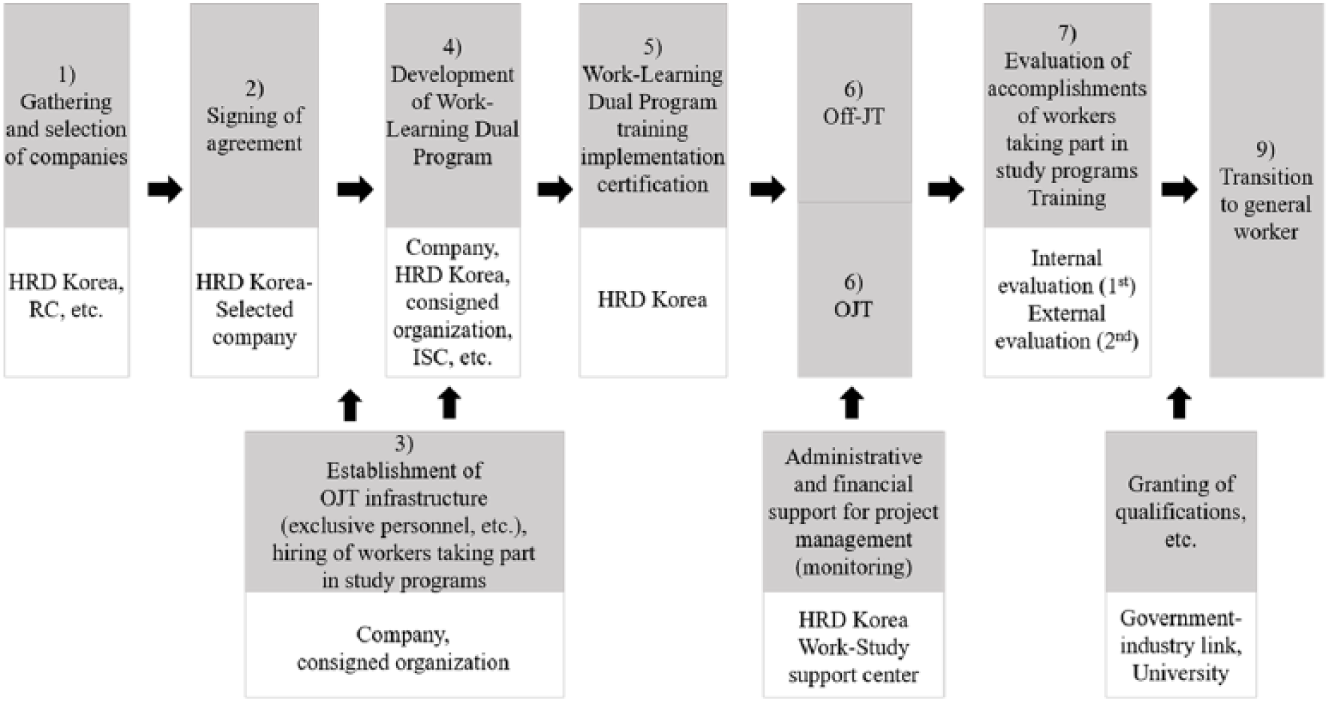
The operation process of WLDS.
Selecting Participating Companies
A participating company must adhere to several rules to be selected for and continue WLDS. First, the company should have at least 50 employees (Yoon et al., 2017). Second, the company should possess cutting-edge skills in a relevant field, which may require long-term skill development. Depending on the required competencies for a specific job, the time period for WLDS varies from 6 months to 4 years with 300 to 1,000 hr of training every year (Na, 2013). Third, employers should plan to develop their employees. Fourth, the company must possess on-site instructors, HRD practitioners, and partner with educational institutions to provide both theoretical and practical training. Fifth, the company should offer more than minimum wage to the participants for their training. Finally, the company should also not be in a bad financial state or numerous industrial accidents. If the company does not meet these criteria, they are not qualified for WLDS.
Development and Certification
WLDS is designed by the company with support from related professional institutes or experts. WLDS is designed based on the qualifications set up by Korean National Competency Standards (NCS; Na, 2013). If the NCS-based qualifications have not been developed yet, WLDS must be designed based on the NCS qualifications related to the specific technique (Yoon et al., 2017). Once the program is developed, the certification/credits are determined by HRD Korea, which monitors, analyzes, and rectifies the program (Yoon et al., 2017).
Evaluation and Employment
The participants are evaluated only after training has been mostly completed in two steps: internal and external. The participants are internally evaluated after completing more than 80% of the program (Yoon et al., 2017). The evaluation methods and time are determined by the company or the educational institution. If the participants pass the evaluation, WLDS certification is granted (Na, 2013).
After passing the internal evaluation, the participants can apply for an external evaluation consisting of all essential competencies suggested by NCS. The external evaluation has two steps: (a) pen and paper, descriptive problems are worth 40 points, and (b) job performance and interview are worth 60 points. Participants with more than 60 points pass the evaluation and acquire qualification/certification from the government (Yoon et al., 2017). After completing WLDS, the participating company must hire the participants.
Current Status
By June 2016, 7,485 companies were selected for WLDS, 4,255 companies implemented WLDS, 5,035 employees became on-site company instructors, and 20,910 individuals participated in WLDS (Yoon et al., 2017). Among the selected companies, 95.9% of the companies were small- and medium-sized companies with fewer than 300 employees. Among the participants, 7,140 (34.1%) were students or graduates of vocational high schools and 6,274 (30.0%) were graduates from universities (Yoon et al., 2017). The rest were college students (18.7%), general high school students (14.7%), and others (2.5%). The majority were in their teens (31.7%) and 20s (44.4%).
Literature Review
To explore and interpret the literature related to WLDS, it is important to define the scope of workplace learning and TD. Garavan, Carbery, and Rock’s (2012) key issues in TD and multiple constituency were used as frameworks.
Workplace Learning
Workplace learning can be described as a process of acquiring and assimilating competencies that lead individuals to their fundamental behavioral change within specific organizational contexts (Garavan, Morley, Gunnigle, & McGuire, 2002). Learning activities could be distinguished by their locus of control including formal, informal, and incidental. Individuals generally earn degrees, certificates, and/or credits through formal learning in educational institutions, local communities, or cultural organizations (Marsick & Watkins, 1990). Learning from everyday life experiences is considered informal learning, and incidental learning refers to an accidental and unintentional outcome when individuals are aware that learning has occurred (Marsick & Watkins, 1990). In this study, we expect to identify various types of learning activities through WLDS.
TD
Garavan et al. (2012) categorized the limited number of definitions of talent and/or TD into three approaches: exclusive, inclusive, and hybrid. From an exclusive perspective, an organization selectively chooses high potential employees and invests in them to accomplish its vision and drive performance. From an inclusive perspective, an organization plans, selects, and implements development strategies and activities for its entire talent pool to ensure the current and future talent supply accomplish its strategic objectives (Garavan et al., 2012). A hybrid approach is a mix of the two approaches.
Garavan et al. (2012) found that research has predominantly relied on the exclusive perspective and the meaning of talent and approaches to TD differ on a case-by-case basis. Thus, various models and approaches that follow the HRD perspective are needed because TD in HRD should be in line with its disciplinary values (Mehdiabadi & Li, 2016). The current study adopted an inclusive approach as well as Garavan et al.’s (2012) key framework to explore WLDS. The framework covers various aspects of a TD initiative and provides specific probing questions to help us understand WLDS.
Five Issues in TD
According to Garavan et al. (2012), five key issues must be considered in TD (see Table 1). When TD approaches are designed or reviewed, it is important to (a) define the talent for each approach, (b) clarify objectives, (c) identify who plays a key role in each approach, (d) determine the TD process, and (e) establish an effective structure and activities given the conditions. As the scope of TD may vary by organizational context (Mehdiabadi & Li, 2016), considering multifaceted concepts and constitutions of the approaches may help us understand WLDS practices in this study.
Key Issues of Talent Development.

Source. Garavan, Carbery, and Rock (2012).
Note. TD = Talent development.
Multiple Constituencies
According to Campbell and Lambright (2016), it is critical to identify and incorporate various constituencies in data collection. TD programs are likely to involve numerous relationships with various parties and stakeholders may have distinct interests and perspectives. To better understand WLDS, we included opinions of multiple stakeholders associated with WLDS. We explored the experience of the participants who were the target group of WLDS as well as the employers’ perspectives since they decided to operate WLDS. On-site instructors and HRD practitioners were also included because they may have different viewpoints and comprehensive understanding about WLDS while planning, designing, and implementing WLDS. Finally, we included opinions of staff in HRD Korea, which played an external stakeholder role by providing financial support and practical guidance.
Research Methods
To explore how WLDS works and its influence on learning and performance outcomes at various levels, we used a basic qualitative research design that aims to understand people’s experiences (Merriam, 2009). We conducted interviews as the primary data collection method and collected documents from HRD Korea, the agency responsible for the implementation of WLDS. Through the qualitative data, this exploratory study could investigate how WLDS operates in the workplace and what participants experienced in terms of their learning and performance.
Data Collection
Following the multiple constituency model, we collected data from various stakeholders of WLDS. We implemented a criterion sampling strategy for richness and quality assurance of data (Merriam, 2009) using the following criteria. First, we selected private enterprises that had implemented WLDS for more than 2 years, so the interviewees had adequate opportunities to observe and experience WLDS. The participants must have participated in WLDS for more than 6 months. After contacting more than 10 organizations, three agreed to participate in this study: one service and two manufacturing companies. One company had one to 100 employees, another had 100 to 1,000, and the third had 1,000 to 5,000. We contacted the companies’ human resource (HR) practitioners who chose and introduced interview candidates. Before each interview, we sent an email with the interview questions, so the interviewees could reflect on their experiences. The questions are listed in Table 2.
Interview Questions.

Note. WLDS = work and learning dual system.
Twelve people were interviewed: seven participants, two instructors, two HRD practitioners, and one CEO. Nine were male and three were female. Follow-up questions were asked to ensure that the critical aspects of their experiences were well articulated. All interviews were conducted in Korean. Documents related to WLDS were also acquired from HRD Korea because documents can be a great source of data (Merriam, 2009).
Data Analysis
After the interviews were transcribed, the themes were extracted using a qualitative content analysis approach (Merriam, 2009). For this approach, we carefully read the participants’ narratives and constructed categories using “open coding” (Merriam, 2009, p. 178). After working through the twelve transcripts in this manner, we examined our marginal notes and codes/categories and grouped them. Finally, we examined how each code was associated with our framework that involved Garavan et al.’s (2012) TD key issues and multiple constituency consideration. For verification, we jointly conducted the coding procedures and reconciled any discrepancies through discussion until consensus was reached. After extracting the themes, a member check (Patton, 2015) was conducted to determine whether the themes from the interview transcripts were identical to what the interviewees shared. For any inaccuracy, the transcripts were revisited and revised. Investigator triangulation (Patton, 2015) was also used for data analysis. Initially, the respective analyses of the derived codes were conducted by one author and then confirmed by the other authors. When there were disagreements, they were discussed until consensus was reached.
Findings
The findings are structured according to Garavan et al.’s (2012) dimensions of the TD program (see Table 1).
Definition of Talent in WLDS
One of the criteria to select a company to participate in WLDS was that the CEO planned to develop employees (Yoon et al., 2017). In addition, as 95.9% of the participating companies were small- and medium-sized companies that had difficulty securing and retaining skillful talent, WLDS satisfied the participating companies’ strategic planning and achievement of the business strategy. The participants of WLDS were future employees of the participating organizations. The on-site instructors were high potential employees and experts in specific skills, and were personally able to reflect, learn, and develop while transferring their tacit knowledge to explicit knowledge as they taught. All criteria matched the inclusive TD definition. One of the instructors described his experience: Since I should teach what I have done, I had to reflect on my experience and skills, and explore relevant academic knowledge. It was a great opportunity for me to develop and conceptualize my knowledge and skills.
Purposes of WLDS
WLDS emphasizes developing technical competencies of talent while it aims to provide prospective employees with systematic training and development sessions to raise their job-related competencies and soft skills required in the workplace. However, several instructors shared that WLDS also gave them an opportunity to develop their leadership, coaching, and communication skills; instructors must take sequential courses regarding leadership, coaching, and communication. As they transfer their experience and competencies, they also implement what they learn. In this sense, WLDS offers the instructors an opportunity to develop their soft skills.
Needs and Responsibilities
Although WLDS was designed to solve issues at various levels, it was primarily designed to meet the needs of the participating companies. The on-site program is organizationally driven rather than based on self-directed development activities of individual participants. WLDS satisfies small- and medium-sized companies’ needs (Garavan et al., 2012): securing and retaining skillful younger talent. The interviewed CEO described the following benefits: After implementing WLDS, our company could reduce the high costs for recruitment, selection, and reeducation. The retention rate of the new recruits has also improved significantly by 75%. Our company was also able to redesign our TD and/or HRD plan systematically. Above all, both productivity and the total sales have increased by 25%.
The CEO’s resource-based view justified the company’s investment in TD to potentially capitalize on business opportunities and facilitate expansion (Garavan et al., 2012). It was from an organizational perspective on WLDS as a potential source of competitive advantage as it was connected with positive outputs. Although WLDS is organizationally driven, it also meets the individual needs. Almost all WLDS participants in this study indicated that WLDS was a great opportunity to develop their competencies as well as their careers. As they were also employed in the participating companies, WLDS satisfied the need for career management and employability of the younger generations (Rasdi, Ismail, & Garavan, 2011).
Pace
WLDS can be categorized as an accelerated approach. Traditional TD approaches are passive, slow (i.e., 5-7 years), and emphasize experiential learning whereas accelerated TD approaches emphasize the talent’s competency for performance and reduce the learning time with intensive and structured learning experiences (Garavan et al., 2012). Almost all participants could develop their skills and knowledge within 2 years. They interacted with the on-site instructors and other employees, broadened their network in the company, and learned about the company.
Architecture
A TD program should be structured based on the needs of TD, developmental pathways, effective HR systems, and blended developmental strategies (Garavan et al., 2012).
Needs of TD
All of the participating companies faced training issues such as competency mismatch and required additional resource investment for new employees, so they had a clear need to recruit and develop talent. Each company developed its own competency model based on the qualifications from Korean NCS and utilized a specific competency model to articulate its talent needs and evaluate its WLDS. The companies could also develop and motivate experienced and skillful employees as instructors through WLDS. The interviewed CEO shared, “My company recognized the instructors in front of other employees and compensated them for the time they spent on WLDS.”
Developmental pathways
TD pathways include developmental experience, exposure, and challenges (Garavan et al., 2012). The WLDS participants had various experiences. One of the participants described his experience: By acquiring necessary skills and knowledge, I could interact with my instructor and other employees. Since I was the youngest, they described the do’s and don’ts and tips to adjust to the company culture quickly. Before WLDS was completed, I knew everyone in the company already.
The participant understood the organizational culture, developed a broader perspective, enhanced cultural awareness, and built relationships to enhance networking skills, which Garavan et al. (2012) described as the experience dimension of the developmental pathways. As prospective employees, the participants were exposed to diverse contexts and situations. One participant shared his experience: I couldn’t understand the job description, characteristics, and environment before participating in WLDS. After learning from the instructor and practicing with real tools and facilities, I could apply what I learned in various contexts.
Finally, as the participants learned new skills and worked in the participating company, all tasks were challenging. The participants learned from mistakes and failures, dealt with stressful situations, and recognized personal limitations (Garavan et al., 2012).
Effective HR systems
In cooperation with governmental agencies, the participating companies established their HR systems to support WLDS. To be selected, the companies should have plans to develop talent. Once the program was completed, the companies and the government agency evaluated the participants’ competencies and provided certification or credits, and the companies were committed to employing the participants. Without aligning the HR practices with their business strategies, the companies would not be selected or would fail to continue WLDS. This regulation allowed WLDS to integrate an advanced level of talent. In practice, however, several HRD practitioners shared that it was quite difficult to design their WLDS to align with Korean NCS because some NCS-based qualifications had not been developed. They also had difficulty maintaining WLDS because WLDS regulations and policies have been revised several times.
Programs to enable TD
The instructors, HRD practitioners in the company, professors in educational institutions, and experts of NCS in HRD Korea collaborated to design the program. Therefore, each program had several formal learning elements, including lectures. As the participants learned and practiced specific job-related skills for the first time, the participants increased their job scope, implemented change, and developed new practices. Interactions with on-site instructors and other employees could be considered relationship-based TD interventions. One of the participants described it as follows: Since I had a mentor in the company as a part of WLDS, I interacted with him, not only for the skill acquisition, but also for the comprehension of the organizational culture and the development of my vision in this company. Through WLDS, I was able to shorten my learning and working time with better productivity and adjust to the company quickly.
Finally, several participants and instructors shared their informal learning opportunities. They learned job-related skills that were originally not planned in WLDS while working with the instructor and dealing with various situations and variables. One of the participants described this advantage: The advantage of WLDS I had was immediate feedback. The on-site instructor immediately answered questions and provided feedback when I had difficulties in certain tasks. When the instructor had never thought about the issue, we solved the issue together. So, I was able to develop technical agility to deal with various situations.
For teaching, the instructors recognized their own tacit knowledge to teach some unplanned content. They had to adapt to the circumstances and extemporaneously prepare the curriculum and teach the participants.
Outcomes
In addition to the findings of the current study based on the key dimensions of TD, we identified several WLDS outcomes from the perspectives of multiple stakeholders. From the participants’ perspective, they could become employed. Most job seekers in Korea spend a long time acquiring unnecessary qualifications after graduating from high school or a university. However, the WLDS participants received TD training in a company and jobs for which they were responsible. By being employed early, the participants could also achieve economic independence.
From an organization’s perspective, the smaller-sized enterprises could hire talented youth who had qualifications through WLDS approved by the government and further develop them to become core talent for the companies. Furthermore, it is expected that the new recruits with necessary skills and knowledge would have higher levels of organizational commitment and retention. Due to the relevant OJT, the mismatch issue between employers’ needs and employees’ capabilities was also resolved by WLDS. The interviewed CEO described this trend: Securing skillful employees was one of the most critical issues. We had younger employees who just graduated from universities, but we should reeducate them. Due to WLDS, we can secure skillful employees, save resources, and reinvest in them through a TD system for other employees.
The participating companies could also significantly reduce the expenses of reeducating new employees. Once a company was selected for WLDS, the Korean government agencies provided funds and support for the necessary training expenses for the participants. On the negative side, several instructors and HRD practitioners shared that they dealt with the increased teaching and managing workload in addition to their original jobs due to WLDS. In addition, some NCS qualifications did not match the needed competencies for small companies. More importantly, one of the HRD practitioners shared some negative outcomes: The CEO of my company was initially uncomfortable allowing the participants to learn and work at the same time because we should pay them. Other employees who should take care of the participants’ tasks for their educational sessions complained about their additional tasks. We also dealt with complaints from current employees who did not have developmental opportunities. Above all, those participants who completed WLDS often got a job in one of our competitors’ companies or quit for their mandatory military service. Since we spent time and effort to develop them, it became our huge loss.
From the Korean government’s perspective, WLDS addressed several social issues. By creating a soft transition from a high school or university to a stable job, WLDS could improve the youth employment rate and create a more stable job market. Ultimately, it is expected that competency-based education, evaluation, certification, employment, and HR systems will pave the way to establish a competency-based society from the current social atmosphere that considers one’s educational background as more important than job training. One participant shared her impression, “Through WLDS, the company has recognized me as a critical future talent and provided opportunities of early promotion and an excellence award. WLDS is the way to move toward a competency-based society and I was very proud of myself.”
Discussion
Economic and social issues have called for a new approach to developing talent at the individual, organizational, and national levels. To address these issues, a new government-private sector collaboration model was designed and implemented in Korea. Our study explored WLDS and its influence on learning and performance outcomes at various levels through interviews with multiple stakeholders and documents from relevant agencies. The findings were presented within the key dimensions of TD by Garavan et al. (2012), and the outcomes were described from multiple stakeholders.
We found several advantages of WLDS. Employers expected to hire qualified employees and develop their competencies that are crucial for organizational performance and sustainability. Partnerships with the government, employers, educators, instructors, and HRD practitioners may be effective to address major issues in the Korean labor market (Molgat, Deschenaux, & LeBlanc, 2011). Employers’ active involvement helped design practical and effective programs. The participants could develop their abilities and learn about their jobs and organizations. The TD plan and support provided by the government may also contribute to national HRD (NHRD) that involves workforce, economic, and social development at the national level (Alagaraja, Kotamraju, & Kim, 2014).
Our study also revealed challenges for WLDS. Many participating organizations struggled to secure instructors due to a lack of qualified candidates and difficulty finding temporary replacements for employees who took on the instructor role. When these employees become part-time WLDS training participants, an increased workload may not be avoidable. The limited resources from smaller size participating organizations should be significantly considered when preparing WLDS (Nolan & Garavan, 2016). As a new initiative, WLDS still faces challenges and often makes mistakes that cause confusion and complications. In particular, the one-size-fits-all approach tends to confuse small or nonmanufacturing organizations due to the mismatch between NCS qualifications and the required competencies. Hence, the match between the organizations’ demands and the governmental plan should be an ongoing focus (Alagaraja et al., 2014).
Theoretical Implications
We explored various voices related to WLDS considering multiple constituencies (Campbell & Lambright, 2016). From an individual perspective, we found that various types of workplace learning take place. Marsick and Watkins (1990) included all experiences and learning activities as part of workplace learning and categorized learning as formal, informal, and incidental learning. The participants engaged in all three types of learning as they observed what the instructor did, learned conceptual knowledge from the professors in educational institutions, and practiced what they learned in the companies.
According to Ellstrom (2001), five factors are related to these types of learning. First, tasks related to learning should be complex, different/new, and important to learners. The competencies the participants learned were cutting edge (complex and new) and the participants had never practiced with tools and facilities (new and different) before the training. They were also employed and able to immediately use the new skills and knowledge (importance). The instructors also learned as they prepared the lessons and interacted with the participants. Second, opportunities for feedback, evaluation, and reflection on the outcomes are critical for participants to learn (Ellstrom, 2001). These factors were included when WLDS was initially designed for each company, and several of the participants shared that they had these opportunities in practice. Ellstrom (2001) also emphasized the formalized work process. As the participating companies, the educational institutions, and HRD Korea jointly designed their WLDS, they formalized the competencies through WLDS. This practice is also aligned with the trend of workplace learning, as WLDS was customized (Garavan et al., 2012). As the participants learned, worked, and reflected while interacting with the instructor, both the participants and the instructor customized the learning process. Fourth, as the participants practiced what they learned by themselves, they were confronted with problems that they had not yet learned. For this process, they learned how to handle problems and developed their own work processes. Several participants shared that they could develop technical agility to deal with new situations. The last factor is the learning resources that were provided from multiple sources including instructors, HRD practitioners, and professors. In conclusion, WLDS integrates learning and work thoroughly, which helps the participants and instructors experience diverse types of learning.
As another stakeholder, the on-site instructors, experienced knowledge creation processes (Nonaka, von Krogh, & Voelpel, 2006). As the instructors designed OJT, they reflected on their own experience and practice (e.g., tacit knowledge). Through this process, the tacit knowledge of the instructors was captured as explicit knowledge (Nonaka et al., 2006). The informal and self-directed learning of the instructors took place through personal reflection as they became active agents who controlled the learning processes with a full locus of control (Garavan et al., 2002).
The participating organizations (mostly smaller sizes) benefited the most from WLDS. Overcoming size-related issues is quite strategic because they cannot continue their businesses without skilled talent. Based on the findings of this study, the participating organizations could (a) recruit skilled talent, (b) retain them, (c) increase job satisfaction of the talent, and (d) enhance their performance and productivity. According to Fenwick (2008), when individuals recognize their own work-related knowledge and skills and an organization values them, the individuals develop a sense of identity in the organization, which is positively related to adjustment in a different culture and increases other positive outcomes (Gresham & Clayton, 2011).
Positive organizational outcomes from WLDS have been supported by several empirical studies. Ritter, Matthews, Ford, and Henderson (2016) argued that employees’ job satisfaction increases when they understand their jobs before employment. The WLDS participants learned their jobs before they were fully employed. Curran and Prottas (2017) suggested that employees who understand the job description and characteristics are more engaged in their work. WLDS is also significantly related to positive outcomes from the government’s perspective because it increases youth employment rates, lowers the employment age, and establishes a competency-based society.
Practical Implications
The findings of this study offer several practical insights for multiple stakeholders. First, WLDS could be a tool to handle the issue of a mismatch between emerging markets and increasing youth employment to ensure stable proliferation of the future job market. By developing early job entry conditions for youth through WLDS, enterprises can address the talent shortage. Continuous and systematic support after WLDS also enhances the capabilities and retention of the newly hired talent who participates in WLDS. This beneficial cycle strengthens the competitiveness of individuals and companies, which may lead to national economic development. To maintain and increase the output, HRD practitioners and CEOs should strategically and systematically improve their TD programs and cooperate with relevant governmental agencies in terms of NHRD.
As several of the instructors and HRD practitioners take on more WLDS tasks in addition to their current tasks, systematic interventions must be designed and implemented. The Korean government could maintain and develop WLDS further and even establish a long-term vocational training system to further enhance these positive outcomes and eventually solve the ongoing social issues. Therefore, government agencies should revise the current WLDS policies and procedures to support multiple stakeholders and manage participating companies to ensure that they continue to follow the policies and procedures. These improvements can be incorporated when the benefits of WLDS are advertised broadly. For this strategic and marketing reason, active participation from large companies can lead to increased awareness from the public and can substantially increase the number of youth employees. WLDS could develop a coexisting model that not only includes smaller companies but also encourages large and high potential companies to actively participate.
Regarding the operation of WLDS, the paradigm should shift from process management to performance-based support. As the current WLDS operation is primarily funded by the government, intensive management and supervision are necessary. From a long-term perspective, administrative supervision and assessment should be reduced, and the positive outcomes from WLDS and the achievement of learning objectives should be used as criteria for further support.
Since more than 75% of the participants in WLDS fall into two age groups, teens and 20s, training this group helps lower the youth unemployment rate. Prospective employees in the middle and older years (about 24%) can also easily adapt to new job-related skills and knowledge through WLDS. Thus, WLDS may significantly help make the Korean labor market more flexible.
WLDS also benefits individual participants’ career development. By participating in WLDS, young employees can experience work-related tasks, explore what they want to pursue, and to plan their career path. The organization may suggest possible career options for the young workforce, so they can envision themselves in the organization. Instructors can also use WLDS to develop their leadership skills such as coaching, mentoring, communication skills, and performance evaluation. WLDS may be more effective if organizations select instructors from the manager candidate pool to develop their leadership skills and experience.
Finally, in addition to saving training expenses and developing talented young employees and future leaders, the organization can take advantage of WLDS as it promotes knowledge management. Through WLDS, critical knowledge and skills are shared and transferred from instructors to young novices. Knowledge management can take place formally or informally, but if there is an organized and structured system, WLDS will be a strong resource to manage knowledge within the organization.
Limitations and Future Studies
There are several limitations in this study and suggestions for future research. First, as an exploratory qualitative study, we primarily collected data through interviews with a small group of 12 participants in three participating companies, a mix of multiple stakeholders, and documents from relevant government agencies. Future research should include larger samples for generalization using a quantitative approach to measure the effectiveness of WLDS.
Second, this study limited its scope to how WLDS worked overall using a TD framework, but we did not delve deeply into experiences and perceptions of employees, employers, and stakeholders in the process of the program. For example, this study did not explore how individuals from various parties perceived program activities in the entry, learning, and exit stages. Focusing on experiences of a particular party in a certain process may add thorough and rich knowledge about WLDS. Future research may also consider a comprehensive project that entails multiple substudies from various perspectives of interested parties.
Third, in this study, the case of WLDS fully reflected the Korean social, economic, political, and organizational contexts. Thus, caution is needed to apply WLDS to other contexts. We suggest examining comprehensive conceptual research that simulates WLDS with different environmental factors. When a similar TD program is launched in other emerging markets, it would be interesting to explore the cultural, structural, and administrative differences in terms of processes, policies, and learning and performance outcomes.
Fourth, our study investigated WLDS at a particular time in the early phase of its program. As a new program is likely to make mistakes or have unexpected outcomes, what we found may have already been addressed or altered as the program has grown. To better understand WLDS and more precisely assess its effectiveness, a long-term examination is required. Future research may consider collecting longitudinal data that involve the advantages, challenges, and problems for multiple consecutive years.
Footnotes
Declaration of Conflicting Interests
The author(s) declared no potential conflicts of interest with respect to the research, authorship, and/or publication of this article.
Funding
The author(s) received no financial support for the research, authorship, and/or publication of this article.