



Abstract
The Problem
The underrepresentation of people of color in science, technology, engineering, and mathematics (STEM) has become a crisis of significant proportion. The crisis is more pronounced when we examine participation by race and gender and explore how these two primary identity dimensions serve to marginalize women of color in STEM fields. These differential representations start during the early years and continue within institutions of higher education and the workplace.
The Solution
To address the absence of women of color in STEM, it is important to understand the forces that hinder and support their career development, beginning with early childhood experiences and throughout education and work environments. Interventions promoting diversity, equity, and inclusion must start in early and secondary education and continue through academia and the workplace.
Stakeholders
Addressing this crisis is the responsibility of leaders of public and higher education and those of business and industry.
After decades of work and sacrifice to open doors for women of color in STEM fields, differential participation persists, disparities in level of achievement continue, and career in science still exacts a heavy personal and professional toll
The comment noted above, as authored by a Chancellor and three vice-presidents of major higher education institutions, demonstrate the concern for the underrepresentation of women of color in science, technology, engineering, and mathematics (STEM) fields across the nation’s universities with implications for careers in business and industry. They argued that addressing the issue of underrepresentation among women of color is not just an economic issue but a social justice issue and that the “opportunity to pursue personal and professional success is a fundamental right for all of our citizen” (Cantor et al., 2014, p. 29).
The current situation regarding people of color in STEM has become one of the thorniest issues of contemporary focus according to Bonner, Alfred, Lewis, Nave, and Fryzel (2009). These authors, along with many other critical scholars, argue what started as a national concern in STEM has now escalated to crisis point. The crisis is more pronounced when we examine participation in STEM by race and gender and explore how these two primary identity dimensions privilege some and marginalize others within the academic and business environments (Alfred, 2017). These differential representations start during the early school years and continue within institutions of higher education and the workplace. Therefore, to capture the experiences of women of color in academia and the workplace, it is important to understand the forces that hinder and support their career development from the early beginnings. After all, careers do not happen overnight but are first influenced by early experiences in and out of schooling.
The absence of women of color in STEM occupations was first brought to the nation’s attention by Shirley Malcolm, Paula Hall, and Janet Brown in 1976 with their book, The Double Bind: The Price of Being a Minority Woman in Science. To highlight continued invisibility of women of color in social science literature, the Harvard Educational Review (HER) editors (“Unraveling the Double Bind,” 2011) reported for 36 years since the book was published (1976-2010), their journal published only 16 articles related specifically to women of color in higher education or minority participation in STEM. As they wrote, None of these articles addressed this unique intersection—the “double oppression of sex and race or ethnicity plus the third oppression in the chosen career, science.” This intersection of race and gender in STEM highlights the disparity in levels of achievement of women of color when compared to white women or to men of color, especially at the most advanced level. (“Unraveling the Double Bind,” 2011, p. 2)
Hence, to understand the low representation of Black and Hispanic women in STEM, it is necessary to explore their experiences in education and employment and how race, gender, and the culture of the STEM discipline intersect to inform their education and career development. Advancing women of color in STEM must be part of the national dialogue on global competitiveness. Indeed, the fastest growing population groups are racial minorities, thus making long-term economic growth of the United States dependent on its racial minority population. As Cantor et al. (2014) explained, Our nation is facing a STEM pipeline crisis in a world where both our workforce needs and the growth of our international competition are growing at an ever-accelerating pace. Students who live at the intersection of race, gender, ethnicity, and class are disproportionately absent from the STEM enterprise.” (p. 29)
Yet current population data suggest these students to be the fastest growing college-aged population and collectively belong to the fastest growing population groups in the United States.
We are now at a crisis point with threats of losing ground because the nation lags in recruiting and retaining members of the fastest growing population into STEM fields. Blacks and Hispanics are the two largest population of underrepresented minorities but have among the lowest participation rate in STEM education and careers. The crisis is quite convincing when we examine data for women’s representation within these two population groups. For example, according to the National Science Foundation, Digest (2017), White men (51%) and White women (20%) occupied 71% of science and engineering occupations—a proportion slightly higher than their representation in the U.S. working-age population of 70%. Asian men (12%) and women (5%) represent 17% of science and engineering populations—a proportion that far outweighs representation in the working age population at 5%. The data show stark underrepresentation of Black men (3%) and Black women (2%) for a combined participation at 5%, when compared with their proportion of the U.S. working-population age at 11%. The same is true of the Hispanic participation, with men (4%) and women (2%) for a 6% participation—a number far below their 16% proportion of the U.S. workforce. Based on data, Blacks and Hispanics are more severely underrepresented with women slightly more disadvantaged than their male counterparts.
The pipeline metaphor is a recurring analytical frame used in the literature to explore and explain the stages to a STEM profession (Cannady, Greenwald, & Harris, 2014; Rice & Alfred, 2014). Scholars have advanced different perspectives regarding the STEM talent pool deficit to include poor quality public school education, the small number of students majoring in STEM disciplines at undergraduate and graduate levels, the high rate of attrition among undergraduate STEM majors, and poor-quality programs that inadequately prepare students to perform successfully in business and industry. While there is merit in each of these perspectives, none explains why males, particularly White males, in both academic settings and work organizations are navigating the pipeline more successfully than women, especially women of color. For example, Hurtado, Egan, and Hughes (2012) found although undergraduate women of color are more likely to complete their degree within 6 years, those aspiring to major in STEM fields at the entry point were less likely than their racial minority male counterparts to be retained in STEM. For those who complete baccalaureate degree and persevere through graduate school and earn a master and/or doctoral degree, current literature is replete with evidence of challenges they endure both in school and the workplace, causing some to exit from STEM education and later, the professions.
Purpose
Global competitiveness of the United States lies in growing the talent pool in STEM fields—a talent pool that is inclusive of racial minorities. Human resource development (HRD), with career development as one of its pillars, can play a role in the retention and advancement of women of color in STEM. The purpose of this article is to explore the crisis of representation in STEM careers among Black and Hispanic women. Because careers begin early in the developmental process, we examined forces that hinder and support career choice, development, and retention among Black and Hispanic women in STEM education and in the professions. It will make visible the double oppression of race and gender within a myriad of personal and structural/institutional contexts to include the third oppression in the chosen STEM career. In addition, this article highlights ways by which work organizations support and advance women of color in STEM fields. We used the following questions to guide the review.
What contributes to the underrepresentation of women of color in U.S. STEM education and professions?
How can HRD within organizations support and advance women of color in STEM professions?
Because HRD is concerned with the development of employees within different work contexts, we have focused on women of color, primarily Blacks and Hispanics and trace their developmental experiences leading to their STEM career.
Conceptual Framework
To understand the underrepresentation of women of color in STEM education and the professions, we have used the concepts of social capital and intersectionality as guiding frameworks. These frameworks together will help illuminate forces that have potential for integrating and promoting women in STEM and those that serve as barriers to career development and advancement.
Social Capital Perspectives
The concept of social capital has been widely viewed as a determinant of an individual’s economic growth and a contributor to well-being of communities and nations, and has, thus, captured the attention of policy makers, researchers, educators, and community development practitioners alike (Alfred, 2009). Many have credited the initial works of Bourdieu, Coleman, and Putnam for advancing the concepts of social capital.
Bourdieu (1977, 1986) posits social capital has to do with structural relations and subjective beliefs that are associated with inequalities of resources and power. He further argues that inequality is caused by the unequal access to and interaction of various kinds of capitals, namely symbolic, cultural, and social. Bourdieu became interested in the ways that members of the middle and upper class were able to capitalize on material and human resources inherent in networks and social groups to advance their own interests. His significant contribution, therefore, is the interconnection of social capital and social inequalities and the importance of social capital as a source of power to advance one’s interest and leverage one’s position, in this case, in education and the chosen STEM career.
Unlike Bourdieu, Coleman (1988, 1998) employed the concept of social capital in educational research among young children. From his research on the educational attainment among students in public and private schools, Coleman concluded that students in private schools performed better than those in public schools. He theorized that the private school students performed better because there was a stronger sense of community and community norms which the parents, teachers, and students embraced (Alfred, 2009). His major contribution to social capital is the importance of communities as avenues for relationship building, support, networking, and career advancement for individuals who are often marginalized in academic and work spaces.
Another area of social capital research is that of Putnam’s (2000) who applied Coleman’s conceptualization of social capital in his landmark work on the role of trustworthiness and obligation in civil society. Situating his work within the realm of political science, Putnam contends that participation in civic associations can rekindle social solidarity and help to revitalize a decaying community. His basic argument is that to build civil society, there must be an element of trust and reciprocity among community members and that could be accomplished through participation in communities of individuals with a shared purpose.
According to Putnam, social capital serves both as a bonding and a bridging function. As a bonding function, it tends to reinforce community values, cultures, and group homogeneity. As a bridging function, Putnam suggests that social capital can provide linkages to networks and acquaintances that are external to one’s immediate community. As a career development strategy, building communities within academic and work spaces provides opportunities for ethnic minorities to interact with community members who can provide the bridging capital not available in their immediate ethnic communities. For example, it is not unusual for Black and Hispanic women to have strong bonding relations with members of their cultural and religious groups, but they often have weak bridging ties that link them beyond their ethnocultural communities where the networking essential for career advancement and social mobility exists.
While the work of each author noted above presents a differing view, three common components, namely, networks, resources, and norms, are common characteristics of social capital theory identified in their work and which contribute to our understanding of the experiences of Black and Hispanic women in STEM education and employment. That is, are they included in both bonding and bridging networks, have access to required resources, and share the norms inherent in the academic and the workplace communities in which they hold membership? While the concepts of social capital help illuminate the resources and relationships necessary for career development and advances, the concept of intersectionality allows a nuanced look at the ways marginalizing identities negatively affect access to networks and resources within communities of practice.
Intersectional Perspective
While the social capital perspectives help understand the structures that can support and advance women’s academic and career pursuits, the intersectional perspective provides a more critical lens to explore the lack of representation among those who occupy spaces within the margins of what is considered mainstream cultures. As Collins and Bilge (2016) explain, intersectionality as an analytic tool is useful to help uncover, explain, and illuminate the complexity of discrimination faced by people within spaces that were built to perpetuate a dominant power narrative of White, male, heterosexual, Christian norms. Yet these norms are “myths” in that they are socially constructed by people and continued by people who knowingly or unknowingly benefit from existing systems of power (Lorde, 1980). STEM fields in both academia and business and industry, historically, are grounded in the values of the White majority that perpetuates these mythic norms.
To challenge the White-dominated cultural values, intersectionality emerged out of Critical Legal Scholarship and Critical Race Theory to highlight the way that different aspects and dimensions of identity intersect and result in different forms of oppression (Crenshaw, 1989). In addition, the examination of power and oppression in intersectionality emerged out of an expansion of “feminist and antiracist discourse” that did not fully address the experiences of Black women who experience what Crenshaw (1989) explained as “double-discrimination—the combined effects of practices which discriminate on the basis of race and on the basis of sex” (p. 149). Intersectionality explores sexism, patriarchy, racism, classism, and belief-ism. These isms impact the degree to which individuals are privileged or oppressed in societies and the conditions under which careers are developed and sustained. Furthermore, Cantor et al. (2014) assert, “The intersectional lens pushes us to ask new questions about the conditions under which talent can thrive” (p. 30) and remind us that to understand the absence and experiences of underrepresented groups and individuals in STEM, we need to examine the issues with nuanced perspectives that cannot be captured through the broad dimensions of race or gender. Hence, we examined how women’s multiple identities intersect to inform their experiences in academia and the workplace.
Method: Review and Analysis of Extant Literature
We drew data from empirical studies, conceptual analyses, governmental reports and databases, and other related literature to explore underlying forces that contribute to the crisis of representation among Black and Latina women in STEM. This review served to identify the factors that contribute to underrepresentation, starting with early school to graduate and professional education and their workplace experiences in business and industry. Then we explored programs and strategies for the development, retention, and advancement of Black and Hispanic women in STEM work organizations.
Factors that contribute to underrepresentation in academia, business, and industry for women of color are complex and multidimensional. Therefore, the following search terms were used to sift through the various books, articles, and other literature: (a) women of color or minority women in STEM, (b) women of color in STEM education or science or technology or engineering or mathematics, (c) underrepresentation of women of color in STEM, (d) experiences of women of color in STEM, (e) Black women in STEM, (f) Hispanic women in STEM. Screening literature exclusively looking for publications that included the key words “women of color” was intentional to further narrow the discussion to that group rather that women in general. The following databases were searched for literature with the following results as shown in Table 1:
Underrepresentation of Women of Color in Science, Technology, Engineering, and Mathematics (STEM) Search Results.
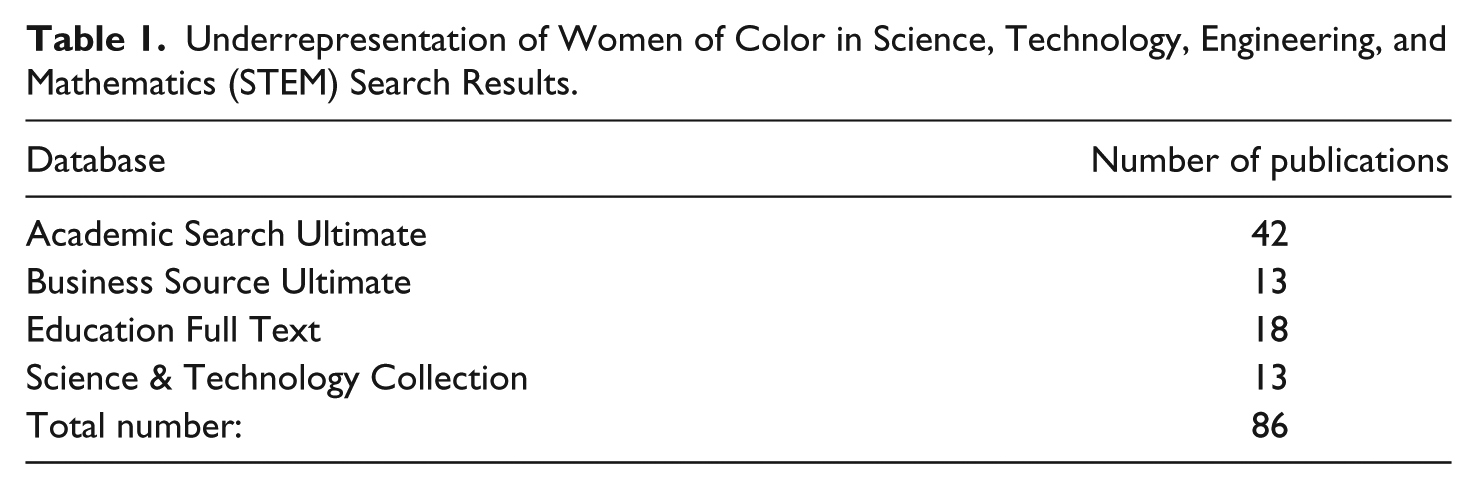
Databases were chosen according to prevalence in the field and to ensure that relevant publications were included in the literature search. The initial search generated 283 articles, yet after further examination of each article, literature was further sorted ensuring the articles referred to adult, professional women of color, occurred within academia and/or business and industry, and described underrepresentation of women in STEM fields. The included literature was published in peer reviewed journals, book publications, and governmental reports. The data set that remained included articles that specifically highlighted underrepresentation for women of color in STEM fields.
Next, to better understand existing support structures that promote diversity, inclusion, and retention in STEM education and the professions, a comprehensive literature search was conducted and the following search terms were used to sift through the various books, articles, and literature: (a) women of color or minority women in STEM, (c) STEM education or science or technology or engineering or mathematics, (d) support or supporting or aid or assistance or help or guidance for minority women/women of color in STEM, (e) retention/advancement strategies for women of color in STEM. The initial search produced the following results as shown in Table 2:
Supporting Systems/Programs/Strategies Search Results.
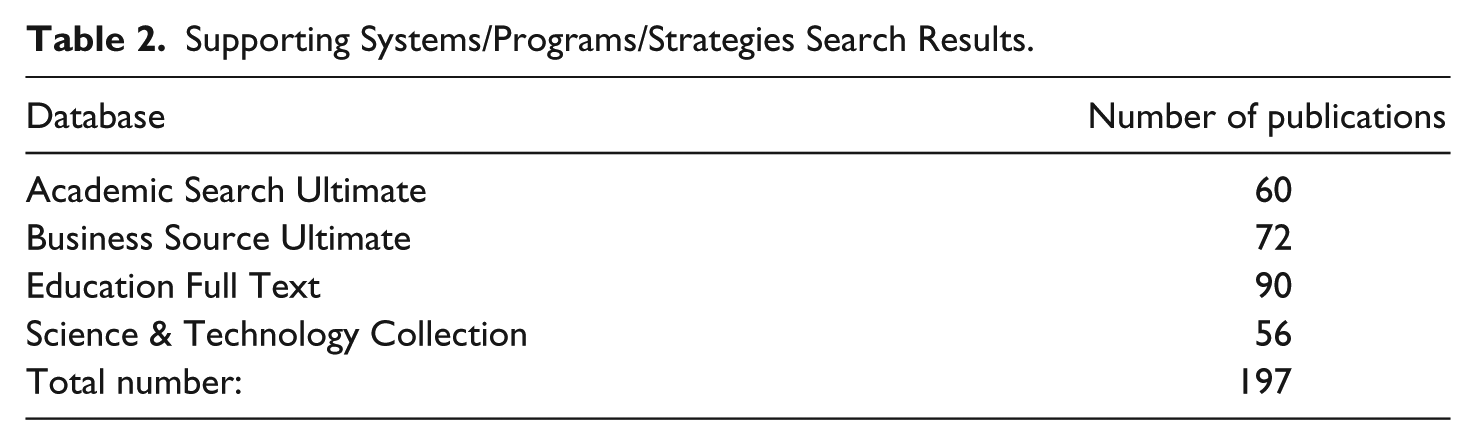
After further examination of each article, the literature included addressed systems of support for women and women of color in business and industry.
The overall results were organized according to (a) factors that contribute to underrepresentation of women of color in STEM along the career pathways and (b) programs, strategies, support systems for the development, retention, and the advancement of women in STEM, with special emphasis on those from underrepresented populations.
Underrepresentation of Women of Color in STEM
To understand underrepresentation of women in STEM, especially Black and Hispanic women, we first trace the problem to early beginnings of the career history, namely messages one receives and internalizes about gender roles, gender appropriate career pathways, and one’s place in the schooling enterprises (Byars-Winston, 2013; Hart, 2016). Such messages originate from the family, institutions, and the wider society. Individuals analyze, synthesize, and create their reality based on social and cultural contexts, to include race, class, gender, nationality, to name a few.
Societal and Institutional Influences During the Pre-College Years
A major societal barrier is the effect of stereotyping or “stereotype threat” in STEM field (Gunderson, Ramirez, Levine, & Berlock, 2011; Shapiro & Williams, 2011). According to Gunderson et al. (2011), one such stereotype is that girls have less aptitude toward math and, therefore, display a more negative attitude toward the discipline during the elementary and secondary school years. Stereotypes play a critical role in math performance and, hence, their preparation for STEM. When other factors such as race and socioeconomic status are considered, Black and Hispanic girls become severely marginalized from entering and matriculating through STEM education programs. The stereotypes are transmitted in society, through parents, teachers (Gunderson et al., 2011), peers, and the current explosion of social media. According to Shapiro and Williams (2011), stereotypes ultimately undermine women’s interest and their performance in STEM fields even if they have a positive attitude toward math.
The underachievement and underrepresentation of students in mathematics and science will negatively impact our nation and labor force (Jackson, 2004) including the future career mobility and economic well-being of the proportion for whom the gap continues to widen (Parson, Travis, & Simpson, 2005). Oakes, Joseph, and Muir (2004) argue the practice of tracking in the early grades partly accounts for the underrepresentation of racial and ethnic minorities, particularly in science and mathematics. As Fuller (2008) explains, tracking occurs “when students’ academic performance in science and mathematics become the critical filters and pipeline linkages for enrollment in advanced mathematics and science courses and future science, technology, engineering, and mathematics (STEM) college majors and careers” (p. 3). Therefore, future interests in STEM fields are thwarted because of these tracking decisions in the early grades, resulting in a status of under preparation for future participation in secondary and especially postsecondary STEM education. This contributes to the narrow pipeline for ethnic and underrepresented minorities that is often referred to in the literature. As Russell (2008) lamented, Unfortunately, elitism, racism, and capitalism have prevailed and thwart detracking efforts aimed at providing all students with equal resources, high expectation, highly qualified teachers, and an enriched curriculum. Tracking African American students from low income or impoverished backgrounds only further exacerbates the achievement gaps between African American students, and the white middle/upper class students. (p. 175)
Another systemic deterrent is the treatment of students of color in public schools and beyond. For example, to create a structure aimed at compliance and minimize disruptions, policies and guidelines are enacted that often represent the values and ideologies of the dominant members of society, resulting in the perpetuation of privilege and marginalization. As Morris (2016) explains, these guidelines attempt to regulate clothing, hair styles, and verbal expressions often referred to as “attitude” in case of Black and Hispanic girls. These vague and implicit guidelines are contributing to a large percentage of Black girls, for example, being pushed out of schools before they graduate (Morris, 2016). Moreover, Morris further notes, when students are pushed out for what is considered to be unfair and biased infractions, they are more likely to distrust the adults in the school environment and lose interest in their schooling because they perceive no one cares about them or their school accomplishments.
As a result, these students end up with more disciplinary actions, lower grades from missing class time, and eventual stop/drop out prior to graduation. This phenomenon is referred to as “push out” which has become a crisis among Black and Hispanic girls in public schools. In a report released by the National Women’s Law Center and the NAACP Legal Defense Fund, it was noted that 12% of all African American girls in public schools (pre-K to 12th grade) were suspended in 2014. Therefore, even before making it to college, Black women are bombarded with institutional restrictions/marginalization to entering a STEM program. Those who do not leak out from the pipeline and make it to the collegiate level, they are often met with numerous institutional barriers that impede their chances to complete college, especially in a STEM-related discipline.
STEM Education and the Marginalization of Women of Color
One such institutional barrier is the messages (subtle and unsubtle) that women receive upon entry in institutions of higher education that signal they do not belong in a STEM career track, especially physical sciences, computer science, engineering, and mathematics (Dasgupta & Stout, 2014). “Doubts about belonging, in turn, hinder women’s achievement, engagement, and persistence in STEM majors by making them question whether their abilities, interests, and aspirations are compatible with STEM” (Dasgupta & Stout, 2014, p. 24). The social environment within disciplinary programs has been found to be a major barrier to women’s persistence, retention, and matriculation through STEM careers.
As Miyake et al. (2010) explain, a major reason why women feel out of place in STEM is because of the widespread stereotype that STEM fields are reserved for men, and women who believe the message tend to underperform and feel a lower sense of belonging. Moreover, this message is accentuated when one considers the 3:1 ratio of men to women in STEM programs. For women of color, their absence is more glaring as they are often the only one or one of two members of their racial/ethnic group in the class, placing them in a token position. According to Kanter (1977), being a token gives one a heightened sense of visibility and brings into consciousness the stereotypes about their group and the pressure to perform well. Building on Kanter’s (1977) work, Kachchaf, Ko, Hodari, and Ong (2015) also concluded that being a token often excludes women of color from group or team membership resulting in further alienation and marginalization.
The research has found, however, that access to mentors and role models has a positive impact on the women’s professional development in STEM and the positive impact is compounded when the mentor is a woman (Buzzanell, Long, Anderson, Kokini, & Batra, 2015). Unfortunately, women encounter few same sex role models in STEM education programs, particularly full professors in the physical sciences and engineering where the ratio of male to female faculty is about 4:1 (Dasgupta & Stout, 2014). While mentoring is viewed as a positive intervention, women of color mentees often struggle with ambivalence, loss of confidence, and disenchantment in mentoring relationships (Buzzanell et al., 2015). Although these struggles are often considered to be the individual’s problem, it is argued that mentoring for underrepresented women is a systemic inequality in that the current mentoring practice both privileges and marginalizes, supports and undermines, assumes equal distribution, yet contributes to inequitable outcomes for women of color mentees (Buzzanell et al., 2015).
The current practice does not account for the different needs, individual experiences, vulnerabilities, frustration, and struggles these women face in academia. Women of color experience both gender and racial discrimination when accessing resources in the workplace. For example, Buzzanell et al. (2015) conducted a study to understand experiences with mentoring among underrepresented women in STEM. While mentoring is viewed as a formal institutional process deemed as comprehensive, developmental, nurturing, and collegial, the participants in that study reported mentoring for them was not about career development or providing support. Instead, participants reported mentoring was aligned with annual evaluation, apprenticeship, and theft of intellectual property (Buzzanell et al., 2015). Therefore, mentoring experiences served to further alienate them from the academic spaces that threatened their retention and matriculation to academia or business and industry.
Another phenomenon that seems to serve as a barrier to women’s inclusion and sense of belonging in their chosen STEM program is what De Velde and Laursen (2011) refer to as the “Glass Obstacle Course.” According to the authors, “The notion of the glass obstacle course captures the unequal gendered processes at work in women’s graduate careers, including exclusion from the Old Boys’ Club, outright sexism, a lack of women role models, and difficult work-life choices” (p. 571). Graduate school is a critical juncture for women. It is a period during which they are socialized into their chosen STEM field and learn the values and skills of their disciplinary culture (Sallee, 2012). It is a period where implicit and explicit gendered values become more pronounced. Because most STEM fields are dominated by men, that creates a masculinized culture where gender bias contributes to different experiences for men and women. In fact, it has been found that women encounter more barriers in graduate school than they encountered in undergraduate education. We argue that the experiences are more visible at the graduate level because women have acquired the language to articulate their experiences and to recognize how the various dimensions of identity intersect to shape their encounters in male dominated (often White), STEM spaces.
Beyond STEM Education: Navigating the Cultures of Academia and Industry
Regardless of discipline and ethnicity, women of color work in academia and industry STEM environments where they are isolated and often alienated because of the absence or limited number of peers from their cultural or ethnic group. While the numbers vary by professions, it has been established that Black and Hispanic women are not well represented in any of the STEM fields, particularly at the leadership ranks. For example, about 3.2% of Fortune 500 boardroom executive positions are held by women of color while White women hold 13.4% and White men, 73.3% for a total of 86.7% of these positions. The critical absence of underrepresented minorities in executive leadership positions in business and industry exemplifies the STEM crisis identified. According to Johnson, Thomas, and Brown (2017), the significant underrepresentation of women of color in the various STEM work environments exacerbates and intensify their negative experiences. These negative experiences, they argue, eventually derail women’s aspiration and interests in STEM-related careers. As a result, women withdraw from the profession, signaling a self-fulfilling prophesy and leaving others to conclude they are not committed or not willing to work hard enough (Johnson et al., 2017).
For those who stay the course, many lack developmental relationships like mentoring and informal peer networks, are vulnerable to harassment and discrimination, and work within an organizational climate where the leadership stance on diversity and inclusion is often nonexistent (Buzzanell et al., 2015; Johnson et al., 2017) and must contend with isolation, marginalization, and racialization (Petty & White, 2017). Rice and Alfred’s (2014) report of a study of the career development of Black female engineers found debilitating factors within the academy and the professional workplace. Institutional factors to impede the women’s progress in STEM education programs were limited African American female representation, uncaring and unsupportive faculty, and peer networks that were found to be unwelcoming to underrepresented minorities. Within the industry workplace, participants reported a lack of diversity where they were oftentimes the only one or one of two minority female engineers in their organization. Moreover, as reported in previous research, the participants’ gender, race, and age intersect to compound the feeling of isolation and a disconnect with the workplace community (Rice & Alfred, 2014). Participants were young and worked in environments dominated by White males. Clearly, they were left out of the “Good Old Boys” network where relationships are formed and sage advice is given on career development and advancement.
Women of color in STEM fields (as with women in other fields) often experience challenges in balancing career and other aspects of life. According to Kachchaf, Ko, Hodari, and Ong (2015), these challenges arise from the stress of trying to balance the demands of managing a family and household and the embodiment of the ideal worker norm, characterized as White and male. The authors explored the nature of the challenges of balancing career–life for three underrepresented minority women and the impact of these issues on their career trajectories. The study supports previous findings that a woman of color is often the only person of color in her department; therefore, these women experience class differences and lower pay, isolation, social exclusion, insecurity about one’s work, and communication problems with colleagues. Hence, the accumulation of these challenges may lead some to leave STEM professions in academia for industry jobs with the belief that industry jobs offer higher pay and may be more supportive of work–life balance. However, many have found that to be a myth and that barriers exist in both academia and industry work environments.
Archie, Kogan, and Laursen (2015) suggest career–life or work–life balance is not the only factor influencing women’s decision to leave or remain in a STEM profession. Workplace climate has been found to be another major factor to influence the STEM career for women of color. The researchers described workplace climate as a multidimensional construct with formal and informal norms and practices that mediate one’s behavior within the workplace. Positive linkages between work–life satisfaction and workplace culture may dramatically increase a woman’s decision to remain in a STEM field and the opposite is also true. For those who remain in the professions, Hodari, Ong, Ko, and Smith, (2016) assert they draw on their sense of agency to manage the oppressive cultures in their work organizations.
While the literature is replete with evidence of racial and gender discrimination, there is also lessons of survival to be learned from those who have found success in their profession. Ko, Kachchaf, Hodari, and Ong (2014) explored the factors of persistence and success from the life stories from 22 women of color with bachelor’s and advanced degrees in physics or astronomy, two of the most exclusive STEM fields. The women shared eight key points as lessons that contributed to their retention and professional growth in their field: (a) an environment that enabled success, (b) circumventing unsupportive advisors, (c) combating isolation using peer networks, (d) consciously demonstrating abilities to counteract doubt, (e) safe spaces for whole selves, (f) getting out of their department to stay in STEM, (g) remembering passion for science, and (h) engaging in activism to support other minorities. By exercising agency, the women created new pathways in the sciences for others to follow and not be passive victims of the departmental cultures or institutional structures.
While women often evoke their sense of agency to help them persist in midst of oppressive and marginalizing forces, leadership has an ethical responsibility to create positive work environments where all members can have equal access to resource and support for developing their life career. Focusing on HRD in business and industry, what can organizations learn from the literature in their quest to recruit, develop, retain, and advance women of color in the workplace?
Support Systems for Women of Color in Business and Industry Settings
Like academia, business and industry face many of the same challenges with recruiting and retaining women of color. Existing support systems are recognized as being necessary beyond the personal level and extend into the current departmental and institutional practices. For example, in astronomy and planetary sciences, women of color report high rates of harassment at work. The evidence supports that the harassment is heightened when a woman is also part of another minority group (Clancy, Lee, Rodgers, & Richey, 2017). The support systems to help address the behaviors that contribute to these experiences include direct structural recommendations. The authors indicate that solutions require a multilevel approach that includes (a) code of conduct or formal education programs around acceptable behavior, (b) cultural sensitivity training, (c) leadership modeling of appropriate behaviors. Part of the multilevel approach begins with strategic planning for change at the organizational level.
Wilson (2014) furthers the call to corporate America by indicating the importance of strategic planning along with structured mentoring. Organizations’ values and goals, in partnership with those of other stakeholders, are critical to changing the demographic composition in the workplace. “The goal of workplace equality and diversity must be a combined commitment among corporate America, governmental agencies, educational institutions, and society as a whole” (Wilson, 2014, p. 89). Hence, changing demographic representation in STEM is a governmental, educational, social, economic, as well as personal effort.
For those employed, to ensure that mentoring is meaningful and goal oriented, they should have opportunities for leadership positions. The incorporation of women at all levels of an organization demonstrates structural changes in hiring, recruitment, and promotion within the corporation (Schaefer, 2015). Mentoring is mentioned as only one part of the equation and that to make lasting and meaningful change, the corporate culture must also change to allow more access to leadership. The commitment of any company can be demonstrated through acceptance and making space for all aspects of individual identity and integration into the organizational culture.
J. Brown (2016) highlights the importance and added value of employers in recognizing and making physical space for marginalized identities in the workplace. Brown writes, “Part of the work of inclusion is helping those already in the workforce to feel safe bringing more of themselves to work, versus what they have done historically, such as downplaying parts of themselves for purposes of assimilation” (p. 25). The corporate environment continues to be dominated by a workplace culture that reinforces the superiority of gender normative men in STEM oriented professions.
The male, gender normative culture in many STEM professions run alongside personally directed messages that encourage women to seek out mentors, identify their own terms for success, and practice strategic mentoring. Mentoring is a personal interaction, but when intentionally facilitated and supported in industries, it can serve to disrupt behaviors that lead to inequity in opportunity. Byars-Winston (2013) points out there are things that contribute to STEM underrepresentation that highlight disconnects between an American ideology of equal opportunity and access and the actual experiences that various groups encounter in STEM. These disconnects reveal the schisms that exist between the prevailing myth of meritocracy and the persistent reality of educational and occupational inequity. (p. 54)
These elements are valuable things to consider in understanding support systems for women in STEM.
In addition to training around personal beliefs, a strengths-based approach to incorporating women of color into STEM industries may be beneficial. Understanding personal strengths from a psychological perspective places the focus for all people on what is done well rather than deficit-based models of viewing people. Using a strengths-based model for coaching and mentoring in one study identified that women in both their work and personal life were impacted in a positive way (Elston & Boniwell, 2011). Rather than viewing women from a deficit model, they were included within the mainstream culture and recognized for their competence, strengths, and their contributions to the workplace community.
Another element of support for women is worker flexibility and control over work. A study conducted by Moen et al. (2016) demonstrates a positive impact on the following aspects of career and personal health when women are involved in designing their work environments and the strategic planning of their workplace structures: “burnout, job satisfaction, perceived stress, and psychological distress” (p. 58). Changing the social environment of the workplace to relate to better health outcomes is a relevant source of support and a retention and advance strategy for women of color in STEM.
Finally, as a means of promoting inclusion in the workplace and providing space for marginalized groups to claim space in the work environment, many companies are implementing employee resource groups (ERGs) for these purposes. These employee work groups or business resource groups, or communities as they are also referred to, are voluntary grassroots groups that come together around a common purpose and many lay the groundwork for global diversity and inclusion strategies (J. Brown, 2016). They are usually formed organically out of the need for people of difference to feel a sense of belonging and create relationships with people of similar backgrounds. These groups offer support, understanding, information and resource sharing that would hopefully contribute to career success of the membership noted by Erika Irish Brown (2017), Global Head of Diversity and Inclusion at Bloomberg LP. These groups provide the social capital which have been found critical to employee development and career success. The organization also benefits and, thus, many companies have created frameworks that enable ERGs to thrive and contribute to fundamental organizational objectives. Some of the demonstrated benefits to the organization include recruitment and retention of vital and diverse employees, finding and cultivating leadership talent, and marketing outreach in terms of products, product placement, and a global view of the marketplace (DiversityInc Staff, 2012). While the ERG strategy is not a panacea for the underrepresentation of women of color in STEM, it is a viable business plan for addressing the marginalizing of women based on their multiple identities as well as create space for the development of social capital whereby women have access to networks, resources, and common norms—elements which have been found to benefit more privileged groups.
Recommendations for Future Research
Many recommendations for future research can be gleaned from this study, and we highlighted three. Because the data for this research were drawn from a review of existing literature, we recommend empirical studies of women of color in STEM disciplines, both in STEM education and in the workplace, using a mixed method design. It would also be important to study organizations with a commitment to diversity and document successful programs, policies, and practices that have proven to make a differences in the retention and advancement of people of color in STEM professions. Moreover, it would be essential to do a series of case studies on employee resource groups (ERGs) in organizations to understand and empirically document how these groups are advancing the organization as well as career development of group members.
Conclusion
Overall, career development for women of color in STEM fields begins within family and community and is influenced by societal messages about their place as women—minority women—in male-dominated careers in the fields of STEM. Early interest in a STEM field are fueled or diminished in public schools, often resulting from the intersection of race, class, gender, and social class. Those who escape the leaky pipeline enter college where they often experience their first lessons of exclusion, self-doubt, loss of interest, and for many, eventual drop out or transfer to a non-STEM program. Those who successfully navigate the course enter graduate programs where they are met with personal and structural barriers that threaten their journey to a professional career in academia or industry. Graduate school is the juncture where women of color are most vulnerable because of discrimination from the intersection of their multiple identities of race, gender, class, and sexual orientation, among others. From sheer determination, persistence, the love for the discipline and support from family, friends, peers, and significant individuals in the academic environment, some make it through professional education and enter the world of work, either in academia or business and industry, where the struggle for survival and career advancement continues. Some industry leaders have recognized the value of diversifying the workforce considering the growing population of underrepresented minorities in the U.S. population. It is incumbent on the leaders of academia and industry to strategically plan for the successful recruitment, education, and retention of underrepresented minorities in STEM. After all, the global positioning of the United States depends on its competitiveness in STEM which calls for inclusion of its fastest growing population group—namely, Blacks and Hispanics.
Footnotes
Authors’ Note
A version of this article was presented at the Academy of HRD Asia conference, November 8-10, 2017, India Institute of Technology, Ahmedabad, India.
Declaration of Conflicting Interests
The author(s) declared no potential conflicts of interest with respect to the research, authorship, and/or publication of this article.
Funding
The author(s) received no financial support for the research, authorship, and/or publication of this article.