




Abstract
The Problem
The lack of theoretical frameworks representing voices and leadership experiences of women of color, compounded by multiple ways intersectionality changes the experience, continues to be under-represented in Human Resources Development (HRD) literature. Furthermore, given the field of HRD is fundamental to developing the whole person, lack of attention to voices and leadership experiences of women of color is problematic. Here, women of color represent Black, African American, and Indigenous women leaders.
The Solution
Applied critical leadership is introduced as a theoretical framework to expand and enhance HRD research, theory, and practice in the development of women of color as leaders. A conceptual development model, the Feminist Indigenous Mixteco Migrant Epistemology (FIMME) is introduced as a sociocultural view of leadership, defining multiple ways women of color harness the power of intersecting racial, ethnic, gendered, linguistic, socio-economic, and migrant leadership practices.
The Stakeholders
Human Resources Development scholars, students, and policymakers benefit from novel ways to think about women of color in leadership through culturally grounded concepts, bringing light to nuanced understandings. Exemplars for women’s leadership for culturally and linguistically diverse and Indigenous societies are provided as solutions to socio-political complexity.
The field of human resource development is focused on “increasing the learning capacity of individuals, groups, collectives, and organizations through development and application of learning-based interventions for the purpose of optimizing human organizational growth and effectiveness” (Chalofsky, 1992, p. 354). However, the field has not attended well to the development of women of color as leaders. Consequently, the voices and leadership experiences of this group have been silenced. With all sectors of the workforce seeking to increase their diversity and inclusive initiatives, effective leadership is critical to achieving this goal. However, there the lack of attention to the leadership development of women of color remains a critical omission.
The purpose of this article is to highlight how critical perspectives bring to light the raced, gendered, and classed perspectives that are missing in the dominant Human Resources Development (HRD) paradigm. This article will center on the leadership of women of color whose unique and authentic ways of knowing contribute to a sociocultural perspective of leadership. In this article, the term women of color will be applied to women who identify as Black, African American, migrant Indigenous 1Mixtec, 2 Afro-Indigenous, and 3 Xicana. Sociocultural refers to power dynamics and organizational structures used to oppress based on one’s race, gender, or social class (Merriam & Caffarella, 1999). A migrant perspective further highlights the needs for more inclusive research on Indigenous people who have emerged as leaders in the workforce (Grover & Keenan, 2006; Santamaría et al., 2020). Recognizing various worldviews is “critical to understanding how members of the group acquire and use knowledge” (p. 395). We contend that leadership frameworks should include multiple perspectives in order to effectively develop all of those who lead and to contribute to more inclusive models of leadership.
Women of Color in Leadership: Review of Literature
To better understand how the lived experiences of Black, African American, migrant Indigenous Mixtec, Afro-Indigenous, and Xicana women are represented in the HRD literature, we reviewed the four HRD journals: Advances in Developing Human Resources, Human Resource Development Review, Human Resource Development Quarterly, and Human Resources Development International for relevant studies. We used the keywords Black, African American, women of color, intersectionality, indigeneity, and leadership, singly and in combination. The result yielded a few studies mostly from previous issues of Advances in Developing Human Resources. This is not an extraordinary discovery, however, since the journal has been exclusively thematic until the end of 2021. Therefore, most of the studies that were relevant to this literature review were published in Advances in Developing Human Resources between 2009 and 2019.
Perspectives of Women of Color as Leaders
While HRD research on the experiences and perspectives of women in leadership roles is readily available, findings reflecting the perspectives and experiences of women of color in leadership roles remain marginalized with respect to the dominant HRD paradigm. This is an issue, given the increasing number of Black or African American and Hispanic or Latinx women of color leaders in academia and industry (Alfred et al., 2019). This stands in contrast to the exclusion and therefore lack of consideration to their voices, agency, and ways of leading as important for organizations to understand. Ways in which leaders who are women of color live their intersectionality (e.g., race, gender, class) through stories in the face of discrimination and racism, renders Black feminism and women of color epistemologies indicators of authentic leadership to inform, improve, and change the existing HRD paradigm for the better.
Byrd (2009a) studied Black women leaders across predominantly White organizations and found participants had been subjected to disempowering encounters with colleagues, exclusion from good ole boy networking opportunities, being the only woman of color in various professional contexts, needing validation, and disrupting stereotypical race, culture and gender myths attributed to Black women. These findings reveal shared salient themes experienced by women leaders in the academy identified in similar studies amongst smaller group of women leaders of color (Johnson & Thomas, 2012; Lloyd-Jones, 2009). In a related study of gender equity leadership development and the impact of mentoring, Sims et al. (2021) found that among 56 faculty members, servant leadership was identified as a gender-neutral way or style of developing leaders as skilled mentors toward improving leadership experiences reported by women of color leaders in higher education. In terms of coping as a necessity for leaders included in similar studies, Walker (2009) found among African American women providing leadership in predominantly White organizations, that faith and spirituality were used “as a means to endure the adversities” experienced by Black women leaders (p. 654). This research and correlated studies suggest women of color who lead in academe and industry embody and express leadership in ways that are qualitatively different based on the intersectional nature of raced and gendered identities. They require sense-making opportunities, thrive when appropriate mentoring opportunities are available, and tend to lead from a place of authenticity; contributing to feminist woman of color centered epistemologies to research, frame, to better understand and support unique and different ways of leading (Johnson & Thomas, 2012).
This raises the question as to why the voices, experiences, and needs of women of color in leadership are virtually absent from the HRD canon. Is it possible these voices are not valued, or are they possibly not significant enough a population to consider? These issues continue to raise questions about the lack of development of women of color as leaders as well as exclusion of their voices and leadership experiences in the field.
Lifting Voices Through Story
An important factor when analyzing women of color in leadership is the notion of being heard as an historically and scholarly silenced group. The first thing that needs to be discussed when analyzing this is the intersectionality of race and gender when locating who is excluded. In a higher education study, Byrd (2009a) found that when it comes giving voice to the lived experiences of 10 African American women leaders, sociocultural theories like Black feminist theory and critical race theory are necessary to employ. Utilizing a feminist perspective in higher education, researchers Nickels and Kowalski-Braun (2012) similarly found women of color leaders’ voices in a program mentoring study to not only be missing in research, but also to be “undervalued, or treated as an afterthought” (p.188). The value in use of critical race theory to interrupt sanctioned theories suggesting which people can or cannot to which kinds of work is highlighted in research by Rocco, Bernier, and Bowman (2014, p. 458), who join other scholars who write about ways in which critical race theory can assist in giving voice to the previously silenced (Thijssen et al., 2008). In their concept article on contextualizing leadership strategies of Black women in the U.S. and South Africa; Johnson and Thomas (2012) similarly found that a critical research space has been forged for the study of Black women leaders that needs to increase to include raised visibility and integration of feminist epistemology to voice “intersections of various dimensions including race and gender” (p. 163) to create a better understanding of the experiences of women of color in leadership roles. These findings are intriguing because for one, efforts described will require diversity training and support, but most importantly because it shows that administrators and practitioners alike require active buy-in and participation, which adds to the need for appropriate and suitable mentors for women of color in academe and the corporate sector. Finally, regarding voice, in Walker’s (2009) reflection on leadership from the perspective of an African American woman of faith, she calls for the inclusion of spirituality when examining leadership in what she calls “a place for new voices and new perspectives of workplace values and beliefs to be heard and to flourish” (p. 654). This is shared in the spirit of creating understanding and support for the professional development of women leaders of color.
Mitigating Intersectional Discrimination
Researchers have also conducted various studies on discrimination from the intersection of multiple identities of race, gender, class, and sexual orientation. Alfred et al. (2019) conducted a literature review of 86 articles highlighting underrepresentation for women of color in STEM fields, which concluded that career development for women of color is complex. Their success depends on family and community support and is influenced by societal messaging about their place as minority women working in male dominated fields. Likewise, Jean-Maire et al. (2009) found in their study of 12 Black women leaders of HBCU’s, that deeper understanding of the ways in which social realities such as racism, sexism, and classism affect the experiences of individuals within the workplace is necessary if HRD is to move forward in ways that make sense. These findings appear to remain true to the idea of Black women’s ways of knowing which have evolved from a shared historical background of racism, sexism, and classism “that are in direct contrast with dominant, Eurocentric epistemologies” (p. 570). In fact, these researchers like others, conclude that as HRD evolves and becomes more inclusive, research framed by critical race theory, Afrocentric epistemologies, and constructs like intersectionality are necessary for HRD to appreciate the role of race in organizational life (Rocco et al., 2014).
These studies are important because they highlight missing voices and lack of professional development to support women of color in leadership and shows that it transfers into ways in which these women “show up” and perform in leadership contexts as well. This leads to further questions about how women of color express their leadership that is different.
Unique Authentic Leadership and Epistemologies
The unique ways in which women of color lead based on their lived experiences is also something that has been studied. Lloyd-Jones (2009) conducted a qualitative single-case-study to examine the lived experiences of an African American woman senior-level administrator in a predominantly White research university which concluded that despite achieving advanced levels of education and holding high-ranking positions within academia, many African American women in administrative positions encounter social inequity emerging from intersectionality. This is true across multiple studies. In their collective autoethnography on authentic leadership in higher education, Ngunjiri and Hernandez (2017) similarly concluded that complexities inherent to intersectionality of race, gender, and class require mutual reciprocity amongst all members of the institution to counter inequities present. Another interesting relationship between intersectionality, power, and authentic leadership is that studies have also shown that women of color in leadership roles want to be genuine in their work. They want to “show up” authentically, as themselves. Nickels and Kowalski-Braun (2012) confirm this by stating, “we cannot guide others towards authentic self-expression if we’re not willing to face the anxiety raised by being genuine” (p. 58). In their related comprehensive literature review on developing positive identity in minoritized women leaders in higher education, Manongsong and Ghosh (2021) found similar results claiming professional developers can support minoritized mentees impacted by imposter phenomena by supporting their development of positive leader identities grounded in the strengths each authentically brings to their leadership practice.
Research has also been done that looks at incorporating Black, feminist, and critical epistemologies to study women of color in leadership. Byrd (2009a, 2009b) research calling for the integration of sociocultural and feminist theoretical framing continues to build and add to the idea that it is worth understanding women of color not only have unique voices, work toward developing agency for themselves and others, but also exhibit unique ways of leading professionally that is inextricably tied to the intersectional reality of their racial, linguistic, and cultural identity. Additionally, Johnson and Thomas (2012), Jean-Marie et al. (2009), Nickels and Kowalski-Braun (2012), and Rocco et al. (2014) each found that there was a need to call for new epistemologies and theories to more appropriately frame, study, and report women of colors’ unique “ways of leading” including the specialized role of mentors in their professional development (Jean-Marie et al., 2009, p. 562). Johnson and Thomas further the premise by suggesting these different lenses and approaches include experiences of Black women internationally and those practicing leadership in different geographical locations. Certainly, the literature reviewed paints a clear picture of perspectives of women of color in leadership that clearly asks for ways forward by way of a conceptual development model to define, explain, and reflect a women of color epistemology and complementary leadership approach to provide the kinds of understanding of women of color and the ways they experience and enact leadership needed to increase their voices, visibility, development, and support by fields such as HRD.
Theoretical Frameworks for Studying Women of Color in Leadership
Critical perspectives are needed to unveil and seek an understanding of the ways in which power and privilege have limited the development of women of color as leaders and a recognition of their unique, authentic practice of leadership informed from their cultural experiences (Byrd, 2009a). Critical Race Theory (Bell, 1995; Crenshaw, 1993; Delgado & Stefancic, 2017; Ladson-Billings, 1998, and others) along with Black Feminist Theory (Collins, 2000) are commonly used theoretical frameworks for studying social oppression and marginalization. In addition, these theories add raced, gendered, and classed perspectives of leadership that are absent in identity-neutral studies.
Critical Race Theory
In the U.S., though race is socially constructed it is actualized daily through social constructions manifested in contexts like higher education and industry where people of color work alongside White people (Crenshaw, 1993). As such, race, according to the author, necessitates critique and interrogation by way of critical race theory (CRT). Researchers like Delgado and Stefancic (2017) are among activists and scholars whose contributions describe ways in which relationships among race, racism, and power are relevant, further necessitating CRT. In her definition, Gloria Ladson-Billings (1998) describes CRT as, “a set of legal scholarship theories about racial inequality and how race functions in the society” (p.7). In this way, the theory “calls for the legitimization of narratives of discrimination and the power of the law used against persons of color and the importance of these counter narratives for… leadership and policy” (Parker & Villalpando, 2007, p. 520). CRT “promotes social justice and transformation by challenging traditional notions of how to conduct, practice, or rhetorically engage in educational politics and leadership” (Alemán, 2009, p. 295). Furthermore, CRT considers race first in examining inequality in society (Ladson-Billings & Tate, 1995). Principal tenets of CRT include “(1) racism is normal, not aberrant, in U.S. society, (2) storytelling is an important form for exploring race and racism in society, (3) CRT theorist critique liberalism and, (4) an emphasis on racial realism” exists (Bell, 1995; Ladson-Billings, 2009, p. 88). As such, CRT is appropriate in decentering Whiteness as well as recognizing, acknowledging, and storying race centered inquiry.
Black Feminist Theory
Overlooked in initial studies on women in leadership, women of color have begun to reject race neutral and identity-neutral research that fails to express their authentic ways of knowing and practicing leadership (Sanchez-Hucles & Davis, 2010). Furthermore, intersectionality (Crenshaw, 1993), the multiple forces that combine to create complex social experiences, adds a dimension of leadership to women of color that is not present in the experiences of White women, who although possibly marginalized by gender, can claim their Whiteness as a privilege (Byrd, 2018).
Central to Black feminist theory is the concept of shared experiences, collectivism, and a common bond (Collins, 2000). Furthermore, the concept explains how women of color: (1) self-define themselves and reject the dominant ideology (2) view oppression as an interlocking system, and (3) appreciate the significance of culture and community (Bell et al, 2000). Therefore, applying a Black feminist lens to the leadership experiences of women of color is appropriate because historically this group has been omitted, devalued, and misinterpreted and therefore require a sociocultural epistemology to support their navigation of everyday experience. Moreover, a Black feminist framework supports shared histories and ancestral ways of knowing. The deep intertwined ancestral knowledge of intersectional identity application in work and life can be tapped to inform what women of color believe as truth, finding resourceful value in the essence of themselves, and what they individually and collectively experience (Santamaría et al., 2020; Santamaría et al., 2022).
Applied Critical Leadership
Applied critical leadership (ACL) is an inclusive theory to practice approach that has been utilized in empirical studies of Black women’s, Indigenous women’s, and studies featuring people of color in leadership roles (Santamaría, 2014; Santamaría et al., 2022; Santamaría & Jean-Marie, 2014; Santamaría & Santamaría, 2012, 2016). The established framework has been used across leadership contexts including theology, community development, health, higher education, and technology in the U.S. and other countries (Abawi, 2019; Amiot et al., 2020; Carter & Abawi, 2018; Green, 2015; Hattori, 2016; Parker & McKinney, 2015; Solis-Walker, 2016). Interdisciplinary applications of ACL, render the framework nimble and thus relevant to the field of HRD. ACL research findings are in direct line with HRD research highlighting implications for women of color in leadership (Byrd & Stanley, 2009; ; Sims et al., 2021). Bringing an ACL approach as a complement to previous HRD studies strengthens and expands these research findings concerning women of color in leadership.
As further complement to HRD research, ACL has origins in critical and critical race theory and deeply grounded in transformational and transformative leadership (Bass, 1985; Kincheloe & McLaren, 2011; Ladson-Billings, 1998; Shields, 2010). ACL offers a departure from patriarchal leadership and management paradigms void of reference to cultural, linguistic, gender, or socio-economic diversity theorized to reflect a time and social climate when homogeneity, oppression, and segregation were normalized (see Burgoyne & Reynolds, 1997).
The ACL framework emerged because there were few explicit leadership approaches that explored and unpacked the unique ways in which women leaders of color harness positive attributes of their identities and embody them as central to their leadership practice. Applied critical leadership builds upon and expands leadership for social justice by positing that leaders of color do so through critically informed lenses of their Black and Indigenous woman of color experiences. Importantly, research findings acknowledge cases of applied leadership practitioners’ utilization of privilege as allied equity partners. Specifically Applied critical leadership is the emancipatory practice of choosing to address … issues and challenges using a critical race perspective to enact context-specific change in response to power, domination, access, and achievement imbalances, resulting in improvement (for the greater good). (Santamaría & Santamaría, 2012, p. 7)
The leadership theory to practice framework is embodied by way of nine characteristics or actions, observed in the leadership practices of more than 350 leaders, (many of them women of color) in a variety of organizational leadership contexts (Abawi, 2019; Green, 2015; Hattori, 2016; Parker & McKinney, 2015; Santamaría & Jean-Marie, 2014; Solis-Walker, 2016).
The following characteristics were observed or reported by applied critical leaders surveyed or interviewed from 2010 through 2020. These leaders’ practices are evidence by their: • Initiating critical courageous conversations in the communities of practice. • Utilizing consensus building in decision making. • Working deliberately toward disrupting negative racial, cultural, linguistic, gender, class stereotypes. • Enacting leadership as a function of giving back to marginalized/minoritized BIPOC communities. • Creating and disseminating information on critical issues for community and mainstream. • Building trust with members of the mainstream or outside of the community of practice. • Honoring, welcoming, and including all members of the constituency. • Creating and sustaining inclusive and safe spaces for critical and courageous conversations. • Enacting servant, reflective, action-oriented leadership by example.
Research findings suggest leaders who utilize applied critical leadership consider race, language, gender, class, and culture as central considerations in their leadership practice (Abawi, 2019; Amiot et al., 2020; Carter & Abawi, 2018; Green, 2015; Hattori, 2016; Parker & McKinney, 2015; Santamaría & Santamaría, 2012, 2016; Solis-Walker, 2016). When women of color lead in this way, they ask themselves how aspects of their identities enhance their abilities to perceive different perspectives, resulting in more informed, appropriate, and therefore effective leadership practices (Sanchez-Hucles & Davis, 2010). The applied critical leadership framework together with critical race theory and Black feminist theory, demonstrate and support ways in which sociocultural relevant frameworks affirm, inform, and support the leadership of women of color.
Healing the Heart: A Unique Way of Leading
Healing the Heart—Curando el Corazon—Na’ Sanna’e Ini’ e, was a state and county funded innovations project implemented from 2017 to 2021, designed to revitalize migrant Indigenous ways of treating mental health symptoms. The project was conceived in response to the disproportionate language and cultural dissonance that kept the migrant and Indigenous Mixtec community from seeking out mental health services from county services. The Black and Indigenous women leaders of Healing the Heart—Curando el Corazon were tasked with: confirming that stress, anxiety, and depression were impacting the migrant Indigenous Mixtec community; determining whether there are traditional Mixtec healing modalities or medicine being used to treat these symptoms; evaluating whether treatments were effective in remedying the symptoms; and working in partnership with county partners to integrate appropriate components of complementary alternative Indigenous medicine into the therapeutic practices of county practitioners, who endeavored to become more culturally competent toward providing better service to the Mixtec as a prioritized systemically underserved group. Over the duration of the project over 450 members of the community were served and 98% saw a reduction in symptoms based on the effectiveness of the alternative Indigenous healing modalities.
The authors of this conceptual development article are also the women of color members of Healing the Heart. Leadership positions held by project members were Director/Principal Investigator, Project Evaluator, Project Coordinator, Research Assistant, and Community Health Worker. Our identities and thus our positionalities are important and relevant to this article because who we are impacted our leadership practice (Santamaría et al., 2020; 2022; Sims & Carter, 2019). We choose to bring our story into the academic, practitioner, scholar, HRD space to improve the work of HRD practitioners by providing real-world context for ways in which leadership might better attend to the growth and development of women of color in leadership. We tell our own rarified Black Indigenous woman of color in leadership story because we are the only ones who can. As Black and Indigenous women leaders, scholar practitioners, researchers, and authors we are aware of challenges inherent to navigating Western/modern, patriarchal, and positivist scholarly ways and means of communicating knowledge. We understand how participation in inquiry discourse in these ways may be to the possible detriment of honoring languages, culture, and Indigenous “ways of being” for the sake of academic knowledge and professional HRD advancement.
Further to this end, we link our research to emergent theories and approaches designed for and by people of color, like ACL and CRT (see Ladson-Billings, 1998). This is done whilst offering a contribution HRD and leadership to better inform human development, training, mentoring, support, and succession planning in the workplace (see Ghosh et al., 2014). In Healing the Heart, we worked with one another “across culture, across language, class, and difference” toward a shared “call” of service to the Mixtec and Indigenous community of color, with respect to healing, celebrating Indigenous knowledge, our ways of knowing, and our sacred divinely feminine ways of being (Moraga & Anzaldúa, 2015, p. xxiii). Specifically, as Black, Indigenous, Indigenous descent, Mixtec, Afro-Indigenous, and Xicana scholars we endeavored to expand current understandings of leadership for, on behalf of, and in service to the Mixtec peoples of Oaxaca, Mexico; some 70,000 in number who migrated with their families and now live and work along the central coast of California, and in doing so identified a unique way of leading.
The Feminist Indigenous Mixteco Migrant Epistemology Model
The system of knowing that emerged from this project connected to ancestral lineage and those who will come after those involved in the work. When optimally adjusted, participants described themselves as connected, whole, and fully integrated (e.g., body, mind, soul), like participants in Jean-Marie et al.’s (2009) study when describing states of transcendence. Of note is the occurrence of this efficacious way of leading occurring when women of color are leading in communities of color (Santamaría et al., 2020; Santamaría et al., 2022). As such, the African American and migrant Indigenous women’s ways of understanding, sharing, learning, and ultimately providing leadership is highly complex and dynamic as indicated in Figure 1. 1. Knowledge and leadership are firmly rooted through geographically located Oaxacan culture and language passed on from mother to child, regardless of migration. 2. They are anchored by a divinely feminine communal ancient and sacred ancestral lineage. 3. Knowing and leadership can be expressed by individual, or group organization earmarked by resourcefulness (creative) and resilience (enduring). 4. Intelligence and leadership are signaled by women’s aspirational ability to survive by courageous adaptation as necessary. 5. Intact and unchanged language and culture are evidence of spiritual quality of knowledge, leadership, and women’s ways of knowing. The feminist Indigenous Mixteco migrant epistemology (FIMME) model.
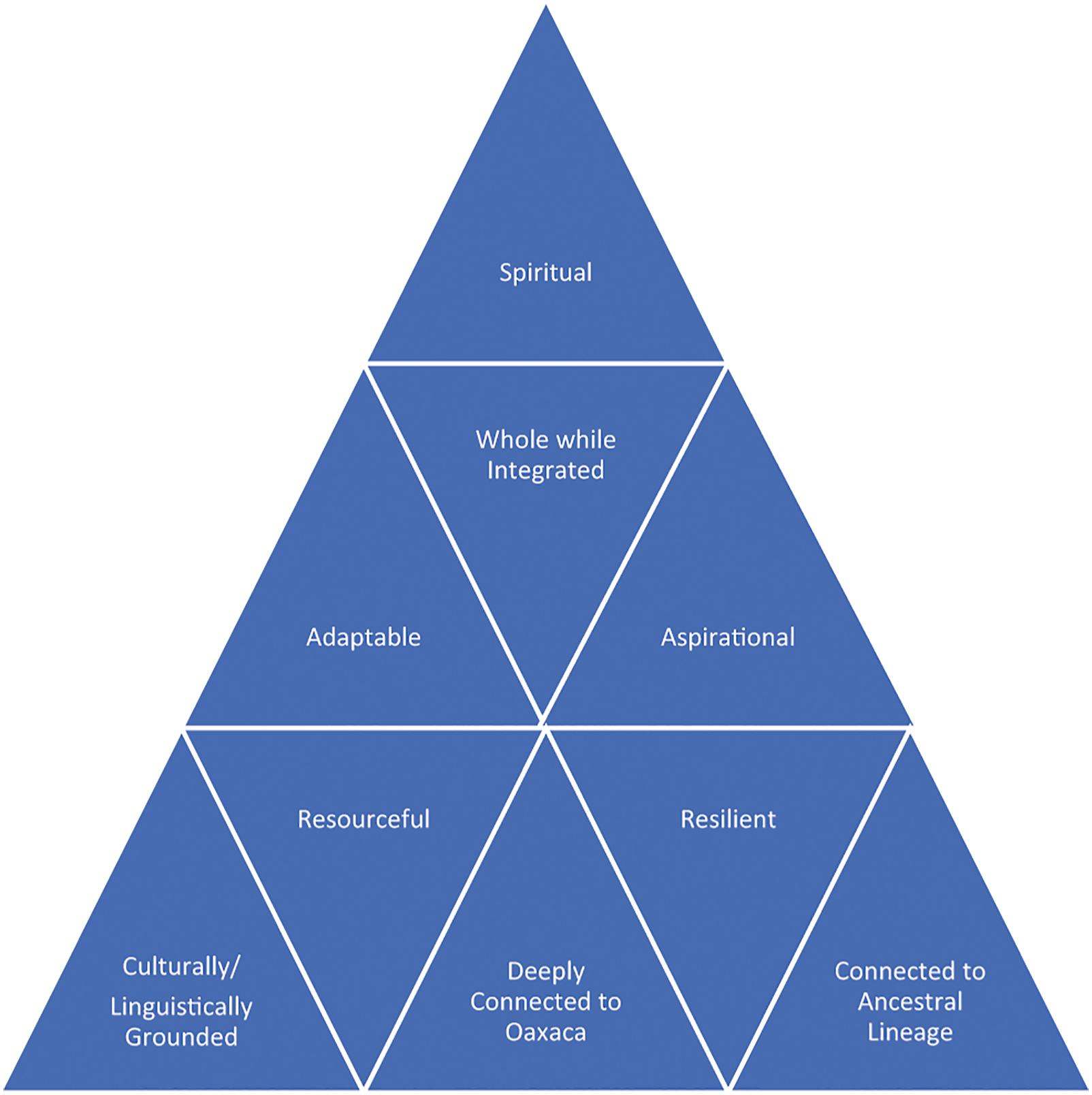
Feminist Indigenous Mixteco Migrant Epistemology takes on the perspective that Mixteco systems of consciousness and leadership spring from nebulous lines of connection running back and forth from mother to child, through DNA in and around what can be understood to be physical, spiritual, natural, linguistic, cultural, and geographical realities governed by deep divine feminine wisdom. This dynamic system of knowing and leadership stems from the Sacred connection knowing that though Mixteco people are here present on this time and space continuum, so also are ancestral lineages and those who will replace these peoples in the future. There is a shared knowing that the Mixteco connect heaven and earth through Indigenous bodies as conduits of all that is. Like many other women in “surviving” Indigenous groups, Mixteco women leaders are resourceful, highly adaptable, clannish community-oriented people. Mixteco women express leadership by working for the greatest good of the group, whether it be family, community, or pueblo (village/township). When optimally adjusted, Mixteco women leaders see themselves as connected, whole, and integrated. As such, Mixteco women’s ways of understanding, sharing, learning, leading, and disseminating knowledge is highly complex and dynamic dependent on individual woman and community member experiential awareness. Figure 2 shows ways in which this epistemology relates to CRT and Black feminist theories, the ACL framework referenced, as well providing support for critical HRD. Fimme, CRT, and ACL Affirming CHRD connections.
Feminist Indigenous Mixteco Migrant Epistemology wisdom and knowledge are what make a Mixtec woman wise and worthy of providing leadership beyond anything learned in a book, in a school, or in a university.
Implications for Critical Human Resource Development Research, Theory, and Practice
Applied critical leadership supports critical human resource development (CHRD) in that both are in the business of challenging and “transforming workplaces and HRD practice toward justice, fairness, and equity” (Fenwick, 2004, p. 193). While there is no universal definition of CHRD, Ty (2007) highlighted that in addition to transforming organizational and social structures, traditional HRD needed to establish a worldview for responding to matters of social injustice and bringing about lasting peace. Bierema (2009) further challenged the dominant masculine HRD rationality and suggested a more balanced critical feminist theoretical framework. Critical HRD challenges the dominance of a positivistic HRD paradigm (Valentin, 2006) that has resulted in the silencing of women of color. However, gendered perspectives fall short of approaches that include other social realities that women bring to the leadership experience. Inclusive frameworks should consider gender and race inequities for advancing a Critical HRD paradigm.
Moreover, a CHRD ideology brings to light issues of social oppression and recognizes the possibility of emancipation and social change (Fenwick, 2004; Sambrook, 2014). According to Bierema and Callahan (2014), critical HRD emerged in response to inadequacies in the dominant HRD paradigm and a lack of emphasis on social justice issues in traditional views of HRD. The women of color leaders’ work with the Mixtec community exemplified Bierema and Callahan’s (2014) reconceptualization and reframing of HRD practice from training/development, career development, and organization toward authentic relating, learning, changing, and organizing behaviors in the workplace. The Black and Indigenous women leaders experienced their work and epistemology through unique ways of knowing as an interrogation of dominant theory and practice, including the creation of alternative understandings and practices promoting diversity, change, pluralism, and equality across societies and their representative languages and cultures despite their spectrum of difference (Bierema & D’Abundo, 2003; Santamaría et al., 2020). A number of CHRD scholars have contributed to this paradigm and established a platform to advance discussions of race, gender, class, and migrant status in leadership (Byrd, 2014; Gedro et al., 2014; Osafo & Yawson, 2020; Sambrook, 2014). The new epistemology offered reveals ways in which a shift toward CHRD challenges existing HRD paradigms as the interrogation of subordinating systems of organizational and professional knowledge, in this case through multiple critical lenses (Byrd, 2014; Daniels, 2006). To the more dominant field of HRD, leadership development programs that are more inclusive are needed, not only for the women of color, but to educate others on the sociocultural ways that leadership is experienced and practiced.
Conclusion
This article identified a feminist epistemology of leadership through the lens of Black and Indigenous women of color. Their unique ways of knowing and practicing leadership revealed new ways to think about leadership and in particular, the practice of Indigenous and Indigenous descent leadership experiences. The idea is that when leadership is carried out by women of color who have transcended psychological, emotional, or societal barriers including experiences with racism, discrimination, and/or oppression; these powerful understandings inform their expression of leadership in qualitatively different ways (Hughes & Dodge, 1997; Mays, 1995; Sims & Carter, 2019). These aspects are relevant to and inform the field of critical HRD regarding ways in which people learn and perform their work in various disciplines. For HRD as the process for increasing knowledge, skills, and capacities for all people in a society, it is critically important for supervisors, managers, and higher-level leaders to know and understand, the nature of women leaders of color. It is important to comprehend that regarding development, coaching, mentoring, and succession planning, women leaders of color may uniquely relate to their constituents through shared aspects of difference (e.g., race, ethnicity, culture, language) or deeply shared profound struggle (e.g., poverty, language loss, displacement, genocide) (Mays, 1995). This conceptualization suggests one way “forward” and a snapshot of a paradigmatic shift from HRD to CHRD practice, one becoming increasingly important for leadership as a discipline to also consider (Giscombe & Mattis, 2002).
Footnotes
Declaration of Conflicting Interests
The author(s) declared no potential conflicts of interest with respect to the research, authorship, and/or publication of this article.
Funding
The author(s) received financial support for the research of this article from the Mental Health Services Act (MHSA) of California through an Innovations grant administered to MICOP through the Ventura County Office of Behavioral Health (VCBH).