



Abstract
The Problem
Learning designers are central to employee capability transformations, and their contributions became invaluable during Covid-19. Resultantly, jobs for learning experience (LX) designers became more noticeable. Yet not much is known about LX designer skills. While there are assumptions that a LX designer may be similar to an instructional designer or technologist, there is no empirical evidence.
The Solution
In defining the skills of an LX designer, the employer’s voice is essential. In this study, we applied a case study design and examined 25 LX designer job announcements (JAs) across eight industries.
The Stakeholders
Through this study, employers can introspect on the development of their JAs and their expectations of LX designers. Professors who teach learning and instructional design courses can strengthen their course content alignment with the LX designer skillset. Researchers can use the suggested studies to further the LX designer discourse.
Keywords
Learning designers are central to employee capability transformations, and their contributions became invaluable during Covid-19 (North et al., 2021; Xie et al., 2021). Resultantly, jobs for learning experience (LX) designers became more noticeable (North et al., 2021; Nworie, 2022). Yet not much is known about LX designer skills. Broadly conceptualized by practitioners, learning experience design (LXD) is user-focused and requires instructional design (ID) and user experience design (UXD) skills (Chang & Kuwata, 2020; Schmidt & Huang, 2021). Hence, a LX designer combines design thinking with curriculum development and emerging technologies to configure content for specific behaviors and preferences (Kilgore, 2016). Given the practice-based viewpoints, Schmidt and Huang (2021) posited that research on the LXD phenomenon, its components, and boundaries is needed. While assumptions that a LX designer may be similar to an instructional designer or technologist exist (North et al., 2021; Nworie, 2022; Raynis, 2018), there is no empirical evidence. Moreover, in recent reviews of instructional designer competencies, UXD skills remained uncited (Klein & Kelly, 2018; North et al., 2021; Wang et al., 2021). We contend that this empirical gap implicates the professionalization of and the outcomes and impact of LX designers and instigates research fragmentation. Essentially, the term LX designer is ambiguous in corporate and academic settings. Moore et al. (2011) cautioned that ambiguous use of terms and lack of conceptual clarity create confusion and negatively effects subsequent studies. Therefore, we proposed one research question: What skills do employers want from a LX designer?
Given that professionalization of LX designers falls within the learning and development (L&D) domain of human resource development (HRD) (Ghosh et al., 2014; McGuire & Cseh, 2006), and that HRD is an applied field (Ruona & Gilley, 2009), the employer’s voice is essential. The employers bring a perspective that shines a light on expectations and subsequent work (Rousseau, 2006). Therefore, HRD faculty can strengthen their course content and design with this study. First, the study results can serve as a reference for reading materials, student projects, and content exploration in instructional design (ID), adult learning, and e-learning courses. Second, this study can offer a synopsis of LX designer skill requirements that employers can use to inform their L&D talent acquisition strategy and bolster their job announcements. Employers can also use the skill synopsis to upskill their L&D teams. Third, this study can serve as a baseline for subsequent studies to further enrich our understanding of the LXD phenomenon, its components, and its boundaries. To this end, first, we describe the conceptual framework. Second, we share the research methods. Third, we present the results, discussion, and conclusion. Lastly, we offer research and practice implications.
Conceptual Framework
In this framework, we first present perspectives that allude to the role of ID and UXD in LXD. After that, we describe and synthesize ID models. Then, we give UXD characteristics and applications. Lastly, we offer a summary.
Learning Experience Design
Although employers are hiring LX designers, the term LXD is not clearly defined because there is a shortage of empirical research. Hence conceptualizations exist, but LXD is understudied. Chang and Kuwata (2020) postulated that LXD is a combination of ID and UXD skills. Schmidt and Huang (2021) reinforced the UXD skills. They added that LXD is a human-centric, theoretically grounded, and socio-culturally sensitive approach to learning design to propel learners towards identified learning goals. Clark (2022) offered that although LXD remains ill-defined, LXD may use a combination of art and science related to organization demands, learning, psychology, and technology. Floor (2016) echoed the sentiments of Schmidt and Huang (2021) that LXD is about learner-centered experiences tied to context, goals, and outcomes. Kilgore (2016) added that an LX designer implements LXD by combining design thinking with curriculum development and emerging technologies to configure content for specific behaviors and preferences. The perspectives mentioned above, primarily from practitioners, hint that LXD seems connected to ID and UXD. Hence, the following insights.
Instructional Design
The field and practice of ID have and continue to evolve. Context remains a marker of the ID evolution. Larson and Lockee (2008) noted the influence of human performance technology (HPT) on ID in the business and industry context. While HPT and ID focus on closing gaps, HPT focuses on using interventions to improve people’s performance. As such, HPT emphasizes front-end analysis to identify the problem, causes, and symptoms and may include interventions beyond instructional (Morrison et al., 2019). Today, ID, a subset of HPT, is a systematic design process that is informed by learning, change, system, organizational, management, and technology theories which emphasize efficiency, effectiveness, and learning that yields a change in performance (Larson & Lockee, 2008; Morrison et al., 2019).
In applying ID, ADDIE (analysis, design, development, implementation, and evaluation) and the rapid prototyping models permeate its application. Villachica et al. (2010) reported that of 185 respondents who had some form of ID experience, 100 or more cited the following ADDIE-related activities: front-end analysis, needs assessment, task analysis, selecting appropriate content, selecting or modifying instructional content, writing performance objectives, and create a design document. Overall, the highest responses were associated with the analysis, design, and development phases. The lowest responses were associated with the implementation phase (Villachica et al., 2010).
Rapid prototyping is an accelerated ID process focused on the efficiency of the product through continuous evaluation and iteration (Dick et al., 2004). The goal is design utilization; usability testing is critical because the learner and designer enter a discovery process (Tripp & Bichelmeyer, 1990). Incremental feedback and change are core to aligning the target audience, context, and solution. Today, RP includes collaborative and design tools that support efficiency in communication and iteration (Roytek, 2010; van Merriënboer & Kirschner, 2017). However, the RP may not be appropriate for all instructional problems (Tripp & Bichelmeyer, 1990).
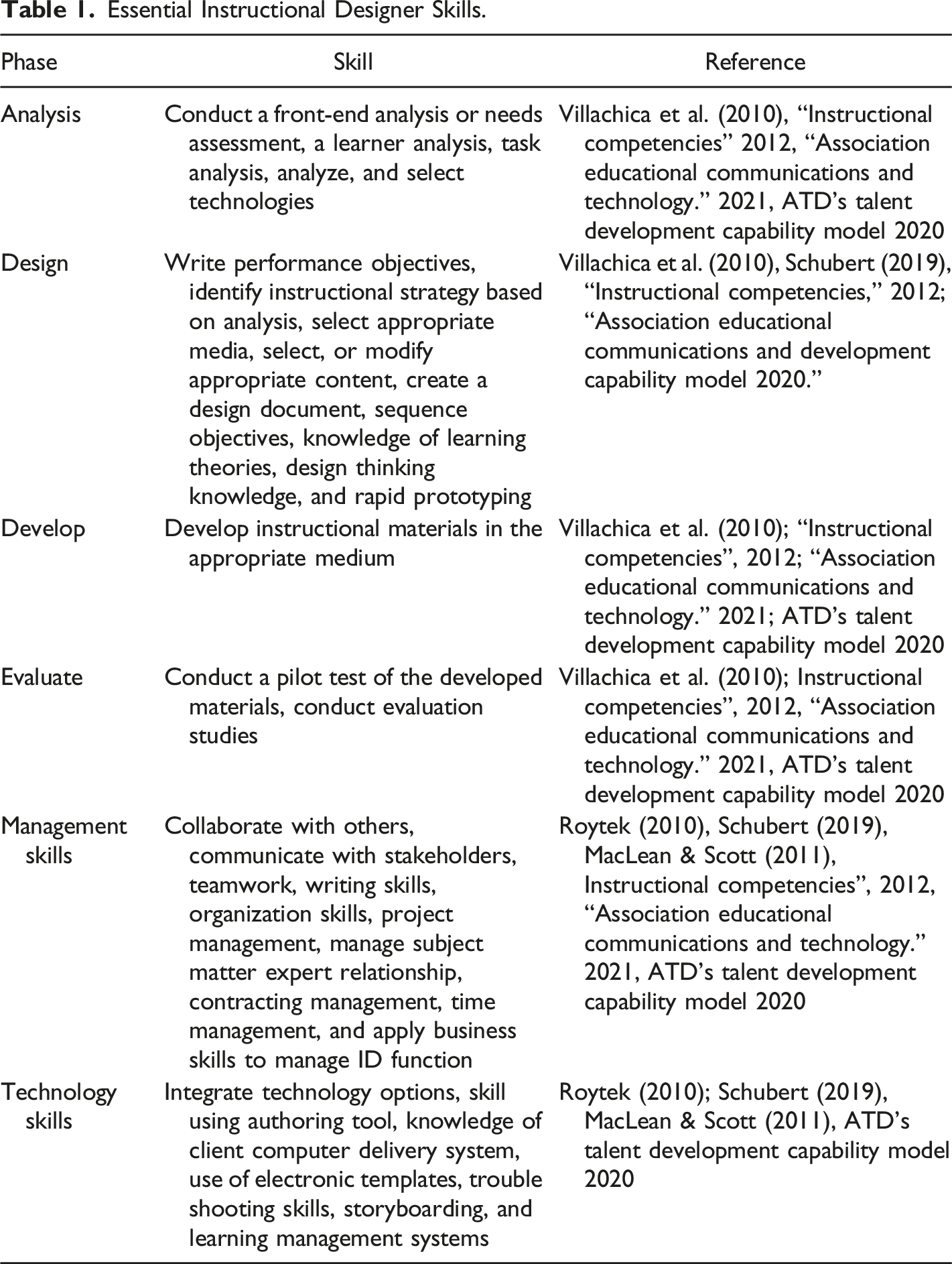
While other ID models exist (Dick et al., 2004; Morrison et al., 2019), most are deviations from the ADDIE model (Gustafson & Branch, 2002). The ID models signify similar competencies for instructional designers. The only recent differentiation is the design thinking competency, which the Association for Talent Development (ATD) added to its ID capability in 2020. (ATD’s Talent Development Capability Model, 2020). Design thinking emphasizes ideation among stakeholders for gap and target audience analyses and learning design. Table 1 summarizes the major ID competencies posited by “Association for Educational Communications and Technology, 2012”; “ATD’s Talent Development Capability Model.” 2020; “Instructional Design Competencies.” 2012; MacLean & Scott, 2011; Schubert, 2019; Villachica et al., 2010. Overall, these competencies are not exclusive, but they represent a benchmark.
User Experience Design
Unger and Chandler (2012) defined UXD as creating and synchronizing the elements that affect user experience in a company to influence their perceptions and behavior. Williams (2007) added that UXD is about designs that help us achieve goals by stimulating and satisfying our intellects, pleasing our emotions, and engaging our senses. At the same time, Borriraklert and Kiattisin (2021) stated that UXD is a way to make innovations work by observing a person’s emotion and the usability of a product, service, or system. To execute user experience (UX) designers are keen on how logic and a viable structure align with the user’s experience and needs and how this alignment leads to an emotional connection (Unger & Chandler, 2012). Subsequently, UX designers need design principles, processes, and research skills (Borriraklert & Kiattisin, 2021). In applying UXD, cognizance of three design levels, visceral, behavioral, and reflective, which evoke different emotions, is fundamental. Visceral design is about the initial impact of a product, the first interaction with its appearance, touch, and feel, while the behavioral level is about the product’s use and experience (Norman, 2004). Instrumental to the behavioral level are user, context, and task analyses. The user analysis yields an integrated persona profile that may include knowledge, competencies, motivation, attitude, objectives, tasks, and needs. In contrast, the task analysis yields a typology of knowledge, usage patterns, behaviors, attitudes, actions, and scenarios (Idoughi et al., 2012). Altogether, the user, contextual, and task analyses yield scenarios that inform the design. Finally, the reflective level engages the highest feelings, emotions, and cognitions. Therefore, the quality of the interaction matters because, through reflections, we create identities (i.e., pride, shame, failure) and possibly memories (Norman, 2004). To translate the visceral, behavioral, and reflective principles, UX designers need aesthetic, usability, art, technology, business, and project management skills (Borriraklert & Kiattisin, 2021).
Embedded in all services and products is user experience design. For example, UXD exists in our mobile phones and kitchen appliances. A vivid application of UXD, relatable to most people, is Instagram’s photo-sharing experience (Fabricant, 2013). From the educational perspective, UXD is essential for learning technologies because they impact learning experiences. In the realm of mental health services, Hackett et al. (2018) suggested that the experience-based co-design process helped engage participants’ voices and perspectives about their experiences in the quality of mental care. The youths advocated for mental services that validated, responded to, and adapted to their needs. Also, Idoughi et al. (2012) applied UXD to the e-maintenance service of an agro-alimentary business and advocated for using the persona in behavioral design. Buxton (2007) exemplified the shift from the techno-centric design to UXD in the words of the Italian climber Reinhold Messner, in speaking about the transformations in modern mountaineering: “… in the first 200 years of alpinism, it was the mountain that was the important thing. … But for some years now, especially on my own tours, it is no longer the mountain that is important, but the man, the man with his weaknesses and strengths, the man and how he copes with the critical situations met on high mountains” (p. 127).
Buxton (2007) offered that “A holistic design not only requires an ecosystem, but it also feeds one” (p. 52). The ecosystem includes multi-disciplinary teams where the UXD is constructed and reconstructed through design thinking. Subsequently, teams engage in creative, agile, and dialogic approaches that transcend inquiry, lead to new frameworks for meaning and action, contemplate the human experience, and determine the steps needed for the future (Barge, 2015). The design process embodies the reality that organizations are meaning-making spaces where learning and innovation, as social processes, are intimately tied to human emotions and rely on inexact methodologies (Liedtka et al., 2018). Inexact methodologies may include prototyping, usability checks, and iteration. Today, organizations use UXD widely as a strategy for all experiences, including corporate culture, customers, research, and lean product development (Fabricant, 2013). Wilson (2014) shared that UXD transcends all corners of the Apple organization, for example, everyone is thinking about UXD not just the designers. In summary, UXD is a high-involvement process where diverse teams and stakeholders (i.e., customers, engineers, leaders) continuously construct their experiences.
Summary
In reviewing ID and UXD, the focus is on the user. In UXD, the user’s visceral, behavioral, and reflective characteristics emerge through a socially constructed design process intertwined within an ecosystem. In contrast, ID encompasses a systematic, data-driven design process that yields learning experiences to improve performance. Lastly, ID and UXD rely on designers who can collaborate and ideate with multidisciplinary stakeholders internal and external to the organization.
Research Design
We used an exploratory case study design for this study. Tetnowski (2015) shared that an exploratory case study seeks to understand a phenomenon, particularly when there is minimal research to inform and guide the research question. The case included job announcements (JAs) posted on LinkedIn between August 1st, 2020 and September 30th, 2020 in the United States with the title learning experience designer.
Data Source and Sample
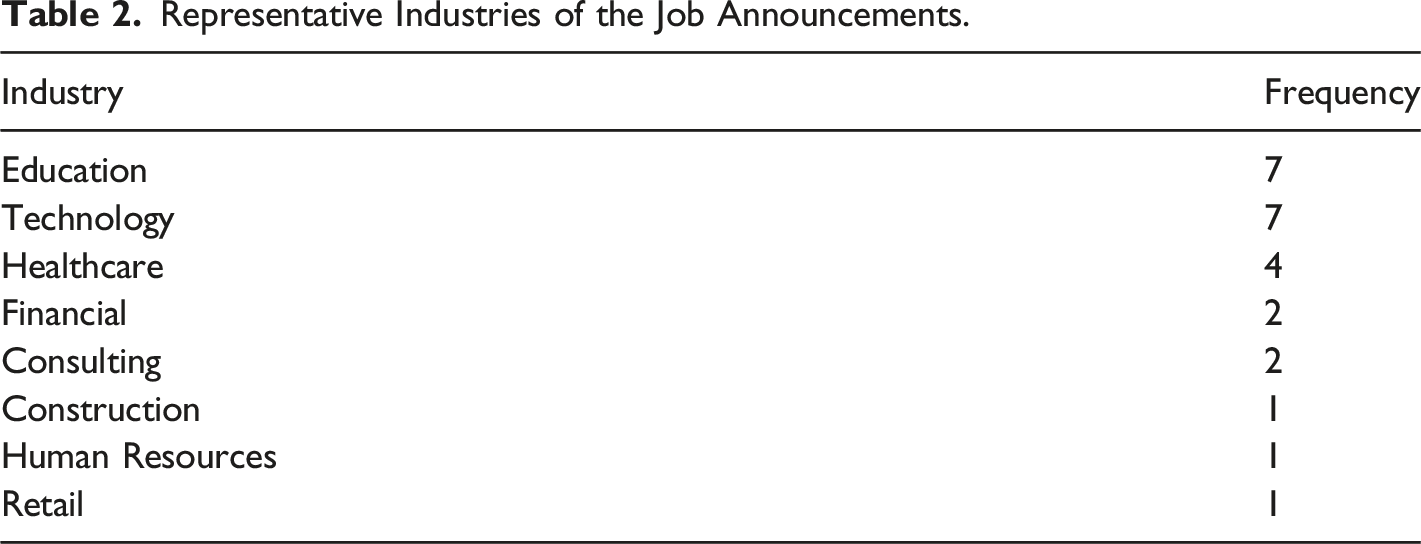
Representative Industries of the Job Announcements.
Data Analysis
We applied content analysis to review the job announcements. The content analysis included four steps: getting a sense of the documents, identifying themes, gathering meaning per the themes, and creating an overall skillset for an LX designer. In the execution of the four steps, we were cognizant of the language used to describe LXD skills. To make sense of documents, we read the job announcements twice. First, the objective was to review the full description to understand the employers’ understanding of LXD. In the second step, we created two documents; the first included a job overview, and the second had the skills expectations. After completing the two documents, we made two data sets. The first set included twelve job announcements, and the second included thirteen. We reviewed the first data set and identified the six recurrent themes (i.e., project management, adaptive, technology). Next, we reread the first data set and extracted the content aligned with the themes. Finally, we applied the same process to the second data set. Notably, two additional themes emerged. In the final step, we summarized the importance of themes and identified relevant statements, where applicable.
Integrity Measures
Trustworthiness is the credibility of the data and the dependability of the researchers’ conclusions (Barker & Pistrang, 2005). During the data analysis, we followed the practice of writing notes about our assumptions. After analyzing the data sets, as described above, we met with one LXD colleague, who has a master’s in human resource development and who has six years of LXD experience, to review the findings and clarify interpretations. In the end, the inter-rater analyses did not change the results, but it helped frame the discussion.
Reflexivity
Two of us are HRD faculty who teach graduate courses; one is a PhD student in HRD. One of us teaches instructional design and e-learning courses. Both courses have an applied problem-based approach where students apply ID and e-learning concepts to learning projects provided by companies. Resultantly, we made two assumptions: (a) that LXD is intertwined with instructional design and (b) that the learner, task, and contextual analyses are core to LXD. The inter-rater analysis helped to identify and bracket our personal experiences to interpret the data effectively (van Manen, 1990).
Results
Essential Instructional Designer Skills.
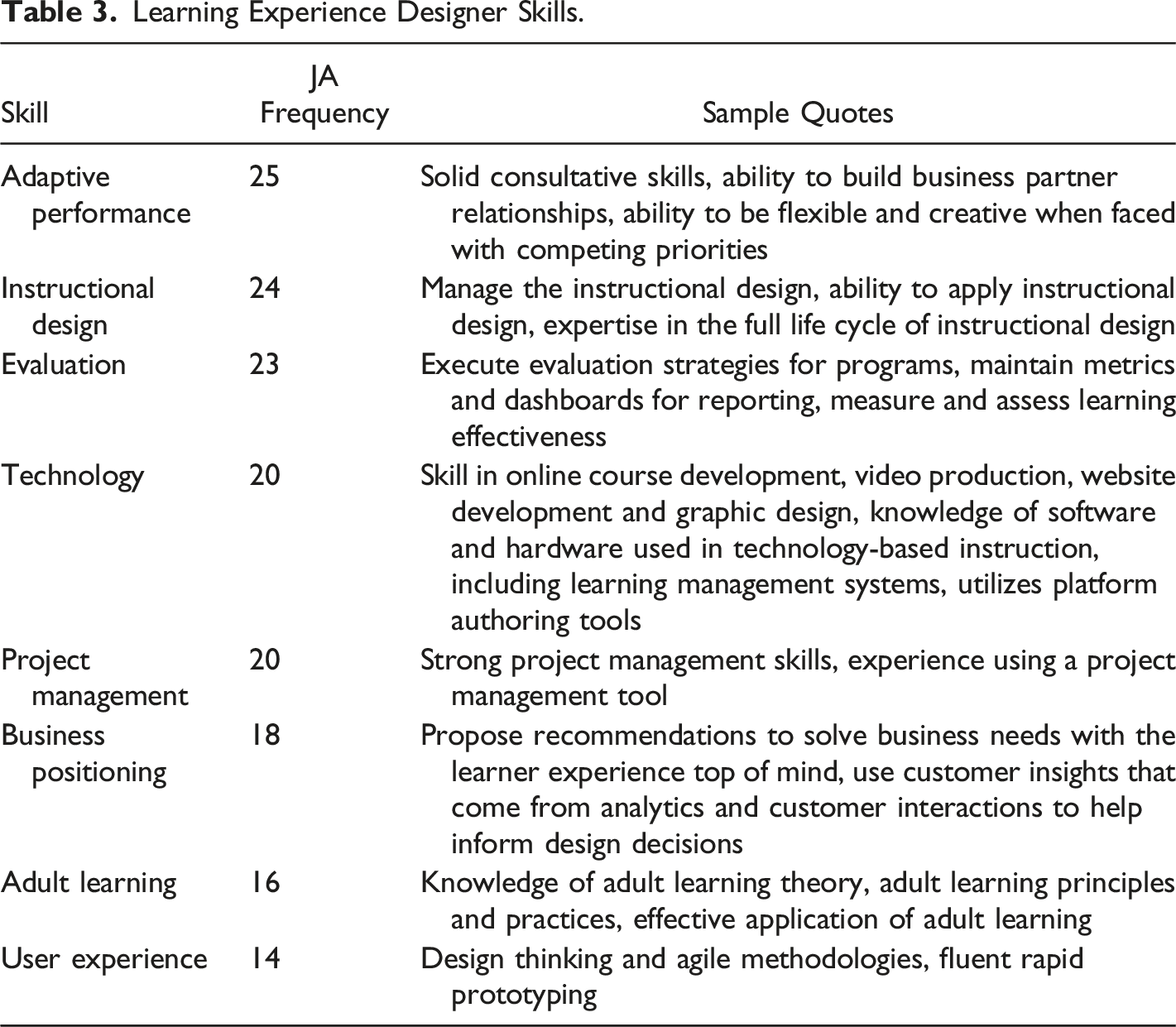
First, all employers, via the JAs, emphasized the significance of adaptive performance skills (APSs). Adaptive performance skills included consulting, collaboration, communication, problem-solving, creativity, paradox navigation, learning, risk-taking, presentation, writing, and relationship building. In addition, the JAs highlighted the significance of empathy, passion, agility, and humor. Per the adaptive skills, employers expect LX designers to execute their tasks in a consultative and collaborative manner with clients, subject matter experts, customers, and employees. Besides, consultation and relationship building with external stakeholders such as non-governmental organizations and the private sector were paramount. Also, employers expect LX designers to consult with the business teams to drive performance. However, only three JAs included consultation between LX designers and UX designers. The following statements showcase adaptive performance skills. “Utilize your creativity, consultative, problem solving … skills to provide clear and easy-to-understand learning solutions for our clients.” “Demonstrated problem solving skills; ability to proactively manage course design and development issues as well as project schedule.” “Experience in a growth organization where ambiguity, quick decision-making and change agility skills are an everyday occurrence.” “Proven track record in creating collaborative and influential partnerships with HR Strategic partners and stakeholders to create alignment between business strategy, goals, behaviors, and culture to drive performance.” “As a self-starter and a creative thinker, you will always look for new ways to approach problems, communicating your solutions in a timely, clear, and concise manner.”
Second, twenty-four job announcements included the need for instructional design (ID) knowledge and skills. The employers, via the JAs, indicated that the Analysis, Design, Development, Implementation, and Evaluation [ADDIE] and the Successive Approximation Model (SAM) models were significant. In addition, employers also emphasized problem analysis, needs assessment, learner analysis, task analysis, storyboarding, design, and assessment skills. Besides, per the JAs, LX designers must write effective performance objectives and align performance objectives with the design and evaluation. Employers referenced the significance of working with external and internal subject matter experts alongside this requirement. Prominent among the ID descriptions were words such as experiential, creative, interactive, performance-based, and learner-centered. The abovementioned skills were primarily linked to face-to-face training, e-learning, micro-learning, and mobile learning. The following statements highlight how the JAs positioned the ID skills. “Possesses and provides expertise in the full life cycle of instructional design processes to design, develop, and implement effective instructional materials, learning resources and content.” “…progressive learning and development experience in the field of instructional design, including significant experience in designing, curating, and rolling out an on-demand, digital learning strategy to large organizations.”
Third, evaluation skills were salient among twenty-three JAs. Employers aligned the evaluation skills with defining business cases and performance needs, analyzing technology tools and platforms, and evaluating learning effectiveness and return on investment. Learning experience designers will use internal and external data (customer insights) to define performance and business needs to inform learning design. A needs assessment was the recurrent front-end analysis tool identified in the JAs, although the JAs also included task and learner analyses. In addition, LX designers will define and design success metrics that align with business cases. The success metrics will require that LX designers continuously conduct program and learning evaluations. The JAs also heightened the need to evaluate the internal and external technologies to continually advance and maximize features and functions for learning continually. The significance of the evaluation skills hinged on client satisfaction and engagement. The following three statements describe the importance of evaluation skills, “Analyze on-demand, digital learning platform, program, and curated pathway effectiveness, and recommend continuous improvement methods, ensuring they are innovative and providing tangible value to end-users.” “Create and use strong success metrics to monitor and evaluate impact and ROI of learning development content.” “Use customer insights that come from analytics and customer interactions to help inform design decisions …” “Continually evaluate solutions for quality, behavioral and business impact, and scalability…” “Present and promote the use of qualitative and quantitative data in the design and development of learning experiences.”
Fourth, twenty JAs included technology skills which fell into six categories. Fifteen of the twenty JAs indicated the need for authoring skills with Articulate 360 and Captivate. Nevertheless, employers also cited SnagIt, RoboHelp, MadCap Flare, and iSpring. Twelve JAs called for Adobe Creative and Microsoft Office Suite skills, while eleven JAs highlighted video production and editing skills related to Camtasia, GoAnimate, and Premier Pro. Seven JAs referenced the need for learning management skills. Only five JAs alluded to technology related to user experience design, specifically the Framer and Figma prototyping skills. Also, only five JAs included gaming, simulations, augmented reality, website creation, and graphic design. Overall, per the JAs, employers linked these technology skills with e-learning, micro-learning, podcasts, videos, and communities of practice. The following statements represent the technology stipulations, “Experience with learning experience platforms and emerging technology trends for content creation, e.g., gamification, social learning, virtual reality, augmented reality, podcasts, etc.” “Experience using video editing tools (Final Cut, Adobe Premier, After Effects, Camtasia or similar), and experience using eLearning development software (Articulate Storyline).”
Fifth, twenty JAs indicated that LX designers should have project management skills. These skills include communication, project scoping, defining specifications, tracking progress, and achieving outcomes. Employers expect the LX designers to show PM effectiveness in diverse environments (i.e., face-to-face, virtual) that encompass diverse audiences. The JAs showed that PM is vital for successful outcomes that positively impact the business. The following are two statements, “Strong project management skills with ability to lead multiple, complex projects with tight time frames in a matrixed environment.” “Use strong project management skills in developing outcomes that positively impact the business.”
Sixth, employers, per the eighteen JAs, sought LX designers with business positioning skills. LX designers will frame learning as a business value proposition. Also, the LX designers will build partnerships with multiple internal (i.e., operations, engineering) and external stakeholders (i.e., customers, suppliers) and interpret context and data to frame the business cases. Employers want the LX designers to learn the business quickly and its strategic capabilities to align learning and development (L&D) efforts. The following statements emphasize the business positioning skills, “…create highly interactive learning solutions that improve … business performance, flexes with business strategy changes and acts as a key contributor in a complex environment…” “…alignment with the business, partner with our teams and global product business teams to support employees…” “Work with … business units, outside provider organizations, and outside vendors to develop and maintain success metrics for professional … offerings”
Seventh, via sixteen JAs, employers want LX designers to know and apply adult learning theories. The LX designers will know a broad range of theories, some of which are (a) cognitive psychology, (b) cognitive apprenticeship, (c) experiential learning, (d) situated learning, (e) andragogy, and (f) systems thinking. Learning experience designers will apply adult learning principles and create engaging, learner-centered experiences and materials. The learning experiences referenced in the job announcements were face-to-face instruction, e-learning, and micro-learning. Also, employers want LX designers to conduct learner analyses to make sense of target audience characteristics. The following statements highlight how employers phrased the learning theory expectations. “Apply what you know about adult learning and share what you learn along the way with the rest of the team.” “Demonstrated knowledge and experience in the effective application of adult learning approaches …” “Display demonstrated expertise in … adult learning best practices…”
Lastly, user experience design (UXD) skills appeared in fourteen JAs, representing all industries. The UXD skills incorporated an understanding of UX design, prototype development, and usability. In addition, the LX designers should have a mindset and skills for design thinking and agile methodology. However, only one of the fourteen JAs explicitly mentioned the user persona’s creation, maintenance, and applicability. The following statements offer UXD perspectives. “Fluent in design thinking, rapid prototyping, and agile methodologies. “Support innovation lab ideas and projects using design thinking and stage gate framework to reimagine the educational experience through a wide variety of emerging educational technologies.” “Utilize creative problem solving and design thinking to develop and enhance alternative approaches to learning experiences.” “Collaborate with the people development team to take high-level requirements and develop prototypes to rapidly test and iterate learning solutions.” “Lead design sprints and ideation exercises with cross-functional teams. Use a variety of tools, such as UX prototyping software and content authoring tools, to create rapid prototypes and final designs.” “Conduct user tests with students and educators to find opportunities to improve designs and products.”
Discussion
The results indicated that when employers seek an LX designer, they want a strategic learning partner who aligns learning with the business and is keenly aware of the omnipresence of change on business outcomes. The LX designer helps leaders define and meet strategic capability. For example, employers expect LX designers to learn with and about external customers because learning can offer a unique customer value proposition. Today, customers are integral to L&D initiatives (i.e., customer and leadership development) because LX designers can develop and accelerate employees' capability by learning with and from customers and the broader business context. Business positioning is not new; Larson and Lockee (2008) emphasized that knowing the business case that underlines learning interventions is salient. However, Anand (2022) shared that due to market shifts, increased stakeholder input, technology advancement, and flexible value chains, learning professionals must go beyond the performance challenges of today and help business leaders envision a human capability future.
Per the JAs, employers also want adaptive LX designers. Adaptive performance skills are a significant priority for today’s workforce (Spar & Dye, 2018; Strauss, 2017; World Economic Forum, 2015). Research shows that employees without adaptivity skills flounder with proactive behaviors, implicating strategic, relational, and normative knowledge (Dutton et al., 2001; Strauss, 2017). LX designers develop and sustain relationships, communicate effectively, solve problems, be creative, and navigate ambiguity amid organizational uncertainty and disruption. LX designers are proactive, responsive, and results-oriented. These findings affiliate with Williams van Rooij (2013), who found that interpersonal skills are relevant for learning professionals. Resultantly, there is a need for faculty to explore how they intertwine APS with LXD skills. In a critical incident analysis of failures and successes on the job, Waight and Greer (2021) found that HRD professionals, some of whom are learning specialists, who applied emotional intelligence, consulting, effective communication, and analytic thinking were adaptive. Overall, APS is essential for LX designers because it helps them with what Adair (2007) called anticipatory thinking (what to expect next), triangular thinking (multiple perspectives), and abductive thinking (making the most reasonable guess).
This study also showed employers want LX designers to apply a diagnostic approach to learning design. In the JAs, the ID skills emphasized the ADDIE model, which included diagnosing (i.e., need, learner, task), designing, developing, implementing, and evaluating the learning experience. This planned approach to creating learning experiences emphasized the human performance model, which focuses on systematically analyzing the root cause (s) of problems, considering solution(s), and implementing a solution (Rothwell et al., 2015). The rapid prototyping, project management, technology, and business positioning skills listed in the JAs also hinted that LX designers plan for and manage data, time, quality, and cost. This study supports the ID, technology, and project management skills purported by North et al., 2021; Nworie, 2022; Raynis, 2018. Hence, the JAs suggest LX designers need to be responsive to business needs, use data to inform their designs, and be mindful of effectiveness and efficiencies.
The term UXD appeared in more than half of the JAs and was primarily focused on design thinking and agile methodology skills. This finding is not unique to only LX designers. The ATD capability model includes design thinking as a knowledge base for instructional designers. In this study, employers want LX designers to use design thinking for alternative thinking and ideation conversations toward innovative learning experiences. Design thinking is a process in which humans collaborate, problem framing evolves, and prototypes and solutions emerge without specific data parameters (Liedtka et al., 2018; Roehrig et al., 2015). Design thinking can also guide designers toward meeting business goals by leveraging available resources (Anand, 2022). To capture a more encompassing UXD skill set, we encourage employers to emphasize three design levels; visceral, behavioral, and reflective (Norman, 2004). We also suggest that employers emphasize the emphatic mindset. Smeenk et al. (2019) found that UX designers who understand and can navigate context and have emphatic skills achieve more profound meaning-making with stakeholders. A deeper meaning is essential because LX designers help leaders with today’s performance challenges and enact L & D strategies that influence workforce and talent development transformations (Anand, 2022).
Limitations
Job announcements are rich data sources (North et al., 2021; Nworie, 2022; Sugar et al., 2012), and in this exploratory case study, we looked at 25 jobs on one job site for two months. Given the dynamics of companies and the job market, a more comprehensive data source may offer insights into how LX designer skillset cluster across industries.
Implications
The following implications offer research, practice, and teaching strategies that can enrich the LX designer discourse and professionalization.
Implications for Human Resource Development Research
Given that the professionalization of LX designers is core to HRD programs, we propose three studies. First, the results in this study emerged from twenty-five LX designer job postings. A replication study with more JAs over a longer timeframe can compare and strengthen the key constructs that emerged in this study across industries. Second, Nworie (2022) shared that employers in the education industry may require different design skills than those of business and industry. Like Schmidt and Huang (2021), this study showed that an LX designer draws knowledge and skills from various disciplines and theories. Although boundaryless, this study saw the emergence of the business, education, and psychology disciplines. We suggest a study that further explores the work of LX designers via interviews and observations to extrapolate the thinking in use. Finally, the evolutionary nature of the LXD can pose challenges for faculty who teach in these programs (Nworie, 2022). Faculty may be prone to teach what they have been taught and, in the process, disregard the employability landscape (Larson & Lockee, 2008).
Consequently, a study on what HRD faculty teach and how they innovate toward LX designers' professionalization is necessary. This study may help HRD faculty introspect on the employability potential they perpetuate in their learning design courses.
Implications for Human Resource Development Practice
Learning Experience Designer Skills.
Implications for Teaching
Employers expect LX designers to showcase various technical and adaptive skills per this study. For HRD faculty, these skill requirements raise questions about the relevance of HRD programs and courses. Hence, HRD faculty may consider an outside-in approach to ensure continued relevance with employers’ needs and students’ employability. For example, annual focus groups with LX designers can be instrumental in understanding their work and skills. Similarly, partnering with an LX designer as a guest speaker or lecturer adds timely perspectives. Also, LX designers can serve as software and process informants, adding value by helping students with templates, language, and processes. Lastly, HRD faculty should consider the content and learning experience as technical and adaptive skills conveyors. In this vein, creating partnerships with employers where the employer provides meaningful projects to students is a tactic that can result in employability, referrals, and lasting relationships. These projects trigger students' adaptive skills because they must consult, communicate, and adapt to the employer’s needs and context amidst a changing environment. While the projects will result in technical outcomes, in processing with students, the antecedents, moderating behaviors, and results of their overall experience, notions of the adaptiveness emerge. During this reflection, faculty can listen to the students' language and help them process their reactions to change and paradoxes.
Conclusion
In this study, we explored, using JAs, what skills employers want from a LX designer. The results revealed employers want eight major skills: adaptive performance, instructional design, evaluation, technology, project management, business positioning, adult learning, and UXD. Overall, the 25 employers see an LX designer as an expert that leverages diagnostic (i.e., needs assessments, task and learner analyses, performance objectives, business case); UXD (design thinking, alternative thinking, agile methodologies); and adaptive approaches (i.e., critical thinking, problem-solving, creativity, paradox navigation) to design learning experiences. Employers also see an LX designer as a project manager who can identify business cases, apply relevant technology skills, and communicate the impact of the learning transformations through evaluation. In addition, adaptive performance is instrumental to the LX designer skill discourse. Learning experience designers need adaptive performance skills to navigate the emergence of volatility, uncertainty, complexity, and ambiguity. This study supports the view that LX designers need ID and UXD skills (Chang & Kuwata, 2020; Kilgore, 2016; Schmidt & Huang, 2021). Yet, the UXD skills identified in this study came from 14 JAs which means that for some employers the term LX designer may be synonymous to instructional designer. Also, this study showed that the JAs inclusive of UXD did not require diverse UXD skills, for example, visceral, behavioral, and reflective design skills.
Footnotes
Declaration of Conflicting Interests
The author(s) declared no potential conflicts of interest with respect to the research, authorship, and/or publication of this article.
Funding
The author(s) received no financial support for the research, authorship, and/or publication of this article.
