



Abstract
Superstitions are common phenomena in human society, especially in Asian cultures. Superstitious beliefs can have a negative impact on the social well-being of people in society because they are highly associated with financial risk-taking and gambling behaviors. This study looks at the effects of different types of superstitious belief (proactive vs. passive) on consumers’ risk-taking behaviors. Categorized based on the characteristics associated with an illusion of control in a situation, proactive and passive superstitious beliefs were found to show differences in risk-taking behaviors. The results demonstrate that passive superstitious beliefs increase the likelihood of engaging in risky behaviors when a superstitious object is introduced. The research suggests social marketing and public policy implications.
Keywords
Superstitions are common phenomena in human society (Torgler, 2007). Some Eastern cultures rely on numbers, forces, or astrology to make what they believe is a right decision (Hernandez, Wang, Minor, & Liu, 2008). Chinese consumers are willing to pay premiums for the “right” phone number, with combinations like 888, because they believe that the digit 8 is associated with luck or prosperity (Yardley, 2006). Across different cultures, many people believe that behaving in a certain superstitious way can create good luck (e.g., using a magic pen) or can bring them bad luck (e.g., breaking a mirror). Superstitious beliefs help people cope with uncertainty and alleviate anxiety (Rice, 2003). For instance, many studies demonstrate that superstitious beliefs among athletes may have a positive effect on performance by reducing psychological stress and anxiety levels in order to build confidence (Burger & Lynn, 2005; Foster, Weigand, & Baines, 2006; Schippers & Van Lange, 2006).
Superstitious beliefs sometimes negatively impact the social well-being of people in society. Most superstitious beliefs are highly associated with financial risk-taking and gambling behaviors (Darke & Freedman, 1997; Joukhador, Blaszczynski, & Maccallum, 2004; Xu, Zwick, & Schwarz, 2011). People who exhibit more superstitious beliefs in gambling tend to have higher gambling intensity (e.g., number of gambling sessions per week, level of debt, and time spent gambling; Joukhador et al., 2004). These risk-taking behaviors can lead to several individual problems, such as addiction, depression, financial loss, and a negative impact on work and relationships (Hume & Mort, 2011), and societal problems such as increased crime, theft, domestic violence, suicide, counterfeiting, and money laundering (Wynne & Shaffer, 2003).
The degree to which individuals rely on superstitious beliefs in their decisions depends on various factors, such as associated level of stress (Keinan, 2002), the importance of outcomes (Pongsakornrungsilp, Pusaksrikit, & Schroeder, 2011), the desired level of control (Case, Fitness, Cairns, & Stevenson, 2004), and uncertainty (Schippers & Van Lange, 2006). Previous studies also identified other superstition antecedents that heighten superstition tendencies including a stronger belief in fate, weaker belief in religion, and lesser need for learning (Mowen & Carlson, 2003; Rudski & Edwards, 2007; Torgler, 2007). In terms of consequences, superstition is found to be positively related to irrational purchases (Block & Kramer, 2009), gambling propensity (Mowen, Fang, & Scott, 2009; Wu, Lai, Tong, & Tao, 2013), and brand logo sensitivity (Wang, Hernandez, Minor, & Wei, 2012). Although existing literature examines several antecedents and consequences of superstitious beliefs, there is still a lack of research on individual differences in superstitious beliefs and how they affect individuals’ risk-taking behaviors.
Surprisingly, not many studies have investigated the effect of superstition in a social marketing context. Existing research primarily examines superstition in organ donation marketing. A study by Lwin, Williams, and Lan (2002) extended the scope of social marketing initiatives by investigating how superstitious beliefs affect individuals’ attitudes toward organ donation. They found that, in Asian societies, individuals who have strong superstitious beliefs are more likely to have negative attitudes toward organ donation. Thus, the superstitious beliefs are likely to create barriers toward organ donation leading to lower benefits to society as a whole. Although it is a challenge for marketers to overcome individuals’ superstitious beliefs and to promote organ donation (Clarke, 2007), marketers need to focus their efforts on addressing spiritual concerns (Lwin, Williams, & Lan, 2002). Based on prior findings, knowledge of the impact of superstition on social marketing initiatives can be very important to social marketers.
This research investigates the link between superstition and risk-taking behaviors including gambling and financial decision-making. Prior research found that problem gambling has been relatively overlooked in the study of risk-taking behaviors, even though gamblers experience multiple negative consequences, as they accumulate significant debt (Engwall, Hunter, & Steinberg, 2004). Moreover, individuals who show one type of risk-taking behavior tend to engage in other addictive behaviors, such as drug and alcohol use, high-risk sexual behavior, gambling, and eating disorders (Gambino, Shaffer, & Cummings, 1992). In this research, risk-taking activities can cause social problems due to one’s loss of control, especially when marketers apply marketing tools that have encouraged or influenced individuals’ risk-taking behaviors (e.g., advertising for online gambling, promoting sweepstakes, and giving out lucrative bonuses in online gaming).
Thailand is a country of superstitious people with almost everybody believing in good and bad luck. Superstitious beliefs play an important role in Thai consumer and business decisions (Ehrlich, 2009a, 2009b). For example, Thai lottery gamblers may spend several hours rubbing a tree’s gnarly bark hoping to see a lucky number appear in the wood’s swirling grain (Ehrlich, 2009b). Unlike Chinese and Japanese cultures, the lucky number in Thai culture is 9 because it is pronounced similar to the word progress or moving forward. The license plate ending with 9999 received the highest bid in the license auction. Many startup business owners consult with a numerologist before setting a store or business opening date. The country is also the world’s largest producer, seller, and exporter of amulets (Ehrlich, 2009a). These facts make Thailand an interesting country in which to study superstitious beliefs and how they affect consumer risk-taking behaviors.
Prior research found that people differ in their superstitious beliefs and that such differences predict superstitious behavior (Fluke, Webster, & Saucier, 2014). Hernandez, Wang, Minor, and Liu (2008) proposed a framework that identifies two types of superstitious beliefs—proactive and passive. Proactive superstitious beliefs allow individuals to seek control over the situations around them. In contrast, passive superstitious beliefs involve circumstances in which the outcomes lie beyond their control. The purpose of this research is to generate a deeper understanding of the effects of these different types of superstitious beliefs on risk-taking behaviors.
The most commonly known consumer risk-taking activities are generally associated with gambling, financial decisions, and entrepreneurial pursuits (Krueger & Dickson, 1994; Mandel, 2003; McGregor, 2006). However, relatively little is known about how consumers make risky decisions based on superstitious beliefs, even though risk-taking behavior is relevant to a high uncertainty level, which can be driven by superstitious beliefs (Byrnes, Miller, & Schafer, 1999). Thus, this study aims to extend our understanding of how superstitious beliefs affect risk-taking behaviors, particularly among Thai consumers. By introducing a superstitious object, we attempt to examine how it affects proactive and passive superstitious consumers’ risk-taking behaviors, including engaging in financial investment and participating in sweepstakes.
Theoretical Background
Superstitious Beliefs
According to the American Heritage Dictionary of the English Language (1985), superstitious beliefs refer to irrational beliefs that an object, action, or circumstance, not logically related to a course of events, influences its outcome. Superstitious beliefs can fall into multiple categories (Carlson, Mowen, & Fang, 2009). The category that is commonly used in assessing superstitious beliefs is divided into two types: negative superstitions that involve certain behaviors or omens that are associated with unlucky or harmful consequences (e.g., breaking a mirror, walking under a ladder, or using the number 13) and positive superstitions that involve a desire to bring about lucky or preferable consequences (e.g., carrying a lucky charm, touching wood, or crossing fingers; Fluke et al., 2014; Wiseman & Watt, 2004). Fluke and his colleagues (2014) found differences in positive and negative superstitious beliefs toward lottery drawing behavior. Their results show that only consumers who believe in negative superstition are more likely to report greater confidence in winning a lottery with their selected numbers.
Individual Difference in Superstitious Belief: Passive Versus Proactive
Besides positive and negative superstitious beliefs, Hernandez et al. (2008) categorized superstitious beliefs based on characteristics associated with situations in which the individuals either lack control of their luck or take charge of their luck. Hernandez and colleagues classify these two types of superstitious beliefs as (1) passive superstitious beliefs that involve circumstances in which the outcomes lie beyond one’s control. It implies that an event was meant to be explicitly predetermined by prior unseen forces; (2) proactive superstitious beliefs that involve ritual behaviors that consumers perform to keep bad forces away and bring in good forces. These beliefs allow consumers to seek control over the situations around them such as carrying magic pens and performing superstitious rituals (Hernandez et al., 2008). Hernandez et al. (2008) found that proactive superstitious beliefs positively influence consumer novelty seeking, whereas passive superstitious beliefs negatively influence consumer novelty seeking. In addition, their results support that consumers who hold passive superstitious beliefs are less likely to depend on others for judgment and decisions.
The use of superstitious objects (e.g., lucky charms, amulets, or sacred items) and rituals is often noted in gamblers, and their importance may lie in the potential to develop control illusions (Joukhador et al., 2004) and help individuals confront uncertainty (Pongsakornrungsilp et al., 2011). Existing research reported that the interaction with superstitious objects usually results in changing behavior (Block & Kramer, 2009; Damisch, Stoberock, & Mussweiler, 2010). Damisch, Stoberock, and Mussweiler (2010) found that participants performed better in a putting task when they were handed a superstition-activated golf ball (lucky ball). Another instance is demonstrated by Block and Kramer (2009). The Asian participants who believed that red was a lucky color indicated that they were more likely to buy a rice cooker in red (superstition activated) than one in a neutral color (green). Kramer and Block (2014) also found that individuals who are high in experiential processing scored higher in creative tasks when they were exposed to superstition-activated experimental stimuli (previously touched by high performer).
Prior research found that the specific consequences of superstitious beliefs are not likely to be the same for all consumers (Block & Kramer, 2009; Kramer & Block, 2008; Mowen et al., 2009; Wang et al., 2012; Wu et al., 2013). Some superstitious individuals who want to take control of their fate may change their risk-taking behavior if they receive sacred or magical objects (Wiseman & Watt, 2004). It is possible that the differences between these proactive and passive superstitious beliefs can influence consumption patterns in different ways. Thus, this research employs the concept of Hernandez et al.’s (2008) superstitious beliefs to understand the impact of superstitions on risk-taking behaviors.
The Effects of Superstitious Beliefs on Risk-Taking Behaviors
Risk-taking behavior is defined as an individual’s decision-making behavior in situations that involve uncertainty of outcomes and the possibility of loss (Sitkin & Pablo, 1992). Generally, an individual’s risk-taking behavior is influenced by a combination of the personal, environmental, situational, and definitional aspects of the decision (Coleman, 2007). Carlson, Mowen, and Fang (2009) found that superstition is positively associated with risk-taking behavior and uncertainty, which includes gambling interest, sport fanship, interest in promotional games, and financial investment decision-making. In regard to various types of risk-taking behaviors, existing research on superstition mainly focuses on the influence of superstitious beliefs on gambling activities. Prior research examines the effect of superstitious beliefs on lottery gamblers’ behavior based on the frequency of play, the amount of money gambled, and the number of tickets purchased (e.g., Burns, Gillett, Rubinstein, & Gentry, 1990; Rogers & Webley, 2001). Superstitious beliefs are found to be correlated positively with frequency of lottery gambling and gambling intensity (Joukhador et al., 2004; Rogers & Webley, 2001).
Like gambling, investing in the stock market and participating in promotional games (contests, drawings, and sweepstakes) involve risky behaviors and uncertain outcomes (Carlson et al., 2009). A number of studies have specifically explored increased use of superstitious beliefs in the context of financial and investment decision-making as well as decisions to participate in promotional games (Carlson et al., 2009; Darke & Freedman 1997; Jiang, Cho, & Adaval, 2009; Prendergast & Thompson, 2008). Darke and Freedman (1997) examined the effects of lucky events and irrational beliefs on risk-taking behavior. They found that individuals who believed in luck (superstitious individuals) were more confident and bet more after they experienced a lucky event. Moreover, Carlson et al. (2009) show that superstitious consumers who engage in risk-taking activities believe that their superstitious actions influence the likelihood of investing in a profitable stock and winning a contest. Prendergast and Thompson (2008) found that a positive superstitious belief was significantly associated with the choice of entering a sweepstakes as compared to receiving a discount or a coupon. Jiang, Cho, and Adaval (2009) showed that consumers were likely to invest more money in a riskier online trading account than into a less risky choice when they were primed with lucky numbers compared to when they were primed with unlucky numbers.
Each individual differs in their propensity to express superstitious behavior depending on their level of expected outcomes from uncertain and risky situations. It is possible that people who have different types of superstitious beliefs will behave differently in terms of risk-taking behaviors. This research applies the framework from Hernandez et al. (2008) and investigates the differences between two types of superstitious consumers, passive and proactive, in their risk-taking behaviors. It is useful to turn to attribution theory to explain the differences between these two superstitious beliefs. This research proposes Weiner’s (1985) three major dimensions of attribution theory that determine causal inferences, which are locus of causality, stability, and controllability.
Locus of causality refers to the perceived origin of the cause for the outcome. This dimension appears as a continuum from internal to external attributions. Internal attribution refers to the effort or ability of the person being observed, whereas external attribution refers to situational factors that are often beyond the observed individual’s control (Harvey, Madison, Martinko, Crook, & Crook, 2014).
The second dimension, stability, refers to the perceived persistence of the cause. Ability is perceived as a more stable cause of success than effort. The stability of a cause can increase or decrease the emotional and behavioral responses driven by the locus of the attribution (Harvey et al., 2014).
The third dimension, controllability, refers to the extent to which an individual perceives the cause of an outcome to be under someone’s decision (Weiner, 1985). Controllability can be exercised by oneself (internally) or by someone else (externally). There is some overlap between these three dimensions. For instance, effort, which is usually viewed as internal and unstable, is most often seen as controllable, whereas task difficulty, which is seen as external and stable, is most often viewed as uncontrollable (Harvey et al., 2014). Through the use of attribution theory, people attempt to establish control over their lives and improve their ability to predict future events (Eberly, Holley, Johnson, & Mitchell, 2011).
Hypothesis 1
Following this view, Hernandez et al. (2008) explained that proactive superstitious consumers tend to believe in their ability to control external forces through practicing superstitious rituals, such as carrying a lucky charm and practicing feng shui. On the other hand, Hernandez et al. noted that passive superstitious consumers tend to believe that they are controlled by the external forces. They also believe in determined destiny and accept situations as they are meant to be. When confronted with uncertainties, proactive superstitious individuals tend to put a strong effort toward engaging in ritual behaviors because these rituals are viewed as a means to bring good luck and keep bad luck away. Engaging in these superstitious rituals is found to be associated with risk-taking and novelty seeking (Hernandez et al., 2008). On the other hand, passive superstitious individuals believe that their life is controlled by external forces. They are less likely to seek novelty and new experiences (Hernandez et al., 2008). Thus, when engaging in risk-taking activities, it is possible that proactive superstitious consumers who like to control external forces may already actively practice the superstitious rituals to bring good luck before they make the decision. Therefore, they may be more willing to take part in risky decisions. The following hypothesis is proposed:
Hypothesis 2
According to Coleman (2007), the decision-making style of risk-takers is driven by their beliefs in luck and superstition. West and Berthon (1997) also support that successful risk-takers tend to believe that they have special abilities to beat the odds and that nature is good to them. In addition, superstitious behavior will be most evident when a person perceives success as dependent on external factors (Schippers & Van Lange, 2006).
To understand how these two superstitious groups respond to risk-taking activities when their superstitions are activated or when they enter a situation where they confront uncertainty, we introduced congruency theory into this context. Congruency theory assumes that individuals’ needs, desires, and preferences are correspondent with situations, rewards, and gratification. This theory suggests that individuals tend to be more responsive to situations or messages that are consistent with their own cultural beliefs, self-concept, and attitudes (Cui & Yang, 2009). Previous literature provides support for the notion that individuals’ selves are projected onto product choices and that they seek products with images congruent with their concept of self (Emile & Sangwan, 2014). Thus, congruency theory is useful for examining the effects of exogenous variables on consumer responses. It is employed to illustrate the extent to which an individual’s beliefs regarding her or his own skills are in accord with the actual activities or requirements of the job or major in which that person works (Spokane, Meir, & Catalano, 2000).
We propose that when providing magical objects to both superstitious groups, the passive superstitious consumers may engage in more risk-taking behaviors than their proactive superstitious counterparts. Passive superstitious belief is positively associated with a belief in fate and magic. In addition, passive superstitious individuals believe that they do not have control over external forces. According to congruency theory (Cui & Yang, 2009), providing a magical object to passive superstitious consumers is congruent with their existing beliefs in fate and magic. Therefore, the magical object may be used as a cue provided by external forces that can guide them to a better outcome. Moreover, in some situations, the magical belief can increase the task performance, as consumers believe that the situation will improve as a consequence of some magical approaches (Keinan, 2002). On the other hand, proactive superstitious consumers who believe in their ability to control their own fate and luck (effort attribution) may feel that they lose control over their fate when given a magical object. Therefore, they may be less likely to engage in risk-taking behaviors.
Method
Research Design
Thailand is selected as a setting for this study because of the propensity of Thai consumers to have strong beliefs in astrology and to love risky activities (Thairungroj & Surinjamlong, 2007). They often use various ways of employing superstitious rituals in their daily life (Ariyabuddhiphongs & Chanchalermporn, 2007). In addition, there is a lucrative business for soothsayers and fortune-tellers throughout the country (Chaitrong, 2010). Thus, examining superstitious behavior in Thailand will help broaden the relationship between superstition and risk-taking phenomenon.
Prescreening questionnaire
Participants were undergraduate students at a university in Thailand. Prior to the study, the participants completed a prescreening questionnaire containing the Proactive–Passive Superstitious Scale adapted from Hernandez et al. (2008). The scale was modified to fit the participants’ cultural beliefs and background (see Appendix). It used a 5-point scale with 1 = strongly disbelieve and 5 = strongly believe. Proactive superstitious items included statements such as “Carrying a lucky charm will bring good luck,” “Performing a team ritual before a football match will lead the team to win,” and “Houses and buildings placed in auspicious land and appropriate location are good for its fortune flow” (Cronbach’s α = .87). Passive superstitious items included statements such as “In many situations what happens to people is determined by fate,” “Number 8 and 9 attract good luck,” and “With fate the way it is, many times I feel that I have little influence over the things that happen to me” (Cronbach’s α = .82). The prescreened participants who scored an average or higher in either proactive (Mproactive = 2.71) or passive (Mpassive = 3.06) items were invited back to participate in the next step.
Participants and design
Undergraduate students (N = 114, male = 18, female = 96) who completed the prescreening questionnaire participated in the study in exchange for extra credits. The study was conducted in a 2 (proactive vs. passive) × 2 (magic pen vs. no magic pen) between-subjects design.
Procedure
The participants were invited to participate in a study about managerial decision-making. Both proactive and passive superstitious participants were randomly assigned to one of the two conditions (magic pen vs. no magic pen). The magic pen conditions were adapted from Damisch et al. (2010). According to the attribution theory, being given a magic pen could be seen as external attribution and it was also beyond the individual’s control (uncontrollable) similar to stumbling across a four-leaf clover or finding a lucky penny. After the experimenter distributed the paper questionnaire to the participants, he handed out a “magic pen” to each participant. The participants were told that they could use the pen to complete the questionnaire and that they could keep the pen after the study, as it was a token of appreciation to compensate for their time. The experimenter told the story that he received the pens from a monk at a sacred temple and they were supposed to bring good luck and prosperity (in Thai culture, any item consecrated by a monk is generally treated as a magical object). In addition to storytelling, the experimenter showed the picture of how he received the consecrated pens from the monk to the participants in order to create the belief toward the sacred (magic) pen (see Figure 1). In the no magic pen conditions, the experimenter distributed the questionnaire and handed out pens to the participants without telling the story. The participants were told that they could use the pens to complete the questionnaire and could keep the pen, as it was a token of appreciation to compensate for their time.

Picture showing how the experimenter obtained consecrated (magic) pens.
Dependent variables
In the study, two types of risk-taking were examined. First, the participants read a scenario on managerial decision-making, which was akin to a decision involving financial risk. The scenario was adapted from Xu, Zwick, and Schwarz (2011) where the participants assumed the role of a chief executive officer of a computer manufacturing company. They had to make a decision on whether to adopt or reject a product improvement program recommended by the research and development department. The decisions read as follows:
After reading the scenario in the questionnaire, the participants selected the decision of their choice. Then, they were to report their relative preference between the two options on a 1 (strongly prefer Decision A) to 10 (strongly prefer Decision B) scale (Duclos, Wan, & Jiang, 2013). Following the decision, the participants answered a question on the relative risk level of the two decisions (Which option was riskier?) on a scale of 1 (Decision A is riskier) to 10 (Decision B is riskier). They also answered the question “How lucky do you feel today?” (1 = not at all, 7 = I feel very lucky). Then, they were asked to answer a series of filter, unrelated questions to hide the purpose of the study. To examine another type of risk-taking (gambling), another dependent variable measure was added. At the end of the questionnaire, they were told that they had a chance to enter a raffle to win a prize for their participation. There were two prizes offered. The first prize was 1,500 baht cash (approximately US$45), which would have only one winner (more risky). Another option was to enter a raffle to win 500 baht cash (approximately US$15), which would have three winners (less risky). Then, the participants were thanked and dismissed.
Results
Manipulation Checks
The results showed that participants perceived Decision B as riskier than Decision A. We compared the mean score (M = 7.07) to the middle point (M = 5.5), t(113) = 7.55, p < .001. The relatively high mean score meant that participants perceived Decision B to be riskier. Participants in the magic pen conditions also thought that they were more lucky than those in the no magic pen conditions, Mmagic pen = 4.61 versus Mno magic pen = 4.11, F(1, 112) = 4.32, p < .05. Among those participants who received the magic pen, there is no statistically significant difference between proactive and passive superstitious participants in terms of the perception of luck. Both groups reported the same level of luckiness, Mproactive = 4.35 versus Mpassive = 4.86, F(1, 57) = 3.41, p = ns. Therefore, the manipulation worked as intended.
Decisions
Without the magic pen (magical object), proactive superstitious participants were more likely to make the riskier decision (chose Decision B) than passive superstitious participants, 71% versus 45.8%, χ2(1, n = 55) = 3.56, p = .05. However, the opposite was true when the magic pens (magical object) were handed to the participants. That is passive superstitious participants were more likely to make the riskier managerial decision (chose Decision B) than the proactive superstitious participants, 80% versus 55.9%, χ2(1, n = 59) = 3.68, p < .05 (see Figure 2).
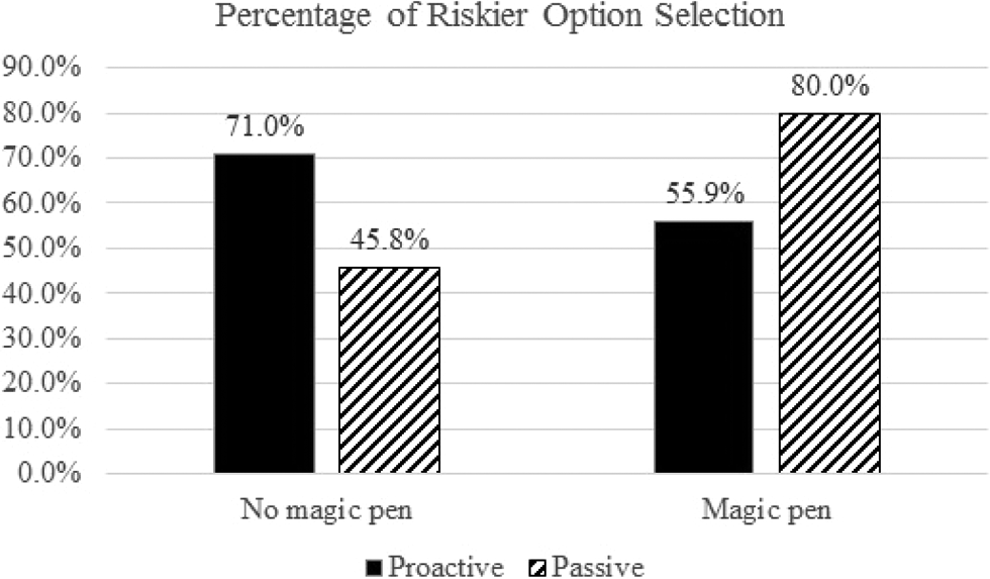
Percentage of riskier option selection.
When asked about their relative preference between Decision A and Decision B, the results showed the same pattern. There was a significant interaction between superstition and the magic pen, F(1, 110) = 12.08, p < .01. Simple effect analysis showed that passive superstitious participants who received the magic pen also reported a higher preference for the riskier decision (Decision B) compared to proactive superstitious participants (Mpassive = 6.60 vs. Mproactive = 4.94, p < .05). However, when the superstition was not activated (no magic pen), proactive superstitious participants reported a higher preference for the riskier decision (Decision B) than the passive superstitious participants (Mproactive = 6.52 vs. Mpassive = 5.08, p < .05).
Raffle Choice
Without the magic pen (magical object), proactive superstitious participants were more likely to enter into the riskier raffle than passive superstitious participants, 61.3% versus 33.3%, χ2(1, n = 55) = 4.23, p < .05. However, the opposite is true when the participants were given the magic pens. The passive superstitious participants were more likely to enter into the riskier raffle than the proactive superstitious participants, 72% versus 44.1%, χ2(1, n = 59) = 4.54, p < .05. Thus, Hypotheses 1 and 2 are supported for both decisions (managerial decision and raffle choice) (see Figure 3).
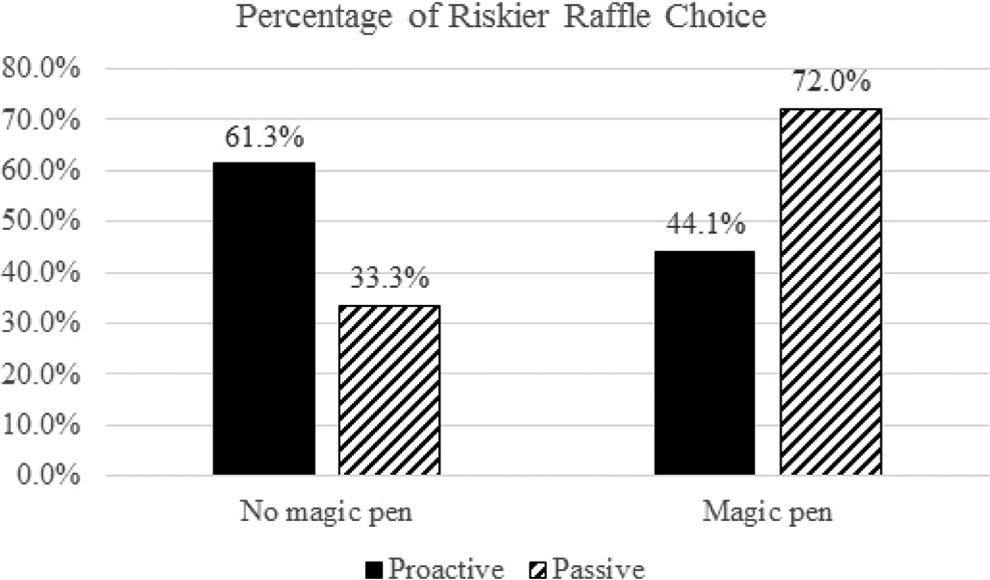
Percentage of riskier raffle choice.
General Discussion
Consumer superstition has been found to affect choices and behaviors in the marketplace and in society (Block & Kramer, 2009; Raylu & Oei, 2004; Wang et al., 2012), especially in Asian cultures (Kramer & Block, 2008; Hernandez et al., 2008; Yardley, 2006). The influence of superstitious belief is likely to exist in most gambling and other risk-taking activities (Joukhador et al., 2004). Additionally, when people look for signs to influence chance outcomes, they are using superstition as a heuristic device to make a decision (Carlson et al., 2009). The superstitious beliefs are often associated with financial risk-taking behaviors, which can lead to multiple problems that affect individuals and the society at large (e.g., financial loss, personal debts, increased crime rates, domestic violence, and suicide; Hume & Mort, 2011; Wynne & Shaffer, 2003). Thailand is among the developing countries in Southeast Asia in which people are superstitious and believe in both good and bad luck. Superstitious beliefs are a part of the Thai way of life, making Thailand an interesting culture in which to study the effects of superstitious beliefs on consumer behaviors.
This research adopted the framework by Hernandez et al. (2008) and tested the individual difference in the reaction of the two types of superstitious consumers (proactive vs. passive) toward a superstitious object and how it affected their risk-taking behaviors. The results demonstrated that a superstitious object affected the decision-making of passive superstitious consumers more than that of proactive superstitious consumers. After receiving a magic pen (superstitious object), passive superstitious participants were more likely to make a risky decision and enter a high-risk raffle. However, when there was no superstitious object presented (magic pen), proactive superstitious consumers were more willing to take part in a risky decision as compared to the passive superstitious consumers. In this study, we gave the participants a magical object (pen), which may have increased the perceived luck in passive superstitious consumers, leading them to make risky decisions. However, proactive superstitious consumers tend to believe in their ability to control external forces through practicing superstitious rituals (Hernandez et al., 2008). They also want to control their own luck (effort attribution). Therefore, when proactive superstitious consumers were given a superstitious object (magic pen), they may have felt that they lost control of their own luck, which makes them less likely to engage in risk-taking behaviors.
This research allows us to clearly distinguish the differences between the concept of Hernandez et al.’s (2008) proactive and passive types of superstition and how each type has an effect on the risk-taking behavior of Thai consumers when interacting with a superstitious object. Exploration of superstitious beliefs is crucial in consumer behavior because people use them as a means to cope with uncertainty and alleviate anxiety (Raylu & Oei, 2004). The results enhance our understanding on how superstitious consumers engage in risk-taking activities and in which way they can be encouraged to increase or to reduce this interest.
In general, proactive superstitious consumers like to practice superstitious rituals to keep bad forces away, bring in good forces, and to increase their chance of gaining good luck. Passive superstitious consumers perceive that they do not have control over their luck, so they use external forces as a guide in their decision-making process. This research further explains the consequences of superstitious belief, as a superstitious object can enhance risk-taking behavior especially for passive superstitious consumers. We show that by providing a magical object (magic pen), passive superstitious consumers increase their risk-taking behavior. It is possible that the superstitious belief can be transferred through contagion and impact actual performance (Kramer & Block, 2014). We found that the existence of a superstitious belief that is perceived to transfer through intermediary objects is more likely among passive superstitious consumers. The results also show that magical (superstition activated) objects do not affect proactive superstitious consumers. That could be because they do not feel they have control over the objects nor have they put in any effort into acquiring the object themselves. Future studies could examine the difference in situations where proactive superstitious consumers carry their own lucky charm or have it provided to them.
An alternative explanation for this effect could be attributed to positive mood. Research has shown that good luck and good mood are highly correlated and lucky people are happy and optimistic (Duong & Ohtsuka, 2000). When individuals feel lucky, they are more willing to take financial risks (Jiang et al., 2009). Therefore, receiving the magical object (pen) may activate the concept of luck, which then elicits positive affect among the passive superstitious participants who already believe in magic and magical objects. Therefore, future studies may explore whether positive affect mediates the relationship.
Implications
Theoretically, this study extends the framework proposed by Hernandez et al. (2008) on superstitious types (passive vs. proactive) and tested the framework in an experimental setting. It adds to the body of literature on superstitious beliefs by testing how proactive versus passive superstitious individuals react to a magical object (magic pen) and how the reaction affects their risk-taking behaviors. The research also presents empirical evidence from another Eastern culture (Thailand), a country in which superstition is a way of life. We found support for the differences of the proactive and passive superstitious types and their impacts on risk-taking behaviors.
This research also offers implications for marketing and public practices. Often times, when individuals participate in any risk-taking activity (e.g., gambling, playing bingo, and entering sweepstakes) or making financial decisions (e.g., stock market investment), they go through stages of uncertainty (concern about the outcomes), anxiety, and fear of losing control (Shimp & Bearden 1982; Taylor, 1974). Exposing passive superstitious individuals to superstitious-related objects, such as a lucky charm, an amulet, or a red lucky prayer tassel (Chinese), may lead to higher confidence in those individuals, which can result in engaging in riskier behaviors (e.g., placing higher bets in gambling, making irrational financial decisions, or investing in high-risk stocks). Therefore, policy makers may need to control for the exposure and selling of those objects near places where people are likely to be vulnerable to those decisions (casinos, gaming machines).
Our study suggests that individuals may be influenced by marketing campaigns related to superstition or magical thinking. When consumers face decisions, they do not always make rational evaluations. It is possible that superstitious consumers may be lured or be taken advantage of by some marketing campaigns or other risky businesses. For example, they could be deceived into purchasing defective products that are associated with superstition (e.g., red rice cookers in Chinese culture or products with number “7” in Western cultures), or they could be influenced by a marketing campaign that manipulates the hope and illusion of control (Vaidyanathan & Aggarwal, 2008). Thus, public policy needs to be aware of superstitious-related marketing campaigns.
Moreover, with increasing popularity for online gaming (e.g., Texas Hold’em poker) and sports betting (e.g., Fantasy football), it is difficult to distinguish whether it is a leisure activity or gambling. Nonetheless, these activities can lead to an addictive behavior of those who play. Knowing that individuals may be either proactive or passive superstitious, the marketing campaigns for these types of products should be carefully monitored and regulated, as some promotional tactics may trigger risky decisions. For example, promotional materials should not contain any superstitious-activated object such as a lucky penny or any message that may enhance perceived luck. A growing body of superstition studies need to investigate more specific explanations for the decision-making process.
Generally, people who are very superstitious can become vulnerable because they can be easily deceived by illicit marketing campaigns, as they tend not to rationalize their behavior (McGregor, Nash, & Prentice, 2010). This study evidences how passive superstitious individuals can become the victims of embedding risky activities into their everyday life. By providing them lucky charms or magical objects, passive superstitious individuals may increase their feeling of being lucky and that will lead them to engage more in risk-taking activities. Thus, social marketers can emphasize the importance of logical and rational thinking when tailoring messages to break superstitious habits and offer various case studies to the communities to reach these audiences in order to moderate their superstitions (Nooteboom, 2015).
The challenge for marketers is to segment individuals based on their psychographic information (personality traits, values, and lifestyle; Greenberg & McDonald, 1989), which, in this case, refers to passive versus proactive superstition. Although it is a challenge to identify the proactive and passive superstitious consumers, marketers may use demographic information as a guideline. Prior research found that adolescents and low-income people are vulnerable individuals who have a high chance of engaging in risky behavior (Nooteboom, 2015). Based on our findings, it is possible that the more the adolescents and low-income consumers become proactive superstitious believers, the more they have put their faith in risk-taking behaviors because proactive superstitions can increase their feeling of hope and being in power and control.
Lastly, existing literature on superstitious beliefs in Thailand mostly concerns lottery gambling behaviors (Ariyabuddhiphongs, 2011; Ariyabuddhiphongs & Chanchalermporn, 2007), consumer cocreation (Pongsakornrungsilp et al., 2011), and other types of risk-taking behavior (Soedarmono, Machrouh, & Tarazi, 2013; Uriely & Belhassen, 2006). Thailand has a culture that is full of superstitious beliefs. This study adds to the body of literature about consumers in Thailand and how their superstitious beliefs affect the likelihood of making risky decisions or taking risks.
Limitations and Future Research Directions
Although our investigation does not measure the need for control and, thus, limited our ability to make statements about causality, the present study suggests the possibility that the need for control may serve as a moderating variable between these two types of superstitious beliefs. It would be important for future research to test whether superstitious rituals or objects lead to an increase in perceived control (Keinan, 2002). Additionally, future studies should examine whether the differences between these two superstitious beliefs are actually affected by their need for control. According to the attribution theory, people attempt to establish control over their lives and improve their ability to predict future events. In this experiment, we only used one stimulus (magic pen) to test the hypotheses. Future study may also examine whether other stimuli, which exhibit different combinations of the attribution theory or congruency theory, still yield the same effects. Moreover, in this study, the participants were classified as either proactive or passive superstitious consumers. Future study should look at individuals who scored relatively high in both proactive and passive superstition scales and whether that factor would affect risk-taking behaviors.
Additional investigations into the extent to which superstition impacts various consumption behaviors and decision-making are also necessary. Further research can try to understand in which situations individuals are more likely to be influenced by their superstitious beliefs. For example, Kramer and Block (2008) reported that American participants became significantly more risk averse in their choices after thinking about Friday the 13th, as compared to a day that is not associated with bad luck. As thinking about Friday the 13th is relevant to passive superstitious belief, future research may test how proactive and passive superstitious beliefs may affect risk-averse behavior and whether superstitious objects may moderate that effect.
In addition, superstition may influence individuals differently in their risk-taking perception. Individuals with high levels of superstitious beliefs may sustain their motivation to take risks. Given potential differences in the perception of risk between superstitious groups, a range of factors may moderate the role of superstition in risk-taking perception, such as the awareness of anticipated outcomes and the exposure to risky situations (Spurrier & Blaszczynski, 2014). Improving the knowledge of how individuals interpret and use information about superstitious beliefs in risk perception may help us to understand their propensity for risk-taking behaviors.
Previous research categorizes superstitious beliefs into two types: negative and positive superstitions. Negative superstitions involve behaviors or omens that are associated with negative (unlucky or harmful) consequences; whereas positive superstitions are associated with the desire to bring luck or preferable consequences (Fluke et al., 2014; Wiseman & Watt, 2004). In this study, we explored only how passive versus proactive superstitious individuals react in the positive superstitious situation (magical object). Future research could explore the framework in other negative superstition situations such as when individuals encounter bad luck or unlucky stimuli (e.g., products showing the number 13—an unlucky number in Western cultures or the number 4—an unlucky number in Eastern cultures).
Today’s Internet technology makes online gambling and gaming accessible to everybody including vulnerable populations such as adolescents. Online gambling could result in several issues such as addiction, depression, and negative effects on school, work, and relationships (Hume & Mort, 2011). Adolescents are likely to engage in many misbehaviors such as smoking, drug, and alcohol consumption, especially when their friends participate in it (peer pressure; Cox & Cox, 1998). They also increasingly participate in online gambling (Hume & Mort, 2011). Future research can look into superstition in online gambling among youth and young adults and how superstitious beliefs affect individuals’ decisions at young ages. Furthermore, other marketing tactics, such as coupons and free bonus points in online gaming, may affect one’s superstitious belief and risk-taking behavior. Future research may look into empirically examining various marketing tactics on superstitious beliefs and behaviors.
This study was conducted in Thailand whose culture belongs to the Eastern culture. However, the findings will be more powerful if they can be generalized across other Eastern cultures such as China, Japan, and Korea that are also considered superstitious cultures. Moreover, Eastern cultures are considered superstitious cultures, while Western cultures are less likely to believe in superstitions (Hernandez et al., 2008). Future studies can look at the difference between Eastern and Western cultures and their types of superstitious beliefs (e.g., comparing Thai vs. American, proactive vs. passive superstitious consumers) to examine how cross-cultural differences in superstitious beliefs can affect risk-taking behaviors.
Footnotes
Appendix
Modified Proactive–Passive Superstitious Scale from Hernandez et al. (2008) In many situations, what happens to people is determined by fate. Your personality is determined by astrological alignment. Black magic exists. Fu Lu Shou/Cornstalk plant attracts health, wealth, and prosperity. Carrying a lucky charm will bring good luck. Performing a team ritual before a football match will lead the team to win. Getting a good job or promotion in the future will depend on my getting the right turn of events. Horoscopes are right too often for it to be a coincidence. King of Naga exists. Houses and buildings placed in auspicious land and appropriate locations are good for fortune flow. Numbers 8 and 9 attract good luck. Having a magic pen in the car will bring a safe driving journey. Praying for success before going to work will bring you success in the day. With fate the way it is, many times I feel that I have little influence over the things that happen to me. Your birthday affects your destiny. Some consumers are able to lift objects through mental forces. Your palm lines impact your future. A statue of a beckoning women attracts financial prospects. The dreams while you sleep tell you what will happen. Giving red water to a sacred statue and pledging will receive blessings. Receiving a banknote from the first customer and taking it to touch products in the shop will attract more money. Numbers 0 and 6 attract bad luck.
Declaration of Conflicting Interests
The author(s) declared no potential conflicts of interest with respect to the research, authorship, and/or publication of this article.
Funding
The author(s) received no financial support for the research, authorship, and/or publication of this article.