



Abstract
Background:
Despite evidence of the protective effects of a diet high in fruits and vegetables, intake among Ohio adults remains low. A health communication campaign is an attractive behavior change intervention due to its potential to reach a large audience.
Focus of the Article:
This study aims to examine the development of a state-level health communication campaign and to assess outcome measures relative to fruit and vegetable intake.
Research Question:
Two research questions were evaluated: (1) How did Ohio State University Extension use formative research to inform the campaign’s development? and (2) Was campaign exposure associated with increased fruit and vegetable consumption or readiness to increase fruit and vegetable consumption among the target audience comprising Ohio adults eligible for the Supplemental Nutrition Assistance Program (SNAP)?
Program Design/Approach:
Ohio State University Extension conducted extensive formative evaluation prior to developing the Celebrate Your Plate health communication campaign. The campaign was designed to increase the target audiences’ fruit and vegetable consumption, reinforce messages taught in nutrition education classes, and reach a larger segment of the population with messages promoting healthy behaviors. The campaign was implemented statewide through a multi-year phased rollout and comprised a mix of printed and digital communication channels and an accompanying website. Supportive individual- and community-level programming was also implemented by Ohio State University Extension as part of a multilevel approach to increasing fruit and vegetable intake.
Importance to the Social Marketing Field:
The limited existing research on the effectiveness of health communication campaigns to increase consumption of healthy foods largely focuses on national campaigns and this study examines effectiveness of a locally tailored campaign.
Methods:
This study comprised a mixed-methods multi-stage evaluation: qualitative data were collected in four pilot counties to assess the target audience’s awareness and reception of the campaign and recommendations for future efforts. Cross-sectional post-implementation outcome evaluation data were collected and analyzed to assess campaign exposure and behaviors of the target audience.
Results:
During the pilot evaluation, the target audience responded positively to campaign materials and identified the perceived cost of healthy recipes as a main barrier to changing eating patterns. After the campaign was rolled out statewide, approximately 18% of the target audience indicated exposure to Celebrate Your Plate in aided recall. Campaign exposure was significantly associated with higher fruit (p < .001) and vegetable (p < .001) consumption. The Stages of Change model was used to conceptualize readiness to increase fruit and vegetable consumption; campaign exposure was significantly associated with readiness to increase fruit (p = .001) and vegetable (p = .027) consumption.
Recommendations for Research or Practice:
Results of this study show that campaign exposure is significantly associated with higher fruit and vegetable consumption and readiness to consume more fruits and vegetables among the target audience, though more rigorous evaluation is needed to determine causality.
Limitations:
This study included cross-sectional data and lacked a control group and consequently cannot be used to determine if behavioral observations resulted from campaign exposure. Additionally, this study relied on self-reported data and is susceptible to response biases.
Keywords
Supplemental Nutrition Assistance Program Education (SNAP-Ed) is a Federally funded program through the United States Department of Agriculture (USDA) Food and Nutrition Service (FNS) that promotes evidence-based nutrition education to low-income populations. One of the guiding principles of SNAP-Ed is the Social-Ecological Model (SEM; McLeroy et al., 1988) which states that factors from multiple levels of society—individual, interpersonal, community, political, and societal—influence behavior (U.S. Department of Agriculture Food and Nutrition Service, 2020). In alignment with SEM, FNS requires states to incorporate at least one broad-based approach in addition to individual- and group-level education classes, to reach a larger segment of the SNAP-eligible population defined as those at or below 185% of the Federal Poverty Level (FPL) (U.S. Department of Agriculture Food and Nutrition Service, 2020). To achieve this, states commonly employ social marketing and health communication campaigns to deliver nutrition messages using billboards, television and radio, social media, and other platforms (Gleason et al., 2018).
According to Daniel et al., health communication and social marketing methods are increasingly being applied to improve public health. There are many activities that influence behavior change, and for maximum efficacy, they should be carefully integrated into a comprehensive marketing plan, often called the “marketing mix.” (Daniel et al., 2009) Using the 4 P’s of the traditional marketing mix (product, price, place, and promotion) is one of the core principles of social marketing, as well as 1) using behavior-change as the benchmark to design and evaluate the intervention; 2) using research to understand target audiences, pretest intervention elements, and monitor interventions as they are rolled out; 3) using segmentation of target audiences to ensure maximum efficiency and effectiveness in the use of scarce resources; 4) creating attractive and motivational exchanges with target audiences; and 5) paying close attention to the competition faced by the desired behavior (Andreasen, 2002). While Celebrate Your Plate primarily focuses on promotion of the desired behavior (increased intake of fruits and vegetables), the campaign incorporates the first four core principles described above. Communication campaigns that adopt multiple principles have been shown to be more effective at achieving behavior change, such as healthy eating (Carins & Rundle-Thiele, 2013; McDermott et al., 2005). Health communication and social marketing campaigns have the potential to address complex problems facing public health (Daniel et al., 2009).
In 2013, Ohio State University Extension, the implementing agency (IA) of Ohio SNAP-Ed, together with the Ohio State Nutrition Action Committee (SNAC), a group of similarly oriented stakeholders, began development of a health communication campaign. The goal of the campaign was to support nutrition messages being taught in existing SNAP-Ed direct education programs to a broader population of SNAP-eligible Ohioans. Employing the core principles of social marketing, in Fiscal Year 2016, Ohio SNAP-Ed and SNAC identified SNAP-eligible families with children as the campaign’s target audience, worked with a professional marketing firm to develop attractive and motivational messages for the Celebrate Your Plate campaign promoting healthy recipes and budget savvy tips, and conducted extensive formative testing to better understand barriers and competition to the desired behaviors (fruit and vegetable consumption) and ideal placement and promotion of messages. Subsequently, a multi-year phased statewide rollout of the Celebrate Your Plate health communication campaign began in August 2017. Together with Ohio SNAP-Ed administrators, Altarum, a non-profit health research organization serving as the external evaluator, conducted pilot, process, and outcome evaluations throughout each phase to assess how well the campaign reached and resonated with the target audience. This article focuses on findings from the pilot and outcome evaluations.
Background
It is well established that diets high in fruits and vegetables are protective against many chronic diseases, including cardiovascular disease and some cancers (U.S. Department of Health and Human Services & U.S. Department of Agriculture, 2015; Wang et al., 2014). Despite evidence supporting the importance of a diet high in fruits and vegetables, 37.7% and 18.7% of Ohio adults consume fruits and vegetables, respectively, less than one time daily (Centers for Disease Control and Prevention, 2017). Furthermore, researchers have found socioeconomic disparities in fruit and vegetable consumption, mirroring the increased risk of diet-related chronic disease among vulnerable populations (Dubowitz et al., 2008; Lee-Kwan et al., 2017).
Many successful food and beverage-focused health communication campaigns have taken positive messaging approaches based on frameworks including the health-branding framework (Evans et al., 2014) and Food Well-Being models (Block et al., 2011; Bublitz & Peracchio, 2015). These two models suggest that campaign messages should address the diversity of consumers’ knowledge and beliefs, and focus on the ability of foods and beverages to promote optimal health, rather than on their specific nutrient and health profiles (Englund, Zhou, et al., 2020). During formative research, Ohio SNAP-Ed gathered extensive qualitative and quantitative data to understand the needs of the target audience and identify barriers to increased fruit and vegetable consumption. Formative research identified cost as the primary driver of the target audience’s food choices, followed by their immediate family’s food preferences. Keeping with the principles of the health branding framework and Food Well-Being model, and tailored to the desires of the target audience, the product or behavior to be marketed to SNAP eligible Ohioans was increased fruit and vegetable consumption promoted through healthy, family-friendly recipes that are quick and easy to prepare, and also budget-savvy shopping tips to address perceived costs (price) associated with healthy eating.
The placement and promotion of communication campaigns affect populations through direct (i.e., the transmission of knowledge and awareness) and indirect pathways, resulting in gradual shifts in societal norms (Pollard et al., 2007; Wakefield et al., 2010). In terms of SEM, social marketing and health communication campaigns can have a positive influence on norms and values at the population level if implemented across multiple sectors and settings (U.S. Department of Health and Human Services & U.S. Department of Agriculture, 2015). In order to elicit lasting behavior change, supportive interventions, such as direct nutrition education classes, and other initiatives, such as policy changes that facilitate access and affordability of healthy foods, should be in place to complement health communication campaigns including Celebrate Your Plate (Rekhy & McConchie, 2014; Wakefield et al., 2010).
Mass media campaigns present as attractive behavior change interventions due to their potential to reach large audiences at a low cost per capita (Wakefield et al., 2010); however, limited research has been published about the effectiveness of campaigns promoting consumption of healthy foods, often because industry-supported campaigns may contain proprietary information (Englund, Hedrick, et al., 2020; Englund, Zhou, et al., 2020) and due to difficulty in ascertaining success (Rekhy & McConchie, 2014). A recent review of national-level campaigns promoting healthy foods and beverages found that most campaigns measured behavioral determinants, including perceptions and attitudes about the brand, and some behavioral outcomes, such as intake of targeted food items (Englund et al., 2020). Another review found that campaigns promoting nutrition and physical activity resulted in short-term behavior change, but sustained behavior change may be more difficult to achieve due to competing environmental factors, such as ease of access and marketing of processed and energy-dense food options (Wakefield et al., 2010). Additionally, most published literature focuses on national-level campaigns (Pollard et al., 2007; Rekhy & McConchie, 2014), while few focus on campaigns tailored to a more local regional culture (Englund et al., 2020).
The purpose of this study was to measure exposure, or recall, of the Celebrate Your Plate campaign among SNAP-eligible Ohioans and to assess differences between exposed and unexposed adults based on key demographic characteristics, fruit and vegetable consumption, and readiness to engage in behavior change.
Method
Campaign Development and Approach
During the development of the campaign, Ohio SNAP-Ed and SNAC undertook formative research which used mapping techniques to identify four pilot counties with high proportions of the target audience. Additionally, 11 focus groups were conducted in the pilot counties and a statewide survey was distributed targeting families with children eligible for the Supplemental Nutrition Assistance Program (SNAP). Results from the formative research indicated that cost was the primary factor driving the target audiences’ choices relative to fruit and vegetable consumption, followed by their immediate family’s food preferences and the foods parents chose to purchase for their children, including those requested by children. Furthermore, parents desired online resources to directly benefit their families. These findings were used to refine the campaign communication materials and delivery channels. Ohio SNAP-Ed worked with a professional marketing firm to develop the communication strategy and media plan, as well as visually appealing and motivational campaign materials. Ohio SNAP-Ed and SNAC elected to implement the campaign using a multi-year phased rollout strategy to maximize resources. Implementation began in the pilot counties (pilot phase) and was then rolled out to different quadrants of the state (phases 1–4 in corresponding Quadrants 1–4). Table 1 depicts the timelines, delivery channels, and communication materials for each phase, and Figure 1 illustrates the distribution of Ohio counties into quadrants.
Timeline and Delivery Channels of the Celebrate Your Plate Phased Rollout.

Note. “Mobile display and rich media” includes inter-app banner ads featuring recipe images with a tagline and click-through link and interstitial swipe galleries; “Facebook dark and boosted posts” are types of paid Facebook advertisements; “cash jackets” are money envelops used by check cashing facilities that featured a campaign recipe and image; “The Bag” was a coupon bag distributed to low-income neighborhoods with a campaign ad printed on the exterior of the bag or a campaign flyer; “tents” are triangular folded tabletop displays placed at check cashing facilities featuring a campaign recipe image, tagline, and website; “mats” are small, flat advertisements placed on a counter featuring a recipe image, tagline, and website; “posters” were large displays with a campaign recipe image, tagline, and website coupled with smaller flyers people could take home placed in convenience and thrift stores; “door hangers” were small printed flyers featuring a campaign recipe hung on door knobs of neighborhoods in low-income census tracts.

Counties by quadrant for phased campaign rollout. Note. This image depicts how Ohio counties were divided into four quadrants aligning with the phased rollout of Celebrate Your Plate.
Pilot Evaluation
Preliminary campaign messages were rolled out to the four pilot counties that were identified during formative research and disseminated through the digital and out of home/audio channels described in Table 1. To glean input regarding the design of the materials (product), as well as placement and promotion of targeted campaign messages, focus groups and interviews were conducted with members of the target audience residing in the pilot counties. A focus group guide was developed, containing open-ended questions on campaign materials and channels of delivery, and was designed so that each group session would last approximately 90 min. Similarly, the interview guide consisted of open-ended questions about campaign materials and channels of delivery and was designed to take no more than 30 min to complete by telephone. All participants provided signed or oral consent prior to participating. The pilot evaluation protocol and data collection instruments were reviewed and approved by The Ohio State University’s Institutional Review Board.
Convenience sampling at local food pantries and food distribution sites was used to recruit participants for the focus groups and interviews. To protect participants’ privacy and simplify the recruitment process, income eligibility was determined based on the sites from which individuals were recruited, all of which primarily served low-income populations, rather than actual participation in SNAP or adherence to income eligibility requirements. Interested individuals provided their contact information and were later called to determine whether they were aged 18 years or older and if they were willing to participate in either a focus group or telephone interview. Experienced evaluators facilitated the focus groups and telephone interviews. Prior to participating in the study, all participants provided either written or verbal consent. Focus group participants received $30 to help cover the cost of travel and childcare for attending the focus group, and telephone interviewees were mailed a $10 payment for their participation. Transcriptions and notes of focus group discussions and telephone interviews were analyzed using qualitative data analysis software (QSR International’s NVivo version 11) to identify common themes relative to the target audiences’ receptivity to campaign messaging, channel of delivery, and the campaign’s potential to elicit behavior change.
Outcome Evaluation
Timed according to the implementation of phases 1–4, Altarum collected cross-sectional post-implementation outcome evaluation data in all four quadrants and pre-implementation data in the Quadrants 2 and 4. Results were weighted to adjust for non-response and to match the profile of SNAP recipients in targeted counties based on gender, age, level of education, and race/ethnicity, and calibrated using data from the 2017 Ohio Behavioral Risk Factor Surveillance Survey. Post-implementation survey results from all four quadrants were combined to gain greater statistical power when comparing those who were exposed to the campaign to those unexposed. The data collection timeline is illustrated in Table 2.
Timeline for Launching Phases 1–4 of the Campaign and Survey Administration.

Note. Data were weighted to adjust for non-response and to match the profile of SNAP recipients based on quadrant of residence, gender, age, level of education, and race/ethnicity, and calibrated using data from the 2017 Ohio Behavioral Risk Factor Surveillance Survey.
Survey questions focused on exposure to the health communication campaign (e.g., print ads, online ads, Celebrate Your Plate website, etc.) and self-reported health behaviors (e.g., personal perceptions of health, daily consumption of fruits and vegetables, perceived barriers to eating fruits and vegetables, level of confidence purchasing healthy foods, etc.). The survey was only available in English, designed to take approximately 10 min to complete, and included 30 questions. While the data collection instrument was not validated, selected measures were included from the SNAP-Ed Evaluation Framework, a guide provided by USDA FNS for evaluating SNAP-Ed programming (U.S. Department of Agriculture Food and Nutrition Service, 2016).
Two different, but comparable, data collection methodologies were employed in Quadrants 1 and 2 versus Quadrants 3 and 4 to optimize response. In Quadrants 1 and 2, data were collected via telephone drawing from a randomized purchased list comprised of households residing in included counties earning less than $35,000 per year with known children in the household. The purchased list included approximately 75% cell phones and 25% landlines. To increase the efficiency of data collection and reduce costs, the telephone survey used in Quadrants 1 and 2 was adapted into a web-based survey for Quadrants 3 and 4 using nearly identical questions. In Quadrants 3 and 4, data were collected online using a two-pronged approach: non-probability sampling provided by an online web panel and probability sampling using a purchased list for a push-to-web mailing. The web panel sample included households residing in included counties reporting annual incomes of less than $35,000 and the purchased list contained the same criteria as for Quadrants 1 and 2. Since the study relied on a non-probability sample in Quadrants 3 and 4, there is the potential for bias; however, non-probability samples can be reliable when used to reject a null hypothesis (Yeager et al., 2011). All respondents provided informed consent prior to participating in the survey and the study protocols were approved by The Ohio State University Institutional Review Board.
Several composite variables were calculated for use in the analysis. The variable participation in assistance programs was calculated based on reported participation in one or more assistance programs, including Medicaid, SNAP, free or reduced-price school lunch or breakfast, accessing a food pantry, the Special Supplemental Nutrition Program for Women, Infants, and Children (WIC), free summer meals, Temporary Assistance for Needy Families (TANF), and Head Start. The variable exposure to the campaign was calculated based on respondents’ recall of the campaign through one or more delivery channel. For analytical purposes, respondents were categorized into three groups for race and ethnicity: non-Hispanic White, non-Hispanic Black, and those who identify as Hispanic, another race, or reported multiple races (other/multiple race or ethnicity). Additionally, only respondents that identified as men or women were included in this analysis due to the small percentage that indicated “other” or “prefer not to answer” for gender.
The Transtheoretical or stage of change (SOC) model (Prochaska & Velicer, 1997) was used to conceptualize readiness to increase fruit and vegetable consumption. The SOC model has been applied to various health-related behaviors including smoking, drug and alcohol misuse, physical activity, and fruit and vegetable consumption (Glasson et al., 2009). The model theorizes that behavior change is mediated by decisional balance (relative importance given to the benefits and costs of changing behavior), self-efficacy (ability to enact change), and processes of change (strategies used to facilitate change). This study uses the SOC outlined in the model—pre-contemplation, contemplation, preparation, action, and maintenance—to conceptualize readiness to increase fruit and vegetable consumption among the campaign’s target audience. Respondents were categorized into the five stages based on their reported fruit and vegetable intake, taking into consideration whether they were meeting the 2015–2020 Dietary Guidelines for Americans recommendations for 2,000 calorie level diet (U.S. Department of Health and Human Services & U.S. Department of Agriculture, 2015) and if they were planning to increase consumption now, in the next 30 days, or within the next 6 months. Those who reported consuming fewer than the recommended number of cups of fruits (2.0 cups) and vegetables (2.5 cups) per day and indicated that they were not thinking of eating more fruits/vegetables were classified in the “pre-contemplation” stage. Those who were not meeting dietary recommendations but were thinking about eating more fruits/vegetables and planning to start within the next 6 months were classified in the “contemplation” stage. Higher stages of the model include those in the “preparation” stage who are not meeting dietary recommendations but planning to increase consumption in the next 30 days, and individuals in the “action” stage who are meeting dietary recommendations but trying to eat more. Those exceeding dietary recommendations were in the “maintenance” stage.
Analyses were conducted to determine significant differences between subgroups of interest (gender, race, presence of children under 18 years of age in the household, and participation in an assistance program). Descriptive statistics were examined using 95% confidence intervals; chi-square tests for categorical variables and linear regression modeling for continuous variables were conducted to examine significance by exposure status within subgroups of interest, adjusting for sample weights. All data analyses were conducted by Altarum using SAS Software for Windows Version 9.4 and IBM SPSS Statistics for Windows Version 26.
Findings
Pilot Evaluation
A total of 42 people attended focus groups and 22 people participated in interviews across the four pilot counties. Overall, campaign materials were well-received among focus group and interview participants. Most found the materials to be eye-catching and indicated that seeing the materials would drive them to seek out more information. However, few participants (4 focus group participants, 8 interviewees) recalled having seen or believed that they had seen the logo previously. Fewer respondents recalled seeing or hearing the campaign messages through the following distribution channels: online advertisements, Pandora radio, printed materials, and the campaign website. One barrier common among participants was lack of internet access: 12% of focus group participants and 33% of interviewees did not regularly use devices connected to the internet. When these individuals were asked which campaign materials and delivery channels they preferred, grocery stores were mentioned most frequently, followed by food pantries/food distribution sites, churches and other retail stores (i.e., dollar stores).
The perceived cost of preparing healthy recipes was a recurring theme during telephone interviews and focus groups. Participants expressed a general concern about the cost of a healthy eating pattern and more specific concerns about certain ingredients shown on various campaign materials perceived to be expensive or inaccessible (e.g., baby corn, blueberries, etc.). If a certain food item was perceived to be high in cost, it seemed to negatively influence an individual’s perception of the Celebrate Your Plate recipes and materials. Participants recommended featuring recipes that contain simple, easily accessed ingredients that most households have on hand, or offering ideas for ingredient substitutions. In addition, participants requested more tips about freezing foods and preventing food waste to help extend the life of their fruits and vegetables.
Outcome Evaluation
Demographics
Survey data weighted to represent SNAP recipients in Ohio showed that the majority of the target audience identifies as women and/or White, approximately one-third live in a household with one or more children aged 17 years or younger, and less than half participated in an assistance program in the 12 months prior to the survey (Table 3). There were no significant differences in these demographic characteristics between quadrants.
Target Audience Demographics.

Note. Data were weighted to adjust for non-response and to match the profile of SNAP recipients based on quadrant of residence, gender, age, level of education, and race/ethnicity, and calibrated using data from the 2017 Ohio Behavioral Risk Factor Surveillance Survey.
a Total Weighted n = 2,083,136; Unweighted n = 2,547.
Campaign exposure
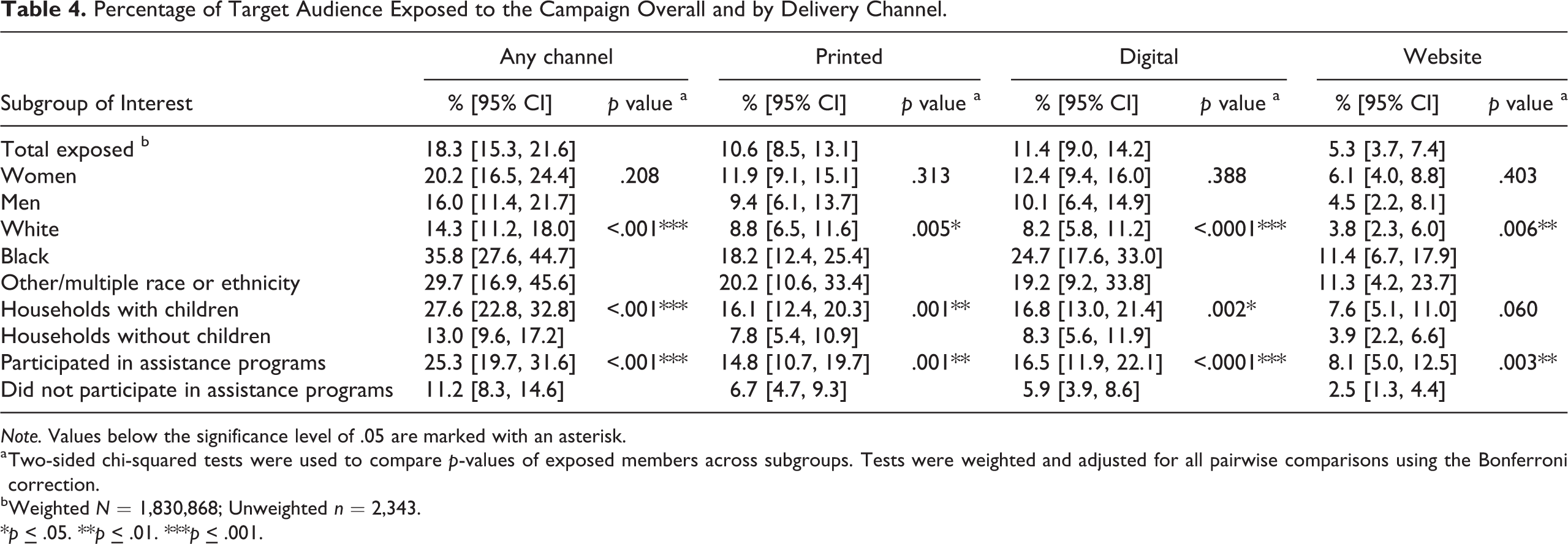
Statewide, nearly one-fifth of the target audience recalled seeing or hearing Celebrate Your Plate campaign materials or messages through any delivery channel (print, digital, or website) post-implementation (Table 4). When examining by communication channel, the level of exposure was similar for printed materials and digital advertisements, but lower for the website. Of those exposed to digital advertisements, many participants (40%) recalled clicking on the advertisement. Exposure across any channel and exposure to each individual channel was significantly higher among members of the target audience who were non-White, had children in the household, and among those who had participated in assistance programs within the last 12 months.
Percentage of Target Audience Exposed to the Campaign Overall and by Delivery Channel.
Note. Values below the significance level of .05 are marked with an asterisk.
a Two-sided chi-squared tests were used to compare p-values of exposed members across subgroups. Tests were weighted and adjusted for all pairwise comparisons using the Bonferroni correction.
b Weighted N = 1,830,868; Unweighted n = 2,343.
*p
Campaign exposure encouraged most participants (72%) to think about or make positive dietary changes; more than half (57%) of the target audience exposed to the campaign took an action, such as eating and/or buying more fruits and vegetables, trying a Celebrate Your Plate recipe, visiting the website, and/or signing up for a nutrition education class. An additional 15% of participants thought about eating more fruits or vegetables or planned healthy meals for their family but did not yet take an action. Chi-square tests demonstrated that exposure to the website was significantly associated with taking a positive dietary action (p = 0.001); there was no significant relationship between exposure and taking an action through the other delivery channels.
Healthy eating behaviors
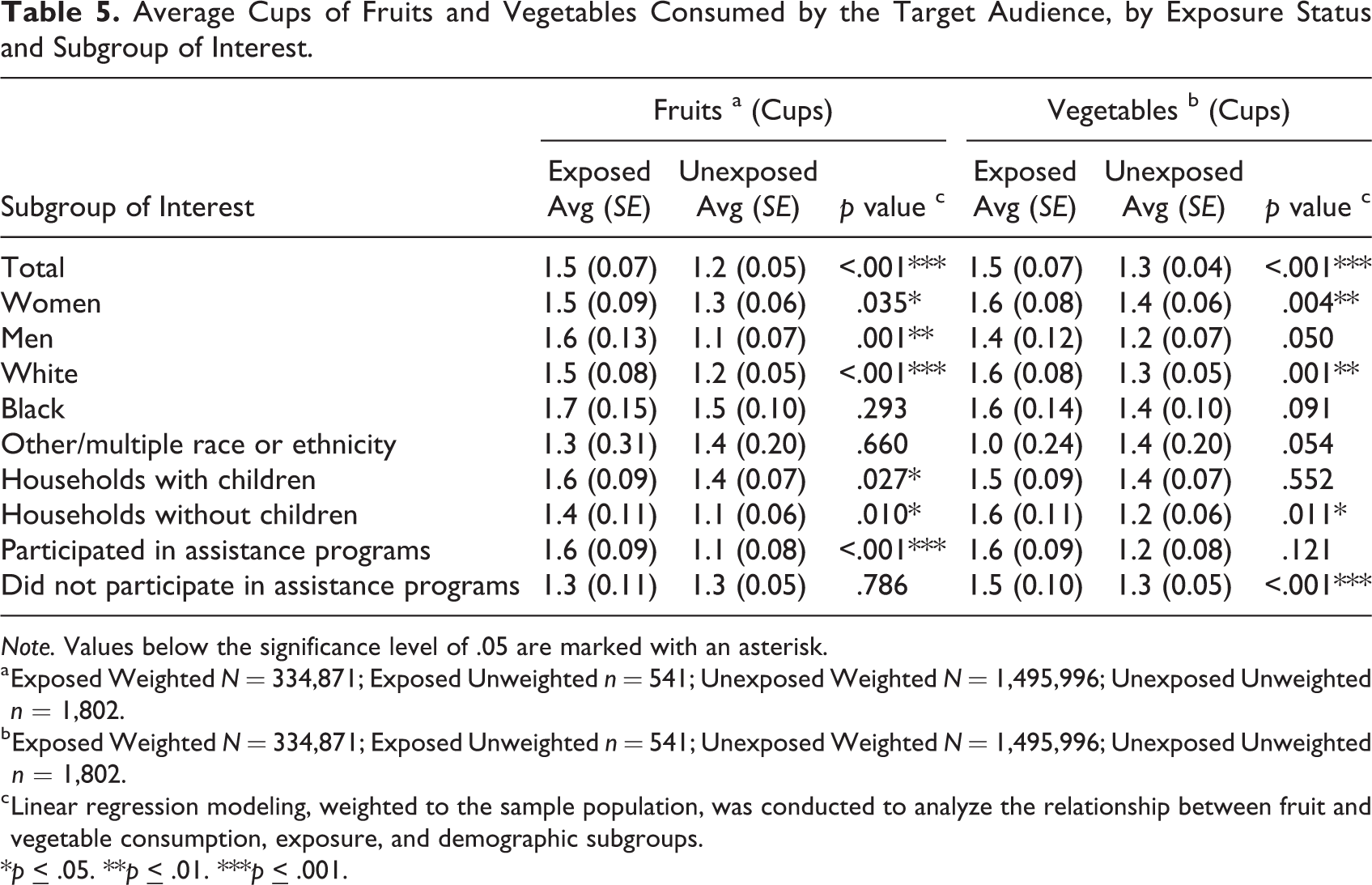
Linear regression modeling was used to determine that members of the target audience who were exposed to the health communication campaign consumed significantly more cups of fruit (p < .001) and vegetables (p < .001) per day on average than those who were unexposed to the campaign (Table 5).
Average Cups of Fruits and Vegetables Consumed by the Target Audience, by Exposure Status and Subgroup of Interest.
Note. Values below the significance level of .05 are marked with an asterisk.
a Exposed Weighted N = 334,871; Exposed Unweighted n = 541; Unexposed Weighted N = 1,495,996; Unexposed Unweighted n = 1,802.
b Exposed Weighted N = 334,871; Exposed Unweighted n = 541; Unexposed Weighted N = 1,495,996; Unexposed Unweighted n = 1,802.
c Linear regression modeling, weighted to the sample population, was conducted to analyze the relationship between fruit and vegetable consumption, exposure, and demographic subgroups.
*p
This trend also held true for gender, with exposed women and men consuming significantly more fruits and vegetables than their unexposed counterparts. White respondents exposed to the campaign consumed significantly more fruits (p < 0.001) and vegetables (p = 0.001) than unexposed white respondents; this was not seen in other race/ethnicity groups, however. Households with children that were exposed to the campaign consumed significantly more fruit than households unexposed to the campaign (p = .027). Those participating in an assistance program and exposed to the campaign consumed significantly more fruit than those unexposed (p < 0.001), while those not participating in a program and exposed to the campaign consumed significantly more vegetables than those unexposed (p < 0.001). A scale was used to represent the SOC in linear regression models, where 1 represented the pre-contemplation stage and 5 represented the action stage, to conceptualize the target audience’s readiness to increase fruit and vegetable consumption (Figure 2).
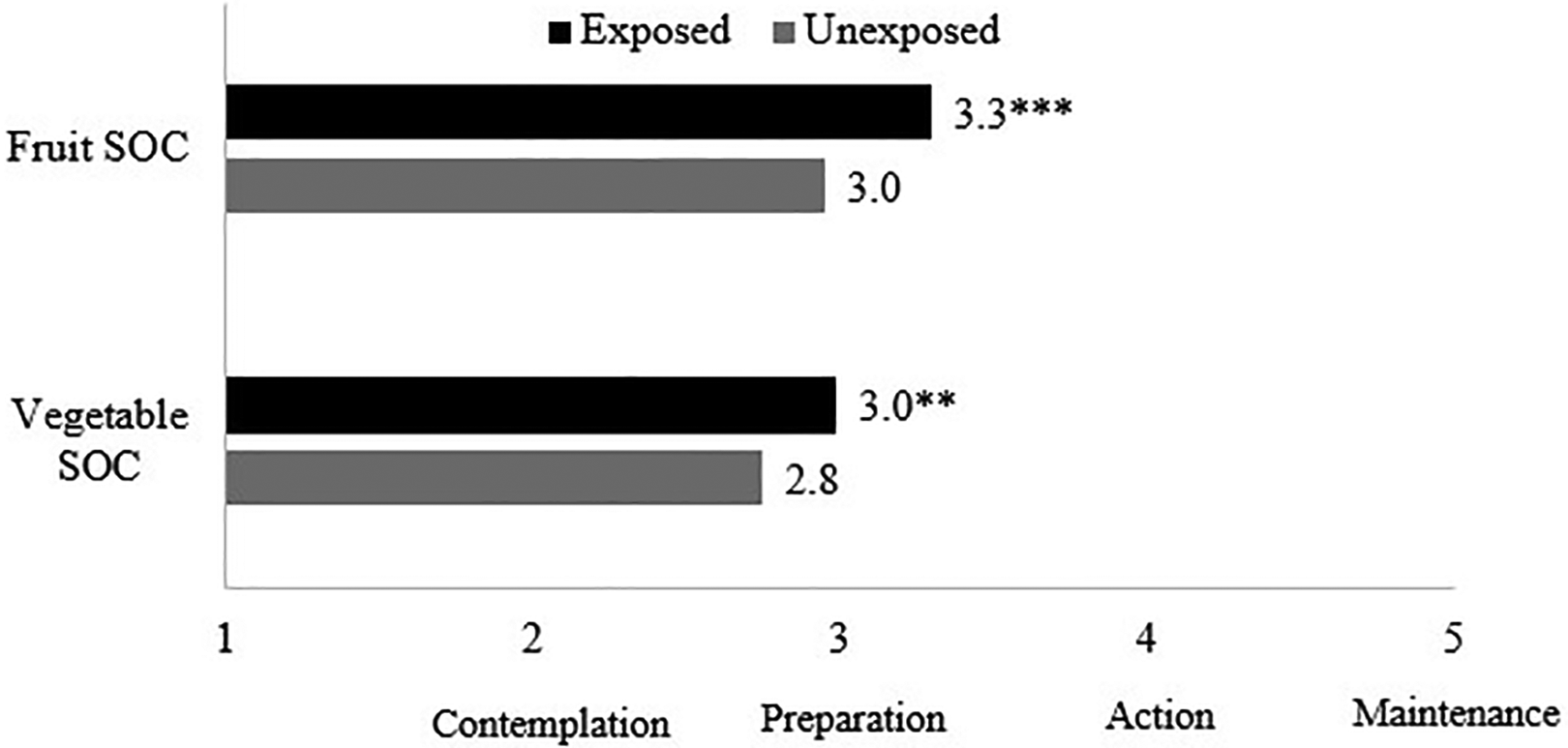
Average SOC for fruit and vegetable consumption by campaign exposure. Note. Significant differences at the α = .05 level were shown between exposed and unexposed for both fruit consumption (p = .001) and vegetable consumption (p = .027) using linear regression modeling.
Target audience members exposed to the campaign were significantly further along in the SOC model, on average, for both fruit and vegetable consumption than those unexposed (p = .001 and p = .027, respectively). Based on the model for fruit consumption, those exposed to the campaign were between the “preparation” and “action” stages on average, while unexposed members of the target audience were significantly lower in the model, in the “preparation” stage. The model for vegetable consumption placed those exposed to the campaign in the “preparation” stage, on average, with those unexposed closer to the “contemplation” stage. While this trend was significant overall, there were no significant differences among subgroups of interest when comparing average SOC by exposure status.
Discussion
The current literature demonstrates that health communication campaigns promoting fruit and vegetable consumption are most effective when the campaign uses research-informed clear messaging to target key segments of the population, and is disseminated through multiple channels of delivery including both paid and earned media (Englund et al., 2020). Furthermore, it is important to leverage cross-sectoral partnerships including industry, governmental, and non-governmental organizations, with the additional support of policy, environmental, and educational initiatives in alignment with SEM (Pollard et al., 2007; Rekhy & McConchie, 2014). A recent review of large and national branded marketing and media campaigns promoting diet-related health behaviors found that fruit and vegetable consumption was the most commonly promoted behavior and that most campaigns were guided by formative research using paid media channels and audience segmentation to tailor messaging to specific demographic groups (Englund et al., 2020). Furthermore, these campaigns used a logo or other graphical brand representation, and successfully garnered unpaid and/or earned media. The Celebrate Your Plate campaign included many of these components, and findings from this study suggest that state-level health communication campaigns can be used to promote fruit and vegetable consumption among local audiences.
Similar to the national-level campaigns reviewed by Englund et al. (2020), Ohio SNAP-Ed undertook comprehensive formative research, tailored messages to the target audience, used a combination of paid and earned media, and cross-collaborated with external organizations for the development and dissemination of Celebrate Your Plate. This data-driven approach likely contributed to the successes observed in phases 1 through 4. Specifically, results from this evaluation suggest that the campaign resonated with key segments of the target audience (households with children and households that participated in one or more assistance programs in the last 12 months), demonstrating the effectiveness of the formative research.
Mass media campaigns have the potential to influence behavior at multiple levels of SEM through direct and indirect pathways working toward gradual shifts in societal norms (Pollard et al., 2007; Wakefield et al., 2010). To achieve this outcome, health communication campaigns may require repeated exposure over an extended time period, and support from other programs and policies to elicit enduring behavior change (Pollard et al., 2007; Rekhy & McConchie, 2014; Wakefield et al., 2010). Ohio SNAP-Ed has committed to supporting the campaign’s efforts to promote behavior change through ongoing nutrition education programming and the implementation of policy, systems and environmental strategies that facilitate access to and affordability of healthy foods in priority communities. Further, Ohio SNAP-Ed participates in a statewide partnership to prevent and reduce chronic diseases by alleviating barriers to fruit and vegetable consumption and physical activity and leverages cross-sectoral public health partnerships (e.g., WIC, etc.) to expand visibility and reach of campaign messages. Through these initiatives that expand access to and affordability of fruits and vegetables, there is the potential to address all four Ps of the traditional marketing mix (products, price, place, and promotion) and expand Celebrate Your Plate into a truly integrated social marketing campaign and elicit enduring behavior change (Jackson et al., 2014).
Ohio SNAP-Ed elected to utilize a phased approach to concentrate program resources in one quadrant of the state at a time; as such, Celebrate Your Plate was only fielded in each quadrant of Ohio for approximately 12 weeks before undergoing evaluation, which may not have been a sufficient duration to capture sustained behavior change. Despite the short duration of the study period, this study found that exposure was significantly associated with greater fruit and vegetable consumption in the target audience and subgroups of interest. Additionally, those exposed to the campaign were more likely to be at a higher stage of change for fruit and vegetable consumption than those unexposed. However, this study included only cross-sectional data and lacked a control group, and consequently, it cannot be used to determine if behavioral observations were a result of campaign exposure. For example, those interested in healthy eating behaviors may be more likely to seek out or recall seeing messaging about fruit and vegetable consumption, such as those promoted by the Celebrate Your Plate campaign. Also, there are many inherent limitations to assessing behavior change resulting from social marketing and health communication campaign exposure: previous studies have noted difficulties measuring dosage, inconsistency in measurement across studies, contamination from other programs or environmental factors, and bias associated with self-reported behaviors (Englund et al., 2020; Rekhy & McConchie, 2014; Wakefield et al., 2010). Despite these limitations, results from this study offer promising support for future, more rigorous evaluation of the influence of health communication campaigns on individual-level behavior change.
This study is also unique in that it attempted to examine exposure to a health communication campaign by delivery channel. Previous evaluations (Englund et al., 2020; Pollard et al., 2007; Rekhy & McConchie, 2014) did not attempt or were unable to assess the relationship between delivery channel and exposure to the campaign. Evidence supporting specific delivery channels over others would help guide future practitioners in determining the most effective approaches to implementation. While Celebrate Your Plate was not disseminated through mass-marketing platforms such as television, radio, and billboards, which may have higher visibility than social media advertisements and the smaller-scale channels used for printed materials in the current campaign, this study found that printed campaign materials were most frequently recalled by target audience members, closely followed by digital advertisements. Although the smallest percentage of the target audience recalled visiting the Celebrate Your Plate website, those who did so were significantly more likely to report taking a positive dietary action compared with those exposed through an alternate delivery channel. The Celebrate Your Plate website hosts resources that support targeted behaviors, such as healthy tips and recipes, which may help drive behavior change. In all, multiple communication channels appear to have contributed to a successful campaign; printed materials are important for reaching larger numbers of the target audience and those without access to the internet or social media, while digital advertisements help drive people to the website where they can find more helpful information and resources about shopping, cooking, and eating healthy meals.
The SOC model has been used to identify interventions and messages targeting individuals at different stages with similar beliefs, but improvements in the distribution of a population across stages can also be examined when assessing an intervention’s effectiveness (Diehr et al., 2011). This study applied the SOC model to compare readiness to increase fruit and vegetable consumption among members of the target audience who were exposed and unexposed to Celebrate Your Plate. Those exposed to the campaign were significantly more likely to be further along in the model, on average, compared to those unexposed. This suggests that exposure to the campaign could help encourage those thinking about making changes to prepare and take action to change dietary behaviors; however more research is needed to determine what is driving this association.
In all, Celebrate Your Plate was recalled by almost one in five SNAP-eligible Ohioans after a 12-week study period and seemed to particularly resonate with key segments of the target audience such as households with children and households that participated in assistance programs. Results from this study found that exposure to the campaign was associated with greater consumption of fruits and vegetables and readiness to increase fruit consumption. Printed materials and social media advertisements were the most effective delivery channels in reaching larger segments of the population, while the website may have been more effective in supporting positive dietary actions and behavior change. These findings can help inform development of future campaigns promoting fruit and vegetable consumption.
The successes of Celebrate Your Plate can likely be attributed to the intensive formative research undertaken by Ohio SNAP-Ed and SNAC to inform campaign development. Opportunities for improvement of the Celebrate Your Plate campaign include longer duration of delivery of messages and materials, greater diversification of printed and mass media channels, and increased collaboration with cross-sectoral partners to increase available funding and promotional opportunities. Future evaluations of health communication campaigns should attempt to utilize longitudinal design methods and employ a comparison group to the extent possible, to determine if exposure increases readiness to change and, ultimately, leads to increased fruit and vegetable consumption. Future evaluations should also evaluate the delivery channels which are most effective in driving behavior change, and the duration and saturation of messaging needed to elicit sustained behavior change. This study surveyed two quadrants prior to campaign implementation to serve as a quasi-comparison group; however, issues with program contamination made the data unreliable. Use of a comparison group in observational studies, such as this, is difficult due to the array of environmental factors that can influence complex behaviors such as fruit and vegetable consumption.
Strengths and Limitations
Similar to other observational outcome evaluations, there are multiple limitations to this evaluation. Primarily, this evaluation relied on self-reporting which introduces a variety of response biases and the potential influence of external interventions, campaigns, and other factors. In terms of exposure, survey respondents may have mistaken another health communication campaign promoting healthy eating or physical activity for Celebrate Your Plate. Additionally, respondents may have misrepresented the amount of fruits and vegetables they consumed and their intentions to change behaviors. Similarly, the data collection approach employed in Quadrants 3 and 4, an online survey, may have provided a higher degree of perceived anonymity than the telephone interviews used in Quadrants 1 and 2, which may have contributed to social desirability bias (Gittelman et al., 2015).
Conclusion
Comprehensive formative research and a pilot evaluation likely contributed to the success of the Celebrate Your Plate health communication campaign. Results of this study show that campaign exposure is significantly associated with higher fruit and vegetable consumption and increased readiness to consume more fruits and vegetables among SNAP-eligible adults in Ohio. Continued implementation of Celebrate Your Plate may result in greater reach of the target audience in Ohio. Furthermore, by implementing supportive programming and working with statewide partners to alleviate perceived barriers to fruit and vegetable consumption, thereby addressing the full marketing mix, Ohio SNAP-Ed has the potential to expand Celebrate Your Plate into an integrated social marketing campaign and elicit enduring behavior change. Ongoing evaluation of the campaign should examine exposure through the various channels of delivery and maintenance of behavior change among the target audience. Future evaluations of health communication campaigns aiming to increase fruit and vegetable consumption should employ a longitudinal design and a comparison group, to the extent possible.
Footnotes
Declaration of Conflicting Interests
The author(s) declared the following potential conflicts of interest with respect to the research, authorship, and/or publication of this article: Some of the authors of this manuscript served as external consultants.
Funding
The author(s) disclosed receipt of the following financial support for the research, authorship, and/or publication of this article: This work was supported by the USDA-Food Nutrition Service, Ohio SNAP-Ed, G-2021-17-0437.
