




Abstract
Background
SARS-CoV-2 (the virus that causes COVID-19) has spread to almost every area globally, infecting millions and killing millions. Several measures have been instituted across the globe to reduce the spread of the pandemic. However, the traditional strategies employed by governments and other stakeholders to tackle COVIT-19 pandemic have not been effective in changing behaviour.
Focus
The study sought to investigate the influence of social marketing on eliciting voluntary adoption of Covid-19 safety behaviours during and beyond the coronavirus pandemic by integrating two behavioural change theories.
Key Hypotheses
the study tested the following key hypotheses: perceived susceptibility of the Covid-19 pandemic will have significant influence on motivation to engage in safety behaviour, perceived severity to the Covid-19 pandemic will have significant impact on motivation to perform the Covid-19 safety behaviours, perceived benefits for engaging in the Covid-19 safety behaviours will significantly influence motivation to engage in the safety behaviours, perceived efficacy of the safety measures to prevent Covid-19 will have positive and significant impact on motivation to engage in the safety behaviours, there is a positive association between confidence in ability to perform the safety behaviours (self-efficacy) and motivation to perform the safety behaviours, there is a positive connection between cues to action and motivation to perform the Covid-19 safety behaviours and there is a negative relationship between perceived barriers and motivation to engage in the Covid-19 safety behaviours and Motivation to perform the Covid-19 safety behaviours will result in the actual performance of behaviour to wash hand frequently, avoid handshaking, social distance, and wear a facemask.
Methods
The data was collected from 540 respondents in Ghana and the hypothesised relationships analysed using partial least squares structural equation modeling (PLS-SEM).
Results
The study found a strong positive and significant relationship between motivation to engage in the safety behaviours and actual performance of the behaviour. The result further shows severity, perceived benefit, response efficacy, perceived barriers, cues to action, and self-efficacy as antecedents for motivation to engage in the safety behaviours during and after the pandemic. There was however, an insignificant relationship between perceived susceptibility and motivation to engage in the safety behaviours.
Importance to Social Marketing Field
The contribution of this research among others to the field of social marketing constitutes an extension of previous theories that will expand generalisations or fine-tune the theoretical propositions. It is worth mentioning that although the health belief model has been empirically proven for its predictive ability to explain a significant amount of variance in health-related behaviours, integrating response efficacy and motivation from the protection-motivation theory in our model provides a high explanatory power of the model. The study, thus, contributes to the theory-building effort in social marketing.
Limitations
Since this study only concentrated on residents in Accra, we do not assume that the findings reflect the views of the general Ghanaian population. This may limit the generalisability of the results. Future research may consider collecting data from the general Ghanaian population.
Keywords
SARS-CoV-2 (the virus that causes COVID-19) has spread to almost every area globally, infecting millions and killing millions (Okereke et al., 2021). As of the end of April 2021, the total number of cases stood at 170 million, with the total deaths since the outbreak of the pandemic being 3.5 million (Hopkins, 2021; WHO, 2021). The regions most affected by the pandemic are Europe, North and South America, despite the advanced health systems in most of these developed economies. In Africa, however, the spread of the pandemic has been slow compared to other regions (Europe and America). As of December 2021, a total of 8.9 million people have been infected with the virus, resulting in 222,276 deaths across the continent (Statista, 2021). In Ghana, 154,891 people have been infected with the virus, with 1357 losing their lives to the pandemic as of December, 2021 (GHS, 2021).
Several measures have been instituted across the globe to reduce the spread of the pandemic and lessen its devastating effect (Calderon-Anyosa & Kaufman, 2021). Among these measures, those recommended by the WHO are being touted as the most effective means of reducing the pandemic spread (Lee, 2020). These measures include maintaining social distancing, regular handwashing with soap under running water, avoid handshaking and covering mouths with tissue when coughing and disposing of the tissue properly (WHO, 2021). Maintaining these behaviours, especially frequent handwashing with soap, avoiding handshaking, and covering the mouth with a tissue while coughing, are positive hygienic behaviours relevant for preventing diseases and future viruses. Additionally, as suggested by the WHO (2021), until a significant number of the population is vaccinated to achieve herd immunity, we have to continue observing these safety behaviours.
As the COVID-19 pandemic spreads through Sub-Saharan Africa, policymakers in the region face an almost impossible choice but encourage adherence to these safety behaviours recommended by the WHO. With vaccines in short supply and questions regarding vulnerable health services, severe shortages of intensive care beds and ventilators, and underlying public health (Amewu, Asante, Pauw, & Thurlow, 2020; The Economist, 2021), countries within the sub-region must act quickly and strategically. The risk of a new wave of infections in Africa, according to the WHO (2021), is still very high, with the Serum Institute of India’s COVID-19 vaccine doses being delayed for the foreseeable future, slow vaccine rollouts, and new variations of the virus making inroads. Due to delays and limitations in vaccine supply, African countries are falling further behind the rest of the globe in the COVID-19 vaccine rollout, accounting for only 10% of all vaccines administered globally as of November 2021. An assessment by the WHO (2021) for instance, suggests that the continent may not have 70% vaccination coverage until August 2024. Based on these challenges, effective and strategic means are required to ensure adoption of safety behaviours to prevent the spread of the virus in Sub-Saharan Africa. Several efforts were implemented to achieve this objective, including enactment of laws and regulations, public education and the use of security agencies (eg. Police and Military) to compel people to comply with the Covid-19 safety behaviours. For example, the government of Ghana has enacted an emergency public safety act (Sarkodie et al., 2021) to deal with the threat posed by the Covid-19 pandemic and provide public health and protection (Dzisi & Dei, 2020). Other actions include restrictions on hosting of events, including public and social gatherings, closure of borders, ban on most recreational activities, and partial lockdown of some cities (Dzisi & Dei, 2020). Security agencies have been tasked to enforce adherence to these measures strictly (Dzisi & Dei, 2020; Upoalkpajor & Upoalkpajor, 2020). Despite these efforts, little impact is being made in terms of adoption of these safety behaviours. For example, a survey by the Ghana Health Service (GHS, 2021) to measure the rate of compliance to the Covid-19 safety protocols shows that less than 25% of the population in Accra (a city that has recorded the highest cases since the outbreak of the pandemic in Ghana) adhered to the safety protocols. This notwithstanding the use of security agencies to enforce compliance.
What is lacking, in our estimation, is the limited attention to behavioural change approaches such as social marketing to elicit voluntary adoption of these behaviours during and possibly, after the pandemic. In other words, behaviour change towards the safety protocols is most likely to be the most suitable means to encourage adoption of these behaviours in fighting the coronavirus pandemic in Africa. This is because research has shown that behaviour adopted voluntarily is more likely to be sustained longer than when people are coerced to perform a behaviour (Camisön-Zornoza & Boronat-Navarro, 2010; Kirchler, Hoelzl, & Wahl, 2008). Thus, when people are compelled to perform a recommended behaviour, they are likely to perform it for a short period and revert to the old behaviour, particularly when no one is watching. Thus, for the interventions to be successful, Ghanaians would have to voluntarily change their behaviour regarding handshaking, social distancing, hand washing, and wearing the facemask. Despite the ability of social marketing as a behavioural change approach to influence target audiences’ behaviour, limited studies have been conducted from the perspective of social marketing to encourage voluntary adoption of the safety behaviours. The study thus, argues for the use of social marketing as behavioural change technique to promote these behaviours. The study integrates two behaviour change theories (the protection-motivation theory (PMT) and the health belief model) to predict factors that influence target audiences’ motivation to engage in the Covid-19 safety behaviours even after the pandemic. The study further provides a conceptual framework that social marketers could use to design effective interventions for voluntary adoption of the safety measures against the Covid-19 pandemic and beyond.
The study also contributes to the social marketing literature from a developing country context. Though the social marketing concept has effectively been used to influence behaviour change towards adopting, modifying, or abandoning an undesirable behaviour for the benefit of the individual and society (Gruneklee et al., 2016), the extant social marketing literature seems to suggest that the majority of the research has been conducted mostly in the developed countries to target a variety of behaviours, including the attitude of adolescents towards alcohol (Rundle-thiele, Parkinson, & Arli, 2017), the problem of alcohol use (Kubacki, Rundle-Thiele, Lahtinen, & Parkinson, 2015), healthy eating and physical activity participation (Brennan, , Previte, & Fry, 2016), among others, with fairly little research from developing economy contexts. Although scanty, it is fair to point out that few studies have been done within the Ghanaian context. However, these studies have mainly focused on HIV/AIDS testing intentions among Ghanaian university students (Tweneboah-koduah, 2014), cervical cancer screening intentions among college students in Ghana (Abotchie & Shokar, 2009) and substance use and risky sexual behaviours among sexually experienced Ghanaian youth (Doku, 2012).
The succeeding sections discuss the literature review, theoretical perspectives, research methodology, results, discussions of the results in relation to past studies, theoretical and practical implications, and the limitations of the study.
Literature Review
The efficacy of the application of commercial marketing principles to influence behaviour for the benefit of society and individual has gained popularity in recent years (Ahmad, 2019; Brennan et al., 2016; Tweneboah-Koduah, Adams, M., & Nyarku, 2020). The concept has been applied successfully in areas such as HIV testing intention (Olawepo, Pharr, & Kachen, 2018), obesity (Kemper & Ballantine, 2017), alcohol misuse (Wettstein, Suggs, & Lellig, 2012), and taxation (Tweneboah-Koduah, 2017). For instance, the work of Tweneboah-Koduah et al. (2020) shows that designing interventions based on the principles of social marketing was an effective means of achieving behaviour change towards illegal mining in Ghana. Kamin and Kokole (2016) also provide evidence of the effectiveness of the social marketing concept in influencing retailers’ behaviour towards compliance with the minimum legal drinking age.
In the wake of the coronavirus outbreak and the need to influence and maintain a positive behaviour towards frequent handwashing and other safety measures, social marketing, a behavioural change technique, provides a unique avenue to achieving this objective. Scholars aver that using behavioural change tools such as social marketing is more likely to produce the needed result than a mere creation of awareness through public education (Madill & Abele, 2007; Rundle-thiele et al., 2017). However, since the outbreak of the coronavirus pandemic, the review of the extant literature shows that limited attention has been given to the use of social marketing to encourage voluntary adoption of the safety behaviours, particularly from a developing country context. This happens in spite of the assertion and recognition of the social marketing approach to positively influence behaviour. Thus, the current study seeks to proffer a social marketing solution to frequent handwashing, handshaking, and social distance behaviour during and beyond the Covid-19 pandemic using two behavioural change theories.
Theoretical Perspectives and Hypotheses Development
The study draws on the PMT and the health belief model (HBM) to predict the willingness or otherwise of target audience to perform safety behaviours against the Covid-19 pandemic and beyond the pandemic. According to the PMT, changing a person’s behaviour can be accomplished by appealing to their fears (Maddux & Rogers, 1983; Pelsmacker, Cauberghe, & Dens, 2011; Rogers, 1975). The proposed components of fear arousal are the magnitude or intensity of the danger posed by a perceived incident, the likelihood of that event occurring, the effectiveness of the protective response and the individual’s belief in his or her ability to perform the recommended solution (Bashirian, Barati, Mohammadi, Moaddabshoar, & Dogonchi, 2019; Rogers, 1975; Woo & Lee, 2022). According to the theory, these factors interact to assess the degree of safety motivation, resulting in a behaviour motivated by the desire to protect oneself from risk (Gaston & Prapavessis, 2014; Nelson & Cismaru, 2011). In other words, the motivation to perform a suggested protective behaviour is aroused when these cognitive responses are perceived to be high. However, the most recent version of the theory suggests that the motivation to protect oneself against harm is a positive linear feature of beliefs: that the risk is serious, that one is potentially vulnerable, that one can perform the coping action (self-efficacy), and that the proposed response or solution is effective (response efficacy) (Nelson & Cismaru, 2011). This suggests that people will be motivated to perform the proposed safety behaviours (avoid hand shaking, frequently wash hand with soap, social distance, and sanitise hand frequently) if they believe that these recommended solutions will prevent them from the danger posed by the Covid-19 disease. Using the PMT, the work of Woo and Lee (2022), for instance, shows that intention to avoid travel by tourists during Covid-19 was influenced by the motivation to protect oneself due to appraisal of the threat of the virus and coping appraisals. The findings of Bashirian et al. (2019) also show that the perceived threat appraisal of breast cancer and protection motivation structure was the strongest predictor of intention to perform breast self-examination among Iranian female health workers.
The HBM, like the PMT, is based on the idea that an individual’s belief about a health condition will influence protective behaviour (Razmara, Aghamolaei, Madani, Hosseini, & Zare, 2018; Rosenstock, 1974). The model assesses the connection between health-related beliefs and health-preventive behaviours. According to the model, people who consider themselves exposed and vulnerable to a condition (susceptibility) will take precautionary measures to avoid the danger (Rosenstock, Strecher, & Becker, 1988; Twum, Ofori, Agyapong, & Yalley, 2021; Wong, Alias, Wong, & Lee, 2020). Furthermore, if people believe that a condition is potentially dangerous (perceived severity), and perceive that they can minimise the dangers of the condition by a series of actions and that the advantages of these actions (perceived benefits) outweigh the constraints to complying with the behaviour (perceived barrier), they are more apt to perform the behaviour (Wong et al., 2020). Put differently, the probability of participating in the prescribed behaviour increases when there is a high perceived danger, low obstacles, and high perceived benefits of action. This suggests that when people believe that the Covid-19 pandemic is severe and they are vulnerable to contracting it and that the benefits of the proposed safety behaviours are more than the cost, they are more likely to take the safety behaviours seriously. The model further proposes that self-efficacy and cues to action are additional factors influencing ability and willingness to take steps to perform a recommended behaviour. The ability to overcome challenges to performing a recommended behaviour is known as self-efficacy. Anything that helps to make the threat of a disease more visible is referred to as a cue to action. Thus, with regard to the Covid-19 safety behaviours, people will be willing to perform to the behaviour if they believe that they have confidence in their ability to perform the behaviour, perceive fewer external barriers, and that the result will be beneficial. Conceptual framework.
Based on the theoretical perspectives discussed above (See Figure 1), the study proposes that, to achieve a behaviour change towards the safety behaviours (frequent handwashing with soap, avoiding handshaking, and social distancing) during and beyond the coronavirus pandemic, effective strategies must be designed with the following in mind: (a) vulnerability and severity of the Covid-19 pandemic (b) benefits and efficacy of the recommended behaviour (c) barriers to the performance of the recommended behaviour, and (d) cues to action and self-efficacy to perform the recommended safety behaviours. The study, thus, developed the following hypotheses:
Hypothesis 1: Perceived susceptibility of the Covid-19 pandemic will have significant influence on motivation to engage in safety behaviour.
Hypothesis 2: Perceived severity to the Covid-19 pandemic will have significant impact on motivation to perform the Covid-19 safety behaviours.
Hypothesis 3: Perceived benefits for engaging in the Covid-19 safety behaviours will significantly influence motivation to engage in the safety behaviours.
Hypothesis 4: Perceived efficacy of the safety measures to prevent Covid-19 will have positive and significant impact on motivation to engage in the safety behaviours.
Hypothesis 5: There is a positive association between confidence in ability to perform the safety behaviours (self-efficacy) and motivation to perform the safety behaviours.
Hypothesis 6: There is a positive connection between cues to action and motivation to perform the Covid-19 safety behaviours.
Hypothesis 7: There is a negative relationship between perceived barriers and motivation to engage in the Covid-19 safety behaviours.
Hypothesis 8: Motivation to perform the Covid-19 safety behaviours will result in the actual performance of behaviour to wash hand frequently, avoid handshaking, social distance, and wear a facemask.
Methodology
The study sought to predict behaviour change towards Covid-19 safety behaviours using two behavioural change theories and provide social marketing solutions. The study is a cross-sectional study that uses a quantitative research approach to test the proposed hypothesised relationships. The target population for the study comprised individuals from Accra - the capital city of Ghana. Accra was purposively selected since it has recorded the highest number of Covid-19 cases (55%) in Ghana as of May 2021 (GHS, 2021). However, the respondents were selected from two major markets (Markola and Agbogbloshie) and the two largest shopping malls in the capital (Accra Mall and Westhill Mall). These locations were chosen to cater for people with various demographic status. The middle-upper class prefers shopping in the malls, while the lower class prefers shopping in the markets.
According to the Ghana Statistical Service (Ghana Statistical Service, 2020), the population of Accra as of September 2020 is 4.1 million. Using the sample size formula of (Glenn, 1992) with a 5% precision and a 95% confidence level, a sample size of 562 was determined. This was deemed appropriate as Sarstedt et al. (2020) and (Wolf et al., 2013) recommend that for a structural equation modelling, a sample size above 250 is deemed adequate for a large population of above 5000. (Wolf et al., 2013) for instance, contend that a larger sample is desirable since the larger the sample size, the higher the generalisation of the findings among the sample population. Two hundred and eighty-one (281) of the respondents were from the shopping malls, and the other 281 were from the market places. Specifically, 130 were from Westhills Mall, 151 from Accra Mall, 130 from Agbogbloshie, and 151 from Markola market.
A self-administered structured questionnaire was used to collect data from 562 respondents. Due to the lack of a sampling frame, a convenient sampling technique was used in selecting the respondents based on their availability and willingness to participate in the study (Taherdoost, 2016). Tweneboah-Koduah et al. (2020) used this approach to collect data from Ghanaian household respondents to understand their waste management behaviour.
Even though the nature of this study did not require ethical approval from Ethics Review Committee, faculty members at the University of Ghana Business school are required to sign ethical declaration form and submit it to the Chairman of Research and Conference Committee. Therefore, the authors addressed the following ethical issues: During the questionnaire design, overly long questionnaire to overburden respondents was avoided. The authors avoided questions that are confusing, or improperly worded and did not design the questionnaire so as to obtain the required information in an unbiased manner and questions that could invade respondents’ privacy or cause them undue stress were avoided. The authors at the start of questionnaire administration informed respondents that they were not obliged to answer any question that might make them uncomfortable, and could stop answering the questions at any time should they experience any discomfort. All respondents gave verbal consent before questionnaires were giving to them. The authors ensured that the respondents felt comfortable by addressing their apprehensions: provided them with adequate information about the purpose of the research and confidentiality at the start of the questionnaire administration. The data was analysed and interpreted in an unbiased manner.
Sources of Measurement Items.

The scale items were pretested with ten persons from each chosen location to improve comprehension and clarity. The questionnaire was amended according to the feedback received and distributed to the study participants for a response. On average, it took between 15 and 20 min for a questionnaire to be completed and no incentive were offered to the respondents. Though 562 questionnaires were distributed, 553 were received, out of which 540 representing 96.1% of valid responses were used for further analysis after eliminating incomplete responses. The data was analysed using Partial Least Square Structural Equation Modelling (PLS-SEM).
Results and Analysis
The two-step approach to SEM as recommended by Anderson and Gerbing (1988) was followed. First, the measurement model was analysed to ascertain the reliability and validity of the measurement items. Second, after validity and reliability was achieved, the hypothesised paths were assessed in the structural model.
Measurement Model
Measurement Model.

Discriminant Validity Based on HTMT Ratio.
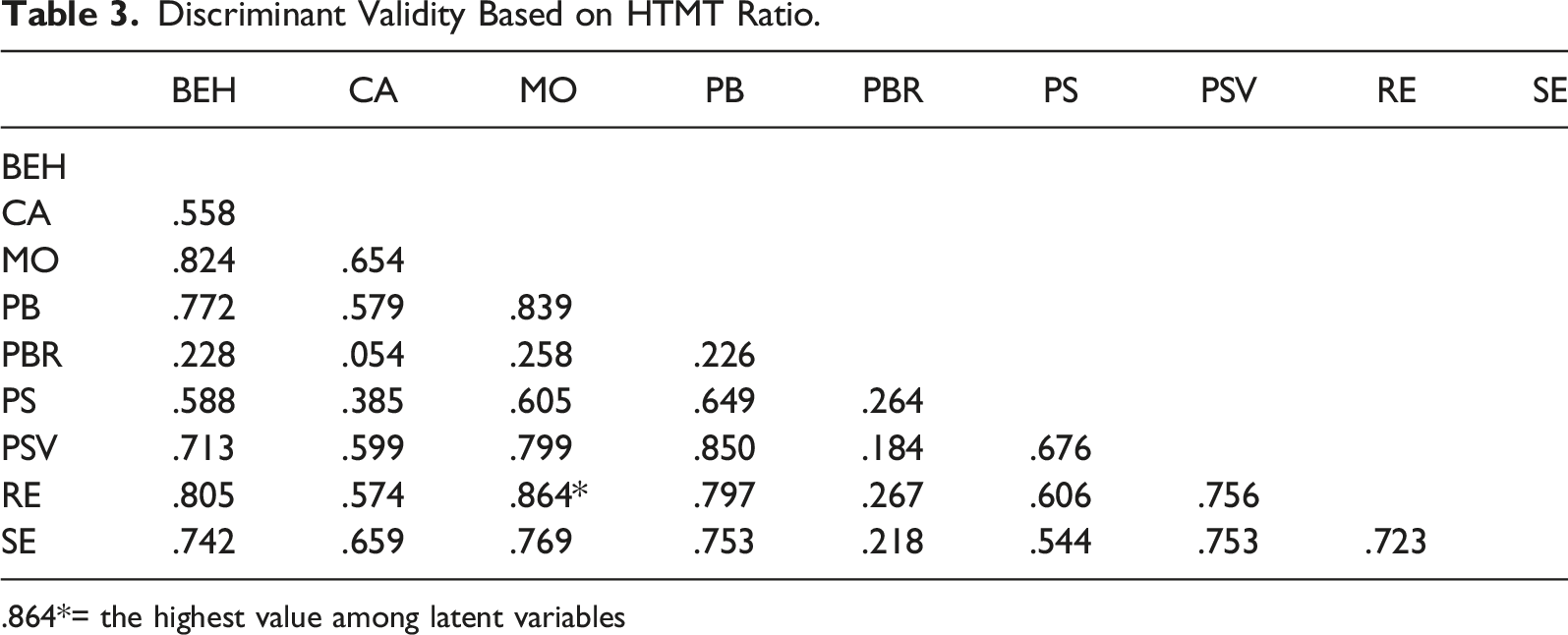
.864*= the highest value among latent variables
The Structural Model
The proposed hypothesised paths were assessed through the structural model after achieving reliability and validity of the measurement items (see Figure 2 and Table 4). The Structural model. Analysis of Hypothesised Structural Paths. R2 = 63.5; *** p < .001; ** p < .05; * p < .10.

The test results for the structural relationships between the constructs are displayed in Table 3. H1a, which suggests a direct, positive and significant relationship between perceived susceptibility and motivation to engage in Covid-19 safety protocols was not supported (β = .001, t = .052, p > .96). The study however, found support for the remaining hypotheses
Discussion and Conclusions
The study aimed to examine factors that will motivate the target audience to voluntarily engage in Covid-19 safety behaviours during and after the pandemic from the perspective of the HBM and PMT. The study further sought to examine the link between motivation to engage in the safety behaviours and actual performance of the safety behaviours. In this study, motivation to engage in Covid-19 safety behaviours was conceptualised as willingness to social distance, properly wear facemask in public places, wash hands frequently with soap, and avoid handshaking. Actual behaviour on the other hand was conceptualised as performance of these safety/hygienic behaviours (social distancing, frequent handwashing, avoidance of handshaking) and willingness to continue after the pandemic.
The result shows an insignificant relationship between perceived susceptibility and motivation to engage in the Covid-19 safety behaviours. In other words, vulnerability to the coronavirus disease has no influence on target audiences’ motivation to engage in the Covid-19 safety behaviours since they do not see themselves as being at risk of becoming infected with Covid-19. This suggests that focusing on vulnerability will not influence the target audience in Ghana to engage in the Covid-19 safety behaviours. This could be explained by the conspiracy theories including Africans being immune to the coronavirus. These highlights the importance of raising public risk perception, as high risk perception has been shown to improve epidemic control in many infectious disease outbreaks (Sundström et al., 2015). The insignificant result contradicts past studies that found perceived susceptibility as an important variable in influencing health related behaviours (Moghadam, Raheli, Zarifian, & Yazdanpanah, 2020; Tweneboah-Koduah, 2018). The result however, agrees with the findings of Wong et al. (2020) which shows a low perception of susceptibility among Malaysians to the Covid-19 disease. The study also agrees with (Razmara et al., 2018) who found perceived susceptibility as an insignificant predictor of safe driving behaviour among taxi drivers in Bandar Abbas, Iran.
Similar to the findings of previous studies (Moghadam et al., 2020; Nugrahani, Budihastuti, & Pamungakasari, 2017), the result for H2 indicates a positive significant relationship between perceived severity and motivation to engage in social distancing, frequently wash hands and avoid handshaking. For instance, the findings of Nugrahani et al. (2017) show that perceived severity of cervical cancer was a significant influencer of Kediri’s women intention to receive the HPV vaccine. This finding however, disconfirms the finding of Tweneboah-Koduah (2018) who found an insignificant connection between perceived severity and breast cancer protective behaviours among women. The result also revealed in H3 a positive significant connection between perceived benefit and motivation to engage in Covid-19 safety behaviours. This finding is consistent with past studies that found perceived benefit as a significant variable for influencing behaviour (Mercadante & Law, 2021; Reaves et al., 2016; Rundle-thiele et al., 2017). The work of (Mercadante & Law 2021) for instance, shows that perceived benefits play a significant role in the vaccination intention for both flu and Covid-19. Similarly, the findings of Reaves et al. (2016) also show a positive significant relationship between perceived benefit and physical activity as consumers with high perceived benefits reports high physical activity than those with low perceived benefits. This finding however, contradicts the findings of Tavafian, Hasani, Aghamolaei, Zare, and Gregory (2009) who found insignificant relationship between perceived benefit and BSE behaviour.
Additionally, for H4, the study found a positive significant association between response efficacy and motivation to engage in the safety behaviours. This suggests that the target audiences’ belief in the effectiveness of the safety behaviours to protect from Covid-19 is a significant motivating factor to engage in social distancing, avoid handshaking and wash hands frequently during and after the Covid-19 pandemic. This corroborates the findings of past studies (Gaston & Prapavessis, 2014; Ngondo & Klyueva, 2019). The study of Gaston and Prapavessis (2014) for instance, shows a positive correlation between belief in the effectiveness of a proposed solution to encourage physical activity during pregnancy and willingness by pregnant women to engage in physical activity. For H5, the study found a positive significant relationship between self-efficacy and motivation to engage in the Covid-19 safety behaviours. This suggests that making people believe in their ability to social distance, wear the facemask properly in public places, sanitise their hands frequently, avoid handshaking and frequently wash hands with soap will significantly influence their motivation to engage in these behaviours. This finding is consistent with past empirical studies that found self-efficacy as an important variable for the performance of heath behaviour (Mercadante & Law, 2021; Moghadam et al., 2020; Tweneboah-Koduah, 2018). This finding however, disagrees with the findings of Salari and Filus (2017) who found a no significant correlation between mothers’ self-efficacy and intention to participate in parenting programmes.
Consistent with past studies, the study found support for H6, which posits a positive significant relationship between cues to action and motivation to engage in the Covid-19 safety behaviours. This means that providing various cues to action about the Covid-19 safety behaviours will significantly influence motivation to engage in the behaviours. This provides support for other scholars (e.g., Razmara et al., 2018; Tweneboah-Koduah, 2018) who also found a positive correlation between cues to action and performance of desired behaviour. For example, the work of Razmara et al. (2018) indicates a significant positive association between cues to action and performance of safe driving behaviour. H7, which suggests a negative significant relationship between perceived barriers and motivation to engage in the Covid-19 safety behaviours was also supported. This result indicates that the higher the perceived barriers, the lower the motivation to engage in the Covid-19 safety behaviours and the lower the barriers, the higher the motivation to engage in the behaviour. Thus, reducing perceived barriers such as perception of being tagged as disrespectful for not shaking hands is much likely to increase motivation to engage in the Covid-19 safety behaviours.
Finally, and most importantly, the study shows a strong correlation between motivation to engage in the Covid-19 safety behaviours and actual performance of the behaviour, providing support for H8. This shows that when people are motivated, they will voluntarily perform the Covid-19 safety behaviours and likely continue with social distancing, frequent handwashing and avoid handshaking during and after the pandemic. This finding is in conformity with past findings (Nelson & Cismaru, 2011; Pelsmacker et al., 2011; Plotnikoff & Higginbotham, 2002).
Theoretical, Policy and Practical Implications of the Study
Firstly, the study, for the first time, has integrated the Health Believe Model and the Protection Motivation Theory to predicts target audiences’ motivation to engage in Covid-19 safety behaviours during and beyond the pandemic in the Ghanaian context and found all the integrated constructs to be applicable to Ghanaian situation except the relationship between perceived susceptibility and motivation to engage in Covid-19 safety protocols. The contribution of this research constitutes an extension of previous theories that will expand generalisations or fine-tune the theoretical propositions (Marshall & Rossman, 2011). It is worth mentioning that although the HBM has been empirically proven for its predictive ability to explain a significant amount of variance in health-related behaviours, integrating response efficacy and motivation from the PMT in our model provides a high explanatory power of the model. The study, thus, contributes to the theory-building effort in social marketing (Rundle-Thiele et al., 2019).
Secondly, using these theories, the result shows a positive correlation between perceived severity, perceived benefits, perceived barriers, cues to action, self-efficacy and response efficacy and motivation to social distancing, sanitize their hand frequently, avoid handshaking and frequently wash hand with soap. Theoretically, the positive associations suggest that these variables are the key ingredients necessary for motivating target audience in Ghana to engage the Covid-19 safety behaviours during and after the pandemic.
Thirdly, this research contributes to policy by bringing out the devastating effects of the COVID-19 pandemic on the Ghanaian economy and advocates social marketing approaches that could be used by implementers to promote the adoption of COVID-19 protective behaviours. (Marshall & Rossman, 2011) posit that the significance of a study for policy can be developed by discussing formal policy development in that area and by presenting data that shows how often the problem occurs and how costly it can be.
Practically, the results show that social marketers and policymakers in Ghana seeking to improve performance of the Covid-19 behaviours should appropriately emphasise the severity of coronavirus. Additionally, they should emphasise the benefits and efficacy of the safety behaviours to protect people from contracting the coronavirus, identify ways to lower barriers, and reinforce self-efficacy beliefs. The result shows insignificant relationship between perceived susceptibility and motivation to engage in the Covid-19 safety behaviours. This suggests that the Ghanaian public do not believe that they are susceptible to the Covid-19 disease and that focusing so much attention on susceptibility will yield a minimal result. Based on this finding, the authors recommend that to help design effective intervention to motivate the Ghanaian public to engage in the Covid-19 safety behaviours, limited attention should be given to susceptibility to the coronavirus disease.
Finally, the result further shows that motivation to engage in the Covid-19 safety behaviours leads to actual performance of the behaviour. Thus, when target audience are motivated by managers of social marketing interventions, people will take steps to perform the recommended behaviours.
Limitations and Direction for Future Studies
Notwithstanding the immense contributions of this study, it has some limitations that need to be considered when interpreting the findings. Firstly, Despite the importance of perceived susceptibility in predicting health related behaviours, the current study found perceived susceptibility as an insignificant construct to motivate engagement in the Covid-19 safety behaviours from the Ghanaian context. We recommend that future studies should use qualitative studies to understand why perceived susceptibility is not significant in the Ghanaian Context. Secondly, the current study was conducted using the HBM and Protective Motivation Theory to understand COVID-19 Protective behaviours. Given the importance of other theories in social marketing in influencing intention to perform desired behaviours, we recommend that future studies should use other theories in social marketing to understand COVID-19 protective behaviours in the Ghanaian Context. Thirdly, the study used HBM and PMT to understand the COVID-19 protective behaviours in the Ghanaian context. We suggest that future studies could use HBM and PMT to understand COVID-19 Protective behaviours in other contexts. Fourthly, given that this study only concentrated on residents in Accra, we do not assume that the findings reflect the views of the general Ghanaian population. This may limit the generalisability of the results. Future research may consider collecting data from the general Ghanaian population. Sixthly, the current study aggregated multiple behaviours, such as frequent hand washing, avoidance of handshaking, and facemask wearing in a single study. This is because, all social marketing interventions in Ghana on COVID-19 promoted all as COVID-19 Protective behaviours. We however, recommend for future studies to examine them in separate studies. Finally, the findings of this research are based on a cross-sectional data, which may suggest static correlations among the dimensions used at a single point in time. However, as acknowledged by past scholars (e.g., Rahmandad, Lim, & Sterman, 2021), there are possible feedback loops involved in behavioural issues. For instance, the current level of Covid-19 morbidity and mortality may influence the target audience’s perception and behaviours, which may subsequently influence future morbidity and mortality. Future researchers could, therefore, explore longitudinal data to see the pattern of change over time.
Finally, since self-reported intended behaviour may not always lead to behaviour performance, future studies should ascertain the actual performance of the behaviours as reported by respondents in this study. It is worth mentioning that notwithstanding the limitations outlined, our study may work as an important foundation on which further studies could be built.
Footnotes
Declaration of Conflicting Interests
The author(s) declared no potential conflicts of interest with respect to the research, authorship, and/or publication of this article.
Funding
The author(s) received no financial support for the research, authorship, and/or publication of this article.
