



Abstract
Efficient and coordinated health care responses to intimate partner violence (IPV) are essential, given that health care settings are a major entry point for abused women who seek professional services. However, there is a lack of evidence on how IPV referrals are effectively made within health care settings. In order to help program planners and providers across sectors to address the complex and chronic issue of IPV, a greater understanding of the post-IPV identification referral process is essential. A scoping review of the evidence on IPV referral programs and processes in health care settings was undertaken to provide an overview of the state of evidence and identify pertinent gaps in existing research. The scoping review identified 13 evaluative studies and 6 qualitative, primarily nonevaluative studies that examined IPV referral programs and processes. Evaluative studies involved a variety of designs and IPV referral outcomes. Rich descriptions of barriers and facilitators to seeking referrals by victims and making referrals by health care providers emerged from the evaluative and qualitative studies, but were explored more in depth in the qualitative studies. This scoping review provides guidance on what is currently known about IPV referral programs in health care settings and provides a starting point for further research on effectiveness of referral processes.
Introduction
Intimate partner violence (IPV) is a major health and social issue (Krug, Dahlberg, Mercy, Zwi, & Lozano, 2002). While both women and men are victims of IPV, higher prevalence rates exist among women. Twenty-one to fifty-five percent of women in North America have experienced IPV during their lifetime (Cohen & Maclean, 2004; U.S. Department of Justice, 2003) and many suffer multiple acute and chronic health consequences (Plichta, 1992). In addition to compromised physical and mental health, adverse social and economic circumstances are consequences of IPV. These include economic hardship, unstable housing, isolation, and limited social support (Campbell, 2002; Campbell, Snow-Jones, & Dienemann, 2002). Efficient and coordinated health care responses to IPV are essential, given that health care settings are a major entry point for abused women who seek professional services (American Academy of Family Physicians, 2005; American Medical Association, 2000; Cherniak et al., 2005; Feder, et al., 2009; O'Campo, Kirst, Tsamis et al. 2011; O'Campo, Ahmad & Cyriac, 2008; U.S. Preventive Services Task Force, 2004; Wathen & MacMillan, 2003).
In particular, health care institutions can play a pivotal role by making timely referrals to social and health services. For example, a coordinated process of care is designed not only as an immediate health response but also as a long-term plan of comprehensive care through referrals (see Figure 1). Yet, along with IPV screening procedures, referral of IPV victims to services is controversial in many health care settings due to lack of provider comfort to screen and refer, and/or concern that screening and referral may cause victims harm (O'Campo et al. 2011; Rhodes & Levinson, 2003).

Complexity of the process of IPV screening, referral, and problem resolution.
Generally, there is a lack of evidence on how IPV referrals are effectively made and on barriers and facilitators to the referral process in health care settings (McFarlane, Groff, O’Brien & Watson, 2006). In order to help program planners and providers across sectors to address the complex and chronic issue of IPV, a greater understanding of the post-IPV identification referral process is needed. While systematic reviews provide strong evidence base to inform the design of sound programs, such efforts require a pool of high-quality evidence to draw from. It was our original intent to undertake an evidence synthesis of studies describing IPV referral practices in health care settings; however, our initial investigation into the literature yielded a sparse set of high-quality studies. Consequently, we have undertaken a scoping review of the evidence on IPV referral practices in health care settings. The aim of the review is to provide an overview of the state of evidence and identify pertinent gaps in existing research.
We applied a realist lens to the scoping review in that we focused on identifying the extent to which information on underlying theory and mechanisms related to referral program success or failure are present in the existing literature (Pawson, 2006). This scoping review provides guidance on what is currently known about IPV referral programs in health care settings and provide a starting point for future research aiming to inform IPV intervention improvement.
Methods
A scoping review identifies the sources and range of existing evidence in a research area by efficiently recording key concepts and findings (Anderson, Allen, Peckham, & Goodwin, 2008; Arksey & O’Malley, 2005; Arksey, 2003; Levac, Colquoun, & O’Brien, 2010). Unlike a systematic review, a scoping review neither synthesizes nor provides an assessment outlining the quality of the available research (Arksey & O’Malley, 2005). Rather, by analytically summarizing the literature, one can identify pertinent gaps in the existing research. Ultimately, the gaps serve to inform policy makers and service providers about a previously unexplored topic or area of interest (Arksey & O’Malley, 2005). Researchers iteratively review and reflect upon available literature and apply inclusion and exclusion criteria to narrow the evidence reviewed with respect to a specific research question. Moreover, scoping reviews assess the quantity and breadth of current evidence and guide future research by highlighting existing gaps, as opposed to determining strength and generalizability of evidence as in systematic reviews (Arksey & O’Malley, 2005). In this review, we took a realist approach (Pawson, 2006) to scoping that focused on summarizing common elements in the literature about the “critical ingredients” of IPV referral processes in health care settings. Therefore, the approach is more inclusive and incorporated a wide range of study designs, including quantitative and qualitative research.
Search Strategy
The literature search included articles published in English (in both industrialized and nonindustrialized countries) between January 1990 and July 2010. Search terms included the term referral program and related synonyms such as model, program, intervention, best practice, innovation, success, health service, program evaluation, program development, and consultation. Search terms also included the term intimate partner violence and related synonyms including domestic violence, abuse, violence against women, and victimization. The search terms were then entered into the following medical and social science databases using Boolean operators: MEDLINE, EBM Reviews, PsychINFO, ASSIA, Social Sciences Abstracts, Social Sciences Citation Indexed, Social Services Abstracts, Sociological Abstracts, and Violence and Abuse Abstracts. In order to assess the breadth of evidence on IPV referral processes and programs, a range of evidence was collected, including both qualitative and quantitative scholarly literature such as theoretical literature on behavior change, and articles describing previously evaluated referral programs. The current study screened and included quantitative and qualitative articles; however, different extraction procedures were applied to each type of evidence.
Article Screening
The electronic database search yielded a total of 14,529 articles (see Figure 2). Two teams of screeners independently applied inclusion criteria to article abstracts found in the academic and gray (unpublished) literature after the electronic search. In order for an article to be included, it must have described research exploring referral processes in IPV programs in health care settings. We define health care settings as health care environments in which victims of IPV are referred to (internal or external) services by health care providers including doctors, nurses, social workers, and IPV victim advocates. Articles that were excluded from the review primarily discussed IPV screening programs and were strictly conceptual in nature, describing the prevalence of IPV and/or the need for referral of victims. Based on the application of the inclusion/exclusion criteria, 14,472 articles were excluded leaving 57 articles that specifically focused on IPV referral programs/processes. Full text of these 57 articles were then accessed and reviewed. Two teams of two to three reviewers read the full text articles and reapplied the above criteria (i.e., research on IPV referral programs, focus on programs in health care settings) to confirm inclusion.
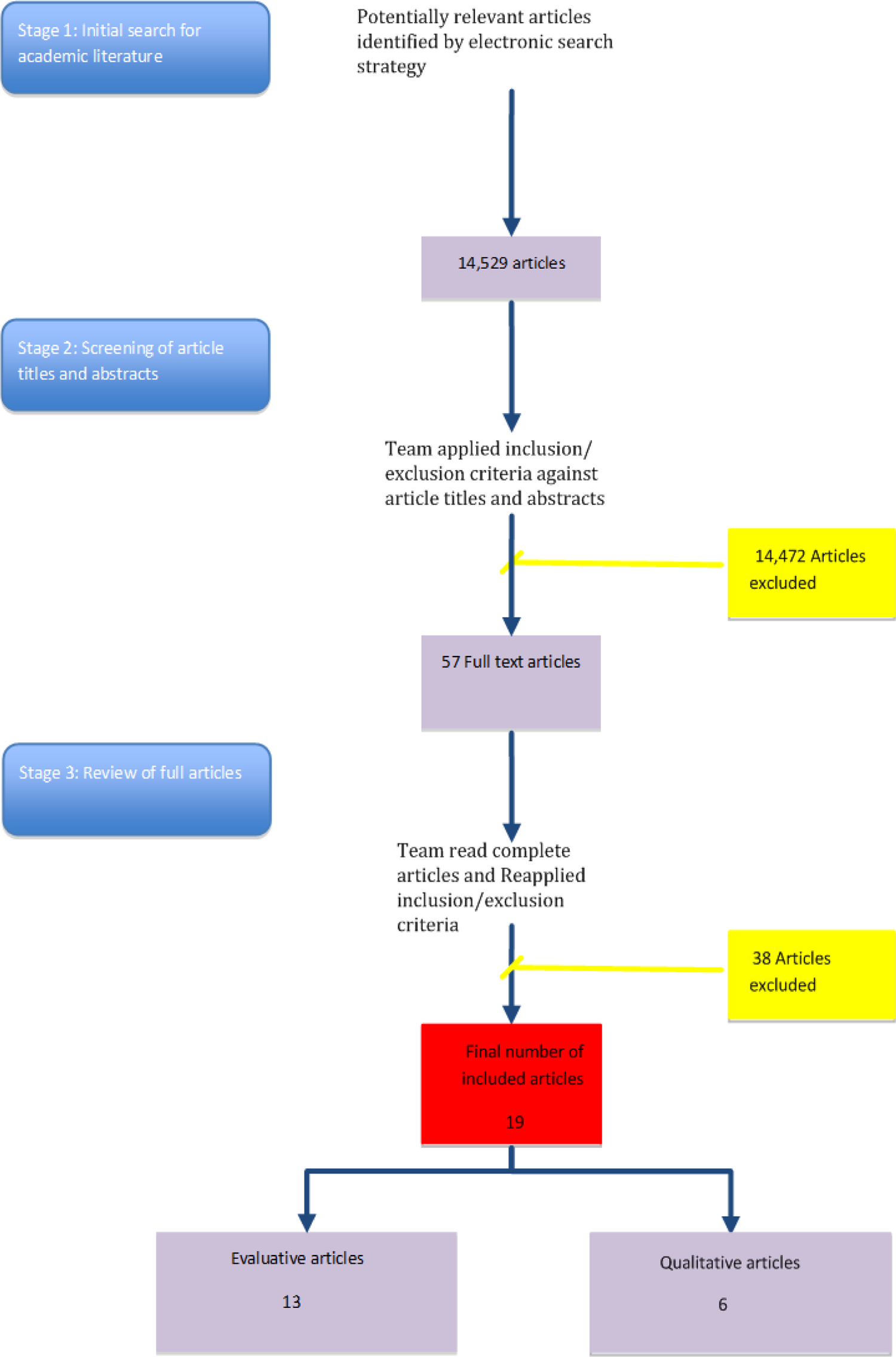
Article Screening.
We then applied another inclusion criterion related to the realist review approach to evidence synthesis. Pawson, Greenhalgh, Harvey, and Walshe (2005) describe realist reviews as a unique literature review methodology designed to examine the mechanisms or facilitators related to the success or failure of a “complex service intervention” (p. 22). Realist syntheses are helpful for understanding the effectiveness of health care programming as they involve the review of evaluative evidence to “unpack” the inner mechanisms of an intervention by making explicit the underlying theory about how programs work, and then systematically gathering evidence to test these theories, in consideration of the role of contextual factors on program workings (Pawson et al., 2005). In this process, we considered and included articles in the scoping review that provided detail on IPV referral programs and processes and identified potential mechanisms or facilitators that relate to program success or failure. This was done to comment on the state of evaluative evidence in this area and to isolate the extent to which evidence on IPV referral programs contains discussions or explanations of program success or failure for the purposes of a future realist synthesis. Through the application of these criteria, 13 evaluative articles that examined the impact of a specific referral program on IPV outcomes were included for scoping and extraction. We also identified six qualitative articles, which did not contain evidence related to a specific program and were thus considered to be nonevaluative, but discussed important themes on barriers and facilitators to making IPV referrals in health care settings. Thus, a total of 19 articles were included for scoping and extraction.
Scoping and Extraction Process
Two teams of three individuals per team were created to scope the articles included for review. Each team was assigned a set of articles from which they independently extracted information according to predetermined extraction criteria. From the 13 included evaluative articles, information was systematically extracted in an effort to identify the nature and extent of evidence available in the literature that would facilitate a greater understanding of how referral programs operate and highlight program mechanisms in a future realist synthesis. Information on population and program setting, definition of IPV, and program outcomes were extracted to provide a descriptive picture of programmatic response to IPV. We also extracted information pertaining to a number of realist informed criteria. As part of realist syntheses, in-depth information on program implementation, perceptions by providers and clients on how well the program is working, and potential reasons for the success or failure of programs can be key to identifying and understanding the program mechanisms that lead to positive outcomes (O'Campo et al., 2011; O'Campo, Kirst, Schaefer-McDaniel et al., 2009). Information on these areas was subsequently extracted.
The “thickness” or “richness” of a program description also helps to unpack how programs work in the context of a realist synthesis (O'Campo et al., 2011; O'Campo et al. 2009). In the current scoping review, an article was considered “rich” if it contained information to satisfy multiple extraction criteria and if overall, it provided detailed description of referral processes. Qualitative articles were reviewed and content was analyzed for key themes relating to the extraction criteria.
Results
Evaluative Articles
The scoping review identified a heterogeneous body of evaluative evidence (including a range of designs and outcomes) on IPV referral programs. Designs included randomized controlled trials (RCTs) and pre-post studies that examined the effectiveness of different referral interventions, studies examining the reasons for victim acceptance of a referral, studies assessing effects of an intervention on provider capacity for referral as well as one study that involved a survey of existing policies regarding action on IPV within maternity services (see Table 1). We now discuss the extent of evidence available on the topics extracted in the evaluative articles.
Description of Evaluative Articles

Definition of IPV
Of the 13 articles reviewed, 6 provided an explicit definition of IPV (Kiely, El-Mohandes, El-Khorazaty, & Gantz, 2010; Krasnoff & Moscati, 2002; Marchant, Davidson, Garcia, & Parsons, 2001; McFarlane, Groff, O’Brien, & Watson, 2006; Thompson et al., 2000; Trautman, McCarthy, Miller, Campbell, & Kelen, 2007). An additional three articles did not explicitly define IPV but provided implicit definitions based on operationalization in the study, either through screening questionnaires or sampling criteria (Kendall et al., 2009; McCaw et al., 2002; McFarlane, Soeken, Reel, Parker, & Silva, 1997). Four articles did not define IPV at all (McFarlane, Soeken, & Wiist, 2000; McFarlane & Wiist, 1997; Muelleman & Feighny, 1999; Norton & Shauer, 1997). IPV was sometimes referred to as domestic violence, abuse, or interpersonal violence. Some studies focused on physical violence (Kendall et al., 2009; Krasnoff & Moscati, 2002) while others utilized a broader definition of violence including physical, psychological, or sexual (Kiely et al., 2010; Marchant et al., 2001; McCaw et al., 2002; Thompson et al., 2000). Several studies broadly defined a perpetrator as a current or former intimate partner (Kendall et al., 2009; Kiely et al., 2010; McFarlane et al., 2006; Trautman et al., 2007) while others specified violence that occurred in heterosexual relationships (McFarlane et al., 1997), and one study included parental violence in its definition (Thompson et al., 2000).
IPV Outcomes
All evaluative studies clearly articulated outcomes that can be linked to the impact of referral programs. The outcomes were highly heterogeneous, however, and related to different aims and goals of the studies. Some studies focused on changes in safety behaviors as an outcome, such as the completion of a safety plan or changes in perceived safety over time (Kendall et al., 2009; McFarlane et al., 2006). Many studies measured changes in IPV, self-reported end of violence, and other proxy violence measures such as changes in the number of police calls and repeat emergency department visits (Kiely et al., 2010; Krasnoff & Moscati, 2002; McFarlane et al., 2006; McFarlane et al., 1997; McFarlane et al., 2000; Muelleman & Feighy, 1999). A few studies assessed changes in IPV victims’ use of community resources (Krasnoff & Moscati, 2002; McFarlane et al., 2006; McFarlane et al., 1997; McFarlane et al., 2000; Muelleman & Feighny, 1999). Other articles examined the reason for acceptance of a referral (McCaw et al., 2002), the quality of domestic violence management/referral (Thompson et al., 2000), or assessed the predictors of IPV service use (Norton & Schauer, 1997). One article assessed the effectiveness of a computer-based health survey for referring IPV victims to social work services (Trautman et al., 2007). Another study involved a national scan to determine whether IPV screening and referral policies existed in maternity services and explored provider perceptions of screening and referral processes, but provided no assessment of program effectiveness in its design (Marchant et al., 2001).
Rich Description of Referral Processes
Rich description entails a detailed description of the referral process from screening to connection with a service provider. This would include information on who is involved in the referral process, what roles they played, and what procedures were followed to determine how and to whom victims should be referred. Of the 13 evaluative studies, 10 studies provided a relatively rich description of referral procedures and processes (Kendall et al., 2009; Kiely et al., 2010; Krasnoff & Moscati, 2002; McCaw et al., 2002; McFarlane et al., 2006; McFarlane & Wiist, 1997; Norton McFarlane et al., 1997; McFarlane et al., 2000; & Shauer, 1997; Trautman et al., 2007), while 3 studies did not provide rich descriptions (Marchant et al., 2001; Muelleman & Feighny, 1999; Thompson et al., 2000).
The 10 studies that provided relatively rich descriptions reflect heterogeneous referral programs across sites, especially in terms of the actual procedures through which referrals occurred, as well as the types of resources offered. Of the 10 studies, the setting for referrals ranged from hospital emergency departments (Kendall et al., 2009; Krasnoff & Moscati, 2002; Norton & Shauer, 1997; Trautman et al., 2007) to an entire health maintenance organization (HMO) McCaw et al., 2002), to prenatal and primary care clinics (Kiely et al., 2010; McFarlane et al., 2006 McFarlane et al., 1997; McFarlane et al., 2000; McFarlane & Wiist, 1997).
In all cases, except one (Trautman et al., 2007), it was clear that a protocol for referral was implemented. Nurses were frequently responsible for screening and referring victims (Krasnoff & Moscati, 2002; McFarlane et al., 2006; McFarlane et al., 2000) although physicians provided referrals as well (Kendall et al., 2009). In some studies, women were self-screened using a computer-based program or given referrals after self-disclosure (Kiely et al., 2010; Trautman et al., 2007), and in some instances a mixture of referral sources were cited (McCaw et al., 2002). Women were most frequently referred to on-site domestic violence advocates or social workers who then provided further support and referrals to community resources (Kendall et al., 2009; Krasnoff & Moscati, 2002; Norton & Shauer, 1997; McCaw et al., 2002; Trautman et al., 2007). Other referrals included domestic violence support groups, counseling, “mentor mother” programs, cognitive behavioral interventions, and nurse case management (McFarlane et al., 2006; McFarlane et al., 1997; McFarlane et al., 2000; McFarlane & Wiist, 1997; Norton & Shauer, 1997; McCaw et al., 2002).
Reasons for Seeking and Making Referrals
We assessed whether studies addressed reasons for why victims sought and providers made referrals. These could include any combination of decision-making processes that contributed to why referrals may be sought or made as well as institutional facilitators of referral, such as clear educational training for health providers. The four RCT studies are excluded from this discussion as the reasons for seeking and making referrals were largely determined by randomization (Kiely et al., 2010; McFarlane et al., 2006; McFarlane et al., 2000; Thompson et al., 2000).
Eight studies provided some information on either reasons for victims’ seeking or providers’ making referrals (Kendall et al., 2009; Krasnoff & Moscati, 2002; Marchant et al., 2001; McCaw et al., 2002; McFarlane & Wiist, 1997; Muelleman & Feighny, 1999; Norton & Shauer, 1997; Trautman et al., 2007), while one study did not report any information relating to reasons for seeking or making referrals (McFarlane et al., 1997). Of the eight studies, only one reported reasons for why participants sought referral (McCaw et al., 2002) and only three reported reasons for why providers made referrals (Kendall et al., 2009; Marchant et al., 2001; Muelleman & Feighny, 1999), while four reported some information regarding both participant and provider reasoning (Krasnoff & Moscati, 2002; McFarlane & Wiist, 1997; Norton & Shauer, 1997; Trautman et al., 2007). According to these studies, women sought referrals due to concern for their children, fear for their physical well-being, and wanting to change their situation by self-disclosing to health care providers (Krasnoff & Moscati, 2002; McCaw et al., 2002). The convenience and immediacy of a within-hospital referral was also cited as a motivating factor (Norton & Shauer, 1997). A key reason why health care providers made referrals was having an institutional policy or agreed-upon practices regarding referrals postscreening or disclosure (Kendall et al., 2009; Krasnoff & Moscati, 2002; Marchant, 2001; McFarlane & Wiist, 1997; Muelleman & Feighny, 1999; Norton & Shauer, 1997; Trautman et al., 2007). Receipt of training on how to provide referrals (Kendall et al., 2009) and having an on-site IPV advocate (Krasnoff & Moscati, 2002; Norton & Shauer, 1997) were additional reasons.
Reasons for Not Seeking and Making Referrals
Similarly, we also considered whether studies addressed reasons why victims did not seek or providers did not make referrals. These included individual-level reasons regarding why victims or providers might feel that a referral would be inappropriate as well as institutional barriers to referral. We separate reasons for not seeking and making referrals from reasons for seeking and making referrals because these two aspects of referral may not have been addressed by the same studies. Fewer studies reported reasons for not seeking and making referrals than reasons for seeking and making referrals. Excluding randomized trials, six studies provided information regarding these reasons (Kendall et al., 2009; Krasnoff & Moscati, 2002; Marchant, 2001; McCaw et al., 2002; Norton & Shauer, 1997; Trautman et al., 2007), while three studies did not address these topics (McFarlane et al., 1997; McFarlane & Wiist, 1997; Muelleman & Feighny, 1999; Thompson et al., 2000; ). Of the six studies, five discussed both victim and provider reasons (Kendall et al., 2009; Krasnoff & Moscati, 2002; Marchant, 2001; Norton & Shauer, 1997; Trautman et al., 2007), while one only discussed victims’ reasons for not seeking referrals (McCaw et al., 2002). Limited time and availability of on-site IPV referral resources were repeatedly cited as factors for both providers not making and victims not seeking referrals (Kendall et al., 2009; Norton & Shauer, 1997; Trautman et al., 2007). Additionally, fear of losing custody of children, coming from a culture which may perpetuate abusive situations, immigration status, fear of retribution, and past negative experiences with agencies were all reported reasons for why women did not seek referrals (Krasnoff & Moscati, 2002; Marchant, 2001; McCaw et al., 2002; Norton & Shauer, 1997). Lack of knowledge, training, and support to handle the referral situation, and barriers related to screening (which then affected referral rates) were additional reasons why providers did not make referrals (Kendall et al., 2009; Marchant, 2001).
Participant Perception of the Referral Process
Participant perceptions of the referral process can capture important information on the quality and nature of referrals for IPV victims. Collecting information on the quality and nature of referrals is essential to assist with the design and improvement of referral programs. Of the 13 evaluative studies included, only 1 study provided in-depth information on the victims’ perceptions of the referrals they received. This information included the types of referral services most commonly received, the source of the referrals, and level of satisfaction with the referrals received (Norton & Schauer, 1997).
Provider Perception of the Referral Aspect of the Program
Consideration of provider perceptions of the referral process is necessary for achieving an understanding of what resources need to be in place in order for providers to effectively refer identified victims to further services. Three studies presented provider perceptions, of which two reported perceptions that interventions were successful in increasing providers’ comfort with referring and awareness that there is a need to refer (Kendall et al., 2009;Thompson et al., 2000). Yet another study highlighted the need for more training for midwives on how to support victims (Marchant et al., 2001).
Explanation of Program Success or Failure
Eleven of the thirteen evaluative referral studies attempted to explain or provide reasons for success, failure, or challenges in the referral process for victims of IPV. Reasons for success/failure differed by referral outcome. Two studies discussed how success with respect to victims’ acceptance of a referral was related to the supportive approach taken by providers (Krasnoff & Moscati, 2002; McCaw et al., 2002). One study identified that community resource use after referral was related to severity of abuse experienced by IPV victims (McFarlane et al., 1997). Three studies attributed improved outcomes, such as increased safety behaviors, decreased violence, or group IPV counseling access, to victim readiness to change and accept an intervention (Kendall et al., 2009; Norton & Schauer, 1997; McFarlane et al., 2006). Two studies attributed an increase in service use by way of referrals to easy access to various resources and strong links between the health care setting and community services (McCaw et al., 2002; Muelleman & Fieghny, 1999). Two studies found that ethnic minority women who screened positive for IPV had lower community resource use, and they attributed this to cultural barriers (McFarlane et al., 2000; Norton & Schauer, 1997). One study noted that low referral rates after screening and low access to referred services were due to logistical difficulties in accessing a positive screening printout by providers. Victim service refusal and low social worker coverage were also cited as reasons for low referral rates (Trautman et al., 2007).
Themes From Qualitative Articles
Of the qualitative studies, two explored the effectiveness of specific IPV referral programs (Hathaway, Willis, & Zimmer, 2002; McCaw et al., 2002)—one of these studies (McCaw et al., 2002) incorporated a mixed–methods design and is discussed in the evaluative article section as well (see Table 2). The other four studies drew on population samples of health care providers or victims and explored general perceptions and experiences with the IPV referral process. The qualitative studies highlighted many aspects of referral that were not discussed in depth in the evaluative studies. Particularly, the qualitative studies provided rich discussions of both victim and provider perceptions regarding the process of referral and the various facilitators and barriers to referral. We highlight here some key themes raised in the qualitative articles that might assist in the optimization of the design and evaluation of referral programs.
Description of Qualitative Articles

Several qualitative articles drew particular attention to the unique barriers facing minority or marginalized women in seeking referrals, either because of ethnicity or same-sex relationship status (Alhusen, Lucea, & Glass, 2010; McCaw et al., 2002). Qualitative studies emphasized the need for health care providers to take a holistic view of the victim’s situation, balancing a range of victim needs (Dienemann, Glass, & Hyman, 2005; Hathaway et al., 2002; Kulkarni, Bell, & Wylie, 2010). Victims and health care providers may prioritize their need for referral differently. While victims may not be ready to accept a referral, victims noted that it would be beneficial to have resources discretely advertised in health care settings (Kulkarni et al., 2010). Moreover, victims noted the importance of open, trusting health care provider–client relationships; ongoing offers of referral were important to meet their complex and long-term needs for support (Brendtro & Bowker, 1989, Dienemann et al., 2005, Hathaway et al., 2002; McCaw et al., 2002). Victims identified the need for health care providers to respect their choices regarding their decision to follow up with referrals. Victims emphasized a preference for immediate referral post-disclosure and that IPV specialists located on-site were essential particularly because many felt that their health care providers did not have all of the resources and tools to deal effectively with IPV (Brendtro & Bowker, 1989; Dienemann et al., 2005; Hathaway et al., 2002).
Similarly, health care providers expressed concerns that their desire to provide immediate referrals post-disclosure was not supported by readily available resources (D’Avolio, 2011). IPV specialists were identified as sources to help victims navigate the barriers to accessing various resources with limited availability, including shelters (Kulkarni et al., 2010).
Discussion
In this scoping review, we found that a small body of evaluative research on IPV referral programs exists, but that this research examines various outcomes through different study designs. Thus, comparability across studies would be difficult in a future realist synthesis. Rich descriptions of programs, including discussion of potential reasons why programs succeeded or failed, were provided in the majority of studies.
A large proportion of studies explored whether victims sought referrals or whether providers made referrals, and some provided explanations of program success or failure. The desire of victims to change their situation, the convenience and immediacy of referral, respectful and trusting relationships between victims and providers, and the implementation of institutional referral policies and training for providers emerged as facilitators to IPV referral. Similarly, the studies highlighted that limited time and availability of on-site IPV referral resources, barriers to screening, and lack of provider comfort, knowledge, and training may be challenges in making referrals for providers. Fear of retribution or losing children, cultural barriers, and previous negative experiences with services emerged as challenges to seeking referral for victims. The scoping review suggests that these are areas to pay attention to in the referral process. However, this evidence is very preliminary, given the nature of scoping reviews; thus further research is needed to isolate the role of these factors in the implementation and success of IPV referral program processes.
Generally, victim and provider perceptions of the programs, and information on reasons why victims would not seek or providers would not make referrals were not explored in depth in the evaluative studies as in the qualitative studies. As only one study combined quantitative and qualitative methods, this highlights the need for more evaluative research that incorporates mixed-method designs. The combination of quantitative and qualitative methods would provide the explanatory power necessary to more fully understand how key IPV referral program processes and components work to achieve program success and to elucidate the important role of contextual factors on program outcomes.
Based on the current review, a future realist synthesis would be important to further isolate IPV referral program mechanisms that are currently poorly understood. However, the results of the synthesis would likely be limited in informing program improvement and development, due to the heterogeneity of existing evidence. Future evaluations should focus on key outcomes, employ comparable designs, and incorporate mixed quantitative and qualitative methods in order to fully unpack the mechanisms related to IPV referral program success.
Our scoping review reveals some additional limitations in the current body of literature examining referral programs for IPV. For example, the research predominantly focuses on female victims of IPV and on victims and perpetrators in heterosexual relationships. More research is needed to assess accessibility and needs across diverse groups with respect to IPV referral services. Further evaluative work would need to be generated to assess how well referral programs work for such diverse populations.
There is emerging evidence that referral of IPV victims to health and social services can positively impact on victim outcomes such as mental health and re-victimization (Bybee & Sullivan, 2005; Tiwari et al., 2005). However, the main finding of the scoping review is that more evidence is needed about how referral processes work in health care settings. More in-depth, evaluative evidence on IPV referral programs is needed to complement the significant body of research evaluating the effectiveness of IPV screening programs in health care settings (O’Campo et al., 2011) in order to improve the ability of health care institutions to assist victims along the complex pathway to IPV resolution. Maritt Kirst is an Assistant Professor at the Ontario Tobacco Research Unit and the Dalla Lana School of Public Health, University of Toronto. She is also an Affiliate Scientist with the Centre for Research on Inner City Health, St. Michael s Hospital, in Toronto, Canada. Her research focuses on the evaluation of tobacco control policies, and social contextual effects on substance use and mental health outcomes.
Footnotes
Declaration of Conflicting Interests
The authors declared no potential conflicts of interest with respect to the research, authorship, and/or publication of this article.
Funding
The authors disclosed receipt of the following financial support for the research, authorship, and/or publication of this article: This research was funded by a Canadian Institutes of Health Research Knowledge Synthesis Grant.