



Abstract
Victims of childhood sexual abuse carry the experience of abuse into adulthood. One of the dilemmas victims face during adulthood is the decision to disclose or conceal the abuse. Although adult disclosure may be affected by former disclosure during childhood, adult survivors face new challenges and dilemmas, such as to whom, when, and how to tell. The purpose of this article is to review the domains found in the literature on survivors’ experiences regarding disclosure of child sexual abuse during adulthood, all of which were published between 1980 and 2013. Domains include decisions to disclose during adulthood, barriers and facilitators to disclosure and potential recipients of the disclosure, as well as the process of telling and its impact on survivors’ well-being. The authors present implications for policy, practice, and research.
While the growth of research concerning child sexual abuse (CSA) disclosure has led to greater understanding of the challenges children face when considering disclosure, there is less attention focused on adult survivors of CSA and disclosure.
Draucker and Martsolf (2008) offer the following conceptualization of disclosure: “ … a process that is complex, progressive, and multifaceted, best captured by the metaphor of ‘storying’” (p. 1045). In its broadest definition, disclosure refers to telling another person about the abuse either formally or informally, voluntarily or in response to others’ invitations to tell (Ullman, 2003). Some researchers agree that many survivors of CSA will never tell their stories, and many will delay the telling (Hébert, Tourigny, Cyr, McDuff, & Joly, 2009; Jonzon & Lindblad, 2004). Accordingly, the concept of delay of disclosure has been extensively reported in the literature (e.g., Hébert et al., 2009; Hershkowitz, Lanes, & Lamb, 2007; Schönbucher, Maier, Mohler-Kuo, Schnyder, & Landolt, 2012). A commonly cited definition of delay found in the literature refers to the survivor’s avoidance of disclosing the abuse (e.g., Smith et al., 2000). Delay can be temporary, when eventually the survivor chooses to tell his or her abuse story to a trusted person, or it can be permanent, with survivors’ decisions not to reveal their story. Hébert, Tourigny, Cyr, McDuff, and Joly (2009) reported one of the five survivors never disclosed the childhood sexual abuse, and nearly 60% delayed disclosure for more than 5 years after the first episode. Similarly, Jonzon and Lindblad (2004) reported less than one third disclosed the abuse during childhood, and most of the survivors waited an average of 21 years until disclosing during adulthood.
There are several individual, social, and cultural dimensions that impact the decision to disclose or conceal the abuse story. Individuals who disclose childhood sexual abuse make decisions to disclose or not during adulthood. The transition to adulthood brings new challenges and introduces the survivors to new surroundings, including individuals or groups (formal and informal) who are not aware of the survivor’s story of abuse. To disclose the abuse can mean bringing the abused childhood world into the current life, possibly contaminating it forever (Tener, 2010). On the other hand, to avoid disclosure means carrying a heavy burden and may require a great deal of energy in secret keeping (Staller & Nelson-Gardell, 2005).
Social expectations of others about disclosing during adulthood might be similarly diverse. On one hand, there may be an expectation that adult survivors will “turn their childhood perpetrator in,” since sex offenders pose a source of fear and anxiety in society (Levenson, Brannon, Fortney, & Baker, 2007). On the other hand, the phenomenon of sexual abuse is so threatening that society might reject a person who reveals his or her story publicly or society might use stereotypes in order to encapsulate it from daily life (Tener & Eisikovits, in press). Accordingly, several studies indicated that survivors of sexual abuse tend to feel more comfortable when their abuse fits the stereotype of kidnapping and sustaining serious injury (Wolitzky-Taylor et al., 2011), neither of which are typical experiences for those reporting CSA (Salter, 2013).
Numerous studies during the last three decades described elements of disclosure. Some studies were restricted to disclosure during childhood (e.g., London, Bruck, Ceci, & Shuman, 2005; McElvaney, Greene, & Hogan, 2012; Schaeffer, Leventhal, & Asnes, 2011), while others combined disclosure during childhood and adulthood (for review, see Ullman, 2003). A major drawback in some studies was the tendency to combine childhood and adulthood disclosure without specifically examining each of them separately. Though some of the variables in the disclosure process may be similar in childhood and adulthood, other variables are unique to each and require individual examination. For example, Roesler and Wind (1994) examined both survivors who disclosed during childhood and ones who disclosed during adulthood. In so doing, the authors presented facilitators to disclosure, but it was not clear whether some of them were more common to specific age-groups. A case in point, one may assume that “wanted protection from the abuse” (p. 333) would be more likely to motivate childhood disclosure, while the “secret interfered with intimacy” (p. 333) would more likely be related to adult disclosure. Only a few studies specifically addressed the phenomenon of adult disclosure, and of those, some stressed very specific domains, such as disclosing during therapy sessions (McGregor, Glover, Gautam, & Jülich, 2010) or disclosing abuse by specific types of offenders, that is, abuse by clergy (Isely, Isely, Freiburger, & McMackin, 2008).
While some similarities between the disclosures of children and adults do exist (Ullman, 2003), it is important to understand the specific dynamics of each. For example, while fear of negative responses from others appears to be an area that impacts both children and adults, an adults’ decision making can occur whether the abuse was disclosed or concealed during childhood. Whether to disclose or not must be faced each time the adult meets a new situation. Each new social system—formal or informal—and each new relationship—short or long term—necessitates the decision. As examples, the survivor might disclose to a caring nurse in the delivery room or to an intimate partner in a long-term relationship. Accordingly, the purpose of this article is to review the domains found in the research literature on adult disclosure experience. As mentioned, the authors considered literature published between 1980 and 2013 as published in peer-reviewed journals. Our search included decisions to disclose during adulthood, barriers and facilitators to disclosure, potential recipients of the disclosure, the process of telling, and its impact on survivors’ well-being.
Method
Articles between 1980 and 2013 were reviewed. The academic databases that reflect the multidisciplinary nature of the phenomenon under study were searched: criminal justice (Criminal Justice Abstracts); health care (Medline with full text); psychology (PsychInfo); social work (Social Work Abstracts); sociology (Sociological Abstracts); and Web of Science database. Search terms included CSA, incest, adult, and disclosure.
The following inclusion criteria were implemented: (1) qualitative and quantitative studies examining domains of disclosure of CSA during adulthood; (2) studies sampling survivors only, as the purpose of the review was to focus on the experience of the survivors themselves; (3) In the case of studies that consisted of essential information about both childhood and adulthood disclosure, the parts of the article that dealt specifically with adult disclosure of childhood experiences were reviewed.
The following articles were excluded from the review: (1) articles in languages other than English; (2) reviews, opinions, and editorials; (3) articles that discussed disclosure only during childhood or adolescence; (4) Articles in which it was impossible to differentiate between information about childhood and adulthood disclosure; (5) publications that discussed professionals’ and lay persons’ opinions and attitudes toward disclosure; (6) articles discussing delayed disclosure without emphasizing whether disclosure actually took place in childhood or adulthood.
During the review of the articles, six main domains were located and were used as a framework. These included (1) the decision to disclose, (2) barriers for disclosure, (3) facilitators for disclosure, (4) process of disclosure, (5) responses to disclosure, and (6) the impact of disclosure on survivor’s well-being.
Results
In total, 55 articles in Criminal Justice Abstracts were found, 281 articles in Medline with full text, 58 articles in PsychInfo, 19 articles in Social Work Abstracts, 39 articles in Sociological Abstracts, and 1 additional article in the Web of Science based on citations of selected articles. In all, 28 articles published between 1980 and 2013 that met our criteria were reviewed (see Table 1).
Descriptions of Reviewed Articles.
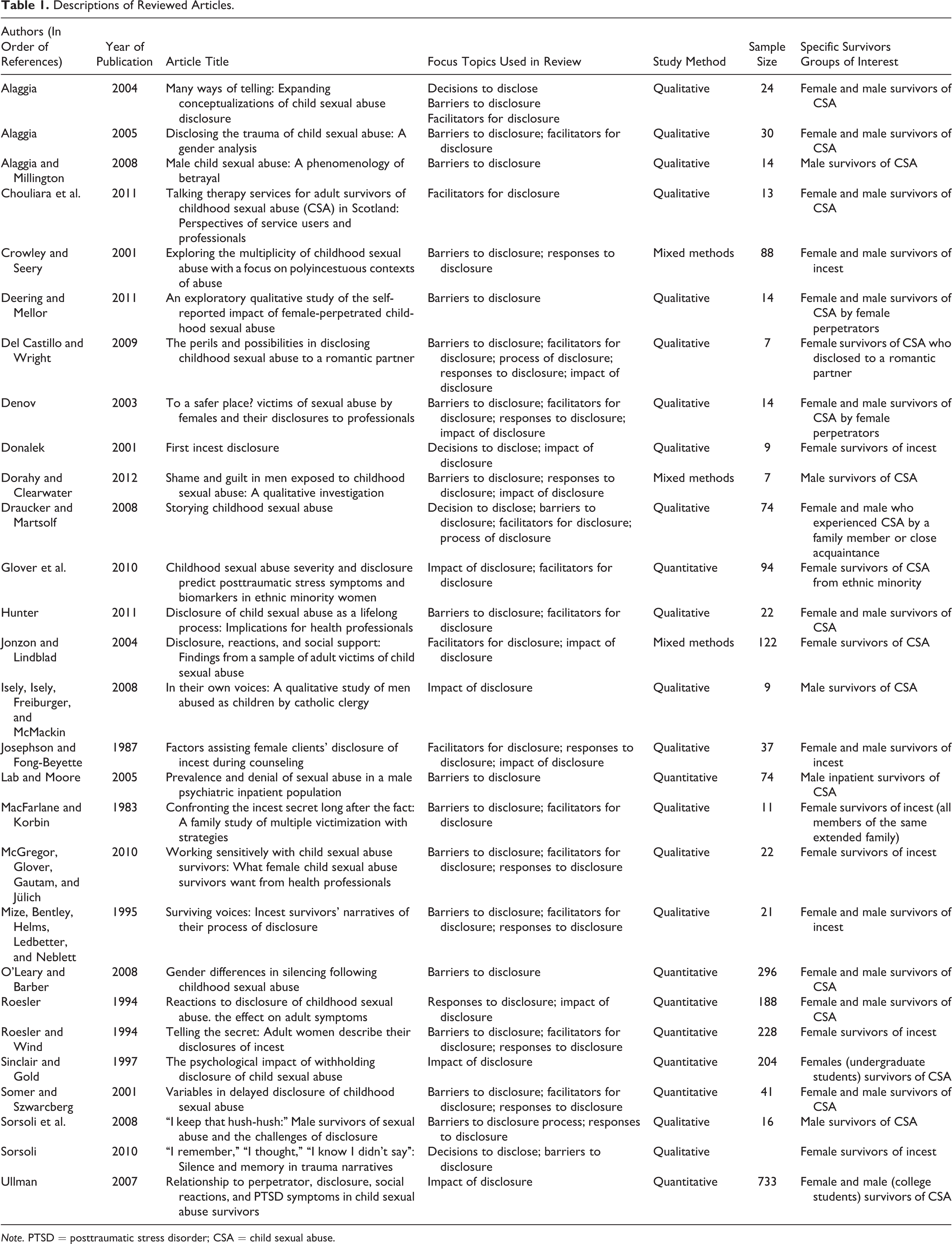
Note. PTSD = posttraumatic stress disorder; CSA = child sexual abuse.
Although the results are organized according to the categories listed previously, the contents in specific categories are not necessarily exclusive. For example, negative responses to disclosure during childhood or adulthood can function as a barrier to further disclosure during adulthood. On the contrary, positive responses from significant others can be categorized as facilitators to further disclosure.
Decisions to Disclose
Adult decision making about disclosure is described in the literature as thoughtful and well processed, and decisions to disclose or conceal are typically described as purposeful (Alaggia, 2004; Draucker & Martsolf, 2008), meaning that the survivors are deliberately telling or withholding information about the abuse to another person. “Intentionality has to do with the directedness or aboutness of mental states—the fact that, for example, one’s thinking is of or about something” (Siewert, 2011, para. 1). It should be noted that other impetus to disclose is also discussed in the literature, for example, elicited disclosure that is encouraged by therapists (Alaggia, 2004; Donalek, 2001). However, the same mechanism exists whether it is prompted by others or self-motivated: Survivors deliberately and willingly decide whether to reveal information about the abuse to another person, and they are engaged in self-dialogue about the right time for the disclosure (Del Castillo & Wright, 2009). The emotional and cognitive processes involved in the decision to disclose are described as overwhelming, and survivors struggle with confusion and doubts (Donalek, 2001). Yet the act of telling is described in the literature as purposeful and intentional. It is not clear in the literature whether other forms of disclosure, such as disclosing the story unintentionally to a recipient after being triggered or overwhelmed, can also occur during adulthood.
Barriers to Disclosure
A relatively large portion of the literature about adult disclosure of CSA focuses on the barriers for disclosure. These can be divided into intrapersonal, interpersonal, and sociocultural barriers. When discussing intrapersonal barriers, some survivors describe lacking an awareness about whether or not they were abused or about feeling ambiguity about the accuracy of their memory regarding childhood sexual abuse. They describe having repressed the memory of the abuse into adulthood. Even when they were somewhat aware of it, they found themselves questioning whether what happened constituted abuse (Crowley & Seery, 2001; Lab & Moore, 2005) and expressed concern about the accuracy of their memories and whether or not they were genuine (Dorahy & Clearwater, 2012; Sorsoli, Kia-Keating, & Grossman, 2008). Other adult survivors were fully aware of the past abuse and yet knowingly chose to avoid disclosing it (Sorsoli, 2010). They referred to shame, guilt, self-blame (Alaggia, 2004; Dorahy & Clearwater, 2012; Draucker & Martsolf, 2008), and anxiety as the most frequent barriers to disclosure (Dorahy & Clearwater, 2012). They also expressed doubt regarding how to address the subject, and they were unsure whether disclosing would improve their current state of well-being (Sorsoli et al., 2008).
Interpersonal barriers to disclosing relate to all social systems surrounding the adult survivor: family, environment, society, and culture. Survivors talk about fear of others’ reactions to their stories. They have prior expectations about other’s reactions, and they engage in predicting how others will respond. Their main concerns focus on their fear of not being believed and on being emotionally hurt after disclosing (Alaggia, 2004). They fear others will not be interested or will reject their story, dismiss it, condemn them, or further expose the story to others without their permission (Del Castillo & Wright, 2009; Dorahy & Clearwater, 2012; Draucker & Martsolf, 2008). They also fear hurting the people they care about and are concerned about the feelings others might have after they hear their stories, such as feeling sad or guilty (Alaggia, 2004; Draucker & Martsolf, 2008; Hunter, 2011; Mize, Bentley, Helms, Ledbetter, & Neblett, 1995).
Some survivors noted the fear that disclosure will ruin their present lives, making them lose everything they had achieved so far (their partner, children, and psychological balance (Donalek, 2001). They might also state that the abuse is irrelevant to their current lives and does not represent their current identities, thus describing disclosure as an unnecessary act (Sorsoli, 2010). During childhood, the purpose of disclosure could be to protect oneself and to stop the abuse. However, during adulthood, survivors may have moved physically away from the perpetrator (Alaggia, 2004). In some cases, adults acquired normative social statuses such as establishing a family and/or career, making friends, and becoming involved with new social systems. In these cases, even when they did disclose the abuse during childhood, others in their present environment may be unaware of the childhood abuse. He or she then has to reconsider the disclosure process all over again and decide whether it will be beneficial. In other cases, when survivors were abused by a family member, the relationship with the perpetrator continued into adulthood. In these cases, disclosing the abuse might endanger the survivors’ relationship with other family members. Upon disclosure about incestuous relationships, survivors may face abandonment by other family members who prefer to take the side of the perpetrator. In still other cases, they are encouraged by family members to ignore or minimize the past abuse (Crowley & Seery, 2001). Accordingly, studies indicate it is much less likely for adult survivors to disclose their abuse to their family of origin. Somer and Szwarcberg (2001) reported that 95% of respondents chose not to disclose to a family member during adulthood. When disclosure to parents did occur, less favorable responses (nonsympathy and unresponsiveness) were noted (Crowley & Seery, 2001; Roesler & Wind, 1994; Somer & Szwarcberg, 2001). Some survivors state that reporting the abuse to professionals might result in feeling that the listener does not want to hear their story, especially if the survivor suffered from mental illness or substance abuse (Draucker & Martsolf, 2008). Another complicating factor is the presence of negative experiences of disclosure during childhood, which may impact future decisions to disclose (Hunter, 2011; Somer & Szwarcberg, 2001). The childhood disclosure may have had such a negative psychological impact that it shapes the way survivors think about it in the future.
When discussing how survivors are affected by social and cultural attitudes, it is interesting to note that even though survivors are concerned about society’s reactions to their stories, some survivors bring up concerns related to the level of congruence between their stories and social expectations about survivors of CSA, as they perceive them. More specifically, they feel that they are part of a society that can only accept limited social scripts, such as men as perpetrators and not as victims, or of women as victims but not perpetrators (Sorsoli et al., 2008). The “unstereotyped” survivors, in general, might feel that there is no social legitimation for their abuse (Denov, 2003; Draucker & Martsolf, 2008). For example, male victims fear they may be judged as weak or thought to be gay if they disclose the abuse (Dorahy & Clearwater, 2012; O'Leary & Barber, 2008). They may also be concerned that they might become perpetrators because folk knowledge tells them that they are at greater risk of perpetrating in adulthood (Alaggia, 2005). Denov’s (2003) study of women abused in childhood by female perpetrators reports that all the participants described the fear of a negative response to their disclosures based on their perpetrator’s gender. One respondent, for example, declared it would have been easier to disclose whether she had been abused by her father rather than by a female perpetrator.
Facilitators for Disclosure
A number of factors have been identified in the literature as facilitators to assist survivors as they decide whether to tell their story to others. Retrieving memories of the abuse and acknowledging that abuse occurred are both described in the literature as facilitating disclosure (e.g., Alaggia, 2004; Sorsoli, 2010). About a third of the survivors interviewed in Alaggia’s study (2004) stated that they became aware of the abuse and were able to define and describe their experiences as abusive only as adults. Retrieved memories may be an extreme negative emotional experience, which could lead to disclosure as a way of giving meaning to and controlling these events (Alaggia, 2004; Del Castillo & Wright, 2009).
Some survivors’ motivation to disclose derived from the need to protect young family members who are potentially in danger of being abused by the same perpetrator. MacFarlane and Korbin (1983) studied four adult survivors of incest, all from the same family, who disclosed their fear that their preschool family member (the daughter of their perpetrator) would be abused when she turned the same age as they were when first abused. Additionally, some adult survivors described creating geographic distance from the perpetrator or family of origin as a facilitator for disclosure (Alaggia, 2004; Hunter, 2011).
Much of the current literature reports that most adults choose to disclose to individuals with whom they have a trusting relationship such as professionals, including counselors, doctors or psychiatrists (Deering & Mellor, 2011), intimate partners, and friends (Denov, 2003; Draucker & Martsolf, 2008; Hunter, 2011; Isely et al., 2008; Jonzon & Lindblad, 2004; Sorsoli et al., 2008). The relationship with others usually has to achieve a level of intimacy for the survivor to feel comfortable sharing his or her story (Del Castillo & Wright, 2009). The psychological efforts required in order to keep the abuse a secret during childhood may encourage survivors to share their stories with loved or trusted ones during adulthood and avoid keeping the abuse secret. Previous research discusses the difficulties involved in disclosing; however, some victims also work very hard not to disclose, thus keeping the secret hidden from the view of others. Some adult survivors believe that telling their story will enable them to pursue a path to healing (Draucker & Martsolf, 2008). Survivors seem to search for the “safe and trusted space,” where they can tell their story without danger (Chouliara et al., 2011).
In the same manner, findings indicate that high levels of social support during adulthood serve as an important facilitator for disclosure (Crowley & Seery, 2001; Mize et al., 1995). Women with high levels of social support tended to disclose their abuse stories to at least five people from their adult social networks (Jonzon & Lindblad, 2004). When asked hypothetically what would have encouraged them to disclose the abuse in health care settings, the survivors emphasized the importance of professionals’ ability to provide an unconditional positive response for them (McGregor et al., 2010).
Media stories about famous people who disclose their history of victimization and public attention to legal cases against perpetrators serve as facilitators for disclosure (e.g., Kennedy, 2011). Both of those examples can provoke survivors’ disclosure to public venues, such as help centers, law enforcement, or other support systems. Publicized stories may assist survivors in believing their personal stories have been approved and legitimated by others. They feel they are no longer considered deviant but have become part of society.
The process of telling
Though the literature reveals much information about barriers and facilitators to disclosure, much less is known about the process of telling, for example, the sequence of disclosure or the terms being used when the stories are described. Draucker and Martsolf (2008) define a series of stages for disclosing CSA stories during adulthood that include (1) “working up to coming out with it,” (2) “really coming out with it,” (3) “revising the story: story-as-account,” and (4) “sharing the story: story-as-message” (p. 1039). In the first stage, survivors give general details about the abuse (Sorsoli et al., 2008) and carefully examine how the recipient responds. In the second stage, if the responses were perceived as positive (empathic and nonjudgmental), survivors will begin to disclose their stories in more detail or to more sources. Each time they tell their stories to others, they also revise them into a “story-as-account,” assimilating other viewpoints into their narrative in ways that they perceive as positive and empowering (Draucker & Martsolf, 2008). During this process, some survivors may choose to share their stories with the public (e.g., in a large gathering or through the media). In cases of a negative reaction during one of these stages of disclosure, the survivor might decide to avoid further disclosure; this is what the authors refer to as “shielding the story: story-as-secret” (Draucker & Martsolf, 2008, p. 1039). Del Castillo and Wright (2009) described two distinct ways of disclosing that were commonly used by their respondents. First, telling the story as though they were reporting the news and with little apparent affect. Second, revealing the whole story with no control of its components, described by one of the survivors as “vomiting” the story (p. 396).
Perceived Responses to Disclosure During Adulthood
Generally, survivors report more positive than negative responses to adult disclosure than to childhood disclosure (Roesler, 1994; Roesler & Wind, 1994; Somer & Szwarcberg, 2001). This may be because as adults they have more control of their story and they are more discerning about to whom they disclose the abuse story. For example, they may specifically choose to disclose to a person that they believe will be supportive (Draucker & Martsolf, 2008) such as a professional who specializes in treating CSA survivors. Nevertheless, regardless of the care they take in choosing to whom to disclose, responses to adult disclosure can be extremely negative as well (e.g., Deering & Mellor, 2011).
Survivors describe a positive response as calm, supportive, and accepting, followed by encouragement to talk more about the abuse (Denov, 2003; Josephson & Fong-Beyette, 1987). On the contrary, negative responses from others include signs that listeners are uncomfortable or hostile to the story, listeners not believing and dismissing the story, or listeners minimizing and normalizing the abuse, as well as listeners refusing to further discuss the subject or changing the subject (Crowley & Seery, 2001; Deering & Mellor, 2011; Denov, 2003; Dorahy & Clearwater, 2012; Draucker & Martsolf, 2008). Other characteristics of negative responses include a listener’s unnecessary interest in sexual details (or in cases of a romantic partner, being sexually aroused from the abuse story) or anger toward the offender or the survivor and insensitivity to the survivor’s needs (Del Castillo & Wright, 2009; Josephson & Fong-Beyette, 1987). Responses can also vary according to the gender of the survivors or the offenders. For example, some men who disclose being sexually abused by women were described by the recipient of the story as “lucky bastards” (Deering & Mellor, 2011, p. 65).
The Impact of Disclosure on Survivors
The impact of the first disclosure often determines whether the survivor will tell again. On one hand, negative responses from others may act as a deterrent to further disclosure and result in feelings of isolation and distress (Donalek, 2001), as well as distrust of others (Isely et al., 2008; Josephson & Fong-Beyette, 1987). On the other hand, Denov (2003) reported that survivors who received negative responses from professionals after disclosure tended to consult more professionals until they received a positive response.
Revealing the story might create a sense of loss of control. Despite engaging in a long and thoughtful process of decision making, survivors cannot necessarily predict the short- and long-term consequences of their disclosure, which can cause symptoms of distress in cases of negative responses (Glover et al., 2010). One of the participants in Dorahy and Clearwater (2012) described the effect of the disclosure as a “mine field,” where negative, dangerous, and offensive consequences can occur unexpectedly.
It should be noted that the consequences of not telling can be extremely harsh as well. Ullman’s study (2007) of survivors revealed that they had more symptoms of posttraumatic stress disorder if they delayed disclosure. Sinclair and Gold (1997) found that symptoms of traumatization were most likely to occur when survivors expressed a desire to tell their story but did not tell it. The symptomology could also occur in cases where the survivors have already disclosed the story to some other recipients but did not tell other desirable sources.
Positive responses to the disclosure had several effects on survivors’ well-being. Draucker and Martsolf (2008) described the stage of “story-as-account” (mentioned in one of the previous domains) in which each telling enabled the survivor to incorporate more insights into his or her story and eventually change the narrative (e.g., growing from feelings of self-blame in the abuse to understanding that only the offender should be held accountable). The repeated telling was interpreted by survivors as a healing experience. Mize, Bentley, Helms, Ledbetter, and Neblett (1995) reported survivors’ response to whether they would disclose again included phrases such as “in a heartbeat” and “with no question.”
Conclusion
In summary, the research on the disclosure of sexual abuse during adulthood reveals that this is a complicated process that involves several domains (see Table 2). CSA disclosure has been under investigation for the last three decades. Yet the findings from this review reveal that the disclosing during adulthood is only partially understood and may be combined with child abuse disclosure, though the two processes can be very different.
Critical Findings of Adult Disclosure of CSA.
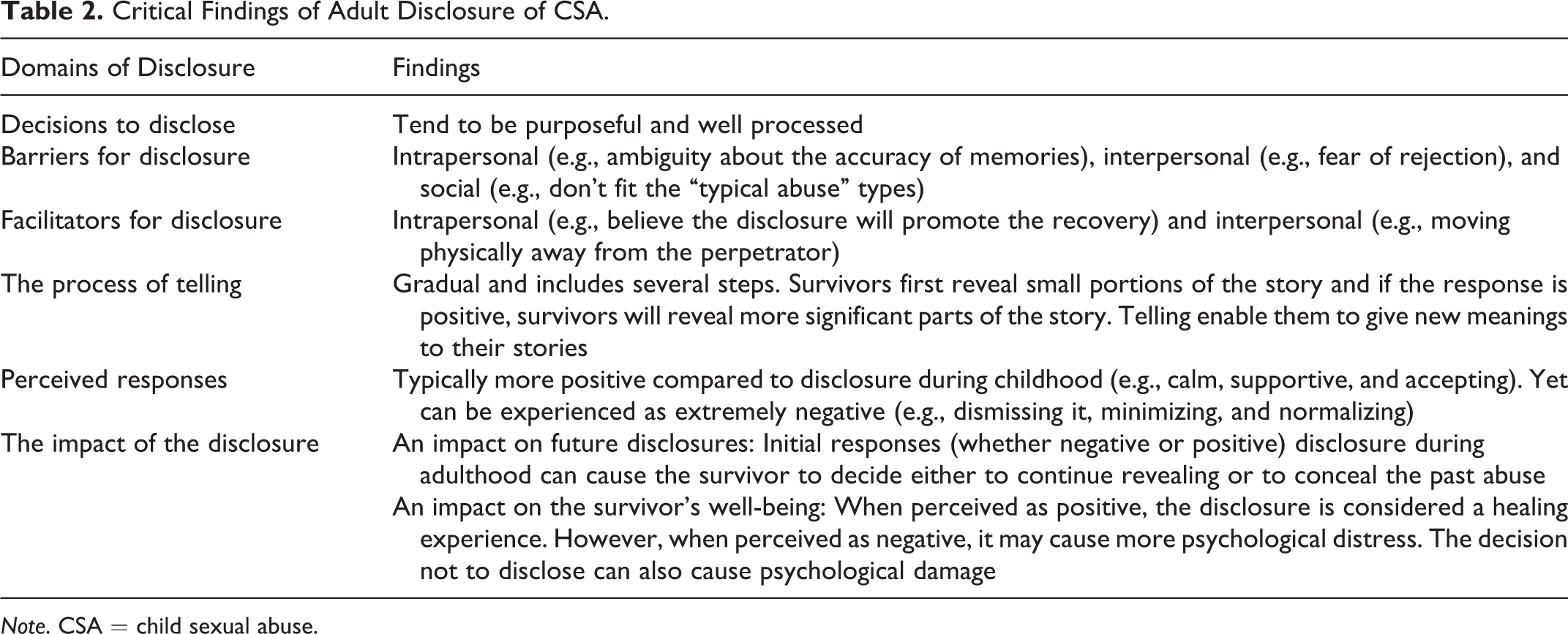
Note. CSA = child sexual abuse.
Adult survivors of CSA are at risk for numerous intrapersonal and interpersonal difficulties (Lacelle, Hébert, Lavoie, Vitaro, & Tremblay, 2012; Lamoureux, Palmieri, Jackson, & Hobfoll, 2012). Yet disclosure may serve as a way to assist in the recovery process. “The expression of a personal narrative to a listener is a powerful way in which we build our identities, forge interpersonal connections, and sustain a sense of purpose and meaning” (Baddeley & Singer, 2009, p. 203). Indeed, some of the adult survivors reviewed in the studies look at the disclosure process in adulthood as an epiphany which added meaning and balance to their lives. However, disclosure is likely to be a complicated process. Even though survivors have more control over the story during adulthood (e.g., they can choose who to tell and are not under the custody of the perpetrator), the results of the disclosure even in adulthood can be harsh or unpredictable, causing further alienation from others. Even when they carefully choose the timing and the person to disclose to, they cannot predict the short- and long-term consequences of telling. On the other hand, much of our knowledge is based on clinical literature. One can assume there is less information about survivors who did not disclose the abuse during adulthood and do not seek forms of counseling. It is possible that some survivors do not think that the childhood abuse had a significant effect on their present life and do not consider dilemmas about disclosure as a major part of their life.
Two ways of conceptualizing adult survivors of CSA are proposed. One way is to observe them as a distinct group, apart from all others, who define themselves as survivors of sexual trauma. This may fit the perception and needs of some of the survivors. Yet another way is to look at the survivors as part of any other group of individuals involved in decision making about disclosing a sensitive or traumatic memory. This broader perspective provides a wider lens for understanding the context of disclosure. For example, Alea and Bluck (as cited in Baddeley & Singer, 2009) present a conceptual model of the social functions of autobiographical memory which can fit a variety of experiences. This model takes into account several variables involved in the memory disclosure as follows: the speakers’ characteristics (age, gender, and personality), the listeners’ characteristics (familiarity and similarity to the speaker), the memory characteristics (level of details and emotions), and the social function of the memory. This model incorporates many variables involved in the process of disclosure by providing a holistic view of each individual without stereotyping his or her experience. For example, an adult survivor of CSA, when considering disclosure, may be specifically concerned with issues of recovered or repressed memories but may also be generally concerned with his or her culture’s rules concerning disclosing of any sexual topics to others. Looking at disclosure during adulthood as a phenomenon that is both unique to the survivors and also part of the general patterns of disclosing traumatic memories allows for a broader, more thorough understanding of an issue which is part of the daily lives of many sexual abuse survivors.
Implications for Practice, Policy, and Research
Disclosure of CSA during adulthood is a multilayer diverse experience for the survivors. It requires professionals from different disciplines working with CSA survivors to be aware of the context of each adult survivor when he or she faces the dilemma to tell the story.
During adulthood, new barriers as well as facilitators to disclosure arise. Telling the abuse story is a challenging process whether the abuse was disclosed during childhood or not. One should not assume disclosing is a preferable option for every individual. Disclosing the abuse can be experienced as extremely beneficial, especially when the responses are positive, but it can also be an extremely hurtful experience when the responses are negative. Disclosing should be carefully considered depending on domains such as the client’s current emotional state, experiences of former disclosure (if they exist), potential sources for social support, possible perceived responses to the disclosure, and the way those things may affect the survivors’ life.
Further research should focus more specifically on the process of disclosing during adulthood while distinguishing between childhood and adulthood disclosure. Relatively little is understood about the decisions to disclose and the actual process of disclosing during adulthood. Many questions remain partially answered, such as what the actual process of telling involves, how survivors disclose to different sources (e.g., law enforcements, criminal justice system, health professionals, family members, or friends?), and how responses from one source effect the survivor’s tendency to tell other sources. Further research is also needed in order to understand the way the nonclinical population deals with past abuse at the present time.
Future studies should also focus on age differences among survivors, as it is most likely that the experiences of disclosure during adulthood are affected by social norms, which change across generations. Another possible area of study is the differences between lengths of time the abuse was delayed during adulthood, that is, how survivors who delayed disclosure many years into adulthood differ from those who disclosed during young adulthood. Further studies should emphasize cultural differences concerning the phenomenon, as the experience of disclosing the abuse in religious or conservative societies, for example, can be significantly different.
Qualitative studies consisting of interviewing all involved in this phenomenon will allow for a more thorough understanding. In addition, applying general models of memory telling or decision making will enable a broader perspective on disclosure that applies to this population.
Footnotes
Declaration of Conflicting Interests
The author(s) declared no potential conflicts of interest with respect to the research, authorship, and/or publication of this article.
Funding
The author(s) received no financial support for the research, authorship, and/or publication of this article.