



Abstract
Baby factories and baby harvesting are relatively new terms that involve breeding, trafficking, and abuse of infants and their biological mothers. Since it was first described in a United Nations Educational, Scientific and Cultural Organization report in Nigeria in 2006, several more baby factories have been discovered over the years. Infertile women are noted to be major patrons of these baby factories due to the stigmatization of childless couples in Southern Nigeria and issues around cultural acceptability of surrogacy and adoption. These practices have contributed to the growth in the industry which results in physical, psychological, and sexual violence to the victims. Tackling baby factories will involve a multifaceted approach that includes advocacy and enacting of legislation barring baby factories and infant trafficking and harsh consequences for their patrons. Also, programs to educate young girls on preventing unwanted pregnancies are needed. Methods of improving awareness and acceptability of adoption and surrogacy and reducing the administrative and legal bottlenecks associated with these options for infertile couples should be explored to diminish the importance of baby factories.
Background
Infertility is a global public health problem affecting up to one third of couples in some parts of the world (Inhorn, 2003; World Health Organization, 2001). In sub-Saharan Africa (SSA), infertility is common due to the high prevalence of sexually transmitted infections (STIs) among women, which are often either asymptomatic or poorly treated and complicated by tubal damage and presentation with infertility later in life (Akande et al., 2003; Mascarenhas, Flaxman, Boerma, Vanderpoel, & Stevens, 2012; World Health Organization, 2001). Reports on infertility in Nigeria suggest that approximately 25% of couples may be infertile (Ajayi & Dibosa-Osadolor, 2011), higher than the global prevalence (17%) of infertility (Boivin, Bunting, Collins, & Nygren, 2007; Inhorn, 2003).
Several African cultures like the Igbos and Yorubas of Southern Nigeria place high social value on procreation, and the inability to conceive can often result in severe psychosocial stress for couples (Amujiri, 2013; Dyer, Abrahams, Mokoena, Lombard, & Spuy, 2005; Mascarenhas et al., 2012; Onyemachi, 2010). As a result, couples are willing to go to great lengths to achieve the social status of parenthood. Treatment for infertility can be a long and often expensive process, outside of the economic possibility of many couples (Giwa-Osagie, 2002; Shahin, 2007; Vayena, Peterson, Adamson, & Nygren, 2009). Also, the success rate of “conventional-” assisted reproductive techniques (ARTs) like in vitro fertilization (IVF) is still generally low (Giwa-Osagie, 2002). As such, alternative methods like adoption and surrogacy may be the only options. Surrogacy is the practice of having a woman carry or have a child on behalf of another.
Due to the social stigma associated with infertility, many infertile women in Nigeria do not opt for adoption or surrogacy (Ojelabi, Osamor, & Owumi, 2015). For example, a study in Nigeria found that religious leaders (both Christian and Muslim) do not approve of surrogacy as a form of procreation (Ajayi & Dibosa-Osadolor, 2011). Therefore, they are pursued in a more clandestine fashion. This has contributed to the illegal formation of baby factories that constitute a new trend of human trafficking in Nigeria and are beginning to proliferate and thrive. The victims of baby factories are young women and girls whose newborns are sold upon delivery to a third party. Potentially, baby factories may also involve trafficking of these infants if their buyers are exploiters, which makes this crime distinct from previously known child trafficking crimes around the world, targeting mainly peri-pubertal children (United Nations Office on Drugs and Crime, 2014). While cases of baby trafficking have been reported in other countries as well (China, Thailand, Eastern Europe, and Guatemala), the authors of this article decided to focus on Nigeria, since media reports suggest that baby factory “business” may be more widespread in Nigeria than in any other country in the world.
Description of Baby Factories
Baby factories are usually buildings or institutions such as hospitals or orphanages that have been converted to shelters for young pregnant girls and women for the purpose of delivery and selling off their offspring (Huntley, 2013). Heinous crimes are noted to occur in these baby factories that include baby breeding, forced impregnations, sale of babies, illegal adoptions, and even human trafficking. It is not uncommon in baby factories for women to be forcefully impregnated by one of their kidnappers or an associate for the sake of birthing another offspring to be trafficked after a completed cycle.
The first documented case of baby harvesting occurred in 2006, while more disturbing discoveries on baby factories and their practices are now being routinely made in Nigeria (Oberabor & Fatunde, 2014; Pflanz, 2008; The Telegraph, 2011; United Nations Educational, Scientific and Cultural Organization [UNESCO], 2006). All baby factories discovered so far have been in the Southern part of the country (Figure 1) where the Igbos and Yorubas are the predominant tribes. As mentioned earlier, these tribes place high social values on procreation which in turn may create social stigma against couples’ infertility and choice for open legal adoptions. Perpetrators of these crimes have been described as being highly organized syndicates that involve a diverse number of players (Onuoha, 2014).

Number of women (pregnant or recently delivered) found in baby factories between 2008 and 2014.
In these baby factories, young girls, often unmarried and from low socioeconomic backgrounds who get pregnant out of wedlock, are exploited (Okoli & Okpaleke, 2014). The girls are usually afraid of the social consequences and stigmatization associated with teenage pregnancy and single motherhood and thus vulnerable to human traffickers. Oftentimes, girls with unwanted pregnancies are introduced to the operators of these factories in their pursuit of abortion services. While some of the victims were reportedly lured into these baby factories on the pretext of procuring an abortion, some others are said to have been kidnapped into these baby factories even without pregnancy, following which they are raped and impregnated by agents of these human traffickers (Huntley, 2013). Media reports suggest that these girls are promised money to give up their babies after birth (Huntley, 2013; Okoli & Okpaleke, 2014). Those kidnapped are held captive against their wish for months till they are delivered of their child. Upon delivery, the babies are taken willingly or forcefully from them and trafficked to an “expectant” mother who pays the syndicate significantly to have the baby. The expectant mothers who receive the babies are believed to be infertile wealthier women in the society who have pretended to being pregnant. Some of the women who get these children are those who have been deceived into believing that they are pregnant by miracle performers who sedate them when the “miracle delivery” is expected and produce a baby from the factories to accomplish the miracle (BBC News, 2012). The captors of these girls often refuse to let their victims go after delivery especially when the arrangement has been against their wish, and it has been reported that after delivery, some are primed for another breeding season (Cristiansson, 2013; Okoli & Okpaleke, 2014). Figure 2 shows the number of identified baby factories by year, while Table 1 shows the number of victims (pregnant or those who recently delivered) found in the baby factories by state as reported by various publications and the media between 2008 and 2014. These data have been carefully collected by location and time to prevent double counting. More information on the data is available in the supplementary file. While this observation points to an increasing trend of baby factories, further investigations are needed to confirm this observation as this trend might be a consequence of improved surveillance for these baby factories by law enforcement officers.
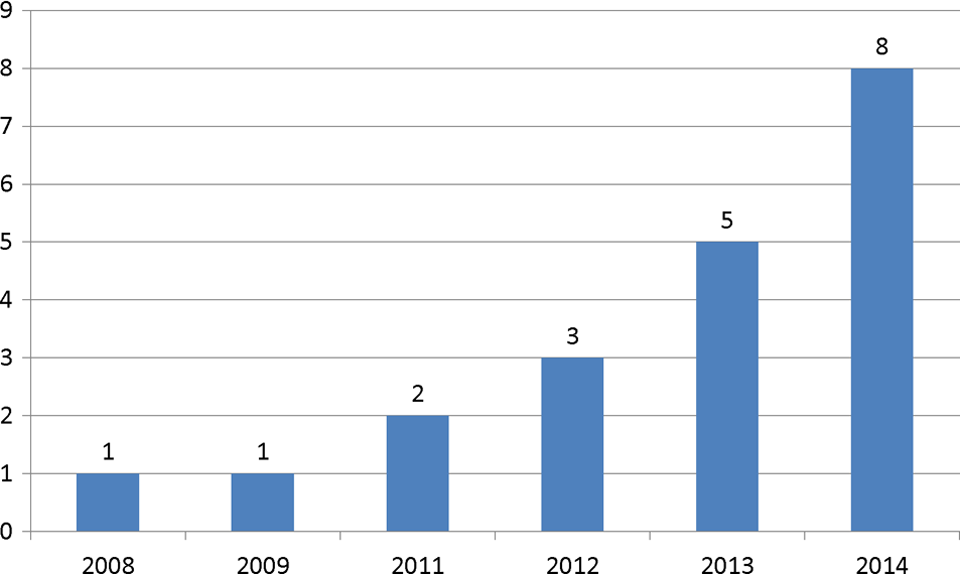
Number of identified baby factories.
Distribution of Victims (Pregnant or Those Who Recently Delivered) Found in Baby Factories Between 2008 and 2014.
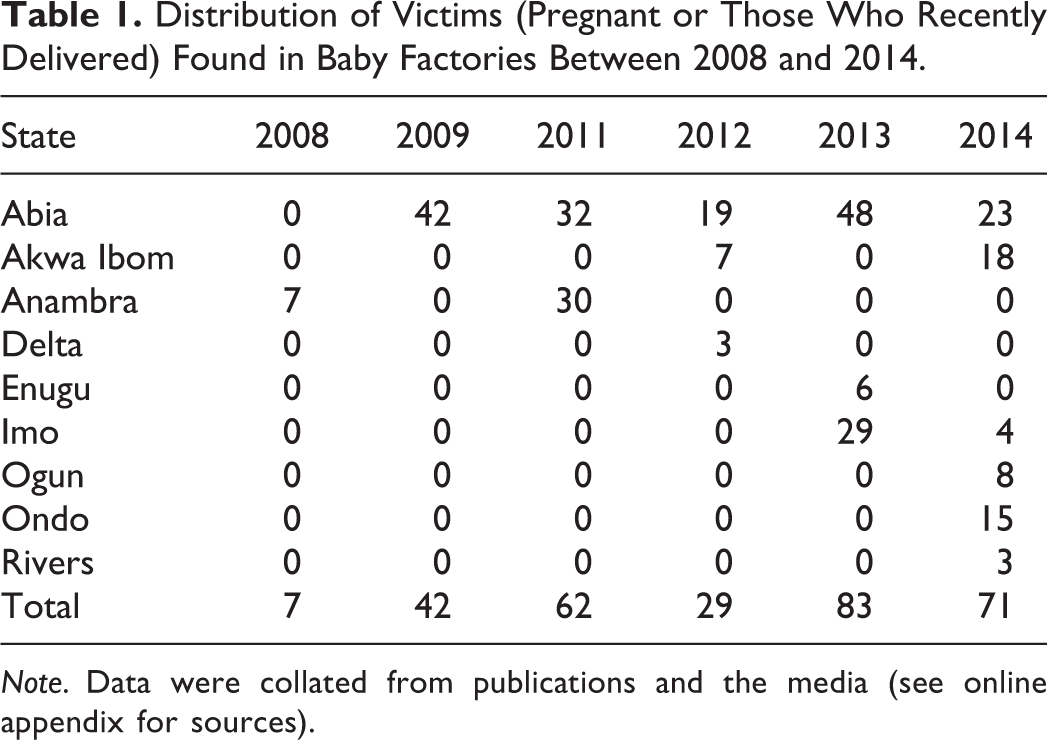
Note. Data were collated from publications and the media (see online appendix for sources).
Factors Promoting Baby Factories
Experts studying the factors that contribute to child trafficking in Nigeria have identified three ideologies that are promoting the baby factory boom, which include the premium placed on childbearing, demonization of infertility and childlessness, and stigmatization of teenage pregnancy and single parenting (Ojelabi et al., 2015; Okoli, 2014). These factors are significant drawbacks, and changing these opinions will in no little measure contribute to tackling this grave problem.
With 46% of the Nigerian population noted to be living under poverty line, the most important factor promoting baby factories in Nigeria is poverty (Alfred, Francis, & Ale, 2014; The World Bank, n.d.). In the context of intergenerational poverty, young females are vulnerable to the efforts of traffickers who encourage them to breed babies as an easy means of making money. Teenage girls who may have to support their families through hawking are exposed to rape and pregnancy with the possibility of ending up as victims of baby factories.
In addition, Nigeria is one of the countries worst affected by the HIV/AIDS pandemic in SSA, thereby leaving it with a large number of orphans and vulnerable children ( Africa’s Orphaned and Vulnerable Generations, 2006). Vulnerable teenage girls who may have no one to care for them could be enticed into the business of infant breeding. They can also be kidnapped and forced into this practice, with very little suspicion from the authorities.
The law of supply and demand plays a critical role in promoting baby factories. As long as there is demand for infants through any means, there will continue to be those willing to take the risk of supplying buyers with what they want. The premium placed on childbearing pushes couples to go to any length to have a baby of their own. It is also noteworthy that because abortion in Nigeria is still largely restrictive, termination of socially unwanted pregnancies (such as teenage pregnancies and pregnancies out of wedlock) is usually provided in obscured locations by unlicensed practitioners. Hence, young girls with unwanted pregnancies in their pursuit of illegal termination of pregnancies could easily fall prey to proprietors of these baby factories. Interplay between increased demand from desperate couples wanting to complete their family and supply from girls with unwanted pregnancies will continue to drive the business of baby factories.
Cross-border adoption and trafficking could be contributing significantly to the demand for such babies. Foreign-born infants are cherished in some high-income countries. These international adoptions, which started as altruistic adoption of orphans and vulnerable children from war ravaged countries, are now more tolerated and widely acceptable and could be one of the drivers of baby factories (Kapstein, 2003).
Information about the legal status of surrogacy in Africa is limited (Motayev, 2012). Only South Africa has a detailed surrogacy law allowing altruistic and commercial surrogacy. This does not mean that surrogacy does not take place in other countries within the continent but the popularity and acceptance are limited. In Nigeria, various fertility practitioners have created rules that govern their practices in the absence of a national law or regulation (Ajayi & Dibosa-Osadolor, 2011). Notwithstanding, surrogacy is a controversial procedure that many do not want to publicly associate with (Allen, 1990; Jadva, Murray, Lycett, MacCallum, & Golombok, 2003). Turning these wrong beliefs around through communication and education campaigns will help to improve acceptance of surrogacy and decrease the demand for trafficked children.
The high cost of ART at the very few fertility centers may have a role to play in the proliferation of baby factories in Nigeria. In a country with a minimum wage in the range of US$52–60 per month, a round of IVF at these clinics could cost between US$2,500 and US$2,700 despite the uncertainty of success (Giwa-Osagie, 2002; Vayena et al., 2009). On the other hand, a child from these baby factories could be arranged for as little as 25,000 Naira (US$160) and is guaranteed. As such, one can infer that only a few couples will be able to afford an IVF or ethical surrogacy at a licensed health facility and those who cannot may opt for these baby factories as a source of their “wanted child.”
Illiteracy and lack of information is also a contributor to human and child trafficking. Uneducated women and children are deprived of an opportunity to find a decent job, which in turn may allow traffickers to lure their victims into baby factories with false promises of receiving education or acquiring professional skills. In some parts of Nigeria, families have willingly allowed members of their homes to be trafficked for illicit businesses. By 2006, about 92% of trafficked Nigerians to Europe for prostitution were from Edo and Delta states (UNESCO, 2006). In Edo state, an estimated one in three homes has at least one member of the family who has been trafficked to a developed country possibly for prostitution (UNESCO, 2006). Such high level of ignorance could be a major driver of baby factories.
Corruption among law enforcement agents is also a prominent point raised by Huntley in her landmark paper. Some law enforcement agents and judges are believed to be implicit in these activities. It is difficult to explain why a notable baby factory operator was once arrested and released only to be found still operating a baby factory a couple of years after the initial arrest.
Baby Factories and Violence Against Women
There is no doubt that violence against women (VAW) is highly prevalent in Nigeria, with some studies reporting as high as 42% prevalence (Antai, 2011; Fawole, 2008; Fawole, Abass, & Fawole, 2010; Oyediran & Cunningham, 2014). However, the new wave of VAW directed at young vulnerable girls at baby factories has not been adequately reported. Perhaps these have been pervasive in the society for a long time, but no one took notice of the practice until the expansion of the “trade.” These vulnerable women have been noted to experience physical, sexual, and psychological violence at the hands of their kidnappers.
Enslaved girls often suffer physical violence in the factories (Okoli & Okpaleke, 2014). While some of them have willingly entered into these baby factories, others have been kidnapped and held against their wish. In order to prevent them from escaping from these dens, they are restrained and physically abused (Okoli & Okpaleke, 2014). As a result of their enslavement, these pregnant girls are not believed to receive adequate health care services that can ensure the safety of their babies and a healthy motherhood for them. There is also a chance that some of these young mothers die at childbirth, though deaths are more likely to be covered up than reported.
Women found in these factories have been reported to be as young as 14 years (Agence France-Presse [AFP], 2013; The Telegraph, 2011). Having sex with a minor is statutory rape even when intercourse is consensual (Finkelhor, 1991). However, consensual intercourse is not always the case as has been discussed previously. Some of these girls are forced into these baby factories and held against their wish for lengthy periods during which they are repeatedly raped (Okoli & Okpaleke, 2014). The criminals who perpetrate these acts are also a high-risk group for infectious diseases, thereby exposing these girls to HIV and other STIs while in these baby factories. Rape also has the potential to cause genital tract injuries which if not properly managed can impact on sexual and reproductive functions later on.
Unlawful detention in these baby factories is generally the norm. This can cause depression and other more severe mental health problems. The possibility of suicide among those who have been kidnapped and raped is also high (Resick, 1993). In addition, those enslaved are threatened by their captors to prevent them from running away. These young girls who probably fled their homes are also likely to have emotional problems associated with the unavailability of their family members, thereby causing their psychological state to deteriorate further.
Children as Victims of Baby Factories
The Convention for the Rights of a Child emphasizes the rights of a child to be cared for by his or her parents (United Nations Children’s Fund, 1989). The proliferation of baby factories and child trafficking denies children of this right.
While it has been reported that most of the children from baby factories end up as “adoptees” through the wrong route, the potential for their exploitation at these homes as a result of a lack of official status and the possibility of their involvement in illicit activities like prostitution, drug pushing, domestic servitude, and organ harvesting remains (Huntley, 2013). Children trafficked could easily be introduced to these illegal practices or be victims at an early age. Abandonment by adopted parents is also possible, should it be discovered that the child has some developmental problems. Also, children from baby factories have been reported to have ended up as sacrifices to deities at shrines (AFP, 2013).
The potential of terrorist organizations buying young children for the purpose of grooming them for suicide missions has also been reported (Alfred et al., 2014). With the ongoing insurgency in some parts of Nigeria, efforts need to be concerted in order to avert the decadence into such practices. Besides human trafficking, organ trafficking is also growing. The need to continue to meet the demands of the organ market can also be thought to fuel the breeding of children for harvesting their organs.
Tackling the Baby Factory Menace
The proliferation of baby factories in Nigeria has been widely reported in local and international media (AFP, 2013; Alfred et al., 2014; BBC News, 2012; Cristiansson, 2013; Oberabor & Fatunde, 2014; Pflanz, 2008; The Telegraph, 2011). As a consequence, the international community has begun reacting. Denmark recently banned all adoptions from Nigeria (The Guardian, 2014). This is a positive step, hoping other developed countries will emulate to further reduce the demand from these countries for trafficked children.
Lack of social services for young girls who get pregnant out of wedlock needs to be tackled. This will be in addition to sexual education programs on how to avoid unwanted pregnancies. Also, these programs should provide them information on where they can get support from the government, should they fall into unwanted situations.
Human trafficking is a multibillion dollar business across the globe and the third most common crime in Africa (Beyrer, 2004; Obokata, 2005). Nigeria has also been identified as one of the major sources of trafficked people to Europe (The Guardian, 2014; UNESCO, 2006). Turning around this shaming label will require that efforts are committed toward breaking these syndicates and bringing the perpetrators to book. Obtaining support from other countries on cross-country money laundering may well help to identify traffickers and stifle their pathway for financing the baby factory business and pursuing legal redress against those caught.
An effective prosecution of traffickers operating baby factories is not possible without adequate and comprehensive legislation prohibiting such criminal activities. Although laws against human trafficking have been established in Nigeria, namely, Trafficking in Persons (Prohibition) Law Enforcement and Administration Act 2003 and Child Rights Act 2003, they do not directly address baby factories and baby harvesting which are growing (Huntley, 2013; Onuoha, 2014). These Acts criminalize some offenses that may be involved in the operation of a baby factory such as human trafficking for the purpose of involuntary reproductive servitude; the sale of children for immoral purposes; holding or possessing any person as a slave; abduction, removal, and transfer of a child from his or her parents without their will; sexual intercourse with a child; and sexual abuse and any forms of exploitation of a child. However, these provisions appear to be insufficient for Nigerian law enforcement and legal professionals to say that baby factories constitute human trafficking. For example, though the national agency for the prohibition of trafficking in persons and other related matters (NAPTIP) is responsible for enforcement of the Trafficking Act 2003 and has the power to initiate investigations of the crimes related to human trafficking, it was reported that this agency refused to investigate certain baby factory crimes and returned these cases to the police due to the lack of jurisdiction, claiming that these offenses constitute illegal adoptions and baby sales and do not relate to human trafficking (AFP, 2013; Madike, 2013). This example demonstrates that, in addition to adopting laws recognizing baby factory phenomenon as human trafficking, the role of NAPTIP and the police in addressing baby factory crimes needs to be properly outlined. This will ensure that issues that border on roles and responsibilities or jurisdiction which has affected prosecution of operators of such factories in the past do not arise again. Furthermore, civil society organizations need to lend a voice to the growing menace of baby factory business and educate law enforcement officers, lawyers, and judges about baby factories and its correlation with human trafficking in order to raise awareness about these problems and solicit for laws against child trafficking and baby factories.
The need to make human trafficking either a crime against humanity or a self-standing international crime of jus cogens has been raised (Huntley, 2013; Mattar, 2002; Obokata, 2005). Such law will contribute to fighting the impunity of operators of baby factories more effectively. Elevating baby factory crimes to the status of a crime against humanity would allow prosecuting traffickers in the International Criminal Court (ICC). To date, the ICC has not tried any human trafficking case. However, should such precedent occur in the future, human traffickers, who either are Nigerians or operate baby factories on the territory of Nigeria, may become prospective “targets” of the ICC, since Nigeria has signed and ratified the ICC Statute.
An additional comprehensive field research is needed to improve knowledge about the baby factory phenomenon. Civil society organizations are encouraged to gather additional evidence on destination countries for such babies, the estimated number of victims of baby factories (this includes infants and their biological mothers), the types of abuse that these children encounter, the criminal groups involved in operation of baby factories and the countries where they engage in illegal activities, and demand side of baby factories. Should these investigations uncover facts that support a finding that baby factory crimes constitute a crime against humanity, it would give incentive to Nigeria, as a State Party to the ICC Statute, to take measures to eradicate this problem and prosecute traffickers operating baby factories. In addition, the international community could use such findings as leverage in convincing other countries where traffickers involved in these criminal activities reside to cooperate with the Nigerian Government to fight against this phenomenon.
At the same time, crimes against humanity have a rather high threshold that requires such crimes to be “part of a widespread or systematic attack.” Thus, those cases of baby factories, in which organized criminal syndicates are not directly involved, are unlikely to be classified as a crime against humanity. Alternatively, it may be argued that baby factory as a form of human trafficking may become a self-standing international crime of jus cogens if human trafficking attains this status in the future, which is quite possible. This would allow legal professionals to advocate for application of universal jurisdiction to operators of baby factories by domestic courts of any state regardless of territorial or nationality links, which may pose even a more serious challenge for them to escape prosecution. Additional advocacy on changing the status of baby factory crimes is necessary. Nigerian lawyers may contribute to the change of status of baby factory crimes by starting discussion of this issue at various conferences and symposia.
Furthermore, clear laws on adoption need to be made and proper homes and orphanages where infertile couples may adopt a child legally should be considered. For these purposes, it is recommended that Nigeria sign and ratify the Hague Convention No. 33 on the Convention on Protection of Children and Cooperation in Respect of Intercountry Adoption (1993), as this may help to establish transparent mechanisms for adoptions as well as improve policies and legislation in this field.
The high burden of infertility in Nigeria needs to be addressed. This will require a multipronged approach which will include identifying STIs early and treating them before they cause irreversible tubal blockage later in life and consequently infertility. To address this, it will be necessary to solicit for routine screening programs among sexually active women. In addition, controlling the cost of ART by establishing more centers and providing for ART coverage in health insurance plans may help women who cannot afford to pay out of pocket, the huge sums currently charged by the few centers available in the country. Also, there needs to be a reorientation of the public on infertility, its causes, and the management so that infertile women are not stigmatized and ostracized from the society. Furthermore, the low level of public knowledge and acceptance of surrogacy needs to change.
There is a dearth of research on baby factory practices. Additional effort by researchers should be directed at identifying the root causes of this problem and developing intervention programs to address them.
Limitations
This article discusses a new phenomenon that has not been adequately researched in Nigeria or any other country, possibly due to the clandestine nature of baby factories. As such, many of the papers reviewed in this article are from media publications and non-peer-reviewed journals. Still, these data and arguments herein provide an impetus for in-depth research on this topic.
Conclusion
Baby factories and baby harvesting are prevalent in Nigeria and this practice is growing. There are inadequate laws that address this new wave of VAW and the accompanying child abuse. Thus, this new crime needs a concerted societal response using all the tools of advocacy and the law to reverse the trend and bring to book the perpetrators of such acts.
Critical findings
Baby trafficking is prevalent in Nigeria.
Vulnerable young girls are being exploited at the hands of traffickers.
Victims of baby factories (biological mothers of infants) experience physical, sexual, and psychological violence.
High infertility prevalence and stigmatization of infertility may be contributing to baby trafficking.
There are no clear laws that govern surrogacy in Nigeria.
Implication of the Review for Practice
Baby factory and baby harvesting are new terminologies that require formal recognition. This review is a tool for advocacy to raise awareness about baby factories and to solicit international recognition either as a crime against humanity or as a self-standing international crime of jus cogens. The review identifies the factors that are promoting the baby factory practice and proposes ways at handling them. Efforts need to be directed at reducing the cost of ART to make it more affordable for more people. There is a need to develop programs to educate young girls about this practice and ways to avoid being a victim. Laws on baby farming practice and also on surrogacy and adoption are urgently needed. Roles, responsibilities, and jurisdiction of security agencies need to be properly outlined.
Footnotes
Acknowledgments
O.A.M., O.O., O.O.M., S.S.H., and B.B. conceptualized this article and jointly developed the manuscript. All authors agree to the final version of this article.
Declaration of Conflicting Interests
The author(s) declared no potential conflicts of interest with respect to the research, authorship, and/or publication of this article.
Funding
The author(s) received no financial support for the research, authorship, and/or publication of this article.
