



Abstract
The effect of family visits on prisoner well-being and future behavior is an important consideration in the development of prison policy. This review systematically examines current research findings that explore the impact of prison visits from family members on three specific offender outcomes: prisoners’ well-being, rule breaking within the prison, and recidivism. The review focuses on visits by family and does not duplicate earlier reviews but rather extends them into current literature, through identification of empirical studies conducted post 1989, published since 1991. Ten studies met the stipulated inclusion criteria. All are case–control and cohort studies. The review of studies used a standardized quality assessment tool. Results show considerable variation in study quality, methods, and findings. However, studies consistently reported positive effects of prisoners receiving visits. Prison visits reduced depressive symptoms in women and adolescent prisoners. There was some evidence of reduction in rule-breaking behavior. One high-quality study suggested that visits reduced recidivism and increased survival in the community. Although there were positive outcomes associated with prison visits, it was not possible to draw strong conclusions for the outcomes of interest due to a lack of research, methodological discrepancies, and variability in outcome measures and results. The discussion considers the implications of the findings for policy, practice, and research.
Research has shown the existence and maintenance of strong interpersonal relationships with friends or family reduces the likelihood of re-offending and successful reintegration into the community (Hairston, 1988; May, Sharma, & Stewart, 2008; Niven & Stewart, 2005). Importantly, the maintenance of “good quality” relationships during a prison sentence has been associated with the successful development of the relationship post release (La Vigne, Naser, Brooks, & Castro, 2005). This body of evidence, therefore, highlights the need to maintain or develop supportive relationships during prison sentences in order to reduce recidivism. Hale (1988) went so far as to say, “Since rehabilitation and re-entry of the offender into the community is the ultimate goal of the correctional system, it should be obvious that the maintenance of the offender’s family system is of vital concern” (Hale, 1988, p. 143).
Prison visits are an obvious means by which prisoners can strengthen existing relationships: Indeed, they feature in prison regimes on a general basis. Research suggests the benefits, in addition to reduced recidivism (Bales & Mears, 2008; Hairston, 1988), include improved mental health of prisoners and other family members, an increased probability of the family remaining together post release (Hairston, 1991), and an improved level of social adjustment during imprisonment and after release (Casey-Avecedo & Bakken, 2002). This review aims to search for and evaluate all of the studies published since 1991 that investigate the impact of prison visits from family members on prisoner’s well-being, behavior, and recidivism and to inform practice, policy, and further research.
Objectives of the Review
The role of prison visits in the maintenance of family relationships and the reduction of recidivism has undergone some research to date. Hairston (1988) reviewed the existing literature in relation to family ties and recidivism, which included disciplinary infractions within the prison environment. In 1991, she further provided a review of family ties, well-being, and post-release success (Hairston, 1991). This review systematically investigates the impact of prison visits from family members on three specific offender outcomes. Preliminary investigation showed that all peer-reviewed, published papers relevant to prison visits conducted prior to 1989 were included in Hairston’s (1988, 1991) reviews. Therefore, this review focuses on research that has been conducted post these reviews. Specifically, this review aims to determine whether family visits: affect prisoners’ well-being (i.e., stress, depression, suicidal/self-harm behaviors); improve prisoners’ rule breaking within the prison environment; and reduce recidivism as measured by official records.
The Protective Role of Relationships
Arguably, the most important relationship disrupted by imprisonment for adolescents is with their parents and for adults with their intimate partners or children. These primary relationships allow prisoners to maintain their social identity and provide a sense of security, well-being, and an assurance of worth (Hairston, 1988). Hairston (1991) suggested that the maintenance of these relationships throughout the sentence leads to decreased recidivism and improved mental health and family reunification after release. Although based on limited evidence, Hairston concluded that there are strong social, economic, and emotional reasons to develop programs that enhance family ties and to change prison policies that inhibit family interaction.
Little research has explored the role of the parental relationship in recidivism. However, the general offending literature considers family relationships to be both a risk and protective factor for delinquency (Stouhamer-Loeber, Loeber, Wei, Farrington, & Wikstrom, 2002). Considerable research has concentrated on the risks and mechanisms associated with the parental relationship that influences adolescent offending behavior (Rhule-Louie & McMahon, 2007). That antisocial behavior can emerge through modeling from parent–child relationships suggests that separation during incarceration may be beneficial. However, a study by Ryan and Yang (2005) of juvenile delinquents in residential care found that those who received visits had lower offending rates than those who did not.
Contact with children is viewed as having a positive effect on a parent’s relationship with their child(ren), and many parents work hard to maintain contact during periods of separation (Hairston, 1991). Indeed, Poehlmann, Dallaire, Loper, and Shear’s (2010) review found benefits of child contact for incarcerated parents in reduced distress levels and better parent–child relationships for both male and female prisoners. However, this relationship is complicated. For example, Poehlmann (2005) did not establish a relationship between visits and increased relationship quality between mothers and their children, although telephone contact did appear to improve relationship quality. Concerns for their children’s experience may prevent prisoners from encouraging their visits. Although a lack of contact with their child may have negative consequences for the prisoner, bringing their children into the prison environment may not feel appropriate and limit any positive effects.
While for female prisoners, there is little evidence that adult intimate relationships are protective the consensus is that they are protective for male offenders. Segrin and Flora (2001) found that possessing a satisfying marriage reduced loneliness during incarceration. Carlson and Cervera (1991) demonstrated that conjugal visits increased participants’ perception of closeness. This demonstrates that contact between prisoners and their partners through visits can improve prisoner well-being. However, evidence is contrary concerning re-offending. Rhule-Louie and McMahon (2007) found that individuals chose partners who supported their antisocial and criminal behaviors. However, Sampson, Laub, and Wimer’s (2006) longitudinal research with 500 young men showed that marriage was associated with a 35% reduction in the odds of an individual engaging in crime. If marriage is a protective factor for men, then encouraging prisoners to maintain their long-term relationships may be a useful tool in reducing re-offending. Sampson et al. described four possible mechanisms through which marriage could be causal in reducing re-offending: Marriage creates social obligations that increase the cost of crime; marriage causes significant changes in routines and patterns of association; the female partner exerts direct social control; and finally, marriage leads to a change in self-identity to a more “responsible” person. If intimate relationships are to continue to facilitate this, contact during a sentence is important.
There are difficulties associated with maintaining visits throughout a prison sentence. Although some prisoners may see visits as the highlight of their time, their families can view visits as difficult emotionally and practically and prison staff see visits as organizationally problematic (Dixey & Woodall, 2012). Fuller (1993) identified a range of obstacles such as work schedules, distance, and child care and health problem. Comfort (2003) provided further examples describing the very negative experiences of female partners visiting one American prison as almost a secondary form of imprisonment. Indeed, visitors need motivation to maintain contact and those setting prison policies need reasons to support family members to visit. Hairston (1988) suggested that without access to their family prisoners lose hope that they can achieve more in their lives, become more socially impaired, and their emotional resources are depleted. As a result, they may re-offend at higher rates than previously. If this is the case, then a review of research that investigates the impact of visits on future positive outcomes is necessary to provide information to shape future policy.
Method
Sources of Literature
The first author conducted preliminary searches using the terms “prison,” “visits,” and “recidivism” in databases that include research within the fields of criminal justice, social sciences, and psychology. The search included papers post 1989 to capture research conducted following that date, not yet published and considered in Hairston (1991). The initial search identified the following databases as most effective in generating research in the required area: Ovid MEDLINE(R) 2008–2015, Ovid MEDLINE(R) 1988–1995, Ovid MEDLINE(R) 1980–1987, Ovid MEDLINE(R) 1946–1979, Ovid OLDMEDLINE(R) 1946–1965, PsycINFO 1806–2015, Web of Science 1898–2015, EBSCO 1978–2015, and Science Direct May 2015 update. Together, these databases review over 8,000 journals and cross all possible areas that could be relevant to this study. A full literature review was undertaken using the English language version (which includes papers translated into English) in December 2011, January 2012, January 2014, October 2014, and May 2015.
Search Strategy
The reviewer searched the abstracts of relevant online databases using a number of search terms related to the key concepts. The reviewer developed search terms through a number of exploratory searches using different terms and permutations for each research question, with the terms prison* AND visit* common to all research questions and searches. Table 1 depicts additional terms considered for each specific research question. All of the searches were rerun substituting jail* and then incarceration for prison* and social support for visit* until all permutations were used. The full search results are available from the first author.
Additional Search Terms for Each Research Question.

Study Selection
Selected studies were those that met the general inclusion criteria (see Table 2) and the criteria pertinent to each specific question investigated. To ensure that the studies would be based on stringent methodology, the researchers also decided that only peer-reviewed articles would be included (Smith, Gates, & Foxcroft, 2006). This resulted in the exclusion of 26 dissertation abstracts and six books that had some relation to the search criteria. The criteria were applied at three stages: Initial sift to determine whether the study was related to the subject of interest, at this stage many studies were rejected that were not related to prisons or concerned visits by professionals; Consideration of the abstracts to determine relevance to the questions being explored by the review, at this stage many studies were rejected that were related to the process of visits but not the effect, or the way visits affected the family and children but not the prisoner; and Reading the full text to establish if the papers met the specific research question criteria.
Inclusion Criteria.

Ten papers met the inclusion criteria. The reference sections of these papers were also manually searched resulting in two further papers. However, they did not meet the inclusion criteria. Figure 1 provides an overview of the exclusion process.
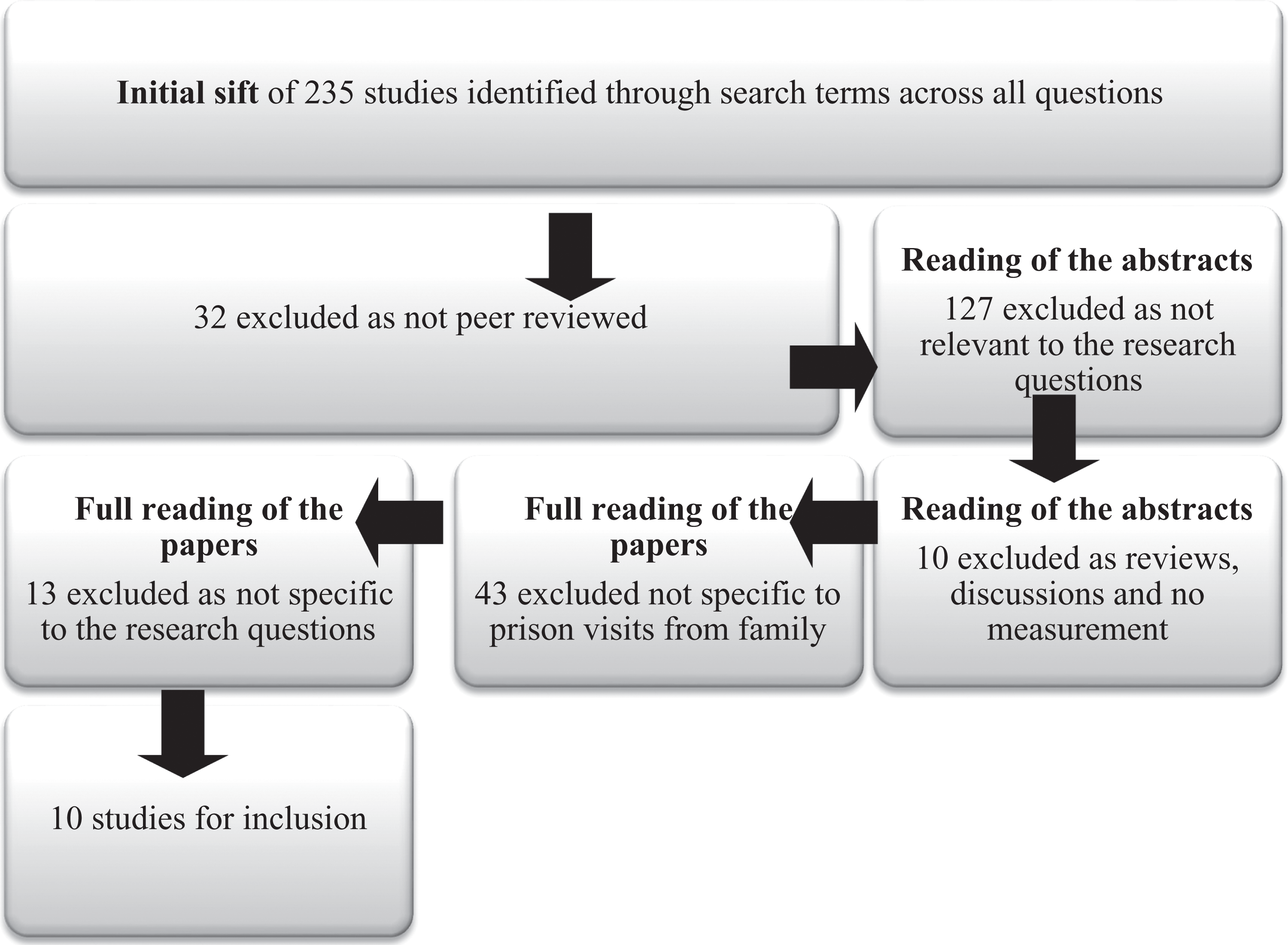
Flow diagram of the identification/exclusion process; initial sift to full review of the paper.
Data Extraction
Data extraction from the articles used a standardized form. This collated information on the studies and participant’s characteristics, measures used for independent and dependent variables, and outcome data for male and female prisoners and adult and adolescent prisoners. The first author and a second researcher reviewed the 10 studies separately to ensure reliability (concordance rate 95%). Both researchers also assessed the quality of each paper using a quality assessment instrument, which was adapted from the Critical Appraisal Skills Program tools for reviewing randomized control trials, cohort studies, and case studies (Public Health Resource Unit, 2006). This tool asked raters to consider nine questions centered on the quality of presentation, design, and analysis. Table 3 includes a summary of the specific questions asked and scores achieved.
Summary of Study Scores on Each Question.

Detailed questions are available from the first author on request.
Quality Assessment
Each study was assessed on items such as a focused hypothesis, quantifiable relationships between visits and outcomes of interest, control groups, accounting for bias, number of participants, and precision and presentation of results. After rating each of the items based on presence or absence, an overall quality score was calculated.
Both researchers consistently reached the same overall scores for each paper, achieving the same answer for each question asked. Possible scores ranged between 9 and 18. The following are the codes assigned to each study: A: high quality (score of 16–18): All or most of the criteria met (90%) and if not. The authors judged that those criteria unmet are unlikely to alter the conclusions reached (five studies scored within this range). B: medium quality (score of 12–15): Some of the criteria met (70%) and if not. The authors judged that those criteria unmet are unlikely to alter the conclusions reached (three studies scored within this range). C: low quality (score less than 12): Few or none of the criteria met (less than 70%). The authors judged that the study quality alters the conclusion of the study (two studies scored within this range).
Results
Table 4 provides an overview of each study and a summary of the quality scores.
Summary of Studies Included in the Review.

Quality key: A = high quality (16–18)—all or most of the criteria were met and if not the areas that have not been met would not alter the conclusion significantly. B = medium quality (12–15)—some of the criteria were met. Those criteria that have not been met are thought unlikely to alter the conclusions. C = low quality (less than 12)—few or none of the criteria were met. The conclusions of the study are likely to alter significantly.
Research Question 1: Do Visits Affect Prisoners’ Well-Being?
Monahan, Goldweber, and Cauffman (2011)
This study considered how visitation from parents affected adolescents’ mental health during the first 2 months of incarceration. The participants were 276 male adolescents between 14 and 17 years old in one secure juvenile facility in North America. The comparison is between those who received prison visits and those who did not with differences in the groups for age, parental education, and distance for parents to travel to prison accounted for. The number of prison visits from parents was derived from official records as the number from baseline to Month 2, calculated at number per week. Level of depression was assessed via the Center for Epidemiological Studies—Depression Scale (Radloff, 1977) during a 2-hr baseline interview and then weekly 1½ hr follow-up interviews for the first 3 weeks and then monthly.
The study used growth curve modeling to test differences in the level of depression and change over time. During the first week, there were no differences between groups on level of depressive symptoms. Over the 2 months, those who were receiving visits reported a more rapid decline in depressive symptoms than those who did not. An increased number of visits accounted for a more rapid reduction in depressive symptoms. Parental visits accounted for 8% of the variance in depressive symptoms. The effects of visits and relationship quality accounted for 11% of variance, suggesting the effects of visits as independent from the effects of relationship quality.
This study scored 16 on the quality assurance measure. The researcher defined a clear research question and measurable hypotheses. The participant group was appropriate and comparison achieved effectively within the sample. Data collection occurred from the same source and time period. Collection was regular with some variables controlled for. However, they did not account for other factors that may affect depression such as relationships within the environment and withdrawal from substances. The detailed results included confidence intervals. The authors addressed each hypothesis and explained the results with all outcomes considered and explored. They reported clearly on the limitations of the study. This study provides reliable evidence that prison visits affect well-being in a positive manner.
Poehlmann (2005)
This study attempted to determine whether early and current relationship disconnection is associated with maternal depression. The participants were 94 mothers aged between 19 and 44 years, from one female prison in North America. The authors considered differences in the groups for age, recency of sentence, and distance to travel for visits, with none found. Self-report of face-to-face visits in the last 2 months identified type and frequency of contact. Assessment through the Center for Epidemiological Studies—Depression Scale (Radloff, 1977) provided level of depression. The results of the multiple regression analysis demonstrated a relationship between early relationship disconnection and depression, which accounted for 6% of the variance. Fewer face-to-face visits with children related to an increase in depression, which additionally accounted for 5% of the variance.
This study scored 15. Although the complicated hypotheses required simplifying, they were measurable. The participant group was appropriate and comparison achieved effectively within the sample. Data collection used the same source and the same period for each participant. Data were collected regularly and were current for all measures apart from past trauma. Consideration was given to some controlling variables. However, as with the previous study, the authors did not account for other factors that may affect depression. More positively, the results were robust and presented in detail. The authors explored all the results reporting on and explaining each hypothesis and considering all outcomes. This study further supports the view that prison visits affect well-being in a positive manner.
Houck and Loper (2002)
This study examined stress related to parenting among a sample of female prisoners and to determine whether differences in the amount of parenting stress predicted prison adjustment. The sample included 362 mothers aged between 19 and 59 years, recruited from one prison in North America. Frequency of visits was taken from self-report over the last year. The authors used an adaptation of the Parenting Stress Index (PSI; Abidin, 1995), adding visitation stress as a 7-item scale, validated prior to use (α = .76). It measured discomfort felt by mothers regarding visit procedures and constraints. The depression, anxiety, somatization, and global scales of the Brief Symptom Inventory (BSI; Derogotis, 1993) measured adjustment.
The authors added being part of a minority group as a covariate to the subsequent analysis when initial analysis suggested that this affected the results. Analysis of individual beta weights for each regression analysis indicated that parenting stress concerning visitation was associated with elevated anxiety. Visitation stress (measured through the 7-item scale) was also associated with the global score on the BSI, suggesting overall emotional adjustment difficulties.
This study scored 13. The researchers defined a clear research question and measurable hypotheses. They attempted to quantify relationships between stress and adjustment. However, in terms of this review’s research question, visits were not well defined. Nevertheless, the participant group was appropriate and comparison achieved effectively within the sample. The authors compared norms for the general and psychiatric populations. They collected data from the same source and within the same period for each participant, although some participants completed the questionnaires alone. The information provided to participants would not have made the expected outcomes obvious to them; however, introducing the incentive of “soda and cookies” may have introduced bias related to motivation to fully engage.
The authors presented the results of multiple regression analysis clearly and in detail. They explained the process of attaining the results in a clear systematic manner. The strength of this study was that the researchers created a measure related to visitation stress that they developed from talking to the prison population prior to its use in this study. Participants involved in development of the measure were not involved in this study. The authors were thorough in exploring the limitations of the study and considering a number of variables that may have influenced the results. The authors considered a number of options for the meaning of their findings and suggested future research. They considered services that may help participants in terms of their mental health issues. This study suggested that prison visits affect well-being in a negative manner for some women, as they add to adjustment difficulties in the prison environment.
Tuerk and Loper (2006)
This study explored the association between parental stress and the amount of prior contact, as well as the type and frequency of current contact between incarcerated children and their mothers. The sample included 357 mothers aged between 18 and 50 years, recruited as part of a larger study in one prison in North America. Factors such as age, age of the child, and criminal history were included in the analysis. Self-report of face-to-face visits in the last year provided type and frequency of contact. The PSI for Incarcerated Women (PSI-IW; Houck & Loper, 2002) determined levels of stress. The variable of interest for this review, increased visits, was not significantly associated with parental stress.
This study scored 11. The researchers had defined a research question, but the results did not fully answer it. The hypotheses required simplification; however, they were measurable hypotheses. They attempted to quantify relationships between parental stress and prison contact, but this was inconsistent. Nevertheless, the participant group was appropriate. The authors collected data from the same source and within the same period for each participant, and the participants were part of a larger study and blind to the purpose of the research. The authors considered some controlling variables. However, they did not account for other factors that may affect stress such as victimization within the environment. This study suggested that prison visits have no effect on well-being. However, concerns over the quality of this study limit the value of the findings.
Studies excluded post full review stage
Two further studies could have been included in this review, but on further analysis, they did not explicitly state that the visits received were from family. Pinese, Furegato, and Santos (2010) provided a medium quality study with females incarcerated in Brazil. The results of the analysis demonstrated a relationship between the absence of visits and severe depression. The second study, by Wooldredge (1999), was one of the few papers that considered well-being in relation to adult males in prison. They identified a significant relationship between prisoner well-being and increased numbers of visits. However, there were many limitations to this study. For example, the measurement strategies were weak; there was no attempt to measure the number of visits. The study was also reliant upon self-report using a questionnaire that prisoners with low reading skills could not complete.
Research Question 2: Do Visits Improve Prisoners’ Rule-breaking Behavior?
Jiang and Winfree (2006)
This study attempted to provide quantitative data to explore the differences between social support for male and female prisoners and the impact this had upon rule breaking within the prison environment. The authors conducted interviews to collect data on internal and external social support. About 12,269 male and 3,116 female prisoners were chosen from a stratified sample taken from 275 separate prisons. About 1,100 prisoners refused to participate, resulting in over 14,000 participants.
Archived data for the prisoners who agreed to take part in a nationwide study in the United States provided prison rule-breaking behavior. The researchers hypothesized that social support would affect rule-breaking behavior and that the effect of social support would vary by gender. Visits by children were one measure of social support. The study controlled for age, race, criminal history, length of sentence, and drug use. Many of the results were positive. However, in terms of visits from children, the variable of interest in this review, there was no significant impact upon prison behavior.
With regard to the quality appraisal tool, this study scored 17 and was rated at Level A “all or most of the criteria have been met and if not the areas that have not been met would not alter the conclusion significantly.” The researchers had defined a clear research question and developed measurable hypotheses. They attempted to quantify relationships between elements of social support and rule-breaking behavior. The participant group was appropriate and the development of the sample well constructed, achieving comparison effectively within the sample. The authors collected data from the same source for each participant, and all available participants within a period were asked to participate resulting in a very large cohort. Controlling variables were considered and included in the analysis, and results for different groups reported separately. A regression model generated robust and meaningful results as a percentage of change on rule-breaking behavior. The study reported on and explained each hypothesis considering and exploring the results. This study suggested that prison visits have no effect on rule-breaking behavior within the prison environment.
Siennick, Mears, and Bales (2013)
This study attempted to examine the effect of prison visitation on the probability of disciplinary infractions. The study considered the anticipatory effects of visits; whether the effects were dependent on the visitor, the type of infraction, and the frequency of visits. The design was a cohort study that was part of a larger longitudinal study. A comparison of relationships between visits and prison infractions was extracted from using a within-subjects design. The archived information for all 7,000 prisoners released from prisons in Florida during a 5-month period provided the data.
Logistic regression analysis suggested that the odds of an infraction are significantly lower in the 3 weeks prior to a visit and significantly higher in the 4 weeks immediately following a visit. Prisoners’ previsit infraction rate was significantly lower than their usual risk, and the postvisit infraction rate was significantly higher than their usual risk. Risk declined in the 3 weeks leading up to a visit, and just before the visit, it is 48% lower than baseline probability. In the week after the visit, it was 58% above the baseline. It then declined to base rate 6 weeks after the visit.
Contraband infraction showed the greatest proportional change in probability surrounding visits—77% lower the week before and 130% higher the week after. The proportional change in probability is smallest for defiance—36% lower the week before and 43% higher the week after. Proportional changes in violence and supervision are in between. Overall visits alter trends in multiple forms of misconduct in similar ways with effects strongest for contraband. Those visited by spouses had the lowest overall infraction level, but the greatest change pre and post visit, relatives had the second greatest effect on change and friends the least. Frequently visited prisoners had a lower base rate for infractions than typically visited prisoners did. When frequently visited prisoners went longer between visits, their risk of infraction increased significantly.
This study scored 16 on the quality assessment instrument. The researchers had defined a clear research question and developed measurable hypotheses. They attempted to quantify relationships between visits and infractions achieving comparison within the sample, which effectively provided its own control. The study collected data from the same source for each participant and from all available participants within a period. Data collection period and follow-up period were the same. A range of controlling variables, such as age, sex, prior criminal history, and length of sentence, were included in the analysis. The odds ratio results were robust and meaningful, measured at an α level of .05 or less. Each hypothesis was tested and explained in the results and with all outcomes considered and explored. However, there was no differentiation between results for each gender group. This study provided reliable evidence that prison visits reduce rule breaking within the prison environment.
Cochran (2012)
This study examined the relationship between prison visitation and misconduct events. The study developed a dual trajectory model for visitation and misconduct. The design was a cohort study that was part of a larger longitudinal study. The author conducted a comparison of relationships between visits and misconduct using the archived information of 2,070 prisoners incarcerated in prisons in Florida during a 12-month period. They then employed dual trajectory analysis to test the relationships between groups.
Most prisoners did not engage in misconduct; however, the prisoners who did not receive visits had a lower probability of no misconduct (66.8%). The authors concluded that nonvisited compared to visited prisoners are more likely to misbehave in prison. In particular, approximately 28% of nonvisited inmates fell in the low misconduct trajectory, compared to 21% of early visited inmates and late visited inmates and 23% of the consistently visited inmates. The nonvisited prisoners were more likely to be in the high misconduct group (5.6%). Interestingly, the early visited prisoners were even more likely to be in this group (8.1%), while the late and consistently visited prisoners essentially were never in the high misconduct group.
This study scored 16 on the quality assessment instrument. The researchers defined a clear research question. They quantified relationships between visits and misconduct, achieving comparison within the sample, which effectively provided its own control. The study collected data from the same source for each participant and from all available participants within a set time period. Data collection period and follow-up period were the same. A range of controlling variables, such as age, sex, prior criminal history, and length of sentence, were included in the analysis. The odds ratio results were robust and meaningful. This study provided reliable evidence that prison visits reduce rule breaking within the prison environment.
Jiang, Fisher-Giorlando, and Mo (2005 )
This study attempted to provide quantitative data to explore the effect of social support on rule breaking within the prison environment, with visits by children as one measure of social support. Sampling, data collection, and control variables were the same as those employed by Jiang and Winfree (2006). Exclusion of participants without children and those sentenced to life resulted in over 9,000 participants. The researchers hypothesized that social support would affect rule-breaking behavior. There were three categories of rule-breaking behavior considered: overall rule violations per month, violent rule violations per month, and drug property rule violations per month. Visits by children were one measure of social support.
Many of the results of the regression analysis were positive. The significant results (ranging between p < .05 and p < .001) for external social support were that married prisoners were 14% less likely to engage in overall rule-breaking behavior. Those who received visits from children were more likely to engage in drug and property rule-breaking behavior.
This study scored 15. The researchers defined a clear research question and developed measurable hypotheses. They attempted to quantify relationships between visits and rule-breaking behavior. The participant group was appropriate and the development of the sample well constructed, with comparison achieved effectively within the sample and controlling variables considered. The study collected data from the same source for each participant. However, the authors did not explain some of the exclusion criteria. The results showed significant differences between rule-breaking behaviors when different variables applied. However, there was no differentiation between results for each gender group, which limited the meaning of the findings. This study provided evidence that prison visits, specifically from children, can increase rule breaking within the prison environment.
Hensley, Koscheski, and Tewksbury (2002)
This study attempted to explore the relationship between threatened and actual violence and conjugal visits. The authors collected data from 256 male and female prisoners who volunteered to take part from two prisons in Mississippi; they asked all the prisoners in randomly selected units to take part. The response rate for men was 30% and for women was 33%. The study considered two research questions: Do those who in engage in conjugal visits have lower levels of threats of violence? and do those who engage in conjugal visits have lower levels of actual violence?
The results of multiple regression analysis suggested that those prisoners who engaged in conjugal visits did not differ significantly from those who did not on their self-reported threats of violence and actual violence.
This study scored 12. The researchers had defined a clear research question and developed measurable hypotheses. They attempted to quantify relationships between conjugal visits and violence in the prison environment. However, the measurement strategies were weak—there was no attempt to measure the number of conjugal visits or the length of time participants had been engaged in the program. The study was reliant upon self-report for violence, and the questions asked did not capture low-level violent acts. Sexual assault was also included, but this was only one question and did not differentiate between behaviors. The self-selected sample was small compared to the population and differed from the general population. The differences between those who engaged in visits and those who did not could have accounted for the results. More positively, the authors of the study recognized the limitations of the study, presented the findings appropriately, and labeled the study as exploratory. This study suggested that prison visits have no effect on rule breaking within the prison environment, but quality concerns limit the value of the findings.
Research Question 3: Do Visits Reduce Recidivism?
Bales and Mears (2008)
This study attempted to provide support for the assumption that social ties reduce recidivism, through testing the effect of prison visits on 2-year recidivism rates. The authors collected data from archived information for all 7,000 prisoners released from prisons in Florida during a 4-month period. The study explored eight hypotheses that considered a combination of the following ideas: Prisoners visited in the previous 12 months were less likely to be reconvicted; increased frequency of visits lowered or delayed recidivism; visits from family, and most specifically a spouse, lowered or delayed recidivism; visits closer to release were more beneficial; and effects would differ dependent on the characteristics of each prisoner. These characteristics were included as controlling variables in the analyses.
The results of logistic regression suggested that those prisoners who received visits had 30.7% lower odds for recidivism than those who did not. For each additional visit that took place, the odds lowered by 3.8% on average, although the effects of the first visits were higher. For each additional month that visits were received, the odds lowered by 4.8%. Survival curves show that those who received visits but did re-offend survived longer in the community prior to re-offending compared to those who did not receive visits. When exploring the differences between who visited and recidivism, the higher frequency of spousal visits was associated with lower recidivism. The higher frequency of child visits was associated with higher recidivism, a result the researchers did not anticipate. As they anticipated, visits closer to release lowered the likelihood of recidivism further. These effects applied to men but not women and were not significant for White men; also factors that were not anticipated.
This study scored 17. The researchers defined a clear research question and developed measurable hypotheses. They attempted to quantify relationships between visits and recidivism, achieving comparison within the sample, which effectively provided its own control. They collected data from the same source for each participant and from all available participants within the period. Data collection period and follow-up period were the same. A range of controlling variables, namely, age, sex, prior criminal history, and length of sentence, were included in the analysis. The study presented the results as odds ratios and survival curves. Results were robust and meaningful, at p < .05 and often p < .01 or p < .001. The authors reported on each hypothesis explaining the results and considering all outcomes. This study provided reliable evidence that prison visits reduce recidivism.
Discussion
This review set out to evaluate the available literature and determine systematically the effects of prison visits on several offender outcome variables, namely, well-being, prison rule breaking, and recidivism. Together, the results of the studies scrutinized found visits had significant positive effects on well-being and recidivism. Prison visits reduced depressive symptoms in women and adolescent prisoners, reduced recidivism, and increased survival to re-offense in the community. Prison visits had both positive and negative effects on rule breaking. However, the strength of conclusions drawn for the different outcome variables varied due to the quality of the studies available for review, the variability of the measures used, and the lack of specific research in each area. The following provides a brief summary of findings and implications for practice and policy.
Do Prison Visits Improve Prisoners’ Well-Being?
Four studies related to this specific research question. One explored the relationships between visits from children and depression, and the other explored child visits and stress in incarcerated mothers. Poehlmann (2005) found that those receiving fewer visits from their children had significantly higher levels of depression. Because this study is rated medium quality, scoring 15, the finding that visits from children reduce women’s depression in the prison environment can be viewed with some confidence. In terms of stress, Houck and Loper (2002) found that for some mothers receiving visits from children increased their stress and anxiety, which affected their adjustment to the prison environment. To the contrary, Tuerk and Loper (2006) failed to support a relationship between visits and reduced parental stress, while finding contact via letters did reduce stress. Letter writing may reduce stress by allowing contact in an indirect way, thus negating any parental stress caused by children entering the prison environment. Relying on the results of this study requires caution, as it was rated low quality. Nevertheless, this conflicting evidence suggests that the effect of children’s visits on stress is an important area for clarification.
One study showed that prison visits moderate the negative effects of incarceration on depression for adolescents, improving their well-being within the prison environment. Monahan et al. (2011) found that male adolescents receiving more visits from their parents experienced a significantly quicker reduction in depressive symptoms than those who did not. Further, when those relationships were of a higher quality, the adolescents had significantly fewer symptoms of depression. While only one study considered this, it is high quality resulting in some confidence in the results.
Two studies could not be included; however, as they did not explicitly state that the visits were from family members. Pinese et al. (2010) provided further international support for the research of Poehlmann (2005) that severe depression was significantly associated with mothers not receiving visits from their children. Wooldredge (1999) explored the underresearched relationship between well-being and visits in male prisoners, but several factors reduced the reliability of this study leaving the effect of visits on male well-being unanswered.
Do Visits Reduce Prisoners’ Rule-Breaking Behavior?
Five studies explored the effects of visits on rule breaking in prison. Jiang et al. (2005) considered the impact of visits by prisoners’ children on rule-breaking behavior. In a follow-up study, Jiang and Winfree (2006) considered the differential impact on male and female prisoners. Siennick et al. (2013) and Cochran (2012) considered the relationship between visits and infractions, while Hensley et al. (2002) concluded that conjugal visits had no effect on prisoners’ violent behavior, although the study was rated low quality. Although Cochran (2012) identified that prisoners who received visits had lower rates of misconduct compared to prisoners who received early visits that later reduced in number, more nuanced research identified subtle differences when the relationship of the visitor was taken into account. Prisoners receiving visits from their children were significantly more likely to engage in drug- and property-related rule breaking (Jiang et al., 2005). This result was counterintuitive and may be related to increased visits providing more opportunity to bring contraband into prisons, a factor uncontrolled for in the study. Face-to-face visits between prisoners and their children do not provide protection from rule-breaking behavior. Telephone calls, however, do appear to be beneficial (Jiang et al., 2005; Jiang & Winfree, 2006), a finding consistent with Poehlmann’s (2005) previous finding that relationship quality improves via contact through telephone calls. The interpretation of these results can be made with a degree of confidence due to their moderate to high-quality rating. The study by Siennick et al. (2013), rated with the highest quality score, did show an impact of visits on reduced rule-breaking behavior, with those visited by spouses and those visited more frequently having the least infractions. However, they also revealed fluctuations in rule-breaking behavior, with reductions before visits and increases after visits. Once again, the available number of studies of high quality limits the confidence in conclusions that can be drawn from research in this area.
Do Visits Reduce Recidivism?
Only one high-quality study, by Bales and Mears (2008), attempted to address this question. Generally, reconviction research is difficult to conduct, as many confounding variables are likely to affect the link between any one factor and recidivism. This research attempted to account for these variables and provided robust evidence to support the idea that an increase in prison visits predicts a reduction in reconviction. The results show that those prisoners who were visited had significantly lower recidivism rates and lived longer in the community without re-offending than those who were not visited. Further, as the number of visits increased, the likelihood of recidivism significantly reduced. These results were not consistent for all types of visits and prisoner. The number of visits could not be isolated as a predictive factor for women’s reconviction. Visits from partners reduced recidivism for men, while visits from children heightened the risk of recidivism for fathers. Overall, visits appeared positive in terms of a reduction in recidivism. However, these results may reflect only the strength of the interpersonal relationships, with visits being one measure of that. The researchers considered and ran a number of controls for this but remained comfortable with their finding that visits were a specific factor in their own right, as marriage did not affect findings and relationships are also unlikely to remain unchanged throughout a period of incarceration. The findings of this study are robust, but the lack of other studies in this area limits the ability to generalize conclusions.
Limitations of the Examined Studies
Many of the examined studies had sample limitations, which confounded the outcomes, creating difficulties generalizing results to the wider population. The reviewed research only considered heterosexual intimate relationships. The participants were not consistently the same age or sex. Only one study excluded because it did not explicitly state that the visits were from family members, and which had many methodological limitations, considered well-being in relation to adult males in prison.
Methodological differences between the studies are likely to account for the range of results reported. The main differences noted were the definitions of variables measured and the tools of measurement used. For example, “prison visits” is not in itself a unified concept. Who visits, the type of visit, and the length and frequency of visit were not consistent across the studies. The studies chosen did not use the same measurement methods, apart from two that considered depression. However, these studies did not analyze the data in the same way.
Limitations of This Review
There were also limitations to the methodology used in this review. In order to ensure the research included is ethically sound only peer-reviewed papers were included, possibly limiting its range. The reliability of the review findings is problematic due to the limited number of studies included and the variety of outcomes being measured; hence, the original research questions cannot be answered with authority. Nonetheless, the findings of this review are important because they highlight the need for more high-quality research exploring the impact of prison visits on well-being, prison rule breaking, and recidivism before firm conclusions can be drawn and used to steer policy and practice.
Implications for Future Research
The review identified a number of areas that warrant future research. Significantly, the relationship of visits to suicide and self-harm could not be addressed in this review as no relevant studies were identified. Future research exploring the effect of prison visits on adult males’ depressive symptoms, self-harm, and suicidal ideation may be useful considering men form the largest incarcerated population.
There were a number of areas of conflicting evidence throughout this review, notably the effect of children’s visits on parental stress and rule-breaking behaviors. These are important areas of clarification for men and women. The exploration of rule breaking may benefit from more research that considers different types of rule breaking and contact.
What happens during a visit is an interesting area to explore further, as this may provide an insight into the conflicting results. Fathers’ increased recidivism related to increased visits from their children may be explained by a lack of shame related to imprisonment. In other words, it is likely that this research question results in a select sample of fathers for whom offending is a lifestyle, accepted by the family, who are more at risk of recidivism than men who do not have this level of family acceptance of criminality and imprisonment. To the contrary, the evidence that visits from intimate partners reduces; recidivism may be facilitated via the positive effects of relationship bonds (Sampson et al., 2006). Visits maintain social obligations, self-identity associated with a relationship, and they maintain a prisoner’s connection to their partner weakening the influence of antisocial peers and allowing female partners to continue to influence the prisoner’s behavior. However, these results do not demonstrate effects for female prisoners, and these sex differences require further exploration.
Implications for Practice and Policy
This review supports previous research and reviews that suggest prison visits have positive effects on well-being and offending behavior internationally. The results suggest that one promising avenue would be for governmental and prison policy to support prisoners receiving family visits. Indeed, this would seem a simple, cost effective, and fruitful step toward achieving goals set by U.K. policy to reduce offending (Ministry of Justice, 2013).
Findings highlighted the importance of sex differences. Prison visits were not associated with a reduction in women’s recidivism in contrast to men’s recidivism. Furthermore, studies suggested improvements in prisoner well-being for women who received visits from their children, while it increased recidivism for men who received children’s visits. This is significant to practice, as it suggests clinicians and professionals should consider sex-specific factors in the development of official policy and practice. However, as the evidence related to recidivism was limited to one study, the results are too preliminary for action but rather flag the need to investigate these issues further.
Considering the findings related to children, special consideration given to the benefits of helping prisoners manage their visits with children is likely to be effective. This corroborates the view of Poehlmann et al. (2010), who found that visits were associated with positive outcomes for the child when the visits occurred as part of an intervention, but negative outcomes when the visits were not part of an intervention, thus highlighting the need for well-structured and supported visits. Finally, the review shows that those working with adolescents should recognize that visits from parents are critical to the well-being of young prisoners. The effects do not appear to be only as a result of existing “good” parent–child relationships. Sometimes, the view among professionals is that relationships between young prisoners and their parents that are judged poor quality should not be encouraged. However, in terms of well-being, this review shows that adolescents can benefit from parental visits irrespective of the quality of the relationship.
Conclusion
In summary, this review highlights the promising effects of prison visits on a range of important variables related to prisoner well-being and offending behavior. The limited studies and their range of quality suggest that future research is needed to create a reliable evidence base from which sound policy and practice can be derived. This point is supported by a recent paper by Cochran and Mears (2013) that considered the elements required to develop a theoretical framework for prison visits to support the guidance and assessment of research in this area. This review recommends that future research should use reliable outcome measures, control for confounding variables where possible, use country-specific populations to inform local policy, and investigate why specific types of visits have different outcomes for prisoners.
Footnotes
Declaration of Conflicting Interests
The author(s) declared no potential conflicts of interest with respect to the research, authorship, and/or publication of this article.
Funding
The author(s) received no financial support for the research, authorship, and/or publication of this article.