



Abstract
In view of the rapidly aging population, increasing attention has been paid to studying persons with dementia. Factors associated with its onset, prognosis, and treatment as well as ways to support caregivers in the community have been extensively studied. Despite the fact that older persons with dementia are at higher risk of abuse compared to their cognitively unimpaired counterparts in institutions and the community, however, relatively little attention has been paid to understanding such abuse. This review summarizes the available literature on abuse of older persons with dementia. It compares methodologies used across studies and highlights the implications of using different informants, sampling strategies, and abuse subtypes in studying abuse of persons with dementia and discussed the relevant cultural considerations for research. The results of this review provide important information for researchers, policy makers, and practitioners.
According to the World Health Organization (WHO, 2012), the worldwide population aged 60 or above is projected to increase from 605 million to 2 billion from 2000 to 2050. Odds of developing dementia increases exponentially with age, doubling approximately every 5 years since the age of 65. Latest official data reported prevalence of 1/14 and 1/6 for older population aged over 65 and 80 years, respectively (Alzheimer’s Society, 2016). It is estimated that the number of older persons with dementia (46.8 million in 2015) across all nations will double (74.7 million) by 2030, and triple (131.5 million) by 2050, with the diagnosis of new cases surpassing 7 million annually (Prince et al., 2015). The rapid growth of this older adult population will inevitably give rise to an increased number of cases of dementia.
Elder Abuse and Dementia
Elder abuse refers to “a single or repeated act, or lack of appropriate action occurring within any relationship where there is an expectation of trust, which cause harm to an elder” (WHO, 2002, p. 2). It can occur in the form of psychological, physical, financial, emotional, and sexual abuse or neglect (National Research Council, 2003).
Dementia is a general term used to describe the loss of memory and other mental abilities, which is characterized by a continuous decline in cognitive functioning, physical independence, and self-care ability (Alzheimer’s Association, 2016). Common types of dementia include Alzheimer’s disease, vascular dementia, Parkinson’s disease, and dementia with Lewy bodies (Alzheimer’s Association, 2016). Older persons with dementia experience irreversible deterioration in their ability to perform activities of daily living and require intensive support from a caregiver. Research indicates that caring for persons with dementia increases the risk of caregiver burnout (Yan, 2014), potentially leading to abuse of care recipients (Shinan-Altman & Cohen, 2009).
Not surprisingly, older persons with dementia are at elevated risks of abuse. Reported rates of abuse in older persons with dementia ranges from 0.3% to 78.4% in the community (Sasaki et al., 2007; Yan & Kwok, 2011) and 8.3% to 78.3% in institutional settings (Cooper, Dow, Hay, Livingston, & Livingston, 2013; Rabold & Goergen, 2013). These rates are much higher than the rates of 3.2–27.5% recorded in general older population (Cooper et al., 2008). Abuse of persons with dementia usually goes unnoticed (Cooney, Howard, & Lawlor, 2006). This is in part due to their lack of cognitive capacity to detect and report abuse. Older persons with dementia may be ignorant of the possibility of seeking help with abuse, primarily because of their cognitive status (Borza, Reisberg, Macarie, & Astărăstoae, 2011). They may also fear retaliation or losing support from the caregivers. Another possible reason for underreporting is the marginalization and discrimination of persons with dementia. Previous studies indicated that bystanders observe behavior as “less abusive” when the victims has dementia. In a study of 135 potential caregivers in Japan, respondents perceived abusive behavior toward a cognitively impaired older person as less abusive than they perceived the same behavior directed toward a cognitively unimpaired older person (Matsuda, 2007).
The Present Review
Objectives
The present review summarizes existing literature on abuse of older persons with dementia, thereby provides valuable information to practitioner and policy makers to inform prevention and intervention efforts. It also reviews and critiques important methodological issues to which researchers should pay special attention in interpreting the findings and in formulating their future research.
Search Strategy
A search was conducted of various databases, including CINAHL, PsychINFO, MEDLINE, PUBMED, Excerpta Medica dataBASE, Taylor & Francis, Springer, ScienceDirect, Wiley Online Library, ProQuest, Sage Journals, British Nursing Index, Turning Research into Practice database, and Academic Search Premier, for articles published in English from 1992 to April 2014. In view that mild cognitive impairment (MCI) is closely related to dementia, we have included “cognitive impairment” in our search but have only screen in papers that investigate age-related cognitive impairment. The key words “dementia,” “cognitive impairment,” “risk factors,” “risk assessment,” “prevalence,” “frequency,” “incidence,” “detection,” and “screening” were input in combination with “elder abuse/self-neglect/mistreatment/maltreatment.” Titles, abstracts, and full articles were consecutively reviewed to extract original studies reporting rates and/or risk factors for elder abuse among older persons with cognitively impaired in community and institutional settings. We include studies that: were original studies; were peer reviewed; involve older victims with dementia; included victims aged 50 years or older; involve elder abuse/self-neglect as an outcome; measured rates of abuse and/or risk factors; were not in the form of a dissertation; report; article in a trade journal, magazine, or newspaper; or single-case studies; and were written in English
Forty-two articles covering 38 studies met these criteria (the findings of 3 studies were published in seven articles). An additional four articles were identified in the references of these publications. Three more articles not indexed in electronic databases were accessed through the paper-based catalogue at the authors’ affiliated university, resulting in a total of 49 articles.
Of the 49 studies reviewed, 40 addressed elder abuse in domestic settings, with the remaining 9 focusing on institutional settings. Thirty-two studies focused exclusively on populations with dementia. Twelve included both cognitively impaired and unimpaired persons in their samples for comparison purposes. Five included persons with cognitive and physical impairments.
Integrating the guidelines recommended by Strengthening the Reporting of Observational studies in Epidemiology (STROBE; University of Bern, 2009) and the Newcastle-Ottawa Quality Assessment (NOQA) Scale (Wells et al., 2013), a set of quality assessment criteria were developed by the authors (see Table 1). Based on these criteria, only 29 studies attained scores of 6 or higher out of a maximum of 11 (see Table 2). To improve external validity of the review, however, all 49 studies are included in our review.
Guidelines Recommended by STROBE and NOQA.
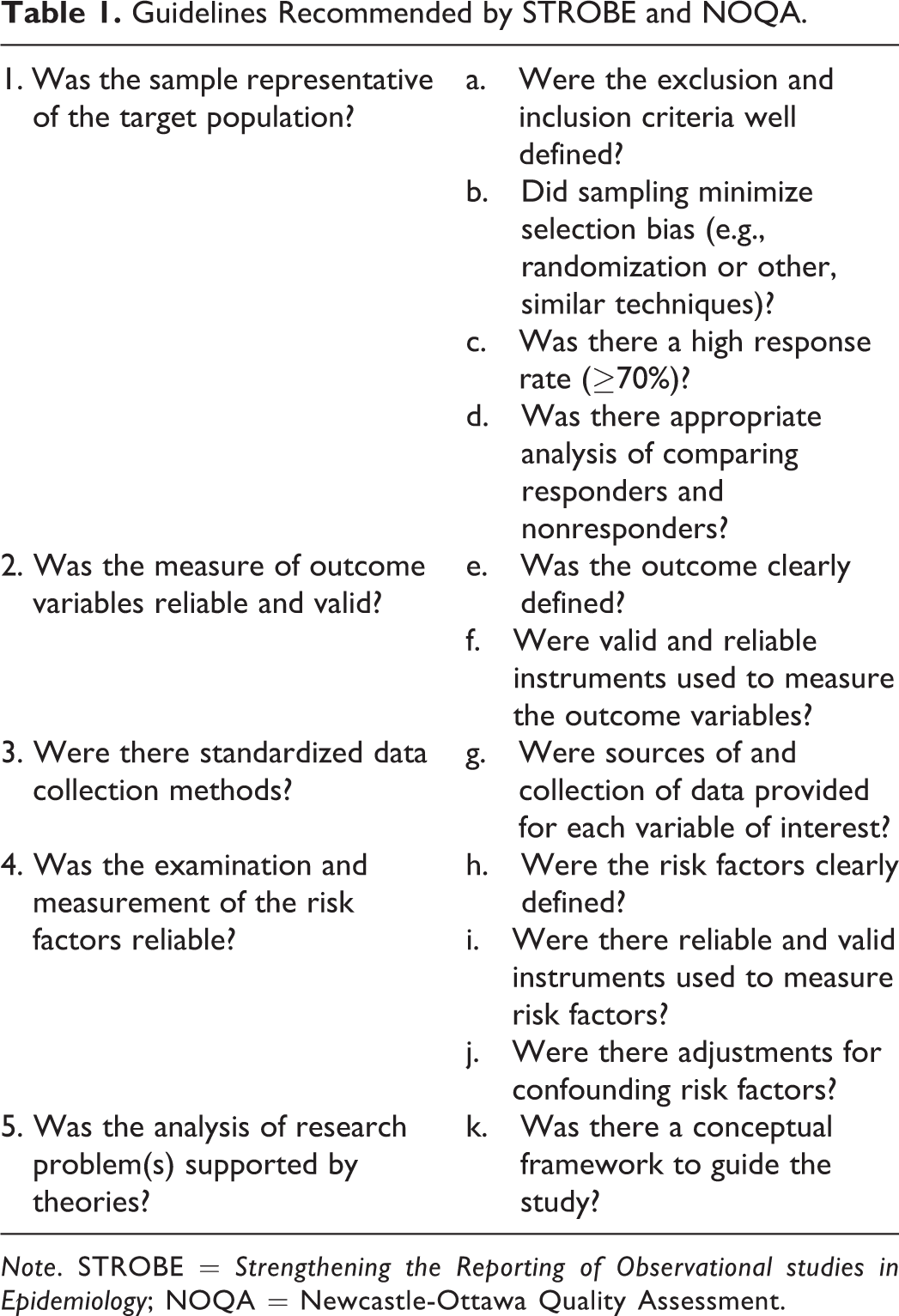
Note. STROBE = Strengthening the Reporting of Observational studies in Epidemiology; NOQA = Newcastle-Ottawa Quality Assessment.
Prevalence of Elder Mistreatment.

Note. CTS2 = Revised Conflict Tactics Scale; EAI = Elder Abuse Instrument; MCTS = Modified Conflict Tactics Scale; CTS = Conflict Tactics Scale; NGO = nongovernmental organization; CPEAB = Caregiver Psychological Elder Abuse Behavior Scale; NA = not available.
Methodological Issues Identified in the Review
A huge variation in reported rates was observed across the studies. The rates of abuse in older persons with dementia ranged from 3 per 1,000 to 78.4%, with physical abuse ranging from 1.5% to 78.4%, psychological abuse from 3.5% to 75%, caregiver neglect from 0.3% to 78.3%, financial abuse from 0.3% to 2.5%, and self-neglect 12.6%. These variations can be partly ascribed to the different methodologies used. Among the many methodological variations, one such difference is the divergent definitions used by researchers and the different subtypes of abuse included in these studies.
Variations in Definitions and Subtypes
Although the majority of researchers have agreed on the definition of elder abuse, they tend to adopt various operational definitions and examine different subtypes of abuse in their studies.
Psychological abuse was the most common form studied, being included in 36 of the 49 studies, followed by physical abuse (34/49) and neglect (17/49). In contrast, sexual abuse (8/49), financial abuse (7/49), and self-neglect (3/49) were seldom examined. The absence of apparent symptoms of financial abuse may account for their less prominent position in the literature. Possibly due to its sensitive nature, sexual abuse was only examined in eight studies. A few studies also address other forms of abuse such as physical restriction, financial neglect, violation of personal rights, or restriction to bedrooms.
Two of the 49 studies used general terminologies such as “violence” without specifying the elder abuse subtypes under investigation. The wide variation in operational definitions of abuse and subtypes studied reduces the comparability of the reported rates generated from these studies. A more congruent definition, a clearer differentiation of abuse subtypes, and a more clear-cut breakdown in rates of abuse are needed for this area of research.
Assessment Instruments Used
Related to the different definitions employed in existing literature is the different instruments used to capture abuse. Thirty-three of the 49 reviewed studies reported rates of elder abuse, with 29 of which using an elder abuse assessment instrument whose validity and reliability had been established. The Modified Conflict Tactics Scale (MCTS; Beach et al., 2005), with internal consistency of 0.69–0.82 and sensitivity of 0.87 against expert consensus, was used in nine studies. Seven studies used the Conflict Tactics Scale (CTS; Straus, Gelles, & Steinmetz, 1980), with internal consistency ranging from 0.64 to 0.82. The Revised CTS (CTS2; Straus, Hamby, Boney-McCoy, & Sugarman, 1996) was used in three studies, with internal consistency being 0.69–0.81 for Psychological Aggression and 0.69–0.82 for the Physical Assault subscale. Three studies used the Potentially Harmful Behavior Scale (PHBS; Williamson & Shaffer, 2001), with internal consistency ranging from 0.62 to 0.95. Other commonly used measurements included the Caregiver Abuse Screen (CASE; Reis & Nahmiash, 1995; α = .75), the Minimum Data Set Abuse Screen (MDS-A; weighted κ = .75; Morris, Fries, Steel, Ikegami, & Bernabei, 1997), Elder Abuse Instrument (EAI; α = .95; Fulmer, Street, & Carr, 1984), Caregiver Psychological Elder Abuse Behavior (CPEAB) Scale (α = .95; test–retest reliability intraclass correlation = .64 and content validity index = .95; Wang, 2005), Scale of Risk of Elder Abuse in the Home (REAH; Hamilton, 1989), and Pillemer criteria (Pillemer & Finkelhor, 1988).
Reported rates of abuse vary across studies using instruments. Studies that used validated and reliable instruments generally reported higher rates or frequency than those that did not. Studies using standardized instruments yielded rates of 15.4–62.3% for psychological abuse, 1.6–78.4% for physical abuse, and 4–78% for neglect. In comparison, nonstandardized instruments generated rates of 3.5–43.8% for psychological abuse, 1.5–11.9% for physical abuse, and 3.5–18.8% for neglect. Instruments with more items (10 or more) also yielded higher rates, with 15.4–62.3% for psychological and 1.6–78.4% for physical abuse. In sharp contrast, shorter instruments (six or fewer) produced much lower rates of 3.5–34% for psychological and 1.5–10.5% for physical abuse.
Studies Using Instruments With Established Psychometric Properties
Asia
A limited number of studies in this category were conducted in Asia. Yan and Kwok (2011) recruited 122 family caregivers of community-dwelling older persons with dementia in Hong Kong. Using the Chinese CTS2, 62.3% and 18%, respectively, of the respondents admitted having verbally and physically abused their care recipients in the surveyed month. To further examine the longitudinal pattern of elder abuse, Yan (2014) used the same instrument to analyze prospective data of 149 family caregivers of persons with dementia in Hong Kong and reported rates of 40.3% for verbal and 15.4% for physical abuse at 6-month follow-up.
In Taiwan, Wang, Lin, and Lee (2006) gathered information from 92 family caregivers of older persons with physical or cognitive impairment. Of the potential score of 20–80 on the CPEAB scale, a mean score of 30.45 was obtained, indicating that most caregivers in the sample had perpetrated some form of psychologically abusive behaviors against their care recipients. In a Japanese survey of 123 family caregivers of cognitively impaired elders referred to a memory clinic, using the Japanese version of the MCTS, 19 respondents (15.4%) reported abuse, with psychological abuse reported in all cases and physical abuse in two cases (1.6%; Kishimoto et al., 2013).
A cross-sectional study involving a small convenience sample of 40 older patients with dementia was conducted in a geriatric outpatient unit in Turkey (Asti & Erdem, 2006). Using the REAH (Hamilton, 1989), the researchers reported relatively low rates of 1.5% for physical abuse, 3.5% for psychological abuse, 3.5% for caregiver neglect, and 2.5% for financial abuse.
Europe
In the UK, Cooper, Katona, Orrell, and Livingston (2007) used MCTS to analyze cross-sectional data obtained from 86 family caregivers of dementia patients (aged ≥ 65). Abuse was defined as being subjected to one or more physically or psychologically abusive acts occurring twice or more in the surveyed month. The study reported overall abuse of 27.9%. Psychological aggression was identified in all cases, and three cases (3.5%) also involved physical assault. To identify prospective progress in the severity of elder abuse, Cooper, Blanchard, et al. (2010) analyzed longitudinal data collected from 131 family caregivers of older persons with dementia and estimated rates of abuse as 48.1% at baseline and 61.8% at 1-year follow-up. Based on a larger convenient sample of 220 family caregivers of community-dwelling elders with dementia, Cooper, Maxmin, Selwood, Blanchard, and Livingston (2009) compared predictive value, sensitivity, and specificity of the MCTS against the Pillemer criteria (Pillemer & Finkelhor, 1988). According to the MCTS, 33.6% reported that abusive acts had occurred “at least sometimes” over the preceding 3 months, with 32.7% reporting psychological abuse and 3.6% physical abuse. The Pillemer criteria gave lower rates of 21.4% for overall abuse, with 20.0% for psychological and 3.6% for physical abuse. The study concluded that the Pillemer criteria demonstrated better predictive value, sensitivity, and specificity in the sample.
In Spain, Pérez-Rojo et al. (2009) interviewed 45 caregivers of older relatives with dementia. Along the potential range of 0–8 on the CASE, a mean of 4.2 was obtained, suggesting that the majority of caregivers in this sample were at the risk of abusing their care recipients.
Another study in the UK drew on data from 82 British family caregivers of dementia patients (Cooney et al., 2006). Using the CTS, 42 (51.0%) indicated positive responses for psychological aggression and 16 (20.0%) for physical abuse. Most physical abusers (12/16) also admitted psychological aggression. Two abusers reported a combination of physical and psychological abuse and neglect.
America
Similar observations were also made in studies conducted in the United States. Wiglesworth et al. (2010) examined cross-sectional data of 129 family caregivers for older persons with dementia. Using the CTS2, 47.3% reported abuse. Of them, 88.5% had engaged in psychological abuse and 19.7% in physical abuse. Using the EAI, neglect was identified in 29.5% of the caregivers. A combination of multiple types of abuse was common for the victims in this sample, with 31% experiencing more than one form. An earlier study based their analysis on 184 consecutively recruited caregivers of older persons with Alzheimer’s disease in Chicago. Using the CTS, 5.4% reported physical violence against their care recipients.
Studies Using Instruments Without Known Psychometric Properties
Asia
Only two studies in this category were based on Asian population. Lee and Kolomer (2005) recruited 481 family caregivers of older persons with dementia in Seoul. They developed an original instrument to measure physical abuse, verbal abuse, and neglect. The most frequently reported form of physical abuse was “yelling at the care recipient” (16.4%), followed by “confining the care recipient in a room” (7.5%) and “hitting the care recipient” (3.3%). The most commonly reported forms of caregiver neglect included “not answering questions of the care recipient” (15.2%), “leaving the care recipient unattended” (4.0%), and “not preparing meals for the care recipient” (2.9%).
In a Japanese survey of 412 family caregivers of older community dwellers using visiting nursing services, over one third (34.9%) reported having exhibited potentially harmful behavior (PHB) toward their older care recipient over the past 12 months (Sasaki et al., 2007). According to their checklist, verbal abuse (16.8%) and ignoring (13.6%) were the most common. Physical attacks (4.5%), neglecting to care (2.8%), and deprivation of money (0.3%) were less common.
Europe
Compton, Flanagan, and Gregg (1997) studied a convenience sample of 38 older persons with dementia and their family caregivers who had been referred to a rural psychiatry practice in Northern Ireland. Using adapted items from Gilleard’s Problem Checklist (Gilleard, 1984), 14 abuse cases were identified, representing a rate of 37%. The most common subtypes were verbal abuse (34.0%) and physical abuse (10.5%).
America
Two earlier studies were carried out in the United States. Using a self-developed questionnaire, Coyne, Reichman, and Berbig (1993) gave a similar rate of 11.9% for physical abuse in a convenience sample of 342 caregivers of community-dwelling older persons with dementia in the United States.
The other study used a single item to ask respondents whether they “feared of being or had been violent to their care recipients” (Kilburn, 1996) and reported rates of 18.8% for potential and 14.0% for actual violence in a community sample of 202 family caregivers of older persons with Alzheimer’s disease in the United States.
Summary
Most studies were conducted in Western societies, with a few in Asian countries. Despite the cultural emphasis on filial piety, caregivers in Asia reported high rates of abuse, with overall abuse ranging from 1.6% to 62.3%, psychological abuse from 9.7% to 62.3%, and physical abuse from 1.6% to 18.0%. These are higher than the rates recorded in Western countries of 5.4–51.0% for overall abuse, 1.5–20.0% for physical abuse, and 3.5–51.0% for psychological abuse. This is in part because Asian people tend to identify culturally specific forms of abuse that are not necessarily considered as abusive from Western perspectives (Yan, Chan, & Tiwari, 2014). For example, attitudes and actions that violate cultural expectation of filial obligation, such as “failure to show respect to older persons” (Tam & Neysmith, 2006), “lack of dignified living environment for older parents” (Nagpaul, 1998), “blaming an elder” (Arai, 2006), and “insufficient attention paid to or direct expression of disagreement with senior relatives” are uniquely identified as abuse in Asian societies. Given cultural differences in the perceptions of elder abuse, reported rates from different cultures are not exactly comparable.
In contrast to the presumption that most people would be reluctant to disclose negative family affairs for the fear of “losing face,” most people were willing to report their experience of abuse. However, all but one of the established instruments used in these studies had been developed in Western societies, casting doubt on their applicability to Asian societies, given the cultural specificity of some of the risk factors. Careful translation and proper modification of these instruments are required when used in Asian populations.
Use of Informants
Studies using observers as informants reported rates as low as 4.6% for abuse (Cooper et al., 2006) and 12.6% for self-neglect (Dong, Wilson, Mendes de Leon, & Evans, 2010). Given the low reporting rates of elder abuse among older persons with dementia, it is not surprising that official data from social services agency generate rates as low rate as 2.66% (Dong, Simon, Rajan, & Evans, 2011).
Consistent with recent findings that suspected abusers would discuss abuse with well-trained assessors (Lachs & Pillemer, 2015), most family caregivers were ready to report their abusive acts, yielding relatively high rates ranging from 5.4% to 62.3% for overall abuse. All but three studies relied on a single reporting source, with care recipient reports leading to higher estimates regardless of the types of abuse studied. To obtain more accurate estimates and to examine any systematic differences in reports obtained from different informants, it will be advisable to obtain information from multiple parties and to triangulate information from multiple sources in future studies. Furthermore, it is possible that observers may only detect abuse resulting in physically observable indicators. We suggest that observer measurement should only be used when both the care recipient and caregiver are incapable of lucid communication.
Reports by family caregivers
The majority of the reviewed studies relied solely on family caregiver reports. These yielded relatively high (5.4–62.3%) but varying rates for different forms of abuse, with psychological abuse ranging from 3.5% to 62.3%, physical abuse from 1.5% to 20.0%, and caregiver neglect from 3.5% to 13.9%.
Reports by caregiver–care recipient dyads
VandeWeerd, Paveza, Walsh, and Corvin (2013) analyzed reported on CTS from 254 family caregivers and 76 cognitively impaired older persons in the United States. A total of 17.2% of caregivers admitted having used physical violence against their care recipients to resolve conflicts. In comparison, 26.1% of the care recipients considered their dyadic relationship to be physically abusive. VandeWeerd and Paveza (2008) drew on cross-sectional data from the same sample. Verbal violence as a conflict resolution strategy was reported by 60.1% of the caregivers and 74.8% of the care recipients.
Beach et al. (2005) interviewed 265 community-dwelling older persons with cognitive impairment and their family caregivers in the United States. Using items adapted from the CTS, about 26.0% of the elderly respondents reported having been subjected to some form of abuse from their caregivers. Verbal aggression such as “yelling”/“screaming” (22.2%) or “insulting”/“swearing”/“using a harsh tone of voice”/“calling names” (11.7%) was more prevalent. In contrast, physical abuse such as “hitting”/“shaking”/“slapping”/“rough handling” was much less common (1%). Used as a validation check, caregiver reported rates were not reported in the study.
Summary
Most of the studies reviewed here relied solely on family caregiver reports. These generated comparatively high rates, implying a willingness among caregivers to report abuse. In comparison, observer measurements yielded much lower rates, suggesting that observers may have higher standards as to what constitutes abuse and that existing instruments may lack sensitivity to detect abuse. It is therefore recommended that more standardized criteria should be made available such that observer measurements will have better reliability and validity. In studies with reports from caregiver–care recipient dyads, the latter gave significantly higher rates. The divergent rates reported by each part of the dyad are in part due to their subjective interpretation of and levels of tolerance to abuse. Dual informants can be used to reduce single-source biases.
Comparison of Cognitively Impaired and Intact Cohorts
Despite the general recognition that compromised cognitive status and caregiving stress increase the risk of elder abuse, only 12 of the 49 studies actually compared rates or risks recorded for cognitively impaired and unimpaired elderly cohorts. Friedman, Avila, Tanouye, and Joseph (2011) screened 164 older persons from a trauma registry in the United States. Three of the seven older persons with dementia were identified as victims of physical abuse, yielding a rate of 42.9%, whereas 24.2% of the 157 older persons without dementia were reported to be victims of physical abuse. Clinical data from a sexual assault exam indicated that of 198 elderly victims of sexual abuse, 53.4% were patients with dementia and 46.4% were not (Baker, Sugar, & Eckert, 2009).
Self-neglect was also more prevalent among older persons with cognitive decline. In Romania, data from the medical files of a geriatric department indicated that, of the 30 self-neglect cases identified, 76.67% involved older persons with dementia compared to 23.33% without (Alexa, Ilie, MoroŞanu, Emmanouil-Stamos, & Räihä, 2012).
Summary
Rates of abuse (mistreatment and self-neglect) were higher in older persons with dementia than in their cognitively intact counterparts, suggesting a need to differentiate cognitive status in rate estimates. Further research should address this issue to confirm whether abuse of cognitively impaired older persons forms a separate subtype of violence. This will yield conceptual clarity on the usefulness and feasibility of studying the abuse of older persons with cognitive impairments.
Nonrepresentative Samples
Only one of the reviewed studies used a representative sample. Cooper et al. (2006) analyzed a randomly selected cross-national sample comprising cognitively impaired and nonimpaired older adults in the community. Using the Minimum Data Set Home Care, 179 of the 3,881 older persons screened as positive for abuse (4.6%). Of the 507 with a diagnosis of dementia, 10.8% had been abused; of the 1,136 screened as positive for dementia, a similar rate of 10.2% had been abused. These results indicate that the reported rates of abuse involving older persons with dementia were more than twice that recorded in the elder population as a whole. This sharp disparity suggests a significant link between age-related cognitive impairment and an increased risk of abuse.
All the remaining studies based their analysis on small, nonrepresentative samples, such as participants in geriatric research projects (Cooper et al., 2008, 2010); clients of a social service organization (Yan & Kwok, 2011); or patients of clinics, medical centers, or hospitals (VandeWeerd, Paveza, Walsh, & Corvin, 2013). Rates drawn from these specific samples may not be accurate due to various reasons. First of all, abused victims are subjected to varying degrees of physical injury or complications that result in more frequent visits to clinics, thereby increasing their chance of being selected for participation in research studies. It may also be the case that physical and cognitive decline in the clinical population predisposes them to an elevated risk of abuse. In terms of the types of abuse identified, it is possible that older persons subjected to specific forms of abuse, such as psychological abuse, financial exploitation, and neglect, are underrepresented in these samples. In any event, using such small and potentially biased samples may not produce accurate estimates of prevalence. Rather, their results may only reflect frequency of abuse in a particular unit of population, thus should be interpreted with extra caution.
This observation has important practice implication. As clinical samples may represent a convergent group of population who are at an elevated risk of being abused, routinely interviewing older persons with vulnerabilities and their caregivers about abuse would lead to timely detection. Due to the sensitive nature of the interviewed questions, rapport should be established prior to the interviews to reduce responses reactance.
Impact of Different Stages of Impairment
Clinicians have speculated that the different stages of cognitive impairment may expose the care recipient to different vulnerabilities, which in turn correspond to different abuse subtypes (Burnight & Mosqueda, 2011). It is also likely that elder abuse may vary in terms of severity along the continuum of disease progression. Only one of the studies reviewed considered this notion. Drawing on a sample of 88 residents in institutional settings, Borza, Reisberg, Macarie, and Astărăstoae (2011) reported significant differences in the impact of three different stages of Alzheimer’s disease on emotional abuse, neglect, and punishment. The mean values of abuse scores corresponding to mild Alzheimer’s disease were lower than those corresponding to the moderate and moderately severe stages. The study also indicated that elders with mild Alzheimer’s disease reported lower severity of emotional abuse, neglect, and punishment, compared to those in the moderate and severe stages. This study showed that persons with dementia are able to respond to interview questions. Given that persons with dementia may be subjected to various symptoms that compromise their cognitive functioning and perception, however, further research including both victim reports and external validation is urgently needed.
Studies in Institutional Settings
Studies on abuse of residents with dementia in institutional settings are underrepresented in current literature, with only six studies available (Borza et al., 2011; Burgess, Dowdell, & Prentky, 2000; Burgess & Phillips, 2006; Cooper et al., 2013; Ramsey-Klawsnik, Teaster, Mendiondo, Marcum, & Abner, 2008; Rosen et al., 2008), two of which involving resident-to-resident aggression (RRA; Ramsey-Klawsnik et al., 2008; Rosen et al., 2008). Summarizing from these studies, reported rates in institutional settings ranged from 8.3% to 66% for physical abuse, from 8.3% to 75% for psychological abuse, and 78.3% for neglect. Among the sexual abuse cases, around 60% involved older persons with dementia.
Staff-to-resident abuse
Cooper, Dow, Hay, Livingston, and Livingston (2013) obtained a purposive sample comprising 36 caseworkers caring for demented residents in care homes in the UK. Using the Care Home Conflict Scale, they reported that 5.6% had not given residents enough food, 8.3% had threatened residents, and 8.3% had avoided residents with challenging or help-seeking behaviors. Borza et al. (2011) interviewed 88 nursing home residents with dementia in Romania using items adapted from the Child Abuse and Trauma Scale. Defining abuse as experience of one or more abusive incidents, neglect was commonly reported (78.3%), followed by psychological abuse (75%) and physical abuse (59.1%). Sexual abuse had been experienced or witnessed by 20.5%.
Examining data from 20 cases of sexual abuse of residents of assisted facilities who were referred to forensic evaluation services, 12 of the 20 (60%) victims had Alzheimer’s disease or dementia (Burgess et al., 2000). The finding of this study needs to be interpreted with caution, as all 20 cases came to law enforcement, which is extremely rare for abuse of persons with dementia. Of the 284 elder sexual abuse cases referred to Adult Protective Service programs, nurse examiners, or law enforcement, 60% involved victims with cognitive impairment (Burgess & Phillips, 2006).
Resident-to-resident abuse (RRA)
Rosen et al. (2008) investigated RRA in nursing facilities using data collected from focus groups with 96 staff members and 7 residents (52% were diagnosed as having dementia). Verbal aggression was the most commonly reported form (72%), followed by physical aggression (66%) and sexual aggression (18%). Dementia or cognitive impairment as a trigger for RRA was mentioned by 18% of the participants.
Among 124 sexual abuse cases in nursing homes, 78% of confirmed perpetrators were institutional residents and 40% of resident perpetrators were cognitively impaired. A total of 97% of the victims lacked the cognitive capacity to manage finances (Ramsey-Klawsnik et al., 2008).
Summary
Although generally ignored in existing literature, elder abuse occurs in institutional settings. While residents with cognitive impairment are vulnerable to various forms of abuse, they may also direct abusive acts toward other residents. Caution should be taken in interpreting research findings from institute setting. Although cognitively impaired residents continue to dominate a significant proportion and places in institutions (Teresi, Morris, Mattis, & Reisberg, 2000), with the recent movement focusing on community care, it is possible that the difference between those residing in institutions and those residing in the community is minimal. Further research is needed to compare and contrast any systematic difference between older persons in institutions and the community. In any event, the presence of cognitive impairment compounded by minimal oversight, insufficient regulations, and low staff ratios can potentially conspire to enhance risk of abuse (Wood & Stephens, 2003).
Studies reviewed here suggested varying and high rates of abuse against institutionalized residents by staff (5.6–78.3%). However, due to the selected and small samples used, results generated from these studies may not be accurate. Equally worth noting was the low rates of staff self-reports (5.0–21.4%), indicating their reluctance to report abuse. The investigatory entities may be reluctant to confirm certain types of abuse without a high threshold of proof in some instances, particularly when criminal sanctions are likely. Furthermore, institutes may not welcome research studies that reflect poorly on the staff and management, thus creating an extra barrier in research in institutes.
Cross-Sectional Design
Most of the studies included here (42/49) examined cross-sectional data, making it extremely difficult to examine how prognosis of the illness, caregiver–care recipient dyadic relationship, or caregiving context may affect abuse. As noted above, elder abuse may manifest itself differently at different stages of cognitive decline. In addition, there could be significant differences between relationships which were already abusive at a premorbid stage and those that have become abusive after the onset of disease. Nonetheless, a cross-sectional design provides very little information about causal effect and hampers accurate identification of the risk factors for elder abuse.
Differences in Assessment Period
Another methodological issue that limits the comparability of findings across studies is the temporal dimension. Only 17 of the 49 studies specified the assessment period for elder abuse. Among those that reported a study period, respondents were asked to report abusive experiences ranging from the past month to the past year.
As reported by family caregivers, rates of abuse over a 1-month period ranged from 30% to 62.3%, with psychological (15.4–62.3%) and physical abuse (1.6–18%) being the most commonly reported (Kishimoto et al., 2013; Yan, 2014; Yan & Kwok, 2011). Abuse occurring over the past 3 months gave a similar rate (27.9–61.8%), with psychological abuse being the most frequently reported (33%), followed by physical abuse (4%; Cooper et al., 2008, 2013; Cooper, Blanchard, et al., 2010; Cooper, Maxmin, Selwood, Blanchard, & Livingston, 2009; Cooper, Selwood, et al., 2010; Selwood, Cooper, Owens, Blanchard, & Livingston, 2009). Psychological abuse over a 6-month period was documented as 9.7% (Wang, Lin, & Lee, 2006). Psychological abuse over a 1-year period ranged from 34% to 51% and physical abuse from 9.3% to 20% (Compton, Flanagan, & Gregg, 1997; Cooney & Wrigley, 1996, 2006; Dong et al., 2011; Rabold & Goergen, 2013; Wiglesworth et al., 2010).
Lack of a Context-Specific Theoretical Framework
Relatively little effort has been made to develop a sound theoretical framework for understanding elder abuse in persons with dementia. Elder abuse is a multidimensional and complex phenomenon, with multiple contributing factors and significant variation across subtypes. A notable problem in current theoretical development in this field is the propensity to overinclude all forms of abuse in different populations within a single theoretical model (Kinnear & Graycar, 1999), despite the heterogeneity of older population (Yan et al., 2014) and interdependence of abuse subtypes (Jackson & Hafemeister, 2011). Of the 49 studies reviewed, only 18 attempting to apply a theoretical framework to guide their empirical investigation. Theories commonly used in studies reviewed include caregiver stress model (McCubbin & Patterson, 1983), communal relationships theory (Mills & Clark, 1982), risk vulnerability model (Rose & Killien, 1983), and ecological framework (Schiamberg & Gans, 1999, 2000). However, most of these conceptual models were borrowed from available elder abuse literature without considering the contextual, interpersonal, and intrapersonal risk factors specific to the persons with dementia. Various characteristics specific to persons with dementia and the caregiving context, including the continuous progress of dementia, personality change of the patients, increasing caregiver burden and isolation, social stigma and social exclusion associated with dementia, may have unique influence on abuse. The use of available theories may be problematic, given the plausible different causal pathways of abuse in older persons with versus without dementia as in domestic versus institutional settings. The application of the same theoretical model to various forms of abuse is based on the assumption that they are driven by similar intents and motives, which is not the case. Furthermore, in spite of increasing calls for a multidisciplinary approach to elder abuse research, most theorists remain in their narrowly defined disciplines or domains. A theory derived from a single discipline tends to neglect key dimensions of the diversity, complexity, and uniqueness of abuse against elders with dementia. Further research is needed to conceptualize context-specific and multidisciplinary theoretical frameworks to justify research designs, interpret research outcomes, and produce potential intervention options.
Risk Factors
Existing studies have generated disputes over the risk factors for abuse of elders with cognitive impairment. For instance, although some studies found that females are more vulnerable to abuse than males (Friedman, Avila, Tanouye, & Joseph, 2011; Kishimoto et al., 2013), others found the opposite (Yan, 2014). Such contradictory outcomes are likely to be the result of different abuse subtypes and cohorts studied. For example, dementia has been identified as a risk factor for some types of abuse but not others. Jackson and Hafemeister (2011) examined 71 abuse cases through parallel interviews with caseworkers (n = 71), abused victims (n = 55), and third-party informants (n = 35), and a further 2,142 cases identified from state agency data. They reported that victims without dementia were more likely to experience financial exploitation (β = 0.78, p < .01) and physical abuse (β = 0.68, p < .001), whereas victims with dementia were more likely to suffer neglect (β = 1.40, p < .001). The heterogeneous characteristics of the populations studied may result in different risk factors. One example is the different cultural contexts and expectations in diverse populations. For instance, compared to older persons in Western societies, older Asians may have higher expectations of interdependency among family members and the filial responsibilities of adult children. Older persons from diverse cultural backgrounds may thus be exposed to different risk factors. Furthermore, due to the dramatically different characteristics of their living environments and interpersonal relationships, institutionalized elders and those living in the community may face different risk factors.
Care Recipient Characteristics
Cognitive impairment
A total of 12 studies identified cognitive impairment as a risk factor for abuse. Studies conducted in the UK reported a positive association between abuse and cognitive impairment, with odds ratios (ORs) ranging from 1.2 to 1.4 (Cooper et al., 2006, 2008, 2010). In South Korea, decreased cognitive ability in older persons contributed to levels of abuse and neglect, with β ranging from 0.233 to 0.338 (p < .001; Lee, 2008, 2009; Lee & Kolomer, 2005). In the United States, compromised cognitive status increased the risk of physical, emotional, and financial abuse and caregiver neglect, with OR ranging from 3.02 to 6.24 (Dong et al., 2009; Shaffer, Dooley, & Williamson, 2007; VandeWeerd et al., 2013). Older persons with cognitive impairments were frequently the targets of sexual abuse, accounting for 60% (Burgess et al., 2000) and 53% (Baker et al., 2009) of total reported cases.
Behavioral problems
Fourteen studies indicated a positive association between behavioral problems and abuse. In the United States, older persons demonstrating violent or abusive behaviors were 4 and 8 times more likely to be physically and verbally abused, respectively (VandeWeerd et al., 2013; VandeWeerd, Paveza, & Fulmer, 2006). In Hong Kong, agitated behaviors were associated with the co-occurrence of verbal (r = .310, p < .01) and physical abuse (r = .259, p < .01) in a 6-month prospective study (Yan, 2014) and with the sole occurrence of physical abuse (r = .420, p < .01) in a cross-sectional study (Yan & Kwok, 2011). In South Korea and Japan, behavioral disturbance was positively correlated with abuse and neglect, with the correlation ranging from .3 to .395 (p < .01) (Lee, 2009; Kishimoto et al., 2013; Sasaki et al., 2007). Studies conducted in the UK have concluded that older persons who were irritable, abusive, and resistant to care were at higher risk of abuse (Compton et al., 1997; Cooper et al., 2006, 2008, 2010). In Spain, compared to older persons at a low risk of abuse, those exposed to high risk were more likely to demonstrate aggressive (t = −4.000, p < .01) and proactive behaviors (t = −3.000, p < .01; Pérez-Rojo, Izal, Montorio, & Penhale, 2009).
Functional impairment
Eight studies explored the role of functional impairment. Japanese studies identified a negative association between functional ability and abuse, with the correlation ranging from −.236 to −.13 (p < .05; Kishimoto et al., 2013; Sasaki et al., 2007). In South Korea, decreased ability to perform activities of daily living contributed to levels of abuse and neglect experienced (β ranging from −0.12 to −0.07, p < .001; Lee, 2009; Lee & Kolomer, 2005). Similarly, functional impairment was a prominent risk factor for family violence against older persons in Western societies (Cooper et al., 2006, 2008; Coyne, Reichman, & Berbig, 1993; VandeWeerd et al., 2013).
Psychiatric illness or psychological problems
Six studies examined the effect of psychiatric illness and psychological problems. Within a representative British sample (N = 3,881), abuse rates of 18.3% (15/87) and 14.0% (12/86) were recorded for older persons with delusions and hallucinations, respectively. This is in sharp comparison to the rate of 4.6% recorded in the sample as a whole (Cooper et al., 2006). Studies based on smaller convenience samples in the UK and the United States reported that older persons demonstrating psychiatric symptoms (irritability, depression, etc.) were more likely to be physically and psychologically abused, with OR ranging from 0.566 to 38.300 (Cooper et al., 2006, 2008;VandeWeerd et al., 2006; Williamson & Shaffer, 2001). Consistently, risk of abuse was higher among older Japanese with neuropsychiatric symptoms (r = .395, p = .001; Kishimoto et al., 2013).
Physical health
Inconsistent findings have been observed regarding the impact of physical health. In the UK, compared to those who were not abused, older persons who were abused were more likely to complain about pressure sores, impaired vision, hearing problems, and unintended weight loss (Cooper et al., 2006). Older Japanese with hearing problems were at increased risk of abuse and neglect (r = .120, p < .05; Sasaki et al., 2007). In the United States, poorer self-rated health predicted greater risk of PHBs (OR = 0.76; Beach et al., 2005). Examining official data from a trauma registry involving 41 physically abused older American, 43.9% had heart disease and 9.8% pulmonary disease. However, a recent study has reported that absence of chronic disease other than dementia increased the risk of physical abuse (β = −0.159, p < .05; Yan, 2014). Similarly, Asti and Erdem (2006) reported that older persons with dementia with one disease obtained higher abuse scores than those with two diseases.
Gender
Two studies which considered the effect of gender reported inconsistent findings. A study using official records in the United States indicated that 58.5% of physically abused elders were female, and 41.5% were male (Friedman et al., 2011). In Hong Kong, being male contributed to a higher degree of physical abuse (β = 0.178, p < .05; Yan, 2014).
Age
Age had a different impact on the different types of abuse. Young-olds were more likely to become victims of verbal abuse (Cooper et al., 2006; VandeWeerd et al., 2006; Yan & Kwok, 2011). However, self-neglect usually involved old-olds (Dong et al., 2009). This is partly due to different etiologies of these two forms of abuse. Self-neglect is usually associated with severe dementia and physical frailty that are commonly found in older persons with advanced age (Dyer, Goodwin, Pickens-Pace, Burnett, & Kelly, 2007). In comparison, young-olds generally with better physical and cognitive status are more likely to engage in verbal conflicts with their caregivers (VandeWeerd et al., 2006), thus increasing the risk of verbal abuse.
Caregiver Characteristics
Psychological problems and psychiatric illness
A total of 10 studies investigated the effect of psychological problems and psychiatric illness. In the United States, caregivers with depression were more likely to perpetrate physical and psychological abuse, with OR ranging from 1.385 to 4.18 (Beach et al., 2005; Paveza et al., 1992; Shaffer et al., 2007; VandeWeerd et al., 2006) and a correlation from .32 to .39 (p < .01; Wiglesworth et al., 2010; Williamson & Shaffer, 2001). In Spain and the UK, abuse was significantly predicted by emotional distress (Cooney et al., 2006), anxiety (Compton et al., 1997; Cooper et al., 2006), and depressed affect (Cooper et al., 2010) among caregivers.
Caregiving burden
The existence of caregiving burden as a risk factor was consistently supported by evidence from 14 studies. Studies conducted in Chinese societies (two in Hong Kong and one in Taiwan) reported a positive association between abuse and burden, with a correlation ranging from .178 to .465 (p < .01; Wang et al., 2006; Yan, 2014; Yan & Kwok, 2011). In South Korea, caregiving burden contributed to the severity of abuse and neglect, with β ranging from 0.246 to 0.604 (p < .001; Lee, 2008, 2009; Lee & Kolomer, 2005). Likewise, Japanese caregivers experiencing a higher level of burden were more likely to be abusive, with correlation ranging from .2 to .385 (p < .001; Kishimoto et al., 2013; Sasaki et al., 2007). A significant positive relationship between burden and abuse was also identified in studies conducted in Spain (Pérez-Rojo et al., 2009), the UK (Cooper et al., 2008, 2010), and the United States (Beach et al., 2005; Gainey & Payne, 2006; VandeWeerd et al., 2006), with OR ranging from 1.08 to 1.85. With the combination of filial piety and inadequate alternative placements, family caregivers remain predominant in dementia care system in Asian culture. Caregivers may feel entrapped in filial piety and turn their frustration into abusive behaviors (Yan, 2014). In Western countries, common reasons for assuming a caregiver role are a sense of duty, gilt, social pressures, reciprocity, or love (Brodaty & Donkin, 2009). Caregivers with negative motivations (duty, guilt, social or cultural norms) are more likely to develop emotional stress and resent their roles, thus at an increased risk of abusing their care recipients (Camden, Livingston, & Cooper, 2011).
Dysfunctional coping
Five studies explored the role of dysfunctional coping strategies (e.g., behavioral disengagement, proactive aggression, substance use, etc.). Three of them concluded that informal caregivers using more dysfunctional and proactively aggressive coping strategies were more likely to perpetrate abuse, with correlation ranging from .3 to .32 (p < .01; Cooper et al., 2008, 2010; Shaffer et al., 2007). In particular, family caregivers who abused alcohol were 3 times more likely to engage in physical violence (VandeWeerd et al., 2013). In nursing facilities, professional caregivers reporting stress-induced alcohol consumption were at increased risk of being abusive (OR = 1.82; Rabold & Goergen, 2013).
Caregiver gender
Four studies yielded inconsistent results regarding caregiver gender as a risk factor. In Taiwan and the United States, being a female caregiver was associated with increased risk of perpetrating psychological abuse (r = .234, p < .05; Wang et al., 2006), physical abuse (OR = 2.735; VandeWeerd et al., 2006), and PHBs (r = −.14, p < .01; Shaffer et al., 2007). Conversely, male caregivers in Japan were more likely to be abusive (β = 0.251, p < .001; Kishimoto et al., 2013). Compared to men, women generally perceive life events as more negative and less controllable, thus more likely to adopt negative coping styles (Matud, 2004). It is therefore understandable that female caregivers in most cultures tend to be more abusive than their male counterparts. However, in traditional Japanese culture, caregiving is predominately a “female task” (85%; Long & Harris, 2000), it is possible that male caregivers may not be able to cope with this new role and thus are more prone to abuse the care recipient.
Caregiver age
The role of age in abuse has generated controversial outcomes in the three studies considering it. Although younger caregivers were more psychologically aggressive in Taiwan (r = .315, p < .01; Wang et al., 2006), their older compatriots were more abusive in the United States (OR = 1.04; Beach et al., 2005) and Germany (OR = 1.04; Rabold & Goergen, 2013).
Caregiver and Care Recipient Relationship
It is possible that the quality of premorbid caregiver–care recipient relationship may affect how caregivers evaluate their current relationships and how they appraised caregiving stressors. Caregivers in historically poor relationship generally perceived their current interaction with their care recipients as less rewarding and the caregiving role as more stressful, thus more likely to engage in abusive behaviors (Lawrence, Tennstedt, & Assmann, 1998).
Premorbid relationship
Four studies examined the impact of relationship before onset of dementia. In the UK, abuse was associated with less rewarding (r = −.300, p < .001; Cooper et al., 2010) and more argumentative (t = −1.960, p = .05; Cooney et al., 2006) dyadic relationships. In the United States, caregivers who had perceived fewer rewards (positive caregiving perception) in their pre-illness relationships were more likely to engage in PHBs (r = −.220, p < .001; Williamson & Shaffer, 2001).
Current relationship
Two studies investigated the role of the current caregiver–care recipient relationship. British caregivers who received more rejection (resistance to care) from their care recipients were more likely to perpetrate physical abuse (t = −4.490, p = .03), verbal abuse (t = −3.73, p = .0001), and neglect (t = −4.490, p = .03; Cooney et al., 2006). In the United States, having fewer rewards from the current relationship predicted PHBs (r = −.4, p < .001; Williamson & Shaffer, 2001).
Kinship
Spouses and adult children were identified as the primary perpetrators in four studies. In the United States, the rates of various forms of abuse committed by spousal caregivers ranged from 5% to 51% (Williamson & Shaffer, 2001). Compared to nonspouses, spouses were 3–4 times more likely to be abusive (Beach et al., 2005). Official records revealed that 32.6% of physical abusers were adult children and 11% were spouses (Friedman et al., 2011). In Japan, spousal and adult children caregivers were at higher risk of perpetrating abuse (Kishimoto et al., 2013; Sasaki et al., 2007).
Caregiving Context
Social support
The impact of social support was examined in seven studies. In the UK and South Korea, the lack of formal social support (home care, daycare services, social service programs, etc.) contributed to the degree of abuse and neglect, with β ranging from −0.180 to −0.174 (p < .01; Cooper et al., 2010; Lee, 2008; Lee & Kolomer, 2005). In Hong Kong and the United States, receiving informal social support (e.g., help from relatives, friends, domestic helpers, etc.) reduced the risk of verbal abuse (r = −.26, p < .01; Yan & Kwok, 2011) and physical abuse (B = −0.22, p < .05; Kilburn, 1996). Social support also mitigated the severity of elder abuse in Japan (Kishimoto et al., 2013) and Spain (Pérez-Rojo et al., 2009).
Living arrangements
Caregiver–care recipient coresidence was a risk factor in four studies. In Hong Kong, more coresidence days increased the risk of verbal and physical abuse, with the correlation ranging from .240 to .370 (p < .01; Yan, 2014; Yan & Kwok, 2011). Coresidence was also associated with caregiver-to-care recipient violence in the United States (Kilburn, 1996; Paveza et al., 1992). Plausibly, intensive interaction and potentially aggressive confrontation generated by shared residence can result in the occurrence or escalation of abuse (Table 3).
Risk Factors for Elder Mistreatment.
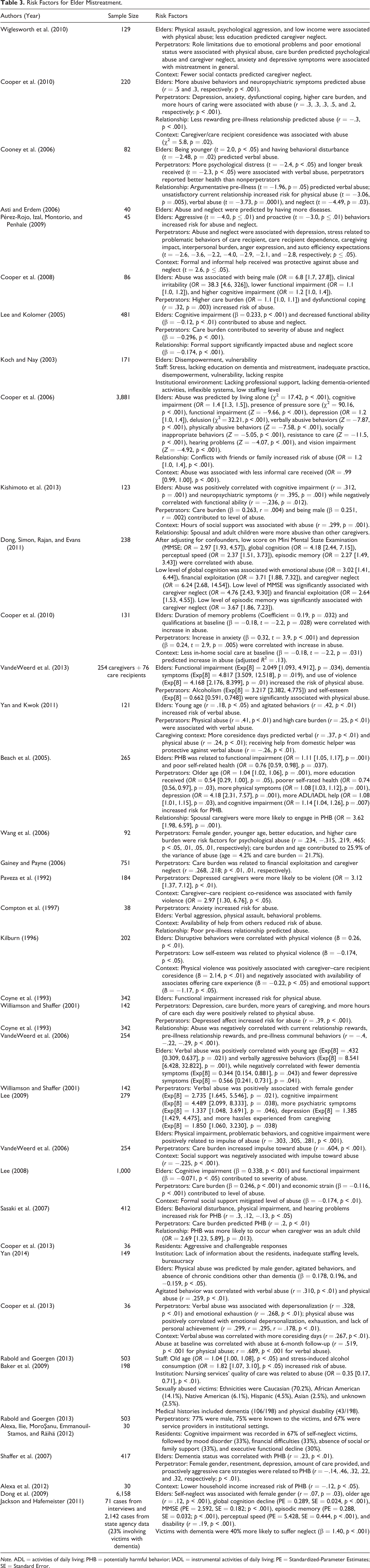
Note. ADL = activities of daily living; PHB = potentially harmful behavior; IADL = instrumental activities of daily living; PE = Standardized-Parameter Estimates; SE = Standard Error.
Implications
For Practice
Given family caregivers’ readiness to report abuse, routinely inquiring them about this may facilitate timely detection of suspected cases. To minimize self-report biases of in single reporters, reports by other informers (care recipients, observers, etc.) should be taken as validation check. The characteristics of older persons with dementia and their caregivers require that they contact the medical, heath care, social services systems on a regular basis, and frontline human service professionals should pay particularly attention to cases of plausible abuse. These are good opportunities for professionals to identify cases at risk for abuse and to provide support and assistance accordingly.
Since the most relevant risk factors were related to dementia symptoms, stages of the disease should also be taken into account in the detection and intervention of elder abuse. Disease-sensitive screening tools are required to capture the specific characteristics of abuse involving older persons with different stages of dementia. Clinicians should be informed of the nature and prognosis of dementia and be alert of the potential risk related to symptoms associated with different stages of dementia.
Effective intervention protocol special to elder abuse in persons with dementia is urgently needed. Older persons with dementia may rely heavily on their caregivers for daily care and assistance. Apart from tangible assistance, many of the caregivers may be their close families or loved ones. It is important that these factors are taken into account in intervening elder abuse in persons with dementia. Direct intervention such as legal measures, that is, taking the abused person away from the abusive situation, may not be the optimal way of intervening abuse in such cases. Indirect intervention, including mediation, support services, and so on, could be beneficial in some cases. Under any circumstance, intervention programs should be carefully designed and implemented to take into account the best interest of the persons with dementia.
Prevention is of particular importance for abuse of persons with dementia. Findings from a 6-month prospective study showed that once family caregivers enter into the abusive cycle, abuse becomes habitual, and reduction in agitated behavior does not result in a corresponding reduction in abuse (Yan, 2014). This suggests that it is important to prevent new cases of elder abuse. There are educational materials for professionals and family caregivers, screening tools, and referral protocol available for this purpose (Antezberger et al., 2000). Development and promotion of such instruments for prevention of abuse would be of great value for clinical practice.
For Research
Although elder abuse is prevalent in institutional settings, professional caregivers were reluctant to report it. Therefore, special attention should be paid to rapport building and question design when interviewing this group of potential perpetrators. Larger and more representative samples are also necessary to achieve a more comprehensive understanding of abuse prevalence and severity. Prospective and longitudinal research is needed to identify causation mechanism, moderating effects, and progressive manifestations of abuse among older persons with dementia.
Given the unique characteristics of the caregiving situation for older persons with dementia, the caregiver stress model and the communal relationships theory have been used most frequently in advancing the understanding of abuse of this vulnerable population. However, it is also important to attend to contribution of characteristics outside of the caregiver–care recipient relationship. Informal support from other family members; formal support from community services; awareness and support from medical, health, and social services; policy and legislation that protects the rights of the person with dementia, culture and values of the larger society all have potential impact on abuse of older persons with dementia. Careful consideration of variables on both the micro level and macro level, and their interactions, would provide a more comprehensive pictures of factors associated with abuse of persons with dementia. The ecological framework is potentially useful in advancing understand of abuse of persons with dementia.
For Policy
Intervention in, and prevention of, abuse of older persons with dementia should be set as a top priority in policy-making. Educational programs focusing on cognitively impaired elders’ vulnerability to abuse should be implemented to enhance public attention to the issue and reduce the social stigma of reporting. Interdisciplinary work is needed with clinicians, social workers, and health professionals to detect abuse indicators and aid the reporting of suspected cases. Examples of such work include regular physical examination, mental capacity assessment, home visits, and so on. As care burden is a strong predictor of abuse, community services should provide respite services, support groups, and secondary caregivers to mitigate the intensive burden experienced by primary caregivers.
Since persons with dementia may not be able to protect themselves from harm and may not be able to seek help in face of family violence, reporting of abuse should be made mandatory. It is also important to incorporate training on how to detect and respond to elder abuse in the curriculum of medical, health, social, and legal professionals, such that people working in these industries have the basic sense of how to react to potential abuse cases.
Conclusion
Although elder abuse is a common public health issue in persons with dementia, significant gaps exist in research, practice, and policy-making. This article reviewed the existing literature on abuse of persons with dementia, which is important for risk assessment, timely detection, prevention, and intervention of abuse. Methodological issues and their impact on study outcomes are also discussed and critiqued. Findings from this review provide valuable information to direct future social work practice, research, and policy-making. Interdisciplinary and synergistic work from relevant fields is needed to reduce abuse and improve health and safety in persons with dementia.
Footnotes
Declaration of Conflicting Interests
The author(s) declared no potential conflicts of interest with respect to the research, authorship, and/or publication of this article.
Funding
The author(s) disclosed receipt of the following financial support for the research, authorship, and/or publication of this article: The project is supported by the Hong Kong General Research Fund #HKU751113H.