



Abstract
When confronted with a sexual attacker, women are often extremely concerned with avoiding rape completion. While narrative reviews typically suggest that the victim resistance is linked to rape avoidance, much of the existing literature relies on overlapping samples from the National Crime Victimization Survey. The current meta-analysis examines whether victim resistance is related to a greater likelihood of avoiding rape completion. Results from a systematic literature search across 25 databases supplemented by a search of the gray literature resulted in 4,581 hits of which seven studies met eligibility criteria for the review. Findings suggest that women who resist their attacker are significantly more likely than nonresisters to avoid rape completion. This finding held across analyses for physical resistance, verbal resistance, or resistance of any kind. Limitations of the analysis and policy implications are discussed, with particular focus on other research findings that resistance may be linked to greater victim injury.
Sexual assaults negatively affect millions of victims every year in the United States and around the world. These invasive crimes cause psychological and emotional damage as well as physical injuries and in extreme cases death (Mieczkowski & Beauregard, 2010; Scott & Beaman, 2004). All of this harm to the victim is often intensified when the rape itself is completed (i.e., when vaginal, anal, or oral penetration occurs as part of the assault), compared to cases in which penetration does not occur (Kilpatrick, Saunders, Amick-McMullan, & Best, 1989; Siegel, Golding, Stein, Burnam, & Sorenson, 1990; Ullman, 1997, 2007). Crimes in which rapes are completed generally cause more psychological damage, including anxiety and depression, as well as suicidal thoughts and attempts (Kilpatrick et al., 1989; Siegel et al., 1990; Ullman, 1997, 2007). Furthermore, there is often additional physical damage that results from a more invasive assault, both immediately following the rape and manifested in chronic conditions that develop over time, such as pelvic and other internal pain, gynecological issues, and other ongoing medical problems (Koss & Heslet, 1992; Ullman, 2007; Ullman & Brecklin, 2003). This greater psychological and physical damage leads to an inevitably higher use of victim services to combat these effects, increasing the societal costs resulting from such crimes (Koss & Heslet, 1992; Ullman, 2007; Ullman & Brecklin, 2003).
Due to the increased victim and societal problems that result from completed rapes, it is important to determine how victims can reduce the likelihood of a penetrative assault. While many individual studies have studied the relationship between victim resistance and rape completion, to date no quantitative summary of this literature has been undertaken. In an effort to provide guidance for victims, the current study provides a systematic review and meta-analysis of the extant literature on the relationship between victim resistance and rape completion.
Victim Resistance in Sexual Assault
One of the most influential actions a victim can take during a sexual assault is to resist, and resistance has implications for rape completion as well as victim injury beyond the sexual assault itself. Unfortunately, conflicting research evidence across studies results in ambiguity with respect to the impact of victim resistance on victim injury (e.g., see results from Block & Skogan, 1986; Marchbanks, Lui, & Mercy, 1990; Ruback & Ivie, 1988; Tark & Kleck, 2004, 2014; Ullman & Knight, 1993, 1995; Yun & Lee, 2014). The majority of the research focusing on rape completion has found that victim resistance decreases the likelihood of a sexual assault culminating in penetration. Sarah Ullman (1997, 2007) discusses this relationship in detail, suggesting that the more resistance a victim uses, the greater her chances of avoiding a completed rape without incurring more injury.
Ullman is not alone in her recommendations in terms of rape avoidance. For example, Clay-Warner (2002) determined a significant reduction in likelihood of completion when victims employed self-protective behaviors. Similarly, Marchbanks, Lui, and Mercy (1990) compared women who used no self-protection to those who used any of three types of self-protection (nonforceful, forceful, or both) and determined that victims who used any of these self-protective measures had a substantially decreased likelihood of completed rape. Zoucha-Jensen and Coyne (1993) found that nonforceful verbal resistance was ineffective at stopping a rape, but that forceful verbal resistance and, even more so, physical resistance served as an effective deterrent to rape completion. Similarly, Kleck and Sayles (1990) determined that resistance with any weapon (particularly a gun or knife) is the most effective in terms of rape avoidance, but that, overwhelmingly, victims who resist are much less likely to suffer a completed rape compared to nonresisters.
While such research suggests that resistance is in the best interests of the victim in terms of rape avoidance, it may not necessarily be this simple. Hazelwood, Reboussin, and Warren (1989) examined the effects of resistance in a sample of serial rapists who had committed 10 or more sexually abusive crimes. Although the authors did not directly analyze the effects of resistance on rape completion, they did determine that these serial offenders took a great deal more pleasure in offenses in which the victim resisted. Furthermore, victim resistance was found to occur within crimes of longer duration. Both of these relationships could certainly be related to a greater likelihood of rape completion, as a more pleasurable assault for the offender might lead to attempts at further sexual pleasure (including penetration or forced victim participation). As well, the longer the duration of an assault, the more actions the offender is capable of taking, both in terms of violence and in terms of sexually intrusive behaviors, a finding generally supported by previous research (Balemba & Beauregard, 2012; Balemba, Beauregard, & Mieczkowski, 2012; Mieczkowski & Beauregard, 2010).
Further, although the literature appears to be mostly in agreement regarding the relationship between victim resistance and rape completion, upon closer inspection of the existing studies it is apparent that this perceived agreement may in part be a function of overlapping data. Most notably, the large majority of studies that examine this relationship use data from the National Crime Victimization Survey (NCVS; formerly, the National Crime Survey [NCS]; see Table 1). The NCVS collects information on criminal victimizations of all types from approximately 90,000 households, equating to about 160,000 individuals annually (Bureau of Justice Statistics, n.d.). Information is collected regarding the frequency of victimization, details and characteristics of victimizations, and resultant consequences (Bureau of Justice Statistics, n.d.). 1
Overlapping Studies Using the National Crime Victimization Survey (NCVS)/National Crime Survey (NCS) Data Set.

aThese samples are larger because they are projected national sample sizes based on the responding survey sample.
Those studies that use overlapping years from the NCVS are essentially reaffirming the findings of others using the same sample, which does not add additional knowledge to the field. To be fair, these studies often have differing goals. For example, Martin and Bachman (1998) used NCVS data spanning the years 1992–1994 and reported on the relationship between offender alcohol use and rape completion, with analyses also examining the effects of resistance. Comparatively, Clay-Warner (2002) used NCVS data from 1992 to 1998 but examined the differing effects of victim resistance as situational danger increases. Although these studies had very different overall goals, when focusing solely on the effects of victim resistance on rape completion they do not contribute unique information to the field because their analyses and subsequent results arise from overlapping samples (1992–1994 and 1992–1998). Due to this issue of overlapping data, the extant research on this topic is not nearly as extensive as it appears to be.
Aim of the Study
In light of numerous studies having analyzed variations of the same data set, the current study aims to provide a quantitative summary of the existing, unique research that examines the relationship between victim resistance and rape completion. In addition, we differentiate the effects of physical and verbal resistance on rape completion. Although differences from situation to situation cannot be assessed in the current analysis, our hope is to use the available research evidence to provide a recommended course of action for sexual assault victims in terms of rape avoidance. While the burden of harm reduction should absolutely fall on offenders rather than victims, we believe that educating victims may help to reduce the occurrence of some of the more deleterious sexual assault outcomes.
Method
Systematic Literature Search
We attempted to identify and retrieve the entire population of existing studies that met the a priori inclusion criteria. The principle technique was a systematic search of 25 bibliographic databases (listed in the Appendix), from database inception to June 15, 2015. We also searched for gray literature by reviewing the bibliographies of studies that met our inclusion criteria, the bibliographies of narrative literature reviews, and the reference lists of other related studies on victim resistance and rape outcomes (that did not meet our inclusion criteria). In addition, we hand searched the terms “rape AND resistance” in 13 academic journals such as Aggression and Violent Behavior, Criminal Justice and Behavior, Journal of Interpersonal Violence, Sexual Abuse, Violence against Women, and Violence and Victims. Last, we reviewed the curricula vitae of Ronet Bachman, Jody Clay-Warner, Gary Kleck, Raymond Knight, and Sarah Ullman.
Database search terms
Our search was designed around four constructs: rape outcome, victim, resistance, and sexual crime. This search was part of a larger project examining the outcomes of victim resistance in violent crimes, resulting in a broader set of terms than the current focus on rape completion. This search protocol was developed and refined over 75 iterations, and the final terms were combined in a Boolean abstract search using multiple truncations (see Mann, 2005, for details on Boolean search strategies). They include the following:
Inclusion criteria
We included in the analysis all studies reporting on incidents of rape or attempted rape in which an individual-level outcome of rape completion/rape avoidance was assessed and an individual-level variable of victim resistance was measured. The samples were limited to female victims 2 aged 12 years or older and a resistance group sample with a minimum of 20 subjects. 3 Included studies were conducted in the United States, Canada, Australia, New Zealand, or a Western European country. 4 Studies were written in English and used a treatment/control group design (a group of resisters and a group of nonresisters). Finally, the report must have provided sufficient numerical or graphical data to allow for computation of an effect size with respect to the relationship between resistance and rape completion. 5
Coding of Study Reports
Data were extracted systematically for each study and the following were coded: (a) characteristics of the publication (date, publication type, and peer-reviewed status), (b) characteristics of the study (time period in which the data were collected, method of data collection, and geographic location), (c) type of respondent (victim, offender, or official report), and (d) characteristics of the study (sample size, type of research design, type of rape outcome measure, and type of victim resistance measure). 6
The Effect Size
Prior to pooling results across the set of included studies, individual study findings were first converted into commensurable effect sizes. Given that most of the studies identified for inclusion in the analysis present 2 × 2 outcomes in terms of completed versus attempted rape, effect sizes were calculated as odds ratios (ORs). Studies were coded such that values below 1 indicate a negative effect of resistance (i.e., the resister group is more likely to suffer a completed rape) and values greater than 1 indicate a beneficial effect of resistance (i.e., resisters are more likely to avoid a completed rape). One study (Ullman & Knight, 1991) measured the rape outcome variable on a 6-point ordinal scale representing severity of sexual abuse. This study’s effect size was calculated as a standardized mean difference (d), which was converted to a log odds ratio (LOR) using the Cox logit method (see Sanchez-Meca, Marin-Martinez, & Chacon-Moscoso, 2003). 7 All effect sizes were computed using David Wilson’s effect size calculator, available on the Campbell Collaboration’s website (http://www.campbellcollaboration.org/resources/effect_size_input.php).
Analytic Approach
Of central concern in meta-analysis is ensuring that the set of studies pooled together are comparable. We tested for heterogeneity in the effect size distributions using Cochran’s Q-statistics and I 2 tests. The Q-statistic examines whether differences between-study effect sizes are the result of random subject-level sampling error (Lipsey & Wilson, 2001), while the I 2 statistic estimates the percentage of total variation (from 0% to 100%) across the set of effect sizes (Higgins, Thompson, Deeks, & Altman, 2003).
To pool effect sizes across the set of studies, we implemented both fixed and random effect models. Random effect models give proportionately larger weights to smaller studies and smaller weights to larger studies than do fixed effects models, as each study’s effect size is weighted by its inverse variance (Borenstein, Hedges, Higgins, & Rothstein, 2009). We also implemented fixed effects models, which assume that any variability that emerges between studies is a result of random variation (Deeks, Altman, & Bradburn, 2001). The use of both models was employed as a robustness check. While between-study variability was evident (discussed below) and would traditionally suggest the use of a random effects model, the proportionately higher weights given to smaller studies by this type of model is not always desirable and may overestimate the probability of Type I error when a small set of studies is being pooled (see Guolo & Varin, 2015; Schulze, 2007).
Analysis strategy
We examined three categories of victim resistance groups in relation to rape outcome: The first analysis pooled results from studies of total resisters (i.e., victims who resisted in any manner) compared to total nonresisters (i.e., victims who did not resist in any way). Second, we assessed the impacts of physical resistance on rape outcome, using two separate comparison groups: (2a) First, we pooled study results for the comparison of physical resisters versus nonresisters. This comparison group consisted of victims who did not use any means of resistance to their attackers. (2b) Second, we compared physical resisters to those who did not physically resist. While the group of resisters was the same as in 2a, the comparison group in this case included women who reacted in any way other than using physical resistance. This may have included nonresistance, compliance, verbal resistance, and so forth. The reason for these two comparison groups is because, when faced with a sexual attacker, a victim often has several options available. Her choices are not simply to resist or not resist; if she opts to resist, she may choose to employ different types of self-protective strategies. Third, we examined the effects of verbal resistance, also using two comparison groups. (3a) The first comparison was between verbal resisters and nonresisters; the comparison group here was limited to victims who did not resist in any way. (3b) The second comparison pooled effect sizes for the comparison of verbal resisters versus those who did not verbally resist, that is, this comparison group included women who reacted in any way that did not include verbal resistance (such as physical resistance, no resistance, or fleeing). Not all seven studies provided data for each of these comparisons; as such the set of studies used for each analysis differs.
Another typical concern in meta-analysis is the impact of publication bias and “small study effects.” Publication bias refers to the fact that published research is more likely to show statistically significant results than is nonpublished research (Egger, Dickersin, & Smith, 2001). A related issue is that small studies often show bigger treatment effects than do large studies (Sterne, Gavaghan, & Egger, 2000). We approached these concerns by examining a funnel plot of each study’s effect size plotted against its standard error, with an Egger's test for small-study effects used to assess the degree of asymmetry in the plot (Egger, Smith, Schneider, & Minder, 1997).
Meta-analyses were conducted using the natural log of the ORs and the metan module in Stata SE 18.0.
Results
Systematic Review
The search of the 25 databases resulted in a total of 4,581 hits. 8,9 Of the total hits, 143 articles were selected for preliminary review based on possibly meeting meta-analytic inclusion criteria, and 96% of these studies were retrieved and reviewed in full. 10
Independence of units of analysis
Including effect sizes from multiple studies reporting on the same sample of victims would result in double counting (or triple or quadruple counting, in some cases) the effects from this sample and lead to a biased estimate of the pooled effect. As such, we use only one effect size from each subject sample in any particular analysis. As discussed earlier, during the literature search process it became apparent that many of the published studies on victim resistance and rape outcomes employ variations of the NCVS data set (previously known as the NCS). See Table 1 for a list of the NCVS/NCS studies that used overlapping samples and the resulting decisions regarding inclusion in the current analysis. In selecting from among the NCVS/NCS studies, we chose a combination of two studies (Kleck and Tark, 2004; Marchbanks et al., 1990) that provided the most years from this data set so as to prevent data loss to the extent possible.
Overview of the included studies
After applying the inclusion criteria and screening for nonindependent data sources, seven studies remained; details on the included studies are provided in Table 2. 11 The studies include data on a total of 2,787 rape and attempted rape victims, with sample sizes ranging from 114 to 740. The majority of the studies were based on data sources collected in the 1970s and 1980s. Even the two most recently published studies were based on data that are not recent; Fisher, Daigle, Cullen, and Santana (2007) used a sample collected in 1997, while Kleck and Tark (2004) used NCVS data collected from 1992 to 2002. Five of the studies were published in peer-reviewed journals, while two are technical reports. 12 Six of the seven studies were based on U.S. data, with three using national data sets and three set in individual cities (Denver, CO; Pittsburgh, PA; and Bridgewater, MA). The seventh study was conducted in Ontario, Canada. Data for four of the studies were collected via in-person and/or telephone interviews with victims, two studies collected data using record abstraction of offenders’ institutional files, and one study used data from police-reported incidents.
Key Study Features.
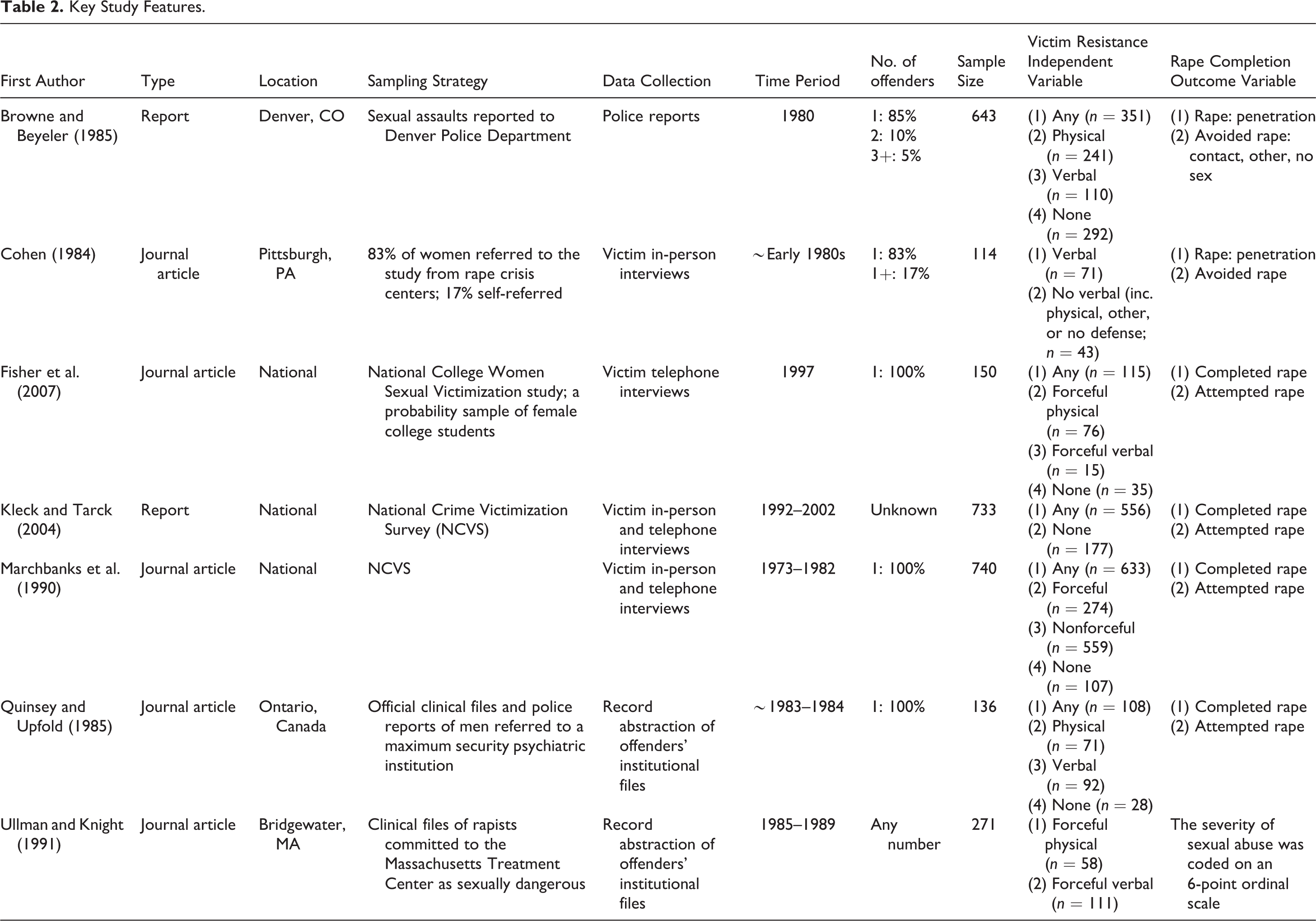
Rape completion is not an inherently dichotomous term. While some studies define completion as vaginal or anal penetration, other studies include digital or oral penetration as markers of completion, while others permit the respondent herself to conclude whether she was the victim of a rape or attempted rape. The rape completion outcome variable was measured dichotomously in six of the studies included in the present analysis (completed vs. attempted rape); in the remaining study Ullman and Knight (1991) assessed sexual abuse severity on a 6-point scale. While arguably a conceptually dissimilar measure, the authors also incorporated a separate measure of victim injury; thus, the measure of sexual abuse represents an estimate of the degree to which the rapes were completed or avoided and is not comorbid with degree of injury.
Meta-Analyses of Victim Resistance on Rape Completion
Total resisters versus total nonresisters (n = 5 studies)
Figure 1 presents a forest plot displaying each study’s LOR for the comparison of resister and nonresister groups, along with each study’s 95% confidence interval (CI) and relative weight contributing to the overall pooled effect. Weights are from the random effects model. The LORs ranged from 1.494 to 2.765, with all five of the studies showing a statistically significant greater rate of rape avoidance for the resister group. The overall mean effect size in the random effects model was significant, with an LOR of 1.850, 95% CI [1.561, 2.138], z = 12.558, p < .001. This is equivalent to an OR of 6.36 and suggests that any type of resistance by victims in rape incidents is linked to a greater likelihood of rape avoidance. Results using a fixed effects model were also significant, with a pooled effect size of 1.846, 95% CI [1.606, 2.086], z = 15.062, p < .001.

Forest plot of total resisters versus nonresisters.
The pooled effect showed low heterogeneity, as measured by both the Q-statistic (Q = 5.07, df = 4, p < 0.280) and the I 2 value, indicating that approximately 21.1% of the variation between studies in terms of rape completion is due to random factors.
Physical resistance
The first set of resister subgroups includes those victims who physically resisted their attacker.
Physical resisters versus nonresisters (n = 4 studies)
Physical resistance was related to a statistically significant increase in rape avoidance in comparison to nonresistance (see Figure 2). The LORs for this analysis ranged from 1.208 to 2.624, with all four studies showing a statistically significant increase in rape avoidance for the physical resister group. The overall mean effect size was significant: LOR = 1.858, 95% CI [1.207, 2.509], z = 5.595, p < .001, with an equivalent OR of 6.41. The mean effect size in the fixed effects model was also statistically significant, LOR = 1.767, 95% CI [1.472, 2.063], z = 11.717, p < .001. A significant level of heterogeneity was evidenced among this group of effect sizes (Q = 9.60, df = 3, p < .022, I 2 = 68.7%). Heterogeneity across studies is not surprising given that the studies used substantially different samples of victims/incidents (e.g., official reports of incarcerated rapists versus victim interviews).

Forest plot of physical resisters versus nonresisters.
Physical resisters versus those who did not physically resist (n = 4 studies)
We also examined physical resisters in comparison to victims who reacted in any way that did not include physical resistance (i.e., did not resist, verbally resisted, resisted in some other nonverbal/nonphysical manner). The random effects pooled LOR of 0.557 (95% CI [−0.191, −1.305], z = 1.26, p = .145, OR = 1.75) was not statistically significant. Results are presented in Figure 3. These results suggest that, in comparison to those who reacted in any way besides physical resistance, physical resistance is not related to a decreased likelihood of rape completion.

Forest plot of physical resisters versus those who did not physically resist.
Results from the less conservative fixed effects model present the opposite finding, with a pooled LOR of 0.577, 95% CI [0.375, 0.779]. This effect was significant, z = 5.597, p < .001, with a significant level of between-study heterogeneity (Q = 36.46, df = 3, p < .001, I 2 = 91.8%). These conflicting findings indicate that the treatment of between-study variability is critical in this small set of studies; in the fixed effects model, the Quinsey and Upfold (1985) and Ullman and Knight (1991) studies are weighted much less heavily than in the random effects model, and the CI is narrower.
Verbal resistance
The second set of subgroup analyses focus on those victims who verbally resisted during their assault.
Verbal resisters versus nonresisters (n = 4 studies)
Compared to those who did not resist, women who engaged in verbal resistance were more likely to successfully avoid rape completion (Figure 4). The pooled random effects LOR for this analysis was 1.808 (95% CI [1.415, 2.201]), a statistically significant effect (z = 9.012, p < .001). All four effect sizes were positive and significant, and the associated OR was 6.10. The fixed effects results were also significant (LOR = 1.777, 95% CI [1.462, 2.093], z = 11.042, p < .001). The set of studies was homogenous (Q = 3.74, df = 3, p < .291, I 2 = 19.7%).

Forest plot of verbal resisters versus nonresisters.
Verbal resisters versus those who did not verbally resist (n = 5 studies)
Last, we compared results for women who verbally resisted versus women who engaged in any reaction that did not include verbal resistance (Figure 5). These victims were also significantly less likely to suffer a completed rape than their nonverbal counterparts (LOR = 0.825, 95% CI [0.593, 1.056), z = 6.982, p < .001, OR = 2.28). Fixed effects results were significant as well (LOR = 0.825, 95% CI [0.613, 1.036], z = 7.627, p < .001), and between-study heterogeneity was low (Q = 4.49, df = 4, p < .344, I 2 = 10.9%).

Forest plot of verbal resisters versus those who did not verbally resist.
Publication Bias
No evidence of publication bias was found using Egger’s test (bias = −0.135, SE = 2.30, t = −0.06, p = .956). Funnel plot results are available upon request.
Discussion
Based on a small set of studies examining incidents of sexual assault or rape, we find a positive effect of victim resistance on rape avoidance. Resisters are more likely than nonresisters to avoid a completed rape. This finding holds true for physical resistance, verbal resistance, or resistance of any kind. Upon comparing different types of resistance, instances of physical resistance were the most likely to result in rape avoidance when the comparison group was nonresisters. An exception to this conclusion is when physical resisters were compared to all who did not physically resist (which would include those who used another method of resistance, such as verbal resistance). In the random effects model, resistance was not found to decrease the likelihood of rape completion; however, a significant effect was found in the fixed effects model (physical resistance increased the chance of rape avoidance). This suggests that, while physical resistance significantly decreases rape completion, it does not do so to a greater extent than other types of resistance—at least not to the point of achieving statistical significance.
Together, these meta-analytic results suggest that victims should resist a sexually abusive assailant in whatever way possible in order to increase their chances of rape avoidance. This coincides with previous narrative reviews that culminate in similar recommendations, including Ullman’s comprehensive reviews (1997, 2007). While this finding may appear to point to a simple policy recommendation in terms of victim education and harm reduction, we caution that these results may not tell the whole story as they do not take into account all relevant victim outcomes. While rape completion is an invasive, harmful, and damaging outcome for a victim to endure, this is not the only negative outcome that can result from a violent sexual assault. Victims may also be concerned about the possibility of injury, including injury severe enough to require medical treatment, or even death.
If research finds that victim resistance not only reduces rape completion but also successfully decreases victim injury, recommendations would be straightforward. However, this does not appear to be the case. Debates are ongoing within the current literature regarding the effects of victim self-protective measures on victim injury. While there are some who claim resistance does not increase a victim’s likelihood of injury (e.g., Tark & Kleck, 2014; Ullman & Knight, 1993, 1995), there are just as many who appear to support the opposite notion—that victim resistance increases a victim’s chance and/or degree of injury (e.g., Block & Skogan, 1986; Marchbanks et al., 1990; Ruback & Ivie, 1988; Yun & Lee, 2014 13 ). A recent meta-analysis (Wong & Balemba, 2016) addressed this issue to begin to make sense of the ramifications of victim resistance with respect to injury. The analysis found a significant increase in victim injury when victims resisted an assailant—particularly, when victims used physical resistance. These results strongly support the contention that victims increase their likelihood of an injurious assault when they physically resist an attacker.
This conclusion poses a dilemma, which obfuscates blanket guidelines for women to consider in the face of sexual assault. Combined, the information suggests that the victim of a sexual assault is faced with a ghastly decision: Is she willing to trade-off an increased likelihood of injury for a decreased likelihood of rape completion? This dilemma is particularly contentious when considering the effects on the victim when she does not resist an assault. Many women might choose to fight off an attacker, even if it resulted in increased injury, to try to avoid a penetrative assault. A victim who does not resist might face more barriers within the justice system, especially in terms of being believed by law enforcement and by juries. Furthermore, a nonresisting victim may receive less support from a spouse or partner and the psychological damage sometimes caused by not fully resisting can be as damaging as any physical scars or injuries (Galliano, Noble, Travis, & Puechl, 1993; Rozee & Koss, 2001). Victims who are passive or “freeze” during an assault may blame themselves, experience feelings of shame and guilt, and be less likely to seek help from victim services or report the crime (Galliano et al., 1993). Thus, advising victims to reduce their level of resistance to avoid injury may in some circumstances do more harm than good. This dilemma is not a new one and, in fact, was proposed almost 40 years ago by Pauline Bart (1979): Probably no aspect of rape research is as fraught with dilemmas of policy and practical application as that of whether women have more to gain or to lose in physically resisting a would-be rapist. Two dimensions are involved. First, does a woman enhance or diminish her chances of avoiding rape by resisting physically? Second, regardless of whether a woman is raped or avoids rape, does physical resistance so increase her chances of severe injury as to provide, at best, a Pyrrhic victory? (p. 18)
While perhaps not aiding much in terms of policy, we believe the results from the current analysis represent valuable information of which victims should be aware. Should a victim choose to resist her assailant—in particular by using physical resistance—she may escape a completed assault but end up incurring more injuries (as supported by the current results and Wong & Balemba, 2016). Whether additional (potentially serious) physical injuries but no penetrative assault would be considered a more or less deleterious outcome is up to the individual to decide.
Limitations
The current study is not without limitations. First, despite attempts to keep the inclusion criteria as liberal as possible, as well as implementing a comprehensive search strategy across 25 electronic databases along with a search of the gray literature, the set of studies meeting the criteria for inclusion in the analysis was small. A sizable number of potentially eligible studies were excluded due to their use of overlapping years of data from the NCVS data set. Additional research in this area is needed, and future studies should be designed so as to enable differentiations among types of victim resistance and their impact on rape outcomes. We would recommend including measures that more finely distinguish between the “physical” and “verbal” categories, for example, “forceful physical resistance” versus “nonforceful physical resistance” as measured by Fisher et al. (2007).
Another limitation relates to measurement problems or issues of biased samples among the included studies. For example, records from incarcerated offenders represent those offenders who were convicted of their crimes and are thus likely to overrepresent serious, violent offenses. Police-reported crimes are also likely to represent more serious crimes, as are interviews with women who choose to attend rape crisis centers. Also, as Quinsey and Upfold (1985) point out, if a strategy is very successful, it is less likely to be detected. For example, a loud scream from a victim who is grabbed by an assailant at a bus stop may scare off the attacker and save the victim from being raped but may not necessarily be reported (and, if so, might be recorded as a simple assault, as there may be no way of proving intentions with respect to rape). Conversely, an opposite bias in the data is that those victims who suffered a lethal outcome would also not be counted in the analysis of the outcomes of resistance, since homicides were not included in many of the study data sources. Overall, victimization surveys are most likely to be representative of victims’ experiences with resistance to rape and attempted rape incidents, as they are more likely to include instances of noncompleted rapes that are not reported to police.
Another relevant limitation is that there is not sufficient information to determine the temporal sequence of events within the assaults included in the present analysis. In other words, there is no way to determine whether the victim’s resistance followed or preceded the completion of the penetrative portion of the assault. 14 This is an important distinction that must be made, as it is possible that in some scenarios victims resist in response to intrusive violence from the offender rather than before penetration occurs. Such a limitation is mentioned in most studies that examine this issue—both in terms of the effects on injury and rape completion—and, in fact, is the basis of the main analysis of interest within Tark and Kleck (2014). Results from the temporal analysis by Tark and Kleck (2014) find that victim resistance does not increase the likelihood of rape completion and that most self-protective actions by victims were related to a significantly lower risk of rape completion. Specifically, the authors found that 19.5% of rapes were completed following victim resistance compared with 88.1% completed when the victim did not resist. Exceptions to this general finding were uncovered with respect to two specific types of victim resistance which did increase the likelihood of completed rape: arguing/reasoning/pleading with the rapist and cooperating/pretending to cooperate with the rapist.
A limitation with respect to the analysis is our inability to employ moderator analyses or meta-regression techniques, which would have been useful to assess characteristics related to a greater likelihood of rape completion. Unfortunately, at the current time, there are not enough studies available in the existing literature to enable such analyses; future studies on victim resistance in sexual crimes should consider incorporating these important variables to allow for analyses examining situational, victim, and offender characteristics that affect the likelihood of rape completion or that might moderate the relationship between resistance and completion. We are surprised that only seven studies met our inclusion criteria and that such little research on this issue has been conducted in the past 40 years.
Conclusion and Implications
It is difficult to determine exactly how to use the information gathered herein in terms of policy recommendations. When combined with previous findings regarding the relationship between victim resistance and victim injury (especially Wong & Balemba, 2016), what recommendations should be made to potential victims? What must be taken into consideration is the fact that there are many different types of assaults, with some more likely to result in either more violence or more intrusive outcomes regardless of whether the victim incorporates self-protective behaviors. That is, assaults are not homogeneous in nature, with the victim’s response the only determinant of final outcome. While victim resistance does have a significant impact, there are many other factors at play as well.
For example, violence and resultant victim injury are typically more likely to occur when the victim is an adult rather than a child (Balemba & Beauregard, 2012; Scott & Beaman, 2004), when the offender is intoxicated (Martin & Bachman, 1998; Testa, Vanzile-Tamsen, & Livingston, 2004), and when the offender uses a weapon during the assault (Balemba et al., 2012; Marchbanks et al., 1990). Relatedly, rape completion is also more likely to occur when an offender uses a weapon during the assault (Ullman, 1997, 2007), when the offender is intoxicated (Brecklin & Ullman, 2002; Ullman & Brecklin, 2000) or not intoxicated (Cleveland, Koss, & Lyons, 1999; Martin & Bachman, 1998)—a lack of agreement within the literature likely due to dosage levels that have differing effects (e.g., disinhibition vs. impaired sexual functioning; Testa et al., 2004)—and when the victim is younger, particularly when the victim is a female (Woodhams, Gillet, & Grant, 2007). Thus, the level of victim resistance is not the only factor of importance in determining what leads to various outcomes within a sexual assault incident.
Although the question remains regarding how best to educate potential victims, the current analysis is a significant step forward in learning more about the crime of sexual assault and the role that victim resistance plays. Combined with previous research it paints a relatively bleak picture for victims hoping to avoid both rape completion and injury; the research and criminal justice communities must be aware of these facts in order to move forward and improve policy, offender programming, and victim education and awareness training.
Footnotes
Appendix
Declaration of Conflicting Interests
The author(s) declared no potential conflicts of interest with respect to the research, authorship, and/or publication of this article.
Funding
The author(s) received no financial support for the research, authorship, and/or publication of this article.