



Abstract
Dating violence (DV) and sexual violence (SV) are widespread problems among adolescents and emerging adults. A growing body of literature demonstrates that exposure to sexually explicit media (SEM) and sexually violent media (SVM) may be risk factors for DV and SV. The purpose of this article is to provide a systematic and comprehensive literature review on the impact of exposure to SEM and SVM on DV and SV attitudes and behaviors. A total of 43 studies utilizing adolescent and emerging adult samples were reviewed, and collectively the findings suggest that (1) exposure to SEM and SVM is positively related to DV and SV myths and more accepting attitudes toward DV and SV; (2) exposure to SEM and SVM is positively related to actual and anticipated DV and SV victimization, perpetration, and bystander nonintervention; (3) SEM and SVM more strongly impact men’s DV and SV attitudes and behaviors than women’s DV and SV attitudes and behaviors; and (4) preexisting attitudes related to DV and SV and media preferences moderate the relationship between SEM and SVM exposure and DV and SV attitudes and behaviors. Future studies should strive to employ longitudinal and experimental designs, more closely examine the mediators and moderators of SEM and SVM exposure on DV and SV outcomes, focus on the impacts of SEM and SVM that extend beyond men’s use of violence against women, and examine the extent to which media literacy programs could be used independently or in conjunction with existing DV and SV prevention programs to enhance effectiveness of these programming efforts.
Keywords
Dating and sexual violence (SV) are widespread problems among adolescent and emerging adult populations (Centers for Disease Control and Prevention, National Center for Injury Prevention and Control, 2011; Straus, 2004). Dating violence (DV) consists of physical violence (e.g., punching), SV (e.g., rape), threats of physical or SV (e.g., the use of sexually aggressive words or gestures), psychological/emotional violence (e.g., controlling what the victim can and cannot do), and/or stalking within a dating relationship (Centers for Disease Control and Prevention, National Center for Injury Prevention and Control, 2002), whereas SV consists of any sexual act (e.g., sexual harassment, unwanted contact, sexual coercion, attempted, and completed rape) perpetrated against someone’s will (Basile & Saltzman, 2002). Both DV and SV can result in a number of negative psychological, academic, and relational outcomes (for reviews of the literature, see Edwards, Dardis, & Gidycz, 2011; Tharp et al., 2013). Although there are a number of risk factors (e.g., alcohol use, history of child abuse; see Vagi et al., 2013, for a review) for DV and SV, media exposure is one risk factor for DV and SV that has been receiving increasing attention (Connolly, Friedlander, Pepler, Craig, & Laporte, 2010; Friedlander, Connolly, Pepler, & Craig, 2013; Manganello, 2008).
To date, much of the research examining media as a risk factor for DV and SV has focused on understanding the impacts of exposure to sexually violent media (SVM) and sexually explicit media (SEM). SVM is defined as media depicting rape or physical harm in a sexual context. Examples of SVM include the rape of Sansa Stark in HBO’s Game of Thrones, the pervasive glamorization of sexual and intimate partner violence in Fifty Shades of Grey, and the ability to purchase women, perform sexual acts on them, and then kill them in Grand Theft Auto-V. SEM is defined as media depicting nonviolent intercourse (i.e., oral, vaginal, or anal), sexual contact (e.g., touching intimate parts), or sexual objectification of women (e.g., women portrayed as sex objects to be consumed by men). Although SEM does not depict violence, it may include the domination, degradation, subordination, or humiliation of women (Wood, 2013). Examples of SEM include the oral sex scene with Marnie and Desi in Season 4 of HBO’s Girls, Playboy Magazine, and the sexual objectification of women in Nicki Minaj’s “Anaconda” music video. Moreover, there is a growing body of literature suggesting that exposure to SEM and SVM can affect DV and SV attitudes (e.g., attitudes accepting of DV and SV, attitudes accepting of interpersonal violence, rape myth acceptance, and acceptance of violence against women) and behaviors (e.g., DV and SV victimization, perpetration, and bystander behaviors; Bonino, Ciairano, Rabaglietti, & Cattelino, 2006; Brown & L’Engle, 2009; Fischer & Greitemeyer, 2006; Foubert, Brosi, & Bannon, 2011; Kahlor & Eastin, 2011; Malamuth & Check, 1985; Malamuth, Hald, & Koss, 2012). Furthermore, it is important to note that although some SEM may portray sex in loving, healthy manner, it may be problematic when sex is depicted loosely, considering the risks associated with having sex (e.g., unwanted pregnancy, sexually transmitted infections) are rarely shown or given the appropriate emotional worth in the media (Eyal & Finnerty, 2007).
While research from the 1980s and 1990s focused heavily on exposure to SVM and violent and aggressive outcomes (e.g., Linz, Donnerstein, & Penrod, 1988; Malamuth & Check, 1985; Mayerson & Taylor, 1987; Weisz & Earls, 1995), similar findings have been documented in recent years with exposure to SEM (e.g., Beck, Boys, Rose, & Beck, 2012; Kistler & Lee, 2009; Yao, Mahood, & Linz, 2010; Ybarra, Strassburger, & Mitchell, 2014). Moreover, although DV includes SV, we chose to examine DV and SV separately because SV can occur more broadly outside of romantic relationships. We specifically focus on DV and SV, given DV and SV typically co-occur (Hamby & Grych, 2013), are frequently studied together and are targeted similarly in prevention programs (Edwards, Rodenhizer-Stämpfli, & Eckstein, 2015). Although other forms of aggression (e.g., bullying, peer verbal, and physical aggression) may co-occur with either DV and SV, they are beyond the scope of this article, given the 43 studies reviewed exclusively focus on DV and SV.
The purpose of this article is to provide a systematic and comprehensive literature review on the impact of exposure to SEM and SVM on DV and SV attitudes and behaviors. Before reviewing the extant literature on this topic, we will first discuss the prevalence of DV and SV in popular media and provide a theoretical framework for how and why SEM and SVM may impact DV and SV attitudes in behaviors (for a more detailed overview of media effects and the conditions under which media may produce effects on certain individuals, see Valkenburg, Peter, & Walter, 2016). After reviewing the extant literature, we will discuss limitations of the research, provide suggestions for future research, and delineate the implications of this body of work for practice and policy. Although there have been previous theoretical and review papers on the impact of media exposure on DV and SV (e.g., Hald, Malamuth, & Yuen, 2010; Harrington & Neilson, 2009; Manganello, 2008; Ward, 2016), we are unaware of any peer-reviewed papers that provide a systematic review, are inclusive of multiple types of media, and include both DV and SV.
Prevalence of Dating and SV in Popular Media
Adolescents and young adults are exposed to a great deal of mass media on a daily basis. In terms of overall media consumption not specific to SEM or SVM, Rideout, Foehr, and Roberts (2010) found that on average, adolescents are exposed to 10 hr and 45 min of media on a daily basis (this estimate includes media that was consumed during other tasks), while adults in the United States consume approximately 10 hr and 39 min of media (Nielsen Company, 2016). The medium through which people consume media has also changed in recent years due to the advent of information and communication technologies (e.g., smartphones, Internet), ultimately increasing access and availability to media throughout the course of the day (Rideout, Foehr, & Roberts, 2010). According to the Nielsen Company (2011), the average American spends 35.1 hr per week watching television/movies on TV, 1.5 hr watching television/movies on a computer, and 1.3 hr watching television/movies on a mobile device. Looking at other forms of media, research has documented that youth between the ages of 8 and 18 spend on average 2 hr and 19 min per day listening to music through a variety of different platforms (e.g., computer, iPhone, and radio; Rideout et al., 2010) and roughly 97% of adolescents between the ages of 12 and 17 spend an hour or more a day playing video games (Lenhart et al., 2008).
In addition to documenting the adolescents’ and young adults’ widespread exposure to media, researchers have documented the prevalence of SEM and SVM in the media. In an analysis of 3,000 television shows airing between 2001 and 2002, researchers found that 64% of episodes aired showed sexual content (Kunkel et al., 2007), and more recently, a content analysis of the top 20 Nielsen-rated adolescent television shows indicated that 83% of those programs contained sexually explicit material (Nielsen Company, 2011). Depictions of SV have also become increasingly popular on television, particularly crime dramas (Cuklanz & Moorti, 2006). In an analysis of 26 prime time television shows containing rape story lines, Brinson (1992) found that rape myths were present, on average, 5.08 times per story line. In regard to film, the R-rated slasher genre (i.e., a subgenre of horror films in which the villain [usually male] stalks and murders his or her victims [usually female] in a graphically violent manner) has frequently been criticized for showing sexual acts and violence against women, with one third of sex scenes characterized by violence (Linz & Donnerstein, 1994), approximately 1.38 scenes per slasher film depict sex and violence concomitantly (Welsh, 2009), and as many as 22% of female characters die in sexual situations (Molitor & Sapolsky, 1993).
More sexually explicit than slasher films is pornography, which as many as 48% of college men and 3% of college women report viewing on a weekly basis (Carroll et al., 2008), and 13% of college men and 1% of college women view online on a daily basis (Simons, Simons, Lei, & Sutton, 2012). A content analysis of mainstream pornography revealed that 88% of scenes include physical aggression toward women such as spanking, open-hand slapping, hair pulling, choking, and bondage (Bridges, Wosnitzer, Scharrer, Sun, & Liberman, 2010; Foubert et al., 2011). While a large majority of pornography viewers are exposed to some degree of violence or aggression, as many as 27% of college men report viewing sadomasochistic pornography and 19% report consuming pornography depicting rape in the last year (Foubert et al., 2011).
Extending beyond television and film, a content analysis of pornographic magazines revealed that 25% of the content depicts SV, with women most frequently portrayed in the role of the victim (Barron & Kimmel, 2000). In addition, researchers found that 14% of these scenes depicted low levels of SV, whereas 12% were characterized by high levels of SV (Barron & Kimmel, 2000). Furthermore, studies examining the prevalence of SEM and SVM in video games have demonstrated that 83% of male video game characters are violent and 32% of scenes from video games portray violence in an eroticized manner (Dill & Thill, 2007). Sexually explicit content frequently coincides with the use of violence in video games (Smith, 2006; Thompson, Tepichin, & Haninger, 2006); and in recent years, there has been a substantial growth in video games that sexually objectify women or allow gamers to perpetrate violence against women (Beck et al., 2012).
Finally, of all forms of media, music is believed to contain the most references to SEM (Pardun, L’Engle, & Brown, 2005), and in a 2008 analysis of Billboard magazine’s most popular songs, 37% of songs were found to contain sexually explicit lyrics, and 65% of those songs contained sexually degrading lyrics (e.g., the other person is objectified, insatiable sexual appetite; Primack, Gold, Schwarz, & Dalton, 2008). In terms of music videos, the sexual objectification and degradation of women is also a common theme (Conrad, Dixon, & Zhang, 2009). In an early analysis of music programming on the popular young adult music channel, MTV, 31% of 30-s music video clips portrayed implicit or explicit SVM (Sommers-Flanagan, Sommers-Flanagan, & Davis, 1993), and a more recent content analysis of the top 10 songs in pop, hip-hop/rhythm and blues (R&B) and country from Billboard’s “Hot 100” chart between March 2007 and September 2008, revealed that among female artists, 91.6% of music videos portrayed at least one instance of sexual objectification (Aubrey & Frisby, 2011). Given the increasing sexually explicit and sexually violent content in the media and the role of the media in the sexual socialization of adolescents and young adults (Ward, 2003, 2016), it is important to understand how media impacts viewers’ attitudes and behaviors related to DV and SV.
Theoretical Framework for Review
In understanding the impacts of SEM and SVM on DV and SV attitudes and behaviors, it is important also to review theories that have provided a foundation on which the 43 reviewed studies are based. One of the most widely cited communication theories of media effects is the cultivation theory (Gerbner & Gross, 1976; Gerbner, Gross, Morgan, & Signorielli, 1994; Gerbner, Gross, Signorielli, Morgan, & Jackson-Beeck, 1979). According to the cultivation theory (Gerbner et al., 1994), screen media (e.g., television) can influence individuals’ perceptions of reality by altering attitudes and beliefs about the real world. Gerber and colleagues (1994) argue that the more frequently an individual is exposed to certain types of media, the more their perceptions of reality mirror what they view. The main assumptions of this theory are that media-biased perceptions develop over time and that these perceptions result from viewers believing that media accurately reflects real-world social norms and cultural values. However, cultivation theory has been criticized for overemphasizing the amount of media exposure and downplaying the importance of the content of media and viewer’s motivation for media selection (Zurbriggen & Morgan, 2006). Thus, more recently, research has adopted a constructivist approach by examining viewer involvement with media (e.g., motivations for media consumption) as a moderator for media consumption and sexual attitudes (Zubriggen & Morgan, 2006).
In addition to cultivation theory (Gerbner et al., 1994), other theories have been utilized to explain the effects SEM and SVM exposure over time. Priming, arousal, and mimicry (e.g., imitations of behaviors) are processes that may account for short-term effects of SVM exposure, whereas observational learning, desensitization, and enactive learning may account for more long-term media effects (Anderson et al., 2003). Social cognitive theory (Bandura, 2002) touches on many of these processes, suggesting that attitudes and behaviors can be learned through real-world experiences and vicariously via the media. Today, the media plays an important role in the sexual socialization of youth (see Ward, 2003, 2016, for reviews of the literature), and adolescents and emerging adults are more likely to imitate behaviors that are depicted as resulting in personal gain or benefit in the absence of negative consequences (Baranowski, Perry, & Parcel, 2002). In SVM, aggressive or coercive behavior tends to be void of consequence and is often portrayed in a positive light (e.g., aggression is a means of receiving pleasure) and in the context of video games, players are often rewarded for using violence. Moreover, SVM disproportionately depicts male perpetrated violence against women (Bryant & Brown, 1989), and some viewers may believe what is depicted in SEM and SVM is reflective of normative sexual relationships (Malamuth & Check, 1985). Research has found that exposure to media that dehumanizes or objectifies women may prime masculinity norms, resulting in more tolerance of violence toward women (Ward, 2016). Taken together, these may increase the likelihood of some viewers imitating what they watch in SEM and SVM and adopting the mind-set that it is acceptable to use violence to seek sexual pleasure or as a means of managing conflict in intimate relationships.
Furthermore, individual differences also play a role in the degree to which exposure to SEM and SVM impacts viewer’s attitudes and behaviors (Anderson et al., 2003; Bryant, Thompson, & Finklea, 2013). According to uses-and-gratifications theory (Katz, Blumler, & Gurevitch, 1973; Rosengren, 1974; Rubin, 2009), individuals seek out media in response to their own needs and desires, which is largely influenced by psychological and social factors. Individual needs or desires may differently motivate viewers to seek out certain types of media, which determines how frequently they view the media, and ultimately the degree to which the media affects them (Haridakis, 2002). In general, men are typically more attracted to media that is violent and sexual in nature than women and tend to be more tolerant and accepting of SVM (Emmers-Sommer, Pauley, Hanzal, & Triplett, 2006). In addition, individuals who already have attitudes accepting of DV/SV or have a history of perpetration may seek out SEM or SVM because they find this type of media to be arousing or stimulating (Emmers-Sommer et al., 2006). Individuals may also have a preference for SEM or SVM because they find the content is familiar or cognitively accessible or because the act of viewing SEM and SVM validates and reinforces their current behaviors or belief system (Bogaert, 2001; Huesmann, 1988). Additionally, viewers may seek out media that mirrors their own experiences. For example, research has found that women with histories of sexual victimization and who have experienced psychological violence by a family member are more likely than those without prior sexual victimization or histories of family psychological violence to view pornography depicting violence against women (Romito & Beltramini, 2011).
Review of Existing Studies Method
For the current review, the authors identified all published articles that examined the influence of SEM and SVM exposure (e.g., television, film, pornography, and magazine) on DV and SV attitudes (e.g., rape myth acceptance) and behaviors (e.g., DV and SV perpetration), in addition to mediators and moderators, among adolescence and young adults. Although these types of media can be related to other outcomes, such as depression (Primack, Swanier, Georgiopoulos, Land, & Fine, 2009) and self-esteem (Hawkins, Richards, Granley, & Stein, 2004), reviewing these other correlates and outcomes of media exposure was beyond the scope of this review. This article only examines how SEM and SVM are related to DV and SV attitudes and behaviors. As measured in the studies we included in our review, DV and SV attitudes include attitudes accepting of DV, SV, and violence against women, as well as attitudes toward victims and perpetrators of DV and SV, and endorsement of rape myths. DV and SV behaviors include participants’ own self-reported experiences of DV and SV victimization, perpetration, and bystander behavior as well as intentions to engage in DV and SV perpetration or bystander behavior.
Key terms used in the search included all possible and relevant combinations of the following: “dating violence,” “violence against women,” “intimate partner violence,” “partner violence,” “partner abuse,” “sexual violence,” “sexual relationships,” “rape,” “sexual assault,” “social dating,” “victimization,” “popular media,” “media,” “television,” “magazines,” “pornography,” “film,” “movies,” “books,” “media exposure,” “music videos,” “music,” “video games,” “Internet,” “sexual media,” and “mass media.” Databases searched included: Psych Info, Psych Articles, Psych Critiques, Medline, Criminal Justice Abstracts, Violence and Abuse Abstracts, Film & Television Literature Index, Communication Abstracts, and Communication & Mass Media Complete.
Article inclusion/exclusion criteria were (1) studies examining media exposure outcomes that were specific to DV and SV attitudes and behaviors; studies that examined other related outcomes (e.g., gender role ideology) were beyond the scope of this review, given that we were most interested in attitudes and behaviors specific to DV and SV; (2) studies whose participants had a mean age of at least 12 years and a mean age of 25 years or less were included or if at least 75% of the studies participants were between the ages of 12 and 25, given the focus of this review is on adolescent and emerging adults’ exposure, given the paper’s focus on SEM and SVM impacts on youth and emergent adults; (3) only studies that included participants from North America and Western Europe were included; (4) studies examining the impact of DV and SV in news media were excluded because depictions of DV and SV in news media are believed to differ from those in fictional media (e.g., news media are more likely to endorse prototypical images [e.g., stranger rape] and less likely to report the social context in which DV occurs; Cuklanz, 2000; Sutherland et al., 2016) and consumers of news media are more likely to only read headlines, suggesting that although DV and SV may be prevalent in news media, the duration of the exposure may be relatively brief and different from other forms of media (Franiuk, Seefelt, & Vandello, 2008). However, studies assessing the impact of magazines, books, pornography, music, music videos, film, television, and video games that included SEM and SVM content were included; and (5) studies examining victims’ perceptions of their abusers consumption of media were excluded. Although we do not examine the role of the Internet itself, it is important to understand that the type of media consumed rather than the medium by which it was consumed is inherent in our inclusion criteria. That is, we did not exclude studies because participants watched television or music videos on the Internet or on a personal device but instead included them because the type of media they consume.
The reference lists of the initial set of articles obtained from the authors’ search of the previously listed databases were reviewed, and additional articles that were consistent with the inclusion and exclusion criteria were included in the review. A total of 43 studies published between 1981 and 2015 were included in the review and are discussed below and organized by methodology (experimental vs. nonexperimental and cross-sectional vs. longitudinal). The first author read and summarized all of the articles with assistance from the second author. The article summaries were checked at least once by undergraduate research assistants to ensure that the authors had appropriately summarized and reported relevant findings. Summary tables are available upon request from the author and available at http://unh.edu/ivrl/Supplemental.html. Below we organize the findings by experimental and nonexperimental studies, and within each of these categories, we report separate longitudinal studies from cross-sectional studies (see Table 1 for a summary of critical findings).
Summary of Research Examining the Impact of SEM and SVM Exposure on DV and SV Attitudes and Behaviors.
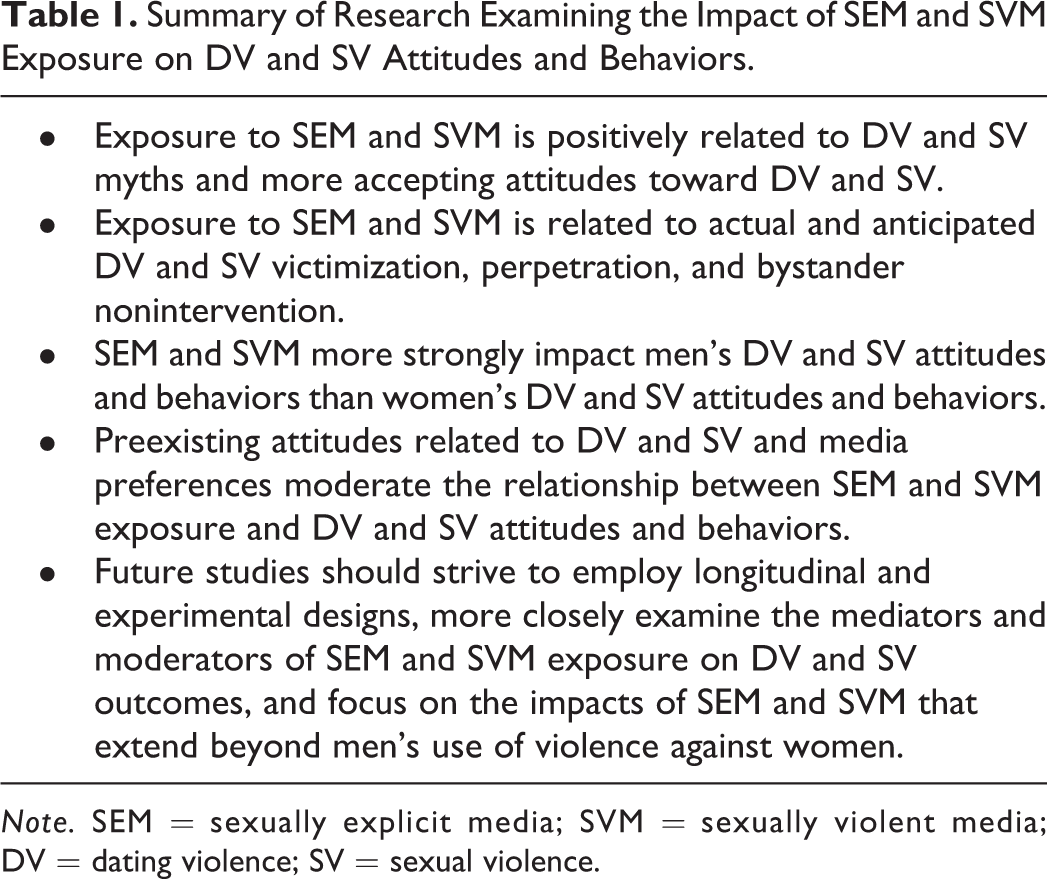
Note. SEM = sexually explicit media; SVM = sexually violent media; DV = dating violence; SV = sexual violence.
Experimental Studies
Longitudinal
Four studies (i.e., Linz et al., 1988; Malamuth & Ceniti, 1986; Malamuth & Check, 1981, 1985) employed a longitudinal, experimental design to examine the causal impact of media exposure on DV and SV attitudes and behaviors. Of those, three examined the influence of SEM or SVM exposure on attitudes accepting of DV. Malamuth and Check (1985) found that rape myth acceptance was positively associated with men’s exposure to pornographic passages depicting rape resulting in the victim’s arousal compared to depictions of rape resulting in disgust. In another study, men, but not women, reported greater acceptance of interpersonal violence 1 week after exposure to sexually violent films compared to men exposed to films void of SV (Malamuth & Check, 1981). Furthermore, participants who were exposed to R-rated violent films over the course of 4–10 days reported less sympathy toward rape victims during the postexposure follow-up several days later compared to participants who viewed the R-rated nonviolent or X-rated nonviolent films and participants in the nonexposure conditions (Linz et al., 1988). However, in a study by Malamuth and Centi (1986), exposure to sexually violent or nonviolent pornographic narratives over the course of 4 weeks did not influence participants’ self-reported likelihood to rape at the 1-week follow-up.
Cross-sectional
Nineteen studies utilized a cross-sectional experimental design and assessed media exposure and attitudes accepting of DV and SV. Compared to participants who either had no media exposure or exposure to media that did not depict SEM or SVM, women’s exposure to either sexually violent or nonviolent pornographic narratives (Mayerson & Taylor, 1987), girl’s exposure to rap music videos depicting sexual objectification of women (Johnson, Adams, Ashburn, & Reed, 1995), participant’s violent and sex-typed video game exposure (Dill, Brown, & Collins, 2008), men’s exposure to sexually violent films (Weisz & Earls, 1995), men’s exposure to sexually objectifying music videos (Aubrey, Hopper, & Mbure, 2011), and women’s, but not men’s, exposure to a music video depicting sexual harassment (Kalof, 1999) reported greater acceptance of violence (e.g., acceptance of interpersonal violence, violence against women, and sexual harassment judgments). Aubrey, Hopper, and Mbure (2011) also found that among men, adversarial sexual beliefs mediated the relationship between exposure to sexually objectifying music videos and both acceptance of interpersonal violence and tolerance for sexual harassment. Additionally, researchers have found that men and women who are low on the personality trait agreeableness and who have higher rates of prior pornography consumption were more likely to be more accepting of violence against women after viewing hard-core pornography and that for men low in agreeableness, this relationship was moderated by sexual arousal from pornography exposure (Hald & Malamuth, 2015).
Results of cross-sectional, experimental studies assessing media exposure and rape myth acceptance have been mixed. Compared to participants in control groups who either had no media exposure or exposure to media that did not depict SEM or SVM, men’s exposure to sexually objectifying video games (Beck et al., 2012), men’s exposure to highly sexualized hip-hop music videos (Kistler & Lee, 2009), men’s exposure to sexually violent films (Weisz & Earls, 1995), and women’s exposure to either sexually violent or nonviolent pornographic narratives (Mayerson & Taylor, 1987) resulted in greater rape myth acceptance. St. Lawrence and Joyner (1991) found similar findings, where exposure to sexually violent heavy-metal rock music slightly increased rape myth acceptance and acceptance of interpersonal violence; however, these differences were not statistically significant. 1 Other experimental studies, however, have found that rape myth acceptance is not impacted by men’s differential exposure to pornography on the Internet (Barak, Fisher, Belfry, & Lashambe, 1999), men’s exposure to sexually degrading music videos (Sprankle, End, & Bretz, 2012), women’s exposure to sexually explicit hip-hop videos (Kistler & Lee, 2009), men and women’s exposure to a music video depicting sexual harassment (Kalof, 1999), men’s exposure to highly sexually objectifying music videos (Aubrey et al., 2011), or women’s exposure to SEM and SVM in video games (Beck et al., 2012). Interestingly, Lee, Hust, Zhang, and Zhang (2011) found that college students’ exposure to sexually violent and sexually nonviolent film clips did not influence rape myth acceptance; however, participants who were exposed to clips depicting physical violence against women were more accepting of rape myths after viewing the clips. Also, related to DV and SV attitudes, women’s media preference for love stories, but not men’s media preference, moderated the relationship between exposure to unadulterated and censored (i.e., mosaiced) films, depicting SV and rape myth acceptance (Emmers-Sommer et al., 2006), and men’s adversarial sexual beliefs mediated the relationship between exposure to sexually objectifying music videos and acceptance of DV and tolerance of sexual harassment (Aubrey et al., 2011).
In addition to DV and SV attitudes and rape myth acceptance, research has examined the relationships between perceptions of victims and perpetrators and exposure to SEM and SVM. Exposure to media was related to participants’ judgments of victims and perpetrators in rape narratives in four studies (i.e., Apanovitch, Hobfoll, & Salovey, 2002; Burgess & Burpo, 2012; Linz, Donnerstein, & Adams, 1989; Weisz & Earls, 1995). In a study by Apanovitch, Hobfoll, and Salovey (2002), women’s exposure to pornographic rape narratives was associated with greater empathy for the victim and perceptions of victim injury, whereas men reported greater empathy for the perpetrator. A study by Weisz and Earls (1995) found that after viewing films depicting SV against a man, male participants reported less empathy for rape victims compared to women exposed to SV against a man or women, and both men and women exposed to films showing physical violence. In addition, men were more lenient toward the perpetrator after viewing films depicting SV against a man than women exposed to SV against a man or women (Weisz & Earls, 1995). Similarly, Milburn, Mather, and Conrad (2000) found that after reading an account of a date rape in a magazine, men who had viewed a sexually objectifying and degrading R-rated film beforehand believed that the victim in the date rape scenario in the magazine “got what she wanted” compared to those who watched a neutral cartoon. Burgess and Burpo (2012) found similar findings, where men’s exposure to music videos that were rated high in sexualized and objectifying content, as opposed to low objectifying content, resulted in less empathy for victims and perceived the perpetrator as less guilty in narratives depicting rape (Burgess & Burpo, 2012). Compared to individuals viewing sexually arousing but nonviolent films, men who viewed sexually violent films prior to watching clips depicting interpersonal violence attributed less injury to the victims (Linz et al., 1989).
Three studies examined the effect of media exposure on intent to perpetrate DV and SV. Researchers found that exposure to films depicting SV, as opposed to neutral or physically violent films, resulted in a greater likelihood of raping in a sample of men (Weisz & Earls, 1995). Additionally, men’s exposure to a sexually explicit video game resulted in a greater self-reported likelihood to perpetrate DV (i.e., sexual harassment) compared to men who played nonsexual social or nonsocial video games (Yao et al., 2010). However, differential exposure to pornography (i.e., spending more or less time or having a greater number of pornographic sites in the bookmark list), did not impact participants self-reported likelihood to perpetrate SV (i.e., sexual harassment; Barak et al., 1999).
Nonexperimental Studies
Longitudinal
Only one study used a longitudinal, nonexperimental design. Brown and L’Engle (2009) documented that exposure to SEM media, as measured during the first study session, predicted sexual harassment perpetration 2 years later for adolescent boys but not girls.
Cross-sectional
Nineteen studies utilized nonexperimental, cross-sectional designs. Five of these studies examined the relationship between media exposure and attitudes accepting of DV and SV. Of the five studies, four studies found that greater rape myth acceptance was positively associated with men’s exposure to sexually violent pornographic media (Garcia, 1986), men’s exposure to sadomasochistic and rape pornography (Foubert et al., 2011), men and women’s exposure to erotica 2 (Perse, 1994), and women’s exposure to pornography during childhood (Corne, Briere, & Esses, 1992). However, one study found rape myth acceptance did not vary as a function of hours spent viewing pornography over the course of 1 month among college men and women (Padgett, Brislin-Slutz, & Neal, 1989).
Other rape-related attitudes were examined in two studies. Specifically, women’s pornography exposure during childhood was associated with a greater prevalence of rape fantasies in adulthood (Corne et al., 1992), and adolescents’ pornography consumption was related to the beliefs that rape is caused by a woman’s appearance and actions and men’s sexuality and biology (e.g., “men have stronger needs than women”; Cowan & Campbell, 1995). Three other studies examined pornography exposure on attitudes accepting of violence against women. Malamuth et al., (2012) found that greater pornography exposure was positively related to attitudes accepting of violence against women; however, Padgett et al., (1989) found that attitudes accepting of violence against women did not vary as a function of the number of hours college students spent each month viewing pornography. In addition, college women’s exposure to pornography during childhood was not associated with attitudes accepting of interpersonal violence in adulthood (Corne et al., 1992).
Six studies examined the relationship between media exposure and DV and SV perpetration. Pornography consumption was associated with greater use of sexual coercion by men (Simons et al., 2012) and adolescent and young adults’ sexual harassment perpetration and use of sexual force (reading and viewing; Bonino et al., 2006). Among men who scored high on general (e.g., general hostility) and specific (e.g., hostile masculinity, hostility toward women, impersonal sex) risk factors for sexual aggression, frequent pornography consumption was associated with an increased risk for sexual aggression (Vega & Malamuth, 2007). Exposure to sexually violent pornography, but not nonviolent pornography, was associated with greater use of sexual coercion and rape (Demaré, Lips, & Briere, 1993). However, in other studies, exposure to pornographic media was not associated with sexual offender status among adolescents (Zgourides, Monto, & Harris, 1997 ) and did not play a role in adolescent’s commission of sexual offenses (Becker & Stein, 1991). Lastly, among adolescent boys, high pornography consumption moderated the relationship between frequent exposure to harsh corporal punishment during adolescence and perpetrating sexual coercion (Simons et al., 2012).
Four studies examined media exposure and intent to perpetrate DV and SV. Self-reported likelihood to rape was associated with fraternity men’s mainstream, sadomasochistic, and rape pornography exposure (Foubert et al., 2011) and men’s exposure to sexually violent pornography (Demaré et al., 1993). Additionally, sexually violent pornography use among undergraduate men was associated with the likelihood of perpetrating sexual aggression (e.g., intent to use sexual force and sexual coercion), even after controlling for attitudes accepting of DV (Demaré, Briere, & Lips, 1988). Furthermore, men’s exposure to both hard-core violent and rape pornography, but not soft-core pornography, was associated with self-reported likelihood to rape, whereas exposure to hard-core violent, rape, and soft-core pornography were all positively associated with undergraduate men’s self-reported likelihood of using sexual coercion (Boeringer, 1994).
Six studies examined the relationship between media exposure on DV and SV victimization behaviors. Svedin and Priebe (2007) found that boys with a history of child sexual exploitation (i.e., child prostitution or sexual exploitation for payment under the age of 18) were more likely than boys without a history of child sexual exploitation to view violent or deviant pornography. Furthermore, viewing and reading pornography was associated with girls’ and boys’ SV victimization, but viewing and reading pornography was associated with sexual harassment victimization for girls but not boys (Bonino et al., 2006). Similarly, pornography exposure (i.e., exposure via sexually explicit texts or images, pornographic books or magazines, videos, movies, the Internet, or cell phones) was associated with DV and SV victimization among high school girls, but not boys (Romito & Beltrami, 2015), and girls with histories of SV victimization were more likely to watch pornography depicting violence against women than girls without histories of SV victimization (Romito & Beltramini, 2011). Additionally, girl’s pornography consumption was associated with greater likelihood of being a victim of sexual coercion by a male partner, and more frequent pornography exposure among girls moderated the relationship between father’s hostility (e.g., shouting/yelling, swearing at child) during adolescence and being victims of sexual coercion (Simons et al., 2012). Ybarra et al. (2014) found that more frequent exposure to sexual media was related to ever having had sex, coercive sex victimization, and attempted/completed rape.
One study assessed the relationship between media exposure and bystander behaviors. Less willingness to intervene in situations of SV was associated with fraternity men’s exposure to rape pornography (Foubert et al., 2011). Fraternity men’s exposure to sadomasochistic pornography was associated with lower scores on bystander efficacy (Foubert et al., 2011).
Summary
Taken together, much of the literature reviewed above has documented significant associations among exposure to both SEM and SVM and DV and SV attitudes and behaviors. More specifically, the majority of nonexperimental, experimental, longitudinal, and cross-sectional studies have documented that exposure to SEM and SVM is positively related to more accepting attitudes toward DV and SV, including higher rape myth endorsement and perceptions of victims and perpetrators who are consistent with commonly held rape myths (e.g., the victim wanted it). Grounded in social cognitive and cultivation theories, it may be that these attitudes are learned or reinforced via exposure to SEM or SVM (Bandura, 2002) or that after prolonged exposure to SEM and SVM over the course of the lifetime, viewers’ attitudes and beliefs become congruent with those depicted in SEM and SVM (Gerbner et al., 1994). With that said, it is evident that certain forms of SEM and SVM were less likely to impact some DV- and SV-related attitudes, which may point to differences in content properties of media that enhance or minimize media effects, consistent with priming theory (Berkowitz & Powers, 1979) and social cognitive theory (Bandura, 2002). For example, four cross-sectional, experimental studies found that exposure to sexually explicit music videos did not impact rape myth acceptance (Aubrey et al., 2011; Kalof, 1999; Kistler & Lee, 2009; Sprankle et al., 2012), whereas three studies employing the same methodology found that exposure to sexually explicit or violent music videos was associated with a greater acceptance of DV/SV (Aubrey et al., 2011; Johnson et al., 1995; Kalof, 1999). It may be that the content of the music videos in these studies did not prime rape myth acceptance but did prime other constructs related to acceptance of DV and/or SV, such as adversarial sexual beliefs or hostility toward women (Aubrey et al., 2011). Although rape myth acceptance and acceptance of DV and SV are related constructs, some prior research has suggested that SEM is more likely to influence rape myth acceptance when the use of rape results in positive consequences but, in the absence of this positive reinforcement, the threshold for SEM to influence rape myth acceptance may not be met (Malamuth & Check, 1985).
Furthermore, exposure to SEM and SVM has been shown by a number of studies to relate to actual and anticipated DV and SV victimization and perpetration; however, these studies are overwhelmingly cross-sectional in nature. Only one longitudinal study has found that exposure to SEM was associated with SV perpetration among boys, not girls, 2 years later (Brown & L’Engle, 2009). Of the remainder of studies examining the influence of SEM or SVM on actual or anticipated perpetration, all but two of these studies (i.e., Yao et al., 2010; Weisz & Earls, 1995) have examined the impact of sexually violent or nonviolent pornography and have not assessed other forms of SEM and SVM (e.g., video games, films). Additionally, the studies reviewed that examined actual and anticipated DV or SV victimization all employed cross-sectional, nonexperimental designs and used adolescent samples. Little attention has been paid to the impact of SEM and SVM on bystander behavior, with only one study documenting that exposure to SVM was associated with less bystander willingness to intervene and efficacy in situations of SV.
Generally, the impacts of SEM and SVM on DV and SV attitudes and behaviors seem to be stronger for boys and young men than girls and young women. Grounded in uses-and-gratifications theory (Katz et al., 1973; Rosengren, 1974; Rubin, 2009), this may be due in part to the fact that generally men are more attracted to violent media (Knobloch-Westerwick, 2015) and that SEM and SVM overwhelmingly depicts male-perpetrated violence against women, making it easier for boys and young men identify with these characters (Cohen, 2001). Research also has documented that preexisting attitudes related to SV (i.e., adversarial sexual beliefs) mediate the relationship between SEM exposure and SV attitudes (Aubrey et al., 2011) and that for certain men (i.e., individuals low in the personality trait agreeableness), sexual arousal mediated the relationship between SEM exposure and DV and SV attitudes (Hald & Malamuth, 2015). Studies also identified moderators, finding that media preference moderated the relationship between SVM exposure and DV and SV attitudes (Emmers-Sommer et al., 2006) and that low levels of the personality trait agreeableness moderated the relationship between SEM exposure and DV and SV attitudes among men and women (Hald & Malamuth, 2015). These findings are consistent with theories emphasizing how viewer characteristics and their media selectivity influence their own media effects, in other words, the degree to which exposure influences DV and SV attitudes (e.g., social cognitive theory, Bandura, 2002; uses-and-gratifications theory, Katz et al., 1973; Rosengren, 1974; Rubin, 2009; and differential susceptibility to media effects model, Valkenburg & Peter, 2013).
Lastly, while the studies do cover a wide range of time (i.e., 1981–2015), findings appear consistent across time (i.e., findings of studies completed in the 1980s–1990s are similar to findings of studies conducted in the 2000s). However, most of the studies completed in the 1980s and 1990s examined SEM and SVM in the context of pornography or film, whereas research since the 2000s is more diverse in terms of the types of media assessed. That said, there is some variation in terms of measurement, as the measures used to assess DV and SV attitudes and behaviors in studies from the early 1980s and 1990s have been replaced with updated measures in more recent studies (e.g., Rape Myth Acceptance Scale). Additionally, while the vast majority of studies used valid and reliable measures to assess DV and SV attitudes and behaviors, researchers were more likely to develop their own measures or adapt existing measures when specifically assessing media use, exposure, or related constructs (e.g., identification with characters in media). Although there were no significant differences in overall findings in the studies reviewed, these variations in measurement may warrant further exploration in future research.
Extant Literature Limitations and Future Directions
Although our knowledge of the impact of SEM and SVM exposure on DV and SV attitudes and behaviors has undoubtedly increased as a result of the studies reviewed above, there are a number of limitations to the literature. To begin, the vast majority of research utilized nonexperimental, cross-sectional designs. This type of methodology tells us nothing about the causal impact of SEM and SVM exposure on DV and SV attitudes and behaviors. It could be that individuals with more accepting DV and SV attitudes and individuals who already engage in DV and SV behaviors are, in turn, more likely to seek out media congruent with these attitudes and experiences. Thus, longitudinal and experimental studies are much more meaningful in determining temporal and causal relationships, which needs to be the focus of future research. In fact, the findings of the longitudinal studies reviewed in this article overwhelmingly found that exposure to SVM is associated with more accepting DV and SV attitudes, whereas exposure to SEM was associated with SV perpetration; however, all of these studies were conducted in the 1980s and more recent research is needed. Additionally, studies that utilize both experimental and longitudinal designs with multiple follow-up periods and multiple indicators of DV and SV attitudes and behaviors are recommended.
Furthermore, to date, almost all the studies have examined media depicting men’s use of violence against women. Although this is important, it ignores how media depicting women’s use of violence against men and sexual minorities’ use of violence in same-sex relationships may impact DV- and SV-related behaviors and attitudes. Thus, future research should examine how SEM and SVM depicting other gender dyads impacts DV and SV attitudes and behaviors.
Another shortcoming of the extant literature is that few studies have examined the mediators (i.e., why media leads to attitudes and behaviors) and moderators (i.e., for which individuals, media may be most impactful) of SEM and SVM exposure on DV and SV attitudes and behaviors. In fact, only two studies (Aubrey et al., 2011; Hald & Malamuth, 2015) examined mediators (i.e., sexual arousal and men’s adversarial sexual beliefs) of the relationship between SEM exposure and attitudes associated with DV and SV (i.e., rape myth acceptance, acceptance of interpersonal violence, and tolerance of sexual harassment) and two studies (Emmers-Sommer et al., 2006; Hald & Malamuth, 2015) examined moderators (i.e., media preferences and personality) of the relationship between SEM and SVM exposure on DV and SV attitudes (i.e., rape myth acceptance, acceptance of interpersonal violence). One study examined SEM exposure as a moderator of adverse childhood experiences (i.e., harsh corporal punishment, parental hostility) and DV and SV victimization and perpetration experiences (Simons et al., 2012). Having a better understanding of the mediators and moderators of these relationships is a critical area for future research that could have widespread implications for media literacy interventions and DV and SV prevention programs.
Furthermore, although there is a large body of literature that documents the relationships between SEM and SVM exposure on DV and SV attitudes and behaviors, to date, few existing adolescent and young adult DV and SV prevention programs include media literacy components, which were recently declared an “area ripe for exploration” within the field of DV prevention programs by leading DV and SV researchers (Whitaker, Murphy, Eckhardt, Hodges, & Cowart, 2013). An exception to this is Leyva and Eckstein’s (2015) Bringing in the Bystander–High School Curriculum which teaches youth to think critically about the ways in which the media normalizes DV and SV. Moreover, although social media is receiving recent attention for the role it plays in experiences of DV and SV (Edwards et al., 2015; Thompson, 2014), none of the studies reviewed examined how SEM and SVM exposure relate to technology-based DV and SV. Prevention initiatives likely need to include a discussion about social media and how to safely use dating sites and apps such as Tinder and Bumble (see Fairbairn, Bivens, & Dawson, 2013, for a review), given that users report experiencing sexual harassment (i.e., receiving unsolicited/unwanted nude pictures) and women in particular report sexual coercion (i.e., being pressured to send nude pictures of themselves) from other users on mobile dating apps (Lee & Crofts, 2015; Ringrose, Harvey, Gill, & Livingstone, 2013).
Implications for Practice and Policy
The extant literature on impact of SEM and SVM exposure on DV and SV attitudes and behaviors has a number of implications for practice and policy (see Table 2 for a summary). Although no widely used, evidence-based DV and SV prevention programs include media literacy components, there is anecdotal evidence that local and state crisis centers are incorporating media literacy components into their DV and SV prevention efforts (Boston Public Health Commission; Graffunder, Noonan, Cox, & Wheaton, 2004; New Hampshire Sexual Assault Support Services); however, the extent to which this added component impacts DV and SV attitudes and behaviors is unknown. Nevertheless, there is research that media literacy interventions help adolescents and young adults develop more critical skills when viewing media, resulting in less problematic attitudes and behaviors (e.g., cigarette smoking, risky sexual behaviors, and general aggression; see Jeong, Cho & Hwang, 2012, for a review; see also Bickham & Slaby, 2012; Byrne, 2009). In light of the growing popularity of activism surrounding DV and SV on social media (e.g., the Instagram accounts “Bye Felipe” and “Feminist Tinder” that document women’s experiences of harassment and abuse on dating sites), future research should examine whether these efforts influence DV and SV attitudes and behaviors and whether or not these efforts should be considered in prevention programming.
Implications for Practice.
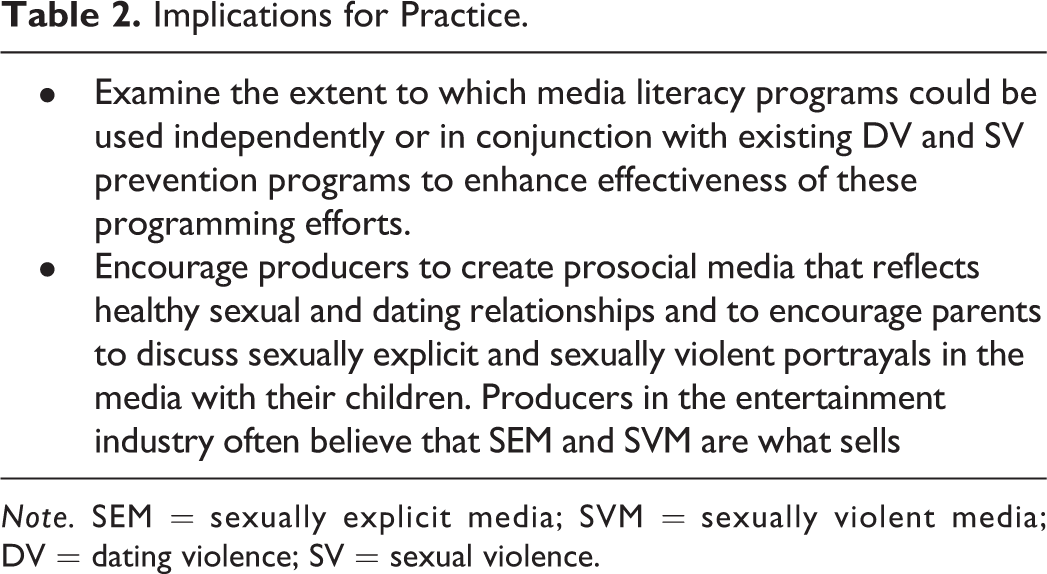
Note. SEM = sexually explicit media; SVM = sexually violent media; DV = dating violence; SV = sexual violence.
In addition to integrating media literacy modules into DV and SV prevention programming, there needs to be a greater emphasis on encouraging producers to create prosocial media that reflects healthy sexual and dating relationships and encouraging parents to discuss sexually explicit and sexually violent portrayals in the media with their children. Producers in the entertainment industry often believe that SEM and SVM are what sells; however, a study by Cerridwen and Simonton (2009) revealed that sexually explicit and sexually violent content in films did not boost box office sales, critical acclaim, or winning awards. Along these lines, researchers, practitioners, and policy makers could work with media producers to help foster more positive and healthy illustrations of relationships in popular media. A similar movement has been undertaken by psychotherapists in order to encourage more accurate portrayals of mental illness and psychotherapy in film (see Orchowski, Spickard, & McNamara, 2006, for a discussion). For example, a division of the American Psychological Association has begun to consult with Hollywood producers to promote more accurate depictions of psychotherapy as well as developing an award for television and movie producers who demonstrate excellence in their portrayals of psychotherapy. Another award exists that is presented by End Violence International, which is given to journalists and other media representatives who strive to accurately portray violence against women and the victims impact. It is worth considering similar and more widespread approaches to encourage media producers to provide not only accurate portrayals of DV and SV (as opposed to those riddled with myths or those that romanticize or glorify DV and SV) but to also portray healthy relationships across various forms of media. Although there are clearly media portrayals that do this, there are far less than those depicting SEM and SVM (Dill & Thill, 2007; Nielsen Company, 2011).
Final Thoughts
This article is the first to systematically review the impact of SEM and SVM exposure across multiple forms of media and the impacts of these media forms on DV and SV attitudes behaviors. Given adolescents and young adults are the greatest consumers of this type of media and at the greatest risk for DV and SV, it is important to understand media effects associated with SEM and SVM. The studies reviewed herein provide compelling evidence that these forms of media are related to more accepting attitudes of DV and SV and may increase an individual’s risk of experiencing DV and SV. As our understanding of these complex relationships increase with future research, this will aid in our ability to tailor prevention programming and policies with the ultimate goal of reducing the incidence and prevalence of DV and SV in the lives of youth.
Footnotes
Acknowledgments
We would like to thank Murray A. Straus, Kimberly J. Mitchell, Heather Turner, Janis Wolak, Lisa Jones, Emily Douglas, Kaitlin Lounsbury, and Angela Neal for their review and feedback on the article. We would also like to thank Alyssa Frechette for assistance retrieving articles and checking the accuracy of our summary tables and Eleanor MacKenzie, Ashley MacPherson, Ellen Haynes, Timothy Armoroso, Katherine Seavey, Lauren Guetling, Kayla Putnam, Joshua Dolman, and Kirby Parm for their assistance in checking the accuracy of our summary tables.
Declaration of Conflicting Interests
The author(s) declared no potential conflicts of interest with respect to the research, authorship, and/or publication of this article.
Funding
The author(s) received no financial support for the research, authorship, and/or publication of this article.