



Abstract
Extant evidence has shown that insecure adult attachment is related to dysfunctional parenting styles that heighten parents’ risk of child maltreatment. However, there is a lack of studies appraising the evidence for the association between insecure adult attachment and child maltreatment. This meta-analytic study examined the relationship between parents’ adult attachment and child maltreatment perpetration/child abuse potential. Studies examining the relationship between parents’ adult attachment and child maltreatment/child abuse potential published before February 2017 were identified through a systematic search of online databases. In total, 16 studies (N = 1,830) were selected. Meta-analysis based on random-effects models shows a significant positive association between insecure attachment and child maltreatment (pooled effect size: odds ratio [OR] = 2.93, p = .000). Subgroup analyses show insecure attachment was more strongly associated with failure to thrive (OR = 8.04, p = .000) and filicide (OR = 5.00, p < .05). Medium effect sizes were found for subgroup analyses on insecure romantic attachment (OR = 3.76, p = .000), general attachment (OR = 3.38, p = .000), attachment to own child (OR = 3.13, p = .001), and to own parents (OR = 2.63, p = .000) in relation to child maltreatment.
Introduction
Child maltreatment, defined as violence acts including physical abuse, sexual abuse, neglect, and psychological abuse against children (Pinheiro, 2006), is a serious social and public health challenge worldwide. A meta-analytic study estimates preceding year prevalence of 22.6% for child physical abuse and 16.3–18.4% for neglect (Stoltenborgh, Bakermans-Kranenburg, Alink, & van IJzendoorn, 2015). In view of the well-documented adverse effects of child maltreatment on child development and mental disorders in adulthood (Fry, McCoy, & Swales, 2012; Ip et al., 2015; Norman et al., 2012), an ample amount of studies aimed at understanding the causes of child maltreatment have been conducted to inform policy and intervention strategies. Despite extant evidence showing that insecure adult attachment (George, Kaplan, & Main, 1984, 1985, 1996; Main, Kaplan, & Cassidy, 1985) is related to dysfunctional parenting that puts parents at risk of child maltreatment (Jones, Cassidy, & Shaver, 2015; van IJzendoorn, 1995), there is a lack of studies appraising the evidence for the association between insecure adult attachment and child maltreatment.
Attachment theory proposes that adults’ early attachments with their caregivers shape their expectations and relational functioning in close relationships, including relationships with their own children (Bowlby, 1988; Crittenden, Ainsworth, Cicchetti, & Carlson, 1989). While adult attachment literature shares a theoretical root in Bowlby’s attachment theory, there are two major lines of research—the social and personality psychology tradition that relies on self-report measures of attachment; and the developmental psychology tradition that adopts the Adult Attachment Interview (AAI; George et al., 1985), a narrative measure of adult attachment. These two traditions result in variations in adult attachment operationalization. Along the line of social attachment research, Hazan and Shaver (1987) developed a self-report measure that provides three categories of attachment (secure, avoidant, anxiety/ ambivalent), and more recently, the literature appraises a continuum measure of two attachment dimensions—anxiety (tendency to cling to proximity maintenance and fear of abandonment) and avoidance (characterized by discomfort with closeness and tendency to avoid proximity). Individuals high on anxiety and avoidance are considered as insecure and those low on both dimensions are considered as secure. Meanwhile, developmental research on attachment based on the AAI classifies individuals’ state of mind with respect to attachment with three major categories (secure, dismissing, and preoccupied) and an additional category called unresolved attachment.
The emotion regulation framework that is at the theoretical core of attachment theory is useful in explaining individual’s experience of dysfunctional interpersonal relationships and the underlying relationship between attachment insecurity and child maltreatment. Secure attachment figures provide a source of psychological safety and security that help alleviate emotional distress (Bartholomew & Horowitz, 1991). However, individuals who are insecurely attached are characterized by inability to generate effective emotion regulation strategies—individuals with attachment anxiety tend to be more emotionally reactive; and those with attachment avoidance tend to minimize their feelings and distance themselves from others (Kobak & Sceery, 1988). Such dysfunctional emotion regulation in turn contribute to have higher levels of negative affects such as depression and anxiety, and impaired relational functioning (Marganska, Gallagher, & Miranda, 2013; Wei, Vogel, Ku, & Zakalik, 2005). Further, there has been evidence supporting the link between insecure adult attachment and dysfunctional parenting, including providing less sensitive and responsive caregiving through dysfunctional emotion regulation (Jones, Brett, Ehrlich, Lejuez, & Cassidy, 2014). Moreover, insecure adult attachment has been linked to a number of characteristics associated with child maltreatment, for instance, less supportive behavior toward one’s child (Crowell & Feldman, 1988), poor anger management, and intrusiveness toward one’s child (Adam, Gunnar, & Tanaka, 2004). In contrast, secure parents show more support, higher sensitivity, and more warmth toward their children (Crowell & Feldman, 1988; Tarabulsy et al., 2005; Verschueren, Dossche, Marcoen, Mahieu, & Bakermans-Kranenburg, 2006). Further, insecurely attached parents are more likely to have insecurely attached children (van IJzendoorn, 1995) who may be less compliant to parents’ instruction and who may exhibit more behavioral problems (Kochanska & Kim, 2013), which may increase parents’ risk of child maltreatment. Similarly, effects on relational and parental functioning have been observed in adults’ romantic attachment patterns (Hazan & Shaver, 1987). Adults who are insecurely attached to their partner are found to have higher parenting stress (Rholes, Simpson, & Friedman, 2006) and are more likely to experience severe partner violence (Rankin, Saunders, & Williams, 2000), factors which in turn elevate the parents’ risk of child maltreatment.
However, the available empirical evidence for the relationship between adult attachment and child maltreatment has been inconclusive. While several studies show that maltreating parents are more likely to have insecure attachment styles relative to nonmaltreating parents (e.g., Frigerio, Costantino, Ceppi, & Barone, 2013; Ward, Lee, & Lipper, 2000), a few studies failed to establish such a relationship (e.g., Ammaniti, Nicolais, & Speranza, 2004; Zuravin & DiBlasio, 1992, 1996). The inconsistent findings may be attributed to the variability in the ways of attachment classification (Coolbear & Benoit, 1999), and the samples selected (Zuravin & DiBlasio, 1992). The most relevant and recent review on this topic was the systematic review conducted by Jones, Cassidy, and Shaver (2015), which extensively discussed the relationship between attachment styles and various aspects of parenting, including parental responsiveness, hostility, and child maltreatment. Based on the argument that the two distinctive methodological approaches, that is, self-report measures and narrative interview (the AAI) assess different facets of attachment, the review had a focus on literature on self-reported adult attachment. From the six relevant studies reviewed, the study suggests that insecure adult attachment styles are related to child maltreatment risk. However, the review was unable to show the magnitude of the relationship across studies without employing quantitative synthesis. In addition, the picture is not yet complete, because questions remain unanswered regarding whether and to what extent self-report measures and interview methods influence the magnitude of the relationship between adult attachment and child maltreatment. Even though several reviews and many meta-analyses (e.g., Black, Heyman, & Slep, 2001; Schumacher, Slep, & Heyman, 2001; Stith et al., 2009) have addressed child maltreatment risk factors pertaining to a wide range of aspects of an individual’s socio-ecology, no research has addressed the potential association between adult attachment and child maltreatment. A quantitative synthesis of available evidence is much needed to provide an accurate estimation of the effect size of the relationship between adult attachment and child maltreatment.
The present meta-analysis is the first to measure the composite effect size of the association between the parent’s adult attachment and child maltreatment. This study seeks to determine whether the magnitudes of the association differ for different types of child maltreatment; and whether there are differences in the magnitude of association for studies measuring adult attachment using self-report and interview measures. We hypothesized a significant relationship between parents’ insecure adult attachment and child maltreatment.
Method
Search Strategy
This study covers papers published in English in the electronic databases PubMed, PsychInfo, MEDLINE, Sociological Abstracts, Social Services Abstract, and ERIC before February 2017. Relevant publications were systematically searched through titles, key words, and abstracts with the following three groups of key words: (1) child, adolescent, teen, infant, baby, newborn; (2) aggression, violence, assault, neglect, negligence, corporal punishment, failure to thrive, malnutrition, shaken baby syndrome, injury, trauma, witness, mistreat, maltreat, deprivation, abnormal illness behavior by proxy; and (3) adult or parental attachment. Additional relevant publications were identified by manually searching the reference lists of all the retrieved articles.
Eligibility Criteria
The eligibility criteria were chosen to be broad in order to include potentially relevant studies. Studies were included if they met the following criteria: The study quantitatively examined the relationship between adult attachment and child maltreatment or child maltreatment potential. Perpetrators included in the study were parents or in a parenting role (e.g., grandmother, stepfather). The study included at least one measurement assessing adult attachment in respect to an attachment figure such as own parents/caregivers, romantic partner, or own child. The study examined any forms of child maltreatment, such as child physical abuse, child neglect, corporal punishment, malnutrition, failure to thrive, illness behavior by proxy, child injuries, and shaken baby syndrome. Studies that examined child maltreatment potential, the likelihood that a parent will become physically abusive, such as with the use of Child Abuse Potential Inventory (CAPI; Milner, 1986) were also included because higher scores on this measure are associated with actual abusive discipline tactics (Rodriguez, 2010).
Data Extraction
We computed the effect sizes for studies that did not directly report effect sizes but provided sufficient information (i.e., means and standard deviations). For studies with insufficient data for analysis, an attempt was made to contact the authors for the needed data. Studies were excluded if no additional data were provided in response. A data coding sheet was developed to record each study’s data. The coding sheet recorded the following: (1) basic publication information such as title, author(s), year of publication, and country of origin; (2) study information such as sample size, study design, nature of participants, age range, or mean age of participants; (3) type of maltreatment and measures used; and (4) adult attachment classification and measures used.
Statistical Analyses
Because the selected studies involved studies reporting correlations (r) and odds ratios (OR), and some studies contributed multiple correlation coefficients, several steps were taken to combine the effect sizes. For studies with multiple correlation coefficients for same variable, multiple effect sizes (r) within one study were averaged so each study only contributed one effect size to the analysis (Bangert-Drowns, 1986). This method could reduce potential bias in favor of studies reporting multiple effect sizes and has been used in previous studies (Dewald, Meijer, Oort, Kerkhof, & Bögels, 2010; Roisman et al., 2007). Correlations were then transformed to OR for presentation; this was performed by the software Comprehensive Meta-Analysis (CMA; Borenstein, Hedges, Higgins, & Rothstein, 2005). Random-effects models were used in the analyses. To examine the association between insecure attachment and child maltreatment, pooled OR estimates (with corresponding 95% confidence interval [CI]) were calculated. Effect size for each study was adjusted according to the study sample size; this weighting procedure was done by CMA (Borenstein et al., 2005).
Q statistic was used to estimate heterogeneity. Because the Q test is known to have low power to detect true heterogeneity, especially when only a small number of studies are included, a p value of <.1 (rather than the conventional p < .05) is considered as significant and indicative of a wide spread of variability across the included studies (Higgins, Thompson, Deeks, & Altman, 2003). The I 2 statistic was calculated for each pooled estimate to determine the percentage of total variation in the reported effect sizes across the included studies. I 2 values of 25%, 50%, and 75% represent low, moderate, and high levels of heterogeneity, respectively (Higgins & Thompson, 2002; Higgins et al., 2003).
The studies were then divided into subgroups according to the types of outcome (child abuse potential and child maltreatment perpetration), forms of child maltreatment perpetration as defined by the studies (child maltreatment, physical abuse, neglect, failure to thrive, and filicide), types of attachment figure (general attachment, attachment to own parents, partner, and own child), and types of adult attachment measure (interview and self-report measure). Finally, potential publication bias was estimated with funnel plots by plotting individual studies’ effect size against the standard error of the effect size. A symmetrical shape implies no publication bias is observed.
Results
Studies Characteristics and Participants
We identified 16 studies meeting the inclusion criteria. Study characteristics are listed in Table 1. The process of studies selection is illustrated in Figure 1. The selected studies were published between 1992 and 2014. Among these studies, sample size for each study ranged from 48 to 276, with a total number of 1,830 participants. All studies were cross-sectional in nature. The parents’ mean age ranged from 18.1 to 45.3. Most studies had mothers as participants, with only one study (Rodriguez & Richardson, 2007) including both mothers and fathers, and one study (Howard, 2010) including only fathers. All studies were conducted in Western countries including the United States, Canada, and Italy. Most studies had predominantly Caucasian participants. The participants were recruited through various settings such as hospitals, child protective services (CPS), juvenile court, and from the general community.
Characteristics of Studies Included in the Meta-Analysis.
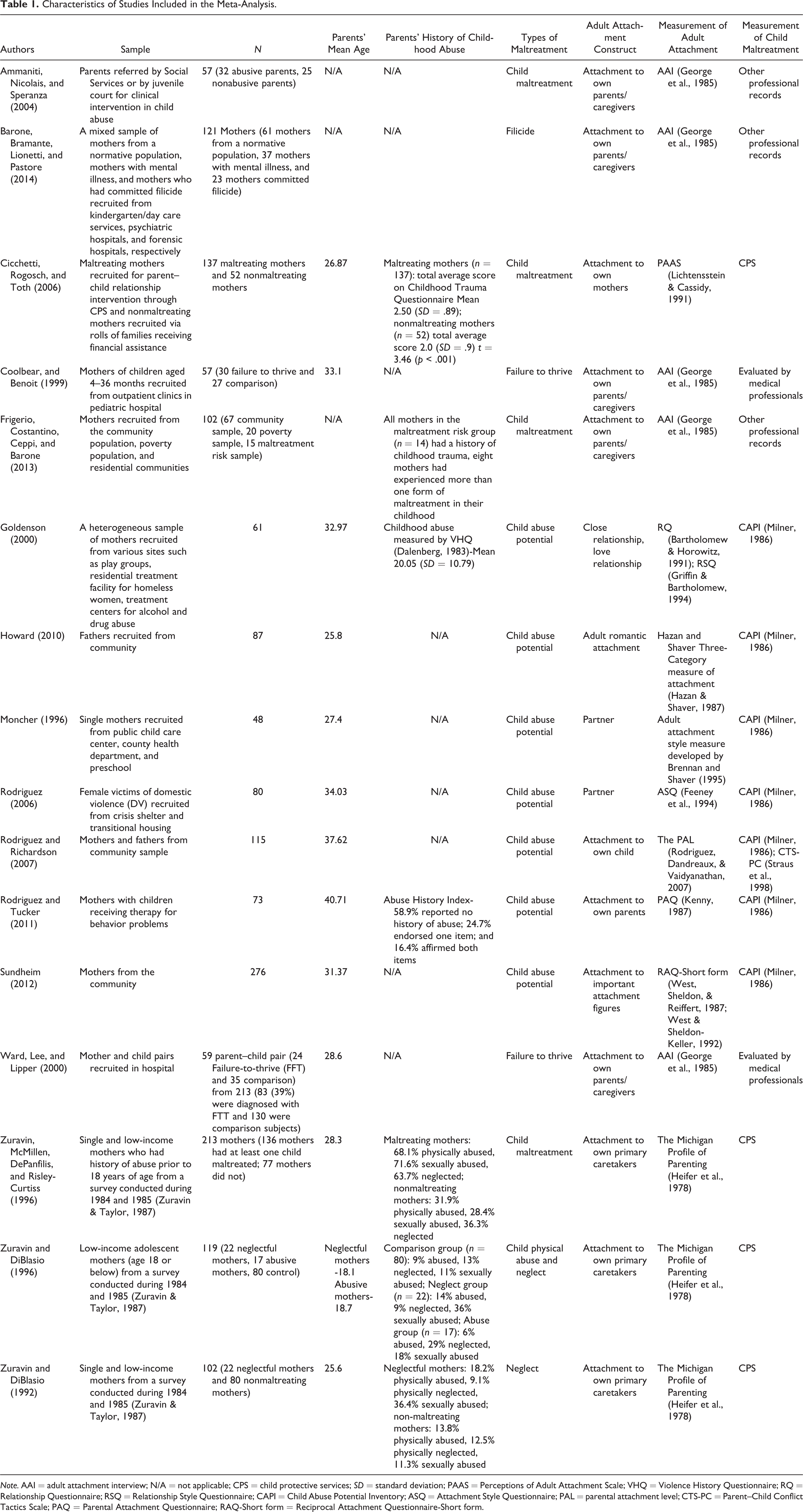
Note. AAI = adult attachment interview; N/A = not applicable; CPS = child protective services; SD = standard deviation; PAAS = Perceptions of Adult Attachment Scale; VHQ = Violence History Questionnaire; RQ = Relationship Questionnaire; RSQ = Relationship Style Questionnaire; CAPI = Child Abuse Potential Inventory; ASQ = Attachment Style Questionnaire; PAL = parental attachment level; CTS-PC = Parent–Child Conflict Tactics Scale; PAQ = Parental Attachment Questionnaire; RAQ-Short form = Reciprocal Attachment Questionnaire-Short form.
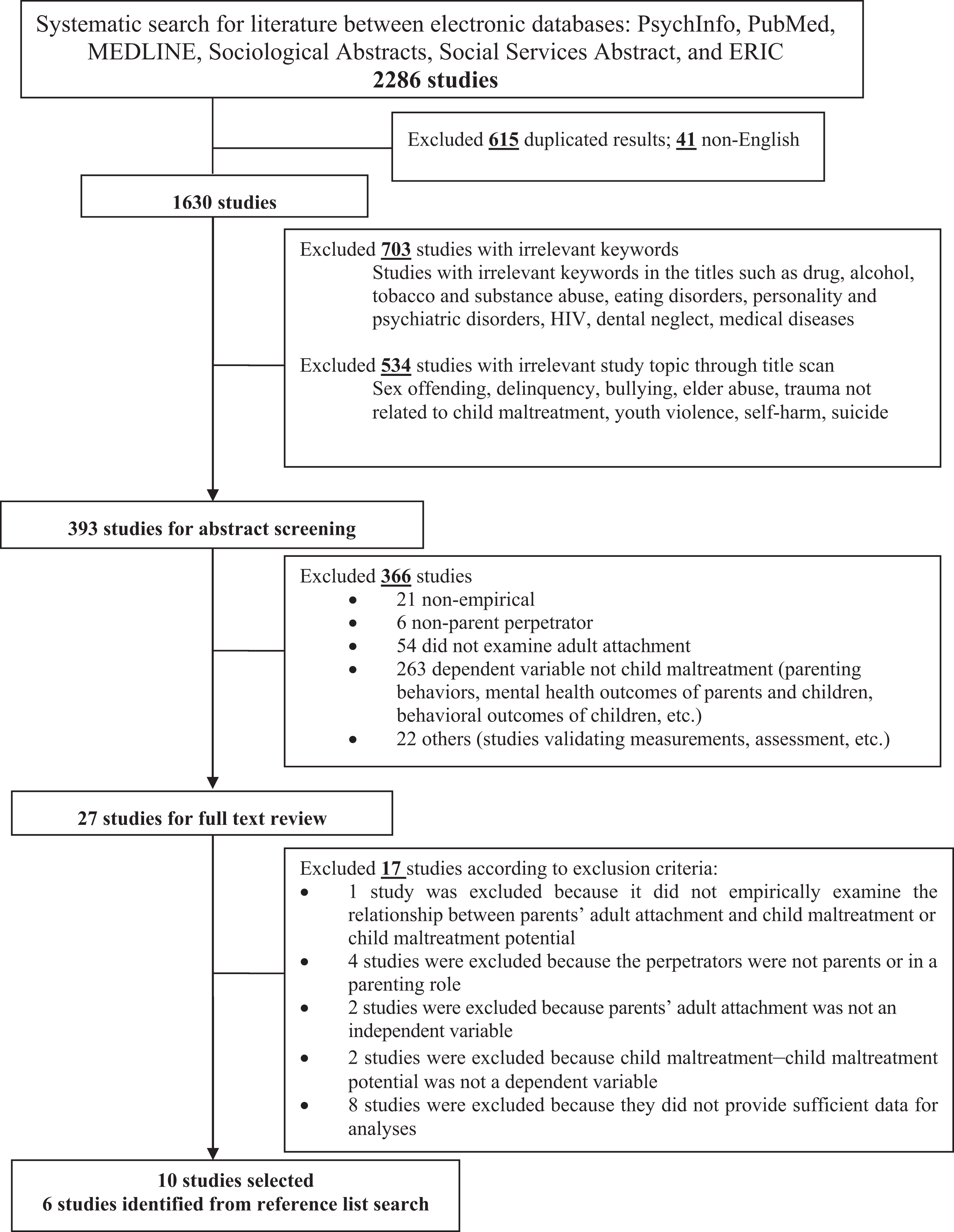
Process of systematic search for literature.
Among the 16 studies selected, 9 studies examined child maltreatment perpetration as an outcome, which was assessed by child protection services, medical professionals, or other professional records. Seven studies examined child abuse potential as an outcome, which was measured by the CAPI (Milner, 1986). In terms of the adult attachment measurements, five studies used the AAI (George et al., 1985), a semistructured interview to assess one’s recollection of one’s relationship with one’s own parents. Five studies used self-report measures to tap adult attachment to parents, including Perceptions of Adult Attachment Scale (Lichtenstein & Cassidy, 1991), the Michigan Profile of Parenting (Helfer, Schneider, & Hoffmeister, 1978), and Parental Attachment Level (Rodriguez, Dandreaux, & Vaidyanathan, 2007). Four studies examined romantic attachment, which was measured by the Relationship Questionnaire (Bartholomew & Horowitz, 1991), the Relationship Style Questionnaire (Griffin & Bartholomew, 1994), Hazan and Shaver’s three-category measure of attachment (Hazan & Shaver, 1987), a general measure of attachment style (Brennan & Shaver, 1995), and the Attachment Style Questionnaire (Feeney, Noller, & Hanrahan, 1994). One study examined parents’ attachment to their own child and measured this with the Parental Attachment Questionnaire (Kenny, 1987). One study used the Reciprocal Attachment Questionnaire–Short Form (West, Sheldon, & Reiffer, 1987; West & Sheldon-Keller, 1992) to assess attachment to important attachment figures.
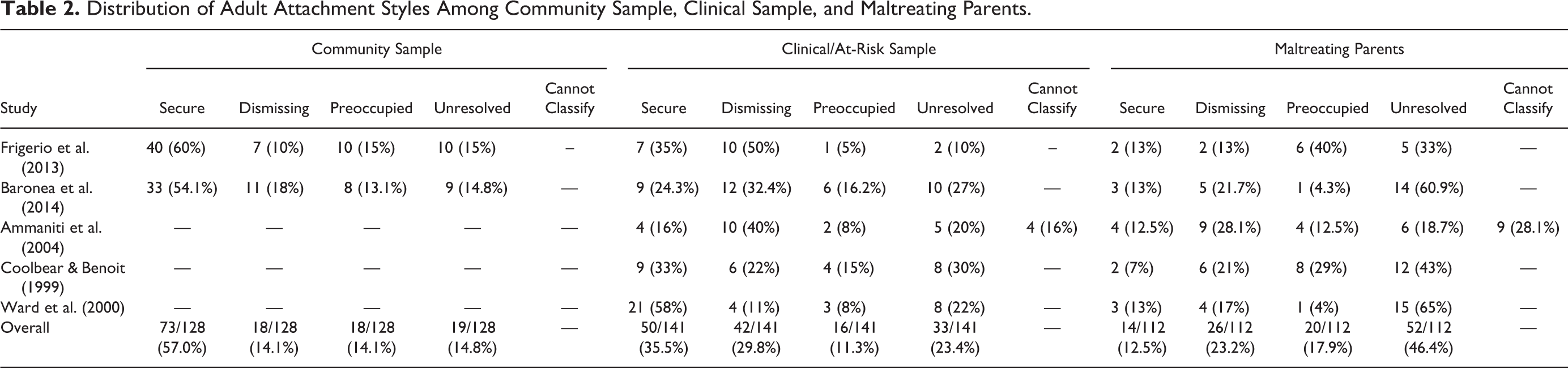
Five studies that used the AAI reported the distribution of attachment classifications among maltreating parents and nonmaltreating parents. As shown in Table 2, insecure attachment classifications including dismissing, preoccupied, and unresolved attachment were highly distributed among maltreating parents in relation to nonmaltreating parents. Overall, 87.5% of the maltreating parents were classified as insecurely attached or having unresolved attachment, compared to 64.5% of the nonmaltreating clinical sample, and 43% of the community sample. In particular, 46.4% maltreating parents had an unresolved attachment, compared to 23.4% among the clinical sample and only 14.8% among the community sample.
Distribution of Adult Attachment Styles Among Community Sample, Clinical Sample, and Maltreating Parents.
Synthesis of Effect Sizes
The 16 studies provided 17 estimated effect sizes. As shown in Figure 2, the summary effect size for the association between insecure attachment and child maltreatment is OR = 2.93 (95% CI [2.31, 3.72]; p = .000). Because the heterogeneity test yielded insignificant result (Q = 20.38, df = 16, p = .204), the presence of heterogeneity (wide spread variation of the included studies) is not certain. However, given the very different nature of studies included in this study and assumed that the effects being estimated in different studies are not identical, we conducted subgroup analyses in order to examine the possible cause of study heterogeneity in terms of the study outcome, type of attachment figure, measure of adult attachment, type of child maltreatment, and how child maltreatment was assessed. I 2 statistics (I 2 = 21.5%) show that over 20% of the heterogeneity could be attributed to variation. No evidence of publication bias was found in the meta-analysis because the funnel plot of all studies appeared to be symmetrical (Figure 3).

Forest plot of the effect sizes between insecure adult attachment and child maltreatment.
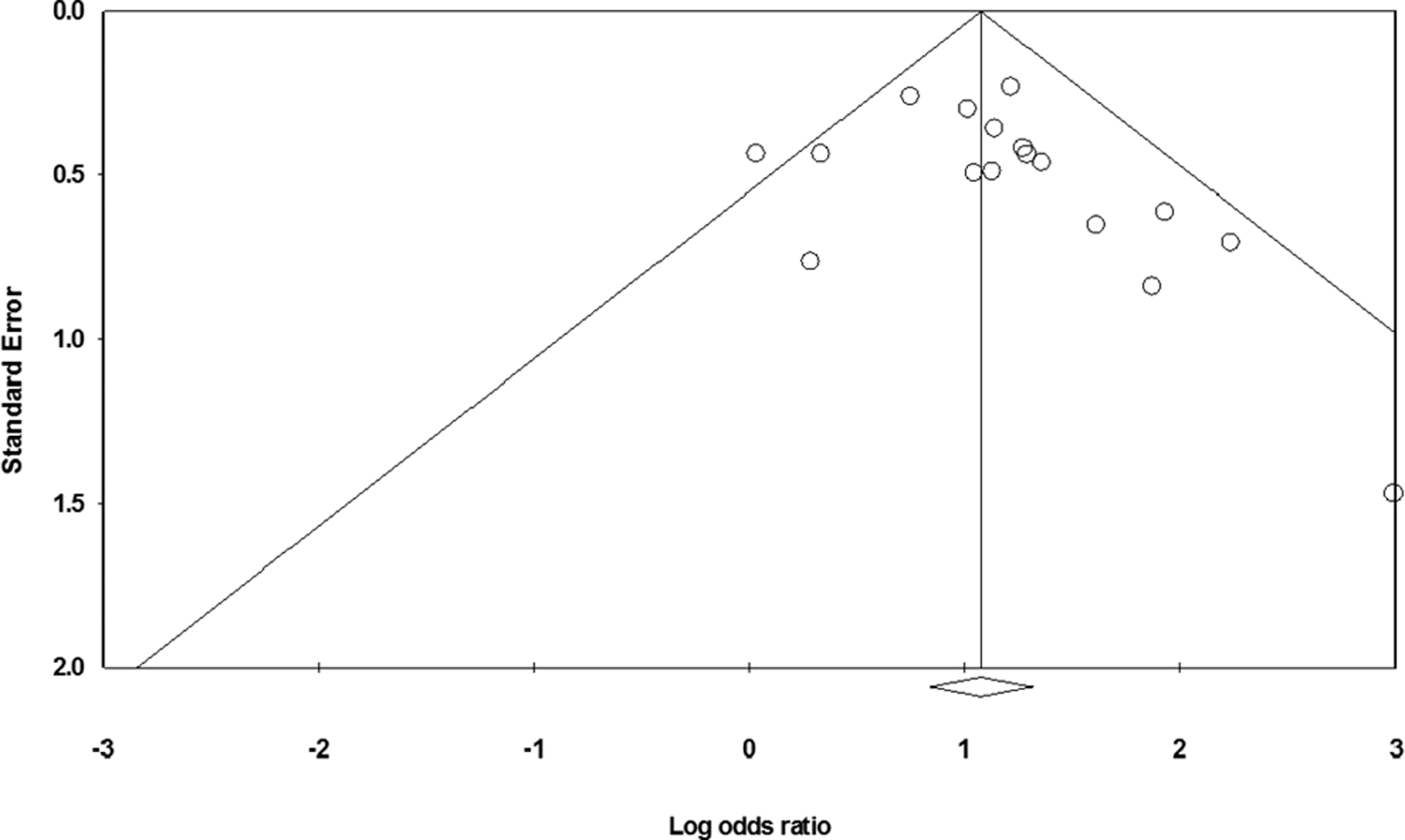
Funnel plot of standard error by log odds ratio.
Subgroup Analyses
Subgroup analyses were performed, and results are shown in Table 3. Our results show that when we grouped the studies by types of outcome, insecure attachment was more strongly associated with child maltreatment potential (OR = 3.52, 95% CI [2.65, 4.66]; p = .000) than child maltreatment perpetration. The analyses grouped by maltreatment type show larger effect sizes for the relationship between insecure attachment and failure to thrive (OR = 8.04, 95% CI [2.79, 23.16]; p = .000), and filicide (OR = 5.00, 95% CI [1.39, 17.94]; p = .014), followed by child physical abuse potential (OR = 3.52, 95% CI [2.66, 4.66]; p = .000), child physical abuse (OR = 3.10, 95% CI [1.18, 8.10]; p = .02), and child maltreatment (OR = 2.37, 95% CI [1.64, 3.43]; p = .000). However, the relationship between insecure adult attachment and child neglect was insignificant (p = .55). Further, a stronger association was observed for studies measuring adult attachment using interviews (i.e., the AAI; OR = 5.04, 95% CI [2.34, 10.89]; p = .000) than for studies using self-report measures (OR = 2.75, 95% CI [2.18, 3.46]; p = .000). The results of the subgroup analyses on child maltreatment measures show substantially larger effect size for child maltreatment evaluated by medical professionals (OR = 8.04, 95% CI [2.79, 23.16]; p = .000), followed by child maltreatment captured by CPS (OR = 2.08, 95% CI [1.40, 3.09]). For studies assessing child maltreatment by other professional records, the relationship was not significant (p = .125). Further, we grouped the analyses by the attachment figure (parents, partner, own child, and general attachment). Medium effect sizes were found for the relationships between insecure attachment with different attachment figures and child maltreatment. The relationship between insecure romantic attachment and child maltreatment was OR = 3.76 (95% CI [2.03, 6.00]; p = .000), general attachment was OR = 3.38 (95% CI [2.14, 5.32]; p = .000), own child was OR = 3.13 (95% CI [1.55, 6.33]; p = .001), and own parents was OR = 2.63 (95% CI [1.81, 3.83 = .000). It is noteworthy that the wide CIs for some effect size estimates are likely to be contributed by relatively small sample sizes in some studies, especially studies using the AAI.
Subgroup Analyses.
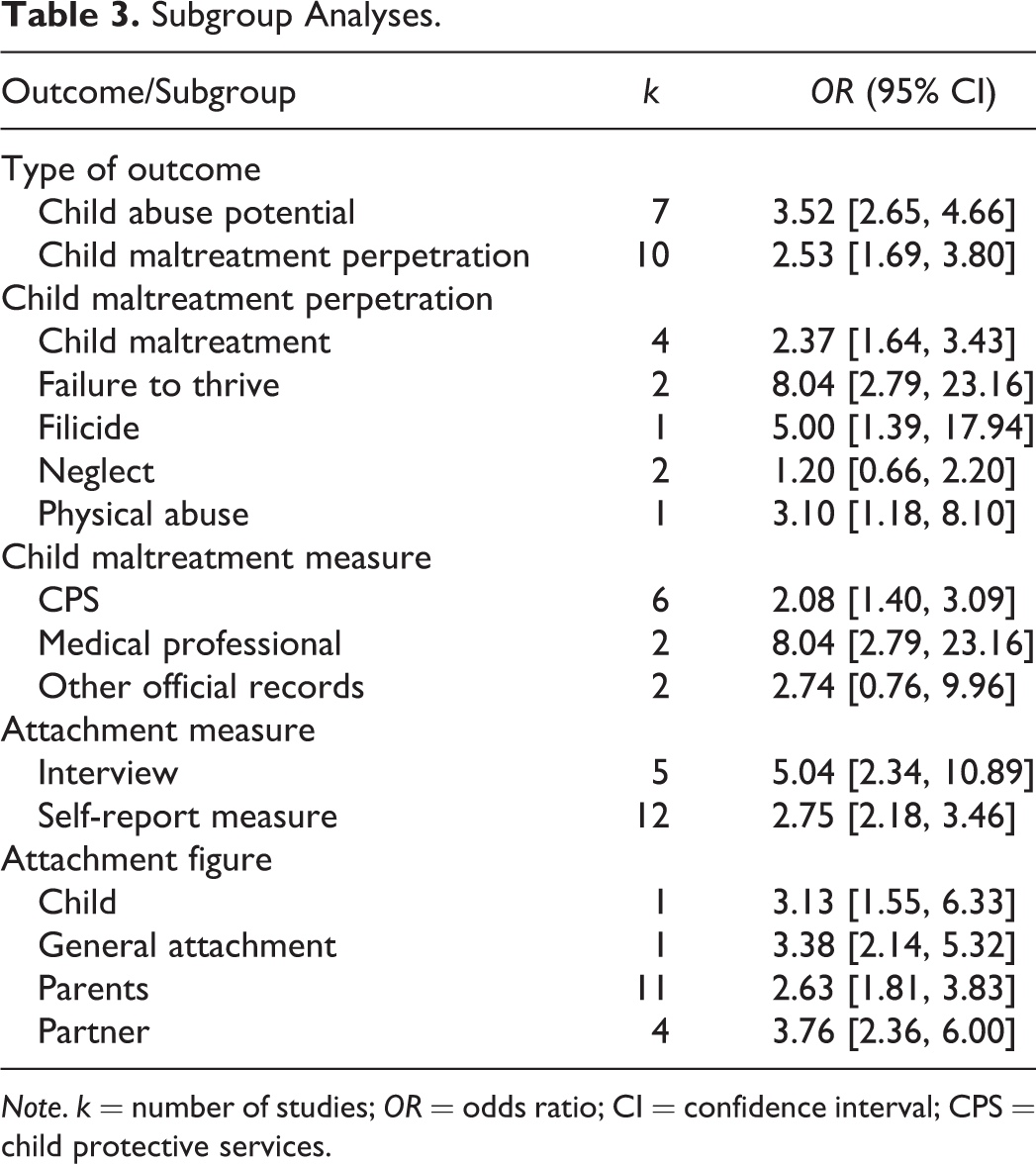
Note. k = number of studies; OR = odds ratio; CI = confidence interval; CPS = child protective services.
Discussion
Despite the fact that the variations in how adult attachment is operationalized and classified have complicated past reviews of the attachment literature (Jones et al., 2015), this meta-analysis attempted to summarize available evidence on the relationship between insecure adult attachment and child maltreatment.
Five studies using the AAI provide distribution of attachment classifications among different groups, with a larger proportion of maltreating parents (87.5%) having an insecure attachment compared to nonmaltreating clinical (64.5%) and community (43%) samples. The distributions of attachment styles among clinical and community samples obtained in this study are comparable to the ones reported in the review by Bakermans-Kranenburg and van IJzendoorn (2009). It is noteworthy that unresolved attachment is overrepresented among maltreating parents (46.6%) compared to nonmaltreating parents (14.8–23.4%), indicating it is more common for maltreating parents to show signs of cognitive dissociation or disorientation in regard to their early loss or traumatic experiences. This finding is in line with previous findings showing adults with adverse childhood experiences (ACE), especially experience of multiple ACEs, are more likely to have unresolved attachment as assessed by the AAI (Murphy et al., 2014). This finding is also relevant to the wealth of literature documenting intergenerational continuity of child maltreatment (Kwako, Noll, Putnam, & Trickett, 2010; Oliver, 1993). Individuals who experienced maltreatment in their childhood and were unable to mentally process the overwhelming experience are likely to have an unresolved attachment in adulthood, and subsequently have higher levels of relationship problems (Bailey, Moran, & Pederson, 2007), posttraumatic stress (Stovall-McClough & Cloitre, 2006), and disrupted interactive behavior with the child (Madigan, Moran, Schuengel, Pederson, & Otten, 2007). All these factors elevate the individual’s risk of maltreating their child. This finding adds to the literature that attachment insecurity may be one of the contributing factors to the transmission of intergenerational child maltreatment.
As hypothesized, meta-analyses of the 16 studies selected through our systematic selection process revealed that parents with insecure attachment had significantly higher risk of child maltreatment perpetration and child physical abuse potential (pooled effect size: OR = 2.93). This observation is consistent with the literature showing that one relationship has implications for other relationships within the family system (Stroud, Durbin, Wilson, & Mendelsohn, 2011; van IJzendoorn, 1992). This finding also suggests that relationships may be an important factor in understanding abusive parenting. Although the ecological model (Bronfenbrenner, 1977; Bronfenbrenner & Morris, 2006) proposes that factors proximal to child maltreatment such as parent–child interaction are more important, our finding regarding parents with insecure attachment suggests that distal interaction between parents and grandparents is also influential to the proximal interaction between the current parent–child dyad. Parents who had poor childhood experiences with their own parents or important caregivers may have internalized a working model characterized by hostility and fear, and they may project their own childhood relationship onto their child and replicate such relationship with their own child (Cramer & Kelly, 2010; Crowell & Feldman, 1988).
Subgroup analyses further indicate that significant association between insecure attachment and child maltreatment regardless of the attachment figure (own parents, romantic partner, own child, and attachment in general) the studies referred to. The effects of the associations were largely similar across different attachment figures, with the OR of 3.76 for romantic attachment, 3.38 for general attachment, 3.13 for attachment to own child, and 2.63 for attachment to own parents, which indicate that poor relational bonds with different important attachment figures increase the risk of child maltreatment. The finding is also consistent with previous studies showing that early attachment to own parents has rather important influence on adults’ life (Rosenthal & Kobak, 2010; Umemura, Lacinová, & Macek, 2015). From the view of child protection, this finding supports the idea that establishing safe, stable, nurturing relationships is a crucial prevention strategy in child maltreatment (Centers for Disease Control and Prevention, 2014).
Further, our subgroup analyses show a larger effect size (OR = 5.04) for the relationship between insecure parents and child maltreatment when attachment is measured by the AAI compared to self-report measures (OR = 2.75). One reason for this observation is that the AAI is able to capture the core social well-being of an individual (Steele & Steele, 2008) by assessing memories of an adult’s childhood relationships with parents and the adult’s own appraisal of how these experiences affect their personality and development. The coding process of AAI allows interviewers to consider both the content and the coherence of discourse given by the interviewees. By contrast, self-report measures are subject to distorted responses due to the self-defense mechanism, and thus they may not reflect the true attachment styles of parents (Ravitz, Maunder, Hunter, Sthankiya, & Lancee, 2010).
Subgroup analysis of studies segregated by maltreatment type shows that effect sizes for studies examining failure to thrive (OR = 8.04) and filicide (OR = 5.00) were higher compared to studies examining other types of child maltreatment. This suggests that distressed relationships may be a core risk factor for these two types of child maltreatment. Despite an insignificant relationship between insecure attachment and child neglect was observed, the studies that observed this involved samples of adolescent mothers, a group particularly vulnerable to a range of health, emotional, social, and financial difficulties (Center for Disease Control Prevention, 2013). In particular, family structure and socioeconomic status such as living in poverty and being single or divorce have found to be salient risk factors for child neglect for this special group (Lo et al., 2017). The influence of adult attachment on adolescent mothers may be less prominent, and insignificant finding was observed. Further, effect size for studies assessing child maltreatment by medical professionals was substantially higher (OR = 8.04) than assessing by CPS (OR = 2.08). This may be explained by the fact that child maltreatment episodes come to attention to medical professionals are likely to be seriously harmed or injured (Goad, 2008), thereby resulting in greater effect size.
Limitations of the Study
Although it has been over 30 years since the concept of adult attachment emerged in the literature, this review found that surprisingly insufficient attention has been paid to understanding the relationship between adult attachment and child maltreatment perpetration. This study’s analysis is therefore limited by the lack of research studies on this topic. In particular, because limited studies were included in some subgroups in the subgroup analyses, one should be cautious in interpretation of the findings. Yet, these groupings deemed appropriate and are conceptually meaningful, and they provided information about the difference in effect sizes across subgroups. In addition, because studies examining fathers’ adult attachment are limited, it was not possible to examine whether there is a gender difference in the association. Further, the studies included in this review were from Western countries; whether these findings replicate to Eastern cultures is uncertain. Because many Eastern cultures are influenced by Confucianism—which highly values interpersonal relationships—we postulate that attachment may be an important factor in understanding child maltreatment in Eastern cultures. Further studies are warranted on how attachment styles of parents in the East influence the way they parent their children.
Implications for Research, Practice, and Policy
Parents’ relational functioning is rooted in their early experience with their own caregivers, in their current attachment with their romantic partner and own child, and in how the parents appraise these relational experiences. The findings of this study provide valuable implications on child maltreatment prevention and intervention in research, clinical, and policy terms. In terms of research, this study expands on the previous systematic review of the association between adult attachment and child maltreatment by providing quantitative synthesis of available evidence. This study provides evidence for further research on the role of adult attachment in child maltreatment. In particular, future studies should delineate whether attachments to one’s own parents and partner have different degrees of influence on the risk of child maltreatment. In addition, future studies could take into account the concordance or in-concordance of attachment styles between a parent’s partner or spouse and examine whether having a secure partner or spouse can buffer the risk of child maltreatment. Future studies looking more closely at the relationship between different subtypes of insecure attachment and child maltreatment are recommended.
Because this study shows that maltreating parents were more likely to have an insecure and unresolved attachment than nonmaltreating parents, it is reasonable to expect that intervention that goes beyond intellectual understanding of relational and parenting skills—intervention that actually enhances parents’ awareness of how their own childhood experience and current attachment relationships underlie their present parenting—may produce more enduring effects. Although attachment is a relatively stable construct, intervention and engagement in healthy relationships to obtain positive attachment experiences with a partner or therapist may help reconstruct insecure attachment representation (van IJzendoorn, 1995). By helping parents in gaining insights into their past attachment relationships and resolving attachment difficulties, practitioners can further encourage and empower parents to provide their children with the sensitive parenting that they might not have received themselves. Finally, the usefulness of adult attachment measures in a clinical setting for screening child maltreatment risk is also worth considering. In particular, because it has been shown that a mother’s attachment to her fetus is predictive of her feelings of irritation with the fetus (Pollock & Percy, 1999), assessing mothers’ past and current attachment relationships as early as during the pregnancy period could be useful to identify maltreatment risk (and to intervene) at an early stage.
Critical Findings
Unresolved attachment was overrepresented among maltreating parents (46.6%) compared to nonmaltreating parents in the clinical sample (23.4%) and the community sample (14.8%).
Meta-analyses of 16 studies revealed that parents with insecure attachment had significantly higher risk of child maltreatment perpetration and child physical abuse potential (pooled effect size: OR = 2.93), suggesting that relationship may be an important factor in understanding abusive parenting.
Subgroup analyses showed the association was largely similar for romantic attachment (OR = 3.76) and general attachment (OR = 3.38), attachment to own child (OR = 3.13), and to own parents (OR = 2.63), in relation to child maltreatment.
Implications of the Review for Practice, Policy, and Research
Future studies should delineate whether the adult’s attachment to different attachment figures has a different degree of influence on the risk of child maltreatment.
Future studies should examine whether having a secure partner or spouse can buffer the risk of child maltreatment.
Future studies looking more closely to the relationship between different subtypes of insecure attachment and child maltreatment are also recommended.
Intervention that goes beyond intellectual understanding of relational and parenting skills—that is, intervention that enhances parents’ awareness of how their own childhood experience and current attachment relationships underlie their present parenting—may produce more enduring effects.
At the primary prevention level, the usefulness of adult attachment measures in a clinical setting for screening child maltreatment risk is also worth considering.
Footnotes
Declaration of Conflicting Interests
The author(s) declared no potential conflicts of interest with respect to the research, authorship, and/or publication of this article.
Funding
The author(s) received no financial support for the research, authorship, and/or publication of this article.