



Abstract
The strong positive association between offending and victimization, or the victim–offender overlap, has received considerable amount of research attention in recent years. Empirical research has made important strides in unpacking the sources of the phenomenon, but important questions remain unanswered. Ambiguity surrounds the utility of certain theoretical explanations for the overlap, the nature of the phenomenon, and the methodological tools used to examine its etiology. Owing to these knowledge gaps, the scientific meaning of the victim–offender overlap is unclear. Moreover, a number of potentially important theoretical arguments are rarely subject to empirical testing in this line of research. The purpose of this article is to use a narrative review methodology to provide a critical reappraisal of the theoretical, empirical, and methodological research on the victim–offender overlap and offer directions for ways forward to develop a more comprehensive understanding of the phenomenon. This review includes critical analysis of 78 academic publications, along with a table that summarizes the key findings and conclusions from 18 critical empirical studies that have contributed to our understanding of the victim–offender overlap. We offer recommendations for the continued development of theoretical and methodological tools to better understand this complex phenomenon.
Scientific research on the causes of victimization and criminal offending traditionally evolved separately in the criminological literature. Reflecting on this trend, Reiss (1981) observed, “any theory that assumes no overlap exists between populations of victims and offenders or that they are distinct types of persons distorts the empirical research” (p. 711). Since then, researchers have increasingly come to recognize that separating victims and offenders into discrete groups obscures valuable information about the etiology of interpersonal violence. More importantly, a growing body of research finds that offending is a strong determinant of victimization and vice versa (e.g., Berg & Loeber, 2011; Lauritsen, Sampson, & Laub, 1991; Ousey, Wilcox, & Fisher, 2011; Singer, 1981; Stewart, Schreck, & Simons, 2006). Victims and offenders are not necessarily distinct groups; rather, the same people rotate between each role with regularity. Some scholars go as far to suggest that this pattern, known as the victim–offender overlap, may represent a criminological fact akin to the age–crime curve. Few researchers doubt the existence of the overlap, but critical questions remain unanswered about the origins and nature of the phenomenon.
More than 10 years ago, Lauritsen and Laub (2007) concluded that research on the overlap had reached an “impasse” because efforts to identify its etiology had produced few major breakthroughs. Since then, however, a small number of important empirical findings have appeared in the literature, casting additional light on mechanisms that are responsible for the phenomenon (for a review, see Berg 2012; Berg & Felson, 2016). Recent years have witnessed a surge of interest in the victim–offender overlap, aided by the availability of fertile longitudinal data sets capturing information on criminal offending, victimization experiences, antisocial behavior, and theoretically relevant explanatory processes.
However, the lack of significant progress toward identifying the sources of the overlap is possibly due to a number of unresolved theoretical and methodological challenges. As a result, there is a need to reassess the challenges involved in properly testing leading theoretical frameworks and, more importantly, to consider whether some propositions are even of value given the accumulated evidence. In fact, perhaps the sources of the overlap are not located at the individual-level unit of analysis but in other analytical units, which heretofore have not received sufficient theoretical or empirical attention. Adding to these challenges, several measurement issues impede the ability of researchers to sufficiently isolate the conditions that produce the overlap.
This article provides a reappraisal of research on the victim–offender overlap with the broader purpose of elaborating on prior efforts (e.g., Berg, 2012; Lauritsen & Laub, 2007). 1 We used a narrative review methodology to provide a critical analysis of more than 90 academic publications, along with a table that summarizes the key findings and conclusions from several critical empirical studies that have contributed to our understanding of the victim–offender overlap (see Table 1). Nearly, every empirical study reviewed here focuses primarily on interpersonal violence or serious offending at various stages of the life course. These studies have conducted tests of key theoretical ideas or have implemented innovative methodological techniques that have broken new ground for important findings (see also Lauritsen & Laub, 2007). The review is not exclusive to criminology or psychology but incorporates research from multiple social scientific disciplines. Moreover, this review includes published papers that focused primarily on the question of the victim–offender overlap using quantitative techniques. We also included qualitative studies that have led to significant theoretical and empirical advances.
Summary of Research of Important Relevance to the Victim-Offender Overlap.
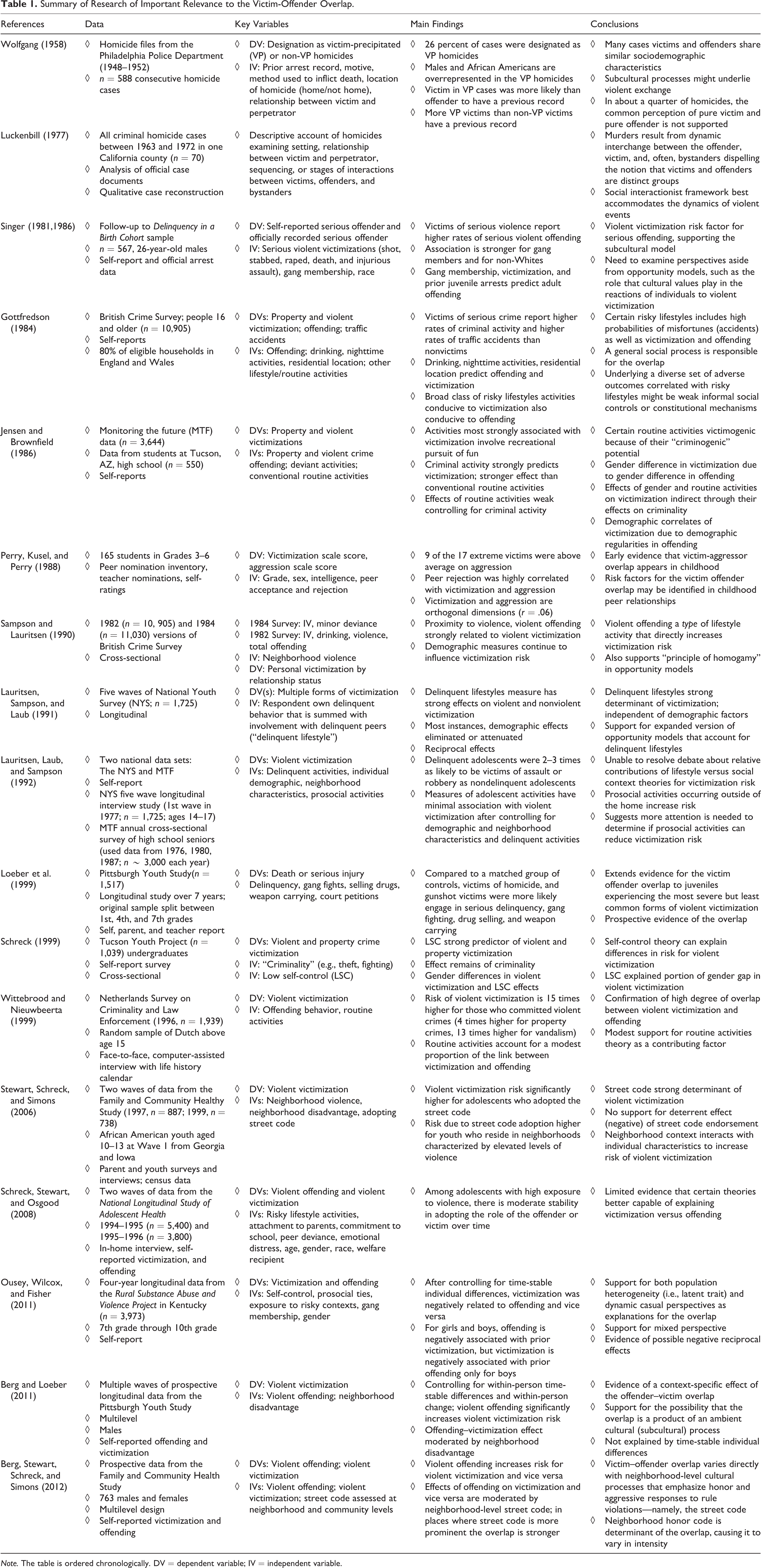
Note. The table is ordered chronologically. DV = dependent variable; IV = independent variable.
Specifically, the aims of this article are (1) to review prevailing theoretical perspectives and relevant empirical evidence, (2) to present a situational perspective of how interpersonal disputes may contribute to the victim–offender overlap (Berg, 2012; Berg & Felson, 2016), (3) to describe persistent challenges in testing the conceptual assumptions of leading frameworks, and (4) to offer possible pathways forward in this research.
Revisiting Leading Theoretical Perspectives
More than three decades ago, Gottfredson (1984) wrote, “Criminologists paid too little attention” to the victimization–offending link, and he insisted that there should be “an increased focus…on the social processes which produce” the phenomenon (p. 33). Such remarks came on the heels of several foundational developments that set the stage for later explanatory research. For example, von Hentig’s (1948) typology of victim vulnerability granted victims an active rather than purely passive role as recipients of interpersonal violence. Subsequently, Wolfgang (1958) observed that sizable percentages of homicide victims in Philadelphia were themselves offenders who had been arrested for serious crimes. Moreover, Wolfgang’s data revealed that homicide victims and perpetrators had similar sociodemographic profiles. In addition, the production of large-scale self-report victimization surveys in the 1970s, such as the National Crime Survey, provided detailed information on victims, offenders, and the situational characteristics of crime incidents that enabled inductive theorizing about the sources of victimization rather than offending (Lauritsen & Laub, 2007).
Differential Exposure Perspectives
A class of theoretical models commonly found in research on the overlap emphasizes how certain actions and personal characteristics enhance the vulnerability and attractiveness of individuals as crime targets (Jensen & Brownfield, 1986; Meier & Meithe, 1993). The source of this uneven vulnerability rests ultimately in broadscale social structural arrangements. Known as differential exposure perspectives, these models propose that the distribution of opportunities for violent victimization is a function of routine activity patterns of everyday life. An exposure perspective developed by Hindelang, Gottfredson, and Garofalo (1978) has long served as the basis for a prominent explanation of the victim–offender overlap. Their work showed that victimization risk was closely associated with several person-level characteristics and that victim and offender populations share similar sociodemographic profiles. Hindelang and colleagues (1978) concluded that individuals “who disproportionately come into contact with and/or associate with persons who have high rates of offending are likely to be disproportionately victimized” (p. 122). From this perspective, demographic differences in victimization risk are thus attributable to differences in lifestyles, certain of which involve routine exposure to situations lacking capable guardianship that are in close proximity to motivated offenders (Cohen & Felson, 1979). In essence, their model implied that certain people, by virtue of their lifestyles, are more inclined to be in situations that would provide sufficient opportunities to behave in ways that “precipitate or escalate violent victimization” (Hindelang, Gottfredson, & Garofalo, 1978, p. 268). Later, Osgood and colleagues (1996) extended the lifestyles perspectives by including assumptions of social control theory. They hypothesized that offending is the product of situational inducements (i.e., motivations)—thus differential exposure to risky settings—unfolding in the context of unstructured socializing with peers (Osgood et al., 1996).
Altogether, interpretations of the routine activities/lifestyles perspective lead to hypotheses suggesting that victimization and offending are joint products of differential exposure to violence-conducive social contexts and, therefore, the association between them is spurious (Sampson & Lauritsen, 1990). If these hypotheses hold explanatory value, then controlling for theoretically relevant exposure variables should reduce the strong positive correlation to zero.
However, there is limited empirical support for propositions suggesting the overlap is a function of lifestyle exposure to risky social contexts (see also Lauritsen & Laub, 2007). Studies find that victimization risk varies closely with self-reported offending, irrespective of other indicators of lifestyles/routine activities. For example, measures of leisure activities and proximity to high crime areas do not account for a significant portion of the offending–victimization association (Averdijk & Bernasco, 2015; Lattimore, Linster, & MacDonald, 1997; Lauritsen & Davis Quinet, 1995; Lauritsen et al., 1991; Sampson & Lauritsen, 1990; Shaffer & Ruback, 2002; van Gelder, Averdijk, Eisner, & Ribaud, 2015; Wittebrood & Nieuwbeerta, 1999). Furthermore, few conventional routine activities protect against victimization and none eliminate the strong positive effects of delinquent behavior (Lauritsen, Laub, & Sampson, 1992). On the other hand, research-based trajectory models of victimization and offending found that risky lifestyle measures were the most reliable determinants of membership in the dual trajectory groups (Mulford et al., 2016).
Before drawing firm conclusions about the utility of the differential exposure perspective for the victim–offender overlap, three issues warrant further attention. First, studies rarely examine data pertaining to the situational context of violent events. Most studies assess whether the average frequencies (e.g., daily, weekly, and monthly) of time spent in risky settings predict violent offending and victimization. Common frequency indicators confound multiple key components of situations, such as the location of the activity, the presence of guardians, the characteristics of others in the setting, and the actual time spent performing an activity in a given space. Standard measures of routine activities typically do not allow for the disentangling of the temporal patterning of exposure to a given setting and the occurrence of violent events (but see Averjidk & Bernasco 2015). Measures of routine activities commonly used in criminological research are therefore too imprecise to adequately determine how certain routine activities increase victimization risk and criminal offending. Lacking in this work are situation-specific measures that overlap temporally with the victimization incident—that is, measures that ask precisely what the person was doing and with whom they were doing it with during the time frame in which they were victimized.
Second, clear and consistent definitions of lifestyles/routine activities are lacking. Some studies treat heavy drinking (Daday, Broidy, Candall, & Sklar, 2005) and violent behavior as elements of risky lifestyles/routine activities (Jensen & Brownfield, 1986), whereas others conceptualize heavy drinking and violent behavior as separate indicators of offending (Deadman & MacDonald, 2004). The operationalization of lifestyle/routine activity constructs varies widely in empirical tests (see Spano & Freilich, 2009), making it difficult to draw comparisons across studies.
Third, researchers have not quantified the degree to which victims and offenders self-select into risky social contexts. The alleged “causal” effect of risky social contexts on interpersonal violence might be an artifact of selection. There is evidence to support this possibility: Using a situational decomposition method, a Finnish study found that 29% of the total effect of “socializing at night” on victimization was spurious for boys and nearly 88% was spurious for girls in the sample (Felson, Savolainen, Berg, & Ellonen, 2013). The findings point to the possibility that selection mechanisms account for some of the linkage between routine activities and victimization.
Cultural Perspectives
Criminology integrates cultural assumptions to varying degrees into nearly all prominent theoretical frameworks. Under some accounts, weak commitments to conventional culture essentially free the actor from behaving according to his or her own self-interests, whereas other accounts assign motivational power to specific norms governing antisocial behaviors (see Berg, Sevel, & Stewart, 2015; Kornhauser, 1978). For decades, researchers asserted that prescriptive conduct norms sanctioning aggression are partly responsible for the persistent association between violent victimization and offending. Early research pointed to the concentration of homicide victims and offenders in lower socioeconomic groups as an indication of an underlying normative structure unique to impoverished locations (Wolfgang, 1958). As an example, Wolfgang (1958) argued that, norms of honor are especially salient in lower class environments in that residents rely on “physical combat as a measure of daring, courage or defense of status” (pp. 188–189).
With growing evidence suggesting the victimization–offending association remained strong regardless of differential exposure and social control variables and that it varied with dimensions of social stratification (e.g., social class), researchers increasingly relied on cultural explanations. Singer (1986), for instance, speculated that the association between victimization and offending was a product of retaliatory violence, sustained by subcultural conduct norms in which vengeance receives collective sanction. He argued that “dominant cultural values dictate calling the police” within middle-class communities (p. 68), which allegedly explained the infrequency of serious violence among the more affluent. Most research did not specify actual measures of relevant cultural constructs; instead, researchers interpreted the correlation between victimization and offending as evidence of a “subcultural” process itself. Hence, the overlap was confirmation of an influential subcultural mechanism, although measures of the mechanism were not specified.
Despite significant attention, the cultural constructs hypothetically responsible for the overlap are often conceptualized differently across studies (e.g., subculture, oppositional culture). Nevertheless, in their most basic interpretation, prominent cultural explanations for the overlap focus on a common conceptual mechanism: honor. Norms inhered in honor cultures place a premium on the maintenance of respect, lower the threshold of personal insult, define violations of self in an adversarial manner, and endorse violence as an appropriate means to regulate interpersonal disputes (Berg et al., 2015). Cultural systems organized around codes of honor often sanction retaliatory aggression as an appropriate response to an affront (Cooney, 1998). For example, Anderson’s (1999) narrative suggests that young men engage in violent altercations to promote street credibility, and many “crave respect to the point that they would risk their lives to attain and maintain it” (p. 76). Where an honor culture is entrenched, conflicts are more likely to escalate to physical violence since there is an expectation to forcefully respond to mistreatment (see Cooney, 1998). Disrespected individuals are expected to “immediately enforce [their] precedence” by punishing wrongdoers with violence of like or greater proportion (Horowitz, 1983, p. 82). Status is assigned to individuals who do not allow others to exploit them—victims imperil their own reputations if their own mistreatment goes unrequited. Conventional modes of conflict resolution often have little force where norms of honor are prominent because the criterion for respect is based on principles that are unlikely to accept peaceful resolutions of disputes. The association between victimization and offending is potentially a product of retaliatory violence, sustained by subcultural conduct norms in which vengeance receives collective sanction (Singer, 1986).
Within the context of impoverished urban neighborhoods, a climate of legal hostility, or perceived statelessness, potentially sustains codes of honor, making residents reluctant to enlist state authorities (i.e., police, courts) to intervene in conflicts (Berg, Slocum, & Loeber, 2013; Cooney, 1998; Rich & Grey, 2005). Residents of these neighborhoods often perceive the criminal justice system as unfair, unresponsive, and discriminatory against minorities. A number of studies in low-income urban communities find that young men “avoid the police whenever possible” (Rosenfeld, Jacobs, & Wright, 2003, p. 298) over concerns about being harassed or subject to undeserved legal attention. Further, Horowitz (1983) observed that “disputes over honor must be settled personally, not through the legal system” (p. 82). More recent studies of adolescents reveal that the association between offending and victimization is not confounded by the street code or similar mechanisms (Stewart et al., 2006) and that deadly violence is propelled by norms of honor in neighborhoods where the state and its enforcement power lack legitimacy (Kubrin & Weitzer, 2003). These conditions are not exclusive to urban America but are also found in predominantly White rural locales and in marginalized communities in other countries, as well (Black, 1998). It is worth emphasizing that these conditions are, in theory, racially invariant and therefore should be evident among all racial and ethnic groups but pronounced in places defined by entrenched economic disadvantage (Berg et al., 2015).
Early research on the overlap also did not separate violent behavior from the cultural properties thought to explain the phenomenon. As a result, the hypothesized effects of cultural processes were not subject to proper testing. More recently, however, studies reveal that the association between offending and victimization is not confounded by the street code or similar mechanisms (Stewart et al., 2006). Multilevel research by Berg, Stewart, Schreck, and Simons (2012) found that the victimization–offending association was magnified in places where the street code was prominent in the social landscape (see also Berg & Loeber, 2011).
To summarize the aforementioned research, cultural perspectives suggest three pathways through which violence-related conduct norms account for the victim–offender overlap. First, those who espouse conduct norms sanctioning violence have an increased risk for violent offending. Second, victims who adhere to these conduct norms are more likely to attack an antagonist and engage in provocative actions, thereby increasing their risk for violent victimization. Third, violent conduct norms magnify the association, such that aggression is more likely to invite aggressive reactions in settings where norms of honor are common (Berg & Loeber, 2011).
However, this research suffers from several shortcomings that warrant further attention. First, there is a lack of understanding of precisely how the honor culture contributes to the overlap. Perhaps the honor culture is responsible for increased involvement in interpersonal conflicts and it increases the likelihood that conflicts will escalate. These suppositions are speculative, as most research does not specify actual measures of relevant cultural constructs.
Another issue is that researchers use ego-centered measures of the street code or similar constructs to assess the personal salience of behaving in certain ways in response to disrespectful treatment. These measures, however, do not asses how others understand the reputations of victims or offenders. To the extent that the social signals of the street code operate to deter predation and mistreatment (Anderson, 1999), it is necessary to assess information about victims and offenders from the perspective of their peers in a social network. Reputations are forged in networks of affiliation (Gambetta, 2009). Perhaps individuals who are perceived, either through their appearance or reputation, to be dangerous are less likely to be targets of crime; if true, this would manifest as a negative association between offending and victimization (see Berg & Loeber, 2015). Hence, more information is needed to understand why violent conduct norms increase rather than lower rates of victimization.
Individual Differences: Person-Level Mechanisms
Theories of criminality and victimization that focus on person-level mechanisms shift the conceptual focus of the explanation from the types of contexts to the types of people. Another prominent class of hypotheses regarding the sources of the overlap focus on individual differences. Typically, these differences are conceived as person-level biological characteristics, psychological processes, and cognitive abilities that correlate with higher rates of antisocial behavior. Central to most hypotheses relating to individual differences is the notion of population heterogeneity, which assumes that differences among people in various behaviors, life outcomes, and experiences reflect latent traits distributed heterogeneously throughout the population (Lauritsen & Davis Quinet, 1995). Any correlation between such diverse occurrences is therefore a spurious by-product of a common trait or set of traits. For example, Sparks (1982) posited that the skewed distribution of repeat victims might mirror the population distribution of “victim proneness.” The concept is a form of risk heterogeneity that refers to the degree to which people provoke violence are exploitable and susceptible to predation. Similarly, Gottfredson (1984) found in the British Crime Survey that respondents who engaged in criminal offending also reported higher victimization risk and more frequent involvement in traffic accidents than nonoffenders. He suggested that each outcome is a symptom of individual differences that effectively select individuals into dangerous situations. The thrust of his perspective undergirds modern discussions of the potential sources of the overlap.
Social control (i.e., social bond) theories have expanded from their traditional role as explanations for antisocial behavior to also account for victimization. Gottfredson (1981) bridged the assumptions of the lifestyles perspective with the logic of social control models to suggest that serious offending and vulnerability to victimization were mutual by-products of weakened informal bonds to society (Gottfredson, 1984). From this viewpoint, “the social processes which produce high rates of offending in some segments of the population are also productive to high rates of victimization” (p. 17). However, most empirical research conducted on samples of adolescents and young adults reveals that weak social bonds predict both victimization and offending but do not explain their positive association (e.g., Lauritsen et al., 1991; Loeber et al., 1999; Melde, Berg, & Esbensen, 2014; Ousey et al., 2011; Schreck, Stewart, & Osgood, 2008).
Modern considerations of individual differences primarily center on components of self-regulation—namely, low self-control (LSC; Gottfredson & Hirschi, 1990). The basic assumption of this research holds that variation in LSC produces numerous negative health and behavioral outcomes and therefore may account for the victimization–offending association (Pridemore & Berg, 2017). Several recent cross-sectional and longitudinal studies on adolescents and young adults in the United States found that the association withstands the potentially confounding effects of LSC, suggesting the construct is a significant, but not the primary, source of the phenomenon (Lauritsen & Laub, 2007; Schreck, 1999; Turanovic & Pratt, 2014). A number of studies of victimization have employed self-control measures comprised of items capturing antisocial and criminal behaviors; however, such constructs make it difficult to gauge how LSC—rather than its various behavioral manifestations—affects the association between victimization and offending. Overall, the effects of self-control are among the most consistent individual-level predictors of the victim–offender overlap.
Similarly, impulsivity and related dimensions of self-regulation explain a portion of the association between victimization and offending but do not reduce it to zero (Ousey et al., 2011). Further still, other longitudinal studies of adolescents report that a sizable portion of the overlap is attributable to between-person latent individual differences (Sullivan, Ousey, & Wilcox, 2016). However, Berg and Loeber’s (2011) panel study of young men in Pittsburgh revealed that the victimization–offending association remained significant even when controlling for potential sources of time-stable spuriousness (e.g., time-stable characteristics of the person that could account for the link between offending and victimization).
Perhaps the attractiveness of self-control theory in this branch of research results from the testability and simplicity of the theory. It also has high face validity, parsimony, and generality—near requirements for admiration in the halls of hypothesis formulation. Whatever the reasons for the popularity of self-control theory, numerous other individual differences mechanisms have received less research attention, many of which might contribute to the genesis of the victim–offender overlap. For instance, criminologists have largely neglected the genetic underpinnings of the overlap. Without accounting for these effects, this could lead to inaccurate estimates of the environmental component. Prominent environmental mechanisms (e.g., social bonds) might in fact have a genetic basis. In fact, the search for causes of the overlap is best characterized as a search for environmental causes. However, there is growing evidence across the social sciences that theoretically relevant individual traits are highly heritable (Moffitt, 2005) and that biological mechanisms, including puberty, predict victimization as well as aggression among adolescents (Haynie & Piquero, 2006). For instance, research using twin designs revealed that antisocial behavior and victimization both vary independently with genetic factors (Beaver, Boutwell, Barnes, & Cooper, 2009) and nonshared environmental components (Fisher, Smith, van Jaarsveld, Sawyer, & Wardle, 2015). The process through which the heritability component generates higher rates of victimization and offending remains unclear.
A recent longitudinal study found that entry into adult role transitions involving bonds of conformity and control had a minimal impact on the declining magnitude of the association between victimization and offending across the life course (Schreck, Berg, Ousey, Stewart, & Miller, 2015). The authors suggested that perhaps biologically based maturational processes associated with aging accounted for the declining association between victimization and offending. This claim, however, remains speculative without additional testing.
A parallel line of epidemiological research provides an alternative vantage point from which to conceptualize the role of risk heterogeneity mechanisms in the production of the overlap. This work demonstrates that, much like violent conduct and victimization, multiple adverse health outcomes and forms of antisocial conduct cluster within the same people. As Junger and Dekovic (2003) suggested in their overview of these patterns, “co-occurrence is generally the rule rather than the exception” (p. 213). For example, research on a New Zealand birth cohort found that chronic offenders tend to exhibit acute mental and physical health impairments relative to others (Odgers et al., 2007). A systematic review of 44 prospective studies found that children who suffer higher rates of unintentional injuries (e.g., fractures, bruises) exhibit contemporaneous psychological and behavioral problems (Maughan, Stafford, Shah, & Kuh, 2014; Mytton, Towner, Brussoni, & Gray, 2009). In fact, Shepherd, Farrington, and Potts (2002) argued that “injury is one symptom of an antisocial personality that arises in childhood and persists into adulthood” (p. 539). The cooccurrence of aggressive conduct, victimization, psychiatric morbidity, and adverse health outcomes provides incidental evidence supporting explanations that rely on latent trait perspectives. More effort should be made to integrate strands of research from the epidemiological and health psychology literatures given their potential explanatory value.
Although individual differences have been subject to a large amount of attention, criminologists have dedicated less time to hypotheses from developmental models focused on what are considered “evocative traits.” For instance, Patterson’s coercive interaction perspective theorizes the development of antisocial traits that are responsible for coercive behavioral tendencies (see Patterson, DeBaryshe, & Ramsey, 1989). According to this perspective, frequent irritable exchanges between children and their parents within the context of harsh and unpredictable family environments are the basis for coercive styles of interaction. The analytical focus is the family unit since it is considered the “training ground” for aggression. Also, of interest to this model is the gradual reinforcement of coercive responses to aversive treatment—rejected demands or social control attempts—that serve as a functional strategy to “survive in a highly aversive social system” (Patterson et al., 1989, p. 330). Children learn to use coercion to obtain desired outcomes when confronted with rejection, while at the same time they do not develop adequate prosocial skills. The long-term implications of coercive tendencies are evident across the life course, resulting in social rejection, life failure, and antisocial behavior (e.g., Odgers et al., 2007). A key point is that evocative traits do not necessarily reflect socialization deficits, as is the case with self-control, but they are learned and continually reinforced through subsequent coercive interactions (Patterson et al., 1989).
What does the coercive interaction perspective hold for efforts to understand the etiology of the overlap? Perhaps it opens another window into a potential individual difference process through which the overlap develops from childhood. If coercive behavioral traits are responsible for provocative and hostile styles of social interaction, these tendencies may lead to higher rates of violent victimization and offending. In fact, recent research on young children found that evocative tendencies are heritable and they predict victimization—even by unfamiliar adversaries in novel situations (DiLalla & John, 2014). Coercive tendencies might operate as confounding or mediating processes. Either way, developmental perspectives warrant consideration: Controlling for coercive tendencies, even those assessed at early childhood, could account for the association between victimization and offending across stages of the life course (e.g., Lauritsen et al., 1991; Schreck et al., 2015). Researchers should dedicate more attention to determining whether the overlap is a developmental product of underlying coercive tendencies that unfold—through socialization—in childhood. This perspective also points toward opportunities for intervention efforts involving parent–child training practices, such as parent management training (see Kazdin, 2005) which might prevent hostile styles of interaction that manifest in both victimization experiences and offending behaviors.
Additionally, the search for the causes of the victim–offender overlap in the catalogue of individual differences has not dedicated sufficient attention to information processing deficits, cognitive biases, and forms of psychiatric morbidity. People who perceive hostile intent and are chronically vigilant tend to become embroiled in conflicted social exchanges that escalate to violence (Crick & Dodge, 1994). Accounting for these processing deficits could explain a sizable portion of the association between violent offending and victimization. In addition, callous-unemotional traits—a lack of guilt and empathy and deficient affect—have been shown to be strongly associated with aggressive behaviors; in addition, there is emerging evidence of a linkage between these traits and peer victimization (Barker & Salekin, 2012). Other studies have found that callous traits might be responsible for part of the overlap (see Fontaine, Hanscombe, Berg, McCory, & Viding, 2016). Furthermore, a related stream of developmental research has highlighted associations between emotion dysregulation and patterns of aggressive styles of social interaction (Schwartz, Dodge, Pettit, & Bates, 1997). Few studies have examined the implications of negative affective states for the victim–offender overlap, although negative affect has been shown to be positively correlated with rates of victimization and offending in a study of New Zealand young adults (Silver, Arseneault, Langley, Caspi, & Moffitt, 2005). Verbal intelligence, or the latent capacity to communicate using language, might also hold promise as an explanation for the overlap. Studies have found that components of verbal intelligence is directly correlated with aggressive behavior, negative life events, and well-being (see Vaske, Newsome, & Boisvert, 2013). Specifically, people with low verbal intelligence are less adept at persuasively articulating their emotions and frustrations and, therefore, struggle to negotiate verbal solutions to disputes, all of which increases the likelihood of their involvement in physical confrontations (Stattin & Klackenberg-Larsson, 1993).
A Situational Perspective of the Overlap
Berg and Felson (2016) recently argued that consideration of the situational context of interpersonal disputes is critical to understanding the victim–offender overlap (see also Berg, 2012). Although situational perspectives are important explanations for aggression in the social psychological literature, this work has largely gone unnoticed in research on the overlap. Rather, as is apparent in the preceding discussion, the substantive focus is commonly the person and, in some cases, their neighborhood social context. Moreover, most data sets contain minimal information on the situational characteristics of violent incidents and even fewer contain information on disputes that do not turn violent.
Acts of violence are typically motivated by moralistic violations that originate in disputes over right and wrong. Some conflicts involve an exchange of insults—going no further, whereas others escalate to fisticuffs resulting in serious injuries. In fact, most homicides usually begin when someone expresses a grievance and a verbal disagreement ensues (Luckenbill, 1977). Dispute related or moralistic violence probably accounts for a large share of the overlap between violent offending and victimization. Knowing how certain people typically manage interpersonal disputes—for example, whether they apologized, threatened, negotiated solutions—helps explain why the same people rotate between the roles of victim and offender. Perhaps much, but certainly not all, of the victim–offender overlap is comprised of people whose conflicts tend to culminate in physical violence (Berg & Felson, 2016). It would be helpful to know if these conflict management styles are stable across time, situations, and relationships, which would be best examined through longitudinal research that explores the victim–offender overlap and conflict management styles beginning in childhood.
It is necessary to account for the motives for violence to understand the escalation of disputes (Berg & Felson, 2016; Berg & Loeber, 2015). Three common motives include (1) to force compliance, (2) retributive justice, and (3) social identity maintenance. The first motive, to force compliance, involves the use of violence (or its threat) to compel or deter the behavior of the adversary. The second motive, retributive justice, involves the tendency for individuals to use violence in response to offensive or disrespectful behaviors. The third motive involves the use of violence to enhance or protect identities. After receiving an insult, the target feels dishonored and his image appears weak, but a retaliatory strike can serve to restore his image.
Berg and Felson (2016) have suggested that serious offenders and nonoffenders possess different tendencies when they engage in dispute-related behaviors, and these tendencies may account for why offenders have relatively higher rates of victimization. First, offenders are less likely to engage in remedial actions during disputes, which may increase their risk of being victimized by their adversaries. Second, Berg and Felson (2016) have theorized that third-party presence and actions are critical components of the victim–offender overlap. Specifically, insults and challenges to favorable social identities resonate with actors when they are delivered before an audience irrespective of whether the audience participates in the exchange. If third parties encourage the adversaries, the conflict is more likely to escalate to violence, whereas certain interventions can also lead to peaceful settlements. The police are another type of third party that can determine whether a dispute ends violently or peacefully (Cooney, 1998). Third, drinking alcohol to the point of intoxication likely has causal effects on victimization because it leads to provocative or risky behavior. When people are intoxicated, they may be more aggressive, more likely to violate social norms, less aware of risks, and less likely to take precautions. Fourth, adversary characteristics could account for the overlap. When unarmed violence is contemplated, physical strength is an important resource for antagonists to deploy (Archer, 2007). Those who are more powerful relative to an opponent tend to initiate physical conflict because they expect to prevail based on experimental evidence (Archer & Benson, 2008). Research on adversary effects suggests that people generally avoid confrontations with more dangerous adversaries due to the potential for physical suffering (Berg & Loeber 2015). Since offenders are impulsive and short-sighted, they are less attentive to the characteristics of their opponents, let alone the potential costs of their actions. Consequently, offenders, especially violent people, compared to nonoffenders may be more willing to attack adversaries who possess superior coercive power, which elevates their risk for suffering violent victimization.
Altogether, to understand the situational sources of the overlap, it is important to identify the mechanism that not only produce conflict but also those that cause conflicts to escalate. Offenders may be involved in interpersonal conflicts more frequently and their behaviors during conflicts might be more provocative (Berg & Felson, 2016). Their inadequate prosocial skills combined with their provocative tendencies lead to frequent involvement in violent confrontations.
Persistent Methodological Challenges
Standard survey questions usually ignore the dynamic components of violent incidents, and therefore they inadvertently create an inaccurate dichotomy between victim and aggressor. For example, victimization questions found in a number of data sets ask respondents to recall whether they were “attacked” or “assaulted” during a 6-month to 1-year time frame (e.g., Chen, 2009). Such questions might very well gather information on incidents where a respondent was both victim and perpetrator in the same incident. To illustrate, imagine two antagonists, Person A and Person B, embroiled in a dispute over unpaid debts. After a heated verbal exchange, accusations, and series of bilateral threats, Person A physically attacks Person B; and within a matter of seconds, the roles reverse and Person A finds himself on the receiving end of a retaliatory strike from B. Alternatively, in a second scenario, Person A insults Person B calling into question his social identity; Person B immediately responds by punching Person A, who then engages in a counter-attack against Person B. Within each hypothetical conflict, Person A and Person B alternate between the roles of victim and offender. 2
This simple illustration highlights the challenges of measuring the situational dynamics of moralistic incidents to document the descriptive profile and sources of the overlap. If Person A responded affirmatively to a survey item asking whether he was “attacked” in the past 6 months, then the researcher would have no knowledge of his corresponding role as the initial aggressor. The same would be true if he reported engaging in violent conduct.
This example also illustrates the underlying problem: Standard survey items obscure the dynamic character of violent events and, as a result, tend to conflate the potential alternating roles of each antagonist within the same incident. Moreover, separate self-report questions assessing either victimization or offending possibly capture a respondent’s multiple roles in the same incident rather than in different incidents. This is problematic because research implicitly assumes the overlap is a function of the positive association between victimization and offending events across successive incidents (where the respondent occupied only one role in separate violent incidents). People retaliate against antagonists within and across incidents. Perhaps people tend to respond to survey items that represent their role at the culmination of violent disputes (e.g., offender or victim) or, alternatively, their most salient role during the dispute—that which personally resonates.
If the positive correlation between offending and victimization arises from the same incident, then the overlap might reflect retaliatory dynamics within the course of a conflict. However, insofar as offending and victimization questionnaires prompt respondents to report separate violence incidents, where the person occupied a single role within an incident, then the association reflects rotating roles as either victim or offender across different disputes. We suspect that current survey strategies yield a strong positive correlation between individuals’ involvement in violent events. Perhaps existing methodologies are too imprecise to allow for strong claims about the persistent nature of role overlap, let alone the tendencies for people to specialize in victimization or offending.
Additionally, existing evidence has not clearly unpacked the qualities of the criminal (e.g., property, white collar, drug, and vice) and violent behaviors—whether illegal or simply deviant, or both—that constitute the bulk of the overlap. It is not clear if this association is a function of all criminal offending or only violent offenses. For instance, studies tend to find a strong association between victimization and composite indicators of general delinquency—that combine violent and nonviolent offenses (e.g., Lauritsen et al., 1991; Ousey et al., 2011), whereas other studies only use variables assessing violent offending (e.g., Berg & Loeber, 2011) or drug dealing (Berg & Loeber, 2015). Some examine property crime separately (Wittebrood & Nieuwbeerta, 1999). Decomposing the nature of the offending effect into the varieties of criminal behavior is critical to advancing substantive theorizing about the sources of the overlap. Some evidence suggests that offenders who commit violence along with other crimes differ from those offenders who commit property and drug offenses but not violent crimes (Felson & Osgood, 2008). 3 The overlap might be more strongly influenced by the latter population than the former and, if so, this suggests efforts to understand the overlap should isolate the mechanisms underlying violent offending. Predatory actions such as theft and fraud can generate disputes and thus lead to dispute-related violence. Property offenders might therefore have higher rates of victimization than nonoffenders since their behavior leads to grievances.
Another pressing problem in research on the victim–offender overlap relates to the complications that arise from reverse temporal ordering. Knowing whether violent conduct preceded or followed victimization experiences is important for isolating the causal mechanisms underlying the association between them. The complexities of this issue are not new and so we will only briefly elaborate (see Lauritsen et al., 1991; Lauritsen & Laub, 2007; Ousey et al., 2011). As noted above, with many of the commonly used measures, the same person could identify as the victim and victimizer in the same incident (Shaffer & Ruback, 2002). Placing victimization and offending in its proper temporal sequence within an incident is generally not feasible given the imprecision of available self-report measurement instruments and study protocols. Most research implicitly assumes the overlap is a successive phenomenon that accumulates from conflicts across time. As a potential remedy, researchers specify one-period lags of the independent variable to ensure a temporal gap between victimization (X) in Wave T and offending (Y) in Wave T + 1 or vice versa. Even if the overlap develops from role differentiation across successive incidents, it is possible that lag specifications still omit information about incidents that occur between measurement periods. The sequence of intervening incidents could operate in a way to contradict the presumed casual specification. Methodological designs with recall periods spanning 6 months, a year, or longer are most vulnerable to this problem. More broadly, there are good reasons to question if lagged specifications add substantial clarity to the inferences from causal estimates. In fact, others assert that the “idea that one-year lagged independent variables predict current year victimization seems far-fetched” (Wilcox, Tillyer, & Fisher, 2009, p. 265).
More effort should be made to test theoretical assumptions regarding the social context of the overlap using qualitative and mixed methods designs. This research has informed our understanding of how an honor culture promotes retaliatory violence in certain communities (e.g., Jacobs & Wright, 2006); however, less attention is focused on the ways that alternative more conventional cultural systems might reduce retaliatory actions and thereby curb the overlap. Further, qualitative research might illuminate how life-course processes, in the form of institutional commitments, affect the age-graded association between offending and victimization. Perhaps these processes alter how people come to define the importance of retaliatory violence. Quantitative research alone might not be sufficient to investigate theoretical claims about the mechanisms responsible for the overlap.
Omitted variable bias stemming from the effects of unobserved time-stable heterogeneity is another methodological challenge in research on the victim–offender overlap. A failure to account for time-stable unobserved heterogeneity could cause researchers to generate inaccurate estimates of the magnitude of the victimization–offending association. Studies should do more to isolate the portion of the association explained by unobserved time-stable confounds and observed time-varying theoretical mechanisms. A strategy to deal with omitted variable bias is to use variants of fixed effects models, which enable researchers to efficiently control for unobserved time-stable confounds in longitudinal data. For instance, a hybrid random effects model allows for the estimation of both the stable and time-varying components of time-varying observed variables. Decomposition of the time-varying variables as between- and within-person parts effectively removes unobserved preexisting differences from the within-person estimates (Raudenbush & Bryk, 2002). In this way, the person functions as their own control. Rarely do studies account for the potential impact of unobserved heterogeneity on the association between victimization and offending, or vice versa (cf. Berg & Loeber, 2011; Wittebrood & Nieuwbeerta, 1999). Fixed effects models are not the panacea to threats of time-stable omitted variable bias; rather, they can magnify measurement inaccuracies because all variation is within individuals, “which is heavily contaminated by measurement error” (Kennedy, 2003, p. 313). Also, fixed effects models are unable to control for time-varying forms of unobserved heterogeneity. Also, simply recognizing that time-stable unobserved confounds exist does not advance research on their conceptual identification and measurement. Future research should work toward a conceptualization of stable unobserved mechanisms.
Observational data present difficulties for causal estimation. To circumvent these challenges, researchers should consider conducting laboratory experiments to examine the nature and sources of the victim–offender overlap. Moralistic violence is often studied in the laboratory setting. In fact, there is a long history of experimental research on interpersonal aggression that relies on simulated Hawk–Dove games, vignettes, ultimatum games, and the Taylor aggression paradigm (e.g., Archer & Benson, 2008; Lightdale & Prentice, 1994). Controlled experimental manipulations can approximate the dynamics of a victimization–offending association found in observational data. For instance, participants can compete against real or simulated opponents for finite resources in ways that mirror “victimization” (e.g., costs), where they can “retaliate” (e.g., challenge) or defer to their opponents or pay to increase their coercive power (e.g., escalate). Among its many advantages, the experimental design permits a priori specification of temporal ordering, the manipulation of situational mechanisms and adversary characteristics, including relative power differentials, and in some cases allows for controls for individual differences (e.g., Archer & Benson, 2008). For these reasons, experimentation offers an additional untapped platform to test propositions about the theoretical mechanisms that generate the victimization–offending association.
Conclusion
An increasing amount of attention is directed at documenting and explaining the association between victimization and offending, otherwise known as the victim–offender overlap. The growing search for causes has revealed key information about the conditions that give rise to the overlap; still, its complex etiology is not well understood. Prominent theoretical perspectives should be reevaluated in an effort to determine the explanatory value of standard hypotheses, develop more refined empirical tests, and expose alternative explanations. Further, unexploited theoretical perspectives deserve greater empirical attention because they may hold clues to unraveling the sources of the phenomenon. Nor is there a clear understanding of the nature of the behaviors and experiences that comprise the overlap. Several methodological challenges also pose significant hurdles but, at the same time, they present good opportunities to advance this line of research several steps forward. Deciphering the sources of the overlap has the potential to significantly advance criminological research on the nature of interpersonal violence.
Footnotes
Authors’ Note
An early version of this article was presented at the National Institute of Justice Violent Victimization Technical Working Group Meeting, December 2–3, 2014, Washington, DC. The opinions, findings, and conclusions or recommendations expressed in this report are those of the authors and do not necessarily reflect those of the Department of Justice.
Declaration of Conflicting Interests
The author(s) declared no potential conflicts of interest with respect to the research, authorship, and/or publication of this article.
Funding
The author(s) disclosed receipt of the following financial support for the research, authorship, and/or publication of this article: This project was supported by Contract No. 2015-256, awarded by the National Institute of Justice, Office of Justice Programs, U.S. Department of Justice.