



Abstract
The aim of the systematic review described in this article was to synthesize available high-quality evidence on the outcomes of noninstitutional child maltreatment across the life span. A systematic review of previous systematic reviews and meta-analyses was conducted. Ten databases were searched. One hundred eleven papers which met stringent inclusion and exclusion criteria were selected for review. Papers were included if they reported systematic reviews and meta-analyses of longitudinal or cross-sectional controlled studies, or single-group cohort primary studies of the outcomes of child maltreatment in the domains of physical and mental health and psychosocial adjustment of individuals who were children lived mainly with their families. Using AMSTAR criteria, selected systematic reviews and meta-analyses were found to be of moderate or high quality. Searches, study selection, data extraction, and study quality assessments were independently conducted by two researchers, with a high degree of interrater reliability. The 111 systematic reviews and meta-analyses reviewed in this article covered 2,534 independent primary studies involving 30,375,962 participants, of whom more than 518,022 had been maltreated. The magnitude and quality of this evidence base allow considerable confidence to be placed in obtained results. Significant associations were found between a history of child maltreatment and adjustment in the domains of physical health, mental health, and psychosocial adjustment in a very wide range of areas. The many adverse outcomes associated with child maltreatment documented in this review highlight the importance of implementing evidence-based child protection policies and practices to prevent maltreatment and treat child abuse survivors.
It is the first in a series of three on the outcome of child maltreatment. The second paper is a review of review papers on the outcome of severe neglect in orphanages which care for large groups of children, with inadequate and unstable staffing, and limited physical resources (Carr et al., 2020a). The third paper is a review of studies of outcomes for survivors of child maltreatment which occurred in long-term residential care (Carr et al., 2020b).
In this article, the general term “child maltreatment” is used to refer to physical, sexual, and emotional abuse, and physical and emotional neglect, or to a combination of these various types of trauma. Where a specific form of maltreatment is being referred to, for example, sexual abuse, then the specific form of abuse or neglect is specifically mentioned.
Child maltreatment reflects the international consensus about what constitutes unacceptable childcare and the violation of children’s human rights (United Nations’ Convention on the Rights of the Child, 1992). In a series of meta-analyses involving 244 international studies, Stoltenborgh, Bakermans–Kranenburg, Alink, and van Ijzendoorn (2015) found that more than a third of all children around the world experience child maltreatment. Overall prevalence rates from self-report studies were 363/1,000 for emotional abuse, 226/1,000 for physical abuse, 127/1,000 for sexual abuse, 163/1,000 for physical neglect, and 184/1,000 for emotional neglect.
The etiology of child maltreatment is complex and multidimensional. A wide range of factors associated with perpetrators, children, the nature of maltreatment, and the immediate and broader social, economic, and cultural context within which maltreatment occurs have been implicated in its etiology (Corby, Shemmings, & Wilkins, 2014; Korbin & Krugman, 2013; Myers, 2011; Stith et al., 2009). Systematic reviews and meta-analyses converge on the conclusion that child maltreatment is associated with adverse outcomes across the life span in three broad domains: physical health (e.g., Wegman & Steltler, 2009), mental health (e.g., Carr, Martins, Stingel, Lemgruber, & Juruena, 2013), and psychosocial adjustment (e.g., Weber, Jud, & Landolt, 2016; Zielinski, 2009).
There are few major inconsistencies in these findings. There is, however, a lack of clarity on the scope and quality of the evidence base that links various types of child maltreatment to adverse outcomes in multiple domains across the life span. This is largely due to the scope and methodology of systematic reviews and meta-analyses that have been published in this field. Some previous reviews have predominantly focused on one type of maltreatment, for example, physical abuse (e.g., Ip et al., 2016; Smith-Marek et al., 2015) or sexual abuse (e.g., Amado, Arce, & Herraiz, 2015; Chen et al., 2010). Others have focused predominantly on a relatively narrow range of outcomes, for example, physical health (e.g., Wegman & Steltler, 2009), mental health (e.g., Carr et al., 2013), or aspects of psychosocial adjustment (e.g., Homma, Wang, Saewyc, & Kishor, 2012; Wilson, Stover, & Berkowitz, 2009). While many extant reviews synthesize evidence on a narrow range of outcomes for specific types of maltreatment, few draw together evidence on the effects of multiple forms of maltreatment on a wide range of outcomes. There are some notable exceptions (e.g., Fry, McCoy, & Swales, 2012). However, the design features of more comprehensive reviews have led to the omission of some primary studies cited in other review papers. Thus, attempts to draw together all available high-quality evidence on the outcome of child maltreatment have met with only partial success.
There are now over 100 systematic reviews and meta-analyses on the outcomes of various types of child maltreatment. Conducting a “review of reviews” is a particularly useful way for synthesizing this vast scientific literature (Smith, Devane, Begley, & Clarke, 2011). Very few systematic reviews of reviews have been conducted on the outcome of child maltreatment. Those that have been published have focused exclusively on sexual abuse (Hillberg, Hamilton-Giachritsis, & Dixon, 2011; Maniglio, 2011a, 2011b). None have been conducted on the outcomes of multiple forms of child maltreatment. The current study aimed to address this gap in the literature. Our aim was to conduct a systematic review of previous systematic reviews and meta-analyses to synthesize all available high-quality evidence in this field. Our primary research question was: What outcomes in the areas of physical and mental health and psychosocial adjustment are associated with the experience of noninstitutional child maltreatment (including physical, sexual, and emotional abuse and physical and emotional neglect)?
Method
Guidelines for conducting systematic reviews of systematic reviews were followed in developing a protocol for this review (Smith et al., 2011). The protocol specified the aim, databases to be searched, search terms, study selection criteria, supplementary manual search strategies, data extraction system, study quality assessment procedures, and data synthesis methods. The review was registered with PROSPERO (international database of prospectively registered systematic reviews in health and social care) at the Centre for Reviews and Dissemination, University of York (https://www.crd.york.ac.uk/PROSPERO/registerReview.php#index.php). The registration number is CRD42017065082.
Search Terms
Record titles, abstracts, and key words were searched in the electronic databases listed in the next section. Using appropriate Boolean operators, terms denoting child maltreatment or child abuse or a range of other synonyms were combined with terms reflecting a range of possible physical and mental health and social adjustment problems, which in turn were combined with the terms systematic review or meta-analysis. The search was limited to individuals who had not been in residential childcare. Where appropriate, Medical Subject Heading (MeSH) terms were used relating to child abuse which varied depending on the database. The search was conducted from database inception to June 2017. The following is the specific search string that was used (“Child abuse” MeSH term) OR ((maltreat* OR “mistreatment” OR “sexual abuse” OR “physical abuse” OR “emotional abuse” OR “psychological abuse” OR neglect) AND (child OR children)) OR (“child abuse” OR “abuse of children”) AND (health OR Illness OR Death OR Mortality OR Longevity OR “Medically unexplained symptoms” OR “functional somatic symptoms” OR Somatization OR Somatization OR syndrome OR “Irritable bowel syndrome” OR Seizures OR “chronic fatigue” OR “pelvic pain” OR chronic OR fibromyalgia OR STD OR disease OR Psych* OR Behav* OR Emotion* OR Depress* OR Bipolar OR Anxiety OR PTSD OR “post-traumatic stress disorder” OR Stress OR Obsess* OR Panic OR Phob* OR Eating OR Anorexia OR Bulimia OR outcome OR condition OR Binge OR Obesity OR Drug OR Substance OR Alcohol OR Gambling OR Personality OR Psychosis OR Schiz* OR Paranoi* OR Dissociat* OR “mental health” OR Self-esteem OR Suicide OR Self-harm OR Self-mutilation OR Promiscuity OR Prostitut* OR Revictim* OR Violence OR Aggression OR Anger OR Hostility OR Fire OR disorder OR Criminality OR Crime OR Criminal OR Delinquency OR resilience OR “Juvenile delinquency” OR Offence OR Offend* OR symptom OR Arrest OR Prison OR Imprison* OR Incarcerat* OR Separation OR Divorce OR Unemploy* OR Socioeconomic OR poverty OR Homeless* OR Education OR School OR drop-out OR adjustment OR Intergeneration* OR attachment) AND (“systematic review” OR meta-analysis) NOT (care OR “residential care” OR “foster care” OR Institution OR “Looked after”).
Databases
The following 10 databases were searched: PsycINFO, PubMed, Academic Search Complete, Excerpta Medica database (EMBASE), Sociological Abstracts, Cumulative Index to Nursing and Allied Health Literature (CINAHL), Web of Science, Applied Social Sciences Index and Abstracts, Education Resource Information Centre (ERIC), and Cochrane Library.
Inclusion and Exclusion Criteria
Inclusion and exclusion criteria were used to identify high-quality systematic reviews and meta-analyses relevant to the research question. Papers were included if they reported systematic reviews and meta-analyses of longitudinal controlled studies, cross-sectional controlled studies, or single group cohort primary studies of the outcomes of child maltreatment in the domains of physical and mental health and psychosocial adjustment of human participants across the life span, for individuals, who were children lived mainly with their families and not in long-term residential care or foster care. If there was reference to some studies in a review which included teenagers who were detained for brief periods for delinquency or had multiple brief placements as children, these reviews were included.
Systematic reviews and meta-analyses that did not meet three of the following four basic AMSTAR (A Measurement Tool to Assess Systematic Reviews) systematic review quality criteria were excluded (Shea et al., 2009). (1) The review included a description of an a priori design with a clear research question and explicit inclusion criteria for selecting studies. (2) The review was based on a comprehensive literature search of at least two databases in which appropriate search terms were used. (3) The review provided a table of characteristics of included studies. In this table, for each study, information was given on the author, publication date, participants age and gender, the type of maltreatment participants had experienced, and the type of outcome that was assessed. (4) The review took the quality of studies into account in drawing conclusions.
Narrative, integrative, and nonsystematic reviews; discursive papers; theoretical papers; papers describing individual quantitative or qualitative studies (rather than reviews of multiple studies); editorials; and letters were excluded. Systematic reviews of previous systematic reviews and meta-analyses were also excluded. Papers not published in English language peer-reviewed journals were excluded. Conference proceedings, books, chapters, dissertations, and gray literature were also excluded.
Search Process
Records identified in electronic searches were downloaded to EndNote (http://endnote.com). Covidence (https://www.covidence.org/) was used for record screening. In addition to the electronic database search, a supplementary manual search was conducted. Bibliographies of review papers and tables of contents of relevant journals were searched. Established researchers in the field were also contacted.
Through electronic and manual searches, 1,730 separate records were identified after duplicates were removed. When the titles and abstracts of these were screened, 241 relevant papers were downloaded for full text screening. A final set of 111 papers, which met inclusion criteria were selected for review. Figure 1 is a flow diagram of the search process. The quality of these papers was assessed with AMSTAR (Shea et al., 2009).
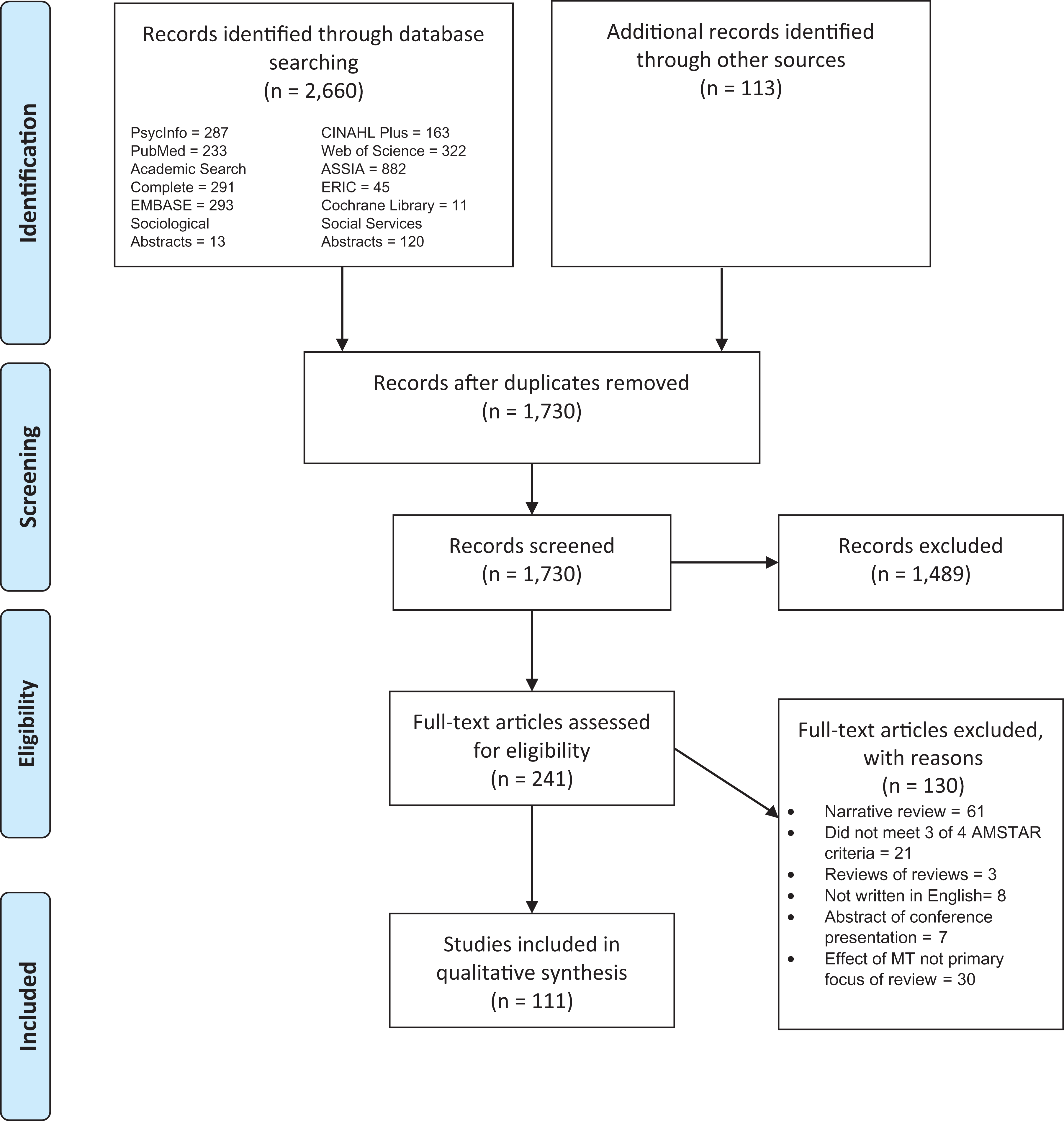
PRISMA (Preferred Reporting Items for Systematic Reviews and Meta-Analyses) flow diagram of literature search on outcomes of child abuse.
Data Extraction and Synthesis
Two research assistants were trained in using the systematic review protocol. Both independently conducted searches, study selection, data extraction, and study quality assessments. They used a data extraction and quality assessment form which included 11 AMSTAR quality assessment items and 15 study characteristics and outcome items.
The 11 AMSTAR items were described a priori design with research question and inclusion criteria; used two independent data extractors and a consensus procedure for disagreements; used a comprehensive literature search of at least two databases with appropriate search terms and years of search indicated, and manual search; searched for reports regardless of publication type and did not exclude reports based on language or publication type; provided a list of included and excluded studies; provided characteristics of included studies in a table; provided ratings of the scientific quality of studies; took the quality of studies into account in drawing conclusions and making recommendations; provided a test of homogeneity to check whether results of studies could be validly pooled, and used a random effects model if heterogeneity was present; assessed publication bias if there were more than 10 studies; and acknowledged sources of support for systematic review and included studies to indicate conflict of interest (Shea et al., 2009).
The 15 study characteristic items were main type of abuse; main outcome, data synthesis by meta-analysis or narrative review, databases searched, number of primary studies, number of participants, % prospective studies, % controlled studies, % probability sample studies, % clinical sample studies, % mainly adult samples, mean age of participants (when adjustment was assessed), % all female samples, % of female participants, and key findings. Data extracted from 111 systematic reviews and meta-analyses were tabulated and a narrative synthesis was conducted.
Interrater Agreement
Disagreements between the two research assistants were identified on the “resolve conflicts” page of Covidence, and these were resolved by discussion. Percentage agreement and Krippendorff’s α (Hayes & Krippendorff, 2007) were used to determine interrater agreement and reliability. There was a high level of interrater agreement. For screening records and full texts, agreement rates were 93% and 85%, respectively. For quality assessment, agreement rates ranged from 87% to 100% for AMSTAR items. There was 95% agreement for total AMSTAR scores, and the Krippendorff’s α value was 0.9. For data extraction agreement, rates ranged from 86% to 100% and the Krippendorff’s α values ranged from 0.76 to 1.00.
Study Quality
Forty-six (41%) reviews and meta-analyses were of high quality, with AMSTAR scores between 7 and 11. The remainder (56%) were of moderate quality. Fewer than half included pairs of raters for record screening and data extraction, searched the gray literature, provided a list of excluded studies, provided individual quality ratings of primary studies, and assessed risk of bias. Half or more described an a priori design, used a comprehensive search strategy, tabulated study characteristics, took study quality into account when drawing conclusions, tested for study homogeneity and took account of this in data analysis, and indicated conflicts of interests.
Results
The 111 papers in the review were published between 1988 and 2017. Five (5%) were published before 2000. Twenty-six (23%) were published between 2001 and 2010. Eighty (72%) were published between 2011 and 2017.
Study Design Features and Sample Characteristics
Online Supplemental Table 1 presents study design features and sample characteristics. Seventy-four (67%) papers were concerned with outcomes for a range of different types of maltreatment including physical, sexual, and emotional abuse, and physical and emotional neglect. Thirty-two (29%) papers focused mainly on sexual abuse, three (3%) mainly on physical abuse, and two (2%) mainly on neglect. There were no papers which focused mainly on emotional abuse. Twenty (18%) papers addressed physical health outcomes of maltreatment, 41 (37%) mental health outcomes, and 50 (45%) adverse psychosocial outcomes. A small number of papers (n = 7, 6%) dealt with outcomes for child abuse survivors in more than one of these three domains.
There were 46 (41%) systematic reviews and 65 (59%) meta-analyses. The number of databases searched in these studies ranged from 1 to 20 and mean was 5. In most papers (n = 87, 78%), five or fewer databases were searched. The most frequently searched database was Medline/PubMed (n = 96), followed by PsycINFO (n = 73), EMBASE (n = 46), Web of Science/Web of Knowledge (n = 24), CINAHL, (n = 21), and ERIC (n = 20).
The number of studies (k) covered in review papers included in this review ranged from 5 to 184, with a mean of 30. The total number of participants (N) within these review papers ranged from 152 to 12,819,487, with a mean of 286,566 and a median of 12,752.
The mean proportions of prospective studies, controlled studies that included samples of abuse survivors and individuals who had not been abused, studies of probability samples, and studies of clinical samples were 20%, 67%, 18%, and 47%, respectively. The proportions of studies with each of these four designs ranged from 0% to 100%. This was because some reviews included no studies with these designs, and some focused exclusively on studies with one of these particularly strong designs.
The mean proportions of studies of adult samples and child samples in reviewed papers were 61% and 39%, respectively. The proportions of studies with each of these two types of participants ranged from 0% to 100%. The mean age of samples ranged from 1½ to 45 years, with an overall mean of 25 years. The mean proportions of primary studies of all female samples and of females in primary studies were 33% and 38%, respectively. For each of these variables, proportions ranged from 0% to 100%.
Overlap in Primary Studies Included in Review Papers
In total, there were 2,534 primary studies reviewed in the 111 systematic reviews and meta-analyses included in the current review. Not all of the 2,534 primary studies were reviewed in all 111 systematic review and meta-analyses. There was a relatively small degree of overlap. The percentage of 111 review papers in which each of 2,534 primary studies was included, ranged from 0.9% to 6.3%, with a mean of 1.2%. This mean was obtained by summing the percentage of review papers in which each primary study appeared and dividing by the total number of primary studies (2,534). The percentage of 2,534 primary studies included in each of 111 review papers ranged from 0.2% to 7.2%, with a mean of 1.2%. This mean was obtained by summing the percentage of primary studies included in each review paper and dividing by the total number of review papers (111). The small degree of overlap of primary studies included in the 111 reviews has two main implications (Ballard & Montgomery, 2017). First, the 111 review papers we reviewed did not all synthesize same group of primary studies. Second, the current review of reviews is important because it summarizes in a single source, results of previous syntheses of subgroups of 2,534 primary studies.
Key Findings
Key findings from the 111 systematic reviews are given in Online Supplemental Table 2. What follows is an integrative narrative summary of findings on the adverse outcomes of child maltreatment in the domains of physical health, mental health, and psychosocial adjustment.
Physical Health Outcomes of Child Maltreatment
There were 20 systematic reviews or meta-analyses which concluded that child maltreatment was associated with negative physical health outcomes or physiological abnormalities across the life span. Four meta-analyses and one systematic review, which focused on general physical health, showed that there were significant associations between a history of various types of child maltreatment and a range of physical health problems including neurological, musculoskeletal, respiratory, cardiovascular, gastrointestinal, gynecological, genitourinary, metabolic, sleep, and psychosomatic disorders as well as a variety of pain conditions (Fry et al., 2012; Irish, Kobayashi, & Delahanty, 2010; Norman et al., 2012; Paras et al., 2009; Wegman & Steltler, 2009). Two systematic reviews and two meta-analyses found significant associations between a history of child maltreatment and risk of developing specific conditions including diabetes (Huang et al., 2015), chronic pain (Davis, Luecken, & Zautra, 2005), fibromyalgia (Häuser, Kosseva, Uceyler, Klose, & Sommer, 2011), and cancer (Holman et al., 2016). Four meta-analyses and five systematic reviews, which were concerned with abnormalities in the structure and/or functioning of the brain and endocrine system, showed that there were significant associations between a history of child maltreatment and reduced hippocampal and amygdala volumes (especially where adult survivors had post-traumatic stress disorder [PTSD]), amygdala hyperactivation to faces expressing emotions, abnormalities in the structure of the prefrontal cortex, and dysregulation of the hypothalamic–pituitary–adrenal (HPA) axis (Ahmed-Leitao, Spies, van den Heuvel, & Seedat, 2016; Bernard, Frost, Bennett, & Lindhiem, 2017; Bicanic et al., 2007; Frodl & O’Keane, 2013; Hein & Monk, 2017; Hulme, 2011; Lim, Radua, & Rubia, 2014; Paquola, Bennett, & Lagopoulos, 2016; Woon & Hedges, 2008). These physical abnormalities in the structure and functioning of the brain and endocrine system may subserve adverse mental health outcomes of abuse survivors. One meta-analysis and one systematic review concluded that there was a significant association between a history of child maltreatment and a pro-inflammatory state in adulthood, suggesting a potential molecular pathway by which child maltreatment confers vulnerability to physical and mental health problems in adulthood by reducing the efficiency of the immune system (Baumeister, Akhtar, Ciufolini, Pariante, & Mondelli, 2016; Coelho, Viola, Walss-Bass, Brietzke, & Grassi-Oliveira, 2014).
Critical Findings.

Implications for Policy, Practice, and Research.
The association between maltreatment and physical health outcomes was moderated by gender, age, and type of maltreatment. Females had poorer general health outcomes than males (Wegman & Steltler, 2009). Adult, but not child survivors of maltreatment, showed reduced hippocampal volume (Woon & Hedges, 2008). Older males with depression and other mental health problems showed greater gray matter abnormalities in prefrontal–limbic brain regions than younger people or females without significant mental health problems (Paquola et al., 2016). The risk of diabetes was greater in survivors of neglect than survivors of physical or sexual abuse (Huang et al., 2015). In two meta-analyses, particularly strong associations were found between sexual abuse and pelvic pain or gynecological problems, and gastrointestinal problems (Irish et al., 2010; Paras et al., 2009).
Mental Health Outcomes of Child Maltreatment
There were 45 systematic reviews and meta-analyses which concluded that child maltreatment was associated with negative mental health outcomes across the life span.
Seven meta-analyses and six systematic reviews, each of which was concerned with a wide range of general mental health problems and disorders, concluded that there was a significant association between child maltreatment including physical, sexual, and emotional abuse and neglect and some or all of the following conditions: PTSD, dissociative disorders, anxiety disorders, depression, bipolar disorder, substance use disorders, eating disorders, psychotic disorders, disruptive behavior disorders, and personality disorders (Amado et al., 2015; Carr et al., 2013; Chen et al., 2010; Fry et al., 2012; Ip et al., 2016; Jumper, 1995; Martins, de Carvalho Tofoli, Von Werne Baes, & Juruena, 2011; Matheson, Shepherd, Pinchbeck, Laurens, & Carr, 2013; Norman et al., 2012; Paolucci, Genuis, & Violato, 2001; Schneeberger, Dietl, Muenzenmaier, Huber, & Lang, 2014; Spies et al., 2012; Weich, Patterson, Shaw, & Stewart-Brown, 2009).
Across these seven meta-analyses and six systematic reviews, there was no clear pattern of associations between specific types of maltreatment and specific mental health outcomes. Findings on moderators of the association between maltreatment and general mental health outcomes were not consistent across reviews. For example, Paolucci, Genuis, and Violato (2001) found that gender and type of sexual abuse did not moderate the effects of child sexual abuse on adult adjustment. In contrast, Amado, Arce, and Herraiz (2015) found that gender and type of sexual abuse moderated the effects of child sexual abuse on adult adjustment, with females and survivors of penetrative sexual abuse having higher rates of depressive and anxiety disorders than males and survivors of noncontact abuse.
Depression
Five meta-analyses and three systematic reviews, with a predominant focus in depression, found a significant association between a history of child maltreatment and depression, including perinatal depression, in adulthood (Alvarez-Segura et al., 2014; Choi & Sikkema, 2016; Li, D’Arcy, & Meng, 2016; Lindert et al., 2014; Mandelli, Petrelli, & Serretti, 2015; Nanni, Uher, & Danese, 2012; Nelson, Klumparendt, Doebler, & Ehring, 2017; Wosu, Gelaye, & Williams, 2015). Compared with normal controls, survivors of child maltreatment had double the risk of developing depression, developed depression earlier in their lives, were less responsive to treatment, and were at increased risk of chronic depression.
Surviving multiple forms of severe abuse, especially sexual and emotional abuse, increased the risk of developing depression, particularly in females (Li et al., 2016; Mandelli et al., 2015; Nelson et al., 2017). Borderline personality disorder, which involves significant dysphoria, was also found in a meta-analysis to have a significant association with child maltreatment in adolescents (Winsper et al., 2016).
Anxiety
In two meta-analyses that focused predominantly on depression and anxiety, there was a significant association between recollections of any type of child maltreatment and anxiety disorders (Li et al., 2016; Lindert et al., 2014). Child maltreatment doubled the risk of developing an anxiety disorder in adulthood.
Bipolar disorder
Two meta-analyses and three systematic reviews which focused predominantly on bipolar disorder found a significant association between child maltreatment including physical, sexual, and emotional abuse and neglect and both the occurrence of bipolar disorder and an unfavorable clinical course for those who developed this condition (Agnew-Blais & Danese, 2016; Daruy-Filho, Brietzke, Lafer, & Grassi-Oliveira, 2011; Maniglio, 2013a, 2013b; Palmier-Claus, Berry, Bucci, Mansell, & Varese, 2016). An unfavorable clinical course for bipolar disorder was characterized by early onset, delay in diagnosis and treatment, rapid cycling pattern, severe manic and depressive symptoms, psychotic symptoms, comorbid substance use disorder and PTSD, and suicidality. There was a particularly strong association between emotional abuse and the occurrence of bipolar disorder (Palmier-Claus et al., 2016) and between physical abuse and an unfavorable clinical course (Daruy-Filho et al., 2011).
Psychosis
Two meta-analyses and two systematic reviews focused predominantly on psychosis (Bendall, Jackson, Hulbert, & McGorry, 2008; Trotta, Murray, & Fisher, 2015; Varese et al., 2012; Velikonja, Fisher, Mason, & Johnson, 2015). The earliest of these reviews drew no firm conclusions due to the methodological limitations of available evidence. In the three more recent papers, it was concluded that there was a significant association between child maltreatment including physical, sexual, and emotional abuse and neglect, on the one hand, and psychosis, first episode psychosis, and schizotypy in adulthood on the other. Schizotypy is genetic vulnerability to psychosis that falls on a continuum between healthy functioning and severe mental health problems including schizophrenia. There was a particularly strong association between emotional abuse and psychosis (Varese et al., 2012).
Eating disorders and obesity
Six meta-analyses and two systematic reviews which focused predominantly on eating disorders concluded that there was a significant association between these conditions in adolescence and adulthood and various types of child maltreatment including physical, sexual, and emotional abuse and neglect (Caslini et al., 2016; Danese, 2014; Hemmingsson, Johansson, & Reynisdottir, 2014; Irish et al. 2010; Midei & Matthews, 2011; Pignatelli, Wampers, Loriedo, Biondi, & Vanderlinden, 2017; Smolak & Murnen, 2002; Wang, Wu, Yang, & Song, 2015). In this context, eating disorders include bulimia nervosa, binge eating disorder, anorexia nervosa, and obesity. In three of the four reviews, there was a particularly strong association between emotional abuse and eating disorders (Caslini et al., 2016; Hemmingsson et al., 2014; Pignatelli et al., 2017; Wang et al., 2015).
Alcohol and drug use disorders
One meta-analysis and four systematic reviews, which focused predominantly on alcohol and drug use disorders, concluded that there was a significant association between various features of these conditions in adolescence and adulthood and child maltreatment (Butt, Chou, & Browne, 2011; Draucker & Mazurczyk, 2013; Kristman-Valente & Wells, 2014; Langeland & Hartgers, 1998; Tonmyr, Thornton, Draca, & Wekerle, 2010). Child maltreatment, including physical and sexual and neglect, was associated with earlier onset and more harmful patterns of substance use.
Nonepileptic seizures
In two meta-analyses, there was a significant association between child sexual abuse and nonepileptic seizures in adulthood (Paras et al., 2009; Sharpe & Faye, 2006).
Adverse Psychosocial Outcomes of Child Maltreatment
Fifty-five systematic reviews and meta-analyses concluded that child maltreatment was associated with a wide range of negative psychosocial outcomes across the life span including deficits in cognitive functioning, language delay, insecure attachment, school attainment problems, antisocial behavior and aggression, sexual aggression, risky sexual behavior, parenting problems, self-harm and suicide, and deficits in a range of other areas of psychosocial functioning that impact on quality of life.
Cognitive functioning deficits
In one meta-analysis and three systematic reviews predominantly concerned with cognition, it was concluded that there was a significant association between child maltreatment and impaired cognitive functioning (Irigaray et al., 2013; Maguire et al., 2015; Masson, East-Richard, & Cellard, 2016; Veltman & Browne, 2001). In childhood, adolescence, and adulthood, child maltreatment was associated with deficits in global cognitive functioning as indexed by IQ, and also with specific deficits, particularly in the areas of memory and executive functions. Exposure to severe maltreatment and multiple types of maltreatment for long periods of time was associated with greater deficits (Irigaray et al., 2013). The impact of a combination of maltreatment and the presence of psychiatric disorders (mainly PTSD) on cognitive functioning was greater in childhood than in adulthood (Masson et al., 2016).
Language delay
In two meta-analyses and one systematic review, it was concluded that there was a significant association between child maltreatment and delayed development of language in childhood, particularly expressive skills (Lum, Powell, Timms, & Snow, 2015; Sylvestre, Bussieres, & Bouchard, 2016; Veltman & Browne, 2001). The association between maltreatment and language skills was moderated by age, with younger children showing greater language delays (Sylvestre et al., 2016).
Insecure attachment
In two meta-analyses, it was concluded that maltreated infants and toddlers under 4 years of age were significantly more likely to have an insecure attachment style than normal controls (Baer & Martinez, 2006; Cyr, Euser, Bakermans-Kranenburg, & Van Ijzendoorn, 2010). The infants in these studies were being parented by young disadvantaged mothers and had experienced physical or emotional abuse or neglect.
School attainment problems
In one meta-analysis and three systematic reviews, it was concluded that there was a significant association between child maltreatment, including emotional abuse and neglect, and school attainment problems (Barbosa Pacheco, Irigaray, Werlan, Tiellet Nunes, & de Lima Argimon, 2014; Maguire et al., 2015; Paolucci et al., 2001; Veltman & Browne, 2001). Significantly, more maltreated children and adolescents and adult survivors of child abuse had school attainment problems compared with normal controls.
Antisocial behavior and aggression
In four meta-analyses and four systematic reviews, it was concluded that there was a significant association between child maltreatment, on the one hand, and antisocial behavior and aggression in childhood, adolescence, and adulthood on the other (Braga, Gonçalves, Basto-Pereira, & Maia, 2017; Byrd & Manuck, 2014; Fry et al., 2012; Maas, Herrenkohl, & Sousa, 2008; Maniglio, 2014, 2015; Norman et al. 2012; Wilson et al., 2009). Compared with normal controls, more adolescent and adult maltreatment survivors engaged in antisocial behavior and aggression, especially if they had been exposed to multiple forms of severe maltreatment (Braga et al., 2017; Maas et al., 2008; Maniglio, 2014, 2015; Wilson et al., 2009). In a Gene × Environment interaction, child maltreatment was more strongly associated with antisocial behavior in the low-activity, relative to high-activity MAOA genotype (Byrd & Manuck, 2014). MAOA is the gene encoding monoamine oxidase A which preferentially deaminates the neurotransmitters, serotonin, and norepinephrine, which subserve the expression of aggression.
Sexual aggression
In three meta-analyses and four systematic reviews, there was a significant association between child maltreatment and sexual aggression in adolescence and adulthood (Fry et al., 2012; Hanson & Slater, 1988; Jespersen, Lalumiere, & Seto, 2009; Maas et al., 2008; Mallie, Viljoen, Mordell, Spice, & Roesch, 2011; Paolucci et al., 2001; Smith–Marek et al., 2015). Compared with normal controls, significantly more survivors of physical and sexual abuse sexually abused others or engaged in intimate partner violence. A history of child sexual abuse was associated with perpetration of sexual abuse in adolescence and adulthood (Hanson & Slater, 1988; Jespersen et al., 2009; Mallie et al., 2011; Paolucci et al., 2001). A history physical abuse was associated with intimate partner violence in adulthood (Maas et al., 2008; Smith-Marke et al., 2015). There was also a significant association between physical child abuse and victimization in adulthood through intimate partner violence, especially for females (Smith-Marke et al., 2015).
Risky sexual behavior
In eight meta-analyses and five systematic reviews, it was concluded that there was a significant association between child maltreatment, especially child sexual abuse, and risky sexual behavior in adolescence and adulthood (Abajobir, Kisely, Maravilla, Williams, & Najman, 2017; Arriola, Louden, Doldren, & Fortenberry, 2005; Draucker & Mazurczyk, 2013; Fry et al., 2012; Homma et al., 2012; Lloyd & Operario, 2012; Madigan, Wade, Tarabulsy, Jenkins, & Shouldice, 2014; Noll, Shenk, & Putnam, 2009; Norman et al., 2012; Paolucci et al., 2001; Schneeberger et al., 2014; Senn, Carey, & Vanable, 2008; Spies et al., 2012). In this context, risky sexual behavior included earlier age of first intercourse, having an older first sex partner, unprotected sex, sex with multiple partners, sex with strangers, more bisexual relationships, multiperson sex, sex while intoxicated, sex trading, and sexual revictimization. There was also a significant association between child sexual abuse and adverse outcomes of risky sexual behavior including STD or HIV infection and unplanned teenage pregnancy involvement. The association between child sexual abuse and risky sexual behavior was stronger where sexual abuse was severe, prolonged, involved multiple perpetrators, and was accompanied by physical abuse (Draucker & Mazurczyk, 2013; Madigan et al., 2014).
Parenting problems
In four systematic reviews, there was evidence for a significant association between a history of child maltreatment and parenting problems (Hughes & Cossar, 2016; Hugill, Berry, & Fletcher, 2017; Thornberry, Knight, & Lovegrove, 2012; Vaillancourt, Pawlby, & Fearon, 2017). In this context, parenting problems covered a broad spectrum, ranging from experiencing greater parenting stress than normal controls, through lack of sensitivity to children’s cues, to engaging in abusive parenting practices. The association between child maltreatment and problematic parenting, in some instances, was mediated by maternal depression and stress reactivity (Hugill et al., 2017; Vaillancourt et al., 2017).
Self-harm and suicidality
In five meta-analyses and six systematic reviews, there was a significant association between child maltreatment and self-harming or suicidal phenomena in adolescents and adults (Chen et al., 2010; Devries et al., 2014; Evans, Hawton, & Rodham, 2005; Fry et al., 2012; Klonsky & Moyer, 2008; Miller, Esposito-Smythers, Weismoore, & Renshaw, 2013; Mironova et al., 2011; Norman et al., 2012; Paolucci et al., 2001; Rhodes et al., 2011; Schneeberger et al., 2014). In this context, self-harming and suicidal phenomena refer to a broad spectrum of activity including nonsuicidal self-harm (such as self-inflicted cuts or burns), suicidal ideation, and attempted suicide. Survivors of multiple forms of severe maltreatment were more likely to engage in self-harm or suicidal phenomena (Miller et al., 2013; Mironova et al., 2011). The association between child maltreatment and suicidal phenomena in some instances was mediated by low self-esteem (Evans et al., 2005). The association between sexual and physical abuse and suicide attempts was stronger for males than females in some reviews (Miller et al., 2013; Rhodes et al., 2011) but not others (Klonsky & Moyer, 2008).
Other psychosocial outcomes
In 5 meta-analyses and 10 systematic reviews, it was concluded that there were significant associations between child maltreatment and a range of psychosocial outcomes not previously mentioned above. Child maltreatment was associated with deficits in emotion understanding, recognition, and knowledge (Benarous, Guile, Consoli, & Cohen, 2015; da Silva Ferreira, Crippa, & de Lima Osório, 2014; Luke & Banerjee, 2013) and the development of negative personality traits (Khaleque, 2015) in childhood and adolescence. In adulthood, child maltreatment was associated with occupational adjustment problems (de Jong, Alink, Bijleveld, Finkenauer, & Hendriks, 2015) and gambling problems mediated by mental health difficulties (Lane et al., 2016). Across the life span, child maltreatment was associated with sleep problems (Steine et al., 2012), low self-esteem (Barbosa Pacheco et al., 2014; Khaleque, 2015), interpersonal dependency (Bornstein et al., 2005), poor adjustment within family and peer relationships (Barbosa Pacheco et al., 2014; de Jong et al., 2015; Naughton et al., 2013; Rind & Tromovitch, 1997; Rind, Tromovitch, & Bauserman, 1998), and negative quality of life (de Jong et al., 2015; Spies et al., 2012; Weber et al., 2016). On the positive side, factors associated with resilience among survivors of child sexual abuse included social support from the family and the wider network and positive engagement in education (Domhardt, Munzer, Fegert, & Goldbeck, 2015). Other protective factors included interpersonal and emotional competence, active coping, optimism, a belief in the capacity to control one’s life, and blaming the perpetrator rather than the self for sexual abuse.
Discussion
The main research question we addressed in this article was: What outcomes in the areas of physical and mental health and psychosocial adjustment are associated with the experience of noninstitutional child maltreatment (including physical, sexual, and emotional abuse, and physical and emotional neglect)? To answer this question, we conducted a systematic review of previous systematic reviews and meta-analyses to synthesize all available evidence in this field that was of a reasonably high quality. A synthesis of our principal findings is outlined below.
Physical health outcomes
Child maltreatment was associated with an exceptionally wide range of physical health problems and a pro-inflammatory state associated with reduced immune system efficiency which may underpin many of these difficulties. Health problems associated with maltreatment included neurological, musculoskeletal, respiratory, cardiovascular, gastrointestinal, gynecological, genitourinary, metabolic, sleep, and psychosomatic disorders as well as a variety of pain conditions and increased risk of developing diabetes and cancer. Females had poorer general health outcomes than males. There were particularly strong associations between sexual abuse and pelvic pain or gynecological problems, and gastrointestinal problems. Adult survivors of child maltreatment also had significant abnormalities in the structure and functioning of the brain and endocrine system, possibly associated with mental health problems. These abnormalities were not present in children. The evidence suggests that child maltreatment initiates problematic neurobiological changes which develop into significant abnormalities as children mature into adulthood.
Mental health outcomes
Child maltreatment was associated with an exceptionally wide range of mental health problems. These included disruptive/aggressive behavior disorders, substance use disorders, and eating disorders in childhood and adolescence. They also included PTSD, anxiety disorders, depression, bipolar disorder, psychotic disorders, dissociative disorders, psychosomatic disorders, and personality disorders in adulthood. Child maltreatment was associated with an unfavorable clinical course for some conditions, notably depression and bipolar disorder. Surviving multiple forms of severe maltreatment, and emotional abuse in particular, was associated with more severe mental health problems in adulthood. There was a strong association between emotional abuse and the occurrence of bipolar disorder, psychosis, and eating disorders.
Adverse psychosocial outcomes
Child maltreatment was associated with a wide range of negative psychosocial outcomes which first appeared in childhood, and some persisted into adulthood. These included deficits in cognitive functioning, language development, and school attainment; deficits in emotion understanding, recognition, and knowledge; insecure attachment and relationship problems; and the development of negative personality traits. Child maltreatment was also associated with problems that tended to come to the fore in adolescence or early adulthood including sexual aggression, risky sexual behavior, parenting problems, occupational adjustment problems, gambling, self-harm, and suicide. Across the life span, child maltreatment was associated with sleep problems, poor adjustment within the family and peer group, and a negative quality of life. There was some degree of specificity in the links between types of abuse and later adjustment problems. Risky sexual behavior was strongly associated with a history of child sexual abuse, and aggression was strongly associated with a history of physical abuse. However, the more marked pattern in the evidence was the association between poorer psychosocial outcomes and exposure to multiple types of severe and prolonged child maltreatment.
Limitations
While robust, the conclusions of our review should be tempered by a consideration of its limitations. The validity of our conclusions was constrained by the scientific quality of the studies on which they are based. While 41% of reviews and meta-analyses in our review of reviews were of high quality, with AMSTAR scores between 7 and 11, the AMSTAR scores of the 59% indicated that they were only of moderate quality. The mean proportion of prospective studies in reviews and meta-analyses considered in this article was only 20%, with the remainder (80%) being cross-sectional. This limits the degree to which a definitive causal link between maltreatment and outcomes may be inferred. However, it is very highly probable that child maltreatment accounted for adverse outcomes in adulthood. In primary studies of systematic reviews and meta-analyses which we reviewed, there was variability in definitions of what exactly constituted different types of maltreatment (physical, sexual, and emotional abuse and neglect), and in the way, various outcome variables (physical and mental health disorders and various aspects of psychosocial adjustment) were assessed. This, to some degree, affected the validity of our conclusions. Few primary studies assessed protective factors associated with resilience, and only one review (Domhardt et al., 2015) addressed this issue. The range of countries in which primary studies were conducted and associated cultural, and socioeconomic differences that may affect child protection (Conte, 2014) were not reported in many reviews. On the positive side, our review was methodologically robust and comprehensive. These strengths allow confidence to be placed in our conclusions.
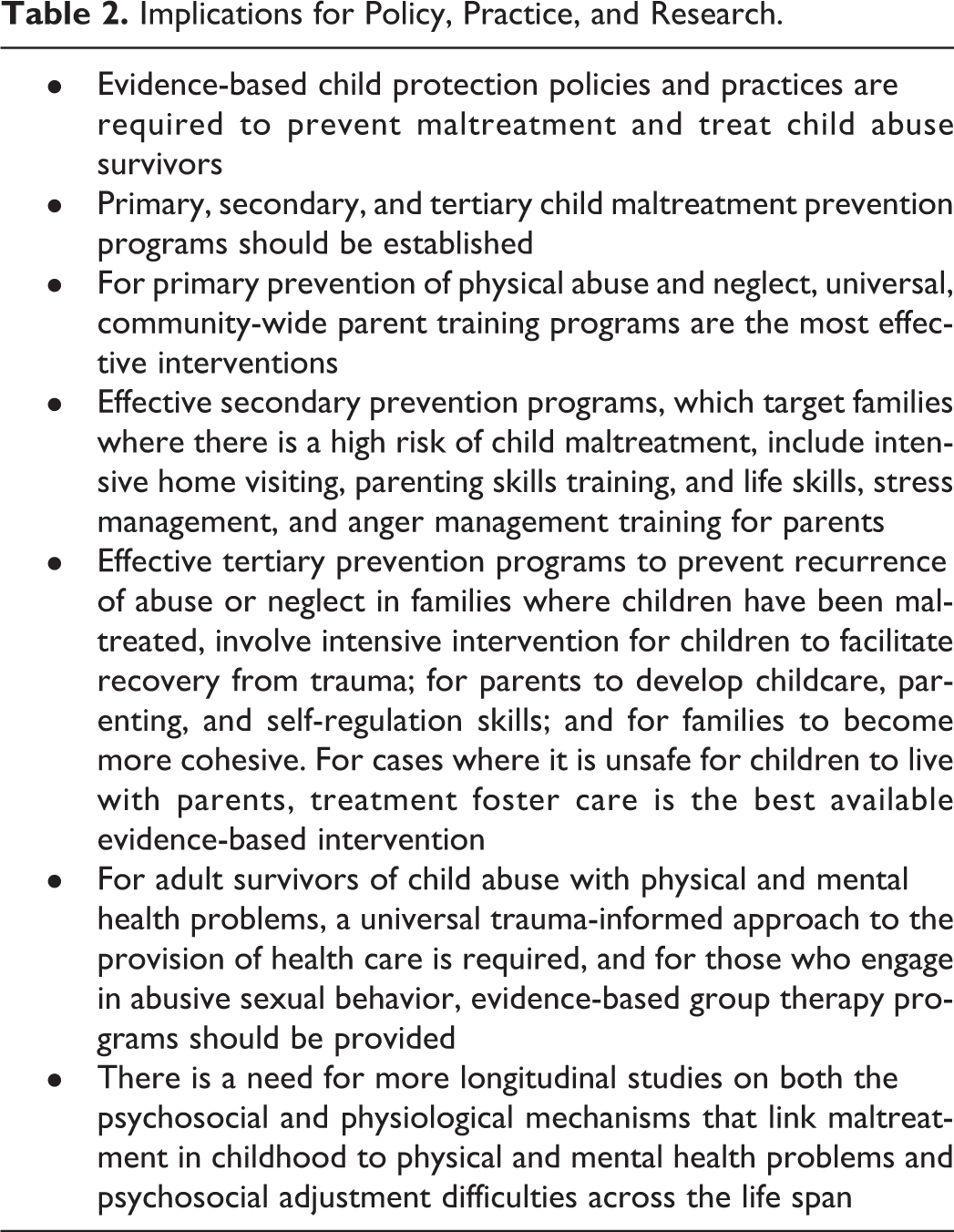
Implications for Policy and Practice
The many adverse outcomes associated with child maltreatment documented in this review highlight the importance of implementing evidence-based child protection policies and practices to prevent maltreatment and treat child maltreatment survivors. The main policy implication of our review is that primary, secondary, and tertiary child maltreatment prevention programs should be established (Scott, Lonne, & Higgins, 2016). With regard to primary prevention, for physical abuse, universal, community-wide parent training programs, for example, Triple P (Sanders & Pidgeon, 2014), have a strong evidence base (Chen & Chan, 2016; Coore Desai, Reece, & Shakespeare-Pellington, 2017). Universal school-based safety skills programs are the main evidence-based primary prevention interventions for sexual abuse (Mikton & Butchart, 2009).
Secondary prevention programs target families in which there is a high risk of child maltreatment, for example, young, disadvantaged families, or families of children with disabilities. Key elements of such programs include early intervention with at-risk parents, home visiting, parenting skills training, and life skills, stress management, and anger management training for parents. Intensive home visiting programs, for example, the Nurse Family Partnership (Olds et al., 2009), have the strongest evidence base in this domain (MacMillan et al., 2009; Mikton & Butchart, 2009).
Tertiary prevention programs to prevent recurrence of abuse or neglect in families where children have been maltreated involve intensive intervention to help children recover from trauma; for parents to develop childcare, parenting, and self-regulation skills; and for families to become more cohesive (Carr, 2017; McMillan et al., 2009). For cases where it is unsafe for children to live with parents, treatment foster care is the best available evidence-based intervention (Schelbe, Gieger, Boel-Studt, & Julien-Chinn, 2018).
For adult survivors of child abuse with physical and mental health problems, a universal trauma-informed approach to the provision of health care is required, since this alerts health-care professionals to the possibility that presenting problems may be trauma-related and therefore require this to be taken into account when offering research-informed interventions (Hanson et al., 2018). For those who engage in abusive sexual behavior, evidence-based group therapy programs may be provided (Walton & Chou, 2015).
Implications for Future Research
The small number of longitudinal studies, essential for establishing causal links between maltreatment and outcomes for abuse survivors, underlines the importance of conducting more prospective studies. Research on the physiological and psychosocial mechanisms that link child maltreatment with physical and mental health problems and psychosocial adjustment difficulties across the life span is at an early stage of development. Our review points to a number of areas in this domain deserving investigation. With regard to physiological processes, it would be useful to investigate the mechanisms by which child abuse triggers a pro-inflammatory state associated with reduced immune system efficiency (Coelho et al., 2014) and the link between this and the range of physical health problems shown by maltreatment survivors. It would also be valuable to investigate the process though which child maltreatment leads to abnormalities in the development and functioning of the hippocampus, amygdala, prefrontal cortex, and HPA axis, and the way in which these abnormalities are linked to the wide range of mental health disorders shown by abuse survivors (Hulme, 2011; Paquola et al., 2016; Woon & Hedges, 2008). With regard to psychosocial processes, it would be informative to investigate the mechanisms by which maltreatment leads to problems with the development of secure attachments, cognitive skills, language, and emotional understanding in early life, and how these in turn lead to adult mental health disorders, relationship problems, parenting difficulties, and occupational adjustment problems. In this type of research, it would be valuable to focus on the role of protective factors such as cultural and socioeconomic support for child protection at a national level (Conte, 2014), the availability of socially supportive relationships and engagement in education at a community level, and personal competencies (Domhardt et al., 2015) in preventing adult adjustment problems and promoting post-traumatic growth (Elderton, Berry, & Chan, 2017).
Supplemental Material
Supplemental Material, Online_Supplemental_Archive_801334 - A Systematic Review of Reviews of the Outcome of Noninstitutional Child Maltreatment
Supplemental Material, Online_Supplemental_Archive_801334 for A Systematic Review of Reviews of the Outcome of Noninstitutional Child Maltreatment by Alan Carr, Hollie Duff and Fiona Craddock in Trauma, Violence, & Abuse
Supplemental Material
Supplemental Material, Online_Supplemental_Material_801334 - A Systematic Review of Reviews of the Outcome of Noninstitutional Child Maltreatment
Supplemental Material, Online_Supplemental_Material_801334 for A Systematic Review of Reviews of the Outcome of Noninstitutional Child Maltreatment by Alan Carr, Hollie Duff and Fiona Craddock in Trauma, Violence, & Abuse
Footnotes
Declaration of Conflicting Interests
The author(s) declared no potential conflicts of interest with respect to the research, authorship, and/or publication of this article.
Funding
The author(s) disclosed receipt of the following financial support for the research, authorship, and/or publication of this article: This work was supported by the Scottish Child Abuse Inquiry.

Supplemental Material
Supplemental material for this article is available online.
References
Supplementary Material
Please find the following supplemental material available below.
For Open Access articles published under a Creative Commons License, all supplemental material carries the same license as the article it is associated with.
For non-Open Access articles published, all supplemental material carries a non-exclusive license, and permission requests for re-use of supplemental material or any part of supplemental material shall be sent directly to the copyright owner as specified in the copyright notice associated with the article.
