



Abstract
It is well-documented that insecure attachment poses substantial risks to post-trauma recovery. Although attachment anxiety reliably predicts and is associated with elevated post-traumatic stress symptoms (PTSS), the attachment avoidance–PTSS link has been far less consistent. This suggests both attenuating and enhancing connections between attachment difficulties and post-trauma outcomes. The goal of this study is 2-fold: (a) to review and summarize extant evidence concerning the relation between insecure attachment and PTSS and (b) to review mechanism(s) underlying attachment anxiety and attachment avoidance that may explain the development of PTSS. Following a systematic review of the empirical literature investigating attachment, trauma, and post-trauma reactions, a total of 138 studies were identified and summarized. The review further identifies explanatory mechanisms underlying the association between insecure attachment and PTSS, including stress appraisals, cognitive factors, self-esteem, emotion regulation strategies, social factors, and trauma-specific factors (i.e., type of trauma, extreme stress). Implications for practice, policy, and research are discussed.
Early relationships with caregivers help shape our interpersonal expectations. These initial bonds set into motion automatic, and often unconscious, processes that provide the foundation for schemas that outline how we relate to others throughout our lives. Internalized interpersonal schemas and expectations can, however, be affected by traumatic stressors, particularly traumas committed at the hands of another human being and/or loved one. Traumatic events may impair attachment processes and result in psychopathology, particularly post-traumatic stress disorder (PTSD). This systematic review examines the association between insecure attachment and post-traumatic stress symptoms (PTSS). Further, mechanisms that explain the association between attachment difficulties and PTSS are identified and discussed.
Attachment Theory
The attachment framework posits that the formation of secure or close emotional bonds between individuals and their primary caregivers increases the chances of survival and sustains human development (Bowlby, 1969/1982). A secure attachment style is typically fostered by warm, sensitive caregivers. In contrast, insensitive, inconsistent, or rejecting parenting can result in an insecure attachment style (Bowlby, 1969/1982). These early attachment experiences are internalized over time and lead to the development of working models of the self and others. These schemas also influence one’s affect regulation, cognitions, behavior, and personality development throughout the life span (Fraley & Shaver, 2000).
Ainsworth, Blehar, Waters, and Wall (1978) first classified infants into secure attachment, insecure anxious attachment, and insecure avoidant attachment. The three-category taxonomy was later applied to other human behaviors including romantic love (Hazan & Shaver, 1987). Adult attachment signifies interpersonal schemata of romantic relationships and includes one’s beliefs about the availability and responsiveness of partners and predicts behaviors in relationships (Brennan, Clark, & Shaver, 1998). Seminal research (e.g., Brennan et al., 1998) suggests that secure attachment is characterized by a positive regard for self and others and comfort with both intimacy and autonomy. Conversely, insecure anxious attachment is associated with fears of abandonment and frequent reassurance seeking in intimate relationships, while insecure avoidant attachment is related to distrust, self-sufficiency, and diminished pursuit of engagement or intimacy with others, which is often perceived by others as aloof or emotionally distant (Brennan et al., 1998; Hazan & Shaver, 1987). Another widely used adult attachment taxonomy was proposed by Bartholomew and Horowitz (1991). The four attachment prototypes similarly map onto the anxiety-avoidance dimensions: secure attachment (low anxiety, low avoidance), preoccupied attachment (high anxiety, low avoidance), dismissing-avoidant attachment (low anxiety, high avoidance), and finally fearful-avoidant attachment (high anxiety, high avoidance; Bartholomew & Horowitz, 1991). Insecure adult attachment has been linked with a host of negative outcomes, including risk of PTSD or PTSS following trauma (see meta-analysis by Woodhouse, Ayers, & Field, 2015).
Insecure Attachment and Psychopathology Following Trauma Exposure
In response to distressing events, attachment orientations may shape individuals’ perceptions and reactions (e.g., intensifying negative emotional states or distancing self from emotional situations). Trauma may lead to the mobilization of internal and external resources for coping with stress, and thus, attachment orientations may play a significant role in vulnerability to post-traumatic stress. Difficulties commonly observed among insecure individuals include interpersonal relatedness, affect regulation, help-seeking, and stress management (e.g., Cook et al., 2005), which can impact trauma recovery and enhance vulnerability for PTSD. A meta-analysis by Woodhouse, Ayers, and Field (2015) produced a much-needed statistical analysis of the association between insecure attachment and PTSS. The authors found modest population effect sizes for both attachment anxiety (p̂ = .26) and attachment avoidance (p̂ = .24) in predicting PTSS, though they noted several studies returned an effect size of .0 for the latter. Fearful attachment showed the largest effect size (p̂ = .44), followed by preoccupied attachment (p̂ = .31), and lastly, a nonsignificant effect size for dismissing attachment (p̂ = .16). Differentiation between manifestations of insecure attachment and understanding their unique role in PTSS remains of critical empirical importance. Given the consistent association between insecure attachment and PTSS, it is imperative to understand the mechanisms underlying insecure attachment that yield risk of developing PTSS.
Research has clearly demonstrated that many types of insecure attachment negatively impact post-trauma mental health. Identifying mechanism(s) that might explain how attachment styles influence post-trauma reactions is crucial to inform related psychological interventions, given that insecure attachment, being a distal factor, may be less amenable to interventions. We hope to achieve two goals in this article: (a) to systematically review and summarize extant evidence on the relation between insecure attachment and PTSS and (b) to review mechanism(s) underlying the association between attachment anxiety and attachment avoidance and PTSS.
Method
A systematic review of the empirical literature investigating attachment, trauma, and post-trauma reactions was conducted. Consistent with prior systematic reviews (e.g., Capaldi, Knoble, Shortt, & Kim, 2012), the search strategy was as follows. First, a combined search term of “attachment” and “PTSD or post-traumatic stress disorder or post-traumatic” was used to examine abstracts within the PsycINFO, PubMed, and Social Service Abstracts databases in January 2018 and again in July 2018. The search strategy involved a two-stage process of screening abstracts and reviewing remaining, potentially relevant articles. The search returned a total of 1,989 peer-reviewed records. We also consulted Woodhouse et al. (2015) and article reference lists to identify six additional studies.
After removing duplicate papers and non-English papers, 1,555 publications were retained and screened. Three reviewers independently assessed the suitability of these retrieved articles for use in the current article. The abstracts were read in detail and/or the full article was accessed to exclude nonoriginal papers (e.g., conceptual papers) and qualitative studies. Of the 1,555 articles, 805 were retained based on these criteria (see Figure 1 for a preferred reporting items for systematic reviews and meta-analyses [PRISMA] diagram). Next, the authors independently abstracted study data and conclusions to verify that the article met the predefined inclusionary criteria: (a) included a sample in which all participants had exposure to trauma, (b) assessed the variables of interest (i.e., attachment, PTSS, and trauma), and (c) examined the association between attachment and PTSS. While stressful events may be perceived as traumatic (e.g., bereavement studies, cancer studies), for consistency and clarity, trauma was conceptualized in the present review in accordance to the Diagnostic and Statistical Manual (DSM) Criterion A definition (i.e., “exposure to actual or threatened death, serious injury, or sexual violence,” p. 271; American Psychiatric Association, 2013). A small number of discrepancies were resolved through discussion and consensus. The entire search process yielded 138 studies that met inclusion criteria.
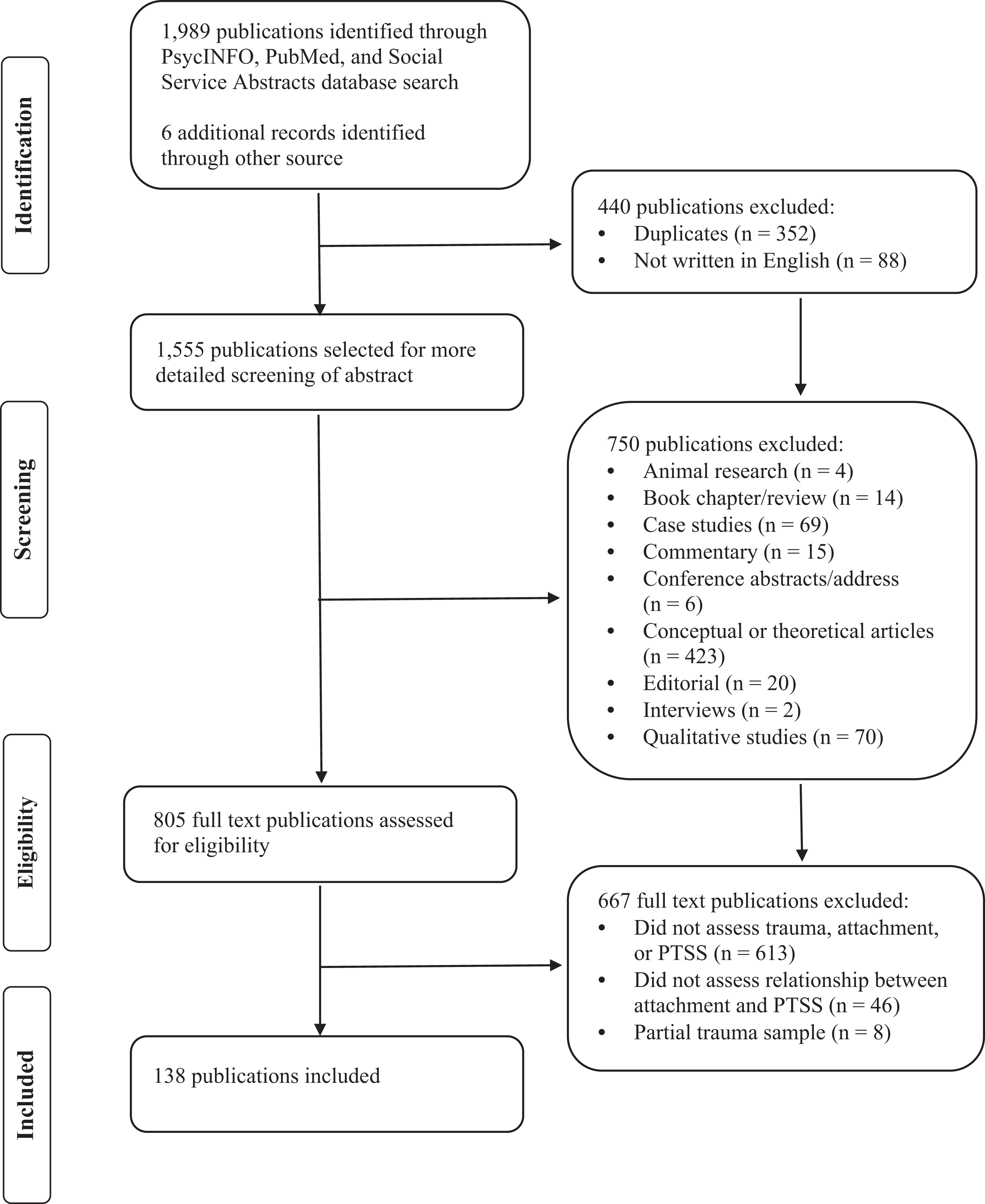
PRISMA diagram for systematic review.
To assess study quality, each author independently scored the 138 articles using the Quality Assessment Tool developed by the National Institute of Health (https://www.nhlbi.nih.gov/health-topics/study-quality-assessment-tools) and provided a final rating of “poor,” “fair,” or “good” for each article based on ratings across criteria. The third author collected the independent ratings for comparison and consensus. Initial ratings failed to achieve consensus in 16 of the 138 cases (11.5%). In those cases, the third author returned to the articles to identify areas of discordance across criteria among the authors. In all cases, this resulted in corrections to the original scores and consensus among the authors. In all cases of discordance, quality ratings were ultimately placed in a stronger quality category as a result of this process.
Results
Descriptive Results
A detailed description of the name of the author(s), publication year, trauma type, sample characteristics, measures, and the main findings for the 138 studies can be found in Online Supplemental Table 1.
Publication Year, Sample Characteristics, Trauma Types, and Measures
As seen in Online Supplemental Table 1, the year of publication ranged from 1993 to 2018 and included sample sizes ranging from 22 to 3,735. The type of trauma exposure varied across studies to include a range of interpersonal or human-induced traumatic events (IPT; e.g., child abuse) and noninterpersonal (NIPT; e.g., bushfire exposure) forms of trauma. A wide range of measures was used to operationalize attachment. Numerous studies relied on Brennan, Clark, and Shavers (1998) Experiences in Close Relationships Scale (1998; n = 23) or Fraley and colleagues’ (2000) revised version (2000; n = 16). The measures utilized to assess for PTSD/PTSS also varied, with many using the PTSD Checklist (Weathers, Litz, Herman, Huska, & Keane, 1993; n = 32) and the PTSD Inventory (Solomon et al., 1993; n = 22).
The most common rating of methodological quality was “fair” (n = 115, 83.3%), followed by “good” (n = 17, 12.3%) and “poor” (n = 6, 4.3%; Online Supplemental Table 1). Studies rated as “fair” typically fell into this category for one (or more) of the following methodological shortcomings: (a) failure to include a calculation of power or effect size (71.7% of total sample), (b) cross-sectional data collection (75.3% of total sample), (c) failure to consider or report whether participation rate of eligible persons was at least 50% and/or use of convenience samples (67.4% of total sample), and (d) failure to measure or statistically adjust for potential confounding variables (54.3% of total sample). In addition to the above shortcomings, studies rated as “poor” suffered from additional study limitations such as (a) failure to measure or report important information regarding participant exposure to trauma (e.g., time since trauma occurred, use of a mixed trauma sample) or (b) failure to use exposure or outcomes measures that were clearly defined, valid, or reliable.
Attachment Anxiety, PTSS, and Other Psychological Outcomes
Main findings for 138 studies are detailed in Online Supplemental Table 1. Several findings are worth highlighting. Notably, greater attachment anxiety has been found to predict heightened risk of PTSS among a variety of populations, including but not limited to, the following: intimate partner violence survivors (e.g., Lilly & Lim, 2013), persons exposed to terrorist attacks (e.g., Fraley, Fazzari, Bonanno, & Dekel, 2006), survivors of childhood trauma (e.g., Busuito, Huth-Bocks, & Puro, 2014), Holocaust survivors (e.g., Cohen, Dekel, & Solomon, 2002), prisoners of war (POWs; e.g., Dieperink, Leskela, Thuras, & Engdahl, 2001), security employees (e.g., Bogaerts, Kunst, & Winkel, 2009), torture victims (e.g., Kanninen, Punamäki, & Qouta, 2003), combat veterans (e.g., Ghafoori, Hierholzer, Howsepian, & Boardman, 2008), therapists with vicarious exposure (e.g., Marmaras, Lee, Siegel, & Reich, 2003), persons exposed to natural disasters (e.g., An, Yuan, Liu, Zhou, & Xu, 2018), survivors of motor vehicle accidents (e.g., Andersen, Elklit, & Vase, 2011), clinical populations (e.g., Karatzias et al., 2018), and trauma-exposed college students (e.g., Shallcross, Frazier, & Anders, 2014).
As expected, attachment anxiety was recurrently found to be predictive of PTSS, including all symptom clusters as per DSM-IV-TR criteria (i.e., reexperiencing, avoidance, and hyperarousal symptoms; Ogle, Rubin, & Siegler, 2015). Ogle, Rubin, and Siegler (2015) found that the relation between attachment anxiety and PTSS was strongest for those who experienced childhood trauma, particularly symptoms such as stronger physical reactions to, and more frequent intrusions of, trauma memories.
Although anxious attachment has been linked with PTSS for those with NIPT experiences (e.g., exposure to missile fire, Besser & Neria, 2010; motor vehicle accidents, Armour, Elklit, & Shevlin, 2011), comparison studies support that IPT (e.g., assaults, childhood maltreatment, and intimate partner violence), rather than NIPT, has been linked to greater attachment anxiety, which, in turn, has predicted greater risk of PTSS (e.g., Elwood & Williams, 2007; Lim, Adams, & Lilly, 2012).
Forms of war-related trauma are also implicated in anxious attachment and PTSS over time. A longitudinal study by Mikulincer, Ein-Dor, Solomon, and Shaver (2011) examining the long-term impact of war captivity found that ex-POWs scored higher on attachment anxiety at 18, 30, and 35 years after the Yom Kippur war than the control group of veterans who were not held captive; attachment anxiety increased linearly over time for POWs, whereas attachment anxiety decreased linearly for the controls. Regardless of group membership, higher levels of PTSS were related to greater levels of attachment anxiety at each time point.
Intraindividual and dyadic effects of anxious attachment and PTSS have also been examined among couples. An individual’s attachment anxiety was found to be predictive of greater intraindividual/self PTSS and partners’ PTSS (Ein-Dor, Doron, Solomon, Mikulincer, & Shaver, 2010; Gallagher et al., 2017). In another study among male partners with PTSS, female partners with greater attachment anxiety reported lower family and marital adjustment (Zerach, Greene, & Solomon, 2015). One longitudinal study found that anxious attachment predicted intrusion and avoidance PTSS among wives of former POWs (Lahav, Kanat-Maymon, & Solomon, 2016).
Anxious attachment has also been found to affect recovery from PTSD. Preoccupied attachment style (high anxiety, low avoidance) was predictive of poor outcomes (i.e., fewer reductions in PTSS severity) following group treatment for combat veterans with PTSD (Forbes, Parslow, Fletcher, McHugh, & Creamer, 2010). Male combat veterans with an active diagnosis of PTSD were found to have greater attachment anxiety compared to veterans who were previously diagnosed and had since recovered from PTSD (Ferrajão & Oliveira, 2015).
Attachment anxiety has been found to predict not only PTSS but increased depressive symptoms, anxious symptoms, somatization, and decreased perceived social support (Besser & Neria, 2010; Owens et al., 2014; Scheidt et al., 2012; Waldinger, Schulz, Barsky, & Ahern, 2006; Woodward et al., 2013). Among POWs, anxious attachment was linked with more severe psychological difficulties beyond PTSS (e.g., increased abandonment fears, feelings of suffering, loss of control, and hostility) than those avoidantly attached or securely attached (Solomon, Ginzburg, Mikulincer, Neria, & Ohry, 1998). O’Connor and Elklit (2008) found that, in addition to PTSS, exposure to various forms of trauma predicted somatization and negative affectivity among college students. Lilly and Lim (2013) investigated the relationship between attachment, emotion dysregulation, cognitions, and psychopathology among intimate partner violence survivors and trauma-exposed undergraduates; the authors found that those exhibiting greater attachment anxiety had higher levels of PTSS, depressive symptoms, and somatization in both samples.
Several studies failed to find an association between anxious attachment and PTSS, including one study of male service members with combat exposure (Frey, Blackburn, Werner-Wilson, Parker, & Wood, 2011), among civilians who were near the World Trade Center on September 11, 2001 (Fraley et al., 2006), and among individuals coping with HIV/AIDS (Gore-Felton et al., 2013).
Attachment Avoidance, PTSS, and Other Psychological Outcomes
Empirical evidence indicates that anxiously attached trauma survivors are at elevated risk of PTSS; however, avoidant attachment has been less consistently linked with PTSS (see Online Supplemental Table 1). To better understand the role of attachment avoidance in the context of post-trauma recovery over time, Murphy, Elklit, Hyland, and Shevlin (2016) investigated temporal relations between insecure attachment and PTSS among therapy-seeking female survivors of childhood sexual abuse. Cross-lagged panel analysis indicated that attachment avoidance at Times 1 and 2 predicted PTSS at Times 2 and 3, respectively, indicating that attachment avoidance may be especially pertinent to the persistence of PTSS. Similarly, Turunen, Haravuori, Punamaki, Suomalainen, and Marttunen (2014) found that, when compared to securely attached students, avoidantly attached students displayed similarly low levels of PTSS at 4 and 16 months after a school shooting, yet the latter group experienced a hike in symptoms when reassessed 28 months later.
Although there is less evidence regarding the link between attachment avoidance and PTSS, some evidence suggests that this form of attachment is especially associated with somatic-based symptoms (e.g., Ein-Dor et al., 2010; O’Connor & Elklit, 2008; Riggs et al., 2007b). In a study investigating psychological reactions to missile attack, avoidant individuals were found to utilize more distancing strategies and endorsed higher levels of somatization, hostility, and trauma-related avoidance compared to their securely attached counterparts (Mikulincer, Florian, & Weller, 1993). Further, Waller, Scheidt, and Hartmann (2004) found that a large proportion of individuals suffering from somatoform disorders could be categorized as dismissing avoidant. Further, in a sample of adults in an inpatient trauma treatment program who endorsed a history of childhood abuse, attachment avoidance was found to increase the odds of developing a dissociative identity disorder by 84% (Riggs et al., 2007b).
Mechanisms That Explain the Association Between Attachment and PTSS
To better understand the ongoing dispute regarding the attachment avoidance–PTSS link and to better understand the link between attachment anxiety and PTSS, this section reviews possible mechanisms underlying risk of PTSS (Table 1). Twenty-three articles performed a mediation and/or moderation analysis, identifying possible mechanisms implicated in the link between attachment and PTSS. Categories of possible explanatory mechanisms include (a) stress appraisals, (b) cognitive factors, (c) self-esteem, (d) emotion regulation strategies, (e) social factors: social bonds and social support, and (f) trauma-specific factors: type of trauma and extreme stress.
Reviewed Mechanisms Underlying the Relationship Between Insecure Attachment and PTSD.

Note. n = 23. Att = attachment; anx = anxiety/anxious; avoid = avoidance/avoidant; PTSS = post-traumatic stress symptoms; PTSD = post-traumatic stress disorder.
Stress appraisals
Among Israeli adults exposed to ongoing terrorist attacks, Besser, Neria, and Haynes (2009) found that men and women who were anxiously attached experienced greater perceived stress, which in turn predicted increased PTSS. While the impact of daily stressors and perceived stress on PTSS likely has a strong influence stemming from attachment style, the empirical literature has been limited to this study.
Cognitive factors
Cognitive schemas such as internal models of self and others are known to constitute risk and protection from the development of psychopathology. For example, having comforting, positive mental representations of others may explain positive post-trauma functioning among secure individuals (Mikulincer, Shaver, & Horesh, 2006). Relatedly, Browne and Winkelman (2007) found that a negative model of self (attachment anxiety) has been linked to increased cognitive distortions (e.g., self-criticism, preoccupation with danger), which may influence PTSS in childhood trauma survivors. In a related article, Israeli recruits who identified as more anxiously attached reported more negative patterns of cognitions (e.g., increased threat appraisal, beliefs that one is incapable of coping with combat training; Mikulincer & Florian, 1995), the latter of which may further exacerbate PTSS; however, the mediation was not formally examined in the study. Ogle, Rubin, and Siegler (2016b) found evidence to suggest that attachment anxious predicted greater PTSS through maladaptive trauma appraisals (e.g., more central to personal identity).
Another study by Joubert, Webster, and Hackett (2012) found that among maltreated adolescents referred for psychological services, fearful or unresolved attachment predicted PTSS through compromised working memory. Relatedly, dispositional mindfulness was supported to partially mediate the link between attachment and PTSS among Chinese adolescents exposed to a severe tornado (An et al., 2018).
Self-esteem
Emerging research has identified object relations, which represent one’s internalized perception of self and others, as another way through which insecure attachment leads to greater PTSD risk. Ortigo and colleagues (2013) examined the mediating roles of two object relations variables, self-esteem and affective quality of representations of others, in the association between attachment and PTSS. Using a sample of impoverished, largely African American hospital patients, the authors found that the combination of the object relations variables and attachment variables accounted for 13–16% of the variance in PTSS. Further, the pathway between dismissing-avoidant attachment and PTSS was mediated by both object relations variables. Conversely, only self-esteem produced a significant mediating effect on the association between preoccupied avoidant attachment and PTSS (Ortigo, Westen, DeFife, & Bradley, 2013). Similarly, Bistricky et al. (2017) found an indirect effect of low interpersonal competence on the association between attachment avoidance and PTSS.
Self-worth has also been found to mediate the association between insecure attachment and PTSS among undergraduate students exposed to IPT (Lim et al., 2012). The authors found that those who reported greater anxious attachment were more likely to report PTSS due to decreased self-esteem. A similar finding was observed in regard to attachment avoidance: Its impact on PTSS was partially exerted through low self-worth. The mediating relationship was not supported in NIPT survivors (Lim et al., 2012).
Emotion regulation factors
Attachment styles are considered to have a predisposing influence in the development and regulation of oneself, including in one’s affect regulation (e.g., Fraley & Shaver, 2000). In a sample of adult patients recruited at trauma center emergency rooms, Benoit and colleagues (2010) found that attachment insecurity conferred risk of PTSS through dysfunctional emotional regulation strategies. Specifically, emotion-focused strategies (e.g., self-blame) and increased substance use mediated the link between attachment and PTSS 4 and 12 weeks post-trauma. In contrast, avoidance-oriented emotion regulation strategies, such as distraction, were not associated with PTSS. Ferrajão, Badoud, and Oliveira (2017) found support for the mediating effect of mental strategies organization in the relationship between attachment anxiety and PTSS. That is, attachment anxiety was found to lower the ability to use mental strategies, such as self-regulation, which was then predictive of greater PTSS. Hébert, Daspe, and Cyr (2018) found that secure attachment was related to lower PTSS through the decreased use of avoidant coping and increased approach coping. Increased risk of PTSS was also found among clinicians who were recruited following the 9/11 attacks; namely, Tosone, McTighe, Bauwens, and Naturale (2011) found that avoidant and ambivalent attachment predicted shared traumatic stress via lowered resilience.
Social support
In the aftermath of trauma, social support has been identified as one of the strongest buffers against the development of PTSD (Ozer, Best, Lipsey, & Weiss, 2003). Besser and Neria (2012) examined the mediating role of social support in the association between insecure attachment and PTSS among Israeli students exposed to terrorist attacks. The authors found that anxious attachment was predictive of higher PTSS through decreased perceived social support. Results suggest that either proximity-seeking behaviors are maladaptive or efforts of others may be perceived as unhelpful and, thus, not protective against the development of PTSS. Similarly, a study by Halpern, Maunder, Schwartz, and Gurevich (2011) found that anxious-avoidant attachment predicted reduced social support and increased social withdrawal among ambulance workers exposed to work-related trauma. While mental health outcomes were not examined in this study, social factors may further affect post-trauma reactions, as seen in the recent study by Volgin and Bates (2016). In a longitudinal study consisting of university and community college students, Shallcross, Frazier, and Anders (2014) corroborated the mediating role of social resources in the association between insecure attachment and PTSS. The authors found that positive social support, negative social reactions, and social withdrawal following the upsetting event emerged as significant factors through which pre-event attachment avoidance and attachment anxiety predicted post-event PTSS. Of note, however, the operational definition of potentially traumatic events was expanded to include experiences (e.g., relationship resolution) that would not typically meet criterion for PTSD in DSM-IV-TR (American Psychiatric Association, 2000).
Other evidence suggests the mediating effect of social support may vary among attachment styles. Among Belgian Red Cross workers, adult attachment style and perception of social support moderated the relation between the critical incident exposure and PTSS (Declercq & Palmans, 2006). Findings indicated that those with a fearful-avoidant or preoccupied attachment were especially prone to develop PTSS following a critical incident. Like many other studies, this study also showed that dismissing-avoidant attachment confers the lowest risk of PTSS when compared to other insecure attachment patterns.
A low emotional investment in close relationships also seems to safeguard against psychological maladjustment post-trauma. This deactivating hypothesis, first put forward by Fraley, Davis, and Shaver (1998), was observed in multiple studies. For example, in a sample of female incest survivors, both secure and dismissing attachment were found to be inversely associated with emotional distress (Alexander et al., 1998). Similarly, the hypothesis was affirmed among survivors of Victorian bushfires in Australia (Gallagher et al., 2016). Compared to participants who were next to their loved ones during the disaster, attachment avoidance had a weaker relationship with PTSS and depressive symptoms among separated participants. Gallagher and colleagues (2016) concluded that the separation was likely conducive to “individualistic, self-serving” (p. 61) “fight-or-flight responses” (p. 60) that were adaptive during the disaster experience, particularly for those with attachment avoidance, lowering risks of developing PTSS.
Trauma-specific factors
Another mechanism that has been proposed includes the type of trauma experienced. Renaud (2008) postulated that avoidant attachment individuals may only be more susceptible to PTSS after experiencing NIPT. In Renaud (2008), the majority of the male veterans endorsed avoidant attachment styles, which was found to be associated with higher levels of PTSS. However, it is important to note that studies examining NIPT, IPT, or both have produced varied findings regarding the avoidant attachment–PTSS link (e.g., Elklit, Karstoft, Lahav, & Andersen, 2016; Gore-Felton et al., 2013; Huang, Chen, Su, & Kung, 2016).
Studies using war and refugee samples suggest that avoidant attachment may be more protective under certain war-related conditions. Ein-Dor and colleagues (2010) compared a sample of former POWs and a control sample of noncaptive war veterans. Attachment avoidance was found to be only related to PTSS and secondary traumatic stress (in their wives) in the subsample that was held captive. Similar results were obtained in a study comparing two samples of Israeli Jewish settlers: one group that was exposed to high threat of terror attacks and a control group with minimal threat. Mikulincer, Horesh, Eilati, and Kotler (1999) found that although anxious-ambivalent attachment was related to psychopathology in both groups, avoidant attachment was related to psychopathology, including PTSS, only in the high-threat group. Further, as attachment avoidance increased, the discrepancy in symptomatology between both groups increased.
Even when avoidant individuals struggle with heightened emotional distress after experiencing trauma, it is likely their defensiveness and concealment may mislead close others. Following the September 11 attack (a sudden, extreme adversity), a sample of high-exposure survivors were assessed via self-reports and others’ reports on their psychological adjustment (Fraley et al., 2006). Interestingly, although highly dismissive-avoidant individuals endorsed relatively high levels of PTSS and depression symptoms in their self-report, their friends and family did not see these changes. Fraley and colleagues (2006) speculated that dismissive-avoidant individuals did experience profound symptoms following the disaster, yet they were unwilling to reveal their vulnerability to close others.
In regard to anxious attachment, Zerach and Tam (2016) found that the positive association between anxious attachment and PTSS was only significant for young adults evicted from their homes in the Gaza settlements; while the positive association failed to achieve significance for nonevicted, nonresidents. The results suggest that the association between anxious attachment and PTSS may especially salient under conditions of greater threat or loss.
Discussion
This systematic review focuses on the impact of adult attachment on PTSS. Results from the review reveal several key conclusions. First, following exposure to various forms of trauma (i.e., IPT and NIPT), secure attachment appears to serve as a stress-regulation resource that decreases risk of post-trauma psychopathology. On the other hand, anxious attachment appears to be a consistent predictor of post-trauma psychopathology, particularly PTSS. Literature connecting avoidant attachment with PTSS is more inconsistent and suggests both attenuating and enhancing connections between attachment difficulties and post-trauma outcomes.
Results of this review suggest that adverse experiences that are caused by human perpetrators (e.g., physical, sexual, and psychological assault) have a larger negative impact on functioning compared to NIPT (e.g., impersonal incidents such as accidents or natural disasters). IPT experiences may activate one’s attachment insecurity system and disrupt behavioral, affective, and interpersonal responses. Increased anxiety-related attachment issues (e.g., fears of abandonment, doubts on self-worth, and preoccupation with seeking reassurance) and avoidance-related attachment issues (e.g., suppression in seeking social support, minimization of affective responses, and social withdrawal) may result in maladaptive coping behaviors that, in turn, result in more adverse outcomes.
Not only does insecure attachment have intraindividual effects in developing PTSS, there can also be a dyadic influence of attachment on others’ mental health (Ein-Dor et al., 2010; Gallagher et al., 2016). Thus, insecurely attached individuals may engage in problematic interactions that exacerbate PTSS and/or depression in a significant other. Given the interpersonal nature of attachment processes, maladaptive efforts to seek reassurance (e.g., attachment anxiety) or enhance self-reliance (e.g., attachment avoidance) among trauma survivors likely result in disrupted interpersonal relationships and psychological concerns. One longitudinal study on veterans suggest that war trauma, specifically war captivity, can have enduring effects on PTSS, personalities, self-conceptions, and interpersonal dynamics (Mikulincer et al., 2011).
A number of mechanisms that account for the positive association, or lack of an association, between attachment and PTSS have been examined in the literature. The findings to date regarding anxious attachment and post-trauma sequela may be accounted for by anxious individuals’ hypersensitivity to negative emotional or relational experiences, a tendency to base emotions on negative self-evaluations, and an impaired ability to modulate emotional states, all of which may pose vulnerability for PTSD and/or other forms of psychopathology. While several studies have started to examine the mechanisms underlying attachment anxiety and PTSS, a dearth of research has investigated the mechanisms explaining the link between attachment and other forms of psychopathology (e.g., depression). Continued exploration of mediating mechanisms that account for the robust associations between anxious attachment and PTSS, and other trauma-related conditions, is warranted.
The association between avoidant attachment and psychopathology is less consistent. The meta-analysis conducted by Woodhouse et al. (2015) suggests that dismissing attachment, and to a lesser extent, avoidant attachment may not be as maladaptive post-trauma as anxious attachment. By and large, the current review is in line with findings of Woodhouse et al. (2015). Not only did avoidant attachment less consistently predicted PTSS, compared to anxious attachment, its relationship with other post-trauma outcomes including depression and anxiety also seemed variable. The current review advances the understanding of this phenomenon by identifying possible third variables that might attenuate or enhance the relationship between avoidant attachment and PTSS. Findings indicate this may likely be due to the fact that some avoidance-related behaviors and cognitions may buffer against the adverse effects of trauma. Mikulincer and Florian (1998) were among the first to suggest that avoidant attachment “may act as a predispositional factor to psychopathology” (as cited in Mikulincer et al., 1999, p. 840) that becomes evident in contexts of extreme threat. They argued that individuals with avoidant attachment may possess sufficient capacities to endure everyday stressors given their “sense of self-efficacy and mastery” and ability to “withhold their habitual distancing coping strategies,” making them appear relatively resilient to psychopathology (Mikulincer et al., 1999, p. 839). However, the “defensive façade” (Mikulincer et al., 1999, p. 839) may deteriorate in the face of extreme threats, rendering their insecurity apparent and their coping response maladaptive. The defensive façade that commonly underlies attachment avoidance may be functional in certain life stressors, but it may be challenged in extreme crises and exacerbate risk of PTSS (Mikulincer et al., 1999).
Some researchers believe that psychological resilience among dismissive individuals could be primarily explained by their tendency to distance themselves from or suppress threat-related cues, cognitions or emotions, deny experience of distress, and downplay the impact of the adversity (Besser & Neria, 2010; Currier, Holland, & Allen, 2012; Ferrajão & Oliveira, 2015; Fraley et al., 2006). Further, individuals with avoidant attachment may experience less attachment-related concern (e.g., “This traumatic event ruined my marriage,” “no one will ever want to be with me again”) that could adversely impact post-trauma psychological health (Fraley, Davis, & Shaver, 1998). It is believed that these deactivating strategies, which contrast hyperactivating strategies that propel anxious individuals to be hypervigilant to distress and intensify negative affect, in turn, serve as a protective adaptation in the face of trauma.
Although these strategies may be useful in the short term for those with greater avoidant attachment, a small literature suggests that these strategies may confer risk of greater long-term difficulties (e.g., Busuito et al., 2014; Murphy et al., 2016) and enhance risk of psychopathology that is less frequently assessed post-trauma (i.e., somatization, substance abuse). Possibly due to having an unfavorable perspective of others, avoidant individuals are likely to interact within social relationships in a manner consistent with their social cognition. Interpersonally, these defensive social schemas may lead them to distrust others, assign negative attributions, have negatively biased attention and memory of others, display animosity toward others, and negatively perceive social support, all of which may hamper the quality of their interpersonal relations. Therefore, theoretically, a defensive interactional style could produce detrimental effects in the context of recovering from significant life stressors. In fact, individuals with dismissing-avoidant attachment were significantly underrepresented among veterans-seeking services at a Veterans Administration (Currier et al., 2012). Continued use of avoidance and deactivating strategies can hinder one’s ability to receive external resources such as emotional or instrumental support. In the absence of help seeking, close others may also fail to recognize survivors’ struggles. Given this observation, it is crucial to consider “contextual differences between populations and the timing of assessments,” especially in understanding the influence of attachment avoidance following adversity (Currier et al., 2012). Further, it is possible that avoidant attachment constitutes vulnerability for post-trauma maladjustment in forms other than PTSS, such as somatization (e.g., Riggs et al., 2007b). Further investigation into the mediating and moderating impact of avoidance-related behaviors and cognitions, as well as longitudinal investigation, may shed light on the inconsistent pattern of findings in regard to avoidant attachment and PTSS.
Lastly, the review further substantiates the universality of human attachment in trauma-exposed populations among various nations, cultures, and genders (for more information on this topic, see van Ijzendoorn & Sagi-Schwartz, 2008). The diversity in the study and assessment of attachment is apparent in this review, considering the wide range of studied populations (e.g., United States, Middle East, Europe, and Asia), genders, cultures (i.e., individualistic and collectivistic cultures), and languages (e.g., English, Hebrew, German, and Mandarin Chinese), all of which corroborates the buffering effects of secure attachment and seemingly deleterious effects of insecure attachment. Despite this phenomenon, there appears to be a lack of cross-cultural and/or linguistically validated tools in assessing attachment (e.g., Kanninen et al., 2003), an important limitation and imperative next step in studying the link between attachment and PTSD from a global perspective.
Limitations
Several limitations of this review are worth noting. First, the current article is limited by its exclusion of unpublished studies, which may bias the conclusions toward only studies with statistically significant findings. Another limitation to consider is the methodological inconsistencies across assessments for attachment orientation (including classification method) and PTSS, which is problematic when drawing comparisons across studies. Notably, literature on the links between attachment and trauma is limited by the current methodological quality of published studies. The majority of studies reviewed were ranked as “fair” in quality and were limited by one (or more) of the following limitations: cross-sectional study design, failure to consider or report effect sizes, reliance on convenience samples, or failure to consider key potential confounding variables. In the case of studies rated as “poor,” additional limitations were present, such as failure to use valid and/or reliable measures to measure key study constructs or failure to measure or report important aspects of participants’ history of trauma exposure (i.e., overall trauma load, time since last trauma). Even among the studies in this review that assessed attachment and PTSD longitudinally (n = 34, 24.6%), prospective studies that assess attachment prior to trauma exposure are currently rare (n = 3, 2.2%), limiting conclusions that can be drawn regarding whether attachment is a stable construct that predicts psychological responses to trauma, or whether attachment may change as a result of PTSD symptom development.
Implications for Practice, Policy, and Research
While the association between attachment anxiety and post-trauma psychopathology has been well-established by existing research, mixed findings remain for the association between attachment avoidance and psychological well-being. Individuals with dismissing-avoidant attachment may very well be resistant to emotional distress. Or, their psychological vulnerability might only surface after some time or only under extreme, prolonged circumstances (e.g., Mikulincer & Florian, 1998). In addition, the putative psychological vulnerability for avoidant individuals may present itself in forms of psychopathology that have received relatively less attention in the field of trauma, such as somatoform disorders. In line with the idea of psychological multifinality, this highlights the importance of a comprehensive mental health assessment in future trauma-related studies (Wayment & Vierthaler, 2002). Moreover, using a four-factor attachment prototype to classify participants may be more appropriate than the anxiety-avoidance continuum given emerging evidence that there may be different underlying mechanisms and outcomes between fearful-avoidant (high anxiety and high avoidance; e.g., Bogaerts, Daalder, Van Der Knaap, Kunst, & Buschman, 2008; Currier et al., 2012; Escolas et al., 2012; Tavakoli, Chen, Zook, & Bethea, 2015) and dismissing-avoidant individuals (low anxiety and high avoidance; e.g., Kanninen et al., 2003) on PTSS.
Results from Woodhouse et al.’s (2015) meta-analysis highlight the importance of secure attachment. The buffering effect of secure attachment has been demonstrated across a variety of trauma-exposed populations and is strongly linked with reduced PTSS (e.g., Benoit, Bouthillier, Moss, Rousseau, & Brunet, 2010) and depressive symptoms (e.g., Besser & Neria, 2010; Wayment & Vierthaler, 2002). Moreover, given the negative implications of attachment anxiety on treatment recovery (e.g., Forbes et al., 2010), anxious attachment may even limit the benefit of treatment and impede adequate engagement in trauma-focused interventions. Findings, therefore, underscore the importance of providing clinical approaches aimed at promoting secure attachment styles early in life given its buffering effects into adulthood and beyond. Secure attachment has predicted lower levels of suffering, decreased helplessness, and adaptive coping during captivity for POWs (Solomon et al., 1998). Likewise, those securely attached experience less depression following the death of a loved one compared to those insecurely attached (Wayment & Vierthaler, 2002). Findings, therefore, underscore the importance of providing clinical approaches aimed at promoting secure attachment styles. Understanding an individual’s attachment style and its implications is informative to the field of trauma. This will help not only in identifying at-risk individuals for prevention or early intervention (Wayment & Vierthaler, 2002) but also in determining suitable intervening strategies for different individuals. One challenging factor, however, is that insecurely attached individuals appear more reluctant to engage in support-seeking behaviors in times of stress (Mikulincer et al., 1993). Thus, prevention and intervention efforts should facilitate the screening of vulnerable individuals, in this case, those who may be insecurely attached.
Clinicians and other mental health professionals might consider incorporating attachment-related mechanisms in evidence-based post-trauma interventions to alleviate psychopathology and negative outcomes (e.g., PTSD, depression, somatization, and personality disorders). Given the pivotal influence of attachment, the use of a comprehensive, developmental framework when conceptualizing and treating trauma cases is warranted (Ortigo et al., 2013). Interventions especially aimed at targeting maladaptive affect regulation strategies and interpersonal processes related to different insecure attachment styles may be particularly beneficial. Relatedly, modification of one’s internal model of self and others may prove vital in the treatment of PTSS. Further, mindfulness-based interventions also appear to be a promising direction in targeting and reducing insecure attachment tendencies (Kelly & Garland, 2016).
For individuals with attachment anxiety, clinical interventions might be oriented toward increasing distress tolerance and reducing emotional overreactivity. On the other hand, interventions with avoidant individuals might focus on addressing defensive cognitive and emotion regulation styles, improving views of others (and self), and reducing distancing behaviors in interpersonal interactions. If dismissing-avoidant individuals are truly experiencing distress through medically unexplained physical symptoms rather than psychological symptoms, or if avoidant attachment increases psychological risk not immediately but under different circumstances (e.g., long-term or extreme threat), being able to identify these individuals would be imperative to carry out the appropriate treatments. Continual work in uncovering the mechanisms that explain the association between attachment insecurity and PTSS will improve not only interventions for trauma survivors but also interventions for nontrauma-exposed population. Finally, as research establishes the universality and innateness of attachment orientations, additional efforts in developing validated tools for use cross-culturally, as well as in examining culture-specific variations among trauma-exposed populations, will help us better understand and treat trauma survivors.
Supplemental Material
Supplemental Material, Online_Supplemental_Table_1 - The Differential Effects of Insecure Attachment on Post-Traumatic Stress: A Systematic Review of Extant Findings and Explanatory Mechanisms
Supplemental Material, Online_Supplemental_Table_1 for The Differential Effects of Insecure Attachment on Post-Traumatic Stress: A Systematic Review of Extant Findings and Explanatory Mechanisms by Ban Hong Lim, Mikhaella A. Hodges and Michelle M. Lilly in Trauma, Violence, & Abuse
Supplemental Material
Supplemental Material, References - The Differential Effects of Insecure Attachment on Post-Traumatic Stress: A Systematic Review of Extant Findings and Explanatory Mechanisms
Supplemental Material, References for The Differential Effects of Insecure Attachment on Post-Traumatic Stress: A Systematic Review of Extant Findings and Explanatory Mechanisms by Ban Hong Lim, Mikhaella A. Hodges and Michelle M. Lilly in Trauma, Violence, & Abuse
Footnotes
Declaration of Conflicting Interests
The author(s) declared no potential conflicts of interest with respect to the research, authorship, and/or publication of this article.
Funding
The author(s) received no financial support for the research, authorship, and/or publication of this article.
Supplemental Material
Supplemental material for this article is available online.
References
Supplementary Material
Please find the following supplemental material available below.
For Open Access articles published under a Creative Commons License, all supplemental material carries the same license as the article it is associated with.
For non-Open Access articles published, all supplemental material carries a non-exclusive license, and permission requests for re-use of supplemental material or any part of supplemental material shall be sent directly to the copyright owner as specified in the copyright notice associated with the article.
