



Abstract
While it is known that young people exposed to maltreatment or abuse are at elevated risk of developing post-traumatic stress disorder (PTSD), much of our current knowledge of mechanisms that link trauma to childhood PTSD is based on single-incident, often noninterpersonal, trauma. Theoretical models highlight psychological processes of appraisals, memory, and coping as important for the development of PTSD. The aim of this review was to synthesize the literature on the role of these key psychological processes in relation to PTSD in maltreated children and teens. Studies were included if they (1) identified a sample of maltreated individuals, ≤18 years old; (2) measured (a) trauma memory, (b) appraisals, or (c) post-trauma cognitive or behavioral responses; and (3) measured PTSD symptoms. The systematic search of three electronic databases (American Psychological Association PsychNet, PubMed, and Published International Literature on Traumatic Stress) resulted in the inclusion of 36 papers, which described 31 studies and 33 unique samples. The review found cognitive behavioral models of PTSD appeared appropriate for understanding outcomes following maltreatment, but further research is needed on all processes, particularly trauma memory. Overall, there remain significant gaps in our knowledge of how psychological processes link maltreatment to PTSD. There is limited evidence concerning how maltreatment-related characteristics (e.g., chronicity, duration, and type of abuse) influence psychological processes and in turn affect outcomes. This review recommends further research in this area and suggests that, at the very least, comprehensive assessment should be conducted with all young people reporting maltreatment to identify appraisals and coping strategies that will potentially impact on their ongoing adjustment.
Keywords
Child maltreatment is defined as the abuse or neglect of an individual under 18 years of age that occurs in the context of a relationship of power, trust, or responsibility (World Health Organization [WHO], 2016). It may include physical, sexual, and/or emotional abuse, as well as neglect and exposure to domestic violence. While some instances of child maltreatment are single-incident events, it is widely recognized that the majority of maltreated children experience enduring and pervasive abuse and/or neglect, sometimes referred to as developmental trauma or complex trauma (Price-Robertson, Higgins, & Vassallo, 2013).
Maltreatment is considered a key risk factor for psychopathology across the life span (Fergusson, McLeod, & Horwood, 2013), with maltreated children demonstrating elevated risk of a range of psychological, emotional, and behavioral difficulties in response to the trauma they experience (Éthier, Lemelin, & Lacharité, 2004). One such possible outcome is post-traumatic stress disorder (PTSD), a trauma exposure–specific disorder, categorized by symptoms of reexperiencing (e.g., distressing intrusive memories or “flashbacks”), avoidant coping (e.g., thought suppression), hyperarousal (e.g., difficulty concentrating), and negative alterations in mood or cognitions (e.g., thoughts like “the world is very unsafe”; American Psychiatric Association, 2013). Various large-scale studies have demonstrated that young people exposed to maltreatment or abuse are at elevated risk of PTSD (e.g., T. Ford, Vostanis, Meltzer, & Goodman, 2007; Saywitz, Mannarino, Berliner, & Cohen, 2000).
Key psychological process central to the development and diversity maintenance of PTSD are often conceptualized within a cognitive-behavioral framework (e.g., Brewin, Dalgleish, & Joseph, 1996; Ehlers & Clark, 2000; Foa, Steketee, & Rothbaum, 1989; Meiser-Stedman, 2002), with diagnostic criteria and recommended psychological treatments based on these models. For example, Ehlers and Clark (2000) highlight three psychological processes in response to trauma (maladaptive appraisals, trauma memory, and coping strategies) and propose that these also contribute to the maintenance of PTSD (Supplementary Figure SF1).
There is good empirical support for cognitive-behavioral models of PTSD for understanding trauma responses in youth (Mitchell, Brennan, Curran, Hanna, & Dyer, 2017; Trickey, Siddaway, Meiser-Stedman, Serpell, & Field, 2012). However, to date, much of this research has been conducted in single-incident trauma samples, such as following road traffic accidents or disaster traumas (e.g., see reviews, Hiller et al., 2016; Trickey et al. 2012). This research focus on single-incident trauma is disproportionate, given that interpersonal and chronic trauma is associated with 2–3 times greater risk of developing PTSD compared to single-incident trauma (Copeland, Keeler, Angold, & Costello, 2007; McCloskey & Walker, 2000). Therefore, there remains ongoing debate in the academic and clinical fields about whether these same models can apply to maltreated young people who are more likely to have experienced complex ongoing trauma.
The experience of more complex or developmental trauma certainly brings with it some unique considerations that are often not present following acute trauma exposure but can be important to consider within frameworks of traumatic stress. In particular, ongoing maltreatment means the young person has likely been exposed to chronic, interpersonal trauma across key development periods, possibly without the opportunity to recover between each traumatic experience (R. Thompson, English & White, 2016). Unlike an acute trauma exposure, there is also often no “pretrauma period” for maltreated young people, whose experiences potentially span much of their early development. Such experiences have the potential to have a pervasive impact on an individual’s developing sense of self, their perceptions of the world, and their cognitive and emotional capabilities (R. Thompson et al., 2016; van der Kolk, 2005). Core psychological processes, such as maladaptive appraisals (e.g., the world is unsafe, anyone could hurt me), are potentially going to be particularly entrenched in this group. Yet, in some cases, where the young person is no longer experiencing maltreatment, uncertainties or instability in their environment may mean such appraisals are a relatively accurate reflection of their situation. Similarly, while avoidant coping is considered a key maintainer of traumatic stress, smaller studies with young people living in high-risk communities have shown that it can also be relatively adaptive, at least in the short term (Gonzales, Tein, Sandler, & Friedman, 2001; Grant et al., 2000).
Other models of broader maltreatment-related psychopathology have attempted to address the broader complexities that often present with these trauma populations. These models generally include maladaptive cognitive processes but consider these among a variety of other processes. For example, developmental models of trauma include altered schemas but also consider how early interpersonal trauma leads to disrupted neurobiological development, physiological dysregulation, affect dysregulation, disrupted attachment patterns, and chronic feelings of ineffectiveness (van der Kolk, 2005). Similarly, Cook et al.’s (2017) model of complex trauma includes post-trauma processes such as under- and overcontrolled behavior patterns, an incoherent sense of self, and parental emotional functioning.
Despite the potential complexities around the processes that may link maltreatment to a broad range of psychological outcomes, it remains the case that a number of large studies have shown elevated rates of PTSD in maltreated young people. As one example, a survey of 1,000 young people in out-of-home care, who have commonly been exposed to significant early maltreatment, were found to be 12 times more likely to meet criteria for PTSD compared to their peers (T. Ford et al., 2007). It is also the case that the current predominant framework for understanding post-trauma presentations and, crucially, for informing psychological intervention, are cognitive models—this includes trauma-focused cognitive-behavioral therapy (TF-CBT), the current first-line treatment recommended treatment for young people with PTSD (National Institute of Clinical Excellence [NICE], 2018).
Thus, it is essential to understand whether current cognitive models of PTSD accurately reflect post-trauma psychological sequelae following maltreatment, in order to assist in refining treatments, and to ensure they are in the most effective formats. Therefore, this review investigated the current empirical evidence for key psychological processes linking maltreatment to PTSD, as highlighted in cognitive behavioral models of PTSD. Specifically, this review focused on synthesizing empirical evidence for the role of (i) maladaptive appraisals, (ii) cognitive and behavioral coping responses, and (iii) trauma memory qualities. We aimed to provide a clearer understanding of the relevance of these processes to post-traumatic stress symptoms (PTSS) following maltreatment, while also drawing attention to gaps in the evidence base.
Method
This review followed Preferred Reporting Items for Systematic Reviews and Meta-Analyses (PRISMA) guidelines (Moher, Liberati, Tetzlaff, & Altman, 2009). Following a scoping exercise to understand the broad extent of the literature, inclusion criteria were finalized and the review registered as a protocol (PROSPERO 2016: CRD42016051199).
Defining “Maltreatment”
Harm to children can present differently in various contexts. For the purpose of this review, a framework of maltreatment presented by the National Society of Prevention of Cruelty to Children was adopted (Cawson, Wattam, Brooker, & Kelly, 2000): Either a specific action toward a child by one or more adults or in some circumstances by an older child or children, or the omission of care which an adult had a responsibility to provide. It does not include general harmful conditions, such as environmental conditions, which apply to all children in a community, neighbourhood or other social group. (p. 3)
Search Strategy
The literature search was conducted across three databases: PubMed, American Psychological Association (APA) PsychNet, and the Published International Literature on Traumatic Stress (PILOTS) database. Gray literature was searched using APA PsychNet extra. Search terms were developed with guidance from a subject-specific expert, and appropriate synonyms were identified using key word searches in each database to determine additional descriptors of a phrase or concept. The final search strategy included words related to maltreatment (e.g., abuse OR maltreatment OR neglect), children and adolescents (including synonyms e.g. youth), appraisals (e.g., appraisals OR attribution), memory, coping (e.g., coping skills OR coping strategies), and PTSD (complex PTSD OR posttraumatic stress disorder; full search strategy: Supplementary Table S1). Searches were conducted in August 2016 and September 2017. Reference lists were hand-searched and relevant titles screened.
Selection criteria
Eligible studies had to (1) be an original study (e.g., excluding reviews, case studies, and unpublished theses); (2) be written in English; (3) identify a sample or subsample of maltreated individuals, ≤18 years old; (4) measure at least one of the following: (a) appraisals, (b) post-trauma cognitive or behavioral responses, or (c) trauma memory qualities; and (5) measure PTSS, either via a diagnostic measure or via symptom checklist. Since the focus was on complex trauma from child maltreatment specifically, papers were excluded if the sample (1) focused on wider civil/community conflict (e.g., war/refugee) or (2) all experienced isolated, single-incident interpersonal trauma (e.g., a one-off assault).
Interrater reliability
The lead author reviewed titles and abstracts of all studies identified in the electronic database search (N = 2,227; Figure 1). In line with PRISMA guidelines (McDonagh, Peterson, Raina, Chang, & Shekelle, 2008; Moher, Liberati, Tetzlaff & Altman, 2009), a second reviewer screened a random 10% of abstracts. Interrater agreement was assessed by absolute agreement and Gwet’s (2002) first-order agreement coefficient (AC1). Gwet’s AC1 was preferred to Cohen’s κ, as κ has been shown to be sensitive to trait prevalence in the subject population and can produce low estimates of chance-corrected agreement even when absolute agreement is high (Feinstein & Cicchetti, 1990; Gwet, 2002). The prevalence of paper inclusion for abstract screening was low (12% included), so low κ coefficients would be expected. Absolute agreement among screeners was 89.7%, with a Gwet’s AC1 value of 0.87 (95% confidence interval [CI] = [0.81, 0.93]).
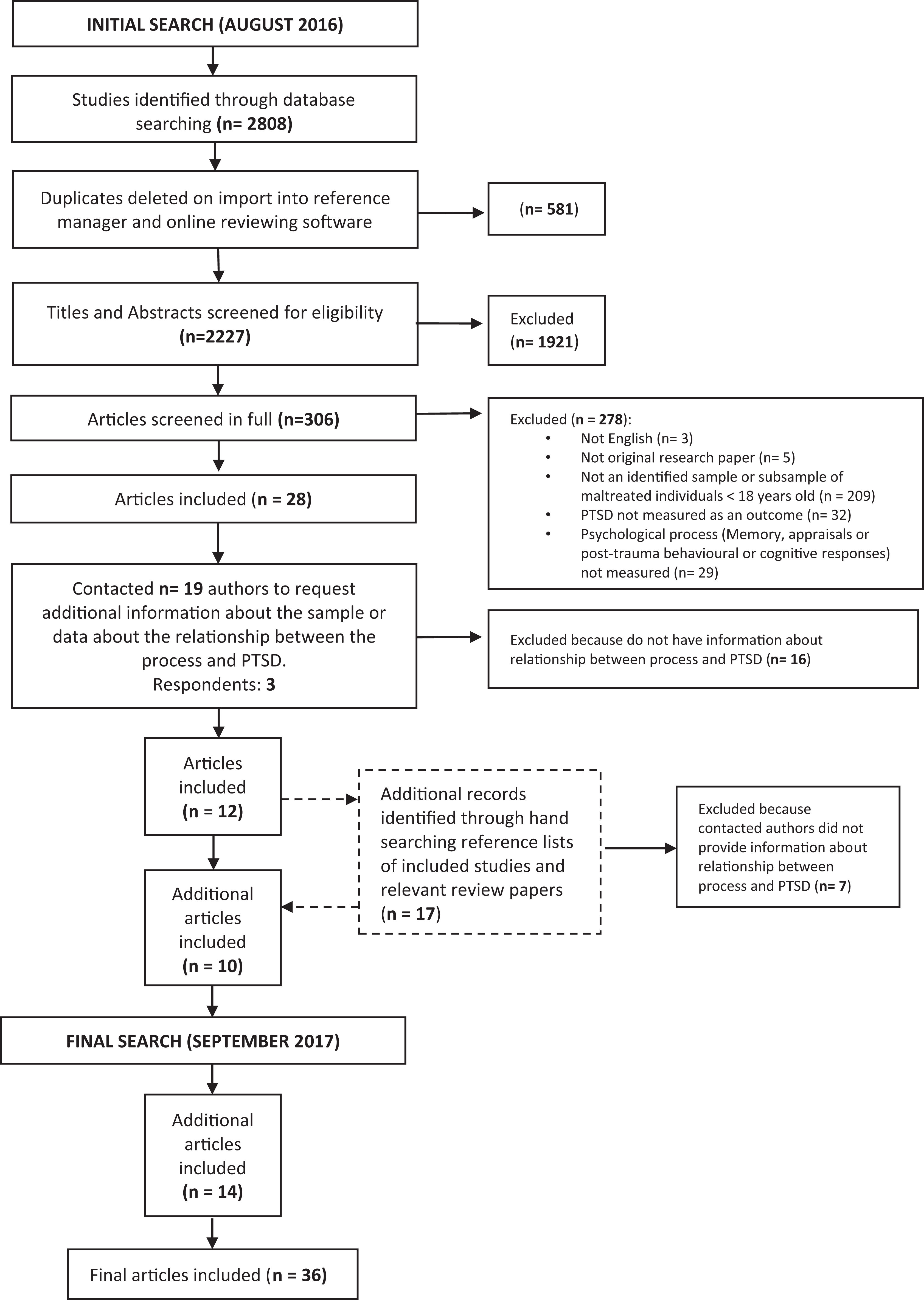
Preferred Reporting Items for Systematic Reviews and Meta-Analyses diagram showing the systematic search process.
Abstracts where there was disagreement were taken to a consensus meeting. In all cases of disagreement, the second reviewer had excluded articles that the primary reviewer had included (i.e., there was no evidence of overexclusion). The first author then reviewed the included articles’ full texts (N = 306), and the second reviewer a randomly selected 10%. Absolute agreement was 100% (Gwet’s AC1 = 1.00).
Data Collection and Quality Assessment (QA)
Data extraction forms were developed to retrieve information regarding publication details, recruitment processes, key sample characteristics, and assessment and outcome measures used (Supplementary Table S2). Quality was assessed using the Critical Appraisal Skills Programme (2017) cohort study checklist adapted for observational studies. This assessed recruitment, sample characteristics, ascertainment of maltreatment history, measurement of psychological processes and PTSS, statistical analyses and treatment of confounding variables, and consistency of results with existing evidence. Additional items were added to assess the quality of participant follow-up for the five longitudinal studies included in this review. Each item was scored according to the extent to which methodological quality indicated it would be likely to introduce bias: 0 points likely, 1 point indicated unlikely but requires more information, and 2 points unlikely. A percentage score was calculated for each paper. Of note, many included studies had different stated aims than ones investigated in the current review. Therefore, low ratings in relation to this review do not necessarily reflect overall quality of each individual paper.
The lead researcher completed data extraction and QA checks for all eligible papers. The second reviewer completed data extraction and QA checks on 25% of papers. Absolute agreement was 98.9% (Gwet’s AC1 = 0.985, 95% CI [0.956, 1.00]).
Results
Description of the Selected Studies
Across the two electronic database searches 42 papers were eligible. Of these, 26 papers were included. With the 16 papers that were eligible but ultimately not included, the main reason for exclusion was that information was not provided about the relationship between the psychological process and PTSS. An additional 10 papers were identified by hand-searching reference lists. In total, 36 articles presenting findings from 31 unique studies with 33 samples were included in this review (Figure 1). V. Wolfe, Gentile, Michienzi, and Sas (1991) analyzed data from two different recruitment samples (victim–witness preparation sample and family services sample), and Pittenger et al. (2016) separated children and adolescents. To avoid introducing bias by separately reviewing different publications based on the same study, this review will primarily discuss the 31 unique studies conducted.
Overview of included studies
Individual study details are presented in Supplementary Table S2. Included studies were published between 1989 and 2017, with 17 of the 31 studies published in the last 5 years. Twenty of the 31 studies were derived from the United States, 8 in Canada, 1 in Hong Kong, and 2 in Europe. Five papers investigated more than one psychological process. Twenty-eight papers explored appraisals and PTSS, 11 examined coping and PTSS, and 2 focused on memory and PTSS.
Design of studies
Twenty-six of the thirty-one studies presented cross-sectional data and five were longitudinal. The majority of studies were observational. Three studies included a nonmaltreated control group, one study recruited a sample who were all maltreated but compared two groups of individuals with and without PTSD, and one further study recruited three comparison groups—maltreated individuals with PTSD, maltreated individuals without PTSD, and a nonmaltreated control group.
Nature of the sample
Included studies covered young people aged 4–20 years of age. Most studies (21 of the 31) had a minimum mean age of 12 years. The two studies where the age range went up to 20 years, predominantly included young people under 18 and were thus retained in the review (Shenk, Putnam, Rausch, Peugh, & Noll, 2014; Srinivas, DePrince, & Chu, 2015). Eight studies recruited only female participants; a further 16 studies had predominantly female samples (≥60%). Ten studies reported a majority of participants who self-identified as Caucasian, five reported a majority of participants who self-identified as African American, three reported a majority of participants who self-identified as multiracial, two reported a majority of participants who self-identified as Hispanic, and one study reported an equal proportion of Caucasian and African American participants. Twelve studies did not describe the ethnicity of the sample.
In 30 of the 31 studies, participants had come into contact with services. Recruitment settings included treatment facilities, therapeutic or counselling services, child protective services, victim advocacy programs, child welfare services, residential services, child sexual abuse medical clinics, family services, primary care services, and court settings. One study recruited from secondary schools (Lam, 2015).
Nature of maltreatment
The majority of studies recruited youth with a substantiated maltreatment history. Eleven studies included children whose exposure to maltreatment had been ascertained in one of the following ways: abuse had been officially substantiated by protective services; perpetrator admission had been obtained; there was physical evidence strongly consistent with abuse; trained interviewers or staff had concluded that abuse was probable; or there was a police charge in relation to abuse. Two studies recruited at least some participants where maltreatment had not been confirmed (Freeman & Beck, 2000; Kaplow, Dodge, Amaya-Jackson, & Saxe, 2005; Shapiro, Kaplow, Amaya-Jackson, & Dodge, 2012). Eight studies predominantly relied on the young person self-reporting their maltreatment history, of which two recruited participants from residential or protective services, so maltreatment was highly probable (Elzy, Clark, Dollard, & Hummer, 2013; Kaur & Kearney, 2015). Ten studies did not clearly describe how maltreatment history was ascertained; however, of these studies another two had recruited from protective custody, so again maltreatment was probable (Kaur & Kearney, 2013; Ross & Kearney, 2017).
The majority of studies did not use standardized measures to screen for trauma history. The few studies that did screen for trauma used measures such as the Traumatic Events Screening Inventory for Children (J. Ford, 2002), the History of Victimization Form (Wolfe, Gentile, & Bourdeau, 1987), and the Abuse Dimensions Inventory (Chaffin, Wherry, Newlin, Crutchfield, & Dykman, 1997).
In 18 of the 31 studies, sexual abuse was the primary form of maltreatment; however, many participants would likely have experienced additional types of abuse given the high incidence of co-occurring maltreatment. A further nine studies recruited samples with mixed maltreatment histories. Three studies recruited samples with physical and/or sexual abuse histories (Kolko, Brown, & Berliner, 2002; Runyon & Kenny, 2002; Sharma-Patel et al., 2014) and one recruited participants exposed to physical abuse or neglect (Bertó et al., 2017).
Measurement of PTSS
In most cases, PTSS data was derived from self-report symptom checklists. Four studies included caregiver report of PTSS, and nine included an additional diagnostic interview. All studies except one used standardized measures for PTSS, although 14 different measures were used overall. Most commonly, studies used the PTSD subscale of the Children’s Impact of Traumatic Events Scale–Revised (CITES-R; V. Wolfe, Gentile, Michienzi, & Sas, 1991; n = 8), the Trauma Symptom Checklist for Children (Briere, 1996; n = 6), the PTSD subscale of the Child Behavior Checklist (CBCL; Achenbach & Edelbrock, 1983; n = 3), and the PTSD Reaction Index (Steinberg, Brymer, Decker, & Pynoos, 2004; n = 3). The one study that did not use a standardized measure combined items from two validated measures of PTSS, although the resulting scale did not accurately reflect diagnostic criteria for PTSD (Spaccarelli, 1995).
Measurement of psychological processes
A range of measures were used to assess trauma memory, appraisals, and coping, but the vast majority were self-report. The most commonly used were appraisal subscales from CITES-R (V. Wolfe et al., 1991; n = 7), the Child Post-Traumatic Cognitions Inventory (Meiser-Stedman et al., 2009; n = 4), and the Children’s Attributions and Perceptions Scale (CAPS; Mannarino, Cohen, & Berman, 1994; n = 3).
Most studies referenced at least one standardized measure but did not always report the psychometric information for the current study. Two studies used measurement tools developed specifically for the purposes of the study and thus psychometric information for these measures was limited at the time of publication. Only information regarding Chronbach’s α for the use of the scale in the current sample was provided (the three papers by Feiring and colleagues on one sample; D. A. Wolfe, Sas, & Wekerle, 1994).
One study measured “avoidance” by coding forensic interviews, with the result that coded responses may reflect avoidance of the interview rather than cognitive avoidance of abuse (Kaplow et al., 2005; Shapiro et al., 2012).
Inclusion of abuse variables
To fully understand how maltreatment links to psychological outcomes, it is important to consider the context of the abuse and of factors that might relate to adjustment. Factors that might influence ongoing adjustment include sociodemographic variables, additional mental health comorbidities, and abuse variables such as duration and frequency of abuse, age of onset, relationship to perpetrator, type of abuse, removal from home, contact with perpetrator, and involvement in court processes. Twenty-two of the 36 papers considered sociodemographic factors in their analyses, while 13 controlled for at least two abuse severity variables when analyzing the relationship between the psychological process and PTSS. For many papers, the relationship between the psychological process and PTSS was not the focus of the study; therefore, exploration of confounding variables was not relevant to the study aims.
Post-Trauma Appraisals
Blame
Abuse-specific self-blame (ASSB)
Eleven studies explored how ASSB was associated with PTSS. Five studies found a significant association, five did not, and one (longitudinal) study had mixed findings at different time points. Specifically, five studies identified a significant association with small to medium effect sizes (Alix, Cossette, Hébert, Cyr, & Frappier, 2017; Crouch, Smith, Ezzell, & Saunders, 1999; Kletter, Weems, & Carrion, 2009; Pittenger et al., 2016; V. Wolfe et al., 1991). The standard deviation (SD) change in PTSS for a one SD change in ASSB ranged from .20 to .38, which are small effects by conventional standards (Cohen, 1988). Studies that reported correlation coefficients found correlations in the range of .37–.53, representing small to medium effect sizes. Thus, analytical differences might account for small versus small–medium effect sizes.
As noted, five studies did not find a significant association (Daigneault, Hébert, & Tourigny, 2006; Daigneault, Tourigny, & Hébert, 2006; Sharma-Patel & Brown, 2016; Srinivas et al., 2015; D. A. Wolfe et al., 1994; V. Wolfe et al., 1989). Quality pattern varied across the 11 studies which investigated the relationship between ASSB and PTSS, but generally the studies which did not find an association had slightly higher quality scores. Notably, none of the studies in which ASSB was significantly associated with PTSS controlled for abuse variables (such as duration or severity) in their analyses. In contrast, four of the five studies where nonsignificant associations were shown conducted multivariate analyses that accounted for abuse variables (Daigneault, Hébert, et al., 2006; Srinivas et al., 2015; V. Wolfe et al., 1989; D. A. Wolfe et al., 1994) or other psychological processes (Daigneault, Hébert, et al., 2006). Thus, conflicting findings might be explained by analytical differences, and it is possible that when abuse factors (e.g., duration of abuse, n = 3) or other psychological processes (e.g., coping, n = 1) are considered, the association between self-blame and PTSS does not persist.
One longitudinal study had mixed findings (Feiring, Taska, & Lewis, 2002). Only one other study was longitudinal (Sharma-Patel & Brown, 2016), and was one of the five studies that did not find a significant association, at any time point. Feiring et al. showed that ASSB at the time of abuse discovery did not significantly predict levels of PTSS 1 year later, but that reductions in ASSB across the course of a year were significantly associated with improvements (i.e., reductions) in PTSS. In contrast, Sharma-Patel and Brown (2016) found that ASSB was not significantly associated with change in PTSS over the course of several months. However, participants in this latter study (but not the former) received TF-CBT- during this time frame, so treatment potentially confounded the relationship between ASSB and PTSS. Of note, some caution is warranted when interpreting longitudinal findings from Sharma-Patel et al. as their attrition rate was high and findings were not consistent with other treatment literature. For the purpose of this review, the Sharma-Patel et al.’s study was also considered to be lower quality (36%) than the Feiring et al.’s study (69%).
Guilt
While much of the maltreatment literature uses the terms “guilt” and “self-blame” interchangeably, three studies explored guilt as a unique construct in relation to PTSS (Gauthier-Duchesne, Hébert, & Daspe, 2017; Kletter et al., 2009; D. A. Wolfe et al., 1994). However, across these three studies, guilt was operationalized differently, which may account for differences in findings. For example, Wolfe et al. defined guilt as an “emotional reaction,” Kletter et al. explored “survivor guilt” (guilt that the event was worse for other people than for the individual), and Gauthier-Duchesne et al. did not describe how guilt was operationalized. Two of these studies found that guilt was significantly associated with PTSS (Gauthier-Duchesne et al., 2017; D. A. Wolfe et al., 1994). These were both high-quality studies (>70%), but their findings should be interpreted with caution because both studies measured guilt using only a subset of items within the Self-Blame/Guilt subscale of the CITES/CITES-R and no information is available as to the validity and reliability of this subscale. Furthermore, in these two studies, both the measure for guilt and for PTSS came from subscales of the same measure.
Finally, Kletter, Weems, and Carrion (2009), a high-quality study (89%) which explored a slightly different concept of guilt (“survivor guilt”) did not identify a significant association with PTSS. Given that maltreatment can occur on an individual basis (in comparison to other trauma types that might affect a large group of individuals, such as a natural disaster), it is perhaps unsurprising that this appraisal was not relevant to PTSS outcomes in this population.
Abuse-specific external blame
Only two studies investigated whether blame attributions to others were associated with PTSS (Feiring, Taska, & Chen, 2002; Kolko et al., 2002; quality scores >60%). One study looked specifically at perpetrator blame and one study looked at caregiver blame (using 2 items: “This happened to me because my mother wasn’t there” and “This happened because my mother didn’t know what was happening to me”). Both studies showed perpetrator blame was not significantly associated with PTSS. Feiring et al. did find caregiver blame was associated with PTSS immediately following abuse disclosure, though this association did not persist after 1 year.
General attributions of self-blame (GASB)
Six studies explored whether positive and negative attributions in relation to general events (i.e., not abuse specific) were associated with PTSS. For example, a general attribution would be “I am to blame for things that go wrong,” whereas an abuse-specific attribution would be “the abuse happened because of the way I acted.” Two studies found a significant association between GASB and PTSS (Cohen & Mannarino, 2000; Daigneault, Hébert, et al., 2006), two did not (V. Wolfe, Gentile, & Wolfe, 1989; V. Wolfe et al., 1991), and two were mixed. Among the mixed findings, Runyon and Kenny (2002) found a significant association between GASB and PTSS in a sexually abused, but not a physically abused, subsample. Feiring, Taska, and Lewis (2002) found GASB was not associated with PTSS at time of disclosure but was significantly associated with PTSS 1 year later. Across studies that found a significant association between GASB and PTSS, the SD change in PTSS for a one SD change in GASB ranged from .16 to .53, representing a small to medium effect. Overall, there was no clear pattern of differences in quality score between those that found a difference and those that did not. However, the two studies that found a significant association used a different measure of GASB than the two studies that did not find a significant association, which could explain the disparity in findings. Two studies used the CAPS (Mannarino et al., 1994), while the other two studies used the KASTAN-R (Kaslow, Tannenbaum, & Seligman, 1978). The CAPS is a brief measure that asks direct questions about blaming oneself for bad things, while the KASTAN uses hypothetical scenarios to infer whether an individual has a self-blaming style. The two different tools may measure slightly different concepts, which could account for differences in findings. Furthermore, psychometric information for the original KASTAN is not available, so it is difficult to assess which measure is more psychometrically sound.
Shame
Five studies explored shame. Three studies found a significant positive association between shame and PTSS following maltreatment (Alix et al., 2017; Feiring, Taska, & Chen, 2002; Feiring, Taska, & Lewis, 1998; Srinivas et al., 2015), with effect sizes in the small to moderate range (SD change = .20–.60). Two studies found shame was not significantly associated with PTSS (Kletter et al., 2009; Mannarino, Cohen, Deblinger, Runyon, & Steer, 2012). The different aged study samples might explain these discrepant findings. Across studies that found an association between shame and PTSS, the mean age of the child was 15.8 years (excluding Feiring et al., 1998, Feiring, Taska, & Chen, 2002, which did not provide a mean sample age). In the two studies that did not find an association, the mean age was 10.5 years. Shame might be more relevant for individuals at certain developmental phases than at others; however, more research is needed.
Disparate findings with respect to shame could also be due to methodological differences. All but one study were considered to be of reasonable quality (>60%); however, two of the three studies that found an association between shame and PTSS had significant methodological limitations. Alix, Cossette, Hébert, Cyr, and Frappier (2017; QA = 41%) recruited a high proportion of participants with single-incident sexual abuse limiting the generalizability of the findings to a wider maltreatment population and did not consider possible confounders or effect modifiers (such as demographic variables or abuse characteristics) in their analyses. Feiring, Taska, and Lewis (1998, 2002) used a self-developed measure of shame, consisting of 4 items with no validation reported.
Vulnerability or victim appraisals
Five studies explored victim or vulnerability appraisals, looking variably at personal vulnerability, victim appraisals, powerlessness, and/or dangerous world. These appraisals were conceptualized differently by studies in this review, which limited the extent to which conclusions could be drawn about their relevance to PTSS.
Personal vulnerability
Two studies found appraisals of personal vulnerability were significantly positively associated with some PTSD symptom clusters (Crouch et al., 1999; V. Wolfe et al., 1991). Crouch et al. (QA = 65%) found a higher sense of personal vulnerability was significantly associated with higher overall PTSS (r = .65), while Wolfe et al. (QA = 40%) found it was significantly associated with intrusive symptoms (r = .50) and avoidant symptoms (r = .42), but not overall symptom severity.
Victim appraisals
Kolko, Brown, and Berliner (2002; QA = 61%) explored perceptions of being a victim and found that perceiving that one was “treated unfairly” was associated with a PTSD diagnosis. Individuals diagnosed with PTSD had perceived victimization scores that were .84 SDs higher than individuals without PTSD, reflecting a large effect (Cohen, 1988).
Powerlessness
Three studies explored perceptions of “powerlessness” (Crouch et al., 1999; Pittenger et al., 2016; V. Wolfe et al., 1991). Crouch et al. found feeling disempowered was associated with PTSS (QA = 65%), whereas Pittenger et al. and Wolfe et al. found powerlessness was not associated with PSTD (QA = 40% for both). These two studies also had a high rate of single-incidence sexual abuse and may not reflect typical maltreatment samples.
Dangerous world
Three studies investigated appraisals about the world being dangerous (Crouch et al., 1999, QA = 60%; Kaur & Kearney, 2015, QA = 55%; V. Wolfe et al., 1991, QA = 40%). Only Kaur and Kearney (2015) found a significant association with PTSS; this study was unique in that all individuals were in protective custody, all had varied maltreatment backgrounds (rather than sexual abuse histories), and the sample consisted of almost equal numbers of males and females. Abuse severity or being removed from home might influence how individuals perceive the world, which in turn could influence adjustment.
Interpersonal appraisals
Interpersonal trust
One study explored appraisals of “interpersonal trust.” Cohen and Mannarino (2000; QA = 78%) found small but significant associations between perceptions that individuals were disbelieved about their experiences and PTSS and between beliefs that trusting others was “risky” and PTSS.
Negative reactions of others
Two studies explored perceived negative perceptions by others (i.e., “being viewed negatively by others following maltreatment”) and PTSS (Crouch et al., 1999; V. Wolfe et al., 1991). Crouch et al. found a significant association between perceived negative perceptions by others and PTSS, whereas Wolfe et al. found an association between perceived negative perceptions and intrusive symptoms but not PTSS overall. Due to a high incidence of single-incident sexual abuse in the study by Wolfe et al., the findings in Crouch et al. are potentially more generalizable to populations exposed to chronic maltreatment. The study by Crouch et al. was also deemed to be of higher quality (65% vs. 40%).
Self in relation to others
Two high-quality studies examined how maltreated youth view themselves in relation to others (Cohen & Mannarino, 2000; Srinivas et al., 2015). Srinivas et al. found alienation—a perception of being disconnected and detached from others—was significantly associated with PTSS (SD change = .42) and Cohen and Mannarino found feeling “different to peers” was significantly associated with PTSS (r = .32).
Perceived impact of maltreatment
Two studies explored appraisals of the impact of the abuse (Kolko et al., 2002, QA = 61%; Pittenger et al., 2016, QA = 40%). Both studies found that individuals who believed the abuse would impact their resources, relationships, emotional adjustment, and need for help had significantly greater PTSS. However, both studies created self-report measures to assess “impact of the abuse,” so these measures had not been previously validated.
Combined appraisals
Ten studies explored how combinations of maladaptive appraisals (e.g., self-evaluation, evaluation of others, and perceptions of harm) jointly influenced PTSS rather than individually. The number of appraisals considered in combination ranged from 2 to 5. Nine of the 10 studies found combinations of appraisals were significantly associated with PTSS in maltreated children (see Table 1). One study did not find a significant association between combined appraisals and PTSS, but this study recruited exclusively from secondary schools. These individuals may not have come into contact with services and possibly experienced less severe maltreatment or were better able to adjust to their experiences (Lam, 2015). As a result, this sample may not be representative of chronic maltreatment populations. Studies that considered joint effects of appraisals on PTSS reported effect sizes (correlations) in the range of .30–.72. One study did not report information necessary to derive an effect size (Ross & Kearney, 2017).
Overview of Study Findings and Effect Size.
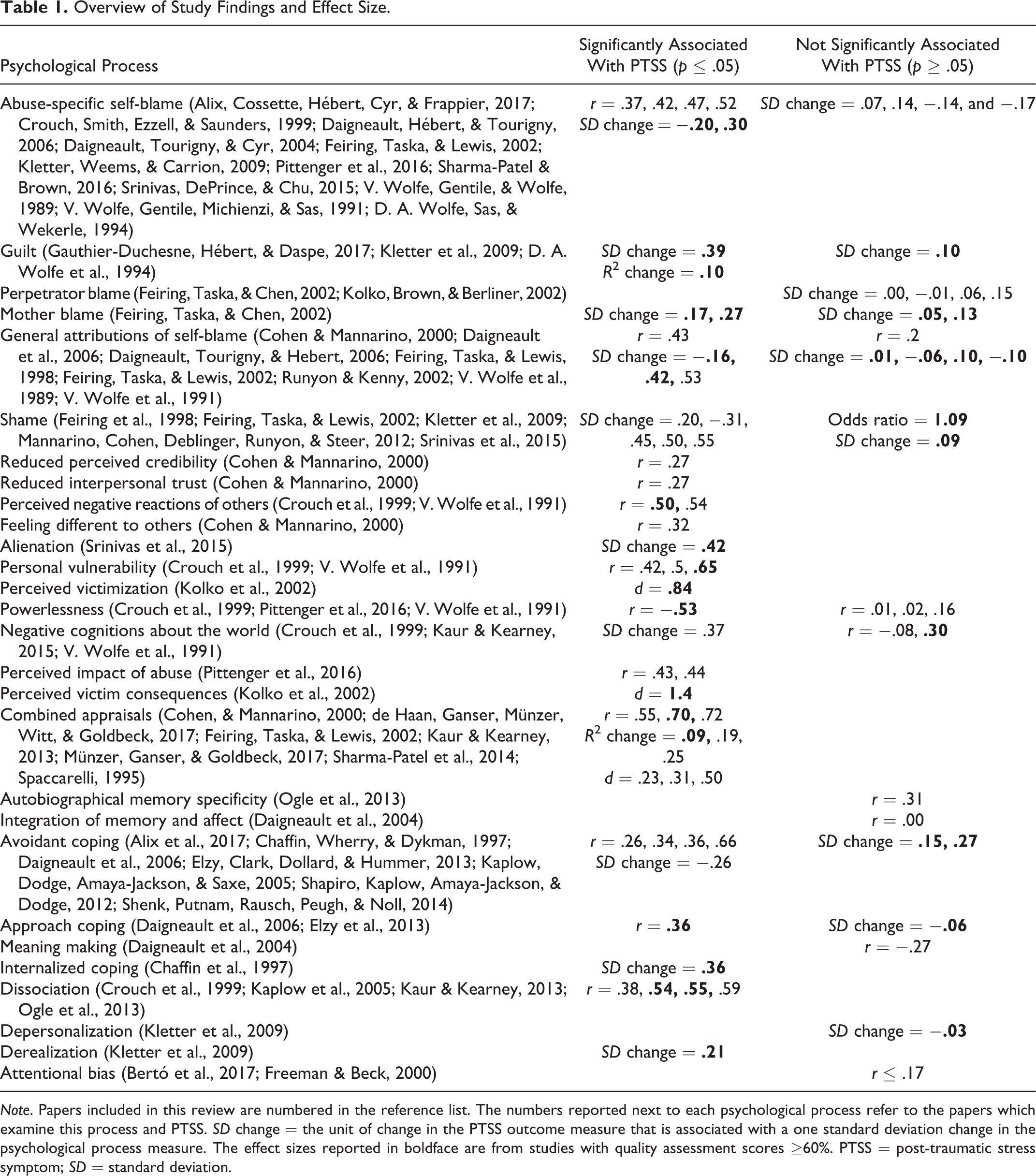
Note. Papers included in this review are numbered in the reference list. The numbers reported next to each psychological process refer to the papers which examine this process and PTSS. SD change = the unit of change in the PTSS outcome measure that is associated with a one standard deviation change in the psychological process measure. The effect sizes reported in boldface are from studies with quality assessment scores ≥60%. PTSS = post-traumatic stress symptom; SD = standard deviation.
Post-Trauma Maladaptive Coping
Behavioral coping
Avoidant coping
Six studies explored avoidant coping and PTSS. Three studies found that avoidant coping was significantly associated with PTSS, with effect sizes (correlation or partial correlation coefficients) in the small or moderate range ([.26–.66]; Alix et al., 2017; Kaplow et al., 2005; Shapiro et al., 2012; Shenk et al., 2014). Of note, one study (Kaplow et al., QA = 67%; Shapiro et al., QA = 64%) used a measure of “avoidance” that may not accurately reflect avoidance of the trauma itself, and two studies (Alix et al., QA = 41%; Shenk et al., QA = 82%) did not account for any abuse characteristics (e.g., severity, duration) in their analyses.
Two high-quality studies did not find an association between avoidant coping and PTSS (Chaffin, Wherry, & Dykman, 1997, QA = 94%; Daigneault, Hébert, et al., 2006, QA = 77%). In contrast, one (lower quality) study showed avoidant coping might actually be adaptive for children with high levels of trauma (Elzy et al., 2013, QA = 56%). All three studies considered demographic variables in their analyses, and two considered abuse characteristics. Overall, these studies suggest when controlling for demographic and abuse characteristics, avoidant coping does not uniquely predict PTSS, although further research is needed.
Approach coping
Three studies explored “approach” coping (Chaffin et al., 1997; Daigneault, Hébert, et al., 2006; Elzy et al., 2013), though this concept was operationalized differently across studies. Generally, approach coping includes seeking social support, positive reappraisal, and problem-solving. Chaffin et al. did not include positive reappraisal in their measure of coping, and Daigneault et al. did not include problem-solving. Of the three studies, only Elzy et al. found a significant association between approach coping and PTSS. This study was deemed lower quality (56%) than studies by Chaffin et al. (1997; 94%) and Daigneault, Hébert, and Tourigny (2006; 77%) and this finding is not in line with research in single-incident trauma populations which suggests approach coping is adaptive (N. J. Thompson, Fiorillo, Rothbaum, Ressler, & Michopoulos, 2018).
Findings reported by Daigneault, Hébert, et al. (2006) and Chaffin, Wherry, and Dykman (1997) are more consistent with research in other trauma areas. These studies accounted for abuse characteristics in their analyses, while Elzy, Clark, Dollard, and Hummer (2013) did not. However, discrepancies might also be explained by differences in the study samples. Elzy et al. recruited individuals from residential care with complex and varied maltreatment histories, while Daigneault, Hébert, et al. and Chaffin et al. recruited victims of sexual abuse from treatment centers.
In a further study, Daigneault, Tourigny, and Cyr (2004) explored a coping style called “meaning making,” which considered how individuals evaluated their experiences and how this then guided social, creative, or political actions. The study found no relationship between “meaning making” and PTSS, but the measure used was not validated for use in this population and the quality of this study was low (28%).
Additional coping styles
Chaffin et al. (1997, QA = 94%) found “angry” coping was not associated with PTSS but that internalized maladaptive coping strategies (e.g., social withdrawal, self-criticism, and resignation) were associated with hyperarousal symptoms. In contrast, Shapiro, Kaplow, Amaya-Jackson, and Dodge (2012, QA = 64%) showed that the adaptive coping strategies “positive affective” and “emotional expressive” coping were not associated with PTSS.
Cognitive coping
Dissociation
Five studies investigated dissociation and PTSS, and all studies found that increased dissociative responses were significantly associated with increased PTSS (Crouch et al., 1999; Kaplow et al., 2005; Kaur & Kearney, 2013; Ogle et al., 2013; Ross & Kearney, 2017). Effects sizes were in the moderate range (correlation or partial correlation coefficient from .38 to .59). Quality scores ranged from 39% to 67%, but there was no obvious patterns between QA score and level of correlation.
Depersonalization and derealization
Depersonalization (feeling detached from one self) and derealization (being unsure whether events or people are real) are also considered to be dissociative mechanisms, however, these processes were not widely studied. One study found that depersonalization and derealization (combined) were associated with avoidance symptoms (Ross & Kearney, 2017, QA = 65%), while another study (Kletter et al., 2009, QA = 89%) that only investigated these concepts separately found only derealization was significantly associated with PTSS.
Attention bias
Two studies explored cognitive interference for threat-related stimuli and how this might contribute to PTSS. One study found attentional bias toward threat (which could be indicative of selective attention for threatening information) did not differ between maltreated youth with or without PTSD (Freeman & Beck, 2000). Another study found maltreated individuals with PTSD displayed an attentional bias away from threat (which could be indicative of cognitive avoidance) but toward sad stimuli, compared to healthy controls (Bertó et al., 2017). These two studies differed in the way they measured attentional bias (words or facial expressions) and in the type of maltreatment that was present (sexual abuse vs. physical abuse/negligence), which could have contributed to the heterogeneity in these findings. For the purpose of this review, the study by Freeman and Beck was considered lower quality than the study by Bertó et al. (28% vs. 50%).
Trauma Memory
Only two studies explored trauma memory and PTSS (Daigneault, Tourigny, & Cyr, 2004; Ogle et al., 2013). Daigneault et al. found neither the ability to integrate memory and affect nor the ability to cohesively recall memories were associated with PTSS. The measure used to assess these memory constructs had not previously been used in an adolescent population. Ogle et al. found maltreated adolescents reported less autobiographical memory specificity than nonmaltreated peers, but specificity was not associated with PTSS. This suggests maltreatment might disrupt typical memory processes but that PTSS is not maintained by a memory bias for threat-related information. Findings from both studies must be interpreted with caution as quality was deemed low (28% and 39%, respectively) and sample sizes were small, which may have limited the ability to detect effects.
Discussion
Despite a known increased risk of PTSD following interpersonal and chronic trauma, within the academic and clinical field there remains ongoing debate about the relevance of cognitive frameworks for PTSD for young people exposed to chronic maltreatment or developmental trauma. This review aimed to synthesize existing literature on psychological processes implicated in PTSD in maltreated children and to identify avenues for future research. Thirty-one studies were identified that measured how post-trauma appraisals, coping, and trauma memory were associated with PTSD in maltreated youth. In line with research in single-incident trauma populations, this review showed general support for the cognitive behavioral model of PTSD following maltreatment (Mitchell et al., 2017; Trickey et al., 2012).
Post-Trauma Appraisals
Appraisals were the most widely studied psychological process in relation to PTSD, and a range of different appraisals were explored. Findings suggested that features of maltreatment such as abuse duration, severity, relationship to perpetrator, and age of onset may influence how appraisals result in psychological maladjustment. For example, some studies found a significant association between self-blame and PTSS, but this finding did not persist when abuse characteristics (e.g., perpetrator relationship, severity, and duration) were accounted for. Similarly, there was some evidence to suggest the relationship between perceptions of vulnerability and PTSS varied according to chronicity and type of maltreatment, as well as whether maltreatment warranted removal from the home. Furthermore, the relationship between shame and PTSS may depend on the age and development of the child, such that older children are more affected by feelings of shame than younger children.
These findings support Ehlers and Clark’s (2000) cognitive model, which proposes that trauma characteristics contribute to the development and maintenance of PTSD through their effects on coping strategies and appraisals. Similarly, a meta-analysis of risk factors for PTSD following primarily single-incident trauma showed that both objective trauma characteristics and post-trauma individual factors influence PTSD development (Trickey et al., 2012). There is a need for additional research on relationships between abuse features, psychological processes, and PTSS identified in our review.
A key finding of this review was that combinations of appraisals might be more relevant to the development and maintenance of PTSS than individual appraisals alone. Indeed, studies showed that specific combinations of appraisals interact to give rise to ongoing difficulties, and that appraisals considered jointly explained more variance in PTSS. For example, individuals with multiple unhelpful cognitions about their own vulnerability and that the world is a dangerous place might have a compounded sense of threat, which is central to the development of PTSD. Similarly, individuals who both blame themselves for the abuse and who also have a general sense of self-blame about negative events have been shown to have increased risk of PTSD (Daigneault, Hébert, et al., 2006). Thus, future research may benefit from further exploration of whether specific types of appraisals are more relevant to PTSD, while clinical assessments should gather an overview of an individual’s set of appraisals in order to understand how these appraisals might interact to affect well-being and which appraisals are driving distress. Finally, some individual appraisals have received relatively little attention to date and warrant further investigation. A small number of studies showed that guilt, interpersonally based appraisals and perceived “impact of abuse” were significantly associated with PTSS, but further research of these concepts is indicated.
Coping
The review found less robust evidence that avoidance might drive the development of PTSS, once demographic and abuse characteristics are accounted for. Indeed, two studies unexpectedly found that avoidant coping could be protective in the immediate aftermath of abuse (Chaffin et al., 1997; Elzy et al., 2013). This is not in line with much of the adult literature (Ullman & Filipas, 2005; Walsh, Fortier, & DiLillo, 2010). However, there is similar evidence from studies with high-risk groups of adolescents, which showed avoidant coping to be adaptive at higher levels of stress (Gonzales et al., 2001; Grant et al., 2000). It is possible that youth find avoidant coping increasingly helpful due to perceiving more circumstances to be beyond their control, and it is possible that avoidance might be a protective strategy in the shorter term. However, it is not yet clear what the longer term implications of avoidant coping may be. These findings suggest treatment strategies should be tentative about targeting coping strategies that adolescents appear to be employing adaptively but should be aware that they might lead to negative outcomes in the long term. Longitudinal research is needed to better understand these mechanisms.
In contrast, an extremely avoidant response in the form of dissociation was significantly associated with PTSS in all relevant studies. This is in line with literature that shows persistent dissociation is a risk factor for PTSD following a multitude of trauma types (Briere, Scott, & Weathers, 2005). It is suggested that dissociation might contribute to PTSD via acting as an avoidance mechanism and/or preventing effective processing of trauma memories. One possible alternative explanation for these findings is that children do not always have the same capacity to engage in behaviorally avoidant coping strategies (since they have less control over their lives) and hence may engage in “psychologically” avoidant coping (such as dissociation). Overall however, findings from this review suggest that dissociation should be routinely assessed in maltreated youth and that it is likely to be an important treatment target where it exists.
Trauma Memory
The review found a paucity of research (only two studies) exploring the role of trauma memory qualities in relation to PTSS in maltreated youth. This is despite the potentially central role of trauma-related memories in maintaining this disorder. The two existing studies showed that although maltreatment might disrupt typical encoding of memory (Ogle et al. 2013), an overfocus on trauma memories, difficulties integrating trauma memories and affect, and problems recalling trauma memories were not significantly related to PTSS (Daigneault et al., 2004; Ogle et al., 2013). These findings are not consistent with research from single-incident trauma populations, which reports that trauma memories with strong perceptual elements and that are not contextualized, contribute to the maintenance of PTSD (e.g., Halligan, Michael, Clark, & Ehlers, 2003). However, both studies that explored memory following maltreatment recruited small samples, which might relate to the lack of significant findings. There is a clear need for further research in this area, given memory processes are considered central to PTSD in other child and adult trauma-exposed samples, including in intervention approaches.
Limitations and Other Considerations
Limitations of this review largely reflect general limitations in the literature. The majority of the research is cross-sectional, limiting the ability to infer conclusions about causal processes contributing to PTSS. There was a noticeable lack of research related to certain maltreatment types, and some of the tentative conclusions drawn in this review might not be relevant to populations exposed to neglect, emotional abuse, or intimate partner violence. Furthermore, co-occurrence of abuse is common, but the majority of studies focused on one trauma type to determine participant eligibility (e.g., sexual abuse). An overall lack of information about trauma-related factors (e.g., chronicity or pervasiveness of abuse) makes it difficult to determine how generalizable findings are to wider maltreatment populations. Similarly, the average age in most studies was 12 years and findings are not generalizable to preschool populations, where there are clearly different developmental considerations. We were also unable to comprehensively explore how different processes (e.g., different types of appraisals) may interact to influence PTSS, but this may improve knowledge of how applicable the cognitive model of PTSD is to understanding outcomes of maltreated children. Finally, many papers used different measures (sometimes not validated) and had slightly different conceptualizations of terms, making comparisons between studies difficult.
This review focused on synthesizing the available literature on specific cognitive and behavior mechanisms and PTSD in maltreated young people to explore the current evidence base for cognitive models of PTSD. These models are core for the development of psychological interventions, and indeed form the framework for the current first-line psychological intervention for PTSD—trauma-focused CBT (TF-CBT), which has growing evidence of efficacy with more complex populations, including young people who have experienced maltreatment (e.g., Cohen, Deblinger, Mannarino, & Steer, 2004; Sachser, Keller, & Goldbeck, 2017). Nevertheless, it is important to note that this does not imply that other frameworks for understanding the complex traumatic stress presentations and comorbidities with maltreated young people are incorrect. Clinical, anecdotal, and empirical evidence have all highlighted the significant affect dysregulation and interpersonal difficulties (including difficulties forming relationships) that chronically maltreated young people can develop, with the newly proposed international classification of disease (ICD-11) complex PTSD diagnosis attempting to address this. It remains important for research to continue to explore the role of malleable psychological processes, particularly those that are transdiagnostic, that may maintain broader maltreatment-related distress in this group.
Clinical Implications and Future Research
Overall, there was general support for the relevance of cognitive behavioral models of PTSD for maltreated children; however, several avenues for further research were identified (see Table 2). There was a broad consensus that both maladaptive appraisals and coping strategies can contribute to increased rates of PTSS in maltreated young people, and a cognitive behavioral framework could be used to guide assessment and identify any potentially maladaptive psychological processes. TF-CBT components that modify maladaptive appraisals could be particularly useful in this population, but clinicians should be tentative about targeting coping strategies used by young people without first facilitating learning of coping skills that might be more adaptive in the long term. There is not enough evidence to support or refute the role of memory qualities in PTSD development. Given the particular distress that intrusive and sensory-laden trauma memories may have on a young person’s well-being, further elucidating the role of trauma or maltreatment memory qualities for these young people remains an important area of investigation.
Implications of the Review for Practice, Policy, and Research.

Note. PTSS = post-traumatic stress symptom; SD = standard deviation; NICE = National Institute of Clinical Excellence; PTSD = post-traumatic stress disorder.
While it was outside the scope of this review to provide an overview of the evidence for psychological interventions for PTSD for this group, and it remains that trauma-focused CBT is the first-line recommended approach based on current available evidence (e.g., see NICE, 2018), there also remains a need for the development of interventions that can successfully target these symptoms within ever resource-stretched services. This review synthesizes the evidence of what mechanisms could be targeted to enact symptom change, although further research on specific processes is clearly needed.
Conclusion
In sum, findings from this systematic review suggest that a cognitive behavioral framework is generally appropriate for understanding the development and maintenance of child or youth PTSD following maltreatment, but more research is needed to elucidate other potential mechanisms that may also be involved. Cognitive appraisals, particularly in conjunction with one another, are significantly associated with an increased risk of PTSS following maltreatment and studies generally demonstrated small to moderate effect sizes. Maladaptive cognitive and behavioral coping responses were also shown to be significantly associated with PTSS, with studies again demonstrating small to moderate effect sizes. There was insufficient research to support or refute the role of memory qualities in maintaining PTSD symptom severity following maltreatment, and this relationship in particular, needs further exploration. Better understanding is needed of the interplay between psychological processes, demographic factors, abuse-specific characteristics, and PTSD to enable clinicians to effectively identify young people most at risk of poor outcomes. However, earlier screening of potentially maladaptive appraisals and coping responses in chronically maltreatment children, before they develop into more entrenched clinical-level difficulties, may be one avenue for reducing the well-documented poor psychological outcomes that are often identified in this group.
Supplemental Material
Supplementary_material_tva - The Relevance of Cognitive Behavioral Models of Post-Traumatic Stress Following Child Maltreatment: A Systematic Review
Supplementary_material_tva for The Relevance of Cognitive Behavioral Models of Post-Traumatic Stress Following Child Maltreatment: A Systematic Review by Hannah Wiseman, Catherine Hamilton-Giachritsis and Rachel M. Hiller in Trauma, Violence, & Abuse
Footnotes
Declaration of Conflicting Interests
The author(s) declared no potential conflicts of interest with respect to the research, authorship, and/or publication of this article.
Funding
The author(s) disclosed receipt of the following financial support for the research, authorship, and/or publication of this article: Rachel M. Hiller is funded by an ESRC Future Research Leader grant (ES/N01782X/1) and a University of Bath Prize Research Fellowship.

Supplemental Material
Supplemental material for this article is available online.
References
Supplementary Material
Please find the following supplemental material available below.
For Open Access articles published under a Creative Commons License, all supplemental material carries the same license as the article it is associated with.
For non-Open Access articles published, all supplemental material carries a non-exclusive license, and permission requests for re-use of supplemental material or any part of supplemental material shall be sent directly to the copyright owner as specified in the copyright notice associated with the article.
