



Abstract
Background:
Trauma-informed care is increasingly recognized as the ideal model of care for acute psychiatric inpatient units; however, it continues to be a challenge to implement. The aims of this review are (1) to synthesize the research exploring health professionals’ experiences of providing trauma-informed care in acute psychiatric inpatient settings and (2) to examine these experiences through a gender lens, particularly relating to gender-based violence. This research will provide additional insights to facilitate implementation of trauma-informed care in acute psychiatric inpatient care.
Method:
A comprehensive scoping review methodology was adopted. English-language, peer-reviewed articles published between January 1998 and March 2018 were identified from seven databases. Inclusion criteria included a qualitative or mixed-method study design.
Results:
Eight full-text articles were found. This review highlights the importance for health professionals to have a reflective environment and a multilayered level of collaboration to adopt trauma-informed care. However, negative attitudes toward female consumers and inconsistent implementation strategies continue to hold back implementation of trauma-informed care in acute psychiatric inpatient units. Overall, limited consideration for gendered issues and gender-based violence in the implementation of trauma-informed care in acute psychiatric inpatient settings was found.
Conclusion and Implications:
There is a lack of research on health professionals’ experiences of providing trauma-informed care in acute psychiatric inpatient units, with even less research considerating gender-based violence. We argue that more research is needed to gain a better understanding of the experience of health professionals from acute psychiatric inpatient settings to inform future implementation of trauma-informed care.
Keywords
Trauma-informed care is a framework for human service systems. Over the past two decades, it has evolved and gained increasing traction in various fields and disciplines including drug and alcohol, psychology, psychiatry, education, public health, criminal justice, and social work (Champine et al., 2018; Donisch et al., 2016; Hanson & Lang, 2016). Trauma-informed care is based on an understanding of the impact of trauma on people’s lives, their service needs, and vulnerabilities (Harris & Fallot, 2001). It includes the principles of safety, trustworthiness and transparency, peer support and mutual self-help, collaboration and mutuality, and empowerment, voice, and choice (Elliott et al., 2005; Fallot & Harris, 2009). It also takes cultural, historical, and gender issues into account (Substance Abuse and Mental Health Services Administration (SAMHSA), 2014). Trauma-informed care framework acknowledges the pervasiveness, directionality, and impact of trauma experienced by people with mental health disorders (Barton et al., 2009; Bateman et al., 2013; Cusack et al., 2003). It informs organizational and systems models of care globally and recognizes the responsibility of mental health services to be responsive to trauma at a systemic level (Heckman et al., 2005; Jennings, 2008; Markoff et al., 2005). Trauma-informed care offers the potential to improve both consumers and health professionals’ experiences (Sweeney et al., 2018).
Gender is an important consideration in responding to mental health issues and trauma. One in the 10 women with severe mental illness have recently experienced sexual violence (Khalifeh et al., 2016), and between 30% and 60% of women accessing acute psychiatric inpatient settings have experienced intimate partner, domestic/family, or sexual violence in their lifetime (Oram et al., 2013). Sexual violence (between 5% and 45%) is also prevalent during an admission to a psychiatric inpatient unit (Clarke, 2008; Frueh et al., 2005; Grubaugh et al., 2007). Research supports the value of trauma-informed approaches for women in psychiatric settings (Sweeney et al., 2016). It has been shown to improve mental health outcomes, provide safer environments for consumers, and decrease psychiatric and trauma symptoms and substance use (Bills & Bloom, 1998; Cocozza et al., 2005; Morrissey et al., 2005). Yet it is unclear from extant research to what extent gender is addressed in mental health settings, and what level of awareness is present about the gendered impacts of trauma.
Despite the increased recognition in the research context of the relationship between trauma, violence and mental illness, in practice, the biomedical model continues to be the dominant model of care in acute psychiatric inpatient settings (Wilson et al., 2017). The biomedical model treats mental illness as a medical problem, focusing on biological symptoms rather than acknowledging the role of psychosocial factors (Astbury, 2006). This has been identified as a hindrance to disclosures of violence and a promoter of ineffective responses to trauma (Trevillion, Hughes, et al., 2014). In severe cases, it can even further retraumatize consumers, particularly if health professionals are dismissive of their trauma experience (Ahrens, 2006). There is overwhelming research showing the benefits of trauma-informed care and the limitations of the biomedical model (Sweeney et al., 2018). It is important to gain further understanding of health professionals’ attempts to implement trauma-informed care in psychiatric inpatient settings, and what barriers might prevent them from succeeding.
Trauma-informed care is a beneficial yet complex model of care for health professionals to implement (Sweeney et al., 2018). It improves the working environments, increases job satisfaction, and reduces work stress through improved relationships between consumers and health professional (Sweeney et al., 2018). However, where trauma-informed care has been encouraged, studies suggest that health professionals have struggled to translate the values and principles into their day-to-day practice (Muskett, 2014; Wilson et al., 2017). Traditionally, clinicians working in acute mental health settings have perceived embedding recovery, choice, and control as “too risky” (Harris & Fallot, 2001). This has been attributed to a lack of alternative interventions and low practitioner skill levels, as well as a limited understanding of the pervasive impact of trauma (Chandler, 2008). These limitations result in a preferencing of safety and containment of consumers over providing trauma-informed therapeutic interventions (Browne et al., 2014; Chandler, 2008; Cleary et al., 2014). Most research on trauma-informed care to date has focused on the challenges to implementation with little focus on the perceptions of health professionals attempting to implement this model of care.
To date, the qualitative literature investigating how health professionals perceive and experience the delivery of trauma-informed care in acute psychiatric inpatient settings has not been synthesized or explored. Most research on trauma-informed care has focused on identifying trauma-informed practices and activities such as reducing restraint and seclusion. Other research in this area has focused on examining the challenges to implementing trauma-informed care in acute mental health settings and mapping these findings against the principles of trauma-informed care (Muskett, 2014; Wilson et al., 2017). This scoping review builds on previous literature reviews of trauma-informed care in mental health settings (Muskett, 2014; Wilson et al., 2017). The aim of this review is to identify and synthesize the existing research (either qualitative or mixed methods) that explores health professionals’ experiences of providing trauma-informed care in acute psychiatric inpatient settings. Its other main aim is to explore these experiences through a gender lens, relating to gender-based violence, and how this impacts on care delivery. This review will aid in bridging the translational gap to routine implementation of trauma-informed mental health care (Tansella & Thornicroft, 2009; Wensing et al., 2006).
Method
A five-stage scoping review methodology was used (Arksey & O’Malley, 2005; Levac et al., 2010). This involved identifying the research question, identifying relevant studies, study selection, charting the data and collating, and summarizing and reporting the results. This was an iterative process that involved flexibly moving between each stage and continuously gathering contemporary literature to ensure all appropriate articles were included.
Identifying the Research Questions
Our first research question was “What are health professionals’ experiences of providing trauma-informed care in acute psychiatric inpatient settings?” Our second research question was “What are health professionals’ awareness of the gendered impacts of trauma in acute psychiatric inpatient settings and how does this impact on the care they provide?”
Identifying Relevant Studies
A three-step search strategy was utilized (The Joanna Briggs Institute [JBI], 2015). The searches were filtered by English language only and were conducted in March 2018. A time frame of 20 years (1998–2018) was applied to the search as preliminary reviews of the literature on trauma-informed care showed minimal activity prior to 2000. The initial search involved an analysis of the words contained in the title and abstract of retrieved papers and of the index terms used to describe the articles across MEDLINE and CINAHL. The second search employed all key words and index terms across PsycINFO, Embase, PsychARTICLES, PubMed, and Cochrane library. Finally, the reference list of all identified reports and articles were searched for additional studies. Each key word search topic was searched independently and then combined with each other (see Table 1).
Electronic Search Terms.

Titles and abstracts of the articles were reviewed manually to determine whether they met the inclusion criteria. Snowballing, contacting authors and review of reference lists of relevant articles, was then completed. The systematic and scoping literature reviews were then reviewed to identify 11 further relevant articles. Only empirical studies reporting primary data were included.
Inclusion and Exclusion Criteria
Any qualitative or mixed-method empirical studies published in peer-reviewed scientific journals where participants included staff working in acute psychiatric inpatient settings were included in this review. Only research published between January 1998 and March 2018 was included since there is little trauma-informed care literature prior to this time. Studies focusing exclusively on nonacute mental health settings (e.g., community, rehabilitation, and forensic) were excluded, as were studies where only consumers were involved. This review focused specifically on psychiatric inpatient units, due to their unique role, setting, and circumstances. Inpatient units in Victoria provide short-term admission (average length 12 days) for patients with high levels of acuity and distress. The context of high levels of acuity and care differs greatly in scope and opportunity to other settings such as community mental health. Equally, the type of setting with bedrooms, shared facilities, the gender-mix nature of inpatient units, and the associated prevalence of gender-based violence set them apart from other mental health settings. In studies where there were both staff and consumer participants, the study had to analyze and present the staff experiences separately to be included. Articles were also excluded if not written in English.
All four authors were involved in reviewing the scoping review question, inclusion and exclusion criteria. Once agreed upon, two authors (CO'D & LT) concurrently and independently applied the inclusion and exclusion criteria to all citations and identified those meeting the research objective. In the case of uncertainty, the full article was obtained and reviewed until consensus was agreed. After the initial selection of applicable citations, full texts of all selected citations were obtained and then the full texts were independently reviewed to finalize the list of those included. In the case of disagreement, a third reviewer (KH) assessed the article in question.
Study Selection
Electronic database and hand searches yielded 1,046 studies after duplicates were removed (see Figure 1). One hundred eight articles were excluded as they did not meet inclusion criteria after titles and abstracts were reviewed. Thirty-eight full-text articles were reviewed; 32 of these were excluded as they did not meet inclusion criteria. Two articles were included after reviewing the references. Information from the identified studies were extracted into a custom-designed template and charted. The data charting form consisted of the following characteristics: author, year, country, aim of the study, study population and size, methods/study design, and main findings.

PRISMA flow diagram of completed search.
Data Analysis
Qualitative conventional content analysis (Hsieh & Shannon, 2005) was used to analyze the eight studies included in the review. This is a useful approach when there is limited research literature available on a phenomenon (Hsieh & Shannon, 2005). Underpinning this approach was a feminist theoretical framework that acknowledged the gendered issues associated with trauma experienced by consumers who access acute psychiatric inpatient units. Transcripts were coded initially by the first author using an inductive approach. Codes were identified and then sorted into categories. The coding was focused on two main areas of interest to answer the research question: health professionals’ experiences of providing trauma-informed care in acute psychiatric inpatient units and associated gender-based violence issues. All authors (CO'D, LT, SF & KH) contributed to the development of themes in an iterative fashion and codeveloped the data chart form. The software package, NVivo Version 11 (QSR International, 2015), was used to manage the data.
Assessing quality
Quality was assessed using the Critical Appraisal Skills Programme (CASP, 2018) Checklist for assessing qualitative research evidence. The CASP Checklist provided a systematic process of assessing the methodological quality of the studies included in the scoping review (JBI, 2015). This was particularly useful to strengthen the methodology given the limited studies included in this review. Nine of the 10 questions of the CASP Checklist are rated on a scale of yes (allocated 2 points), can’t tell (allocated 1 point), or no (allocated 0 point), giving a maximum rating of 18. The 10th question requires a qualitative response. High quality was defined as a score of 13 or more, with medium-quality papers scoring 7–12 and low-quality papers scoring 6 or less (CASP, 2018).
Results
Descriptive Summary
There were eight studies included in this review. Three studies utilized a mixed-methods design (Isobel, 2015; Isobel & Edwards, 2017; Leavey et al., 2006), one used a case study design (Chandler, 2012), one used narrative design (Chandler, 2008), and one used focus groups (Krumm et al., 2006). Two studies used qualitative methods only (Copperman & Knowles, 2006; Kanerva et al., 2016). Information extracted from the studies is summarized in Table 2.
Summary of Articles Included in Review.
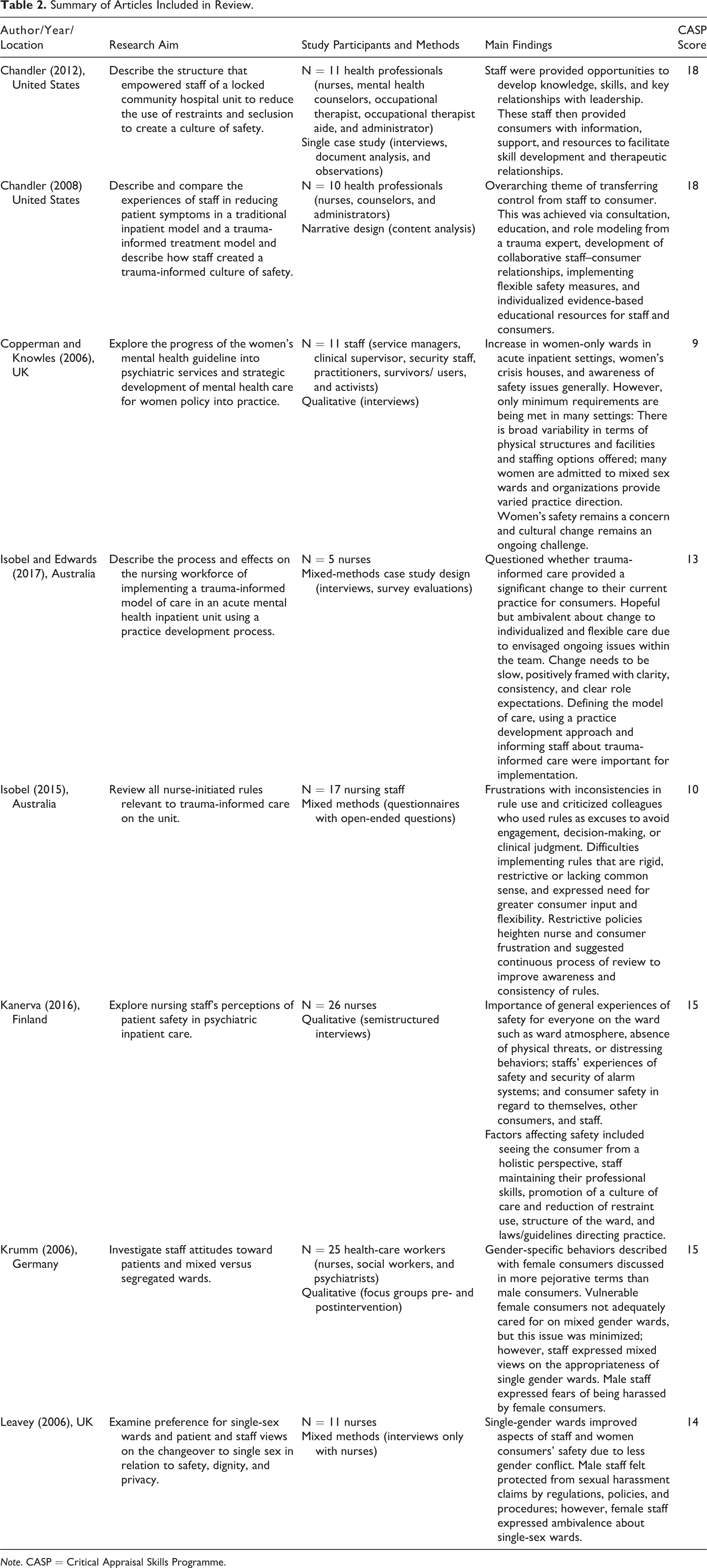
Note. CASP = Critical Appraisal Skills Programme.
Two studies were conducted in Australia (Isobel, 2015; Isobel & Edwards, 2017), two in the United States of America (Chandler, 2008, 2012), two in the United Kingdom (Copperman & Knowles, 2006; Leavey et al., 2006), one in Finland (Kanerva et al., 2016), and one in Germany (Krumm et al., 2006). Three papers included both health professional and consumer perspectives (Copperman & Knowles, 2006; Isobel, 2015; Leavey et al., 2006), which were reported separately. Only health professionals’ perspectives were included in this review. Nursing staff constituted the majority of health professionals in the studies included in this review. The studies also included service managers and directors, middle managers, and clinical supervisors who were principally from a nursing background. In addition, security staff, mental health counselors, occupational therapists, administration, social workers, and psychiatrists were also included in these studies. Only three studies identified the gender of participants, approximately 75% of whom were women (Chandler, 2012; Kanerva et al., 2016; Krumm et al., 2006).
Main Findings
Five themes were developed from analysis of the included studies: reflecting on past practices, recognizing personal experiences, moving from control to collaboration, overcoming disparities in the delivery of care, and negative attitudes toward women. The first two themes, “Reflecting on past practices” and “recognizing personal experiences,” discuss health professionals’ reflections on aspects that facilitated and hindered the implementation of trauma-informed care. The themes “moving from control to collaboration” and “overcoming disparities in delivery of care” explore the shift from a controlling, risk averse, and patriarchal approach toward responsive; collaborative; and empowering practices. The final theme “negative attitudes toward women” highlights health professionals’ negative attitudes toward female consumers and the overall limited consideration of gender-based violence in acute psychiatric inpatient settings. The themes are described in detail below, highlighting the experiences of health professionals providing trauma-informed care in acute psychiatric inpatient settings and gendered issues relating to trauma.
Reflecting on Past Practices
Health professionals in the included studies reflected on previous practices, such as the use of control and diversion, older psychotropic medications, restraint and seclusion, “separating and silencing patients” (Chandler, 2008), rigid nursing rules, and restrictive policies (Isobel, 2015). Understanding the possible adverse effects of these practices, encouraged the adoption of evidence-based trauma-informed practices, including alternative ways of supporting consumers and therefore improved the working conditions for staff (Chandler, 2012). Reflecting on historical practices also encouraged staff to empathize with consumers, consider their historical trauma experiences in psychiatric inpatient units, and tailor their approach accordingly (Kanerva et al., 2016). Furthermore, understanding consumers’ behaviors and expressed emotions within the trauma-informed care framework encouraged staff to provide a more holistic care response (Chandler, 2012). Overall, reflecting on the past helped health professionals to recognize the benefits of adopting a trauma-informed model of care.
Recognizing Personal Experiences
Despite identifying the benefits of implementing trauma-informed care, health professionals expressed their fears and anxieties associated with these changes. They admitted feelings of confusion and anxiety due to misunderstandings between staff, lack of guidance from senior management, and their organization; an absence of policies or procedures; insufficient training or unclear therapeutic frameworks; and role expectations (Copperman & Knowles, 2006; Isobel, 2015; Isobel & Edwards, 2017; Leavey et al., 2006). Health professionals expressed worry about their own inadequacies in responding to trauma, described variously as, “Opening a can of worms” and a fear of being “overwhelmed by a flood of emotion” (Copperman & Knowles, 2006) or increased micromanagement through “control and reaction by way of policies and rules” (Isobel, 2015). Others were fearful of their approach being criticized or labeled as traumatizing (Isobel & Edwards, 2017), resulting in avoidance of supervision (Copperman & Knowles, 2006). These personal experiences significantly hindered their abilities to adopt a trauma-informed care approach.
Moving From Control to Collaboration
A multidisciplinary and collaborative approach between consumers and colleagues within the acute psychiatric inpatient unit was particularly important for relinquishing control of consumers. It allowed for the development of responsive and collaborative relationships with consumers, leading to increased choice and a more flexible and confident nursing group (Chandler, 2012; Isobel & Edwards, 2017). However, this deepening of relationships and collaborative practice also raised many challenges as it required a paradigm shift from control to collaboration with consumers and all staff members (Chandler, 2008, 2012; Kanerva et al., 2016). Health professionals struggled to balance organizational pressures to follow safety and risk management procedures while integrating principles of trauma-informed care, promoting recovery, and reducing coercive practices (Isobel & Edwards, 2017; Kanerva et al., 2016). They struggled to relinquish control as they believed consumers were a risk to themselves and to each other (Isobel & Edwards, 2017; Kanerva et al., 2016).
These changes were managed effectively on a daily basis through proactive responses and attention to the needs and moods of the consumers and themselves rather than being reactive to consumer behaviors. This allowed space for the development of mutual respect and positive relationships between consumers and health professionals (Chandler, 2012). At an organizational level, these tensions were facilitated through consultation, education and role modeling by a trauma expert, and educational resources and bolstering evidence of a reduction of physical threats and distressing behaviors (Chandler, 2008; Kanerva et al., 2016). Furthermore, at an organizational level, scaffolding of trauma-informed care through strong leadership, structural, practical, and policy change were key to health professionals’ feelings of safety, enabling them to manage risk and bring about a cultural change (Chandler, 2008, 2012; Isobel & Edwards, 2017; Kanerva et al., 2016).
Overcoming Disparities in Delivery of Care
A significant challenge experienced by staff is the variability in how trauma-informed care is interpreted, adopted, and implemented. Disparities between each psychiatric unit depended on health professionals and management’s understanding of the impact of trauma and how they balanced the constant demands of bed management and physical space (Copperman & Knowles, 2006). These disparities regarding implementation of trauma-informed care and perspectives resulted in ongoing concerns for female consumers’ safety and cultural change issues (Copperman & Knowles, 2006). Developing systemic processes of shared understandings and accountability within acute psychiatric inpatient units alleviated some of these discrepancies and reduced the frustrations experienced by health professionals (Copperman & Knowles, 2006; Isobel, 2015). Furthermore, reflecting on the dominance and hierarchy of the biomedical model within acute psychiatric inpatient units was useful to address these issues. Promoting individual strengths, empowering nurses to make decisions, and speak up against the system were recognized as integral for fostering the implementation of trauma-informed care (Chandler, 2012).
Negative Attitudes Toward Women
The majority of studies failed to explore gender or gender-based violence. Only three articles made mention of consumers’ gender (Krumm et al., 2006; Leavey et al., 2006), and only one of these articles explored issues connected to women’s mental health specifically (Copperman & Knowles, 2006). Those articles that did discuss gender, reported negative attitudes toward women, minimizing trauma and focusing on structural aspects of the psychiatric inpatient unit, such as single-sex wards. Most concerning was the open expression of negative attitudes and descriptions of female consumers as “demanding,” “flirtatious,” “sexually aggressive,” and the belief consumers make false claims of sexual harassment against staff (Copperman & Knowles, 2006; Krumm et al., 2006; Leavey et al., 2006). These negative attitudes were predominately reported by male staff.
Discussion
The purpose of this scoping review was to understand health professionals’ experiences of implementing trauma-informed care in acute psychiatric inpatient units. It also attempted to understand health professionals’ awareness of gender-based violence given the prevalence of trauma experienced by female consumers.
This review highlights the various benefits and challenges experienced by health professionals when adopting trauma-informed care. It shows the importance for health professionals to have a supportive space to reflect on some historical practices as restrictive and move toward a trauma-informed model of care. Staffs’ anxiety and fears due to lack of training, support, or direction negatively impacted their ability to adopt a new model of trauma-informed care. Conversely, staffs’ reflections on their own personal behaviors and emotions positively built greater empathy toward consumers. These insights further strengthened health professionals’ recognition of the benefits to implementing a trauma-informed approach. This is consistent with previous research that shows health professionals are more supportive of providing a safer environment for consumers when they are aware of the effects of trauma and violence (Farro et al., 2011; Hopper et al., 2010).
Furthermore, this review suggests that implementing trauma-informed care requires a meaningful collaboration between health professionals and consumers, supported by the organization to manage risk and relinquish control. It is evident that this multilayered level of collaboration in conjunction with systemic change facilitated a move toward a culture of empowerment and trust. This collaborative implementation strategy is not only in line with previous research (García-Moreno et al., 2015) but also likely to increase morale, job satisfaction, and collaboration among health professionals (Torchalla et al., 2014).
Most concerning, this review shows that gender, let alone gender-based violence, received limited consideration by health professionals working in acute psychiatric inpatient settings. This is a major omission given the prevalence of sexual and intimate partner violence amongst women experiencing mental health issues (Oram et al., 2013). Of those that did discuss gender, predominantly male staff reported negative attitudes toward female consumers. Trauma was also minimized or responded to with structural responses, such as the use of single-sex wards only. These negative attitudes are not uncommon from male health professionals and can contribute to the retraumatization of female consumers (Henderson et al., 2014; Hockett et al., 2016; Ponic, 2016; Ranjbar & Speer, 2013).
Strengths and Limitations
This scoping review bridges the gap in trauma-informed care literature by providing insights into how health professionals experience the delivery of trauma-informed care in acute psychiatric inpatient settings. Uniquely, this gives an insight into their personal practices and experiences, in addition to organizational and attitudinal issues in relation to gender. Using a scoping review methodology (Arksey & O’Malley, 2005) and the CASP (2018) provided a comprehensive, rigorous, and critical evaluation of the articles reviewed. Despite the limited research studies available in this area, the CASP shows that six of the eight articles included in this review met the criteria for “high-quality” papers (Chandler, 2008, 2012; Isobel & Edwards, 2017; Kanerva et al., 2016; Krumm et al., 2006; Leavey et al., 2006), and two met the criteria for “medium-quality” papers (Copperman & Knowles, 2006; Isobel, 2015). Multiple reviewers, inclusion/exclusion criteria, and the assessment of interrater reliability further strengthened the methodology of this scoping review.
Limitations of this review include the practical restrictions of searching electronic databases, which may result in missing some important articles. Due to the paucity of research in this area, the themes synthesized are based on a small sample of research from only five countries which makes it difficult to generalize the findings. Furthermore, the health professionals from these studies were predominantly from a nursing profession thereby limiting the perspectives to one profession. Few studies reported the participants gender, of those that did most of the participants were women. Given the reported negative attitudes toward women from this small sample of research, it would be useful to gather a broader sample of perspectives from men and women from various different health professional backgrounds.
Implications for Further Research, Practice, and Policy
Trauma-informed care has been around for almost two decades (Elliott et al., 2005; Fallot & Harris, 2009; Harris & Fallot, 2001) and continues to be a challenge to implement which is longer than expected (Proctor et al., 2009). There is limited research on trauma-informed care in acute psychiatric inpatient units, from either health professionals’ or consumers’ perspective despite the recognized challenges to implementation. There is also a major paucity of trauma-informed care research in acute psychiatric inpatient units that consider gender and gender-based violence. In-depth research is essential to understand health professionals’ experiences in order to move beyond fear and reluctance of change to a comprehensive implementation of trauma-informed care. Understanding the challenges impacting the implementation of trauma-informed care practices is important, particularly considering the lack of evaluation studies that have been completed thus far on this topic (Quadara, 2015). Future mental health research should focus on gender (Howard et al., 2017) including gender-based violence and health professionals attitudes. Normalization process theory (NPT; May & Finch, 2009) recognizes the challenges of implementing complex interventions in health-care systems with multiple professions and interactions (Murray et al., 2010). Future research could utilize NPT to aid in understanding the successful implementation of trauma-informed care in acute psychiatric inpatient units.
Pragmatically, the implementation of trauma-informed care into mental health services requires a multifaceted approach (Brooker et al., 2016). It needs to be integrated into all levels of an organization, including policy and practice to influence how services and staff respond to and provide care to female consumers (Williams & Paul, 2008). Moreover, policy and practice needs to acknowledge and address the tensions that exist between legislated compulsory treatment, the biomedical model with the juxtaposition of the principles of trauma-informed care, such as collaboration and choice. Health professionals need to be regularly and consistently supported through reflective practice, specific training, and skill development in sensitive inquiry and responsiveness to trauma (Elliott et al., 2005; Nyame et al., 2013; Trevillion, Byford, et al., 2014). In addition, specialist staff or advocates are needed to broaden the focus from a biomedical model to a trauma-informed model of care in acute psychiatric inpatient settings (Trevillion, Byford, et al., 2014). Perhaps, given the evidenced complexity, incorporating a trauma- and violence-informed care into practice and policy may be more appropriate than trauma-informed care alone (Wathen et al., 2011). A recent scoping review shows the benefits of integrating primary health-care providers, with women-specific services informed by a trauma- and violence-informed lens (Mantler et al., 2018). This approach increases access to health-care services and decreases future health-care burden (Mantler et al., 2018). This review highlights the need for acute psychiatric inpatient settings to adopt a collaborative and equitable multidisciplinary approach to responding to the individual needs of consumers to effectively implement trauma-informed care.
Conclusion
Trauma-informed care is becoming an increasingly recognized model of care across many settings, including acute psychiatric inpatient units. There is limited research to date of health professionals’ and consumers’ experiences of trauma-informed care in acute psychiatric inpatient units (Muskett, 2014; Wilson et al., 2017). There is also a significant lack of research on trauma-informed care in acute psychiatric inpatient units that consider gender-related issues and gender-based violence. It is important to understand these experiences to aid in the translational gap of implementing trauma-informed care. Consistent with previous research, this review shows that implementation of trauma-informed care continues to be complex and challenging (Quadara, 2015). From our limited findings, it is clear that health professionals struggle to implement trauma-informed care despite acknowledging the perceived benefits. However, a multilayered response aids in the shift from a patriarchal approach to a collaborative, empowering, and trauma-informed approach. Most concerning is the negative attitudes toward female consumers and the overall limited consideration of gender-based violence in acute psychiatric inpatient settings. Further research will provide a greater understanding of the supports required to comprehensively implement trauma-informed care and consider gender-based violence in acute psychiatric inpatient units.
Footnotes
Declaration of Conflicting Interests
The author(s) declared no potential conflicts of interest with respect to the research, authorship, and/or publication of this article.
Funding
The author(s) received no financial support for the research, authorship, and/or publication of this article.
