



Abstract
Twenty-three samples from 22 longitudinal studies assessing both bullying perpetration and bullying victimization were selected from a sample of 1,408 candidate studies using several prespecified criteria (i.e., participants ≤ 18 years of age; self-reported bullying victimization and perpetration assessed with a lag of at least 1 month but no more than 24 months; not a treatment or program study). A random effects meta-analysis was then performed on the concurrent and cross-lagged longitudinal associations between bullying victimization and perpetration in the 23 samples. A large pooled effect size (r = .40, 95% confidence interval [CI] = [.34, .45]) was obtained for the concurrent association between bullying victimization and perpetration, whereas modest to moderate effect sizes (victimization to perpetration: r = .20, 95% CI [.17, .24]; perpetration to victimization: r = .21, 95% CI [.17, .24]) were obtained for the two cross-lagged longitudinal correlations. The results did not change when analyses were conducted separately for traditional bullying and cyberbullying outcomes. These findings indicate that bullying victimization and perpetration correlate strongly and that their cross-lagged longitudinal relationship runs in both directions, such that perpetration is just as likely to lead to future victimization as victimization is to lead to future perpetration. Different theoretical models are proposed in an effort to explain these results: cycle of violence, general strain, and social cognitive theories for victimization leading to perpetration and risky lifestyles, routine activities, and peer selection theories for perpetration leading to victimization.
Keywords
There is general consensus among researchers working in the field of youth violence that bullying victimization and bullying perpetration overlap extensively, and that bullying victimization can lead to bullying perpetration, which will be referred to simply as victimization and perpetration, respectively, from this point forward. In a meta-analysis of youth who bully, youth who report being bullied, and youth who both bully and are bullied, Cook et al. (2010) observed extensive overlap in background characteristics and predictor variable relationships between the three groups, suggesting that all three may share a common etiology. Research conducted since the Cook et al. meta-analysis has strengthened the supposition that bullying victimization and perpetration overlap extensively. Chan and Wong (2015), for instance, computed robust positive correlations between different victimization and perpetration subtypes. Shetgiri et al. (2012), on the other hand, observed that being bullied and feeling unsafe at school were significant risk factors for bully status in a large representative sample of U.S. schoolchildren in grades 6 through 10. A limitation of the Chan and Wong (2015) and Shetgiri et al. (2012) studies, however, was that they were cross-sectional in nature. Using longitudinal data designed to shed further light on this issue, Walters and Espelage (2018) noticed that bullying victimization predicted perpetration, via hostility measured 6 months after victimization and 6 months before perpetration. An oversight in this study, however, was that the path from bullying perpetration to victimization was never tested.
Based on the results of their analysis, Walters and Espelage (2018) speculated that the trauma of victimization created the cognitive-affective state of hostility, which then increased the bullied victim’s odds of bullying others, although they also made allowances for learning effects, whereby victims learn to bully from being bullied themselves. The actual effect of victimization on later perpetration, however, was modest. First, the zero-order correlation between victimization at Wave 1 and perpetration 12 months later at Wave 3 failed to achieve significance using a Bonferroni corrected α level, and the direct effect of victimization on subsequent perpetration was insignificant when hostility, anger, and depression were controlled. There are also questions as to whether the reverse correlation, from perpetration to victimization, might not also be significant. Using longitudinal data from a large group of Cypriot middle schoolers, Fanti and Kimonis (2012) discovered that perpetration predicted victimization slightly better than victimization predicted perpetration (r = .28 vs. .24). Chu et al. (2018) also recorded a predictive effect for perpetration on victimization that was slightly higher than the effect of victimization on perpetration (r = .37 vs. .30), whereas Bartlett and Wright observed just the opposite (r = .20 vs. .24). In a fourth study, Kendrick et al. (2012) recorded cross-lagged correlations between victimization and perpetration that were identical. These results suggest that perpetration may have as much impact on future victimization as victimization has on future perpetration.
Given the potentially severe negative physical, psychological, and social consequences of bullying for perpetrators and victims (Wolke & Lereya, 2015), it is imperative that the nature of the victimization–perpetration relationship be uncovered. Cross-sectional studies have documented a moderate to strong association between victimization and perpetration (Chan & Wong, 2015; Cook et al., 2010; Shetgiri et al., 2012), but longitudinal data are required to verify the direction of the victimization–perpetration relationship and the temporal order of the two variables. Several possibilities suggest themselves: Victimization could lead to perpetration, perpetration could lead to victimization, or the relationship could be reciprocal or bidirectional. Understanding in what direction or directions the causal effect travels—from victimization to perpetration, from perpetration to victimization, or in both directions—is vital in understanding, preventing, and managing this ubiquitous and potentially damaging problem. Theoretically, the victimization to perpetration pattern implies that bullying, like child abuse, follows a cycle of violence (Widom, 1989), in which bullying victimization encourages later perpetration (Walters & Espelage, 2018). The perpetration to victimization pattern, on the other hand, is more consistent with risky lifestyles/routine activities theory (Garofalo, 1987) and suggests that bullying perpetration can create peer relations and routine activities that increase a child’s odds of becoming a victim of bullying (Cho & Lee, 2018). There are also important practical implications to the direction of association between bullying victimization and perpetration in that it can offer clues as to the age and approach that will be most effective in reducing victimization and perpetration.
A meta-analysis of prospective data could be of assistance in determining the direction in which the association between bullying victimization and perpetration flows. This, in turn, could help shed light on the etiology of victimization and/or perpetration and provide guidance as to which approach is best in addressing the interconnected problems of bullying victimization and perpetration. Analyzing data from studies that have appraised victimization and perpetration prospectively could also help illuminate whether traditional bullying and cyberbullying have similar or dissimilar patterns of effect by analyzing them both separately and collectively. The separate analyses could help establish whether the cyberbullying victimization–perpetration relationship parallels or diverges from the traditional bullying victimization–perpetration relationship. The combined analyses could be useful in establishing whether cyberbullying victimization/perpetration and traditional bullying victimization/perpetration are interchangeable or whether one provides a stronger lead-in than the other. For instance, the anonymity afforded by cyberbullying might make it preferable to traditional bullying as a first step in transitioning from a victim of bullying to a bully-victim. Alternately, the interpersonal nature of traditional bullying may make it more likely that someone who engages in traditional bullying perpetration will become the object of bullying victimization via risky lifestyle and routine activity factors than someone who engages only in cyberbullying perpetration.
Cyberbullying shares several features in common with traditional bullying, but there are just as many differences as there are similarities between these two forms of bullying. With traditional bullying, the victim is nearly always aware of the perpetrator’s identity, whereas with cyberbullying, the perpetrator is often unknown to the victim. Anonymity may be one reason why adolescents are more than twice as likely to report being victimized by cyberbullying as by traditional bullying (Modecki et al., 2014). Second, whereas research on the relationship between age and traditional bullying has produced mixed results (Clifopoulos & Witenberg, 2008), a positive correlation has been observed between cyberbullying and age such that mid-adolescents are significantly more likely to engage in online bullying than early adolescents (Robson & Witenberg, 2013). Third, differences based on sex have been observed between traditional bullying and cyberbullying. Thus, while boys are more likely to be victimized by traditional bullying (Huang & Chou, 2010), girls are more likely to be victimized by cyberbullying (Lee & Shin, 2017). And where boys are more likely to engage in cyberbullying if they have been cyber-victimized themselves (Zsila et al., 2019), girls are more likely to engage in cyberbullying when they have been the victims of traditional bullying (Wong et al., 2017). Finally, there is evidence that cyberbullying may have a more detrimental effect on victims than traditional bullying (Giumetti & Kowalski, 2016; Waasdorp & Bradshaw, 2015).
The current meta-analysis was designed to serve five purposes. The first purpose was to gauge the magnitude of relationship between concurrent victimization and perpetration. It was reasoned that this relationship would be significant and of moderate to high magnitude, using effect size criteria from Rice and Harris (2005): r ≈ .10 (small effect), r ≈ .24 (moderate effect), r ≈ .37 (large effect). The second purpose was to assess the temporal direction of the association between victimization and perpetration by calculating the cross-lagged longitudinal correlations between past perpetration and future victimization and between past victimization and future perpetration. It was assumed that the pooled effect sizes for the two prospective cross-lagged correlations would be significant and that any differences between them would be minimal. The third objective of this study was to determine whether meaningful effect size differences exist between traditional bullying/victimization and cyberbullying/victimization and whether the effect extends across types (i.e., from traditional perpetration to cyber victimization, from traditional victimization to cyber perpetration, from cyber perpetration to traditional victimization, and from cyber victimization to traditional perpetration). The fourth purpose of this study was to investigate the effect of four moderator variables (age, gender, study location, and length of follow-up) on bullying. Finally, heterogeneity, publication bias, and the sensitivity of each outcome to extreme values were assessed.
Method
Five criteria were used to select studies for this meta-analysis. First, the studies had to have been completed or published by April 1, 2019, the date study selection began. Second, all participants in a sample had to be 18 years of age or younger at the start of the study. This was based on the desire to examine school-age bullying rather than bullying in college, at work, or in prison. It is also consistent with the definition of bullying established by the Center for Disease Control and Prevention in which an age range of 5–18 years is given. Third, self-reported bullying victimization and perpetration had to have each been assessed and the information available for meta-analysis. Fourth, victimization and perpetration had to have been assessed prospectively, with at least 1 month and no more than 24 months between assessments. Fifth, zero-order correlations between measures of victimization and perpetration had to be either available in the original article or provided by the researchers upon request.
Studies
A literature review designed to identify every published study and any unpublished studies containing prospective data on bullying victimization and perpetration was undertaken. The specific databases searched were Academic Search Complete, Criminal Justice Abstracts, Dissertation Abstracts, ERIC, HeinOnline, JSTOR Journals, PsycArticles, Psychology and Behavior Sciences Collection, PsycINFO, Social Sciences Citation Index, SocIndex, and Sociological Collection. Using the search terms “bullying victimization” and “bullying perpetration” in combination produced an initial sample of 1,362 studies and articles. Additional studies (n = 46) were identified in a survey of the reference sections of several major review articles (e.g., Cook et al., 2010; Foody et al., 2017).
After removing duplicate studies from the sample, the abstracts of all remaining studies were reviewed to determine whether the study included measures of both bullying victimization and perpetration and ensure that the study was not evaluating a treatment or prevention program. This resulted in a sample of 147 studies. The method sections of each study were then reviewed to determine whether the study satisfied the remaining criteria (i.e., no participants older than 18 years of age at the start of the study; study used prospective data with at least 1 month but no more than 24 months between waves). This produced a sample of 30 studies, 9 of which reported the requisite information (concurrent and cross-lagged correlations between victimization and perpetration) for the meta-analysis. The authors of the 21 studies not reporting the requisite information were contacted by email and 13 eventually responded and provided the necessary information. Authors not responding to initial inquiries were contacted on at least three more occasions over the course of the next several months.
Procedure
The meta-analysis was performed with Comprehensive Meta-Analysis (CMA), Version 2 (Borenstein et al., 2005). Four analyses were conducted, one on all forms of bullying combined, one on traditional bullying, one on cyberbullying, and one on the intersection between traditional bullying and cyberbullying (T × C). Each study/sample contributed no more than one effect size to an analysis, so multiple estimates from the same study were averaged prior to being pooled. Based on the assumption that the effect sizes for the different studies likely varied as a function of sample or outcome, the current meta-analysis was performed using a random effects model. The random effects model was used to calculate a pooled effect size and assess heterogeneity, publication bias, and sensitivity. Heterogeneity was investigated using the Q-statistic and I2 (Higgins & Thompson, 2002), publication bias was tested with funnel plots (Egger et al., 1997) and the trim and fill procedure (Duval & Tweedie, 2000), and sensitivity was appraised by recomputing the pooled effect size after each individual effect size had been systematically removed from the sample, one at a time.
Four potential moderator variables were assessed in this study. One was categorical and the other three were continuous. The categorical moderator was location where the study took place (United States versus any other country). This geographic breakdown was designed to determine whether results from a handful of studies conducted on U.S. samples, where bullying is seen as a particularly serious problem (Gladden et al., 2013), were significantly different from other countries. The three continuous moderators were mean participant age at the start of the study (in years), female participants (as a proportion of the total sample), and length of follow-up or time between waves (in months). The categorical moderator variable was assessed with the Q-between (Qb) statistic and the three continuous moderator variables were assessed with CMA meta-regression. Victimization and perpetration were measured in their traditional and cyber forms. When both forms were assessed in the same study, effects were averaged before calculating a total pooled effect size for the combined analyses.
Results
Table 1 provides a synopsis of the 22 studies and 23 samples used in the current meta-analysis. Pooling the 23 nonredundant univariate effect sizes with a random effects model produced a mean effect size of .40 for the concurrent victimization–perpetration correlation, .20 for the cross-lagged longitudinal victimization to perpetration relationship, and .21 for the cross-lagged longitudinal perpetration to victimization relationship (see Table 2). Forest plots of the cross-lagged victimization to perpetration and perpetration to victimization relationships can be found in Figures 1 and 2, respectively.
Studies Included in the Current Meta-Analysis.
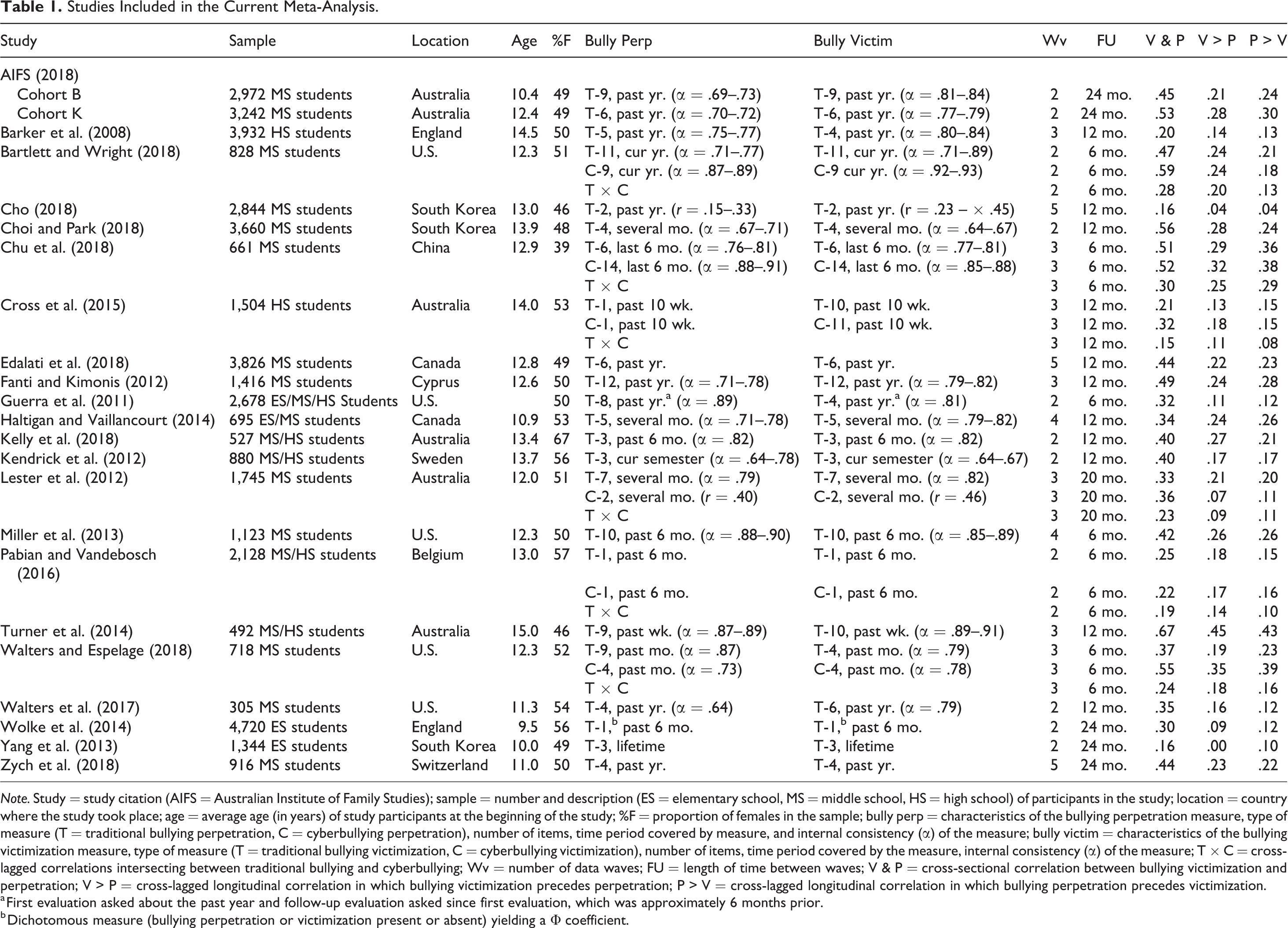
Note. Study = study citation (AIFS = Australian Institute of Family Studies); sample = number and description (ES = elementary school, MS = middle school, HS = high school) of participants in the study; location = country where the study took place; age = average age (in years) of study participants at the beginning of the study; %F = proportion of females in the sample; bully perp = characteristics of the bullying perpetration measure, type of measure (T = traditional bullying perpetration, C = cyberbullying perpetration), number of items, time period covered by measure, and internal consistency (α) of the measure; bully victim = characteristics of the bullying victimization measure, type of measure (T = traditional bullying victimization, C = cyberbullying victimization), number of items, time period covered by the measure, internal consistency (α) of the measure; T × C = cross-lagged correlations intersecting between traditional bullying and cyberbullying; Wv = number of data waves; FU = length of time between waves; V & P = cross-sectional correlation between bullying victimization and perpetration; V > P = cross-lagged longitudinal correlation in which bullying victimization precedes perpetration; P > V = cross-lagged longitudinal correlation in which bullying perpetration precedes victimization.
a First evaluation asked about the past year and follow-up evaluation asked since first evaluation, which was approximately 6 months prior.
b Dichotomous measure (bullying perpetration or victimization present or absent) yielding a Φ coefficient.
Summary of the Pooled Effect Sizes and Heterogeneity, Publication Bias, and Sensitivity Analyses for Any Bullying, Traditional Bullying, Cyberbullying, and the Traditional × Cyberbullying Intersection.
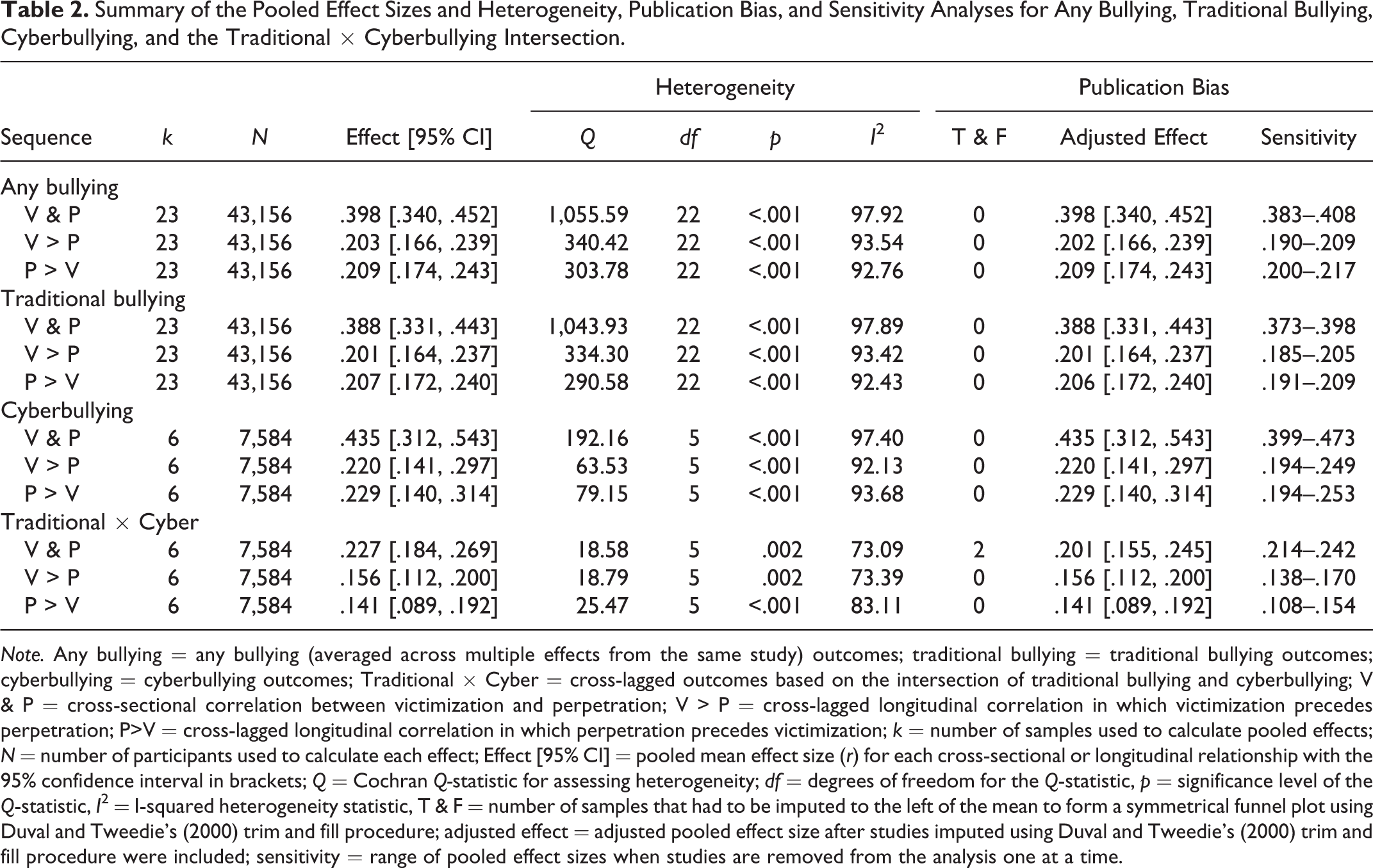
Note. Any bullying = any bullying (averaged across multiple effects from the same study) outcomes; traditional bullying = traditional bullying outcomes; cyberbullying = cyberbullying outcomes; Traditional × Cyber = cross-lagged outcomes based on the intersection of traditional bullying and cyberbullying; V & P = cross-sectional correlation between victimization and perpetration; V > P = cross-lagged longitudinal correlation in which victimization precedes perpetration; P>V = cross-lagged longitudinal correlation in which perpetration precedes victimization; k = number of samples used to calculate pooled effects; N = number of participants used to calculate each effect; Effect [95% CI] = pooled mean effect size (r) for each cross-sectional or longitudinal relationship with the 95% confidence interval in brackets; Q = Cochran Q-statistic for assessing heterogeneity; df = degrees of freedom for the Q-statistic, p = significance level of the Q-statistic, I2 = I-squared heterogeneity statistic, T & F = number of samples that had to be imputed to the left of the mean to form a symmetrical funnel plot using Duval and Tweedie’s (2000) trim and fill procedure; adjusted effect = adjusted pooled effect size after studies imputed using Duval and Tweedie’s (2000) trim and fill procedure were included; sensitivity = range of pooled effect sizes when studies are removed from the analysis one at a time.

Forest plot for any bullying victimization leading to any bullying perpetration.
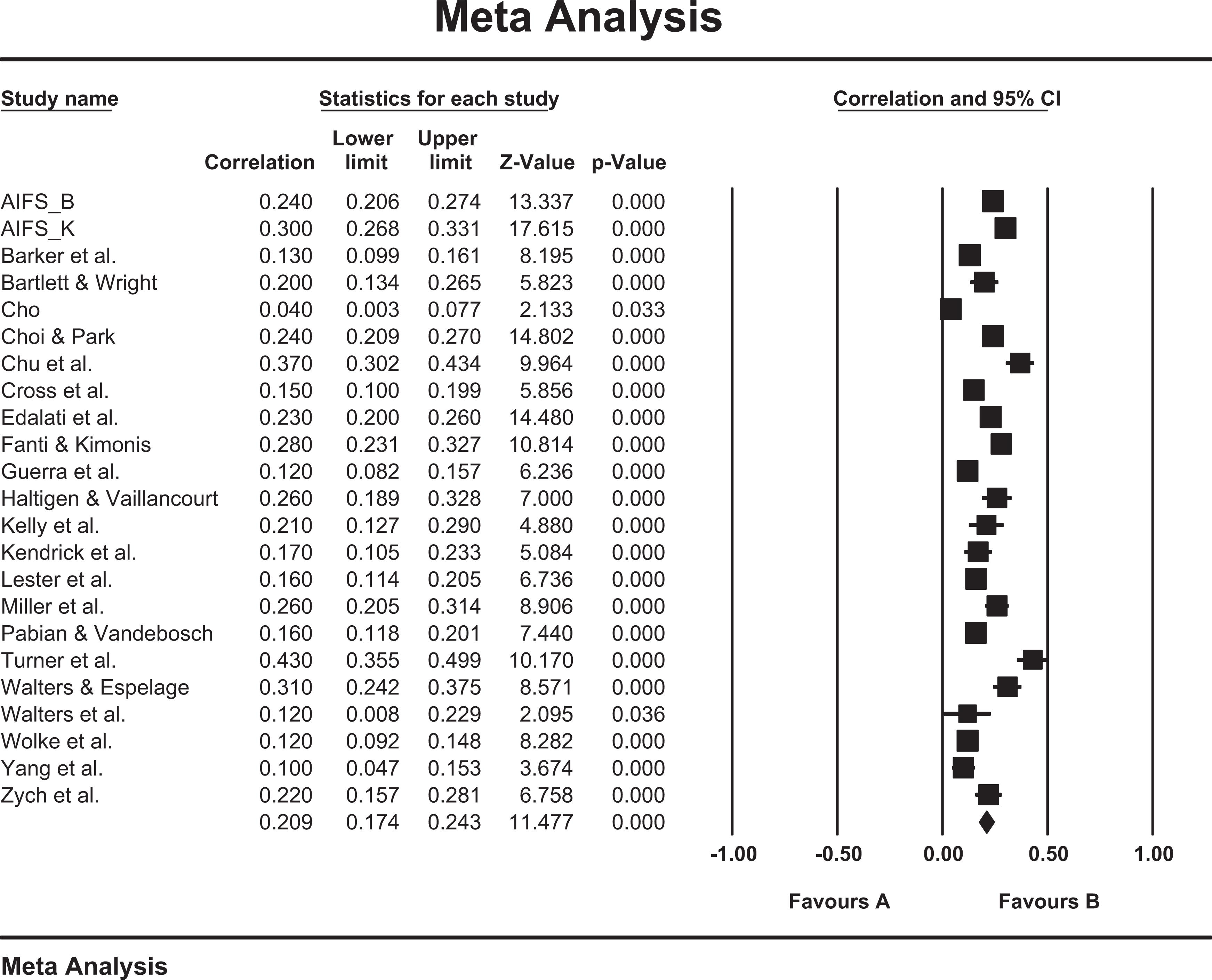
Forest plot for any bullying perpetration leading to any bullying victimization.
There was strong evidence of between-study heterogeneity (Q-statistic and I2) in the cross-sectional and longitudinal victimization–perpetration associations, indicating that a random effects model was the correct choice for this meta-analysis and that all three victimization–perpetration relationships may be moderated by third variables. There was no evidence of publication bias in studies assessing the concurrent relationship between victimization and perpetration (see funnel plot in Figure 3), and there were no signs of publication bias in studies attempting to predict any perpetration with any victimization, with the possible exception of the concurrent correlations in the Traditional × Cyber Cross-Lags (see trim and fill results in Table 2). Even so, the adjusted pooled effect size and confidence interval (CI) obtained when studies were imputed using Duval and Tweedie’s (2000) trim and fill procedure were only 11% lower than the unadjusted pooled effect size and CI.
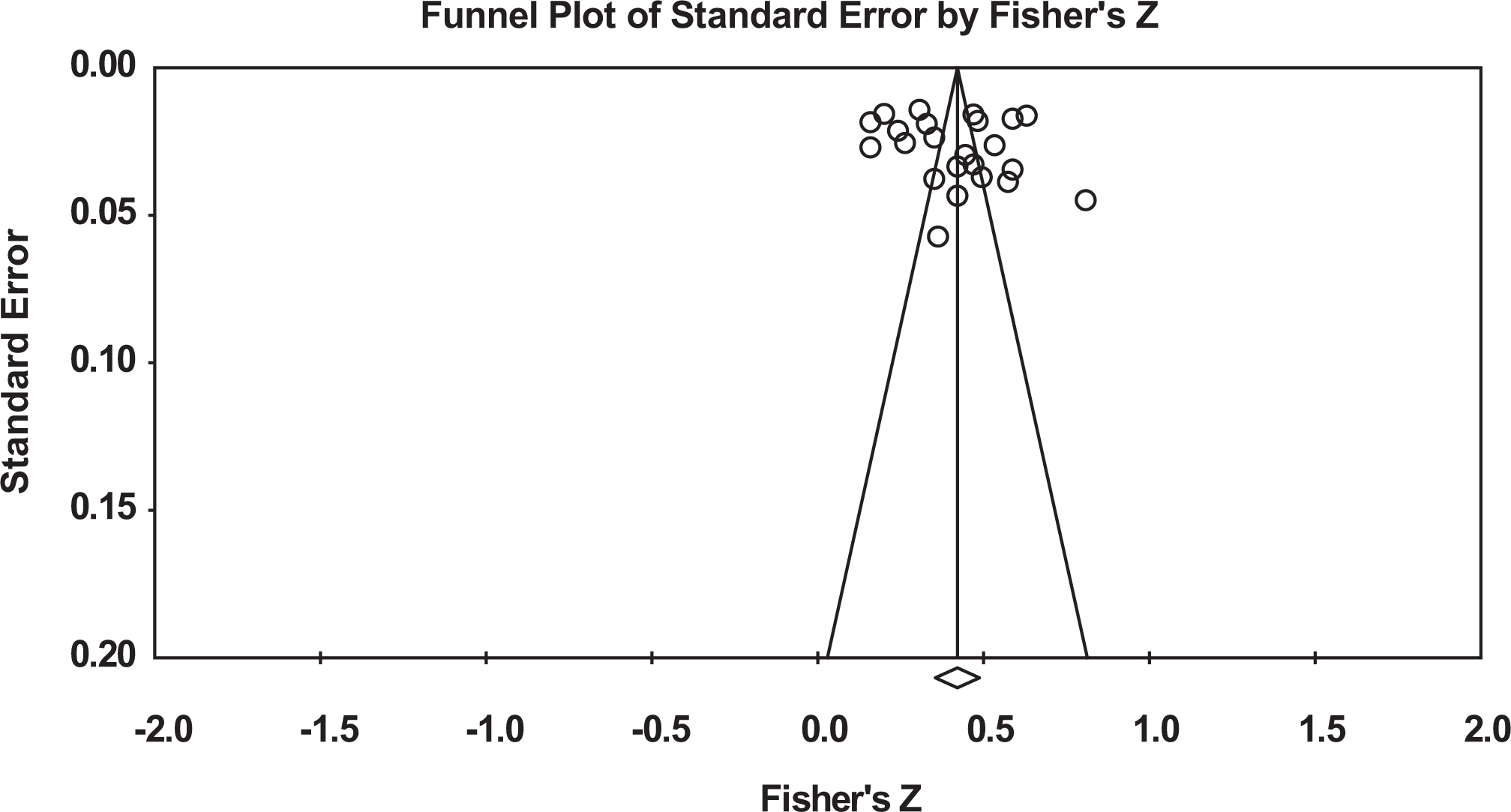
Funnel plot for any bullying concurrent correlations.
Effect sizes for any bullying, traditional bullying, and cyberbullying concurrent victimization–perpetration associations were significant and large (Rice & Harris, 2005). Effect sizes for any bullying, traditional bullying, and cyberbullying cross-lagged longitudinal victimization–perpetration associations were modest to moderate and significant. Analyses computed across bullying types (i.e., intersection between traditional and cyber-bullying) revealed a moderate pooled effect size for the concurrent relationship and modest pooled effect sizes for the cross-lagged longitudinal relationships, all of which were statistically significant.
Pooled effect size results did not change to any great extent when traditional bullying and cyberbullying were analyzed separately. Therefore, while the cyberbullying effects were 12%–14% higher than the traditional bullying effects, there was extensive overlap between the two sets of CIs and thus no basis on which to conclude that these differences were meaningful or real. Sensitivity testing demonstrated that no one study had an undue influence on the overall pattern of results.
Findings from a moderation analysis of any bullying relationships (cross-sectional, longitudinal victimization–perpetration, longitudinal perpetration–victimization) are summarized in Table 3. Just one significant moderation effect was recorded in the current meta-analysis. Specifically, the victimization → perpetration sequence was stronger in older samples than in younger samples. There were no significant moderator effects across the three relationships for either study location, gender, or length of follow-up. In addition, significant CIs were obtained for the five U.S. studies: concurrent victimization–perpetration correlation (.419, .333–.499), cross-lagged longitudinal victimization to perpetration correlation (.209, .131–284), and cross-lagged longitudinal perpetration to victimization correlation (.205, .125–.282).
Moderator Variable Analyses for Any Bullying.
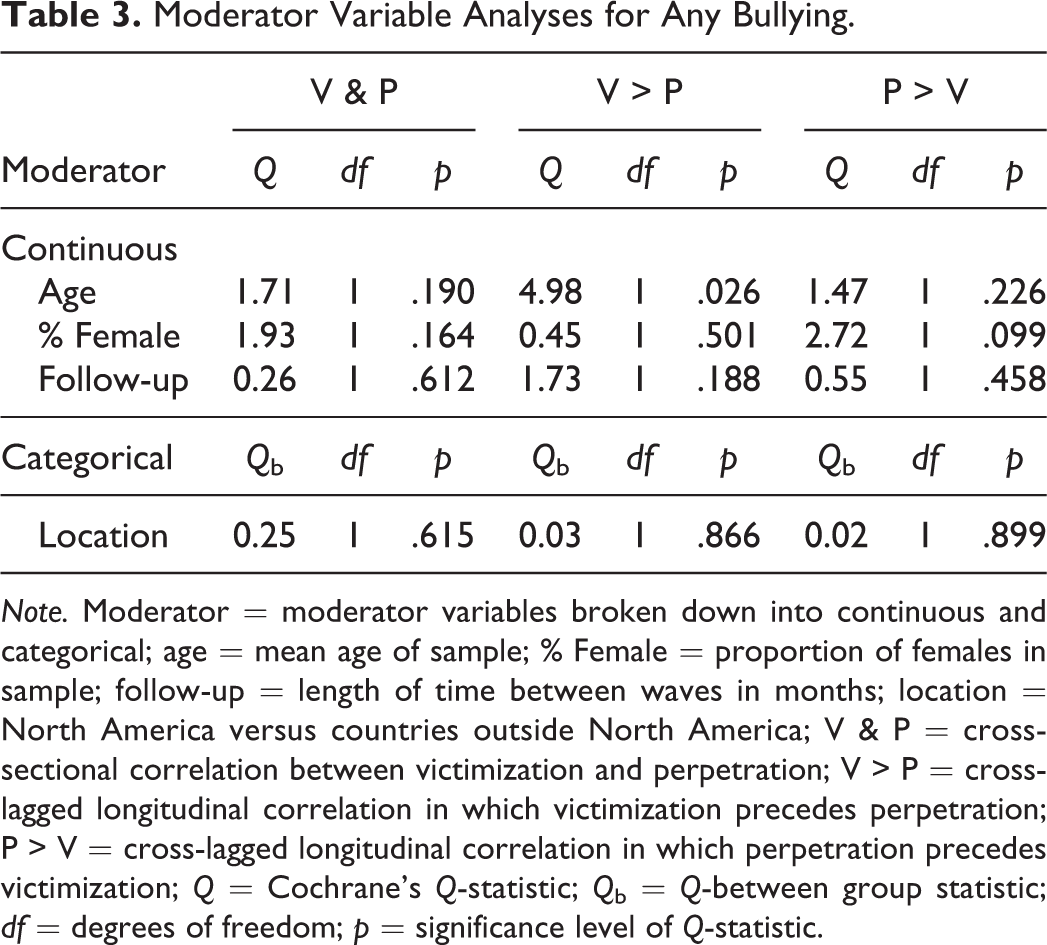
Note. Moderator = moderator variables broken down into continuous and categorical; age = mean age of sample; % Female = proportion of females in sample; follow-up = length of time between waves in months; location = North America versus countries outside North America; V & P = cross-sectional correlation between victimization and perpetration; V > P = cross-lagged longitudinal correlation in which victimization precedes perpetration; P > V = cross-lagged longitudinal correlation in which perpetration precedes victimization; Q = Cochrane’s Q-statistic; Qb = Q-between group statistic; df = degrees of freedom; p = significance level of Q-statistic.
Discussion
The results of the current meta-analysis not only confirm the presence of a strong concurrent relationship between bullying victimization and perpetration, they also verify the existence of a modest to moderate two-way cross-lagged longitudinal relationship between victimization and perpetration, regardless of whether traditional bullying, cyberbullying, or both were analyzed. There were even significant cross-lagged temporal effects at the intersection of traditional bullying/victimization and cyberbullying/victimization. This would seem to suggest that across different types of bullying, perpetration is just as likely to be followed by victimization as victimization is to be followed by perpetration. As has long been assumed (Cook et al., 2010), youthful victims of bullying are at increased risk of engaging in bullying themselves, but as the current results suggest, youth who bully are also at increased risk of becoming future victims of bullying. The effects were modest to moderate in magnitude and unrelated to either study location (United States versus any other country) or length of follow-up (which ranged from 4 to 24 months). One small moderating effect was noted, nonetheless, in which older youth displayed a slightly stronger victimization to perpetration sequence than younger youth. It would seem that this finding could serve as a springboard for future research, a possibility discussed later in this section.
Theoretical Implications
The current results suggest that the moderately strong relationship that exists between bullying victimization and perpetration is reciprocal or bidirectional. However, just because the victimization–perpetration relationship runs in both directions does not mean that the same mechanism is responsible for both effects. In a recent study on violent victimization and aggressive offending, Walters (2020) discovered that peer delinquency mediated the prospective relationship between aggressive offending and violent victimization but not the prospective relationship between violent victimization and aggressive offending. Thus, one mechanism that mediated the offending → victimization relationship in the Walters (2020) study was an increase in delinquent peers, made possible by homophily or peer selection (Kiesner et al., 2003), and which, along with a change in routine activities (Cohen & Felson, 1979) and involvement in risky lifestyles (Garofalo, 1987), augmented the offender’s vulnerability to victimization in a process referred to as person proximity (Walters, 2020). A similar process may occur with bullying. Those who bully, like those who engage in delinquency, may select one another and affiliate based on common interests and statuses. Such affiliation can increase the risk of victimization for some who bully by increasing their proximity to other bullies via a change in routine activities. Because there is evidence that bullying may function as a social hierarchy (Koh & Wong, 2017), those who bully can become victims of bullying themselves when placed in situations with those who are higher than them in the bullying hierarchy. In this way, perpetration and victimization are both risk factors for future perpetration.
Whereas peer selection, routine activities, and person proximity may be responsible for the offending/bullying → victimization sequence of the larger victim–offender relationship, the victimization → offending/bullying sequence may be more a function of social learning (Akers, 1998), social cognition (Bandura, 1986), general strain (Agnew, 1992), and cycle of violence (Widom, 1989) factors. In the previously mentioned Walters (2020) investigation, the victimization → offending sequence was not mediated by association with delinquent peers, in direct contrast to what social learning theory would propose, or depression, contrary to what the general strain theory would predict. Instead, it was mediated by the cognitive-affective construct of interpersonal hostility, which comes from social cognitive theory. Apparently, being the victim of violent crime contributed to a rise in thoughts and feelings of interpersonal hostility in Walters (2020), which the individual then acted upon by expanding his or her involvement in aggressive offending. This same relationship was observed in a study on bullying, whereby exposure to victimization led to intensified thoughts and feelings of hostility 6 months later, which then led to a significant rise in bullying perpetration 6 months after this (Walters & Espelage, 2018). Deviant peer/routine activity mediation of the bullying perpetration → bullying victimization sequence and hostile attitude/general strain mediation of the bullying victimization → bullying perpetration sequence need to be corroborated, although both effects hold promise of advancing our understanding of the bullying victimization–perpetration relationship.
Practical Implications
There are several noteworthy practical implications to the current results. First, the cross-lagged longitudinal correlations between victimization and perpetration revealed that perpetration was just as likely to lead to victimization as victimization was to lead to perpetration. Hence, each variable serves as a risk factor for the other. This would seem to provide verification of Widom’s (1989) cycle of violence concept; whereas Widom focused almost exclusively on the victim to perpetrator sequence, results from the current meta-analysis connote that the relationship may run in both directions. Second, school-based bullying programs should be as comprehensive as possible, addressing perpetrators, victims, and bystanders alike, and covering all salient features of the school environment. Evidence-based bullying programs like KiVa (Juvonen et al., 2016) and the Olweus Bullying Prevention Program (Ttofi & Farrington, 2009) owe their existence and continued viability to the comprehensive approach they take in helping children manage the thoughts, feelings, and behaviors that mark, motivate, and characterize victimization and perpetration. Third, a meta-analysis by Yeager et al. (2015) showed that bullying prevention programs were more effective with younger children (<8th grade) than with older children (>8th grade). According to the results of this study, the perpetration → victimization sequence was significantly stronger in older than in younger samples. One possibility is that this association or sequence becomes stronger and more resistant to change with time, being most amenable to intervention early in its development.
Limitations
As with any study, the current meta-analysis suffered from several limitations. First, the original literature review identified eight studies that could not be included in the current meta-analysis because the requisite correlations were missing from the published articles and repeated attempts to get the information from the authors failed. Data that are missing systematically can create bias in a meta-analysis. In fact, there was evidence of modest to moderate publication bias in the analyses performed on the traditional bullying and cyberbullying measures. Second, there was diversity in gender and nationality but not in age in this meta-analysis, although the latter was by design. The focus of the current meta-analysis was on the relationship between victimization and perpetration in nontreated samples of school-age children and adolescents. This still presents a limitation, however, by restricting the sample’s age range and, in the process, reducing its diversity. Furthermore, diversity in race and ethnicity could not be explored because many of the studies failed to report this information. Third, bullying is an umbrella term for a number of different behaviors, to include pushing, shoving, insulting, ostracizing, and name-calling. The vast majority of studies included in the current meta-analysis did not provide a specific breakdown as to the types of bullying being investigated other than to differentiate between traditional bullying and cyberbullying, both of which were identified and analyzed in the current set of analyses.
Directions for Future Research
One direction for future research would be testing the theory behind the alleged bidirectional victimization–perpetration relationship observed in this meta-analysis. As described earlier in this section, the theory holds that peer selection, routine activities, and person proximity are largely responsible for the perpetration → victimization sequence, whereas social learning, general strain, and interpersonal hostility are the principal mediators of the victimization → perpetration “cycle of violence” sequence. Hence, different mechanisms may be at work in mediating the opposing legs of the putative bidirectional victimization–perpetration relationship. Verifying these mechanisms should be a principal objective of future research. A second direction for future research is more in-depth analysis of variables that may moderate the victimization–perpetration relationship. The only moderating effect observed in the current meta-analysis was for age, in which the victimization → perpetration sequence was significantly stronger in older, as opposed to younger, adolescents. The opportunities this presents for clarifying the developmental origins of the victimization–perpetration relationship constitute fertile ground for future research. To the extent that bullying prevention programs are more effective with younger, as opposed to older, students (Yeager et al., 2015), addressing bullying victimization at an early age, before the victimization → perpetration sequence has had a chance to congeal, may provide the optimal conditions for change. Finally, person-level analyses using latent class procedures, as was done by Williford et al. (2011), may be capable of providing additional information on the bullying victimization–perpetration relationship beyond the variable-level analyses reported in this meta-analysis.
Conclusion
The results of this meta-analysis indicate that the concurrent relationship between bullying victimization and perpetration is strong and that the cross-lagged longitudinal relationship is modest to moderate in magnitude and runs in both directions. A cross-lagged longitudinal association between victimization and perpetration appears to exist for traditional bullying, cyberbullying, and the intersection of the two. Separate mechanisms are proposed for the two parts of what may be a bidirectional relationship, but additional research is required to verify these mechanisms and determine how generalizable the results are to countries, like the United States, that suffer from serious problems with bullying yet were underrepresented in the current meta-analysis.
Critical Findings
A strong relationship exists between concurrent measures of bullying victimization and perpetration.
A modest to moderate relationship exists between cross-lagged longitudinal measures of bullying victimization and perpetration, operating in both directions—from bullying victimization to bullying perpetration and from bullying perpetration to bullying victimization.
The putative bidirectional relationship between bullying victimization and bullying perpetration can be observed with traditional bullying, cyberbullying, and even the intersection between traditional bullying and cyberbullying.
Because bullying victimization and perpetration appear to be affecting one another, both need to be addressed by parents, schools, practitioners, and others involved in preventing bullying behavior and assisting those who have been negatively affected by this poorly understood aggressive pattern.
Implications for Practice, Policy, and Research
Additional research is required to determine if and how bullying perpetration causes, facilitates, or encourages bullying victimization and if and how victimization causes, facilitates, or encourages perpetration. This information could be very useful in explaining, preventing, and controlling the ubiquitous problem of school-age bullying.
Whereas peer selection, routine activities, and person proximity may be responsible for the bullying → victimization sequence of the larger victim–offender relationship, the victimization → bullying sequence may be more a function of social learning, social cognition, and general strain. A theoretical model is introduced in an effort to guide future research in this area.
School-based bullying programs should be as comprehensive as possible, addressing bullies, victims, and bystanders alike, and covering all salient features of the school environment. Such programs should work on helping students manage the thoughts, feelings, and behaviors that mark, motivate, and characterize bullying victimization and perpetration.
Footnotes
Acknowledgment
The author would like to thank Kamran Afzali, the Australian Institute of Family Studies, Edward Barker, Sujung Cho, Patricia Conrod, Donna Cross, Stacey Cutbush, Hanie Edalati, John Haltigan, Erin Kelly, Eunro Lee, Tanya Lereya, Leanne Lester, Barbara Maughan, Sara Pabian, Soowon Park, Therese Shaw, Marla Stuart, Kate Reynolds, Tracy Vaillancourt, Jason Williams, Kirk Williams, Dieter Wolke, William Yen, and Izabela Zych for providing data unavailable in published sources.
Declaration of Conflicting Interests
The author(s) declared no potential conflicts of interest with respect to the research, authorship, and/or publication of this article.
Funding
The author(s) received no financial support for the research, authorship, and/or publication of this article.
