



Abstract
This systematic review is the first published attempt to synthesize literature pertaining to intimate partner violence (IPV) interventions impacting South Asian women in the United States. Applying the conceptual framework of intersectionality, the goals of this review are to (1) understand current trends, intervention modalities, and areas of focus within IPV interventions targeting South Asian communities in the United States and (2) to identify gaps in the address of IPV among these communities. Using the Cochrane Handbook and Preferred Reporting Items for Systematic Reviews and Meta-Analyses guidelines, we searched 35 databases and identified 12 research studies. Our study included a collective sample of 318 South Asian IPV survivors and 25 organizations. Findings underscore that there are minimal IPV interventions available to South Asian women living in the United States. Most interventions have not been systematically evaluated, making their efficacy questionable. Those that reported outcome evaluation, namely recurrence of IPV, demonstrated limited efficacy. IPV research on South Asian women often dismisses financial concerns in light of cultural dimensions impacting IPV. Given that financial dependence is a major driver of violence against South Asian women, scholars must question the efficacy of available interventions that cannot foster the social and economic security of IPV survivors. Without sufficient attention to the intersecting social, cultural, and economic challenges that South Asian women face in abusive relationships, the efficacy of IPV interventions will remain limited.
Background
According to the World Health Organization (WHO, 2013), 35% of women globally have experienced intimate partner violence (IPV), and 38% of the murders of women are perpetrated by an intimate partner. The range of IPV includes private humiliation; sexual coercion; physical, emotional, financial and sexual abuse; and murder (Chang et al., 2010; Niaz et al., 2017). IPV is one of the most pressing social issues in South Asia, partially due to cultural and religious norms that can normalize the experiences of violence.
IPV is highly prevalent in South Asian contexts, including Afghanistan, Bangladesh, Bhutan, India, Pakistan, the Maldives, Sri Lanka, and Nepal (International Center for Research on Women, 2017; UN Women, 2011; WHO, 2013; World Bank, 2019a). Data in Pakistan indicate that 35%–39% of married women aged 15–49 had experienced IPV (National Institute of Population Studies, 2013; Overseas Development Institute [ODI], 2017), and 33% have experienced IPV in the past year (ODI, 2017). In a nationally representative survey of Nepal, 33% of women had experienced IPV (ODI, 2017). The National Family Health Survey of India revealed that 33% of ever-married women have experienced physical, sexual, or emotional partner violence (International Institute for Population Sciences & National Family Health Survey, 2016). In a sample in Bangladesh, 49.6% of women had experienced physical violence, 28.7% had experienced psychological violence, and 27.2% had experienced sexual violence (Bangladesh Bureau of Statistics, 2016; ODI, 2017). South Asian women tend to have lower levels of education and lower levels of employment in the formal labor sector as compared to men; therefore, financial dependence on a spouse may impede women’s ability to leave violent relationships (Chatterjee et al., 2018; International Labour Organization, 2018; Verick, 2018; World Bank, 2018).
In more recent years, South Asians have become one of the largest immigrant communities in the United States (Zong & Batalova, 2017; South Asians Americans Leading Together [SAALT], 2019), South Asians Americans Leading Together [SAALT], 2019), numbering over 5.4 million people with an expected growth by over 80% within the past decade (SAALT, 2019, 2012). South Asians currently make up nearly half (48%) of all Asian American immigrants in the United States (SAALT, 2012; Varughese, 2017). The South Asian population in the United States is composed of people who have origins in India (40.3%), Pakistan (30.3%), Bangladesh (24%), Bhutan (27%), and Sri Lanka (7.2%) (SAALT, 2019). In terms of religion, the South Asian American community is 51% Hindu, 18% Christian, 10% Muslim, and 5% Sikh (Mishra, 2016).
Immigration patterns for South Asian Americans have also shifted over time. Following the 1965 Immigration Act, there was a significant increase in South Asian immigrants to the United States who had professional degrees or were coming to the United States to complete their graduate education (Minocha, 1987). In more recent years, there has been an influx of individuals on H1-B visas of South Asians entering the United States to work in highly skilled jobs (Kelkar, 2012) including computing and software engineering. There are also a significant number of South Asian immigrants who enter the United States as asylees, refugees, or undocumented immigrants (SAALT, 2019). Excluding Sri Lankans, more than 60% of all recently immigrated South Asians are under the age of 30 with a 1:1 ratio of males to females (Minocha, 1987). However, there remains a disparity in terms of educational attainment as 72% of South Asian men have college degrees as compared to 52% of South Asian women (Minocha, 1987).
Existing literature indicates that IPV rates are higher for South Asian Americans and immigrants than for South Asians in their home countries. Between 22% and 77% of South Asian women in the United States have reported experiencing some form of abuse by an intimate partner at least once in their lives (Adam & Schewe, 2007; Adams, 2000; Mahapatra, 2012; Raj & Silverman, 2002a; Yoshihama & Dabby, 2015). A descriptive analysis of the experiences of IPV survivors indicated relapses and cyclical patterns of abuse in women’s lives (Mahapatra, 2012). Due to the lack of prevalence data for particular South Asian communities, such as Afghans, Bhutanese, and Sri Lankans, it is possible that actual prevalence rates may be either over- or underestimated.
Although there have been systematic reviews of IPV for various minority communities, including Latinas (Alvarez et al., 2016), sexual minority populations (Edwards et al., 2015), and Native Americans (Finfgeld-Connett, 2015), to date, there has been no published systematic review of IPV interventions impacting South Asian women, living in either South Asia or the United States. As such, this systematic review aimed to evaluate the published literature on IPV interventions targeting South Asian women living in the United States in order to determine the cumulative impact of these intervention efforts.
The present study utilizes the conceptual framework of intersectionality, which recognizes that women of color experience life through multiple systems of oppression (Crenshaw, 1989), including race, gender, caste, religion, and socioeconomic class. South Asian immigrant women are often disadvantaged by multiple systems including sociocultural norms, legal status, religious traditions, language proficiency, and socioeconomic factors (Lee, 2015). Understanding these intersections will provide a deeper understanding of how to better intervene with South Asian women who have experienced IPV. As such, the goals of the present systematic review were (1) to understand current trends, intervention modalities, and areas of focus within IPV interventions targeting South Asian communities in the United States and (2) to identify gaps in the address of IPV among these communities.
Influence of Sociocultural Norms and Gender Roles
The impact of IPV on South Asian immigrants is particularly challenging because of cultural and linguistic barriers faced by this group in the United States (Adam & Schewe, 2007; Dasgupta, 2000; Wang, 1996; Yoshioka et al., 2003). There is wide diversity among South Asian communities in regard to language, culture, and religion (Ahmad-Stout et al., 2018). Nonetheless, cultural patterns and shared social perceptions persist across South Asian communities. South Asians tend to value community well-being over individual health; this collectivity principle guides moral values and religious codes across multiple religious and ethnic communities in South Asia (Varughese, 2017). As a result, women may be reluctant to disclose violence because they tend to prioritize their families’ health and community reputation over their individual well-being.
Rigid gender roles have also been recognized as a significant factor in compounding IPV among South Asians (Ahmad et al., 2004; Ahmed-Stout et al., 2018; Dasgupta, 1998a, 1998b; Raj & Silverman, 2002). The division of labor within South Asian families is such that women are responsible for caregiving roles, while men are expected to financially provide for the family (Dasgupta, 1998a; World Bank, 2017a). This division of labor often makes women feel that their emotional or mental health concerns are trivial in comparison to the pragmatic tasks of earning an income and financially managing a household. Women may be viewed by members of the larger South Asian community as being physically and intellectually inferior to men, leading their emotional, financial, and health needs to be less prioritized over their male counterparts (George & Rahangdale, 1999; Lee & Hadeed, 2009).
Immigration Barriers and Status of Dependency
Many South Asian women migrate to the United States through a visa that is dependent on their spouse (Bhandari, 2008; Kelkar, 2012). As such, their legal presence in this country is intimately connected to their partner (Balgamwalla, 2013; The Tribune, 2014). Women on these dependent H4 visas face additional challenges in terms of employment and benefits as their legal status and employment/benefit eligibility are linked to their spouse (Kelkar, 2012). Like many other immigrant women, South Asian women deal with issues regarding their cultural integration into American society while concurrently feeling bounded by cultures and traditions from their home countries (Dasgupta, 2000; Singh & Unnithan, 1999). Dependence on one’s spouse and in-laws, lack of English proficiency, financial instability, lack of social supports, and uncertain legal status can leave women feeling vulnerable and socially isolated (George & Rahangdale, 1999). These cultural and systemic barriers make it difficult for South Asian immigrant women facing IPV to seek assistance from both formal and informal sources.
South Asian women often frame their experiences of IPV as a part of their cultural upbringing (Dasgupta, 2007; Flood & Pease, 2009; Rianon & Shelton, 2003). Research finds that South Asian women may not recognize certain acts and behaviors as abusive due to expectations regarding familial obligations and culturally prescribed gender roles (Ahmad et al., 2004). Likewise, the fear of being shamed, stigmatized, and ostracized are factors that can prohibit South Asian women from coming forward about their abusive experiences (Ahmed-Stout et al., 2018; Yoshioka et al., 2003).
Interventions Offered by South Asian Organizations
Some of the mainstream IPV services that have been shown to be effective in the United States include mental health counseling, shelter access, health screening, legal advocacy, transitional housing, and community outreach (Rivas et al., 2016). There is a wide variation in the number and ethnicity of clients with whom these organizations work. South Asian IPV organizations primarily focus on temporary programs that are necessary tools for improving economic well-being, such as shelter assistance, legal help, and English-language classes. However, the efficacy and impact of these interventions are still largely unknown. While researchers have acknowledged that cultural issues, limited English-speaking proficiency, and immigration status impact the prevalence of IPV among the South Asian community (Ahmed-Stout et al., 2018; Raj & Silverman, 2002), interventions have failed to highlight the financial issues that prevent women from leaving abusive relationships. Similarly, though interventions have addressed the mental health challenges resulting from IPV, little attention has been paid to the role of economic conditions as a primary factor in shaping women’s ability to leave a violent relationship and achieve both mental and financial stability. Economic support provided for South Asian women experiencing IPV in the United States is inadequate, particularly given the diverse populations these organizations serve (SAALT, 2012).
South Asian organizations working with IPV survivors often do not provide financial support or economic empowerment services (Hahn & Postmus, 2014). The community-based advocacy organization, SAALT, recently released a report called, “A Demographic Snapshot of South Asians in the U.S.” (2012). They found that of 34 community organizations working closely with South Asian immigrant women experiencing IPV in the United States, only eight had economic empowerment programs for IPV survivors (SAALT, 2019, 2012). Financially sustainable solutions that provide women the legal and economic independence to leave violent relationships are required to effectively deal with the problem of IPV within immigrant and racial/ethnic minority communities.
Method
Inclusion Criteria
We conducted a systematic review of the literature published from 1980 through June 2019 on IPV interventions for South Asian women living in the United States. Inclusion criteria for studies were (1) participants or a subset of total participants in the study were South Asian women living in the United States and (2) participants had undergone an intervention or received care from a community-based organization that sought to address IPV. Because the nature and scale of IPV interventions vary widely internationally and would be adversely impacted by a number of other confounding factors, we excluded studies conducted outside of the United States. The demographic, racial, and socioeconomic profile of these diasporic South Asians in the United States makes this population distinct from those living in South Asia.
Protocol and Registration
This systematic review followed the guidelines described in the Cochrane Handbook (Higgins & Green, 2008) and the Preferred Reporting Items for Systematic Reviews and Meta-Analyses guidelines (Moher et al., 2009). The research protocol for systematic review was published online through the International Prospective Register for Systematic Reviews through the University of York, Centre for Reviews and Dissemination under the registration number CRD42019128431 (Tripathi & Azhar, 2019). The protocol was made public 12 weeks before the completion of data collection and analysis.
Data Sources
This systematic review identified manuscripts in the following 23 databases for publications from 1980 through June 2019: (1) Academic Search Premier, (2) Business Source Premier, (3) Criminal Justice Abstracts, (4) Defining Gender, 1450–1910, (5) Econlit, (6) Family and Society Studies Worldwide, (7) Gender Watch, (8) MEDLINE with Full Text, (9) National Criminal Justice Reference Service Abstracts Database, (10) North American Women’s Letters and Diaries: Colonial Times to 1950, (11) PAIS International, (12) ProQuest Dissertations & Theses, (13) ProQuest Sociology, (14) Psych INFO, (15) Psychiatry Online, (16) PubMed, (17) Sociological Abstracts, (18) Social Services Abstracts, (19) Social Work Abstracts (EBSCO), (20) Westlaw, (21) Worldwide Political Science Abstracts, (22) Women and Social Movements in the U.S., 1600–2000 (Scholar’s Edition), and (23) Women’s Studies International. After these databases had been reviewed, a second search was conducted utilizing an additional 12 databases, including Academic Search Premier, Google Scholar, JSTOR, and Project Muse. We also checked reference lists in published studies to identify additional interventions. Finally, we also contacted NGOs serving South Asian survivors of IPV for additional unpublished data but did not receive any additional information from these sources.
Data Collection and Coding
We conducted our search using combinations of the following two search terms and their synonyms and derivatives: (a) a term relating to IPV and (b) a term relating to South Asian women. For example, for MEDLINE/PubMed, our search was written as follows: (a) Subject Terms: (violen* OR abus*) AND (South Asia* OR Asia* OR India* OR Pakistan* OR Bangladesh* OR Nepal* OR Sri Lanka* OR immigrant* OR minority* OR women of color*).
Articles were coded by both of the authors on multiple factors including study description, research design, sample size, intervention setting, theoretical orientation, race/ethnicity of sample, region/geographical location, intervention format, use of a validated scale, method of measurement for IPV, intervention format, and sample age range. The first level of coding focused on descriptive elements and the second level of coding focused on identifying patterns and inferential meta-codes. Later, these codes were pulled together to generate more meaningful themes. Both the authors independently coded interventions, and a consensus was reached on all data extraction and coding decisions. Interrater reliability was measured by the percentage of agreement for coding decisions, using kappa (κ) statistics to adjust for chance. Interrater reliability was found to be 80.5%. We used the following formula: pO − pc/1 − pc, where pO is the observed proportion of agreement and pc is the proportion of agreement by chance (Elliott, 2018). During the review, duplicate studies were removed and filtered based on inclusion criteria. The quality of included studies was assessed using the Critical Appraisal Skills Program tool designed for evaluating qualitative studies (Noyes et al., 2013; Singh, 2013; CASP, 2018) (Table 1).
Critical Skill Appraisal Program Qualitative Analyses of Studies.
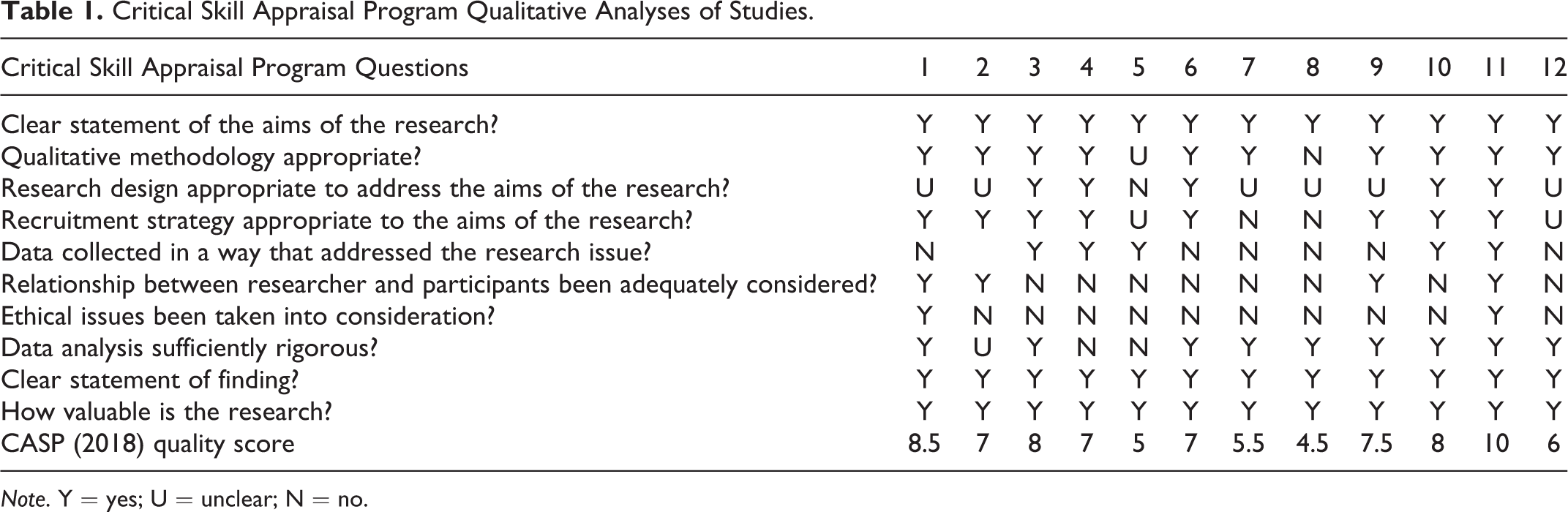
Note. Y = yes; U = unclear; N = no.
Results
As depicted in Figure 1, during the initial search, 189 articles were screened for study inclusion. From these, 29 articles were duplicates and were removed. In the second stage of the screening process, 72 articles met study criteria and 88 articles were excluded. Following this step, another 48 articles were excluded because they did not focus on IPV interventions among South Asian populations. After an additional screening to remove those studies that were not evaluating interventions (but rather focused on the prevalence of IPV or other sociocultural factors impacting IPV), 12 articles were excluded. A final sample of 12 studies met all inclusion criteria. From these 12 studies, we created a collective sample of 25 organizations and 318 South Asian IPV survivors.

Adapted Preferred Reporting Items for Systematic Reviews and Meta-Analyses flow diagram demonstrating study selection methodologies and filter results.
We found two main recurring components for IPV interventions: use of the advocacy model and community outreach services. Advocacy interventions involve advocating on behalf of IPV survivors and linking them to social and legal services (Eckhardt et al., 2013; Rivas et al., 2016; Sullivan, 2012). For the purposes of this review, we define advocacy interventions as legal aid, immigration support, translation services, support groups, housing, financial assistance, and mental health services. Community outreach involves identifying a specific need for a particular group or community and provide services specific to the needs of that community (Shorey et al., 2014).
Eight studies in our review (65%) combined multiple interventions, such as individual therapy, group counseling, legal support, crisis hotline, support groups, shelter assistance, job search assistance, career counseling, and community education. In two studies, advocacy was a stand-alone service (Kim, 2000; Yoshihama et al., 2012), whereas most studies integrated advocacy as part of a larger intervention (Abraham, 1995; Kapoor et al., 2017; Merchant, 2000; Preisser, 1999).
Eight studies reported data from multiple organizations and interventions. Within these studies combining multiple organizations, there was a collective sample of 13 organizations that used both therapeutic and advocacy interventions (Abraham, 1995; Dasgupta & Warrier, 1997; Kim, 2000; Pillay, 2004; Preisser, 1999). For example, seven organizations in Kim’s (2000) study combined clinical care, advocacy, and service outreach through the provision of English language classes, immigration services, and shelter assistance. Within clinical services, both individual and group-level psychotherapy was offered. The other 12 organizations specifically focused on advocacy interventions (Kapoor et al., 2017; Merchant, 2000; Yoshihama & Tolman, 2015; Yoshihama et al., 2012). None of the 12 studies included financial support interventions nor any explicit acknowledgment of the importance of economic empowerment.
Sampling
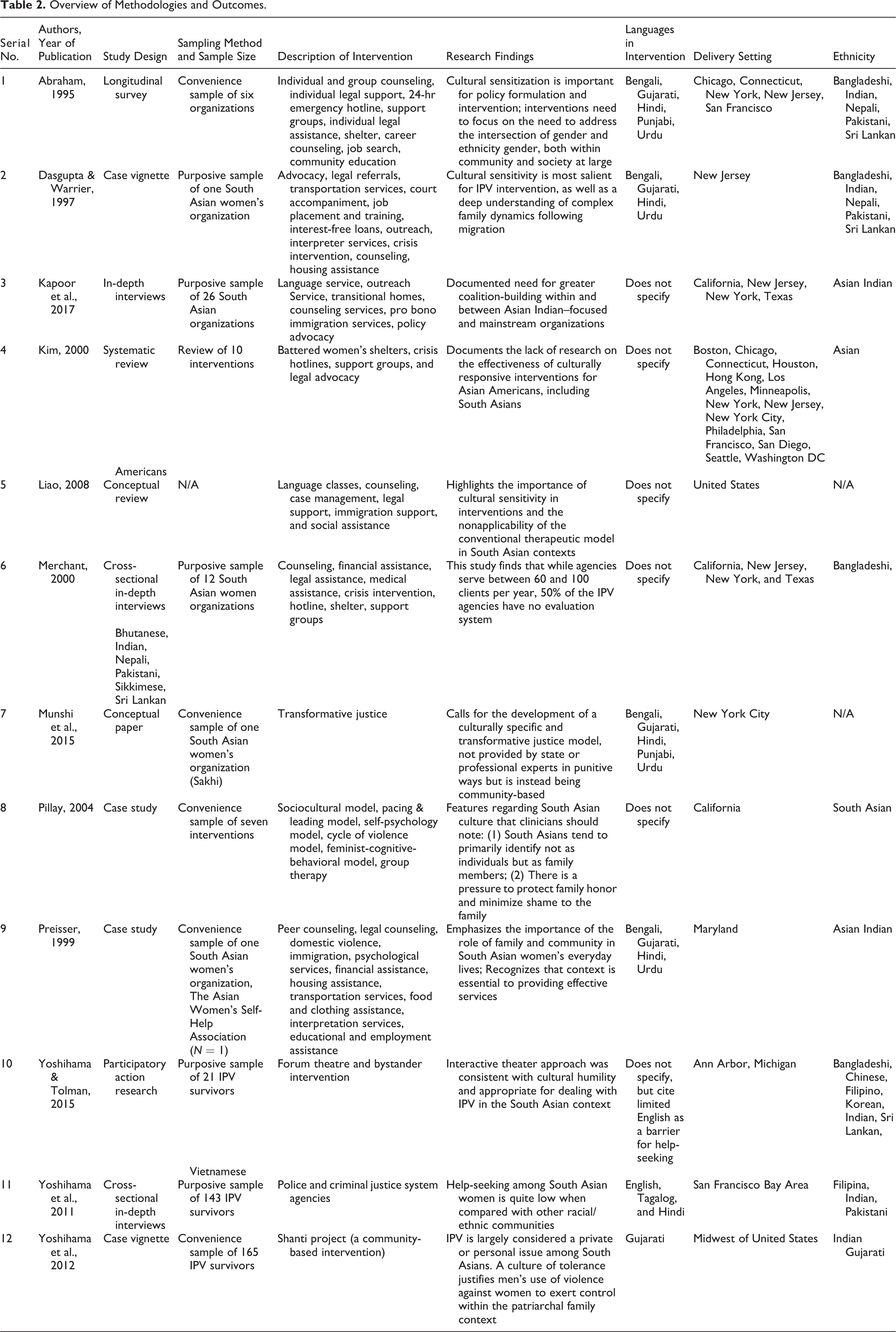
Four studies looked at the effects of IPV interventions at the individual level, while eight studies looked at effects at the organizational level. The sampling methods used to recruit South Asian women were mostly purposive and convenience sampling, with 50% of the studies utilizing convenience and purposive sampling. The age range of the women in the sample was from 21 to 45 years. Most of the women in the sample had low income, were not employed in the formal sector, and had not attended or completed higher education. As highlighted in Table 2, the majority of studies (60%) were done in the tristate area of New York, New Jersey, and Connecticut. Most studies focused on metropolitan areas like Los Angeles, New York, and Chicago. Participants were mostly of Indian, Bangladeshi, Pakistani, and Sri Lankan origin. Only three studies in our review included Nepali women. Across all studies, women from Bhutan or Afghanistan were missing. Our review encompassed findings from 25 South Asian community-based organizations serving IPV survivors, most of which had been in service for anywhere from 15 to 30 years. The average sample size was relatively small, ranging from seven organizations for those studies that examined South Asian organizations and 109 for studies that examined IPV survivors.
Overview of Methodologies and Outcomes.
Research Design
All of the studies in our review were qualitative. Four of these studies utilized a case study method to analyze the intervention efforts of a particular organization (Dasgupta & Warrier, 1997; Pillay, 2004; Preisser, 1999; Yoshihama et al., 2012) and one study used a community-based participatory approach to evaluate an interactive theater intervention (Yoshihama & Tolman, 2015). Other studies utilized either surveys or chart reviews to collect data at one point in time (Merchant, 2000; Yoshihama et al., 2011; Yoshihama et al., 2012). Only one study in our review utilized longitudinal analysis (Abraham, 1995). Most of these studies (70%) were observational in nature and lacked outcome evaluation of interventions. Among the 12 reviewed studies, only one was published in the past 5 years.
Theoretical Framework
Existing interventions were designed approximately 10–20 years ago; most interventions lacked a clear theoretical framework. While the use of multiple theoretical perspectives within an intervention model makes comparisons across studies difficult, key features emerged from our review. A recurring feature of IPV interventions for South Asian women is the reliance on two models: the family preservation model (Abraham, 1995; Kim, 2000) and a feminist model (Pillay, 2004; Yoshihama et al., 2012). As highlighted in Table 3, only two studies in our review utilized a theoretical framework specifically tailored to the South Asian cultural context (Dasgupta & Warrier, 1997; Preisser, 1999). Family preservation models acknowledge that divorce or separation is not regarded as a viable option for many South Asian women (Dasgupta & Dasgupta, 1996), and women may be reluctant to seek separation from their partners because of a strong cultural value on family unity. South Asian women may be fearful of leaving their husbands and returning to their family of origin as this may also not be a safe alternative. An approach that prioritizes family preservation may press women to stay in an abusive relationship to preserve family unity at a personal cost to their own mental health and safety. The two studies that utilized a feminist model saw South Asian men’s role in the dominant social position in intimate relationships as a factor associated with IPV (Abraham, 1995; Yoshihama et al., 2012).
Description of Included Studies.

Delivery Setting
While we do not have quantitative meta-analytic data to substantiate this, the effectiveness of interventions appears to be largely related to the setting/location of the intervention delivery. In multiple studies, religious spaces were found to be effective for individual counseling or group advocacy compared to workspaces like social service agencies, police stations, or family courts (Kim, 2000; Yoshihama et al., 2012). Only one study highlighted the link between viewing IPV as a private problem and the low formal help-seeking among women (Yoshihama et al., 2011). Given the private nature of IPV in South Asian communities, women were reluctant to approach the criminal justice system, such as police and the courts for help (Yoshihama et al., 2011). Another vital aspect of delivering IPV interventions is the availability of services in South Asian languages. The most commonly offered languages were Bengali, Gujarati, Hindi, Punjabi, and Urdu (Abraham, 1995; Dasgupta & Warrier, 1997; Munshi et al., 2015; Preisser, 1999; Yoshihama et al., 2012).
Intervention Format
Interventions emphasized professional development and crisis management, such as access to mental health crisis hotlines, career counseling, safety planning, and interest-free loans (Abraham, 1995; Dasgupta & Warrier, 1997; Kim, 2000; Liao, 2008; Merchant, 2000). Six interventions provided referrals for legal advocacy (Abraham, 1995; Dasgupta & Warrier, 1997; Kapoor et al., 2017; Kim, 2000; Liao, 2008; Merchant, 2000). Two interventions emphasized the community mobilization model for addressing IPV, which involves the provision of community education, building support among key stakeholders, developing programs to strengthen social networks, and organizing community groups to challenge social norms that contribute to violence (Yoshihama & Tolman, 2015; Yoshihama et al., 2012). Given the small sample size of our study and the lack of quantitative data, a factorial analysis of intervention components at the moderation level could not be conducted to identify the most effective aspects of this sample of IPV interventions.
Among the limited interventions available, none of the published studies utilized standardized measures to evaluate outcomes. While researchers have made some progress in addressing IPV and its impact across different groups of South Asian women, there remains a paucity of intervention research for this ethnic minority community. Similar to previous systematic reviews on IPV interventions (Petering et al., 2014), we found that measures of intervention success were inconsistent across studies; positive trends toward reduction of IPV appeared to diminish at long-term follow-up, if long-term follow-up even occurred; and intervention studies did not follow experimental designs that could further substantiate their efficacy.
Themes
Key themes that emerged from a thematic content analysis of the interventions were (1) the need for culturally specific advocacy and interventions, (2) recognizing IPV as a private problem for South Asian women, (3) the lack of rigor in evaluating existing interventions, and (4) understanding the role of family values, honor, and shame in South Asian women’s lives. Our review identified an additional gap in that none of the included studies utilized an economic empowerment model.
The need for culturally specific advocacy and interventions
There is a pressing need for IPV intervention research for racial/ethnic minority communities. In our systematic review, we found that only two interventions took a culturally specific approach for IPV survivors (Dasgupta & Warrier, 1997; Preisser, 1999). Another six studies (Abraham, 1995; Dasgupta & Warrier, 1997; Kim, 2000; Liao, 2008; Munshi et al., 2015; Preisser, 1999) mentioned the need for culturally specific advocacy in their recommendations but did not provide evidence to validate whether the intervention itself was tailored to the needs of South Asian women. Eight studies in our systematic review have qualitatively documented the positive impact of culturally tailored mental health counseling for IPV survivors (Abraham, 1995; Dasgupta & Warrier, 1997; Kapoor et al., 2017; Kim, 2000; Liao, 2008; Merchant, 2000; Pillay, 2004; Preisser, 1999). However, these studies did not provide outcome evaluation to quantify the scale of this effect size. There is still significant work required to deal with the challenges for effective implementation of IPV screening and intervention in health care settings in the United States, including the lack of trained staff in hospitals and the need for greater confidentiality in settings for intervention delivery (Ghandour et al., 2015).
Recognizing IPV as a private problem for South Asian women
Across interventions, we found a recurring ideology that viewed IPV as a private problem for South Asian women. For example, in the community-based intervention, the Shanti project (Yoshihama et al., 2012), sharing personal issues with people outside of one’s immediate family or community was seen to potentially bring shame and stigma on the family. Six studies in our review mentioned IPV as a private issue among South Asian women and found that therapeutically focused interventions were more effective over advocacy (Dasgupta & Warrier, 1997; Kim, 2000; Liao, 2008; Preisser, 1999; Yoshihama et al., 2011; Yoshihama et al., 2012). The private nature of IPV was also found to be associated with service utilization and help-seeking behaviors. Broad advocacy efforts and services available through the criminal justice system were found to be ineffective and underutilized with South Asian women primarily because women were reluctant to disclose sensitive issues in a space that was considered to be public or affiliated with the state (Yoshihama et al., 2011).
Lack of rigor in evaluating interventions
Only six of the 12 studies conducted any form of outcome evaluation, leaving several questions unanswered regarding intervention effectiveness (Abraham, 1995; Dasgupta & Warrier, 1997; Kim, 2000; Liao, 2008; Munshi et al., 2015; Preisser, 1999). There is a pressing need to standardize the outcomes of interest in these IPV studies and ensure that the study design allows for the effective evaluation of these outcomes through statistical means. In summary, we continue to know little about which intervention models work best for particular groups of IPV survivors (Trabold et al., 2018) and lack sufficient information in regard to the most efficacious components of interventions. Existing evidence-based IPV interventions in the United States have largely been researched with White samples and may not be an appropriate choice for this particular community due to their unique sociocultural norms.
Understanding the role of family values, honor, and shame in South Asian women’s lives
We found that five studies appreciated the importance of family values, honor, and shame in South Asian families (Abraham, 1995; Dasgupta & Warrier, 1997; Kim, 2000; Pillay, 2004; Preisser, 1999). It is socially undesirable in South Asian communities to involve people outside of the family in what is perceived to be a private problem. The lack of utilization of legal services may be explained by the importance and expectations placed on family structure and privacy (Preisser, 1999). Similarly, family ties, honor, and shame were found to be associated with the underutilization of social services or help-seeking behavior among South Asian women in three studies (Abraham, 1995; Dasgupta & Warrier, 1997; Kim, 2000). One intervention utilized interactive theater to help participants develop a deeper understanding of culturally specific family dynamics (Yoshihama & Tolman, 2015).
Discussion
In the past 20 years, there has been a growth in IPV research targeting South Asian women in the United States. Our systematic review contributes to the growing body of evidence by providing an evaluation of IPV intervention research and identifying gaps for South Asian IPV survivors. We found that the sample data from which IPV prevalence among South Asian women in the United States is based is limited by factors related to age, region, and the definition of abuse. For example, most studies have focused on women between the ages of 25 and 50 years. Only two of the studies reported on the IPV experiences of women younger than 20 years or over 50 years of age, both developmental stages, where frailty, physical/financial dependence, and culturally engendered shame may heighten IPV risk. In many South Asian communities, early marriage is culturally normative (United Nations Children’s Fund, 2017). Therefore, having data on both younger and older South Asian women can enrich our understanding of the impact of developmental stages on IPV prevalence. An additional gap in the research is the lack of inclusion of IPV survivors who are living with but not married to their partners. Similarly, South Asian women experiencing IPV within queer relationships remain absent from our review.
Further, studies have limited their definition of violence by largely excluding financial abuse from the definition of IPV. If broadened to include financial abuse, estimates of IPV among South Asian women living in the United States are likely to be even higher. Our review found that few studies appreciated the significance of combined economic and social interventions in South Asian contexts (Bourey et al., 2015; International Food Policy Research Institute & World Food Program, 2014; World Bank, 2016a, 2016b).
While the wide heterogeneity in theoretical perspectives makes it difficult to make comparisons across studies, some key features emerged: (1) culturally specific interventions were more sensitive to the importance of shame and stigma associated with IPV in South Asian communities, (2) individual mental health counseling was preferred by South Asian women due to the stigmatized nature of IPV and the reluctance to discuss IPV in groups, (3) services provided in community members’ native language were helpful as they bolstered social relationships and fostered trust and communication with clinicians.
This review also collated information on the theoretical frameworks guiding IPV and their potential influence on intervention efficacy. Our findings indicate that culturally specific advocacy and intervention may help reduce IPV among South Asian women. However, the impact of these interventions was not measured as effect sizes were not reported. Interventions that seem to demonstrate the most effectiveness were culturally specific to South Asian communities. Interventions in this review considered health and mental well-being as primary outcomes with a less explicit focus on the reduction in the incidence of violence. There was also limited evidence for the efficacy of interventions provided in primary care settings (Kim, 2000). It is vital to recognize these deficiencies as our lack of knowledge on best practices negatively impacts social policy, practice, and research with South Asian communities impacted by IPV.
In summary, our review demonstrates that current studies fall short in assessing which elements of IPV interventions work best for South Asian women. The Centers for Disease Control and Prevention (CDC, 2017) highlight a two-pronged strategy for intervention, which includes prevention and protection at the individual, relationship, community, and society levels. These intervention strategies can be culturally adapted for the specific needs of South Asian women. The lack of accurate data on South Asian communities in the United States hampers our ability to accurately address these issues. Cross-validating Census data on nationality, region, gender, age, language, religion, and ethnicity would assist in greater generalizability of findings. Ensuring that the U.S. Census Bureau disaggregates data for Asian populations, and then further disaggregates data for South Asian populations, would assist in this regard (Edlagan & Vaghul, 2016; White House Initiative on Asian Americans and Pacific Islanders, 2019).
The findings of our systematic review also suggest the importance of culturally appropriate interventions in addressing IPV. Although limited in number, the few extant studies have shown that culturally specific, individual-level interventions, including counseling and case management, were preferred over group-level advocacy efforts. Similar to other research findings, the key reasons for not seeking formal help were due to the fear of divorce, negative perceptions of divorced women, financial dependence on their husbands, concerns about their children’s future, expecting violence to be a result of one’s own karma, a concern for society’s reactions, fear of increased anger from their husbands, fear of losing children, and family rejection/blame (Kapoor et al., 2017; Yoshihama et al., 2011). Additional research is required to develop a better understanding of the ways in which cultural intervention components can mediate IPV risk for South Asian women who face financial concerns in leaving their partners.
Additionally, our review exposed a gap in the ability of IPV interventions to address women’s financial issues. Studies have shown that IPV has a negative effect on survivors’ economic security and independence (Institute for Women’s Policy Research [IWPR], 2018). Women’s financial dependence on their partners may force them to continue to live with their perpetrator, which could eventually lead to future negative outcomes including poor health, deteriorating mental wellbeing, and the recurrence of violence (Institute for Women’s Policy Research, 2016, 2017; Mary Kay Foundation, 2012; Schulera & Nazneen, 2018). This can be the case for South Asian women where sociocultural norms still keep many women out of the formal labor force (Chatterjee et al., 2018; ILO, 2018; Verick, 2018; World Bank, 2018). Further, South Asian communities in the United States are economically diverse, and our findings are mostly reflective of groups with lower socioeconomic status who have been historically more likely to utilize IPV services within South Asian organizations.
Research in other communities has demonstrated that economic empowerment can improve health outcomes for IPV survivors (Akilova & Marti, 2014; Dalal, 2011; Oxfam, 2015; Postmus & Plummer, 2010; Raj et al., 2018; Weaver et al., 2009). It is crucial to recognize the economic challenges that South Asian women face in order to provide meaningful interventions for IPV survivors. Of the 34 organizations that explicitly work on IPV among South Asian communities in the United States, we have categorized only five of these as having programs that promote the economic self-sufficiency of women. These programs remain unevaluated, so it is unclear if they are meeting their objectives.
The economic empowerment of IPV survivors should include the following: (1) an increase in financial literacy or the knowledge/skills to make sound financial decisions and obtain resources; (2) an improvement in economic self-efficacy or the belief that one has the resources, options, and confidence to be successful; and (3) an enhancement in economic self-sufficiency or economic behaviors that demonstrate their self-efficacy or financial literacy regarding personal finance management (Gowdy & Pearlmutter, 1993; Perry & Morris, 2005; Postmus et al., 2010; Vitt et al., 2000).
Our review also demonstrates that intervention delivery setting was pivotal for the success of the intervention. Shared community environments, including churches, mosques, temples, and gurudwaras, were found to be safer spaces for IPV interventions as compared to criminal justice settings such as a police office, a municipal court building, or other government facilities. This is indicative of the fact that many South Asian women prefer to keep IPV as a private and personal problem, and fear public disclosure to government agencies and police. Future interventions need to recognize this salient feature and devise strategies that provide interventions in places of worship or other community-based settings for IPV survivors. Disclosing abuse or violence can be culturally shameful and may cause experiences of social isolation or exclusion.
Holistic perspectives suggest that economic empowerment interventions should be offered in conjunction with comprehensive health and mental health services that assist women in recovering from violent relationships (Bowleg, 2012; Bolis & Hughes, 2015; Information Resource Management System, 2018). For example, providing culturally tailored mental health counseling services to women who are experiencing IPV is insufficient when these programs may be ignoring the survivor’s ability to buy food or procure housing, independent of their violent partners. Few studies have evaluated the impact of linking economic empowerment interventions to other social services to reduce violence against women (Hahn & Postmus, 2014). The vast cultural, religious, and socioeconomic differences in South Asian communities highlight the need for a more in-depth study of the nuances of IPV intervention effectiveness among subgroups.
There is also a need for future research to recognize changes in the reasons for South Asians migrating to the United States. As per the Global Boston report (2019), South Asians who immigrated during the second immigration wave (1965–1980) were a highly educated group of people, often specializing in medicine, engineering, and other scientific fields. Many of these individuals came to the United States to complete their education or begin their professional careers, indicating an upper-class privilege, while current South Asian immigrants hail from much wider socioeconomic and educational backgrounds. Emerging patterns indicate a downward trend in labor force participation for South Asian immigrant women as South Asian women who immigrated in 2000 or later have lower odds of employment than those who immigrated during the 1980s or earlier (Read & Cohen, 2007; Srivastava, 2015). Because raising the economic status of South Asian women is correlated to the reduction of IPV (Bourey et al., 2015; World Bank, 2016), an effective intervention for IPV may involve psychoeducation, vocational training, and job placement for South Asian immigrant women.
Limitations
The studies included in this systematic review had multiple methodological concerns. While our search yielded several qualitative studies that provided insight into the social epidemiology of IPV for South Asian women, including patterns of occurrence, sociodemographic characteristics, and health correlates (Abraham, 1995; Dasgupta & Warrier, 1997; Kim, 2000; Preisser, 1999; Yoshihama & Tolman, 2015; Yoshihama et al., 2012), our review also highlighted many gaps in IPV intervention research for South Asian communities. None of the included studies utilized generalizable sampling methods like random sampling or stratified proportionate sampling. Using such techniques would reduce selection bias and increase the generalizability of study findings. Future research should also utilize longitudinal designs to be able to gauge the long term impact (or lack of impact) of IPV interventions. Randomization of treatment would also help substantiate whether changes in outcomes were truly the result of IPV intervention versus just random causes. Given the ethical issues arising out of experimental trials regarding IPV intervention, other research studies have alternatively utilized robust program evaluation to assess the effectiveness of IPV interventions (Alvarez et al., 2016; Hamberger et al., 2015; Hampton et al., 2008; Messing et al., 2015; Miller et al., 2015; Whitaker et al., 2013).
The small number of participants within interventions and the small number of organizations implementing interventions was another barrier to assessing intervention effectiveness. Many studies appeared to be pilot studies, were not replicated in other settings, and did not provide quantitative outcome evaluation data to test efficacy. There was also a lack of cultural diversity within study samples, which decreased the study’s generalizability across South Asian communities.
The geographic area in which the study occurred also emerged as a strong limitation. South Asian populations in many parts of the South, Southwest, Midwest, and Pacific Northwest were essentially excluded from inclusion in IPV intervention research. The focus on metropolitan urban areas may also have impact on generalizability across South Asian communities in the United States. Future interventions need to include a diverse pool of South Asian women, including those who reside in rural or suburban areas of the country. For example, a significant Bhutanese population is clustered in the Dallas and Atlanta metropolitan areas (SAALT, 2019) but have failed to be included in any of the intervention studies. Additionally, none of the extant studies focused on Sri Lankan, Afghan, or Nepali populations, reflecting a gap in both service provision and research for these smaller South Asian communities. Research also needs to acknowledge the regional variation in the composition of South Asian communities. For example, the population of Bangladeshi immigrant women in Jackson Heights, New York City, is different from Punjabi women living in Yuba City, CA, or Gujarati women in Edison, NJ. Hence, a more community-specific approach, tailored to differences in language, customs, and religion within diverse South Asian contexts, may be more efficacious.
Finally, although we made attempts to contact authors for further information, our analysis ultimately relied solely on data directly provided in the primary research article. Therefore, there may be elements of these interventions that we have not been able to fully evaluate. Additionally, having more recent studies in our review would have helped us to understand outcomes in a way that better reflected current trends. Because this review is limited to interventions intended for South Asian women in the United States, we make no claims for how our findings may relate to other racial or ethnic minority communities in the United States or elsewhere.
Implications for Social Policy, Practice, and Research
This review sheds light on methodological concerns for IPV intervention research on South Asian women in the United States. Sample sizes tended to be small, study designs were observational, and interventions had not been replicated in other settings. Our review highlighted that many South Asian organizations are focused on addressing the immediate emotional needs of women faced with IPV and are generally oriented to address crisis care for IPV survivors. A robust research agenda for IPV intervention research should also focus on the long-term financial needs and sustainability of survivors, namely, economic independence. Future research should focus on the development and implementation of systems of care that can support the provision of culturally competent interventions for South Asian women in the United States.
Lack of cultural sensitivity remains one of the greatest challenges in the provision of IPV services within the South Asian community. The continuation or relapse of partner violence also influences the effectiveness of existing treatment options. Because of the nature and ethics of violence intervention, conducting experimental research with IPV survivors may not always be viable. The greater incorporation of community-based participatory research (CBPR) methodologies might address some of the limitations in service utilization seen within the field (Trabold et al., 2018). CBPR has been highlighted as an effective model for IPV research with vulnerable populations and offers mutual benefits to researchers, community members involved in the research, and the wider community (Eftekhari et al., 2013; Hotze, 2011; Holkup et al., 2004; World Bank & Global Women’s Institute, 2016). Future research needs to explore the mechanisms of engagement with South Asian communities to better address IPV intervention.
Finally, there is also a need for rigorous research to better assess which intervention components are most effective for ethnic minority populations. Promising IPV interventions, such as that of Kapoor et al. (2017), can be enhanced and replicated to further improve outcomes. The inclusion of economically relevant outcomes, such as increased self-sufficiency and having enough savings to leave an abusive partner, should also be measured.
The findings of this review also help us understand the gaps in existing IPV interventions for South Asian women, particularly in terms of financial empowerment. The findings from our review may be informative to advocates and service providers who are designing new IPV interventions and culturally adapting existing, evidence-based ones, to meet the culturally specific needs of South Asian women impacted by IPV. Policy makers can utilize these findings to allocate more resources within the Violence Against Women Act funding to specifically advocate for changes that are inclusive of the needs of South Asian women.
In summary, our study underscores the need for further research evaluating the IPV interventions for South Asian women in the United States. Future IPV interventions should broaden their samples to include women from a wider range in age, marital status, sexual orientation, and socioeconomic background. Longitudinal and experimental study designs are also sorely needed to test the efficacy of existing interventions for South Asian women. Future research should also consider the underrepresentation of certain South Asian communities such as Sri Lankans, Bhutanese, or Afghans. Our review also stresses the necessity for the development of IPV interventions that are inclusive of an economic empowerment model. These interventions need to be culturally tailored for the prevention and treatment of IPV among South Asian women. Given that financial dependence is a major driver of violence against South Asian women, scholars must question the efficacy of available interventions that cannot foster the social and economic security of IPV survivors. Without sufficient attention to the intersecting social, cultural, and economic challenges that South Asian women face in abusive relationships, the efficacy of IPV interventions will remain limited.
Footnotes
Declaration of Conflicting Interests
The author(s) declared no potential conflicts of interest with respect to the research, authorship, and/or publication of this article.
Funding
The author(s) received no financial support for the research, authorship, and/or publication of this article.
