



Abstract
Adolescence is a developmental period in which disordered eating and negative body image are highly prevalent, yet their risk factors are insufficiently understood and targeted. Despite research implicating both teasing and bullying victimization in the development of eating disorders, these strands of research are yet to be integrated. This systematic review hence aimed to identify whether teasing and bullying victimization are associated with greater risk of eating disorders and body image disturbance for adolescents. Systematic searches of PsycINFO and PubMed databases identified 79 papers that included quantitative analyses of the relationship between weight-related or nonspecific teasing or bullying victimization and disordered eating or body image disturbance. Overall, studies indicated that adolescents who are teased or bullied are more likely to experience disordered eating and negative body image compared to nonvictimized adolescents. This was more consistently observed in cross-sectional studies than in longitudinal findings. We identify several methodological limitations of the literature, including the infrequent consideration of potential mediating and moderating variables. Finally, we outline future directions such as temporal sequencing of the complex interrelationships among teasing and bullying, disordered eating, and body image disturbance in adolescents.
Bullying, mental health challenges, and body image are some of the main concerns identified by adolescents in recent national surveys, reflective of their high prevalence in this population (Carlisle et al., 2018). Among adolescents, eating disorders are associated with high mortality rates (Schmidt et al., 2016), frequent comorbidities such as depression and substance abuse (Micali et al., 2015), and negative consequences for employment, education, and close relationships (Schmidt et al., 2016), even when symptoms are subthreshold (Stice et al., 2013). Common symptoms of eating disorders include reduced overall energy intake or avoidance of energy-dense foods (dietary restriction), eating large quantities within a short time frame (binge eating), and self-induced vomiting or use of laxatives or diuretics to prevent weight gain (purging; American Psychiatric Association, 2013).
Subthreshold cases of eating disorders have a 1-month prevalence of 22.2% in Australian adolescents, compared to 6.2% for full-threshold eating disorders (Mitchison et al., 2019) or 6%–8% in multinational adolescent samples (Galmiche et al., 2019). The median age of onset is 15–25 years (Schmidt et al., 2016). Body image concerns, such as being dissatisfied with or ashamed of one’s weight and/or shape, are similarly prevalent and impairing for adolescents (Rohde et al., 2015), and research has thus sought to identify modifiable risk factors such as teasing and bullying victimization. In this review, we aim to synthesize studies examining how victimization affects eating disorder psychopathology during adolescence.
Teasing and Bullying Literature
Bullying refers to repeated, intentional interpersonal aggression with an imbalance of power (Olweus, 1991), including verbal taunts/threats, physical harm, and social exclusion both in-person and via technology (cyberbullying; Hymel & Swearer, 2015). Teasing is similar to bullying in that it involves an intentionally harmful provocation commenting on the target (Keltner et al., 2001). However, teasing differs from bullying in that it may have both aggressive and playful qualities and need not be repetitive or involve an imbalance of power (Land, 2003). As this review will demonstrate, some research indicates similar effects of teasing and bullying, while other studies reveal disparities. Both teasing and bullying are forms of “victimization,” which is the term that this review will use to refer to findings that encompass both phenomena.
Around 29.2% of adolescents experience occasional bullying (>1 episode in the past 2 months) and 11.3% chronic bullying (>2−3 times/month) by peers (Chester et al., 2015). Similarly, 21%–36% of teens reported being teased within a school year (Marsh et al., 2010). Most victimization is face-to-face, involving verbal, physical, or relational means rather than online in the cyber space, though both face-to-face and online forms appear to result in negative consequences for individuals’ health and academic performance (H. J. Thomas, Connor, et al., 2017).
Weight is a frequent focus of victimization, reflected in prevalence rates up to 40% higher in individuals with an overweight body mass index (BMI; a measurement of weight with respect to height; Schvey et al., 2019). Weight-related victimization is one form of weight stigma, which has been found in up to 90% of adolescents of all body sizes (Hand et al., 2017), and may lead to eating pathology via internalized weight bias and negative affect (Puhl & Suh, 2015). However, the psychological consequences of weight-related bullying remain even after controlling for victims’ BMI (Puhl & King, 2013). Bidirectional relationships may also exist, as weight-related teasing is also associated with weight gain (Schvey et al., 2019). Furthermore, gender differences may include teasing of adolescent girls for displaying body fat versus victimization of boys for lower muscle mass (Taylor, 2011). However, research has been largely female-centric. Ultimately, it is important to investigate not only nonspecific teasing and bullying (i.e., not focusing on any specific attribute) but also victimization for one’s weight and/or body shape.
Role of Bullying and Teasing in Disordered Eating and Body Image Disturbance
Interpersonal influences are particularly important during adolescence; for example, adolescents who do not conform to their peers’ norms or values, such as athleticism and attractiveness, are more likely to be victimized by peers (Knack et al., 2012). Perpetrators are not limited to peers but may also include family and educators (Salmivalli, 2010). One way to conceptualize the effects of the many potential forms of bullying and teasing is social ranking theory, which proposes that humans’ evolutionary need for social acceptance leads to emotional and behavioral defensive strategies in response to rejection or disapproval by others (Pinto-Gouveia et al., 2014), as may occur when being bullied or teased. These strategies are often based on physical appearance due to societal emphasis placed on attractiveness as a marker of social value, particularly for women (Strahan et al., 2006). Consequently, even nonspecific victimization may lead to body image disturbance and disordered eating as a way to mitigate perceived social threat (Matos et al., 2014).
Two relevant meta-analyses were conducted prior to the current review. Across 57 studies, Menzel and colleagues (2010) found a large mean effect size for the impact of weight- and appearance-related teasing on body dissatisfaction, dietary restraint, and bulimic behaviors in cross-sectional studies but small effects for longitudinal analyses. In a more recent meta-analysis, Lie et al. (2019) found that 71% of the 22 studies included reported significantly higher rates of generic or appearance-related bullying or teasing victimization among individuals with eating disorders, prior to the onset of their disorder, compared with healthy controls. They noted that there was a clearer association between victimization and bulimia nervosa and binge eating disorder than for anorexia nervosa.
However, there remain unanswered questions. No review to date has focused on adolescents specifically, despite being the peak developmental period for peer victimization (Smokowski & Evans, 2019) and disordered eating and body image disturbance (Schmidt et al., 2016). The particular importance of each of these factors and their interrelationship during adolescence highlight the need for a review specifically into this age-group. Furthermore, the most recent review by Lie and colleagues (2019) focused purely on eating disorders, and thus, research on body image-related variables and subclinical disordered eating has not been reviewed for nearly a decade. Although Menzel et al.’s (2010) review included broader body image constructs, they did not include nonspecific victimization (only weight- and appearance-related teasing). Each paper hence presented only a limited picture of outcomes and neither focused on the age-group in which eating disorders are most likely to develop. By conducting a systematic review of this area, we were able to provide a broader overview of the literature than would be possible in a meta-analysis due to the considerable variation in design and measures of studies in this field.
Current Review
In sum, research indicates that (a) both full syndrome and subclinical disordered eating behaviors are highly prevalent among adolescents, (b) body image disturbance and any eating pathology have negative impacts, and (c) subclinical disordered eating and negative body image appear to contribute to the development of clinical eating disorders. Given these findings, we aimed to provide a comprehensive and objective synthesis of literature on how bullying and teasing victimization relate to eating disorders, disordered eating, and body image concerns in adolescents, including potential mediators and moderators of such effects. In doing so, bullying and teasing may provide a key focal point for psychosocial interventions and preventive strategies in order to limit the frequency and extent to which adolescents develop a negative relationship with food and their bodies.
Method
Databases, Search Terms, and Search Strategy
This review adhered to the Preferred Reporting Items for Systematic Reviews and Meta-Analyses (PRISMA) Guidelines (Shamseer et al., 2015) in designing a review protocol (see Figure 1). Systematic searches were initially conducted on July 6, 2019, then updated on June 11, 2020, using two databases: PsycInfo and PubMed. All studies published prior to the search date were screened for eligibility. The following terms were used to search titles and abstracts: (“teasing” OR “weight-related teasing” OR “bullying” OR “weight-related bullying” OR “weight-related teasing”) AND (“body dissatisfaction” OR “disordered eating” OR “eating disorders” OR “body image” OR “weight concerns” OR “shape concerns”) AND (“adolescents” OR “youth” OR “adolescence” OR “childhood” OR “child” OR “children” OR “teen”). All studies with the full text available online at the time of the search were included and then assessed for relevance.
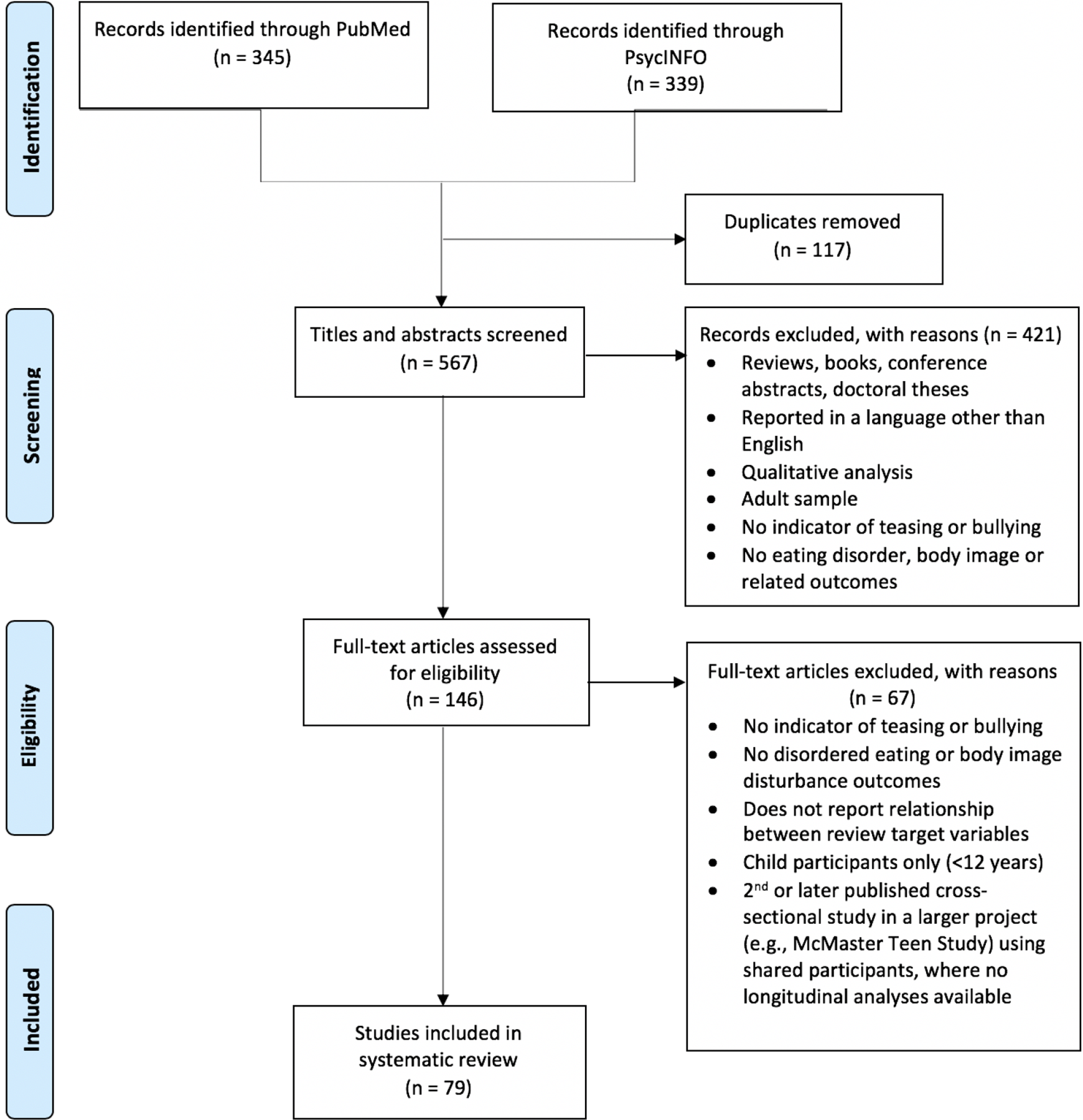
Preferred Reporting Items for Systematic Reviews and Meta-Analyses flow diagram of systematic search.
Eligibility Criteria
The following criteria were used to select studies to be included in the final analysis: (1) sample included (but was not necessarily limited to) adolescents (12−18 years), (2) included a measure of frequency of teasing or bullying victimization, and (3) included a measure of body dissatisfaction, body image, eating disorders, disordered eating, or another variable related to body image disturbance. Studies were excluded based on the following criteria: (1) reviews, (2) books, (3) conference abstracts, (4) doctoral theses, (5) full text unavailable in English, (6) abstract only, and (7) exclusively qualitative studies.
Selection Process
The PRISMA flowchart depicted in Figure 1 illustrates the process of literature search and selection. As can be seen, from the initial 684 records identified, 79 articles were ultimately included in the review. Studies were only included if both their measure of teasing and/or bullying and their measure of disordered eating or a body image-related construct were administered to adolescent-aged participants. Where multiple articles were part of a single, larger study, the first published article was included if all articles were cross-sectional. Where multiple longitudinal articles were available as part of a larger study, all such publications were included. This was done due to the relative lack of longitudinal, compared to cross-sectional, research and the importance of longitudinal analyses in assessing causal relationships. Articles were excluded if they did not report analyses of the relationship between teasing/bullying and the disordered eating or body image disturbance variable/s.
Assessment of Study Quality
A 13-item checklist was created to analyze study quality. This checklist was adapted from assessment tools published by the National Institutes of Health (2014) for observational studies. Items appraised the study design (one item), sample (three items), measures (eight items), and reporting of results (one item). Please refer to the Online Appendix for a complete list of criteria. The first author rated all of the studies. The second author independently rated 15 studies, and the interrater agreement was 94.4%, with consensus reached through discussion. The mean score was 7.4 (SD = 1.86) out of a total possible 13 points, which reflected similar methodological descriptions from previous reviews (e.g., Lie et al., 2019). Five studies scored 0–4, 14 scored 10–13, and the majority (60 studies) scored 5–9. This indicated that most studies were of average quality, with few of poor quality and several of excellent quality. Studies of excellent quality were typically longitudinal and used validated, multi-item, continuous measures. Studies of lower quality were largely cross-sectional, had nonrepresentative samples, and used unvalidated, single-item, and/or dichotomous scales. The score for each study is reported in Table 1.
Summary of Studies Included in Systematic Review.

Note. n.r. = not reported. Victimization measures: BFIS = Bullying and Friendship Interview Schedule; CAPA = Child and Adolescent Psychiatric Assessment; EPICQ = European Cyberbullying Intervention Project Questionnaire; GBS = Gatehouse Bullying Scale; MRFS = McKnight Risk Factor Survey; OB/VQ = Olweus Bully/Victim Questionnaire; PARTS = Physical Appearance Related Teasing Scale; PBS = Pediatric Behavior Scale; POTS-R = Perception of Teasing Scale, Revised; POTS = Perception of Teasing Scale; POTS-F = Perception of Teasing Scale for Friends; PRQ = Peers Relations Questionnaire; PSPS = Perceived Sociocultural Pressure Scale; SCBS = School Climate Bullying Survey; SEQ-PRV = Social Experience Questionnaire, Peer Relational Victimization subscale; SSQC = Student Survey Questionnaire of Cyberbullying; TQ-R = Teasing Questionnaire-Revised; VI = Victimization Index. Outcome measures: AAI = Appearance Anxiety Inventory; BAQ = Ben-Tovim Walker Body Attitudes Questionnaire; BCRS = Breast/Chest Rating Scale; BDS = Body Dissatisfaction Scale; BES = Body Esteem Scale; BESAA = Body Esteem Scale for Adolescents and Adults; BET = Branched Eating Disorders Test; BIATQ-PSS = Body Image Automatic Thoughts Questionnaire, Positive Self-Statements Subscale; BIS-BD = Body Investment Scale, Body Image Dissatisfaction subscale; BISS-A = Body Image Shame Scale, Adolescents Version; BSSS = Body Shape Satisfaction Scale; BULIT-B = Bulimia Test—Binge subscale; CAPA = Child and Adolescent Psychiatric Assessment; CDRS = Contour Drawing Rating Scale; Ch/ASRS = Child/Adolescent Version of the Silhouette Rating Scale; ChEAT = Children’s Eating Attitudes Test; ChEDE = Eating Disorder Examination version 12.0D/C.2, adapted for children; ChEDE-Q = Children’s Eating Disorder Examination Questionnaire; DEBQ = Dutch Eating Behavior Questionnaire, DEBQ-R = Restraint subscale; DMS = Drive for Muscularity Scale; EAT = Eating Attitudes Test, EAT-FP = Food Preoccupation subscale; EDDS = Eating Disorder Diagnostic Scale; EDE = Eating Disorders Examination Interview; EDE-Q = Eating Disorder Examination Questionnaire; EDI = Eating Disorders Inventory, EDI-B = Bulimia subscale, EDI-BD = Body Dissatisfaction subscale, EDI-D = Dieting subscale, EDI-DT = Drive for Thinness subscale; EDI-C = Eating Disorders Inventory, Children’s Version; EDI-3 = Eating Disorder Inventory version 3; EEICA = Scale of Body Dissatisfaction for Adolescents; FRS-BAC = Figure Rating Scales for Brazilian Adults and Children; IBSS-R = Ideal Body Stereotype Scale Revised; HBSC = Health Behavior in School Aged Children survey; KWCS = Killen Weight Concerns Scale; MBSRQ = Multidimensional Body-Self Relations Questionnaire, MBSRQ-AS = Appearance Scales, MBSRQ-AE = Appearance Evaluation subscale; MEBS = Minnesota Eating Behavior Survey; MWCBS = Moderate Weight Control Behaviors Scale; NPS = Negative Physical Self Scale; OBCS = Objectified Body Consciousness Scale, OBCS-ACB = Appearance Control Beliefs subscale, OBCS-BSH = Body Shame subscale OBCS-BSV = Body Surveillance subscale; QEWP = Questionnaire on Eating and Weight Patterns; SBFD = Stunkard Body Figure Drawings; SDBPS = Satisfaction and Dissatisfaction with Body Parts Scale; SIQYA = Self Image Questionnaire for Young Adolescents; SPPC/A-SEPA = Self Perception Profile for Children/Adolescents, Self-Esteem for Physical Appearance subscale; SSED = Short Screen for Eating Disorders; TREI = Thinness and Restricting Expectancy Inventory; YRBS = Youth Risk Behavior Survey.
* Project EAT studies included in this review were as follows: Eisenberg et al. (2006), Goldschmidt et al. (2015, 2016), Haines et al. (2006), Neumark-Sztainer et al. (2002, 2007), Paxton et al. (2006), Simone et al. (2019), Wang et al. (2019), West et al. (2019).
Results
Study Design and Sample Characteristics
See Table 1 for a summary of the sample, measures, and findings for each study. Studies are referred to by their number from the table to aid reporting of results. Longitudinal studies of the same cohort, such as in Project EAT (23), are collated to reflect their common sample. Forty-six studies were cross-sectional, and 15 of 33 longitudinal studies were from shared data sets; thus, 64 unique samples were included. Fourteen were stratified samples, one clustered, three clinical, and 46 community samples. Overall, most studies were cross-sectional and relied on convenience sampling of general, usually school, populations. The most common data location was the United States (27/64 data sets), followed by Europe (14/64), Australia and New Zealand (8/64), Canada (4/64), South America (6/64), Asia (4/64), and Israel (1/64). This reflects the overrepresentation of “WEIRD”(western, educated, industrialized, rich, and democratic) societies in psychological research. Publication dates indicated a proliferation of articles in the last decade, with 35 studies being published in 2016–2019 alone (followed by 13 in 2011–2015, 17 in 2006–2010, 10 in 2000–2005, four in 1994–1999, and none before 1994).
All studies included adolescent participants (12–18 years), but 33 studies also included children (<12 years), 10 included young adults (>18 years), and eight included all age groups. Where limited data were reported about demographic variables, authors were contacted, but age range remained unavailable for six studies and ethnicity for 26 studies. Caucasian was the most commonly endorsed category in 45 studies and constituted 70% or greater of the sample in 25 studies. Other commonly reported ethnicities were African American, Hispanic, Asian, and mixed race/biracial. Most studies (57/79) included both male and female participants and the remaining included female participants only. Only one study (26) reported the nonbinary and transgender participants, reflecting the prevailing focus on cisgender women in eating disorder literature. All studies measured victimization frequency, with only two also including a measure of victimization distress (40) or perceived harm (23). Only one study (44) included specific eating disorder diagnoses; thus, all other disordered eating outcomes refer to specific symptoms rather than full-threshold diagnoses.
Cross-Sectional Study Findings
Weight-related victimization
Thirty-three studies reported cross-sectional analyses of weight-related victimization, with all but one (46) examining teasing. Most studies (27/33) assessed lifetime history of victimization, though several focused on “recent” (31, 46) or 12-month teasing (23, 45, and 48) and one was unspecified (49). Studies most commonly assessed victimization by peers (14/33) or any source (17/33), while only few included friends (4/33), any family member (8/33), parents (4/33), and siblings (3/33). Potential confounds such as BMI, age, gender, race, and socioeconomic status were controlled in 16 of 33 studies. Only two studies reported relevant mediators, being body dissatisfaction and global psychological functioning for the effect of weight-related teasing on disordered eating behaviors (28, 60). One study found a positive association with unhealthy weight control behaviors and weight concerns only when victimization led to perceived harm (23).
Disordered eating
Findings largely supported a positive relationship between weight-related teasing and global eating disorder psychopathology, for victimization by peers (19, 38), family (48), and any source (10, 18, 29, 50, 52, and 58), with small to medium effect sizes. Similarly, there were small to medium positive associations with frequency of specific eating disorder behaviors, including dietary restraint (26, 28, 31, 40, and 60), bulimic behaviors (25, 31, 40, and 56), unhealthy weight control behaviors (23, 26, 38, 39, 45, and 46), and binge eating (26, 39, and 45). Medium effects were more frequent for unhealthy weight control behaviors and binge eating than for dieting and purging. Only a minority reported nonsignificant results for general eating psychopathology (1, 11) and dietary restriction (48, 57). Two studies (28, 60) found that weight-related teasing was associated with bulimic behaviors and dietary restriction via body dissatisfaction and global psychological functioning.
Body image
Several studies indicated a positive association with specific attitudinal variables such as drive for or investment in thinness (38, 42, and 50), thin ideal internalization (29, 54), and drive for muscularity in both boys and girls (53), with highly variable effect sizes ranging from small to large. Weight-related teasing was also associated with poorer body image (33, 56), body esteem (40), weight esteem (29), body satisfaction (49), greater body dissatisfaction (21, 28, 31, 38, 45, 50, 52, 53, 54, and 60), discrepancy between one’s ideal and actual body (1), body shame (8), internalization of appearance ideals (29), and body image, weight, or concerns (10, 14, 23, 25, 28, 30, 48). Medium effects were typically seen for body dissatisfaction and body shame, with otherwise small effects. Four studies found no association between weight-related teasing and appearance control beliefs (8), body dissatisfaction (25, 63), and body image (32).
Nonspecific victimization
Of the 21 studies reporting cross-sectional analyses of nonspecific victimization, three measured teasing, three measured cyberbullying, two measured both cyber and traditional bullying, and 16 measured nonspecific bullying. As with cross-sectional studies on weight-related teasing, the majority of studies asked about perpetration by peers or any source, although there was considerable variation in the victimization time frame. Three studies reported mediational analyses and 14 studies controlled for potential confounds, most commonly age, BMI, ethnicity, and gender.
Disordered eating
Only one cross-sectional study examined the effect of nonspecific teasing on disordered eating, finding that greater lifetime teasing by friends and family was associated with greater dietary restraint (4). Two studies assessed recent cyberbullying, finding a small positive association with both dieting (51) and general eating pathology (43). Seven studies assessed nonspecific bullying, finding that greater bullying was associated with greater eating disorder symptoms (5, 6, and 9), binge eating (12), unhealthy weight control behaviors (20), and bulimic symptoms (30). Global eating pathology showed small to medium effects and specific behaviors reflected small effects. Two studies reported nonsignificant results; one found no relationship with symptoms of anorexia nervosa, which they attributed to a low prevalence rate (30), and another found no differences in victimization rates between participants diagnosed with anorexia or bulimia nervosa and a control group (44). Only one study reported relevant mediational analyses, finding that the positive association between bullying and eating pathology was mediated by increased anxiety (5).
Body image
Of the 16 cross-sectional studies including broader body image constructs, three measured nonspecific teasing and had mixed findings: an association with more negative body image (4), no relationship with body image (32), and an association with seeing oneself as too thin in boys only and too fat in girls only (33). Four studies examined cyberbullying and found that greater self-reported cyberbullying was associated with poorer body image (34), lower body esteem (47), greater body dissatisfaction (51), and greater overweight preoccupation (43). Finally, 10 studies assessed nonspecific bullying, finding negative associations with appearance self-esteem (15) and body image (34, 61) and positive associations with body dissatisfaction (7, 15), body shame (9), perception of one’s body as too thin or too fat (27), weight loss preoccupation (37), weight loss attitudes (55), and appearance frustration (41). All effects ranged from small to medium, with considerable variation. No studies reported nonsignificant findings. Two studies examined mediation, finding that bullying was positively associated with weight-loss preoccupation via lower body esteem and self-esteem and greater emotional problems (37) and that bullying was positively associated with disordered eating and weight-loss attitudes via distress (55).
Longitudinal Study Findings
Weight-related victimization
Twenty-four studies, including 14 from larger data sets (13, 23, and 29), reported longitudinal findings for weight-related victimization, all assessing teasing. Fourteen examined lifetime history and 10 used 12-month prevalence. Most studies assessed victimization by any source (15/25), though some assessed peer (8/25) or family victimization (6/25). The follow-up duration varied from 8 to 9 months (2/24), 1 year (4/24), 18 months (3/24), 2 years (3/24), 2½ years (1/24), 3 years (4/24), and 5, 10, and 15 years (Project EAT studies, 23).
Disordered eating
Fifteen studies examined the longitudinal effect of weight-related victimization on disordered eating behaviors. Four studies from two data sets indicated that greater teasing predicts more frequent binge eating (22, 23), but one study from a shared data set found no relationship with binge eating over a different 5-year follow-up (23). One study found that greater teasing predicted more frequent purging and skipping of meals at 18-month and 2.5-year follow-ups (64). Findings were mixed for global eating pathology, as two studies from the same data set (13) found that greater weight-related teasing predicted greater disordered eating at 2- and 3-year follow-ups, but seven studies’ findings were nonsignificant at 8-month, 18-month, 2-year, 3-year, 5-year, or 10-year follow-ups (23, 29, 50, and 57). Among Project EAT studies, one found that greater baseline weight-related teasing predicted greater extreme weight control behaviors 5 years later, another found that it predicted greater unhealthy weight control behaviors in males but not females at the same 5-year follow-up, and one study found that teasing at the 5-year follow-up did not predict unhealthy weight control behaviors at the 10-year follow-up (23). Project EAT also found that baseline teasing did not predict dieting at the 10-year follow-up (23). Two studies found no longitudinal effect for bulimic behaviors (2, 22). Effect sizes were typically small.
Body image
Twelve of the 14 studies including such outcomes reported significant, largely small effects. Weight-related teasing predicted greater body dissatisfaction (2, 23, and 54), body image concerns (29), body dysmorphic symptoms (35), and appearance anxiety (64) and poorer appearance/weight esteem (17, 29, and 59), body satisfaction (23), and body image (57). However, body satisfaction findings suggested stronger effects for younger, compared to older, adolescents, and effects decreased when accounting for depression, BMI, and teasing at follow-up (23). While one study found a medium, positive effect for drive for thinness via body dissatisfaction at an 8-month follow-up (62), two studies found no longitudinal relationship for drive for thinness (2) and thin-ideal internalization (54).
Nonspecific victimization
Eight studies, five from shared data sets (17, 36), conducted longitudinal analyses of nonspecific victimization. Six examined bullying (9, 17, and 36), one teasing (16), and one relational victimization (being excluded by peers; 24). All studies investigated peer victimization, of which two were lifetime (9, 16), four were recent (24, 36), and two were 12 months (17). Four studies controlled for baseline BMI (9, 36), one (24) controlled for free lunch status and mother’s marital status, and the McMaster Teen studies controlled for ethnicity, household income, and parental education level (36). Follow-up periods included 8 months (24), 1 year (9, 36), 2 years (9, 16, and 36), 3 years (17, 36), 4–6 years (36), and 8 and 14 years (17).
Disordered eating
Five studies included disordered eating behaviors in their longitudinal analyses. All examined general eating pathology, finding a direct (16, 36) and an indirect relationship via body shame (9), body esteem (17), and bullying perpetration (36), with small to medium effects. Another study found that greater teasing predicted fewer eating disorder tendencies in girls at the 2-year follow-up (16), though no explanation was proposed for this. No studies examined specific eating disorder behaviors.
Body image
Five studies also examined body image outcomes. One study found that peer victimization predicted greater body dissatisfaction at three 2-year intervals, with a bidirectional relationship among late adolescent girls, but not boys (36). Two studies (17, 24) found that bullying and relational victimization predicted lower body esteem at 8-month and 8-year follow-ups, while another from a shared data set (17) did not find a significant relationship with body esteem subscales over 3 years except for lower weight-related body esteem in girls. Finally, one study (9) found that bullying indirectly predicted greater body shame at 1- and 2-year follow-ups, mediated by eating pathology.
Discussion
This study conducted a systematic review of literature on weight-related and nonspecific teasing and bullying and their association with disordered eating and body image. Both cross-sectional and longitudinal studies indicated that greater frequency of victimization was associated with greater likelihood of disordered eating and body image disturbance. Binge eating was a particularly consistent outcome of weight-related victimization, which showed positive associations with dietary restraint, purging, and global eating pathology in cross-sectional but not longitudinal analyses. Cross-sectional studies also supported a positive association between nonspecific victimization and global eating pathology, dietary restriction, binge eating, and unhealthy weight control behaviors but presented mixed findings for symptoms of anorexia and bulimia nervosa. Longitudinal findings were mixed across both forms of victimization; however, both forms of victimization showed more consistent effects for body image, as did cross-sectional analyses. Body dissatisfaction was the most common and consistently supported variable but was notably absent in longitudinal analyses of nonspecific victimization. There was no clear pattern evident of which body image constructs were less likely to be associated with victimization. Mediational analyses were too sparse to draw any conclusions, and moderators were rarely included. One study found moderation by gender (33); however, there were fewer gender differences than might be expected, and teasing was positively associated with drive for muscularity (pursuit of a muscular appearance), dietary restraint, and purging across genders (26, 30, and 53). Future research should seek to clarify whether the links between victimization and body image concerns may vary depending on varying appearance ideals, such as a muscular versus thin body.
Methodological Review
As outlined previously, most studies were of average methodological quality. Although we have attempted to provide an overview of effect sizes where possible, necessary information was often absent, making it difficult to infer the strength of associations and compare outcomes. Another common limitation was the predominance of cross-sectional over longitudinal designs. By analyzing their results separately, our review has highlighted disparities in findings based on study design, and the inconsistency of longitudinal findings questions what meaning can be drawn from cross-sectional research. Longitudinal results remain too few and variable to allow firm conclusions about causality, particularly given the many shared data sets. Furthermore, although some longitudinal studies included follow-ups of up to 15 years, many were only 8–12 months and few used multiple follow-ups. This provides a limited picture of changes over adolescence and the stability of causal effects.
The studies in this review also reflect considerable diversity of measures in this area of literature. There were 18 different victimization measures and over 40 measures of body image and disordered eating. All were self-report, which may be biased by limited insight, social desirability or stigma, and common method variance. Only one study used eating disorder classifications (44), indicating the need for greater use of diagnostic interviews.
Twenty-six studies used author-derived victimization measures that had not undergone validation and were often single item. Although some were derived from validated scales, their reliability and validity remain questionable. Future studies should consider whether longer, validated measures are feasible, which could require assessing fewer constructs. Most studies did not provide participants with a definition of teasing or bullying, which is problematic given their multiple potential interpretations (Thomas et al., 2018). Similarly, few studies considered the type (e.g., physical, verbal) of victimization. More research is particularly needed on cyberbullying, which was only investigated in 4 of 79 studies but may be regularly experienced by up to 27.4% of adolescents (H. J. Thomas, Connor, et al., 2017). While measures of disordered eating and body image were more consistently validated and multi-item than those of victimization, many were still author-derived. This could reflect the rapid proliferation of constructs, causing concern that assessments of outcomes such as drive for thinness and thin-ideal internalization may indeed measure the same latent variable (Stice, 2016). Comprehensive investigation of potential interrelations will facilitate development and empirical testing of mediational risk factor models for eating disorder onset.
Strengths and Limitations of This Review
Our review is the first and largest synthesis of the spectrum of weight-related and nonspecific teasing and bullying, disordered eating, and body image disturbance in adolescence, providing both breadth and depth of insight. Our scope allows recognition of the detrimental impact of subclinical eating pathology and broader attitudes such as body dissatisfaction. By separately summarizing cross-sectional and longitudinal findings, our review also enabled comparison of results that have correlational versus potentially causal meaning. However, we were not able to conduct statistical analysis of effect sizes as in a meta-analysis nor were we able to examine moderators and mediators in great depth due to limited reporting in the included studies. We did not include gray literature nor related constructs such as harassment. Finally, we did not include retrospective assessments of teasing or bullying during adolescence with an adult sample due to risk of bias; however, such studies may still provide useful insight that would be valuable to compare to our findings.
Implications and Future Directions
Implications of our review are summarized subsequently. These implications include that by synthesizing studies on the effects of both nonspecific and weight-related teasing, our findings highlight that these effects of teasing may be equally as severe as those of bullying. It is hence important to screen adolescents for a history of any form of victimization. Social ranking theory could explain our findings for the effect of weight-related victimization on weight control behaviors as a defensive strategy consistent with the focus of the victimization. However, weight-related victimization was also positively associated with binge eating, which questions this theoretical stance due to potential weight gain, which could increase perceived social threat rather than mitigating it. Weight stigma literature proposes that internalized weight stigma (negative attitudes toward those in larger bodies) and stereotype threat (risk of confirming negative stereotypes about one’s group) may lead to overeating due to increased stress and decreased cognitive control over behavior (Nolan & Eshleman, 2016). However, it is unclear whether this would explain our findings for the effects of nonspecific victimization and the fact that many studies controlled for BMI, suggesting that victimization does not exclusively affect adolescents in larger bodies. This reflects the need for a unifying explanation of how both weight-related and nonspecific victimization might lead to diverse eating disorder pathology. Given the relative lack of research on nontraditional forms of victimization such as cyberbullying, future studies should also seek to clarify whether differences exist in comparison to traditional forms.
Further research is also needed as to whether negative body image could mediate or moderate the relationship between victimization and disordered eating or reflect a frequently co-occurring outcome. Longitudinal analyses that probe mediational and moderator effects will enable temporal sequencing and distinction between risk and maintenance factors in disordered eating, aiding development of prevention and treatment programs. Research should also consider bidirectional relationships, for which there is emerging evidence in young adult samples (Kwan et al., 2017), but only one study in our review provided initial evidence among adolescent females (36).
Current antibullying programs do not consider disordered eating or body image, and eating disorder prevention programs have similarly focused on media literacy, cognitive dissonance, and cognitive behavioral therapy strategies rather than victimization (Khanh-Dao Le et al., 2017). These interventions may hence have limited utility due to intersection of victimization, disordered eating, and body image. Adolescents with particularly severe histories of victimization may benefit from targeted therapies in order to reduce their risk of developing an eating disorder. For example, recent studies indicate that imagery rescripting may be useful in reducing the negative emotional effects of bullying and in targeting eating disorder cognitions (Dugué et al., 2019; Watson et al., 2016). None of the studies included in this review accounted for other types of childhood victimization such as sexual abuse or neglect. Future research should examine the prevalence and consequences of such experiences when co-occurring with bullying or teasing, given increasing recognition of the detrimental long-term effects of polyvictimization (Ford & Delker, 2018), including increasing the risk of disordered eating symptoms in adulthood (Hasselle et al., 2017). Finally, researchers should target underresearched populations such as ethnic minorities, LGBTQI+ youth, and those from non-Western countries, disadvantaged socioeconomic backgrounds, and rural areas. Without including diverse populations, interventions and prevention programs may have limited effectiveness.
Conclusions
This review has provided new insight into the wide-reaching consequences of bullying and teasing among adolescents. Our findings reveal that such experiences of victimization are associated with a greater risk of disordered eating and body image disturbance, with some evidence for causal relationships that persist over time. Although there is much in this area that is not yet fully understood, it is clear that targeted psychosocial interventions during or prior to adolescence are needed to reduce the burden of eating disorders and related cognitions and behaviors for young people, their families, and communities.
Implications of the Current Review for Practice, Policy, and Research
Practice
Teasing should be recognized as equally severe as bullying in its effects.
Screening adolescents for a history of victimization is important in understanding their risk of developing disordered eating behaviors.
Trauma-focused therapies and imagery rescripting may be useful for those with severe bullying histories.
Policy
Current interventions address victimization and eating disorders separately, so may not be sufficiently targeted.
Research
More research is needed for potential transdiagnostic mechanisms by which both weight-related and nonspecific victimization can lead to diverse eating disorder pathology.
Supplemental Material
Supplemental Material, sj-pdf-1-tva-10.1177_1524838020985534 - The Impact of Teasing and Bullying Victimization on Disordered Eating and Body Image Disturbance Among Adolescents: A Systematic Review
Supplemental Material, sj-pdf-1-tva-10.1177_1524838020985534 for The Impact of Teasing and Bullying Victimization on Disordered Eating and Body Image Disturbance Among Adolescents: A Systematic Review by Sinead Day, Kay Bussey, Nora Trompeter and Deborah Mitchison in Trauma, Violence, & Abuse
Footnotes
Acknowledgments
The authors wish to thank Claudia La Caria and Sinia Bhandari for their contribution to the literature search process.
Declaration of Conflicting Interests
The author(s) declared no potential conflicts of interest with respect to the research, authorship, and/or publication of this article.
Funding
The author(s) received no financial support for the research, authorship, and/or publication of this article.

Supplemental Material
The supplemental material for this article is available online.
References
Supplementary Material
Please find the following supplemental material available below.
For Open Access articles published under a Creative Commons License, all supplemental material carries the same license as the article it is associated with.
For non-Open Access articles published, all supplemental material carries a non-exclusive license, and permission requests for re-use of supplemental material or any part of supplemental material shall be sent directly to the copyright owner as specified in the copyright notice associated with the article.
